Venus is losing water much faster than previously thought, study suggests

Venus could be shedding water to space at a much faster rate than previously thought. That is the conclusion of researchers in the US, who have identified a mechanism in the Venusian ionosphere that could be involved in water loss.

How much water Venus had in the past is uncertain, with some planetary scientists suggesting that the planet may have once had oceans that eventually evaporated as the Venusian greenhouse effect began to run away with itself. Today, only 0.002% of the planet’s atmosphere is composed of water vapour. If condensed on Venus’ surface, this water would form a global equivalent layer (GEL) just 3 cm deep – compared to Earth’s GEL of 3 km.

If Venus began life with a large amount of water, then it has lost almost all of it. Current thinking is that non-thermal hydrogen escape is responsible. This process involves solar radiation splitting water molecules into oxygen and hydrogen. Being lightweight, some of this hydrogen will then escape into space and be swept away by the solar wind.

Lost forever

“Once a hydrogen atom has gone, Venus has lost, in some sense, a water molecule forever,” says Mike Chaffin of the University of Boulder, Colorado.

In recent years, Chaffin’s team have explored water loss from planetary atmospheres via a different mechanism involving the formyl cation (HCO+). This ion is a product of molecular recombination in a planetary ionosphere after molecules such as water and carbon dioxide are broken apart by solar radiation. In their model, Chaffin and his colleagues describe the dissociative recombination of HCO+, whereby an electron that has been liberated when an atom or molecule is ionized then collides with the ion, splitting HCO+ apart into carbon monoxide(CO) and an energetic hydrogen atom. This “hot hydrogen” has enough energy to escape the planet’s gravity.

In 2023, Chaffin and colleague Bethan Gregory found that HCO+ dissociative recombination is responsible for 5–50% of the water loss from Mars’ ionosphere.

However, when Chaffin, Gregory and Eryn Cangi led their team to apply the same mechanism to Venus’ atmosphere, the models showed that HCO+ dissociative recombination must be the dominant form of water loss on the planet, doubling the previously calculated rate of water loss.

Lack of data

The problem is, HCO+ has yet to be detected on Venus.

“I worried about this a lot when we were preparing our paper [describing our results],” Chaffin told Physics World. “Based on our modelling work, there should be a lot more HCO+ on Venus than we thought previously, but how much can we trust our model?”

Chaffin says that the uncertainty is related to NASA’s Pioneer Venus Orbiter, which has been the only space mission so far with an instrument capable of probing Venus’ ionosphere. Launched in 1978, Pioneer was not specifically designed to detect HCO+.

“This has been a gap in measurements of Venus,” says Chaffin, although he does say that by extrapolating from the Pioneer results, one can infer a water-loss rate that is “in the same ballpark” as that predicted by the HCO+ mechanism. Chaffin takes this as indirect confirmation of the model.

Chaffin’s confidence is backed up by Janet Luhmann  at the Space Sciences Laboratory at the University of California, Berkeley. “So long as [Chaffin and colleagues’] assumptions are accurate, there is no reason I can see to dismiss this concept,” she says.

Water sources

If true, then the HCO+ dissociative recombination model changes the history of water on Venus, somewhat. If Venus did have oceans, then some of its surviving water vapour will originate from those oceans, some will come from outgassing via volcanoes, and the remainder arriving through comet and asteroid impacts.

The increase in the escape rate means that if Venus did once have oceans, compressing the time it takes to lose that water to space thanks to the efficiency of the HCO+ mechanism means those oceans could have survived on the surface for longer. If Venus never had oceans, then either the rate of outgassing or the rate of impacts, or both, must be higher to at least keep pace with the speed of water loss.

Unfortunately, forthcoming missions to Venus may not be able to confirm the presence of HCO+. Neither Europe’s Envision mission, planned to launch in 2031, nor NASA’s DAVINCI spacecraft that will blast off in the late 2020s, will study the ionosphere.

However, Sanjay Limaye of the University of Wisconsin, Madison points out that Russia has proposed an instrument for India’s planned Venus orbiter that may be able to detect HCO+ around 2031.

However, Luhmann, who specializes in studying the interaction between the solar wind and planetary atmospheres, thinks there might be another way. The escaping hot hydrogen from the HCO+ dissociative recombination process is moving fast. Whereas Chaffin believes it will be too fast to detect, Luhmann is not so ready to dismiss it.

“In-situ measurements of hydrogen pickup ions may be useful if they are sensitive enough and can distinguish the characteristic initial energies of the escaping neutrals before they are ionized,” she says, pointing to previous work on Mars that has accomplished the same thing.

The research is described in Nature.
Next-generation quantum sensors detect human biomagnetism

Anna Kowalczyk, an assistant professor in the University of Birmingham’s Centre for Human Brain Health, has set out to develop new tools that could help neuroscientists do their work better.

“Our motivation is to use transcranial magnetic stimulation with a brain imaging technique called magnetoencephalography, and this is a very challenging task, because commercial sensors may not work well in this setup,” Kowalczyk says. “I wanted to start developing quantum sensors for brain imaging, and I basically started from scratch.”

Transcranial magnetic stimulation uses magnetic fields to stimulate neurons in the brain by placing a magnetic coil against the scalp and generating brief magnetic pulses that induce electrical currents in the brain. Magnetoencephalography measures the magnetic fields produced by this resultant activity and can be used to map brain activity and understand the relationships between brain regions and their functions.

Optically pumped magnetometers (OPMs) are emerging as preferred sensors for biomagnetism applications. Commercial OPMs used for magnetoencephalography are “zero field sensors,” meaning that they can detect very small magnetic fields, often at femtotesla-level sensitivities. Many zero-field sensors are sensitive to environmental magnetic fields and so require extensive shielding systems and noise cancellation techniques.

Kowalczyk’s research, led by Harry Cook, a graduate student studying physics at the University of Birmingham, decided to employ “slightly different physics” with their sensors. “We decided to make use of slightly different physics to develop a sensor that can work in higher magnetic fields with great precision,” says Kowalczyk.

Their prototype sensor is an optically pumped magnetic gradiometer (OPMG) that operates by nonlinear magneto-optical rotation: linearly polarized light passes through a rubidium vapour, preparing the atoms in the vapour to be magnetically sensitive. When an external magnetic field changes, the frequency of atoms’ precession around the magnetic field changes, which is in turn detected with laser light. In other words, changes in the magnetic field are tracked by measuring changes in light properties.

With one “cell” of rubidium vapour, the researchers can measure an external magnetic field locally. With two cells, they can directly measure the difference, or gradient, in the magnetic field (i.e., their sensor becomes a gradiometer).

After designing and prototyping the sensor, the researchers tested its performance by characterizing an auditory evoked response in the human brain, a common benchmark for OPMs. Next, they set out to measure the field from a human heartbeat. During recording, the building lifts were running and the team recorded the resulting magnetic disturbance using commercial sensors.

“[In our experimental setup] we’re inside this metal box, basically, but the [external field] is still many times larger than a human heartbeat, let alone the human brain. So we wanted to see how well our sensor could measure the gradient from the heart while rejecting the unwanted magnetic field,” Cook explains. “It wasn’t a perfect setup, but we could clearly see that there’s a human heartbeat that’s well-characterized from a magnetic perspective…Our gradient method remained almost flat during this measurement, while the reference sensor showed all the variations.”

The researchers concluded that the OPMG could be explored further for biomagnetism applications and are pursuing two directions for research going forward: improving the current sensor; and developing sensors that could measure multiple types of neural activity simultaneously.

“We need to make the sensor more robust…and we need to make more sensors. The main motivation is to make it work with transcranial magnetic stimulation, and we also want to make hybridized quantum sensors that can measure two kinds of neural activities at the same time,” says Kowalczyk, referencing functional near infrared spectroscopy, another optical method for measuring brain activity. “Each method would bring different kinds of information. We’re not saying that our sensor is better than commercial sensors, it’s just different. Our aim is to develop technology that enables new approaches and new capabilities in neuroscience and beyond.”

Initial results from the OPMG prototype are published in Quantum Science and Technology.

Celebrating attosecond science, physics tournament focuses on fun

The 2023 Nobel Prize For Physics was shared by three scientists who pioneered the use of ultrashort, attosecond laser pulses for studying the behaviour electrons in matter.

In this episode of the Physics World Weekly podcast, I chat with three people involved with the IOPP-ZJU International Symposium on Progress in Attosecond Science. The event will be held on 23 May at China’s Zhejiang University and can also be attended online via Zoom. It is organized by IOP Publishing (which brings you Physics World) and Zhejiang University.

Joining me in a lively discussion of attosecond science are Haiqing Lin of Zhejiang University, Caterina Vozzi of Italy’s Institute for Photonics and Nanotechnologies and David Gevaux of the IOPP journal Reports on Progress in Physics, which is supporting the symposium.

This week’s episode also features an interview with Anthony Quinlan, who was a two-time contestant in the PLANCKS international theoretical physics competition for students. He now helps organize the event, the finals of which will be held in Dublin next week.

Quinlan chats with Physics World’s Katherine Skipper about competition, which involves teams of undergraduate and masters’ students solving “fun” physics problems. Quinlan explains that contestants are encouraged to come up with creative solutions – which sometimes leads to unexpected paths to the correct answer.

Domain walls in twisted graphene make 1D superconductors

Domain walls in graphene form strictly one-dimensional (1D) systems that can become superconducting via the so-called proximity effect. This is the finding of a team led by scientists at the University of Manchester, UK, who uncovered the behaviour by isolating individual domain walls in graphene and studying the transport of electrons within them – something that had never been done before. The discovery has applications in metrology and in some types of quantum bits (qubits), though team member Julien Barrier, who is now a postdoctoral researcher at the Institute of Photonic Sciences (ICFO) in Barcelona, Spain, suggests it might also impact other fields.

“Such strict 1D systems are extremely rare,” Barrier says, “and could serve a number of potential applications.”

The researchers made their 1D system by stacking two layers of graphene (a sheet of carbon just one atom thick) atop each other. When they misalign the layers ever so slightly (less than 0.1°) with respect to each other, the material experiences a strain that makes the atoms in its lattice rearrange themselves into micrometre-scale domains of aligned bilayer graphene.

The narrow regions at the intersection between these domains are known as domain walls, and previous work by members of the same team showed that these walls are very good at conducting electricity. The boundaries between domains were also known (thanks to work by Vladimir Fal’ko and colleagues at Manchester’s National Graphene Institute) to contain special counterpropagating electronic channels that form by hybridizing “edge states” within the conducting domain walls.

These edge states are a consequence of the quantum Hall effect, which occurs when a current passing along the length of a thin conducting sheet gives rise to an extremely precise voltage across opposite surfaces of the sheet. This voltage only occurs when a strong magnetic field is applied perpendicular to the sheet, and it is quantized – that is, it can only change in discrete steps.

One important property of edge states is that electrons in them are said to be “topologically protected” because they can only travel in one direction. They also steer around imperfections or defects in the material without backscattering. Since backscattering is the main energy-dissipating process in electronic devices, such protected states could be useful components in next-generation energy-efficient devices.

Achieving superconductivity in the quantum Hall regime

Over the years, much effort has therefore gone into trying to achieve superconductivity in the quantum Hall regime, as this would mean that the transport of Cooper pairs of electrons (that is, those that travel unhindered through a material to form supercurrents) is mediated by these 1D edge states.

To identify the domain walls in their bilayer graphene sample, the Manchester team turned to a technique called near-field photocurrent imaging developed by Krishna Kumar’s group at the ICFO. This technique provided the information the scientists needed to isolate the domain walls and place them between two superconductors.

They found that doing so not only induces robust superconductivity inside the walls, it also allows the walls to carry individual electronic modes. “This is proof of the 1D nature of this system,” Barrier says.

One unexpected finding is that the superconductivity stems from the proximity of edge states in the domain walls and, in particular, from the strictly 1D states existing within the walls. This means it does not arise from quantum Hall edges on each of the domain walls, as the researchers previously thought.

New approach overcomes previous limitations

The researchers led by Barrier, Na Xin and Andre Geim began their study using a conventional approach in which counterpropagating quantum Hall edge states were brought close together, but these experiments did not produce the results they expected. In previous studies, experimental progress in this direction was limited to observing oscillatory behaviour in the normal (non-superconducting) state, or more recently, to very small supercurrent (of less than 1 nA) at ultralow temperatures of less than 10 mK, Barrier explains.

The new approach, which the team describes in Nature, overcomes these limitations. Thanks to support on the theory side from Fal’ko’s group, the researchers realized that the strictly 1D electronic states they observed in the graphene domain walls hybridize much better with superconductivity than quantum Hall edge states. This realization enabled the researchers to measure supercurrents of a few 10nA at temperatures of ~1K.

Barrier says the new system could develop along numerous research directions. There is currently an intense interest in quasi-1D (multimode) proximity superconductivity using nanowires, quantum point contacts, quantum dots and other such structures. Indeed, electronic devices containing these structures are already on the market. The new system provides superconductivity via single-mode 1D states and could make such research redundant, he says.

“Our estimation is that electrons propagate in two opposite directions, less than a nanometre apart, without scattering,” he tells Physics World. “Such ballistic 1D systems are exceptionally rare and can be controlled by a gate voltage (like quantum point contacts) and exhibit standing waves (like superconducting quantum dots).”

Researchers split on merits and pitfalls of AI in peer review, IOP Publishing survey finds

Researchers are divided over whether artificial intelligence (AI) is having a positive or negative impact on peer review. That is according to a new report from IOP Publishing, which looks at scientists’ perception and experiences of peer review. The study also finds that interest in a paper and the reputation of the journal remain the most important factors for researchers when considering whether to peer review an article.

Entitled State of Peer Review 2024, the report is based on a survey of more than 3000 researchers from over 100 countries. IOP Publishing carried out a similar survey in 2020 but researchers’ growing use of AI tools since then to write or augment peer-review reports has raised various ethical issues. In particular, there are questions over data protection, confidentiality and the accuracy of reviewer reports.

IOP Publishing, which publishes Physics World, currently does not allow the use of generative AI to “write or augment” peer-review reports or for AI tools to be named as authors on manuscripts. Instead, it encourages authors to be “open and transparent” about their use of such tools in their work. However, publishers do not yet have a way to accurately detect whether text has been generated by AI.

About 35% of respondents to the survey think that open-source generative AI tools such as ChatGPT will harm peer review, while 36% say it will have no impact. Just 29% believe AI can benefit scholarly communication. When asked to expand on their responses, researchers admit that such tools can provide some “useful outputs”. However, they warn that expert human verification and editing is vital before AI-generated text can be used in peer review.

The study also looks at how much peer review researchers carry out, finding that 30% of reviewers from high-income countries say they receive too many peer-review requests, compared with just 10% from low and middle-income countries. Moreover, 28% of senior researchers also say they get too many requests to peer review, compared to just 7% of PhD students and 9% of postdocs.

“Quality peer review is essential to the integrity and validity of science and relies on reviewers who are engaged, motivated and competent at providing constructive feedback,” says Laura Feetham-Walker, peer review engagement manager at IOP Publishing. “The insights we gain from this survey helps us to ensure we can continue to evolve the support we provide to the global reviewer community to help with their important work.”

Decimal time: life in a world where our days are divided differently

In an era where conspiracy theories run amok, this fictional thriller invites more than just the curiosity of its adolescent target audience. Written by the London-based author Sam Sedgman – a self-styled “nerd and enthusiastic ferroequinologist” – The Clockwork Conspiracy is a story about the potential impact of a new law to decimalize time in the UK. According to Miriam – one of the MPs in the novel – the law will “simplify the way we measure things [and] make the UK a leader in scientific research”.

The plan sounds innocuous enough: a day will be divided into 10 hours, each of 100 minutes, with each minute being 100 seconds. The proposed new law is not entirely in the realms of fiction – after all, decimal time was the legal standard in France during the French Revolution.

Before the bill is debated in parliament, however, renowned horologist Diggory disappears from the belfry at Big Ben. His son Isaac begins a quest to find his father, assisted by newly acquainted partner in crime, the rebellious Hattie.

As well as learning about the personalities of the protagonists, readers gain knowledge of topics they might otherwise know little about. Diggory, for example, elucidates the mechanics of clocks, Isaac provides insight into the sciences, and Hattie sheds light on how parliament works as she helps them get to the bottom of Diggory’s disappearance.

Thanks to her penchant for exploration, we are privy to the top-secret meeting of the Timekeepers – the group responsible for monitoring and protecting time – held at none other than the Royal Observatory, home of Greenwich Mean Time and the Prime Meridian. It’s an exciting adventure as our protagonists navigate London to overcome the plots’ obstacles.

To bolster the plausibility of decimal time as a threat to our everyday life, Sedgman refers to various significant historical events, including the suffragette movement, the introduction of the decimal pound in 1971 and the Millennium Bug. Timekeeper Penny explains the threat of the new law to the children: “Time is like water…it can be misused”.

The novel portrays different perspectives surrounding the bill in a nicely balanced way. These include the views of the Timekeepers (who disapprove of the bill), the Machinists (who rebel against it with vandalism) and the parliamentarians (who mysteriously support it). It’s an approach that lets readers appreciate the different views and rationale behind them.

The Clockwork Conspiracy uses fun facts to propel the plot and teach readers about time and the history of timekeeping, without potentially dry information being clumsily shoehorned in. Amid the suspense, the novel highlights the universal importance of friendship, family and personal integrity. Despite being aimed at children, it offers insight into the mechanics of society at large. It’s therefore a book that can be enjoyed by readers of any age.

Hope or hype: can upright treatment increase access to advanced radiotherapy?

Upright radiotherapy, in which a patient is treated in an upright position rather than lying down (supine), is an old technique that’s seen a resurgence of interest recently. At the ESTRO 2024 meeting, experts in the field discussed the potential benefits and ongoing challenges of upright radiotherapy – in a quest to discover whether the approach offers hope or is merely hype.

Up first, Ye Zhang from PSI took a look at some of the key driving forces for moving to upright radiotherapy. The ability to rotate and reposition the patient during upright treatments removes the need for a costly and bulky gantry. And eliminating the gantry reduces the space requirements for a particle therapy system by an estimated 80%, greatly lowering the costs of installing a treatment facility.

“Reducing the cost increases the accessibility of particle therapy to the population worldwide,” Zhang explained, citing a recent review paper that concluded “only 1% of radiotherapy patients currently receive particle therapy, however, at least 15% of patients could benefit”.

As well as offering economic advantages, removing the gantry provides more space at the isocentre, enabling the integration of advanced treatment methods such as proton arc therapy, combined proton–photon treatments and the use of MR guidance.

Upright positioning may also provide clinical advantages, by utilizing geometric variations between the target and the organs-at-risk to distribute dose. The idea here is that different organ positions, morphology and motion directly affect the dose distribution and may provide a means to optimize radiation delivery.

“The potential for upright treatment is significant,” Zhang concluded. “Not only to reduce the cost, which is important to push particle therapy worldwide to benefit more patients, but it also has potential clinical benefits which are under investigation, and there’s definitely a lot of potential to integrate future advanced radiotherapy concepts.”

Work in progress

While upright radiotherapy offers many potential benefits, there are still ongoing challenges to solve. “Upright radiotherapy is a true paradigm shift because it affects every step in the workflow: imaging, segmentation, treatment planning, quality assurance, treatment delivery and even follow up,” explained Lennart Volz from GSI. “All of these steps have to be translated into the upright position.”

Volz pointed out that upright treatment is not a new concept, with investigations into chair-based solutions dating back to the 1960s. “Yet, to the best of my knowledge, there are currently only six centres treating in an upright position, for indications other than ocular tumours,” he said. “On the other side, there are 110 gantries.”

One reason behind this slow uptake may be a previous lack of commercial upright imaging systems, as well as the absence of modern tools such as adaptive workflows and image guidance. Nearly all body sites will undergo anatomic changes between supine and upright postures, making upright planning-quality CT essential for clinical transfer. Upright MRI and PET systems may also be needed. Luckily, said Volz, several industry vendors are now developing cost-efficient upright imaging systems.

For image segmentation, one unknown is whether existing auto-contouring tools trained for supine treatments still work for upright geometries. Treatment planning and quality assurance (QA) procedures may also require modification, with new margin recipes and bespoke QA equipment, for example. It’s also important to define which upright posture (straight, leaning forward, half standing, for instance) is best suited for each treatment site. Finally, Volz emphasized that an adaptive workflow is mandatory.

“Upright radiotherapy has a lot of potential, but many challenges remain,” he concluded. “The most crucial challenge is that we need more data, more evidence to support the different decisions that have to be taken for upright radiotherapy. Luckily, there are many ongoing projects in the field to address these challenges.”

Early experience

Sophie Boisbouvier of Centre Léon Bérard examined upright treatment from the patient’s perspective, sharing her experience of using the upright positioner developed by Leo Cancer Care. In one example, a study of nine breast cancer patients who spent 40 min in the positioner, seven of the participants preferred the upright to the supine position.

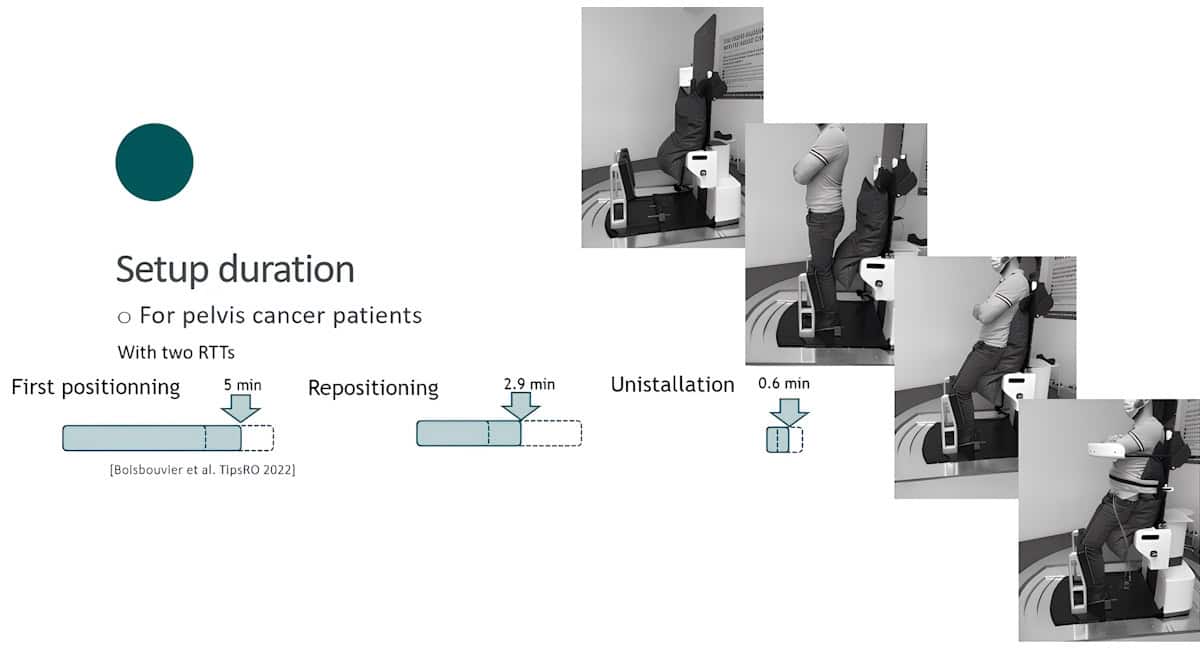
In another study, 16 pelvis cancer patients were setup three times in the upright positioner for comparison with supine treatment. In the supine position, some patients reported pain and found it difficult to be setup or get out; this was not the case for the upright position. “Globally, patients seem more comfortable and more satisfied in the upright position than the supine position, or at least as comfortable and as satisfied,” she said.

Patient setup for upright radiotherapy

For these 16 patients, initial positioning took 5 min (with two radiation therapy technologists), repositioning less than 3 min and uninstallation less than 1 min. The mean inter-fraction positioning shift was below 1 mm in all directions. And after 20 min on the chair and several rotations, the mean position shift was close to 0 mm.

“It seems feasible to setup a patient in a reasonable time frame, but we still need additional data and comparison with data on the supine position,” she said. “For reproducibility and stability, the first data are promising, however, we also need more data on various localizations and 3D images to know whether the organ position is reproducible and stable.”

At the Northwestern Medicine Proton Center in Chicago, there’s a fully clinical upright system that has already treated over 675 patients. Mark Pankuch explained that the four-room proton centre has one gantry, one fixed beam and two inclined beams that offer two treatment positions. When the gantry reached full capacity, “we wanted to go to upright treatments, because we needed more gantry-type treatments and only had one gantry system,” he said.

To achieve the move to upright, the group first needed an upright imaging system. They collaborated with system vendor P-Cure to install a wall-mounted CT scanner that lowers itself vertically over the patient. The next task was to design a positioning chair that was compatible with the treatment room’s existing robotic systems.

Due to limitations in the robot’s vertical movement, they ended up designing two chairs: one optimized for the thorax and the other for cranial treatment. The centre now treats about 80 patients per year, the majority in the cranial chair. To date, 57% of these have been ophthalmic treatments and 29% brain or spinal cord treatments.

“Lots of lessons were learned, but the one big takeaway is that we designed a scanner and a chair for an existing room for a particular need,” Pankuch explained. “If a treatment room was designed around an ideal scanner or chair, there’s much more utility, functionality and efficiency that can be gained for sure.”

Strategy and enthusiasm

Rounding off the symposium, Thomas Bortfeld from Massachusetts General Hospital described some advanced treatment concepts facilitated by upright radiotherapy. Advances in beam geometry could enable particle therapy to fit into a conventional treatment room of about 50 m2, giving more patients access to this treatment.

Increasing delivery speed, meanwhile, allows more patients to be treated in a single clinical centre.  Currently, the main speed limiting factor is the switching between energy layers, which can account for over 70% of the delivery time. “Once we simplify our beamlines in the upright scenario, we can maybe get away with much simpler beamlines that will reduce the energy switching time to essentially zero,” Bortfeld said, adding that his colleague Konrad Nesteruk and international collaborators are currently investigating fixed-field alternating gradient techniques that remove the need to switch the magnet for different energy settings.

Image guidance remains a key challenge for upright radiotherapy. Bortfeld’s group is currently studying ultralow-field MR guidance using a mobile 64 mT scanner, which they are about to test in the proton environment. They are also testing 6.5 mT MRI for breast imaging, finding that even this extremely low field provides decent image quality.

As for the symposium’s theme of hope versus hype, Bortfeld thinks there is a little bit of both. “Hype is not what we want, but it’s good to see a lot of interest. There certainly is also hope, no question of that,” he concluded. “What we really need is not hype but enthusiasm, and many of us have enthusiasm in this field. We also need, maybe not only hope, but to define a strategy. Strategy and enthusiasm is where we want to be.”

Pump–probe microscopy reveals how historical paintings fade

Munch's Despair

New insights into how a yellow pigment widely used in historical artwork fades over time have been gained by researchers in the US. Using an imaging technique that they had developed to detect skin cancer, Martin Fischer and colleagues at Duke University showed how signs of paint degradation can appear on a microscopic scale, before it is visible to the eye.

As they painted their masterpieces, artists throughout history knew that the colours they used would fade over time. Recently, however, analytical techniques are providing insights into the properties of microscopic grains of pigment and why they fade. This allows us to imagine artworks as they looked when they were first painted, and how to conserve and restore paintings.

“Understanding the reason for pigment degradation is extremely important to halt damage that has occurred, prevent damage that has not yet happened, and to get an idea how a degraded masterpiece might have looked originally,” Fischer explains.

One of the most challenging aspects of this task is the deep complexity hidden beneath the surface of a painting. In many paintings, numerous pigments have been mixed together and layered on top of each other, making them difficult to analyse without damaging the artwork.

In their study, Fischer and colleagues overcame this challenge using a method called pump-probe microscopy, which uses pairs of synchronized femtosecond laser pulses. The two different pulsed laser beams are superimposed and then focused onto the sample being imaged, with a controlled delay between the arrival of the pump and pulse. The pump pulse comes first and creates excitations within the sample. Then the probe pulse interacts with the sample such that the reflected light contains information about specific excitations and therefore the chemical composition of the sample.

Powerful technique

Pump–prove microscopy has become a powerful technique for generating high-contrast images of non-fluorescent images, especially in living tissues. Indeed, Fischer’s team have already adapted it to examine moles for signs of skin cancer. Now, the group has used technique to examine the degradation of pigments hidden within complex layers of paint. They focused on pigments containing cadmium sulphide, which are bright yellow and have played an important role in the history of art.

“CdS was popular with artists like Edvard Munch, Henri Matisse, and Pablo Picasso, but is also very prone to degradation,” Fischer explains. “Despite the importance of CdS, the influence of the environmental conditions and manufacturing methods on the degradation process is not very well understood.”

To investigate the effect, the team started by synthesizing a CdS pigment, using a historical method often used by artists of the past.  They then accelerated the aging process by exposing their pigment to high levels of light and humidity. This quickly degraded the CdS grains into hydrated cadmium sulphate, causing the yellow colour to fade.

Variable breakdown

During the degradation process, the researchers used pump–probe microscopy to monitor changes to individual CdS grains. Their experiment revealed that the breakdown process can vary widely, depending on the size and shape of the grains.

“We discovered that degradation tends to happen more strongly for small, rough CdS crystals that are closer to the surface,” Fischer explains. In contrast, “degradation in larger crystals tends to start from the outside in, and from top to bottom.”

The experiment also showed that signs of degradation can start to appear well before they are visible even to the sharp eyes of art conservators. “Having such an early warning signal could be very helpful to adjust storage or display conditions for the artwork or to indicate the need for early intervention,” Fischer adds.

Based on their success, Fischer and colleagues now hope that pump–probe microscopy will help them to gain a better understanding of the degradation processes that cause fading in other types of pigment. In turn, their work could enable conservators to develop new and improved techniques, helping them to protect priceless historical artwork for years to come.

The research is described in JPhys Photonics.

Effective Science Communication (3rd edition) with Sam Illingworth

Want to learn more on this subject?

Whatever career stage you are at, join us to learn more about communicating science to your colleagues and external partners.

We will seek to empower scientists to effectively share their work, enhancing the impact of their research and facilitating a deeper public understanding of science. Our goal is to bridge the gap between the scientific community and society at large, promoting science as a cornerstone of informed citizenship and social progress.

Want to learn more on this subject?

Sam Illingworth is an associate professor at Edinburgh Napier University, where his work and research focus on using poetry and games as a way of developing dialogues between scientists and other publics. He is also an award-winning science communicator, poet, games designer, Principal Fellow of Advance HE (PFHEA), chief executive editor of Geoscience Communication and the founder of Consilience, the world’s first peer-reviewed science and poetry journal.


About this ebook

Effective Science Communication: A practical guide to surviving as a scientist (3rd edition) is an essential handbook tailored for scientists at any stage of their career, aiming to enhance both their inward-facing and outward-facing communication skills. The book is structured into detailed chapters, each focusing on different aspects of science communication, from publishing in peer-reviewed journals to engaging with the media. It offers a blend of theoretical insights and practical exercises designed to build confidence and competence in communicating scientific research. This guide seeks to empower scientists to effectively share their work, enhancing the impact of their research and facilitating a deeper public understanding of science. Through this, it aims to bridge the gap between the scientific community and society at large, promoting science as a cornerstone of informed citizenship and social progress.

Authors Sam Illingworth and Grant Allen

Sucking up crude oil with laser-treated cork

New research suggests that laser-treated cork could be used to tackle crude oil spills. In a study published in Applied Physics Letters, researchers from China and Israel found that femtosecond laser processing alters the surface structure of cork so that it heats rapidly in sunlight and absorbs oil.

Oil spills are ecological disasters that wreak havoc on marine ecosystems, with devastating, long lasting effects on marine animals and their habitats. Oil spill cleanup also presents a major technical challenge.

There’s a lack of effective strategies for clearing water contaminated with high-viscosity oil. Various techniques are employed, such as physically skimming the crude oil off the surface, use of chemical dispersants and even setting the oil alight, but these are often expensive with low efficacy and can cause secondary pollution. Alternative, environmentally friendly solutions are needed.

The authors of the latest research stumbled upon cork as a possible material for cleaning up oil spills by accident.

“In a different laser experiment, we accidentally found that the wettability of the cork processed using a laser changed significantly, gaining superhydrophobic (water-repelling) and superoleophilic (oil-attracting) properties,” says first author Yuchun He, a physicist at Central South University, China, in a press statement.

Following this discovery, the researchers wondered whether, as a porous material, cork could be used to suck up oil. They also found that after femtosecond laser processing, the surface of the cork became very dark, “which made us realize that it might be an excellent material for photothermal conversion,” He explains.

By absorbing energy from sunlight and heating the crude oil, the scientists hypothesized that the black cork would lower the oil’s viscosity, making it easier to absorb.

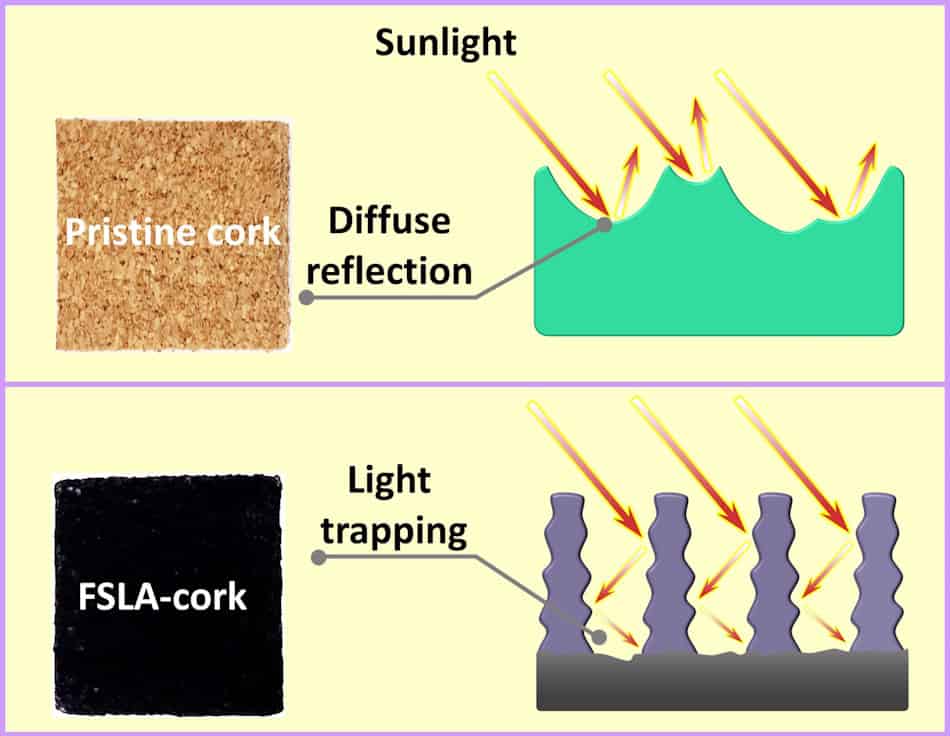
To characterize the properties of the femtosecond laser-processed cork, the team used scanning electron and confocal laser scanning microscopy. Their analysis showed that while untreated cork had an uneven honeycomb-like surface structure, the laser-processed cork was covered in a regular, striped arrangement of micro-scale grooves, scattered with nanoparticles.

The microscopy studies also showed that the laser-processed cork contained a higher proportion of carbon than untreated cork. This carbonization process occurs when heat from the laser breaks down long-chain cellulose molecules and releases carbon oxides as gas, reducing the cork’s relative oxygen content.

Laser-processed cork

Tests showed that the laser-treated cork had an extremely high solar absorption rate, absorbing more than 90% of light and reflecting less than 10%. Under simulated sunlight, the processed cork hit temperatures of 63°C after 120 s, while untreated cork rose to only 50°C. The laser-treated cork was also found to heat rapidly, reaching 50°C within 15–30 s.

When the researchers tested how well cork absorbed oil, they found that in the dark, the performance of laser-processed and untreated cork was similar, with crude oil gradually infiltrating over 45 min. Under light exposure, however, similar samples of laser-treated cork became saturated with oil within 2 min, while 10 min was needed for complete infiltration of unprocessed cork.

The team says that the nanoscale grooves and an increased surface area on the carbonized, laser-treated cork trap light. This causes the cork to rapidly heat in sunlight and heat nearby oil, reducing its high viscosity. The processed cork’s superoleophilic properties, linked to the changed surface structure and carbonization, then come into play, enabling the cork to suck up the more fluid oil while repelling water.

Cork comes from the bark of cork oak trees. As it is a renewable material that the trees can replace after harvesting, the researchers say it would be a sustainable, inexpensive and environmentally friendly material to use for cleaning up oil spills.

They propose that a pump connected to an oil tanker could be used to suck the crude oil out of cork as it is absorbed from the seawater. In laboratory experiments, the team demonstrated that a small-scale version of this setup could successfully extract oil from seawater in a Petri dish.

“Oil recovery is a complex and systematic task, and participating in oil recovery throughout its entire life cycle is our goal,” He says. “The next step is to prepare electrothermal materials using polyurethane foam as the skeleton for oil adsorption, combining photothermal and electrothermal techniques to form an all-weather oil recovery system.”

Copyright © 2026 by IOP Publishing Ltd and individual contributors