

Giant jets caught on camera

It is well known that thunderstorms drive electrical current upwards from clouds into the ionosphere – the electrically charged layer of the upper atmosphere that starts at altitudes of about 90 km – and that charge drifts downwards through the atmosphere during fine weather. But scientists have long suspected that other effects may help to maintain the potential difference of about 300 000 volts between the Earth’s surface and the ionosphere.

During a thunderstorm in the South China Sea in July 2002, Su and co-workers used low-light-level cameras to photograph the clouds every 17 milliseconds. The five jets they observed – dubbed carrot-jets or tree-jets according to their shapes – were visible for some tens of milliseconds. But crucially, the team also detected simultaneous bursts of radio waves in four of the five cases, which indicates that the jets had transferred significant amounts of charge. The thunderclouds were at an altitude of 16 km.

Such electromagnetic bursts have only previously been linked with powerful lightning strikes, which are known to transfer large quantities of charge. But Su and colleagues do not believe that lightning triggered the radio waves they detected, since the local lightning detection network registered no strikes at the times of the jets.

Similar atmospheric events known as blue jets have previously been observed leaping up to 70 km from thunderclouds – high enough to reach the ionosphere. But since no electromagnetic emissions have been associated with blue jets, scientists do not believe that they are significant carriers of charge in the so-called global electric circuit.
Room-temperature single-electron devices made easier

A single-electron transistor consists of a conducting ‘island’ that is separated from the source and drain terminals by tunnel barriers (see figure). Electrons can only transfer between the island and the source and drain terminals by quantum tunnelling through the barriers. For such devices to operate at room temperature, which is essential if they are to be used in realistic circuits, the islands must be smaller than 10 nanometres across. Moreover, the potential energy of the tunnel barriers must be high enough to localize electrons on the island.

In 2001 the Cambridge-Tokyo team made single-electron transistors from thin films that contained nanocrystalline silicon grains that were embedded in an amorphous silicon matrix. “In such material, the grains ‘naturally’ form the islands required by a single-electron transistor and the grain boundaries ‘naturally’ form the tunnel barriers needed to confine the electrons on the grains,” team member Zahid Durrani told PhysicsWeb. While that single-electron transistor worked at 60 Kelvin, the potential energy of the tunnel barriers was only 40 meV, which was too low for the device to work at higher temperatures.

The team has now increased this energy to 173 meV, which means that the transistor is able to operate at 300 K. “We use low-temperature oxidation to oxidise the grain boundaries from amorphous silicon into silicon dioxide,” said Durrani. “This wraps each grain in silicon oxide and allows us to increase our tunnel barrier height so that electrons can be confined on the grains at room temperature.”

Super-cool thermometer relies on noise

Existing low-temperature thermometers are unsatisfactory because they are either too slow, too expensive or not accurate enough. They can also be complicated to use and often only work over a limited temperature range. Moreover, it is difficult to calibrate these thermometers at temperatures in the range near 1 Kelvin.

Schoelkopf and colleagues have developed a ‘shot noise thermometer’ that consists of a sensor made of two layers of aluminium that are separated by a thin insulating barrier of aluminium oxide. When a voltage is applied to the device, electrons are forced to tunnel through the barrier and this generates an electrical current that contains shot noise.

The researchers found that the temperature could be related to the voltage by a noise measurement that depends only on two fundamental constants – the electron charge and Boltzmann’s constant – and the assumption that the electrons obey Fermi-Dirac statistics. Therefore, by measuring the noise and the voltage, they were able to calculate exact temperatures.

The Yale team found that the shot noise thermometer could measure temperatures with a precision of 0.02% in the range near 1 Kelvin. Schoelkopf and colleagues plan to improve this performance further and hope that the device could eventually be used as a low-temperature standard in measurement science and metrology.

RHIC unveils new results

As the universe cooled, free quarks and gluons combined into protons and neutrons, which then bound together to form light nuclei. Researchers at the CERN laboratory in Switzerland claimed to have created a quark-gluon plasma (QGP) in February 2000, but their results were inconclusive because the plasma existed only fleetingly.

The RHIC teams compared the results of collisions between beams of gold nuclei with results of collisions between gold nuclei and a beam of deuterons – nuclei containing just a proton and a neutron. When a gold nucleus collides with another gold nucleus the constituent protons and neutrons are thought to melt together and form a QGP. However, when a gold nucleus collides with a deuteron it should remain intact.

The Brookhaven researchers were able to observe this difference in behaviour by comparing the number of quark jets generated in the respective collisions. Quark jets are produced when a pair of energetic quarks is knocked loose from within a proton or neutron and each of these loose quarks produces a jet of ordinary particles. As expected, the scientists observed fewer quark jets from gold-gold collisions than from the deuteron-gold collisions. They believe that this is because the energy of the “missing” jets is being “quenched” by the dense QGP.

“This is a very exciting result and clearly indicates we are on the right track,” said Thomas Kirk, Brookhaven’s associate lab director for high-energy and nuclear physics. “But the case for having created a quark-gluon plasma is not yet closed.”

CERN will rejoin the race to create the first QGP when the ALICE heavy-ion experiment turns on at the Large Hadron Collider in 2007. Collision energies at ALICE will be about 30 times higher than those at RHIC.

Micromachines made easy

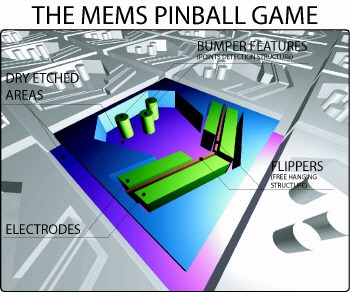
Bring and colleagues built a micro pinball table in which silicon cantilevers acted as the ‘flippers’, magnetic beads 150 microns in diameter were the balls, and the table measured 25 millimetres square. They started with two 700-micron thick wafers of single crystal silicon and used a combination of oxidation, patterning and dry etching – with an additional oxygen plasma bonding step – to make the device (figure 1).

The patterning involves only one step – compared with several steps for traditional methods. Moreover, the plasma bonding takes place at room temperature, which means that a wider choice of materials can be used to make the devices. The high temperatures involved in current fabrication techniques limit the materials that can be processed.

The researchers put in the balls ‘by hand’ and tilted the table at an angle of 20 degrees to the horizontal (figure 2). They found that the speed of a ball could reach up to 0.75 kilometres per hour – or 210 000 microns per second. This is equivalent to a football having an almost supersonic speed of 1125 km per hour (see ‘related links’ for a short film of the game).

“The pinball games are used for demonstrating this simple and easy process,” Brings told PhysicsWeb. “It also demonstrates some of the effects that occur on the micrometer level, such as small apparent inertia.” The team says that the process could be used to build devices such as spatial light modulators, micromotors, optical switches and viscometers.

Celebrating Einstein with dance

The work will be choreographed by Mark Baldwin, and will be his first work for the Rambert as its new artistic director. The Rambert’s education department will also work in collaboration with the Institute of Physics to develop practical dance workshops for schools, a schools’ matinee performance, and resource materials that can be used to teach both science and dance.

“We are very excited about this collaboration,” said Jerry Cowhig, managing director of Institute of Physics Publishing. “Dance is an expressive medium and it will be ideal for abstract concepts like the theories of Einstein on everything from tiny atoms to the dynamics of the whole cosmos. I love the work of Rambert and am confident this new work will trigger many people’s curiosity about physics in Einstein Year”.

“I believe the Institute’s commissioning of Rambert to be an inspired choice and a testament to how the diverse areas of art and science can work together,” said Baldwin. “Physics encompasses many complex areas, but I hope to incorporate a few concepts that we can all relate to, such as time, space and light.”

Spinning star goes flat out

Many astronomical bodies – including the Earth – are known to be ‘oblate’: in other words, they are larger around the equator than around the poles. As a rigid, rocky planet, the Earth is just 0.3% wider at the equator than at the poles, but astronomers have long expected the effect to be larger for gaseous objects like stars. Fast-rotating bodies with large centrifugal forces at their surfaces are also likely to be more oblate.

In line with these predictions, a previous study suggested that the equatorial radius of Achernar – which is six times more massive than the Sun – was about 14% larger than its polar radius. But the new measurements show that the equatorial radius of Achernar is equivalent to 12 solar radii, compared with about eight at the poles.

Domiciano de Souza and colleagues exploited the rotation of the Earth to make regular observations of the star using two telescopes almost perpendicular to each other. Merging the signals produced interference patterns that allowed the group to measure the angular size of the star in directions almost 90 degrees apart.

The astronomers add that Achernar, which is 145 light years away, could be even more oblate than their data suggest, because they are uncertain of the orientation of the star’s axis of rotation during their observations.

Fuel cells: environmental friend or foe?

A completely efficient system of producing, storing and transporting hydrogen should, in principle, lead to no unwanted emissions of the gas. But the Caltech researchers point out that such a system would be expensive, and that in reality around 10-20% of the hydrogen would escape into the atmosphere. They say that if hydrogen fuel cells replaced all of today’s oil and gas-based combustion technologies, such losses would double or even triple the total hydrogen deposited into the atmosphere at the Earth’s surface.

“More or less dramatic scenarios are equally imaginable, but clearly the potential impact on the hydrogen cycle is great,” say the researchers.

Tromp and colleagues say that the hydrogen would be oxidised when it reaches the stratosphere, which would cool the stratosphere and create more clouds. This would delay the break up of the polar vortex at the north and south poles, making the holes in the ozone layer larger and longer lasting. They estimate that the extra hydrogen will lead to a 5-8% rise in ozone depletion at the north pole and between 3 and 7% at the south pole.

The exact scale of this additional ozone depletion, however, depends on a number of unknown quantities. In addition to uncertainty over the extent of hydrogen emissions in the future, little is understood about how soil absorbs hydrogen from the atmosphere. The researchers say it is conceivable that this process could compensate for all new anthropogenic emissions.

New look for space shuttle tiles

Conventional heat-resistant tiles on spacecraft are held together by chemical binders – which can be destroyed by the high temperatures experienced on re-entry into the atmosphere – or with mechanical connections, which can lead to concentrations of stress in the structure. Estrin and co-workers made prototype ‘blocks’ from a polyester resin to show that they could be joined together using their geometry alone. The concave parts of one block are interlocked with the convex parts of other blocks and vice versa.

Each block is held in place by six neighbours, which means that it is unable to move. In mechanical tests the researchers confirmed that structures made from the blocks remained intact even after some of the blocks had been removed. Moreover, cracks cannot spread from one block to another because there are no ‘bridges’ in the form of adhesive or mechanical connections holding them together.

“In a patented work we suggested producing assemblies of interlocked elements not by manufacturing the elements one by one and then stacking them together, but by growing the entire structure layer-by-layer,” Estrin told PhysicsWeb. “In addition to spacecraft applications, such structures could be used in buildings in earthquake risk areas, architectural design, sound insulation and mortar-free masonry – particularly in extra-terrestrial constructions.”

Closing in on neutron stars

Isolated neutron stars are highly magnetized, rapidly rotating objects that are formed by the collapse of massive stars. Although they are typically only about 10 kilometres across, neutron stars are at least 40% heavier than the Sun. This means that their core density is higher than that of an atomic nucleus.

Bignami and colleagues studied the young neutron star 1E1207.4-5209 using the EPIC camera on board the XXM-Newton observatory. They analysed the X-ray photons emitted from the star and found three distinct spectral lines at 0.7, 1.4 and 2.1 keV, and a fourth weaker line at 2.8 keV.

The Italian group believes that spectral lines are caused by the cyclotron resonance effect. “Electrons at the surface of the neutron star spiral around inside the star’s magnetic field, and in doing so they absorb photons of a well-defined energy,” Bignami told PhysicsWeb. “This energy is directly related to the value of the magnetic field of the star.”

Bignami adds that neutron stars contain exotic states of matter that cannot be reproduced in the laboratory, which means that they can help physicists to understand how neutrons are held together in atomic nuclei. The team also plans to look at more objects like 1E1207.4-5209. “One is good but it is better to have ten,” said Bignami.

Copyright © 2026 by IOP Publishing Ltd and individual contributors