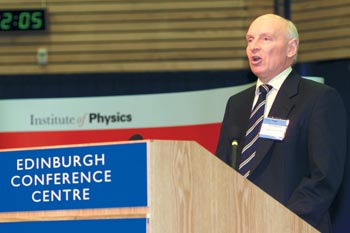
John Bardeen: genius in action

Scientific genius is no easier to pinpoint than artistic genius. It derives from a combination of factors, including – but not limited to – intuition, imagination, far-reaching vision, exceptional native gifts that blossom into significant technical skills, and the willingness and ability to challenge conventional wisdom. Perhaps even more importantly, scientific genius depends on an instinct for invention, an ability to focus on the problem at hand, and a determination to pursue that problem to a successful conclusion.
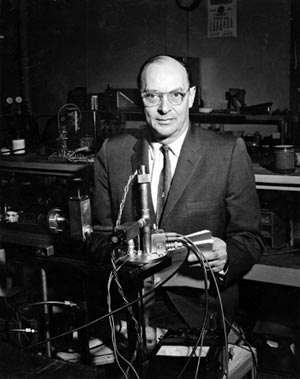
John Bardeen, the inventor of the transistor and leader of the team that developed the microscopic theory of superconductivity, possessed all of these qualities. But what made him different from so many fellow scientific geniuses of the 20th century – Bohr, Dirac, Einstein, Feynman, Gell-Mann, Landau, Oppenheimer and Pauli? The answer lies not only in his two Nobel Prizes for Physics (in 1956 and 1972), but also his remarkable modesty, his deep interest in the application of science, and his genuine ability to collaborate easily with experimentalist and theorist alike. He was, moreover, a devoted and loving husband and father, who imparted to his children his passion for science. Indeed, his two sons – Jim and Bill – became distinguished theoretical physicists in their own right.

This biography of Bardeen captures well these aspects of his character as they developed and were refined during his life-long voyage of scientific exploration. Born in Madison, Wisconsin, in 1908, John soon displayed formidable mathematical and athletic abilities. After graduating from high school aged just 13, he took two years of additional high-school courses before starting his undergraduate studies at Wisconsin. Bardeen graduated in 1928 despite also having taken a year off during his degree to work in Chicago.

Following two years of graduate work in electrical engineering at Wisconsin – and a three-year spell developing new approaches to oil exploration at Gulf Oil in Pittsburgh – Bardeen went to Princeton as a graduate student in 1933. He initially thought that he might work with Einstein, who had just joined the Institute for Advanced Study. But after arriving, Bardeen decided instead to work with Eugene Wigner. He completed his PhD on the work function of metals in just two years.

After three years as a postdoc at Harvard, Bardeen married Jane Maxwell in 1938 and moved to Minnesota as a junior member of the faculty there. Following a wartime stint at the Naval Ordinance Laboratory, he joined Bell Labs in 1945. It was here, working closely with Walter Brattain – his old friend and office-mate – that Bardeen invented the transistor in 1947.

Bardeen’s voyage reached its apogee at the University of Illinois in Urbana-Champaign in 1957. Following six years of sustained effort, Bardeen – along with his postdoc Leon Cooper and his graduate student Bob Schrieffer – solved the most significant scientific challenge of his time. Together they developed a microscopic theory of the superconductivity of metals at very low temperatures. In the years that followed, as a consultant to Xerox, Bardeen also played a major role in the development of xerography, while continuing to work at Illinois on a wide variety of problems in condensed matter.

Bardeen’s perhaps unique ability to move seamlessly from fundamental theory to applications of major commercial importance is described well by the authors. It could be argued that no one changed the lives of people everywhere more than Bardeen. Yet, as the authors emphasize, his fundamental scientific contributions were of comparable importance.

So how was it that Bardeen and his young collaborators were able to solve the riddle of superconductivity? The solution had, after all, eluded their distinguished theoretical colleagues – Blatt, Feynman, Frohlich, Ginzburg, Gor’kov, Landau and London. The answer is, in part, to be found in Bardeen’s emphasis on understanding the experimental facts and developing a phenomenological description of these while simultaneously pursuing a number of different theoretical scenarios with his younger colleagues, of whom I consider myself fortunate to have been one.

His instinct that a new mathematical approach was required, his intuition that it might arise out of an improved understanding of the polaron problem, and his realization that it was essential to sort out the combined role of the electron-electron and electron-phonon interactions all played a part. So did his focus on the behaviour of a few electrons outside the Fermi sea, together with his willingness and ability to learn new mathematical techniques.

Equally important was his total dedication to cracking the problem, and the encouragement, support and freedom to pursue their own ideas that he gave to his younger colleagues, who played key roles in the development of the theory. The resulting BCS theory is arguably one of the major contributions to physics in the 20th century. It not only solved the riddle of superconductivity, but also had a lasting impact on the fields of astrophysics, nuclear physics and particle physics.

There are several tantalizing “what if” questions in Bardeen’s career. What if – rather than continuing with engineering at Madison and then going into industry for three years – he had been successful in his 1929 application to Trinity College, Cambridge, for one of their coveted fellowships? What if – as a consequence of incorrect experimental results – Eugene Wigner had not become discouraged about understanding nuclear physics in 1932 and therefore not spent three critical years studying condensed matter? In either case, would Bardeen’s scientific interests have gone in quite a different direction? And what if Bill Shockley, who was single-handedly responsible for Bardeen leaving Bell Labs in 1951, had supported John’s continuing interest in the fundamental physics of semiconductors and his desire to work on superconductivity? Would Bardeen have been able to solve superconductivity if he had stayed at Bell Labs?

Lillian Hoddeson and Vicki Daitch mostly get John Bardeen right, which makes the book a great read and a valuable contribution to the history of present-day physics. As his first postdoc from 1952 to 1955, and as a physics colleague who occupied the adjoining office from 1959 to 1991, I spent much of my scientific career in close proximity to John. I therefore had an excellent opportunity to observe, up close and personal, Bardeen’s approach to science and his interaction with his students, colleagues, friends and family. Hoddeson and Daitch have done a first-rate job in describing these issues and in chronicling the first half of his life up to his move to Illinois in 1951.

Where there is room for improvement is in their description of that second half of his career, from his early days at Urbana to the development of the BCS theory and the theory of mixtures of helium-3 and helium-4, and on the nature of his leadership role in condensed matter in Urbana. I would have preferred more on the unique scientific environment that he found, nurtured and perpetuated there. Several first-person accounts of some of these facets of John’s career can be found in a special issue of Physics Today (April 1992), which examines the life and science of this unique and much-admired individual.

One wishes, too, that the authors had intertwined their account of Bardeen’s life with an equally lucid account of the development of our understanding of condensed matter between 1950 and 1980 – an understanding made possible in no small part by Bardeen’s seminal work. It is a story that remains to be told at the level achieved by George Johnson in Strange Beauty – his meticulously researched biography of Murray Gell-Mann – in which the science and the person are equally well described.

Heavy elements lend weight to early stars

Astronomers believe that virtually all elements heavier than boron are produced by nuclear reactions inside stars. When these stars explode at the ends of their lives, the elements are ejected into space. But before this can happen, the lighter elements created during the big bang – such as hydrogen and helium – must coalesce into stars, which must evolve for around 700 million years according to existing theories. This means that the presence of heavy elements in ancient stars and galaxies can indicate when star formation began.

Wolfram Freudling of the Space Telescope European Coordinating Facility and the European Southern Observatory in Germany and colleagues used the Hubble Space Telescope to inspect the light emitted by the three quasars (W Freudling et al 2003 Astrophys. J. Lett. 587 L67). As this light travelled through space, the expansion of the universe increased its wavelength – the effect known as ‘redshift’ – so the researchers detected it as infrared radiation. With redshifts ranging from 5.78 to 6.28, the light from these quasars must have been emitted just 900 million years after the Big Bang.

In the infrared spectra from the quasars, Freudling’s team found the characteristic absorption pattern of iron. If such a heavy element existed 900 million years ago, the researchers argue, stars must have started to form when the universe was around 200 million years old. “We believe that the iron we detected was created in the very first generation of stars which formed soon after the Big Bang,” says Freudling.

The discovery by Freudling’s group seems to be supported by a separate study by Jason Prochaska of the University of California at Santa Cruz and colleagues (J Prochaska et al 2003 Nature 423 57). Prochaska’s team used the HIRES spectrograph at the Keck I telescope in Hawaii to measure the abundances of 25 elements in a galaxy with a redshift of 2.63. Previous studies of this kind have focused on just a few relatively light elements.

The US researchers say that their discovery of heavy elements such as zinc in such a young galaxy suggests that stars may form and begin to synthesize elements much more rapidly than astronomers thought. They also found that the relative abundance of the 25 elements in the galaxy was similar to that in our – much younger – solar system. This could mean that the synthesis of elements has followed a common pattern throughout the history of the universe.

The climatic effects of water vapour

Extreme variations in local weather and the seasons make it easy for people to mutter “greenhouse effect”, and blame everything on carbon dioxide. Along with other man-made gases, such as methane, carbon dioxide has received a bad press for many years and is uniformly cited as the major cause of the greenhouse effect. This is simply not correct. While increases in carbon dioxide may be the source of an enhanced greenhouse effect, and therefore global warming, the role of the most vital molecule in our atmosphere – water – is rarely discussed. Indeed, water barely rates a mention in the hundreds of pages of the 2001 report by the Intergovernmental Panel on Climate Change.

Many aspects of the seemingly simple water molecule conspire to make it difficult to model its effect on our climate. Unlike most other atmospheric gases, the distribution of water in the atmosphere varies strongly with time, location and altitude (figure 1). Water is also unique among atmospheric molecules because it changes phase at terrestrial temperatures. This means that it can transfer energy from its frozen form at the poles to its liquid and vapour forms in the atmosphere. Once in the atmosphere, water moves with the winds and can even diffuse up to the stratosphere, where it is responsible for destroying the ultraviolet-shielding ozone layer.

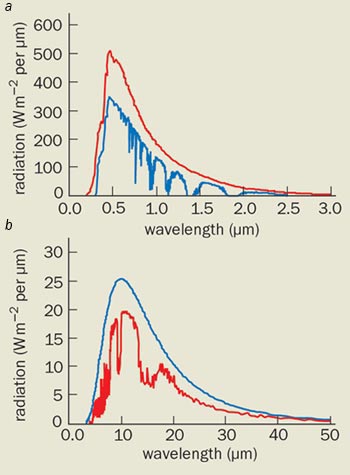
The atmosphere plays a crucial role in the Earth’s radiation budget because it absorbs both the incoming radiation from the Sun and the outgoing radiation that is reflected from the planet’s surface. However, the radiation in each of these processes has very different wavelengths. The Sun radiates approximately as a black body with a temperature of 5800 K, which peaks in the optical region at a wavelength of about 0.6 µm. The reflected radiation profile, on the other hand, is much closer to a black body at a temperature of 275 K, and has a peak at much longer infrared wavelengths (about 11 µm). The physical processes that lead to the absorption of radiation in the two regions are different, but water vapour plays the dominant role in both.

Balancing the books

Physicists have been modelling the Earth’s atmosphere for over a century, and we have built up a very detailed understanding of the key processes that are involved in the global energy budget (figure 2). For example, it is now well established that the top of the Earth’s atmosphere receives a surface-averaged energy input from the Sun of 342 W m-2. This is calculated by knowing the amount of energy that is radiated by the Sun and the angle that the Earth subtends. If the incoming and outgoing radiation is not equal then the global energy budget does not balance and the temperature of the planet will change until a new balance is established. What is feared is that a build-up of greenhouse gases is causing an increase in the absorption of the outgoing, infrared radiation.

Satellite measurements show that 235 W m-2 of incoming solar radiation is absorbed by the Earth, but the latest models and measurements suggest that the atmosphere is responsible for just 67 W m-2 of this amount. The rest is absorbed by the ground and by the oceans, which play a key role in the energy budget due to their large heat capacity and their ability to store carbon dioxide, and, of course, water vapour.

The greenhouse effect is precisely the difference between the long-wave radiation that is emitted by the Earth’s surface and the upward thermal radiation that leaves the tropopause – the upper boundary of the turbulent portion of the atmosphere that we all inhabit. The greenhouse effect is about 146 W m-2 in clear skies and some 30 W m-2 higher under cloud cover.

There are a number of popular misconceptions about the greenhouse effect, notably that it is a bad thing. On the contrary, the greenhouse effect is a significant factor in making the Earth habitable. Without it the average temperature on Earth would be lowered by about 30 K, which would make most of the planet’s surface decidedly chilly. Furthermore, it is the water vapour in the lower 10 km or so of the atmosphere, rather than man-made carbon-dioxide emissions, that contributes most to this warming effect.

The absorption of light by molecules in the atmosphere generally results in two basic molecular processes: bound-free and bound-bound transitions. Bound-free transitions take place in the more energetic ultraviolet region of the spectrum and cause the molecules to break up. In bound-bound transitions, which occur at longer wavelengths, the molecules jump from some combination of rotational and vibrational states to another, which produces a very distinct “signature” (figure 3). It is therefore very easy to identify which atmospheric absorbers are at work, although it is much more difficult to work out the actual numbers. Nevertheless, large databases that list all the known molecular transitions and their associated properties have been compiled. The most widely used is the high-resolution transmission molecular absorption database (HITRAN), which has been developed over many years by Larry Rothman, who is now at the Harvard-Smithsonian Center for Astrophysics in Cambridge in the US.

But when the absorption values in the HITRAN database are used in model-atmosphere calculations, the results are disturbing. For clear skies, the models predict that the atmosphere absorbs much less sunlight than is measured by a variety of satellite and aircraft. The difference between the predictions and the measurements can be as large as 30 W m-2. (see “Radiation budget is called to account” by A Maurellis Physics World November 2001 pp22-23). This problem has become known as the absorption anomaly. And there are even worse problems in understanding absorption models when the sky is cloudy.

Not all models underestimate the amount of atmospheric absorption because some physicists choose to add extra absorption to their models to mop up the surplus radiation. However, the physical cause of the missing clear-sky absorption and its exact wavelength distribution remain unresolved, and a source of fertile speculation. Everyone’s favourite molecule is always a candidate.

Our favourite molecule is water. Water vapour is responsible for 70% of the known absorption of incoming sunlight, particularly in the infrared region. Indeed, ask any infrared astronomer about which regions of the spectrum provide the best views and you will get a list of the wavelengths where water does not absorb – the so-called atmospheric windows. After all, there have to be some pretty strong reasons to brave the inhospitable climate of Antarctica to build the South Pole Telescope, as US astronomers have recently undertaken. Water absorption bands are also present in the optical region and extend all the way to the ultraviolet, although they are less strong at shorter wavelengths. The precise effect of these absorption bands is hard to determine, despite the best efforts of many talented and dedicated scientists.

A fresh look at hand-held communication devices

If you had cast the doubts about the safety of mobile phones to the back of your mind, then think again. Hand-held personal data assistants (PDAs) are about to bring these concerns firmly to the front. The way we use PDAs – holding them in front of our heads as opposed to against our ears – presents new challenges concerning the potential health risks of mobile devices.

Personal communication handsets such as PDAs emit and receive electromagnetic waves with frequencies between about 1.5 and 3 GHz, which is in the radio region of the spectrum. While we know that too much ultraviolet radiation can damage the skin and that gamma radiation should be avoided at all costs, relatively little is known about the biological effects – if any – of electromagnetic waves at radio frequencies.

New research now suggests that wearing glasses can dramatically change how much radiation the human head absorbs from hand-held mobile devices as Matthew Chalmers describes in the May edition of Physics World. Matthew Chalmers is Features Editor of Physics World

When a little can mean a lot

What follows is the beginning of a quantum romance. Alice and Bob meet in a bar. After some pleasant conversation, Bob asks for Alice’s phone number so that he can call her sometime. But Alice is not quite sure about Bob and decides to leave their future to chance by flipping a coin in private. If the coin is heads she will give Bob her phone number, but if it is tails she will give him a completely random number. The coin does not land kindly for Bob and Alice gives him a random number.

The next morning Alice changes her mind and decides that, after all, she would like Bob to phone her. But how can he phone if Alice did not give him the right number? Luckily Alice was thinking ahead the night before and made sure that she got Bob’s number in case she changed her mind. So Alice calls Bob, but his voice-mail is switched on so she has to leave a message. The only problem is that Bob exchanged a lot of phone numbers the night before and there is only space for Alice to squeeze one bit of information – a one or a zero – onto his answering machine.

Fortunately Alice had anticipated this possibility when she met Bob. So instead of just giving him a classical random number, she had in fact given him a special quantum state at the bar. And with the one extra bit of information that Alice leaves on his answer machine, Bob can work out her number and call her, which he does.

Find out how Alice managed to convey her full phone number to Bob by only giving him one bit of information, in the May issue of Physics World. The article is written by David DiVincenzo and Barbara Terhal who are at the IBM Watson Research Center in New York and the Institute for Quantum Information at the California Institute of Technology.

Superconducting quantum computing

True quantum computers have the potential to solve much more demanding problems because they can exploit the quantum coherence that results from the wave nature of quantum systems. This coherence means that the basic processing components of a quantum computer have a common phase – just like the photons in a laser beam. A classical memory register that has N bits, each of which can be in one of two states 0 and 1, can store any one of 2N configurations at a given time. However, a quantum-coherent register that contains N quantum bits, or qubits, can store a coherent superposition of all 2N configurations at the same time.

But therein lies the problem of actually building a quantum computer.

In the May issue of Physics World, Goran Wendin from the Department of Microtechnology and Nanoscience at Chalmers Institute of Technology in Sweden describes how solid-state quantum information processing has moved a step closer thanks to macroscopic circuits that behave like single quantum objects.

The reality of negative refraction

Figure 1

One of the most fundamental phenomena in optics is refraction. When a beam of light crosses the interface between two different materials, its path is altered depending on the difference in the refractive indices of the materials. The greater the difference, the greater the refraction of the beam. For all known naturally occurring materials the refractive index assumes only positive values. But does this have to be the case?

In 1967 Soviet physicist Victor Veselago hypothesized that a material with a negative refractive index could exist without violating any of the laws of physics. Veselago predicted that this remarkable material would exhibit a wide variety of new optical phenomena, from reversed geometrical optics to reversed Doppler shifts. However, until recently no one had found such a material, and Veselago’s ideas had remained untested.

In the last three years all this has changed, and negative-index materials are at the centre of a lively – and sometimes heated – debate (see “Electromagnetic materials enter the negative age”Physics World September 2001 pp47-51; and August 2002 pp8-9). In 2000, following insights from John Pendry and co-workers at Imperial College in London, our group at the University of California in San Diego used combinations of copper rings and wires that were deposited on circuit-board substrates to create materials that had unusual electromagnetic properties. We were convinced that one of these “metamaterials” had a negative refractive index, and in 2001 we performed an experiment that confirmed that a microwave beam would undergo negative refraction at the interface between our metamaterial and air – unlike any existing material.

The possibility that materials – albeit artificially constructed ones – could reverse the refraction of light at an interface sparked a flurry of speculation about the new phenomenon, and about the applications it might enable. One of the more provocative suggestions came from Pendry, who predicted that a slab of negative-index material could refocus the rays of a nearby source far better than the diffraction limit that is associated with all positive-index optics. In other words, it could lead to a “perfect lens”. But despite our experimental results, many researchers found the concept of negative refraction and its consequences unsettling. Was there a flaw in the reasoning? Could the experimental results be otherwise explained?

Negative reaction

In his original analysis Veselago pointed out that while nature allows for negative refractive indices, they can only occur in a dispersive medium – a material in which beams of light with different wavelengths are refracted in different directions. In 2001 Prashant Valanju and colleagues at the University of Texas suggested that dispersion would be the downfall of negative refraction.

Valanju agreed that a beam consisting of a single wavelength could indeed be refracted in the negative direction, but noted that real light waves always have more than one wavelength component. This means that refraction at the interface between a positive-index material and a negative-index material would tear the wave apart, leaving no single negatively refracted wave. Valanju reasoned that the refracted wave would die away and that any practical realization of negative refraction, such as Pendry’s perfect lens, was therefore impossible.

As for the experimental evidence, Valanju criticized the proximity of the detector to the sample, claiming that the observed fields were due to the rapidly decaying, multiwavelength inhomogeneous wave. He suggested that if we were to measure the inhomogeneous wave further away from the sample then we would no longer be able to detect the fields.

All materials are dispersive to some degree. The focal length of a lens, for example, varies depending on the colour of light that is being focused. But the negative-index metamaterials that have been demonstrated are far more dispersive than typical materials. Does this inherent dispersion constitute proof that negative refraction is impossible?

Negative refraction

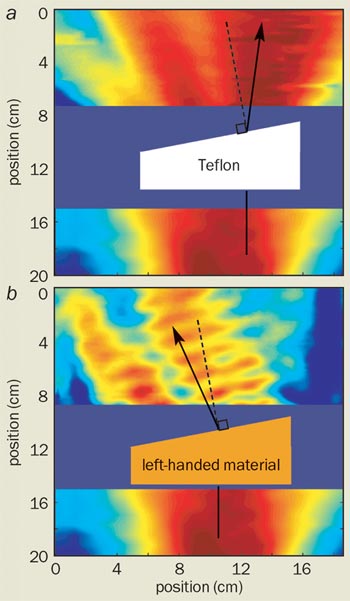
Two experiments have just been performed that could finally lay the issue of negative refraction to rest. They support our original findings and uphold Veselago’s hypothesis. Using a planar waveguide configuration, Andrew Houck and colleagues at the Massachusetts Institute of Technology (MIT) have mapped the field pattern of microwaves that were transmitted through wedge-shaped samples of both positive- and negative-index materials (Phys. Rev. Lett. 90 137401).

The researchers used a positive-index Teflon wedge as a control sample, which caused the path of a microwave beam to exit the sample at a positive angle with respect to a line drawn perpendicular to the surface, in accordance with Snell’s law. In contrast, the beam that emerged from a metamaterial wedge that was made from a grid of rings and wires exited at a negative angle for certain frequencies. In other words, the beam was negatively refracted (figure 1).

Figure 2

To make sure that the observed beam was due to the inherent negative index of the wedge – as opposed to an artefact associated with the sample being lossy or diffractive – the team used two different wedge samples so that waves would be incident on the metamaterial at two different angles. Both cases exhibited negative refraction at angles that were consistent with the sample having a well defined negative index – confirmation of Snell’s law for a negative refractive index. In case there were still doubters, the researchers went further to show that a rectangular sample of the metamaterial can refocus the rays from a nearby antenna – verifying another of Veselago’s many predictions.

Using a different approach, Claudio Parazzoli, Kin Li and co-workers in the Phantom Works division of Boeing constructed a wedge sample that was appropriate for free-space measurements (figure 2). Again based on a ring and wire structure, the Boeing sample clearly demonstrates negative refraction (Phys. Rev. Lett. 90 107401). As in the MIT experiment, the negatively refracted beam does not decay as a function of distance in any anomalous manner, even when it was measured as far as 28 wavelengths – about 66 cm – from the sample. The Boeing group also calculated the refractive index of the metamaterial using electromagnetic simulations. The value obtained showed excellent agreement with the refraction data, and has the same variation as a function of frequency as the experimentally measured index.

Positive implications

These experiments should be sufficient to dispel any doubts regarding the reality of negative refraction. But there are additional problems in realizing the exotic applications that have been predicted for negative-index materials. Because it is desirable to convey as much power as possible through a negative-index material for device applications, absorption must be minimized. The metamaterial samples that were used in the recent refraction experiments tend to have significant losses, and this could be an intrinsic property of negative-index materials

There is strong theoretical evidence, however, that negative refraction does not imply large losses. In 2000 Masaya Notomi at NTT Basic Research Laboratories in Japan showed that refraction-like behaviour could be expected to occur in photonic crystals that exhibit negative refraction for certain lattice parameters. Photonic crystals are periodic structures that are built on the scale of the optical wavelength, and that only allow certain wavelengths to pass through them. The theoretical structures that Notomi constructed could in reality be composed of insulating dielectric materials, which have negligible losses even at optical wavelengths.

Notomi’s work has sparked interest in using photonic crystals as negative-index materials, and many researchers are now exploring this possibility. Recent time-dependent simulations by Stavrula Foteinopoulou and colleagues at Iowa State University and the FORTH laboratory in Greece have shown that a pulse of radiation will undergo negative refraction in a photonic crystal (Phys. Rev. Lett. 90 107401). Further simulations by Chiyan Liu and colleagues at MIT have recently shown that another of Veselago’s predictions for negative-index media can be observed in a photonic crystal – the Cerenkov radiation that is emitted from a charged particle traversing a photonic crystal is emitted in the backwards rather than the forwards direction (Science 299 368).

An indication that practical devices based on negative-index materials may be on the horizon comes from the recent work of Christophe Caloz and Tatsuo Itoh at the University of California in Los Angeles, who have built electronic-circuit analogues of negative-index materials. By swapping the roles of capacitance and inductance in a circuit model of a transmission line – which is used in electrical engineering to represent microwave devices such as waveguides and optical fibres – they arrived at the circuit equivalent of a negative-index material (J. Appl. Phys. 92 5560).

While the transmission-line models bear more resemblance to traditional radio-frequency circuits, they still obey the same physical laws as the metamaterials that are used in the refraction experiments. The devices that Caloz and Itoh have demonstrated show only moderate dispersion, with no noticeable increase in absorption. These complementary approaches to negative refraction – photonic crystals and circuit models – indicate that negative-index materials have a positive future.

Whether or not these recent experiments will put an end to the debate that surrounds negative refraction remains to be seen. But it is now clear that negative-index metamaterials exist. The notion of negative refraction, however, often leads to possibilities that go against intuition. Controversy is bound to arise, and we can look forward to exciting times in this rapidly evolving field.

A model approach to society

Science in Britain today is in an improving financial position. Significant increases in funding for education and research are filtering through from government coffers. Politicians, it seems, have realized both the lack of support given to education in the past and the value of research in today’s knowledge economy.

But we cannot take this change of heart for granted. In the long run, public support for what scientists do will be crucial in increasing funding further. The advancement of physics will depend on a dialogue with the public that is based on mutual understanding and realistic expectations on both sides.

My thinking on this topic has been influenced by stimulating discussions that I have had with social scientists. Most scientists (myself included) were probably only dimly aware of the sociology of science until the physicist Alan Sokal published his now famous spoof paper “Towards a hermeneutics of quantum gravity” in the journal Social Text (1996 46/7 217-252).

Sokal’s intention was to parody how the language of science and mathematics was being abused by some post-modern writers. His article triggered an acrimonious turf war between the two sides that not only centred on the misuse of language but also highlighted a philosophical difference about the nature of science itself (see “Science studies – what’s wrong” by Jean Bricmont Physics World December 1997 pp15-16).

In an extreme view of physics, which I myself held as a young researcher more than 30 years ago, physicists search for the ultimate theory of forces and matter, from which everything else will follow as a secondary scientific endeavour. In contrast, the extreme post-modernists whom Sokal was parodying put the individual at the centre. Some sociologists view scientific knowledge as the shared views of a group of individuals – a “social construct” – rather than as some fundamental knowledge about nature.

My views on the “absolute truth” of theories and our ability to make accurate predictions are best illustrated by some work in probability theory that was carried out by Vladimir Vapnik and Alexey Chervonenkis in 1968. They showed that if we have access to only a finite amount of data, our ability to predict and generalize from the data is limited. To use a phrase coined by the computer scientist Les Valiant in 1984, we can only be “probably approximately correct”. So while I am pretty sure that the Sun will rise tomorrow, for example, I cannot be absolutely certain.

The apparent gulf between scientists and sociologists has narrowed in the last two or three years. Scientists now openly acknowledge that the emergence of an accepted theory involves “social interaction” of some form. Indeed, in many areas of physics, such as cold fusion and high-temperature superconductivity, the scientific disputes have been extremely hostile and personal. The extreme views of post-modernism in social sciences, meanwhile, have given way to a more pragmatic discourse with which scientists can engage. Even the widest gulf, it seems, may be narrowed with a little humility.

The encode-decode metaphor

The debate between scientists and social scientists has mainly focused on the challenges of communicating with fellow academics. But physicists must also communicate with the wider public. Traditionally this has been done through the “public understanding of science”, which can be caricatured along the following lines: when you (the public) have understood what we (the scientists) are saying, everything will be okay. Recently, however, scientists have moved towards a new dialogue, driven partly by the genuine concern that many people have about new technologies, and partly by the strident view of campaigning special-interest groups. This new dialogue is more of a two-way process.

But what does the public think about scientific researchers? According to a recent survey carried out by the Office of Science and Technology in the UK, less than a half (48%) of the public who were interviewed trust scientists in universities to provide accurate information on scientific facts. On the face of it, this is pretty shocking. Most of the public, it appears, do not trust us to tell the truth about scientific matters. However, other sources of scientific information are viewed even less favourably, with only a third of TV news and current-affairs programmes being regarded as trustworthy sources of scientific information. The equivalent figures for environmental campaign groups (30%), government advisory groups (13%), tabloid journalists (4%) and government ministers (4%) are lower still.

So while science may be difficult and specialized, the public is prepared to give scientists quite a big benefit of the doubt. But how can we build on this relatively advantageous position? I find it helpful to think in terms of the “encode-decode” metaphor, which dates back to the work of the sociologist Stuart Hall some 30 years ago. Encoding and decoding is an essential issue in communicating data and takes a huge range of forms, such as CD-ROMs, magnetic disks or computer displays. Given this huge diversity of formats, different systems must conform to common standards. We need to take data that have been encoded in a source, transmit them through a physical carrier of some kind, and then decode the transmission for storage or display in the recipient medium. Formats and standards are what make communications between different physical systems possible.

As for human communication, our my personal experience of the physical world is contained in the complex bag of chemical transmissions and electrical signals that is inside you and me. If we are to communicate successfully, I have to think carefully to encode what is inside me so that you can decode the sound and light waves that reach you. Similarly, I need to be sensitive to how you have encoded your views when I try to decode the signals that I receive from your speech and gestures. This two-way process is essential to successful communication and understanding.

I have found this a useful metaphor not least because it underlines why engagement with the public is so challenging. First, in some subjects we are trying to “encode” scientific understanding of topics of which the public will have little day-to-day experience. Second, we have no common formats in the human body akin to the standards prescribed for encoding data in physical systems. The one area where we do have standards that transcend the individual is, of course, mathematics, which is why it is such a powerful framework for understanding the physical world. Unfortunately, mathematics is not an appropriate way of engaging with the public.

Why more means less

Let me finally suggest a metaphor for why it is that the more we know, the less we seem to know. It is based on the idea of a “space of organized knowledge”. This space contains regions that are “understood”, surrounded by regions that are “not yet understood at all”. Near the boundaries between the two, the uncertainties and errors increase as our theories become more approximate and less probably correct. Our existing knowledge is “measured” by the volume of the inner regions, while their surface area is a measure of “what we know we don’t know”.

This space can be illustrated by considering how knowledge expanded as we entered the quantum era early last century. Macroscopic phenomena described by classical mechanics, for example, occupy a sub-region that is now part of a larger region that also describes objects moving at close to the speed of light.

Our search for new knowledge uncovers new phenomena, as much as it deepens our knowledge in mature areas of science. Molecular biology and the genome, for example, are built on physical laws, but they surely represent a new field of science – a new dimension in this space of organized knowledge. Quite clearly, the space of scientific knowledge is already of a high dimension, and will become of an even higher dimension in the future. Recalling that objects in a higher dimension usually have a higher surface area to volume ratio than those in a lower dimension, this metaphor gives us one way to think about why the more we know the less we seem to know.

While scientists may well query the value of this kind of concept, I am sure that many social scientists will query its entire validity. They might, however, be reassured if we acknowledge that this space is not absolute and fixed. Radical restructuring of the space of organized knowledge does take place and can be regarded as the highest goal of the scientist. Maxwell’s theory of electromagnetism, for example, united the previously disjointed phenomena of electricity and magnetism.

I am conscious that much of what I have said is of limited practical use in taking forward a science-in-society agenda, but it should at least provide food for thought.

Europe’s gaps in R&D

The European Union’s commissioner for research, Philippe Busquin, has set himself the ambitious target that EU member states should increase their spending on research from the current average level of 1.9% of gross domestic product (GDP) to 3% by 2010. Moreover, says Busquin, two-thirds of the extra investment should come from industry. Such an increase, he claims, would create 400,000 extra jobs every year after 2010 – and also fuel further increases in GDP (europa.eu.int/comm/research/era/3pct). The physics-based technologies identified in Busquin’s vision include aerospace, photovoltaics, nanotechnology, and information and communication technologies.


The action plan for achieving this vision, released at the end of April, contains a long list of measures that range from making careers in research more attractive to developing better tax breaks for companies that invest in research. The plan also calls for increased co-ordination between member states in their approaches to R&D, including new guidelines on intellectual property rights, increased public spending on research and innovation, and stronger links between industry and public research.

There is little to argue with here and an analysis of the world’s top 500 companies as ranked by spending on R&D reveals why – and where – action is necessary. Europe’s share of R&D investment by the top 500 is just 28%, compared with 44% for the US, while Japan – which has a population one-third that of the EU – accounts for 23%. Information and communication technologies (ICT) is the sector that receives most R&D investment (27.4%) on a global basis, followed by automobiles and parts (17.6%) and pharmaceuticals (15.5%). In the EU, automobiles account for 24% of R&D investment, with the German car maker DaimlerChrysler spending more on research than any other European company. Pharmaceuticals and ICT both receive 16% of the EU’s R&D investment. The figure for ICT is clearly too low if Europe wants to compete in this sector on the global stage.

There are also significant differences in R&D intensity – investment as a fraction of GDP – across Europe. Sweden already boasts a figure of 3.6%, closely followed by Finland with 3.4%, while Germany (2.5%), France (2.2%) and Denmark (2.1%) all have plans to reach the 3% target by 2010. However, a few large countries – including the UK but especially Italy and Spain – still need to pull up their R&D socks.

Better than nothing

The LIGO gravitational-wave experiment has already made headlines twice this year, following presentations at conferences in Denver in February and Philadelphia in April. Indeed, on both occasions LIGO made headlines without actually detecting any “ripples in the fabric of space-time”, as gravitational waves are so often and so poetically called. It is unusual for negative or null results to receive such attention, even though they can often represent scientific progress by ruling out various theoretical ideas. This was the case recently when physicists at the University of Colorado placed upper limits on possible sub-millimetre forces caused by extra space-time dimensions.

Indeed, the ability of experiments to search for, and possibly detect, ever weaker and rarer effects is essential to progress in many areas of fundamental physics. It is almost certain that researchers in some of these fields – like the search for gravitational waves – will eventually find something, while others – such as those looking for free particles with fractional charges – will probably not. The prospects for those physicists hoping to detect proton decay or measure the electric dipole moment of the neutron or the electron lie somewhere in between these two extremes, but the potential pay-off in scientific terms is enormous. As always, patience and precision will be the name of the game.

Magnesium diboride at the double

Superconductivity occurs when electrons in a material bind together to form Cooper pairs that can travel through the sample without resistance. At low temperature, the electrons overcome their mutual repulsion by interacting with lattice vibrations called phonons. The energy gap of a superconductor is the energy needed to break the electron pair apart.

Magnesium diboride consists of hexagonal planes of boron atoms separated by planes of magnesium atoms, with the magnesium centred above and below the boron hexagons (see figure). This structure is very similar to that of graphite: each carbon atom – which has four valence electrons – is bonded to three others and occupies all planar bonding states (the sigma bands). The remaining electron moves in orbitals above and below the plane to form pi bands. Boron atoms have fewer valence electrons than carbon so not all of the sigma bands are occupied. This means that lattice vibrations in the planes are much larger, which results in the formation of strong electron pairs.

Most superconductors have only one energy gap but in 2002, theorists predicted magnesium diboride might have more than one. These gaps develop simultaneously at the superconducting transition temperature, Tc. Now, Takashi Takahashi from Tohoku University and colleagues have used high-resolution photoemission spectroscopy (ARPES) to directly observe the two gaps by resolving the sigma and pi bands.

Tahakashi and co-workers measured ARPES spectra at two temperatures below and above Tc (17 K and 45 K). They found that the sigma bands have a large gap of 6-7 meV, whereas the pi band has a smaller gap of 1-2 meV. These results agree with previous reports. As the superconductivity of magnesium diboride is bulk in nature, the researchers conclude that the sigma band is dominant.

Copyright © 2026 by IOP Publishing Ltd and individual contributors