BaBar detects new particle

Quarks and antiquarks come in six different ‘flavours’ and are held together in two and threes by gluons. Up and down quarks are the lightest and can be found in protons and neutrons. The strange, charm, bottom and top quarks are heavier and are not found in ordinary matter. However, they can be created in high-energy collisions at particle accelerators or in interactions between cosmic rays and atoms in the atmosphere.

The BaBar team used data from electron-positron collisions at the PEP-II asymmetric storage ring at SLAC. They plotted the number of candidate events for Ds particles against mass and observed a narrow peak in the distribution near 2.32 GeV (see figure).

Particles composed of a charm quark and a strange anti-quark have been detected before. However, the mass of the new meson – as a particle containing a quark and an antiquark is known – is lower than predicted by theoretical models. Moreover, the small width and the way in which it decays are also quite different from theory. This may mean that current models of charm mesons and quark potentials need to be modified. Alternatively, the particle could be in a novel, hitherto unseen, four-quark state. The team believes that these unexpected findings could provide insights into the force that binds quarks, and indeed gluons, together.

Cold plasmas destroy bacteria

Plasmas can contain both charged particles – electrons and ions – and uncharged particles, such as chemically reactive atoms and molecules. At atmospheric pressure, most plasmas are very hot – thousands of degrees centigrade – and so are difficult to control.

Laroussi and co-workers used a ‘resistive barrier discharge’ to produce a cold plasma at room temperature and pressure. They injected a gas mixture of 97% helium and 3% oxygen between two planar electrodes and then applied a voltage of a few kilovolts at a frequency of 60 hertz (figure 1). The advantage of this method is that a relatively small power input – between 50 and 300 watts – can generate large volumes of plasma.

The team exposed two types of bacteria – those with and without outer cell membranes – and studied the effect of the plasma with a scanning electron microscope. After an exposure of 10 minutes, both types of bacteria had been killed by ultraviolet radiation and free radicals from the plasma (figures 2 and 3). In addition, the charged particles caused structural damage to outer cell membranes in only microseconds. This is because the electrostatic tension in the cell membrane becomes greater than its tensile strength.

The team believes that cold plasmas would also prove lethal to more dangerous bacteria and also viruses. The technique could be used to sterilize medical equipment quickly and safely, and has the potential to replace present, more toxic methods. “We now hope to investigate the effect of cold plasma on sub-cellular components and understand its effects on biochemical pathways,” Laroussi told PhysicsWeb.

Titan may have an icy surface

The atmosphere of Titan is made up of a thick haze, about 800 metres deep, of methane, nitrogen and carbon dioxide. This layer obscures the surface and makes it difficult to detect what lies below. Previous studies focused on a small range of wavelengths but spectral peaks that are characteristic of surface compounds only show up at a larger range of wavelengths.

It is known from the Voyager mission that the atmosphere of Titan becomes more transparent in the near infrared part of the spectrum. Griffith and co-workers have now made multiple measurements between 0.8 and 5.1 μm using the United Kingdom Infrared Telescope (UKIRT) and NASA’s Infrared Telescope Facility (IRTF). They investigated the reflectivity – the fraction of light reflected – of Titan’s surface at certain narrow wavelength ‘windows’ to catch glimpses of the surface where it is not masked by the atmosphere.

The team measured reflectivities at eight separate wavelengths of 0.83, 0.94, 1.07, 1.28, 1.58, 2.0, 2.9 and 5.0 μm. “These values, if taken together, indicate the presence of water ice,” Griffith told PhysicsWeb. In fact, Titan’s spectrum resembles that of Ganymede – Jupiter’s largest satellite – which is dominated by ice features. Below 1 μm, dirty water ice features like those found on many of Jupiter’s other satellites were also seen. Moreover, the reflectivities did not match those of the organic sediments that had been expected.

Physicists investigate brain power

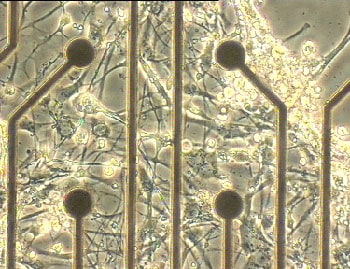
Eshel Ben-Jacob and colleagues used an in-vitro technique to study the effect of cell density on the formation of neuronal clusters. The researchers grew cultures of rat-brain neurones on top of a silicon nitride surface and followed the development of the networks with time-lapse video recording. They found that the network, which is initially uniform, separates by the creation of ‘borders’ that break it into separate ‘basins’. Each basin then collapses into a cluster, which remains intact until it degrades 3 to 4 weeks later (see figure 1).

The scientists found that the network only evolved into clusters when the cell density was greater than 10 000 cells per square millimetre. The clusters, which each contain around 10 000 cells, are about 250 micrometres across and are inter-connected by axon bundles 10 micrometres in diameter. The Israeli team also measured the electric signals fired by cells grown on top of an array of microelectrodes (see figure 2). It found that the neural networks were able to self-control the strength of their interconnections, and their shape, to maintain the required level of electrical activity.

Ben-Jacob and co-workers say that their results “might provide important clues towards understanding self-organization in the central nervous system and the brain itself.” The group now plans to grow well-defined networks and compare their development with those of randomly grown ones.

Bismuth breaks half-life record for alpha decay

Although bismuth-209 is commonly thought to be the heaviest stable isotope that exists in nature, theory suggests that it should be metastable and decay via alpha-particle emission to thallium-205. This decay is not easy to measure because the alpha particles generated have very little energy, which means that the isotope decays at a very low rate.

The equipment used by the Orsay team consists of two “heat and light” detectors that are enclosed in a reflecting cavity and cooled to 20mk. The first detector- containing bismuth-209, germanium and oxygen – undergoes a slight temperature rise when it absorbs an alpha particle. This temperature change is measured in the form of a voltage pulse whose amplitude is directly proportional to the energy released. The second detector, made from a thin disk of germanium, registers the light flashes from alpha-particle events.

The team performed two measurements, one with 31 grams of bismuth in the detector and the other with 62 grams. The scientists registered 128 alpha-particle events over 5 days and found an unexpected line in the spectrum at 3.14 MeV – now attributed to bismuth-209 decay. The half-life was calculated to be (1.9 +/- 0.2 ) x 1019 years, which is in good agreement with the theoretical prediction of 4.6 x 10¹⁹ years.

The technique could be also be used to accurately detect beta and gamma decays. “The experiment is a by-product of our search for dark matter,” team member Pierre de Marcillac told PhysicWeb. “Other kinds of decays such as protons from proton-rich nuclei could be studied by the same method but this will have to be proved!”

Computer models make “super-alloys”

Advances in metal alloying techniques are largely made by trial and error. Costly, time-consuming experiments result in only small improvements in physical and mechanical properties. Materials scientists rely on experimentally determined phase diagrams to design new alloys, but it takes millions of such diagrams to produce new multi-element structures- even for common metal combinations.

Now, Saito and co-workers have used three electronic “magic numbers” to make a novel set of alloys. The numbers are: the electron-to-atom ratio; the “bond order”, which represents the average bonding strength between atoms; and the d electron-orbital energy level, which represents the average electronegativity.

The researchers produced alloys based on titanium that also contained tantalum, niobium, zirconium, vanadium and oxygen in a simple body-centred cubic structure. Superior properties were observed only when all three of the magic numbers had specific values – 4.24 for the electron-to-atom ratio for example. The alloys do not expand on heating and are very strong. Moreover, they are super-elastic and super-plastic because they can be stretched without being deformed.

The team focused on the elastic modulus of the system – the ratio of the stress applied to the strain produced – and found a characteristic anisotropy in the metal crystals. “This anisotropy brings a new type of dislocation-free plastic deformation mechanism,” Saito told PhysicsWeb. “The mechanism makes it possible for the alloy to accumulate large amounts of elastic strain energy, which leads to the exceptional properties observed.”

Caesium violates parity in a new way

In quantum mechanics, parity is the operator that reverses all three directions in space. However, parity is not always conserved in nature. Lee and Yang first suggested this in 1956 to explain the decay of K-mesons and later that year Mrs Wu and colleagues observed parity violation in the radioactive decay of cobalt-60.

An accurate measurement of parity violation was made in Boulder in 1997. Two years later, the same team measured the strength of the parity violating weak interaction in a caesium atom when they determined the value of Qw – the weak charge of the nucleus – to a precision of better than 1%. This experiment measured how quickly the electric field of a laser beam could excite caesium atoms from the 6S ground state to the 7S excited state – a transition strictly forbidden by symmetry. The researchers found a deviation between the experimentally observed value and the theoretical value expected in the Standard Model. This deviation was large enough to imply physics beyond the Standard Model.

Now, Marie-Anne Bouchiat and colleagues at the Laboratoire Kastler Brossel in Paris and the Institute for Physical Research in Armenia have performed an independent measurement using an entirely new method to cross-check the Boulder result. Bouchiat and co-workers used a polarized laser beam to excite atoms from the 6S ground state to the 7S excited state in an electric field and found that there was an angular “atomic anisotropy” in the 7S states which violates parity. The researchers then looked at the transition from the excited 7S to 6P states –the transition following the 6S to 7S – using a “stimulation emission” technique which amplified the resonance of this allowed transition (see figure). The size of this amplification is used to determine the anisotropy coming from the excited vapour atoms that have violated parity.

Using their method the team was able to measure atomic parity violation to an accuracy of 9% but it hopes to achieve a precision of 1%in future experiments.

Giant CCD imager snaps first shot

The CCD chips, made by e2v technologies of the UK, are a key part of the CFHT’s wide-field digital imager called MegaCam. The chips are mounted in an aray that has a central area made from four rows of nine CCDs and covers an area of 25 x 25 cm. This is equivalent to a 1 degree x 1 degree field of view on the sky, roughly the size of four full moons. Each CCD chip is sensitive to wavelengths from 300 to 1100 nm and contains 2048 x 4612 pixels.

The company says its custom-designed chip packaging makes the devices ideal for astronomy. “The packaging is designed to ensure that chips fit together with a minimal amount of light lost by falling down the cracks between the chips,” Paul Jordan from e2v said.

It took e2v 18 months to manufacture all 40 CCD chips, each of which has a surface flatness better than 10 microns. “This ensures all the light stays in focus without the need for any mechanical correction,” explained Jordan. “As the instrument is suspended at the primary focus of the telescope, this makes the system lighter, smaller and cheaper to construct in the long run.”

Before upgrading to the MegaCam, the CFHT used an imaging device based on 12 CCDs. “The new system has a much larger field of view and will allow astronomers to produce single images that contain much more information,” said Jordan. “Instead of seeing just a few stars in one image, astronomers can now see clusters of stars or extended galaxies.”

The MegaCam has only been in action since the beginning of April but has already acquired some spectacular images. With exposure times ranging from a few seconds to several minutes, the MegaCam can also acquire images much faster than other imaging methods, such as photographic plates.

Light flashes investigated on Mir

The Earth is surrounded by a spherical magnetic field known as the magnetosphere, which protects it from cosmic radiation. However, at a certain location over the South Atlantic Ocean – off the coast of Brazil – this shielding effect is weaker. Spacecraft passing through this so-called “South Atlantic Anomaly” (SAA) are exposed to higher fluxes of cosmic rays – in particular protons.

The Mir astronauts recorded the number of flashes they observed while wearing helmets containing particle detectors as Mir’s orbit passed through the SAA. Marco Casolino from the University of Tor Vergata in Rome and an international team of colleagues plotted the light-flash rate against the number of particles – mostly protons. They also plotted the flash rate against the number of relativistic nuclei, to completely remove the proton component, inside and outside the SAA.

The researchers found that the light-flash rate was not related to the number of protons detected, which means that that the light flashes cannot be caused by protons alone. Moreover, light flashes inside the SAA are more frequent than outside it: 0.15 flashes per minute were counted inside compared to only 0.06 per minute outside. This implies that there must be another factor contributing to flashes inside the anomaly.

The team proposes two complementary mechanisms to explain these findings. The first is the direct interaction of heavy nuclei with the retina that causes ionization or excitation and the second, proton-induced nuclear interactions in the eye that produce knock-on particles.

Solar cells become thinner and cheaper

Most commercial solar cells use flat substrates on which a light-absorbing layer is deposited. The new device built by Koenenkamp and colleagues, however, consists of a cadmium-tellurium absorber layer deposited on top of a structured substrate made of porous titanium dioxide (see figure). When photons hit the absorber layer, they excite electrons into the conduction band of the material where they are registered as electrical current. Any stray photons are scattered back into this layer by the pores in the titanium dioxide. This creates an output current that is up to fifty times greater than in a substrate-cell made up of flat, non-porous material.

Using such a structured cell shortens the transport path for the photo-excited electrons which means that the material can be of a relatively low quality. The light path through the absorber, meanwhile, is enhanced through scattering which means that a higher proportion of incident sunlight is absorbed and that less material needs to be used in the cell.

The researchers found that a cadmium-tellurium layer 150-200 nm thick was sufficient to absorb most of the sunlight. The cell produces a voltage of 0.67 V and a current of 8.9 mA cm-2 when illuminated with 100 mW cm-2 of sunlight. This is comparable to conventional solar cells, which typically produce between 0.5 and 1 V. In addition, when the absorber was alloyed with mercury, the current was boosted by more than 50% to 15 mA cm-2.

“Although these cells are still less efficient than existing cadmium-tellurium solar cells, our results show that absorber material considered useless for flat cells can still give good output when highly structured substrates are used,” Koenenkamp told PhysicsWeb. “These findings may open the way to less expensive processes in photovoltaics.” The team now hopes to show that the same principle could be applied to other materials, such as amorphous silicon and compound solar cells.

Copyright © 2026 by IOP Publishing Ltd and individual contributors