B mesons decay in a new way

B mesons are particles that consist of a “bottom” quark or antiquark plus another lighter quark or antiquark. B mesons have been observed decaying into various combinations of baryons – particles that contain three quarks – and other mesons before, but never into two baryons. The Belle collaboration has now observed B mesons decaying into an antiproton and a lambda baryon, Λc+. This particle contains an up, down and a charmed quark.

There are three currently accepted models for the decay of B mesons into a Λc+ and an antiproton: the diquark, QCD sum rule and pole models. The predictions of the models differ by an order of magnitude and the Belle experiment is able to distinguish between them.

An elementary particle can decay into a certain number of lighter particles. Most particles exhibit several different decay modes, leading to the production of a specific set of particles. The fraction of the time a particle decays via a specific mode is known as the “branching” fraction. The researchers measured this fraction for the decay of the B meson into an antiproton and a Λc+.

The team found a value of approximately 2.19 x 10⁻⁵ for the two-body decay of the B meson. This fraction is about an order of magnitude smaller than a three-body decay, which suggests that the ‘pole’ model is correct.

Anti-Einstein sentiment surfaces again

One’s first reaction to books like this is to follow Virgil’s advice about the trimmers in hell: “Speak not of them, but look, and pass them by” (Dante Inferno III 51). Yet there are reasons for reviewing this book in spite of its lack of originality or intellectual merit. Its author has gained a certain notoriety as the result of his indefatigable – not to say monomaniacal – efforts to indict Einstein as an “incorrigible plagiarist”.

By his own claim, this is the author’s sixth book on the subject of Einstein’s work on the special and general theories of relativity. (A search of the Internet, however, turned up no record of the other five.) Its publication by a “vanity publisher” has brought Bjerknes appearances at bookstores, articles in newspapers and magazines, recommendations on several websites, to mention just a few of the 355 items that a search on Google did reveal.

The book is of interest as the latest manifestation of an undercurrent of hostility towards Einstein that has run for almost 90 years, surfacing from time to time. Since the inception of the theories of relativity – both special and general – Einstein and his work have been attacked on the basis of numerous physical and philosophical misunderstandings and/or prejudices, quite often tinged with various versions of anti-Semitism.

Relativity has been attacked in the name of US pragmatism, German idealism, English Hegelianism, French Bergsonianism (by fellow Jew Henri Bergson!), Soviet “diamat” (dialectical materialism) and Nazi “Deutsche Physik” (German physics), to name but a few of the high-minded (and not so high-minded) points of the compass from which such attacks have originated over the years.

So it seems worthwhile to review such a book – if only to be reminded that the current still runs strong – and to highlight the need for caution in uncritically accepting the claims of such “objective” attacks on Einstein. (I hasten to add that serious critical scrutiny of any person or theory is always welcome.)

This book is primarily an industrious compilation of citations taken from various points of the intellectual compass. Well over half of the book consists of quotations in English and in various original languages, with source notes – all duly accurate as far as I checked. The one glaring exception is of a supposed quotation from Einstein that appears on the front cover of the book – “The secret to creativity is knowing how to hide your sources” – for which no source is given. This liberal helping of quotations is seasoned with the author’s own comments, examples of which are given below.

The citations fall into three broad classes. First, there are those from the traditional anti-Einstein literature. They range from Nobel-prize winners, like Johannes Stark and Philip Lenard, through run-of-the-mill physicists such as Ernst Gehrke, to out-and-out confidence tricksters, like Paul Weyland, to name but some of those cited from the Weimar Republic days. Bjerknes does not cite their anti-Semitic outbursts or mention their Nazi connections, nor does he cite any of the extensive literature from the Nazi era that attempted to salvage the special theory (while savaging Einstein) by attributing it to the “Aryans” Hendrik Antoon Lorentz and Henri Poincaré. He does cite Sir Edmund Whittaker, Herbert Ives, and many other non-Germans who made similar attacks without any public anti-Semitic comments.

Apparently, it does not bother Bjerknes that the various opponents of the special and general theories that he cites attack relativity from mutually contradictory viewpoints. Nor does he seem to realize the incongruity of endorsing claims that Einstein’s theories are wrong as well as claims that they were plagiarized from valid sources! The culmination of Bjerknes’s uncritical piling of name upon name is found on pages 231-233, which constitute two full pages of names, ranging from the famous – like Gauss and John Locke – to unknowns like Pavannini and Caldonazzi, all of whom are cited as having made unnamed (but referenced) “contributions toward the general theory of relativity”.

In the second main category of citations, Bjerknes cites carefully chosen excerpts from numerous valuable accounts of the development of relativity theory that discuss the role of Lorentz, Poincaré and many others. These researchers carried out work on the optics and electrodynamics of moving bodies that helped to create the intellectual atmosphere that led to the formulation of the special theory.

The author, however, takes any hint that Einstein did not work in an intellectual vacuum as proof positive that he was a plagiarist – as if any scientific creation is a purely individual activity. Einstein himself acknowledged that the special theory of relativity would soon have been formulated without him, while claiming (correctly I believe) that, in his absence, the general theory would not have been so easy to arrive at. Indeed, Bjerknes has a much harder time producing evidence of Einstein’s “plagiarism” of the general theory, a topic I shall not discuss.

I will mention just one example of the author’s method of citation: his treatment of Wolfgang Pauli, in which case we are fortunate in having additional information. Writing of Einstein’s role in the development of special relativity, Bjerknes argues: “In 1921 Wolfgang Pauli set the record straight in the Encyklopädie der mathematischen Wissenschaften.” He then cites extensively – but not completely – Pauli’s comments on the roles of Woldemar Voigt, Lorentz, Poincaré and Einstein in developing some of the key concepts in the now-standard version of the special theory.

The author concludes: “After giving Poincaré his due credit, and acknowledging that Einstein holds no priority for the special theory of relativity, Pauli, half-heartedly, pays the seemingly obligatory homage to Einstein the then recently emerged celebrity [by writing] ‘It was Einstein, finally, who in a way completed the basic formulation of this new discipline.'”. Bjerknes then adds: “It appears that Pauli was forced, or felt compelled, to praise Einstein with additional inappropriate and, evidently, insincere comments.”

But what if we consult letters that were sent to Pauli by Felix Klein – the renowned German mathematician who orchestrated the Encyklopädie? It emerges from these letters that indeed “Pauli was forced, or felt compelled” by Klein – although not to praise Einstein more, but to say more about the role of Poincaré and Lorentz! Similarly, Klein asked Pauli to give more credit to Hilbert in his discussion of the origins of the general theory (see Wolfgang Pauli 1979 Scientific Correspondence with Bohr, Einstein, Heisenberg, a.o. Volume 1 1919-1929 (Springer, Berlin)).

Lest Bjerknes now seize upon these letters as evidence against Einstein, let me hasten to add that in them Klein evaluates Einstein’s work most highly. He refers to Einstein as “a genius” and points out that “[t]here still remains enough [credit] in this connection for Einstein”. Klein also exonerates him from any role in the public hullabaloo: “In his personal comments Einstein is always so lovable, quite in contrast to the insane publicity that is set in motion in his honour.”

Finally, let us see what Pauli says in full about Einstein in his Encyklopädie article. After the sentence cited by Bjerknes above, Pauli continues: “[Einstein’s] paper of 1905 was submitted at almost the same time as Poincaré’s article and had been written without previous knowledge of Lorentz’s paper of 1904. It includes not only all the essential results contained in the other two papers, but shows an entirely novel, and much more profound understanding of the whole problem. This will now be demonstrated in detail.”

No wonder Bjerknes does not cite the whole passage!

In the final category of citations in this book, Bjerknes refers many times to the more recent anti-Einstein literature, claiming that Einstein plagiarized the ideas of his first wife, Mileva Einstein-Maric. I have published extensive discussions of this claim – see, for example, “Albert Einstein and Mileva Maric: a scientific collaboration that failed to develop”, which appears in my book Einstein from B to Z (2002 Birkhäuser). I will, therefore, cite just a couple of examples of the intellectual level of Bjerknes’s arguments. Since the author claims that the work – no matter who did it – is plagiarized, he ends up with statements that would be truly ludicrous were they not an insult to a woman who deserves better.

On pages 214-215, for example, Bjerknes writes: “Mileva once hinted to Albert that she was contemplating publishing her memoirs. Albert told her to keep her mouth shut, and may have intimated that he, an innocent idiot, would suffer less than she, the incorrigible plagiarist…What would Mileva have stood to gain by revealing that Albert had taken credit for her work, when she herself had merely repeated what others had already published?”

His discussion of the agreement that the pair came to as part of their divorce settlement – namely that Albert would give Mileva the Nobel-prize money, should he receive that prize – is in a similar vein. “If one thief steals a stolen purse from another thief, then offers to split the purse,” he writes, ” what option does either thief have, but to keep silent and spend the money?”

But our author does endeavour to be fair minded. On page 217 he writes: “Did Albert have no choice but to copy what others had published before him, if indeed he ever actually did? Was he of sub-average intelligence? Given that this issue is still controversial, I’ll give Albert the benefit of the doubt and regard the 1905 paper [on special relativity] as a co-authored work.”

I opened with a quotation from Dante’s Divine Comedy. I will close with one from Mark Twain’s Tom Sawyer: “Let us draw the curtain of charity over the rest of the scene.”


Are the laws of nature changing with time?

WHAT do we mean by “the laws of nature”? The phrase evokes a set of divine and unchanging rules that transcend the “here and now” to apply everywhere and at all times in the universe. The reality is not so grand. When we refer to the laws of nature, what we are really talking about is a particular set of ideas that are striking in their simplicity, that appear to be universal and have been verified by experiment. It is thus human beings who declare that a scientific theory is a law of nature and human beings are quite often wrong.

The development of a scientific theory has always followed the need to understand an observation for which no satisfactory explanation previously existed. When developing new theories, physicists tend to assume that fundamental quantities such as the strength of gravity, the speed of light in a vacuum or the charge on the electron are all constant. And when these theories are found to predict the results of new observations, our belief that these quantities are actually fundamental constants becomes even stronger.

Moreover, despite the rapid changes in technology in recent decades, the timescale on which fundamental new discoveries in physics are made is typically comparable to a human lifespan. This means that theories developed decades ago can appear as if they have been carved in granite.

The end result is a natural reluctance to change our understanding of the world. But it is vital to remember the limitations that have been involved in testing these assumptions. Many of the experiments we carry out to test theories are restricted to the here and now to Earth-bound research labs or to the small part of the universe that we can observe with telescopes. If we could somehow do our experiments in a different place or at a different time, we might well find that the results are different. Indeed, that is what appears to happen when we measure something called the fine-structure constant in the very distant past.

What is the fine-structure constant?

Have the laws of nature remained the same since the Big Bang some 13.5 billion years ago? Paul Dirac first posed this question in 1937, and he was still interested in this idea when he visited the University of New South Wales (UNSW) in Sydney in 1975 where I am now based. Dirac attempted to link the strength of gravity, which describes the large-scale properties of the universe, with the various constants and numbers that characterize the small-scale properties of the universe. In doing so, he claimed that one of the constants of nature, the strength of gravity, should change with time.

Although observations subsequently ruled out Dirac’s ideas, advances in many areas of physics and astronomy have resulted in a whole new set of opportunities for us to search for any hint that the constants of nature might vary. The particular question that I have been vigorously pursuing with colleagues at UNSW and elsewhere can be stated as follows: is the fine-structure constant really constant, or has its value changed over the history of the universe?

The fine-structure constant, α, is a measure of the strength of the electromagnetic interaction, and it quantifies the strength with which electrons bind within atoms and molecules. It is defined as α ≡ e2/h bar c ≈ 1/137, where e is the charge on the electron, h is Planck’s constant divided by 2π, and c is the speed of light in a vacuum. The fine-structure constant is of particular interest because it is a dimensionless number. This makes it even more fundamental than other constants such as the strength of gravity, the speed of light or the charge on the electron (see Constants with and without dimensions).

There are theoretical reasons why α and other dimensionless constants might vary with time. The holy grail of theoretical physics is to find a single unified theory that describes the four fundamental forces: gravity, electromagnetism, and the strong and weak nuclear forces. Although the strengths of these four forces differ, as do the distances over which they operate, most physicists believe that a unified theory will be discovered. If such a theory is not found, a great deal of the elegance and beauty of fundamental physics will be lost.

Einstein’s theory of gravity the general theory of relativity only requires three spatial dimensions. However, the leading contender for a unified theory requires extra dimensions beyond our familiar three. We do not know if these unified theories are correct, but if extra dimensions do exist, they must be tiny compared with our ordinary spatial dimensions.

The concept of attributing a “size” to a dimension may seem strange but it is important. The current size of the universe is determined by the distance that light has travelled since the Big Bang (i.e. about 13.5 billion light-years) and by the amount by which it has expanded since then. This means that the actual size of the universe is about 40 billion light-years and rising.

Are the extra dimensions predicted by unified theories also expanding at the same rate as the universe? The answer to this question is no. If the tiny extra dimensions were expanding at this rate, then the strength of gravity would also be changing very rapidly, and there is no evidence for this. However, it may be possible to infer the presence of these extra dimensions if they exist by detecting small changes in the strength of gravity or the other three forces.

It has been predicted, for instance, that “large” extra dimensions might cause small deviations in the inverse-square law of gravity over distances of less than 1 mm. However, recent measurements by John Price and co-workers at the University of Colorado at Boulder have failed to find any evidence for this over distances of about 100 µm (J C Long et al. 2003 Nature 421 922). This is just one of many experiments that have been set up to perform high-precision tests on constants, forces and fundamental symmetries in recent years.

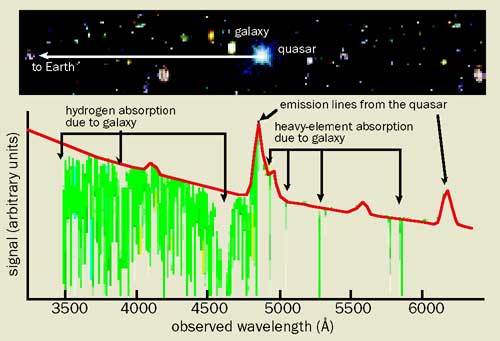
There are several ways to measure possible changes in α with time. We can measure the absorption spectra of quasars at different redshifts, as we have done at UNSW. We can compare the “ticking rates” of atomic clocks made of different elements (see Searching for changes in the fine-structure constant using atomic clocks). We can also study the cosmic microwave background or the creation of the elements in the early universe. However, one of the first methods used to probe how α might have changed over the past two billion years relies on what must be one of the most unusual processes ever studied by physicists the so-called natural nuclear reactor at Oklo in Central Africa.

When photonic crystals meet Fibonacci

One of the clearest optical features in a regular, periodic photocrystal is the photonic band gap, which is similar to the electronic band gap a semiconductor. Light in a certain wavelength range simply cannot get through the structure because the photons that are scattered forward by the holes end up cancelling each other out while reinforcing each other in the reflected directions. These band gaps can result in “super-prisms” that drastically split up very similar colours of light, in structures that dramatically reduce the speed of light, and materials with negative refractive indices.

The bizarre effects of photonic crystals can also occur when the scattering structures are random, since the interference can be strong enough to completely localize the light. Now an Italian-Dutch collaboration has found that light can be slowed substantially in photonic structures that are neither regular nor random but quasi-periodic. And not just in any quasi-periodic structure, but one that follows the famous Fibonacci sequence (L Dal Negro et al. 2003 Phys. Rev. Lett. 90 55501).

Jeremy Baumberg from the Department of Physics / Electronics and Computer Science at Southampton University in the UK describes how photonic crystals based on the Fibonacci sequence could be the optical chips of the future in the April issue of Physics World

Photon steam engines

Modern society relies heavily on the conversion of heat into mechanical work. The first heat engines were responsible for the industrial revolution, but behind the scenes they were also fuelling the development of thermodynamics. In 1824 Sadi Carnot’s interest in improving the performance of steam engines led him to think about the efficiency of a heat engine in a new and fundamental way. He concluded that the maximum efficiency of a heat engine that absorbs heat from a reservoir at a given temperature, T2, and rejects heat to another reservoir at a lower temperature, T1, is η = 1 – T1/T2. In other words it is impossible to extract work from a single heat bath – a rule that we now know to be a consequence of the second law of thermodynamics.

Then came quantum mechanics. Classical thermodynamics tends to work for large numbers of atoms or molecules, which means that some quantum systems can at first appear to violate its basic laws. Now Marlan Scully and co-workers at Texas A&M University and Herbert Walther at the Max-Planck Institute for Quantum Optics in Garching have proposed a “quantum Carnot engine” that displays features that are simply not possible with a classical engine. In particular, their quantum engine can extract work from a single heat bath (M O Scully et al. 2003 Science 299 862-864).

Quantum steam

Carnot’s conceptual heat engine operated in cycles such that there is no change in the internal energy of the working fluid – such as steam – during a cycle. More heat is converted to work as the number of operating cycles increases, without the engine itself being a source of any work. In particular he considered a reversible closed cycle consisting of two isothermal (constant temperature) processes and two adiabatic (no external exchange of heat) processes. He showed that no heat engine operating between two temperatures could be more efficient than a Carnot cycle. But he was wrong.

The “steam” in the new quantum Carnot engine considered by Scully and colleagues comes in the form of photons. The radiation pressure from the photons drives a piston in an optical cavity, which also doubles as one of the cavity mirrors. The other cavity mirror is used to exchange heat with a heat sink at temperature T1. A second heat bath at a higher temperature T2 is required as a source of heat for the radiation, in analogy with the classical Carnot engine.

Scully and co-workers take this source of heat to be a stream of hot atoms, which flows through the cavity and exchanges energy with the photons through emission and absorption processes. These atoms flow out of the cavity at a cooler temperature and are then reheated in a second cavity known as a “hohlraum”. Once the atoms have been heated to T2 they are re-injected into the first cavity for the next cycle of the quantum Carnot engine (see figure).

The quantum and classical Carnot engines therefore operate in the same way – a closed cycle of two isothermal and two adiabatic processes. However, in its simplest form the quantum Carnot engine cannot extract work from a single heat bath. If Qin is the energy absorbed from the bath atoms during the isothermal expansion and Qout is the energy given to the heat sink during the isothermal compression, then the efficiency of the engine is η = (Qin – Qout)/Qin. If the bath atoms are assumed to be two-state systems that absorb and emit radiation at the same frequency, then standard thermodynamic formulas for the photon gas reveal that the efficiency of the quantum Carnot engine is η = 1 – T1/T2 – just as it is for the classical Carnot engine.

Quantum coherence

The new twist in the quantum engine occurs when the bath atoms have three states instead of two, which can result in what is called quantum coherence. If there is a non-vanishing phase difference between the two lowest atomic states, then the atoms are said to have quantum coherence. This can be induced by a microwave field with a frequency that corresponds to the transition between the two lowest atomic states.

Quantum coherence changes the way the atoms interact with the cavity radiation by changing the relative strengths of emission and absorption. The idea is that the atoms leaving the hohlraum at temperature T2 pass through a microwave cavity that causes them to become coherent with phase φ before they enter the optical cavity. They still cause the cavity radiation to come into thermal equilibrium, but the temperature that characterizes the radiation is now Tφ = T2(1 – nεcosφ), where n is the average number of photons for a thermal field at temperature T2, and ε is a small number that characterizes the magnitude of the quantum coherence.

The efficiency of the quantum-coherent Carnot engine can then be expressed as ηφ = (Tφ – T1)/T1. If ε is small, this becomes ηφ ~ η – (T1/T2)nεcosφ, where η is the efficiency of a classical Carnot engine as before. Thus, depending on the value of φ, the efficiency of the quantum Carnot engine can exceed that of the classical engine – even when T1 = T2. It can therefore extract work from a single heat bath.

And the second law?

At first glance this might seem trivial, since the atoms leaving the hohlraum are simply made hotter by the microwave generator, causing the radiation field to become hotter than the temperature of the hohlraum. This is not the case. Microwave heating of the atoms has no direct effect on the temperature Tφ of the cavity radiation. It is the quantum coherence that is induced by the microwave that makes Tφ different from the hohlraum temperature. There is, of course, a cost for this coherence – the microwave energy required to produce the coherence must exceed the net energy that is extracted from the heat bath.

Furthermore, extracting work from a quantum Carnot engine does not violate the second law of thermodynamics because the quantum coherence also costs extra entropy, which ensures that the overall entropy of the system is always increasing.

Practicalities aside, a quantum Carnot engine may one day provide a “quantum afterburner” that will increase the efficiency of a conventional combustion engine. Such a hybrid device would exploit the temperature difference between the combustion and exhaust phases of the four-stroke Otto cycle (see “The energy-saving quantum afterburner” Physics World March 2002 p6 print version only).

The point is that atoms with quantum coherence constitute a substance that is fundamentally different from conventional working fluids such as steam or Freon, which allows us to extend our understanding of thermodynamics at the interface of classical and quantum physics.

The Newton-Beethoven analogy

In his book Franklin and Newton, science historian I Bernard Cohen cites a remark attributed to Einstein that “even had Newton or Leibnitz never lived, the world would have had the calculus, but that if Beethoven had not lived, we would never have had the C-Minor Symphony”.

The Newton-Beethoven comparison – which I have heard expressed in different ways using different scientists and artists – is one of the most dramatic ways of posing the question of the relation between the sciences and the arts. The usual argument contrasts the two, on the basis of the assumption that while the products of science are inevitable those of the arts are not.

In theory…

Many attempts have been made to account for this inevitability. The philosopher Immanuel Kant’s answer involves the role of what he calls “genius”. According to Kant, genius exists in the arts but not in the sciences – despite the common romanticization of scientists like Newton. While scientists can teach others their work, artists produce original works, the secret of the creation of which is unknown.

“Newton could show how he took every one of the steps he had to take to get from the first elements of geometry to his great and profound discoveries,” Kant wrote, “not only to himself but to everyone else as well, in an intuitive[ly clear] way, allowing others to follow.” This is not the case with Homer and other great poets. “One cannot learn to write inspired poetry,” continued Kant, “however elaborate all the precepts of this art may be, and however superb its models.” He believed that works of genius can, however, become examples for minds of lesser originality, which is what gives us schools and traditions in the arts and humanities.

The astronomer and historian Owen Gingerich has made an interesting case in favour of an analogy rather than a contrast. The Newtonian world system is not inevitable, he argues, because alternative explanations for celestial phenomena (in the form of Kepler’s laws) can be derived from other sources such as conservation laws. Gingerich’s demonstration of an alternative highlights the role of imagination and creativity in Newton’s achievement, and in doing so also highlights the singular nature of his work. “Newton’s Principia is a personal achievement that places him in the same creative class as Beethoven or Shakespeare,” Gingerich concludes.

But Gingerich cautions against drawing the Newton-Beethoven analogy too closely. “The synthesis of knowledge achieved in a major scientific theory is not fully the same as the ordering of the components in an artistic composition,” he says. A scientific theory is constrained by nature, and is subject to “experimentation, extension, falsification”. Scientific achievements can be legitimately and even inevitably paraphrased (who but historians reads the Principia any more?) in ways that artistic works cannot. And the way that science progresses is very different from the arts.

Nevertheless, Gingerich concludes, careful analysis of the Newton-Beethoven comparison – of the analogy and the contrast – allows us “to gain a more sensitive view of the nature of scientific creativity”.

…and in experiment

The Newton-Beethoven comparison takes on another dimension if the issue is not theory building but devising and carrying out experiments. Experimentation is often viewed by outsiders as an automatic process involving minimal creative input. In this picture, experimentation resembles the game show “Concentration”, which ran on American television between 1958 and 1973. Contestants had to discover and interpret what lay behind the hidden faces of a set of blocks mounted in a wall. As the game proceeded, the blocks were rotated one at a time to reveal portions of a picture represented by words and symbols, which the contestants vied to decipher. The blocks were rotated by off-stage technicians – the “experimenters” – who activated hidden machinery. The mechanical process was of no real interest to the contestants, who only paid attention to the data on the surface.

The “Concentration” view of experimentation is, of course, inaccurate. Nothing is automatic or inevitable about a well designed experiment, and devising one can involve what Kant calls genius, for which no rule exists beforehand. When staged ingeniously enough, elements that we can understand and control – for example the speeds of balls rolling down a ramp, the shape of beams of light passing through an array of prisms or the procession of a pendulum’s plane of oscillation – can reveal something new about the world of which they are a part. Form emerges out of chaos.

The critical point

Kant is surely right that style and tradition work differently in the sciences and the arts. An experiment is not recognizably a “Newton” or “à la Newton” in the same way that a painting may be recognizably a “Caravaggio” or “à la Caravaggio”. However, experimental work involves a different kind of ingenuity. Although also dependent on imagination and creativity, such ingenuity is not inevitable and creates its own kind of tradition of exemplars because it opens up new domains of research. An experiment is detachable from any specific performance, can be re-performed in myriad other ways with different technologies and degrees of precision, and is therefore a permanent contribution to culture.

The scientific imagination, like the artistic imagination, is a rigorous and disciplined one. It works within a set of existing resources, theories, products, budget and personnel. It fashions these elements into a performance that allows something new to appear, the design of which was not necessarily inevitable. Of course, a larger budget and improved materials would be better. But the experimental imagination looks on the pool of existing resources not as limiting but enabling, and makes its product work with what is available in the here and now. In this respect, the Newton-Beethoven analogy is more comparison than contrast.

Making light of a difficult phase

If these pulses can be shortened to the scale of attoseconds, then the electromagnetic fields within them will be changing on the same timescale as the motion of the electron. This means that physicists can use the pulses to steer electrons with astonishing precision, and control processes such as the emission of light and chemical reactions.

Until now, however, there has been a fundamental obstacle to the production of such short pulses. At the sub-femtosecond level, a laser pulse contains only a few cycles of the carrier electromagnetic wave. As the pulse evolves the carrier wave can therefore become out of phase with the amplitude envelope, which can lead to a variety of different electric-field waveforms. This makes it difficult to put the pulse to any constructive use. The difference in phase between the carrier and envelope waves is called the carrier-envelope phase (CEP), and controlling it precisely is essential for a new generation of experiments that will probe and manipulate processes that occur on a sub-femtosecond timescale.

Now physicists in Vienna and Germany have managed to do just that, allowing the carrier-envelope phase of a high-power ultrashort pulsed laser to be altered at will. With this set-up they were able to control electrons at the scale of 250 as (250 x 1018s), and they claim that their technique is limited only by the most fundamental barrier we know – quantum-mechanical uncertainty (A Baltuska et al. 2003 Nature 421 611).

This article by John Tisch and Jon Marangos from the Department of Physics at Imperial College, London can be read in full in the April issue of Physics World.

Exploding excited electron bubbles

The “particle in a box” is a standard second-year quantum-mechanics problem, much beloved by lecturers and mastered (or not) by successive generations of undergraduates. An electron bubble in liquid helium provides a strikingly simple example of this kind of system, and theory predicts that it should exhibit a series of excited states. But these states have never been demonstrated experimentally. Now Denis Konstantinov and Humphrey Maris of Brown University in the US have observed one of the excited states for the first time by exploding electrons bubbles with sound waves (D Konstantinov and H Maris 2003 Phys. Rev. Lett. 90 025302).

Read this article, by Peter McClintock from the Department of Physics at Lancaster University, in full in the April issue of Physics World.

Astrophysics and air travel

The majority of the exposure comes from cosmic radiation that originates outside our solar system. Violent events such as stellar flares, supernovae and the explosion of galactic nuclei produce a concoction of subatomic particles, primarily protons and electrons. The energies of these particles can be greater than 1020 eV – billions of times higher than in the most powerful particle accelerators – although such energetic particles are very rare. Nuclear particles, which comprise about 98% of the radiation, typically have energies that are between 100 MeV and 10 GeV per nucleon.

In the April issue of Physics World, Graeme Taylor of the National Physical Laboratory in the UK describes a proportional counter that can measure cosmic radiation in more detail.

Ruby slows light at room temperature

The spectral “hole” forms due to coherent population oscillations that are set up when an argon-ion laser operating at 514.5 nm is shone on the ruby. The oscillations lead to a rapid variation in the refractive index of the ruby over a very narrow range of wavelengths, and this greatly reduces the group velocity. Moreover, the ruby is transparent over this narrow range of wavelengths.

The authors write that the pulse slowing depends on the intensity and modulation of the light. “By moving the ruby a small distance away from the focus, we could greatly increase the measured delay,” they report. “The group velocity can be controlled by changing the modulation frequency or the input intensity.”

Moreover, because the technique is easy to implement and involves only one laser, the Rochester team reckons it could find practical applications in telecoms. Light pulses passed along transmission lines could be stopped or delayed in crystals to synchronize or store them.

Copyright © 2026 by IOP Publishing Ltd and individual contributors