

Black holes give as well as take

Theorists have predicted that light emitted by quasars should act as a kind of wind, blowing gas from the accretion disc that surrounds a quasar’s black hole into intergalactic space. This occurs because ions in the gas absorb photons and acquire their momentum.

Chartas and colleagues observed this phenomenon by studying the absorption of X-rays from two quasars known as APM 08279+5255 and PG1115+080, using the “gravitational lensing” of intervening galaxies to magnify the unabsorbed radiation. Astronomers have previously found evidence for this effect in the ultraviolet region of the spectrum, but the new data suggest that X-rays could eject material into space at about ten times the rate of radiation at longer wavelengths.

“The winds we measured imply that as much as a billion suns’ worth of material is blown away over the course of a quasar’s lifetime,” said Chartas.

By measuring the relativistic Doppler shift of the absorption lines, the researchers calculated that the ejected gas was travelling at 40% of the speed of light, considerably faster than predicted. They also found that the quasar winds might regulate the growth of black holes and stimulate star formation.

The results, which were presented yesterday at a meeting of the American Astronomical Society in Quebec, come from data obtained by NASA’s Chandra X-ray Observatory and the European Space Agency’s XMM-Newton satellite. XMM-Newton and Chandra, the third of NASA’s “great observatories” after the Hubble and Compton satellites, were both launched in 1999.
Nuclear era ends at Risø

Originally founded to carry out research on atomic energy, Risø developed a more general energy focus and its nuclear research facilities were mothballed as nuclear power was given lower priority by successive governments. It will now concentrate on other energy technologies such as fuel cells, wind and wave energy.

“This marks a new era for Risø,” said Jørgen Kjems, the laboratory’s managing director. “We can now focus fully on research in new, sustainable energy technologies. This means that Denmark can play a progressive roll in meeting the Kyoto agreement to ensure a better global environment.”

Gamma-ray afterglow reveals new secrets

A gamma-ray burst is a short, intense flash of gamma rays that can last from a few milliseconds to about a hundred seconds. This is followed by an afterglow of longer wavelength radiation that can last for weeks or even years. Until now, however, there has always been a delay between detection of the burst and the first observation of the afterglow.

Fox and co-workers used the High Energy Transient Explorer II (HETE II), which can transmit accurate gamma-ray burst positions to Earth in real time. On 4 October 2002 HETE II sent a signal just 49 seconds after a burst – called GRB 021004 – was located. Among the first telescopes to respond were the Automated Response Telescope in Japan and 48-inch Palomar Oschin Telescope in California.

Other telescopes across the globe then continued taking images for several weeks until the afterglow finally disappeared.

The researchers found that the early afterglow decayed much more slowly than predicted, which means that gamma-ray bursts must be more powerful than previously thought. These findings support the “collapsar” model in which the core of a massive star collapses into a spinning black hole. Moreover, further analysis of the X-ray and optical afterglow showed unusual and hitherto unseen energy variations in the spectrum.

Good news for negative-index materials

Costas Soukoulis and colleagues at Iowa State University in the US and the FORTH laboratory in Greece performed computer simulations on a left-handed photonic crystal to show that causality remains intact in such materials (S Foteinopoulou et al. 2003 Phys. Rev. Lett. 90 107402).

The researchers solved Maxwell’s equations to study how an electromagnetic wave evolves in time as it hits the surface of a negative-index material. They saw that the incoming beam was refracted in the negative direction – as expected – but they also noticed that this refraction did not occur straight away. Instead, the whole wave front was temporarily trapped in the surface region. Soukoulis and colleagues argue that the delays caused by this trapping explain how the outer rays in the beam appear to travel faster than the velocity of light.

“These calculations are an important confirmation that the speed of light is not violated by negative refraction,” John Pendry, a theorist at Imperial College in London who did much of the early work on negative-index materials, told PhysicsWeb. “It is time to move on and start making use of these amazing new materials.”

Further experiments and simulations confirming the existence of negative-index materials have been performed by Claudio Parazzoli and co-workers at the Boeing Phantom Works in Seattle (Phys. Rev. Lett. 90 107401), and by Andrew Houck and colleagues at Harvard University and the Massachusetts Institute of Technology (Phys. Rev. Lett. to be published).

Muons join the fight against nuclear smugglers

Although it is widely used for imaging, X-ray radiography cannot penetrate dense objects or produce three-dimensional images easily. In contrast, muons are highly penetrating – a typical cosmic-ray muon can pass through more than 10 metres of water – and could be used to produce radiographic images of medium-to-large objects in a short exposure time.

To demonstrate the technique, Borozdin and co-workers sandwiched a small tungsten cylinder between two pairs of muon detectors and measured the direction of the muons before and after they had interacted with the object (see figure). The deflections they measured were then used to generate a 3-D image of the cylinder.

The Los Alamos team then simulated the passage of the muons through the volume on a computer. They found that the simulated images were indistinguishable from the experimental ones. Simulations of larger, more complex objects showed that a 10x10x10 cm3 uranium object could be detected inside a large metal container – for example in a truck full of sheep – in about one minute of exposure time.

The team believes that the method may be suitable for a variety of applications in which radiography of dense objects with low radiation dose is required. This includes the surveillance of nuclear materials at borders. “We now intend to improve our analysis methods, to extract all the information possible from each muon,” team member William Priedhorsky told Physics Web. The team also hopes to make the detectors more economical and effective.

European research performance comes under scrutiny

The report focuses on four main areas; human resources; industry and competitiveness; universities and public research centres; and European perspectives. The EU produced 2.14 million graduates in science and technology in 2000, compared to 2.07 million in the US and 1.1 million in Japan. However, it only employed 5.4 researchers per 1000 workers, compared to 8.7 in the US and 9.7 in Japan. Almost three quarters of European post-graduates who go the US for their PhDs prefer to stay there after completing their studies. This number has been rising since the beginning of the 1990s.

The EU devoted a much smaller proportion of its national wealth to research compared to the US and Japan. This gap is increasing because the European private sector invests much less in research and development.

The report also finds that European civil research did not benefit from the decline in military research budgets. Europe does not seem to be able to translate defence research into technological applications, in marked contrast to the US.

Speaking at the launch of the report, European Research Commissioner Philippe Busquin said: “This is not just a study, it is a policy tool. It will enable European leaders in research and innovation to monitor their progress.” He also spoke about the “brain-drain” problem and how to address it. Policy-makers must use the benefits that Europe has to offer to turn Europe into the most competitive knowledge-based economy by 2010, he said.

Terahertz breakthrough at BESSY

Synchrotron radiation is produced when bunches of charged particles, usually electrons that have been accelerated to close to the speed of light, are forced to move in a circular orbit by strong magnetic fields. The wavelengths produced can range from low-energy far-infrared radiation to high-energy X-rays. Terahertz radiation is found at the low-energy end of the spectrum and corresponds to wavelengths between about 1 mm and 15 microns.

Synchrotron radiation is usually incoherent because the bunches – which contain billions of electrons each – are longer than the wavelengths they are emitting. However, if the bunches could be made much smaller, the electrons would then emit in phase with each other and the radiation would be coherent. The electron bunches in the electron storage ring at BESSY are typically about 5 mm long, which is too long to produce coherent terahertz radiation.

Wüestefeld and co-workers therefore adjusted the magnetic fields in the storage ring to produce a special “low-alpha” mode in which the length of the bunches was comparable with the wavelength of terahertz radiation. The electrons in each bunch now behave as one giant particle and emit a beam of coherent rays.

The BESSY team was able to increase the power of the beam by a factor of 105 when they used low-alpha optics. However, if the intensity is increased by too much the beam can become unstable.

Silver nanoclusters make logic gates

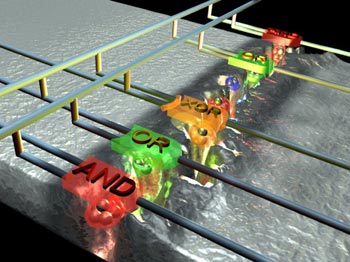
Logic operations – such as NOT, AND and OR – are traditionally carried out by semiconductor devices, but there is a limit to how small circuits that require electrical read-outs can be made. However, devices that rely on optical output are not limited in this way.

Dickson and Lee made the nanoclusters by applying a current to a thin oxidized silver film. The current causes the migration of electrons to produce a break-junction in the sample. Arrays of nanoclusters – which consist of between two and eight silver atoms – form along this break. The researchers take advantage of the fact that these nanoclusters possess well-defined energy levels and thus emit light only when a specific voltage is applied.

The Georgia Tech team applied two separate electrical pulses to their device. The first acts as a “gate” by concentrating holes in and around the silver molecules. The second pulse, applied less than 4 nanoseconds after the first, re-injects electrons into the discrete nanocluster energy levels. The pulse combinations allow current to flow in the device. Light is emitted when electrons and holes recombine within each nanocluster after the second pulse has been applied. “By reading the emission output of two correlated molecules, we can add pulses together and perform a very simple but very important basic addition operation,” says Dickson. Applying different pulses can also cause individual clusters to operate as “on-off” logic gates with AND, OR, NOT and XOR functions.

The researchers will now attempt to make larger optoelectronic arrays by increasing the number of nanoclusters in the devices. They also hope to learn more about how the clusters form and plan to look more closely at the break-junction and its properties.

How the Earth’s core was formed

It is believed that core formation occurred when the Solar System was very young – less than 30 million years old. The Earth formed from a cloud of dust and gas, and material began to come together to form kilometre-sized planets known as “planetisimals”. These planetisimals rapidly joined together to form larger planets, thousands of kilometres in diameter. Researchers think that the Earth had already formed a core at this early stage (figure 1).

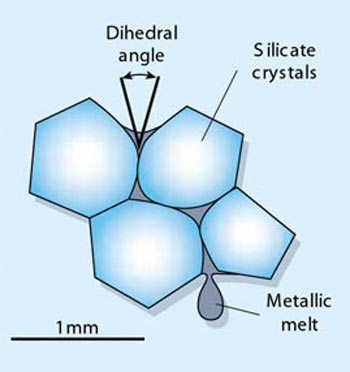
The Earth’s upper mantle is mostly made up of silicon oxide or “silicate” and a mixture of iron and magnesium oxide. At high temperatures, a metallic melt containing iron forms between grains of the silicate crystals because it has a lower melting point. For this metal to form a planetary core, it must separate from the silicate matrix and move through it (figure 2).

Tomoo Katsura and colleagues measured the electrical conductivity of the silicate and iron melt at temperatures of 1300oC and pressures of 3 gigapascals. These conditions correspond to those found about 100 km below the surface of the Earth. The conductivity of iron compounds is much larger than that of silicates, which allows small amounts of the metal alloy to be detected.

The researchers found high conductivities in their samples – corresponding to about 6% by volume of iron melt – which remained even after the temperature was reduced. The molten iron creates “connective” channels in the silicate allowing the metal to separate out.

The high temperatures needed to melt the iron may have come from the heat released from the radioactive decay of short-lived isotopes that were present in the early Solar System. If the high conductivities observed in the experiment correspond to the flow of metal through the silicate, then the separation of core from mantle could have occurred very quickly – in less than 3 million years – in small planetisimals with radii of less than 30 km.

New structure seen in the Crab pulsar

The Crab pulsar is a rotating neutron star in the constellation of Taurus, some 6520 light years from Earth. Formed as the result of a supernova explosion that occurred in 1054, it is known as a “cosmic lighthouse” because it emits extremely bright radio pulses thirty times a second as it rotates. It also emits radiation in the optical, X-ray and gamma-ray parts of the spectrum, but astronomers are still unsure about how this emission mechanism works.

Tim Hankins of New Mexico Tech and co-workers looked at the radio spectrum of the pulsar with the 305-m telescope at the Arecibo Observatory. They used a new detection method that was able to resolve down to the nanosecond time scale. “Because of the propagation through the plasma from the pulsar to the Earth, the short-wavelength parts of the pulsar signals arrive before the long wavelength parts, so the signals are ‘smeared’ across the receiver band,” Hankins told Physics Web. “We developed a technique for removing this smearing.”

The researchers selected a sequence of six giant pulses that were recorded over a period of a few minutes. The time interval between two giant pulses can typically vary from a fraction of a second to over a minute. Based on the very regular rotation rate of the pulsar, the giant pulses “jitter” by several hundred microseconds, relative to the time one would expect them to arrive if they resulted from a narrow beam rotating with the pulsar.

Occasionally, the researchers recorded a pulse that was composed of extremely short, isolated and non-overlapping pulses which lasted only tens of microseconds. Some of the sub-pulses lasted less than two nanoseconds.

The team believes that a process known as “plasma turbulence” – the conversion of kinetic energy in the pulsar’s magnetic atmosphere to radio energy – could explain how such short radio pulses are produced. They hope that their “dispersion removal” technique will help in the search for extra-solar radio bursts and pulsars in other galaxies.

Copyright © 2026 by IOP Publishing Ltd and individual contributors