

Making physics work for the economy

The report identifies four key challenges: low levels of investment in the PBI sector; the low rate of commercialization of academic physics research; the shortage of physics graduates; and the poor image of science and engineering-based industry. The investment problem manifests itself in two ways: the low levels of investment in capital expenditure per employee compared with other sectors, and what the report describes as the “indiscriminate shunning” of technology companies by the investment community since 2000. The fact that around half of today’s physics graduates find jobs outside traditional physics-based industries also presents problems for PBI companies.

The report calls for “effective and informed” investment in industry and for the implementation of policies to close the “R&D investment gap”. Other recommendations include initiatives to encourage entrepreneurship and technology transfer in the physics community, especially in universities, and a national effort to increase the numbers studying physics at school and university level. The report highlights photonics and nanotechnology as two potential growth areas for physics-based companies.

Speaking at the launch of the report Institute president David Wallace said: “I am proud that physics plays such an important role in the UK economy, and look forward to seeing that role continue to increase in importance over the next 10 years, as it shows every indication of doing.”

John Taylor, director general of the research councils, said that micro- and nanotechnologies would be vital for the future of manufacturing. “It is very clear that the future of the UK is about very high value-added industry, businesses and services,” said Taylor. “The high value added and the high barrier to entry come in no small part from mastering the novel capabilities from research in science and technology.”
Optical microscopy sets new records

Advances in nanotechnology rely on researchers being able to manipulate individual structures on the nanoscale. Many new methods have been introduced, such as scanning probe techniques, optical tweezers and atomic force microscopy. Although these ultra-high resolution imaging techniques can detect the presence of very small objects, they cannot actually “see” them.

Raman spectroscopy involves sending laser light through a sample and measuring how the light is scattered. The technique can provide much more detailed structural information about molecules than other imaging methods, because it measures unique vibrational modes of the material being studied.

Hartschuh and co-workers focused a laser beam against the side of a silver wire tip, measuring about 10 nm across. They then scanned the tip over a sample surface at a distance of around 1 nm. The interaction between the electromagnetic energy in the silver tip and the atoms in the sample created packets of light that the researchers collected, filtered and analyzed. This technique is known as “near-field” surface enhanced Raman spectroscopy and can boost the Raman signal intensity by factors of up to 1015 – which allows single molecules to be investigated.

The method can be used to identify the chemical composition of a material and can even detect whether a carbon nanotube is lying horizontally or vertically. This is an improvement on conventional “far-field” microscopy methods (see figure) which do not show such detail.

The researchers now hope to refine their system so that they can image structures – such as proteins – that measure only 5nm across. This means “sharpening” the silver tip or experimenting with different shaped points.

Hydrogen-7 makes its debut

Since the discovery of hydrogen-5 in 2001, physicists have thought that even heavier isotopes – such as hydrogen-7 – could exist, but it was believed that hydrogen-7 would be difficult to detect because it is so unstable. However, advances in experimental techniques, including the use of high-energy beams of short-lived radioactive nuclei, have allowed researchers to look at such unstable systems.

The scientists used radioactive oxygen-18 to produce a high-energy beam of helium-8 atoms at RIKEN. The hydrogen target was supplied by the GANIL laboratory in France. When a helium-8 nucleus reacts with hydrogen, it donates all six of its neutrons to the lighter nucleus and the two protons it leaves behind are then detected by the RIKEN telescope. This device consists of a stack of silicon strip detectors and can measure the energies and angles of several particles at the same time (see figure).

The team also detected tritons – the nuclei of tritium or hydrogen-3 atoms – and neutrons from the break up of hydrogen-7. This method is identical to the one used to produce and detect hydrogen-5. The researchers now hope to improve experimental conditions in their reaction and decrease background effects.

Mars might have a soft centre

Previous analyses of meteorites have shown that the Martian crust is magnetic. This information, together with measurements of the moment of inertia, implies that the Red Planet has a large iron core that was liquid in the past.

William Folkner and co-workers at JPL studied a phenomenon called “solid-body tides” that are caused by the pull of the Sun’s gravitational field on Mars. These tides also cause the orbit of the MGS around Mars to be altered slightly. By measuring the extent of this displacement, the researchers are able to calculate the value of a quantity known as the “tidal Love number”, k2 . A large k2 indicates that Mars is being deformed more strongly, which means that it must be less rigid, and a small k2 points towards a more solid planet.

The researchers found a k2 of around 0.15, which is about twice as large as previous estimates. This result implies a liquid centre – at least for the outer part of the core. Values of less than around 0.1 indicate that the core is solid.

The team now hopes to further refine its study by using new data from the MGS together with information from the Odyssey spacecraft, which is also in orbit around Mars. “In addition, the Mars Reconnaissance Orbiter – to be launched in 2005 – also provides an excellent opportunity to improve our results,” Alex Konopliv, a member of the group, told Physics Web.

Water helps cobalt oxide to become a superconductor

Superconductors are compounds that lose their electrical resistance below a certain “transition temperature”. High-temperature cuprate superconductors consist of layers of copper and oxygen, separated by metal atoms such as yttrium and barium. The supercurrent flows through the copper oxide layers. Attempts to find superconductivity in other transition-metal oxides have been unsuccessful and researchers believe that the copper oxide layer itself might be essential for superconductivity.

Sasaki and co-workers used layers of cobalt oxide, separated by sodium, to make a superconductor. This was achieved with an oxidation process which involved the incorporation of water molecules into the structure (see figure). X-ray diffraction on this material revealed a marked increase in the spacing between two cobalt oxide layers, from around 10 Å before the oxidation process to around 20 Å after. This increase occurs to accommodate the “guest” water molecules.

The researchers found a sharp decrease in the magnetic susceptibility – the ease with which a material can be magnetized by an external field – at about 5 Kelvin. The large susceptibility value suggests that the material undergoes a superconducting transition at this temperature. The electrical resistivity of the material also decreases sharply around the same temperature, which adds further evidence for a superconducting transition.

The two-dimensional nature of the copper oxide layers is thought to be important in this class of superconductors. Similarly, the large separation of the cobalt oxide layers used in the Japanese experiment seems to be crucial in the superconducting behaviour of this compound. The main difference between the two systems is that cobalt ions form a triangular lattice as opposed to the square lattice seen in the cuprates.

The group now hopes to look at how the spacing between the layers, and their composition, influences the superconducting properties of these materials.

Glass behaves like a metal

In metals, cracks usually progress through the joining together of “damage” cavities that can originate within microstructural defects or at interfaces. This “ductile” type of fracture leads to very rough surfaces at the micrometre scale.

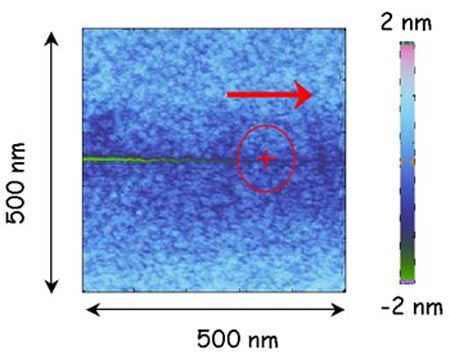
When glass is observed with an optical microscope, the fracture surfaces appear to be very smooth. However, when analyzed at the nanometre scale using an atomic force microscope (AFM), glass surfaces show a roughness very similar to that seen in metallic fracture.

In their experiment, Christian Marlière, Claude Guillot and co-workers performed fracture tests on samples of aluminosilicate glass. They drilled a cylindrical hole in the centre of the sample surface and then applied a perpendicular load using a compressive machine. The external stress on the sample was gradually increased by constantly applying this pressure and was removed as soon as a crack front began to propagate along the sample.

The team monitored the formation of the crack by AFM and find cavities that typically measured 20 nm in length and 5 nm in width ahead of the crack tip. They also observed that these cavities grew with time until they joined up (see video “birth, growth and death of nanocavities”)

To confirm that the spots observed were actual damage cavities, the group used fracture surface topography analysis – a technique normally used to study damage in metals. This method reveals the cavities in the order in which they appear. The researchers showed that the spots seen prior to fracture are depressions, which can be clearly seen in the topography of the final crack structure.

The group now hopes to use its experiment to study samples in three dimensions and correlate surface fracture characteristics with bulk behaviour. The results of the work may lead to the optimized design structures of glass and could also shed light on the basic physical mechanisms of fracture.

No sign yet of extra dimensions

String theory – currently the leading candidate for a unified theory of all the forces – predicts that there are six extra spatial dimensions in addition to the three we are familiar with. Theorists believe that these extra dimensions are curled up into small spaces, and it has been suggested that they may generate forces with strengths comparable to gravity over distances of about 0.1 mm.

Making precise measurements of gravitational interactions at such distances is difficult because gravity is much weaker than electrostatic and magnetic forces at small scales. The most precise experiment to date was that carried out by Eric Adelberger and co-workers at the University of Washington in 2001, who employed a variation of the torsion balance used by Henry Cavendish to measure the gravitational constant in 1798. The Washington researchers measured the strength of gravity down to a distance of 0.2 mm but found no deviation from the inverse square law.

In contrast, the apparatus used by Price and colleagues is quite different to the Cavendish balance. They monitored the mutual attraction between two thin sheets of tungsten, which they placed 0.108 mm apart. They vibrated one of the sheets – the source mass – at the resonant frequency of the second sheet – the detector – and monitored the resulting motion of the detector using an electric probe. The detector was heat treated so that it dissipated very little energy, thereby maximising the sensitivity of the experiment. Furthermore, the experiment was constructed so that the resonant frequency of the detector – just over 1000 Hz – was high enough to eliminate low-frequency interference, such as vibrations in the floor.

By not recording any deviation from Newton’s law, the Colorado researchers have placed new restrictions on the nature of “moduli” forces predicted in some variants of string theory, such as the “string dilaton”, “radion” and “strange modulus” forces.

“If a new force were found it would have a large impact on physics since the whole subject is built on the four known forces, ” says Price. “It is possible that some day string theory will be understood well enough to make very precise predictions about new forces such those as we seek. Until then, it’s a fishin’ expedition.”

Photonic circuits move a step closer

Resonators are widely used in electronics, microwaves and optics. There has been much interest in on-chip resonators in the last decade but the Q factor – the figure of merit for a resonant system – has been limited to about ten thousand. However, many applications require Q factors that are several orders of magnitude higher.

Vahala and co-workers have made toroid-shaped microcavities on silicon wafers that have Q factors of over a hundred million. The cavity confines light in a “whispering gallery” mode in which it orbits around the edge of the cavity at precise resonant frequencies as a result of total internal reflection.

The devices were fabricated on silicon wafers that had been coated with a layer of silicon dioxide. The researchers use photolithography, standard etching techniques and laser treatment to produce the structure shown in the figure above. The technique leaves the edges of the device smooth, which is important for the efficient confinement of light, and does not affect the underlying silicon dioxide support layer.

These devices could be used in a wide range of applications, such as optical sensors and microchip lasers. As standard processing techniques have been used to make the microresonators, they can be produced in large quantities. “Furthermore, they can be integrated with other functions such as electronic circuits,” Vahala told PhysicsWeb. The team now hopes to improve the Q factor of their device. “We hope to get it above one billion,” said Vahala.

Lorentz symmetry stays intact

In 1998, Don Colladay and Alan Kostelecky of Indiana University identified over a hundred co-efficients related to possible violations of Lorentz invariance in a “general” extension to the Standard Model. Astrophysical measurements and experiments with accelerators can set a limit on many of these parameters, but nine parameters that involve electromagnetic effects have yet to be constrained.

Avaloff and co-workers have devised a new experiment that is sensitive to these parameters. Their method involves monitoring microwaves inside a pair of cylindrical cavity resonators. One cavity is oriented in a horizontal direction, while the other points vertically. The researchers believe that any violations of Lorentz invariance will effect the cavities in different ways as the Earth orbits the Sun.

The Stanford team found no difference – or anisotropy – to one part in 1013 for four of the parameters and no anisotropy to one part in 109 for three other parameters. These bounds now constrain seven of the nine coefficients that were previously unknown in the general standard model extension.

The scientists hope to improve their limit by at least a factor of a 100. “We are also working on an experiment to be flown on the International Space Station around 2008, of which Lorentz invariance testing is a part,” Joel Nissen, one of the members of the research group, told PhysicsWeb. “Operation in space should give us greater sensitivity to certain of the coefficients because of the higher velocity of the cavities relative to the centre of the earth and the shorter measurement period – 90 minutes instead of 24 hours.”

Single molecule switches for less

The average power consumed by the latest processor chips, such as the Pentium 4, is about 30 W. This is already a problem in some laptop computers where the extra power needed to remove excess heat significantly reduces the life time of the battery.

The switch made by Meyer, Joachim and co-workers consists of a “porphyrin” molecule that has four phenyl “legs” (see figure). Using the tip of an atomic force microscope (AFM) they rotated one of the legs from one stable position to another. The switch is “on” when the leg lies perpendicular to the central part of the molecule and is “off” when it lies parallel.

While the leg is rotated, the researchers record the force-distance characteristics of the structure. In this way they are able to identify the force and energies required to rotate a single carbon to carbon bond in the molecule.

The scientists found that rotating the phenyl leg requires an energy of less than 100 zeptojoules, which is four orders of magnitude lower than state-of-the-art field effect transistors. The researchers believe their method approaches the thermodynamic limit of switching. A machine made of an assembly of such molecular nanodevices could run on a power of less than 100 W.

“This switch could be used to make storage and logic devices, but there are still many problems to be solved,” Christian Loppacher, one of the researchers in the group told PhysicsWeb. “The next stages in our study are the controlled manipulation of these molecules and an investigation into which conditions and on which substrates the molecule legs can be switched”.

Copyright © 2026 by IOP Publishing Ltd and individual contributors