Biff, bang, pow – science takes a knock

Exploring in print the blurry line between science fact and science fiction has become something of a cottage industry since the publication in 1996 of Lawrence Krauss’s book The Physics of Star Trek. Books by other scientists soon followed, exploring the astronomy, physics, biology and chemistry that are liberally ­ although not always credibly – spattered across the storylines of Star Trek, Star Wars and other works of modern science fiction. Indeed, I was penning my own entry in the field when The Physics of Star Trek was published.

The literature of science fiction is often seen as a bridge between the humanities and the sciences – the “two cultures” that the scholar C P Snow once argued were growing ever further apart. Its sometimes embarrassing cousin – serialized comics – is alleged to be another. This book by the science-fiction writers Lois Gresh and Robert Weinberg purports to examine that peculiar bridge and scrutinize its support beams and girders. The not very surprising revelation is that the science in comics generally does not stand up to such scrutiny.

Each chapter begins with an engagingly written review of the origins of a particular superhero character. As the comic-publishing industry began to blossom in the 1930s and 1940s, the stories featured increasingly revolved around a human being who – through some terrible accident, often involving a strange form of radiation – has developed super-human abilities.

But since so little of what one reads in comic books is based on real science, the authors are frequently forced to admit that the characters or phenomena under discussion are scientifically inexplicable – in other words, impossible to conceive in terms of our current understanding of nature. As the authors note on page 107: “Reading comic books requires some suspension of disbelief.” This is surely one of the great understatements of the new century. The tenuous connection between real science and the literature under examination makes this book something of an odd read. Indeed, The Non-Science of Superheroes might have been a more appropriate title. Judging by the actual title, one would think that a credible if somewhat far-fetched biophysical rationale for Superman’s X-ray vision, for example, would be found somewhere between the covers. Unfortunately, none appears.

What The Science of Superheroes does instead is describe the fantastical power of a superhero and then tell an anecdote or two about some related piece of science that the comic-book author clearly ignored or misunderstood. But even this narrow bridge between science and fiction is all too often strained beyond breaking point.

Some of the “science” questions in the book are posed in ways that are, well, comical. For example, in the chapter on Peter Parker the Amazing Spider-Man, the authors ask: “Could a man ever possess the powers of a spider, and what would they be?” Yikes. In the pages that follow, Gresh and Weinberg tacitly admit that the question is absurd. Indeed, only one or two of the extraordinary powers that are attributed to the arachnid wanna-be Parker are even remotely connected to the biology of real spiders.

The question of whether a man could ever possess spider-like characteristics is never addressed in any way- scientific or otherwise. The authors note that spiders can, for example, crawl up walls and across ceilings thanks to bundles of hair called “scopula”. The moisture at the tips of these microscopic fibres enables the spider to stick to smooth surfaces. But could a human being endowed with scopula in his hands and feet actually crawl across a ceiling? Could the surface tension of water molecules in the tips of millions of microscopic fibres provide sufficient adhesion to support the weight of a man? These and other questions that immediately sprang to my mind are never answered. The discussion of Spider-Man is simply used as an excuse to relate a few interesting anecdotes about spiders.

Although most of the book cheerfully debunks any claims to scientific credibility that comic writers might make, the point is that comic writers rarely make such claims. They are fully aware that they work in the field of fantasy, not science fiction. Comic-book superheroes are fantastical in the literal sense of the word. They are embodiments of the common childhood desire to feel powerful, not logical extensions of science.

Another popular comic that has recently been turned into a major motion picture is X-Men. Through genetic mutations, these characters have developed various telekinetic and psychic abilities, such as the power to change the weather or radiate beams of energy through their eyes. After reviewing these traits, on page 144 the authors write: “The X-Men are more than possible; they’re quite probable in our future.” But how could this statement possibly be justified? Is it probable that humans will mutate to such an extent that they can shoot deadly beams from their eyes or conjure storms telekinetically? Presumably the authors mean to convey that genetic engineering of humans will someday be science fact and that favourable mutations will eventually be induced artificially. But surely they should be much more careful in their proclamations than the comic-book authors they rightly rebuke? A book that claims to distinguish science fact from science fiction must, in my view, make these distinctions as clearly and carefully as possible.

I was, however, pleasantly surprised to find that the most accurate representation of science and technology in comic books is to be found in the Donald Duck and Uncle Scrooge adventures. Carl Banks, the author of these works, routinely and quite accurately described the workings of sonar, nuclear submarines and other marvels of modern technology. His clever ducks also had quite a facility for scientific reasoning. In one story, they concocted a method for raising a sunken ship from the bottom of the sea by filling its hull with ping-pong balls, thereby displacing the water and providing enough buoyancy to float the wreck. A similar method was used 15 years later by a Danish scientist to raise a boat from the bottom of the Persian Gulf. He was reportedly inspired by the Donald Duck comic, which he had read as a boy.

The foregoing reservations aside, a book like The Science of Superheroes could be a useful tool for encouraging comic fans to delve into science. But I can’t say I would recommend it to a physicist interested in speculating on the scientific basis of X-ray vision.

Buy the book
The Science of Superheroes Wiley

Ultracold plasmas and Rydberg gases

The ultracold world has fascinated and surprised scientists since 1911, when Heike Kamerlingh Onnes discovered superconductivity in mercury at 4.2 K. Now physicists routinely achieve temperatures millions of times colder.

When atoms are cooled this close to absolute zero, they fall into the lowest possible quantum state ­ with bizarre consequences. For example, Bose-­Einstein condensates, created for the first time in 1995, are systems where the atoms have undergone a collective identity crisis and fallen together into the same quantum state. Fermi gases, on the other hand, are prevented from this collapse by basic quantum-mechanical principles, and become incompressible. The creation and understanding of Bose-Einstein condensates and Fermi gases represent major advances in ultracold atomic physics (see Physics World August 1999 pp37-42 and April 2002 pp27-31).

But now there is a completely new ultracold system to explore ­ ultracold neutral plasmas. These systems bridge the gap between atomic physics and plasma physics, and between plasma physics and condensed-matter physics. In addition to being fascinating in themselves, these exotic and relatively unexplored states of matter may also help us to understand the surfaces of neutron stars and the centres of planets such as Jupiter.
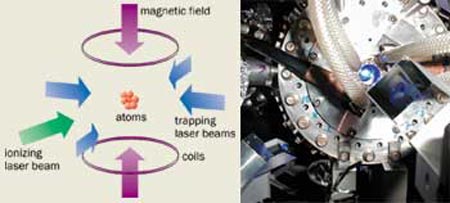

Plasmas are forms of matter in which a significant fraction of the neutral atoms and molecules have been ionized to form free electrons and ions. Ionization usually results from energetic collisions between particles, which means that most plasmas ­ such as the surface of the Sun or a fluorescent light bulb ­ are relatively hot. But it is also possible to create ultracold plasmas, by using lasers to trap and cool neutral atoms to temperatures of 1 mK or lower. Another laser then ionizes the atoms by giving each of the outermost electrons just enough energy to escape the electrical attraction of its parent ion (figure 1).

The key point about ultracold plasmas is that by manipulating the atoms with lasers, the kinetic energy of the liberated electrons can be controlled. Using standard pulsed lasers, the electron energy can be made to correspond to a temperature of as low as 0.1 K ­ a limit set by the frequency bandwidth of the laser pulse. The ions, however, retain the millikelvin temperatures of the neutral atoms. This type of non-equilibrium ultracold plasma evolves rapidly, and many fundamental questions about its behaviour remain unanswered. Experiments conducted so far have revealed surprising dynamics and recombination behaviour that are pushing the limits of our knowledge of plasma physics.

A subtle change of experimental procedure can produce a system that is closely related to ultracold plasmas ­ a cold, dense Rydberg gas. Tuning the laser wavelength slightly below the ionization energy leaves the atoms in highly excited Rydberg states in which the outer electron has a large radius. Compared with atoms in the ground state, these large “floppy” atoms have exaggerated properties, and are easily influenced by their environment. The more highly excited the atoms are, the more susceptible they are to environmental conditions, and the stronger their interactions with each other. Rydberg atoms do not move or collide because they are laser cooled, but the electron orbits of adjacent atoms can overlap. This leads to a bizarre state of the system that blurs the distinction between a plasma and a collection of neutral atoms.

Investigating and understanding the properties of ultracold plasmas and Rydberg gases requires a combination of experimental, theoretical and computational techniques from a variety of different subdisciplines in physics.

Making an ultracold plasma

The story of ultracold plasmas began a few years ago at the National Institute of Standards and Technology (NIST) in Gaithersburg, Maryland. We had been working with laser-cooled metastable xenon atoms and wondered what would happen if we could ionize the entire sample in an instant. For several years prior to our work, the laser-cooling group at NIST had been studying cold atom collisions, some of which produced ions. Work on ultracold plasmas seemed to be a natural extension of this, but instead of making ions by the handful, a million could be made in an instant. We were also motivated by the efforts to create antihydrogen at CERN. One approach to making antihydrogen begins by holding cold positrons and cold antiprotons in the same electrical trap. In this system it may be possible to use a laser to stimulate recombination of the positrons and antiprotons to encourage antihydrogen formation. We naively thought that by ionizing the ultracold atoms in our trap, we would be running the CERN process in reverse. Optimizing the laser-recombination method with a simple system like ours might therefore help guide a similar experiment for antihydrogen.

Another intriguing aspect of the ultracold-plasma experiment was that it seemed we could create a system in which the initial conditions were completely under our control. By choosing the initial density and temperatures of the ions and electrons, it would be possible to arbitrarily set the interaction strength between the atoms and ions in the plasma. Neutral atoms in the ground state collide like billiard balls and the atom­atom interaction is very weak, especially at low temperatures. However, the interaction between colliding Rydberg atoms is much stronger and this increases with the Rydberg excitation because the “orbiting” electron is so weakly attached to its parent ion. When atoms are ionized to form a plasma in which the liberated electrons have essentially zero kinetic energy, the interactions between the ions are very strong. Indeed, the ions are almost always in collision due to the long-range nature of the electrical force, and as the kinetic energy of the particles in the plasma increases, the interactions become weaker.

The ionization step needed to create an ultracold plasma is performed using nanosecond laser pulses. The kinetic energy of the liberated electrons is essentially the difference between the laser’s photon energy and the ionization energy. The lowest electron energy achievable with our pulsed laser corresponds to a temperature of about 0.1 K. It is straightforward to ionize as many as 50% of the trapped atoms, so the peak plasma density in our xenon experiments was something like 1010 per cubic centimetre.

Electrons with a temperature of T = 0.1 K travel at about 100 m s­-1 so you might expect them to speed away from the sluggish ions within a few microseconds, leaving a positive core. But as a net positive charge develops near the centre of the plasma, Coulomb attraction pulls the electrons back. The ions spontaneously form a trap, and, depending on the experimental conditions, more than 90% of the electrons cannot escape the pull.

During this time the electrons thermalize and settle into a spatial distribution that closely follows the density of the ions in the central region of the ion cloud. This is the essence of so-called Debye screening in a plasma: wherever the electron and ion densities differ, electric fields develop that push the system back towards neutrality. Of course, there is a small net shortage of electrons and this results in an outer shell of positive charge. To date, experiments have probed only the central, nearly neutral portion of the plasma because the available diagnostics can only determine the plasma’s average properties.

Once the electrons have thermalized, the ions are initially frozen in place because of their relatively large mass and low temperature. The electrons race back and forth across the ion cloud, rebounding off the Coulomb potential and transferring momentum to the ions. The electrons exert a pressure on the ions just like an ideal gas exerts pressure on the walls of a confining box. This gets the ions moving. The electrons follow and the entire plasma starts to expand. The initial ion cloud has a Gaussian density profile, just like the neutral trapped atoms from which the plasma is made. Due to the dependence of the pressure on the density of the electrons, the plasma maintains its Gaussian shape and its characteristic size doubles in about 10 µs. In hindsight, this picture of the expansion is quite straightforward, but initially it was puzzling because the electrons appeared to be transferring energy to the ions without heating them very much, instead causing them to move outwards. This is different than the random thermal motion normally meant by “heating”.

The collisional thermalization between electrons and ions is very slow, due to the large difference in their masses, and it occurs on a millisecond timescale. The kinetic energy of the outward-moving ions in temperature units may be of the order 100kB, where kB is Boltzmann’s constant. However, a true measure of the ion temperature ­ the deviation of an ion’s velocity from the local average velocity ­ should remain much colder.

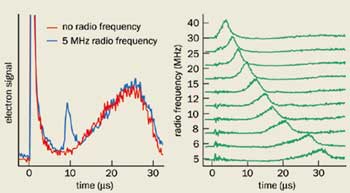
Measuring the outward motion of the ions, at least indirectly, is easy. Oscillating electric fields applied by grids above and below the plasma can resonantly excite its electrons. The response of the electrons is strongest when the frequency of the driving field resonates with the plasma frequency, which is governed by the physical properties of the plasma and scales with the square root of the electron density. For ultracold plasmas this frequency is typically between 1 and 300 MHz. At resonance, the electrons gain energy, which increases the rate at which they escape from the Coulomb well formed by the ions (figure 2. This rate is monitored by detecting the escaping electrons with an electron multiplier, allowing us to determine the average density of the plasma as a function of time. With this information the size and expansion rate of the plasma can be inferred.

Extraordinary expansion

Under most conditions, the kinetic energy of the plasma expansion is directly proportional to the initial energy given to the electrons during the ionization step. However, when the electron energy is decreased so that the kinetic energy is comparable to the Coulomb potential energy between neighbouring charged particles, the plasma expands much faster than expected. Determining the source of this extra energy has inspired theoretical studies by Stepahne Mazevet, Lee Collins, James Hanson and their colleagues at Los Alamos National Laboratory; Francis Robicheaux and his group at Auburn University; and Tom O’ Neil and colleagues at the University of California in San Diego. In all simulations, they observed a heating of the electrons during the first fraction of a microsecond, which agrees with the experimental results. However, there is still some disagreement as to the exact source of the heat.

The heat may come from electron­ion recombination. Electrons lose energy when they combine with an ion, and that energy is transferred to the remaining free electrons. It may also come from the electrical potential energy of the initial system. The neutral atoms from which the plasma is created are randomly distributed in a gas, which means the ions and electrons can have a small initial kinetic energy but a very large electrical potential energy. An additional source of heating may come from “continuum lowering”, in which neighbouring charged particles influence the ionization energy and cause the escaping electrons to have more energy than we expect. All of these factors probably contribute to the plasma expansion to some degree, and sorting out these contributions is one of the issues being addressed by theorists in this field.

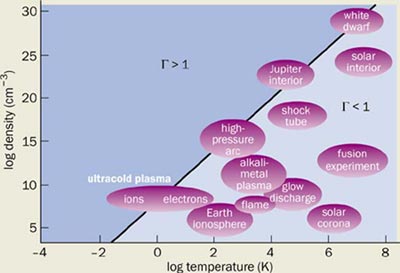
It is the understanding of these expansion dynamics that is exciting, because it may be that ultracold plasmas cross over to the regime of strongly coupled plasma physics. Plasmas are strongly coupled when the ratio of the Coulomb potential energy between neighbouring charged particles and the thermal kinetic energy, Τ = e2/4πε 0akBT, becomes greater than 1 (here a is inter-particle spacing, e is the electron charge and ε0 is the permittivity of free space). Traditional plasma physics confines itself to the regime where Τ figure 3).Basic concepts need to be revised in these systems, such as the complex processes of recombination, Debye screening (in which the different charges arrange themselves to minimize the overall electric field) and the hydrodynamic descriptions of plasmas.

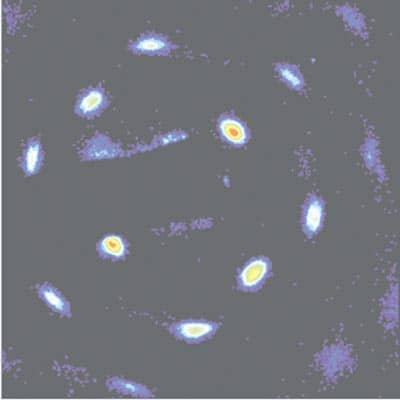
The recent progress in understanding these multicomponent plasmas containing ions and electrons has stimulated studies on single-component plasmas in which only electrons or only ions are trapped. Experiments by David Wineland’s group at NIST in Boulder, Colorado have raised some interesting questions. The researchers showed that as Τ increases, a cold non-neutral plasma changes from a gas-like to a liquid or even a solid structure as the particles develop spatial correlations to minimize the potential energy (figure 4). . Is it possible to create a two-component system in the laboratory with both electrons and ions strongly coupled? How would such a strongly coupled two-component system behave? Is a correlated two-component system a collection of neutral atoms, or is there some metastable state in which the positions of the ions and electrons are all correlated while the electrons are free to move from one ion core to another? The answers to these questions require concepts from condensed-matter, atomic and plasma physics, which is one of the most exciting aspects of ultracold-plasma research.

Dense Rydberg gases

There were big surprises early in our exploration of ultracold neutral plasmas. To make the electrons as cold as possible, we had to calibrate the laser wavelength so that it gave the electrons just enough energy to separate from their parent ions and no more. The obvious way to find that ionization energy was to simply shine the laser on the atoms and look for ions. We could then gradually reduce the photon energy until the ion signal disappeared. But the ion signal did not disappear. Below the ionization energy, when the atoms were excited to Rydberg states, we found ions galore. The system of ultracold Rydberg atoms left on its own had somehow spontaneously ionized.

This observation was reminiscent of work on room-temperature cesium atoms in the early 1980s by Serge Haroche’s group in Paris. In these experiments, two Rydberg atoms collided to form an ion, a free electron and a less excited neutral atom. The free electron went on to collide with several other Rydberg atoms, ionizing them and producing more electrons. If the density of Rydberg atoms was high enough for two of them to collide, the free electron from that collision would trigger an avalanche that ionized the rest of the Rydberg atoms.

However, our observations of ultracold xenon atoms did not quite fit this model. The atoms in our experiment were moving at about 6 cm s­-1, which meant that no Rydberg atoms could collide for the first few hundred microseconds. But we observed spontaneous ionization much quicker than that. In addition, the free electrons coming from this spontaneously ionized Rydberg gas were moving more slowly than the free electrons from a photoionized sample. It was difficult to know if this was a consequence of the process of electron formation, or if it was due to some other effect in the plasma, such as Debye shielding.

The exact cause of spontaneous ionization in a Rydberg system is still uncertain, and while several prominent researchers are narrowing down the possibilities, the subject is somewhat controversial. Tom Gallagher at the University of Virginia has recently gathered evidence that suggests the spontaneous ionization of the Rydberg atoms is due to the same mechanism identified by Haroche. Using a modest radio-frequency field, Gallagher heated the electrons once they were formed, which dramatically increased the rate at which the avalanche proceeded. The spontaneous ionization of the Rydberg system requires energy from somewhere, and collisions between Rydberg atom ­ followed by avalanche ionization ­ seem to provide that energy. Perhaps the first few electrons are created when two Rydberg atoms are “born” in a collision.

Ed Eyler and Phil Gould at the University of Connecticut have suggested that the Rydberg-atom collisions that cause the ionization are not necessarily the result of billiard-ball-type collisions. The van der Waals forces between highly excited Rydberg atoms are strong, causing them to naturally attract one another at long range. The Rydberg atoms perhaps form long-range molecules and collide due to the molecular potential. The collisions would be violent enough that at least one of the Rydberg atoms became ionized.

Another possibility has been put forward by George Raithel at the University of Michigan. Raithel’s work suggests that the first few free electrons are not produced by Rydberg atom collisions but when Rydberg atoms are photoionized by black-body radiation. This broad-spectrum radiation is emitted by the rest of the experiment, which is at room temperature. When the free electrons collide with the Rydberg atoms they scramble the initial Rydberg state. This prevents any radiative decay of the atoms and encourages black-body and collisional ionization.

Harnessing floppy atoms

If the source of the first electrons could be pinned down, it might be possible to create an experiment that prevents the ionization. It is the first few free electrons that apparently cause the avalanche ionization of the rest of the system. Therefore, if these electrons are generated by overlapping Rydberg atoms in the initial gas, the atoms could be put in an optical lattice and kept apart. Michael Noel at Bryn Mawr College in Pennsylvania is creating an experiment to examine this possibility. If the idea is right, it may be possible to drive an insulator­metal transition in a high-density Rydberg gas.

In 1936 Nevill Mott made his famous study of the insulator­metal transition, commonly called the Mott transition. Certain compounds are insulators at room temperature but conductors at lower temperatures. Mott imagined that atoms in the insulator were regularly spaced on a 3D lattice. He calculated that if the distance between the atoms in the lattice changed enough, by changing the temperature for example, the electron clouds from neighbouring atoms would overlap. The electrons would then be free to wander from one lattice site to another ­ the solid would become metallic.

In the Rydberg system, instead of shrinking the lattice constant to make the atoms overlap, you can simply increase the size of the atom by increasing its excitation. But contrary to atoms in solid-state systems, lower energy states are available in Rydberg atoms. When gas atoms in Rydberg states begin to overlap, one electron may be sent to a lower energy state while the other one takes away the excess energy. The Mott transition in an excited-state gas-phase sample therefore remains to be understood.

On the other hand, if the first free electrons come from black-body radiation, then the obvious solution is to get rid of that radiation. Raithel is building a cryogenic system that should eliminate black-body radiation. If, however, the free electrons come from exaggerated van der Waals forces in Rydberg atoms, then nothing can be done to prevent the massive avalanche ionization of the system.

Cold, dense Rydberg gases continue to generate challenging opportunities at the confluence of atomic and condensed-matter physics. This system exists at the quantum­classical interface, where calculations are difficult because it is not described by either one regime or the other. It also blurs the distinction between single-particle interactions and many-body interactions. Aside from possible technical applications, studies of this system will help us understand how to think about these complex issues at a fundamental level.

The latest challenge

The next generation of ultracold-plasma experiments ­ due to begin this year ­ will open up new possibilities. The experiments, which are being built in laboratories at Rice University and at Brigham Young University, use the elements strontium and calcium. These group-II atoms have the distinct advantage that they still have one loosely bound electron when they are ionized. This means that the ions have transition frequencies that can easily be driven by currently available lasers, and tools that are used for laser cooling and atom manipulation may also be used on the plasma.

A technique known as absorptive imaging ­ the workhorse of experiments on ultracold neutral atoms ­ will also be directly transferable to strontium and calcium. This produces a directly observable image of the spatially varying density profile of the plasma. Measuring these density profiles is essential to discriminate among the theoretical simulations of how the plasma density changes with time. Some models predict a shock wave developing during the plasma expansion, while others show ion acoustic waves freezing into place.

By using lasers to cool the ions in the plasma, it will also be possible to reduce the kinetic energy of the ions so that they are strongly coupled. In experiments like these it will be possible to verify and extend the theory of strongly coupled two-component systems. In particular, we will be able to study recombination, collision dynamics, electron heating and expansion in a negative-pressure system.

Ultracold neutral plasmas and dense Rydberg gases are close cousins in this new field of ultracold, highly excited, strongly interacting atomic systems. They inhabit the regions between atomic, plasma and condensed-matter physics. They have already surprised us with puzzling questions ­ some of which we have started to address ­ but every new experiment asks more questions than it answers.

The new hot rods of the physics world

Particle accelerators are the largest pieces of equipment that physicists have to help them unravel nature’s secrets. Take the 27 km circumference of the Large Hadron Collider under construction at CERN in Geneva or the 3 km linear accelerator at the Stanford Linear Accelerator Center in the US. These machines accelerate particles to energies above 1010 eV and then collide them to explore fundamental questions in high-energy physics.

However, as successful as they are in tackling problems such as the origin of mass and the asymmetry between matter and antimatter, accelerators cannot keep achieving higher and higher energies. Most accelerators use radio-frequency waves confined in metallic cavities to give particles a “kick” in energy each time they pass through the cavity. However, the acceleration gradients that these machines can achieve are limited, and the only way to reach higher energies is to build bigger accelerators with more cavities.


Wake-field accelerators

However, an exciting alternative method of acceleration is making great strides towards the next energy regime. The “laser wake field” accelerator relies on exploiting the radiation pressure of an intense laser pulse to displace the electrons in a plasma, leaving a large electric field in its wake (figure 1). Now Viktor Malka of the Ecole Polytechnique in France and colleagues from the CEA/DAM laboratory in Bruyères-le-Châtel, the University of Bordeaux and Imperial College in the UK have demonstrated that electrons can be rapidly accelerated by surfing such a wake (V Malka et al. 2002 Science 298 1596).

Their results show that an electron at rest can be accelerated to an energy of 200 MeV in a distance of just 1 mm. This is a terrestrial particle-acceleration record, although similar plasma-acceleration processes may occur with even greater ferocity in the astrophysical plasmas that surround supernovae and black holes. At rates like this, the current high-energy frontier could be reached in an accelerator only one metre long!

But there is a catch. In addition to reaching high energies, the accelerator must also produce a beam of high quality if it is to be of use in physics applications. This means that the beam must be well collimated, it must contain a large number of particles and all the particles must have the same (or almost the same) energy. There is still a long way to go to realize all these requirements in a working accelerator, but Malka and co-workers have made a significant step towards achieving two of them. They have accessed a new physical regime of the laser-wake-field accelerator, which has resulted in both the highest energy from such a scheme to date and an improvement in the collimation of the beam. The higher-energy particles were found to emerge in a narrow cone of less than 5° and corresponded to a transverse beam quality that is better than that of a typical conventional linear accelerator.

Surfing the wake

Plasmas make promising particle accelerators because they can support electric fields that are greater than several hundred gigavolts per metre. This is achieved by exciting relativistic plasma waves (space­charge oscillations, which depend on the density of the plasma) with a high-intensity laser.

There are different types of plasma-based accelerator. In a basic laser-wake-field accelerator, a pulse of photons that is shorter than the plasma wavelength excites a wake, much like the wake produced by a boat (figure 2 top ). This is the simple, or resonant, laser-wake-field regime, which is characterized by clean wakes and its relative freedom from instabilities due to the shortness of the pulse.

This regime, however, has been difficult to access experimentally. As a result, most of the experimental work to date has focused on the longer-pulse regimes. These are the “beat wave” regime in which two lasers beat at the frequency of the plasma wave (figure 2 middle , and the “self-modulated” regime in which a long laser pulse becomes modulated at the plasma frequency due to an instability of the laser in the plasma (figure 2 bottom ).

The latter regimes have been successfully employed by groups from the University of California at Los Angeles, the Naval Research Laboratory, the University of Michigan and the Lawrence Livermore National Laboratory ­- all in the US -­ and the Rutherford Appleton Laboratory in the UK to accelerate electrons to roughly 100 MeV.

The high-energy frontier

Simple laser-wake-field acceleration has been out of reach until now due to the laser requirements. The pulse must be short enough to “fit” into half a plasma wavelength but must carry enough energy to drive the oscillating plasma electrons to relativistic speeds. These electrons need to be fast enough so that some of them catch the wake and become trapped and accelerated, like white water cascading down the face of an ocean wave. Using advances in short-pulse power made possible by chirped-pulse-amplification technology, the French group was able to generate a pulse with 1 J of laser energy in 30 fs (30 TW of peak power).

However, even this was not quite short enough to fit into the 10 fs half-wave period of the high-density plasma. Instead, the researchers relied on the plasma itself to reshape and effectively shorten the laser pulse. Several mechanisms contribute to this but the simplest to understand is perhaps the one that arises from the difference in group velocity between the head and the tail of the laser pulse in its own wake. The head travels in the plasma and moves at less than the speed of light, while the tail travels in a plasma depression and so moves at roughly the speed of light in a vacuum. Like a collapsible boat travelling in a water depression, the tail catches up with the head (figure 1). Malka and co-workers refer to this as the “forced” laser-wake-field regime.

As exciting as these results are, they are really just the tip of the iceberg of what laser-wake-field accelerators can do. Malka and co-workers point out a number of exciting applications for their ultrashort (100 fs) bursts of collimated electrons, including the production of short, bright X-ray pulses for biology and crystallography. Researchers around the world are hotly pursuing ideas for extending the interaction length and energy reach of wake-field accelerators, as well as improving other aspects of the beam quality.

Energies of 109 eV cannot be far away and represent another big step towards the high-energy frontier, and beyond.

The magnetism of superconductivity

There is something magnetic about superconductivity. Those who work in the field may have started out in a rather casual way, thinking “I will just do this one measurement and then go back to what I was doing before”. But superconductivity holds such a strong fascination that it can soon become a lifelong obsession. One attraction might be the appearance of quantum interference on a macroscopic level, but the mechanism of superconductivity itself also appeals to something quite deep within us.

A crystalline metal is composed of a lattice of positively charged ions. These are left behind when their valence electrons “melt” to produce the electron liquid that is responsible for the current-carrying ability of the metal. Electrons in a metal repel each other violently due to their like-charges, but according to the highly successful Bardeen-­Cooper­-Schrieffer (BCS) theory of 1958, a superconductor can overcome this repulsion by the action of a third party. Pairs of electrons attract each other via fluctuating concentrations of positive charge that they induce on the ionic lattice.

Nature also likes superconductors, because we are finding them in increasingly unlikely places. Now John Sarrao and collaborators at the Los Alamos National Laboratory, the University of Florida and the Institute for Transuranium Elements in Karlsruhe, Germany, have announced the discovery of superconductivity in PuCoGa5 or plutonium cobalt gallium-5 (J L Sarrao et al. 2002 Nature 420 297 – see restircted links). The superconductivity survives up to the astonishingly high temperature of 18 K.

In the February issue of Physics World, Stephen Julian describes the superconducting nature of plutonium in more detail.

Sunspots reveal their dark side

Solar physics is currently enjoying a golden age, but many fundamental questions about the nature of the Sun have not yet been fully answered. What generates the Sun’s magnetic field? How is its atmosphere heated? And what governs the acceleration of the solar wind? However, over the past five years there have been significant advances in our understanding of solar magnetohydrodynamics ­ the subtle and intimate nonlinear interaction between the Sun’s magnetic field and the plasma of which the star is composed.

An example of the Sun’s mystique is sunspots, dark regions on the solar surface that are often accompanied by bursts of activity such as solar flares. Sunspots have been observed for over two millennia, varying in number with a period of 11 years, and we have just experienced a maximum in the sunspot cycle. Moreover, there have recently been two important advances in our understanding of these intriguing solar features.

In the February issue of Physics World, Eric Priest from the Mathematics Institute in St Andrews in the UK discusses these important developments in more detail.

The legend of the leaning tower

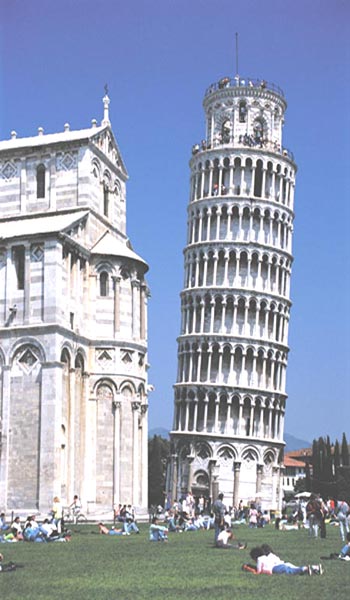
Leaning Tower of Pisa

Commander David R Scott (2 August 1971, lunar surface): “Well, in my left hand I have a feather; in my right hand, a hammer. And I guess one of the reasons we got here today was because of a gentleman named Galileo, a long time ago, who made a rather significant discovery about falling objects in gravity fields. And we thought: ‘Where would be a better place to confirm his findings than on the Moon?’.”

[Camera zooms in on Scott’s hands. One is holding a feather, the other a hammer. The camera pulls back to show the Falcon ­ the Apollo 15 landing craft ­ and the lunar horizon.]
Scott: “And so we thought we’d try it here for you. The feather happens to be, appropriately, a falcon feather for our Falcon. And I’ll drop the two of them here and, hopefully, they’ll hit the ground at the same time.” [Scott releases hammer and feather. They hit the ground at about the same time.]
Scott: “How about that! Mr Galileo was correct in his findings.”

How the legend started

The finding mentioned by Commander Scott, namely that objects of different mass fall at the same rate in a vacuum, is associated with a single person (Galileo) and a single place ­ the Leaning Tower of Pisa. The culprit is Vincenzio Viviani, Galileo’s secretary in the final years of his life.

We owe many of the Galilean legends to Viviani’s warm biography of the Italian scholar. One is the story of how Galileo climbed the Leaning Tower of Pisa and ­ “in the presence of other teachers and philosophers and all the students” ­ showed through repeated experiments that “the velocity of moving bodies of the same composition, but of different weights, moving through the same medium, do not attain the proportion of their weight as Aristotle decreed, but move with the same velocity”.

In his own books, Galileo uses thought experiments to argue that objects of unequal mass fall together in a vacuum. Without mentioning the Leaning Tower, he reports having “made the test” with a cannonball and a musket ball. What is perhaps surprising, however, is that Galileo found that the two balls did not quite fall together. This finding ­ coupled with the fact that Viviani’s biography is the only source to mention that the experiments were done at the Leaning Tower ­ causes most historians of science to doubt Viviani’s version of what Galileo did. They believe that the elderly and then-blind Galileo may have misremembered when speaking to his youthful assistant.

Dropping the ball

Science historians find Galileo’s early experiments with falling bodies fascinating, for several reasons. One is that Galileo was not the first. As far back as the sixth century, other scholars who doubted Aristotle’s account of motion had also experimented with falling bodies and concluded that Aristotle was wrong. They included several 16th-century Italians and one of Galileo’s predecessors as professor at Pisa.

Also intriguing is Galileo’s report, based on experiment, that balls of unequal weight do not only fall at different rates, but that the lighter one initially pulls ahead of the heavier one until the heavier catches up. In the early 1980s the science historian Thomas Settle tried to repeat Galileo’s falling-body experiments and, astonishingly, noted the same thing. He suggested that fatigue induced in the hand holding the heavier object tends to cause this hand to let go more slowly, even when the dropper believes the objects are released simultaneously.

Yet another fascinating side to Galileo’s experiments is the way that they slowly transformed from genuine scientific inquiries into public displays. After Galileo’s death, scientists including Robert Boyle and Willem ‘sGravesande built air pumps and special chambers to explore vertical fall in evacuated environments. King George III, for instance, once witnessed a demonstration involving a feather and a one-guinea coin falling together inside an evacuated tube. The popularity of such demonstrations continues to this day, featuring in many hands-on science exhibits. Indeed, the “drop stop” at the Boston Museum of Science is currently broken from overuse.

Teachers, no doubt, would call the Apollo “feather-drop” a sloppy experiment. Nobody bothered to measure the height from which the objects were released (probably 110-160 cm). Nobody cared that Scott was leaning over with his arms not parallel to the ground. Nobody measured the time of the fall (on the video it is just above 1 s). But as a demonstration it is unforgettable. The TV coverage ­ plus the fact that it has a webpage with video clip (see related links) ­ makes it possibly the most watched science demonstration ever.

The critical point

So why do falling-body experiments continue to be so popular? They were, for example, voted into the top 10 “most beautiful experiments” of all time in my recent poll of Physics World readers (September 2002 pp19­20). I think the answer is related to the fact that, as everyday experience suggests, heavier bodies do fall faster than light ones. Hammers and golf balls, for example, fall faster than feathers and ping-pong balls. Aristotle had codified this observation into an entire framework that was oriented by the everyday observations he was seeking to explain, involving an agent that exerted a force against resistance. Although this framework fails to incorporate acceleration, it is still the one that we mainly live in and that mainly works for us.

Thus we can still find it enlightening, or even surprising, to see with our very own eyes the expectations of that framework being violated. Galileo played a seminal role in transforming that framework, in developing the abstract thinking involved in the new one, and in illustrating its importance. So what if there was no original experiment? Galileo inspired an entire genre of experiments and demonstrations that allow us to change how we think and see. We might as well refer to these as the offspring of Galileo’s experiment at the Leaning Tower of Pisa.

Life after the White Paper

Two decades ago tuition was free and many students received quite generous maintenance grants to cover living costs. Today tuition costs £1100 per year at English universities and the maintenance grant is no more, although the situation is different elsewhere in the UK.

However, two things have not changed. First, students from middle-class backgrounds are still much more likely to go to university than those from poorer homes. Reversing this situation – which he calls a “national disgrace” – is one of the top priorities of Charles Clarke, the secretary of state for education. Clarke’s answer is to re-introduce maintenance grants for the poorest students, and to allow all students to defer the payment of tuition fees and loans until after they have graduated and are earning more than £15 000 per year.

However, the government is also proposing that universities will be able to charge anything up to £3000 per year in tuition fees – which means that students could quite easily graduate with debts in excess of £15 000 following a three-year degree. This will surely scare off the very students that Clarke is seeking to attract into higher education. The government’s solution is to appoint an “access regulator” to make sure that any university that wants to increase its tuition fees above the current level has rigorous admissions procedures in place and can also provide bursaries for students from poorer backgrounds.

The second thing that has not changed over the past decade is the annual output of physics graduates from universities in the UK. This figure has remained at about 2300 while the total number of graduates for all subjects has more than doubled. What impact will the measures in the White Paper have on physics? There is unlikely to be a fall in student numbers for departments that scrap tuition fees – a possibility that is allowed for by the White Paper – or maintain them at current levels. However, physics is often seen as an expensive subject in universities, and vice-chancellors are unlikely to look kindly on such suggestions.

Departments seeking to increase tuition fees face two challenges: to convince the students that their investment in a physics degree will be worthwhile; and to get approval from the access regulator. The best way for departments to convince students will be to demonstrate how successful their graduates have been. There is also a need for the physics community as a whole to mount a public-relations campaign that shows schoolchildren that a degree in physics can be the starting point for a wide range of careers – including many that pay much better than working in academic research.

And thinking hard about how to convince the access regulator that students from poorer backgrounds can be attracted into physics will be good for departments. There must surely be ways of, for example, employing undergraduates during vacations to enthuse these would-be physicists in labs that would otherwise be lying empty. And rarely a month passes without some former physicist endowing a new research centre at a university – are there ways of encouraging similar contributions to undergraduate teaching?

Most of the proposals in the White Paper will not come into effect until 2006 – which gives the physics community time to think about these and others questions. What, for instance, will be the impact of increased debt on the numbers of students carrying on to do research? The physics community must not, however, forget about its most pressing problem – the shortage of physics and science teachers in schools. Unless this situation is reversed, worries about life after 2006 could well be academic.

DNA acts like a “piston”

DNA is often called the “building block of life”. It consists of two linear strands wound into a double helix with one of four different “bases” attached to every sugar group along the strands. DNA is an attractive component for use in molecular machines because it can recognize specific base sequences. It self-assembles easily and complex molecular structures can be made from simple double helices. In addition, DNA can change its shape, which further expands the number of nanostructures possible.

Alberti and Mergny used an unusual “quadruplex” DNA structure, which contains four strands with twenty-one bases, folded in a special way. The structure is made to unfold by adding a fuel DNA strand, creating a “duplex” structure that resembles the more conventional double helix. To re-fold the duplex, the researchers add an “anti-fuel”, which combines with the fuel to form a waste product. The folding-unfolding cycle takes only a few seconds and fluorescence resonance energy-transfer spectroscopy shows that the expansion and contraction occurs over a distance of 5 to 6 nanometres.

The device oscillates between two well-defined states and can be compared to the movement of a piston in a cylinder, the researchers say. “This new type of extension-contraction movement ties in well with work by other groups who observe rotation and scissor-like opening and closing,” Mergny told PhysicsWeb. “From a nanotechnology point of view, it is possible to finely control the structure by the addition of strands with specific sequences.”

The sequence of bases along the chain chosen by the researchers is important biologically and the team now hopes to look at other sequences that exhibit the same type of movement. “We would also like to know if quadruplexes are able to form inside a human cell,” Mergny added.

How do stones skip?

Intuition tells us that the best stones for skipping are flat and circular, and that they should be thrown quickly. A stone should also be “flicked” to give it a spin and should hit the water at a small glancing angle.

Bocquet considered the situation for a flat, thin stone thrown over a perfectly uniform water surface. He found that the main factors that determine whether the stone sinks or skims are the mass of the stone, its angle with respect to the horizon, its angle with respect to the surface of the water, its spin rate and its horizontal velocity. He calculated that small angles combined with high spin rates are best.

According to Bocquet, a stone will only bounce if its initial velocity exceeds a certain value. If the stone is also spinning, this introduces a stabilizing torque that can maintain the initial angle at which it hits the water – which helps the stone bounce again.

The maximum number of bounces depends on the rate at which the stone decelerates – which is in turn directly related to its initial velocity. In principle, a stone could be made to bounce many times by increasing its initial velocity. In practice, however, the number of bounces are limited by the angular destabilization factor – which is independent of the initial velocity. This means that the all-important initial “flick” is crucial. Bocquet believes that his results agree well with observations such as the increase in the number of bounces at the end of a throw – known as “pitty-pat”.

Ultimately he hopes that his calculations will allow someone to break the world record of 38 bounces which, if Bocquet is right, is achieved by throwing the stone at 12 metres per second with an initial spin of 14 revolutions per second.

US rejoins ITER negotiations

The US had been one of the four original partners in the design of ITER – along with the European Union, Japan and Russia – but pulled out in 1999 for reasons of cost. The three remaining partners continued working on the project and Canada – which had originally been involved as part of the EU team – became involved when it offered a site for ITER at Clarington near Toronto in 2001. The French, Japanese and Spanish governments have also offered sites. A decision on where to build the reactor is expected this year. Construction could begin in 2006 and the reactor would be operational in 2014.

ITER has been designed to confine a plasma of deuterium and tritium for times of up to 500 seconds, and to produce 10 times as much fusion power as is used to create and maintain the plasma. According to the DOE: “The Bush administration believes that fusion is a key element in US long-term energy plans because fusion offers the potential for plentiful, safe and environmentally benign energy.”

The US share of the construction costs is expected to be about 10%. The Chinese government has also asked ITER to be involved at this level.

Copyright © 2026 by IOP Publishing Ltd and individual contributors