Artificial intelligence (AI) is used just about everywhere these days and scientific research is no exception. But how can physicists best use the rapidly-changing technology – and how can they be confident in the results AI delivers?
This episode of the Physics World Weekly podcast features a conversation with Rick Stevens, who is a cofounder of the Trillion Parameter Consortium, which is developing AI systems for use in science, engineering, medicine and other fields.
Stevens is a computer scientist at the Argonne National Laboratory and the University of Chicago in the US and he explains how AI can help with a wide range of tasks done by scientific researchers.
Travel to more than 350 astronomy meetings in 2019 resulted in the emission of 42,500 tonnes of carbon dioxide. That’s the conclusion of the first study to examine the carbon emissions from travel to meetings by an entire field. The carbon cost amounts to about one tonne of carbon-dioxide equivalent (tCO2e) per participant per meeting – roughly Africa’s average per capita carbon footprint in 2019 (1.2 tCO2e) (PNAS Nexus3 pgae143).
Carried out by a team led by Andrea Gokus at Washington University in St Louis in the US, the study examined 362 meetings in 2019 that were open to anyone in the astronomical community. These included conferences disseminating scientific findings as well as schools providing lectures and training to students and early-career scientists.
Using data on each participant’s home institutions that were available for 300 of the meetings, the researchers estimated travel-related emissions for each event, assuming delegates went by train or plane. For these meetings, the emissions totalled 38,000 tCO2e and a distance equivalent to travelling to the Sun and halfway back.
For the other 62 meetings that did not have details of the participants’ home institutions, the team estimated the emissions using average data from other conferences. Emissions from those events were put at 4500 tCO2e, bringing the total to 42,500 tCO2e.
The meeting with the highest emissions per participant was Great Barriers in Planet Formation held in Palm Cove, Queensland in Australia, with almost all attendees traveling from outside the country. The travel from the 115 participants resulted in 461 tCO2e, or 4 tCO2e for every person, on average. The team found that emissions could have been more than halved if it had been held in Europe or the north-eastern US.
Hub model
Gokus says that while meetings are important for researchers, “adjustments can be made to reduce their hefty carbon cost”, for example by knowing where participants are based. The researchers found, for example, that emissions from 2019’s biggest astronomical conference – the 223rd American Astronomical Society (AAS) meeting in Seattle – could have been cut by a quarter if it had been held in a more central US location.
The team also explored the impact of switching the 223rd AAS meeting from a single-venue meeting to a hub model, in which simultaneous satellite events are held at different locations. A two-hub model for that conference, with an eastern and western US hub, would have reduced emissions by around 60%, the study finds. Adding a third European hub could have saved 65% of emissions, while a fourth hub in Asia, for instance in Tokyo, would have cut emissions by about 70%.
The researchers claim that such alternative meeting setups as well as virtual attendance, could have benefits beyond the environment. They point out that finances, complex visa processes, parenting and other caring responsibilities as well as disabilities can make travelling to meetings challenging for some.
“By making use of technology to connect virtually, we can foster a more inclusive collaborative approach, which can help us advance our understanding of the universe further,” says Gokus. “It is important that we work together as a community to achieve this goal, because there is no Planet B.”
Inspired by the tetromino shapes in the classic video game Tetris, researchers in the US have designed a simple radiation detector that can monitor radioactive sources both safely and efficiently. Created by Mingda Li and colleagues at the Massachusetts Institute of Technology, the device employs a machine learning algorithm to process data, allowing it to build up accurate maps of sources using just four detector pixels.
Wherever there is a risk of radioactive materials leaking into the environment, it is critical for site managers to map out radiation sources as accurately as possible.
At first glance, there is an obvious solution to maximizing precision, while keeping costs as low as possible, explains Li. “When detecting radiation, the inclination might be to draw nearer to the source to enhance clarity. However, this contradicts the fundamental principles of radiation protection.”
For the people tasked with monitoring radiation, these principles advise that the radiation levels they expose themselves to should be kept as low as reasonably achievable.
Complex and expensive
However, since radiation can interact with intervening objects via a wide array of mechanisms, it is often both complex and expensive to map out radiation sources from reasonably safe distances.
“Thus, the crux of the matter lies in simplifying detector setups without compromising safety by minimizing proximity to radiation sources,” Li explains.
In a typical detector, radiation maps are created by monitoring intensity distribution patterns across a 10×10 array of detector pixels. The main drawback here is that radiation can approach the detector from a variety of directions and distances, making it difficult to extract useful information about the source of that radiation. This is usually done by placing an absorbing mask over the pixels, which provides some directional information, and by doing lots of data processing.
For Li’s team, the first step to reducing the complexity of this process was to minimize redundant information collected by multiple pixels within the array. “By strategically incorporating small [lead] paddings between pixels, we enhance contrast to ensure that each detector receives distinct information, even when the radioactive source is distant,” Li explains.
Machine learning
Next, the team developed machine learning algorithms to extract more accurate information regarding the direction of incoming radiation and the detector’s distance to the source.
Inspiration for the final step of the design would come from an unlikely source. In Tetris, players encounter seven unique tetrominoes, which represent every possible way that four squares can be arranged contiguously to create shapes.
By using these shapes to create detector pixel arrays, the researchers predicted they could achieve similar levels of accuracy as detectors with far larger square arrays. As Li explains, “these shapes offer superior efficiency in utilizing pixels, thereby enhancing accuracy.”.
To demonstrate this, the team designed a series of four–pixel radiation detectors, with the pixels arranged in Tetris-inspired tetromino shapes. To build up radiation maps, these arrays were moved in circular paths around the radioactive sources being studied. This allowed the detector’s algorithms to discern accurate information about source positions and directions, based on the counts received by the four pixels.
Successful field test
“Particularly noteworthy was our successful execution of a field-test at Lawrence Berkeley National Laboratory,” Li recalls. “Even when we withheld the precise source location, the machine learning algorithm could effectively localize it within real experimental data.”
Li’s team is now confident that its novel approach to detector design and data processing could be useful for radiation detection. “The adoption of Tetris-like configurations not only enhances accuracy but also minimizes complexity in detector setups,” Li says. “Moreover, our successful field-test underscores the real-world applicability of our approach, paving the way for enhanced safety and efficacy in radiation monitoring.”
Based on their success, the team hopes the detector design could soon be implemented for applications including the routine monitoring of nuclear reactors, the processing of radioactive material, and the safe storage of harmful radioactive waste.
In addition to former CERN science communicator Achintya Rao looking back at the famous day in 2012 when the lab announced the discovery of the Higgs boson, there’s an interview with Freya Blekman, who talks about the joy of a career in physics as part of the CMS experiment at the Large Hadron Collider.
You can also find out how CERN’s Quantum Technology Initiative is encouraging collaboration between the high-energy physics and quantum tech communities.
But it’s not all about CERN. Over in the US, there are in-depth interviews with Lia Merminga, the physicist who’s current director of the Fermi National Accelerator Laboratory, and with Mike Witherell, who’s head of the Lawrence Berkeley National Laboratory.
Looking to the future, we’ve included an analysis of the influential “P5” report into the future of US particle physics, which recently called for the construction of a muon collider. Physics World also talks to Ambrogio Fasoli – the new head of EUROfusion, who says that Europe must ramp up its efforts to build a demonstration fusion reactor.
Particle therapy is usually delivered using a large and costly gantry to change the angle of incidence of the therapeutic ion beam relative to the patient. If the patient were rotated instead, a simpler fixed-beam configuration could provide 360° access for the particle beam. During patient rotation, however, the changing direction of the gravitational force will deform and displace the tumour and surrounding organs in an unpredictable way. To ensure precise dose delivery to the tumour, such anatomical changes must be detected and compensated for during irradiation.
“Image guidance is absolutely necessary for particle therapy with patient rotation,” explains Kilian Dietrich from Heidelberg University Hospital and the German Cancer Research Center (DKFZ). “To exploit the main benefit of particle therapy – high dose escalation at the tumour with minimal dose to surrounding healthy tissue – prior knowledge of the tissue composition in the irradiation path is required.”
In conventional photon-based radiotherapy, MRI can be implemented in so-called MR-linacs, which offer the possibility to visualize changes in anatomy or patient position with high soft-tissue contrast. However, combining MRI with particle therapy including patient rotation remains a significant challenge.
Particle beams of protons, carbon ions or helium ions are extremely sensitive to non-homogeneous materials in the irradiation path, placing constraints on the MRI magnet and components. To address these limitations, Dietrich and colleagues are developing a radiation-transparent body coil to enable MR-guided particle therapy in combination with patient rotation, describing their work in Medical Physics.
Radiation transparency
One key obstacle when integrating MRI with particle therapy is the design of the radiofrequency (RF) coils used to flip the magnetization of the tissue and receive the generated MR signals. Conventional imaging coils contain highly attenuating electronic components that, if located in the beam path, will cause ion attenuation and scattering that alter the delivered dose distribution and reduce treatment efficacy.
To prevent such adverse effects, the team designed an RF coil with minimal ion attenuation, based on a cylindrical 16-rung birdcage configuration. This specific birdcage coil only has capacitors on the end rings, thereby avoiding attenuation and scattering in a large window in between. And since the birdcage functions both as a transmit and a receive coil, no additional RF coils are required. The design also allows easy integration into a capsule that enables rotation of the patient and the coil together, providing 360° access for a fixed ion beam source.
The researchers built the RF coil from a 35 µm-thick copper conductor embedded between layers of flexible polyimide and adhesive. The coil has an inner diameter of 53 cm and an axial length of 52 cm – providing a large enough field-of-view for full-body cross section imaging.
Measuring the Bragg peak shift caused by the entire RF coil confirmed its total water equivalent thickness (WET, a measure of ion attenuation) as 420 µm. This includes the polyimide and adhesive layers, which are homogeneous and can be compensated for with higher particle beam energy. The WET of the copper layer alone, which is inhomogeneous and cannot simply be compensated for, was approximately 210 µm. This is well within the clinical precision required for dose planning, which lies in the order of millimetres. As such, the team classifies the RF coil as radiation transparent.
Effective imaging
To characterize the imaging quality of their RF coil, the researchers imaged a homogeneous tissue-simulating phantom using a 1.5 T MR system. For the three central planes in the phantom, the transmit RF field distributions were homogeneous and resembled those of simulations and the MR system’s internal body coil. The measured transmit power efficiencies (between 0.17 and 0.26 µT/√W) were lower than the simulated values, but exceeded those of the internal body coil.
To examine the impact of coil rotation, they determined the mean transmit power efficiency in a central subvolume of the phantom for a full capsule rotation. Compared with the simulations, the measurements showed a slight dependence on rotation angle, with optimal transmit power efficiency at rotation angles close to 0° and 180°.
The RF coil also exhibited uniform signal acquisition in the three central phantom planes, with similar receive sensitivity profiles as observed in the simulations, both with the phantom in the horizontal position and when rotated by 30°. For a full rotation of the capsule, the measured receive sensitivity varied between 62% and 125%, decreasing at rotation angles between 15° and 120° and at 205°.
The signal-to-noise ratio (SNR) of the RF body coil showed a slight dependence on the rotation angle, ranging between 103 and 150. Overall, an increase of 10%–43% over the SNR of the internal body coil was achieved, indicating reasonable imaging quality for thoracic, abdominal and pelvic MRI.
To estimate the effect of realistic patient loading in the RF coil, the team also simulated a heterogeneous human voxel model, observing high transmit power efficiency and receive sensitivity for all rotation angles. The next step will be to perform in vivo measurements.
“The RF coil has not been tested in vivo yet since further tests are necessary before the whole setup can be tested,” Dietrich tells Physics World. “This includes patient acceptance for the rotation system as well as the time required to rescue the patient in times of emergency.”
Most physicists dream of making new discoveries that expand what we know about the universe, but they know that such breakthroughs are extremely rare. It’s even more surprising for a scientist to make a great discovery with someone who is not just a colleague, but also their life partner. The best-known husband-and-wife couples in physics are the Curies, Marie and Pierre; as well as their daughter, Irène Joliot-Curie and her husband Frédéric Joliot-Curie. Each couple won a Nobel prize, in 1903 and 1935 respectively, for early work on radioactivity.
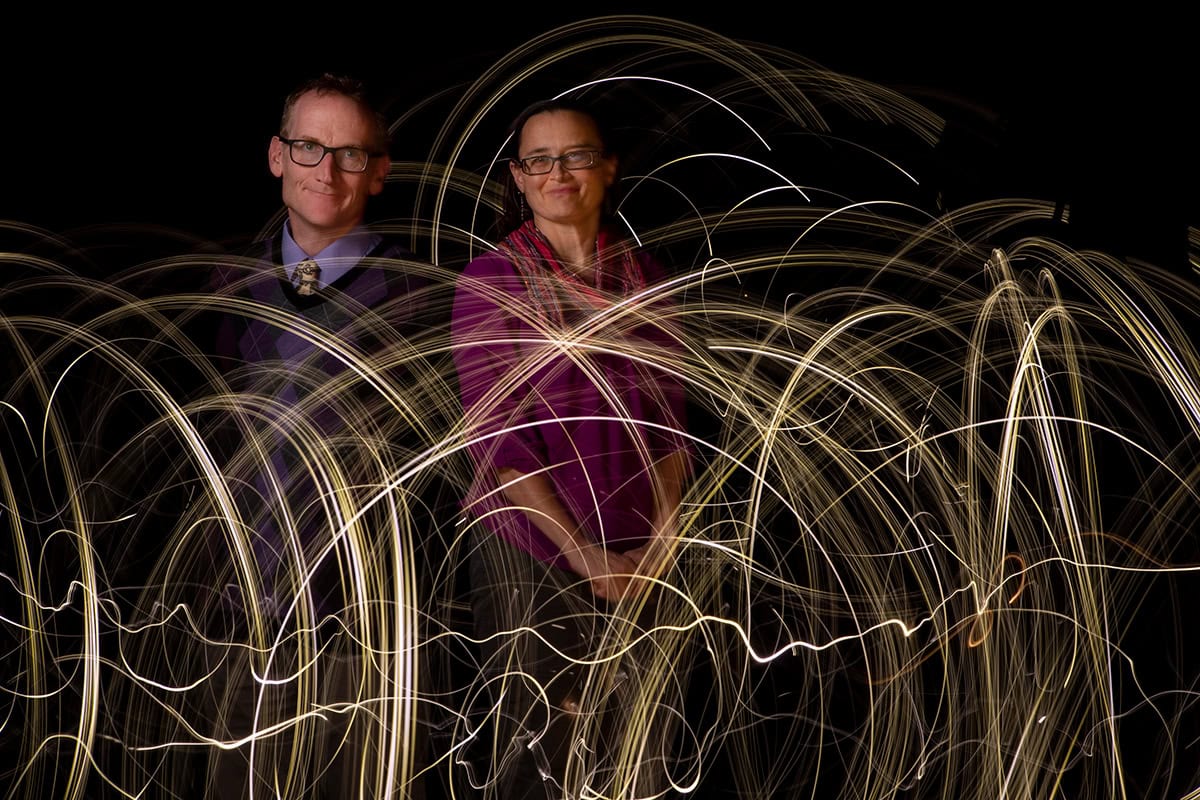
Joining the ranks of these pioneering physicists are contemporary married couple Maura McLaughlin and Duncan Lorimer, who last year were two of three laureates awarded the $1.2m Shaw Prize in Astronomy (see box below) for their breakthroughs in radio astronomy. Together with astrophysicist Matthew Bailes, director of the Australian Research Council Centre of Excellence for Gravitational Wave Discovery, McLaughlin and Lorimer won the prize for their 2007 discovery of fast radio bursts (FRBs) – powerful but short-lived pulses of radio waves from distant cosmological sources. Since their discovery, several thousand of these mysterious cosmic flashes, which last for milliseconds, have been spotted.
Over the years, McLaughlin and Lorimer’s journeys – through academia and their personal life – have been inherently entwined and yet distinctly discrete, as the duo developed careers in radio astronomy and astrophysics that began with pulsars, then included FRBs and now envelop gravitational waves. The couple have also advanced science education and grown astronomical research and teaching at their home base, West Virginia University (WVU) in the US. There, McLaughlin is Eberly Family distinguished professor of physics and astronomy, and chair of the Department of Physics and Astronomy, while Lorimer currently serves as associate dean for research in WVU’s Eberly College of Arts and Sciences.
The Shaw Prize
Shaw laureates Astrophysicists Duncan Lorimer and Maura McLaughlin received the Shaw Prize in 2023 for their discovery of fast radio bursts. (Courtesy: WVU Photo/Raymond Thompson Jr)
The 2023 Shaw Prize in Astronomy, awarded jointly to Duncan Lorimer and Maura McLaughlin, and to their colleague Matthew Bailes, is part of the legacy of Sir Run Run Shaw (1907–2014), a successful Hong Kong-based film and television mogul. Known for his philanthropy, he gave away billions in Hong Kong dollars to support schools and universities, hospitals and charities in Hong Kong, China and elsewhere.
In 2002 he established the Shaw Prize to recognize “those persons who have achieved distinguished contributions in academic and scientific research or applications or have conferred the greatest benefit to mankind”. A gold medal and a certificate for each Shaw laureate, and a monetary award of $1.2m shared among the laureates, is given yearly in astronomy, life science and medicine, and mathematical sciences. Previous winners of the Shaw Prize in Astronomy include Ronald Drever, Kip Thorne and Rainer Weiss, for the first observation of gravitational waves with LIGO. They are among the 16 of the 106 Shaw laureates since 2004 who have also been awarded Nobel prizes.
Accidental cosmic probe
Radio astronomy, which led to much of McLaughlin and Lorimer’s work, was not initially a formal area of research. Instead, it began rather serendipitously in 1928, when Bell Labs radio engineer Karl Jansky was trying to find the possible sources of static at 20.5 MHz that were disrupting the new transatlantic radio telephone service. Among the types of static that he detected was a constant “hiss” from an unknown source that he finally tracked down to the centre of the Milky Way galaxy, using a steerable antenna 30 m in length. His 1933 paper “Electrical disturbances apparently of extraterrestrial origin” received considerable media attention but little notice from the astronomy establishment of the time (see “Radio astronomy: from amateur roots by worldwide groups” by Emma Chapman).
Radio astronomy truly flourished after the Second World War, with new purpose-built facilities. An early example from 1957 was the steerable 76 m dish antenna built by Bernard Lovell and colleagues at Jodrell Bank in the UK – where McLaughlin and Lorimer would later work. Other researchers who led the way include the Nobel-prize-winning astronomer Sir Martin Ryle, who pioneered radio interferometry and developed aperture synthesis; as well as Australian electrical engineer Bernard Mills, who designed and built radio interferometers.
Extraterrestrial radio signals soon yielded important science. In 1951 researchers detected a predicted emission from neutral hydrogen at 1.4 GHz – a fingerprint of this fundamental atom. In 1964 Arno Penzias and Robert Wilson (also based at Bell Labs) inadvertently found a 4.2 GHz signal across the whole sky, while testing orbiting telecom satellites – thereby discovering the cosmic background radiation. And in 1968 another spectacular discovery shaped McLaughlin and Lorimer’s careers, when University of Cambridge graduate student Jocelyn Bell Burnell and her PhD supervisor Antony Hewish announced the observation of an unusual radio signal from space – a pulse that arrived every 1.3 seconds. That signal was the first to come from what were soon called “pulsars”. Hewish would go on to share the 1974 Nobel Prize for Physics for the discovery – while Bell Burnell was infamously left out, supposedly due to her then student status.
As more pulsars were found with varied periods and in different directions of the sky, it became clear that the signals were not being sent by an alien civilization as some researchers had speculated – after all, the chances of an extraterrestrial civilization sending many signals of varying periods, or different civilizations sending out different periodic signals, was slim. One clue was that the pulses were short and coherent, so they had to come from sources smaller than the distance light could travel during the pulse’s lifetime – for instance, the source of a 5 ms pulse could be at a maximum of 1500 km.
As it happened, the signals were our first look at neutron stars – small, extremely dense and rapidly rotating remnants of massive stars after they have gone supernova and had their protons and electrons squeezed into neutrons by gravity’s implacable power. As the star rotates, its strong off-axis magnetic field produces beams of electromagnetic radiation from the magnetic poles. These beams create regular pulses as they sweep past a detector on a direct line of sight. Pulsars are mostly studied at radio frequencies, but they also radiate at other, higher frequencies.
Pulsars to fast bursts
Lorimer and McLaughlin began their careers by studying these exotic stellar objects, but each of them had already been captivated by astronomy and astrophysics as teenagers. Lorimer was born in Darlington, UK. After studying astrophysics as an undergraduate at the University of Wales in Cardiff, he moved to the University of Manchester in 1994, where his PhD research focused on analysing classes of radio pulsars with different periods.
McLaughlin was born in Philadelphia, Pennsylvania, and first studied pulsars as an undergraduate student at Penn State. Her PhD dissertation at Cornell University in 2001 covered pulsars that variously emitted radio waves, X-rays or gamma rays. By 1995 Lorimer was working as a researcher at the Max Planck Institute for Radio Astronomy in Bonn, Germany, whereas McLaughlin joined the Jodrell Bank Observatory in 2003. He met McLaughlin in 1998 while working at the Arecibo Observatory in Puerto Rico. McLaughlin and Lorimer moved to the UK in 2001 to work at the Jodrell Bank observatory.
It was an interesting and exciting time in the pulsar research community, with new pulsars found by computerized Fourier transform analysis that detected the telltale periodicities in vast amounts of observational data. But radio astronomers also sometimes saw transient signals, and McLaughlin had written computer code designed to find single bright pulses. This led to the 2006 discovery of a new class of pulsars dubbed rotating radio transients (RRATS, an acronym recalling a pet rat McLaughlin once had). These stars could be detected only through their sporadic millisecond-long bursts, unlike most pulsars, which were found through their periodic emissions. The discovery in turn initiated further searches for transient pulses (Nature439 817).
The following year, Lorimer and McLaughlin, now a married couple, joined WVU’s department of physics and astronomy as assistant professors. To uncover more distant and bright pulsars, Lorimer gave his graduate student Ash Narkevic the task of looking through archival observational data that the Parkes radio telescope in Australia had taken of the Large and Small Magellanic Clouds – two small galaxies that are satellites to our very own Milky Way, roughly 200,000 light-years away from Earth – of which the Large was already known to host 15 pulsars.
Narkevic examined the data and found a single strong burst – nearly 100 times stronger than the background – at 1.4 GHz with a 5 msec duration. But the burst seemed to come from the Small Magellanic Cloud, where there were only five known pulsars at that time. Even more surprising was the fact that this extremely bright burst did not arrive all the same time. Known as pulse or frequency dispersion, this occurs when radio waves travelling through interstellar space interact with free electrons, dispersing the waves, as higher-frequency waves travel through the free-electron plasma quicker than lower-frequency ones, and arrive earlier at our telescopes.
This dispersion depends on the total number of electrons (or the column density) along the path. The further away the source of the burst, the more likely it is that the waves will encounter even more electrons on their path to Earth, and so the lag between the high- and low-frequency waves is greater. The pulse Narkevic spotted was so distorted by the time it reached Earth that it suggested the source was almost three billion light-years away – well beyond our local galactic neighbourhood. This also meant that the source must be significantly smaller than the Sun, and more on par with the proposed size of pulsars, while also somehow being 1012 times more luminous than a typical pulsar.
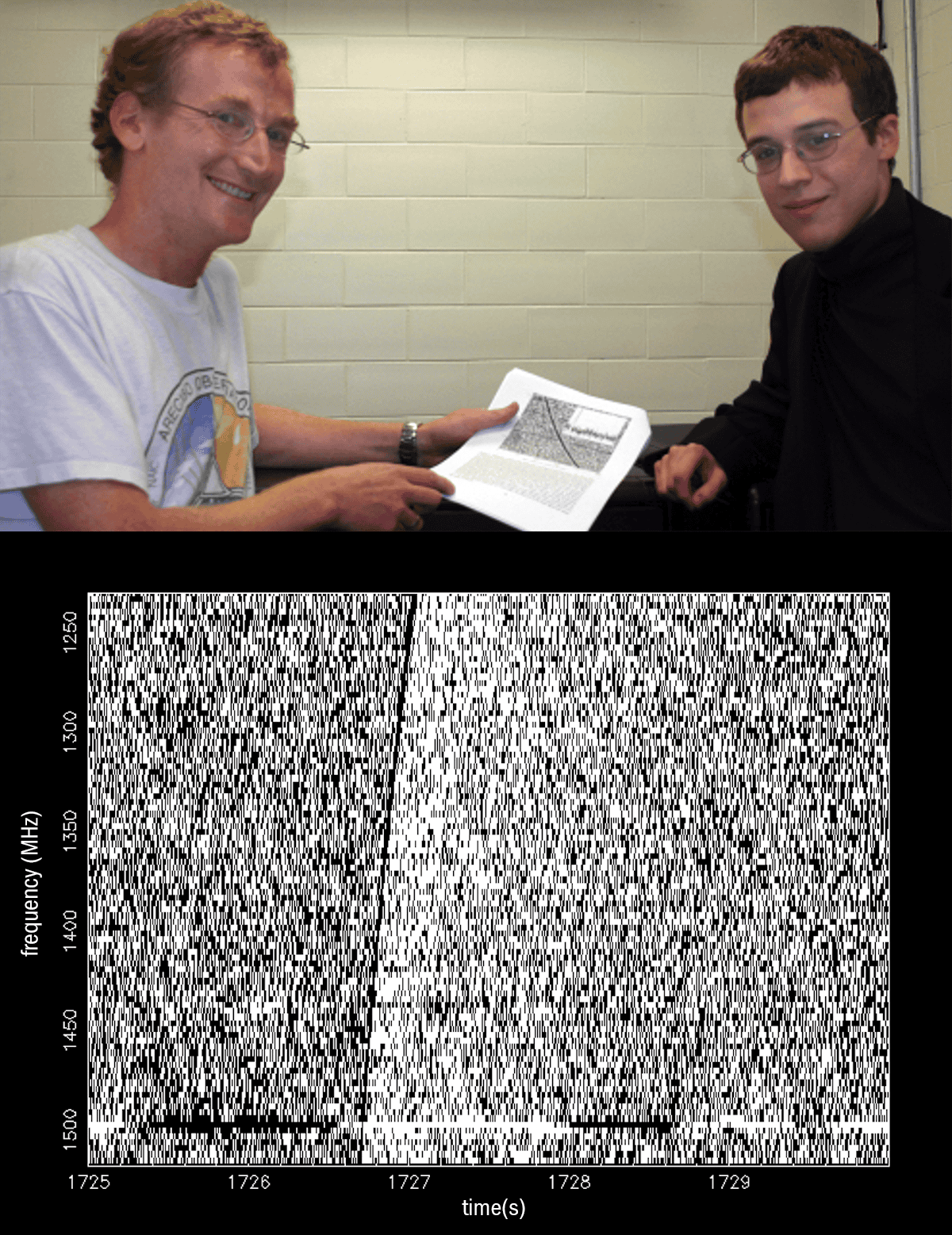
1 The first burst
Courtesy: Duncan Lorimer; Lorimer et al., NRAO/AUI/NSF
(Top) Duncan Lorimer (left) and Ash Narkevic in 2008 with the paper they published in Science about their observation of a fast radio burst (bottom).
The report of this seemingly new phenomenon – a single extremely energetic event at an enormous cosmological distance – was published in Science later that year, after being initially rejected (Science318 777). This first detected fast radio burst came to be known as the “Lorimer burst” (figure 1). After several years and significant further work by Lorimer, McLaughlin, Bailes and others, they found first four and then tens of similar bursts. This launched a new class of cosmological phenomena that now includes more than 1000 FRBs, which have fulfilled the prediction in 2007 that they would serve as cosmological probes.
Thanks to FRBs having been found in different galaxies beyond our own across the sky, they serve as a probe of the intergalactic medium, allowing astrophysicists to measure the density of the material that lies between Earth and the host galaxy (Nature581 391). By measuring the distance to the source of the FRB, and then looking at the dispersion as a function of wavelength of the pulses, astronomers can determine the density of the matter the pulse passed through, thereby yielding a value for the baryonic density of our universe. This is otherwise extremely difficult to measure, thanks to how diffused this matter is in our observable universe. FRBs have also provided an independent measurement for the Hubble constant, the exact value of which has lately come under new scrutiny (MNRAS511 662).
“We are observing an array of pulsars distributed across the sky,” says McLaughlin. “These are 70 millisecond pulsars, so very rapidly rotating. We search for very small deviations in the arrival times of the pulsars that we can’t explain with a timing model that accounts for all the known astrophysical delays.” General relativity predicts that certain deviations in the timing would depend on the relative orientation of pairs of pulsars, so seeing this special angular correlation in the timing would be a clear sign of gravitational waves.
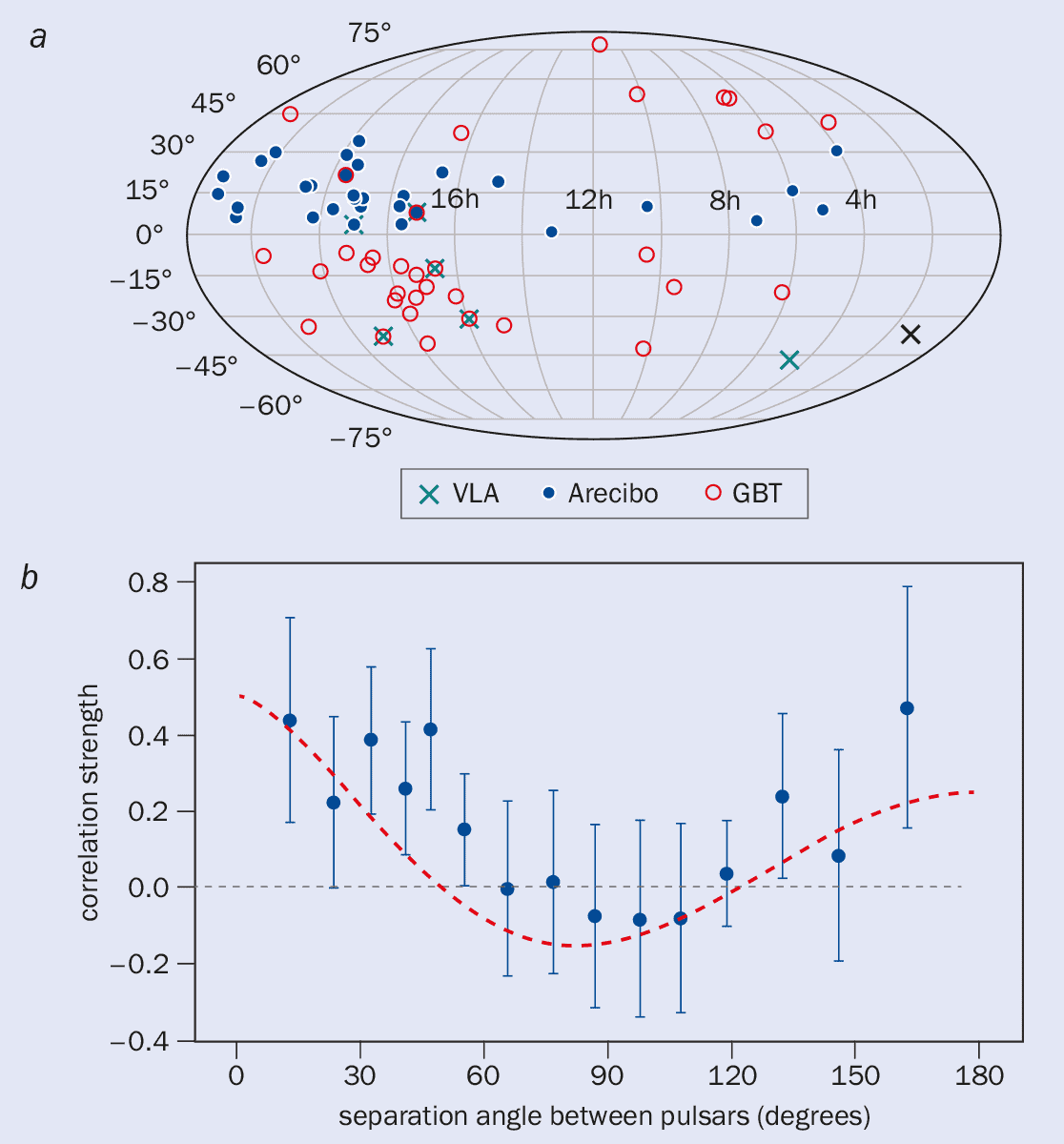
2 Gravitational-wave spectrum
Courtesy: NANOGrav Collaboration
(a) The NANOGrav 15-year data set contains timing observations from 68 pulsars using the Arecibo Observatory, the Green Bank Telescope and the Very Large Array. The map shows pulsar locations in equatorial co-ordinates. (b) The background comes from correlating changes in pulsar arrival times between all possible pairs of the 67 pulsars (2211 distinct pairs in total), and is based on three or more years of timing data. The black line is the expected correlation predicted by general relativity. These calculations assume the gravitational-wave background is from inspiralling supermassive black-hole binaries.
In June 2023 the NANOGrav collaboration published an analysis of 15 years of its data (figure 2), looking at 68 pulsars with millisecond periods, which showed this signature for the first time (ApJL951 L8). McLaughlin says that it represents not just one source of gravitational waves, but a background arising from all gravitational events such as merging supermassive black holes at the hearts of galaxies. This background may contain information about how galaxies interact and perhaps also the early universe. Five years from now, she predicts, NANOGrav will be detecting individual supermassive black-hole binaries and will tag their locations in specific galaxies, to form a black hole atlas.
Star-crossed astronomers
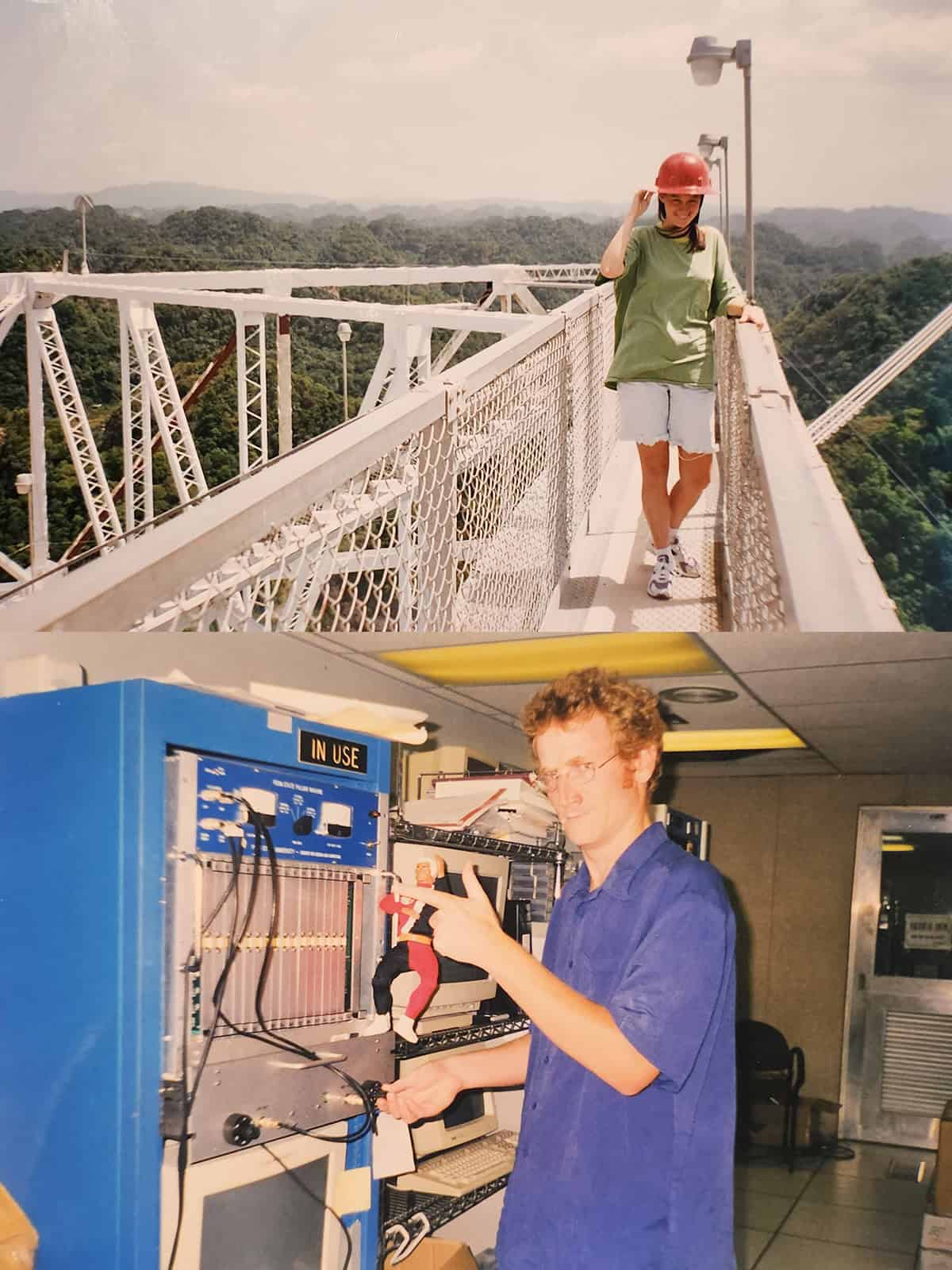
The connections between McLaughlin and Lorimer that played a role in their academic achievements began rather fittingly with an interaction in 1999, at the Arecibo radio telescope in Puerto Rico (now sadly decommissioned). Lorimer was based there at the time, while McLaughlin was a visiting graduate student, and their contact, though not in person, was definitely not cordial. Lorimer sent what he calls a “little snippy e-mail” to McLaughlin about her use of the computer that blocked his own access, which she also recalls as “pretty grumpy”.
Near miss Maura McLaughlin and Duncan Lorimer both worked at Arecibo Observatory in Puerto Rico in 1999, but they didn’t meet in person during that time. (Courtesy: Maura McLaughlin and Duncan Lorimer)
But things improved after they later met in person, and they joined the Jodrell Bank Observatory in the UK. The pair married in 2003 and now have three sons. Over the years, they moved together to the US, set up their own astronomy group at WVU by 2006, and proceeded to work together and alongside each other, publishing many research papers, both joint and separate.
Given all these successes, how do the two researchers balance science and family, especially when they first arrived at WVU with a five-month-old baby to join a department with just one astronomer and no graduate astronomy programme? McLaughlin says it was “Really hard work. Lots of grant writing, developing courses,” but adds that it was also “really fun because we were both building a programme and building a family and moving to a new place”.
Life got even busier in 2007, when another child and the FRB discovery both arrived. The couple says that it was all doable because they fully understood the need to shift scientific or family responsibilities to each other as necessary. According to McLaughlin, this includes equal parenting from her husband, for which she feels “very lucky”. As Lorimer puts it, “We get each other’s mindset.”
However, the fact that they are married may have coloured perceptions of their work and status. “When we first started here at WVU,” Lorimer explains, “a lot of people assumed we were sharing a single position. But the university’s been great. It’s always made it clear from the get-go that we’re obviously on different career trajectories.” And they agree that as they’ve progressed in their individual careers and are known for different things, they’re now unmistakably seen as two distinct scientists.
Shared wavelength Maura McLaughlin and Duncan Lorimer married in 2003 (top). They credit their ability to both have successful careers to sharing and shifting family responsibilities as needed, as well as taking their initially similar career paths on different trajectories. (Courtesy: Maura McLaughlin and Duncan Lorimer)
Beyond the Shaw Prize
The Shaw Prize came as a total surprise to the couple. The pair both received e-mails simultaneously one evening, but Lorimer spotted his first. “We almost missed it as it was just about time to go to bed and the announcement was being made in Hong Kong a few hours after that,” says Lorimer. McLaughlin recalls her husband screaming and excitedly running up the stairs to give her the news. “He doesn’t scream much to begin with, maybe only when the dogs do something bad, and I’m wondering ‘Why is he screaming late on a Sunday night?’ He told me to pull up the e-mail and I thought it was a prank. I read it again and realized it was real. That was quite a Sunday night.” Amusingly, the e-mail for their co-winner Matthew Bailes initially went into his spam folder. The trio would later describe their work in a Shaw Prize Lecture in Hong Kong in November 2023.
So what comes next for the stellar pair? Further research into the different types of FRBs that are still being found, using new telescopes and detection schemes. One new project, an extension of Lorimer’s earlier work in pulsar populations, is to locate FRBs in specific galaxies and among groups of both younger and older stars using the Green Bank telescope in West Virginia, along with others, to help uncover what causes them. FRBs may come from neutron stars with especially huge magnetic fields – dubbed magnetars – but this remains to be seen.
Data from Green Bank is also used in the Pulsar Science Collaboratory, co-founded by McLaughlin and Lorimer (see box below). Meanwhile, the NANOGrav pulsar observation of the gravitational wave background, where McLaughlin continues her long-time involvement, has been hailed by the LIGO Collaboration for opening up the spectrum in the exciting new era of gravitational-wave astronomy and cosmology.
The Pulsar Science Collaboratory
Engaging science Participants in the Pulsar Science Collaboratory, at the Green Bank Telescope control room. (Courtesy: NSF/AUI/GBO)
The Pulsar Science Collaboratory (PSC) was founded in 2007 by Maura McLaughlin, Duncan Lorimer and Sue Ann Heatherly at the Green Bank Observatory; with support from the US National Science Foundation. It is an educational project in which, to date, more than 2000 high-school students have been involved in the search for new pulsars.
Students are trained via a six-week online course and then must pass a certification test to use an online interface to access terabytes of pulsar data from the Green Bank Observatory. They are also invited to a summer workshop at the observatory. McLaughlin and Lorimer proudly note the seven new pulsars that high-school students have so far discovered. Many of these students have continued as college undergraduates or even graduate students working on pulsar and fast-radio-burst science.
At the end of the Shaw Prize Lecture, Lorimer pointed out that there is “still much left to explore”. In an interview for the press, McLaughlin said “We’ve really just started.” Both statements seem fair predictions for anything each one does in their areas of interest in the future – surely with hard work but also with the continuing sense that it’s “really fun”.
The Australian government has controversially announced it will provide A$940m (£500m) for the US-based quantum-startup PsiQuantum. The investment, which comes from the country’s National Quantum Strategy budget, makes PsiQuantum the world’s most funded independent quantum company.
Founded in 2015 by five physicists who were based in the UK, PsiQuantum aims to build a large-scale quantum computer by 2029 using photons as quantum bits (or qubits). As photonic technology is silicon-based, it benefits from advances in large-scale chip-making fabrication and does not need as much cryogenic cooling as other qubit platforms require.
The company has already reported successful on-chip generation and the detection of single-photon qubits, but the technique is not plain sailing. In particular, optical losses still need to be reduced to sufficient levels, while detection needs to be more efficient to improve the quality (or fidelity) of the qubits.
Despite these challenges, PsiQuantum has already attracted several supporters. In 2021 private investors gave the firm $665m and in 2022 the US government provided $25m to both GlobalFoundries and PsiQuantum to develop and build photonic components.
The cash come with some conditions, notably that PsiQuantum should build its regional headquarters in the Queensland capital Brisbane and operate the to-be-developed quantum computer from there. Anthony Albanese, Australia’s prime minister, claims the move will create up to 400 highly skilled jobs, boosting Australia’s tech sector.
A bold declaration
Stephen Bartlett, a quantum physicist from the University of Sydney, welcomes the news. He adds that the scale of the investment “is required to be on par” with companies such as Google, Microsoft, AWS, and IBM that are investing similar amounts into their quantum computer programmes.
Ekaterina Almasque, general partner at the venture capital firm OpenOcean, says that the investment may bring further benefits to Australia. “The [move] is a bold declaration that quantum will be at the heart of Australia’s national tech strategy, firing the starting gun in the next leg of the race for quantum [advantage],” she says. “This will ripple across the venture capital landscape, as government funding provides a major validation of the sector and reduces the risk profile for other investors.”
Open questions
The news, however, did not please everyone. Paul Fletcher, science spokesperson for Australia’s opposition Liberal/National party coalition, criticises the selection process. He says it was “highly questionable” and failed to meet normal standards of transparency and contestability.
“There was no public transparent expression of interest process to call for applications. A small number of companies were invited to participate, but they were required to sign non-disclosure agreements,” says Fletcher. “And the terms made it look like this had all been written so that PsiQuantum was going to be the winner.”
Fletcher adds that is is “particularly troubling” that the Australian government “has chosen to allocate a large amount of funding to a foreign based quantum-computing company” rather than home-grown firms. “It would be a tragedy if this decision ends up making it more difficult for Australian-based quantum companies to compete for global investment because of a perception that their own government doesn’t believe in them,” he states.
Kees Eijkel, director of business development at the quantum institute QuTech in the Netherlands, adds that it is still an open question what “winning technology” will result in a full-scale quantum computer due to the “huge potential” in the scalability of other qubit platforms.
Indeed, quantum physicist Chao-Yang Lu from University of Science and Technology of China took to X to note that there is “no technologically feasible pathway to the fault-tolerant quantum computers PsiQuantum promised” adding that there are many “formidable challenges”.
Lu points out that PsiQuantum had already claimed to have a working quantum computer by 2020, which was then updated to 2025. He says that the date now slipping to 2029 “is [in] itself worrying”.
Cystic fibrosis is a genetic disorder in which defects in the CFTR protein (arising from mutations in the CFTR gene) can cause life-threatening symptoms in multiple organs. In the respiratory system, cystic fibrosis dehydrates the airway and produces sticky mucus in the lungs, leading to breathing problems and increasing the risk of lung infections.
One proposed treatment for cystic fibrosis is gene therapy, in which a viral vector delivers a healthy copy of the CFTR gene into airway cells to produce functional CFTR protein. To transport this vector to target cells and keep it there long enough to interact with them – key challenges for all gene therapies – researchers have coupled the vector to magnetic nanoparticles, which should allow controlled delivery to the airways using an external magnetic field.
Researchers at the University of Adelaide are now tackling another pressing challenge for successful gene therapy – visualizing the magnetic nanoparticles within live airways and manipulating them in vivo. To achieve this, they explored the use of dark-field X-ray imaging to enhance nanoparticle contrast and understand how magnetic nanoparticles move within the airway of a live rat, reporting their findings in Physics in Medicine & Biology.
While conventional X-ray imaging relies on the absorption of X-rays, dark-field X-ray imaging detects small-angle scattering from microstructures within a sample. To perform dark-field imaging, the researchers used a 25.0 keV monochromatic beam at the SPring-8 Synchrotron in Japan. They placed a phase grid into the beam upstream of the sample, creating a pattern of beamlets at the detector. These beamlets diffuse as they scatter through the sample, and the dark-field signal can be extracted from the strength of this blurring at the detector.
Research team From left to right: Martin Donnelley, Kaye Morgan, David Parsons, Ronan Smith and Alexandra McCarron during their visit to Japan to use the SPring-8 Synchrotron. (Courtesy: Martin Donnelley)
“My group previously used high-resolution phase-contrast X-ray imaging for imaging nanoparticle delivery, and we were at the synchrotron when we realised the images weren’t showing the full picture,” first author Ronan Smith tells Physics World. “I developed new methods for directional dark-field imaging during my PhD, so we thought we’d see if that could help.”
Imaging nanoparticle delivery
The researchers first examined the delivery of superparamagnetic nanoparticles to an anaesthetized rat, positioned with the synchrotron beam passing through its trachea at 45°. Imaging a living animal inevitably creates background signals from the surrounding anatomy. To supress this background during nanoparticle delivery, the team employed a novel approach based on analysing the components of the directional dark-field signal.
A suspension of nanoparticles should scatter X-rays isotropically, and the major and minor scattering components of the directional dark-field signal should be equal. Asymmetric structures such as tissue, skin and hair, however, will scatter anisotropically, with most of the signal seen in the major component. By examining just the minor component, the team could enhance the contrast of the nanoparticles signal above the background.
“The directional dark-field retrieval approach was key in isolating the isotropic dark-field signal, generated by nanoparticles entering the airways, from the overlying directional dark-field signal generated by the surrounding anatomy,” Smith explains. “No one has taken this approach before as far as I know.”
Smith and colleagues delivered the nanoparticles into the rat’s trachea over 25 s, capturing 180 frames during this time, guided by the animal’s breathing. Initially, a diagonal line appeared in both the X-ray transmission and dark-field images, showing the nanoparticles starting to flow from the delivery tube into the trachea. At 22.91 s, the minor dark-field signal revealed a noticeable feature in the lower half of the tube, which became gradually clearer before being pushed out by an air bubble at the end of the delivery. The dark-field signal captured this event with 3.5 times higher signal-to-noise ratio than the transmission signal.
Nanoparticle imaging Transmission (a), directional dark-field (b), and major (c) and minor (d) components of the dark-field images. (Courtesy: CC BY 4.0/Phys. Med. Biol. 10.1088/1361-6560/ad40f5)
Imaging the delivery process revealed that the nanoparticles unexpectedly settled inside the delivery tube, with many only reaching the trachea during the last 10% of the delivery. The researchers note that this could lead to suboptimal cellular uptake of viral vectors being delivered by nanoparticles, adding that this process could not have been observed without dark-field imaging.
Rotating nanoparticle strings
Next, the team exposed the rat to a 1.17 T magnet, which caused the nanoparticles to form into string-like structures, and rotated the magnet around its trachea. With the magnet above the rat, transmission images showed that the strings were aligned vertically. As the magnet moved, the strings remained aligned to the magnetic field, suggesting that dynamic magnetic fields could indeed manipulate nanoparticles in situ.
With the magnet alongside the rat (partially aligning the strings along the beam axis), the strings also produced a directional dark-field signal. However, this signal was not clearly visible when the particles were aligned vertically, likely due to the beam passing through fewer nanoparticles in this position.
Smith says that the biologists in his group are now using these imaging results to enhance their work on airway gene therapy. “It’s a cyclic development process, so we have more synchrotron experiments planned to answer the questions that their results give, using a mixture of phase-contrast and directional dark-field imaging,” he explains. “We are also looking at other respiratory applications of dark-field imaging.”
One of the things that sets humans apart from machines is our ability to process the context of a situation and make intelligent decisions based on internal analysis and learned experiences.
Recent years have seen the development of new “smart” and artificially “intelligent” machine systems. While these do have intelligence based on analysing data and predicting outcomes, many intelligent machine networks struggle to contextualize information and tend to just create a general output that may or may not have situational context.
Whether we want to build machines that can make informed contextual decisions like humans can is an ethical debate for another day, but it turns out that neural networks can be equipped with recurrent feedback that allows them to process current inputs based on information from previous inputs. These so-called recurrent neural networks (RNNs) can contextualize, recognise and predict sequences of information (such as time signals and language) and have been used for numerous tasks including language, video and image processing.
There’s now a lot of interest in transferring electronic neural networks into the optical domain, creating optical neural networks that can process large data volumes at high speeds with high energy efficiency. But while there’s been much progress in general optical neural networks, work on recurrent optical neural networks is still limited.
New optoelectronics required
Development of recurrent optical neural networks will require new optoelectronic devices with a short-term memory that’s programmable, computes optical inputs, minimizes noise and is scalable. In a recent study led by Birgit Stiller at the Max Planck Institute for the Science of Light, researchers demonstrated an optoacoustic recurrent operator (OREO) that meets these demands.
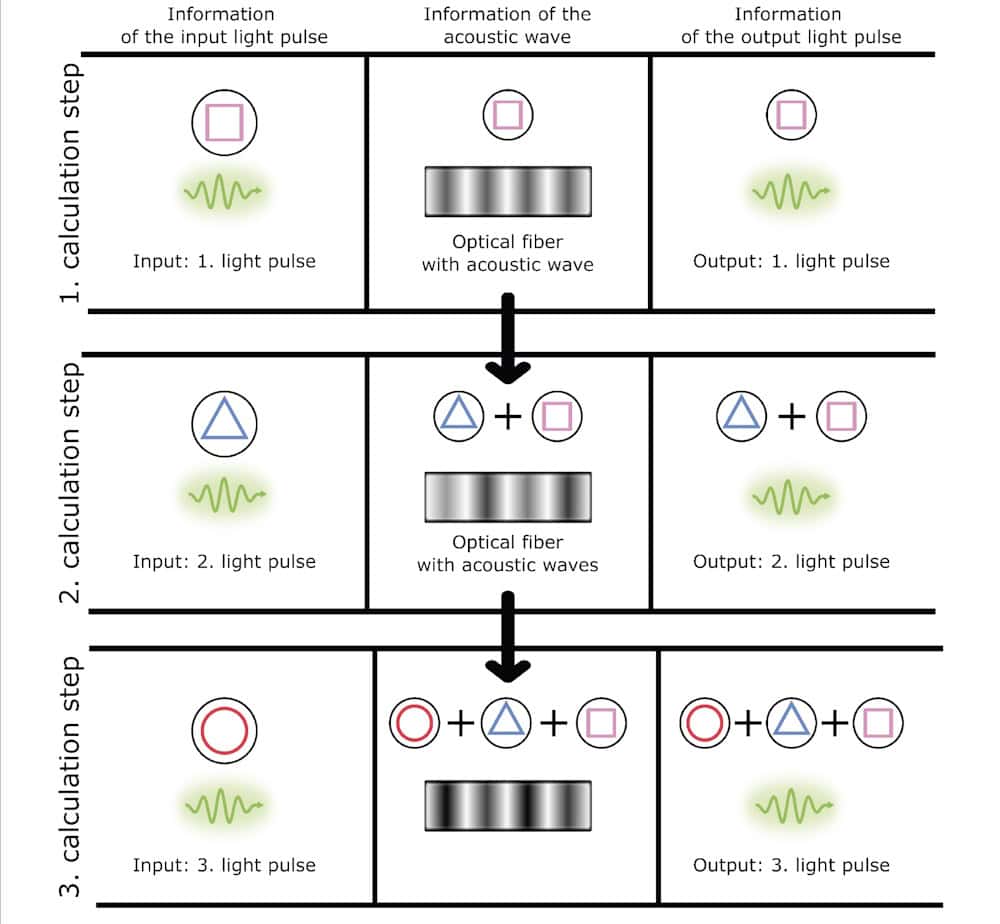
OREO concept Information in an optical pulse is partially converted into an initial acoustic wave, which affects the second and third light–sound processing steps. (Courtesy: Stiller Research Group, MPL)
The acoustic waves in the OREO link subsequent optical pulses and capture the information within, using it to manipulate the next operations. The OREO is based on stimulated Brillouin-Mandelstam scattering, an interaction between the optical waves and travelling sound waves that’s used to add latency and slow the acoustic velocity. This process enables the OREO to contextualize a time-encoded stream of information using sound waves as a form of memory, which could be used not only to remember previous operations but as a basis to manipulate the output of the current operation – much like in electronic RNNs.
“I am very enthusiastic about the generation of sound waves by light waves and the manipulation of light by the means of acoustic waves,” says Stiller. “The fact that sound waves can create fabrication-less temporary structures that can be seen by light and can manipulate light in a hair-thin optical fibre is fascinating to me. Building a smart neural network based on this interaction of optical and acoustic waves motivated me to embark on this new research direction.”
Designed to function in any optical waveguide, including on-chip devices, the OREO controls the recurrent operation entirely optically. In contrast to previous approaches, it does not need an artificial reservoir that requires complex manufacturing processes. The all-optical control is performed on a pulse-by-pulse basis and offers a high degree of reconfigurability that can be used to implement a recurrent dropout (a technique used to prevent overfitting in neural networks) and perform pattern recognition of up to 27 different optical pulse patterns.
“We demonstrated for the first time that we can create sound waves via light for the purposes of optical neural networks,” Stiller tells Physics World. “It is a proof of concept of a new physical computation architecture based on the interaction and reciprocal creation of optical and acoustic waves in optical fibres. These sound waves are, for example, able to connect several subsequent photonic computation steps with each other, so they give a current calculation access to past knowledge.”
Looking to the future
The researchers conclude that they have, for the first time, combined the field of travelling acoustic waves with artificial neural networks, creating the first optoacoustic recurrent operator that connects information carried by subsequent optical data pulses.
These developments pave the way towards more intelligent optical neural networks that could be used to build a new range of computing architectures. While this research has brought an intelligent context to the optical neural networks, it could be further developed to create fundamental building blocks such as nonlinear activation functions and other optoacoustic operators.
“This demonstration is only the first step into a novel type of physical computation architecture based on combining light with travelling sound waves,” says Stiller. “We are looking into upscaling our proof of concepts, working on other light–sound building blocks and aiming to realise a larger optical processing structure mastered by acoustic waves.”
A new ultra-precise atomic clock outperforms existing microwave clocks in time-keeping and sturdiness under real-world conditions. The clock, made by a team of researchers from the California, US-based engineering firm Vector Atomic, exploits the precise frequencies of atomic transitions in iodine molecules and recently passed a three-week trial aboard a ship sailing around Hawaii.
Atomic clocks are the world’s most precise timekeeping devices, and they are essential to staples of modern life such as global positioning systems, telecommunications and data centres. The most common types of atomic clock used in these real-world applications were developed in the 1960s, and they work by measuring the frequency at which atoms oscillate between two energy states. They are often based on caesium atoms, which absorb and emit radiation at microwave frequencies as they oscillate, and the best of them are precise to within one second in six million years.
Clocks that absorb and emit at higher, visible, frequencies are even more precise, with timing errors of less than 1 second in 30 billion years. These optical atomic clocks are, however, much bulkier than their microwave counterparts, and their sensitivity to disturbances in their surroundings means they only work properly under well-controlled conditions.
Prototypes based on iodine
The Vector Atomic work, which the team describe in Nature, represents a step towards overturning these limitations. Led by Vector Atomic co-founder and study co-author Jamil-Abo-Shaeer, the team developed three robust optical clock prototypes based on transitions in iodine molecules (I2). These transitions occur at wavelengths conveniently near those of routinely-employed commercial frequency-doubled lasers, and the iodine itself is confined in a vapour cell, doing away with the need to cool atoms to extremely cold temperatures or keep them in an ultrahigh vacuum. With a volume of around 30 litres, the clocks are also compact enough to fit on a tabletop.
While the precision of these prototype optical clocks lags behind that of the best lab-based versions, it is still 1000 times better than clocks of a similar size that ships currently use, says Abo-Shaeer. The prototype clocks are also 100 times more precise than existing microwave clocks of the same size.
Sea trials
The researchers tested their clocks aboard a Royal New Zealand Navy ship, HMNZS Aotearoa, during a three-week voyage around Hawaii. They found that the clocks performed almost as well as in the laboratory, despite the completely different conditions. Indeed, two of the larger devices recorded errors of less than 400 picoseconds (10-12 seconds) over 24 hours.
The team describe the prototypes as a “key building block” for upgrading the world’s timekeeping networks from the nanosecond to the picosecond regime. According to team member Jonathan Roslund, the goal is to build the world’s first fully integrated optical atomic clock with the same “form factor” as a microwave clock, and then demonstrate that it outperforms microwave clocks under real-world conditions.
“Iodine optical clocks are certainly not new,” he tells Physics World. “In fact, one of the very first optical clocks utilized iodine, but researchers moved onto more exotic atoms with better timekeeping properties. Iodine does have a number of attractive properties, however, for making a compact and simple portable optical clock.”
The most finicky parts of any atomic-clock system, Roslund explains, are the lasers, but iodine can rely on industrial-grade lasers operating at both 1064 nm and 1550 nm. “The vapour cell architecture we employ also uses no consumables and requires neither laser cooling nor a pre-stabilization cavity,” Roslund adds.
The next generation
After testing their first-generation clocks on HMNZS Aotearoa, the researchers developed a second-generation device that is 2.5 times more precise. With a volume of just 30 litres including the power supply and computer control, the upgraded version is now a commercial product called Evergreen-30. “We are also hard at work on a 5-litre version targeting the same performance, and an ultracompact 1-litre version,” Roslund reveals.
As well as travelling aboard ships, Roslund says these smaller clocks could have applications in airborne and space-based systems. They might also make a scientific impact: “We have just finished an exciting demonstration in collaboration with the University of Arizona, in which our Evergreen-30 clocks served as the timebase for a radio observatory in the Event Horizon Telescope Array, which is imaging distant supermassive blackholes.”