Nuclei reveal novel decay

Nuclei decay when they contain either too many neutrons or too many protons to be stable. In addition to alpha, beta and gamma decay and nuclear fission, certain proton-rich nuclei can also decay by emitting protons. Researchers have already observed nuclei with an odd number of protons decaying through the emission of a single proton.

In the latest research, physicists have observed a type of radioactive decay predicted to occur in heavy nuclei with an even number of protons and/or neutrons. In these nuclei the protons and neutrons are bound together by a “pairing” force, which causes emission of two protons at the same time.

Both research groups fired a beam of nickel-58 ions at a fixed target – at GANIL the target was made of nickel, while the GSI experiment used beryllium. The impact caused the nickel-58 ions to split up into a number of smaller nuclei, including iron-45, which contains 26 protons and 19 neutrons. These nuclei were then separated out from the rest of the impact debris, slowed down and captured in a series of silicon detectors, where they quickly decayed via two-proton emission.

The GANIL researchers observed 12 such decays and the GSI researchers four. In both experiments the energy of the emitted protons had a well-defined value of about 1 mega electronvolt, which agrees well with a number of theoretical models. Results from the two experiments also produced consistent values of the two-proton decay half-life – around 4 milliseconds.

The leader of the French group, Bertram Blank of the Centre for Nuclear Energy Studies in Bordeaux-Gradignan, believes that these results are the first conclusive proof of two-proton radioactivity. Two years ago researchers at Oak Ridge National Laboratory in the US observed two-proton emission from neon-18 nuclei but the half-life of the decay was only about 10-15 s. “In contrast to all previous work, iron-45 has a ‘real’ half-life,” says Blank.

Two-proton decay is a potentially powerful tool for nuclear physicists because it could reveal how protons are bound together in the nucleus. If the protons exist in pairs, then they should be emitted from the iron-45 nucleus as a single nucleus of helium-2 and would therefore be separated by only a very small angle. But if, on the other hand, the protons are independent of one another, they would not have any angular correlation.

Unfortunately, the GANIL and GSI experiments are not currently able to measure the angles at which the individual protons are emitted. To reap the full benefits of this latest discovery, nuclear physicists will have to wait several years while they build new experiments.

Optical tweezers grab the limelight

Optical tweezers manipulate particles by using a laser beam to induce an electric dipole moment in the particles. Drawn to the most intense part of the laser’s electric field, the particles can then be picked up, moved and released by switching the laser on, shifting the focus, and switching it off.

The St Andrews device is the first set of optical tweezers to use a Bessel beam to trap particles at different locations along the beam. A Bessel beam is a non-diffracting light beam made up of many wavefronts arranged on a cone. When the wavefronts interfere they produce a bright central maximum surrounded by a series of concentric bright and dark rings.

“When we distort the central maximum by trapping a particle in it, this creates a shadow,” explains Dholakia. “But because the wavefronts are on a cone, the outer parts of the beam pass the particle unhindered and reconstruct the central maximum some distance from the original particle. This new maximum can trap more particles.”

Dholakia and colleagues used their tweezers to trap a low-refractive index particle in a sample cell. Once the beam had reformed it was then able to stack three 5 micron spheres in a second cell located some 3 mm above the first cell. The researchers also aligned 8 micron glass fragments in the bottom cell while simultaneously trapping chromosomes in the top cell.

In the first configuration, the beam was passed upwards through the cells, while in the second it was passed downwards. “Objects are trapped in the rings surrounding the maximum forming two-dimensional arrays of particles in each cell,” says Dholakia.

This method allows three sample cells to form one above the other. According to Dholakia, the St Andrews team can trap different particles in all three traps simultaneously and manipulate them.

The group is now working towards rotating particles in individual cells and using other non-diffracting light patterns. “We believe we can get the sample cell separation distance up to 10 mm,” says Dholakia.

Stars prove their magnetic attraction

Physicists have known for many decades that ordinary stars are powered by nuclear fusion, and have discovered other types of star that rely on alternative sources of energy, such as gravity, radioactivity or rotation. In addition, many researchers now believe that soft-gamma-ray repeaters are powered by magnetism. It is thought that these spinning objects require a high magnetic field because their period of rotation rapidly increases over time and because they generate intense bursts of gamma-rays.

Researchers have suggested that anomalous X-ray pulsars are also powered by magnetic fields because, unlike other X-ray pulsars, they are not accompanied by companion stars from which they can accrete matter. They also do not have sufficient rotational energy to power their emission. They rotate at about the same rate as soft-gamma-ray repeaters, are also located in the galactic plane and have similar X-ray spectra. To date, however, they have not been observed to produce bursts of radiation as soft-gamma-ray repeaters do.

Now, after studying routine data from the Rossi X-ray Timing Explorer satellite, Gavriil and colleagues have discovered two X-ray bursts with properties similar to those of soft-gamma-ray repeaters that originate from the direction of an anomalous X-ray pulsar called 1E 1048.1-5937. They also found a feature in the spectrum of this object that is probably caused by the gyration of protons in an intense magnetic field. If confirmed, this and a similar feature recently found in the spectrum of a soft-gamma-ray repeater would provide direct evidence of strong magnetic fields surrounding these objects.

The researchers propose that the bursts from anomalous X-ray pulsars are harder to detect than those from soft-gamma-ray repeaters because the former are young stars with more malleable outer layers, or crusts. The more malleable the crust, they argue, the more difficult it is to support the strong magnetic fields that give rise to radiation bursts.

Magnetars are thought to have magnetic fields of at least 1014 Gauss, some billion times stronger than the largest sustained magnetic fields created artificially on Earth. Such strong fields could be a boon to physicists as they might give rise to strange effects predicted by quantum electrodynamics.

The most beautiful experiments in physics as chosen by real physicists

When I asked readers earlier this year to submit candidates for the “most beautiful experiment in physics” (Physics World May 2002), I was pleased to receive more than 200 replies. The responses covered a broad spectrum, ranging from actual experiments to thought experiments, and from proposed experiments to proofs, theorems and models. However, one experiment – the double-slit experiment with electrons – was cited more often than any other, receiving a total of 20 votes.

Others in the top 10 included Galileo’s experiments with falling bodies, Millikan’s oil-drop experiment and Newton’s separation of sunlight with a prism. Young’s original double-slit interference experiment with light also appeared in the list (see box).

Aspects of beauty

Readers offered a variety of reasons for their selections. One was the transformative power of the experiment – its ability to change thinking and behaviour. “You’ll never think the same way about light,” commented one reader who proposed a photoelectric-effect experiment.

A fan of Millikan’s oil-drop experiment, meanwhile, observed that repeating the experiment can leave no-one in doubt that electrical charge is quantized and that modern physics is real, observable and true. “When I did the experiment in a junior physics lab many years ago,” he said, “I literally sat staring at the spreadsheet, dumbfounded at how perfect and elegant the whole thing was. I redid the analysis just for the fun of seeing it come out again.”

Experiments can transform our thinking and behaviour, no matter how prepared we may be for the result. Using phrases like “the only experiment I remember after so many years”, readers described experiments they recalled from high school involving beach balls floating in air currents (illustrating the Bernoulli principle), ripple tanks (waves and interference), crushed metal cans (vacuum and air pressure), and skateboard antics (mass and inertia). A few mentioned the Apollo “feather-drop” experiment on the Moon – a recreation of Galileo’s falling-bodies experiment – although they admitted that the location helped to make it unforgettable and possibly the “most watched experiment” of all time.

Readers also defined beautiful experiments in terms of “economy” – in other words how efficiently and dramatically the experiment made an important result stand out. Economy might refer to either the experimental equipment itself or how it presented a significant result, or to both. Someone recalled seeing the gyroscopic principle demonstrated via a bicycle wheel suspended from the ceiling with a rope tied to the axle nut, and observed that – without gyroscopic precession – “there would be no rockets, no global-positioning system (GPS), no advanced aircraft and no Segway [GPS-controlled one-man bikes] and, of course, no bicycles!”.

Another cited a measurement of the time intervals between the drips of a simple tap to illustrate principles of chaos and nonlinear systems and to show how information is transmitted from small scales to large.

Fair play

There were several people who mentioned economical reductio ad absurdum arguments. These included Stephen Hawking’s proof that the universe has not existed forever – or, as one respondent commented, “it’s true because if it were not, all things would be the same temperature”. Others cited Olbers’ paradox that the sky is not uniformly bright even though it contains – to all intents and purposes – an infinite number of stars. (The paradox is resolved by the fact that the universe is expanding, which means that distant light has not yet reached us.)

Still others cited the beauty of certain scientific instruments that used little beyond ingenuity to open up vast new domains for exploration. Examples that fell into this category included Charles Wilson’s cloud chamber, the X-ray interferometer, the scanning tunnelling microscope and the Cosmotron at Brookhaven.

A final aspect of beauty that was often cited by readers might be called “deep play”. This is the sense that we are actively engaged with something outside ourselves that is responding to us – rather than watching a game of our own construction or watching nature from a detached distance. Readers found beauty in small-scale play with simple things like balls, waves, sounds and coins – allowing order in apparently random and contradictory events to show itself. Other readers found beauty in much larger play – such as Roemer’s observations of Jupiter’s moon Io to determine the speed of light or Eddington’s measurement of the bending of starlight. These astronomical observations turn the entire solar system – and even the galaxy and beyond – into a vast playing field for experiment.

Slashdot discussion

My original article was also mentioned on Slashdot.org, an extremely active website. Although Slashdot bills itself as “news for nerds”, its audience evidently includes a large number of science-history aficionados. A discussion with more than 500 comments ensued, many dissecting the merits of particular experiments. Here too the double-slit electron-interference experiment topped the list. One participant remarked that this and other experiments illustrating quantum-mechanical principles “even seem to reveal something about ourselves”, noting that “philosophers and cranks are attracted to the results like moths”.

Other Slashdot participants proposed many of the same experiments as Physics World readers – and often for similar reasons. However, they also came up with an imaginative variety of examples of deep play. These included fun things like putting discarded CDs into microwave ovens, firing potatoes using lengths of pipe and cans of hairspray, and synchronizing coloured lasers to the music of Pink Floyd.

One of the contributors described watching small plastic bags circulating in wind pockets, commenting that “sometimes there’s so much beauty in the world, I just can’t take it”. Another mentioned the fact that a hunter firing at a falling monkey always hits the monkey no matter how far away it is, even though it drops just as the hunter fires. One person even cited sitting outside a hospital to hear the Doppler effect, with the comment: “Anytime an ambulance passes me, I’m amazed.”

One Slashdot participant described a method of producing a fractal using a coin, marker and tape measure, claiming to have nearly cried the first time they saw it. Another described an impromptu game that he and classmates had invented at the end of a lab class, in which a liquid-nitrogen-filled styrofoam cup with holes in the bottom can be made to glide pleasingly around the floor when kicked about as the gas leaks out.

The beauty of the double-slit experiment

The double-slit experiment exemplifies the wave–particle duality of light, as well as quantum physics itself. It demonstrates that light interferes with itself in passing through a pair of slits. It also shows that even single electrons – proceeding one by one – interfere. Richard Feynman is said to have remarked that it contains everything you need to know about quantum mechanics.

The double-slit experiment with electrons possesses all of the aspects of beauty most frequently mentioned by readers – although, unlike all of the other experiments in the top 10, it does not have anyone’s name attached to it. It is transformative, being able to convince even the most die-hard sceptics of the truth of quantum mechanics. “Before seeing it,” one respondent wrote, “I didn’t believe a single word of ‘modern’ physics.” It is economical: the equipment is readily obtained and the concepts are readily understandable, despite its revolutionary result. It is also deep play: the experiment stages a performance that does not occur in nature, but unfolds only in a special situation set up by human beings. In doing so, it dramatically reveals – before our very eyes – something more than was put into it.

“I saw it during an optics course at Edinburgh University,” wrote respondent Alison Campbell, an astronomer at St Andrews University. “The prof didn’t tell us what was going to happen, and the impact was tremendous. I cannot remember the experimental details any more – I just remember the distribution of points that I suddenly saw were arranged in a diffraction pattern. Seeing the two-slit experiment is like watching a total solar eclipse for the first time: a primitive thrill passes through you and the little hairs on your arms stand up. You think this particle–wave thing is really true and the foundations of your knowledge shift and sway.”

Beauty and the experimental process

I was a little disturbed, however, by the ease with which many people seemed to think that the experiments that they were proposing had been conceived, or could be carried out and understood. This seemed a function, in part, of the way that these experiments are often taught. Demonstrations can vastly simplify the experimental process through the use of modern equipment constructed with the “right answer” in view. Textbooks and Web simulations – which exist for most of the experiments on the top 10 list – can involve far greater simplifications. That is true even when, as in the case of some Millikan oil-drop simulations, “dirty” drops that cannot be fitted to the right result are deliberately included along with clean ones in an attempt to promote verisimilitude.

These demonstrations and simulations, I think, diminish the experience of beauty in science by misrepresenting the experimental process. Even when a scientific experiment points to a simple fact or relationship – as Frederic Holmes writes in his book Meselson, Stahl, and the Replication of DNA: A History of the Most Beautiful Experiment in Biology – it usually has been extracted from a “matrix of complexity”, and introduces new complexities into science. Despite its simplicity, he says, “the [Meselson–Stahl] experiment originated in complexity, was surrounded by complexity and directed the way toward the discovery of future complexities.”

And it hardly needs saying that the various experiments demonstrating quantum-mechanical principles were not born simply, and have not made the world simpler. Demonstrations and simulations can misrepresent by encouraging the sense that a scientific experiment is just an illustration of an already formulated lesson – turning the experiment into a paint-by-numbers masterpiece, as it were – rather than a process by which a hitherto unknown truth becomes disclosed for the first time.

One Slashdot contributor touched on this after describing an experiment in which he measured the acceleration of gravity using a pin, a switch, a timer and a shuttlecock. “The most beautiful thing wasn’t learning that gravity is 9.8 ms–2,” he wrote, “but in showing us that from a fairly simple set-up we could quantitatively measure something important in physics.”

The critical point

Beauty, Plato wrote, is not easy to define, but something that “slips through and evades us”. For this reason, many logic-oriented philosophical approaches tend to divorce and even oppose truth and beauty. “The question of truth”, wrote logician Gottlob Frege in one of his most influential works, “would cause us to abandon aesthetic delight for an attitude of scientific investigation.”

I’m far more sympathetic to those philosophical traditions that view truth as involving, most fundamentally, the disclosure of something rather than accurate representation. These traditions allow us to see an intimate connection between scientific inquiry and beauty. At any given time, the scientific frontier is ambiguous and confusing, and requires the skilful planning and performing of experimental actions to sort out and bring clarity.

It is natural to call beautiful those that captivate and transform our thinking, that make the result stand out clearly and economically and not abstractly as a lesson but in a materially embodied way, and that reveal that we are actively engaging with something beyond us. To speak about beauty in science as belonging solely to the province of theory or equations is to misunderstand both beauty and science.

The quantum-mechanical world is likely to remain counterintuitive to human beings, no matter how well-versed or confident we are in the theory. The double-slit electron-interference experiment brings its reality before our eyes in a dramatic, economical and materially embodied way. It is therefore likely to remain in the pantheon of beautiful experiments for a long time to come.

Top 10 beautiful experiments

The list below shows the top 10 most frequently mentioned experiments by readers of Physics World.

1 Young’s double-slit experiment applied to the interference of single electrons

2 Galileo’s experiment on falling bodies (1600s)

3 Millikan’s oil-drop experiment (1910s)

4 Newton’s decomposition of sunlight with a prism (1665–1666)

5 Young’s light-interference experiment (1801)

6 Cavendish’s torsion-bar experiment (1798)

7 Eratosthenes’ measurement of the Earth’s circumference (3rd century BC)

8 Galileo’s experiments with rolling balls down inclined planes (1600s)

9 Rutherford’s discovery of the nucleus (1911)

10 Foucault’s pendulum (1851)

Others experiments that were cited included:

  • Archimedes’ experiment on hydrostatics
  • Roemer’s observations of the speed of light
  • Joule’s paddle-wheel heat experiments
  • Reynolds’s pipe flow experiment
  • Mach & Salcher’s acoustic shock wave
  • Michelson–Morley measurement of the null effect of the ether
  • Röntgen’s detection of Maxwell’s displacement current
  • Oersted’s discovery of electromagnetism
  • The Braggs’ X-ray diffraction of salt crystals
  • Eddington’s measurement of the bending of starlight
  • Stern–Gerlach demonstration of space quantization
  • Schrödinger’s cat thought experiment
  • Trinity test of nuclear chain reaction
  • Wu et al.’s measurement of parity violation
  • Goldhaber’s study of neutrino helicity
  • Feynman dipping an O-ring in water

MEMs see the light

Eye diseases such as retinitis pigmentosa and macular degeneration attack the rod and cone cells that detect light inside the eyeball, but leave most of the nerve endings intact. Although millions of people suffer from these conditions, project member Mark Humayun of the University of Southern California believes that the solution to the problem already exists. “There is a considerable amount of advanced technology literally sitting on the shelf or being used for defence purposes that we could use to help solve blindness,” he says.

The array of electrodes being developed by the American researchers is made from silicon components that are micrometres across – that is, a similar size to the nerve endings in the retina. A small camera attached to the patient’s spectacles activates the array by transmitting radio signals to it. Each electrode then fires an electrical pulse into a group of nerves, and the brain interprets this pulse as a visual signal.

The researchers are testing different electrical waveforms to find the one that best mimics the electrochemical response of the retina to light. Since the retina is very sensitive to pressure, the team plan to use spring-loaded electrodes to keep the devices in contact with the retina using the least possible force. The materials used to encase the arrays must also be highly reliable and compatible with the saline conditions in the eye.

Patients using the MEMs arrays will only be able to see 1000 pixels, in contrast with the millions of pixels visible to the healthy human eye. But project leader Kurt Wessendorf of Sandia National Laboratory says that the device should enable people to perform household tasks and read large type. He is also optimistic that his team will be able to make larger arrays in the near future.

DNA gives new life to dye lasers

It is well known that placing too many dye molecules close together can lead to the quenching of fluorescence when pumped. The Chitose team has overcome this problem by using DNA as a scaffold that isolates the dye molecules and reduces the quenching. “If DNA makes other kinds of dye lase, the range of materials used in solid-state dye lasers will be greatly expanded,” say Kawabe and colleagues.

The scientists fabricate their films from a hemicyanine dye, a lipid and DNA. The ratio of DNA base pairs to dye molecules can be varied from 10:1 to 40:1, which results in films with thicknesses between a few microns and a few millimetres. A frequency-doubled Nd:YAG laser emitting nanosecond pulses optically pumps the film. The incident energy is varied up to a maximum of 1000 µJ.

An intensified CCD camera gathers the emission from the edge of the film and feeds it into a spectrometer. The authors observe spectral narrowing at threshold energies above 25  µJ and conclude that amplification has occurred.

Having tested their approach on a film that does not contain DNA, the researchers believe that the DNA plays an essential role in the laser action. Moreover, the performance of the laser only decreased by a few percent in two hours which, say Kawabe and colleagues, suggests that the device might be suitable for applications. Further studies of the structural and spectroscopic properties of the films are now being carried out.

Diamond – a physicist’s best friend

Diamond is a semiconductor whose excellent physical properties – such as its high thermal conductivity and large band gap – make it the ideal material for devices such as power diodes and high-frequency field effect transistors. However, in its natural form it has too many defects and impurities to be useful in such devices.

Diamond has been produced artificially for nearly fifty years, by heating and compressing graphite using high-pressure high-temperature (HPHT) technology. However, like the naturally occurring form of the material, HPHT diamonds suffer from too many defects and impurities, and, measuring just a few thousandths of a millimetre across, have been too small to be useful for electronic applications.

More recently, techniques have been developed in which single crystals of diamond are deposited onto a substrate from the vapour phase using a hydrocarbon plasma. But diamonds produced in this way are made up of many crystals at different orientations. This is a problem because grain boundaries impede electronic performance.

Isberg and colleagues have now overcome these problems by combining the two techniques, an approach that has been developed over the last two years. By using a substrate made from HPHT diamond many millimetres across, the crystal grains that result from plasma deposition can be made to point in the same direction. Using this technique the researchers have manufactured sizeable diamond crystals with electronic properties better than predicted by theory, and have been able to control the conductivity of the crystals by doping the vapour with boron.

The researchers measured a property of their synthesized diamond known as mobility – a constant that relates the velocity of a charge carrier (an electron or a hole) to the electric field that propels the charge carrier. They discovered that when subjected to low electric fields, the electrons in their diamond have a mobility (measured in square centimetres per volt second) of 4500, and the holes have a mobility of 3800. It is the latter figure that suggests that diamond has great potential in electronic devices since it is significantly greater than the mobility of electrons in SiC and GaN, two semiconductors that are also being investigated for advanced electronics applications.

Isberg says that diamond-based devices will enter the market once the process technology has been refined and larger diamond substrates produced. He believes that certain devices, such as radiation detectors and Schottky diodes, could be developed within the next couple of years, while more complex devices such as field-effect transistors will take longer.

Female-friendly physics

Although the number of female physicists has increased over recent decades, women make up only about 20% of UK physics undergraduates and are considerably less well represented within higher academic positions. To tackle these shortages, the first global meeting on women in physics was held earlier this year by the International Union of Pure and Applied Physics. Today’s report, entitled “Women physicists speak”, sets out how the resolutions from the international conference can be applied specifically to the UK.

The report contains a number of recommendations relating to universities. It says that “if there is to be a qualitative change in the participation of women in physics and astronomy, attitudes of mind and procedures in university departments need to change.” In particular it says that women need carefully tailored advice on their career development as they are unlikely to have older female colleagues to provide informal advice.

The report goes on to say that university vice-chancellors should appoint women to senior positions “in the same proportion as they are represented on university staff, recognizing that women have much to offer that may be different from men.” There should be an established career path for women who work part time or return to work after a break, while men should have the option to work fewer hours in order to undertake childcare. Vice-chancellors must make sure that procedures for promotion and salary revision are transparent.

There are also a number of recommendations for funding bodies, learned societies, industry and government. The report says that the UK’s higher education funding councils need to ensure that the Research Assessment Exercise treats women fairly. As regards salaries, funding councils should justify inequalities between the sexes or take immediate action to raise the pay of women academics to that of men.

In a similar vein, research councils should ensure that their funding does not discriminate along gender lines and must monitor the fairness and objectivity of the peer review process. The report points out that women would particularly benefit if research councils adopt the improved pay and conditions for contract research workers recommended in the recent review by Sir Gareth Roberts.

The report says that the Institute of Physics and the Royal Astronomical Society should “regard the increased participation of women as part of their core strategy and offer an imaginative lead to the community”.

Meanwhile, industry should ensure it has available flexible working patterns, paid paternity and maternity leave, childcare facilities and technical training for those coming back to work. The government should promote more women to senior and policy-making positions.

The report also recommends that examination boards and schools should urgently introduce measures to increase the number of girls studying physics to A level and at university. It says that schools should use attractive careers materials to interest girls in the subject from an early age, “so that they are drawn in rather than feel pushed.”

Condensate cracks Fermi gas

When a gas of ‘bosonic’ atoms is cooled to just above absolute zero, all of the atoms ‘condense’ into the same quantum ground state. Bosons are particles with integer values of spin, and these include atoms that contain an even total number of electrons, protons and neutrons, such as rubidium-87.

But when a gas of fermions is cooled to a similar temperature, the Pauli exclusion principle – which does not affect bosons – stops them all falling into the same quantum state. Instead, the atoms sequentially fill the lowest energy states available, and these atoms strongly repel each other. Fermions have half-integer values of spin, and these include atoms with an odd total number of electrons, protons and neutrons, such as potassium-40.

To probe the interactions that take place between these types of atomic gas, Inguscio and colleagues cooled a mixture of rubidium-87 and potassium-40 gases using a technique known as sympathetic cooling.

As the researchers expected, the potassium atoms formed a Fermi gas when the temperature of the mixture reached 360 nK, and the rubidium atoms formed a Bose-Einstein condensate when the temperature was lowered still further to 240 nK. But the Florence team was surprised to see that – when the Bose-Einstein condensate formed -the number of potassium atoms in the Fermi gas suddenly fell by more than half, and that the escaped atoms collided to create molecules.

According to Inguscio’s team, this phenomenon shows that the strong repulsive interactions between fermions are modified by the presence of the bosons. They believe that bosons could help fermions to pair up in the same way that phonons enable electrons to form Cooper pairs in many superconductors.

The discovery could also help physicists to make a superfluid – a substance that has no viscosity – from a gas of fermions. Superfluidity only emerges in substances that have a large fraction of their atoms in quantum ground states, and has only been seen before in helium and hydrogen.

Could the end be in sight for ultrahigh-energy cosmic rays?

Physicists have known since 1912 that the Earth is constantly bombarded by a cosmic rain of high-energy particles – mostly protons and heavier nuclei – but until recently little progress had been made in understanding where these particles might come from. The reason we cannot do astronomy with cosmic rays is simple: they are charged particles that are deflected by magnetic fields, which means that we cannot determine where they originate from. Even the galactic magnetic field, which is only a few microgauss, can redirect cosmic rays that have energies up to 109 gigaelectron-volts (1018 eV) so that they appear to come uniformly from all directions.

Cosmic rays with ultrahigh energies do exist, although their number falls by a factor of about 1000 for every tenfold increase in energy, i.e. dN/dE is proportional to E-3, where N is the number of particles and E is their energy. Although these ultrahigh-energy cosmic rays are relatively rare, they are deflected less by magnetic fields. This means that we should be able to look back along their incoming directions and identify the astrophysical sites where these particles with such incredible energies are generated naturally. In contrast to these ultrahigh-energy cosmic rays, the Large Hadron Collider, which is currently being built at CERN, will accelerate particles to only about 104 GeV.

Interest in ultrahigh-energy cosmic rays grew following the serendipitous discovery in 1965 of the cosmic microwave background – fossil radiation left over from the hot Big Bang. Soon afterwards it was realized that if the energy of a cosmic-ray proton exceeded 5 x 10⁹ GeV then, in its rest frame, a typical cosmic-background photon would be Lorentz-boosted to gamma-ray energies high enough to excite the proton. Cosmic-ray protons above this energy threshold – known as the Greisen-Zatsepin-Kuzmin (GZK) cut-off – would lose energy rapidly by emitting pions, leading to a sharp drop in their numbers. Such a cut-off would occur only if the sources of such ultrahigh-energy particles are cosmologically distant.

Conversely the observation of particles with energies above the GZK limit would imply that the sources are located in our cosmic backyard. Detailed calculations confirm that most of the cosmic rays observed above the GZK energy must originate within the local supercluster of galaxies, which is typically about 100 million light-years across.

Detecting cosmic showers

Remarkably the first particle with an energy of 1011 GeV was discovered by John Linsley of the University of New Mexico at the pioneering Volcano Ranch experiment several years before the discovery of the cosmic microwave background. At such huge energies the interaction of the primary cosmic ray with air molecules in the atmosphere triggers an “air shower”. This disc-like ionization front travels close to the speed of light and spreads out to cover an area of tens of square kilometres by the time it hits the ground.

The total number of secondary particles in an air shower can exceed the number of stars in our galaxy. Fortunately we only need to measure the particles within 600 m of the core of the shower to estimate the energy of the primary cosmic ray with an accuracy of about 30%. Such estimates are obtained from detailed comparisons with computer simulations of the shower. At these extreme energies, however, the probability of proton-air collisions must be estimated by extrapolating low-energy measurements made in the laboratory with the help of theoretical models.

Unfortunately although a great deal has been learned about high-energy particle collisions from experiments at accelerators, the interests of particle phenomenologists and cosmic-ray physicists are literally orthogonal. Phenomenologists are mainly interested in “hard” collisions that produce particles with large transverse momentum – these collisions are well understood using the theory of perturbative quantum chromodynamics. Meanwhile cosmic-ray physicists are concerned with the much more frequent “soft” events, which are usually non-perturbative and thus much harder to model accurately.

A breakthrough came with the Fly’s Eye experiment, which tracked cosmic rays through the atmosphere by observing the faint ultraviolet fluorescence that is produced when particles in the air shower excite nitrogen molecules. In 1993 the experiment, which was operated by the University of Utah, measured an event that had an energy of 3 x 10¹¹ GeV – equivalent to the kinetic energy of a Pete Sampras serve on a single proton!

Several controversial events had previously been observed, in particular by the Haverah Park array in Yorkshire and by the Yakutsk array in Siberia, but since the Fly’s Eye measurement was direct, and based on using the Earth’s atmosphere as a gigantic calorimeter, it laid to rest doubts about the existence of ultrahigh-energy cosmic rays. Confounding some expectations, the Fly’s Eye experiment demonstrated that none of the events observed beyond the GZK energy could be traced back to any plausible nearby astrophysical source – the uniform distribution of these ultrahigh-energy cosmic rays therefore suggested instead that the sources are cosmologically distant.

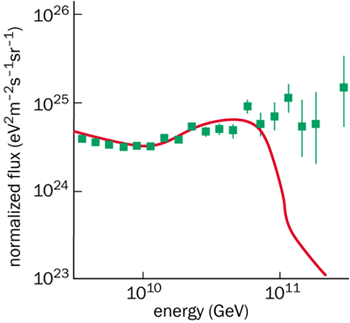
The mystery continued to deepen with further observations using the Akeno Giant Air Shower Array (AGASA) in Japan, which recorded many events with energies well above the GZK energy (see figure 1). The AGASA collaboration measured a clear excess of ultrahigh-energy cosmic rays compared with the spectrum expected for distant sources.

Exotic and ordinary explanations

When reviewing the situation back in 1998, Michael Hillas of Leeds University emphasized that the simplest location for sources that are both nearby and isotropically distributed is the halo of our galaxy. The same proposal had been made independently by Venya Berezinsky and Michael Kachelreiss of the Gran Sasso Laboratory in Italy along with Alex Vilenkin of Tufts University in the US, and by Mike Birkel and the current author at Oxford University. We had suggested that ultrahigh-energy cosmic rays are generated by the slow decays of supermassive dark-matter particles that are predicted by unified theories, and that they could have been created in the early universe. Although such dark-matter particles are well outside the Standard Model of particle physics, the energy spectrum of their decay products is essentially determined by the theory of quantum chromodynamics together with data describing the decay of heavy particles, such as the Z boson.

Our calculation gave a reasonable fit to the AGASA data beyond the GZK energy and predicted the mass of the dark-matter particles to be in excess of 1012 GeV, much greater than all the known particles. Interestingly this is the same energy scale as the “hidden sector” in supersymmetric extensions of the Standard Model, and such particles, named cryptons by John Ellis of CERN, had in fact been predicted to exist with the required long lifetimes. Moreover, in this model cosmic rays cannot bombard the Earth by exactly the same amount in all directions because we are not at the centre of the galaxy – a characteristic that can be tested with more data.

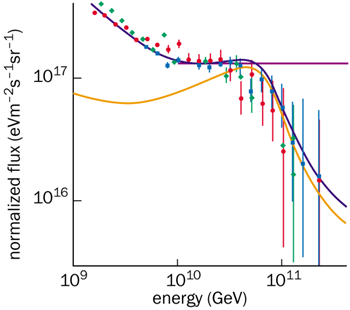
Now John Bahcall of the Institute of Advanced Studies in Princeton and Eli Waxman of the Weizmann Institute in Israel have challenged whether such exotic physics is in fact necessary (arXiv.org/abs/hep-ph/0206217). They point out that the HiRes experiment, the successor to the Fly’s Eye array, has found far fewer events (so far unpublished) above the GZK energy even though it has had a similar exposure to cosmic rays as AGASA. By considering just the data from the air-fluorescence detectors (i.e. Fly’s Eye and HiRes) and the Yakutsk array, they argue that there is indeed a GZK cut-off, and that this implies that the sources are at cosmological distances (see figure 2).

Bahcall and Waxman’s preferred sources are gamma-ray bursts, which are believed to be the most violent explosions in the universe that release an energy equivalent to the rest mass of the Sun within a few seconds or minutes. They point out that the “relativistic fireball” model of gamma-ray bursts incorporates strong, collisionless shocks that could accelerate cosmic rays to 1011 GeV . Nevertheless the energy requirements are formidable. The gamma-ray bursts would have to put three times more energy into accelerating 1010-1011 GeV protons than they are observed to generate as gamma rays. In this model the gamma rays are emitted as synchrotron radiation by electrons that are accelerated to much lower energies.

However, cosmic-ray experimentalists are sceptical about this claim. Alan Watson at Leeds, who is spokesperson for the Pierre Auger Observatory in Argentina, notes that the Yakutsk array has been plagued by a problem that has prevented it from recording very energetic events. Emphasizing the Yakutsk data while ignoring the AGASA data, as Bahcall and Waxman have done, is therefore not advisable.

Moreover, the Fly’s Eye and HiRes experiments establish the shower energy from the observed fluorescence of nitrogen molecules. This determination is based on a measurement of the efficiency of the process that is nearly 40 years old and may need to be revised.

Complex corrections must also be made to take into account the state of the atmosphere, and this is more reliably done with “stereo” observations of the air showers with two well-separated detectors than “mono” observations, which account for the bulk of the reported exposure. In fact, in 1999 the HiRes collaboration reported a number of events beyond the GZK cut-off that were consistent with the AGASA data, but the researchers subsequently withdrew the result after recalibrating the energy measurements. Thus the discrepancy is really between the two methods of studying air showers: measuring the shower’s pattern on the Earth’s surface, as with the Volcano Ranch, Haverah Park, Yakutsk and AGASA arrays; and measuring the fluorescence along the shower’s path through the atmosphere, as the Fly’s Eye and HiRes teams did. It is therefore essential for measurements to be made simultaneously using both techniques to assess the problem and to move the field forward.

This is precisely what will take place at the Pierre Auger Observatory, which saw “first light” last year. Within a few years the question posed in the title of this article should have a clear answer. Looking further ahead, the European Space Agency’s Extreme Universe Space Observatory, which is scheduled to fly on the International Space Station in 2008, will use the atmospheric-fluorescence technique to monitor a huge area and boost the statistics of ultrahigh-energy cosmic rays considerably.

We will soon know whether the solution to the mystery of ultrahigh-energy cosmic rays is novel astrophysics or physics far beyond the Standard Model.

Copyright © 2026 by IOP Publishing Ltd and individual contributors