X-ray beams thin out

When X-rays are shone into a crystal, they are reflected at certain angles by the regular planes of atoms in the crystal. This means that the structure of the crystal can be deduced by studying the reflected X-rays. Since it is difficult to prepare large, good quality crystals, samples are often ground into a powder. In this case, the intensity of the reflected X-rays is recorded as a function of reflection angle, with the peaks in this spectrum showing the dominant angles of reflection.

But this technique only works if the sample is uniform over an area that is at least as large as the cross-section of the X-ray beam. ‘Pinholes’ are used in some analytical techniques to create beams that are micrometres across, but smaller pinholes – even if they could be made – would not transmit a sufficiently high flux of X-rays.

Salditt’s team has solved this problem by making an X-ray waveguide with an exit aperture tens of nanometres across, which emits a beam with an oval cross-section just 69 nm wide and 33 nm high. The researchers say that this is the smallest spot size ever achieved for short-wavelength – or ‘hard’ – X-rays.

In common with optical devices, the waveguide consists of a core with a higher refractive index than the cladding layer that surrounds it. The X-rays travel through the waveguide as a series of reflections that take place each time the beam reaches the boundary between these layers. By adjusting the angle at which the X-rays entered the waveguide, the researchers could select the modes of propagation that travelled through the guide. This allowed them to generate coherent beams of X-rays using the waveguide.

Salditt’s team used a recently developed technique known as ‘resonant coupling’ to shine the X-rays into the waveguide. The core of the waveguide was made from poly(methyl methacrylate) core and the cladding was made from chromium, but this choice of materials was determined by the lithographic technique they used to make the waveguide. With further refinements, they hope to make a waveguide that will produce even narrower beams.

Diamond-free space dust puzzles astronomers

Existing theories of the development of the solar system say that the Sun and the planets formed from an ‘accretion disk’ of gas and dust. Many meteorites – fragments of ancient comets – have been found to contain nanodiamonds, which suggests that the tiny carbon particles were abundant in this disk.

But when Bradley’s group analysed a selection of carbon-rich interplanetary dust particles using transmission electron microscopy, they were surprised to find very little evidence of nanodiamonds. According to the team, the simplest explanation for this observation is that nanodiamonds were not present before the solar system formed. But this raises the question of how the nanodiamonds formed in the chemically ‘oxidizing’ environment of the early solar system, when the nanodiamonds found previously in meteorites appeared to have formed in a ‘reducing’ environment.

Alternatively, the researchers suggest that the nanodiamonds could predate the Sun, but that they may have been more abundant in the inner solar system than they were in its outer reaches. This would mean, however, that our understanding of transport processes in the early solar system was incomplete.

“Any one of these explanations has profound implications concerning our understanding of the early solar system,” write Bradley and colleagues.

Electron pairs behave like bosons

Quantum mechanics predicts that any number of bosons in a system can occupy the same quantum state, so that they can ‘cluster together’. In their 1950s experiment, Robert Hanbury Brown and Richard Twiss confirmed this prediction when they sent a beam of photons – which are bosons – through a beam splitter and measured the intensity of the two resulting beams. They found that the intensities of these beams were ‘positively correlated’ – that is, the peaks in the signals coincided, showing that photons can indeed bunch together. This behaviour is predicted by Bose-Einstein statistics.

In contrast, fermions – such as electrons – cannot share the same quantum state, and the experiment was recently adapted to test this prediction with a beam of electrons. The beam was split into two, and the currents of these beams were found to be ‘negatively correlated’ – when an electron was detected in one of the beams there was no electron in the other, and vice versa. This confirmed that electrons obey Fermi-Dirac statistics.

Physicists then began to speculate how pairs of electrons might behave. In conventional superconductors, electrons overcome their mutual repulsion to form ‘Cooper pairs’, which are propelled through the superconductor by lattice vibrations known as phonons. Now Samuelsson and Büttiker say that these pairs of electrons could show the positive correlation usually associated with bosons.

The researchers propose a set-up in which a quantum dot is connected to two normal conductors and a superconductor. An applied voltage would propel electrons into the normal conductors from the superconductor. But due to the ‘proximity effect’ – in which a superconductor induces superconductivity in an adjacent conductor – the electrons would travel across the quantum dot not singly, but in pairs.

Samuelsson and Büttiker calculated the currents that would flow from the quantum dot into the normal conductors, and found a positive correlation similar to that originally observed in the split beam of photons. This suggests that some of the pairs would split up when they reached the normal conductors, with one electron entering each conductor. This would show that the pairs of electrons behave as bosons, even though single electrons are fermions.

“Interestingly, the underlying statistics is still fermionic, but the association between the electrons make the positive correlations possible,” Büttiker told PhysicsWeb.

Young stars challenge old ideas

Elliptical galaxies are usually reddish in colour, which suggests that the stars they contain are red giants – that is, stars that are in the late stages of stellar evolution. Unlike other types of galaxy, elliptical galaxies have few features – such as spiralling arms or lanes of dust – that would indicate recent activity. This smooth, red appearance has led astronomers to believe that the stars in each elliptical galaxy were formed at roughly the same time, very early in the galaxy’s history.

But now researchers have cast doubt on this view by combining visible and infrared images of galaxy NGC 4365 taken by the 8.2-metre VLT Antu telescope and the Hubble Wide Field and Planetary Camera 2. The observations centred on ‘globular clusters’ – clumps of stars that exist in and around every galaxy – linked with NGC 4365. Periods of star formation in the galaxy leave their mark on these clusters, so astronomers can track the galaxy’s history of star birth by studying them.

The new observations show that many of the globular clusters in NGC 4365 are only a few thousand million years old, in contrast with other stars in the galaxy that are thought to be about 12 thousand million years old. Spectroscopic studies also showed that these stars are also rich in metal. This supports the idea that the stars were born relatively recently when heavier elements – which were synthesized inside stars and then distributed into the interstellar medium by supernovas – were more abundant. In contrast, hydrogen and helium dominated the early Universe, so stars formed in this period contain much less metal.

Astronomers must now try to accommodate the discovery of young stars in old galaxies into theories of galaxy formation and the evolution of the Universe.

“It is a great pleasure to see VLT and Hubble work in concert to produce such an important scientific result,” says team member Piero Benvenuti. “The synergy between the most advanced ground and space telescopes continues to prove its effectiveness, paving the way to impressive new discoveries that would not otherwise be possible.”

Crystalline silicon shapes up

Amorphous and crystalline silicon have different electronic and optical properties, and this makes them suitable for different applications. Sheets of amorphous silicon are easier and cheaper to make than crystalline silicon, so this form is widely used for applications where large areas of silicon are needed, including displays and solar cells. In contrast, the smaller components used in devices such as computers are usually made of crystalline silicon, which can perform electronic operations more quickly.

Both types of silicon are made by depositing silicon from a plasma of ‘silane’ – that is, SiH4 – onto a substrate. This ‘plasma deposition’ technique is straightforward for amorphous silicon, but more complicated for crystalline silicon. And although scientists have long suspected that the hydrogen from the silane play an important role in this process, it has been unclear exactly how the two kinds of silicon are related.

Now Maroudas and colleagues have established that the hydrogen atoms can rearrange the atoms in amorphous silicon into the lattice structure found in crystalline silicon. The researchers proposed that the hydrogen atoms get trapped between loosely bound atoms in amorphous silicon to make a higher-energy Si-H-Si configuration. When the hydrogen atoms are later released, they proposed, the silicon atoms would be left in an ordered, crystalline array.

To test their theory, the Santa Barbara team ran a ‘molecular dynamics’ simulation to show how the deposition process would proceed if their idea were correct. They also deposited silicon from a silane plasma in which some of the hydrogen was replaced by deuterium. These ‘heavy hydrogen’ atoms can be distinguished from hydrogen atoms using infrared spectroscopy, so their motion can be monitored. When they compared scanning electron micrographs of the silicon deposits with the simulation, they found that the results were very similar, supporting their theory.

“This is a rare, if not the first, direct comparison of the structure of a ‘real’ film deposited in the laboratory with that of a ‘model’ film, which was made using computer simulations,” team member Eray Aydil told PhysicsWeb.

Maroudas and co-workers hope that their discovery will lead to a simpler and cheaper way of making crystalline silicon devices. They are also optimistic that it will shed light on the behaviour of other elements with covalent bonds similar to those in silicon.

Nano-boost for data storage

Chopra and Hua placed their nanometre-sized contact made of nickel – which is ferromagnetic – between two electrodes that generate alternating magnetic fields of several hundred Gauss. This set-up, which was run at room temperature, rotated the spin axes of electrons travelling along the ferromagnet. This caused the electrons to scatter, and increased the resistance of the contact by 3150%.

The effect is known as ballistic because – with no applied magnetic field – the electrons move in a straight line through the narrow contact. If the contact were slightly longer, the motion of the electrons would be dominated by random thermal movements, which would thwart the scattering effect of the magnetic field.

In a hard disk the contact would act as the read head and be connected to a circuit that would inject it with spin-polarized electrons. By bringing the contact close to each magnetic domain – or data bit – being read, the electrons flowing through the contact would be scattered by an amount that would depend on the magnetic orientation of the bit. Since each bit in a hard disk is about the same size as the head, ballistic magnetoresistance could be used to create storage capacities as large as several terabits per square inch.

Nearly all of today’s hard disks rely on a related effect called giant magnetoresistance, in which the resistance of alternating layers of magnetic and non-magnetic materials can change by as much as 100%. In addition, so-called colossal magnetoresistance has boosted resistances by up to 1400% at room temperature, but it requires fields of thousands of Gauss and materials with a high intrinsic resistance. In contrast, the relatively small magnetic field used by the Buffalo researchers means that even bits just a few nanometres long will produce a magnetic field strong enough to register a signal in a hard disk’s read head.

“This ballistic magnetoresistance is the largest effect yet seen in spintronics, an area of research that utilizes both the charge and spin of electrons to create electronic circuits,” says Chopra. “But it is not only exciting from a technological point of view. It is interesting scientifically because existing theory cannot yet explain it.” Indeed, he points out that the origin of this effect must be more clearly understood before it can be used reliably in electronic devices.

Laser lights up water droplets

When a high-energy laser hits certain substances, their atoms are ionized and heated into a plasma in a process known as laser-induced breakdown. After the laser is switched off, the electrons and ions recombine and emit their excess energy as light. Since every substance emits a characteristic spectrum, this effect is widely used to determine the composition of materials.

But this method has not been used to detect the presence of chemicals in water vapour because physicists have been unable to make water emit light. Previous attempts to do this – which were based on vessels filled with water – failed because the laser pulses used did not make the plasma hot enough to emit light in the visible part of the spectrum. But now the Lyon team has succeeded by exploiting the spherical shape of droplets of water.

Wolf and co-workers blasted the droplets with pulses from a titanium-sapphire laser lasting just 120 femtoseconds. Crucially, the pulses do not deform the spherical shape, which means that the curved back surface of the droplet focuses the incoming pulse back into the droplet. The researchers say that the intensity of the light in the focus of a 50 µm droplet is boosted by a factor of about 100 compared with the original laser pulse. This creates a region of plasma just nanometres across, which is hot enough to emit white light as it relaxes back to its ground state.

The researchers found that most of this light was emitted in the ‘backward’ direction – that is, in the direction from which the laser pulse arrived. “This is exactly what you need to measure the composition of aerosols remotely,” Wolf told PhysicsWeb. The team also measured the spectral characteristics of the light at different temperatures and found that the water droplets emitted a spectrum of light very similar to that of a perfect black body.

Condensates on crest of a wave

One of the remarkable things about low-temperature physics is that it offers a place where the hidden world of quantum mechanics can be revealed, often giving rise to spectacular effects. In 1995 the Nobel-prize-winning observation of Bose-Einstein condensation showed that a dilute gas of atoms cooled to sufficiently low temperatures could “condense” into an intriguing state in which all the atoms can be described by the same quantum wavefunction.

Bose-Einstein condensation is actually a phase transition – just like the formation of ice in a vessel of water when it is cooled below freezing – but it occurs as a direct result of the underlying rules of quantum mechanics. For decades undergraduates the world over have studied this phenomenon as a textbook problem in statistical physics.

So why is Bose-Einstein condensation in gases still the subject of intense research? If the atoms were truly non-interacting, like the textbook problem usually assumes, interest would likely have died out long ago. Without interactions it would not have been possible to demonstrate superfluidity in these systems, including the recent beautiful observations of large numbers of vortices arranged in well ordered lattices (see Triple first for Bose condensates Physics World May 2001 pp21-22). The atoms do interact, but in such a way as to allow a detailed theoretical understanding from first principles.

The interactions can even be dynamically controlled, allowing one to prescribe whether the atoms interact strongly or weakly and to change the force between the atoms from an attractive interaction to a repulsive one. This developing theme of control is one reason why breakthroughs in the field continue to emerge at a remarkable rate – such as the recent demonstration of bright solitons in a Bose-Einstein condensate.

Out of the shadows

Solitons, and their close relatives solitary waves, occur throughout physics. The term solitary wave refers to a localized disturbance in a continuous medium that can propagate over long distances without any change to its shape or amplitude. Such disturbances were noted as long ago as 1834 by the Scottish scientist John Scott Russell for a shallow canal. He noticed that water waves could propagate for many miles without attenuation or dispersion.

Solitons are essentially the same as solitary waves but they have the additional feature that their amplitude and spatial profile do not change even when multiple solitons collide. Optical solitons are particularly important in fibre-optic communications because the information they carry remains intact as the light pulses travel through the glass fibres.

Now two groups – Randall Hulet’s group at Rice University in the US, and Christophe Salomon and co-workers at the Ecole Normale Supérieure in Paris – have announced the successful generation of bright solitons in Bose-Einstein condensates. This latest work follows several previous experimental efforts to study “dark solitons” in condensates. These objects correspond to regions inside the condensate that ideally contain no atoms, and they occur in systems where the interactions between the atoms are repulsive. Obviously this kind of disturbance can only exist within the confines of a medium. Bright solitons, on the other hand, are completely self-determined condensate bunches that bind together and can propagate through free space. They only occur in systems where the attractive interactions exactly compensate for any dispersion of the wave packet.

Although there are important differences in detail, the two experiments are remarkably similar in spirit. They both used the same isotope of lithium, namely lithium-7, to form the gas. The first step was to create a Bose-Einstein condensate using the now standard techniques of laser cooling and evaporative cooling (see Physics World August 1999 pp37–42, print edition only). Next the atoms were transferred from a trap created by magnetic-field gradients to a simple 3D trap formed by strong laser fields in order to allow the interactions to be controlled.

The Paris group generated a bright soliton by tuning the interactions between the atoms to be slightly attractive (L Khaykovich et al. 2002 Science 296 1290). The researchers observed that most of the condensate atoms were lost, probably due to the fact that an attractive interaction in a gas can lead to the onset of mechanical instability and collapse. However, they also saw a condensate remnant containing some 6000 atoms form a stable bright soliton that could then be studied. Salomon and co-workers guided the atoms in one dimension for a distance of approximately 1 mm and established that there was no discernible spreading of the wave packet and no decay of the amplitude – a clear signature for a soliton. And when they repeated the experiment without interactions between the atoms, they saw obvious evidence for spreading of the wave packet.

The Rice group used a different configuration of laser trap that also restricted the atoms to move in one dimension. In this case, the researchers showed that multiple bright solitons could be formed, each containing in the region of 6000 condensate atoms (K Strecker et al. 2002 Nature 417 150). These multiple-soliton trains were previously known to be possible solutions of the underlying equations that describe Bose-Einstein condensates, but their production is particularly interesting since it allows collisions that are essential to the nature of solitons to be investigated (see figure). Hulet and co-workers observed that the solitons repelled each other, thereby providing information about the phase structure of the underlying condensate wavefunction.

Excitement over excitons

Although quite unrelated, another recent development in Bose-Einstein condensation should be followed with interest. Leonid Butov of the Lawrence Berkeley National Laboratory and co-workers in the US and the UK have recently created regions in a semiconductor that allow the confinement of a high density of composite particles called excitons (L Butov et al. 2002 Nature 417 47). This advance is important because it is a precursory step on the way to making a Bose-Einstein condensate from excitons, rather than atoms.

Excitons are created in semiconductors when a laser field promotes an electron from the valance band to the conduction band. The resulting electron in the conduction band and the hole that it leaves behind can form a bound composite object due to the Coulomb attraction. This composite object is the exciton and it can, in principle, undergo Bose-Einstein condensation if the density and temperature are right. Although significant efforts over many years have gone into demonstrating Bose-Einstein condensation of excitons, the results so far have been controversial.

Butov’s group was able to demonstrate trapping of excitons in all three dimensions thanks to the development of a semiconductor structure that overcame some of the previous limitations. Sandwiched in the middle of the semiconductor are two layers of quantum wells in which the electrons and holes are created and confined to a 2D world. When an external electric field is applied, an electron can be confined to one of the quantum wells while a hole is trapped in the other, thereby leading to a significant increase in the exciton stability.

Of course, a trap needs to provide confinement in all three dimensions. This was possible because the natural disorder in the system led to random fluctuations in the potential energy. Potential wells a few microns across form at certain places in the material and can confine cold dense clouds of excitons. Although Butov and co-workers have not yet demonstrated Bose-Einstein condensation in this novel system, significant progress has clearly been made.

Breakthroughs galore

These are just two examples of the many exciting developments that are currently going on in this field. In addition, Carl Wieman and colleagues at the JILA laboratory in Colorado have found evidence for a molecular Bose-Einstein condensate in a sample of rubidium-85 molecules (E Donley et al. 2002 Nature 417 529; S Kokkelmans et al. 2002 arXiv.org/abs/cond-mat/0204504). Rather than cool the molecules, the JILA team converted part of an atomic condensate into molecules by tuning the interactions between the atoms with pulses of magnetic field.

Meanwhile, Wolfgang Ketterle’s group at the Massachusetts Institute of Technology has shown that a Bose-Einstein condensate of sodium atoms in an optical trap can be replenished with atoms from a second identical condensate using optical tweezers (A Chikkatur et al. 2002 Science 296 2193). This advance is an important step towards creating a new type of laser that continually emits atoms rather than photons (see Atom lasers Physics World August 1999 pp31-35).

Another goal in condensate research is to observe the transition of a dilute fermion gas to a superfluid phase at relatively high temperatures (see A Fermi gas of atoms Physics World April pp27-31). Such a transition would complement studies of superconductivity in exotic condensed matter, and could shed light on the crossover between normal and high-temperature superconductivity.

The future for Bose-Einstein condensation is very bright, and if the breakthroughs continue at the current rapid pace, we may not have to wait too long to see what advances it will bring.

Energy challenges

Satisfying the world’s insatiable appetite for fuel without destroying the environment is the biggest challenge facing the energy industry. World energy consumption is expected to soar by 50% to a staggering 180 000 GW h per year by 2020, with the developing world demanding an ever-increasing share.

Although oil and natural-gas reserves will last for several more decades, environmental concerns are increasingly dominating the agenda. Last year 178 countries agreed to a watered-down version of the original Kyoto protocol, which was designed to reduce the emissions of greenhouse gases from industrialized countries by an average of 5.2% below 1990 levels. Under the new agreement, dubbed “Kyoto lite” by environmentalists, emissions will be cut by just 2%.

The relaxed targets are still not enough to convince the US, the world’s biggest polluter, to sign the Kyoto treaty. Yet within the US, individual states are doing their bit for the environment. California, for example, has set rigid targets for the emission of hydrocarbons, carbon dioxide and nitrogen oxides from new cars and trucks (Green cars move into top gear, page 27 print version). The goals are almost impossible to meet without alternative-fuel vehicles that are powered by fuel cells, batteries or ethanol – rather than petrol – with DaimlerChrysler, Ford and Toyota all playing a role.

Environmental concerns are also driving the search for more energy-efficient lighting for offices and factories, which consumes a massive 15% of electricity in the US (Bright future for efficient lights, page 34 print version only). Physicists are teaming up with lighting companies to find new lamps that emit more light and give off less heat. Light-emitting diodes could lead to electricity savings equivalent to the output of 25 power stations in the US alone if their many technological hurdles can be overcome.

Fuels for the future

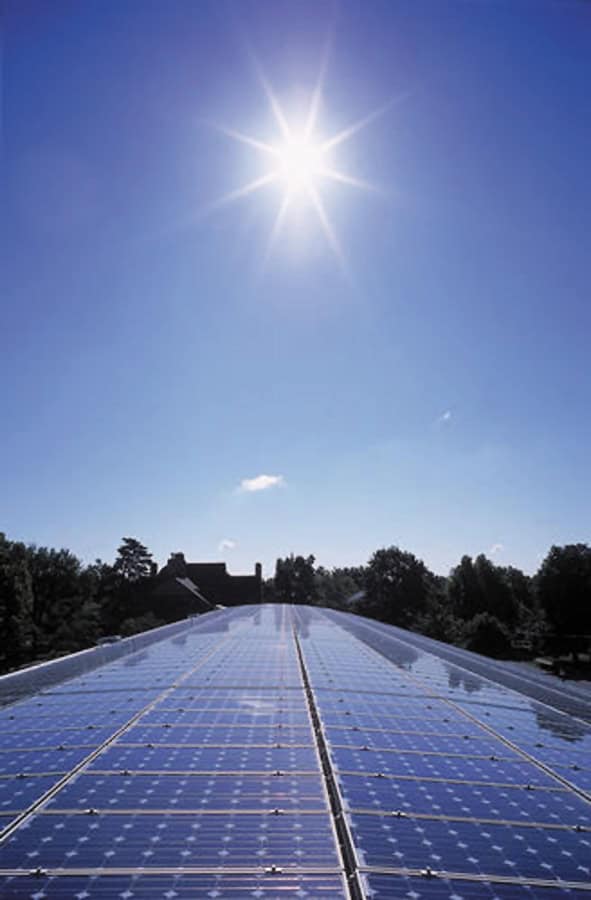
Renewable technologies still make up less than 1% of the world’s commercial energy. Photovoltaic solar cells generated their first gigawatt of power just three years ago, which is about the same as the output from a single coal- or gas-fired power station. However, photovoltaic panels are now being manufactured and installed at an escalating rate thanks to new advances in materials. The largest growth is in the “grid-connected market” in which people can generate solar electricity in their own homes and feed any surplus back into the national grid. Indeed, solar power is more likely to flourish as a distributed resource, rather than through massive centralized “solar farms”.

Solar farm

Distributed power is also likely to emerge from the development of fuel cells – devices that convert the chemical energy of hydrogen and oxygen directly into electricity, with only water as a by-product. Although they have previously been used for space and military applications, stacks of fuel cells could replace the internal-combustion engine and central-heating boilers, as well as the batteries in laptop computers and mobile phones (Fuel cells eye up the mainstream market, page 30 print version only).

The move away from carbon-based fossil fuels to hydrogen is also driving the “hydrogen economy” (The hydrogen economy blasts off, page 29 print version). Iceland is leading the way with ambitious plans to remove all fossil-fuel dependency from the country within a generation. As a start, the capital’s fleet of 80 buses will be replaced by vehicles powered by hydrogen fuel cells.

Supporters of renewable energy are fighting claims that the environmental credentials of solar, wind and wave power are less than impeccable. Wind turbines are moving out to sea, partly to avoid being an eyesore (Wind power moves out to sea, page 40 print version only), while the marriage of solar cells and building materials also reduces space requirements. Even the nuclear industry – long viewed as an environmental pariah – is cleaning up its act with new reactor designs that promise, on paper at least, to be safer and cheaper than conventional pressurized-water reactors (New designs on nuclear energy, page 42 print version only).

A longer-term possibility is nuclear fusion. Despite the enormous progress in the performance of experiments over the past 30 years, nuclear fusion is still decades away from generating electricity. Advocates of fusion power claim that it could be a safe and sustainable source of energy that does not produce any greenhouse gases or long-lived nuclear waste. However, physicists have still to demonstrate that the energy produced by the fusion of deuterium and tritium can be sustained. Advances in physics and engineering are making energy from renewable sources increasingly affordable. But political will – as well as scientific progress – is just as crucial for safeguarding the environment for generations to come.

Energy savings go through the roof

From the outside, Sabine Glaser’s apartment block in Ludwigshafen looks like any other building in the street. But there is more to the 70-year-old property than meets the eye – it is the first old building in Germany to be converted from a draughty energy-guzzling residence to energy-efficient homes. Dubbed the “3 litre house”, the heating bills for Glaser’s 100 m2 apartment have been slashed from €700 a year to just €100 thanks to the latest advances in insulation and building technology.

Heating an old house consumes the equivalent of 20 litres of oil per square metre each year and leads to the production of 60 kg of carbon dioxide per square metre. As its name suggests, the fuel consumption of the 3 litre house is significantly lower. And with at least 24 million apartments in Germany in urgent need of renovation to improve their thermal insulation, it is clear that the potential energy savings are massive.

New legislation that forces every new house in Germany to consume less than 7 litres of oil per square metre came into effect earlier this year. However, the chemical company BASF set itself the more ambitious goal of bringing an older property, just outside the gates of the company’s offices in Ludwigshafen, to well beyond modern standards.

The renovations were completed last year and nine families – including Glaser’s – have moved into apartments that contain a raft of sensors installed by Hermann Heinrich, a building physicist at Kaiserslautern University. Over 150 sensors monitor aspects such as the temperature of the rooms, the energy flux into the building and the air quality to shed light on the energy consumption and heat losses.

The measurements are being made over three years so that Heinrich and co-workers can understand how energy usage changes, for example when the residents go on holiday. “After one year of measurements, we have hints that the energy consumption is, in fact, lower than 3 litres per square metre,” says Heinrich. “The building appears to have fulfilled the architects’ plans.”

Changing rooms

Insulation has played the biggest role in dramatically cutting the fuel consumption of the property. The façade of the building is clad with 20 cm thick panels of NEOPOR, a new type of thermal insulator developed by researchers at BASF. The polystyrene-based material contains microscopic flakes of graphite that reflect heat, making it difficult for thermal radiation to penetrate. Indeed, the thermal conductivity of NEOPOR is significantly lower than that of expanded polystyrene, a common insulator in homes.

As a result, only half the amount of NEOPOR is needed to provide the same level of insulation as conventional polystyrene, making it ideal for old buildings that have little space between cavity walls. The existing insulation in the roof, ceiling and cellar of the building has also been replaced with NEOPOR. About 10 litres of crude oil are needed to produce a NEOPOR panel with an area of 1 m2 and a thickness of 20 cm, but estimates show that this will save some 1200 litres of heating oil over a period of 50 years.

The interior walls of the building are coated with a special plaster that helps to keep rooms cool in summer without air conditioning. Also designed by BASF, the plaster contains microcapsules filled with wax particles that store latent heat – if it is very warm outside, the wax melts, thereby soaking up heat without raising the temperature of the room. Tests have shown that a 2 cm thick layer of the new plaster has the same heat absorption capacity as a 20 cm thick timber-bricked wall.

Knocking down bridges

As well as focusing on good insulation, the designers have also reduced the influence of “thermal bridges”, such as thick bolts and screws that can conduct heat past the insulation. For example, to minimize heat losses, the apartment balconies are built as separate free-standing structures that just touch the house instead of being bolted directly onto the building. In addition, the windows are triple-glazed to cut the heat loss by a factor of five compared with a single pane of glass, while the window frames are made of a plastic that is insulated with a polyurethane core. But the large windows play another important role – as well as improving the amount of natural light entering the lounge and bedrooms, they allow solar radiation to heat south-facing rooms.

Although the building is virtually airtight, an energy-saving ventilation system provides residents with fresh air. Warm, stale air is drawn up from the kitchens and bathrooms to a heat exchanger in the attic, which transfers 85% of the heat to the incoming air. This fresh air is then heated further before being pumped into the living rooms and bedrooms. Heinrich and co-workers at Kaiserslautern also monitor the amount of carbon dioxide breathed out in some of the apartments to tell how well the ventilation system is working. “If the levels of carbon dioxide are too high, the ventilation rate needs to be increased,” explains Heinrich, “but if they are too low then the ventilation can be decreased to save even more money.”

Next year BASF plans to install a polymer-electrolyte-membrane fuel cell in the basement to generate electricity with fewer greenhouse-gas emissions. The miniature power plant will first convert natural gas into a more hydrogen-rich gas, which will then be pumped into the fuel cell to produce an electric current (see pages 30-31). BASF has invested €500 in every square metre of the 3 litre house in Ludwigshafen. But with signs that a market for the renovation of old buildings worth over €400bn is beginning to emerge, the company clearly views their investment as money well spent.

Cool in summer, warm in winter

BASF is not the only organization developing energy-saving building materials. Norbert König, a building physicist at the Fraunhofer Institute for Building Physics in Stuttgart, Germany, and colleagues have developed a new type of double-glazing, called T-OPAL, which turns opaque at high temperatures to prevent buildings from overheating in the summer. Many glass buildings – including greenhouses, conservatories and offices – currently have blinds or air conditioning installed to keep their interiors comfortable in hot weather.

T-OPAL has been designed to be a cheaper alternative, costing just one-tenth of the price of shutters with the same area. The insulating gap in the new type of double glazing is filled with a “thermo-optical polymer”, which has optical properties that change with temperature. On cool days, the polymer exists in its crystalline form and transmits light. However, on hot days, the polymer undergoes a phase transition into a melted state that reflects more light and infrared radiation than its transmits. The glass, which has been patented by the Fraunhofer Institute, is currently in the early stages of production and should be on the market next year.

König’s colleagues in Stuttgart have also developed an inorganic thermal insulator made from recycled glass as an alternative to polystyrene and mineral wool, which can cause respiratory problems if used incorrectly. Shards of glass are ground down and mixed with an expanding agent to create a granular material that can be moulded into shape. During a final stage of heat treatment, the expanded glass granules bond together at certain points to produce a porous insulator with a low thermal conductivity. Known as REAPOR, the new material can withstand high pressures so that it can be integrated with other fixtures and fittings. It is important, says König, for building physicists to develop materials that will work in practise, satisfying both building regulations and construction companies’ budgets.

So, is it possible to build environmentally friendly homes for about the same price as conventional residences? Architect Bill Dunster believes that it is possible. The key, he says, is to include renewable-energy devices and energy-saving features at every decision in the design process, rather than bolt them on as an expensive afterthought. His company has already developed detailed designs, tracked down high-quality building materials and tested them in existing energy-saving buildings, thereby reducing the cost for future developments.

One of Dunster’s most ambitious projects is the Beddington Zero Energy Development (BedZED) – the first large-scale “carbon neutral” housing development situated in Sutton, south west of London. Built on the site of a reclaimed sewage works, the 82 homes are a mixture of apartments, maisonettes and town houses made from reclaimed bricks, timber and steel. The homes are heated by a combined heat and power plant that is fuelled by wood chips from local tree surgeries, which would otherwise be sent to a landfill site, while photovoltaic panels mounted in the cladding and roofs provide additional electricity (see Solar power to the people, pages 35-36 print version only). Some of this electricity will soon be used to power a fleet of electric vehicles belonging to a car pool.

Like the 3 litre house in Ludwigshafen, the south-facing rooms have large triple-glazed windows to benefit from the warmth of the Sun, and insulation with a low thermal conductivity is fitted to all the external walls, roofs and ground floors to reduce heat losses. Meanwhile, each kitchen is equipped with the latest energy-efficient appliances and waste water from the sink and the bath is recycled for use in the toilet and to water the roof gardens – thus cutting water consumption by one-third. All 57 of the houses that are for sale have been snapped up – the remaining 25 will be rented out – and the first residents moved in a few weeks ago.

Flower power

Many of the energy-saving features of BedZED are incorporated in another of Dunster’s designs, the FlowerTower – so-called because it comprises four petal-shaped towers arranged like a flower. Still firmly rooted to the drawing board, the high-rise block is expected to generate all its electricity from a combination of photovoltaic panels and a wind turbine housed in the gap between the towers.

The plans have been developed so that the towers channel the wind, boosting its speed by a factor of four and making wind power possible in urban areas. Dunster believes that the same vertical-axis turbines found on oil rigs are ideal for the project because they are almost silent and only need maintenance once every five years.

Whether the FlowerTower design takes off remains to be seen, but it is clear that architects and building physicists can play an important role in producing environmentally friendly buildings that will help to reduce our impact on the planet.


Copyright © 2026 by IOP Publishing Ltd and individual contributors