The conservation of energy is one of the fundamental principles in physics. Energy can never be created or destroyed, just changed from one form to another. And every second of every day vast amounts of chemical energy are converted into electrical energy in power stations, and into kinetic energy in cars and trucks, to satisfy the world’s demand for power. This is a demand that can only increase if standards of living in the developing world are to improve and poverty is to be eradicated.
The problem is that our ever-increasing energy consumption is having an ever-worsening effect on the environment. Indeed it is proving difficult to get some countries to commit to the modest targets laid down in the wake of the Kyoto agreement.
People with fewer green or global sympathies also have reason to be concerned – last summer’s power cuts in California showed that no one can take electricity for granted. And the global uncertainty that has followed 11 September means that security of energy supply is a higher priority than ever for many nations.
This special issue of Physics World contains more than 20 pages on energy, starting with What does energy really mean? by Robert Crease discussing the origins of the word “energy” itself (p15, print version). Valerie Jamieson introduces a special section “Energy challenges for the 21st century” that highlights alternative and renewable energy sources such as solar, wind and wave power (see Energy challenges, p25 print version). It is clear that there is no single solution to the multi-faceted energy challenges that we face, and that progress is needed on a wide variety of fronts.
Other articles outline opportunities for the physics community in the energy sector (The role for physics in energy supply, p51 print version only) and describe what it is like to be a physicist working at the sharp end of the oil industry (p55, print version only). It is a coincidence that the lead news story in this issue is about a curious proposal to use “microleptons” – particles that particle physicists do not believe exist – to locate oil deposits (see Strange events hit rural England, p5 print version).
While it is strictly true to say that energy can never be destroyed, the reality is that vast amounts of it are wasted needlessly. Significant amounts of energy could be saved if the efficiency of large power plants were increased slightly and the losses in transmission cables were reduced. And the inefficiency of lighting sources can be doubly wasteful if electricity is not converted into light but heat, which then has to be removed by air conditioning.
If energy is the basic unit of currency in physics, the basic unit of currency in energy is not the Joule or the kilowatt-hour but the dollar. It is hard to believe that it would be financially viable to spend vast sums to run a cable between two nations with a one-hour time difference between them so that electricity can be sent back and forth depending on which country is experiencing its peak demand. However, power companies across Europe spend millions on just such cables because they offer the cheapest way to get electricity to the customer.
All of the proposed new energy sources have one thing in common – they are more expensive than existing sources. However, there are signs that attitudes to renewable sources are changing as, for example, oil companies expand into solar power. And many in the car industry seem to believe that hydrogen fuel will solve their pollution problems. Remarkably, many transport commentators – in the UK at least – feel that congestion rather than pollution will be the biggest problem in the industry a decade from now.
But there is still a need for governments to take a lead to ensure that research that is simply too long term for any one company to undertake still happens, and for regulators to make sure that markets give new energy sources a chance to grow. As the ill-fated experiment with market forces that led to the recent power shortages in California showed, the energy market itself is not smart enough to solve the problem.
By 2020 more than 1 billion cars will vie for space on the world’s roads, compared with the 400 million cars that exist today. The growing number of cars and the demand for fuel will call for improvements in fuel efficiency on a scale that will only be possible with new types of engine and fuel.
Whether any specific technology will gain the industrial dominance that petrol-fuelled engines achieved in the 20th century remains to be seen. But plenty of greener alternatives to the internal-combustion engine have started to emerge from showrooms in Europe and North America. Fuel cells, ethanol, electricity and hybrids of electric and petrol power represent the most promising sources of propulsion.
What has stimulated the quest for alternative-fuel cars? European nations with their crowded roads have a history of encouraging more efficient engines. But North America is not far behind. Tough restrictions on the emissions of pollutants from both individual cars and fleets of vehicles sold by manufacturers have played a key role in persuading American car makers to undertake research on greener vehicles. For example, the US government’s corporate average fuel economy (CAFE) standards specify that car manufacturers must reach an average of 27.5 miles per gallon for fleets of cars and 20.7 miles per gallon for light trucks. (In other words cars must be able to travel 100 km on 8.6 litres of petrol, while trucks must consume less than 11.4 litres over the same distance.) Even though the US Senate recently turned down a tightening of the CAFE targets, existing goals are almost impossible to achieve without the availability of some clean-burning alternative-fuel vehicles.
Within the US, California sets much of the agenda for green cars. The state, which tries to balance its residents’ utter dependence on the car with the effort to maintain clean air, sets rigid targets for the emission of hydrocarbons, carbon dioxide and nitrogen oxides from new cars and light trucks. California’s mandate that the six leading car makers produce over 4000 zero-emission cars from next year has helped to stimulate the development of green vehicles.
From hydrogen to ethanol
Fuel cells represent the most futuristic method of propulsion as well as the cleanest; they mix oxygen with hydrogen – a potential fuel of the future – from a pure source or a hydrogen-rich compound such as methanol, and they emit only water vapour (see Fuel cells eye up the mainstream market, pages 30-31 print version only). “Fuel-cell vehicles have tremendous potential to contribute to the goals of sustainable transportation systems and the use of renewable energy,” says Ben Knight, vice president of Honda R&D America.
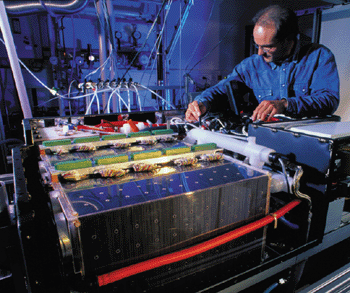
Forward thinking Fuel-cell stacks are moving out of the lab and into demonstration vehicles. (Picture credit: DaimlerChrysler)
Engineers have long used fuel cells to power spacecraft. But their application to Earth-based vehicles has scarcely moved beyond the pre-prototype stage. Nevertheless, several car makers have demonstration models that run on fuel cells. Ford has the P2000, a saloon powered by fuel cells from Ballard’s transportation division in Burnaby, Canada. Ballard also provides fuel cells based on pure hydrogen for the DaimlerChrysler Necar 4, a small vehicle designed for local travel.
A key barrier to the mass acceptance of alternative-fuel cars is the lack of infrastructure for anything but petrol-fuelled vehicles. However, that situation has also begun to change. Last year Honda opened a hydrogen production and fuelling station near Los Angeles, and early this year the California Fuel Cell Partnership (CaFCP) unveiled a methanol fuelling station in West Sacramento. “We are making great progress to demonstrate alternative fuels for fuel-cell vehicles,” says CaFCP’s chairman Don Huberts.
Cars that burn another alternative fuel have already reached the market without having to face the issues of fuel delivery. That fuel is E85, a blend of 85% ethanol and 15% petrol. Ethanol has the environmental advantage of burning more cleanly than petrol, emitting fewer hydrocarbons and less benzene and carbon dioxide. For drivers in the US concerned about the political and economic costs of imported oil, E85 has the added bonus that the ethanol is derived almost entirely from corn grown in the American mid-west.
The National Ethanol Vehicle Coalition, based in Jefferson City, Missouri, estimates that more than 2.3 million “flexible-fuel vehicles”, which can run on both E85 and petrol, will be on the road by the end of the current model year. Manufacturers of such vehicles include the “big three” US car makers – DaimlerChrysler, Ford and General Motors – and the Japanese companies Isuzu and Mazda. The flexible-fuel vehicles range from saloon passenger cars to pick-up trucks and minivans.
New life for battery cars
Electric cars have a long research history, but until recently they had little to show for the work in terms of commercially viable cars for a mass market. That has begun to change with improvements in battery technology and the introduction of new models by American car manufacturers.
Electric cars have obvious green advantages. They emit no pollutants and have impressive energy efficiencies. Until now, however, they have been limited by a lack of range per single electric charging and a lack of speed.
Those limitations are less important for short journeys in and around cities and other densely populated areas than for longer drives. Indeed, in 1998 the American National Highway Traffic Safety Administration defined a new type of car: the low speed/neighbourhood electric vehicle (LSV). These vehicles must meet all the standards specified for other cars but can travel no faster than 40 km per hour. They are designed to complement conventional cars rather than compete with them.
The DaimlerChrysler’s GEM and Ford’s Th!nk neighbor fulfil the criteria for LSVs. Looking like high-tech golf carts, the vehicles run off six 12 V batteries, which give them a range of about 48 km for an 8 hour charging session.
Electric cars are not restricted to the LSV niche. In 2000 Ford brought out the Th!nk city for the European market. This vehicle, introduced to the American market in January with upgrades such as air conditioning and power steering, can be driven on motorways at speeds of up to 90 km per hour and has a range of 85 km per charge. “It is an affordable, fun-to-drive alternative transportation choice when a full-function car is not needed,” says Jim O’Connor, Ford’s division president.
General Motors’ second-generation EV1, meanwhile, has an extremely aerodynamic shape, a top speed of 129 km per hour, and a range of 88–153 km when powered by lead-acid batteries. A nickel-metal-hydride battery pack can increase that range to 120–209 km. In fact, improvements in battery technology promise to make electric cars more competitive with petrol-powered vehicles in all driving situations. Ford’s prototype e-Ka uses lithium-ion batteries, which weigh about one-third as much as lead-acid batteries, giving the vehicle a range of about 200 km at a speed of 80 km per hour between charges.
Twin power
Perhaps the most promising alternative vehicle technology – and the one that is as close to significant commercial use as ethanol-powered cars – is the hybrid electric vehicle. A hybrid car uses both an internal-combustion engine and an electric motor. The concept improves fuel efficiency by allowing the electric motor to take over tasks that involve high fuel usage, such as starting the engine, rapid acceleration and climbing hills.
The dual nature of the power source offers several forms of greenness. The support provided by the electric motor means the petrol engine is smaller and more efficient than that in a conventional internal-combustion car. The electric motor also permits the petrol engine to shut down entirely during certain parts of a journey, such as while waiting at traffic lights. In addition, regenerative braking captures energy from the internal-combustion mode and stores it in the batteries. As a result, hybrids do not need to be recharged, unlike pure electric cars, and their exhausts emit significantly less carbon dioxide than those of petrol-powered cars.
The two best known hybrid electric cars currently on the market are the Honda Insight and the Toyota Prius. The Insight combines several technologies to gain maximum fuel efficiency. Its light aluminium body makes it 225 kg lighter than the Honda Civic. Meanwhile, its small engine and lean-burn technology means it can travel 100 km on just 3.3 litres of petrol for motorway driving. And its teardrop shape makes it one of the most aerodynamically efficient cars on the market.
The Prius gains its efficiency largely from two technical approaches. The electric engine powers the car entirely up to a speed of 24 km per hour before allowing the petrol-driven engine to switch on. And a power-splitting device that brings together the petrol engine and electric motor ensures that the engine operates at its most efficient load and speed most of the time, eliminating the need for a gearbox.
America’s “big three” manufacturers have also developed hybrid vehicles, under a partnership with the Department of Energy called the Hybrid Electric Vehicle Programme that started in 1993.
The major car makers are not alone in developing green vehicles. The Solectria Corporation of Woburn, Massachusetts, has developed components of hybrid electric-drive systems – including AC-induction drive motors with regenerative braking, high-efficiency motor controllers, battery chargers, and other accessories and monitoring systems – that help to power road cars, school buses, delivery trucks and solar racing cars. Overall, the parts made by the company power more than 2000 vehicles worldwide. And, like the larger manufacturers, the company is seeking to expand its green niche to a broad mass market.
In October 1998 Janna Levin arrived to start a postdoc at Sussex University’s Astronomy Centre. She had just said good-bye to her beloved California, swapping the sun of Berkeley for the grey skies of Brighton. However, when she first arrived in the UK the customs and excise officers were surprised to find a stack of identical CDs in her luggage. Their suspicions aroused, they placed most of her possessions in a warehouse and decided to interview her.
The CDs were, in fact, personal copies made by her partner Warren, a blues musician. Also locked up in the warehouse were her transparencies, which she needed for a conference in Rome that we both were about to speak at. To cap it all, the computer with her presentations on it blew up when Warren plugged it into a socket: they had forgotten that UK mains voltage is twice that in the US.
A few days later, Levin arrived in Rome and gave her presentation, grabbing the audience’s attention with the story of her customs nightmare. She then proceeded to draw by hand a number of the topological spaces that she was guiding us through. One of just two people at the 100-strong conference trying to determine the topology of the universe, Levin stole the show with her natural talent for presentation and the quality of her material.
While at Sussex, Levin was offered two lectureships, both of which she subsequently turned down. These were brave decisions. Postdocs usually live a precarious life, taking short-term contracts and travelling around the world from one position to the next. The goal is a hallowed faculty position, where roots can, at last, be laid down and the administration can begin. Levin’s choices reflect her independent streak. Despite the pressure to accept, the posts simply did not feel right.
I am not surprised that Levin has been bold enough to write this book. Through a series of letters to her “mom”, she chronicles the development of her research over a two-year period, while also providing an intimate insight into various aspects of her personal life, many of which return time after time to torment her. The decision to share her innermost thoughts could have failed miserably. The fact that the concept does not fail – but instead develops into a fascinating story – is testament to Levin’s skills and courage.
She gives clear explanations of difficult mathematical concepts, often patiently repeating herself to give us a second chance. Many have done that, but Levin goes further – simultaneously confiding in us her innermost thoughts about her turbulent relationship with Warren, the role that physics plays in her life, and the importance of art in determining how she appreciates her work.
There is something gripping about Levin’s diary style. She acknowledges that the dates of events are not always accurate – in one entry describing a traumatic week at a meeting in a Moscow sanatorium, for example, she suddenly realizes that she was actually there four months earlier. But what binds the book together is the way her thoughts and ideas developed.
There are two main threads to the book: Levin’s desire to understand the shape of our universe and the development of her relationship with Warren. It is a relationship that eventually breaks down, primarily because of Levin’s need to follow the first thread. It is a sad, moving story, yet full of humour, unfolding as the physics that she has to share gets more and more exciting.
Levin believes that the universe is finite, that it does not extend forever. General relativity, for all its success, can only tell us about the local geometry of the universe. It has no feel for the topological nature or shape of the universe. In particular, it cannot say whether the universe has any holes in it, or if a light ray sent from a point could travel all the way round the universe to return to where it was emitted.
Before we can fully follow the more detailed tests that she proposes for a finite universe, Levin has to teach us some basic topology. To my surprise, she succeeds. The topological circle is introduced through her frustration with the London underground’s circle line, something that will be familiar to anyone having to travel on it. The two-dimensional world of the flat-landers lets her introduce the effect of probing from higher dimensions. For example, five fingers intersecting a flat-lander’s world would appear as five disconnected blobs to them.
Levin tantalizes the reader with the prospect that we live in a projection of a higher-dimensional space, or “hyperspace”. Using ideas from topology, she explains how we might test for such an idea. It is all linked to the question of whether the universe is finite or infinite. From where you sit reading this review, the Earth looks flat – as if it could go on forever. But as the beautiful NASA pictures remind us, when we look back at the Earth from space, we see our planet as a two-dimensional sphere – finite, compact and connected.
What about the universe as a whole? Is it infinite or finite, with holes or without? Answering these questions is at the heart of Levin’s work. The party line adopted by most cosmologists is that the universe is spatially flat and infinite in extent. The data, mainly from the distortions seen in the cosmic-microwave-background radiation, appear to favour this outcome, although we cannot be sure. Levin, however, appears confident that the universe cannot be infinite, arguing forcefully that infinities simply do not occur in nature, even if they appear in mathematics.
It is a moot question whether π which is clearly made up of an infinite sequence of numbers, actually appears in nature. Testing the shape of the universe is made all the more difficult by the fact that we cannot step outside of it, by moving up a dimension and peering down on the universe to look for evidence of finiteness. Our task is analogous to the flat-landers trying to understand the origin of the five blobs, which would indicate to them the presence of a third dimension.
Levin sets about the task, patiently introducing us to the powers of topology. Like all good teachers, she tries lots of examples and analogies, hoping that we will cotton on to the basic ideas. It works, and before long we are working with equivalence classes, understanding how coffee cups have the same topology as doughnuts and seeing how light in a compact space will always come back on itself. This last point is crucial. By coupling it with the tiling of geometries, which allows us to view multiple images of the same geometry, Levin is able to propose a scheme to determine the shape of the universe.
By looking at the distribution of the hot and cold spots in the cosmic-microwave-background radiation, it is possible to look for patterns of repeating spots or some other periodic behaviour that would indicate that the universe has a non-trivial topology associated with it. Unfortunately, the task Levin sets herself is ambitious and will probably not work because the universe is so large that – even if it were compact – light would not have had time to traverse it by today. Nevertheless, her explanation of the physics behind the idea is so compelling that I, for one, have been convinced that it is worth trying harder to find evidence for non-trivial topology in the universe.
This is a special book, written by someone who has a gift for science together with the skill and bravery to place that science in the context of her personal life. She describes the struggles facing many postdocs establishing a career in academia as they move constantly between temporary positions while at the same time trying to continue with a life outside of academia. Although she and Warren pay a heavy price as their relationship ends, at the end of the book Levin tantalizingly hints that they may get back together after meeting on a sidewalk in her beloved California, where the book began. In doing so, she even keeps open the possibility of a Hollywood film.
Buy the book How the Universe Got Its Spots: Diary of a Finite Time in a Finite Space: Amazon UK/Amazon US
Something very strange is happening in the heart of the English countryside. It involves local residents, professors of particle physics and two companies with Russian connections searching for oil. It might sound like science fiction but it is really happening.
The story revolves around a company called Technology Investment and Exploration Limited (TIEL) that is seeking permission to drill for oil at a site in rural Leicestershire. The oil will be located with “microleptons” – particles that are completely unknown to high-energy physicists. The company has already won outline planning permission from the local council to build a borehole, and has secured an oil-exploration licence from the government.
TIEL believes that conventional satellite photographs of the Earth contain recordings of invisible microleptons emitted by underground deposits of oil. These areas can be revealed, the company says, by shining a “microlepton generator” onto the photographic film. Having identified an area of interest, TIEL flies over the target area in a small plane or helicopter with a portable “microlepton scanner” on board to identify the exact location of the oil – or deposits of natural gas, gold and other minerals.
Nicholas Yellachich, UK managing director of the firm, told Physics World that the technology is based on work carried out by Martin Perl, who shared the 1995 Nobel Prize for Physics for his discovery of the tau lepton. “This is cheaper and more accurate than conventional oil-exploration technology,” says Yellachich. “It is the first time that this has been used in the West.”
Perl, however, denies any connection with the work. “There is no valid evidence in physics or chemistry for the existence of microleptons or microlepton fields,” he says. “The claims are nonsense. They have nothing to do with my work and have no place in what is known about lepton physics or the lepton family of particles.”
According to Alkor International – a rival firm that claims to have found oil in North Korea using the same technique – microleptons are “very small members of the lepton family”. They are supposed to weigh between 10-40 g and 10-30 g, which means that that the electron – the lightest of the leptons – is about 1000 times more massive than the heaviest microlepton. Millions of microleptons are said to surround every proton and electron in an atom, bonded by a force that is constant out to a critical distance and then zero beyond that region. If this bond is broken, says Alkor’s website, the microleptons can then form billion-strong clusters that pass unhindered through materials at faster than the speed of light. Moreover, gravity forces the clusters to travel vertically upwards.
TIEL intends to work for about 18 weeks on a 4.5 acre site at Vicary Farm, which lies between the villages of Quorn and Woodhouse Eaves about three miles south of Loughborough. The £1.5m project will involve building an access track, sinking a borehole to a depth of 3200 m and carrying out tests. The company promises to return the land to its original agricultural state when the tests are complete.
Scientific scorn
Physicists have been quick to ridicule the technology. “If microleptons existed, we would have detected them a long time ago,” says John Dowell, a particle physicist at Birmingham University. “It is complete rubbish to say that oil could give off these particles. In any case, if microleptons did exist and could pass unhindered through thousands of metres of rock, how can they be detected so easily by a hand-held detector on board a helicopter?” Dowell, whose cousin lives near the proposed drilling site, has written to Leicestershire County Council pointing out the scientific flaws of the company’s technology. “But the council decided to give outline planning permission anyway, ” he says. “It treated the scientific evidence as if it was just another point of view.”
TIEL, which is registered in Guernsey, was given the right to look for oil at Vicary Farm – and at two other sites in Gloucestershire and Wales – by the Department of Trade and Industry (DTI) in 2000. These licences were awarded for just £1000. But before TIEL can start drilling, it must first win full planning permission from the county council and apply to the DTI for a drilling licence.
Local residents – spearheaded by the Charnwood Forest Oil Action Group – are furious about the company’s plans. They are concerned that the drilling will increase noise and damage what is officially designated as an “area of particularly attractive countryside”, and they plan to ask the council to reconsider the planning application.
The action group has also been in contact with Robin Marshall, a particle physicist at Manchester University. “There is not a shred of evidence for the existence of microleptons,” says Marshall, “but the people behind this Russian company are cleverer than your average scientific buffoon. They knew how to get into the British planning system, and realized that the criteria for being awarded a drilling licence in the UK have nothing to do with science and that having such a licence will be of great benefit to them.”
After doing some digging of his own, Marshall discovered microlepton technology is based on a paper published by a Russian physicist called Anatoly Okhatrin in the journal Doklady in 1989. “He was clearly either mad, drunk or deluded,” says Marshall. “He spun a cone of lead weighing several kilograms in front of a pin-hole camera and claimed to have photographed a ‘glow’ surrounding the cone that was due to microleptons.”
Next stage
Last month the chair of the action group, Neil Davidson, and two local MPs discussed TIEL’s plans with the UK’s energy minister Brian Wilson. “He gave us assurances that the DTI would fully scrutinize the geological case for oil if and when it receives a drilling application from TIEL,” says Davidson. The DTI has also asked the Particle Physics and Astronomy Research Council to peer review “microlepton science”.
But it is still unclear why TIEL wants to search for oil in Britain. One theory is that a drilling licence from the British government could be used as a stamp of approval when marketing the technology elsewhere in the world. “It is strange that an oil company is relying on bogus technology”, says Davidson, “when all the available geological evidence suggests there is no oil to be found.”
Iceland might seem an unlikely place to lead a technological revolution that could radically change the structure of the global economy. But as the country takes its initial steps towards becoming the world’s first hydrogen society, Iceland is aiming to prove that the 21st century can be powered without the environmental and political pitfalls of fossil fuels.
With no fossil-fuel reserves, Iceland has long exploited its other geological assets to develop alternative energy sources. It meets virtually all its electricity and heating requirements from hydroelectric power and geothermal water reserves. But the sparsely populated nation of 280 000 still relies on $150m worth of imported fossil fuels every year for transport, including meeting the demands of the country’s fishing fleet, which provides 70% of the national income.
The Icelandic government is now backing an ambitious programme to remove all fossil-fuel requirements from Icelandic society within a generation. The key is to use hydrogen or hydrogen-rich compounds in vehicles powered by fuel cells. The first hydrogen buses will hit the streets of Reykjavík early next year, filling up with hydrogen-rich methanol at a new filling station built by Shell, one of the major corporate backers of the project along with Norsk Hydro and DaimlerChrysler.
Over the next few years, the capital’s entire fleet of 80 buses will be replaced with vehicles powered by polymer electrolyte membrane (PEM) fuel cells, accompanied by the introduction of PEM fuel-cell cars for private transportation (see Fuel cells eye up the mainstream market, pages 30-31 print version only). A demonstration project for a fuel-cell-powered ocean vessel is planned for 2006, with the intention of replacing the entire national fishing fleet beginning in 2015.
Bragi Árnason, a chemist at the University of Iceland and an advocate of hydrogen power since the 1970s, says the transition to a hydrogen economy could be complete by 2030-2040.
Production and storage
The production of hydrogen is well established in Iceland for use in fertilizers. Each year 2000 tonnes of the gas is generated by electrolysing water. But this capacity would have to be increased by almost a factor of 30 to produce enough hydrogen to meet the expected demand.
Electrolysis is an energy-intensive process. According to Árnason, hydrogen produced this way is up to three times as expensive by energy content as imported petrol. Conveniently, PEM fuel cells are up to three times as efficient as internal-combustion engines, so hydrogen fuel is competitively priced. And if hydroelectric electricity is used for production, greenhouse-gas emissions are minimized.
Many pundits in the car industry judge methanol to the best medium for storing hydrogen because it has a relatively high proportion of hydrogen by mass. Moreover, methanol is easier to handle than methane because it is a liquid. Pure molecular hydrogen would be the most energy-efficient fuel, but is extremely awkward to store in a car in its gaseous state.
Another problem with hydrogen is that liquefying and compressing it requires 20-40% of the energy it produces, and pressurized storage tanks weigh many times more than their contents. Metal hydrides can store hydrogen at close to atmospheric pressure, but are too heavy for many uses.
American power
The hydrogen economy involves more than fuel for transport. Iceland is fortunate that it can meet its national demand for electricity with fully renewable sources, but most countries are dependent on fossil fuels to produce electricity for homes and businesses.
Spurred largely by the desire to reduce its dependence on oil imports from politically sensitive parts of the world, the world’s biggest and most energy-hungry economy has also embarked on an ambitious programme to convert to hydrogen.
Late November the US Department of Energy (DOE) published a report that set out a wide-reaching vision of hydrogen as the nation’s premier energy carrier. The DOE aims to realize the “meaningful introduction” of fuel cells for energy generation by 2005, replacing 12 trillion kilowatt-hours of conventional energy with hydrogen by 2010. Each year the US consumes 2500 times as much energy, but the plans do not stop there. By 2030 the DOE intends to replace at least one-tenth of its current annual energy consumption with hydrogen power.
A major part of the DOE proposals is the use of hydrogen fuel cells in distributed generation and the move away from massive centralized power stations to much more localized generation. Many offices and industrial buildings around the world already generate on-site heat and power from fuel cells that use hydrogen-rich fuel derived from natural gas. The cost of on-site fuel cells is now approaching parity with buying energy from existing power plants, but prices should fall dramatically once there is sufficient demand to exploit manufacturing economies of scale.
Promoting adoption
The first stages of the transition to a hydrogen economy are something of a catch-22 situation, with consumer demand unlikely to rise until the infrastructure is in place and vice versa. The DOE proposes that national and state government services should be early adopters of hydrogen technology to help stimulate the market.
Some advocates of the hydrogen economy believe that market forces will be enough to drive the transition. Research by the Rocky Mountain Institute, the environmental think-tank in Colorado founded by experimental physicist Amory Lovins, shows that the transition can be profitable at every step. To kick-start the process, Lovins proposes leasing fuel-cell cars to people who work in and around the buildings where fuel cells have been installed. The cars can fill up with hydrogen while parked during the day, and can also use their fuel cells to generate electricity to sell back to the grid. Eventually, most homes will have a fuel cell in the cellar, Lovins believes.
Hydrogen can also help solve one of the obstacles to the wider adoption of renewable energy sources. If such systems can only provide power when the wind is blowing or the Sun is shining, they will play only a small part in meeting national energy needs. But if that power is used in electrolysis, hydrogen acts as an effective storage medium for renewable energy.
Those first small steps for Iceland could eventually prove to be one giant leap for the rest of the world.
Was there energy before 1800? The question surely makes scientists roll their eyes. Energy, after all, was not discovered or invented. It has powered the Sun for billions of years, made organisms grow for millions and driven industrial machines for hundreds. To claim that energy has not always existed must be the product of science illiteracy or vapid posturing by the “other” side in the science wars.
The history of the word “energy” is well charted and uncontroversial. It comes from the Greek energeia, or activity, with the first technical definition of the word being provided by Aristotle. His definition was, however, different from the one that we use today. Every existing thing, he said, has an energeia that maintains it in being and is related to its end or function, or telos. He called a body’s potential or capacity for action its dynamis, and used en-ergeia to refer to the body being “at work” en route to – or at – that telos. As the philosopher Stephen Toulmin has shown, Aristotle’s views derive from the everyday phenomena that he was seeking to explain – in which an agent (such as a horse) faces obstacles (the resistance of road and cart) to keeping a body (the cart) in motion.
Later, however, “energy” lost its technical meaning. In the mid-18th century the Scottish philosopher David Hume complained that the words “power”, “force” and “energy” were virtually synonymous, and “obscure and uncertain”. As late as 1842 the Encyclopaedia Britannica only gave the word the briefest of entries: “ENERGY, a term of Greek origin, signifying the power, virtue, or efficacy of a thing. It is also used figuratively, to denote emphasis of speech.”
The concept
The evolution of the technical concept is likewise uncontroversial. The subjective experience that individuals have of themselves as a centre of action was one factor. Science historian Stanley Jackson has shown, for instance, that Kepler – like many scientists of his age – believed for a time that nature contained soul-like animistic “agents”, treating energy as a secularized version thereof.
“If we substitute for the word ‘soul’ the word ‘force’,” Kepler wrote, “then we get just the principle which underlies my physics of the skies.” Although he now rejected such souls, he concluded that “this force must be something substantial – ‘substantial’ not in the literal sense but…in the same manner as we say that light is something substantial, meaning by this an unsubstantial entity emanating from a substantial body.”
What was Kepler’s “unsubstantial entity”? In the 17th century this question sparked a furious metaphysical and scientific controversy on the existence, nature and measure of force. Descartes spoke of “quantity of motion”, which he defined as mass, m, times velocity, v, whereas Leibniz argued that the force was not just a quantity but a quality of matter, which he called living force or vis viva, given by mv2.
The debate continued through the 18th century and was the subject of Immanuel Kant’s first essay. Thomas Young, lecturing to the Royal Institution on collisions in 1807, said that “the term energy may be applied, with great propriety, to the product of the mass or weight of a body, into the square of the number expressing its velocity” – thereby tying the word, apparently for the first time, to its modern concept. But Young’s “energy” was not ours. It referred only to what we now call kinetic energy and did not even use our formulation of ½mv2.
Writing on the principle of the conservation of energy, the science historian Thomas Kuhn shows how indebted its formulation was to the phenomena that its creators were trying to explain and to its technological and philosophical context. They were interested in how steam and heat engines operate – particularly the question of how to evaluate and measure their efficiency. They had also recently discovered conversion processes between heat, electricity and other phenomena. Finally, Kuhn pointed out, they were influenced by the philosophical view that sought to explain all phenomena in terms of one or two basic forces.
Addressing a dispute between Joule and Carnot over conceptual and experimental problems involving the interconversion of heat and mechanical work in steam engines, William Thomson (Lord Kelvin) mentioned in 1849 that something involving both work and vis viva was conserved. He did not, however, think that it was yet visible “in the present state of science”. Over the next two decades the full articulation of this insight, involving the recognition that heat was energy – and only one of many forms – would revolutionize science. By the time of the ninth edition of the Britannica in 1899, the entry for “energy” was six pages long and littered with technical terms and equations.
The critical point
So was there energy before 1800?
The common-sense answer is “yes”. Nature does not change, only our ideas about it. Radical “social constructivists”, however, would say “no”, arguing that nature is how we represent it and that the real depends on the consensus of the scientific community. Bruno Latour, for example, argues that things – not just words – have histories. He claims that microbes did not exist before Pasteur discovered them and that Pharaoh Rameses II could not have died of tuberculosis (as now thought) because the bacillus was only discovered in 1882.
These two positions represent different ways of interpreting the above events. Permit me to act annoyingly like a philosopher and say that there is truth in each. The formulation of concepts relies not only on purely theoretical considerations but also on a practical world that is rich in technological devices, such as (in the case of energy) steam engines and temperature-measuring instruments. The network of theoretical considerations and the practical world form a context in which scientific claims can be tested as true or false.
If we emphasize the practical values that permeate this context at the expense of the theoretical considerations, we promote a position similar to that of Latour. If, on the other hand, we emphasize the theoretical considerations rather than the practical and technologically rich horizon, we imply that science represents an ahistorical “reality” apart from a worldly context.
This is the history lesson, in a nutshell, that “energy” has to offer.
TIEL believes that conventional satellite photographs of the Earth contain recordings of invisible microleptons emitted by underground deposits of oil. These areas can be revealed, the company says, by shining a “microlepton generator” onto the photographic film. Having identified an area of interest, TIEL flies over the target area in a small plane or helicopter with a portable “microlepton scanner” on board to identify the exact location of the oil.
Nicholas Yellachich, UK managing director of the firm, told Physics World that the technology is based on work carried out by Martin Perl, who shared the 1995 Nobel Prize for Physics for his discovery of the tau lepton. But Perl denies any connection with the work. “The claims are nonsense, and they have nothing to do with my work,” he says.
According to Alkor International – a rival firm that claims to have found oil using the same technique – microleptons are “very small members of the lepton family”. They are supposed to be about 1000 times less massive than the electron, which is the lightest of the leptons. Millions of microleptons are said to surround every proton and electron in an atom, and – according to Alkor’s website – they can form billion-strong clusters that pass unhindered through materials faster than the speed of light.
Physicists have been quick to ridicule the technology. “If microleptons existed, we would have detected them a long time ago,” says John Dowell, a particle physicist at Birmingham University. “If microleptons did exist and could pass through thousands of metres of rock, how can they be detected so easily by a hand-held detector on board a helicopter?” Dowell has written to Leicestershire County Council pointing out the scientific flaws of the company’s technology. “But the council decided to give outline planning permission anyway, ” he says.
Local residents – spearheaded by the Charnwood Forest Oil Action Group – are furious about the company’s plans. They have been in contact with Robin Marshall, a particle physicist at Manchester University. He discovered that microlepton technology is based on a paper published by a Russian physicist called Anatoly Okhatrin in the journal Doklady in 1989. “He was clearly either mad, drunk or deluded,” says Marshall. “He spun a cone of lead weighing several kilograms in front of a pin-hole camera and claimed to have photographed a ‘glow’ surrounding the cone that was due to microleptons.”
It is still unclear why TIEL wants to search for oil in Britain. One theory is that a drilling licence from the British government could be used as a stamp of approval when marketing the technology elsewhere in the world. “It is strange that an oil company is relying on bogus technology”, says Davidson, “when all the available geological evidence suggests there is no oil to be found.”
Many atomic and molecular reactions take place on time-scales measured in femtoseconds – that is, 10-15 seconds – so they cannot be monitored with conventional techniques. To track such fast processes, physicists have developed laser pulses that last less than a femtosecond. These are created by firing a laser pulse into a gas. One cycle of the laser field strips the electrons from their parent atoms or molecules, and the next cycle drives them back towards the ions, which then emit a brief burst of radiation of a shorter wavelength than the original laser pulse.
But in the technique developed by Corkum and co-workers, the electrons ejected by the ions – rather than radiation – are used to probe the ions. The researchers excited a gas of hydrogen molecules with a laser pulse, which also drives the excited electrons back towards their parent ions. Corkum says that when the electrons reach the ion, they are equivalent to an external electron beam with a current density of 1011 A cm-2. Such beams are ideal tools for investigating ions.
When an electron recollides with its parent hydrogen ion, the ion breaks up into its constituent protons. By measuring the kinetic energy of these protons, Corkum’s team calculated that the electrons collided with their parent ions just a few femtoseconds after they were detached by the laser pulse. This means that these electrons can be used to take a snapshot of the parent ion just femtoseconds after ionization.
To demonstrate their technique, the researchers studied a process in hydrogen molecules known as non-sequential double ionization, in which both electrons are ejected from the atom at the same time. This phenomenon has been investigated before, but Corkum’s team used their technique to show for the first time that it depends on the alignment of the molecule. Their experiments also revealed that the process is an order of magnitude more likely to take place in hydrogen than it is in helium.
“The advantage of our technique is that it eliminates two steps,” Corkum told PhysicsWeb. “We use the electrons directly for ultra-fast measurements rather than converting them to photons first, and we produce the electrons right on the material to be studied, so they can hardly miss.”
Quasars are the brightest objects in the Universe, and exist at the cores of active galaxies. As particles of gas and dust are sucked into the black hole at the centre of the galaxy, they release their gravitational energy as light, and this makes the quasar shine. Previous studies of remote, bright quasars have suggested that supermassive black holes were common in the early Universe.
But existing models cannot explain how so much matter was formed at such an early stage in the development of the Universe. Now Wyithe and Loeb have studied the luminosity of four very bright quasars recently discovered by the Sloan Digital Sky Survey. The quasars have large ‘redshifts’, which means that they are extremely remote and emitted their light when the Universe was very young. The researchers say that the light from them could have been amplified at least ten times by intervening galaxies acting as ‘gravitational lenses’.
Astronomers know that the immense gravitational field of a galaxy can bend the light from any source that lies ‘behind’ it. This effect can produce several images of the background object, but these are usually close together and difficult to resolve. This can make the total light output of the object seem much greater than it really is.
From the density of galaxies in the Universe, Wyithe and Loeb calculated the probability that a galaxy lies in the line-of-sight of the distant quasars. They concluded that the light from 10–30% of similar quasars is magnified by a factor of ten or more.
If the claim is correct, it means that the quasars are dimmer – and that their parent black holes are smaller – than previously thought. This would resolve the theoretical glitch, and could mean that black holes can form in less massive galaxies than astronomers previously thought. “Studies of these lensed quasars could also allow us to ‘weigh’ the intervening galaxies,” Loeb told PhysicsWeb.
Most computers are built to withstand the faults that develop in some of their components over the course of the computer’s lifetime, although these components initially contain no defects. However, many emerging nano- and microscale technologies will be inherently susceptible to defects. For example, no two quantum dots manufactured by self-assembly will be identical. Each will contain a time-independent systematic defect compared to the original design.
Historically, sailors have had to cope with a similar problem – the inaccuracy in their clocks. To get round this they often took the average time of several clocks so that the errors in their clocks would more or less cancel out.
Similarly, Challet and Johnson consider a set of N components, each with a certain systematic error – for example the difference between the actual and registered current in a nanoscale transistor at a given applied voltage. They calculated the effect of combining the components and found that the best way to minimize the error is to select a well-chosen subset of the N components. They worked out that the optimum size of this subset for large numbers of devices should equal N/2.
On this basis, the researchers say that it should be possible to generate a continuous output of useful devices using only defective components. To find the optimum subset from each batch of defective devices, all of the defects can be measured individually and the minimum calculated with a computer. Alternatively, components can be combined through trial and error until the aggregate error is minimized. Once the optimum subset has been selected, fresh components can be added to replenish the original batch and the cycle started over again.
Challet and Johnson point out that this process and the wiring together of the components will add to the overall cost of making the device. But they believe that these extra costs are likely to be outweighed by the fact that defective components can be produced cheaply en masse. Hewlett Packard, for example, has already built a supercomputer – known as Teramac – from partially defective conventional components using adaptive wiring.
“Our scheme implies that the ‘quality’ of a component is not determined solely by its own intrinsic error,” write the researchers. “Instead, error becomes a collective property, which is determined by the ‘environment’ corresponding to the other defective components.”