Superfluid helium: the quantum curiosity that enables huge physics experiments

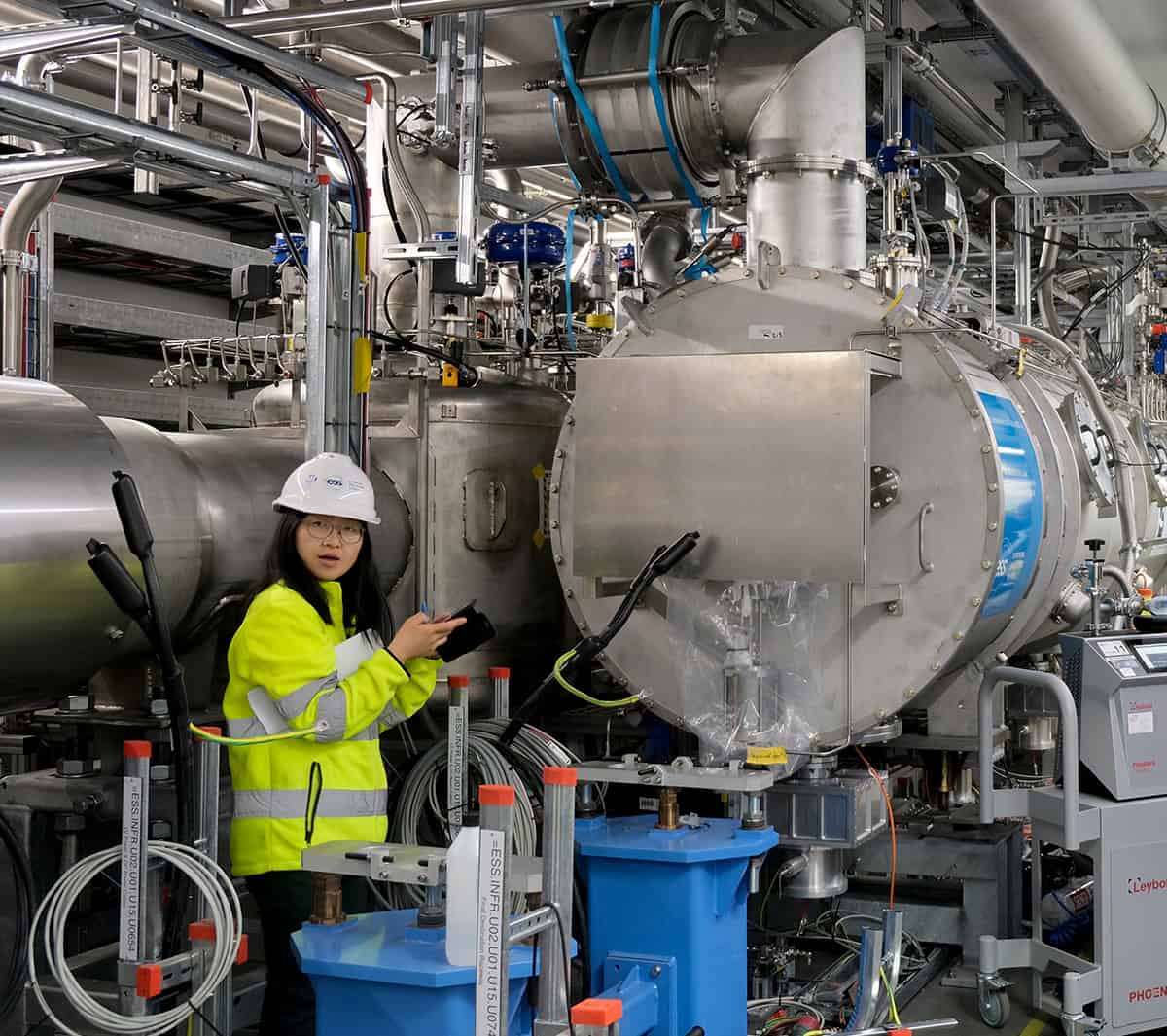
Jianqin Zhang with the beta elliptical cryomodule at the ESS superconducting linear accelerator

The largest use of helium II is currently in particle accelerators, how is it used at these facilities?

Helium II has two main uses in particle accelerators. One is to cool superconducting electromagnets to temperatures below 2.2 K. These create the large magnetic fields that bend and focus particle beams. The conducting wires in these magnets are usually made from niobium–titanium, which becomes a superconductor below about 9 K. However, further cooling allows the magnets to support higher current densities and higher field strengths. As a result, almost all the magnets on the Large Hadron Collider (LHC) at CERN are cooled by helium II.

The second main use of helium II at accelerators is to cool superconducting radio-frequency (SRF) cavities, which are used to accelerate particles. These are made from niobium, which is a superconductor at temperatures below about 9 K. Again, these cavities perform much better at superfluid temperatures, where they use less energy to achieve the same acceleration.

An important benefit of using helium II to cool magnets and SRFs is the superfluid’s very high effective thermal conductivity. As well as making it very efficient at removing heat, the high effective conductivity means that helium does not boil in the bulk – unlike normal liquid helium. This confers great advantage in cooling, particularly when it comes to SRF cavities. This is because the cavities are resonant devices and can be detuned by mechanical vibrations caused by boiling.

While CERN is currently the biggest user of helium II, it is also used at other accelerators worldwide. How will it be used at your institute, the European Spallation Source (ESS), which will be up and running next year?

Like existing spallation sources in the UK, US, Switzerland and Japan, the ESS will accelerate protons to very high energies in a linear accelerator. These protons will then strike a tungsten target, where neutrons will be created by the spallation (fragmentation) of the target nuclei. These neutrons with then be slowed down so that their de Broglie wavelengths are on par with the separations of atoms in solids and molecules. Such neutrons are ideal for experiments that explore the properties of matter.

The ESS accelerator is about 400 m in length and 90% of the acceleration will be done by SRF cavities operating at 2 K. The superfluid is created by a helium refrigerator providing up to 3 kW of cooling at 2 K.

Other accelerator facilities that use superfluid cooling include the Thomas Jefferson Laboratory in the US and the European X-ray Free Electron Laser in Germany. A future International Linear Collider – a possible successor to the LHC – would also employ superfluid-cooled SRFs.

While superfluid-cooled magnets are used in particle accelerators, that was not their first application.

That’s right. They were first designed for use in the Tore Supra tokamak, which began operation in 1988 in France. It has since been upgraded and called WEST, which operates today. Tore Supra, like other tokamaks, used magnetic fields to confine a hot hydrogen plasma. The ultimate goal of researchers working on tokamaks is to develop a practical way to harness nuclear fusion as a source of energy.
John Weisend

Tore Supra’s designers wanted to create longer-lasting plasma pulses and realized that this would not be possible using conventional magnets. They saw superfluid-cooled superconducting magnets as the way forward. The Tore Supra team worked out how to handle liquid helium and also they also developed a piece of technology called a cold compressor that would allow them to efficiently and reliably get down to 2 K. These two developments showed that it was possible operate superfluid-cooled magnets.

Helium II has also been used in space, what was the first mission to be superfluid cooled?

The first real use of helium II in space was to cool a space telescope called the Infrared Interferometer Spectrometer and Radiometer (IRAS). This mission was launched in 1983 by the US, the Netherlands and the UK and it surveyed the entire sky at infrared wavelengths. The atmosphere absorbs infrared light, which is why the telescope was launched into space. Once in orbit, its sensors must be kept as cold as possible to detect low levels of infrared light.

This cooling was done using helium II and mission designers had to overcome significant challenges such as how to vent helium vapour when it is mixed in with blobs of liquid in a low-gravity environment.

IRAS was a watershed mission in astronomy because nobody had so extensively observed the universe in these infrared wavelengths before. Astronomers could peer through dust clouds and see objects that had been invisible to other telescopes.

IRAS observed the universe for 300 days before its superfluid ran out, but a decade later NASA was able to transfer liquid helium in space. How was that done?

Yes, that was a project called Superfluid Helium On-Orbit Transfer (SHOOT), which carried superfluid helium onboard a Space Shuttle. The demonstration involved transferring superfluid from a full dewar to an empty dewar in microgravity. This was done using a pump that made use of the “fountain effect” in helium II.

How does the fountain effect work?

The effect can be understood in terms of the two fluid model, which describes helium II as having a superfluid component and a normal fluid component. These aren’t real physical phases within helium II, but rather provide a convenient way of understanding many of its mechanical and thermal properties.

The effect occurs when two regions of helium II are separated by a porous plug with micron-sized channels. If the helium II in one region is heated and the other region is cold, the superfluid component will move through the porous media towards the heater. This is possible because the superfluid component has zero viscosity and can move without resistance through the tiny channels – something that the normal fluid component cannot do.

Large Hadron Collider at CERN

In the heated region, some of the superfluid component will become normal. However, the normal component is viscous and cannot exit the warm region via the porous plug, so pressure builds up. This pressure can be used to pump helium II without the need for mechanical components.

SHOOT was an important demonstration of how helium II could be transferred in space. However, researchers realized that it is more cost efficient to launch experiments with larger dewars and lower heat loads, than to refill a dewar during a mission.

Helium II also has the ability to flow up the wall of a dewar, but despite its exotic properties a superfluid is relatively easy to handle in bulk. Why is that?

Research done in the 1970s and 80s showed that bulk helium II has essentially the same fluid mechanical properties as a conventional fluid – something that can also be explained by the two fluid model. When helium II flows, quantized vortices in the superfluid component interact with the viscosity of the normal fluid component. The result is that the bulk properties are the same as a conventional fluid.

This is tremendously helpful to engineers like me, I suppose we can be thankful that sometimes the universe is kind. The standard engineering rules that are used to design fluid-handling systems also apply to helium II – rules that help us chose components such as pipes, pumps and valves for a given system. The only instances when we need to consider the special properties of helium II are when we are transferring heat, using porous media or creating thin films of the superfluid.

There are several Nobel Prizes for Physics that were made possible by helium II cooling. Do you have a favourite?

For me it’s the 1996 prize, which went to David Lee, Douglas Osheroff and Robert Richardson for their discovery of superfluidity in helium-3. The superfluid that we have been talking about so far in this interview is helium-4, which is by far the most abundant isotope of the element. Helium-4 is a boson and bosonic atoms are able to condense into the lowest quantum energy state of the system, creating a superfluid.

Helium-3 atoms are not bosons, but are fermions. These atoms cannot undergo this Bose–Einstein condensation directly to create a superfluid.  However, in the early 1970s Lee, Osheroff and Richardson showed that helium-3 can condense into a superfluid at the much lower temperature of 2.7 mK. The physical mechanism for this is similar to what occurs in superconductors, where at low temperatures, fermionic electrons pair up. These “Cooper pairs” are bosons, so they can condense to create a superconductor in which the electrons can flow without resistance.

Because of its magnetic properties, superfluid helium-3 is a much more complicated substance than superfluid helium-4. It has three different superfluid phases, rather than the one phase of helium-4.

What I like about this discovery is that the trio weren’t  searching for superfluity in their experiment. Instead, they were studying the properties of solid helium-3 at very low temperatures and high pressure. I really like the fact that they were looking for one thing and found something entirely different. Often, the most exciting scientific discoveries are made this way.

Further reading

Modified pulse tube refrigerator cuts cryogenic cooling times in half

NIST refrigerator animation

A simple modification to a popular type of cryogenic cooler could save $30 million in global electricity consumption and enough cooling water to fill 5000 Olympic swimming pools. That is the claim of researchers at the National Institute of Standards and Technology (NIST) and the University of Colorado Boulder who describe their energy-efficient design in Nature Communications.

Ryan Snodgrass and colleagues in the US have designed a new way to operate pulse tube refrigerators (PTRs), which compress and expand helium gas in cooling cycle that is similar to that used in a household refrigerator. Developed in the 1980s, PTRs can now reach temperatures of just a few Kelvin, which is below the temperature that helium becomes a liquid (4.2 K).

While PTRs are reliable and used widely in research and industry, they are very power hungry. When Snodgrass and team looked at why commercial PTRs consume so much energy, they found that the devices were designed to be efficient at their final operating temperature of about 4 K. At higher temperatures, the PTRs are much less efficient – and this is a problem because the cooling process begins at room temperature.

Easier repairs

As well as using lots of electricity to cool down, this inefficiency means that it can take a very long time to cool objects. For example, the Cryogenic Underground Observatory for Rare Events (CUORE) – which is looking for neutrinoless double beta decay deep under a mountain in Italy – is cooled to a preliminary 4 K by five PTRs in a process that takes 20 days. Reducing such long cooling times would make it easier and less costly to modify or repair cryogenic systems.

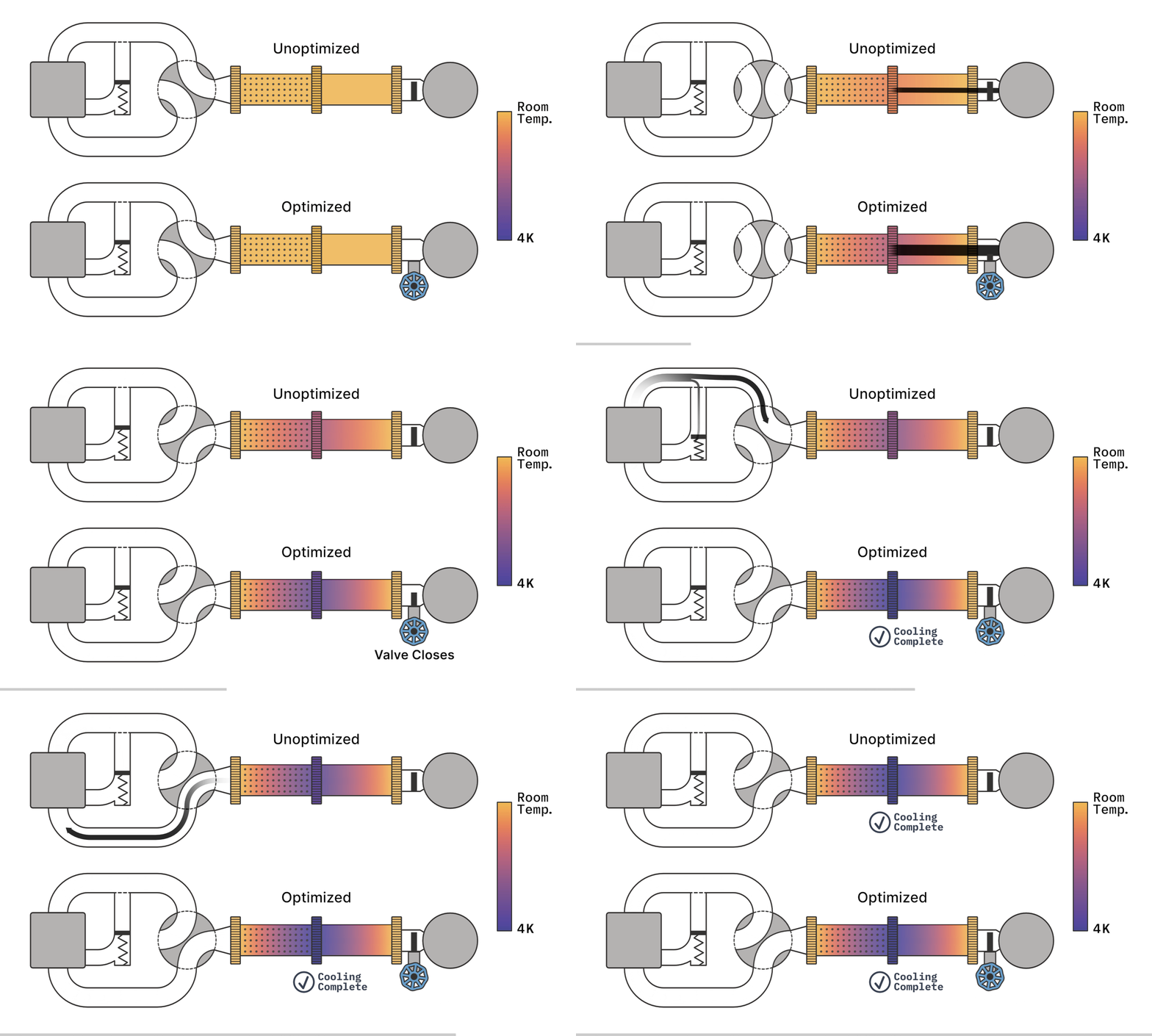
A careful study of the room-temperature operation of PTRs revealed that the helium gas is compressed to a very high pressure. This causes a relief valve to open, sending some of the helium back to the compressor. Less helium is therefore used for cooling, reducing the efficiency of the PTR.

Snodgrass and colleagues solved this problem by replacing the manufacturer-supplied needle valves in a PTR with customized needle valves that can be adjusted constantly. These needle valves control the flow of gas between the refrigerator and its helium reservoirs. They are normally set to optimize the operation of the PTR at cryogenic temperatures.

In the new operating protocol developed at NIST, the needle valves are open at room temperature. This allows gas to flow in and out of the reservoir, which moderates the pressure in the refrigerator. As the temperature drops, the valves are slowly closed – keeping the system at an ideal pressure throughout its operation.

The team found that the modification can boost the cooling rate of PTRs by 1.7–3.5 times. As well as making cooling quicker and more energy efficient, the new design could also be used to reduce the size or number PTRs needed for specific applications. This could be very important for applications in space, where PTRs are already used to cool infrared telescopes such as MIRI on the James Webb Space Telescope.


In real-world social networks, your enemy’s enemy is indeed your friend, say physicists

If you’ve ever tried to remain friends with both halves of a couple going through a nasty divorce, or hung out with a crowd of mutuals that also includes someone you can’t stand, you’ll know what an unbalanced social network feels like.

You’ll probably also sympathize with the 20th-century social psychologist Fritz Heider, who theorized that humans strive to avoid such awkward, unbalanced situations, and instead favour “balanced” networks that obey rules like “the friend of my friend is also my friend” and “the enemy of my enemy is my friend”.

But striving and favouring aren’t the same thing as achieving, and the question of whether real-world social networks exhibit balance has proved surprisingly hard to answer. Some studies suggest that they do. Others say they don’t. And annoyingly, some “null models” – that is, models used to assess the statistical significance of patterns observed in real networks – fail to identify balance even in artificial networks expressly designed to have it.

Two physicists at Northwestern University in the US now report that they’ve cracked this problem – and it turns out that Heider was right. Using data collected from two Bitcoin trading platforms, the tech news site Slashdot, a product review site called Epinions, and interactions between members of the US House of Representatives, István Kovács and Bingjie Hao showed that most social networks do indeed demonstrate strong balance. Their result, they say, could be a first step towards “understanding and potentially reducing polarization in social media” and might also have applications in brain connectivity and protein-protein interactions.

Positive and negative signs

Mathematically speaking, social networks look like groups of nodes (representing people) connected by lines or edges (representing the relationships between them). If two people have an unfriendly or distrustful relationship, the edge connecting their nodes carries a negative sign. Friendly or trustful relationships get a positive sign.

Under this system, the micro-network described by the statement “the enemy of my enemy is my friend” looks like a triangle made up of one negative edge connecting you to your enemy, another negative edge connecting your enemy to their enemy, and one positive edge connecting you to your enemy’s enemy. The total number of negative edges is even, so the network is balanced.

Complicating factors

While the same mathematical framework can be applied to networks of any size and complexity, real-world social networks contain a few wrinkles that are hard to capture in null models. One such wrinkle is that not everyone knows each other. If the enemy of your enemy lives overseas, for example, you might not even know they exist, never mind whether to count them as a friend. Another complicating factor is that some people are friendlier than others, so they will have more positive connections.

In their study, which they describe in Science Advances, Kovács and Hao created a new null model that preserves both the topology (that is, the structure of the connections) and the “signed node degree” (that is, the “friendliness” or otherwise of individual nodes) that characterize real-world networks. By comparing this model to three- and four-node mini-networks in their chosen datasets, they showed that real-world networks are indeed more balanced than would be expected based on the more accurate null model.

So the next time you have to choose between two squabbling friends, or decide whether to trust someone who dislikes the same people as you, take heart: you’re performing a simple mathematical operation, and the most likely outcome will be a social network with more balance. Problem solved!

Protecting phone screens with non-Newtonian fluids

New research shows that phones could be strengthened by adding a layer of material to the screen that fluidized during an impact. In a paper published in PNAS, the team from the University of Edinburgh and Corning, a US-based materials company, developed a mathematical model of an object hitting a phone screen. Using modelling and experiments they identify the optimized fluid properties for this application. Their results show that fluids that become runnier during impact are most effective at protecting the screen.

Despite the development of toughened glass, a smashed phone screen is a commonplace annoyance. James Richards, a postdoc in Edinburgh who led the research, explains that the aim was to design a fluid-based alternative that would sit under the glass and absorb impacts.

The suspension of a car uses a piston moving through hydraulic fluid to absorb bumps in the road. The resistance of the fluid increases the faster the piston moves, which allows the system to adapt to large and small shocks.

In this project, instead of mechanical components, the screen would be protected by a layer of fluid, like a mattress sitting below the glass. To build a system that would adapt to different impacts, the researchers turned to a class of materials called non-Newtonian fluids, whose viscosity changes depending on the force applied. A mixture of cornflour and water is an example of a shear-thickening fluid because it becomes more viscous the harder it is hit. It is also possible to have shear-thinning fluids that become runnier under impact – an example of this is paint.

Soaking Kevlar vests in shear-thickening fluid can make them more resistant to projectiles because the fabric can absorb the impact whilst remaining flexible when worn. As a result, Richards and colleagues suspected that a shear-thickening fluid could also be used to protect phone screen glass.

When an object exerts a force on a screen, the fluid resists the deformation, but the force on the glass itself depends on how much the screen has deformed. This feedback loop makes it difficult to predict how a given fluid will respond, particularly if the fluid is non-Newtonian. “The challenge here is we didn’t know where we were in a design space,” says Richards “So we needed something much, much more general.”

The researchers wanted to perform an optimization that would test their theory that shear-thickening fluids are best at protecting the screen. This is challenging because the height of the bending screen varies continuously, so there are effectively an infinite number of variables to be optimized.

Simplified phone screen for design optimization

The team looked for a way to simplify the system whilst still capturing the essential physics. They identified that the problem would be a lot easier to solve if the screen was flat – meaning the height during impact would be the same everywhere. The quantity that determines whether the screen breaks would then just be the bending moment – the product of the diameter of the plate and the force on it.

The researchers argue that close to the impact, there will be some area of the plate that is effectively flat, with  the size of this flat part becoming smaller the more the screen bends. By solving the equations of motion of the fluid under the plate, the researchers were able to reduce the problem of the flexible plate to a single flat plate whose diameter changes as it squeezes down.

With this simplified system, the team was able to factor in shear thickening or shear thinning fluid behaviour, allowing them to identify the fluid that minimized the bending moment. They were surprised to find that the optimal fluid was not shear-thickening but shear-thinning “It turns out our initial thoughts were entirely wrong” says Richards.

A tight squeeze causes an unexpected fluid response

They attribute this unexpected behaviour to the geometry of the system. During impact, the deformation of the screen squeezes the fluid through a smaller and smaller gap. It’s harder to push a shear-thickening fluid through a narrower space, so whilst it stops the impact, the glass experiences a large force. By contrast, if the fluid is shear-thinning, it will get easier to squeeze as the screen bends. This means the impact spreads out over a longer time, and provided the fluid never gets too runny, it is still possible to absorb the force whilst protecting the screen.

As proof of concept, the researchers tested transparent shear-thickening and shear-thinning fluids in an experiment that mimicked a phone screen. The fluid was sandwiched between a solid base and a sheet of glass, and the force on the glass was measured as a solid wedge pushed down on it. Their result confirms that the force on the glass increases more gradually during impact with the shear-thinning fluid, indicating that this class of fluids would be most effective as screen protectors.

The researchers say that one of their main motivations was to develop a shock absorber that could be used to build flexible phone screens. Their work establishes a framework to optimize the squeezing of non-Newtonian fluids, and they believe it could have applications such as in car windows or even to study how skin creams are applied.

China launches Chang’e-6 mission to return samples from the Moon’s far side

China has successfully launched a mission to bring back sample from the far side of the Moon – the first attempt to do so. Chang’e-6 was launched at 17:27 p.m. local time today by a Long March 5 rocket from Wenchang Satellite Launch Center on Hainan Island. If the landing is successful, the craft is expected to collect and return to Earth up to 2 kg of soil from an area not previously sampled.

China has made considerable progress in lunar exploration in recent years, which began in 2007 with the launch of the lunar orbiter Chang’e-1.

Since then it has carried out four further uncrewed missions that included Chang’e-4, which in 2019 became the first mission to touch down on the far side of the Moon. That craft landed in the Von Kármán crater in the South Pole-Aitken Basin – one of the oldest known impact craters in the Solar System and represents one of the Moon’s most scientifically rich regions.

China’s previous lunar mission was Chang’e-5, which launched in November 2020, and successfully brought back 1.7 kg of samples from the near side of the Moon a month later, the first recovery of lunar samples in 45 years.

Most of the returned samples are stored at the National Astronomical Observatories of China, Chinese Academy of Sciences, in Beijing, with possible access by foreign scientists through collaboration with Chinese colleagues.

To the dark side

Chang’e-6 was built as a back-up for Chang’e-5, but following the success of that mission Chang’e-6 was repurposed for its own assignment.

Weighing 8.2 tonnes, Chang’e-6 consists of four parts: an ascender, lander, returner and orbiter. Upon entering orbit around the Moon, the ascender and lander will separate and touch down in the southern part of the Apollo crater, which lies in the northeastern side of the South Pole-Aitken Basin.

The lander will use a panoramic camera, spectrometer and ground-penetrating radar among other payloads to document the landing site. Chang’e-6 also carries payloads from France, Italy, Sweden and Pakistan, which includes an instrument to measure surface levels of radon.

Within 48 hours after touching down, Chang’e-6 will use a robotic arm to scoop up small rocks from the surface and drill up to 2 m into the ground with the aim to collect about 2 kg of material.

The ascender will lift off from the top of the lander and dock with the returner-orbiter in orbit. The sample container is then transferred to the returner, which will head back to the Earth.

A relay satellite – Queqiao-2 – was launch in March to help communications between Chang’e-6 and ground stations on Earth.

It is hoped that the returned samples will shed light on the early evolution of the Moon given that the far side is not as extensively covered by ancient lava flows as the near side, which helps to preserves materials from the Moon’s early formation. It is also hoped that the results from the mission will provide clues to why the two sides are so different.

China plans two further lunar missions, with Chang’e-7 in 2026 that will explore the lunar south pole for water, followed by Chang’e-8 in 2028 that will build a rudimentary outpost on the Moon in collaboration with Russia.

China then aims to put astronauts on the Moon by 2030, some four years after the US Artemis crewed mission to the Moon, which is currently planned for September 2026.

Bilayer of ultracold atoms has just a 50 nm gap

Two Bose-Einstein condensates (BECs) of magnetic atoms have been created just 50 nm apart from each other – giving physicists the first opportunity to study atomic interactions on this length scale. The work by physicists in the US could lead to studies of several interesting collective phenomena in quantum physics, and could even be useful in quantum computing.

First created in 1995, BECs have become invaluable tools for studying quantum physics. A BEC is a macroscopic entity comprising thousands of atoms that are described by a single quantum wavefunction.  They are created by cooling a trapped cloud of bosonic atoms to a temperature so low that a large fraction of the atoms are in the lowest energy (ground) state of the system.

BECs should be ideal for studying the quantum physics of exotic, strongly interacting systems. However, to prolong the lifetime of a BEC, physicists need to keep it isolated from the outside world to prevent decoherence. This need for isolation makes it difficult to manoeuvre BECs close enough together for the interactions to be studied.

Pancake layers

In the new work, researchers at Massachusetts Institute of Technology in the group of Wolfgang Ketterle (who shared the 2001 Nobel Prize for Physics for cresting BECs) tackled this problem by creating a double-layer BEC of dysprosium atoms, with the two layers just 50 nm apart. To achieve this, the researchers had to keep two pancake-like condensate layers a constant distance apart using lasers with wavelengths more than ten times their separation. This would have been almost impossible using separate optical traps.

Instead, the researchers utilized the fact that dysprosium has a very large spin magnetic moment. They lifted the degeneracy of two electronic spin states using an applied magnetic field. Atoms with opposite spins coupled to light with slightly different frequencies and opposite polarizations. The researchers sent light at both frequencies down the same optical fibre onto the same mirror. Both beams formed standing waves in the cavity. “If the frequency of these two standing waves is slightly different, then at the position where we load this bilayer array, these two standing waves are going to slightly walk off,” says Li Du, who is lead author on the paper describing the research. “Therefore by tuning the frequency difference we’re able to tune the interlayer separation,” he adds.

As both beams utilize the same optical fibre and the same mirror, they are robust to physical disturbance of these components. “Our scheme guarantees that you have two standing waves that can shake a little – or maybe a lot – but the shaking is a common mode, so the difference between the two layers is always fixed,” says Du.

Ringing atoms

The researchers heated one of the layers by about 2 μK and showed how the heat flowed across the vacuum gap to the other layer through the magnetic coupling of the atomic dipoles. Next they induced oscillations in the position of one layer and showed how these affected the position of the other layer: “We hit one layer with a hammer and we see that the other [layer] also starts to ring,” says Du.

The researchers now hope to use the platform to study how atoms closer together than one photon wavelength interact with light. “If the separation is much smaller than the wavelength of light, then the light can no longer tell [the atoms] apart,” says Du. “That potentially allows us to study a special effect called super-radiance.”

Beyond this, the researchers would like to investigate the work’s potential in quantum computing: “We would really like to implement a magnetic quantum gate purely driven by the magnetic dipole-dipole interaction,” he says. The same platform could also be used with BECs of molecules, which would open up the study of electric dipole–dipole interactions. Indeed, in late 2023, researchers at Columbia University in the US published a preprint that describes how they created a BEC of dipolar molecules. This preprint has yet to be peer reviewed.

Twisted graphene

Experimental atomic physicist Cheng Chin of the University of Chicago in Illinois, who last year collaborated with researchers at Shanxi University in China to produce a double layer of rubidium atoms to model twisted bilayer graphene, says that Ketterle and colleagues’ research is “very, very interesting”.

He adds, “This is the first time we’re able to prepare cold atom systems in two layers with such a small spacing…To control such a 2D system is hard but necessary in order to induce the interaction that’s required in two planes. It’s a very smart choice of atom because dysprosium has a very large dipole-dipole interaction. At a conventional spacing of half a micron, you wouldn’t be able to see any kind of coupling between the two layers, but 50 nm is just enough to show that the atoms in the two planes can really talk to each other.”

He suggests follow-up work from both teams’ research could focus on simulating new phases of matter and simulating emergent ones such as superconducting bilayer graphene.

The research is described in Science

Social media: making it work for physics-related businesses

Many physicists work for small-to-medium-sized companies that provide scientific instrumentation and services – and some have founded companies of their own. Such businesses can have limited resources for marketing and customer service, so using social media can be an efficient way to connect with existing users and attract new customers.

In this episode of the Physics World Weekly podcast, Alex Peroff and Neil Spinner of Pine Research Instrumentation explain how they use social media – including podcasts, videos, webinars and live chats – to get their message out.

From their base in Durham, North Carolina, the duo also share their top tips for getting the most out of social media.


Thyracont logo


This podcast is sponsored by Thyracont Vacuum Instruments, which provides all types of vacuum metrology for a broad variety of applications ranging from laboratory research to coating and the semiconductor industry. Explore their sensors, handheld vacuum meters, digital and analogue transducers as well as vacuum accessories and components at thyracont-vacuum.com.

Quantum Machines’ processor-based approach for quantum control

This short video – filmed at the March Meeting of the American Physical Society in Minneapolis earlier in the year – features Itamar Sivan, chief executive and co-founder of Quantum Machines (QM). In the video, he introduces explains how QM makes the control electronics parts of quantum computers – that is, the classical hardware that drives quantum processors.

Yonatan Cohen, chief technology officer and fellow co-founder, then outlines the firm’s evolution to a processor-based approach for quantum control. As a result, QM has a unique processor that generates all the signals that communicate with it, allowing the firm to build more scalable architectures while maintaining high performance.

Cohen explains that the key for QM technology is to implement quantum error correction at scale – which is where the firm’s OPX1000 platform comes in. It is a scaled-up system with very high channel density, which means it can control many qubits with a relatively small system – making it, the firm says, the most scalable control system on the market.

Cohen also discusses the importance to QM of hiring staff who combine an expert knowledge with a passion for the technology and explainshow partnerships help QM maintain a competitive edge in the market. One such tie-up, with NVIDIA, allowed QM to create a link between its control system and the NVIDIA GPU-CPU platform – bringing more computing power to the heart of the quantum computer.

Sivan believes that after installation of the QM tech, within a couple of days, the customer can realize all the experiments that they had conceived.

Semiconductor substrate behaves ‘like the tail wagging the dog’, say scientists

The substrates on which semiconductor chip are grown usually get ignored, but they may be more important than we think. This is the finding of researchers in the US and Germany, who used high-energy X-rays to study titanium dioxide – a common substrate for insulator-to-metal semiconductors. The discovery that this material is far more than just a passive platform could help scientists develop next-generation electronics.

Materials that switch from metal-like to insulating very quickly offer a promising route for developing super-fast electronic transistors. To this end, a team led by materials scientist and physicist Venkatraman Gopalan of Pennsylvania State University, US, began studying a leading candidate for such devices, vanadium dioxide (VO2). Vanadium dioxide is unusual in that its electrons are strongly correlated. This means that, unlike in silicon-based electronics, the repulsion between electrons cannot be ignored.

Crucially, though, the researchers did not look at the VO2 layer on its own. They also analysed how it interacts with the titanium dioxide (TiO2) substrate upon which it is grown. To their surprise, they found that the substrate contains an active layer that behaves just like the semiconductor when the VO2 switches between an insulating state and a metallic one.

Timed X-ray pulse

Gopalan and colleagues obtained their results by growing a very thin film of VO2 atop a thick TiO2 single crystal substrate. They then fabricated a device channel on the ensemble across which they could apply the voltage pulses that switch the semiconductor from insulating to conducting. During this switching, they applied high-energy X-ray pulses from the Advanced Photon Source (APS) at Argonne National Laboratory to the channel and observed the lattice planes of the semiconducting film and the substrate.

“The X-ray pulse was timed so that it could arrive before, at and after the electrical pulse so that we see what happens with time,” Gopalan explains. “It was also raster scanned across the channel to map what happens to the entire channel when the material switches from being an insulator to a metal.”

This technique, known as spatio-temporal X-ray diffraction microscopy, is good at revealing the behaviour of materials at the atomic level. In this case, it showed the researchers that the VO2 film bulges as it changes to a metal. This was unexpected: according to Gopalan, the material was supposed to shrink. “What is more, the substrate, which is usually thought to be electrically and mechanically passive, also bulges along with the VO2 film,” he says. “It is like the tail wagging the dog, and shows that a mechanism that was missed before is at play.”

Native oxygen vacancies are responsible

According to the researchers’ theoretical calculations and modelling, this mechanism involves atomic sites in the material lattice that are missing oxygen atoms. These native oxygen vacancies, as they are known, are present in both the semiconductor and substrate and they ionize and deionize in concert with the applied electric field.

“Neutral oxygen vacancies hold a charge of two electrons, which they can release when the material switches from an insulator to a metal,” Gopalan explains. “The oxygen vacancy left behind is now charged and swells up, leading to the observed swelling in the device. This can also happen in the substrate.”

The experiment itself was very challenging, Gopalan says. One of the X-ray beamlines at the APS had to be specially rigged and it took the team several years to complete the set-up. Then, he adds, “The results were so intriguing and unexpected that it took us several more years to analyse the data and come up with a theory to understand the results.”

According to Gopalan, there is tremendous interest in next-generation electronics based on correlated electronic materials such as VO2 that exhibit a fast insulator-to-metal transition. “While previous studies have analysed this material using various techniques, including using X-rays, our is the first to study a functioning device geometry under realistic conditions, while mapping its response in space and time,” he tells Physics World. “This study is unique in that respect, and it paid off in what it revealed.”

The researchers are now trying to understand the mechanisms behind the substrate’s surprising response, and they plan to revisit their experiment to this end. “We are thinking, for example, of intentionally adding ionizing defects that release electrons and trigger a metal-to-insulator transition when a voltage is applied,” Gopalan reveals.

The present study – which also involved collaborators at Cornell University and Georgia Tech in the US, and the Paul Drude Institute in Germany – is detailed in Advanced Materials.

Wigner crystal appears in bilayer graphene

Researchers at Princeton University in the US say they have made the first direct observation of a Wigner crystal – a structure consisting solely of electrons arranged in a lattice-like configuration. The finding, made by using scanning tunnelling microscopy to examine a material known as Bernal-stacked graphene, confirms a nearly century-old theory that electrons can assemble into a closely-packed lattice without having to orbit around an atom. The work could help scientists discover other phases of exotic matter in which electrons behave collectively.

Although electrons repel each other, at room temperatures their kinetic energy is high enough to overcome this, so they flow together as electric currents. At ultralow temperatures, however, repulsive forces dominate, and electrons spontaneously crystallize into an ordered quantum phase of matter. This, at least, is what the physicist Eugene Wigner predicted 90 years ago would happen. But while scientists have seen evidence of this type of crystalline lattice forming before (for example, in a one-dimensional carbon nanotube and in a quantum wire), it had never been observed directly.

A pristine sample of graphene

In the new work, which is detailed in Nature, researchers led by Princeton’s Ali Yazdani used a scanning tunnelling microscope (STM) to study electrons in a pristine sample of graphene (a sheet of carbon one atom thick). To keep the material as pure as possible, and so avoid the possibility of electron crystals forming in lattice defects or imperfections, they placed one sheet of graphene atop another in a configuration known as a bilayer Bernal stack.

Next, they cooled the sample down to just above absolute zero, which reduced the kinetic energy of the electrons. They also applied a magnetic field perpendicular to the sample’s layers, which suppresses kinetic energy still further by restricting the electrons’ possible orbits. The result was a two-dimensional gas of electrons located between the graphene layers, with a density the researchers could tune by applying a voltage across the sample.

Scanning tunnelling microscopy involves scanning a sharp metallic tip across a sample. When the tip passes over an electron, the particle tunnels through the gap between the sample surface and the tip, thereby creating an electric current. By measuring this current, researchers can determine the local density of electrons. Yazdani and colleagues found that when they increased this density, they observed a phase transition during which the electrons spontaneously assembled into an ordered triangular lattice structure – just as Wigner predicted.

Forcing a lattice to form

The team explains that this spontaneous assembly is the natural outcome of a “battle” between the electrons’ increased density (which pushes them closer together) and their mutual repulsion (which pushes them apart). An organized lattice configuration – a Wigner crystal – is, in effect, a compromise that lets electrons maintain a degree of distance from each other even when their density is relatively high. If the density increases still further, this crystalline phase melts, producing a phase known as a fractional quantum Hall electron liquid as well as an anisotropic quantum fluid in which the electrons organize themselves into stripes.

By analysing the size of each electron site in the Wigner crystal, the researchers also found evidence for the crystal’s “zero-point” motion. This motion, which comes about because of the Heisenberg uncertainty principle, occupies a “remarkable” 30% of the lattice constant of a crystal site, Yazdani explains, and highlights the crystal’s quantum nature.

The Princeton team now aims to use this same STM technique to image a Wigner crystal made of “holes”, which are regions of positive charge where electrons are absent. “We also plan to image other types of electron solid phases, so-called skyrme crystals and ‘bubble phases’,” Yazdani says. “In addition to even more exotic phases such as quasiparticle Wigner crystals made of fractional charges, there is also the possibility to study how these quantum crystals would change in the presence of a net electrical current.”

Copyright © 2026 by IOP Publishing Ltd and individual contributors