

Odyssey finds evidence for ice on Mars

The early results from Odyssey are based on studies of gamma rays and neutrons ejected from the surface of Mars by reactions with cosmic rays. Mars has no magnetic field and only a thin atmosphere, so cosmic rays – particularly protons and alpha particles – can penetrate a metre or so into its soil. When nuclei in this soil absorb these energetic particles, they are excited into higher energy states, and release gamma rays when they return to their ground states. The atoms can also be transformed into different elements by absorbing protons and emitting neutrons of various energies.

Since each element emits a characteristic spectrum of gamma rays – or neutrons with a certain energy distribution – these can reveal the composition of the surface of the planet. The gamma-ray spectrometer consists of three instruments that analyse these emissions: the gamma subsystem, the neutron spectrometer and the high-energy neutron detector. The findings from each instrument are published in separate papers in today’s issue of Science (W Boynton et al; W Feldman et al; I Mitrofanov et al; 2002 Science to appear).

The gamma subsystem found that the regions near the poles of Mars are rich in hydrogen. It also suggests that the surface of Mars consists of a layer of hydrogen-rich material several tens of centimetres thick, covered by a thinner layer of hydrogen-poor material. The hydrogen signal also became weaker below latitudes of about 60°, which suggests that it was attenuated by an increasing thickness of the hydrogen-poor layer towards the equator. The thick layer is thought to contain about 35% water ice, compared with just a few percent in the upper layer.

The high-energy neutron detector and the neutron spectrometer classify neutrons into three bands of ascending energy: thermal, epithermal and fast. When cosmic rays hit hydrogen nuclei, the neutrons emitted have energies in the epithermal energy range, between 0.4 eV and 500 keV. The instruments found that the flux of these neutrons at latitudes above 60° was high, but that the flux of thermal neutrons was higher towards the equator.

The researchers believe that this result is consistent with the conclusions from the gamma-ray study because the energy of epithermal neutrons emitted by hydrogen nuclei in the lower layer would be reduced as these neutrons travelled through the upper layer. The pattern of flux intensity also appeared to match the maps of gamma ray intensity.

The researchers admit that the hydrogen they have detected could be contained in hydroxide-based minerals, but say that the combination of ice-rich and ice-poor layers fits the data well. Since the instruments have only probed the top metre or so of the soil, they even speculate that the surface layers could be just the tip of a larger reservoir of ice beneath the surface of the red planet.

Odyssey was launched in April 2001 and reached Mars last October. Its mission is planned to last until August 2004.
Astronomers tune in to youngest pulsar yet

Pulsars are rapidly spinning neutron stars that are created when a giant star explodes at the end of its life. During this supernova explosion, the outer layer of the star is ejected into space and the inner core collapses into a super-dense, rotating neutron star. Intense magnetic and electric fields make the neutron star emit beams of radiation that sweep across space as the star rotates. Since we observe these beams as regular pulses of radiation, these spinning neutron stars became known as pulsars.

Early Japanese and Chinese astronomical records show that a supernova exploded in the constellation Cassiopeia in 1181. In late 2001, the space-based Chandra X-ray Observatory confirmed astronomers’ beliefs that a pulsar existed in the remains of this supernova, but it only detected X-ray signals from the pulsar. Astronomers had also expected to pick up radio signals from the pulsar – known as PSR J0205+6449 – but existing ground-based radio telescopes failed to detect them.

Now the new radio telescope at Green Bank has detected radio signals from PSR J0205+6449 for the first time, making it the faintest radio-emitting pulsar ever found. The telescope was able to spot the pulsar because it is the largest of its kind in the world and is located in a ‘radio quiet zone’. Although the pulsar rotates once every 15 seconds, the rate of rotation of pulsars is known to change over time. The Green Bank achievement means that astronomers will now be able to track faint pulsars from the ground, instead of using expensive space-based X-ray probes.

“Continued observations of such a young radio pulsar will provide a mine of information for years to come,” says team member Duncan Lorimer of the University of Manchester. “We will be able to precisely track how its rotation changes with time. We will also be able to make comparisons with the X-ray data, which may help us to determine exactly how and where these stars generate and emit radiation.”

The discovery also raises hopes that astronomers at Green Bank will be able to study other faint pulsars that less sensitive telescopes could not detect. “Measuring the luminosity and spectrum of a large sample of these stars will be crucial for making an accurate census of pulsars in our galaxy,” says team member Fernando Camilo of Columbia University in the US.

Europe unveils new plan for space science

Last November European science ministers met to decide on ESA’s budget for the next five years. Space scientists had been hoping for a budget increase of around 5% a year in real terms, but had to make do with an annual rise of about 2.5%. In the light of this shortfall, ESA’s director of science David Southwood predicted that the agency would have to axe a major mission, such as the GAIA galaxy mapper or the Bepi-Colombo mission to Mercury. But ESA will now avoid this fate by arranging its missions into three ‘production groups’ – astrophysics, solar system science and fundamental physics – that Southwood says will enable missions to reuse hardware and share engineering teams,

Within the astrophysics group, the Integral gamma-ray observatory is scheduled to take off later this year, while the infrared and microwave Herschel mission, the Planck cosmic microwave background mission, and Eddington should be launched between 2007 and 2008. GAIA should be launched no later than 2012.

In solar science, the Rosetta comet mission, Mars Express and the SMART-1 technology demonstrator should all be launched in 2003, while BepiColombo and the Solar Orbiter are due to take off in 2011 or 2012.

In fundamental physics, a mission to test the equivalence principle called STEP is due for launch in 2005 (although this mission is still awaiting a decision by NASA), while SMART-2 takes off in 2006 and the LISA gravitational wave mission in 2011. In addition, ESA is a partner in NASA’s Next Generation Space Telescope, which should take off in 2010.

The new science programme will save about Euro 70m through the miniaturization and integration of space-craft subsystems. Southwood says that in addition he will exert a much tighter personal control over management of the agency. But he acknowledges that the programme will be less flexible and that Europe’s space industry will lose jobs.

“We’ve been incredibly lucky to patch things together,” says Southwood. “It’s not that you can’t make efficiency gains, but you can’t keep doing it over and over again. We couldn’t handle another set-back such as the Cluster failure.”

Multi-talented material signals new devices

Ordinary transistors act as switches because they are based on materials whose resistances change depending on the voltage applied to them – that is, their electrical behaviour can be modified electrically. In contrast, the electrical properties of optoelectronic devices – such as light-dependent resistors – can be adjusted by light, and vice versa. And in the emerging field of spintronics, the electrical behaviour of a device can be changed by a magnetic field that lines up the spins of the electrons.

But scientists have so far failed to make a material in which optical, electrical and magnetic characteristics are linked. “As far as we know, our material is the first organic compound that combines all three,” says Haddon.

The compound created by Haddon’s team consists of two phenalenyl ring systems that are connected by a boron atom and chemical groups such as hexyl, butyl or ethyl. The electrons in this compound are ‘delocalized’ from their parent atoms and – above a certain temperature – they migrate to the outer regions of the molecule, making the compound paramagnetic. Below this temperature, the electrons drift into the centre of the molecule, and the compound becomes diamagnetic.

The researchers set out to study the electrical properties of the substance, and found that it is an insulator in its paramagnetic state and a conductor in its diamagnetic state. “We were working to develop organic conductors and superconductors,” Haddon told PhysicsWeb. But they were surprised to discover also that it is transparent to infrared light when it is an insulator, and opaque when it is a conductor.

The exact characteristics of the compound depend on the choice of chemical group, and on the direction of temperature change. For a butyl group, the transition temperature is about 50 °C if the temperature is rising and about 74 °C if it is falling. The transition between opaque and transparent states occurs for several wavelength bands.

Haddon and co-workers are optimistic that this flexibility will make their ‘multi-functional’ material suitable for a variety of applications. They are now developing molecules that can be directly switched with light.

CBI zooms in on cosmic microwaves

The cosmic microwave background provides a picture of the universe as it was some 300 000 years after the big bang, when the universe had cooled down enough for atoms to form, which meant that there were no longer any free electrons to scatter the photons produced in the early universe. Variations in the temperature of the microwave background therefore reflect variations in the density of the universe at this time.

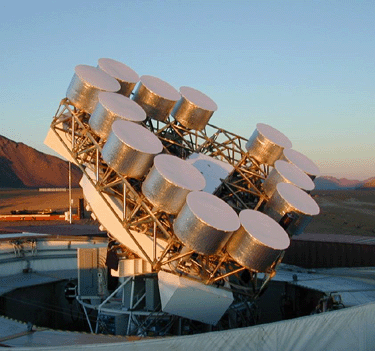
The Cosmic Background Imager is a special-purpose radio telescope that is located at an altitude of 5000 metres in the Chilean Andes. The telescope consists of 13 interferometer elements on a 6-metre platform and operates at 10 frequency bands between 26 and 35 gigahertz. The CBI collaboration involves astrophysicists from the California Institute of Technology, the Canadian Institute for Theoretical Astrophysics, the University of Chicago and the Universidad de Chile.

The standard way to present measurements of the microwave background is to plot the power spectrum against multipole number, which is inversely proportional to angle. The standard big bang plus inflation model of cosmology predicts that this plot should contain a series of peaks, and the heights and positions of these peaks are related to basic astrophysical properties of the universe.

The CBI experiments can measure the power spectrum up to a multipole number of 3500, whereas previous experiments – such as Boomerang, Maxima and DASI – could only measure up to about 1000. These experiments have seen the first two peaks, with hints of a third. The CBI experiment can clearly see four peaks, with hints of two further peaks.

The CBI results are in agreement with previous measurements and confirm the basic model of a flat universe containing both dark matter and dark energy. “These unique high-resolution observations give a powerful confirmation of the standard cosmological model,” says Anthony Readhead of CalTech, who is the principal investigator on the CBI project. “Moreover, this is the first direct detection of the seeds of clusters of galaxies in the early universe.”

Molecular electronics claims called into question

The controversy centres on two papers that appeared in the journals Nature and Science last year. Schön’s group reported that they had made a transistor from a single layer of molecules in an article that appeared in Nature on 18 October. The researchers then said they had made a transistor from a single molecule, a result that appeared in Science on 8 November. The final figures in each paper – which showed the voltage characteristics of the devices – look very similar.

The confusion was compounded when a professor of physics at Cornell University, Paul McEuen, noticed that a similar graph had also appeared in an article by Schön’s team that was published in Science on 11 February 2000. This time, the scale of the graph was a factor of five larger. A second graph in this article is also similar – except for a factor of two – to a graph in an article by Schön’s group that appeared in Science on 28 April 2000.

There are further doubts about graphs published subsequently in the journals Applied Physics Letters and Synthetic Metals.

Bell Labs spokesman Saswato Das told the New York Times that the independent scientists appointed for the investigation would be granted full access. “There are serious scientific concerns, and we would like them reviewed fully, independently and objectively,” he said. Malcolm Beasley of Stanford University in the US is chairing the external review panel.

Beyond an assertion that he will do everything he can to help the inquiry, Schön is declining to comment until it is completed. His team at Bell Labs has published dozens of papers since the beginning of 2000, many of them in Nature and Science.

Crystals get in a twist

Niobium selenide crystals are usually synthesized by heating niobium and selenium in a sealed quartz tube until long whiskers or ribbons form. Satoshi Tanda and co-workers at Hokkaido University in Sapporo have modified this crystal-growth process by creating a large temperature gradient across the tube, which allows the selenium to exist as both liquid droplets and a gas.

The Hokkaido team found three different crystal forms – rings, Möbius strips and figures-of-eight. As the ribbon-shaped crystals grow, they wrap around the selenium droplets, due to the surface tension of the liquid, until they eventually form a perfect seamless ring. Möbius strips are more difficult to produce because of the half-twist involved.

However, the low symmetry of the monoclinic niobium selenide crystals encourages the ribbons to both twist and bend, while rotating droplets may also help. Meanwhile, the figure-of-eight structures form if the ribbons circle the droplet twice. Tanda and co-workers are extending the technique to other materials, including tantalum selenide and tantalum sulphide.

“Nanotorus” nets giant magnetic moment

Carbon nanotubes are rolled-up sheets of graphite that can act as metals, semiconductors or insulators, depending on their radius and the angle at which the sheets are rolled. If a nanotube is bent so that its ends meet, a nanotorus is produced. The electronic properties of such structures are less well understood, and Liu and co-workers suspected that the magnetic behaviour of nanotori would provide some clues.

The team considered nanotori with various radii, made from different types of metallic nanotube, known as ‘armchair’ or ‘zigzag’. In their calculations, the researchers assume that the nanotori are in a magnetic field of 0.1 tesla, which causes the spins of the electrons to line up, producing a magnetic moment. They also imagined that the electrons were flowing around the rings as an electrical current.

When the researchers calculated the magnetic moments of the nanotori, they found that some of the nanotori made from either ‘armchair’ or ‘zigzag’ metallic nanotubes had magnetic moments thousands of times larger than other tori with similar structures. The team realised that the radius of the torus – and therefore the area it enclosed – affected its magnetic moment. This made the magnetic moment very large for certain ‘magic’ radii.

Liu and colleagues believe that the characteristics of the nanotori arise partly from the unusual behaviour of the electrons in the ring-shaped structures. In a torus made from ‘armchair’ nanotubes, the electrons flow along the circumference of the torus. In a torus made from ‘zigzag’ nanotubes, the electrons follow a spiral path around the circumference of the torus, leading to a different magnetic moment. But the calculations also show that the radius of a torus is an important factor.

Liu and co-workers say their discovery is “a unique example of the unusual magnetic behaviour of carbon-based nanostructures”. They also speculate that polygon-shaped rings of nanotubes could have unusual magnetic properties.

Liu’s team now plans to make carbon nanotori in the lab and test their electrical and magnetic properties. “The colossal magnetic moment exhibited by metallic nanotori could be used to fabricate ultra-sensitive magnetic sensors,” Liu told PhysicsWeb.

Jupiter clocks up eleven new moons

Sheppard, Jewitt and colleagues imaged a wide area of the sky around Jupiter in December 2001, and then used computer algorithms to sift the images to identify possible satellites. To exclude rogue asteroids, the team monitored these candidates for several months using the 2.2-metre telescope at the University of Hawaii. Once the new satellites were identified, scientists at NASA’s Jet Propulsion Laboratory and the Minor Planet Center calculated their orbits.

Like most of Jupiter’s satellites, the new moons were found to follow highly eccentric – or elliptical – paths around Jupiter. They also orbit the planet in a retrograde motion, that is, in the opposite direction to the spin of the planet.

The researchers calculated that the orbits of the moons are clustered at a distance of about 20 million kilometres from Jupiter, which is about 300 times the planet’s radius. This suggests that they were formed by the break-up of a larger body, which astronomers believe could either have been a passing asteroid trapped by the early atmosphere of Jupiter, or a neighbouring planetesimal caught as the young planet rapidly aggregated material. Both of these processes would have taken place in the first million years of the solar system.

The Hawaii astronomers are not sure what the moons are made of, but assume that they are rocky bodies similar to asteroids. Based on earlier studies of asteroids – which reflect roughly 4% of the light that falls on them – the researchers calculated that the moons are between two and four kilometres in diameter.

The discovery was announced by the International Astronomical Union in its circular number 7900.

Condensates get longer lives

A Bose-Einstein condensate is an ultra-cold cloud of gas atoms that are all in the same quantum state, and can therefore be described by the same wavefunction. This ‘atomic coherence’ is analogous to the coherence of the photons emitted by a conventional laser. In recent years, physicists have exploited this phenomenon to make atom lasers that emit atoms with coherent de Broglie waves.

Currently these devices can only emit short bursts of coherent atoms because the condensates get used up very quickly. Although these ‘pulsed’ atom lasers are valuable research tools, a device that could emit a continuous stream of coherent atoms could also be used in a wide range of applications. But longer-lasting condensates are needed to make continuous-beam atom lasers, and these are difficult to make because it is impossible to make a new condensate inside an existing one.

To make a condensate, atoms are ‘evaporatively cooled’ from a temperature of about a hundred millikelvin to about a hundred nanokelvin. If this process were carried out in an existing condensate, the warmer atoms would destroy it. This means that the new condensate must be created elsewhere and then added to the existing one. Until now, it has proved impossible to move and merge condensates in this way.

Now Ketterle and co-workers have overcome this problem by using ‘optical tweezers’ to move a freshly made condensate from a ‘production chamber’ into a ‘science chamber’. Optical tweezers consist of a focused laser that induces an electric dipole moment in the atoms. The atoms are then drawn into the most intense part of the electric field of the laser focus. This allows the atoms to be picked up, moved and then released by switching the laser on, shifting the focus, and switching it off.

Using this technique, Ketterle’s group constantly replenished a condensate so that it contained over a million sodium atoms at all times. They say that adjustments to the experiment should raise this number to a hundred million.

“Our continuous condensate source is the most crucial step towards a continuous atom laser,” team member Ananth Chikkatur told PhysicsWeb. According to Chikkatur, there are already several techniques for extracting the atoms from the condensate into a beam. “In principle, we can do it already,” he says.

Copyright © 2026 by IOP Publishing Ltd and individual contributors