Imagine you need to search a telephone directory for the name of a person whose phone number you have. Classically, the number of entries you will need to check is of the order of the total number of entries in the directory. But an algorithm developed by Lov Grover in 1997 states that a quantum computer could trace the name after a number of searches roughly equal to the square root of the total number of entries.
In a quantum system, the entries are each assigned a quantum state. The increase in efficiency arises because the directory is in a ‘superposition’ of all the possible states at the beginning of the experiment. This means that the quantum states of all the entries are connected, and as entries are eliminated from the search, the probability of finding the desired entry increases faster than it does in the classical problem, where the entries are not linked.
Robert Spreeuw and colleagues at the University of Amsterdam have now shown that this efficiency can be achieved by bouncing light pulses back and forth inside an optical cavity through a ‘directory’ plate (N Bhattacharya et al 2002 Phys. Rev. Lett.88 137901). Each round trip is equivalent to one ‘check’ of the directory. The researchers found that the intensity profile of the light pulse is modified by the directory plate in a way that reveals the desired entry after a number of searches that is equal to the square root of the number of entries.
The team admits that – unlike quantum techniques – their method only works for directories with a limited number of entries because its efficiency depends on the width of the light beam used. The database searched by the Amsterdam team had 32 entries.
Elsewhere, Jiangfeng Du and co-workers at the University of Science and Technology of China have used ‘superposition’ to show that the well-known ‘prisoner’s dilemma’ puzzle has a different outcome if it is considered as a quantum problem rather than a classical one (Jiangfeng Du et al 2002 Phys. Rev. Lett.88 137902).
In the prisoner’s dilemma, two or more suspects are held in separate cells. If the suspects share the blame for a particular crime, they will receive shorter sentences in total. If they blame each other, they could either be released or receive much longer sentences. But the suspects don’t know what their fellow prisoners will decide.
In the classical problem, acting selfishly usually leads to the shortest sentences. But Du and colleagues have shown that collaboration is the best strategy in the quantum version of the problem. They analysed the problem on a quantum computer based on the magnetic spin states of hydrogen nuclei, in which the choices available to the prisoners are initially represented as a superposition of quantum states in the quantum computer. This creates a relationship between the prisoners’ choices that does not exist in the classical problem and leads to a different outcome.
In the mid-1950s, Jentschke took up a teaching post at the University of Hamburg. He became interested in setting up a research centre for particle physics, which was to become the Deutsches Elektronen-Synchrotron or DESY. He became a director of experimental physics at the university and forged strong links between the two establishments, which led the university’s Institute of Laser Physics to move to the DESY site.
DESY established a tradition of studying fundamental particle physics and – at the same time – using the synchrotron radiation produced by particle accelerators for more applied research. In the late 1960s, Jentschke initiated plans for the DORIS electron-positron storage ring – also at DESY – which went into action in 1974.
“Without Willibald Jentschke, DESY would never have existed,” said Albrecht Wagner, chairman of the DESY board of directors. “His negotiating skills, tenacity and far-reaching decisions laid the foundations of DESY, and his team spirit still influences DESY’s leadership style.”
When hot hydrogen cooled in the early universe to form galaxies, intense far-ultraviolet radiation would have been emitted as the atoms fell from excited states to the ground state. This so-called Lyman alpha emission is a tell-tale sign of galaxy formation, and has a characteristic wavelength of 121.6 nanometres. But as this radiation travels across space, its wavelength increases because the universe is expanding – an effect known as redshift. This allows astronomers to calculate the age of a galaxy and its distance from Earth.
With a redshift of 6.56, HCM 6A is the first galaxy detected with a redshift greater than six, although many galaxies have been observed with redshifts above five. The previous most distant object – a quasar – had a redshift of 6.28.
Hu’s team had detected several sources of Lyman alpha radiation using the low-resolution imaging spectrograph on the Keck II telescope in Hawaii, but these signals were too weak to be reliable. The researchers then found that a cluster of galaxies known as Abell 370 was lying directly between one of these sources – galaxy HCM 6A – and Earth. This meant that the cluster behaved as a ‘gravitational lens’ and amplified the signal by a factor of 4.5, allowing Hu and colleagues to study galaxy HCM 6A.
Since the light from HCM 6A had been shifted to infrared wavelengths, Hu and colleagues followed up their discovery by examining infrared images of the galaxy taken by the Subaru telescope, also in Hawaii. This study suggested that the galaxy was converting about forty solar masses of matter into new stars every year.
“This galaxy is forming at a time speculated to be in the ‘dark ages’ of the universe when galaxies are beginning to ‘turn on’,” said Hu. She believes that the discovery of such a distant galaxy using a ground-based telescope is encouraging for the Next Generation Space Telescope, which is due for launch next decade. “It means that there should be plenty of these distant galaxies bright enough to observe above the strong airglow of our atmosphere,” she says.
Scientists have previously used DNA computers to crack computational problems with up to nine variables, which involves selecting the correct answer from 512 possible solutions. But now Adleman’s team has shown that a similar technique can solve a problem with 20 variables, which has 220 – or 1 048 576 – possible solutions.
Adleman and colleagues chose an ‘exponential time’ problem, in which each extra variable doubles the amount of computation needed. This is known as an NP-complete problem, and is notoriously difficult to solve for a large number of variables. Other NP-complete problems include the ‘travelling salesman’ problem – in which a salesman has to find the shortest route between a number of cities – and the calculation of interactions between many atoms or molecules.
Adleman and co-workers expressed their problem as a string of 24 ‘clauses’, each of which specified a certain combination of ‘true’ and ‘false’ for three of the 20 variables. The team then assigned two short strands of specially encoded DNA to all 20 variables, representing ‘true’ and ‘false’ for each one.
In the experiment, each of the 24 clauses is represented by a gel-filled glass cell. The strands of DNA corresponding to the variables – and their ‘true’ or ‘false’ state – in each clause were then placed in the cells.
Each of the possible 1 048 576 solutions were then represented by much longer strands of specially encoded DNA, which Adleman’s team added to the first cell. If a long strand had a ‘subsequence’ that complemented all three short strands, it bound to them. But otherwise it passed through the cell.
To move on to the second clause of the formula, a fresh set of long strands was sent into the second cell, which trapped any long strand with a ‘subsequence’ complementary to all three of its short strands. This process was repeated until a complete set of long strands had been added to all 24 cells, corresponding to the 24 clauses. The long strands captured in the cells were collected at the end of the experiment, and these represented the solution to the problem.
According to Adleman and co-workers, their demonstration represents a watershed in DNA computation comparable with the first time that electronic computers solved a complex problem in the 1960s. They are optimistic that such ‘molecular computing’ could ultimately allow scientists to control biological and chemical systems in the way that electronic computers control mechanical and electrical systems now.
Polkinghorne made his name as a particle physicist in the 1960s and 1970s. But in 1979 – following a life as a practising Christian – he quit his post as professor of mathematical physicist at Cambridge University to train as an Anglican priest. After two years as a parish priest in Bristol and a stint as a vicar in Kent, Polkinghorne returned to academia in 1986 to become dean of Trinity Hall, Cambridge. He was then president of Queens’ College Cambridge from 1989 until he retired in 1996.
Polkinghorne believes that science and theology are not opposed to one another and that they provide a different perspective on the world. “Both believe that there is a truth to be sought and found through the pursuit of well-motivated belief,” he says. “I need the binocular approach of science and religion if I am to do any sort of justice to the deep and rich reality of the world in which we live.”
Polkinghorne, who has written 14 books on science and religion over the last 20 years, thinks that theology must be flexible enough to take on board contemporary scientific views. He believes, for example, that God and the Big Bang are perfectly compatible with each other. But one of the main differences between science and religion, according to Polkinghorne, is the fact that scientific knowledge builds on past understanding, whereas there is an unchanging core at the heart of religious beliefs. “What changes is our interpretation of religion. Each generation has to take the understandings of faith and make them its own.”
The Templeton Prize is awarded by the Templeton Foundation, which was set up by Wall Street financier John Templeton in 1972. Recognized as the world’s best known religion prize, it is awarded each year to a living person “to encourage and honour those who advance spiritual matters”. Polkinghorne says he will use the money to fund post-doctoral research into science and religion at Cambridge. “Theology, like any other subject, needs financial support,” he says.
Two types of extensive optical flash have been identified above thunderclouds. ‘Sprites’ – which occur in many shapes – involve the downward movement of charge from the base of the ionosphere at speeds exceeding ten million metres per second. ‘Blue jets’, on the other hand, are conical and are caused by charge travelling upwards from cloud tops at around a hundred thousand metres per second. Their blue colour arises from the ionization of molecules in the atmosphere.
It was suggested more than 80 years ago that such electrical discharges could bridge the gap between a thundercloud and the upper atmosphere. But previous measurements indicated that blue jets could only reach heights of about 40 kilometres. Pasko and colleagues used a low-light video camera at the Arecibo Observatory in Puerto Rico to record images of a blue jet that reached an altitude of about 70 kilometres. This height corresponds to the base of the lower ionosphere’s conducting layer.
The event was recorded in the early hours of 15 September 2001. It spans just 24 video frames and shows the jet travelling upwards and splitting off into two main branches. Successive frames show the branches breaking up into a collection of ‘hotspots’ above an altitude of about 42 kilometres, which corresponds both to the normal maximum height of blue jets and to the lower limit of sprites. At the end of the footage the cloud produces an intense flash of lightning.
The thunderstorm involved was relatively small and localized. Since such storms occur frequently across the world, the researchers speculate that large blue jets are commonplace. The ability to ionize molecules could play a significant role in chemical processes that occur in the atmosphere, such as the growth of nitric oxide and the reduction of ozone. Pasko, however, points out that these effects are probably local rather than global, and still need to be quantified.
El Niño and La Niña are alternating hot and cold periods in the atmosphere and ocean of the Pacific, each lasting about six months. These effects are monitored by the ‘sea surface temperature anomaly’ – the deviation in the temperature of a certain region of the Pacific ocean from its average temperature. El Niño and La Niña are defined as a difference of more than 0.4 degrees centigrade that lasts at least five months. The ‘southern oscillation index’ – the difference in atmospheric pressure between certain points in the Pacific – is also closely linked to El Niño and La Niña.
Climatologists had previously noticed that adjacent El Niños and La Niñas had similar intensities. This prompted Douglass’ team to study these effects over a longer period, and they gathered measurements of the sea surface temperature anomaly and the southern oscillation index spanning more than 30 years.
The researchers showed for the first time that the intensities of both El Niños and La Niñas went through a cycle lasting about 15 years, which consisted of a large peak and two successively smaller peaks. Douglass – whose background is in condensed matter physics – and co-workers realised that this pattern very closely matched a so-called Landau-Lifshitz function, an equation that describes many damped resonant systems in physics.
The Landau-Lifshitz function predicted many features of the super-Niño event detected in the climate data, together with some that have not been seen yet. The physicists – who point out that they are not climate experts – believe that climatologists could use these results to establish the nature of the force that drives the oscillations, and to predict forthcoming El Niños and La Niñas.
Douglass and colleagues based their study on data collected up to July 2000, and initially estimated the error of their model to be between 30% and 50%. But they have been encouraged by more recent data collected while they were writing their research paper, which closely fits their original predictions.
The physicists became involved in the study of El Niño while they were investigating how changes in the output of the Sun affect the Earth’s temperature. “The El Niño effects are ‘noise’ that has to be removed,“ Douglass told PhysicsWeb. “What was understood about El Niño was not good enough for us so we advanced the understanding ourselves.”
Normally the light waves emitted by different points of a thermal source cannot interfere with each other because they are produced out of step with one another. In contrast, different points on an antenna emit waves that interfere constructively in particular directions, producing lobes of radiation restricted to small solid angles. Physicists have shown recently, however, that the radiation emitted by a thermal source made of a polar material is partially coherent at around 10 to 100 nanometres.
Greffet and co-workers increased this coherence length by etching a nanoscale grating structure on the surface of a piece of silicon carbide, which is a polar material. This grating couples the radiation propagating away from the silicon carbide with the electromagnetic waves that automatically form on the surface of the material. These surface waves are coherent because they result from a collective motion of the atoms within the sample.
According to the researchers, this technique could allow scientists to modify the radiative heat transfer properties of some materials. By etching a grating on the surface of the silicon carbide, they were able to transform it from a mirror into a perfect absorber. At infrared wavelengths silicon carbide has a reflectivity of 94%, but with the grating this drops to almost zero. The same process could be applied to glass – another polar material that strongly reflects infrared radiation – allowing it to lose more heat by “radiative cooling”.
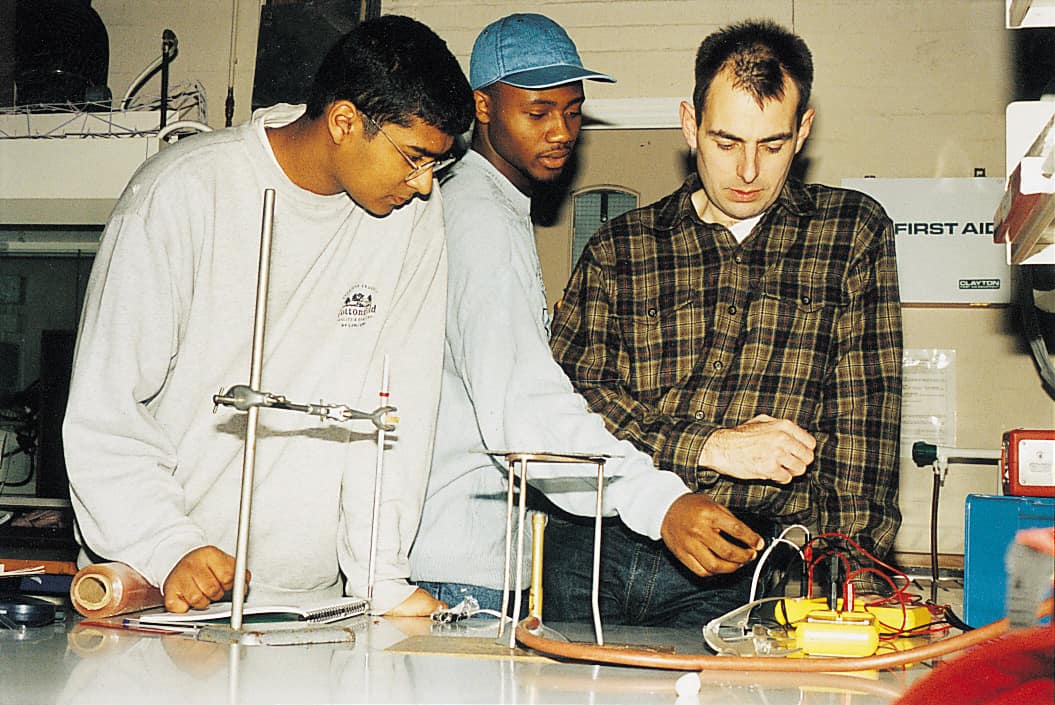
You can do it: on-the-job training is now an option for those wishing to join the teaching profession.
“Before I began my GCSE, physics was my least favourite science. I didn’t have a clue why anyone would study it. However, [after] the first lesson I had with her [a named teacher], it seemed like a whole new subject.”
This quote, from a recent nomination for one of the Institute of Physics Teachers’ Awards, reminds us of the crucial importance of good schoolteachers in ensuring that physics not only survives but thrives. It also hints at the enjoyment that can be derived from teaching. Although my teaching days are long-since gone, I can still remember that special feeling when the light dawned for a pupil who had until then struggled. I also recall the satisfaction of being able to help a student whom one recognized as having greater aptitude and ability than oneself and who would go far, with the right encouragement and challenges.
Postgraduate training
While there are undergraduate routes into teaching – mainly through the four-year BEd course – few aspiring secondary science teachers currently follow this path. Most start their training at graduate level, where there are several ways of achieving Qualified Teacher Status (QTS), which is the prerequisite for working in any “maintained” (i.e. state-sector) or special school in the UK. Until recently, most graduates took a one-year Post-Graduate Certificate of Education (PGCE) course at a university or higher-education college.
For aspiring physics teachers, the PGCE can either be a specialist physics course, complemented by training in how to teach across all of the sciences, or a science course offering some opportunity for specialist physics work. PGCE students aiming to teach at secondary level spend at least 24 weeks working in one or more schools. The rest of the time is spent learning (or relearning) those parts of physics, biology or chemistry that they will have to teach, and getting to grips with the curriculum and other teaching issues, such as pupil assessment. The training is thus a collaboration between tutors from schools and higher education.
PGCE courses vary in length and starting times, with “initial teacher-training providers” in England now offering flexible programmes to meet individuals’ needs and to take into account previous experience. For example, applicants with previous teaching experience – perhaps gained abroad, in private schools or at college or university – can skip those parts of the course where they already have the appropriate skills, and proceed to the final assessment phase.
Trainee teachers can also switch from full-time to part-time study, and vice versa. As training is organized in modules, it means that programmes can even start and finish at different times of year. It is also possible to train through courses running at weekends, or via distance learning, so that trainees can continue in paid employment or keep up family commitments.
Training while you work
In an attempt to tackle the shortage of qualified science teachers, the government has also introduced Graduate Teacher Programmes (GTP). These allow unqualified teachers to be paid a salary of more than £12,000 while training “on the job” in a school, through an individual programme leading to QTS. Open to graduates only, GTP training usually lasts a year. Those wishing to follow this route first need to find a job in a school, although many teaching posts are advertised as being open to such candidates. Applicants must also be supported by a “recommending body” – the school, local education authority, university or other body that will organize the training. The teaching load for such applicants is usually reduced to allow time for training.
Other options include School Centred Initial Teacher Training – full-time school-based training in which the necessary skills and knowledge are acquired in the classroom – and Fast Track, which is aimed at those who show the most potential to do well as teachers and school leaders. In the latter, trainees follow an augmented initial training programme and, after qualification, follow a challenging structured programme of teaching with enhanced pay. Other schemes are also being piloted, including one at Warwick University in which science students take additional education courses during the evening as part of their undergraduate degrees, followed by half-day school-based sessions, leading to credits towards a PGCE.
Financial rewards
Those training to teach now qualify for financial support. Postgraduate trainees in England and Wales may be eligible for a £6000 training bursary. Those in shortage areas (such as physics) can claim a £4000 “golden hello” once they have successfully completed training and seen out their induction period, provided that they are working in a maintained school.
Teachers’ salaries in England and Wales were increased last April to make the profession more financially rewarding. The minimum starting salary for a newly qualified teacher is now just over £16,000, although many start one point up on a nine-point scale and earn £17,000-£18,000. Teachers then move up the scale at the rate of one point per year – exceptional teachers may advance faster – to a salary just less than £25,000. Once teachers reach the top of the scale they can apply to be assessed for an upper pay scale. Promotion to this scale is performance based but eventually allows teachers to earn more than £31,000.
Teachers who have been awarded “advanced-skills” status, as well as those in senior roles or who take on management responsibilities, all qualify for additional salary increments and allowances. Schools may also pay extra to recruit or retain staff. Salary levels for older physicists who become teachers after working in another sector are at the school’s discretion. If a school is really keen, it may offer them a starting salary several points up the scale, although few can afford to do that.
It is the challenges and rewards of teaching that explain why so many teachers remain in the classroom as they get older, even though many take on additional management and leadership responsibilities. Such teachers are vital to the life-blood of physics education. There are, however, other options for teachers: some move into advisory or inspection work; some become teacher trainers or move to positions with examining bodies; others work in industry as education liaison officers, or in consultancy, computing or publishing; and some even become education managers at professional institutions.
In recent years, physicists have successfully slowed and stopped pulses of light in gases of ultracold atoms. A ‘write’ laser drives transitions between two energy levels in the atoms, and then a signal pulse – which is resonant with one of these levels and a third level – is sent into the gas. This pulse is stopped by quantum interference effects, and can be trapped by switching the write laser off. When it is switched back on, the signal pulse is released and continues in the direction it was travelling before it was trapped – with its original frequency and phase properties.
Scully’s group has now used a similar technique to transport these pulses when they are trapped in a gas. In common with previous experiments, they shone the write laser into a gas of rubidium atoms and then sent the signal pulse in. Once the atoms had trapped the light pulse, they switched the write laser off. Fractions of a millisecond later, the team switched on a ‘read’ laser, which was separated from the write laser by six millimetres. The signal pulse was retrieved because the atoms that had trapped the pulse had diffused away from the write laser beam. The amplitude of the signal had dropped, however, because not all of the ‘trapping’ atoms had reached the read laser.
The team also demonstrated that pulses can be retrieved with a frequency that is different to that of the signal pulses. This process exploits the fact that the ‘read’ step of the process does not depend on the frequency of the ‘write’ laser. This means that when the ‘read’ laser retrieves pulses, it can endow them with a frequency corresponding to either of the two energy transitions in the atoms. Scully and colleagues believe this phenomenon could be used to make optical switches or an image storage system.
The team also showed that a retrieved pulse could be made to leave the gas in the opposite direction to which it entered. This means the ‘tail’ of the pulse leaves the gas before its ‘head’, and demonstrates a simple method for generating ‘time-reversed’ quantum pulses.