Neutrinos are difficult to study because they have very little mass and interact only weakly with matter. They also ‘oscillate’ between three possible ‘flavours’ – electron, muon and tau – each of which has a different mass. Previous observations of these oscillations have revealed the differences between these masses, but have not established the masses themselves.
But DeJongh believes that a ‘long-baseline’ experiment in which beams of neutrinos and anti-neutrinos are sent through the Earth could be combined with existing results to determine the masses of the three flavours. By travelling the 9300 kilometres from Fermilab to the SuperKamiokande detector in Japan, the beams would pass through enough matter to increase by a factor of 20 the number of oscillations in either the neutrino or the anti-neutrinos.
The amplified signal would also allow physicists to compare the different oscillation behaviour of neutrinos and anti-neutrinos. Earlier ‘short-baseline’ experiments have been unable to produce this effect because the beams passed through too little matter.
Such an experiment would also give fresh insights into ‘charge-parity violation’, a phenomenon proposed to explain why particles are not exact opposites of their anti-particles. Charge-parity violation could help to explain why there is more matter than anti-matter in the universe when the big bang is thought to have produced equal amounts of each.
According to DeJongh, construction of a new detector in Japan would need to begin around 2006 to coincide with the completion of the new beamline at Fermilab. He has already presented his idea to physicists in Japan, and is optimistic about the project although an agreement has yet to be reached. He concedes that particle physicists are likely to be sceptical until he provides more details.
“Our community as a whole is going through a process of considering the future,” DeJongh told PhysicsWeb, “and I think this is an exciting possible element of our roadmap”.
The SuperKamiokande site has already detected neutrinos from the KEK particle physics lab some 250 kilometres away, although the detector recently suffered an accident and is currently out of commission. There are also plans to send neutrino beams from the CERN particle physics lab in Geneva to the Gran Sasso underground lab 730 kilometres away in Italy, and from Fermilab near Chicago to the Soudan experiment, 710 kilometres away in Minnesota.
In sonoluminescence, pulses of light are emitted by bubbles that are forced to expand and collapse by sound waves. Physicists have long speculated that the considerable compression forces inside the bubbles when they collapse could be large enough to spark nuclear reactions. If this was achieved, it could lead to an endless source of ‘clean’ energy.
Taleyarkhan and co-workers at Oak Ridge, the Rensselaer Polytechnic Institute and the Russian Academy of Sciences claim to have seen the tell-tale decay signals of tritium – a radioactive isotope of hydrogen – in bubbles formed in acetone in which the ordinary hydrogen atoms have been replaced by deuterium atoms (C3D6O). In the experiments the bubbles are created by energetic neutrons, and the acetone vapour in the bubbles is forced to expand and then collapse by an acoustic signal.
The researchers also report evidence of another fusion reaction between two deuterium atoms. They say that the bubbles emitted neutrons with energies of 2.45 MeV, the energy that neutrons are emitted with when deuterium atoms fuse to create helium-3. Taleyarkhan and colleagues went on to calculate that temperatures of a million or even ten million degrees – the temperature at the Sun’s core – must exist inside the bubbles for these reactions to proceed.
But Dan Shapira and Michael Saltmarsh of Oak Ridge report that they failed to detect convincing evidence for either the tritium or the neutrons that the fusion reaction would have generated. The pair observed far fewer neutrons – at least three orders of magnitude fewer – than the fusion of deuterium into helium-3 should generate. They also point out that their neutron detector was much more efficient than the device used by Taleyarkhan’s group.
Taleyarkhan and colleagues dismiss these results, and state that Shapira and Saltmarsh misinterpreted their own results because they failed to calibrate their detector properly. Neither the report by Shapira and Saltmarsh nor the rebuttal by Taleyarkhan’s group are being endorsed by Science.
Mathias Fink of the Laboratory of Waves and Acoustics at the Université Denis Diderot in Paris thinks the work by Taleyarkhan’s group is very exciting. “Many of us working in the field of cavitation have speculated that ‘sonofusion’ could occur, but few of us expected to see it so soon,” he told PhysicsWeb. Fink believes the work is a first step towards a fusion source but emphasizes that a lot of work remains to be done.
But Lawrence Crum, director of the Center for Industrial and Medical Ultrasound at the University of Washington, is sceptical about the claims. He dismisses the idea that the technique could become a viable energy source, but concedes that the discovery would have far-reaching consequences for science if it proves to be true.
Detlef Lohse, a researcher in sonoluminescence at the University of Twente in the Netherlands is also unconvinced. “I am very surprised this paper was published,” he told PhysicsWeb. “The temperature they are claiming is grossly overestimated – the gas inside the bubble would heat up, but most of the energy would be eaten up by vibration, rotation and chemical reactions”.
Other commentators – mindful of the much-hyped but ultimately disproved ‘cold fusion’ claims of the late 1980s – agree that Science has gone out on a limb by publishing the paper by Taleyarkhan’s group.
The latest telescope that is capable of studying the Southern sky in detail was unveiled in January amid a fanfare of Andean pan-pipe music and choreographed movements of its 8.1 metre mirror. The Gemini South telescope at Cerro Pachón in Chile is set to provide astronomers with the sharpest ever infrared images of both distant galaxies and the star-forming regions in our Milky Way galaxy.
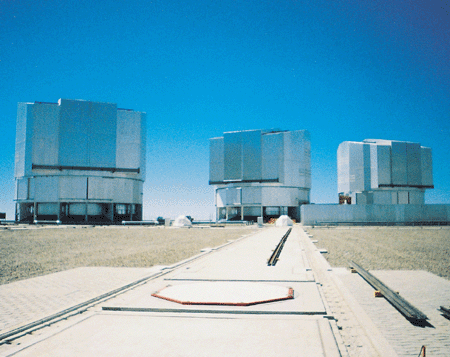
Together with its twin, Gemini North at Mauna Kea in Hawaii, the two telescopes can observe the entire sky and thus respond to rare and unpredictable events, such as outbursts from black-hole binary systems, that occur anywhere in the heavens. And 700 kilometres away, the four 8.2 metre mirrors of the Very Large Telescope have started looking at individual stars in unprecedented detail.
Astronomers from the US, the UK, Canada, Chile, Australia, Argentina and Brazil are already queuing up to use Gemini South and observing time is five times oversubscribed. “The proposals cover the gamut of observational astronomy, including solar-system objects, nearby star-forming regions, cool stars, brown dwarfs and massive extrasolar planets,” says Phil Puxley, assistant director of the Gemini Observatory. Nearby galaxies, clusters of galaxies, gamma-ray bursts and quasars are also on the list of must-have observations.
High sensitivity and high resolution
Both the Gemini telescopes have been optimized for infrared astronomy to a greater extent than the two 10 metre Keck telescopes in Hawaii. Patrick Roche, a project scientist at Oxford University in the UK, explains that the Earth’s atmosphere has two natural windows through which the faint infrared glow from stars and galaxies can pass. Heat from the observatory structure must not swamp these windows to ensure that the telescope has high sensitivity at infrared wavelengths. For example, the dome of the telescope is ventilated to prevent heat from being trapped inside the telescope and the secondary mirror is supported on thin steel-alloy struts to minimize thermal emission.
The sensitivity of the telescope will be improved even further early next year when the aluminium layer that currently coats the primary mirror will be stripped off and replaced with a thin layer of silver, which is more reflective in the infrared.
Previous ground-based telescopes have achieved resolutions of 0.5 arcseconds, but only occasionally during dedicated observations. Meanwhile, the near-infrared camera on the Hubble Space Telescope has captured images with a resolution of 0.2-0.3 arcseconds over a small field of view. In contrast, Gemini North has already been able to image certain parts of the galactic centre in the near-infrared with an angular resolution of 0.1 arcseconds thanks to some clever optical trickery.
Each Gemini telescope has a primary mirror measuring 8.1 metres in diameter made of fused blocks of ultralow-expansion glass. Since the mirror is just 0.2 m thick, it deforms due to gravity as it is manoeuvred into position. A series of sensors and actuators detect this distortion and nudge the mirror back into its perfect shape. Meanwhile, the focus and angle of the secondary mirror can be adjusted up to 100 times per second to correct for wind-induced vibrations and some gross distortions in the atmosphere.
Finer corrections for atmospheric turbulence can be made by directing the light through an “adaptive optics” system of smaller mirrors after it has been reflected by the secondary mirror.
The current system at Gemini North measures the distortions of a bright star near the object that the astronomers want to study. Knowing that this star is a point, the adaptive-optics system can work out how the wavefront of the light is distorted by turbulence in the atmosphere and adjust the smaller mirror to correct for the effect.
Astronomers have more ambitious plans for Gemini South, which currently has an angular resolution of 0.5 arcseconds without adaptive optics. They aim to cancel out the turbulence over an area of sky some 20 times larger than that of its twin using a constellation of “artificial stars”. These stars will be created by shining lasers into the atmosphere to excite the sodium layer. Matt Mountain, director of the Gemini Observatory, expects the resolution at the Southern telescope to improve to 0.07 arcsecond by 2005.
Early results
Phil Lucas of the University of Hertfordshire and Roche of Oxford University in the UK are among the lucky ones who have already made observations with Gemini South during the commissioning phase. They recently obtained images of a star-forming region within the Orion nebula called the central Trapezium at three different wavelengths using a near-infrared spectrograph (see figure).
Since infrared radiation can penetrate through all but the densest clouds of dust, the UK team were able to see for the first time faint red objects weighing just a few times the mass of Jupiter. These objects may be extrasolar planets that have formed within a stellar nursery containing stars just one million years old. “Exactly how these objects formed is not understood,” says Roche. “We don’t know if they condensed from a molecular cloud that fragmented or if they formed from even smaller objects.” The team plans to follow up these measurements using the high-resolution spectrometer on Gemini North. Fortunately the Orion nebula is located in a region of sky that is covered by both telescopes.
With a primary mirror that measures 8.1 metres across, Gemini has ten times the light-collecting power of the Hubble Space Telescope. As a result, Gemini will be able to analyse the light from old and distant galaxies that has been redshifted on its journey to the Earth, as well as light from faint galaxies containing cool stars.
Moreover, mid-infrared observations that were made last year with Gemini North by Eric Perlman of the University of Maryland’s Joint Center for Astrophysics are prompting theorists to re-think their ideas about the cores of “active galaxies”. Previously astronomers had thought that a tiny torus-shaped region of hot dust emitted intense infrared radiation as it was sucked into a black hole at the centre of the active galaxy. But the high-resolution infrared images of galaxy M87, some 50 million light-years away, revealed no such region.
From the Southern hemisphere astronomers can see the Magellanic Clouds – our nearest neighbouring galaxies – and the bulge at the centre of the Milky Way, which is thought to harbour a supermassive black hole. Roger Davies of Durham University in the UK says that Gemini’s high sensitivity and excellent angular resolution will be crucial for black-hole research. “To determine the mass of a black hole at the centre of a galaxy involves measuring the kinematics of the orbiting stars or gas, which in turn relies on the linear resolution,” he explains. “Clearly, if we can improve the resolution from 1 arcsecond to 0.2 arcseconds, we can derive a mass limit on the black hole that is five times better.”
Far north at Cerro Paranal in the Atacama desert, it is easy to see why Chile ranks as one of the best location in the world for astronomy. Over 100 kilometres from the nearest town, the sky is perfectly clear and the air is so dry that even the toughest male astronomers wear moisturizing lotion. All four of the 8.2 metre telescopes that make up the Very Large Telescope (VLT) at Cerro Paranal began operations last year. Images of the Eagle and Horsehead nebulae, Saturn and the Jovian moon Io, and the first observation of a massive compact object or MACHO are among the latest highlights. But Massimo Tarenghi, head of the telescope division at the European Southern Observatory headquarters at Garching in Germany, can barely conceal his delight at the recent success of the VLT’s interferometer.
By combining the light from several telescopes in phase using an interferometer, astronomers at the VLT are aiming to improve the angular resolution to a few milliarcseconds – equivalent to the resolution of a telescope with a diameter of 200 metres. From the resulting interference fringes, astronomers can work out the size of a star and deduce its shape. Moreover, they hope to be able to resolve stellar structure and any orbiting planets. And on extragalactic scales, they even expect to study individual stars around black holes.
Late last year, Tarenghi and his team observed the star Alpha Eridani with two of the four 8.2 metre telescopes and directed the light into the underground interferometer where it was combined in phase. Analysis of the contrast between the fringes revealed the angular diameter of the star to be 1.9 ± 0.05 milliarcseconds. But Tarenghi is most thrilled about the observations of pulsating stars known as Cepheid variables. Because these stars brighten and dim with a period that is correlated to their luminosity, Cepheids provide reliable distance measurements. Indeed, in 1923 Edwin Hubble used these stars to show that the universe is expanding.
“Previous measurements of the diameter of Cepheids had huge errors, but our data are rather good,” smiles Tarenghi. Indeed, the accuracy of the diameters of Zeta Geminorum and Beta Doradus, a star that has never been measured before, are better than 2%. Next year Tarenghi’s team plans to combine the signals from three telescopes for the first time to produce images from the interferometer in addition to the fringes.
Astronomers often talk of a “golden age” of astronomy. The Gemini telescopes and the VLT will ensure that this golden age will continue for many years to come.
What were the most important equations of 20th-century science? Here are 11 essays, aimed at non-specialists, each centred on a different equation. The authors are distinguished in their various fields: six of them are scientists, with the others being science writers or historians of science.
Six of the equations, all of which appear chronologically, are from physics, more specifically “fundamental” physics. The first essay is by the book’s editor, Graham Farmelo of the Science Museum in London. Entitled “A revolution with no revolutionaries”, it tackles the Planck-Einstein equation E = hf, which connects frequency with energy. It also serves as an account of the early days of quantum theory, although there was perhaps a missed opportunity here to mention modern examples of the Planck distribution, such as the cosmic-microwave-background radiation.
The second essay – by science historian Peter Galison – discusses Einstein’s equation E = mc2. Unfortunately, it does not contain as much detail about the special theory of relativity as one might expect. There is more information about nuclear fission, which is, after all, only mildly dependent on relativity.
The third chapter, by Roger Penrose, is on the general theory of relativity. One of the more detailed essays in the book, it contains several equations that the author tells us we may skip at a first reading.
Do not be put off by the odd title of the next chapter: “Erotica, aesthetics and Schrödinger’s wave equation”. Here historian Arthur I Miller continues the story of the development of quantum theory.
Physicist Frank Wilczek’s essay “A piece of magic” is about the Dirac equation, with the last part of the chapter taking us on to quantum electrodynamics and quantum chromodynamics (QCD) – the theories of the electromagnetic and the strong forces.
Christine Sutton concludes the physics element of the book with “Hidden symmetry”, which tackles the Yang-Mills equation, electroweak unification and (again) QCD. There is, however, nothing on condensed-matter physics: presumably it is too difficult to think of great equations in that field.
The seventh essay, by Igor Aleksander, is on Claude Shannon’s equations that answer the questions of what is information and what inhibits its transmission.
In the last four contributions, the character of the equations changes. There is an essay by journalist Oliver Morton on the Drake equation, which gives the expected number of sources of communication from extraterrestrial intelligences as a product of conditional probabilities. This is certainly not profound in the sense that the first seven equations are. As Farmelo comments, Drake’s formula “brought some coherence into a field potentially rife with woolliness”. I wonder, however, if a different equation would have represented astronomy better, such as the Hubble law of the recession of the galaxies.
Next there are two biological essays. One, by John Maynard Smith, concerns the application of game theory to animal behaviour. The other, by Robert May, president of the Royal Society, is about the “quadratic map” as a model of biological populations, and about the discovery of chaotic behaviour in this equation. A feature of each of these contributions is that the authors are largely describing their own work.
The final essay, by journalist Aisling Irwin, is about the discovery – and the chemistry – of the hole in the ozone layer. There is an “equation” here, but it is only used in the chemical sense to describe a reaction like O3 –> O2 + O.
I found all the essays good to read. This is a volume to dip into and to pick and choose from, rather than necessarily to read through consecutively. The various authors have approached their tasks in different ways: some readers will prefer one style, others another.
The book prompts intriguing questions. In particular, have any deserving equations been left out? Should, for example, Heisenberg’s commutation relation between position and momentum have been included? Perhaps Farmelo will one day give us Great Equations of 19th-century Science, or perhaps Great Principles in Science?
Another question is whether great equations are really so important in science? Some affirmative answers can be found in the book. Frank Wilczek, for example, includes the following quote by Heinrich Hertz on Maxwell’s equations: “One cannot escape the feeling that these mathematical formulae have an independent existence and an intelligence of their own, that they are wiser than we are, wiser even than their discoverers, that we get more out of them than was originally put into them.”
Steven Weinberg, meanwhile, has the following to say in a wise afterword: “When an equation is as successful as Dirac’s, it is never simply a mistake. It may not be valid for the reason supposed by its author, it may break down in new contexts, and it may not even mean what its author thought it meant. We must continually be open to reinterpretations of these equations. But the great equations of modern physics are a permanent part of scientific knowledge, which may outlast even the beautiful cathedrals of earlier ages.”
I am tempted to end my review with this inspiring passage, but it is only fair to point out Weinberg’s reference to physics, so that his words may not apply to all of the equations in this book.
Buy the book It Must be Beautiful: Great Equations of Modern Science: Amazon UK/Amazon US
Vanessa Bennett, Callie Crook and Kelly Bullock do not mind being the only girls studying A-level physics at Gosford Hill School in Oxford, a mixed comprehensive with 1200 pupils. In fact, the 17 and 18 year olds are rather proud of it. “It makes me feel more of an individual.” says Callie. “Most of the other girls in our year are studying English, drama and performing arts.” Vanessa agrees: “It makes me feel intelligent.”
Although all three have decided against studying physics at university, they recognize that doing physics at school can open the door to a wide range of careers. Vanessa has always wanted to be a doctor, Callie hopes to be a forensic pathologist and Kelly plans to be a sound engineer. Moreover, they all have high praise for their physics teacher, Helen Reynolds, who has “a way of describing things that other teachers would not think of”.
So why are there so few girls in their class? “Physics is seen as a thing that boys do,” says Callie. Indeed, boys outnumber girls by four to one at A-level in England and Wales – and by ten to one at Gosford Hill. Vanessa has other ideas: “People perceive physics as having a lot of maths in it, which puts both boys and girls off. In fact, our course does not involve that much maths. Teachers have got to get that across to pupils.”
Competitive edge
Physics teaching at Gosford Hill – like many other schools across the UK – has been transformed in the past two years by a new approach to post-16 education that is designed to attract students, like Kelly, who are not studying maths (see New hope for physics education, Physics World October 1999 pp29-32). Kelly admits that some of the maths taught during the physics lessons is complicated, but finds some of the physical concepts more challenging. That said, she gets a kick out of working things out and from doing experiments.
Physics is Vanessa’s favourite science subject. “I really enjoy the lessons and all the practical work we do,” she enthuses. “We have not done quantum behaviour yet, but I really like that kind of thing because it links to chemistry, maths and computing. And I love the whole idea of cosmology because Stephen Hawking does it.” Indeed, when asked if they could name any living physicists, all the girls at Gosford Hill knew Stephen Hawking from his books, television appearances and his waxwork figure at the London Planetarium.
Open days and conferences run by universities for 16-19 year olds have also given the girls a valuable insight into physics and physicists. After visiting the materials-science department at Oxford University, Callie decided she would consider “something in materials” if she fails to get the grades needed to study medicine. During the same visit, Kelly discovered that “physicists are just regular people doing really interesting things and they don’t wear lab coats”.
So do the girls think that they are better at physics than boys, as the exam results in England, Wales and Northern Ireland showed last year? “We’re a lot more competitive with the boys in all our classes,” says Callie. “There are so many of them that we feel we have something to prove.”
Formative years
Below the age of 16, all schoolchildren in England and Wales take a general course in science, rather than specialist lessons in physics, chemistry and biology. Clearly this is the age when many girls are turned off physics. Nicola Sampson, 15, explains that physics is hard compared with biology and chemistry. She finds radioactivity and atomic physics particularly difficult to grasp because “there is nothing to look at”.
Science also has a bad image according to the girls. One reason may be the lack of female role models. “A lot of scientists in the public eye are men,” says Amy Baskerville. “Scientific discoveries made by women are not reported in the media.” The girls believe that if they knew some women physicists, then they might be more inclined to study physics. They also find that the boys in their class are all too eager to point out that all the famous scientists are men – even though the girls usually outsmart the boys in lessons.
Moreover, the impression that some of the girls have of male physicists is bad. “Physicists are people who sit around with too much time on their hands,” says Stephanie Wiggins. “That’s why it breeds so many weird people.” But Jennifer Carlaw believes that the media is at fault for stereotyping physicists as men who wear white coats in the lab. “Not to mention having glasses and bad hair,” adds Stephanie.
Teacher Helen Reynolds says that Gosford Hill is considering separate science lessons for girls and boys. Stephanie thinks it might be a good idea. “When we do experiments, the boys just mess about,” she complains, “they take all the good equipment and muck up everything.”
At the end of the day, having a good teacher makes the world of difference. “Physics does not have to be boring,” says Emily Field, “it depends how it is taught. If teachers make it more exciting, then it is better. If they just read the lessons from a textbook then you are not going to like it.”
Atomic physicist Deborah Jin leads a successful group at JILA. (Picture credit: L Harwood/University of Colorado at Boulder)
When the astronomer Jocelyn Bell Burnell was in her final year as a physics student at Glasgow University in the early 1960s, she was greeted by a barrage of wolf whistles and foot stamping every time she walked into a lecture theatre. The reason for all this unwanted attention was that Bell Burnell was the only woman in an honours class of 50 undergraduates.
Thankfully, this is a tale that few young female physicists today would recognize. But even though the number of women studying physics has increased over the past 40 years, they still remain seriously under-represented. In Japan, for example, just 13% of physics undergraduates are women, while fewer than one in five physics degrees in the US are awarded to women.
The imbalance between the sexes becomes even more pronounced higher up the career ladder. Women occupy just 3% of the permanent physics positions in the Netherlands, for instance, and there is just one female professor of physics in Denmark. “The low percentage of women is a real problem for physics because it discourages some possible talent from even considering a career in the field,” says Helen Quinn, vice-president of the American Physical Society and a theoretical physicist at the Stanford Linear Accelerator Center in California.
The low numbers of women in physics will be one of the underlying themes at the conference on women in physics being organized by the International Union of Pure and Applied Physics (IUPAP) in Paris this month. The conference is expected to attract 300 delegates and will discuss six main topics, including “attracting girls into physics”, “balancing family and career”, and “getting women into the physics power structure”.
At the end of the Paris meeting, delegates will publish a list of resolutions that will be sent to physical societies, funding agencies and governments throughout the world. The 65 national delegations present in Paris will also follow up the recommendations when they return home.
Marcia Barbosa, chair of the IUPAP women in physics working group, believes in change coming from the bottom up – from the scientists in the universities to the physical societies and funding agencies. “When governments people fighting for change, they will have to act,” says Barbosa, who is a statistical physicist at the Universidade Federal do Rio Grande do Sul in Brazil.
Early advantages turn sour
Being one of only few women in physics can have its advantages. Like many women, Helen Quinn believes that it made her more noticeable and memorable early in her career. Ursula Keller, a laser physicist at the ETH in Zurich, agrees: “When you are young and showing result after result, people are so happy that they have found a woman who is good and they are very supportive. Men act like a big brother or a father figure.”
But Keller encountered harder times as she climbed the career ladder. “If you have the competitive edge, some men have a difficult time accepting that you are better than them,” she warns. “The older I got, the more I found being a woman a handicap.”
Margaret Murnane, a laser physicist at the JILA laboratory in Boulder, Colorado, has had similar experiences. “I am better remembered because I am a woman, which is good, but 10% or 20% of male physicists are uncomfortable or threatened by the idea of female physicists, in the US at least. They have made life very, very difficult for me in the past – until I learned to go around them.”
Such bias against women can be difficult to identify and quantify. However, three years ago an influential study of the status of women at the Massachusetts Institute of Technology (MIT) came to the same conclusion: “The committee discovered that junior women faculty [in the school of science] feel well supported within their departments and most do not believe that gender bias will impact their careers. Junior women faculty believe, however, that family-work conflicts may impact their careers differently from those of their male colleagues. In contrast to junior women, many tenured women faculty feel marginalized and excluded from a significant role in their departments. Marginalization increases as women progress through their careers at MIT. Examination of data revealed that marginalization was often accompanied by differences in salary, space, awards, resources and response to outside offers between men and women faculty with women receiving less despite professional accomplishments equal to those of their male colleagues. An important finding was that this problem repeats itself in successive generations of women faculty.”
Keller believes that the situation will only change when more women hold senior positions. Until that happens, however, she copes by being successful and true to herself. “I am not going to change to fit men’s expectation of women,” she insists. “If I become too depressed or angry – and sometimes I do get angry – then I’ll only be less effective in my job.”
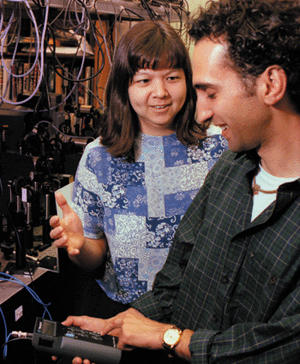
Deborah Jin, an atomic physicist at JILA, finds that it is easy to recognize blatant sexist comments and dismiss them. More often, however, the discrimination she encounters takes a more subtle form. “Many people have an unintentional inclination to take a female physicist less seriously,” she says. “Perhaps this arises simply from the observation that more physicists are men.”
Examples of subtle forms of discrimination include male colleagues addressing female physicists as Mrs, rather than Dr or Professor, or mistaking them for the group secretary. However, when asked if they think physics is too macho, opinions among women differ (see below).
Is physics too macho?
“Physics exists in the abstract and is genderless, but the people who do physics might be too macho. Actually, being too macho, though it might often work to your advantage, can also be a liability when it prevents you from acknowledging what you don’t know.” Lisa Randall, Harvard University, US
“I could never think physics is too macho – maybe physicists are too macho.” Gisela Anton, Erlangen University, Germany
“Yes, sometimes there is a very aggressive and unsupportive attitude in UK academia. This is particularly prevalent in maths and physics.” Helen Mason, Cambridge University, UK
“YES. YES. YES.” Margaret Murnane, JILA, US
Affirmative action in Paris
Last year the IUPAP women in physics group began an international benchmarking study to understand the demographics of physics and the experiences of female physicists in 65 different countries. Roman Czjuko and colleagues at the American Institute of Physics are currently analysing the results, which will be presented at the Paris conference. “This survey is unique in that it will be the only international survey about women in physics in my lifetime,” says Czjuko. “Such studies are challenging because it is notoriously difficult to compare countries with different education systems, cultural backgrounds and economies.”
The survey will look at the latest statistics on education and gender collected by national agencies in 15 countries, as well as anecdotal evidence gathered by working groups in another 20 countries. Another part of the study is a Web-based questionnaire that asks women about their personal experiences throughout their career and also about family issues. So far over 900 women from 50 countries have responded. “We are looking for critical moments that have either helped or hindered a woman’s career,” explains Czjuko. “And from them, we hope to find interesting themes that could form the basis of action plans.”
Barbosa is worried by the fact that many countries deny that the problems faced by female physicists exist. In Latin American countries, for example, women hold about 20% of the faculty positions. “That’s a huge number in comparison with other countries,” says Barbosa, “so many women do not think there is a problem. But as you look along the career path, you see very few women at higher levels, or holding grants or positions of power. Something has to change. Women have to realize that they have to fight for change.”
Fixing the leaky pipeline
The problem of the low numbers of girls opting to study physics at school and university is compounded by the fact that a higher proportion of women than men tend to leave physics at each stage on the career ladder. Several countries have recently introduced women-only university positions and grants to counter the effect of this “leaky pipeline” (see The ladies vanish, p36 print version of Physics World only). The French government has also established a “mission for parity” to ensure that female researchers are treated fairly (see Cherchez la femme, p33 print version of Physics World only).
However, Catherine Cesarsky, director general of the European Southern Observatory, has mixed feelings about such schemes. Cesarsky believes that many women lack self-confidence – something that stems from their education and experiences when they were younger. “That’s their biggest problem because they are certainly as smart as the men,” she says. “I worry that giving women special privileges will undermine their self-confidence and may also put them at a disadvantage because some people will say that ‘she only got the job or prize because she is a woman’.”
Alice White, director of photonics at Bell Labs, the research arm of Lucent Technologies, agrees that it benefits no-one to promote a woman who is not capable, but adds that it is more difficult for women to advance in their careers. “The barrier for women to get over is higher than it is for men,” she argues, “and until it is at the same height then we have to be proactive. We have to make sure that people have a chance to prove themselves.”
As a postgraduate student, White had a Bell Labs fellowship that was designed to encourage women and minorities into science. These days, she remains active in these programmes and also in the recruitment of women. And with her husband, who is also a physicist, White gives science demonstrations to children at her daughters’ school because she finds that most of the female teachers in primary schools are uncomfortable with teaching maths and science. It is also important, says White, to show young children that women actually do science (see Learning lessons from the classroom and How to harness girl power, p34 print version of Physics World only).
Lisa Randall of Harvard University also benefited from a Bell Labs scheme as a graduate student. “This freed me from other responsibilities I would have had as a graduate student so I could focus on research,” she recalls. “Although such programmes can be controversial, I think this was a great one.” Since then Randall has gone on to a highly successful career in theoretical particle physics, and two of her articles are currently the “hottest” papers in physics according to citation analysis.
Anne L’Huillier, a laser physicist at Lund University in Sweden, has also benefited from a Swedish scheme to increase the number of female science professors. Nonetheless, just two of the 40 physics professors at Lund are women. L’Huillier believes that more female professors are needed as role models to encourage a greater number of young women to pursue physics as a career.
Changing attitudes
Parents have been a key influence in the career choices of many successful female physicists. Deborah Jin’s father is a physics professor and her mother has a masters degree in engineering physics and worked as an optical engineer. “I admired the fact that my dad, like most physicists, really enjoyed what he did,” she says, “and I was always proud of the fact that my mum worked as an engineer in a company that employed most of the other kids’ dads.”
While her family ties with physics explain why she started studying the subject, Jin has stayed in physics because she had positive experiences working in labs as a student during the summer holidays.
Stand out from the crowd Laser physicist Margaret Murnane is remembered because she is a woman.
Others have not found it so easy. Margaret Murnane admits that she has been on the verge of giving up physics many times in the past, partly because a small number of men have made life difficult for her. “Physics is dominated by a male idea of how to do things and how to interact,” she says. “It is unbalanced. Men and women are equally good at the scientific process, but their style is often different. There is nothing wrong with that.” Murnane should know – she and her husband are joint leaders of one of world’s leading laser research groups.
Bell Burnell, who is now dean of science at Bath University in the UK, believes that while some women can readily cope with the male ethos, others change their behaviour in order to cope – but often at great personal cost.
Indeed, Catherine Cesarsky believes that life would be better for men and women if there was better balance between the sexes. “Because people in our profession work such long hours, it is much better to be with people of both sexes,” she says. “Everything is immediately more comfortable if both sexes are present.”
The situation seems to be somewhat better for women working in industry, and more women are starting to reach the top positions in Fortune 500 companies like Xerox, Hewlett Packard and Lucent Technologies. Alice White says that getting the job done is what matters in industry and that results, not gender, speak volumes. She also believes that the hierarchical management structure in companies means that women in industry are seeing change faster than their academic counterparts. “A change in attitude at the top soon filters down,” she explains, “but in universities, professors often form their own little empires and there are deep pockets of resistance to change.”
White admits that one of her role models is Cherry Murray, senior vice president at Bell Labs (see The industrial physicist who has it all, Physics World May 2001 p9). She admires Murray for her work as a scientist, for her management style, and for her ability to juggle both family and career successfully. “Her abilities and the standards she sets herself soon dispelled any notion that she got her job because she is a woman,” says White.
While role models have not played a major part in the career choices of most of the women Physics World spoke to – parents have been a much bigger influence – this generation of established female physicists is providing role models for a new generation of female physicists. Kate Adamson, a PhD student in particle theory at Durham University in the UK, says that she has a tremendous amount of respect for the women who have become professors of physics: “You can see that they have fought and fought, and they are still fighting.”
Balancing family and career
So why do so many women drop out of physics after their PhD or a stint as a post-doc? Anne L’Huillier has experienced life as a physicist in both France and Sweden. “The system is much harder in Sweden because you tend to get a permanent job in your late 30s, rather than your early 30s,” she explains. “Perhaps young women – even those who are not thinking about children – see how hard people have to work and decide against it.”
Many young women with husbands who are physicists leave physics altogether due to the difficulty of finding two permanent jobs in the same place. Often these women regard their partners’ career more important than their own and are willing to forsake their own research (see Love and the two-body problem, Physics World October 2001 pp37-39).
But clearly the biggest difference between men and women is children, and many female physicists feel that their career has suffered as a result of taking a break. Helen Quinn believes that the limitations in her career advancement have come more from the choices she has made for family reasons, rather than from prejudice against her as a female physicist.
Helen Mason, an astrophysicist at Cambridge University, has opted to worked part-time most of her career in order to bring up her two children. This has meant that she still has to rely on short-term contracts. “Part-time work is not accepted in the UK and my career has suffered seriously,” she complains. “I now earn much less than my male colleagues do. Most of my peers are professors. I believe that I am just as able as them. I could, and I do, get angry about this.”
But Ursula Keller – who has two children aged five and three – believes that women should wait until they are established in their careers before having children. “You can’t work part-time and then say you want to be a professor,” she explains, “because people won’t think you are serious. There are some phases in your career when having kids is a dumb idea.” Keller says she has seen younger women with families who are not even given a chance. “It is very subtle – they are not given the most prestigious projects and they get sidelined.”
Keller also wants to see an environment where women can readily combine children and a career. “Having a child changed my life more than anything else,” she says, “but a lot of the benefits offered to women are superficial.” She stresses that it is crucial for women in academia to concentrate on their research. Keller would like to see employers take an imaginative and flexible approach to women who have just had children, offering them partial relief from teaching or administrative duties for long periods of time, rather than full maternity leave for several months.
But L’Huillier believes that such a scheme – although great for women – would simply be unworkable: “You have to be aware and accept that your career will not move forward as fast if you have children – it is up to individual women to decide how long this period lasts.” She adds that physics is a fun job where women are free to adjust their time to suit their families.
White, however, believes that it is a “myth” that in order to be a really good physicist, women have to do physics to the exclusion of everything else, including their family. “I think that this myth will die as more and more men share the parenting responsibility with their working wives,” she adds.
Yet many successful women have managed to achieve a balance between family and working life. “It is totally possible,” says Keller, “but it relies on the choices you make.” She sees many women in Germany and Switzerland “beating themselves up” because they spend so little time with their families, but she believes that women should not feel so guilty.
It is a view that Catherine Cesarsky – who has two children – shares: “It is another pitfall that, by some miracle, I avoided.” Keller adds: “In physics you are much more in control of your time and have much more flexibility than women in many other jobs.” However, she does have one unusual piece of advice: “Don’t have kids before you have a professorship.”
Tips for women
So what advice do these successful women have for aspiring physicists? Deborah Jin believes that is important to realize that physics is challenging and that it is easy to get discouraged. Women, in particular, should strive to remain confident about themselves and in their abilities.
Alice White agrees. “Stick with it,” she urges, “the intellectual stimulation you get in the physics community will help you learn and grow your whole life.” It is also important, believes Margaret Murnane, for women to understand that some of the negative aspects they encounter are not personal.
“Stand up and speak out” is the advice from Hide Fukuyama, director of the Institute for Solid State Physics at the University of Tokyo. Fukuyama believes that women need to take the lead, “even in tiny things like organizing seminars and parties”. She believes that it would be good to systematically encourage such behaviour in women, though it would be “somewhat against the tradition in Japan”.
To be successful, claims Helen Quinn, women have to recognize that they must be both capable and assertive without becoming aggressive or defensive. “You need to know how to stand your ground in a physics argument,” she says, “and to accept questions as interest, rather than as a challenge to your work.”
The role of men
While women are leading the battle for equality, men have an important role to play as well. Cesarsky finds that, in general, men become really interested in these issues when they themselves have intelligent daughters and suddenly realize the problems that their children will encounter.
Alice White at Bell Labs also believes that it is crucial to get support from men. She recalls the time she was at an international physics conference when the keynote speaker – a well-known physicist – began telling offensive sexist jokes to the largely male audience. Afterwards, one of White’s colleagues – another senior male physicist – took the speaker to one side and scolded him for his insensitivity. “That really got his attention,” says White. “The moral of the story – women can’t do it alone.”
When five women were made fellows of the Royal Society in 1999 – an unusually large number for a single year – only one, the physiologist Francis Ashcroft, made headlines. The media were interested in Ashcroft because she had said that it was impossible for women to combine motherhood with the highest levels of scientific achievement. The press, however, ignored the fact that three of the other new fellows had children, including Athene Donald – the first female professor of physics at the Cavendish Laboratory in Cambridge – and Janet Thornton, new director of the European Bioinformatics Institute near Cambridge.
The following year, extensive coverage was also given to comments made by Susan Greenfield, professor of neuroscience at Oxford University and director of the Royal Institution. In an interview with the Guardian on 31 May 2000, she argued that she would not be where she is today if she had chosen to have children. “It’s my personal belief”, she said, “that the bottleneck comes when women have babies.” I believe, however, that this proposition that motherhood and serious science are incompatible in the modern world is both false and dangerous.
Of course, there have been some distinguished women who have remained childless – either through choice or circumstance. Their scientific contributions have been immensely valuable and they have often been tireless in supporting other female scientists. The late Daphne Jackson – who for many years was the only female professor of physics in the UK – is a good example. She became head of physics at Surrey University, led a distinguished career in nuclear, medical and radiation physics, and started what is now known as the Daphne Jackson Trust – the “returners scheme” to help women back into academic employment after a career break.
However, most female scientists have chosen to have a family. They include the double Nobel-prize-winning physicist Marie Curie and the crystallographer Dorothy Hodgkin. As for today, nine of the 15 female professors of physics in the UK do have children, including many of the younger ones. Combining science with motherhood is not only possible – but is actually rather common.
Combating the myths
I see two main reasons why the existence of scientific mothers is not more widely known. First, women are reticent to discuss details of their private lives or to boast that they are some sort of “super women”. Second, the media find it more newsworthy to report on childless scientists. For example, two of the three women quoted in a recent article in the Times Higher Education Supplement (12 October 2001) had children and successful careers – yet the headline was “Science and the family don’t mix”, while the banner across the front of the paper read “Can a mother be a top scientist?”.
There are two dangers in perpetuating the myth that science and motherhood cannot be combined. First, it may encourage people to believe that it is a waste of money setting up family-friendly policies that help mothers to stay in work or to return to the lab after having children.
Second, the suggestion that science is not a family-friendly occupation is likely to deter thoughtful young women (and men) from becoming scientists. Science already suffers from the stereotyped image of mad scientists working all day long alone in a laboratory – and we do not need to make things worse. Women who choose a subject like law, in contrast, can point to Cherie Booth as a high-profile example of a female QC who has a brilliant career and is raising four children.
Finding solutions
So why does the fraction of female scientists fall so dramatically with age or seniority as one moves from school, university and PhD level to post-doctoral, lecturer and professorial or senior industrial posts? Delegates from more than 65 different countries at this month’s Paris conference on women in physics – which has been organized by the International Union of Pure and Applied Physics – will attempt to answer this question by comparing the status of female physicists around the world. The women in physics group of the Institute of Physics, which has analysed the situation in the UK, have pinpointed two features of British society that make it especially difficult for female scientists here.
First, British scientists are used to moving around for the sake of their careers, which means that many women and men work without the support of close family around them. Indeed, many of the women who apply for a fellowship from the Daphne Jackson Trust have moved to another part of the country after having children. This change of location severs a woman’s links with her previous employers – the very people who might have been most likely to re-employ her.
The second problem is the late age at which appointments to permanent academic jobs in Britain are made. This contrasts starkly with the situation in France, where the post-doctoral system does not operate and – in theory at least – newly qualified PhDs move straight into permanent posts. A high proportion of academic female scientists in Britain have children only after having obtained a permanent job. This is often the easiest route – and the one that I followed. Unfortunately, some women find that by then it is simply too late.
A small number of women who currently hold lectureships or other academic posts had their children a few years after completing their PhDs, while holding down short-term research fellowships or post-doctoral posts. Those who followed this route were most likely to succeed if they obtained a post that indicates considerable distinction – such as the advanced fellowships and university research fellowships offered by the Royal Society.
However, it requires a truly world-class woman to compete with men on equal terms while raising a young family. In my view, all women who have obtained permanent academic posts after starting a family are absolutely outstanding individuals. I also believe that the women who are at greatest risk of being lost to the scientific community are those who have their children soon after a PhD or while in a post-doc position. It should be recognized that while research fellowships now offer maternity leave, the arrangements for post-docs are much more problematic, with few ever benefiting from them.
Another option is for a woman to start her family during a career break – and then seek a permanent position. But with appointments to academic posts made on the basis of a proven research record – driven by the need for universities to obtain good grades in the Research Assessment Exercise – this option has rarely succeeded in recent years. The small number of women who have followed this path have often been helped by the Daphne Jackson Trust. Interestingly, the pioneering British crystallographer Kathleen Lonsdale is one of the earliest examples of a “returner”. She took five years out from paid employment in the early 1930s to raise three children, continuing her research at home. She was then re-employed as a research assistant at the Royal Institution in London, which acted as a bridge to a permanent post.
Although the proportion of top-class female scientists who have families is not zero, it is certainly not equal to the average of the female population as a whole. Wastage occurs whenever a woman finds that she cannot support her children and put the long hours in at the lab that are required to succeed academically. These conflicting demands put too much of a strain on her lifestyle and she simply leaves science altogether. Another difficulty crops up when the only suitable job a woman can find is a long way from home – and her partner is too fixed in his job to move (see Love and the two-body problemPhysics World October 2001 pp37-39).
The will to succeed
The question of combining science and motherhood is rightly receiving much attention from schemes such as the Athena Project, which is backed by the UK government and funding councils. But it is equally important that young women are not deterred from entering science because of inaccurate reporting of the lifestyle imposed on a successful female scientist.
Kathleen Lonsdale analysed the situation clearly back in 1970. She maintained that marriage and motherhood were at least as socially important to a country as military service and argued that British government regulations at the time were framed to ensure that a man returning to work after military service was not penalized by his absence. “Is it Utopian”, she asked, “to suggest that any country that really wants married women to return to a scientific career when her children no longer need her physical presence should make special arrangements to encourage her to do so?”
The current situation is far better than it was in the 1970s. Nevertheless, as the recent Maximising Returns survey from the UK’s Department of Trade and Industry revealed, women who have science or engineering degrees and have school-age children are less likely to be working than women with other degrees. “While we have a number of excellent small initiatives, I am concerned by the lack of significant progress, the low number of female professors and the lack of recognition given to women in science,” said Patricia Hewitt, the trade and industry secretary, when the survey was published in January. “I believe that we must pursue a more aggressive, joined-up strategy to increase the participation of women in science and engineering.”
I hope the minister takes seriously Kathleen Lonsdale’s point that female scientists who have taken time out to raise children and then wish to return to science deserve special measures – rather than having to face age and discrimination barriers. If women with children are able to continue in scientific work, there is good evidence that, over their whole career, they make very important contributions.
The evident under-representation of women in physics has broad implications, particularly for industries and government agencies that need technically educated staff. Quite simply, the global scientific workforce is failing to use a large fraction of its talent pool. The shortage of female physicists in academia exacerbates the situation, in that female students lack role models in the field.
Of course, the nature and magnitude of the problem varies from country to country. But what is remarkably consistent is that the percentage of women in physics in all countries decreases markedly with each step up the academic ladder and with each level of promotion in industrial and national laboratories. The result is a dearth of women among physicists in leadership positions worldwide. Women are also poorly represented among physicists in decision-making roles in top research institutes, funding agencies, professional societies and government.
Yet women who do reach these top positions seem to command as much respect as their male peers – and sometimes even more.
So how has this situation arisen? In her book Why So Slow?: The Advancement of Women (1998 MIT Press), the psychologist Virginia Valian discusses the roles of what she calls “gender schemas” and “the accumulation of advantage and disadvantage”. As she writes: “A set of implicit, or nonconscious, hypotheses about sex differences plays a central role in shaping men and women’s professional lives. These hypotheses, which I call gender schemas, affect our expectations of men and women, our evaluations of their work, and their performance as professionals.”
Valian argues that small differences in the evaluation and treatment of men and women hold up the glass ceiling. “A useful concept in sociology is the accumulation of advantage and disadvantage. It suggests that, like interest on capital, advantages accrue, and that, like interest on debt, disadvantages also accumulate. Very small differences in treatment can, as they pile up, result in large disparities in salary, promotion and prestige.”
It may sound like a tautology, but the way to encourage women in physics is to have more women. More women means more female peers, more female role models, more mentors and more networks. In my own career of more than 40 years in academia and government, I have observed that the greater the number of women in a department or laboratory, the better they tend to fare – because, as Valian points out, “they are less likely to be perceived in terms of their gender and more in terms of their qualifications”.
Why we must change
There are three reasons why we must care and take action. First, it is good for the health of the field. If the profession is to serve its goal of advancing and disseminating the knowledge of physics, the profession must draw on the widest possible spectrum of talented individuals – the best and the brightest from all segments of society.
The second reason is equity. Scientists have the rare privilege of earning their living by doing what they most enjoy. They are rewarded with intellectual satisfaction and an opportunity to use their skills and energy to make a difference in the world. Women have the right, the need and the talent to compete for these rewards.
Third, if science and technology are to fulfil their potential, we must make it our goal to achieve a scientifically literate society that understands and values the contributions that science can make to our wellbeing. Women are half of that population. Only when women see that they are participating fully in scientific endeavour – as scientific leaders, policy makers and laboratory researchers – will they feel equal partners in a technological society.
While women in positions of authority in physics have a special duty to show their commitment, women early in their careers must take responsibility for seeking information, focusing their efforts, negotiating and building power. Yet for some time to come, it will be mainly men who are hiring, promoting, evaluating and rewarding physicists at all stages in their careers. It therefore falls on the male supervisors – as well as the women – to create a climate in which everyone is treated equitably, without bias or favouritism.
But the single most important factor in increasing the participation of women in physics may well be the commitment and support of top management. Indeed, this factor can in some cases be enough on its own. Credible, supportive and informed managers have an opportunity to instill their values throughout an organization. They can institute objective criteria for evaluation. They can endorse and promote competent women, and they can increase opportunities for management-track assignments.
Conference issues
These issues will all be addressed this month in Paris, at the international conference on women in physics, sponsored by the International Union of Pure and Applied Physics (IUPAP) (see Physics needs women). Conference resolutions will be directed at men and women alike, at schools, universities, scientific societies, governments, granting agencies and at IUPAP itself. They will address key elements for success, such as access to research funding and facilities, the availability of child-care facilities and flexible work schedules, and – in the case of universities – freedom from excessive teaching and service responsibilities.
To ensure that women have an equal opportunity for positions of governance, the resolutions will suggest ways of including more women on key policy committees, editorial boards, national-planning and review committees, and also conference-organizing committees. Scientific and professional societies will also be encouraged to collect and make available statistical data on the participation of women in physics at all levels.
The conference – the first of its kind ever to be held – is a unique opportunity for women from the international community of physicists to exchange ideas and experiences. It is hoped that the networks and strategies that they develop in Paris will prove to be a continuing resource to them as they work to increase the opportunities for women in physics in their own countries.
Buy the book Why So Slow?: The Advancement of Women: Amazon UK/Amazon US
The meeting will have sessions on topics as diverse as attracting girls into physics and getting women into the physics power structure nationally and internationally. Delegates will also publish a list of resolutions that will be sent to physical societies, funding agencies and governments around the world. Many of the issues that will be discussed in Paris are addressed in this special issue on women in physics.
The basic situation can be summarized as follows: women in all walks of life tend to earn less than men and tend to be under-represented in the higher echelons of society. The situation is more pronounced in science and technology, and even more so in physics and engineering. Is this a problem? A female correspondent to this magazine once claimed that it was not. Scientists tend to be underpaid and under-appreciated in general, she wrote, so women tend to avoid scientific careers because they are brighter than men!
The shortage of women is not, however, good for physics as a subject because intellectual progress depends on attracting the very best brains – male and female. The reluctance of women to follow science and engineering careers will also become a problem for many countries as the world economy becomes more and more high-tech. The problem is exacerbated by the fact that large numbers of female science and engineering graduates – 50 000 in the UK alone – are not working at any one time.
The problems start in schools. The number of schoolgirls studying physics in the 16-19 age group varies across the world, but is rarely higher than one in three. This figure falls to about 20% at the undergraduate level, and to less than 10% – and often much less – at the level of university professor. Fortunately, the wave of retirements expected over the next decade offers a chance to redress the balance: the California Institute of Technology, for instance, has set itself the target of increasing the number of female faculty members from 11% to 25% within a decade. Physicists of both sexes must seize this opportunity.
We can learn much from women who have succeeded in physics. Of those contacted by Physics World, most were influenced to study physics by their parents, rather than their teachers. Most did not have mentors or role models either, although many of them are now role models for younger physicists. Moreover, only a handful benefited from schemes designed to encourage women in physics.
According to our sample it is also possible – but not easy – to combine a successful physics career and a family. Many female physicists also pointed out that while much discrimination is unintentional, that does not make it any less real. Male physicists only have to look at the data to see that women are discriminated against.
The women we spoke to have clearly become physicists against the odds, but what about the vast majority of schoolgirls who give physics a wide berth from an early age? Tough as it might be for male and female physicists to accept, image and appearance are important to young people, and anyone trying to encourage them into science needs to recognize this and act on it.
“One could have a mighty bonfire with all the material written on why more women do not practise science” writes one delegate who will be attending the Paris conference. Given the importance of encouraging more women to do physics, Physics World is happy to add more fuel to the fire.
King graduated in natural sciences at Cambridge University, where she also obtained her PhD in materials. She won a Rolls-Royce research fellowship – also at Cambridge – before accepting a lectureship at Nottingham University. King then moved back to Cambridge to take up one of the first Royal Academy of Engineering senior research fellowships and a university lectureship. She has also been a visiting professor at the universities of Swansea and Newcastle. Since 1994 King has held a series of senior positions in R&D.
Sir Peter Williams, president of the Institute, said he was “very pleased” that a senior industrialist had been appointed as chief executive. “At a time when the links between academia and industry and between science and engineering have been recognised as vital, I can think of no-one better suited to succeed Alun”, he said.
King emphasized that her own career – built on the application of science to engineering – closely reflects one of the central aims of the Institute. “I am very excited to be joining the Institute with its focus on leading-edge physics, industry and the world of education”, she said.
King is a fellow of the Royal Academy of Engineering and has been awarded the CBE. She has also received a number of awards for her research.