

Molecules test electron dipole

The electron’s electric dipole moment is a measure of the average distance of charge from the electron’s centre of mass. The dipole moment is parallel to the direction in which the electron spins because any other component of charge distribution would be averaged to zero by the motion of the spin. This implies that the product of an electron’s spin and electric dipole moment is an intrinsic property of the electron. Since the spin reverses if time runs backwards, the dipole moment must be zero if the electron is not to violate ‘time-reversal symmetry’ – a postulate of the Standard Model. Any other value would mean that the Standard Model needs to be revised.

Measurements of the electric dipole moment exploit the tendency of the dipole moment to align itself with an applied electric field and cause the spin of the electron to precess like a gyroscope. Physicists then compare the energy imparted by the field when the dipole moment is parallel and anti-parallel to the field. A fundamental drawback with this method is that the field accelerates the electrons, which makes them generate a magnetic field. This field couples with the magnetic moment due to the electron’s spin, also causing the spin to precess.

The virtue of measuring the dipole moment of electrons in molecules rather than heavy atoms – which are currently used – is that they can generate far higher electric fields and therefore mask the unwanted magnetic effects. The Sussex researchers used ytterbium fluoride, which has strong ionic bonds that polarize the molecule when it is exposed to a modest electric field. The electric field experienced by the ytterbium ion is then the sum of the external electric field and the huge field of the fluorine ion, which is only a few tenths of a nanometre away.

The unwanted effect of magnetic fields are further reduced because the polarised molecules have a cylindrical shape, whereas atoms are almost spherical (this makes the molecules insensitive to magnetic fields perpendicular to the electric field).

Hinds and co-workers have developed an interferometer that measures the dipole moment in a beam of ytterbium fluoride molecules. They use a laser to split the wavefunction of the molecules into two states with opposite spins. Any electric dipole would impart different energies to the two states, changing their relative phase. When the two states are recombined they interfere destructively, resulting in a measurable reduction in amplitude of the beam’s wavefunction.

The researchers have established an upper limit to the dipole moment of around 3 x 10-26 ecm, which is less accurate than the measurement carried out last year – 10-27 ecm – made by Chris Regan and Eugene Commins of the University of California at Berkeley. The ecm unit is charge times distance.

However, Hinds estimates that molecular measurements will improve on this accuracy within a few years and allow physicists to discriminate between rival advanced theories of particle physics, which predict different values of the dipole moment.
Triple jump lights up laser

In a conventional ‘optically pumped’ laser, the atoms or molecules in an optically active material are excited to higher energy levels by single photons from another laser. When the atoms or molecules fall to a lower energy level, they emit light with a well-defined wavelength. Mirrors reflect this light back and forth through the material stimulating further emission, which leads to an intense beam of coherent light.

He and colleagues have now shown that the molecules in a laser material can be excited by absorbing three photons at once. Such ‘multiphoton absorption’ was first predicted in 1931, and two-photon absorption is already used in many applications.

Processes based on two-photon absorption are efficient because the level of excitation of the medium is related to the square of the ‘pump’ light intensity. This relationship becomes cubic if three photons are absorbed, leading to even greater efficiency. A laser based on three-photon absorption can emit extremely intense light from a very small area, and can be excited by lower-energy photons – that is, longer-wavelength radiation.

He and co-workers used pulses from a ‘pump’ laser with a wavelength of 1.3 micrometres – the main wavelength used in optical communications – to stimulate an optically active organic solution. This solution then emitted yellowy-green light with a wavelength of 550 nanometres. This frequency-shifting effect – known as up-conversion – arises because three-photon absorption is so efficient.

According to the team, this effect could have many uses in fibre-optic communications systems, including frequency shifting. “Shorter wavelengths are also desirable for data transmission because they allow for higher density data storage and higher resolution of that data”, says He.

The sensitivity of the organic solution to infrared radiation – which travels further though human tissue than visible light – could also lead to new medical imaging techniques that are less harmful than X-rays.

Supernova link to ancient extinction

Palaeontologists believe that the so-called Pliocene-Pleistocene marine extinction took place after a surge of ultraviolet light entered the Earth’s atmosphere, killing the small organisms that are crucial to the ecosystem of the ocean. Benítez and colleagues now propose that intense cosmic rays from nearby supernovas damaged the ozone layer, allowing ultraviolet radiation from the Sun to stream into the atmosphere.

The team suspected that a well-known astronomical feature known as the ‘Local Bubble’ could explain this event. This local region of hot, low-density gas is about 490 light years across, and astronomers believe that it was created by a series of supernovas. Benítez and colleagues calculated that these explosions took place about two million years ago, when the Scorpius-Centaurus cluster of stars was just 130 light years from Earth. Rotation of our galaxy means that the cluster is now 424 light years away.

Palaeontologists have previously calculated that deposits of iron-60 in the Earth’s crust are two million years old. The iron-60 itself would not have affected life on Earth, but Benítez and colleagues believe that the age of the deposits links them to the supernova bursts in Scorpius-Centaurus, and in turn to the Pliocene-Pleistocene extinction. Previous studies had simply attributed the iron-60 deposits to ‘a background of radioactive iron’ in the Sun’s neighbourhood.

“Many palaeontologists are already considering our theory as a strong alternative to more conventional explanations of the extinction”, Benítez told PhysicsWeb.

Benítez and co-workers are now trying to establish more accurately when the supernovas occurred. To add weight to their theory, they need to show that the explosions took place when the star cluster was in a position to cause maximum damage to the Earth’s atmosphere.

Rare decay claim stirs controversy

In beta decay, one of the neutrons in an unstable nucleus turns into a proton, prompting the emission of an electron and an electron antineutrino. There is a tiny chance, however, that two neutrons will be converted simultaneously, resulting in the emission of two electrons with precisely defined energies.

Such a decay could occur without the emission of any neutrinos, but this would violate one of the fundamental rules in the Standard Model of particle physics, the conservation of ‘lepton number’: electrons and electron neutrinos have a lepton number of 1, and positrons and electron antineutrinos have a lepton number of –1. It would also mean that the neutrino is a so-called Majorana particle – its own anti-particle – and would provide a value for the absolute mass of the neutrino, which can be calculated from the decay half-life.

In a paper published in Modern Physics Letters A, the German group claims to have found the tell-tale peak in the spectrum of electron energies produced by the Heidelberg-Moscow experiment, which looks for nuclear decays in 11.5 kilograms of germanium-76. Ed Witten, a theoretical physicist at the Institute of Advanced Study in Princeton, told the publishers of Modern Physics Letters A that if the discovery were true, it would be a ‘real landmark…giving us an important window on physics beyond the Standard Model’.

Witten also points out that the German group’s estimate of neutrino mass – 0.39 eV – is much bigger than that suggested by the results of neutrino oscillation experiments. This estimate means that neutrinos could be a major source of dark matter in the universe.

But a group of 26 particle physicists from around the world has written to the journal, arguing that the data indicate a flat background with very little signal. They believe that Klapdor-Kleingrothaus and co-workers have analysed only selective data.

One of the co-authors of the letter, Frank Avignone of the University of South Carolina, told PhysicsWeb that such a discovery would automatically merit a Nobel prize. But he stresses that the level of uncertainty quoted by the German group is two to three sigma – this is equivalent to a confidence level of 95% or more, which would not be large enough to claim a discovery in most fields of particle physics.

“Lasetron” could probe the nucleus

The lasetron proposed by Kaplan, of Johns Hopkins University in the US, and Shkolnikov, of the State University of New York at Stony Brook, is based on the principle of synchrotron radiation. Electrons accelerating in a magnetic field continuously emit radiation, and if the electrons are moving in a circle, a stationary observer will see a burst of radiation each time the electrons complete a circuit.

Electronic effects in atoms, such as ionization, typically occur in less than a femtosecond – 10-15 seconds – and these have already been probed by pulses of radiation lasting attoseconds, or 10-18 seconds. But nuclear processes take place about a thousand times faster and existing synchrotrons cannot generate bursts of radiation short enough to study them.

Kaplan and Shkolnikov believe that this problem could be solved by using a super-powerful laser to make electrons circulate extremely quickly. It is well known that electrons circulate in the electromagnetic field of a circularly polarized laser. But according to the pair, existing petawatt lasers – with outputs of 1015 watts – could force electrons to trace out a circle just 0.1 micrometres in radius. This would allow physicists to obtain extremely short pulses of synchrotron radiation.

‘During fission, a nucleus goes through a short-lived transition state when it stretches before breaking into smaller pieces’, Kaplan told PhysicsWeb. ‘This is the kind of process we could observe by scattering zeptosecond pulses off the nucleus’.

The lasetron technique would also generate magnetic fields of up to 106 tesla – a hundred billion times stronger than the magnetic field of Earth. This would allow astrophysicists to study fields as strong as those that exist in space. According to Kaplan, these magnetic fields are within reach. ‘The lasers are available now, although it might take a couple of years to develop the experimental set-up and devices to measure such fields’, he says.

But Kaplan admits that it is likely to be a decade before zeptosecond pulses are achieved. He points out that their calculations are just the first step, and that – currently – nobody even knows how to measure such short bursts.

Scrunched sheets resist pressure

A crumpled sheet consists of peaks connected by curved ridges, and the ridges store most of the energy. A mathematical model of these peaks and ridges predicts that the force required to crumple the sheet increases exponentially as the size of the resulting wad decreases.

To investigate this relationship, Sidney Nagel and colleagues at the University of Chicago in the US placed circular sheets of aluminized Mylar – 34 centimetres across and 12.5 micrometres thick – inside a plastic cylinder of diameter 10.2 centimetres. A weighted piston compressed the sheets inside the cylinder, and the team monitored this compression by measuring the height of the piston above the base of the cylinder.

You might expect the piston to compress the sheet and settle at a fixed height, but the team found that the piston height continued to fall logarithmically with time for up to three weeks. The team found that vibrations in the laboratory were too weak to affect the compression, and concluded that the extra compression must be caused by energy dissipation, either due to friction or to plastic deformation of the sheet.

The crumpled sheets also exhibited hysteresis: when weights were removed from the piston it did not return to its initial height. In order to give reproducible results the sheets had to be specially prepared.

With this method the team showed that as the size of a crumpled sheet decreases, the force needed to crumple it further increases exponentially. This agreed with the scaling relation of the mathematical model, but the experimental value for the exponent differed from the prediction. The researchers believe that frictional forces and plastic deformation may account for the discrepancy.

The result raises questions that could be the basis of further study. For example, how would the relation change with sheets of different thickness and size? Is the creeping descent of the piston due to frictional effects or deformation? The team suggests that rubber sheets could be used to investigate the role of plastic deformation because the plastic effects would be minimal, so the height of the piston would reach its final value more quickly.

Silica spheres make low-power laser

A conventional laser is based on an optically active material that emits light when it is excited by an electrical current or another laser. Mirrors reflect this light back and forth through the material, stimulating more light emission and leading to an intense beam of coherent light.

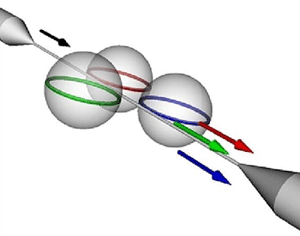
In the ‘microsphere’ laser, this amplification step takes place in a silica sphere placed between the tapered ends of two optical fibres. Laser light shines out of one fibre into the sphere and circulates around its inside surfaces in a so-called whispering-gallery mode. The light intensity grows as light continues to enter the sphere. When the power of the incident light beam is raised above a certain level, the circulating wave escapes from the spheres as coherent radiation, which is detected by the second optical fibre.

The ‘microsphere’ laser also emits radiation over a range of wavelengths because the silica beads shift the wavelength of the incoming light. This effect is known as Raman scattering.

A drawback of the technique is that the volume of small silica spheres is very sensitive to fluctuations in temperature, and this affects the spectrum of the light they emit. In their current set-up, Vahala and co-workers achieved an efficiency ‘quality factor’ of 108 – an order of magnitude lower than previous experiments – but they are optimistic that better temperature control will allow them to use smaller spheres and improve this figure.

‘We have found a way to efficiently couple light into microscopic glass spheres while preserving the exquisite perfection of the sphere in terms of its ability to store and concentrate light,’ Vahala told PhysicsWeb. ‘We knew this property might give us access to the nonlinear physics of the glass itself, but now we need vastly less power than would normally be required.’

Vahala and colleagues point out that several microsphere lasers could be incorporated into a single optical fibre. They believe that their device could be used to investigate various phenomena in quantum electrodynamics and a wide range of nonlinear optical effects. Its compatibility with optical fibres could also make it useful in the communications industry.

Nanotubes feel the heat

Working at Japan’s National Institute for Materials Science, Yihua Gao and Yoshio Bando found that the height of a column of liquid gallium in a nanotube varies linearly with temperature, just as mercury does in conventional thermometers. This allows the temperature to be read in situ using a scanning electron microscope to measure the height of the gallium meniscus.

The researchers found that the gallium inside the nanotubes expands rapidly as the temperature rises – just as gallium does on a macroscopic scale – although its melting point varies greatly at different size scales. In contrast with gallium, the walls of the carbon nanotube expand very little as the temperature rises. On a microscopic scale, gallium is a liquid over a large range of temperatures, and this gives the nanothermometer a measuring range of 323 – 823 kelvin, compared with the range of 4 – 80 kelvin covered by existing nanoscale thermometers.

The nanothermometers were made using a radiofrequency furnace to react gallium oxide vapour with carbon monoxide vapour in a carbon crucible, under a flow of nitrogen gas, at a temperature of 1073 kelvin.

Carbon nanotubes are sheets of graphite molecules rolled into a cylinder and capped at both ends, formed by heating carbon. Along their length they are as strong as diamond.

New letters expose war-time secrets

The war-time meeting between Bohr and Heisenberg has long been shrouded in mystery and was the basis of Michael Frayn’s hugely successful play Copenhagen. However, historians of science who have tried to decipher what happened at the meeting have been forced to rely on Heisenberg’s post-war recollections – which have been ambiguous and contradictory – along with scraps of evidence from secondary sources. The publication of the eleven letters will give historians a valuable source of new material. The letters were originally due to be released in 2012 – fifty years after Bohr’s death – but his family have chosen to release them early to avoid any ‘misunderstanding regarding their contents’.

Much of the controversy centres on claims made by Heisenberg that appeared in Robert Jungk’s 1958 book Brighter Than a Thousand Suns. Jungk claims that Heisenberg had formulated a plan to prevent the development of an atomic bomb through a mutual agreement between German and Allied physicists. In the newly released letters, however, Bohr says that he does not believe that Heisenberg ever hinted that German physicists would do all they could to prevent an atomic bomb.

Bohr emphasizes several times in the letters that he has a clear memory of the meeting – and took very careful note of what Heisenberg said – because it was such an important matter. He claims that Heisenberg was convinced that if the war did not end with a German victory, then it would be decided by the use of atomic weapons. Bohr says that his own silence during the meeting was not because he was shocked to learn that fission was technically feasible – as Heisenberg later claimed – but because he had not realised Germany was working on a bomb. Bohr adds that he did not realise that the Allies were working on a bomb until he escaped to Britain in 1943.

The letters also reveal that Heisenberg came to Copenhagen to help Bohr and other Danish physicists and to explain to them that the Danes’ attitude to Germany was unreasonable. Heisenberg, Bohr claims, argued that the Danes should co-operate with the Germans because they were bound to win the war. Bohr also insists that Heisenberg’s recollection of the meeting was clouded by the fact that Germany’s hopes of winning the war – which in 1941 had seemed strong – faded away as the war neared its end.

Finn Aaserud, director of the Niels Bohr Archive, warns that the letters should be viewed with caution. ‘All the documents were written sixteen years or more after the event they seek to describe,’ he says. ‘Even though the documents show a genuine concern on the part of Bohr to formulate his own recollection of what transpired in 1941, most – if not all – of them were written as reactions to the writings or questions of others and do not reflect Bohr’s main interests and activities at the time.’

Max Perutz

Max Perutz was born in Vienna in 1914 and studied chemistry at the local university. He moved to the Cavendish in 1936 to work on a PhD with the noted crystallographer J D Bernal.

When Hitler invaded Austria, Perutz decided to remain in the UK and spent the rest of his career at Cambridge. He later worked as a research assistant under Sir Lawrence Bragg, and in 1947 was made head of the new Medical Research Council Unit for Molecular Biology. Perutz’s lab went on to become one of the world’s foremost molecular biology laboratories.

Perutz’s prize-winning research involved protein chemistry work at the Molteno Institute in Cambridge and X-ray analysis at the Cavendish. The Nobel Foundation website describes Perutz ‘busily bridging the gap between biology and physics on his bicycle.’ Perutz continued to be active in research long after he retired, publishing more than 100 papers during this period. Once asked why he didn’t retire, Perutz said that he was ‘tied up in some very interesting research at the time.’

Other researchers at the Cavendish who went on to find fame in molecular biology and receive the Nobel Prize in chemistry or medicine include Francis Crick, Aaron Klug, Fred Sanger and James Watson.

Copyright © 2026 by IOP Publishing Ltd and individual contributors