

Materials win medals

Iijima discovered carbon nanotubes in 1991 following studies of the structure of graphite – the material from which nanotubes are made – at Cambridge University. After returning to Japan, he established the helical nature of single- and multi-walled nanotubes, and the electrical properties of nanotubes are now under intense scrutiny. Logic gates and single-electron switches are among the latest devices to be made from nanotubes, which could play a key role in a new generation of electronics. Iijima is a professor at Meijo University in Nagoya, Japan, and a Research Fellow at NIST.
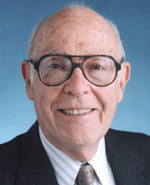

Cahn’s career in materials science was sparked by his desire to understand the ‘phase separation’ that takes place during the processing of metal alloys. In this phenomenon, the components of a previously homogeneous mixture separate from each other when the mixture is cooled. Working with John Hilliard in 1961, Cahn developed a generic expression to explain the effect, the well-known Cahn-Hilliard equation.

This equation has since been used to describe many phenomena in physics and chemistry, from the clustering of galaxies in the early universe to the curdling of cream in coffee. It has even been used to develop digital image processing techniques and to explain the distribution of urban populations.

Cahn is now a Senior Fellow in the Materials Science and Engineering Laboratory at NIST. The Bower Award and Prize for Achievement in Science consists of a gold medal and at least $250 000 in cash.
Organics aid planetary aggregation

Interstellar dust grains typically have a silicate core surrounded by an organic layer, which is encased in ice. Astronomers believe that – when the solar nebula formed – these particles aggregated into asteroids and planetesimals. Previous studies of collisions between dust grains have involved only silicate- and ice-based particles, but the ice is likely to have evaporated in the temperatures of the early solar system.

Based on previous studies of the make-up of interstellar dust, Kouchi and co-workers synthesized a range of organic compounds. To mimic collisions between millimetre-sized particles, they dropped a 1-cm copper sphere onto a copper surface coated with these organic materials. The team then used a load cell to measure the force needed to pull the sphere away from the organic layer to see how well it had stuck. The experiment was repeated for a range of impact velocities and at temperatures of 200–300 kelvin.

Kouchi and colleagues found that sphere stuck to the organic grains at collision speeds of up to five metres per second – an order of magnitude higher than the speed at which silicate- or ice-based grains coagulate. This suggests for the first time that dust grains could have gelled in the turbulent conditions in the early solar system. The organic matter was also stickiest at 250 kelvin, which corresponds to the temperature of the asteroid belt in the young solar nebula.

Astronomers have long wondered why there is a shortage of matter in the asteroid belt. Kouchi’s team believes that this could be explained if planetesimals formed earlier than expected and were then pulled towards the Sun – and out of the asteroid belt – by an effect known as gas drag. The findings also suggest that the first planetesimals formed in the asteroid belt, challenging the accepted view that they emerged almost uniformly across the solar system.

Laser tweezers get a grip on DNA

Existing methods use a laser to move a bead that must be chemically bonded to the end of a DNA strand. The bead alters the chemical make-up of the molecule and cannot be removed, which makes such processes complex and limits their applications.

But the tweezers developed by Hirano’s team exploit the dielectric properties of tiny latex beads, which are added to a solution of DNA molecules, each around 40 micrometres long. To grasp a strand, the researchers focus a 600-milliwatt laser beam onto the desired section of a selected molecule.

The electric field of the beam induces a dipole moment in the beads – which are 200 nanometres in diameter – and this attracts them to the centre of the focused beam where the field is most intense. This cluster of beads traps the strand, which can then be stretched or bent by moving the microscope stage on which the solution is mounted. The DNA molecule can then be released by switching off the laser.

Besides gene therapy, this technique could allow biologists to study the physical properties of different molecular sites on a wide range of biomolecules. Hirano and colleagues are confident that it will be useful in many chemical and physical applications, such as the assembly of micromachines.

‘The trapping force depends on the difference in refractive index between the beads and the surrounding medium’, Hirano told PhysicsWeb, ‘so our technique should also work in gas or vacuum environments’.

Secret of superconductivity in sight

Superconductors are compounds that lose their electrical resistance below a certain ‘transition temperature’. In many superconductors, this happens because electrons pair up – overcoming their mutual repulsion – by interacting with vibrations of the crystal lattice known as phonons. But scientists disagree on the mechanisms that form electron pairs in high-temperature superconductors, which have transition temperatures up to 138 kelvin.

High-temperature cuprate superconductors consist of metal atoms separated by layers of copper oxide. Since the super-current flows through these layers, they have been the focus of many attempts to establish the mechanism that underpins high-temperature superconductivity. Neutron scattering has been widely used in these studies because it can reveal the magnetic spins of electrons in these layers.

Early neutron scattering studies showed that – in many high-temperature superconductors –the electrons in the copper oxide layers are excited into a ‘magnetic resonant mode’. This strongly suggested that magnetic spin played a central role in the cuprate superconductors.

But this effect was only found in compounds with double or triple layers of copper oxide, and could not explain why superconductivity existed in materials with single layers. This apparent anomaly left theorists unable to account for the role of spin alignment in the high-temperature superconductors.

Now Keimer and colleagues at the Russian Academy of Science, the Laboratoire Léon Brillouin and CEA Grenoble, both in France, have seen this alignment of spins in the single-layer compound thallium barium copper oxide. The copper oxide layers in this material are flat and uniform, which means that the spin alignment is unlikely to arise from any rogue structural effects. This led the team to believe that the effect is probably common to all single-layer copper oxide compounds – and therefore to all high-temperature superconductors.

‘Our results highlight the central role of magnetism in the mechanism of high-temperature superconductivity’, Bernhard told PhysicsWeb. ‘This magnetic resonant mode appears below the transition temperature and could therefore be a fingerprint of the electron pairing mechanism.’

Artificial black holes on the horizon

A black hole is created when a certain kind of star collapses under its own weight. Light becomes trapped inside the perimeter of the black hole – known as the ‘event horizon’ – because the escape velocity needed to overcome gravity at this distance equals the velocity of light. Nothing occurring within the event horizon can be observed from outside.

Physicists have suggested that an analogue of a black hole could be created in the lab by trapping sound or light waves in fluids that are travelling more quickly than the waves. The point at which the fluid speed overtakes the wave speed would be equivalent to the event horizon. But researchers have so far been unable to build such an artificial black hole and measure its quantum properties. In particular, says Leonhardt, schemes so far proposed for optical black holes would be plagued by the Doppler effect that arises from the moving medium. This is a problem because light can only be slowed down in a very narrow frequency range.

Leonhardt has solved this problem by considering a ‘black hole with no moving parts’. A laser beam would manipulate the optical properties of a medium – either an ultracold gas or a crystal – in order to permit the transmission of a second beam of light, known as the probe beam. The probe beam would be directed along the length of the medium, while the first, stronger beam, known as the control beam, would illuminate the length of the sample from above. In this set-up, the group velocity of the probe beam is proportional to the intensity of the control beam. The trick is to calculate the quantum effects of varying the intensity of the control beam parabolically along the length of the medium so that it is a maximum at the ends of the sample and zero at its mid-point.

Leonhardt calculated that such an intensity variation would result in a singularity similar to that associated with black holes. The line perpendicular to the probe beam along which the intensity of the control beam is zero would cut space into two unconnected regions. At this point – as at an event horizon in a black hole – the wavelength of the probe beam would taper to zero.

Pairs of photons that travel away from the singularity in opposite directions would also be created, resembling the pairs of particles and anti-particles predicted to occur near the event horizon of a black hole. One particle in each pair should fall into the black hole while the other escapes as so-called Hawking radiation. Astrophysicists have yet to detect any such particles because they are obscured by the ubiquitous cosmic microwave background. But being able to study their analogues in the lab would help physicists to bridge the gap between quantum mechanics, which dictates pair production, and general relativity, which governs the behaviour of black holes.

Leonhardt describes his set up as a ‘naked horizon without the catastrophic attractive force of a black hole’. He adds that there would be ‘absolutely no danger at all’ if such an experiment were built.

Medics get a dose of physics

The beating of the heart is controlled by a wave of electrical activity that starts at the sino-atrial node – the heart’s natural pacemaker – and spreads outwards. In a healthy heart each wave has faded away by the time the next wave arrives. But if this does not happen, it can lead to a heart attack. Understanding this process – which is known as ventricular fibrillation – is the key to developing new ways to treat the victims of cardiac arrest.

Richard Clayton of the University of Leeds and co-workers at the University of Auckland in New Zealand have developed a computer simulation that shows the electrical patterns in the heart when these faulty beats occur, as shown in this image. Also shown are the ‘filaments’ that the unstable ‘re-entrant’ waves rotate around. ‘Our detailed biophysical and anatomical model can simulate this activity’, says Clayton, “and we can then test different pharmacological and physical treatments that could help the patient’.

In the field of radiotherapy, two teams of scientists have devised models that should make treatments safer and more efficient. Norman Kirkby of the University of Surrey worked with engineers and cell biologists from Addenbrooke’s Hospital in Cambridge and Mount Vernon Hospital in Middlesex to simulate the multiplication of cancer cells in brain tumours. The growth of such tumours can be stopped if the DNA in these deviant cells is damaged by doses of radiation.

When cancer cells multiply, they go through a cycle that includes a ‘self-checking’ stage. If the tumour is irradiated during this period, the cells simply repair the damage and keep growing. But the model devised by Kirkby’s team could enable doctors to track the cycle so that they can administer radiation treatments at accurate intervals. This means that the cancer cells will be hit when they are most vulnerable, and damage to healthy tissue will be minimized.

Meanwhile, Frank Verhaegen of the National Physical Laboratory and – working independently – Emiliano Spezi at Velindre Hospital in Cardiff have developed Monte Carlo simulations to calculate optimum radiation doses for individual patients. Existing models for calculating such doses are based on simplified physical models and can overlook the different responses of bone and soft tissue to radiation, which may lead to an inaccurate dose.

The Monte Carlo methods developed by Verhaegen and Spezi predict the paths of every particle as it travels from the accelerator and into the patient. This should allow doctors to account for the exact anatomy of each patient when calculating their radiation dose.

Electrical pulses break light speed record

When a pulse of radiation travels through a ‘dispersive’ medium, different wavelengths in the pulse move at different speeds and the pulse becomes distorted. Ordinary dispersion arises when the refractive index of a material changes with increasing wavelength. This stretches out the pulse and reduces the group velocity – the speed at which the peak of the pulse travels.

But ‘anomalous dispersion’ can occur in materials that absorb radiation in a certain range of wavelengths. The refractive index on either side of this absorption band changes sharply with wavelength. In these regions, the components of radiation at the tail of the pulse interfere destructively, and the peak of the wave is effectively pushed forward.

To create their cable, the Canadian researchers joined together five-metre sections of coaxial cable with alternating electrical impedences. Radiation in the frequency range 9 – 11 MHz is partially reflected at the boundaries of these segments, which gives the cable its absorption band. Haché and Poirier sent electromagnetic pulses with frequencies between 5 and 15 MHz through the cable, and found that the group velocity reached three times the speed of light for frequencies in the absorption band.

Haché and Poirier emphasize that their experiment does not break any laws of physics. Although the group velocity exceeds the speed of light – an effect permitted by relativity – each component of the pulse travels slower than light. It would be impossible to transmit information faster than light because it would be encoded onto a single frequency component.

But as Haché explains, many existing information systems are based on coaxial cables, and the current top speed for data is just two-thirds the speed of light. If the impedance of such cables were adapted, pulses sent at frequencies close to the absorption band could transmit information at speeds approaching that of light.

‘Oddly, the reason no one has done this before is that we are using what most people are trying to avoid – the back-reflection caused by impedance mismatch’, Haché told PhysicsWeb. ‘But as far as superluminal propagation goes, this is the key’.

First light on Gemini South

At its remote location 2737 metres above sea level, Gemini South benefits from cold, dry air and minimal light pollution. With telescopes in both the Northern and Southern hemispheres, Gemini will enable astronomers to continuously monitor objects anywhere in the sky. Simultaneous viewing at both sites will also allow interferometric studies of distant objects to be made, which can produce much sharper images than a single telescope.

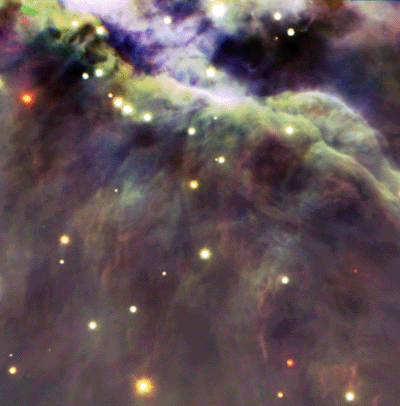
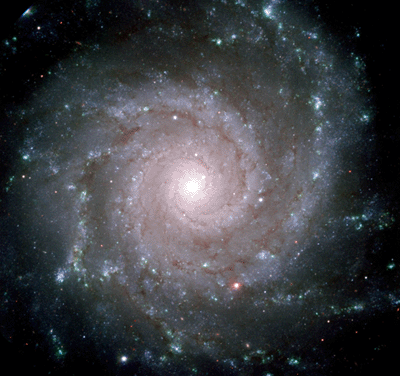
The cosmic dust that shrouds ‘star nurseries’ and active galaxies is invisible at infrared wavelengths, granting astronomers unprecedented views of star birth and other galactic phenomena. Gemini South has already achieved the deepest-ever images of star fields in the constellation Orion, and its potential is further hinted at by a ‘perfect’ picture of a spiral galaxy taken by its Hawaiian counterpart with the UK-built Gemini Multi-Object Spectrograph.

With a quarter share in the Gemini project funded by the Particle Physics and Astronomy Research Council (PPARC), the UK is the second largest partner in the seven-country consortium. ‘By taking a leading role in such international projects, PPARC ensures that UK scientists have access to world-class facilities, enabling them to participate at the frontier of global astronomy research and discovery’, says chief executive Ian Halliday.

Robert Hanbury Brown

Hanbury Brown was born in 1916 and graduated from the University of London in 1935. He spent the next decade on secret radar research at the Air Ministry research station at Bawdsey and the US Naval Research Lab in Washington. After working as an engineering consultant for two years, Hanbury Brown got a job at Manchester University, where Sir Bernard Lovell was starting to build the Jodrell Bank radio telescope. In 1956, with Richard Twiss, he invented the Hanbury Brown and Twiss interferometry technique – which went on to be widely used in astronomy and quantum optics.

In 1963 Hanbury Brown moved to Australia as professor of astronomy at Sydney University. He returned to the UK in the mid-1970s and published his autobiography – Boffin: A Personal Story of the Early Days of Radar, Radio Astronomy and Quantum Optics – in 1991.

Probe to predict landslides and earthquakes

Zimanowski and co-workers pressed together two pieces of volcanic rock and then slid one across the other. Electrodes in each rock monitored the electromotive force that built up between. Although the sliding force was constant, the researchers found that the electrical signal peaked periodically, shortly before any movement was detected.

Based on this experiment, Zimanowski and colleagues developed a probe and used it to measure electrical signals at Mount Stromboli, an active volcano in Italy where landslides are frequent. The detector revealed a pattern in the signals similar to that in their experiment, and the team proposed a four-step process to explain it.

Initially, the researchers believe, strain builds up between the layers of rock. ‘Micro-cracks’ then form at the rock surfaces as they creep over each other, exposing fresh rock. This causes electrical charge to accumulate, which generates the ‘precursor signal’. Mechanical failure follows as the rocks slip past each other, and finally the interface relaxes and the electrical charge dissipates.

According to the German team, this technique would be suitable for monitoring unstable mountainsides, in particular because it gives advance warning of landslides and volcanoes. ‘The field probe is buried between 30 and 50 centimetres in the ground but its detection depth is presently one to two kilometres into the Earth’s crust’, Zimanowski told PhysicsWeb. Improvements to the probe could increase this to a depth of several kilometres, say the researchers, which could enable it to detect the precursor tremors of certain types of earthquake as well.

Copyright © 2026 by IOP Publishing Ltd and individual contributors