The quantum properties of the electromagnetic force are seen in phenomena throughout nature, such as the fixed orbits of electrons within atoms. Similarly, the structure of nuclei demonstrates the quantum effects of nuclear forces. But it is extremely difficult to make analogous observations in gravitational fields because the effect of gravity is negligible at the atomic scale.
To overcome this problem, Nesvizhevsky and co-workers used an intense horizontal beam of ultra-cold neutrons from the reactor at the Institute Laue-Langevin in Grenoble. By directing the beam slightly upwards and allowing the neutrons to fall onto a mirror, also positioned horizontally, the researchers were able to effectively hold the neutrons in a gravitational potential well. Having bounced off the mirror, the small kinetic energy due to the vertical velocity of the neutrons was exactly balanced by the force of gravity at varying heights above the mirror. The neutrons’ lack of charge and long lifetime minimized the effect of forces other than gravity.
Classically, the energy spread of the bouncing neutrons – and so the range of heights to which they could rise – would be continuous. But this is not what the researchers observed. By placing a neutron absorber above the mirror and counting the particles as they moved the absorber up and down, they found that neutrons existed only at certain well defined heights. According to the researchers, these heights correspond to the peaks in a standing wave created when the de Broglie wave of the neutron interferes with its reflection from the mirror. The first peak agreed well with theory, but the researchers still need to confirm the presence of the higher peaks.
Nesvizhevsky says that the experiment could precisely verify the equivalence between inertial and gravitational masses – the reason that all masses accelerate equally in a gravitational field. The set-up could also confirm the electrical neutrality of neutrons. But such studies will require a significant increase in the neutron flux.
Particles with spin angular momentum – a quantum mechanical property – behave like tiny bar magnets and can be aligned by a magnetic field. The operation of conventional electronic devices such as transistors depends solely on the charge of electrons, but physicists believe that highly efficient ‘spintronic‘ systems could be developed that exploit the spin of particles such as electrons and nuclei.
Now Smet and colleagues have brought these devices a step closer with the discovery that the spins of nuclei in a gallium arsenide semiconductor can be controlled with a gate voltage. As in a conventional transistor, the gate voltage controls the flow of electrons through the semiconductor. The team then aligned the spins of these electrons with a strong magnetic field and cooled the set-up to a temperature of 20 millikelvin.
By adjusting the magnetic field and the gate voltage, Smet and colleagues found that they could transfer spin from the electrons to the nuclei within the semiconductor. Moreover, the changes in the spins of the nuclei were reversible and reproducible, which suggests that they could be used to store information.
According to the German team, this phenomenon is also a novel probe of the interactions between the spins of electrons and nuclei. Under the conditions of the experiment, it takes much more energy to flip the spin of an electron than the spin of a nucleus. But if a particular number of electrons are present – determined by the gate voltage – the electrons cooperate to flip the spins of the nuclei using less energy than an individual electron would need. To conserve momentum, this effect has a ‘back action’ on the electrons, altering the current. This means that the state of the nuclear spins can be gauged by measuring the resistance of the semiconductor.
‘In a nutshell, we have developed a purely electrical method of measuring the interaction strength between electrons and nuclei’, Smet told PhysicsWeb. ‘This better understanding is a prerequisite for developing new ways of manipulating nuclear spins with the help of mobile electrons in nuclei’.
The idea that information stored as quantum states could be used to build a super-efficient quantum computer is extremely ambitious, and Smet emphasizes that it may be several decades before we know whether it is even possible. But in developing a probe for electron-nucleus spin interactions, his team has laid some of the foundations.
In order to slow and stop light pulses, a medium must transmit light for only an extremely narrow range of frequencies. In a cloud of gas atoms, this is achieved with a ‘coupling’ laser that drives transitions between two internal energy levels in the atoms. This makes the cloud transparent to some frequencies. Pulses from another laser – which has a frequency that matches the energy difference between one of these levels and a third level – then enter the gas. These pulses would normally be absorbed, but in the presence of the coupling laser they are slowed down by quantum interference effects.
In most crystals, this laser technique produces a ‘spectral gap’ that is too wide to slow light pulses. However Turukhin and colleagues were able to use a third laser to create a very narrow gap in a crystal of yttrium silicate doped with the rare-earth metal praseodymium (Pr-YSO).
First, a coupling laser was used to create the wide spectral gap. The team then switched on a second laser with a wavelength corresponding to a different transition in the crystal. This excitation narrowed the spectral gap, leaving just a small range of frequencies at which light is transmitted through the crystal. When pulses from a third laser enter the crystal, they are slowed down by the quantum interference effects created by the narrow transmission band.
Turukhin and co-workers also found that they could trap a light pulse by switching off the coupling laser when the pulse was inside the crystal. When the coupling laser was switched back on, the light pulse emerged from the crystal.
When a light pulse is trapped inside a medium, it is compressed to a tiny fraction of its length in free space. This means that information encoded onto light pulses could be stored in a very small space. Indeed, the crystal was only three millimetres thick, although it had to be cooled to 5 kelvin.
‘Our experiment shows that this type of quantum storage is possible’, Turukhin told PhysicsWeb. ‘One of the major challenges is the low temperature, but with commercially available refrigerators, our system could lead to a suitable memory device for quantum computing.’
In 1947, Rochester and Clifford Butler – a colleague at Manchester University – noticed an unusual pair of tracks in their cloud chamber. The traces could only be explained by the decay of a neutral particle with a mass about 1000 times greater than that of the electron. After the pair repeated their experiment in the French Pyrenees – where the cosmic ray flux is higher – it emerged that the decaying particle was a kaon, a type of meson. Mesons were predicted to exist fleetingly in the nucleus to explain why similarly charged nucleons bind together.
The kaon had unusual properties that physicists at the time dubbed ‘strange’. When quarks were discovered in the 1960s, it became clear that these characteristics arose from a certain quark within the kaon, and this became known as the ‘strange’ quark.
A plethora of new sub-atomic particles was discovered in the years that followed. The development of particle accelerators allowed physicists to study these particles and establish the relationships between them, which have evolved into the modern Standard Model of particle physics.
Rochester was born on Tyneside in 1908 and attended Armstrong College in Newcastle, which was then part of Durham University. After receiving his BSc, MSc and PhD degrees, he carried out postdoctoral research at the University of California before taking up a lectureship at Manchester University. He returned to Durham in 1955 as professor of physics and chair of the department.
Rochester’s involvement in university life continued after his retirement in 1973, and the new physics department that he helped to design opened in 1997. He died on 26 December 2001.
Meanwhile, physicists at Brookhaven National Laboratory in the US announced today the observation of an extremely rare decay event of the kaon. In a sample of hundreds of billions of kaons – generated by the lab’s Alternating Gradient Synchrotron – only two decayed into a pi-meson (or ‘pion’), a neutrino and an antineutrino.
The E787 Collaboration has not detected this event since they first saw it four years ago, on the 50th anniversary of the kaon’s discovery. The results – which could give new insights into the Standard Model of particle physics – are to appear in Physical Review Letters.
Born in Australia in 1916, Prokhorov moved to the Soviet Union seven years later, following the Russian Revolution. In 1934 he joined the physics department at Russia’s Leningrad State University and on graduating in 1939 moved to the P N Lebedev Physical Institute, Moscow, to start his research career as a postgraduate.
Interrupted by the Second World War, Prokhorov completed his research on nonlinear oscillations in 1946. His subsequent studies of the coherent radiation of electrons in a synchrotron led to his PhD thesis in 1951.
Throughout the early 1950s and while at Lebedev’s Laboratory of Oscillations, Prokhorov and his collaborators used microwave spectroscopy to research molecular structures. In 1955 Prokhorov began to study electronic paramagnetic resonance (EPR) and by 1957 he had discovered that ruby would make a suitable laser material.
As Prokhorov and colleagues in Russia developed their first masers, Charles Townes and Arthur Shawlow were making similar progress in the US. In 1964 Prokhorov, with colleague Nikolai Basov and US scientist Charles Townes, received the Nobel Prize in Physics for “fundamental work in quantum electronics that led to the construction of oscillators and amplifiers based on the maser-laser principle.”
Prokhorov headed Russia’s General Physics Institute until 1998. Reports say that he will be buried alongside the Russia’s greatest scientists in Moscow’s Novodyevichy cemetery.
Magnetic refrigerants heat up when they are subjected to a magnetic field because the second law of thermodynamics states that the entropy – or disorder – of a closed system must increase with time. This is because the electron spins in the atoms of the material are aligned by the magnetic field, which reduces entropy. To compensate for this, the motion of the atoms becomes more random, and the material heats up. In a magnetic refrigerator, this heat would be carried away by water or by air. When the magnetic field is turned off, the electron spins become random again and the temperature of the material falls below that of its surroundings. This allows it to absorb more unwanted heat, and the cycle begins again.
Magnetic refrigerators have two main advantages over today’s commercial devices, which extract heat from a vapour using a compressor: they do not use hazardous or environmentally damaging chemicals, such as chlorofluorocarbons, and they are up to 60% efficient. In contrast, the best gas-compression refrigerators achieve a maximum efficiency of about 40%.
The heating and cooling that takes place in magnetic refrigeration is proportional to the size of the applied magnetic field and the magnetic moments, which are generally largest in rare-earth elements. One such material, a compound based on gadolinium, has previously been shown to work as a magnetic refrigerant, but in a modest magnetic field its entropy only changes significantly at low temperatures. Brück says that in order to operate at room temperature or above this material requires large superconducting magnets, which are expensive and require extensive servicing.
In contrast, the material studied by the Amsterdam researchers, a manganese compound, performs best at room temperature. Although the magnetic moment of manganese is generally only about half that of heavy rare-earth elements, its Curie temperature of 300 kelvin means that it can undergo substantial changes in magnetic entropy using smaller permanent magnets.
Vitalij Pecharsky of the Ames Laboratory in the US thinks that the manganese compound is important scientifically, but believes that its commercial potential is still unclear. Pecharsky and colleagues showed in 1997 how to improve the cooling properties of gadolinium by adding impurities. He adds that researchers at Ames and the Astronautics Corporation of America have recently demonstrated a practical gadolinium-based magnetic refrigerator that works at room temperature using a permanent magnet.
Rod and cone cells in the retina of the human eye send electrical signals to the brain when they detect light. Certain diseases damage these cells and cause blindness, but do not affect the ‘wiring’ – which means that sight could be restored by implanting suitable artificial cells.
Now a photodetector developed at SVEC, which is sponsored by NASA, could fit the bill. The device consists of a thin film of lanthanum-doped lead zirconium titanate (PLZT). The material is grown layer by layer – or ‘epitaxially’ – using a process perfected during research under ultra-high-vacuum conditions in the Wake Shield Facility, a small space-based laboratory launched by the space shuttle into low-Earth orbit. The method produces a uniform crystal structure with optimum optical properties.
PLZT is a ferroelectric material, which means it contains tiny electrical domains, analogous to a ferromagnet. But PLZT also generates an electric field when it absorbs light – a phenomenon known as the photo-ferroelectric effect. Since PLZT is very sensitive to light at wavelengths between 450 and 700 nanometres, it is an excellent candidate for replacing rod and cone cells. “There is a nice overlap between the absorption of PLZT and the spectral sensitivity of the eye”, Ignatiev told PhysicsWeb.
Ignatiev explains that millimetre-sized arrays containing tens of thousands of the photodetectors – each just five micrometres across – could be implanted into the retina, where they would send electrical signals to the optic nerve. The team believes that the brain will learn to interpret the unfamiliar voltages sent by the artificial cells, but they are unsure what level of resolution the implants will achieve or how long they will last.
Special relativity states – among other things – that the speed of light is the same no matter how fast an observer is travelling. The so-called Kennedy-Thorndike experiment tests this prediction by monitoring the oscillations of a light source as it accelerates and decelerates.
Using this technique, Achim’s team set up a standing wave of laser light in a cryogenic optical resonator – or ‘CORE’ – in which the frequency of the standing wave can remain stable over very long periods. For 190 days, they compared its oscillation frequency with that of a standard iodine ‘clock’, which is based on the radiation corresponding to the energy gap between two well-known electronic states in an iodine molecule. In this time, the Earth completes over half its circuit around the Sun and – accounting for the rotation of the Earth – the velocity of the Konstanz lab changes by about 30 kilometres per second.
The team found that frequency of the light in the CORE remained constant throughout the experiment, confirming that – over this velocity range – the speed of light is indeed independent of the velocity of the laboratory in which it is measured. This amounts to a verification of the special theory of relativity three times more accurate than previous tests based on the Kennedy-Thorndike method.
The 190-day measurement was made possible by the extreme stability of the CORE, which consists of a sapphire cavity chilled to 4 kelvin. At this temperature, there is virtually no thermal vibration in the crystalline structure of the cavity, which would cause the frequency of the standing wave to drift. This effect meant that earlier experiments could only run for a matter of days, during which time the velocity of the Earth changes less dramatically.
Achim and colleagues point out that the accuracy of their set-up was limited by the stability of the iodine clock. They believe that recently developed optical clocks – which are around seven times more accurate than the best atomic clocks – will allow them to test special relativity even more stringently in future.
There has been much interest recently in collaborations between art and science. One difficulty with such ventures is that you have to bring together scientists who understand and appreciate art, and artists who understand science. This isn’t always easy to achieve. Rebecca Elson, who died in 1999, would have been ideal for such a venture. She was both a successful astronomer and a fine poet, as this remarkable book, which brings together both her science and her art, makes clear.
Elson was born in Montreal in 1960, the daughter of a geologist father. Her interest in poetry began as a child, although it was not until 1987 that her first poems were published. At university she studied physics, obtaining an MSc from the University of British Columbia and then a PhD from the Institute of Astronomy at Cambridge University. After holding several post-doctoral fellowships in the US, she returned to Cambridge, where she worked from 1991 until her death. Her research focused in the main on stellar populations and star clusters in different environments.
Elson’s concern was always to ground her scientific work in human terms. This cannot have been easy when studying the most distant globular cluster system ever observed. As she writes in an essay reprinted in the book: “There are times when the enterprise seems mechanical…and the mysteries of the Universe seem irrelevant to the lives we humans live down here.” But time and again you can see her making connections between the physical and the moral, the universal and the human.
This is not a straightforward book of poetry. The first third contains Elson’s poems, with a further half or so of the book devoted to extracts from her laboratory notebooks. It concludes with an essay entitled “From stones to stars”, which describes her scientific education and career – from assisting with her father’s geology fieldwork as a child, to her research into star clusters at Cambridge.
The essay was originally prepared for a forthcoming collection of autobiographical essays by alumnae of the Bunting Institute at Radcliffe College in the US. It contains several sharp comments on academic society from the perspective of a female scientist. Cambridge is fortunate to get off much more lightly than Princeton. As Elson writes: “Of course Cambridge was dominated by men, but…Princeton on the other hand was irrefutably male, both in the occupants of E building, where the astronomers worked, and in the way the place was run. In indefinable ways, it was alienating.”
Elson’s poems tend to be highly compressed, and visually very specific. There are echoes of Dickinson, Millay, even Plath, in places. None of those poets, though, could have written a poem that begins:
Having picked the final datum From the universe And fixed it in its column, Named the causes of infinity, Performed the calculus Of the imaginary i…
Elson not only writes such a poem, she makes it sexy, and calls it Carnal Knowledge.
Many of her poems relate science to the human scale, which often results in beautiful metaphors of scientific concepts. In the poem Explaining Relativity, for example, she gives about as good an explanation of general relativity as one could hope for in three lines:
It’s so much more a thing of pliancy, persuasion, Where space might cup itself around a planet Like your palm around a stone
Not all the poems are concerned with science. From one perspective, Elson was a person who just happened to do science. Her poems reflect her concerns, which happened to include science. But there are also poems about nuns bathing, hanging out her husband’s boxer shorts to dry, and a reunion in which family members are portrayed as boats. There is a hilarious poem about kitchen appliances, followed by a reflection on the mice that researchers use to study the cancer from which she ultimately died. By mixing her science poems with those of a more general nature, Elson makes them seem less specifically “scientific” and more just part of her concerns as a human being. This makes them less frightening and easier to approach for readers without a scientific background.
The notebook extracts – which are literary, rather than scientific – are arguably the most fascinating part of the book. They contain material from four notebooks that were written by Elson between 1991 and her death. Although there are references to her astronomical work, these occur when she is using that work as material for a poem or essay. There are no equations and no musings on any astronomical data.
Many of the notebook entries are in verse, and it is often tempting to read these as poems. However, this approach should be resisted. The entries are quite clearly drafts and experimental approaches – rather than final, polished works. Nevertheless, there is more poetry in some of these drafts than in many “finished” poems I have seen, and the temptation to read them as completed pieces can be irresistible.
Consider the following example, from an entry headed Travelling Light, written on 11 September 1996:
We carry what comforts and sustains Which can be space itself & time Not things, which only weigh us down Stepping gently over the earth If you could move like light How things would slow, & stop
Sometimes Elson can be seen worrying at the same idea over several years, trying different approaches, different articulations to her poetry. Her notebook extracts, for example, reveal the various attempts that she made to communicate the idea of dark matter. She is not trying to explain the concept, but trying to convey why it is fascinating to her, why it is important. The five-line poem Dark Matter that emerges from this process is a model of clarity and concision:
Above a pond, An unseen filament Of spider’s floss Suspends a slowly Spinning leaf.
It must have been very difficult and also frustrating for the editors of the notebook extracts – Angelo di Cintio (Elson’s husband), and her friend and fellow poet Anne Berkeley – to decide what to include in the book, which seems to contain less than a fifth of the original material. The editors have, however, tried to show the range of the material in the notebooks, and to give an impression of Elson’s working methods. I think they’ve succeeded. But rather like trying to infer the properties of dark matter from the stars you can see, it is difficult to tell when you do not know what was left out.
I thoroughly recommend this book to anyone interested in poetry or science, or who simply wants to learn more about the remarkable Rebecca Elson.
Putting on the pressure The development of high-pressure technology has opened up detailed studies into the interplay between superconductivity and magnetism. Top panel: the diamond anvil used in heavy-fermion investigations at Geneva and Grenoble can produce pressures up to 10 GPa. Bottom panel: meanwhile, the magnetic behaviour of iron up to 100 GPa has been studied in Osaka. In both cases the resistivity measurements are made with the help of tiny gold-wire connections.
The startling transition of a metal into its superconducting state is revealed by the complete disappearance of electrical resistivity at low temperatures. Indeed, the current in a closed superconducting circuit can circulate forever without damping. Another fundamental property of the superconducting state was discovered in 1933 when Walther Meissner and Robert Ochsenfeld demonstrated that superconductors expel any residual magnetic field. Similarly, superconductivity can be destroyed by applying a magnetic field that exceeds some critical value.
Superconductivity and magnetism usually try to avoid each other – this feature can be exploited to, for example, levitate a magnet above superconductor. So the recent discovery of compounds that are both ferromagnetic and superconducting at the same time came as a surprise to many physicists.
Singlet and triplet superconductivity
The microscopic theory of superconductivity was created by John Bardeen, Leon Cooper and Robert Schrieffer in 1957. According to this so-called BCS theory, the electrons team up to form pairs, known as Cooper pairs, due to interactions with the crystal lattice at low temperatures. Electrons in these Cooper pairs have opposite values of momentum, meaning that the pairs themselves generally have zero orbital angular momentum. The formation of Cooper pairs also leads to the creation of a superconducting energy gap, which means that single electrons cannot occupy states near the Fermi surface. Such energy gaps – which are essentially equal to the energy needed to break up the Cooper pairs – show up clearly as exponential drops in the specific heat and thermal conductivity at what is known as the critical temperature, Tc.
The BCS theory is quite successful at explaining the properties of most superconductors. But the discovery in 1986 of a new class of materials that superconduct at high temperatures remains a challenge to theorists, and there is still no unambiguous theoretical explanation for this phenomenon.
The observation of superconductivity in organic conductors, heavy-fermion systems, the ruthenates and, most recently, the new ferromagnetic superconductors provides strong arguments for the existence of more exotic types of superconductivity. Indeed, superconductivity in ferromagnets must result from a different type of electron-pairing mechanism. In these materials, electrons with spins pointing in the same direction team up with each other to form Cooper pairs with one unit of spin, resulting in so-called triplet superconductivity. In contrast, conventional superconductivity – also known as s-wave singlet superconductivity – occurs when electrons with opposite spins bind together to form Cooper pairs with zero momentum and spin.
A magnetic field can destroy singlet superconductivity in two ways. The first of these effects is known as the orbital effect and is simply a manifestation of the Lorentz force. Since the electrons in the Cooper pair have opposite momenta, the Lorentz force acts in opposing directions and the pair breaks up. The second phenomenon, known as the paramagnetic effect, occurs when a strong magnetic field attempts to align the spins of both the electrons along the field direction.
Singlet superconductivity is destroyed by fields greater than Hp ~ 1.8Tc, where Tc is the critical temperature at which the material loses its electrical resistance. Such fields, however, do not wreck triplet superconductivity because the spins of both electrons may point in the same direction as the field. This means that triplet superconductivity can only be destroyed by the orbital effect.
Various types of magnetic ordering and superconductivity
Ferromagnetism arises when a large number of atoms or electrons align their spins in the same direction. There are actually two sources of magnetism in metals – localized magnetic moments and the “sea” of conduction electrons. Local magnetism occurs in rare-earth metals (such as gadolinium) and the actinides (such as neptunium) due to the incomplete filling of electrons in the inner atomic shells. This leads to a well defined magnetic moment at every fixed atomic site, which in turn produces long-range magnetic coupling due to the exchange of conduction electrons.
The second type of magnetism – known as band magnetism – arises from the magnetic moments of the conduction electrons themselves. In a metal, the electrons are “itinerant”, that is they are free to move from one atomic site to another, and they tend to align their magnetic moments in the direction of an applied field. This also occurs in the uranium-germanium alloys UGe2 and URhGe2, the two ferromagnetic superconductors that were recently discovered by groups at Cambridge University in the UK and at the French atomic energy commission (CEA) laboratory in Grenoble.
Ferromagnets only have a net magnetic moment at low temperatures; the internal magnetic field spontaneously appears at the so-called Curie temperature, which is typically in the range 10-1000 K. At higher temperatures, however, the magnetic moments of the atoms continually change their direction so that the net moment is zero. A similar magnetic transition occurs in antiferromagnets – materials in which the spins of neighbouring atoms point in opposite directions. This transition takes place at the Néel temperature and leads to the disappearance of the internal magnetic field.
Although superconductivity and magnetism seem to be antagonistic phenomena, could they co-exist in the same compound? This question was first posed by the Russian theorist Vitaly Ginzburg in 1957, but early experiments in 1959 by Bernd Matthias, then at Los Alamos, demonstrated that a very small concentration of magnetic rare-earth impurities – even a few per cent – was enough to completely destroy superconductivity when ferromagnetic ordering was present.
The origin of this destructive phenomenon is a quantum-mechanical interaction between the spins of the electrons and the atomic magnetic moments. Below the superconducting transition temperature, this “exchange interaction” attempts to align the Cooper pairs. Exchange interactions therefore place stringent limits on the existence of superconductivity.
However, superconducting crystals that have an antiferromagnetic sub-lattice of rare-earth atoms can, and do, exist. The first such materials – ternary compounds of rare-earth (RE) elements and molybdenum sulphide (REMo6S8) – were discovered in 1975 by Øystein Fischer’s group at the University of Geneva. Two years later Matthias, who was then at Bell Labs in New Jersey, and co-workers found the same behaviour in a series of rhodium-boride alloys (RERh4B4). Most of these compounds superconduct below a critical temperature between 2 K and 10 K, and undergo a magnetic phase transition in the range 0.5-4 K (see Fischer in further reading).
Neutron-scattering experiments have confirmed that the superconducting phase of practically all of these compounds has long-range antiferromagnetic order. Indeed, superconductivity and antiferromagnetism can co-exist quite peacefully because, on average, the magnetic moments in these compounds have almost no effect on the Cooper pairs – i.e. the exchange interaction is zero.
Internal conflicts
But can superconductivity and ferromagnetism co-exist? The answer to this question is much more fascinating. Some clues can be found in erbium rhodium boride (ErRh4B4) and holmium molybdenum sulphide (HoMo6S8) – the superconductivity of both these materials is destroyed by the onset of a first-order ferromagnetic phase transition.
1 Domains and supercurrents Singlet superconductivity can exist in ferromagnetic superconductors like erbium rhodium boride (ErRh4B4) thanks to the formation of a domain-like structure. ErRh4B4 is a superconductor below 8.7 K, but when it is cooled to about 1 K this modulated magnetic structure appears with a period d. This period is smaller than the size of the Cooper pairs, xi. All the magnetic moments in each domain point in the same direction, but the spin of neighbouring domains alternates. Strictly speaking, ErRh4B4 is not a ferromagnet until it is cooled to 0.8 K. Below this temperature the domain walls break down, all the spins point in the same direction and the superconductivity is destroyed.
For example, ErRh4B4 is a superconductor below 8.7 K. When it is cooled to the Curie temperature of 1 K, a “modulated” magnetic structure appears, rather than ferromagnetic ordering (figure 1). What this means is that neighbouring magnetic moments are aligned in the same direction, although the amplitude of the magnetization varies sinusoidally in space. But the ErRh4B4 remains superconducting at this temperature. Strictly speaking, the material is not ferromagnetic because it contains “domain-like” structures with alternating magnetic moments. This structure has been detected by neutron-scattering experiments and its period has been measured to be about 10 nm.
Moreover, in 1983 Sunil K Sinha, George Crabtree and co-workers at Argonne National Lab performed a simultaneous neutron-scattering and resistivity experiment on ErRh4B4. They showed that further cooling to 0.8 K brings about a first-order phase transition into the ferromagnetic phase and the superconductivity disappears. ErRh4B4 is a very rare example of a compound the superconducting properties of which are destroyed at very low temperatures.
What is the origin of such behaviour and what is the nature of the co-existent phase in the temperature interval between 0.8 K and 1 K? In the magnetic state, the presence of a localized atomic magnetic moment affects the spin distribution of the surrounding electrons due to the exchange interaction. This “induced” electron spin in turn interacts with the magnetic moments of other atoms – the so-called Ruderman-Kittel-Kasuya-Yosida interaction. The energy gained by the atoms due to the magnetic transition far exceeds the energy gained by the electrons as they form Cooper pairs at the superconducting transition. Thus magnetism is a much more robust phenomena compared with superconductivity. As a result, superconductivity cannot prevent the magnetic transition, it is only able to modify it.
The modulated ferromagnetic phase appears when ErRh4B4 and HoMo6S8 are cooled below their Curie temperatures. Phil Anderson and Harry Suhl pointed out in 1959 that the period of such sinusoidal magnetic structures, d, is greater than the atomic distance, a, yet smaller than the size of the Cooper pairs, xi (the so-called superconducting coherence length). Simply speaking, this magnetic structure looks like an antiferromagnet from the large-scale viewpoint of superconductivity because neighbouring domains point in opposite directions. But from the microscopic viewpoint of magnetism, the structure looks like a ferromagnet because the magnetic moments of neighbouring atoms point in the same direction (see Fischer in further reading).
However, the creation of domain walls costs energy, so at low temperatures it is energetically more favourable for all the magnetic moments to point in the same direction. Therefore ErRh4B4 turns into a true ferromagnet below 0.8 K and the superconductivity is destroyed.
Strictly speaking, there are no examples of materials in which singlet superconductivity and ferromagnetism co-exist. In all the known singlet ferromagnetic superconductors, like ErRh4B4 and HoMo6S8, a non-uniform magnetic phase appears in the superconducting state rather than a ferromagnetic phase. Similarly, it is very unlikely for singlet superconductivity to appear in the ferromagnetic state because the exchange interaction forbids the formation of Cooper pairs. Superconductivity and ferromagnetism looked destined to remain apart.
Superconductivity turns exotic
Until now we have only considered superconductivity caused by electrons located on the same atomic site teaming up to form Cooper pairs with zero spin. However, other pairings can occur – notably when there is a strong local Coulomb repulsion. This repulsion also plays a crucial role in the appearance of magnetism, helping to establish long-range order or slowly fluctuating magnetic correlations.
Unconventional electron pairing and magnetism are therefore often coupled, and understanding the interplay between the two phenomena is currently one of the key questions in condensed-matter physics. Magnetic interactions can also play an important role in attracting electrons to each other. Antiferromagnetic correlations lead to singlet pairing (with zero spin), while ferromagnetic correlations favour triplet pairing (with one unit of spin).
Another physical system where triplet pairing occurs is superfluid helium-3, and the long tradition of comparing superfluidity and superconductivity looks set to continue. Studies of helium-3 suggest that unconventional superconductivity will be highly anisotropic, i.e. it will depend strongly on the energy and momentum of the electrons. This means that any scattering by impurities in the material is likely to break apart the Cooper pairs. (In comparison, s-wave singlet superconductivity is much more robust and can only be destroyed by magnetic impurities that flip the spins of the charge carriers.) As a result, unconventional superconductivity can only appear in materials with a very high purity.
Superconductivity and itinerant magnetism at the critical pressure
Iron, cobalt and nickel are the best known metallic magnets, and their magnetic properties are governed by the conduction electrons that are free to move throughout the metal. These delocalized electrons populate an energy band that is filled up to the Fermi level, and they give rise to itinerant magnetism. The same band description governs the magnetic behaviour of the newly discovered ferromagnetic superconductors zirconium zinc (ZrZn2) and the uranium compounds UGe2 and URhGe2. In all of these materials, the electrons at the Fermi level are surrounded by a cloud of other charge carriers, which gives them a huge effective mass (up to 100 times greater than the mass of a “bare” electron) and causes them to move slowly. But if the density of states at the Fermi level becomes too high, then a magnetic instability will occur that splits the energy band into two, one part for “spin-up” electrons and one for “spin-down”.
Over the past few decades the theory of itinerant magnetism has been developed and a consistent approach has emerged called “spin-fluctuation” theory (see Springford in further reading). This approach describes how electrons are influenced by the fields produced by others in the Fermi sea. Moreover, spin-fluctuation theory is well suited to describing the “quantum critical point” where a small change in pressure destroys the magnetic ordering of atoms in a solid metal and the Curie temperature vanishes. These transitions are driven solely by quantum fluctuations, rather than thermal effects, and are characterized by a critical pressure, Pc (see Sachdev in further reading).
Quantum critical points have attracted a great deal of attention lately because the large slow spin fluctuations that occur near the critical pressure play a key role in the making and breaking of Cooper pairs. Moreover, experimentalists can apply a range of pressures to a material using a diamond anvil cell and look for any drastic changes to the properties around Pc.
2 Near quantum criticality The typical pressure-temperature phase diagram of a heavy-fermion antiferromagnet. Cerium indium (CeIn3) has been studied extensively in Cambridge, Grenoble and Osaka. At low pressures and temperatures the material is antiferromagnetic (blue), while at high pressures it is behaves like a “Fermi liquid” (purple). Interestingly, CeIn3 has a quantum critical point at about 28 kbar. Here, the antiferromagnetic order and the Néel temperature vanish and CeIn3 becomes superconducting (yellow) over a narrow pressure range on either side of the critical pressure.
Heavy-fermion systems, including the cerium-indium alloy CeIn3, are very sensitive to pressures – a tiny variation in density drastically modifies the low-temperature properties (figure 2). Many groups have studied the antiferromagnetic quantum critical point in heavy-fermion systems in detail, following pioneering work by Didier Jaccard at the University of Geneva in Switzerland on cerium copper germanium (CeCu2Ge2) a decade ago. More recently Gil Lonzarich’s group at Cambridge has discovered antiferromagnetic quantum critical points in cerium indium (CeIn3) and cerium palladium silicon (CePd2Si2). In all of these examples, the existence of superconductivity surrounding the quantum critical point strongly supports the spin-fluctuation theory.
Last year Siddharth Saxena and co-workers at Cambridge teamed up with Andrew Huxley and colleagues at Grenoble with the aim of studying a ferromagnetic quantum critical point in a polycrystalline sample of uranium germanium (UGe2). One of the current authors (JF) was quite reluctant to investigate UGe2 again as it had already been extensively studied by our Japanese colleagues. The same author was therefore surprised to discover that UGe2 became superconducting in the ferromagnetic phase (see figure 3 and Saxena et al. in further reading).
The findings partly confirmed a prediction of the spin-fluctuation approach that had been developed 20 years ago. According to this theory, a triplet superconducting domain should exist on both sides of the critical pressure. However, the experiments showed that it only appeared on the ferromagnetic side.
Dai Aoki and Huxley at Grenoble later found that uranium germanium had similar properties, while Christian Pfleiderer’s group at the University of Karslruhe in Germany revealed the same behaviour in the zirconium-zinc alloy ZrZn2. And earlier this year Katsuya Shimizu of Osaka University in Japan and co-workers reported superconductivity in the high-pressure phase of iron (see further reading). This latest breakthrough represents a milestone in superconductivity research, where one of the main goals is to discover the phenomena in simple elements. However, as we will explain later, the high-pressure hexagonal-close-packed phase of iron is not a ferromagnetic superconductor.
Uranium ferromagnets go superconducting
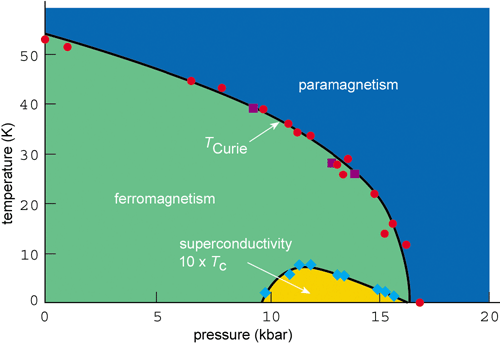
Physicists had believed that UGe2 was a good example of a so-called Ising ferromagnet. At ambient pressure, all the magnetic moments are aligned below 53 K. However, as increasing pressure is applied to the ferromagnet, the Curie temperature decreases rapidly and eventually vanishes at 17 kbars due to the presence of a quantum critical point (figure 3). Above the critical pressure, UGe2 is paramagnetic and the magnetic moments only align in the presence of a magnetic field.
3 United in uranium compounds The phase diagram of UG2 reveals that superconductivity (yellow) and ferromagnetism (green) can co-exist over a limited pressure range. No superconductivity is observed below 10 kbar, which suggests that the proximity to the critical pressure – the pressure at which the magnetic ordering and Curie temperature vanish – is crucial for Cooper pairing.
The discovery of superconductivity in polycrystalline UGe2 by Saxena, Huxley and co-workers was just part of the story. They also found that the superconducting and ferromagnetic phases co-exist up to Curie temperatures of 30 K. Since the charge carriers experience a large effective magnetic field due to the alignment of spins, triplet pairing is a sound hypothesis.
At the same time, single-crystal studies at Grenoble demonstrated that UGe2 also displays the Meissner effect, one of the hallmarks of a superconductor. Soon afterwards microscopic neutron-diffraction experiments also proved the co-existence of superconductivity and ferromagnetism in UGe2. There was even the suggestion that superconductivity might be a bulk property of uranium ferromagnets.
The real proof of bulk superconductivity was obtained last year by Naoyuki Tateiwa and co-workers in Osaka. They observed a specific-heat anomaly at the critical temperature, a classic sign of a superconducting energy gap. The anomaly indicates that at least 15% of the sample superconducts and suggests that the underlying mechanism is due solely to the pairing of electrons with spins pointing “up”.
Recently, the Grenoble group discovered that uranium rhodium germanium (URhGe) is a ferromagnetic superconductor at ambient pressure. It has many similar properties to high-pressure UGe2 – it loses its resistance below 0.3 K, exhibits the Meissner effect and has a large specific-heat anomaly at the superconducting critical temperature.
Unlike UGe2, however, no high-quality crystals of URhGe have been produced so far. When this difficulty has been overcome, the observation of a ferromagnetic superconductor at ambient pressure will open the door to the same diverse range of experiments that have been carried out on the heavy-fermion superconductors, the ruthenates and the high-temperature superconductors. Moreover, new effects are expected to appear when the ferromagnetic domain structure is modified by magnetic fields or by changing the shape of the specimen. By altering the microstructure, we can create weak links between the ferromagnetic domains that should lead to new and interesting electronic networks.
ZrZn2: a promising case
Materials that exhibit itinerant magnetism without local magnetism have attracted a great deal of interest lately because the formation of the electronic band structure is simple. Earlier this year Christian Pfleiderer and co-workers at Karlsruhe made low-temperature measurements on samples of the weak ferromagnet ZrZn2 that had been prepared 10 years earlier by Stephen Hayden, who was then at Cambridge. The results showed that ZrZn2 superconducts only when it is a ferromagnet (i.e. below the critical pressure) and not when it is a paramagnet (i.e. above Pc).
4 Intriguing materials The resistivity, rho, versus temperature as measured in UGe2 at high pressure (blue), ZrZn2 (red) and URhGe (green), and in the hexagonal-closed-packed structure of iron at 25 GPa (inset). In ZrZn2 and iron, the resistivity remains finite rather than dropping completely to zero. While this behaviour is understood in iron (see main text), it remains a mystery in ZrZn2. Curiously there are no signs of a specific-heat anomaly in ZrZn2 at the critical temperature.
ZrZn2 is a much weaker isotropic ferromagnet than UGe2 and URhGe. This means that coherent spin waves will appear below the temperature at which magnetic ordering sets in, while a transverse incoherent component will exist above. In comparison, only longitudinal modes are involved in UGe2. The big surprise was that superconductivity seems to exist up to 22 kbar and is weakly dependent on pressure, at least at low pressures. Once again there is no trace of superconductivity in the paramagnetic phase.
Curiously, the electrical resistance of ZrZn2 below the superconducting transition remains finite, rather than vanishing altogether (figure 4). In addition, there are no signs of any specific-heat anomaly at Tc. Both of these characteristics strongly indicate that superconductivity in ZrZn2 is inhomogeneous and only exists in clusters throughout the material.
Some theorists have argued that the disappearance of the Curie temperature and the superconducting critical temperature at the quantum critical point are sound justification of the phenomena. This may turn out to be the case, but the origin of the residual resistivity, and thus incomplete superconductivity, must be clarified. Either way, ZrZn2 is a promising example of a ferromagnetic superconductor and its true nature will be revealed by new experiments on crystals with improved purity.
Iron under pressure
Pressure can induce changes in crystal structure, and iron is no exception. Indeed, the high abundance of the element and the very high pressures deep inside the Earth’s core mean that the structure of iron is of special interest to geophysicists. The change in the crystal structure drastically modifies the magnetic properties of iron (figure 5).
5 Iron brews rich physics All the complexity of magnetism and superconductivity seems to appear even for a simple element like iron. The body-centred-cubic alpha phase is the well known ferromagnet (green), while if the high pressure and high-temperature gamma phase (blue) was stable at low temperatures it would form an antiferromagnet at 100 K and ambient pressure. The hexagonal-close-packed epsilon phase (purple) is non-magnetic and becomes superconducting (yellow) at low temperatures. The origin of the superconductivity in the epsilon phase and the charge-pairing mechanism remains a mystery and a source of intense debate.
The interplay of three crystal structures – dubbed the alpha, epsilon and gamma phases – and their electronic and magnetic properties can be represented on a pressure-temperature phase diagram. (The alpha, epsilon and gamma phases correspond to the body-centred-cubic, hexagonal-close-packed and face-centred-cubic crystal structures, respectively.) Moreover, the phase transitions that occur are all first order, and the transition between the alpha and epsilon phases has previously been studied in detail with the Mössbauer effect.
At low pressures and low temperatures, iron is the well known ferromagnet with a body-centred-cubic structure. As the pressure increases towards the quantum critical point at 40 GPa, the crystal structure changes to hexagonal close packed and magnetic measurements have shown the iron to be paramagnetic, rather like some heavy-fermion compounds. This suggests that spin fluctuations can occur with a rather low characteristic energy. According to Saxena and Peter Littlewood of Cambridge, this epsilon phase of iron is likely to be dominated by antiferromagnetic interactions, unlike similar structures in cobalt.
Recent resistivity experiments by Shimizu and co-workers at Osaka clearly show that the epsilon phase of iron does superconduct over a large pressure range (figure 5). The Osaka group has shown that its resistance drops by 10% at the critical temperature and it has a Meissner effect that is comparable with a reference sample of superconducting indium at 3.2 K (see figure 4). Here the finite resistance below Tc can be understood because the iron fails to turn into a pure hexagonal-close-packed structure due to experimental difficulties, and because the measurements were made with two gold leads (see lower part of intro figure).
As Saxena and Littlewood emphasized in an article in Nature about Shimizu’s work, the interest in the electric and magnetic properties of hexagonal-close-packed iron lies in the key role it plays in the inner core of the Earth and in stabilizing the planet’s magnetic field. Shimizu’s results will have a big impact as experimental groups rush to characterize the magnetic fluctuations in the epsilon phase. The first step will be to conduct resistivity measurements on a pure sample of epsilon iron and combine these finding with the Mössbauer results. The origin of the superconductivity in high-pressure iron may be antiferromagnetic, rather than ferromagnetic, but no-one knows for sure and the origin of the pairing mechanism remains a mystery.
Experiments versus theory
The theoretical debate on itinerant ferromagnetic superconductors starts with the idea of ferromagnetic spin fluctuations and predicts a superconducting phase on either side of the quantum critical point. But recent experiments reveal that superconductivity only occurs on one side. Krastan Balgoev of Boston College and co-workers have proposed that singlet pairing is restricted to the ferromagnetic phase, but their argument is, unfortunately, confined to low-energy excitations. Meanwhile, Ted Kirkpatrick of the University of Maryland has argued that superconductivity in weak ferromagnets (like ZrZn2) arises due to the coupling of longitudinal fluctuations with transverse spin waves.
For highly anisotropic materials like UGe2, Kazumasa Miyake and Shinji Watanabe at Osaka suggest that the majority of “spin-up” electrons may fulfil other conditions that lead to charge or spin-density waves with their own pairing mechanisms. Finally, classic electron-phonon coupling might also be possible in these complex materials since only the electrons on some small part of the Fermi surface may be coupled to ferromagnetism.
Goals for the future
Superconductivity and magnetism were long thought to be incompatible. Now various examples have been found thanks to improvements in the quality of samples that can be produced. The goals are to search for new examples and to formulate a theory that can explain the underlying pairing mechanism. Whenever new experimental data appear, the theoretical response is fast and leads to a number of different predictions and theories. What is clear, however, is that both the theoretical and experimental communities have been stimulated by the richness of the physics offered by these new materials. The race is now on to find a clear example of triplet pairing in a ferromagnetic superconductor.