New frontiers in superconductivity

Research into superconductivity is enjoying a renaissance. Over the past two years physicists have discovered a wide variety of materials – including iron, single crystals of carbon-60 and even DNA – that lose their electrical resistance at low temperatures. Meanwhile, power cables made from ribbons of high-temperature superconductors have been installed in Detroit and there are similar plans for Los Angeles.

Superconductivity researchers last felt the same surge of excitement back in 1986, when Georg Bednorz and Alex Müller discovered that barium-doped lanthanum copper oxide became a superconductor at 36 K – some 12 K above the previous record temperature. A flood of new materials was discovered soon afterwards. And as records crumbled, the superconducting transition temperature, Tc, climbed above the temperature of liquid nitrogen (77 K), opening up the possibility of new applications. Currently the highest known transition temperature is 130 K for a mercury-based cuprate, yet there is still no agreed theory to explain superconductivity in these materials (see Explaining high-Tc superconductors Physics World December 1999 p55).

Breakthrough for metal compounds

While transition temperatures in the cuprates were climbing to dizzy heights, however, superconductivity in metal alloys and compounds was stuck in a rut at about 20 K. But as Paul Canfield and Sergey Bud’ko describe on page 29 (print version only), the situation changed dramatically last January with the discovery that magnesium diboride superconducts at 40 K. The news sparked a worldwide race to uncover the basic properties of this humble black powder, which had been sitting on the shelf for decades. After all, a superconductor that is both easy to process and can be cooled using electrical refrigerators, rather than messy cryogens, would find many applications.

But how could physicists have failed to spot superconductivity in magnesium diboride for so long? The search for intermetallic superconductors has largely been guided by a theory developed over 40 years ago by John Bardeen, Leon Cooper and Robert Schrieffer. The predictions of BCS theory – as well as physicists’ own prejudices – has largely limited the search for intermetallic superconductors to compounds that contain light elements and transition metals.

Many physicists assumed that a more exotic underlying mechanism was responsible for superconductivity in magnesium diboride. However, the wealth of experiments that followed has proved those physicists wrong – magnesium diboride is an extreme example of a conventional superconductor.

Several groups have made magnesium-diboride wires and it could soon be possible to build lightweight superconducting magnets suitable for magnetic separation and for magnetic-resonance-imaging systems in hospitals. Not bad for a material that has only been in the physics spotlight for a year.

Theoretical challenge

Magnetism and superconductivity are usually thought of as incompatible – superconductors expel any residual internal magnetic field, while a sufficiently high magnetic field can destroy superconductivity. According to the BCS approach, the internal magnetic field in ferromagnets is expected to break apart the electron pairs that are responsible for superconductivity. However, in their article Jacques Flouquet and Alexandre Buzdin describe the recent discovery of three ferromagnetic superconductors.

With a transition temperature of less than 1K, these materials are unlikely to lead to immediate applications. However, they have revealed problems with existing theories of ferromagnetism and superconductivity that are likely to keep researchers busy for some time to come.

Crystalline organic materials are also a rich playground for exotic forms of superconductivity as John Singleton and Charles Mielke explain on page 35 (print version only). These chemically complex materials can, in fact, provide more information about superconductivity and magnetism than supposedly simple materials. Indeed, the number of papers on crystalline organic metals overtook those on high-temperature cuprates three years ago, and the gap has continued to widen.

The rapid pace of recent developments has breathed new life into an already active field. As our understanding of superconductivity grows, we can expect superconductors to make further inroads into industry, and we might even find an explanation for high-Tc superconductivity.

Physics raises food standards

Physicists know less about the temperature inside a soufflé than they do about the temperature of Venus, the late Nicholas Kurti once famously remarked. Yet the food industry uses a surprising variety of physics-based tools and techniques, including X-rays, lasers and spectroscopy, to inspect the quality of products ranging from basmati rice to sausage rolls.

Most producers visually inspect foodstuffs in the factory to identify and remove defective products and contaminants. After all, no one wants to find shards of metal in their baked beans, or stones in their sweetcorn. But visual inspection is also used to grade the quality of food, which adds value and allows producers to recover more of the end-product. For example, the ripest and best-looking tomatoes can command high prices, while the blemished and misshapen ones can be sold to make sauces or soups, rather than be thrown away. Last November physicists and retailers gathered at Woburn Abbey to discuss the latest inspection techniques at the UK Industrial Vision Association’s workshop on machine vision in the food and drink industry.

High standards matter to Jon Roe, a quality-development manager at Sainsbury’s, one of the largest supermarket chains in the UK with an annual turnover of £18bn. Roe explained that Sainsbury’s customers place more importance on high-quality produce than they do on low prices. But in order to maximize profits, food producers need to reject defective goods as early as possible in the production line.

Meaty problem

Some products – like rice and peas – can be inspected relatively easily by using automated optical-sorting machines, to look for defects such as insect damage and discolouration (see Physics sorts the wheat from the chaff Physics World June 2000 pp24-25). Other products, like fresh meat and fish, present greater challenges for machine-vision systems and currently must be inspected by hand. Roe urged physicists and engineers to design the next generation of systems that can recognize a “good” piece of meat by its colour, size and fat content. Moreover, these machines will have to be able to withstand the demands of factory life.

Indeed, meat and fish processing plants are harsh environments, as Mark Graves of Spectral Fusion Technologies in Birmingham discovered when he spent two years in a chicken factory in the Netherlands. Graves was developing an X-ray system to detect fragments of bone in fish and poultry fillets. He began by using off-the-shelf X-ray sources and detectors, similar to those found in baggage-inspection machines at airports. He soon found, however, that the chemicals and high-pressure water jets required to clean the system played havoc with the detectors, causing them to break down regularly. Moreover, the machines often failed to tell the difference between bones and thicker pieces of chicken flesh due to the relatively low contrast between the two materials.

Graves knew that a robust X-ray system dedicated to finding bones in chicken and fish was needed, and by 1995 he had founded Spectral Fusion Technologies (SFT) to develop a new machine called Bonescan.

Initially the company had a difficult job convincing the food industry to buy the machine because X-ray food-inspection systems had previously received a bad press. Graves recalls meeting a senior vice president of Tyson Foods, one of the largest meat producers in the world, at a poultry show in Atlanta in 1998. He told Graves: “X-ray inspection systems don’t work; they are inaccurate; they have too high a false-reject rate; they can’t be cleaned properly; we’ve tested them at great expense; you have nothing new to offer us – don’t waste our time. Stop calling us.” The meeting was over in 30 seconds.

But times have changed and the technology has improved. SFT has now sold 19 Bonescan machines, mostly in the US where companies fear being sued by consumers who choke on chicken bones.

So what makes Bonescan so successful? In a poultry plant, trays of filleted chicken breasts and thighs are scanned through the inspection system, which comprises a polychromatic X-ray source, filters and an array of pixellated photodiodes that have been tuned to specific parts of the X-ray spectrum. By using a range of X-ray energies, Graves and co-workers have greatly improved the contrast between flesh and bone. In particular, the absorption coefficients of the two materials differ significantly at low energies, thereby allowing defects to be revealed in detail (figure 1).

But to avoid confusing a bone with a thicker piece of meat, the researchers also have to determine the thickness of the portion at every point. They do this by exploiting the fact that the absorption coefficients of the two materials are similar at high energies and so combine images obtained at high and low energies. This combined view is then analysed by a neural network – a computer program that has previously been “trained” using thousands of images to distinguish between good fillets and ones that need to be de-boned again by hand.

Graves explains that Bonescan, which costs £250 000, can correctly identify any remaining bones 99% of the time, while the fraction of chicken breasts or thighs that it incorrectly rejects is less than 3%. However, he admits that the system has more difficulty spotting soft bloody bones, which have a similar absorption coefficient to flesh. The machine is also robust enough for factory use – it can be stripped down for cleaning in less than 20 seconds, it calibrates itself and it is simple to operate. Moreover, it can inspect an impressive 10 000 fillets every hour. In fact, Tyson Foods has completely changed its opinion and has now bought seven Bonescan machines.

Bread-and-butter physics

Image analysis is also having a big impact in the cereals industry, as physicist Martin Whitworth of the Campden and Chorleywood Food Research Association explained at the meeting. His company has developed a fast, non-destructive technique to measure the amount of bran in flour. The system, known as Branscan, allows millers to mix very pure white flour with flour of lower grade to produce an acceptable overall blend, thereby improving their cost margins.

Existing techniques involve destructive and time-consuming measurements of the mineral content or the colour of the flour. In some cases, the miller takes a sample from the production line, burns it in the lab and then analyses the residue. In other mills, the overall colour of the flour is inspected – a measurement that can take up to two minutes.

In contrast, Whitworth and co-workers have developed an on-line monitoring technique that exploits the fact that flour is pumped pneumatically to move it around the mill. A trapdoor in the duct automatically collects a small sample of flour directly from the pipeline. A series of lower-power light-emitting diodes illuminates the flour in the inspection area so that a camera can take a snapshot of the sample. Image-analysis software then searches for specks of bran, which are much larger and more irregular in shape than the flour, and computes the bran content before releasing the flour back into the pipeline. The whole process takes about 10 seconds, allowing millers to adjust the flour mixture in real time.

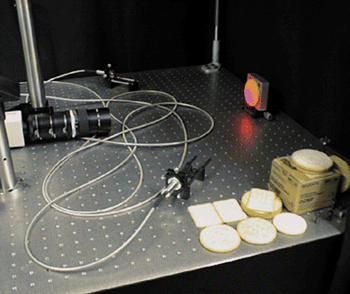
Whitworth’s group, together with Ricky Wildman and Qasim Saleem at Loughborough University in the UK, is also developing a laser-based technique to measure the strain in biscuits (figure 2). Most manufacturers package their biscuits shortly after baking. However, the non-uniform moisture content in freshly baked biscuits can lead to a build up of strain, which causes them to crack.

The researchers are monitoring exactly how this strain develops across a biscuit using electronic speckle pattern interferometry (ESPI) – a technique that is more commonly used in the automotive and aviation industry, as well as in art restoration (see Lasers in art conservation Physics World November 2001 pp37-42).

In ESPI, a laser beam is split into two: one of the beams is focused onto the biscuit, while the other beam is interfered with the reflected light. The resulting interference pattern is recorded in real time with a CCD camera and then subtracted from a reference image. So far, Whitworth and co-workers have detected strains of 10-5 and have started making measurements as a function of humidity. The results could eventually lead to improvements in the baking process, and fewer broken biscuits.

Appliance of science

Although machine-vision systems are not at the cutting-edge of physics research, it is clear that the food and drink industry offers some unique challenges for physicists. Transferring equipment from the lab and making sure it can operate almost continually in a factory environment is the real test. So next time you are enjoying a chicken burger or a chocolate biscuit, it is worth giving some thought to the physics that went into producing it.

Was Aristotle the first physicist?

In the spring of 1998 I found myself standing on the stones of the Lyceum of Aristotle in Athens. It was strange to think that for two millennia no-one had stood on this spot and known the significance of the place. The location of the Lyceum – the world’s first university – had been roughly known to archaeologists, but the serendipitous discovery of it by Ephi Ligouri in 1997 was without doubt one of the most momentous classical discoveries of modern times.

By persistence and immense good fortune, I found myself being shown round the site – which was at the time still closed to the public – by Ligouri herself. The site is large – some 50 metres across – and consists of the exposed foundations of a large building sitting on bedrock. When Ligouri realized that she had stumbled on a “gymnasio” – a building given over to physical exercise and training – she knew at once that it must have been the Lyceum. It was not exactly in the location traditionally assigned to the Lyceum, but the site satisfied all known requirements: to the east of the city walls and on the banks of the river Iliso.

Archaeologists were still working on the site when I visited. However, the future of the site, which is intended to be the venue for a museum of modern art, remains uncertain. The dig was an emergency one before concrete foundations were to be poured onto the site. I hope that these foundations will never be laid. Given its significance in the history of western culture, this is a building that must be preserved for posterity.

Aristotle’s Lyceum provided the world’s first comprehensive set of courses on all aspects of knowledge. Although the little room where Aristotle probably taught had space for perhaps just 10 students, the scope of the courses that he gave there, which miraculously survive today in some 30 books of his lecture notes, was phenomenal. It is hard to believe they were written by a single person.

Aristotle had an extraordinary range of interests and learning. His courses included philosophy, logic, astronomy, physics, biology, meteorology, poetry, drama, ethics, politics, psychology and economics – in fact, many of the subjects of a modern university. Some of his biological insights were not rediscovered until the 19th century and his logic was not superseded until the work of Gottlob Frege in the early part of the 20th century.

Born in northern Greece in 384 BC (see box), Aristotle’s ideas dominated western science and philosophy for nearly 2000 years, from his death in 322 BC until Galileo’s destruction of his mechanics in 1609. Unfortunately, with the rise of modern physics over the past three centuries, Aristotle’s achievements have been eclipsed. We honour the thinkers of antiquity who guessed right – the atomic theory of Democritus, the heliocentric view of Aristarchus – but not the man who we can truly say invented science. For his physics and astronomy, Aristotle has become identified as the barrier to scientific progress in the renaissance.

After he died, Aristotle’s books, which represent perhaps just one-third of his total output, are said to have been buried in a cave in Asia Minor for 200 years. Although the Peripatetic philosopher Andronicus did prepare an edition of Aristotle’s works in Rome shortly after their rediscovery, they were entirely lost to Europe following the fall of the Roman empire. It was not until the 11th and 12th centuries – thanks to Arabic translations from the Islamic kingdoms of Sicily and Spain – that his writings were rediscovered in Europe.

The modern view of Aristotle

The image of Aristotle we have today is profoundly affected by Galileo’s attack on his physics and on his world view. We are left with the idea that Aristotle represents all the worst aspects of medieval philosophy. Plato, on the other hand, is still cited with approval by theorists and mathematicians, who love to imagine that their ideas represent some underlying reality about the universe.

A fairly characteristic view of Aristotle is given by the physicist J D Bernal in his book Science in History (1969 Penguin). “Bruno had to be burnt and Galileo condemned before doctrines which were derived from Aristotle…could be overthrown,” he wrote. “The subsequent history of science is largely, in fact, the story of how Aristotle was overthrown in one field after another. Indeed Ramus was not far from the mark when he maintained in his famous thesis of 1536 ‘that everything Aristotle taught is false’.”

Of course, Aristotle’s incorrect picture of the Earth as the centre of the solar system had to be overthrown, as did several aspects of his dynamics, in order for the new physics of Galileo and Newton to emerge. But we are left with a diminished and usually inaccurate view of Aristotle’s views and work. After all, many of Aristotle’s insights and hypotheses were not superseded until well into the 19th century. His concept of a uniform, ever-flowing time was adopted unaltered by Newton and still has its place in relativistic physics in an inertial frame. We can surely not fail to take seriously someone whose scientific ideas are still alive after more than 2000 years.

Aristotle’s dynamics

Some insight into Aristotle’s scientific views can be obtained from his two great works on physics – Physics and On the Heavens. Aristotle had no mathematical machinery for dealing with the concept of acceleration, so he analysed only states of uniform velocity. He did not analyse frictionless uniform motion because such motion is not seen in the world. It was not until Newton that this Platonic concept of uniform motion in a straight line under no force was seen to be fundamental to dynamics.

The first state that Aristotle did analyse was motion under a constant force resisted by friction – such as a body of mass m being pulled or pushed along the ground. The corresponding Newtonian equation of motion is mdv/dt = F – µmg, where dv/dt is the acceleration, µ is the coefficient of friction, and g is the acceleration due to gravity. For uniform motion we then require, as stated by Aristotle, that a constant force (equal to µmg) must be exerted to overcome friction.

The second state analysed by Aristotle is uniform motion through a resistive medium like air or water – such as a body in free fall through a viscous medium. This was first correctly analysed by Stokes in the 19th century, who recognized that the resistive force is proportional to the velocity. For a slowly falling sphere of radius r then (neglecting buoyancy) mdv/dt = mg – 6 pi rnv, where n is the coefficient of viscosity. Thus the terminal velocity achieved by the falling body is v = mg/6 pi nr.

Aristotle, however, stated that the terminal velocity is inversely proportional to the cross-sectional area, rather than the radius. In place of the coefficient of viscosity, he talked of the “thickness” of the medium. “The medium causes a difference [in the motion],” he wrote, “because it impedes the moving body, most markedly if it is moving in the opposite direction, but to a lesser degree even if it is at rest; and this is particularly true of a medium that is not easily cut through, i.e. a medium that is on the thick side. A body will move through a given medium in a given time, and through the same distance in a thinner medium in a shorter time, in proportion to the thicknesses of the hindering media.”

In other words, Aristotle came close to a correct statement of Stoke’s formula for the terminal velocity in a resistive medium. His analysis of the real, frictional and viscous world is therefore superior in some respects to that of Newton. Newton’s great advance was to deal with accelerated motions. Aristotle was aware that accelerations took place, but he was not able to incorporate them quantitatively.

In retrospect, the Achilles’ heel of Aristotle’s theory was his treatment of bodies moving against slight resistance. The problem is that the Stokes-Aristotle terminal velocity becomes very large as the viscosity tends to zero (as in air) and becomes infinite in the limit of a vacuum. Aristotle responded by saying a vacuum was impossible, but this still did not obviate the need to consider accelerations properly for motion of a projectile in air.

Another fundamental insight of Aristotle’s that was not correctly formulated in the Newtonian programme was the concept of power. Aristotle correctly defined the power of a machine lifting a body as being the weight multiplied by the distance moved, divided by time – in other words the rate of doing mechanical work. He also, very practically, pointed out that there is a threshold to get something moving when there is resistance by friction – “One man cannot move a ship,” as he put it.

Cosmological insights

Aristotle had a reasonably clear notion of buoyancy – that a denser body sinks through a medium while a lighter one rises. He elevated this to a universal process of bodies either seeking the centre of the Earth or moving away from it, depending on whether they are lighter (hot air or fire) or heavier (earth) than air or water. When he considered if the Earth itself could be moving round the Sun, he found that this idea conflicted with the seemingly more powerful notion of a natural motion towards or away from the centre of the Earth.

This led him to postulate that the circular motions of heavenly bodies about the Earth once a day must also be one of the possible natural states of motion. He also had to argue that the universe is finite to avoid infinite circular velocities at the periphery. This picture is another reason why he rejected the idea of uniform motion in a straight line, because it would have implied the concept of an infinite straight line, which is not permitted in a finite universe. Aristotle reduced all forces to pushes or pulls and could not conceive of gravity holding the planets in circular orbits. He did, however, see that forces act at a point and have a definite direction, i.e. that force is a vector.

Aristotle also showed some surprising insights into astronomy. He thought that the stars were at a range of distances from the Earth, and believed that the stars were spheres. Thus the crude medieval picture of the stars as “holes” in the surface of a sphere that let through light from behind had absolutely nothing to do with Aristotle.

Perhaps Aristotle’s most enduring contribution to cosmology was his concept of a uniform ever-flowing time. This was taken over without modification by Newton and was not questioned until the rise of relativity theory at the start of the 20th century. In the special theory of relativity, the rate at which time flows depends on the relative motion of the observer and the clock, although an inertial, uniformly moving observer would still see a uniform time pervading the universe within his or her own frame of reference. In general relativity, the patch over which a freely falling, inertial observer can measure such a uniform time becomes localized to the zone in which the gravitational field is uniform.

Amazingly, though, when we apply general relativity to a homogeneous and isotropic universe – and there exist strong observational reasons for supporting such a model – Aristotle’s uniform cosmic time pervading the universe reappears. Moreover, it is the same time for every observer co-moving with the universe. I find this one of the most paradoxical features of the universe we appear to find ourselves in.

The goal of Aristotle’s physics was to be able to comprehend all phenomena. Newton’s programme was different: he wanted to analyse and predict a subset of the phenomena that are amenable to equations. Goethe made one last-ditch attempt to reinstate this Aristotelean goal of comprehending and experiencing the unity of nature. Although Goethe’s impact on literature was immense, his assault on Newtonian physics failed completely.

Aristotle in perspective

Aristotle’s set of courses at the Lyceum must have been a wonderful experience. In some senses, however, his physics and astronomy were the least successful of his works. His biology was much more potent and permanent in its influence. His ethics, as popularized by Montaigne, permeate the plays of Shakespeare, and remain close to being a unifying core of decency in human history – the middle way to which we escape from the excesses of the Platonic idealism of the world’s religions and cults.

Aristotle’s views on drama still influence the theatre of today – we still speak of the cathartic effect of tragedy – and his precepts were still taken extremely literally by 17th-century playwrights like Ben Johnson and Jean Racine. This was a teacher who loved science and loved poetry, whereas Plato rejected both.

Standing on the stones of the Lyceum, I could hear again the words of the greatest teacher in western culture: “One swallow does not make a summer, and a single day does not make a happy life.”

Aristotle in a nutshell
Born in 384 BC in Stagira, part of ancient Macedonia in northern Greece, Aristotle went at the age of 18 to Athens to study at Plato’s Academy. He stayed there for 19 years, becoming a teacher and independent researcher. But on Plato’s death in 347 BC, Aristotle was forced to leave. It is tempting to speculate that while Plato was a great enough spirit to tolerate – and even encourage – Aristotle’s completely anti-Platonic line of thought, Plato’s disciples could not tolerate the man who should have been Plato’s successor as head of the academy.

For the next 12 years, Aristotle was forced to live in various places around the northern Aegean Sea. It was during this period that Philip of Macedon summoned him to be tutor to his son Alexander for three years. In 335 BC the hegemony of Philip over Athens allowed Aristotle to return the city, where he founded the Lyceum as a rival to the Academy.

He taught there for 12 years and the 2000 pages of his surviving collected works represent the notes he used for his lectures. He also prepared books for publication, which were reputed to be beautifully written, although none has survived. In 323 BC, with the death of Alexander the Great and the loss of Macedonian control of Athens, Aristotle was forced to leave Athens. He died a year later in Asia Minor, aged 62.

Back to text

Life after another RAE

Some 15 years and four RAEs later, departments are no longer judged against some statistical average but in terms of the quality of their research as measured against national and international standards: a grade 5, for instance, now means “quality that equates to attainable levels of international excellence in up to half of the research activity submitted and to attainable levels of national excellence in virtually all of the remainder”. Moreover, a 5* grade has been introduced for the very best departments.

Some 49 physics departments entered the 2001 RAE (see news story). The improvement on 1996 has been dramatic: of the 1668 physicists entered for the exercise, 78% work in departments rated 5 or 5*, compared with 54% in 1996, when 10% fewer physics staff had been entered. Moreover, five departments walked away with one of the prestigious 5* grades. A common feature of Imperial College, Lancaster and Southampton – the three departments that have joined Cambridge and Oxford in the 5* elite – has been their decision to focus on their strengths and to invest in new growth areas, often guided by external advisory committees. They have also joined their ancient rivals in acquiring a taste for champagne. While Imperial, with 100 staff entered in the exercise, is a large department like Cambridge and Oxford – Lancaster and Southampton, with 20 and 30 research-active staff, respectively, show what can be achieved in much smaller departments.

So what do the ratings mean in reality, besides self-esteem and a feel-good factor? Good ratings should help departments to attract additional research grants and better staff and students. Indeed, the grades plug directly into the algorithms used by the UK’s regional funding councils to allocate their budgets for research. However, the overall improvement in ratings, combined with the limited amount of funds, means that in England there will actually be a reduction in funds for departments below the 5* level – which is sure to rankle departments that have worked very hard to gain or retain grade 5 status.

The Labour government has a good record in supporting research, but given the large sums that universities are already demanding to meet the government’s aim that, by the end of the decade, 50% of young people should have the opportunity to benefit from higher education by the time they are 30, the chances of significant additional funds for research look slim. What is more likely to happen is that universities will have to compete for funds in a raft of special one-off schemes, with the stronger getting even stronger.

The picture that emerges from the RAE is probably rosier than that painted by the recent report on physics and astronomy in the UK prepared by an international panel of researchers (see Physics World June 2000 p5, print version only). That report concluded: “At its best, research in physics and astronomy in the UK is at the very highest level world-wide. Beneath the peaks of scientific excellence, however, UK physics research quality noticeably drops.”

One of the great missed opportunities of the RAE is that the output is just a list of grades without any comment or analysis. Together the RAE and the international panel’s report confirm the overall strength of physics and astronomy research in the UK – but given the ongoing pressure on university funding, those working beneath the peaks of scientific excellence may soon find themselves endangered species.

New look for Bose condensates

Immanuel Bloch and colleagues at the Ludwig Maximilians University in Munich, the Max Planck Institute for Quantum Optics, also in Munich, and at ETH Zurich in Switzerland started by cooling a gas of rubidium atoms until they formed a Bose-Einstein condensate – a novel state of matter in which all the atoms collapse into the same quantum state. The condensate was stored in a magnetic trap and then illuminated by six laser beams. These beams formed a three-dimensional energy landscape known as an optical lattice. The peaks and troughs in the landscape form a perfect cubic lattice.

When the potential depth – the energy difference between the top of a peak and the bottom of a trough – was small, the rubidium atoms were able to move freely between the troughs. This is the normal superfluid state of a Bose condensate. However, when the potential depth was enlarged by increasing the laser intensity, the atoms were no longer able to move freely throughout the condensate: such a state is known as a Mott insulator.

In quantum terms, the transition occurs between a superfluid state in which all the atoms have the same quantum phase and the number of atoms in a trough can fluctuate, and an insulating state in which the phase varies but the number of atoms in a trough is fixed. The transition was reversible and the insulating state could be changed back to the superfluid state by reducing the laser intensity again.

Ultracold gases are much ‘cleaner’ and easier to control than the usual solid-state systems that are used to study quantum phase transitions. The techniques developed by the Munich-Zurich team could also have applications in quantum computation.

Leading neutron lab appoints new director

Neutron scattering is a powerful probe of the properties of matter, from biological materials and chemical compounds to sub-atomic particles. ILL was established in 1967 by France and Germany to provide the international scientific community with a powerful source of neutrons for structural research, which it generates with its high-flux reactor. The UK became an equal member of the laboratory in 1973, and the Engineering and Physical Sciences Research Council now funds its share of a third of the budget. Six other European countries have since become partners of the laboratory. Carlile succeeds Dirk Dubbers as director of ILL, who is returning to the University of Heidelberg in Germany.

CERN to find funds for costly collider

At the meeting, the council approved the contract for the magnets for the Large Hadron Collider – the components that pushed the project over budget. Among measures agreed to help pay for them was the establishment of five task forces, which will identify potential savings and restructure the management of the lab’s resources.

The directors also agreed that an External Review Committee should be established to analyse the finances of both the LHC and the rest of CERN’s scientific programme. The committee’s first report will contribute to the lab’s medium- and long-term financial plans, which will be drawn up at the council’s next meeting in March 2002.

The LHC is the next-generation replacement for the Large Electron-Positron Collider, in which hints of the elusive Higgs boson were seen just before it was decommissioned last year. It will collide protons together with a centre-of-mass energy of 14 TeV.

Uncertainty over muon result

In February the Muon (g – 2) experiment at Brookhaven reported a value for the magnetic moment of the muon that disagreed with the Standard Model prediction by 2.6 standard deviations. This meant that there was only a 1% chance that the results were due to a statistical fluke. The g-factor of a particle relates its intrinsic angular momentum or ‘spin’ to its magnetic moment.

Simple quantum theories predict that g=2 for particles such as electrons and muons. However, radiative corrections that cause the continuous emission and re-absorption of short-lived virtual particles means that g is not exactly equal to 2. These radiative corrections can be caused by familiar particles from the Standard Model or by more exotic particles not included in the model. Precise comparisons of the predicted and measured values are therefore a good way to search for new physics beyond the Standard Model.

However, when Marc Knecht and Andreas Nyffeler of the Centre for Theoretical Physics in Marseilles checked the theory, they discovered that three groups had miscalculated a quantity known as the pion pole contribution. All three had found the contribution to be -55.6 x 10⁻¹¹ when it should have been 55.6 x 10⁻¹¹.

When the Standard Model calculation is repeated with the correct value, there is a 13% chance that the difference between theory and experiment is due to a fluke. The experimental team is currently analysing additional data from the muon g – 2 experiment, and will announce its results “sometime this winter or early spring”.

UK research hits new heights

The RAE was carried out by 60 panels of experts, who monitored the quality of research in every university department in their field. Each department was awarded one of seven grades ranging from 1 (the lowest) to 5*, depending on how much of the work was judged to have reached “national” or “international” levels of excellence.

Five physics departments – Cambridge, Imperial, Lancaster, Oxford and Southampton – received a prestigious grade 5*, with Lancaster, Southampton and Imperial winning the top grade for the first time. Twenty-two departments were awarded a grade 5 – twice as many as in 1996 – while only 15 received a grade 4, down from 26 last time. Only seven departments were given the next lowest grade, compared with 13 in 1996.

The physics panel awarded its marks using a range of criteria, including the quality of at least four cited pieces of work submitted by every “research active” member of staff. Other factors included research income, numbers of post-docs and students, and time allocated for experiments at central facilities.

Qualitative factors such as the presence of high-profile departmental visitors and the award of major prizes also counted towards the final grade. The grades are used by the UK’s regional funding councils to work out how much money each university should receive to pay for labs, facilities and the salaries of permanent staff. The funding is skewed so that higher-rated departments receive more money.

But do the better grades reflect a genuine improvement in the quality of physics research or do departments simply know how to “play the game” by making submissions that stand more chance of scoring highly?

John Enderby of Bristol University, who chaired the physics panel, is convinced that standards have risen. “The quality of research in the UK is extremely high,” he says. “Everyone on the panel felt very comfortable that the grades we’d awarded were right. We also asked experts from outside the UK to look at departments rated 5 and 5* – and they agreed completely with our decisions.” Enderby adds that the threshold for a grade 4 has risen since the last RAE, which means that even those departments who remained on that grade have actually improved.

Research Assessment Exercise 2001

Departments are awarded one of seven grades: 1, 2, 3b, 3a, 4, 5, 5* (the highest).

University 2001 1996
Aberystwyth 4 4
Armagh Observatory 4 4
Bath 4 4
Birmingham 5 5
Brighton 3a 1
Bristol 5 5
Cambridge 5* 5*
Cardiff 5 4
Central Lancashire 4 3a
City 4 –
Durham 5 5
Edinburgh 5 5
Exeter 5 4
Glasgow 5 4
Heriot-Watt 4 4
Hertfordshire 4 4
Imperial College 5* 5
Keele 3a 3a
Kent 3a 3a
King’s College London 4 4
Lancaster 5* 3a
Leeds 5 5
Leicester 5 5
Liverpool 5 5
Liverpool John Moores 4 4
Loughborough 4 3a
Manchester 5 5
Newcastle a 4 4
Nottingham 5 4
Open 3a 3b
Oxford 5* 5*
Paisley 3a 1
Plymouth 3a –
Queen Mary 5 4
Queen’s Belfast 5 5
Reading 4 4
Royal Holloway 5 4
Sheffield b 5 4
Sheffield Hallam 3a –
Southampton 5* 4
St Andrews 5 4
Strathclyde c 4 4
Surrey 5 4
Sussex 5 3a
Swansea 5 4
UMIST 4 4
University College London 5 5
Warwick 5 4
York 4 4

Top of table

Notes
a: Surface, nanoscale science and technology group “flagged” by the physics panel – i.e. considered to be at least two points above the overall departmental grade.
b: Sheffield result for physics and astronomy; it also received a grade 5 for medical physics and clincial engineering.
c: Computational non-linear and quantum optics group flagged.

Single-photon machine gears up

Quantum dots are nano-sized deposits of one semiconductor embedded in another semiconductor. The dot material has an energy bandgap that is smaller than that of the surrounding material, and this allows it to trap charge carriers.

Shields and colleagues deposited an array of indium arsenide quantum dots in a layer of undoped gallium arsenide, which they sandwiched between layers of hole- and electron-doped gallium arsenide. The team then applied voltage pulses across the structure.

These pulses force positive holes from the hole-doped layer and electrons from the electron-doped layer into the undoped layer, which contains the quantum dots. Due to its low potential energy, each quantum dot can capture a hole and an electron, and these combine to produce a single photon. A tiny aperture on top of the device allows photons from just one of the quantum dots to escape.

Shields and co-workers designed their generator to emit infrared photons, which corresponded to the sensitive region of their single-photon counter. But according to the team, the quantum dots can be tuned to emit light at a range of wavelengths, including 1.3 micrometres – the wavelength used in fibre optic communications. Dots that generate photons with longer wavelengths are also efficient above 5 kelvin, the temperature at which the current device operates.

Until now, single-photon generators have been driven by lasers, and this makes them bulky and impractical. Previous devices that were electrically driven only worked at millikelvin temperatures.

“A single photon source is a building block for a wide range of applications in quantum information technology, of which secure optical communications is the most immediate”, says Shields. “In the future we may see that quantum effects enable many new optical technologies, rather like the laser did a few decades ago”.

Copyright © 2026 by IOP Publishing Ltd and individual contributors