The Marconi story (see article) has featured a cast of interesting characters. Marconi himself was a larger-than-life scion of a wealthy Irish-Italian family, an energetic mix of entrepreneur, inventor and playboy. Until the mid-1990s the Marconi legacy was maintained by GEC, which was Britain’s largest manufacturing company, with interests ranging from defence to medical electronics. For many years GEC was presided over by Arnold (later Lord) Weinstock, who gained a reputation for being a successful, if cautious, leader. Criticisms focused on the large cash reserves that Weinstock maintained when, critics argued, he should have been spending more on R&D and acquisitions.
The same criticisms cannot be levelled at Weinstock’s successor, George (later Lord) Simpson, who took over in 1996. Simpson decided to sell the company’s defence and aerospace interests, and to focus on the communications sector, which at the time was thriving. GEC was renamed Marconi to symbolize this new direction.
Business was good for a while, but 2001 will be a year to forget for Simpson and Marconi: recession, the collapse of the dot.com bubble and the decision of many telecommunications companies to delay investments in new network infrastructure and equipment hit the company hard. Moreover, some of the companies that Simpson bought with the cash reserves have proved to be worthless. However, Marconi has been not alone in posting multi-billion pound losses, and Lucent Technologies, Nortel and others have all suffered large reverses.
Simpson has since left the firm and a new management team is trying to bring Marconi’s £4bn debt under control and revive the company’s fortunes. Its medical-systems business has been sold to Philips and the workforce in its core business is scheduled to fall to 29 000 in March 2002, a reduction of 10 000 over the course of the year. The company will remain focused on communications – optical networks and broadband technology in particular – and plans to maintain investment in R&D at 11% of revenue. This will involve some reduction in the number of R&D staff but plans will not be finalized until next February.
In the short term Marconi’s fortunes will depend more on its bankers than on its research and development staff. However, it would be shame if a physics-based company with such a long history – many famous high-tech companies have come and gone over the same time frame – should go under with a brave new world of broadband and third-generation wireless technology on the horizon.
Hawking made easier
Stephen Hawking’s new book, The Universe In A Nutshell, receives a favourable review in this issue. It will come as a relief to readers who are not professors of astrophysics to read that our reviewer, who is a professor of astrophysics, finds some of Hawking’s ideas difficult to follow, although this latest work is much more accessible than A Brief History of Time. However, by showing that there was a huge latent demand for popular books about the frontiers of science, Hawking’s bestseller has had an immensely beneficial effect – irrespective of how many copies lie unfinished on coffee tables around the world.
During the last century great strides were made in understanding the structure of the universe and the overall processes that drive its evolution. The utter vastness of the cosmos became apparent following the discovery that although our own galaxy is gigantic, it is just one of many billions of galaxies scattered throughout the universe. The sheer physical size of the universe makes it even more remarkable that the evolution of galaxies is directly linked to physical processes that occur on the smallest scales – the reactions between atomic nuclei.
Now recent results by Art Champagne and co-workers at the University of North Carolina in the US look set to overturn a long-held view about one of the most important nuclear processes that occurs in stars (P Bertone et al. 2001 Phys. Rev. Lett.87 152501).
Stellar evolution
Our current understanding is that the outpouring of energy from stars, and the continual conversion of one element to another inside them, is the direct result of reactions between nuclei. There are many different types of stars and each has its own unique set of nuclear reactions that change in character as the star evolves, in particular towards the end of its life. By looking at the whole picture, it has become clear that the evolution of the universe is driven by several thousand different nuclear reactions, many of which we have limited or no knowledge of at all.
It is almost impossible to measure all of these reactions on Earth, so it is vital to identify the most important ones and concentrate our efforts on understanding them. This is a sensible approach since certain macroscopic properties of a stellar process are often dominated by the properties of a single nuclear reaction.
According to our current knowledge, the main source of energy that sustains burning stars for millions to billions of years comes from two different nuclear processes, both of which convert hydrogen to helium. The first is called the p-p process and dominates the Sun. It involves the fusion of two colliding protons to produce deuterium (an isotope of hydrogen that contains one proton and one neutron), a positron and a neutrino via the weak force. The deuterium, in turn, interacts with another proton by the strong nuclear force to form helium-3, which can then combine with another helium-3 nucleus to finally form helium-4 and two protons. The energy released in this process is due to the final particles having smaller mass than the initial particles.
The second process, known as the CNO cycle, is not important in the Sun but it does dominate heavier stars. Here protons interact with light nuclei, such as carbon, nitrogen and oxygen, rather than with other protons. The actual reaction process is the fusion of a proton with the nucleus, resulting in the emission of a high-energy gamma ray. In fact, the sequence is really a cycle of reactions passing through isotopes of carbon, nitrogen and oxygen, ending with the reaction 15N + p –> 12C + 4He. The carbon nucleus in the final state is then available to go through the sequence again. The net result of this cycle is the conversion of hydrogen to helium, with the carbon nuclei simply acting as catalysts.
For each of the two processes, the factors that dominate the energy output are the mass difference between the initial and final particles, and the rate at which the reactions can occur. One of the slowest reactions in the CNO cycle is the fusion of protons with nitrogen-14 nuclei to produce oxygen-15. The rate of this reaction therefore has an important influence on the energy released by the CNO process and, consequently, on the brightness and lifetime of a star.
Challenging measurement
Over the past 40 years nuclear physicists have been trying to measure the rate of the reaction p + 14N –> 15O, yet there is still considerable uncertainty about its value. The problem lies in the fact that it is difficult to measure the rate at the thermal energies relevant to stellar interiors. Although these temperatures are high, on the order of 100 million degrees, the corresponding reaction rate is extremely small, making it difficult for it to be measured directly in the laboratory.
In 1987 Claus Rolfs and co-workers at Münster University in Germany and Toronto University in Canada investigated this reaction directly by detecting the emission of high-energy gamma rays from the oxygen-15 nuclei (U Schröder et al. 1987 Nucl. Phys.A467 240). However, the rate was only measurable for protons corresponding to effective temperatures many times hotter than the interior of stars. Rolfs and colleagues therefore deduced the reaction rate at lower temperatures by extrapolating the measured data. For this extrapolation to work successfully, however, they had to fit a model of the reaction process to their measurements.
Such a model had to include the possibility that the reaction proton could be captured into an excited state of oxygen-15 that then de-excites by emitting a gamma ray – a route called resonance capture. The model also had to account for the direct process in which the proton is captured by nitrogen-14 but not into an excited state of oxygen-15.
What makes this modelling particularly difficult is that the excited states of oxygen-15 – including those that are lower in energy than the threshold for fusion – can spread their influence over a wide energy range. As a result, Rolfs and co-workers found their model had to include direct-capture and resonant contributions from several oxygen-15 states to explain the data at high temperatures, including a state that lies some 500 keV below the energy threshold. With this model, they could extrapolate the reaction rate to astrophysical temperatures.
Soon after Rolfs’s group published its work, however, it was speculated that the extrapolation of the fit might be incorrect since it predicted that the sub-threshold state had a larger energy spread than expected. According to the uncertainty principle, this meant that the state had a lifetime of only 0.1 femtoseconds (1 fs = 10-15 s).
Now Champagne’s team at North Carolina has measured the lifetime of the state directly and shown that it is some 15 times longer than the value inferred by Rolf and co-workers. The North Carolina lifetime measurement is very impressive as it pushes to the limit a technique that is based on the slow down of a de-exciting nucleus. The radiation that is emitted by the nucleus as it decelerates is Doppler shifted by an amount that is related to the lifetime of the state.
Now that the lifetime of the sub-threshold state has been shown to be much greater than previously thought, we realize that its influence on the rate of the p + 14N –> 15O reaction at astrophysical energies is significantly smaller than that inferred by Rolfs and co-workers. The upshot is that the astrophysical fusion rate is about a factor of two smaller than previously accepted. As a result, the CNO cycle will release energy at a slower rate, thereby increasing stellar lifetimes. For example, the main-sequence stars in globular clusters will be several hundred million years older than we thought.
The experiment confirms how processes associated with the smallest units of matter have an enormous influence on the evolution of the largest structures in the universe. Moreover, it shows that a phenomena lasting just 10-15 seconds can significantly affect the lifetimes of stars.
This review first appeared in the news section of PhysicsWeb on 8 November.
It is said that one of the world’s most eminent quantum-gravity theorists was once asked to explain in his institution’s annual report what he did. He declined, claiming that his work was far too complicated for the general public to understand. All the more credit to Stephen Hawking for having seized the challenge.
Hawking’s previous attempt at popularization – A Brief History of Time – succeeded in sales beyond his wildest dreams. However, I never managed to steer my way through the realm of imaginary time and neither, I would guess, did 99.9999% of the other 25 million or so readers. Indeed, one can be virtually certain that very few of them went beyond chapter 3.
In fact, Hawking has got the message. The Universe in a Nutshell is different. It is far more accessible, and it is full of Hawking’s wry humour. One can select chapters to read without needing to have mastered earlier chapters. One can even cherry pick the juicy bits with little loss of content. And the highlights are well worth reading, in large part because of Hawking’s caustic asides and his infallible optimism.
The ebb and flow of time is a recurring theme that appears and reappears in the book. I must confess that I have still not completely got to grips with imaginary time, but the nutshell metaphor conjures up a much warmer image. The nutshell represents a “hypersphere” in which the roles of space and time have become reversed. It provides a somewhat individualistic approach to quantum gravity, but one that is near to the forefront of current research. In a nutshell, this mixing up of space and time is what happens just inside a black hole as one approaches the black-hole horizon and crosses the point of no return. This is standard black-hole physics, as laid down by Einstein’s theory of gravitation, the theory of general relativity.
The classical view of a black hole is marred by one ugly feature: at the core of the black hole lies a singularity. This is a forbidding concept, since literally all hell may break loose should one get too near to the singularity. Hawking is convinced that such a singularity is never accessible, or “naked”: it is always shrouded by the black-hole horizon. In other words, we can live our lives without undue fear of the horrors of confronting a singularity, with the inevitable breakdown of the physical laws that govern our existence and even our sanity.
Were we to find a naked singularity, it would immediately allow us to extract unlimited resources from other universes. Miracles could be performed. Time travel would become feasible, since space and time reverse their roles. One could travel in time, either far into the future to escape any of the unfortunate calamities of our current era, or into the past, to pursue our dreams of long-lost Elysian fields.
It is this prospect that horrifies Hawking, for one could, if sufficiently perverse, go back in time, seek out one’s grandfather in his infancy, and murder him in order to challenge future generations of physicists. For now our notions of causality would be overturned: the impossible is possible, and there is a fundamental contradiction in the laws of physics.
Kip Thorne proposed a solution to this paradox. Quantum gravity, he argued, tells us that such ventures are subject to the laws of uncertainty. The probability of actually finding a particular individual at a particular place and time would be vanishingly small. Time travel is a good exercise for the statistically inclined. Hawking’s take on time travel is different: he argues that one could never succeed in constructing a workable time machine.
In one of the great tours de force of modern cosmology, Hawking – working with Roger Penrose – predicted that if the universe were causal, and time machines could never exist, then the universe must have begun from a physical singularity. This would be a catastrophe for cosmologists with fundamentalist inclinations.
As with religious movements, cosmologists who deal with the very early universe fall into two schools: the phenomenologists and the fundamentalists. The former deal with data, adopting empirical theory with its lack of rigour and all of its inevitable flaws to match. The latter start from pure mathematics, appeal to beauty and simplicity to guide the physics, and say to hell with any data that happen to clash with the theory. Not that there is usually much in the way of data, apart from rare exceptions.
Here is where the nutshell cosmology enters. The flaw in the deduction about the past singularity is that the theory of general relativity made no allowance for quantum gravity. According to Hawking, quantum gravity mathematically (thanks to imaginary time) provides a dual and singularity-free description of the universe, in which the roles of space and time are reversed. Time has no boundaries, nor does space.
Can we believe a word of this? The answer seems to be that as long as two alternative theories make identical predictions, it is meaningless to debate which one is true. This is positivist thinking. Theory never advances by proving anything is actually true, but rather by leading to predictions that conflict with observable data. All we can ever hope to do is to falsify a theory; then we move on to the next one.
The nutshell theory makes absolutely no predictions that are verifiable, at least not yet. But then neither does its immediate rival, superstring theory, now incorporated into the theory of M-branes, which consist of higher-dimensional space-time manifolds collectively called “p-branes”, where p stands for any integer that represents the dimensionality of space. Physicists would very much like to be able to predict p from first principles.
We know that p cannot be 1 or 2, for we would be, respectively, sausage-like or pancake-like, with the accompanying adverse effects on our digestive systems, among other problems. Quantum gravity can be resolved, at least in principle, in spaces of higher dimensions. This has been one of the great messages from superstring theory. Troublesome infinities (and infinity really is troublesome to a physicist) can be removed if we settle for p in some higher-dimensional space. The preferred number is 10, although some hold out for 4. Certainly 3 is insufficient, for one needs the extra freedom of higher dimensionality.
However, there is a price to pay. The nutshell – and indeed any quantum-gravitational theory – gives rise to too many descriptions of our past. Most can have no bearing on reality. The universe would not resemble our observed universe. It might be immensely more chaotic or quiescent. Either would be a disaster for the predictive power of a fundamental theory. In the absence of any predictions, this line of reasoning about possible outcomes only takes us so far. Hawking, in good company, supplements it with the “anthropic principle”.
Scientists, especially cosmologists, love principles. After all, the cosmological principle carried Einstein far, if at first in the wrong direction. The anthropic principle asserts that the universe is just so because we are here. If it were any different, there would be no cosmologists to observe it (see “Life, the cosmos and everything” Physics World October pp23-25).
One can now supplement the cosmic nutshell with this cosmic principle, and our very own big bang emerges. One can understand, so we are told, why the universe is so vast and relatively uniform, and why it is just beginning to undergo a phase of acceleration away from the big bang.
So we seem to be in good shape. Never mind that the most powerful minds in physics, so they tell us, have been working on superstring theory for two decades and have yet to show us a single unambiguous and experimentally verifiable prediction. Certainly, it is a phenomenally difficult theory. Is the anthropic principle part of the solution? I do not wish to overly dampen the party spirit, but I am underwhelmed by it.
The anthropic principle is one of the more remarkable swindles in physics. Indeed it is metaphysics, and that is the essence of the problem for most physicists in accepting it. The anthropic logic is either immensely subtle, by arguing that we, via our mere existence, control the cosmos, or unabashedly naive, by setting aside any physics explanations that any ultimate theory of physics might reasonably be expected to deliver. Metaphysics lacks predictive power, the very core of physics. The anthropic principle is an extreme expression of our ignorance.
It may well be that the ultimate theory of cosmology will have anthropic ramifications. We are some way yet from this promised land. In the meantime, Hawking’s book is a delight to read. It discusses questions that are at the forefront of current thinking about quantum gravity, yet for the most part is highly readable. It conveys the author’s sense of wonder and awe at the cosmos, and – like a child stepping into the darkness – illustrates his tentative gropings towards the ultimate theory of everything.
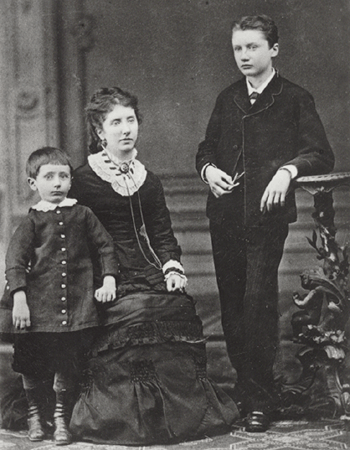
Mother’s boy: Just six years old but far from camera shy, Guglielmo stands by Annie Marconi at their home, Villa Griffone, while big brother Alfonso drapes himself in approved 1880s style. (Picture credit: Marconi plc)
There cannot be many people who screwed up at school, failed to get into university, and then went on to win a Nobel Prize for Physics. But at least one did, and with good reason: he made radio happen. In a few years of manic activity, Guglielmo Marconi managed to transform an obscure piece of maths into a social upheaval that makes the dot.com phenomenon look about as radical as a new bike for your postman.
Marconi’s 1909 Nobel prize seems all the more extraordinary when you consider that – unlike the physicist he shared it with, Ferdinand Braun – Marconi was not, by his own admission, any kind of scientist, or even much of an inventor. He did not really make any fundamental discoveries, and radio was mostly a matter of assembling parts created by other people. But the vision needed to see the possibilities of a new era of communication, and the unstoppable will to pursue it, were all his own. No intellectual, Marconi earned his Nobel prize the hard way by dragging a great chunk of physics out of the lab and holding it up for the world to see, approve and, more importantly, buy.
It was all a long time ago. In fact it is 100 years since Marconi proved, contrary to informed opinion at the time, that wireless waves could cross the Atlantic. Since then, radio has undergone a bumpy ride in the fashion stakes. Some 40 years ago, it was seen as ancient history and distinctly uncool, despite the invention of the transistor. Computers were the upcoming thing for ambitious scientists and engineers. Digital chips were hip; coils and capacitors were not.
But radio never went away, and today it is chic and centre stage again. It even gets called “wireless” by a generation that no longer associates the word with a wooden box that took ages to warm up. Bluetooth wireless technology may one day allow every conceivable electronic gadget to talk effortlessly to every other, while digital transmission is revolutionizing television and will do the same for sound as soon as someone markets a receiver that does not require a second mortgage.
But the radio application that’s had more impact than any other is, of course, the mobile phone. And, in a satisfying display of closure, this three-way marriage of radio, computers and the fixed phone network has enabled millions of texting teenagers to put life back into the concept that started it all: wireless telegraphy.
Making waves
So just how did “wireless” and “telegraphy” get together? Like a horseless carriage, a wireless telegraph proposes to do away with the very thing that makes the technology work. Pursuing an idea like this demands the ability to enter a new world, not just optimize an old one. The Moravian-born US economist Joseph Schumpeter reserved the term “entrepreneur” for people with this gift. He saw them as prime movers of economic change, though their motives were not entirely economic. What drives the true entrepreneur is their dream of a personal kingdom, the spirit of conquest, the sheer joy of achievement. Guglielmo Marconi fits Schumpeter’s model down to the last detail and he changed the world economy every bit as much as that model predicts.
It has to be said that none of this might have happened without Marconi’s access to cash and a jam-packed contact book. Young Guglielmo started his world-bending experiments in a traditional dusty attic, albeit in a well appointed parental home near Bologna in Italy. But the cash and the contacts were crucial for turning mere mucking about into the communications technology that would eventually prove so annoying on the train.
But first the physics. It all started with James Clerk Maxwell who, in 1864, applied some sophisticated mathematics to the intuitive ideas of Michael Faraday and produced four equations that shook the world. Maxwell’s equations showed how magnetic and electric fields could partner each other in a dance that crossed the ballroom at precisely the speed of light, which was surely no coincidence. It looked promising: maybe light, for so long a mystery, was simply an electromagnetic wave. But the evidence was circumstantial.
By 1888 Heinrich Hertz had found something more concrete. Using purely electrical methods, he generated waves that behaved exactly like light, though of enormously greater wavelength. Sparks from an induction coil started off the electromagnetic dance, creating trains of waves that, when intercepted by a loop with a gap in it, could produce microscopic sparks of their own. That, and some giant reflectors, prisms and polarizers, was all there was to it. Well, not quite all. When Hertz died at a tragically young age in 1894, young Marconi got to hear about the concept.
Family connections
It is hard to imagine Hertz as an idol like James Dean or Che Guevara (although he did have a similar beard to the South American revolutionary), so we have to look elsewhere to explain the young Guglielmo’s obsession with Hertzian waves. Since Marconi’s two greatest interests on this planet were radio and women, the first woman in his life, his mother, may have had something to do with it.
Annie Marconi was the daughter of a successful businessman, Andrew Jameson. If the name reminds you of a certain brand of Irish whiskey, that is because he owned the company. Being the daughter of an Irish whiskey baron and giving up a promising career as a singer to marry a well heeled Italian landowner gave Annie certain privileges. One of them was being allowed to indulge her littlest boy’s every whim. So the schoolboy Guglielmo, instead of being pressured into getting good grades, was allowed to follow his nose. And when that nose sniffed Hertzian waves, Annie was right behind him as he followed the scent into a startling new world.
Marconi’s education was patchy, not to say bizarre. Primary school was a disaster, and he was 12 before he got into a secondary school in Florence where, teased about his Bolognese-Irish accent, he did badly. The following year, the family moved to Livorno and a more congenial technical school, but Marconi still underperformed. He never qualified for higher education, even with the help of a private physics tutor, Vincenzo Rosa.
Marconi’s sketchy training was completed with the aid of a bit of networking. His mother got to know a professor of physics at Bologna University, Augusto Righi, a specialist in Hertzian waves who agreed to help her boy. Without the right bits of paper, Righi could not get him into the university, but he could get the young Marconi into the university library. Righi also gave him some tuition in his own lab. It does not seem to have been a huge success, however. Righi later refused to acknowledge his contribution to Marconi’s career, and Marconi always said that his real teacher was Rosa, the hired help in Livorno.
Tireless perfecter
By the summer of 1894, at the age of 20, Marconi was hard at work in his parents’ attic. By 1895 he had lashed together a Morse key, some batteries, an induction coil, a “coherer” (a device for detecting radio waves), a big relay, and – his only personal invention – the all-important aerial and earth. With this unpromising rig he found he could send messages two kilometres, without wires and with a hill in the way. Even Marconi’s father was persuaded that his younger son, though he might not have what it took to be a country landowner, had an idea worth pursuing.
It is unfair to imply that Marconi just threw all this stuff together. He was a tireless perfecter of small details. The coherer was one of them. This tube filled with metal filings was the only practical detector of radio waves available at the time. Radio-frequency current made the small metal fragments coalesce, causing the resistance to drop to almost nothing and stay there until someone shook the tube to “decohere” the filings. After months of experimentation with different metals and particle sizes, Marconi’s coherer was much more sensitive than the devices of Edouard Branly and Oliver Lodge that it was based on. He even invented a gadget that thwacked the tube with a little hammer every time it operated, automatically decohering it for the next signal. Together with Marconi’s elevated aerial and its earth, the improved coherer was a crucial element that transformed a bunch of bits and pieces into a true communications link (see figure below).
As loyal Italians, the family’s first instinct was to offer the new technology to the Italian government. And as a typical government, its first instinct was to play for time. Marconi, already shaping up as a businessman, knew that time was one thing he did not have, and the family network swung into action again. Using her British relatives and contacts, Annie arranged for Guglielmo to meet one or two people who mattered in the world’s greatest maritime nation. By February 1896 Marconi was in London.
From patents to products
Working the wireless Closing the Morse key caused the induction coil to repeatedly charge the aerial to a high voltage. Discharged by sparks jumping the gap, the aerial radiated rapid bursts of radio waves as long as the key was held down. At the receiver, bursts of radio-frequency voltage appeared across a coherer. These bursts made the coherer conduct, allowing a battery to operate a relay, which made the Morse inker mark a moving paper tape. After each burst of radio waves, a hammer struck the coherer to raise its resistance again so that, when the Morse key was released, the relay opened and the inker stopped marking the tape. Because of the way the aerial was connected, Marconi’s original system (above) emitted radio waves across a very broad frequency range, making it difficult for two transmitters to operate in the same area. The aerial connection also meant that the voltage across the coherer was smaller than it could have been. Marconi solved both problems by adding a transformer, called the “jigger”. This allowed the parts of the circuit that produced or detected radio waves – as well as the parts that radiated or received them – to operate under optimum conditions, thereby giving sharper tuning and greater sensitivity.
It all happened very quickly after that. Another Marconi contact in Italy wrote to the Italian ambassador in London, whose diplomatic advice was to forget the Italian government and patent the invention worldwide. Marconi’s cousin, Henry Jameson Davis, a well connected professional engineer, got hold of a patent lawyer and they set to work. After four months’ graft they filed the first application. Just over a year later, Marconi got his patent and formed a company to exploit it. The months between were filled with tests and stunts in which Marconi proved beyond doubt that wireless telegraphy worked.
Henry’s little black book was to prove invaluable: in it was the Scottish engineer A A Campbell Swinton, who would later become the first advocate of all-electronic television. Through him, Marconi met William Preece, the Post Office’s formidable chief engineer. It could have gone either way: Preece was already working on wireless telegraphy himself. As it turned out, he took the young inventor under his wing, introduced him to yet more people, and championed radio in lectures and demonstrations everywhere. Tests at ever-increasing power and distance on Salisbury Plain, in the Bristol Channel, the Solent and at La Spezia near Genoa had the civil and military top brass from Britain and Italy wide-eyed with amazement.
All of this was done with the crudest possible equipment. Marconi’s original system lacked any kind of tuning: his transmitter just blasted out pulses of broadband radio noise. Fine for a demo, but what about interference if two people want to do it at the same time? Away from Marconi’s razzmatazz, two physicists – Ferdinand Braun in Germany and Oliver Lodge in the UK – already had the answer. Lodge called it “syntony”. He had discovered that a suitable electrical circuit could be made to resonate like a tuning fork, and that two circuits tuned to the same frequency could exchange energy. What Lodge did not quite see, however, was how to connect a resonant circuit in such a way that it released its energy as a wave of well defined frequency that only a similarly tuned receiver would respond to.
Marconi intuitively seized on Lodge’s idea and made it work. He called his vital modification the “jigger” – Victorian slang for any sort of gadget. It was what we would now call a matching transformer, and it allowed the tuned circuits to see the high impedance they needed for resonance while delivering energy to the low-impedance aerial and earth system. Typically, Marconi revealed nothing about the origins of the jigger, so we do not know who invented it. It could have been him or any of the increasing band of formally trained engineers he was gathering around him. All we know is that he incorporated it in his famous patent No. 7777 of 1900, a document that marks the graduation of radio from intriguing possibility to commercial proposition.
Transatlantic controversy
There was one other obvious problem with radio that physicists kept harping on about. Even allowing for diffraction at the long wavelengths Marconi was using, they argued that there was no way that radio would work over the horizon. A round world and straight rays just did not fit, so wireless could never compete with wires. This is where Marconi’s lack of formal education proved an asset. He never bothered to work things out, he just tried them. And in test after test he had already shown that radio did work far beyond the horizon. By some means – identified later as reflection from the ionosphere – he could link places on either side of the hill of seawater caused by the curvature of the Earth.
All charged up The terrifying high-voltage capacitor bank of the Poldhu transmitter in Cornwall. In December 1901 a fraction of the energy it stored may have reached Marconi on the other side of Atlantic. (Picture credit: Marconi plc)
By 1900, after some showmanship involving telegraphed reports direct from the Americas Cup yacht race to New York, Marconi had a US company. A radio link between Britain and North America promised high traffic and healthy profits. With enough kilowatts pumped into it, the new syntonic system might make it work. Marconi persuaded his directors to raise the money and give it a go. It was the biggest hill of seawater yet, and it presented technical, financial and political problems that would have finished most people. Marconi just kept on going, even when huge aerials on both sides of the Atlantic blew down in storms. Eventually, on 12 December 1901, he and his assistant George Kemp, huddled in a shack on a windy hill in Newfoundland with the most sensitive detector they had – their own ears – heard the faint, repeated triple dot of the Morse-code letter “S” from their station in Poldhu, Cornwall.
The Marconi publicity machine went into action straight away. And so did the transatlantic cable companies, whose businesses were suddenly threatened. They pointed out that what Marconi had claimed was impossible, and wheeled out various physicists to back them up. Marconi insisted that it had happened, although he only had one witness. We will never know whether Marconi really did hear those three dots, or whether he and Kemp were victims of an illusion brought on by the thought of the £50 000 (nearly £1m in today’s money) his little company had blown on this wild experiment. In the end, it was irrelevant: the publicity ensured masses of business and international star status for Marconi, while the transatlantic radio link, though it eventually worked after a fashion, never made much money.
Class act
Marconi liked being a star. Those three disputed dots set him on a path that took him from the ranks of the well off gentry to the upper echelons of the aristocracy. Already well connected, he began to find that even better connected young women had plenty of time for a famous, not-too-poor 27 year old who combined Italian good looks with British reserve. After a couple of false starts, he fell for a daughter of the Irish nobility, Beatrice O’Brien. Her parents owned about 70 000 acres of County Clare, complete with a huge castle, so the posh wedding in 1905 was quite a step up for the lad from Bologna. And Beatrice’s mother, a fashionable society columnist, made sure that Marky, as she called him in private, stayed among the glitterati of that socially divided pre-war world.
It was a world on its way out. In a tragic rehearsal for the war that would give it its final shove, an upper-class fantasy called Titanic struck ice-cold reality in April 1912. About 1500 people lost their lives. More would have died without Marconi equipment on board: thanks to its distress calls, the Cunard liner Carpathia was at the scene in less than an hour and a half. But this high point for pre-electronic radio came at the start of a terrible year in its inventor’s life.
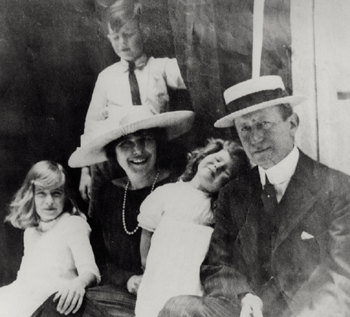
Family man This photograph of Marconi with Bea and their three children was taken some time around 1920. On the left is Degna with Giulio at the back and Gioia between her parents. By 1923 the marriage was over. (Picture credit: Marconi plc)
By May 1912 Bea O’Brien had produced two children. Family life and Marconi just did not mix. His international workaholism was bad enough; the fact that he took advantage of luxury-liner life to indulge in some conspicuous womanizing made it intolerable. Throughout 1912 the couple discussed separation, and it was against this background that the Marconi scandal broke out. It makes today’s sleaze stories look tame. The Prime Minister, David Lloyd George, was accused of insider trading in Marconi shares, which rose dramatically in value when it was disclosed that Marconi had been awarded a government contract for 18 new radio stations. The fact that the Attorney General was the brother of Marconi’s managing director, Godfrey Isaacs, made things even worse. It was all whitewashed away by 1913, but the stain never quite disappeared. Finally, in September, Marconi, always an over-confident driver, crashed while driving in Italy with Bea and lost his right eye. Unfortunately for his wife, the glass replacement did not cramp his style at all.
The First World War brought a spurt of technical development. Electronics, growing from Marconi consultant John Ambrose Fleming’s invention of the thermionic diode in 1904, began to transform radio techniques. Gifted engineers like Henry Round made dramatic improvements to Marconi’s original system. Wavelengths got shorter, and thoughts returned to Hertz’s original experiments with highly directional radio beams. Instead of scattering power in all directions, Marconi’s new short-wave transmitters sent the power where it would do most good.
At last radio could challenge cable, and it did. The net effect, though, was a loss of profits for both businesses, and eventually they had to combine their interests. In 1928, with Marconi’s short-wave “Imperial Chain” connecting Australia, Canada, India and South Africa, the Imperial Wireless and Cable Conference decided that radio and cable should combine to form a single operating company, Imperial and International Communications. Marconi’s company got a 44% share in the new business, but was no longer allowed to be an operator. From then on the dream of linking the world was dead: Marconi became a mere equipment supplier.
Troubled years
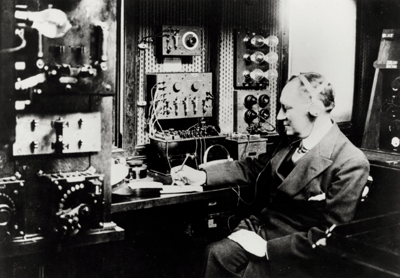
Master of the waves The wireless laboratory of the yacht Elettra, bristling with the latest technology, allowed Marconi to carry out practical experiments. (Picture credit: Marconi plc)
Things really started to go wrong in the early 1920s. After a final bust-up with Bea in 1921, the couple divorced in 1923. In 1925 Isaacs retired as Marconi’s managing director, and a new, far less sympathetic board was installed. Marconi, unwanted in the decreasingly experimental world of commercial radio and by now at the awkward age of 51, started a ridiculous affair with a 17 year old called Betty Paynter. It did not last long, but the male menopause continued: by the summer, Marconi was in love with Cristina Bezzi-Scali, the daughter of an Italian count. He had met her at one of his glitzy parties on Elettra, the 240 foot yacht he had acquired in 1919. Elettra was an essential part of his lifestyle, a refuge in which he could experiment, party and womanize untroubled by wife and family.
Marconi turned his energy from taming wireless waves to beating the system. He became increasingly out of touch with radio technicalities as he used his influence in high places to get round the religious obstacles that prevented him from marrying Cristina. Converting to Roman Catholicism (Annie Marconi had brought him up as a Protestant) was the easy bit. Much harder was the fact that the Catholic church does not recognize divorce. It took two years to bully Bea into telling the necessary lies, but by 1927 his marriage to her was annulled and he was married to a different woman.
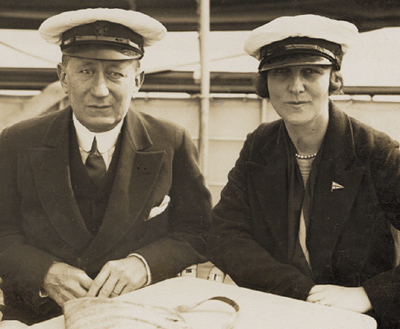
New direction A somewhat sombre Marconi sits with no-nonsense Cristina Bezzi-Scali on the deck of Elettra off Italy in 1928. (Picture credit: Marconi plc)
A very different woman. With Cristina, Marconi’s days as a seafaring experimenter were pretty well over. Cristina expected him to be by her side, not carrying on like a schoolboy, and on the whole he complied. After all, he was a hereditary peer by now, Marchese Marconi. Or maybe he felt that his talents would be better employed helping Italy through the troubled days that were part of the long run-up to the Second World War. Certainly Marconi’s enthusiastic espousal of fascism dates from about this time.
Marconi had been a member of the fascist party since 1923, but it was not until after he had married Cristina that he became really active. In 1930 Benito Mussolini made him president of the Accademia d’Italia, overriding a law that prevented Marconi, by then a member of the Italian senate, from serving. This automatically made Marconi a member of the Fascist Grand Council, a fact that troubled him not one bit. Indeed, he began to insist that correspondence was addressed to “His Excellency the Senator Marchese Guglielmo Marconi, president of the Royal Academy of Italy, Member of the Fascist Grand Council”.
Marconi had become a grand old man, and a very right-wing one at that. He toured the world rallying fascist supporters. He made fascist speeches on the radio. He wrote fascist articles in the press. But when Mussolini invaded Ethiopia in 1935, Marconi was mortified to find himself – as a national of a country subject to sanctions imposed by the League of Nations – prevented from delivering a talk about the invasion on the BBC, the broadcasting corporation he had helped to found.
Marconi’s legacy
Long before Mussolini was toppled, Marconi was dead. His frequently challenged coronary arteries finally gave up on 20 July 1937, his youngest child’s seventh birthday. He left behind him a world that had come to regard radio as a commodity, not a miracle. Britain even had an infant television service, broadcast via Marconi equipment. He also left behind a legion of detractors who correctly pointed out that others, such as Lodge and the Russian Aleksandr Popov, had sent wireless messages before Marconi got his patent, and that even his aerial and earth were not entirely original.
It does not really matter. What Marconi undoubtedly did invent was an entirely new science-based industry. In his hands an obscure and, to most people, unintelligible branch of physics became a consumer product like no other. We are used to being told that some new technology will change the world. Marconi’s is one of the few that did.
Uncertain history: Did Werner Heisenberg deliberately sabotage the German atom-bomb project or did he fail to understand the physics? (Courtesy: German Federal Archives)
Read any account of the development of physics in the early 20th century and you will almost certainly discover that a stay in Germany was de rigueur for any aspiring young physicist. One German physicist who became famous as the teacher of a generation of outstanding pupils was Arnold Sommerfeld. In the summer of 1922, shortly after the young Werner Heisenberg came under his tutelage, Sommerfeld wrote to Paul Epstein, a former student who had since become professor of theoretical physics at the California Institute of Technology: “I expect enormous achievements by Heisenberg, who I think is the most gifted one among all my pupils, including Debye and Pauli.” Just 10 years later, Heisenberg was awarded the Nobel Prize for Physics for the “creation of quantum mechanics”. The Nobel committee summed up Heisenberg’s merits in a nutshell.
But why is Heisenberg still controversial 100 years after his birth? In his recent monograph, Heisenberg and the Nazi Atomic Bomb Project, the American historian Paul Rose raises serious doubts about Heisenberg’s personal morality. He is described as a wildly emotional and ambitious man who was “unable to break out of German anti-Semitic mentality”. Scientifically, too, he is blamed for misconceptions.
Bad physics and bad morals, according to Rose, culminated in Heisenberg’s flawed contribution to the Nazi atomic-bomb project, the failure of which was later fabricated as a deliberate effort to sabotage the project. Moreover, Rose believes that the German mentality of Heisenberg and his friends, fertilized by astounding powers of self-delusion and rationalization, spun the web of self-deception that led to Heisenberg’s version of events. And he blames this combination of fabrication and denial for the confusion about Heisenberg’s work on the atomic bomb that persists to the present day.
Heisenberg’s life has offered rich pickings for historians of physics. David Cassidy has written an authoritative biography, Uncertainty: the Life and Science of Werner Heisenberg, that provides a coherent and convincing view of the most disputed topics of Heisenberg’s life until the end of the Second World War. Meanwhile, the story of the German atomic-bomb project – if it can be so called – has been told by historian Mark Walker and others (see further reading).
But the controversy surrounding Heisenberg continues, perhaps because his life does not lend itself to simple answers. As well as uncertainty, complexity is another physical concept that serves as a metaphor for Heisenberg’s life. After all, we know that the physics of a complex system cannot be understood simply from the collective behaviour of its individual parts. Rather than examine preconceived opinions about the German physicist, we should aim to take a holistic perspective of his life as we attempt to understand him better.
Werner Karl Heisenberg was born on 5 December 1901 in Würzburg, northern Bavaria, and moved to Munich at the age of nine when his father became a professor of Greek studies at the university. In his biography, Cassidy details the social context in which Heisenberg’s early life was rooted. What seems, at first, to be a marginal episode in his formative years – participation in a youth group called Pfadfinder (Pathfinder) – turns out to be a clue to understanding Heisenberg’s behaviour after the First World War.
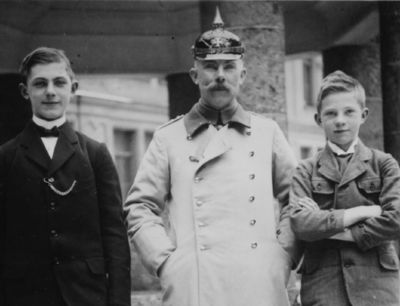
Father and sons Heisenberg (right) and his brother Erwin with their father, a university professor, before he went to fight in the First World War in 1914. (Picture credit: Max-Planck-Institut, courtesy AIP Emilio Segrè Visual Archives)
The years of “pathfinding” after 1919 were those in which Heisenberg was acutely aware of his social environment. Here we find the elements that formed his personal values: rebellion against non-ideal values, such as capitalism, materialism, hypocrisy and moral decadence; adherence to a close circle of likeminded friends united in a “harmony of souls”; a love of nature; and a deeply felt affinity with German culture.
Some of these ideals were not far from the emerging Nazi ideology. Nationalism, although not an explicit Pathfinder virtue, was certainly appreciated by most of the members as an obvious obligation to their country. Teutonic rituals – some of which involved sitting around a camp fire dreaming of a mystical “third Reich” and a magical white knight who symbolized German virtues – featured in some Pathfinder ceremonies. Anti-Semitism, too, was a recurring theme, albeit a disputed one: the Munich Pathfinder contingent split into pro-Jewish and anti-Semitic factions. Moreover, the trust in a Führer as a revered leader of a group was widespread among Pathfinders. Despite such similarities, however, it would be quite misleading to identify Pathfinder ideals with Nazism.
Heisenberg’s affiliation with the youth movement was not a short-term flirtation between boyhood and manhood. He became the leader of a boy group at the age of 17. Gruppe Heisenberg, as it was called, was integrated into a larger troop in which teachers and high-school students were the leaders and group members. In the spring of 1919 the troop actively participated in paramilitary operations against the Munich Soviet Republic – a short-lived attempt to establish a communist regime after revolutionary turmoil at the end of the First World War. These activities, together with the experiences from the First World War that the teachers passed on to their pupils, formed the basis from which the troop set out to renew society. Many of the members shared a fundamental anti-political stance. As a group of highly educated, middle- and upper-class young men, they felt elitist and above plain party politics.
Heisenberg’s case was typical, both with respect to his social roots and to his politics. “I never thought that I could interest myself in politics,” he wrote to a Pathfinder friend in 1923, “because it seemed to me to be a pure money business.” Although the organizational structure of the Pathfinder groups changed over the years, Heisenberg remained firmly committed to the members of his group even after he published his famous paper on quantum mechanics in 1925. They continued to meet once a week in Heisenberg’s home. And at weekends they went on trips to the Alps or to a lake near Munich, where they would sail, play ball games, throw spears and take part in other competitive sports. Indeed, according to Cassidy, the incredible intensity of Heisenberg’s work during the early 1920s was possible only because he could relax completely during these outings. Heisenberg had few friends or even acquaintances outside his youth movement.
Pathfinding was important in another respect. “In addition to many other values, we also discovered science anew,” Heisenberg wrote years later. He focused on areas of science that were rather remote from application, perhaps because his comrades branded science, and physics in particular, as “mechanic materialism”. As he recalled: “Even in science our interests concentrated on those fields in which it was not simply a question of the further development of what is already known.” As a result, Heisenberg preserved a life-long interest in exploring fundamentally new approaches in physics – where success was uncertain – rather than pursuing research along established paths.
University challenge
When Heisenberg entered university in October 1920, physics was not his first choice. Having been brilliantly successful at high school, he intended to study mathematics and to launch immediately into advanced research. Indeed, Heisenberg’s father arranged an appointment with the famous mathematician Ferdinand von Lindemann in the hope that his ambitious son would be admitted into Lindemann’s class where he would begin advanced research straight away. But the interview did not go well for young Heisenberg. Lindemann, who was then 68 and partially deaf, barely understood what Heisenberg said. And from what he did understand, he concluded that the young man’s unorthodox approach to mathematics was not to his taste.
Heisenberg’s second attempt to obtain access to advanced study without the usual preliminaries led him to Arnold Sommerfeld, professor of theoretical physics at Munich. Experienced with exceptional students, Sommerfeld, who was then 52, responded differently: “It may be that you know something; it may be that you know nothing. We shall see.”
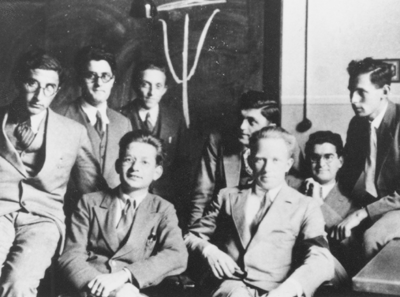
Heisenberg at school Giovanni Gentile, George Placzek, Rudolf Peierls, Gian Carlo Wick, Felix Bloch, Heisenberg, Victor Weisskopf, Fritz Sauter. (Picture credit: AIP Emilio Segrè Visual Archives, Rudolf Peierls Collection)
Heisenberg could not have found a more appropriate home for his ambitions. Here he met congenial students, like Wolfgang Pauli, then 20 years old and in his fifth semester. Indeed, the names of Sommerfeld’s pupils reads like a Who’s Who of modern theoretical physicists: Alfred Landé, Peter Paul Ewald, Karl Herzfeld, Gregor Wentzel, Otto Laporte, Adolf Kratzer and Wilhelm Lenz, to name only those with whom Heisenberg became acquainted during his early studies.
At the time Sommerfeld was deeply immersed in atomic theory. In 1915 he had extended Bohr’s atomic model by taking the theory of special relativity into account and by quantizing both the azimuthal and radial motion of orbiting electrons. A year later, he also quantized the orientation of the electronic orbit. He was able to calculate electronic energies, which gave rise to additional terms in atomic spectra. This fine structure was verified by the spectroscopist Friedrich Paschen with whom Sommerfeld corresponded intensively during the First World War. Sommerfeld’s classic treatise Atomic Structure and Spectral Lines, first published in 1919, went through four editions during Heisenberg’s time at Munich, indicating the rapid progress being made in atomic theory during those years.
Surrounded by like-minded students and guided by a revered leader, Heisenberg felt as intellectually at home in Sommerfeld’s group as he had felt emotionally at home within his Pathfinder group. Sommerfeld soon came to appreciate the talents of his new pupil. In 1922 he made the 21-year-old Heisenberg co-author of two papers on the atomic theory of X-ray spectra and the so-called anomalous Zeeman effect.
The splitting of spectral lines in a magnetic field had been observed some 25 years earlier by the Dutch physicist Pieter Zeeman, and was explained by the interaction of the angular momentum of the orbiting electrons with the external field. The observation of additional splitting, however, was a major riddle in the early days of quantum mechanics and was later recognized to be a consequence of the intrinsic angular momentum or “spin” of the electron.
In 1921 Sommerfeld agreed that Heisenberg could publish a paper on the anomalous Zeeman effect, although he was sceptical about the physical foundation of Heisenberg’s theory. “His Zeeman model generally meets with opposition, particularly with Bohr,” Sommerfeld wrote in a letter to Epstein. “But I find its success so enormous that I held back all my reservations with its publication.” Heisenberg’s model involved half-integer quantum numbers, which he attributed to the atomic core. However, his model did agreed with Landé’s empirical results on the splitting of spectral lines in magnetic fields and, crucially, broke the dogma of integer quantum numbers.
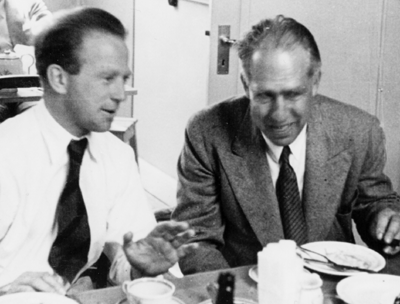
Quantum pioneers Heisenberg (left) formulated the uncertainty principle while working with Niels Bohr (right) in Copenhagen. (Picture credit: P Ehrenfest Jr, courtesy AIP Emilio Segrè Visual Archives, Weisskopf Collection)
In the summer of 1922 Heisenberg met Niels Bohr for the first time and confronted him with his unorthodox ideas about atoms. The meeting took place during a week of lectures by Bohr in Göttingen – the “Bohr festival” as is it became known – and transformed Heisenberg into a well known figure within the small community of atomic theorists.
But Heisenberg did not specialize in atomic theory and his second publication was about alternating vortices in fluids called Kármán vortices. Indeed, Sommerfeld and his pupils repeatedly addressed problems in fluid dynamics, such as the transition from smooth laminar flow to turbulence. It should therefore come as no surprise that Heisenberg’s doctoral dissertation was on fluid flow, rather than atomic physics.
On the road to quantum mechanics
Before Heisenberg finished his studies at Munich in 1923, he spent six months at Max Born’s institute in Göttingen. Born had just started an ambitious research programme in atomic theory, exploring perturbation methods from celestial mechanics in an attempt to deal with many-body problems in atoms by analogy with those in classical mechanics. This research resulted in a collaboration between Heisenberg and Born on the theory of the helium atom. Born also proposed that Heisenberg should come to Göttingen as his assistant after finishing his studies in Munich. But Heisenberg’s doctoral examination almost resulted in disaster. He could not answer experimentalist Wilhelm Wien’s questions about the resolving power of optical instruments and how a storage battery works. Wien only let him pass after Sommerfeld vigorously defended his pupil.
After this traumatic event, Heisenberg was glad to escape to Göttingen where he focused entirely on atomic theory. Within a few months he had qualified as a lecturer following the publication of a paper in which he modified the rules of quantum theory to address the anomalous Zeeman effect. In September 1924 he interrupted his stay at Göttingen and went to Copenhagen, where Bohr had invited him as a research associate. In Copenhagen, Heisenberg’s research focused on the quantum theory of radiation. Bohr, his Dutch assistant Hendrik Kramers, and a visiting American research fellow, John Slater, had worked out a semi-classical theory, which became known as BKS theory. But the hypothesis soon met with serious difficulties and was abandoned.
According to classical dispersion theory, atoms respond to electromagnetic fields by oscillating at the frequency of the absorbed or emitted radiation. Such a theory, however, could not account for the quantum features of the Bohr atom and the particle-like behaviour of radiation in certain circumstances. The BKS modification of classical dispersion theory was still classical, in as far as it assumed that electromagnetic radiation was wave-like and did not involve quanta, although it did account for quantum jumps.
The remedy was a “virtual radiation field”, a sort of ghost field containing the possible frequencies for the quantum transitions of an atom in a given stationary state. Although it violated established physical principles, such as causality and energy conservation, the virtual field suggested a new mathematical framework for connecting the classical and quantum worlds. It therefore became the subject of intense scrutiny by Born and Heisenberg when the latter returned to Göttingen. This was the conceptual prerequisite from which Heisenberg conceived his quantum mechanics. His decisive contribution to this programme was his paper “On a quantum theoretical re-interpretation of kinematical and mechanical relationships”, now considered to be the breakthrough in modern quantum mechanics.
Heisenberg’s paper marked a radical departure from previous attempts to solve atomic problems by making use of observable quantities only. “My entire meagre efforts go toward killing off and suitably replacing the concept of the orbital paths that one cannot observe,” he wrote in a letter dated 9 July 1925. In this respect, his work went far beyond Born’s efforts to achieve a discrete quantum analogue of atomic mechanics. Rather than struggle with the complexities of three-dimensional orbits, Heisenberg dealt with the mechanics of a one-dimensional vibrating system – an anharmonic oscillator. And he explored the behaviour of the observable quantities – the radiation frequencies – that, according to the BKS legacy, had emerged from the “virtual oscillators” of an atom.
The result was formulae in which quantum numbers were related to observable radiation frequencies and intensities. Born noticed that Heisenberg’s formulae could be expressed in a concise manner using matrices. For this reason, the new theory also became known as “matrix mechanics”.
Rapid rise of quantum mechanics
Following Heisenberg’s breakthrough, quantum mechanics took shape at an amazingly rapid pace. Born, together with his new assistant Pascual Jordan, reshaped Heisenberg’s work into a systematic matrix formulation, highlighting the relationships between “conjugate variables”, such as momentum and position, and energy and time. In quantum mechanics, these relationships became commutation relations between conjugate matrices.
Meanwhile Paul Dirac, quite independently from the Göttingen group, presented quantum mechanics in a new language of operators. In Zurich, Erwin Schrödinger took a different approach and in 1926 developed wave mechanics – another form of quantum mechanics, which was found to be equivalent to the matrix method.
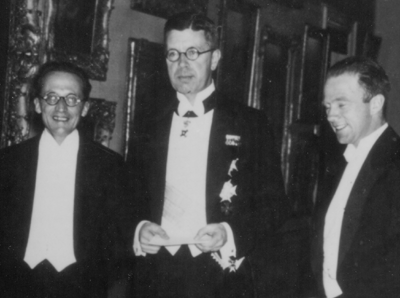
Winning moment Heisenberg (right) and Erwin Schrödinger (left) with the King of Sweden at the Nobel Prize ceremony in 1933. (Picture credit: Max-Planck-Institut für Physik, courtesy AIP Emilio Segrè Visual Archives)
In 1926 Heisenberg succeeded Kramers as Bohr’s assistant in Copenhagen. Having been raised in Sommerfeld’s school and collaborated with Born, Heisenberg was familiar with the guiding spirits of quantum theory like few others. Working in Bohr’s institute, he formulated the principle of uncertainty in March 1927, thereby laying the foundation of what became known as the Copenhagen interpretation of quantum mechanics.
Soon afterwards in October 1927, at the age of 26, he became professor for theoretical physics at the University of Leipzig. Within a few years, Heisenberg established Leipzig as a new centre of modern theoretical physics, together with another Sommerfeld pupil, Peter Debye, who held the chair for experimental physics, and Friedrich Hund, who became extraordinary professor for theoretical physics in 1929.
By the early 1930s a new generation of theorists – such as Felix Bloch, Rudolf Peierls, Edward Teller, Victor Weisskopf and Carl Friedrich von Weizsäcker – had spread the gospel of the new “Heisenberg school”. Students and research fellows from all over the world were attracted to Leipzig, including Ettore Majorana from Italy, Laszlo Tisza from Hungary, and Seishi Kikuchi, Shin-Ichiro Tomonaga and Satoshi Watanabe from Japan. Many of them earned their first academic laurels under Heisenberg’s tutelage by applying quantum mechanics to solid-state physics, then a primary target for solving old problems with a new tool.
Heisenberg himself paid some tribute to the emerging quantum-mechanical theory of solid-state physics by solving the riddle of ferromagnetism, but his main interest was in exploring new areas, rather than applying established methods. He focused, in particular, on the emerging new field of high-energy physics – which in the era before particle accelerators meant cosmic rays and nuclear physics – where the ideas of relativistic quantum field theory could be compared with experimental observations (see Brown and Rechenberg in further reading).
The world is ugly, but the work is beautiful
“It is a pity,” Heisenberg wrote to Sommerfeld in February 1938, “that in a time when physics makes such wonderful progress and it is a pleasure to contribute to its further development, one becomes involved in politics again and again.” To keep himself aloof of politics was no longer possible after Hitler’s rise to power in 1933. Although Heisenberg, like many Germans, probably regarded Hitler’s nationalist zeal with some sympathy, he was appalled at the crudity of the regime when it came to practical measures, such as the purge of non-Aryan colleagues from universities.
In this situation, Heisenberg asked the grand old man of German science, Max Planck, for advice. Planck persuaded him that the physics profession would be better protected by quiet efforts behind the scenes than by open protest. “Planck has spoken – I think I can pass this on to you – with the head of the government,” Heisenberg wrote to Born, a Jew, in June 1933 after Planck had visited Hitler, “and obtained the assurance that nothing will be undertaken beyond the new civil service law that will impede our science.”
Although Born had not been officially dismissed, he had left Göttingen and was ready to emigrate. Even if he had been allowed to stay because of a special regulation that exempted the dismissal of Jews who had served in the First World War, Born saw no future for his children in Germany. “I would like to ask you not to make any decisions yet,” Heisenberg advised his former mentor, “but to wait and see how our country looks in the autumn.” Born ignored Heisenberg’s plea and emigrated to the UK where he stayed for 17 years before returning to Germany in 1953.
This “wait and see” strategy became a characteristic of Heisenberg’s reaction to politics. In 1935 he came closest to an open protest against the Nazi authorities when colleagues from the Leipzig philosophical faculty were dismissed in a second wave of purges. Heisenberg and others were dismayed, and expressed their disapproval at a faculty meeting. The only consequence of this background protest was a formal reprimand for the dissenters by the regional head of the Reich; the dismissals remained in force.
Appalled at politics once more, Heisenberg’s reaction was again to retreat. In a letter to his mother in the autumn of 1935 he wrote: “I must be satisfied to oversee in the small field of science the values that must become important for the future. That is the only clear thing left for me to do in this general chaos. The world out there is really ugly, but the work is beautiful.”
But retreat into science without politics was impossible for the renowned physicist. When Sommerfeld reached retirement age in 1935, Heisenberg was the obvious candidate to succeed him at Munich. But Nazi ideology was now raging in physics too: Johannes Stark and Philip Lenard, both Nobel-prize winners, characterized modern theories like relativity and quantum mechanics as “Jewish physics”. Stark complained publicly that although Einstein had left Germany for America, there were still physicists acting in Einstein’s spirit. Moreover, he protested that “the theoretical formalist Heisenberg, spirit of Einstein’s spirit, is now even to be rewarded with a call to a chair”. This was the start of a campaign against Heisenberg and Sommerfeld, which ended in 1939 when Wilhelm Müller was named as Sommerfeld’s successor. Müller, an aerodynamicist, was branded a “complete idiot” by Sommerfeld.
Heisenberg was driven to despair in the course of this struggle. Using private contacts between his and Heinrich Himmler’s families, he sought assurance from the Nazis that their official view of him was not the same as that expressed in the campaign waged against him. He even thought of emigrating when the investigation into his case seemed to last forever.
Behind the scenes, Heisenberg’s case – and the Nazi regime’s stance on physics in general – was evaluated differently by different groups. Himmler’s power troop, the SS, finally supported Heisenberg and modern theoretical physics for pragmatic reasons, while party leaders and Nazi university representatives emphasized ideology over utility. The fanatics among the physicists – often addressed as one group under the name “Deutsche Physik”, despite their diffuse tendencies – had been successful in preventing Heisenberg from succeeding Sommerfeld. But Heisenberg’s case marked the beginning of the end for their movement. With the outbreak of the Second World War, the Nazi regime valued the possible uses of physics higher than ideology.
The war years
Heisenberg gained government acceptance after the outbreak of the Second World War, and was entrusted by the Ministry of Education with the scientific directorship of the Kaiser Wilhelm Institute of Physics in Berlin, together with Otto Hahn. The institute was under the authority of the Army Ordnance Office because of its central role in co-ordinating a secret war project. Together with other nuclear scientists, who called themselves the Uranium Club, Heisenberg began investigating the possible wartime uses of Hahn’s discovery of nuclear fission. Such uses included nuclear reactors for submarine propulsion and the possibility of a new bomb that “surpasses the explosive power of the strongest explosive materials by several orders of magnitude”, as Heisenberg argued in an early report in December 1939.
To this day, physicists and historians of physics debate Heisenberg’s motivations and role in this effort. His compromises with the Nazi regime – perhaps psychologically explicable in view of his struggle to clear his name – raised doubts about his character. Thousands of pages have been written about “Heisenberg’s war”, but no consensus has been achieved.
According to one version, championed separately by the journalists Robert Jungk and Thomas Powers, Heisenberg deliberately delayed the project’s progress because he abhorred the thought of an atomic bomb in Hitler’s hands. But the historian Paul Rose has taken the opposite view. He believes Heisenberg tried hard to build an atomic bomb, but failed because he did not understand the physics properly. Heisenberg’s own version was that he and fellow scientists in the Uranium Club were spared the decision because they had not made enough progress due to the circumstances of the war.
Meanwhile, Mark Walker has criticized the “black or white” fashion in which this question has been answered. He argues that it was not Heisenberg’s competence that dictated the progress of the atomic-bomb project, rather that the Army Ordnance Office lost interest in it in 1942 because the project would not produce results soon enough to influence the outcome of the war. In his study, Nazi Science, Walker provides an answer, which is perhaps as close as one can approach the truth in this entangled matter. “Did the Germans try to build atom bombs?” he asks. On one hand, he argues the Germans did not invest billions of dollars in the construction of huge factories and the development of detonation devices. But they did manufacture substances that were known to be potential nuclear explosives as quickly as possible without hindering the war effort. There is no simple answer, he concludes.
The controversy goes on
Heisenberg’s life after the war has not generated as much interest, although it too provides room for controversy. Heisenberg failed to find the support of his fellow scientists when he tried to form an elitist German Research Council as the country’s central body for science policy. Although Konrad Adenauer, West Germany’s first chancellor, welcomed Heisenberg’s advice in atomic affairs, his role as a German “atomic tzar” met with derision from the first minister of atomic affairs, Franz Josef Strauss. Scientifically, too, his post-war research in particle physics was regarded with scepticism and seems to have been rather futile, contrary to the sensational newspaper reports that his “Weltformel” – his unified field theory of elementary particles – generated in 1958.
Strictly speaking, the controversy about Heisenberg’s behaviour during the Nazi era is also a postwar story. It began in1947 when the American physicist Samuel Goudsmit published Alsos, a grim account of the German nuclear war effort. Goudsmit used Heisenberg’s case to illustrate the failures of a dictatorship in directing science. In 1956, however, Heisenberg was portrayed as a moral icon for the first time in Jungk’s book Brighter Than a Thousand Suns in an era of Cold War and McCarthyism. Yet Walker later concluded that Jungk’s “conspiracy theory” was the product of a time when, once again, politics harmed science and scientists.
The controversy surrounding Heisenberg has come to the fore again with Copenhagen, a play centred around his visit to Copenhagen in 1941, where he met Niels Bohr and Bohr’s wife, Margrethe. Playwright Michael Frayn’s interest in Heisenberg was aroused after reading Powers’ book Heisenberg’s War, which portrayed Heisenberg – as Jungk had – as a hero who delayed research on the German atomic bomb. Heisenberg’s role in the play is less heroic, however, and his character is embedded in an artistic maze of uncertainties that allude to both quantum uncertainty and the historical uncertainty that exists as a result of the lack of documentary evidence about the meeting in 1941. Some new light may soon be shed on this issue with the forthcoming publication of Bohr’s letters (see Secret letters cast light on Copenhagen, Physics World November p9).
Frayn’s Heisenberg is not the “ugly German” that is portrayed by Rose, nor is he the hero in Jungk’s or Powers’ books. Playing with the uncertainty metaphor from past to present, within and beyond physics, Heisenberg’s life becomes metaphorical itself: a man under contradictory pressures, a symbol of what seems to be a principle far beyond the quantum realm. “What people say about their own motives and intentions, even when they are not caught in the traps that entangled Heisenberg, is always subject to question – as subject to question as what anybody else says about them,” Frayn concludes in his postscript to Copenhagen.
A new Heisenberg has entered the stage, now in the company of a post-modern Zeitgeist: “Thoughts and intentions, even one’s own – perhaps one’s own most of all – remain shifting and elusive,” according to Frayn. “There is not one single thought or intention of any sort that can ever be precisely established.”
Black holes are enormously dense objects with a gravitational pull so strong that not even light can escape from them. Super-massive black holes are between a million and a thousand million times more massive than the Sun, and almost every galaxy is thought to harbour one. This means that any theory of galaxy evolution must account for black-hole formation, and vice versa.
Earlier this year, Graham’s team found that the mass of a black hole is related to the range of velocities of the stars that orbit it. They successfully calculated the mass of black holes from velocity measurements, but these measurements required long – and expensive – telescope exposures.
The new technique relates the mass of a black hole to the distribution of mass in the central, dense region of its host galaxy. Graham and colleagues collected high-quality images of 23 of the galaxies investigated in the earlier study, and measured their luminosities. This allowed them to calculate the density of stars in these galaxies, from which they calculated the masses of their central black holes. They found that the black-hole mass is probably more closely associated with star distribution than it is with the velocity range of stars in the host galaxy.
It may not sound surprising that the mass of a black hole is linked to the concentration of stars around it – the bigger a black hole, the larger its gravitational field and the more matter it would attract. But Graham and co-workers point out that this effect could also arise from a connection between the processes that shape galaxies and construct black holes. Astronomers are still unsure whether black holes existed in the early universe before galaxies formed.
“This is an important realization, which provides further insight into the formation of both galaxies and their central black holes,” says Graham. “We now know that any viable theory of super-massive black hole growth must be connected with the eventual structure of the galaxy”.
Chemical reactions typically take place on time-scales measured in femtoseconds – that is, 10-15 seconds – and scientists have recently used femtosecond laser pulses to track such reactions. But processes that involve electrons – such as ionization – occur about a thousand times more quickly, and shorter pulses are needed to study them.
Femtosecond laser pulses are so short that they contain only a few oscillations of the electromagnetic field. This means it is impossible to shorten them further in order to probe electron effects. But Krausz and colleagues have overcome this problem by firing femtosecond pulses of visible light into neon gas.
As a light pulse enters the gas, it strips electrons from their atoms. These electrons oscillate briefly in the light field before colliding with the newly created neon ions to generate a flash of X-rays. But crucially, the original femtosecond pulse only pulls electrons from their parent atoms during the peaks of its optical cycles – and this makes the bursts of X-rays extremely short.
In order to measure the duration of these X-ray pulses, Krausz and co-workers directed one of them – and the original light pulse – at a krypton target. The X-rays ionize the krypton atoms, and the energies of the freed electrons depend on the electric field of the light pulse at the instant they were ejected. By introducing various delays between the arrival of the two pulses at the krypton target, Krausz’s team was able to measure the range of electron energies and establish that the X-ray pulses lasted just 650 attoseconds.
“With these attosecond pulses, we will be able to track a wide range of electron dynamics inside atoms for the first time”, Krausz told PhysicsWeb. “Together with the fundamental significance of tracing quantum jumps of electrons, they will allow the development of efficient X-ray lasers that will have a number of applications in physics, chemistry and biochemistry”.
Using the Hubble space telescope, Charbonneau and Brown inspected the planet as it passed in front of its parent star, which is 150 light years away. Light from the star passed through the planet’s atmosphere, and the researchers detected the well-known absorption lines of sodium in the yellow region of the spectrum. The 3.5-day orbital period of the planet gave the pair frequent chances to make observations.
The researchers then had to make sure that the absorption lines arose from the atmosphere of the planet rather than the star. To do this, they exploited the fact that absorption lines arising from the star’s atmosphere have their wavelengths slightly Doppler-shifted due to the relative motion of the star and the planet. Extremely sensitive measurements of the motion of the planet established that the sodium lines did indeed arise from the planet’s atmosphere. It is unclear whether this chemical signature is typical of such planets, or if it is unique.
Charbonneau and Brown narrowed their search to sodium after computer models predicted that it would be present in the planet’s atmosphere. Previous studies of the planet had shown that it is a gas giant like Jupiter, which also contains sodium gas. The chemicals associated with life were excluded from the search because such planets are very unlikely to harbour life.
“Only a decade ago, planets outside our solar system were still in the realm of science fiction”, says Charbonneau. “Suddenly, discussing searches for Earth-like planets seems quite reasonable”.
Charbonneau and Brown are now studying starlight reflected to Earth from the planet. They are using highly sensitive detectors because only 0.01% of the light from the parent star reaches them. But the duo are optimistic that these studies will lead to the first measurements of the colour and reflectivity of an extrasolar planet.
Neutrons can be created by either fission or fusion, but existing sources are inflexible, short-lived and expensive. Commercial neutron generators fire beams of hydrogen isotopes – deuterium and tritium – at targets that also contain deuterium and tritium. Deuterium atoms in the beam fuse with deuterium and tritium atoms in the target to produce neutrons, but these sources stop working when the isotopes in the target are used up.
By changing the geometry and the physics of the commercial generator, Leung’s team has now developed a device that is both portable and long-lasting. They replaced the conventional target with a layer of titanium that collects hydrogen isotopes produced by a ‘plasma electrode’. As the deuterium and tritium atoms accumulate, they fuse to form neutrons. Since there is a continuous stream of isotopes from the plasma electrode, the target never gets depleted.
The Berkeley team then revised the lay-out of the device, wrapping the titanium target around the cylindrical plasma electrode, which is driven by a radio wave antenna. This arrangement gives the target a large surface area and allows many more fusion events to occur, increasing the number of neutrons produced. “The beauty of the coaxial design is that you can easily increase production by lengthening the cylinders”, says Leung. “You can also nest ion sources and targets inside each other to increase the output further”.
The plasma electrode generates a high proportion of single hydrogen isotopes, which create more neutrons than two- or three-atom molecules do. In contrast, existing commercial neutron generators produce only a small proportion of single isotopes.
Since the instrument is less than two inches in diameter, it could easily rest on a laboratory bench or descend into a bore-hole. Leung and colleagues are also optimistic that it will provide neutrons for an experimental therapy for brain cancer.
Most high-temperature superconductors consist of layers of copper oxide separated by various combinations of metal atoms. Layers of copper oxide alone would make an insulator, but the metal atoms add charge carriers – electrons or positive holes – to the compound, and below a certain temperature it loses its resistance to electrical current.
The current in a superconductor is made up of pairs of charge carriers, but the nature of the pairing mechanism in the copper-oxide superconductors remains a mystery.
To better understand this process, physicists need to study the effects of different concentrations of charge carriers on the properties of each superconductor. But it is difficult to change the type or concentration of charge carriers without introducing defects to the material or distorting its structure.
Now Schön and colleagues have overcome this problem by adding an electrode to the simplest superconducting copper-oxide compound, calcium copper oxide, which is an insulator under normal conditions. The team adjusted the applied voltage to add charge carriers to the compound, which made the compound a superconductor – a positive voltage adds electrons and a negative voltage adds positive holes. The team found that they could control the concentration of the charge carriers, allowing them to adjust the exact superconducting properties of the compound.
Schön and co-workers measured the conductance of the calcium copper oxide over a range of temperatures, and for different carrier concentrations. The shapes of the profiles closely matched those of more complex copper-oxide superconductors, indicating that the technique reliably reproduces their properties.
“This enables us to tune the carrier concentration over a very wide range without causing disorder or structural changes”, Schön told PhysicsWeb. The technique could allow physicists to map the behaviour of all the copper-oxide superconductors. “This might give us more insight into the physics underlying high-temperature superconductivity”, says Schön.