The Institute of Physics conducts a salary survey every few years – with the results of the latest one having just been released (see article). The American Institute of Physics (AIP) and other similar societies also carry out salary surveys.
American booty
It will not come as much of a surprise to most readers to learn that physicists in the US earn more than their counterparts in the UK. The so-called brain drain – in which British academics move across the Atlantic in search of higher salaries, better working conditions and newer equipment – is a well known phenomenon. Full-time physicists in the US earned an average basic salary of $75,000 (about £52,000), according to last year’s AIP survey. This year’s survey carried out by the Institute of Physics shows that the equivalent figure in the UK is just £31,000.
Physicists in the US also earn more additional income than British-based physicists, from activities such as teaching or consulting. Over a third of doctorates who replied to the American survey received an average of $11,000 in extra income. In contrast, those who responded to the Institute of Physics survey earned an average of just £1600 on top of their basic salary.
Both surveys show that physicists’ salaries depend strongly on a number of factors, including age, employment sector and region. In the US one correlation is particularly striking – the higher the level of education, the higher the salary. The median annual salary for those whose highest qualification is a bachelor’s degree was $60,000, while for those with masters degrees it was $63,800, and for PhDs the figure was $78,000.
In the UK, higher qualifications are of greatest benefit to female physicists. Women in their 40s and 50s whose highest qualification is a BSc earn considerably less than male physicists of the same age with an equivalent qualification. This “gender pay gap”, however, is narrower for women with an MSc or PhD, who earn just as much as men with the same qualifications, regardless of age. Indeed, the extra money earned over a lifetime by a male physicist with a PhD in the UK is £35,000, whereas a woman will earn an extra £205,000.
The earning potential of a PhD for women is, however, obscured because only about 27% of women currently go on to take a higher degree, compared with 38% of men. In fact, the average salaries of male and female physicists in Britain are £33,900 and £24,500, respectively.
The highest median salaries in the US were earned by those physicists working for hospitals or medical services – $100,000. Those working at Federally Funded Research and Development Centres (FFRDCs) earned an average of $96,000, while those working in industry took home an average of $90,200. Those employed at four-year colleges continue to earn the lowest median salary, just $50,000.
In the UK, physicists do not seem to be much better or worse off than their colleagues in other disciplines. For example, a salary survey carried out last year by the Royal Society of Chemistry showed that chemists earned a median salary of about £31,800. Electrical engineers earn slightly more: their basic remuneration, according to the 2000 salary survey of the Institute of Electrical Engineers, was £34,800.
As with physicists, male chemists are bigger earners than their female counterparts – taking home an average of £32,800 a year compared with £24,000. Having higher qualifications makes a significant difference to chemists, with a doctorate earning a chemist an average of £35,000, but a bachelors degree just £28,200. With electrical engineers, the gap is smaller: the median salary for someone holding a first degree is about £35,000 and the equivalent figure for someone with a doctorate is about £38,000.
Research won’t make you rich
Despite the financial benefit of obtaining a PhD, scientists who carry on in research earn less than those who move into other areas such as management and administration. In the Institute of Physics survey, those working in pure and applied research earn, respectively, an average of about £25,200 and £28,000, while those involved in development receive £31,200 and those in management roles take home £46,400.
The figures are similar for fellows and members of the Royal Society of Chemistry. For example, the median for general management is £49,000, finance is £40,000, consultancy is £37,000, and for managers or administrators involved in research and development it is £41,200. However, the figure for those employed in research and development but not primarily as a manager or administrator is £29,000. For electrical engineers working in research, the average salary is about £30,000.
The low pay of those in research reflects in part the poor salaries of post-doctoral researchers. Although science graduates generally earn more than the average for graduates over all disciplines, they must expect years of low pay if they decide to become a post-doc. The average starting salary in Britain after one post-doctoral research contract is just £18,500. As David Triesman, general secretary of the Association of University Teachers, told a recent Institute of Physics forum on the plight of post-docs, this is how much London Underground pays an 18 year old with five GCSEs. Indeed, while national average earnings in the UK have risen by about 150% since 1964, starting salaries for post-docs have only increased by roughly 50%.
Needless to say, the figures from across the Atlantic are higher. Post-docs in the US who have earned their PhDs within the last two years take home $36,000 if they work in universities or observatories, or $43,200 if they work in FFRDCs.
While it may be heartening to physicists that they can earn big bucks in the City, the comparatively poor salaries for researchers threatens the future health of science in Britain, as Peter Cotgreave, director of the lobby group Save British Science, points out. “On every measure, researchers in the British science base produce the goods,” he said recently. “The UK government gets more scientific papers, of the highest quality, for every pound it invests than almost any other public science base in the world. We need new incentives for the cleverest young people to stay in British science rather than go abroad or give up science altogether.”
Such a degree would accept students with lower mathematical ability and “build mathematical knowledge and competence during the course of study” (see UK tackles student shortage and pages 16-17, print version only). It would address the shortage of science graduates that industry is experiencing and, more crucially, it could help to reverse the alarming decline in the number of graduates who are training to become physics teachers.
The new degree is the big idea among the 15 recommendations in the report – the Institute’s first major survey of undergraduate physics for a decade. The massive changes that have taken place in higher education since then – increased student numbers, the introduction of fees and the abolition of grants for many students, and so on – made such a report timely. The crisis in the supply of physics teachers made the timing urgent.
Most physics undergraduates say that their own teachers played a key role in their decision to study physics at university. But it is a fact that a career in teaching simply does not appeal to the vast majority of new physics graduates, most of whom would prefer not to spend their days controlling unruly adolescents and their evenings doing admin and marking homework. That said, the holidays are rather good, as a fairly new physics teacher points out on page 36 (print version only).
The UK produces about 2400 new physics graduates every year. In the early 1990s almost 600 of them trained to become teachers. Today – despite a plethora of schemes to attract science graduates into the profession – that figure has fallen to about 200. And the age profile of physics teachers makes the situation worse: 25% are over 50 and only 11% are under 30. The only solution is to redouble efforts to persuade new graduates to take up teaching, and to greatly increase the pool from which potential physics teachers can be drawn. In addition to investigating the likely demand for, and content of, the new degree, other solutions recommended by the report are closer links between university physics departments and schools, and differential salaries for teachers in shortage subjects.
It is easy to see the university physics community thinking that a new, less mathematical, degree in, say, “physical science”, is just not physics. But the current climate demands a more flexible and imaginative response. The four-year MPhys degree will train those destined for research-based careers, while the BSc will remain for those with good mathematical skills who want to study a three-year degree. It is certainly worth investigating – without delay – the prospects for a new degree taught largely in traditional physics departments.
Philosophy for all
Every time Physics World conducts a reader survey the result comes back that readers want more articles on the history and philosophy of science. In recent years we have published plenty of articles on the history of physics – about Bell, Blackett, Curie, Dirac, Oppenheimer, Planck, Rabi, Rutherford, and so on – and last year we introduced a new column “Critical point” by Robert Crease, a philosopher and historian of science. This month we are going one step further by asking readers what they think about philosophy. To say any more might bias the answer, but we encourage all readers to participate in the survey.
The most successful applications of atomic clocks include the global positioning system (GPS) of satellites for navigation, and also the international basis of timekeeping, known as the coordinated universal timescale or UTC. Atomic clocks are also used in precision tests of fundamental theories, such as quantum electrodynamics and general relativity.
Historically the increase in accuracy of clocks has involved long periods of continuous development that are interrupted by sudden improvements due to new technologies or systems. These leaps in accuracy are often associated with an increase in the frequency of the oscillator that sits at the heart of any clock. Such a revolution occurred in about 1930 when pendulum clocks with frequencies of a few hertz were replaced by quartz oscillators with frequencies in the megahertz range. A similar jump occurred with the advent of atomic clocks based on microwave transitions in the gigahertz range.
Now it seems that time metrology is about to undergo another giant leap in frequency thanks to the development of atomic clocks that use optical transitions, rather than microwave ones. Scott Diddams and co-workers at the National Institute of Standards and Technology (NIST) in Boulder, Colorado, have demonstrated an optical atomic clock based on a petahertz (1015 Hz) transition of a single mercury-199 ion (S Diddams et al. 2001 Science293 825).
In the October issue of Physics World, Fritz Riehle of the Physikalisch Technische Bundesanstalt, Braunschweig, Germany, descibes how the super-accurate clock works.
Which way now? Even redundancy can open up a wealth of new opportunities.
John Clark had just returned from a business trip to the US in December 1993 when his boss at Alcan rang him at home. “He sounded nervous and I suspected that something serious was up,” recalls Clark, who was working as a mathematical modeller in the company’s R&D department. “I asked him if he was going to fire me, but he was evasive.”
Clark, who has a PhD in physics from Warwick University, knew that times were tough for the company. The aluminium market had been flooded with cheap ingots from a major Russian manufacturer that could no longer sell its products to the Russian military following the end of the Cold War. “Suddenly supply far exceeded demand and the price had collapsed below break even. Alcan had made a big loss for the third year running, which clearly was not sustainable.”
Clark drove to his office, where his boss called a staff meeting. Then, in time-honoured fashion, Clark was handed a white envelope informing him that he was to be made redundant. “That was then end of my career with Alcan. It was a severe blow, even though I half suspected it was coming.” Clark, who was then 38 and had worked at Alcan for over eight years, immediately began writing to potential employees. After sending over 200 letters, he eventually found work with London International Group (LIG), which makes Durex condoms, Marigold washing-up gloves and other rubber products.
Four years later he lost his job again. LIG was taken over by a rival and although Clark had done well in his job – he had saved the company millions of pounds by sorting out the thermodynamics of a particular production process – he was unemployed once again. But this time he was prepared. Clark quickly found work after a former boss at LIG, with whom he had kept in touch, invited him to join Bespak, a pharmaceutical firm that makes novel drug-delivery systems.
“The moral of the story is to keep in touch with old colleagues, especially upwardly mobile ones,” says Clark. “As the saying goes, be kind to people on the way up because you never know who you’ll meet on the way down.”
Breaking up is never easy
While some people make a conscious decision to forge a new career, many career changes take place in response to an external trigger. A university physics department might axe its astronomy research group to bolster activity in, say, condensed-matter physics. A government lab might find itself sold off to the private sector, or a company’s R&D department might be disbanded following a merger with a rival firm.
Changing career is rarely pleasant. “Redundancy or forced early retirement can come as a great shock to those who have dedicated their lives to science or engineering,” says Keith Marshall, principal of a specialist career counselling and outplacement consultancy. “The prospect of finding another job outside one’s immediate professional discipline is hard. For many physicists in particular, their subject has been their life.”
Marshall helps clients to take stock of their strengths and transferable skills. “I get them to pinpoint those times in their lives when they’ve felt good about themselves and achieved something,” he explains. “They then identify potential employers or look for other ways in which they can use those skills.”
Fortunately, physicists have many transferable skills, even if they rarely realize that they have these hidden talents. They are analytical, creative and persistent, as well as being good at problem solving, having an eye for detail, and being adept at managing their time. “What emerges from such stocktaking is a far wider range of options than they often thought,” says Marshall. His clients have included scientists who have become consultants, joined high-tech start-ups and gone into teaching, lecturing and science administration. Two have even founded their own gardening businesses.
The one thing that scientists are weak at, however, is knowing how to network. “Scientists are not used to marketing themselves,” says Marshall. “It goes against the grain to sell themselves to others.” He points out that scientists are used to writing research papers in the passive tense, using “we” rather than “I”, and of avoiding any mention of personal involvement. “Physicists must learn to lay claim to their achievements.”
Jobs aren’t what they used to be
Top tips Books that guide physicists through career changes offer plenty of practical advice. Building Careers That Fit, Changing Career Direction and Scientists in Business are available from the Institute of Physics.
The desire for change can sometimes be satisfied just by finding a similar role for another employer or by switching to a different job in the same organization. But if that is not enough, then it is important to decide on a completely new career. “Recall the best things you’ve done and then locate the venue and opportunity to do them again,” advise Stephen Rosen and Celia Paul in their book Career Renewal: Tools for Scientists and Technical Professionals (1998 Academic Press). Rosen, who trained in theoretical physics, is founder and director of Scientific Career Transitions, a consultancy that guides physicists and others through career changes (Physics World May 1998 pp15-16, print version only).
Their book and others – like the Changing Career Direction and Building Careers That Fit guides published by the Institute of Physics – suggest four key steps. First, analyse what you like doing and what you want from your career. Second, identify your current skills and those that you wish to develop further, whether through specific courses or by learning from experience. Third, explore options by looking where and for whom you can work. Finally, make a decision on your future direction and take the practical steps towards that goal – writing a good CV, networking, spotting openings, creating a career-development plan and so on.
Exploring new avenues
It is also important for older physicists to understand that the work place is very different now to what it was 20 or 30 years ago. The idea of a “job for life” is a thing of the past. Management structures are “flatter”, with fewer rungs on the career ladder to climb. There is a greater emphasis on transferable skills in addition to specific technical knowledge. Tasks such as R&D are “outsourced” to external firms and there is an increasing emphasis on maximizing productivity. Employers no longer guarantee long-term job security and instead try to provide employees with the experience and opportunities that will let them remain employed in future – even if that means with another organization altogether.
Redundancy can often be the route to new opportunities. Mike Lee, who produced the Institute’s Building Careers That Fit series, is another physicist who had to change career. After more than ten years as an academic, he joined GEC where he produced distance-learning courses in his role as head of open learning at the company’s management college. In the early 1990s, however, his unit fell victim to company cutbacks.
“With hindsight, redundancy gave me the push I needed to branch out into self-employment,” he recalls. “It has worked out pretty well, but it didn’t feel like an opportunity at the time. In fact, I started out looking for permanent jobs and sought short-term contracts only as a stop gap until the right employer came along.” Although he was good at finding work as a self-employed consultant, it was not until the Institute of Physics asked him to produce the Scientists in Business CD-ROM – a 12-month project – that he fully committed himself to self-employment. “I think I knew all along that deep down this is what I wanted to do, but it took a while to realize it.”
Lee believes that physicists must spend more time thinking about their careers and working out what they really want to do in their lives. “That way, when a career crisis does strike they will be in a far better position to decide how to respond,” he says.
As for Clark, he has plenty of practical advice. “Always have an up-to-date CV – you never know who you might bump into at a conference who might offer you a job or be a useful contact.” Physicists should also keep their network up-to-date, he advises, and apply for the odd job from time to time to keep their interview skills up to scratch. “But you should always have one thought at the back of your mind: what might I do if my current job no longer exists?”
Building Careers That Fit, Changing Career Direction and Scientists in Business are available from the Institute of Physics
So you’ve just entered the final year of your physics degree and you’re starting to feel the pressure. You promise to start job hunting once you’ve done this week’s tutorial problems, written up your project and prepared a presentation on it. Honest! But don’t leave it too late if you want a graduate-trainee job with a blue-chip company warns Elizabeth Wilkinson, an advisor at the University of Manchester and UMIST careers service.
Many large corporations recruit graduates-to-be in October, almost a year in advance. And you could miss out on the wealth of company presentations and interviews that form part of the so-called milkround at many universities. Although jobs are available all year round, it is never too early to think about your future career.
Before you rush out to buy a new suit and print out hundreds of copies of your CV, you first need to think carefully about your interests and needs. Ask yourself what a job has to provide in order to satisfy you, and about the type of environment you would like to work in. The answers will help you to target the types of job you really want, saving you time in the long run.
University careers services have trained advisors who can help you with this process of self-examination, together with computer programs designed to match your interests with a range of occupations. Careers services also provide a wealth of information about different employers and occupations. Many universities make these resources available to researchers employed on short-term contracts, as well as students.
Once you have identified the types of jobs to go for, you’ll need to prepare a résumé. Your CV is often the first impression a prospective employer gets so it is worth spending time making sure it is right. It has to impress an employer at a glance and it has to emphasize your achievements. First identify your key strengths and draw up a list of your talents, including your technical skills and any foreign languages.
A quick look at any job advert reveals that employers are also looking for transferable skills, such as team-work, leadership and communication. According to John Kirwan of Oxford University’s career service, many physicists are unaware of the transferable skills they possess. Your degree demonstrates that you are numerate and have the ability to solve problems, handle data and communicate results. Meanwhile, project work can demonstrate a host of skills from decision making to time management and organizational skills. And if you are a post-doc with experience in teaching and supervising students, you can tick off almost every transferable skill sought by employers.
It is also worth looking beyond your course work. But can working in a bar or being treasurer of the science-fiction society really help your job prospects? “If you are applying for a scientific job then relevant work experience does help,” says Wilkinson at Manchester. “But don’t panic if you don’t have any.” The key is to think broadly. Many student jobs require you to deal with the public – be it over the bar or over the phone – and can be used as evidence of communication skills and commercial awareness. Even role-playing games like Dungeons and Dragons show creativity, planning and problem-solving skills. “Many physics students who repair their own computers forget to mention it on their CVs,” adds Wilkinson. “It is exactly the sort of technical skill that impresses employers.”
Get noticed
You may be heading for a good degree and have a host of transferable skills but so do many other job applicants. How do you make your CV stand out from the crowd? “Put yourself in the shoes of the recruiter,” advises Kirwan, “and ask what you would look for.” Many companies receive hundreds of applications for each job, with recruiters spending only a few minutes reading each CV. So keep it short – two pages at the most – and highlight your skills near the top. Simple things, like listing your achievements or previous appointments in reverse chronology, are effective. And avoid citing all your publications or going into detail about your thesis. “Make an effort to link your CV to the job that is on offer, rather than sending a generic one,” says Victoria Notley, a personnel officer at Sharp Labs of Europe.
Careers fairs and company presentations also give you the ideal opportunity to meet employers and employees in informal surroundings. “Don’t just listen to the presentation and scoff the food before leaving,” says Wilkinson. “Go equipped with some questions and be prepared to engage prospective employers in dialogue. Talk to human-resource managers to gain an insight into the recruitment process. Also try to catch recent graduates off guard to ask them what it is really like to work for the company.”
Like your CV, your covering letter gives you another chance to sell yourself and express your enthusiasm for the job. You can also use the letter to address any mismatches between your skills or experience and the job advert.
Preparation is what you need
Once you have been shortlisted for the job, the next stage is the interview. Interviews come in all shapes and sizes, ranging from a short chat with the boss to a formal grilling by a panel, followed by assessments and group exercises. In all cases, the key to success is in the preparation. Look at the company’s Web site, read its literature and visit a careers service that has an up-to-date file on the firm. After all, knowledge of the company’s products, culture and history shows that you are a serious candidate.
Make sure you have thought about why you want the job and why you want to work for that particular company. Interviewers are likely to ask you about your strengths, your weaknesses and, if you are a post-doc, why you want to leave academia.
Physicists and engineers tend to undersell themselves, according to Wilkinson. If you go into an interview thinking that you are defeated then you will be, she says. So prepare answers that sound positive, mention strengths that fit well with what you think the company is looking for and give examples from your life or work to back up your claims. Similarly, don’t point out weaknesses that are essential to the job.
Another tip is to smile when you enter the interview room and be aware of your body language. “It is hard when you are nervous,” says Wilkinson, “but most employers want to hire someone that they can talk to at the coffee machine.”
Finding a Job is available from the Institute of Physics, e-mail physics@iop.org
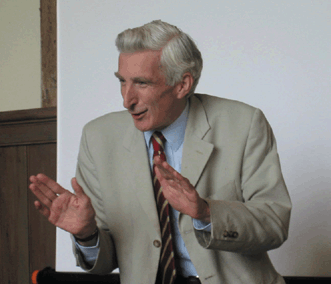
The notion that certain features of the universe, such as the values of the physical constants, may be constrained by the requirement that intelligent observers can arise was first mooted nearly 40 years ago. This “anthropic principle” has been a focus of controversy (even intense antipathy in some quarters) ever since. However, judging by a conference that took place in Cambridge at the end of August, the notion seems to be attracting the interest of an increasing number of eminent physicists. The meeting – the first in a series supported in part by the Templeton Foundation – took place at the Cambridge home of Martin Rees, one of the foremost advocates of the anthropic principle. Future meetings will address the biological and philosophical aspects of the subject.
What is the anthropic principle?
There are various versions of the anthropic principle. The “weak” version accepts the laws of nature and the values of the physical constants as given and claims that the existence of life then imposes a selection effect on where and when we observe the universe. For example, the current age of the universe cannot be less than the nuclear-burning time of a massive star – otherwise there would not have been enough time for the chemical elements that are essential for life to have been generated by stellar nucleosynthesis. On the other hand, the universe cannot be much older than this because the stars would have all burned out. This means that life can only exist when the universe has roughly its observed age. This is a logical consequence of our existence and is relatively uncontroversial.
The “strong” version of the anthropic principle suggests that the presence of observers imposes constraints on the physical constants themselves. In other words, life could only arise if the constants were close to their observed values. Some people might infer from this the existence of a creator who tailor-made the universe for our benefit. However, cosmologists have recently realized that processes in the early universe may naturally have generated an ensemble of universes, each having different values of the constants. We live in one of the universes that is conducive to life. Even though invoking multiple universes is highly speculative, this makes the strong anthropic principle much more palatable from a physical point of view since it just becomes an aspect of the weak version.
In order to argue that the universe is fine-tuned for the emergence of observers, one must specify who qualifies for this description, and not everybody agrees on this. Brandon Carter, who first coined the term “anthropic principle” in 1974, introduced the meeting by emphasizing that the concept can be refined in various ways according to whether one includes every conceivable observer (including ants and extraterrestrials) or just Homo sapiens. He proposed a “refined” anthropic principle, in which the observer is “weighted” according to the amount of information processed. It is not clear, however, that consciousness is the key feature of the anthropic constraints. Other speakers stressed that many of the fine-tunings are just associated with the development of complexity.
Evidence for the anthropic principle
As Virginia Trimble emphasized, the prerequisites for getting out of bed in the morning are many and varied! In particular, the existence of life (or at least our particular form of it) requires the formation of a hierarchy of structures – planets, stars and galaxies – and, as successive speakers pointed out, each of these seems to require rather special conditions.
Carl Murray focused on planet formation. The discovery of several dozen extra-solar planetary systems in recent years suggests that our solar system is far from unique, although he did emphasize that merely having planets is not enough for life to occur since the Earth seems to have been fortunate in various other ways. For example, it is known that the Moon has played an important role as a climate regulator. If the Moon were much smaller, the spin axis of the Earth would change chaotically – leading to catastrophic weather variations that could exclude the emergence of life. Another fortunate aspect of our solar system is that the outer planets seem to have played an important role in the formation of the inner ones.
Our presence on Earth might be regarded as an example of the weak anthropic principle. Rather more controversial are the anthropic conditions that seem to be associated with stars. I discussed in my talk how these involve constraints between the dimensionless “coupling constants” that describe the strengths of the fundamental interactions – in particular the electric fine-structure constant a = e2/h-bar c ~ 1/137, the gravitational fine-structure constant aG = Gmp2/h-bar c = 5 x 10-39, and also the weak fine-structure constant aW = gmec2/h-bar3 x 10-10, where G is the gravitational constant, g is the Fermi constant, mp is the mass of a proton, h-bar is the Planck constant divided by 2 pi, c is the speed of light and me is the mass of an electron.
It seems that aG must be roughly a20 for both “convective” and “radiative” stars to exist (prerequisites for planets and supernovae, respectively) and roughly aW4 for neutrinos to eject the envelope of a star in a supernova explosion (necessary for the dissemination of heavy elements). These “coincidences” might be regarded as examples of the strong anthropic principle.
Several contributors highlighted an even more striking example associated with stars. This involves the strong interaction and concerns the generation of carbon (another prerequisite for our form of life) in the helium-burning phase of red giant stars. This occurs via a reaction in which two alpha particles unite to form a beryllium nucleus that then combines with another alpha particle to form carbon. However, as the late Fred Hoyle (see Sir Fred Hoyle 1915 – 2001 and page 11 of this issue, print version) first pointed out, the beryllium would decay before interacting with another alpha particle were it not for the existence of a remarkably finely tuned resonance in this interaction. This fact is sometimes presented as an anthropic prediction but, as Trimble intriguingly pointed out, there may have been evidence for this resonance in the data even before Hoyle suggested that it be sought in the laboratory.
Heinz Oberhummer, who has studied this resonance in more detail, reported some beautiful work showing how the amount of oxygen and carbon produced in red giant stars varies with the strength and range of the nucleon interactions. His work indicates that the nuclear interaction must be tuned to at least 0.5% if one is to produce both these elements to the extent required for life.
Cosmological anthropic constraints
The anthropic constraints associated with the formation of galaxies involve various cosmological parameters, such as the density of the matter in the universe, the amplitude of the initial density fluctuations, the photon-to-baryon ratio and the cosmological constant (an extra term Einstein introduced into his field equations for cosmological reasons and which may cause the universe to accelerate). Some of these parameters might be determined by processes in the early universe rather than being prescribed freely as part of the initial conditions. However, as Martin Rees discussed, even small deviations from the observed values of such parameters would exclude the formation of structures like galaxies and their subsequent fragmentation into stars.
An interesting twist on these arguments was provided by Anthony Aguirre, who described anthropic constraints on so-called cold cosmological models, in which the initial ratio of photons to baryons (i.e. ordinary matter like protons and neutrons) is much smaller than currently observed. He pointed out that such models could provide life-supporting conditions with very different values of the cosmological parameters and coupling constants to those found in our universe. Both Rees and Aguirre stressed the importance of calculating the probability distribution for such parameters across the different universes because this is the only way of testing the multiple universe or “multiverse” proposal. For example, if the distribution for the amplitude of the density fluctuations fell off too slowly, we would be surprised to be in a universe with a value as small as is observed.
Fundamental constants
In assessing the anthropic principle, a key issue is whether some fundamental theory will eventually determine all the constants uniquely or whether some of them are contingent on initial conditions or accidental features of symmetry breaking. In the first case there is no room for the anthropic principle and the anthropic fine-tunings must just be regarded as coincidental. In the second case, there may be room for anthropic arguments.
One first has to decide which physical constants should be regarded as fundamental. Unification theories predict relationships between some of the constants, so one is certainly not free to vary all of them. Craig Hogan identified the coupling constants associated with the four interactions and some basic mass-scales (e.g. the masses of the electron and the up and down quarks) as fundamental. Although features of biology are not sensitive to the values of these constants, the existence of stable atoms and an interesting range of chemical elements certainly are. For example, even small changes in the quark and electron masses would make the proton, deuteron or hydrogen atom unstable.
The particle physicists at the meeting expressed various views on how likely such tunings are to result from some fundamental theory. As John Donoghue emphasized, “fine-tuning” arises in various different contexts in particle physics – why, for example, are the cosmological constant and strong charge-parity (CP) violation so small? – even though most of these may have no anthropic significance. However, some of them do and he particularly stressed anthropic constraints on the “vacuum expectation value” of the Higgs field, which determines the masses of all the ordinary particles.
At least some physical parameters would appear to be contingent. For example, Frank Wilczek, who first posited the existence of a light particle called the “axion” in order to explain the lack of CP violation in strong interactions, pointed out that the density of these particles would now be much larger than the baryonic density unless an angle associated with the initial conditions of the axion field were tiny. Such a large axion density would be incompatible with the formation of galaxies – and so is anthropically disallowed. The only reasonable explanation for axions and baryons having comparable densities is to invoke an early “inflationary” phase for the universe, in which it expands exponentially fast due to the effect of a cosmological constant. The axion angle would then have different values in different places and we would necessarily live in a region where this angle was very small.
Most physicists would probably prefer the constants to be determined by more conventional physics. So how likely could that be? The current favourite candidate for a fundamental theory is the string model. This posits that space-time is either 10-dimensional (superstring theory) or 11-dimensional (M-theory), with four-dimensional physics emerging from the compactification of the extra dimensions. Unlike the Standard Model of particle physics, which does not incorporate gravity and contains several dozen free parameters, M-theory may predict all the fundamental constants uniquely. This point was emphasized by Malcolm Perry. The only input would then be the string scale (related to the size of the 11th dimension). However, the situation is probably not as clear-cut as this since M-theory only predicts that the number of vacuum states should be discrete; the constants may be uniquely determined within each one but could be different across the states themselves. The crucial issue is whether the number of vacuum states is sufficiently large and their spacing sufficiently small to allow some room for anthropic constraints. This issue remains unresolved.
A new twist arises if the (so-called) constants vary in time even in our universe. This is expected in many unification theories since the constants should be related to the size of the compact internal dimensions, which would be expected to change during at least part of the universe’s history. This theme was taken further by John Barrow. He is part of a team that recently claimed to have found positive evidence for a variation in a of about seven parts in a million by studying absorption lines in several hundred galaxies (see When constants are not constant by Chris Carilli). His attempts to model this effect suggest that a should remain constant during both the early “radiation-dominated” phase of the universe and the late “curvature-dominated” or “cosmological-constant-dominated” phases. However, a can vary over the intermediate matter-dominated phase, which would make it difficult to satisfy the anthropic constraints on a for an extended period if the curvature or cosmological constant were too close to zero.
Quantum cosmology
One reason why many cosmologists now take the anthropic principle seriously is that the “many worlds” interpretation of quantum mechanics seems to be the only sensible context in which to discuss “quantum cosmology” – the branch of physics that tries to describe what happened near the big bang. As emphasized by Jim Hartle, quantum theory allows many mutually incompatible histories. However, it only makes sense to consider the initial conditions that led to the classical behaviour that we observe today. (With complete ignorance of the initial conditions, the quantum fluctuations could be arbitrarily large and the emergence of a classical world would not be possible.) Within this restriction, quantum cosmology allows many different worlds or “branches”, all with different values of the constants, and this validates the strong anthropic principle.
Nevertheless, the cosmologists present had widely different views on how the different worlds might arise. Andrei Linde and Alex Vilenkin invoked “eternal” inflation, in which the universe is eternally self-reproducing. This version of inflation predicts that there may be an infinite number of exponentially large domains – all with different laws of low-energy physics and different coupling constants. Indeed, Linde regarded inflation as the only plausible basis for anthropic arguments. Vilenkin argued that there is a well motivated prescription within the eternal-inflation scenario for calculating probability distributions for the various constants, showing that the distributions should be weighted by the volume of the universe in which each set of values pertains.
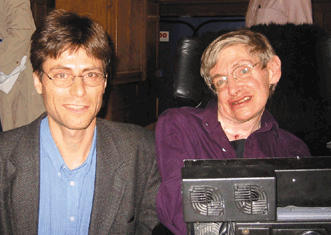
On the other hand, Stephen Hawking objected to the eternal-inflation model on the grounds that it extends to the infinite past and thus violates his “no boundary” proposal for the origin of the universe. This proposal requires that the universe start at a finite time and it avoids the initial singularity by requiring time to become imaginary there (i.e. time is multiplied by (-1)1/2 so that the metric starts off Euclidean rather than Lorentzian). Hawking uses the path-integral approach to calculate the probability of a particular history but only sums over those histories that lead to observers.
Neil Turok elaborated on this theme, showing that there are so-called instantons that represent classical solutions of the Euclidean equations that possess a continuation to real Lorentzian space-time. Although the path integral favours inflationary periods shorter than required, anthropic selection can salvage this since one only considers histories containing observers. This permits either open or closed universes but he argued that Hawking’s favoured (closed) solution is unstable.
More radical physics?
The final day of the conference focused on more radical deviations from standard physics as well as some philosophical issues. Richard Gott presented another version of the many-worlds principle, speculating how the existence of closed timelike curves in general relativity could allow the universe to create itself. Max Tegmark discussed anthropic constraints on the dimensionality of space and time: three spatial dimensions are required for the stability of planetary orbits and more than one time dimension would destroy causality. He also raised the issue of whether it is sufficient to consider universes with different values of the coupling constants, or whether one should also contemplate universes with different physical laws or even different mathematical foundations. This might be the only way to explain anthropic coincidences if the physical constants within a given set of laws turn out to be uniquely specified.
Bill Stoeger discussed the legitimacy of anthropic arguments. He argued that the weak anthropic principle is a logical necessity – but that the strong version only makes sense if variations in the initial conditions of the universe or the values of the constants or the laws of nature allow some scope for anthropic selection. The multiverse proposal may accommodate this possibility, but how legitimate is it, he argued, to invoke the existence of other universes for which there may never be any direct evidence?
Lee Smolin stressed that it is only justifiable if one has a theory that independently predicts the existence of these universes, and that such a theory, to be scientific, must be falsifiable. He argued that most of the universes should have properties like our own and that this need not be equivalent to requiring the existence of observers.
Smolin’s own approach invoked a form of natural selection. He argued that the formation of black holes might generate new universes in which the constants are slightly mutated. In this way, after many generations, the parameter distribution will peak around those values for which black-hole formation is maximized. This proposal involves very speculative physics, since we have no understanding of how the baby universes are born. However, it has the virtue of being testable since one can calculate how many black holes would form if the parameters were different.
A few speakers touched on the issue of consciousness. This is a topic usually eschewed by physicists, but Don Page emphasized that physics is primarily concerned with observations and these are, at root, conscious perceptions. He argued that a particular observer’s experience should be a random sample of all conscious experiences and discussed how one might derive the probability measure for this sample. Ultimately this must depend on unknown laws connecting consciousness with physics. Linde also proposed that consciousness might play a crucial role in the world, speculating that it might exist (like space-time) even without matter.
Such considerations may go beyond the domain of legitimate science. But perhaps the main message of the meeting was that developments in modern physics may require one to extend one’s view of what constitutes legitimate science anyway. The anthropic principle may not yet have attained complete scientific respectability, but it can no longer be dismissed as nothing more than mere metaphysics.
“Anthropic arguments in fundamental physics and cosmology” was held in Cambridge from 30 August -1 September.
Gabriela González and Jorge Pullin of Louisiana State University in the US are living proof that Einstein was wrong when he said that gravitation was not responsible for people falling in love. They met when Pullin attended a meeting on gravitational physics in Cordoba, Argentina, where González was an undergraduate. Soon afterwards they both found positions at Syracuse University near New York – Pullin accepted a post-doc while González worked on her PhD.
After two years, however, the reality of short-term contracts kicked in and Pullin moved to take up another post-doc position in Utah, followed by a tenure-track position at Pennsylvania State University. Meanwhile, González accepted a job at Massachusetts Institute of Technology, a mammoth 10-hour drive from Penn State. They spent six years living apart. Undaunted, the couple found ways to meet as often as they could. “Since we work in closely related fields, we chose to go to conferences that we could attend together,” recalls González. And at weekends they used to meet in a caravan parked half way between Boston and Pennsylvania.
“Living apart was a considerable emotional – and financial – strain,” says González, “and we wouldn’t recommend it to anyone. In our case, it had a happy ending.” Eventually, they both found permanent positions at Louisiana State, where Pullin is a theorist and González works on the LIGO gravitational-wave interferometer. Both of them believe that the separation was worth it in the long run and helped them to increase their marketability.
Double trouble
Finding a permanent position in academia can be hard enough, but it is even tougher when your partner is in the same situation. Inevitably, compromises have to be made. Some physicists, like Pullin and González, choose to live apart temporarily for the sake of their careers, while others accept lower-grade positions to be close to their partners. Couples who have succeeded in combining a happy marriage with two physics careers have had to work hard at it, and have often relied on luck, e-mail and lateral thinking.
Stephen and Katherine Blundell refuse to work in separate cities for the sake of their careers. (Picture credit: S Bebb/Physics Photographic Unit, Oxford University)
Commonly dubbed the “two-body problem”, finding two physics jobs in the same place is an issue that affects both men and women, and, importantly, physics employers. After all, what happens if the top candidate for a lectureship is married to a physicist who can’t find a job nearby? Chances are the candidate will reject the job offer or leave after a few years if their partner finds a better position elsewhere. “Ultimately your marriage is more important than your career,” says Stephen Blundell, a condensed-matter physicist at Oxford University. His astrophysicist wife, Katherine, currently holds a five-year Royal Society research fellowship, the latest in a succession of prestigious fellowships she has bagged to remain in Oxford.
Other couples who live hundreds of miles apart have found that their employers are sympathetic to their situation. Theresa Harrison of Birmingham University in the UK is married to Paul Harrison – a fellow particle physicist at Queen Mary College in London. “We’re lucky to have ‘visitor status’ at each other’s institution, which gives us access to a desk and a computer, for instance,” she says.
But some physicists draw the line at living in separate locations. “We decided very early on that we would not work in different cities,” recalls Stephen Blundell.
Follow you, follow me
Many couples choose to play the career equivalent of follow-my-leader, deciding that one of them should search for the best job available, while the other tags along. “I have spent my life going wherever my partner wanted to go and then somehow contriving to find a niche for myself,” says Althea Wilkinson, an astronomer at Jodrell Bank Observatory in the UK. Her husband, Peter Wilkinson, is associate director of the observatory and has never accepted that they would work in two different places. “I think it would have broken up the relationship, which is why I never attempted it,” she confides.
Theresa Harrison has also found that her career has been influenced by her husband’s choices. “I regard his career as more important than mine,” she confesses. “I’ve only considered positions in UK universities that work on the same particle-physics experiment as he does.”
But the follow-my-leader approach can lead to a great deal of soul-searching, as astrophysicists Moira Jardine and Andrew Cameron discovered in the early 1990s. At the time, they both held post-doctoral fellowships at Sussex University, with the promise of a lectureship for Cameron who was nearing the end of his contract. Then Jardine, whose career was some four years behind her husband’s, was offered a university lectureship a few hundred miles away in the north of England. After much deliberation, they decided that it was better to turn down the offer and stick together than risk finding a second job in the same place. It was the hardest decision they have had to make, admits Cameron.
“In the end the gamble paid off,” says his wife. “When three permanent positions were advertised simultaneously at St Andrews, we jumped at the chance to sell ourselves as a ‘package deal’ – a stellar-magnetic-activity team consisting of an observer and a theorist with 24-hour lines of communication.” They were offered two of the jobs.
The decision to accept should have been a “no brainer” but was complicated by the fact that Cameron had also been offered a more senior position elsewhere. “We both recognized that it would be almost impossible for me to get a permanent job there without it looking like nepotism,” recalls Jardine, who is now firmly ensconced at St Andrews with her husband and family.
Old-fashioned attitudes
Of course, the two-body problem is not unique to science or to academia. But it is a particular challenge for women physicists, according to a study carried out in 1998 by physicists Laurie McNeil from the University of North Carolina and Marc Sher at the College of William and Mary in the US. First because nearly 45% of married women physicists have husbands in the same field, compared with only 6% of men having physicist wives. And second because it is rare to find two physics jobs up for grabs at the same institution at the same time. Short-term contracts compound the problem. Often one partner can end up underemployed, or even unemployed. Indeed, the two-body problem has led to many people – especially women – leaving physics altogether.
Astronomer Donald Lynden Bell of Cambridge University, for instance, believes that his wife Ruth, now a professor in the atomistic-simulation group at Queen’s University in Belfast, remained in a job below her capabilities for 30 years until she accepted her chair in Belfast in 1995.
For the main part of their study, McNeil and Sher surveyed 620 couples where one partner was a physicist. They found that the choice of which partner plays which role can be influenced by professional seniority and research field. “Solid-state physicists tend to get permanent jobs earlier than particle physicists do,” argues Christine Davies, a particle theorist at Glasgow University in the UK.
She went to Glasgow specifically because her husband John was offered a permanent job there. “I only had a temporary lectureship to start with, and then I got an advanced fellowship with the Particle Physics and Astronomy Research Council,” she says. “When it looked as if I would not get a permanent job we decided to leave, and started looking elsewhere. But then the situation in Glasgow suddenly changed and I was offered a position, so we stayed.”
Others are not so lucky. According to McNeil and Sher, problems can arise when the number of job applicants outstrips the number of vacancies. With so many qualified hopefuls, some institutions believe they have the right to restrict the position to candidates who do not have the complication of a physicist spouse. Although the law in many countries prohibits interviewers from asking candidates about their marital status, many go ahead and ask anyway according to Sher, who was shocked by the repeated disregard for the law in interviews.
He reveals that one candidate was told that she would not be considered for the job if her husband did not have a job nearby. “Many remarks sound like the sort of thing one would have heard 25 years ago,” says McNeil. “I would have thought that people who continue to hold such views would have begun to keep them to themselves.”
But as Theresa Harrison points out, in a tight-knit community like particle physics, potential employers often know about your domestic situation before they have met you.
Helping hand
Although there is no magic answer to the two-body problem, many physicists have found that institutions do try and offer help – of sorts. Back in the 1960s when theorist Helen Quinn finished her PhD at the Stanford Linear Accelerator Center in California, she and her husband, Dan, applied for various post-doc positions. “We got two offers from the Daresbury Laboratory in the UK,” she recalls, “and a telegram from the DESY lab in Germany that said our applications had been accepted and a letter would follow.” On that basis they turned down the Daresbury jobs. “When the letter finally arrived, it was only addressed to my husband and offered him a position and a salary,” adds Quinn.
Although the lab agreed to increase her husband’s salary if she worked there too, the additional money was less than half his salary. The Quinns accepted anyway because, as she says, “we no longer had any other choices”. There was some logic to the offer, she concedes. At that time DESY paid American researchers more than they paid Germans; the total offer was the equivalent of two German salaries.
Some universities even offer to help partners find a job on or off campus. “One of our previous employers had a ‘dual-career office’,” says Pullin at Louisiana State. “We wrote to them, but they never got back to us.”
Christine Davies has a happier tale to tell. When she and her husband went to Cornell University in the US, she was the only one with a post-doc position but Cornell found some money to support her husband. Stephen and Katherine Blundell also found a potential employer who was sympathetic to the fact that they would only move together. “It only would have worked because the university was interested in us both as individuals,” stresses Katherine.
Lessons in love
So what are the lessons for young physics couples who have yet to find permanent jobs? Certainly each partner should be wholeheartedly committed to the career of the other. “You must both be prepared to compromise if you want to stay together,” warns Christine Davies. “Also be realistic about the chances of either of you getting a permanent job – ask senior colleagues for advice.”
Many couples have found that fellowships are the answer as they can often be taken from one institution to another. “They also carry prestige and add enormously to your chances of getting a permanent job,” adds Davies. Colleges at Oxford and Cambridge University can also be accommodating, offering fellowships that are distinct from university positions.
“Don’t give up and be prepared to negotiate your terms,” says Theresa Harrison. “There is a shortage of good physicists and employers are often prepared to be flexible for the right candidate.”
In spite of the stresses and strains of a two-physicist relationship, there are plenty of upsides too. Having a partner who understands that physics research can sometimes be all-consuming is probably the biggest bonus. After all, creative insight and breakthroughs are not confined the nine-to-five working day. Neither are the sudden pressures that teaching and exam marking can bring.
Being able to go to conferences with your other half is another plus point: you get to travel the world together and make friends in new countries, although it can be hard to avoid talking shop all the time. The flexibility of academic life also means you can often go on sabbatical together. And you always have someone at hand to proof read your papers and point out the jargon.
“We even occasionally discuss physics,” says Christine Davies, “but thank goodness we don’t work together!”
Many-body problem
If you think the two-body problem is tricky, then the real challenge comes when you add children to the equation. “It’s a problem that many women find they cannot recover from,” says Althea Wilkinson at Jodrell Bank, who has had first-hand experience of the problem. “I had been a temporary physics lecturer at Manchester University for nine years when I was made redundant for not doing enough research while my children were young.” She found help in the form of a Daphne Jackson fellowship, a scheme that allows scientists and engineers to return to research in the UK following a career break due to family commitments. Wilkinson firmly believes that there should be more schemes like it.
Happily Andrew Cameron and Moira Jardine at St Andrews find that working at the same institution offers greater flexibility when the inevitable family emergencies arise. And they should know. Two years ago Cameron stepped in to finish his wife’s lecture courses when their third baby arrived three weeks earlier than planned!
Physicists working in the UK earn an average of £32,000 per year, according to the Institute’s 2001 salary survey. This figure – the median salary for the 5400 members who responded to the survey – is 11% higher than the same figure in 1998 (Physics World November 1998 pp53-54, print version only). It is comparable with average salaries in other areas of UK science but falls well short of earnings in the US (see article).
Carried out by Market Research Services, the survey was sent to the 16,000 Institute members working and living in the UK. The 34% of questionnaires that were returned reveal quite a young membership profile – more than half of members are under 40, with 42% of women under 30 years old. However there is still a huge gap between the sexes – men receive a median salary of about £34,000, whereas women get just £24,500, which is explained in part by the difference in age profile. Women make up just 16% of Institute membership, although this figure is up from 13% three years ago.
Salary profile
The survey ranks salary according to job sector and job function, highest qualification obtained, geographical region and age. In the latter category, the median salary peaks between the ages of 50 and 54, at nearly £41,000. In terms of job sector, the highest pay is found in financial services, which pays physicists a median of £40,000 (table 1), up from £31,400 three years ago. The next highest paying sector is the electrical industry, which pays an average salary of £39,800, followed by telecommunications (£39,000) and information systems engineering (£37,100).
When it comes to job function, managers make the most money, with an average of £46,400 (table 2). Next come the few physicists that work in marketing, retail or distribution (£34,900), followed by consultants (£34,000). Teachers, including university lecturers, make an average of £30,700, but those carrying out pure research earn only £25,100 on average.
There are financial benefits to extra study. As shown in table 3, the 45% of physicists who go on to study a PhD earn an average of £35,000 and the few that gain a DSc do especially well financially, since they are paid a median salary of £52,200. Those who study for a masters degree earn £27,500, while those with an honours degree make £30,300. The comparatively low wage for those with a masters degree is likely to be partly due to the recent introduction of four year undergraduate masters courses in physics, which lower the average age, and hence salary, of those with masters degrees.
Geographical location has a bearing on how much a physicist can earn. Apart from the few working in Europe and the Republic of Ireland, those working in London earn the most – £35,000 on average – with those working in the south east of England and the small fraction of physicists working in Northern Ireland earning the next highest median – £33,500. Wales comes bottom of the heap, with a median salary of just £28,000. The south east is home to the most physicists – 26% of the total, down from 30% last time. Some 14% live in London.
One of the new questions included with the survey this time was why members had decided to join the Institute (see table 4). Asked to select from a list of pre-defined choices, the most popular reason for joining was “to identify with the physics community”, which 75% of respondents cited. This reason is particularly important for fellows (88%) and older members, who also were more likely to value the Institute’s work in schools and lobbying government. Gaining access to the Institute’s magazines and publications, however, was more important to associate members and younger members. Acquiring a professional qualification was important for middle aged members.
Working conditions
Members of the Institute are working long hours – two thirds of respondents say they work more than their contracted hours, with 93% working more than 35 hours a week.
Institute members earn a median basic income of £31,000 and get £1600 of additional income. On average, they receive an estimated £2500 of benefits, including pension contribution, private health care and share options.
In terms of career development, 69% of members said that their employer offered to pay for long term training and development programmes. This figure is lower for part time staff and the self employed. Some 88% of respondents said that their employer would consider them undergoing specialist training to enable them to carry out their existing job better. But only 18% said that their employer would agree to them taking broader “learning for life” qualifications.
The survey also looked at physicists’ career satisfaction by asking them to rank certain aspects of their career on a scale of 1 to 5 (1 meaning they were very satisfied and 5 that they were very dissatisfied). The results in table 5 were obtained by taking an average of all the replies. As was the case three years ago, the results show that respondents tend to be fairly satisfied only with technical opportunities but in all other aspects of their career they are neither satisfied nor dissatisfied.
Asked if they would recommend others to take up physics or engineering at university, a resounding 92% of respondents said they would. Recommending others to take up physics or engineering as a career received a slightly less positive reaction, with 81% saying yes. Some 12% of those advocating the study of physics or engineering at university did not recommend pursing a career in these areas.
1 Median salaries by job sector
Sector
Median salary (£)
No.
Financial services
40 000
101
Electrical industry
39 800
133
Telecommunications
39 000
254
Information systems engineering
37 100
104
Nuclear fuel processing
37 000
74
Electronics/IT manufacture
36 800
209
Light manufacturing
35 000
108
Government/civil service
35 000
160
Other industry
34 400
244
Health
33 600
129
Aerospace
33 400
225
Scientific/technical consultancy
33 300
259
Contract R&D
33 100
79
Instrumentation
33 000
103
Further/higher education college
31 000
197
University
31 000
1080
Other government
30 000
59
School
29 000
380
Research laboratory
28 200
364
Other service
23 800
60
2 Median salaries by job function
Sector
Median salary (£)
%
Management
46 400
17
Marketing/retail/distribution
34 900
1
Consultancy
34 000
10
Administration
31 600
3
Development
31 100
12
Teaching
30 700
16
Technical support
30 000
7
Production
28 300
1
Applied research
28 000
15
Other
27 500
6
Pure research
25 100
11
3 Median salaries by qualification
Highest qualification
Median salary (£)
%
DSc (or equivalent)
52 200
2
HND, HNC
35 000
1
PhD/Dphil
35 000
45
Ordinary/pass degree
31 100
2
Honours degree
30 300
25
Postgraduate diploma
29 800
3
Masters degree
27 500
21
Other
27 200
1
4 Reasons for joining the Institute
Reason
%
To identify with physics community
75
To gain access to the Institute’s magazines and publications
55
To acquire a professional qualification
54
The Institute’s work in schools and lobbying government
In his recent book Faith, Science and Understanding, the physicist-turned-Anglican priest John Polkinghorne makes the claim that, in practice at least, “almost all scientists” are, philosophically speaking, critical realists. A reviewer in this magazine questioned that claim (Facing up to the mystery of God). “Where,” he wondered, “are the statistics?” The reviewer might then have added: “What does Polkinghorne mean by critical realism?” and “What difference does it make?”
It is no surprise that there aren’t statistics on the philosophical commitments of scientists. Many physicists, I think, would claim that the objects in their field of study are really only described, and can only be referred to, by the language of mathematics, and they would regard any attempt to discuss their fundamental properties using ordinary language as hopeless.
Many philosophers would hold that philosophy and science are such vastly different activities that it would be nonsensical to say that scientists “have” a philosophy of science at all. A person who engages in an activity does not need to have a good theory of it. “To expect a scientist to do philosophy of science,” the philosopher Imre Lakatos liked to remark, “is like expecting a fish to do hydrodynamics.”
However, I’d reject that analogy. Unlike hydrologists and fish, scientists and philosophers are both human beings; in principle each could do what the other does. More importantly, scientists have implicit conceptions of what they’re doing and of the kind of things they work with. It therefore seems reasonable to me to survey scientists regarding what they believe about those things, and to ask them what they consider real.
For what philosophers do is analyse such conceptions critically. They look for inconsistencies and contradictions, and they see if these views can be made consonant with other positions we hold about the world. Philosophers know that ideas about things are what physicists call “strongly coupled”. In other words, if you make what looks to be a small adjustment here, it can have a huge impact over there.
This is why philosophers go to such lengths to work through the details of such positions – to which they give various terms, such as “critical realism” – and debate the relative merits of each. This is also why a fully consistent philosophy of science is apt to look strange and unnecessary to scientists, who do not need to go to such lengths to get on with their work.
A survey could, therefore, be an important, if very informal, indicator of which of these positions ring truest for scientists.
So let’s generate some statistics. Below you will find a questionnaire – similar in format to those that some of my colleagues use in their surveys. It would bias the data if I simply listed the names of some philosophical positions – even with short descriptions – because your responses would be influenced by your prior assumptions about the positions or by my descriptions. Therefore the survey concerns what you consider to be “real things”.
The critical point
In a future column, I shall discuss the results, relate them to different philosophical positions, report whether Polkinghorne was right or not, and say what difference it makes.
It sounds easy to answer the question whether a thing is “real” or not. However, I’m sure that some people will find reason to object that, in some cases at least, the question is ambiguous or poorly formed. That’s partly the point. Teachers know the value of asking an ambiguous or poorly formed question as a way of eliciting a more informed understanding.
In the event that I get low statistics, there could be two possible explanations. Either nobody reads this column, which is totally unthinkable and can be dismissed out of hand, or scientists simply don’t care about these issues, which would be an interesting result in itself.
Readers’ poll
Listed below are some names that one often hears scientists mention. Your task is to consider whether they refer to real things. Write down in the first column (I) those that you would (y), would not (n) or are unsure (?) whether to consider real things. In the second column (P), indicate (with y, n or ?) what you think the average professional physicist would think. Finally, in the third column (C) indicate (with y, n or ?) what you think the average citizen would think.
The real thing?
I
y/n/?
P
y/n/?
C
y/n/?
The Earth
Stones
Colours
Wavelengths
After-images
Hallucinations
Emotions
Genes
Atoms
The Bohr atom
Excited states of atoms
Electrons
Quarks
Higher-order infinities
Light waves
Viscosity
Kinetic energy
Electrical resistance
G (gravitational constant)
Real numbers
Mass
Imaginary numbers
Phlogiston
The Ptolemaic solar system
The Copernican solar system
Wavefunction (state of system)
Direction of time
Optional: why did you make the choices you did?
Answers can be sent by post to Robert P Crease at the address below, or by fax to +1 631 632 7522. You can also enter your responses electronically via the Brookhaven National Laboratory Web site.
In the movie The Meaning of Life, the Monty Python team reminds us that we live in “an amazing and expanding universe”. Ever since the startling evidence for cosmic expansion was discovered in the 1920s, physicists have considered the possibility that the so-called constants of nature – such as the charge on the electron and the gravitational constant – are not constant and may, in fact, vary with time.
In the late 1960s, George Gamow suggested that the charge on the electron, e, may vary rather than gravity. More precisely, he considered a variation in the fine-structure constant, a = e2/h-bar c, where h-bar is the Planck constant divided by 2 pi and c is the speed of light. The fine-structure constant is the gauge-coupling constant in quantum electrodynamics and determines the relative strength of the electromagnetic force. In essence, a can be considered a dimensionless measure of the charge on the electron.
Observational tests of the time variation of physical constants have been an idle curiosity of a handful of individuals, including myself, over the last few decades. Now a recent measurement by a team led by John Webb of the University of New South Wales in Sydney has thrust such studies into the spotlight. Webb and co-workers claim to have detected a significant variation in the fine-structure constant over time (J K Webb et al. 2001 Phys. Rev. Lett.87 091301).
In the October issue of Physics World, Chris L Carilli of the National Radio Astronomy Observatory, Socorro, USA, explores the implications of the surprising discovery.