Physicists usually create super-heavy elements by slamming heavy nuclei together inside a collider. But if the nuclei are very proton-rich, they often fail to bond because Coulomb repulsion pushes them apart. Instead, mass is transferred between the nuclei, and leads to two separate nuclei with very different masses. This phenomenon – which was previously thought to take place only above a ‘charge product’ of 1600 – is known as ‘quasi-fission’, and hinders fusion.
Hinde’s team conducted a series of collisions in the 16 megavolt electrostatic accelerator at the Australian National University. They collided pairs of light and heavy nuclei with charge products of between 500 and 1000: carbon-12 and lead-204, fluorine-19 and gold-197, and silicon-30 and tungsten-186. All of these combinations produce a small amount of short-lived radium-216. Hinde and colleagues measured the masses and amounts of decay products from the three samples of radium-216 to compare the reactions.
One might expect the radium-216 produced in each experiment to decay in the same way, but the complex interactions in nuclei containing hundreds of nucleons lead to a range of outcomes. The researchers found that quasi-fission did not take place between carbon and lead. But fragments from the other reactions spanned a wider mass range, which suggested that the process had taken place in the fluorine-gold and silicon-tungsten collisions.
Current theories also predict that quasi-fission should not take place between nuclei with such different masses. But these results suggest that this idea is inaccurate. “This indicates that quasi-fission is competing with fusion in collisions between nuclei with even lower masses, which would otherwise have produced heavy fusion products”, Hindes told PhysicsWeb.
The team hopes that improved models of the dynamics of collisions will describe their unexpected data and lead to better predictions of quasi-fission and fusion in reactions that may form super-heavy elements. Together with an analysis of new carbon-lead data gathered at Daresbury in the UK, the researchers plan to extend their studies to heavier nuclei.
In 1968, together with Dennis Sciama, Rees was the first to predict that fluctuations in the microwave background were due to the uneven distribution of matter in the universe. His research into the structure and evolution of the universe has also sparked many other research efforts. Elsewhere, his work as a spokesperson, educator, writer and public speaker have raised the profile of astrophysics and brought it to a wider audience.
The prize – which consists of a gold medal and a cash award of $150 000 – will be presented on 2 November in Bern, Switzerland, where Einstein formulated his special theory of relativity.
In 1933 Peter Kapitza and Paul Dirac predicted that a standing light wave would act as a ‘light grating’ that could diffract electrons. But light interacts only weakly with electrons, and early attempts to detect coherent electron diffraction failed because the available light sources were too weak.
To form the grating, Batelaan and co-workers directed two powerful pulsed lasers towards each other to create a standing wave several millimetres in length. The maxima of this wave pattern were 266 nanometres apart, half the wavelength of the laser light. A narrow beam of electrons was sent through the grating, and detectors placed 24 centimetres behind the grating map the distribution of the diffracted electrons.
As the team hoped, the profile had a central maximum flanked by weaker peaks, each separated by 55 micrometres, as predicted by Bragg’s law. The heights of the peaks differed slightly from those predicted by Schrödinger’s equation, which describes both the particle and wave nature of all matter. Batelaan and colleagues attribute this discrepancy to imperfect overlap of the lasers that form the grating.
Importantly, the diffracted electron beams keep the same phase relationship after they have passed through the grating. Interferometry – a powerful probe of the structure of matter – is based on the splitting and recombination of such coherent beams. If the phases of the beams stay the same, they recombine ‘constructively’ to give a strong signal. But if one beam passes through a sample of matter, its phase changes and the recombined beams produce a weaker signal. The exact intensity of the signal reveals certain properties of the matter.
As Batelaan explains, an electron interferometer could be extremely sensitive because the wavelength associated with electrons is around ten thousand times shorter than that of light. “Very small effects could cause a shift in the phase of an electron beam”, Batelaan told PhysicsWeb. “We could detect the tiny electromagnetic fields associated with atoms and particles”.
Semiconductors can only be grown on substrates with compatible crystal structures. Until now, this has meant that semiconductors such as gallium arsenide had to be grown on wafers made of the same material. But these are brittle and expensive, and limit the size of the chips to about 15 centimetres for gallium arsenide.
Scientists at Motorola have tackled this problem by developing a layer that can separate the semiconductor from the silicon substrate, yet bond with both of them. This layer – made of strontium titanate – eliminates the strain that arises when III-V semiconductors are placed directly onto the silicon. Gallium arsenide chips up to 30 centimetres across have been grown using the new technique.
The discovery could also solve the long-standing problem of incompatibility between silicon, which has poor optical properties, and light-emitting semiconductor materials. “Gallium arsenide on silicon is just the first step”, says Jim Prendergast, director of physical science at Motorola. “One of our next goals is to grow indium phosphide on silicon, which should support long-wavelength lasers critical to fibre-optic communications”.
A mishap in an attempt to make ultra-thin transistors revealed the unexpected properties of the strontium titanate layer to physicists at Motorola.
Bordogna and Albano of the Institute of Theoretical and Applied Physical Chemistry in La Plata compare the teacher to an applied magnetic field and suggest that the achievement of each student in a class is analogous to the alignment of the individual spins. Achievement depends largely on the ability of the teacher, but social effects are also significant. Classroom discussion is usually a ‘positive’ effect – it tends to increase knowledge, or ‘align’ spins – but idle chatter hinders learning, and ‘misaligns’ the spins.
In order to predict learning trends, Bordogna and Albano assigned scores to different kinds of social interactions. They found that their predictions closely matched data gathered in the classroom by educational psychologists. According to the Ising model, a single misaligned spin in a magnet will quickly reposition itself to match its neighbours. Similarly, it accurately predicts that struggling students will catch up quickly if they join a class of high-achievers.
The ‘persuasiveness’ of a student – which is similar to the ‘aligning’ force exerted between neighbouring atoms – is also a strong factor, and the theory correctly predicts that team-work strongly aids learning, no matter how persuasive the teacher.
Bordogna and Albano are optimistic that their study could be extended to describe how people use the Internet to learn. Although there are important differences – many more people are involved, the nature of the interactions is different and there is no teacher – they believe that the principles are the same.
Some sociologists are uncomfortable with the use of mathematics to describe education, and argue that social situations are too complex to be reduced to equations. But David Byrne, a sociologist at the University of Durham in the UK, points out that people would have been sceptical about modelling economics and biology 25 years ago.
NASA has traditionally funded projects associated with large space missions – such as observations with the Hubble Space Telescope – and currently funds nearly three-quarters of such experiments. The National Science Foundation (NSF) provides grants for the individual scientists who conduct smaller ground-based experiments or theorists who analyse data gathered in space. The organisations recently worked together on the Boomerang experiment in the Antarctic to study the cosmic microwave background.
Although a single agency might lead to a more coherent US astronomy programme, the experts believe that the interests of both NASA and the NSF would be better served by closer cooperation rather than complete integration. They argue that giving NASA full control could favour large, one-off missions at the expense of ongoing smaller experiments and education initiatives conducted by the National Science Foundation. The government-appointed panel was headed by Norman Augustine, retired boss of aerospace company Lockheed Martin.
The gravity of a black hole is so strong that nothing within a certain radius can escape from it – not even light. But astronomers can sometimes detect black holes by the radiation that originates from near their surfaces: as material falls into a black hole, its potential energy is converted into radiation that streams across space.
Previous studies of the motion of stars suggested that a black hole about three million times the mass of the Sun exists in the centre of the Milky Way. But the orbits of those stars had a radius 30 000 times larger than the predicted radius of a black hole that massive. In a region this large, some other entity – such as a cluster of ‘dark stars’ – might make up this unseen mass.
Baganoff and colleagues first confirmed that Sagittarius A* emitted X-rays in 1999, using the space-based Chandra X-ray Observatory. They detected only a weak signal initially, but similar observations a year later revealed that the flux had increased dramatically. In particular, it jumped to about 45 times its previous level during one burst, which lasted for almost three hours. During this period, Baganoff’s team found that the X-ray intensity rose by a factor of five in just ten minutes, and fell in a similar period.
The frequency of these fluctuations is crucial. The conditions that led to such a radical change in the X-ray emission cannot have spread across the black hole any faster than light. But the conditions changed significantly within ten minutes, and this limits the size of the black hole to a region less around one astronomical unit – the distance from the Earth to the Sun – across. A super-massive black hole is the only realistic candidate for the invisible mass that could exist in such a small region.
Baganoff and colleagues now hope to find a similar pattern in the variations of radio waves from Sagittarius A*. If they succeed, they will have excluded the slight possibility that the X-rays came from a different source.
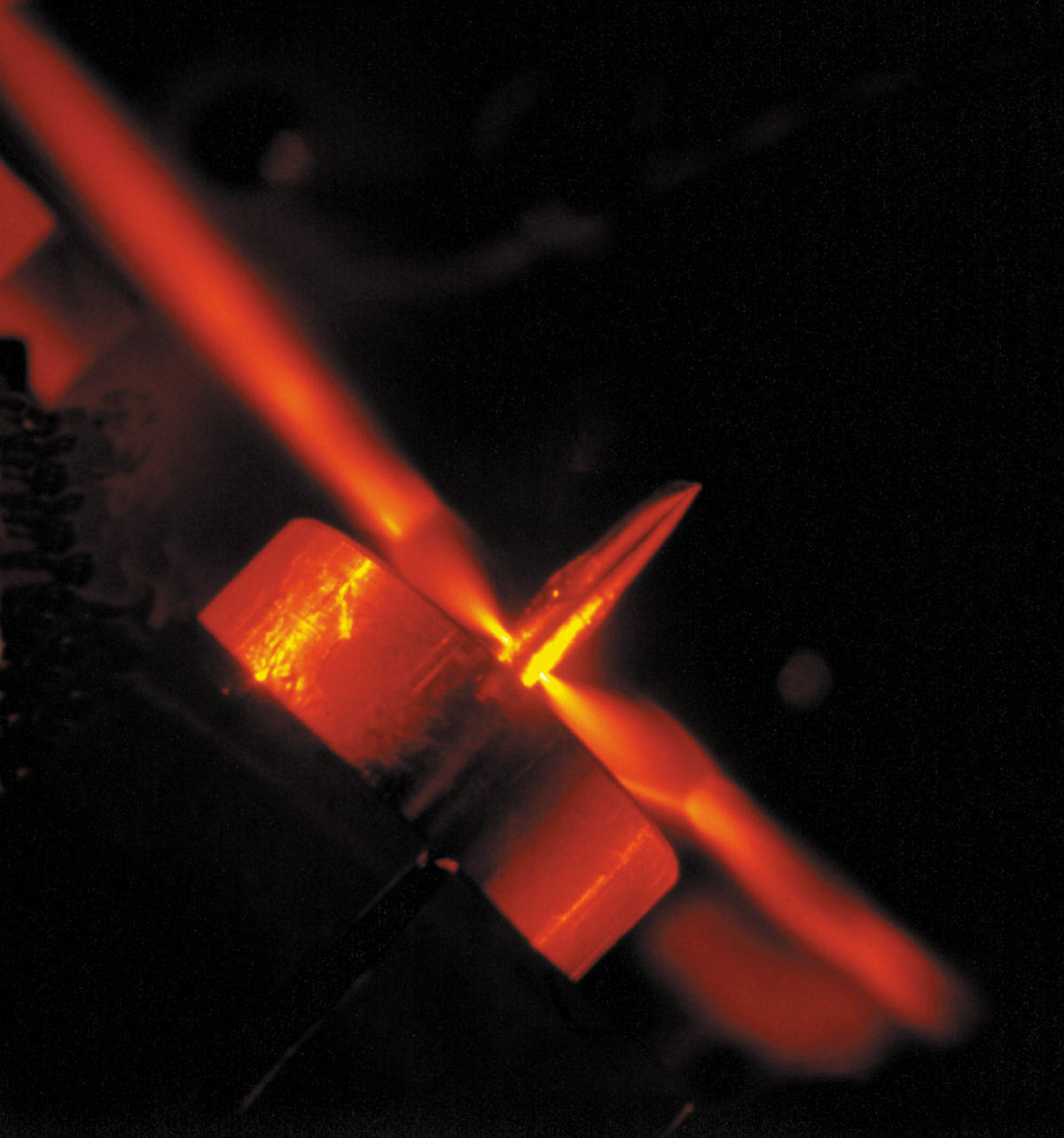
Ultrafast X-ray pulses are generated when neon atoms contained in this metal tube are irradiated with a femtosecond laser. (Courtesy: Ferenc Krausz)
Many amateur photographers are disappointed when they discover that their shots of fast-moving objects are blurred beyond recognition. The most likely reason for this is that the exposure time was not short enough to freeze the motion. In contrast, modern ultrahigh-speed cameras can take up to a million images every second and can capture motion that is normally imperceptible to the human eye. By projecting the photographs on a screen in sequence, the action can be replayed in slow motion. While these techniques are ideal for studying macroscopic objects, how can we possibly follow the motion of atoms and electrons?
The impetus to be able to track the movement of atoms and electrons comes from many areas of science and technology. The ability to look at chemical or biochemical processes is a prerequisite for steering reactions, while insights into the dynamics of electrons and holes in semiconductor structures are crucial for speeding up electronic devices. At a more fundamental level, following the motion of electrons in atoms is essential if we want to understand what happens inside excited atoms and exploit these processes in applications such as X-ray lasers.
So how short does the exposure have to be in order to capture the dynamics of atoms and electrons? Surprisingly, the answer is rooted in classical physics and is determined by the mass of the atom and the Coulomb force exerted on it by its neighbours. The movement of nuclei in a molecular or crystal-lattice structure, for example, can be traced with a probe lasting 10–100 femtoseconds (1 fs = 10–15 s). Meanwhile, the smaller mass of electrons makes them rather snappy movers. Indeed, the motion of bound electrons in excited atoms and molecules evolves on timescales of 10–1000 attoseconds (1 as = 10–18 s) and so requires attosecond probes.
Taking freeze-frame shots of atoms calls for exposures more than a million times shorter than those offered by the fastest high-speed cameras. This enormous gap has been bridged in the last decade thanks to the invention of lasers that produce flashes of light lasting just a few femtoseconds.
Atoms in slow motion
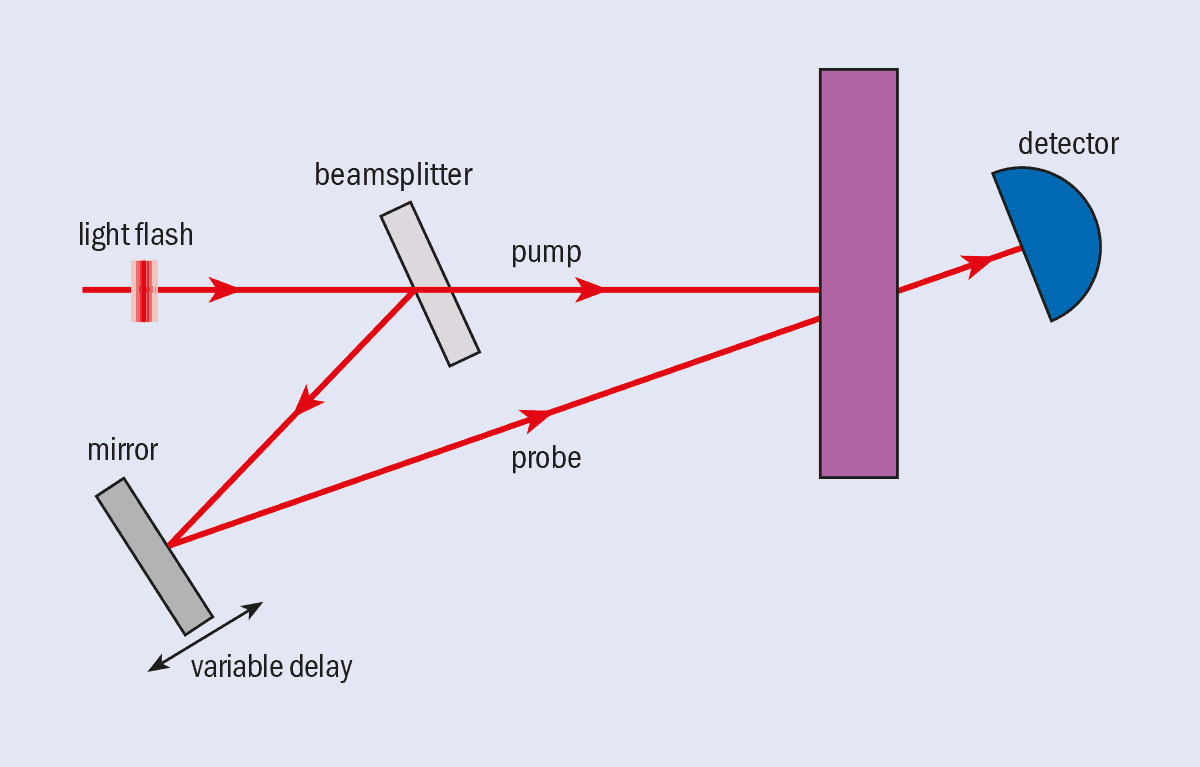
Physicists can now take snapshots of evolving atomic systems with pinpoint accuracy using ultrashort flashes of light to both trigger the dynamics and illuminate the system. This can be done by splitting each laser pulse with a partially transmitting mirror and delaying the less energetic “probe” pulse with respect to the stronger excitation or “pump” pulse (figure 1). In this way a powerful femtosecond laser pulse can initiate the same microscopic process in millions of molecules or sites in a crystal lattice. A weaker portion of the pulse (or a frequency-shifted replica) can then probe the dynamics by measuring changes in the optical properties of the system (e.g. the absorption) at a later instant.
We can replay the atomic or molecular dynamics in slow motion by using a series of femtosecond pulses and increasing the delay between successive pump and probe pulses. This approach is known as time-resolved or pump–probe spectroscopy and is currently the only way to study microscopic dynamics. The time resolution is only limited by the duration of the pump and probe pulses.
1 High-speed photography at the microscale
(Courtesy: IOP Publishing)
To extend high-speed photography to microscopic processes, an ultrashort laser pulse is split in two at a beamsplitter. The excitation or pump pulse initiates the dynamics, e.g. the breaking of a chemical bond, while the probe pulse captures any change in the optical properties at a later time. A sequence of measurements can be made by varying the delay between the pump and probe pulses using a movable mirror. From the change of the optical properties (e.g. absorption) versus delay, the dynamics (e.g. atomic motion) can be reconstructed. The duration of the light flashes determines the resolution of this “time microscope”.
Physicists can now routinely generate pulses shorter than 10 fs using self-mode-locking lasers, which were invented in 1990 by Wilson Sibbett of St Andrews University in Scotland. In a mode-locked laser, the electric fields associated with all the different frequencies or modes that can exist inside the laser cavity add constructively at one point and destructively elsewhere to create a high-intensity spike.
The early mode-locked lasers developed in the 1970s were difficult to construct and operate. In contrast, self-mode locking happens naturally in carefully designed laser cavities that incorporate a solid-state amplifier such as titanium-doped sapphire – a laser medium developed in the 1980s by Peter Moulton at the Massachusetts Institute of Technology. Meanwhile specialized “chirped” mirrors, devised in 1993 by Robert Szipocs of the Research Institute for Solid State Physics and Optics in Budapest and the current author, can further compress the pulses (see Szipocs et al. in further reading).
Using these techniques, Ursula Keller at the ETH in Zurich and, independently, Franz Kartner and colleagues at MIT, have developed oscillators that produce pulses that last just 5 fs and have a wavelength of 800 nm. In other words, these pulses contain only two cycles of the laser field. Since light is an electromagnetic wave, the laser pulses cannot be shorter than the “carrier wavelength”, λ, which therefore limits the duration of the pulse to λ/c, where c is the speed of light.
This means that the wavelength of light limits the resolution with which atoms can be observed in time, as well as limiting the spatial resolution (see the article by Vahid Sandoghdar on page 29, print edition only). Interestingly, physicists can resolve atoms more readily when they are moving than when they are fixed. While it is impossible to view stationary atoms with visible light due to the diffraction limit, femtosecond pulses are capable of tracking moving atoms that are displaced by as little as 0.01 nm in real time due to the fact that the atoms move slowly compared with the speed of light.
Femtosecond chemistry and semiconductor dynamics
The formation and breaking of chemical bonds between atoms in molecules is one of the most important microscopic processes that affect our lives. Ultrafast laser pulses allow physicists and chemists to follow these femtosecond processes by tracing die displacements of die atoms, as demonstrated for the first time in the late 1980s by Ahmed Zewail at the California Institute of Technology. These displacements induce changes in the optical properties of the weakly bound valence electrons that can be revealed instantly by a visible-light probe. In complex systems, however, die atomic motion can be more accurately determined by studying core electrons close to the atomic nucleus, but this requires X-ray wavelengths.
Ultrafast laser pulses also allow us to measure the frequencies with which the chemical bonds stretch and contract. However, molecular vibrations can be measured more easily in the frequency domain using existing techniques, for example by measuring the absorption of infrared radiation as a function of frequency. So what are the advantages of ultrafast lasers?
Unlike frequency-domain techniques, ultrafast lasers provide access to the relative phase of the vibrational modes, which is crucial for reconstructing the dynamical changes in the structure of the molecule. These time-domain measurements can identify which chemical bond broke first, for instance, and the course of the chemical reaction. Moreover, femtosecond pulses can even control chemical reactions, as demonstrated recently by Gustav Gerber and Thomas Baumert at the University of Würzburg in Germany.
Ever since they became widely available, picosecond and femtosecond lasers have been used to investigate the dynamics of charge carriers in semiconductors. New insights into the basic phenomena that limit the speed of integrated circuits allow physicists to extend the limits of high-speed electronics. Ultrashort pulses of light can be used to explore the frontiers of electronics because they are far faster than the fastest electronic devices available.
Moreover, the terahertz electric fields that are produced by ultrashort optical pulses can induce and control currents in integrated circuits on timescales that are inaccessible to electronic instruments. This capability will help to speed up computers by a factor of thousand compared with the current state of the art. And even when terahertz electronics becomes a reality, femtosecond laser pulses will still be fast enough to keep pushing the frontiers of semiconductor technology.
Beyond the femtosecond barrier
So can we gain anything more by improving the resolution of pump–probe spectroscopy beyond 1 fs? The answer is clearly yes – sub-femtosecond laser pulses will enable us to track processes inside atoms for the first time. The first step in this direction is to generate and measure sub-femtosecond or attosecond light pulses. These pulses will have to be substantially shorter than the wave cycle of visible light, which lasts about 2 fs in the case of red light. As a result, shorter wavelengths or higher “carrier frequencies” are needed to generate sub-femtosecond light pulses.
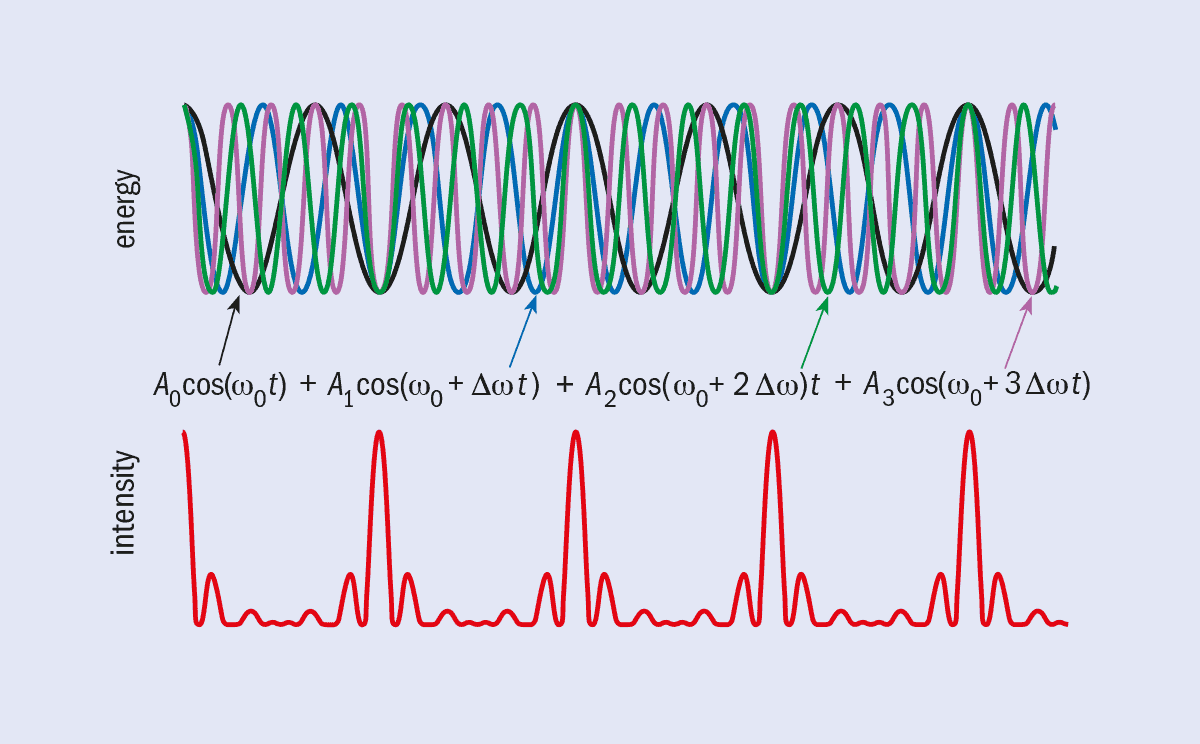
In principle, a sequence of light pulses that are shorter than λ/c can be produced simply by adding together waves that oscillate with an angular frequency of ω0 + NΔω, where Δω is a fixed shift with respect to the fundamental laser wave, ω0 = 2πc/λ, and N is an integer (figure 2). The result is a series of intense spikes separated in time by 1/Δv = 2π/Δω.
2 How to generate sub-femtosecond pulses
(Courtesy: IOP Publishing)
The superposition of several light waves at equidistant frequencies (top) in the ultraviolet region can give rise to a sequence of sub-femtosecond spikes (bottom) if the phases of the waves are adjusted appropriately. The repetition rate of the spikes is Δv = Δω/2π, where Δω is the angular frequency difference between adjacent components.
The duration of these spikes is inversely proportional to both the frequency shift, Av, and the number of waves that add together. This means that in order to produce the subfemtosecond pulses using a limited number of waves, Δv must be similar to the frequency of visible light. Conceptually, this technique is closely related to the mode-locking method that is generally used to generate femtosecond pulses in laser resonators (see Kapteyn and Murnane in further reading). The significant difference, however, is that Δv for sub-femtosecond pulse generation must be several orders of magnitude greater than the frequency spacing between the adjacent modes of a laser resonator. Indeed, Δv must be so large that no laser can amplify all these frequency-shifted waves. The only way that these waves can be produced is using nonlinear optical techniques that are not part of the femtosecond laser oscillator itself.
In general, two nonlinear optical phenomena can be exploited to produce waves that are phase-coherent with the incident laser beam but have much higher frequencies – stimulated Raman scattering and high-order harmonic generation. In order to keep the dispersion of ultraviolet light and the absorption of shorter wavelengths as low as possible, both processes are carried out in a gas.
Raman scattering occurs when light passes through a gas of molecules. The light can excite vibrational or rotational energy levels in the molecules, which subsequently modulate the laser radiation. The potential of stimulated Raman scattering for generating trains of sub-femtosecond pulses has been demonstrated by several groups, including Alexi Sokolov and Stephen Harris at Stanford University in the US. They excited vibrational oscillations in deuterium molecules using two narrow-band lasers, which were chosen so that the difference in frequency between the two beams matched the oscillation frequency of the molecules. The periodic movement of the deuterium nuclei affects the extent to which the electrons are displaced by the laser. This periodic nuclear motion leads to phase-coherent sidebands that are frequency shifted with respect to the incident laser waves by the vibrational frequency (Δv ≈ 90 THz). The spectrum of these coherent collinear Raman modes extends from the infrared to the ultraviolet (figure 3a). Only a fraction of this spectrum – comprising the blue, violet and ultraviolet lines – is needed to generate a train of sub-femtosecond pulses separated by 1/Δv ≈ 11 fs, provided the relative phase of the Raman modes is properly adjusted.
3 Raman sidebands and high harmonics
3a (Courtesy: A Sokolov et al. 2000 Phys. Rev. Lett.85 562)
3b (Courtesy: P Paul et al. 2001 Science292 1689).
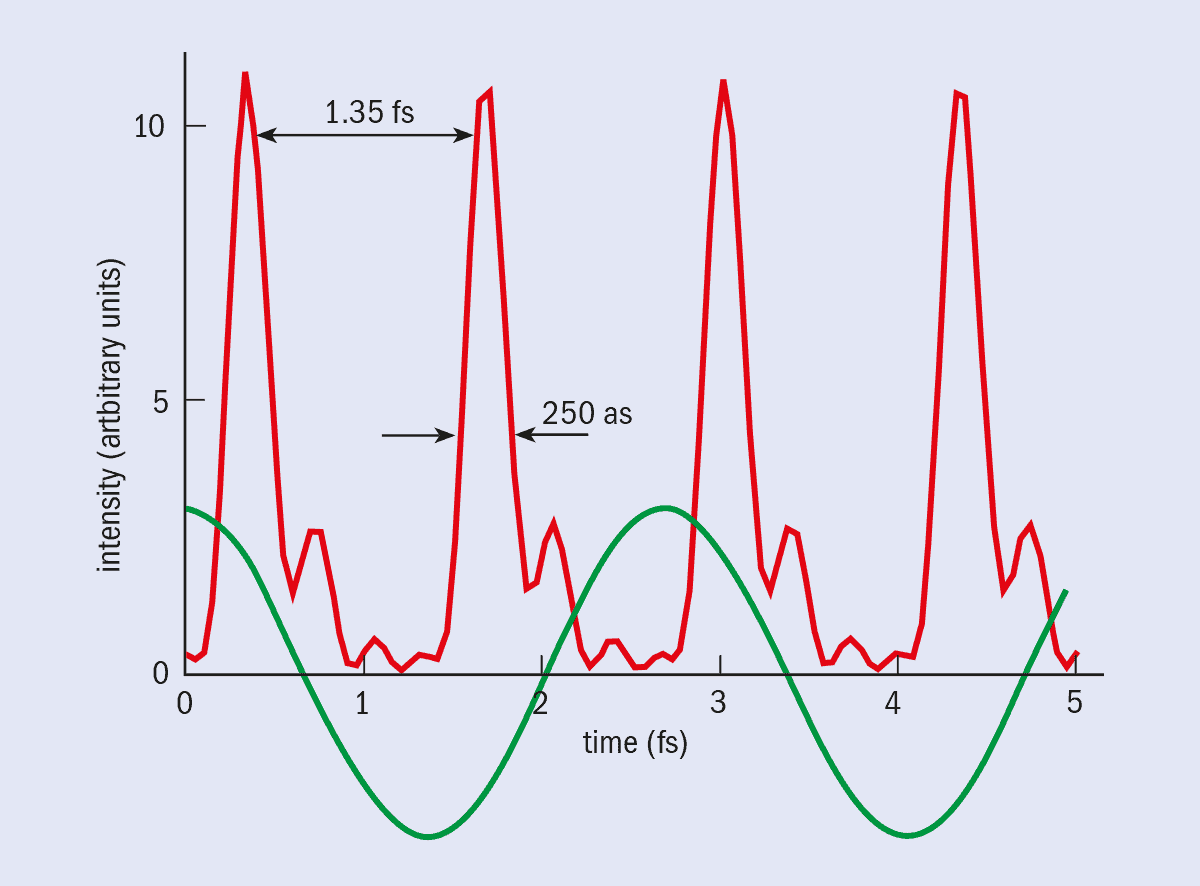
(a) The spectrum produced by Alexi Sokolov and co-workers at Stanford using a collinear Raman generator. From the left: the first two sidebands are at infrared wavelengths, while the next four are in the visible spectrum from red, green, blue to violet. The subsequent sidebands are in the ultraviolet and are only visible from the fluorescence they generate. The sidebands produced by exciting molecular vibrations at the difference of two laser frequencies are coherent and range in wavelength from 2.94 μm to 195 nm. (b) The train of attosecond pulses (red) that is predicted to emerge when a jet of argon gas is exposed to intense 40 fs laser pulses with a wavelength of 800 nm. The 11th, 13th, 15th, 17th and 19th harmonics that are generated add together to produce the ultrashort pulses. The carrier wavelength of the attosecond-pulse train is 53 nm and the train length is of the order of 10 fs. The green line represents the electric field of the driving laser.
Even snorter pulses can be produced by shifting the laser frequency into the extreme ultraviolet using high-order harmonic generation. This phenomenon occurs when a high-power beam of linearly polarized femtosecond laser pulses is passed through an atomic gas. The intense electric field of the light pulse can rip an electron away from an atom and then accelerate it. When the light field reverses in the next half-cycle, the electron can slam back into the ion and give up its energy in the form of an X-ray photon. This process is repeated every half cycle of the laser field, resulting in the emergence of discrete lines in the extreme ultraviolet and X-ray spectrum. These “high-order harmonics” are separated in frequency by twice the frequency of the driving laser field and combine with each other to produce a train of attosecond pulses (figure 3b).
Conclusive experimental evidence for the existence of such a pulse train was obtained only recently by a collaboration between French and Dutch physicists, led by Harm Geert Muller at the FOM Institute for Atomic and Molecular Physics in Amsterdam and Pierre Agostini at the Centre d’Etudes de Saclay near Paris. The experiment indicated the generation of a train of 250 as pulses using 40 fs pump pulses from a Ti: sapphire laser.
Sub-femtosecond spectroscopy
Stimulated Raman scattering and high-harmonic generation unfortunately have their drawbacks for pump-probe spectroscopy. The time interval between the pulses – 11 fs in the Stanford experiment and 1.3 fs in the Amsterdam–Paris work – is so short that the physical, chemical or biological processes under study do not have time to completely decay and return to their initial state before the next pulse arrives. The high repetition rate of the pulses therefore imposes an unacceptably severe restriction on the processes that can be studied.
Clearly pump-probe spectroscopy can only benefit from these ultrafast sources if a single pulse can be selected from the train, as Paul Corkum of the Steacie Institute of Molecular Sciences in Ottawa, Canada, pointed out in his pioneering proposal for attosecond optics. The most promising way of isolating such a pulse is to drive the molecules that produce the Raman lines – or the atoms that emit the high harmonics – for such a short time that a single pulse naturally arises from the generation process. This avoids the formidable task of having to select individual pulses from a multi-terahertz train.
This approach requires that pulses from a Ti:sapphire laser must last no longer than 5–10 fs and must have about a millijoule of energy to produce a single sub-femtosecond burst of ultraviolet or X-ray radiation. But the 5–10 fs pulses that emerge directly from a Ti:sapphire laser oscillator have nanojoules of energy, rather than millijoules. Amplifying this energy by a factor of a million comes at the cost of stretching the pulses in time to about 20 fs.
4 Intense few-cycle laser pulses
(Courtesy: S Sartania et al. 1997 Opt. Lett.22 1526)
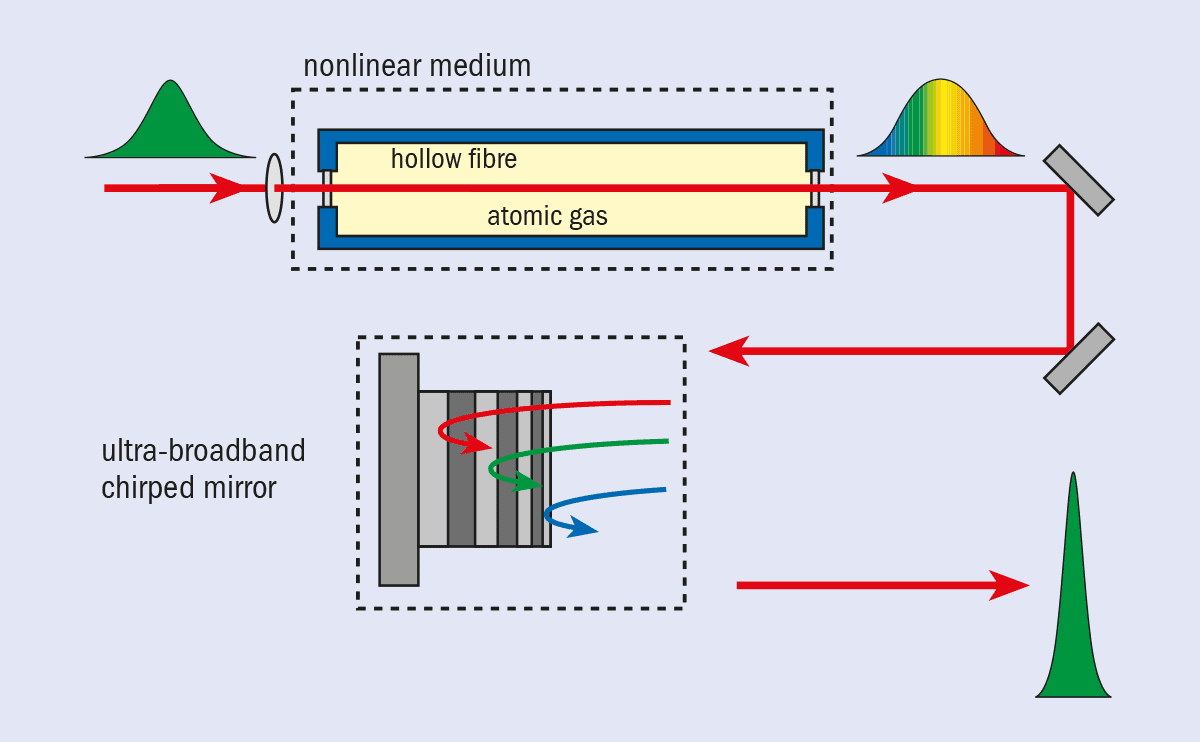
To produce high-energy light pulses comprising less than three wave cycles, 20 fs pulses from a Ti-sapphire laser are first propagated through a hollow-core waveguide filled with neon. The intensity-dependent refractive index of the gas modulates the pulse, resulting in the emergence of new frequency components. The leading edge of the pulse is “red-shifted” to lower frequencies while the trailing edge is “blue-shifted” to higher frequencies. When these pulses impinge on a specially designed “chirped” multilayer mirror, the red-shifted components at the front edge penetrate deeper before being reflected than the blue-shifted components at the trailing edge. This mirror compresses the frequency-broadened pulse in time. The system is capable of delivering 5 fs pulses with a peak power of 0.1 terawatt.
One way around this problem is to take the intense 20 fs pulses and pass them through a hollow waveguide filled with a gas, a device that was invented in 1995 by Orazio Svelto and Sandro De Silvestri of Politecnico di Milano in Italy. Since the refractive index of the gas varies with intensity, the pulse broadens in frequency – the leading edge of the pulse is shifted to a lower frequency while the trailing edge is shifted to a higher frequency. These frequency-broadened pulses are next compressed in time using ultra-broadband “chirped multilayer mirrors” that were developed by my group in Vienna and researchers at Budapest (figure 4). These mirrors are specially designed so that the red-shifted light at the leading edge of the pulse penetrates further before being reflected than the blue-shifted light at the trailing edge. The emerging pulse is less than 10 fs in duration and has a peak intensity in excess of 100 gigawatts. Pulses with these characteristics are opening the way to the generation of single sub-femtosecond pulses.
The first successful steps in this direction were taken recently by exploiting both Raman scattering and high-harmonic generation. Georg Korn and co-workers at the Max Born Institute in Berlin passed 15 fs pulses of violet light through pre-excited sulphur-fluoride molecules with a vibrational frequency of 23 THz. Continuous sidebands were generated, which resulted in the emergence of single pulses that had a wavelength of 400 nm and that last just 4 fs.
In another recent experiment, my group – in collaboration with researchers at the University of Bielefeld in Germany and the National Research Council of Canada in Ottawa – generated single soft X-ray pulses with a wavelength of 14 nm. These isolated X-ray bursts emerged as a collimated laser-like beam from high-harmonic generation in a gas of neon atoms exposed to intense pulses containing a few cycles of the laser field. We measured an upper limit of some 2 fs on the pulse duration by using the X-ray burst as a “pump” pulse to photo-ionize a gas of krypton atoms, and a second time-delayed laser as a “probe” (see Drescher et al. in further reading).
5 Attosecond pulses in action
5a (Courtesy: IOP Publishing)
5b (Courtesy: IOP Publishing)
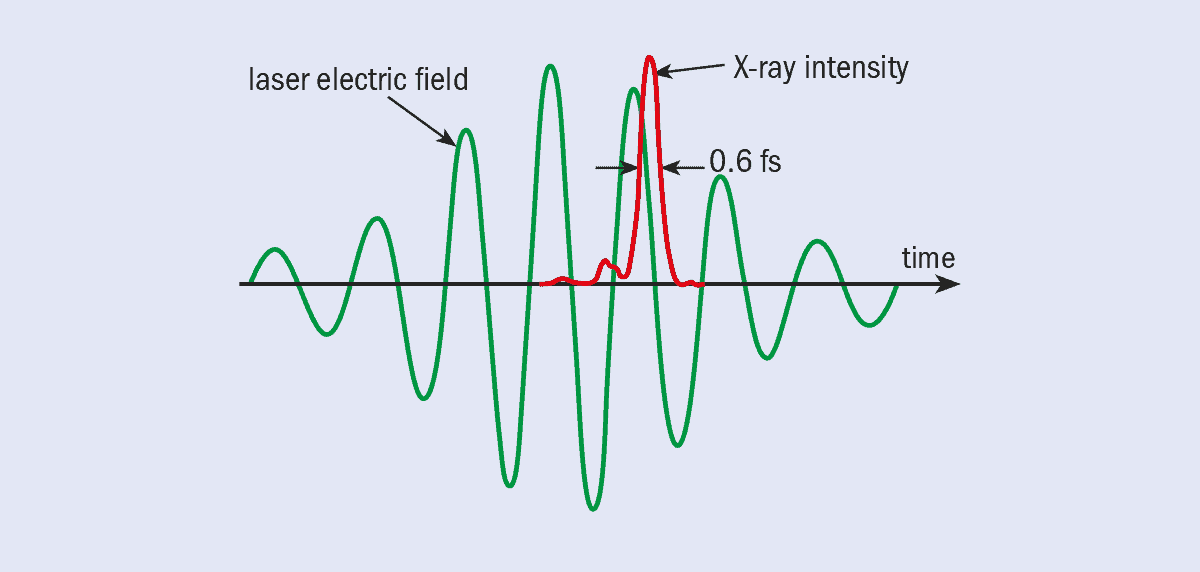
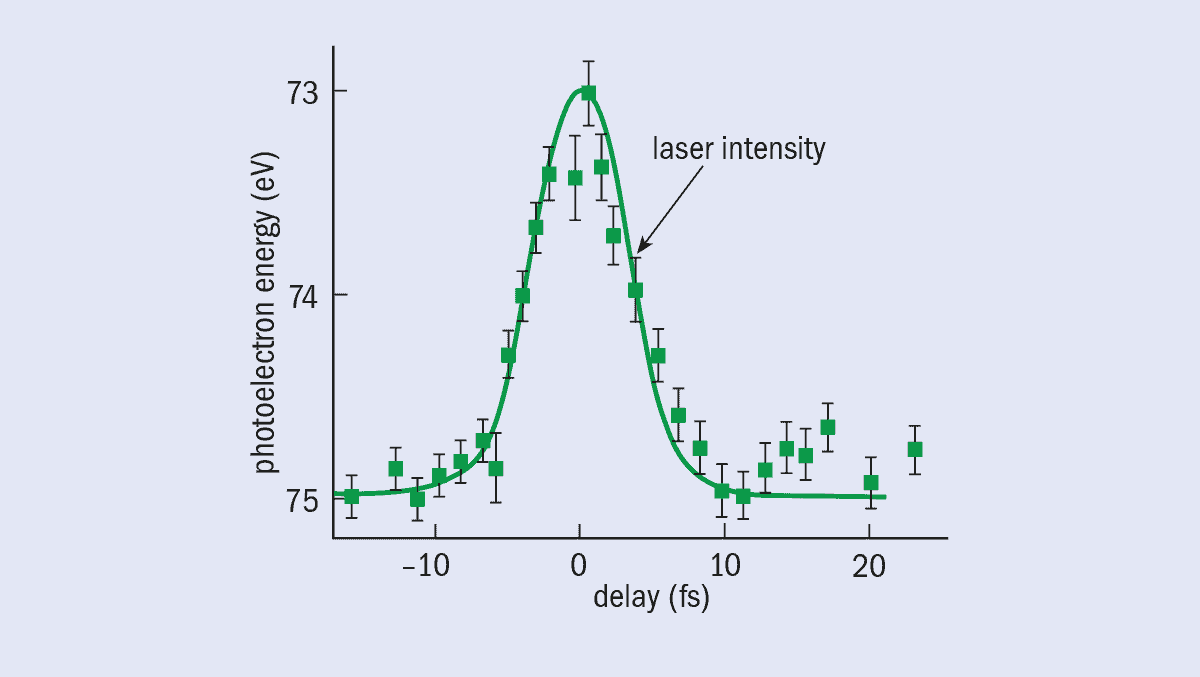
(a) The predicted intensity envelope of the X-ray pulse (red) generated in a high-order-harmonic experiment with neon gas and near-infrared laser pulses lasting 7 fs (green). The isolated X-ray pulse is calculated to last 600 as and have a wavelength of 14 nm. Measuring the duration of such short pulses is challenging. The first measurement reported by a collaboration of Austrian, German and Canadian physicists set an upper limit of approximately 2 fs (see Drescher et al. in further reading). It should be possible to further improve the measurements. (b) The intensity versus time profile of a 7 fs laser pulse was recorded using 1.8 fs X-ray pulses to knock an electron out of an atom. The energy shift of the electron is proportional to the intensity of the longer laser pulse at the instant of X-ray absorption. By measuring this energy shift as a function of delay between the laser and X-ray pulse (points), the intensity (line) was reconstructed with a resolution dictated by the X-ray pulse duration. This is the first “time-microscope” measurement with a resolution approaching 1 fs.
The techniques we developed offer the potential for generating and measuring single attosecond X-ray pulses. Theoretical calculations predict that the X-ray pulses emerging from our experiment lasted 600 as, but to verify this value experimentally requires either higher-energy X-ray pulses or more efficient measurement apparatus (figure 5a).
X-rays are not dispersed as widely in materials as ultraviolet pulses, which means that X-ray pulses lasting 100 as are quite robust. However, their production efficiency is far inferior to that of ultraviolet pulses. Now that there are suitable techniques for generating and measuring single X-ray pulses lasting 100–200 as, research must focus on enhancing the X-ray yield from high-harmonic generation for reliable attosecond pump–probe spectroscopy.
As a first application, we used a series of our 1.8 fs pulses to capture snapshots of the 7 fs laser that was used to generate the X-rays (figure 5b). This allowed us to resolve the intensity profile (i.e. the shape) of a light pulse lasting several femtoseconds for the first time.
Towards attophysics
Physicists are now close to controlling the motion of electrons on a timescale that is substantially shorter than the oscillation period of visible light. Indeed, in our experiment the electric dipoles of the neon atoms may have been set oscillating at the highest frequencies for just a few hundred attoseconds by an intense ultrashort laser. We can also use pulses containing a few cycles of the light field to rip an electron wavepacket from die core of an atom and set it free with similar temporal precision.
The specific time structure of both these processes depends on the evolution of the laser field within the optical cycle. This evolution is, in turn, affected by the relative phase of the carrier wave with respect to the amplitude envelope, the so-called carrier-envelope phase. For example, if the carrier-envelope phase of the laser pulse in figure 5a is shifted by π/2, then the electric field would reach a maximum at the centre of the pulse, rather than zero. In a pulse containing less than three oscillations, this phase shift can significantly modify the evolution of the electric and magnetic fields, and thereby affect the electron trajectories.
The first experimental indications of this phase dependence were observed recently by Gerhard Paulus and Herbert Walther at the Max Planck Institute of Quantum Optics near Munich and collaborators from the Politecnico di Milano. Meanwhile, Stephen Cundiff and co-workers at the JILA laboratory in Boulder, Colorado, and, independently, a collaboration between researchers at Vienna and Munich, have drawn on an ingenious idea of Theodor Hansch at MPI Munich to stabilize the carrier-envelope phase of ultrashort low-energy pulses.
Once amplified high-intensity pulses with a stabilized phase become available, strong-field processes – such as optical-field ionization or high-order harmonic generation – will allow us to measure the carrier-envelope phase directly. Access to this parameter – together with a measurement of the variation in amplitude and the frequency of the laser field using standard techniques – will allow us to determine and control the evolution of the electromagnetic field in a light wave, and even to synthesize arbitrary waveforms of light containing a few cycles.
Such waveforms might allow us to control the motion of an electron after it has been detached from an atom or a molecule. Direct consequences include the reliable generation and control of attosecond pulses at extreme ultraviolet and soft X-ray wavelengths via high-order harmonic generation. And at much higher intensities it may be possible to accelerate attosecond electron pulses up to several megaelectron-volts in energy.
Since these X-ray and electron pulses are synchronized to the laser field with attosecond precision, we will be able to take snapshots of different stages of atomic, molecular and plasma dynamics. These processes will be triggered and steered by the intense field-controlled waveforms of light and probed by X-ray pulses, enabling us to both control and reconstruct the motion of electrons at atomic length scales and with attosecond resolution. In this way, for example, the trajectory of an electron wavepacket might be measured from the instant it is ejected from the atom and could be tailored for different applications. These applications might include the development of more efficient and shorter-wavelength X-ray lasers, or sources of ultrafast, monoenergetic relativistic electron pulses for the next-generation of particle accelerators.
Looking into atoms
Attosecond X-ray pulses will also pave the way towards watching the motion of electrons inside atoms. For example, we expect to be able to track the motion of an electron within a femtosecond of it being set free from a bound state by an intense laser field. We could also follow the relaxation of the remaining bound electrons to their new equilibrium states with attosecond resolution.
Once we can generate attosecond pulses with much higher energies, we will be able to use them as both pumps and probes in pump–probe spectroscopy. We could then selectively remove electrons from the inner shells with a strong attosecond X-ray pulse and probe the filling of the inner-shell vacancy to an accuracy better than 1 fs using a weaker time-delayed replica of the same pulse. Is there any need for this? Why not simply depend on the relaxation times derived from line-width measurements? The simple answer is that the influence of an ultrashort intense field on the bound-electron dynamics – important for applications such as X-ray lasers – cannot be studied in the frequency domain.
6 Attosecond breathing of the hydrogen atom
(Courtesy: IOP Publishing)
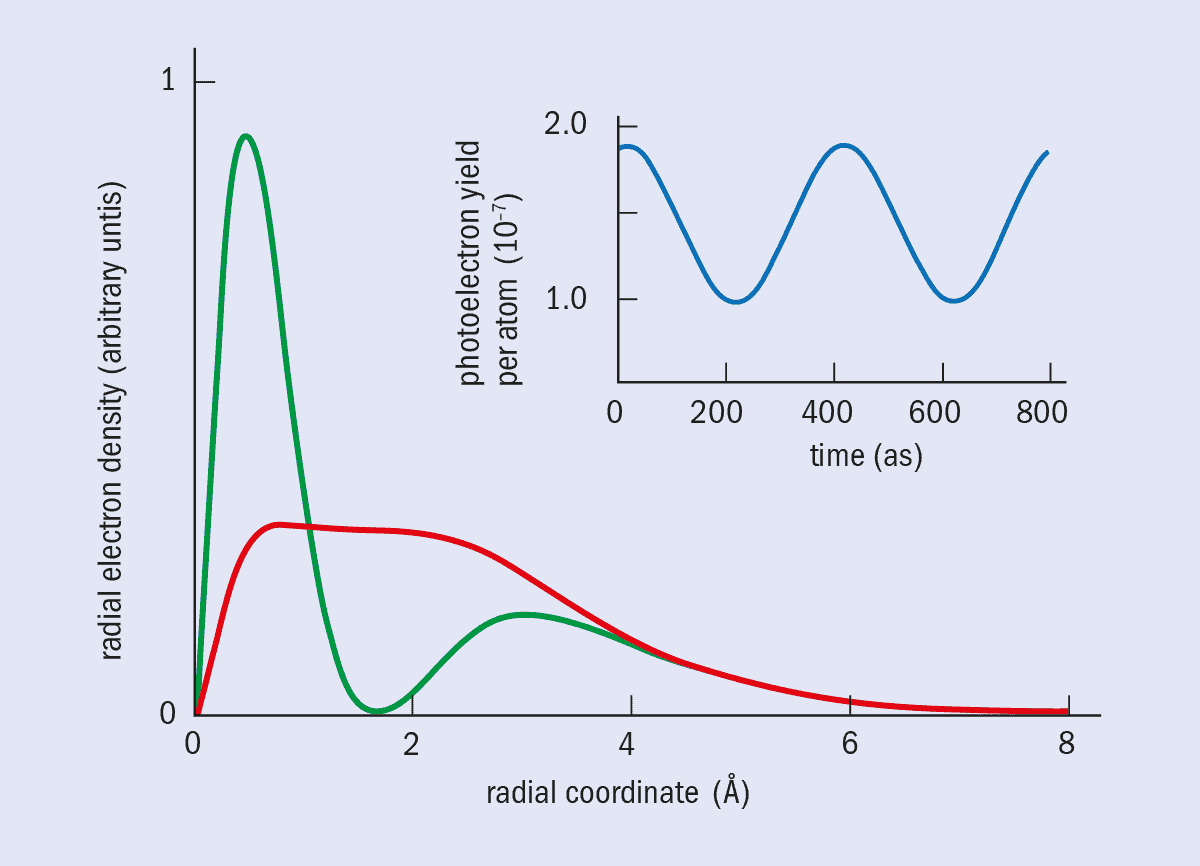
The radial electron density of a 1s–2s superposition state of hydrogen. The time-dependent Schrodinger equation predicts that the wavefunction oscillates between states of maximal (green) and minimal (red) electron density with a period of about 400 as near the nucleus. According to theoretical calculations, this fundamental quantum phenomenon may be observable using attosecond X-ray pulses that ionize the hydrogen atom. Theory predicts that the ionization yield will be modulated at the “breathing” period as a function of the time delay between the attosecond X-ray pulse and the excitation pulse (see insert).
Finally, back to basics. Bohr’s simple model of the hydrogen atom predicts that the electron takes about 150 as to orbit around the proton. According to the laws of quantum mechanics, no observable dynamics takes place as long as the electron resides in its ground state (1s). However, this situation changes if a fraction of the electron wavefunction is excited into the first excited state (2s). The time-dependent Schrodinger equation predicts that the two components (|1s> and |2s>) of the new composite wavefunction will beat at a frequency equal to the transition frequency between the 1s and 2s energy levels (figure 6).
This beating gives rise to a cyclic change in the radial probability distribution of the electron with a period of about 400 as. This “breathing” of the hydrogen atom may be regarded as one of the most fundamental quantum dynamic phenomena in nature. But can it be observed? According to Armin Scrinzi and Thomas Brabec from the Vienna University of Technology, it might be detectable by exploiting the fact that the electron can be detached more easily when it is closer to the atomic core. They predict that measuring the photoionization yield with X-ray pulses shorter than 200 as in a pump–probe experiment might provide direct insight into this quantum dynamics. Although it is only of academic interest at the moment, inner-shell quantum beats may eventually be exploited, for example as clocks for future ultrahigh-speed molecular electronics operating beyond 1 THz.
Outlook
Ultrashort flashes of light allow us to take snapshots of microscopic particles and let us reconstruct their motion. State-of-the-art femtosecond lasers emit pulses that are short enough to resolve the motion of atoms in molecules and solids, as well as charge-carrier dynamics in semiconductors. Meanwhile, specially tailored femtosecond pulses also allow these processes to be controlled and will lead to numerous applications in chemistry, biochemistry and electronics.
The frontiers of both time-resolved spectroscopy and the control of microscopic dynamics are about to be radically extended due to the emerging technical capability that will allow us to synthesize intense pulses containing a few cycles of the laser field that evolve in a precisely determined way. With this technique we will soon be able to control the motion of electron wavepackets on attosecond timescales, just as we can currently control the motion of nuclear wavepackets within a few femtoseconds. The single attosecond X-ray pulses and attosecond electron bunches that will arise from our ability to control electron wavepackets will enable us to probe and steer electron motion with unprecedented precision.
The availability of these tools will herald a new age of experimental physics that will be so radical and so widespread that it will demand a new name. Get ready to welcome the era of attophysics.
Further reading
T Brabec and F Krausz 2000 Intense few-cycle laser fields: frontiers of nonlinear optics Rev. Mod. Phys. 72 545
P Corkum 1995 Breaking the attosecond barrier Optics and Photonics News 6 March pp18–22
M Drescher et al. 2001 X-ray pulses approaching the attosecond frontier Science 291 1923
H Kapteyn and M Murnane 2000 Ultrashort light pulses: life in the fast lane Physics World January pp31–35
G Steinmeyer et al. 1999 Frontiers in ultrashort pulse generation Science 286 1507
R Szipöcs et al. 1995 Pushing the limits of femtosecond technology Optics and Photonics News 6 June pp17–20
A Zewail 2000 Femtochemistry: atomic-scale dynamics of the chemical bond (adapted from the Nobel Lecture) J. Phys. Chem. A 104 5660
Everyday macroscopic objects follow the laws of classical mechanics. But for microscopic objects, such as atoms or nuclei, the wave character of their dynamics has to be taken into account within the framework of quantum mechanics. Wave-like behaviour can show up in various ways, and one of the most striking is the tunnelling effect. Similarly, events that are prohibited due to some other dynamical constraints can occur via a process known as dynamical tunnelling. Indeed, tunnelling plays a major role in a variety of physical phenomena, ranging from alpha-particle radioactivity to the current-voltage characteristics of transistors.
Now two independent teams at the University of Texas, and at the University of Queensland in Australia together with the National Institute of Standards and Technology in Gaithersburg, US, have studied the tunnelling of atoms in the presence of chaos. The work was made possible by sophisticated tools that have recently been developed to study cold atoms and Bose-Einstein condensates (D Steck et al. 2001 Science293 274; W Hensinger et al. 2001 Nature412 52).
In the September issue of Physics World, Amaury Mouchet of the Université François Rabelais and Denis Ullmo of the Laboratoire de Physique Théorique et Modéles Statistiques, France, reveal how chaos can lend a hand to different kinds of tunnelling.
With the new academic year about to begin, undergraduate students will soon be thinking about whether to apply for a PhD. Doing a doctorate can, of course, be a very rewarding experience. It allows students to mature as independent scientists and to experience cutting-edge research – both within their own departments and at prestigious international conferences. However, it turns out that doing a higher degree is particularly beneficial to women in terms of their future earning power.
The Institute of Fiscal Studies (IFS) recently considered the effects of education on the earnings of a group of individuals who were born in 1958. It looked at a total of 2529 people who had been to university and compared their earnings at the age of 33 with those whose highest qualifications were A-levels or Highers (R Blundell et al. 1997 Higher Education, Employment and Earnings in Britain).
The IFS found that, by the time they are 33, men with PhDs actually earn 4.3% less than men who only have a bachelor’s degree. This lower level of income was attributed to the fact that men with doctorates had spent less time in work by that age. In contrast, women with PhDs earn 2.6% more at 33 than women of the same age who only have undergraduate degrees.
The IFS also found that men generally earn more than women with identical qualifications, but that this “gender pay gap” narrows as women become more qualified. So while women who only have A-levels or Highers earn about 38% less than men with the same qualifications, this gap is just 20% for those with a bachelor’s degree, and under 11% for those with higher degrees.
Overall, the IFS estimated that the average salary at age 33 was about £23 000 for men but just £17 000 for women. Surprisingly, men who worked part time received, on average, 10% more per hour than all of those who worked full time, while women who worked part-time earned 10% less per hour.
The women’s unit of the UK government’s Cabinet Office has also looked at pay differentials. It grouped all graduates together and found that women were paid an average of 12% less over their lifetime than men – even if they did not have children. This would lead to a gap in lifetime earnings of £143 000, rising to £160 000 if they had children.
Salaries of women in physics
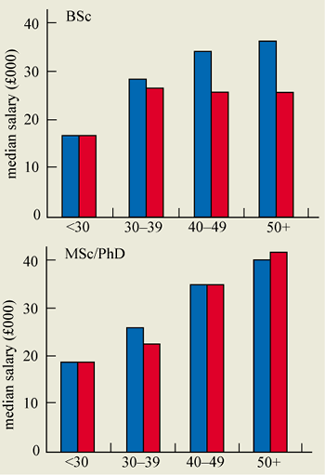
So what is the situation for physics? According to a salary survey carried out by the Institute of Physics in 1998 (Physics World November 1998 pp53-54, print version only), the pattern that was identified by the Cabinet Office – namely that women earn less than men over a lifetime even if they have worked full time – is also true for physicists whose highest qualification is only a BSc. As the figure shows, the salaries for male and female BSc physicists working full time are similar through their 30s, before a large gap opens up in their 40s and 50s. The same pattern has been seen in all of the salary surveys that the Institute has carried out over the last 10 years.
However, when the data for physicists who have an MSc or PhD are compared, the situation is totally different (see figure). There is now no gap between the earning of men and women for those who work full time and have either of these degrees. Indeed, the financial advantage over a working lifetime of obtaining a PhD is £35 000 if you are a man, but much bigger – £205 000 – if you are a woman.
We can also compare the “female deficit” for women physicists compared with the Cabinet Office’s estimate of £143 000. Women who only have a BSc in physics stand to earn a total of £190 000 less, over the course of a lifetime, than men with the same degree. However, if they go on to take a PhD, then the lifetime deficit (compared with men with a PhD) is tiny – just £20 000. It is also worth noting that although women physicists with a BSc earn less then men with the same degree, they still earn, according to the IFS data, more than the average female graduate (£25 000 as opposed to about £17 000).
The bottom line is that it makes good financial sense for a woman to study physics even if she stops at a BSc. It is even more worth her while to continue to a higher degree, where the rewards are better still.
Imperfect but reliable
Are the Institute of Physics’ data reliable? The party-goer looks for her house keys under the street lamp because it is only there that she has light enough to find them, not because that is where she thinks she dropped them. We are using the same principle here. The data quoted have not been collected with any degree of scientific rigour; it is just all the data we have. The size of the sample is small, it is self-selected and it has been taken only among the fraction of physics graduates who retain their membership of the Institute beyond their student years. Indeed, only a fraction of all physics graduates join the Institute and an even smaller proportion (particularly of women) retain their membership over their working lives.
A “steady-state” model has been assumed. We need to think like an astronomer here: the women of 50+ graduated from an “earlier universe”, where the Sex Discrimination Act had never been thought of. The returners’ schemes are also relatively recent, so the oldest cohorts would not have had this support if they had wished to return to a scientific career after a break. The situation should be very different for those graduating with a BSc or PhD in the 21st century.
We all know that a physics degree qualifies graduates to go into many different careers, some of which are not strongly related to physics. Many of us in university teaching have known many students who wanted to become bankers, accountants or software engineers because they hoped to earn much higher salaries this way. Unfortunately, any information about the salary levels of these physicists is not included if they cease their membership of the Institute.
However, although the data are imperfect, I believe that there is a clear message. Women physicists, on average, earn considerably more than other graduates and their average earnings can be comparable with those of men. So not only does physics provide an interesting education, it also leads to a variety of careers with high salaries. However, it is necessary for women both to have a PhD and to work full time to achieve such earnings.
A good choice
There are other reasons for well qualified women to do a PhD. In particular, a PhD gives a woman a chance to develop her independence and satisfy her intellectual curiosity. However, in spite of the fact that women do just as well in their undergraduate studies, only about 27% of women currently go on to take a higher degree, compared with 38% of men.
Some women students find that they feel happier when they are working in a group that already contains a number of women, although for others this is not an issue. Perhaps because of a snowballing effect, a number of research groups do have unusually large fractions of women. Such groups can be an option for women, who may find more support from their peers than they would elsewhere.
We should therefore ensure that good women students are given every encouragement to study for a higher degree. Not only is it good for their careers, but their presence in a research group may encourage other women to join, thereby forming a pool from which future academics will come. This may, in turn, encourage more girls to consider a career in physics, both to their own advantage and to that of us all. Women remain an underused source of talent for science and engineering in the UK.