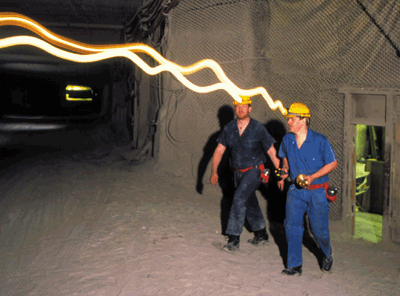
When Neil Spooner, a physicist at Sheffield University in the UK, goes to work, he heads for his office on the ground floor of the Hicks building on the main university campus. When he wants to check on his experiment, however, he must get into his car, drive for two hours and then take a lift that descends 1100 metres underground. On leaving the lift he has to walk for a kilometre in temperatures of up to 40 °C to reach his laboratory. He must bring food and water with him and he won’t see a toilet for another eight hours.
A working salt and potash mine is not the most conventional location for a research laboratory. Yet Spooner and his colleagues in the UK Dark Matter Collaboration (UKDMC) have found the mine at Boulby in North Yorkshire, which is owned by Cleveland Potash Ltd, to be ideally suited to their search for the “dark matter” that is thought to account for more than half of the matter in the universe. Most dark-matter experiments are performed deep underground to shield the detectors from cosmic rays.
Dark days
Dark matter has been proposed by astronomers to explain certain features of the universe, such as the fact that galaxies rotate faster than can be explained by the amount of visible matter that they contain. Some dark matter is thought to exist in the form of ordinary matter that does not “shine”, but many physicists believe that a significant fraction of it comes in the form of new particles, such as weakly interacting massive particles (WIMPs). However, these particles are extremely difficult to detect – if they exist at all – because they only interact very weakly with conventional matter. It is therefore necessary to house dark-matter detectors deep underground to shield them from cosmic rays, which can mimic the WIMPs (see The search for dark matter by Nigel Smith and Neil Spooner in Physics World January 2000 pp23-28).
“The dark-matter problem is a fundamental problem, and if you want to solve it, you are forced to go underground,” says Spooner. “There are other sites around the world that are probably better for these experiments, but in terms of convenience and cost, it was better for us to go to Boulby. Apart from being deep, the salt rock is very low in radioactivity, which produces a better site for experiments.” Other physics experiments housed in mines include the SuperKamiokande neutrino experiment, which is located in a 1000 m deep lead and zinc mine in Japan, and the Sudbury Neutrino Observatory, which was built 2000 m underground in a nickel mine in Canada.
As the Boulby mine is fully operational, the hunt for dark matter has to fit in with the shift-patterns of the 1000 or so miners who spend their days (and sometimes nights) underground. The researchers tend to hitch a ride on the lift going down at 8 am in the morning, and return to the surface with the shift finishing at 4 pm in the afternoon. For safety reasons, the physicists generally work in pairs, and no-one is left alone without prior authorization.
Nigel Smith, who leads the Rutherford Appleton Laboratory’s involvement in the UKDMC, spends a week underground at Boulby every two or three months. Conditions can be “pretty rough” according to Smith. “We have to air condition as best we can. We try and keep the temperatures down to about 28 °C, which is tolerable,” he says. “One of the key things underground is that you must be able to sweat, which surprisingly not everybody can.”
Like many researchers, Smith thrives on the stresses inherent in working in an unusual location. “It makes it much more of a challenge, to get the experiment to work, to get the team to work together well, and to get the best out of yourself,” he says.
“Working in a mine is not like many people imagine a mine to be, crawling through holes, and so on,” adds Spooner. “Obviously there are no windows or anything, but there is lots of space and the labs are lit well. Basically once you’re there, it’s just like working in any other lab.” The collaboration plans to open new laboratories at Boulby – both above and below ground – later this year, paid for by a £3.8m grant from the government’s Joint Infrastructure Fund.
Physics on ice
Nigel Smith has also experienced the difficulties of doing physics in a completely different and even more extreme environment – the South Pole. Being so near to the Earth’s axis, experiments at the South Pole enjoy uninterrupted views of certain parts of the sky. This is crucial for many types of astrophysical observations, such as measurements of the cosmic background radiation. The skies above the Antarctic plateau are also very clear at infrared, microwave and sub-millimetre wavelengths because the air is dry and cold.
Smith made his first visit to the pole in the mid-1980s as a PhD student at Leeds University researching the enemy of dark-matter experiments – cosmic rays – and later spent a complete year there, during which time he experienced the full severity of an austral winter. “The temperature at the pole in the summer can rise as high as 15 below zero,” Smith says. “During the winter it’s a pretty standard 60 °C below.”
…to another. members of the UKDMC have to cope with +40 °C. (Courtesy: David Parker/SPL)
In common with all personnel who spend time at the pole, he had to undergo a full medical examination to check he was physically capable of enduring the polar environment. He also had to take psychological tests similar to those given to nuclear-submarine crews. “There are parallels with working underground,” he says. “You’re in an enclosed environment, which is quite difficult to get out of, with small teams of people who you have to work with and get on with.”
The reality of working at the South Pole was highlighted last year when Rodney Marks, a 32-year-old astrophysicist employed by Smithsonian Astrophysical Observatory, died while working at the Antarctic Submillimeter Telescope and Remote Observatory. Although Marks died on 12 May, his body remained trapped in Antarctica until the end of October.
In addition to the sub-zero temperatures, visitors must also get used to the thin air. At 3000 m above sea level, the polar station places similar strains on the body to those experienced during high-altitude mountaineering expeditions. “When you first step off the plane it is quite a dramatic shock,” says Smith. “You immediately get a nosebleed and a headache, and the 100 m walk to the dome is quite an exertion.”
This initial sensation is like being “hit in the chest by a big truck” says Serap Tilav of Oxford University, who is a member of the Antarctic Muon and Neutrino Detector Array (AMANDA) collaboration. But she quickly adjusted to the cold atmosphere and the everlasting days, and has grown to love the harsh environment in which AMANDA – a neutrino “telescope” that is buried 3 km below the Antarctic ice – is operated.
Now well and truly bitten by the Antarctic bug, Tilav is more than happy to travel quite literally to the end of the Earth in pursuit of fundamental particles. Indeed, she has already visited the South Pole five times, spending one or two months there each time, and is looking forward to returning in December. “I didn’t go for four years, and I missed it terribly,” she says. “There are bands and wild parties, and it is great fun.”
Cold and colder
At the height of the austral summer, between 150 and 200 people may be staying in a vast array of centrally heated canvas tents on the ice, each fitted out with individual living cubicles. Any crew wintering over are housed in the aluminium geodesic dome that functions as the camp’s nerve centre. All food is flown into the base, and the kitchen staff do their best to please the ice-bound inhabitants. However, as all the camp’s water has to be melted, showers are limited to two minutes, twice a week.
While living conditions remain basic, working facilities have improved dramatically over the past ten years, according to John Kovac, a graduate student at the University of Chicago. Kovac first ventured out to the South Pole as a 19-year-old undergraduate at Princeton University, where he was involved in cosmic-background-radiation experiments. He has since made eight more trips to the camp, including one 14-month stay, to take advantage of the Antarctic plateau’s atmospheric stability and celestial vantage point.
The Center for Astrophysical Research in Antarctica (CARA), which has its headquarters at the University of Chicago, operates a number of cosmic background radiation detectors and sub-millimetre devices at the South Pole. The pole is particularly popular for experiments on the cosmic background, and two of the three experiments that have recently reported evidence for the highly significant “second peak” in the cosmic background – the balloon-based Boomerang detector and the ground-based DASI experiment – were based at the pole (see Microwaves map cosmic originsPhysics World June pp5-6).
By the mid-1990s, Kovac had access to a comfortable purpose-built laboratory building, though the ravages of the austral winter continued to push both researchers and their equipment to the limit. “The telescope was situated on a tower 100 yards away from the laboratory,” he says. “Most of my winter was spent outside, in the cold, fumbling with enormous gloves or else battling frostbite, wearing a headlight for illumination, while trying to troubleshoot and fix components on the telescope.”
Out in the wilderness
But is conducting research at the South Pole really so difficult nowadays? With the regular summer flights, on-site heavy machinery, reliable power, a large support staff, and in situ living and dining facilities, it is easier to set up a new experiment at the polar camp than in many other less “extreme” environments, according to Kovac.
“Several of our colleagues take their telescopes to the Atacama desert in Chile, a remote high-altitude plateau, and although you may be able to drive a rental truck up there, you’ve got nowhere to plug your telescope in,” he says.
Benedetto D’Ettorre Piazzoli, an astrophysicist at the University of Naples in Italy, is currently overseeing the installation of a cosmic-ray detector in Yangbajing, Tibet, as part of the Argo YBJ collaboration between Italian and Chinese astrophysicists (Physics World July p6, print version only). At 4300 m above sea level, the site has been chosen to maximize the detection of the smallest of the “air showers” created by the cosmic rays when they interact with the Earth’s atmosphere.
Researchers travelling to the observatory first acclimatise in nearby Lhasa. Despite the apparent remoteness and mountainous terrain, there is reasonable infrastructure and communication. “A geothermal plant that provides electricity is located nearby,” D’Ettorre Piazzoli says. “Telephone and GSM facilities are available, and a local network with a link to the Internet will soon be installed.”
Advances in communications technology have certainly benefited scientists working far from home. Yet setting-up experimental apparatus in remote locations can still be fraught with logistical difficulties, according to John Wettlaufer. As a theoretical physicist in the Polar Science Centre at the University of Washington in Seattle, his interest in ocean-ice growth has taken him out into the Arctic on several occasions, where camps have to be built from scratch.
First, it is necessary to identify a stable ice flow that a small aircraft can land on. Internally heated living shelters must then be constructed quickly, with more being added as food, equipment and personnel arrive. “The vast majority of living is just like that on any camping expedition, except that you are doing it on 3 metres of ice floating on 2000 metres or more of ocean,” he says.
Careful planning is critical to ensure that the equipment works in the cold, salty environment, and that nothing has been left behind. Anyone staying at the University of Washington’s ice camps must also cope with the continual threat of attack from polar bears. “Researchers must be well trained in the use of firearms,” says Wettlaufer. “One year we encountered 54 bears in 10 days.”
Despite the harshness of the environment, Wettlaufer enjoys the solitude and beauty of the Arctic, and the challenge of coping with the extreme temperatures. A keen skier and climber, he accepts that his passion for outdoor sports may have drawn him towards his chosen field of research. However, he maintains that the pursuit of scientific objectives in such extreme locations appeals to a wider range of people than might be expected.
“It is an odd field of research for a physicist and there are no other faculty in our physics department who do similar things,” he says. “But a colleague from Cambridge University who had never been out in the field enjoyed it immensely, as I continue to do – except for a bit of frostbite.”
There is no doubt that Italy is a world force in physics. When the nations of the world are ranked by the number of physics papers that they publish, Italy is sixth. It also makes the top ten when nations are ranked by the impact of their papers as measured by citations in other publications.
Italy is particularly strong in particle physics, thanks to the legacy of Fermi’s “school of Rome” and the establishment of the Istituto Nazionale di Fisica Nucleare (INFN) in 1951. Italy also boasts a unique underground facility for astroparticle-physics experiments at Gran Sasso. There are centres of excellence in other areas – including astrophysics, atomic and optical physics, condensed matter, superconductivity and various areas of theoretical physics – but nothing to match the strength in depth that is found in particle physics.
But there are two key issues concerning Italian physics – and Italian science in general – that need to be addressed. First is the historical fact that the Italian government spends only about half as much on R&D as other European countries such as France, Germany and the UK. The same is also true for other measures such as the annual production of PhDs and industry spending on R&D.
Second is the current system for making appointments to permanent university positions, about which accusations of unnecessary bureaucracy and cronyism abound (see pages 5-6, print version only). Italian physicists still working in Italy are reluctant to go on the record about the situation, but those elsewhere are not. As Claudio Pellegrini, the Italian-born head of a large physics department in the US, points out: “If there is a new faculty position at UCLA, we look for the best candidate worldwide.” This does not happen in Italy, where sometimes even the best Italian does not get the job.
The new minister for education and research, Letizia Moratti, has said that she intends to tackle both these problems, but Italian physicists are not convinced. Yet there is no reason why the Italian physics community cannot work within the current system to ensure that jobs go to the best candidates available, no matter where they came from in the world. However, it remains to be seen if the all-powerful professors are willing to change their ways.
The world of physics in general, and the US in particular, benefited greatly from the energy and ideas of Enrico Fermi. It seems a shame that Italy remains so reluctant to let physicists from other countries return the favour.
Welcome to Ireland
Although Ireland cannot claim to have as strong a physics tradition as Italy, the Irish physics community can be proud of its performance in the first round of awards made by the new Science Foundation Ireland (see page 13, print version only). When it was announced last year that this generously funded agency was going to concentrate on two areas – biotechnology and information and communications technology – the omens did not look good for physics. But of the first ten awards made, each worth about IR£5.6m (about £4.7m), five have gone to physicists. And setting an example that Italy might do well to follow, four of the awards will be taken up by researchers who are currently based outside Ireland.
Optics has always been the most pure and the most applied area of physics. This is as true now as at any time in history. From Newton and his prism to the semiconductor lasers and optical fibres that form the modern world’s communications infrastructure, light has both fascinated physicists and facilitated whole new industries.
In common with all applications of cutting-edge science, fibre communications, medical imaging and other examples of optical technology rely on light behaving in a highly predictable fashion. The light – be it considered a wave or a particle or a ray – must obey the laws of optics. But rules exist to be broken, or at least bent, and as the articles in this special issue illustrate, optics is no exception.
Enter the laser
The invention of the laser in 1960 revolutionized optics and that impact is still being felt today. Modern laser research progresses on many fronts: some physicists want higher intensities and pulse energies, while others are busy trying to increase the efficiency of semiconductor lasers. On page 41 Ferenc Krausz describes research at another frontier – the quest for ever-shorter pulses (see print edition). However, at optical wavelengths, a 5 femtosecond pulse, say, will contain only two or three complete cycles of the laser field. But many processes – such as the movement of electrons inside atoms – occur on timescales that are even faster than this. Researchers must therefore resort to shorter wavelengths and a variety of nonlinear techniques to access the attosecond regime.
Shorter wavelengths are also essential for better resolutions in imaging applications. Indeed, for many years it was thought that the resolution of any optical instrument was limited to about one-third of the wavelength of the radiation being used. Initially the scanning electron microscope, which exploited the much shorter de Broglie wavelengths of particles, was used to reach the parts that optical microscopes could not access. Atomic-force and scanning-tunnelling microscopes followed, but light still has a role to play in the quest for molecular resolution, as Vahid Sandoghdar explains on page 29 (see print version). For instance, by using single molecules as light sources in so-called scanning near-field optical microscopes, it has been possible to achieve a resolution of 180 nm, and for certain applications resolutions of 10 nm or so have been obtained.
Light travels at 299 792 458 metres per second in a vacuum. Not surprisingly it slows down when it encounters anything, be it a piece of glass or a gas of sodium atoms. But if the sodium atoms have been placed in a particular quantum state by a “coupling” laser, it is possible to significantly slow down pulses from a second “probe” laser operating at a carefully chosen wavelength. And as Lene Vestergaard Hau explains in her article, under certain conditions it is possible to reduce the speed of the probe pulse to zero! This trick depends on the variation of the refractive index of the gas with wavelength. Remarkably, a similar trick can be used to increase the speed of the probe to hundreds of times the speed of light (Physics World September 2000 p21).
How do these tricks work? Basic optics teaches us that the speed of light changes from c to c/n when it enters a material with a refractive index of n, while the wavelength changes from L to L/n. We are also taught that the refractive index is also a function of wavelength or frequency. However, when a pulse of light – which must, by definition, contain a range of wavelengths – enters a material, it is slowed down by factor that depends on the variation of the refractive index with frequency. Controlling this variation is the key to changing the speed of the probe pulse.
Basic optics also teaches us that the refractive index causes a ray of light to be bent towards the normal. However, as John Pendry explains on page 47, this is not always the case, and in recent years it has become possible to build structures with negative electric and magnetic properties (see print version). Strangest of these are materials that have a negative refractive index. The new materials emerging from this research could lead to applications in communications, electronics, medical imaging and other branches of optics, and include the possibility of the “perfect lens”.
And there’s more
These are just four areas in which physicists are pushing the laws of optics to the limit. There are many more. Last month, for instance, physicists reported that they had built an optical clock that should be substantially more accurate than the world’s best atomic clocks. Moreover, the new clock relies on the application of a piece of totally unrelated physics research – the discovery of photonic crystal fibres – that is only two years old. Other recent advances include the first all-optical technique for making a Bose condensate and proposals to use “entangled” photons to improve the performance of laser-ranging and lithographic equipment.
Clichés about bright futures and the light fantastic abound in magazine articles about lasers and optics. But for once the clichés are actually true: the future for lasers and optics is very bright indeed.
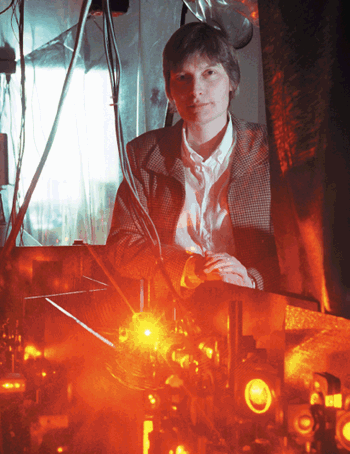
Slow coach: Lene Hau with the laser system that her group uses to bring light to a standstill. (Picture credit: Kris Snibbe/Harvard News Office)
As anyone who uses the Internet will know, the last 10 years have seen some incredible developments in communication. We can now e-mail colleagues thousands of miles away and download research papers from distant servers in seconds. Much of this extraordinary progress has been due to improvements in optical communication. And, despite recent reports of a financial downturn in the optical-technology sector, we are now at a very exciting stage as far as the technology itself is concerned.
Nevertheless, the way we communicate optically is still rather old fashioned. We send optical pulses down a fibre and then, at every important intersection, convert the information into electronic signals. We then process the information electronically – before converting it back to optical signals and sending it on its way again, down another optical fibre.
If we are to keep improving the speed at which we communicate, we will have to find ways of avoiding these conversion steps so that we can process the information optically. One way of doing this is through nonlinear optics – in which one laser beam is used to change the optical properties of another. Although nonlinear optics has traditionally been viewed as an unwanted effect, causing pulses to spread and destroying information, that view is now changing. In the future, nonlinear optics could be used to make optical switches, delay lines, diodes and phase modulators – all of which would be required for purely optical processing.
To really push the boundaries in optical communication, however, we will have to follow completely new avenues of development that will be more than just perturbations of the progress we have seen so far. Non-classical, quantum-mechanical systems are likely to play an important role. They will offer completely new possibilities for optical media, and I predict that we shall see much progress at the interface between physics, applied physics and engineering.
A very exciting possibility for optical communication concerns the recent discovery that light can be slowed down by many orders of magnitude – and even be brought to a complete standstill – in a cloud of ultracold atoms. The ability to halt light in its tracks could lead to remarkable new ways of storing and manipulating optical signals and even to new techniques for quantum computers and communications.
Slowing light to a standstill
The story began three years ago in August 1998, when my research group at the Rowland Institute in Cambridge, Massachusetts, succeeded in reducing the speed of a pulse of light to just 38 miles per hour – about the speed of a Tour de France racing cyclist. What we did was to cool sodium atoms to just 50 billionths of a degree above absolute zero and then illuminate them with a carefully tuned laser beam. This “coupling laser” changed the optical properties of the atoms so dramatically that when a separate laser pulse was sent through the cloud of atoms, its speed was reduced by a factor of some 20 million. The size of the light pulse was also affected, shrinking from 1 km in free space to only 0.05 mm inside the medium. The pulse was then completely contained within the 0.1 mm long, cigar-shaped ultracold-atom cloud.
A very interesting application of ultra-slow light lies in the massive optical nonlinearities that are generated whenever light is slowed to such very slow speeds. Nonlinear optics – which can be used, for example, to increase the frequency of laser light – normally requires very powerful laser fields. However, we have demonstrated a “nonlinear refractive index” – a measure of how much a laser beam can change the optical properties of a medium as seen by another laser beam – that is 14 orders of magnitude larger than in an optical fibre. Indeed, it is the largest nonlinear refractive index ever measured by a factor of a million. Our work has opened up a new regime of nonlinear optics at extremely low light levels. In fact, nonlinear optics close to the single-photon level is even possible.
Recently we have gone a step further. Not content with just slowing light down, we have actually been able to stop, park and regenerate individual light pulses. In other words, we have found a way of storing and retrieving optical information – including phase information – using an atomic medium, with 100% efficiency in read/write operations. We obtain these low light speeds – and stopped light itself – in a new optical medium formed from an entangled system of ultracold atoms and a coupling laser. The optical properties of this coupled system can be changed by simply adjusting the intensity and frequency of the coupling laser. The characteristics of the system rely on fragile quantum-mechanical effects.
Slow light could be used, for example, to create very sensitive optical switches. By using a coupling laser to make a cloud of cold atoms initially transparent to pulses of light, a third laser beam could then be used to control whether or not the pulses pass through the cloud. Turning the third laser on would prevent the pulses from being transmitted; turning it off would transmit the pulses once again. The energy needed to flip the system between the two states could be as small as the energy of just two photons, while the speed of the switching operation could be controlled by adjusting the intensity of the coupling laser and/or the shape and density of the trapped, cold-atom cloud.
Another equally intriguing possibility is the creation of “optical delay lines” – devices that can delay optical information if too much of it arrives at the same time. (They could force the light pulses into a “holding pattern”, just as aeroplanes are held in formation in the sky until a runway at a congested airport becomes available.) With ultracold atoms and ultra-slow light, we can obtain delays of between micro- and milliseconds in a medium that is just 0.1 mm long. Although we could obtain similarly large delays by sending light down an optical fibre, the fibre would have to be up to several hundreds of kilometres long! Another very important aspect of our proposed delay lines is that the delays could be continually adjusted to meet one’s needs by simply changing the intensity of the coupling laser.
Creating ultracold clouds of atoms
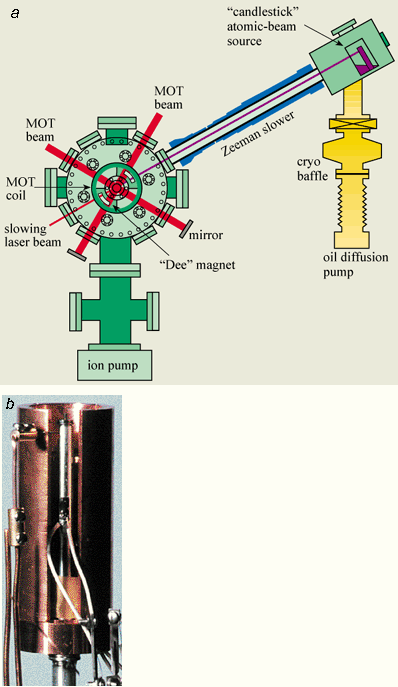
So how do we create this rather unusual medium that can slow down and even stop light? What we do is cool atoms trapped in an electromagnet to very low temperatures – an “atom refrigerator”, if you like (figure 1a). The atoms originate from a specially designed “candlestick” atomic-beam source, so named because it works just like a candle. Atoms are drawn by capillary action from a pool of hot liquid sodium up a fine gold-plated steel mesh (the wick) to a heater that vaporizes them (figure 1b). An intense jet of hot sodium atoms then shoots out of a pinhole with an average velocity of 700 m s-1. These atoms are much too fast to be used directly so we immediately hit them head-on with a laser beam, using radiation pressure to slow the atoms down in a 1 m long magnetic device known as a “Zeeman slower”. The device is so effective that one millisecond later the atoms have slowed to just 50 m s-1.
1 Atom refrigerator (a) To slow light, we need to create an ultracold cloud of atoms. Hot atoms emitted from the ‘candlestick’ atomic-beam source are first decelerated by radiation pressure from the ‘slowing’ laser beam in the 1 m long Zeeman slower. They are then loaded into the ‘optical molasses’ – a region in space created by six counter-propagating magneto-optical trap (MOT) laser beams (red). (The third pair, which goes in and out of the plane of the paper, is not shown.) After laser cooling the atoms to microkelvin temperatures, we turn the lasers off and load the atoms into the 4 Dee magnet, where they are ‘evaporatively cooled’ to nanokelvin temperatures. (b) The candlestick atomic-beam source, which we use to deliver sodium atoms to our experiments, works just like a candle. A gold-coated stainless-steel ‘wick’ draws up atoms from a reservoir of liquid sodium at the base of a copper cylinder, guiding them to an emission hole in a hollow molybdenum cylinder that is filled with the stainless-steel mesh and placed inside the copper pot. At the hole, we create a localized hot spot at 350 °C, which leads to a high emission rate of sodium atoms. Only atoms that go through a small collimation hole in the copper cylinder escape into our set-up the rest hit the copper wall, which is also lined with stainless-steel mesh, and are transported back to the reservoir by a wicking action.
At this point we load the atoms into an “optical molasses” – the region in the middle of our main ultrahigh-vacuum chamber where three pairs of counter-propagating yellow laser beams, tuned to just below an atomic resonance, converge. Those atoms that see the light Doppler-shifted to a frequency that they can absorb, recoil from the small momentum kicks of the absorbed photons, slowing down and cooling in the process. Within a few seconds, the optical molasses holds about 10 billion atoms cooled to 50 millionths of a degree above absolute zero. This is extremely cold. But we want our sample colder still!
For the next cooling step, we turn off all the laser beams so there is complete darkness in the lab. At the same time, we turn on 1000 A of current in the “4 Dee” electromagnet, which is in the shape of four letter Ds. Since sodium atoms have a magnetic dipole moment, we can trap them in the magnetic-field minimum that lies at the centre of the electromagnet.
We then start the process of “evaporative cooling”, which works in rather the same way that a cup of coffee cools. The hottest atoms escape, leaving the left-over atoms to collide and re-equilibrate at a lower temperature before the next set of hot atoms depart and the remainder cool further still. We do not, however, actually wait for the hottest atoms to leave: we help them on their way using “magnetic resonance spectroscopy”. By applying a radio-frequency field and sweeping through the frequencies in a carefully orchestrated way, we keep kicking out the hottest atoms until we are left with a sample of magnetically trapped atoms that are so cold that their “de Broglie” wavelengths are comparable to the distance between the atoms.
At this point, when the atom cloud has been cooled to a temperature of about 500 billionths of a degree above absolute zero (500 nK), we can start to form a “Bose–Einstein condensate”. This is a very odd state of matter in which several million atoms behave in a completely correlated fashion – like a superatom (see Bose condensates make quantum leaps and boundsPhysics World August 1999 pp37–42). It is a state of matter that has properties similar to superconductors and superfluids. First predicted in the 1920s, Bose–Einstein condensates were finally observed in 1995 by Eric Cornell, Carl Wieman and co-workers at the JILA lab in Boulder, Colorado.
The cold-atom clouds contain neutral atoms, which – unlike ions – interact only very weakly with their surroundings. So even when an atom cloud has been cooled to 500 nK, the rest of the system – including the vacuum chamber that is in close proximity to the cold atoms – can be kept at room temperature. This is important for potential practical applications of our new optical medium.
Slowing down light – the secret
We now have ultracold atoms: so how do we use them to slow light down? Traditional materials, such as a block of glass, can slow light by 30% or 40% compared with its speed in a vacuum. However, to slow down light by six or seven orders of magnitude, we cannot rely entirely on classical mechanics and have to turn instead to quantum mechanics for help.
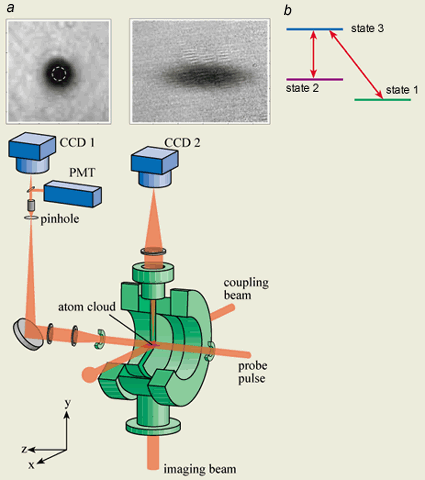
2 Obtaining ultra-slow light (a) A cloud of sodium atoms, cooled to nanokelvin temperatures, is trapped by an electromagnet and freely suspended in the centre of a vacuum chamber held at room temperature. The cloud is then illuminated from the side by a ‘coupling’ laser, which creates a new optical medium from entangled states between the cold atoms and the laser field. The optical properties of this coupled system can be controlled dynamically by varying the intensity of the coupling laser. ‘Probe’ laser pulses are then fired through the cloud in the z direction. To determine the speed of these pulses, we use a photomultiplier tube (PMT) to measure the time it takes them to pass through the system. A third, vertical laser beam the ‘imaging beam’ is used to measure the size of the cloud; its shadow (top right) is recorded by a charge-coupled device camera (CCD2). Another camera (CCD1) images the cloud along the z direction (top left). (b) The three internal quantum states of the sodium atoms, 1, 2 and 3, that are used to slow down light. The coupling laser is tuned to the transition between states 2 and 3, while the probe laser is tuned to the transition between 1 and 3.
After we have evaporatively cooled the sodium atoms, they are all in one particular internal quantum state, 1 (figure 2b). This is an important point: the magnetic field that traps the atoms while evaporative cooling takes place acts as a filter – only those atoms in this state are trapped in the magnet. So having produced a cold-atom cloud trapped between the poles of an electromagnet – the cigar-shaped cloud is typically 0.1–0.2 mm long and 0.05 mm in diameter – we illuminate it from the side with a coupling laser beam. (The cloud does not have to be a Bose-Einstein condensate, but the most dramatic effects are obtained if it is in this special state.) The frequency of the coupling laser is chosen to match the energy gap between the two higher-energy states of the atoms, labelled 2 and 3 (figure 2). This means that the three states, 1, 2 and 3, form an almost closed system that has the special feature of having no (or very few) decays to other levels when the coupling and probe lasers are present. This requires the propagation direction, polarization and frequency of the laser beams to be very carefully controlled.
As its name implies, the coupling laser links or “couples” states 2 and 3 together, which means that we have to consider the mixture of the atoms and the coupling laser light as one complete system. The coupling laser splits the single energy level, corresponding to the energy of state 3, into two nearby levels. The splitting is proportional to the square root of the intensity of the coupling laser, which means that we have a way of controlling the energy levels of the coupled laser-atom system – and hence its optical properties.
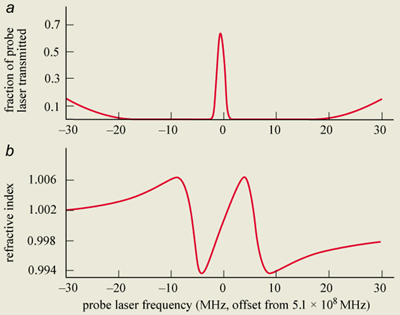
We now fire a probe laser pulse, which we wish to slow, into the atom cloud. The frequency of the probe laser is adjusted until it is resonant, or almost resonant, with the 1 to 3 transition. The refractive index of the atom cloud, as seen by the probe laser beam, then varies in a very odd way with probe frequency: it has two “wiggles” centred on the two frequencies that correspond to the energy differences between 1 and the two new, split energy levels (figure 3). Furthermore, right on 1 to 3 resonance – when the probe laser is tuned precisely midway between the two split energy levels – the refractive index is exactly 1, just as it is in free space. The key point is that the refractive-index profile has a very steep slope around resonance. In other words, we do not slow light by creating a medium with an absolutely enormous refractive index! The “secret” is, rather, to create a very steep slope in the refractive-index profile around resonance. The speed at which a pulse propagates – the so-called group velocity – is inversely proportional to the slope. We get the steepest slope – and hence the slowest light – by minimizing the distance between the split energy levels of the mixed atom-light system, i.e. by applying a very weak coupling laser.
3 Secrets of slow light (a) The amount of probe light transmitted by a cloud of ultracold sodium atoms in the presence of a ‘coupling laser’. The coupling-laser field makes the cloud transparent to probe light within a very narrow range of frequencies. (b) The refractive index of the cloud as a function of the frequency of the probe laser. The group velocity of a probe pulse is inversely proportional to the slope of the index the steeper the slope, the lower the light speed. When the probe is tuned to the frequency of the transition between states 1 and 3, then the refractive index is 1.0 the same as in free space.
It is important to note that our probe light pulse does not have one well defined frequency. It is actually a superposition of travelling plane waves that have a distribution of frequencies. The speed of each plane wave – the so-called phase velocity – is determined by the refractive index at that frequency. In our system, where the index is about 1, the phase velocity is very close to the velocity in free space, i.e. 300,000 km s-1. Around resonance, where the refractive index varies so steeply, the different planes waves all have slightly different phase velocities. These plane waves add up to form the light pulse, and the point of maximum constructive interference between the different components determines the peak of the pulse. It is the group velocity – the speed of this pulse peak – that is slowed to almost a halt.
When we use really cold samples, the atoms hardly move at all, and their energy levels do not smear out due to Doppler effects. This means that the energy levels of the coupled atom-laser system can indeed be brought very close together without overlapping. It is also important to realize that the refractive index stays very close to 1 for all the frequency components in the pulse. If we tried to slow light by creating a material with a huge refractive index – say, larger by a factor of several tens of millions than in free space – our probe laser pulse would reflect off the material. It would simply not be able to enter the material in the first place. The fact that the refractive index stays close to 1 also means that the wavelength of the light pulse and its peak electric-field strength are the same inside as they are outside the medium.
Coupling effects
Another important point of these experiments is that if we did not have a coupling laser, our dense, cold-atom cloud would be completely opaque to the resonant probe laser pulses. It is only in the presence of the coupling laser that the medium becomes transparent. This effect, known as “electromagnetically induced transparency”, was first observed by Steve Harris and co-workers at Stanford University in California in the early 1990s.
So how does the coupling laser pull off this trick? The answer is that the coupling and probe lasers create a “quantum-mechanical interference” in the system. The atoms, which are initially all in state 1, cannot absorb the coupling beam because it is tuned to the energy difference between states 2 and 3. However, when the probe pulse arrives, the two beams shift the atoms to a quantum superposition of states 1 and 2. If the atoms had stayed in state 1, they would have absorbed the probe light, which is tuned to the energy difference between states 1 and 3. And if the atoms were all in state 2, they would have absorbed the coupling laser beam. (In both cases, the atoms would have jumped to state 3 and then spontaneously re-emitted photons in a random direction and the cloud would have glowed yellow.)
But because the system is in a quantum superposition state, the two absorption processes cancel each other out. The superposition state is called a “dark state”. Neither the probe pulse nor the coupling-laser field is absorbed: the system is transparent. This quantum interference is also responsible for the fact that we can keep the steep refractive-index profiles in the presence of spontaneous radiation damping from state 3.
The relative proportions of states 1 and 2 needed to make the system dark varies according to the relative electric-field strengths of the probe and the coupling lasers. In fact, the system is already dark even before we turn the probe laser on because all the atoms start out in state 1, which cannot absorb the coupling laser. We then keep the atoms “dark” by turning on the probe pulse slowly enough to allow the superposition state to continually adjust: the more probe intensity we have, the more atoms will be in state 2.
Impressions of compressions
The tremendous deceleration of light pulses is not the only impressive feature of these experiments. The fact that the pulses are compressed so much in size is equally remarkable. What happens as a pulse enters an atom cloud, lit by the coupling laser, is that the front edge of the pulse slows down, while the back edge – still in free space and travelling at 300,000 km s-1 – catches up. The pulse starts to compress, like a concertina. At the centre of the cloud, where the atomic density is the greatest, the speed and spatial extent of the light pulse are minimized. The pulse is spatially compressed by the same factor as it is slowed down.
Since the maximum amplitude of the pulse’s electric field stays the same as it passes through the atomic cloud, energy is clearly missing from the pulse. Part of that “missing energy” is temporarily stored in the atoms, but most is transferred to the coupling-laser field through stimulated emission. When the pulse leaves the medium, however, the energy is transferred back to the light pulse. The pulse regains the shape it had before it entered the medium, although it is greatly delayed.
We have directly measured this energy transfer by monitoring the coupling laser field with a light detector. As the probe laser pulse propagates slowly through the medium, the atoms within the compressed, localized light-pulse region will, at any given time, be in a dark superposition state. The spatial distribution of the dark states mimics the spatial distribution of the probe pulse.
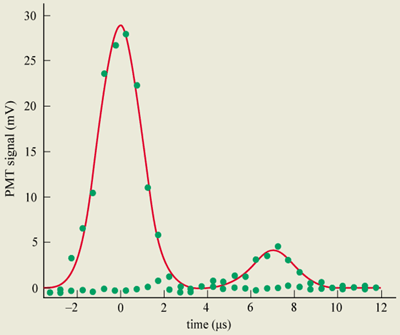
4 Measuring pulse speed and delay This figure provides concrete evidence that light can be slowed to very low speeds. A reference pulse is first sent into the experimental set-up without any atoms present. It sets the zero-point on the time axis from which delays are measured. The intensity of the laser pulse after it emerges from the system is measured with a photomultiplier tube. We then let atoms into the system, cool them down and send in another probe light pulse, which we measure after it has passed through the atom cloud (red line). This pulse has been delayed by more than 7 µs in a cloud that is only 0.2 mm long giving a light speed of 32 m s1. By varying the intensity of the coupling laser, we can control the speed of the pulse and the time it spends in the cloud. The coupling laser also enables the probe pulse to pass through what would otherwise be an opaque medium.
Measuring the speed of our ultra-slow light is relatively easy. Having illuminated the cloud from the side with the coupling laser and fired the probe laser pulse into the atom cloud along its long axis, we simply sit behind the cloud and wait for the light pulse to emerge. We use a photomultiplier tube to measure the arrival time (figure 4). All we then need to do to find the speed of the light pulse is to measure the length of the atom cloud, which we do with a third laser beam, the “imaging” beam (figure 2a). This laser propagates at right angles to the coupling and probe laser beams, passing vertically through the cloud. The atoms create an “absorption shadow” in the imaging beam, which is recorded with a camera that takes a snapshot of the cloud.
Stopping the light pulse
Having learned how to slow light pulses to crawling pace – and compress them so that they are completely contained within our ultracold-atom clouds – we then decided to try a different experiment. When the slow-light pulse had reached the centre of the cloud, we turned off the coupling laser abruptly. The result: no pulse came out. When we later turned the coupling laser back on, the light pulse was regenerated and emerged from the cloud.
What happens when the light pulse slows down is that it is compressed by a factor of some ten million, leaving an almost negligible amount of energy in the pulse. (In free space the pulse contains 25,000 photons and, once compressed, it contains only 1/400 of a free-space photon.) When we turn the coupling laser off abruptly, the light pulse comes to a grinding halt, and the atoms within the localized pulse region are left in their superposition “dark states”. In these states, the relative proportions of states 1 and 2 is a measure of the electric-field ratio between the light pulse and the coupling laser before turn off. In effect, we imprint a phase grating in the atom cloud as if we were recording a hologram.
When we later switch the coupling laser back on, the information left in the atoms – the “grating” – dictates how the light pulse should be regenerated. If we turn the coupling laser back on at the same intensity it had before it was switched off, we generate an exact copy of the light pulse we stored in the cloud. It has the very same shape and wavelength. However, by turning the coupling laser on at a higher intensity, we can generate a revived light pulse that is more intense than the one we sent in and, furthermore, is temporally compressed (i.e. shorter). By turning the coupling laser on and off rapidly a couple of times, we have also been able to regenerate two and even three small light pulses from just one pulse sent into the medium. We have succeeded in storing the pulse in the medium for very long periods of time: several milliseconds in fact. During that time, a light pulse travelling at normal speed would have shot hundreds of miles into the distance. The process of stopping, storing and reviving light is extremely robust. We can slam the coupling laser on and off, and the system – almost magically – self-adjusts to avoid absorption and loss of information.
We are excited that our slow-light experiments have triggered so much new physics both on the theoretical and experimental fronts. Slow light has since been obtained in gases at room temperature by Marlan Scully and his group at Texas A&M University and by Dimitry Budker and co-workers at the University of California at Berkeley. Meanwhile, Ron Walsworth and Mikhail Lukin at the Harvard-Smithsonian Center for Astrophysics in the US have obtained stopped light using a similar process to ours, but with co-propagating probe and coupling laser beams in a hot gas. Other researchers have even managed to create light that travels faster than its speed in a vacuum (see box below).
The cold-atom system allows for the steepest possible refractive-index profiles – and therefore for the most dramatic effects – as Doppler effects are eliminated. Furthermore, cold atoms provide maximum flexibility in the choice of beam geometry. This is important, for example, for the storage and retrieval of multiple pulses of optical information in an atomic medium, as it would allow individual pulses to be selectively addressed.
Superluminal light
Bringing light to a standstill is not the only effect that a laser-manipulated atomic gas can have on a light pulse. Last year Lijun Wang and co-workers at the NEC Research Institute in Princeton, New Jersey, pushed the speed of an electromagnetic pulse to greater than the speed of light in vacuum by passing the pulse through a chamber filled with caesium gas (L J Wang, A Kuzmich and A Dogoriu 2000 Nature406 277). Superluminal propagation was previously observed in independent experiments by Steven Chu at Stanford University in the US, Vladilen Letokhov of the Russian Academy of Sciences in Troitsk and Ray Chiao of the University of California at Berkeley.
In the Princeton work, the researchers illuminated a 6 cm long cell of caesium atoms with two pump lasers that were at slightly different frequencies and both tuned somewhat away from an atomic resonance (see No thing goes faster than light by Aephraim M Steinberg Physics World September 2000 pp21–22). A refractive-index profile with a slope opposite to that in figure 3 was obtained. When a carefully tuned probe pulse was then fired into the medium, its speed became greater than the vacuum light speed. In fact, the pulse appeared to come out of the medium 60 ns before it entered!
However, Einstein’s general theory of relativity was not violated because information – due to quantum-mechanical fluctuations – cannot be carried faster than the vacuum light speed, even by the superluminal light pulses.
Future applications
Slow and stopped light have many potential applications in optical communication and processing, including optical information storage, ultra-sensitive optical switches, and optical delay lines. It could also be used in quantum-information processing, in which quantum-mechanical information is used for computing and communication purposes. Quantum computers could solve problems – in cryptography, for example – that cannot be solved on realistic timescales with a classical computer alone.
One of the big problems for quantum-information processing, however, has been the fact that we are unable to transfer quantum information back and forth with high efficiency between an optical field and an atomic system. But with our ability to stop, park and revive light, we could use stopped-light pulses to imprint quantum information on an atomic cloud. The information could be processed in the cloud through controlled atomic interactions, and we could then revive the light pulses and read the processed quantum information back into the light field where it could be sent further down an optical fibre.
On a very different front, slow light provides us with a totally new way of probing the unusual properties of Bose–Einstein condensates. Very recently, we have developed a light “roadblock” and used it to create ultra-compressed, ultra-slow light pulses that subsequently led to formation of “quantum shock waves” in a Bose–Einstein condensate. It might even be possible to use slow light to study cosmology in laboratories right here on Earth. Ulf Leonhardt from the University of St Andrews in the UK, for example, has predicted that the analogue of black holes could exist in such as system.
Ultra-slow light has opened up a whole new realm of applications and new paths for fundamental research. I believe we have only seen the tip of the iceberg.
The Northern Lights is a well researched biographical tale of the Norwegian physicist and genius Kristian Birkeland, whose life was spent exclusively in pursuit of the scientific goal of understanding solar-terrestrial relationships. The author, Lucy Jago, has turned his life into a highly compelling story that keeps the reader interested, and also learning, as the tale unfolds.
Ahead of his time in terms of his scientific thinking – and unflinchingly focused on achieving his scientific goals – Birkeland found little time for his wife, friends or even his own health as he engaged in a continual battle to overcome the next scientific hurdle. The scientific details in the book are well presented: readers with only a high-school background in physics will understand them, while university-trained physicists will also find them acceptable and accurate.
Most great scientists of the past and present have found that persistence is an important ally in the pursuit of the next breakthrough towards a verifiable understanding of their area of study. Jago’s book shows that Birkeland (1867-1917) certainly had that quality. His persistence, however, extended to raising funds by exploiting his genius as an engineer.
Denied funding through the normal processes of the day, Birkeland co-founded one of the great Norwegian companies of the past century, Norsk Hydro, which began as a producer of artificial fertilizer. More concerned with using the company to support his academic work, Birkeland was less interested in its political and commercial affairs – and was prey to being cheated by his business partner.
In the book we learn how Birkeland was a contemporary and friend of fellow Norwegian adventurers Fridtjof Nansen and Roald Amundsen. The lives of all three men were bound up in the national movement to put Norway on the international map, having in 1905 been freed from many years of Swedish rule. It is only from the perspective of the scientific research of the past 30 years that we can now appreciate how Birkeland’s pioneering work matches the achievements of his more celebrated national scientific colleagues.
Birkeland essentially believed that the Northern Lights were caused by electrically charged particles from the Sun interacting with the Earth’s magnetic field. Although supported by his own observations and by his laboratory simulations of the aurora, Birkeland’s theories failed to gain widespread acceptance until the were confirmed by evidence from satellites in the late 1960s.
He was a man of great energy and focus. In the early pages of the book, Jago tells with the pace of a novelist how he planned and undertook a risky winter climb and over-winter stay at the Haldde Observatory in northern Norway – which he had founded in 1899 – even though he was not an experienced mountaineer. To make his venture successful, Birkeland selected and motivated several young men to come and work with him. His personal magnetism was sufficient to do that, even though those he recruited were well aware of the risks involved in over-wintering at the top of a mountain north of the Arctic Circle.
Another dramatic event in Birkeland’s life – in which his personal persuasion of others led to support and success – occurred when he was challenged to increase the productivity of his nitrogen-fixation process operated through Norsk Hydro. His clarity of insight was his ally, but Jago also weaves into the tale the cost of his personal commitment in terms of his health.
There was no doubt that Birkeland thought himself worthy of the highest accolades for his work in unravelling the complexities of solar-terrestrial relations and electromagnetic coupling through the solar wind. He was, however, frustrated by the rejection from his peers in Britain and his subsequent failure to become a fellow of the Royal Society. He also aspired to a Nobel prize for his plasma technique for nitrogen fixation. Although he came close to winning, he was denied because of the political opposition organized by his partner in Norsk Hydro, who wanted to claim the prize for himself.
Birkeland’s social and family life were relegated to secondary status, seemingly never having priority above his scientific and engineering activities. The author tells of Birkeland’s increasing interest in the daughter of one of his close friends and how the relationship slowly blossomed. His fiancée had recognized his preoccupation with his scientific work, but had expected that he would change and pay more attention to her once they were married. She was to be disappointed. Eventually, the marriage broke up, more because Birkeland practically abandoned his wife than due to any other cause. His only long-term relationships were those with his collaborators.
In summary, this is a somewhat tragic but compelling story of a scientist and engineer who had brilliant insights and seemingly boundless energy. Jago tells the tale with a well judged balance between the scientific background to his life, the excitement of carrying out his projects and his experience of life as a human being. His work on solar-terrestrial relations is now hailed for its vision, pointing the way towards a correct understanding of the influence of the Sun on the planets in the solar system. This book, coming about a century after this prime discovery, is a carefully crafted biography and a very good read.
According to the old adage, “a picture paints a thousand words”. And in many scientific disciplines ultrahigh-speed imaging is the only reliable way to visualize the countless physical and mechanical processes that occur on microsecond timescales. Such processes include ballistics, the propagation of cracks in materials, flame fronts in combustion research, the generation of shock waves in aircraft components and electrical “streamers” in high-voltage research.
Conventional cameras – devices that record images onto photographic film – are at least a hundred times slower than electronic cameras, which can capture up to 600 million images per second. The rate for conventional cameras is limited because the film has to be accelerated to very high speeds through the camera, which is a major obstacle when recording microsecond events. And mechanical failures are not unknown.
In contrast, electronic cameras have no moving parts and can have high sensitivity, making them ideal for recording faint ultrafast processes. Moreover, the resulting digital images can be analysed in far greater detail than conventional photographic prints. So how do electronic cameras work?
In the picture
Light entering the camera is focused onto an image-intensifier photocathode, which releases electrons in proportion to the number of incident photons. These electrons are then accelerated towards a device called a microchannel plate, where they produce an avalanche of electrons via collisions. From the microchannel plate, the electrons are further accelerated towards a phosphor screen where a more intense copy of the original event is created and then transferred via a fibre-optic link to a charge-coupled device (CCD) that records the image.
Indeed, it is this ability to multiply the number of generated photoelectrons that makes it possible to photograph very faint objects at high speeds. With a conventional camera, we either have to increase the exposure time of the camera and risk blurring the image, or dramatically increase the light illuminating the object, which is often undesirable or even impossible.
In general, physicists and engineers demand ever-increasing spatial and temporal resolution from each successive generation of high-speed camera. But it would be prohibitively expensive to build a single camera that would satisfy every application and every scientist’s needs, so compromises must therefore be made. The latest cameras exploit a simple optical trick and improvements in CCD technology to increase the spatial and temporal resolution.
An example of one such camera is the Imacon 200 made by my company DRS Hadland in the UK. It can record up to 200 million images very second with eight CCDs that are coupled to a novel pyramid-shaped beamsplitter. This beamsplitter was first proposed during the 1950s by Courtney Pratt, then at Cambridge University in the UK, and co-workers. However, the device was never produced because it was too laborious and expensive to develop using the technology available to optical designers at the time. Modern computers and rare-earth glasses have revolutionized the design of optical components and the pyramid scheme for the Imacon 200 was completed in a relatively short time.
As its name suggests, the pyramid beamsplitter is a block of glass with eight facets, each of which acts as a highly reflective triangular-shaped mirror. The light from each surface (about 12% of the total incoming light) is reflected towards steering mirrors, which direct each beam towards eight intensified CCD-based sensors. By carefully controlling the read-out time of each CCD, we can increase the temporal resolution relative to that of a camera with only one detector without spoiling the quality of the image. Indeed, cameras that have an electron multiplier between the photocathode and the phosphor screen allow faint images to be recorded while keeping exposure times as short as 5 nanoseconds.
One area that benefits greatly from such high sensitivity is combustion research into environmentally friendly “lean-burn” car engines. The flame front produced immediately after ignition is extremely faint and difficult to record in detail with many cameras. However, this problem can be readily overcome by increasing the camera sensitivity. Meanwhile, the chemical differences between burned and unburned fuel can be investigated by inserting narrow-band-pass filters into the individual optical paths of the eight beams.
Racing ahead
Another advantage of electronic cameras is that they can record discrete frames and continuous “streak” images at the same time. While individual frames show an object in detail, information is inevitably lost during the “dead time” between successive images. Streak images provide a continuous visual record of spatial resolution plotted against time and are particularly useful in applications such as plasma and explosives research.
Camera manufacturers have to respond to the economic concerns of laboratories by using technology in an ingenious way to reduce costs. Our company has developed an ultrahigh-speed camera that is cheaper than the Imacon 200 because it uses a single high-resolution CCD. The camera gives good results but, like all things in life, you get what you pay for.
Light entering the device is split into four beams by four mirrors that are arranged to form a square tunnel with reflective inner surfaces. Each of the four images hits a single photocathode that has been segmented into quadrants that can be controlled independently. This separate “gating” allows the exposure time of each quadrant to be varied during the exposure. It also effectively increases the speed of the camera to 100 million frames per second.
The generated photoelectrons are multiplied in a microchannel plate and accelerated towards a phosphor screen. The intensified image is then coupled via an optical fibre to a single CCD with 2000 x 2000 pixels. Each pixel in the CCD generates electrons when it is exposed to light. The charge on each pixel has to be moved into the memory before the incoming light intensity changes and new electrons are generated. This movement of charge takes time, and essentially limits the speed with which the camera can operate. To reduce this problem and speed up the process, fewer pixels are used to produce the image. Indeed, we judiciously masked all but every 17th pixel in each column of the CCD to the incoming light. The electrons are moved to the masked pixels, which act as a temporary store for charge before the recorded sequence of images is downloaded to permanent memory. The process takes some 5 microseconds, which limits the speed of the camera to 350 000 frames per second – which is still good enough for many materials-research projects.
Ultimately, all high-speed cameras are a compromise as it is impossible to include every desirable feature in a single instrument and, invariably, the type of research dictates the choice of camera. Where long recording times are essential, conventional film cameras have an advantage, although it is more difficult to extract useful data from the analogue images recorded on film. Similarly, some of the latest high-speed video cameras offer reasonably long recording times, but the resolution is sacrificed because fewer pixels on the sensor are used. Electronic cameras have a shorter recording window but are flexible and can be synchronized to ultrafast events.
The choice of camera clearly depends on what picture you want to paint!
First discovered in experiments on ions in the early 1920s, the understanding of magnetic moments played a central role in theoretical physics during the 20th century. In the case of free electrons, comparisons between theory and experiments of ever-increasing accuracy continue to provide one of the most significant tests of the theory of quantum electrodynamics. For example, they test our picture of the vacuum as a polarizable medium consisting of “virtual” clouds of electron-positron pairs. An electron placed in such a medium polarizes the cloud surrounding it, and this in turn has a measurable effect on its apparent magnetic moment.
The case of free electrons is well understood, but the magnetic moments of electrons within atoms are more mysterious. Now Zong-Chao Yan of the University of New Brunswick in Canada has taken an important step towards calculating the magnetic moments in atomic systems with three electrons (Z-C Yan 2001 Phys. Rev. Lett.86 5683).
In the September issue of Physics World, Gordon Drake of the University of Windsor, Canada, explains how simple calculations can be adapted to more complex systems.
Cystal impurities in silicon can now be controlled to the level of one part in a billion, while major faults in the crystalline structure can be avoided. As techniques to control its growth have developed, the applications of silicon have been pushed in new directions. In addition, there is a constant drive to improve light emission from silicon.
A key property of a semiconductor is the energy gap between the states filled by the electrons that bond the atoms together and the anti-bonding states. In silicon, this energy is just over 1 eV. Since the chemical bonding is essentially electronic, we would expect that all the different isotopes would have the same electronic structure.
Even the purest form of silicon contains a mixture of different isotopes. For example, the silicon that is found naturally in sand and window glass is comprised of 92% silicon-28, 5% silicon-29 and 3% silicon-30. These isotopes differ only in their nuclear mass. All silicon atoms have 14 protons and 14 electrons, which means that their chemistry is identical. The masses of the nuclei vary because they contain 14, 15 or 16 neutrons.
However, Mike Thewalt and Denis Karaiskaj at Simon Fraser University in Canada have recently teamed up with German and Russian physicists, to carry out very high-resolution spectroscopy of single-isotope silicon. They have shown that the energy gap increases by 0.1% as we move from silicon-28 to silicon-29 (D Karaiskaj et al. 2001 Phys. Rev. Lett.86 6010).
In the September issue of Physics World, Gordon Davies of King’s College London investigates.
The galaxies that make up lens B1359+154 are around seven billion light-years away and lie in the line of sight of the more distant galaxy, which is over 11 billion light-years away. Rusin and co-workers observed radio emissions and visible light in the constellation of Bootes using the ten ground-based radio-telescopes that make up the Very Long Baseline Array and the Hubble Space Telescope.
Rusin and colleagues used the position and brightness data of the intervening galaxies to simulate how the light of the distant galaxy would be bent. Their prediction closely matched the pattern of images observed. “We think this work will give us an excellent tool for studying much denser clusters of galaxies and the relationships of the individual galaxies to the ‘halo’ of dark matter in which they are embedded”, says team member Martin Norbury.
More complex clusters of galaxies have been known to form lenses that create up to eight images of a background object. Such large numbers of galaxies make it difficult to determine how the gravity of each one affects the behaviour of the lens, but this is much easier with just three galaxies. “Systems such as B1359+154 are very rare”, says Rusin, “so this discovery is an important stepping stone”.
The temperature below which a material loses its resistance to electricity is known as its superconducting transition temperature. In an earlier experiment, Batlogg and colleagues eliminated electrical resistance from carbon-60 at 54 kelvin by adding positive ‘holes’ to it. But when they added tribromomethane, the resistance disappeared at the much higher temperature of 117 kelvin.
Carbon-60 molecules form a crystal with a face-centred cubic structure. Its lattice constant – the separation of the centres of two adjacent molecules – is 1.417 nanometres. When trichloromethane was added to the molecule, this stretched to 1.428 nanometres and the transition temperature reached about 70 kelvin. But when tribromomethane was added, the lattice constant grew to 1.443 nanometres, and superconductivity persisted up to 117 kelvin.
As these results show, the transition temperature of carbon-60 increases linearly with lattice constant, and Batlogg’s team believes that boosting this constant is the key to achieving superconductivity at higher temperatures. But this will be a challenge: the weak electrostatic attractions that bind the carbon-60 crystal lattice – known as van der Waals forces – will rapidly weaken even further as the carbon-60 molecules accept larger neutral molecules.
This work is the latest in a string of experiments conducted by Batlogg and colleagues into the intriguing properties of carbon-60. The electron-phonon interactions thought to give rise to its superconductivity are dominant inside individual molecules of carbon-60. But the electronic ‘density of states’ of the material – which helps to determine how well it conducts electricity – is associated with the bulk material.