‘Radio-loud’ quasars – which are brighter at radio wavelengths than in the optical range – emit two narrow beams of radiation that emerge from opposite edges of the quasar. Blazars are a type of radio-loud quasar that periodically send violent pulses of radiowaves into space and were originally defined by the ‘synchrotron’ radiation that they emit when electrons are accelerated in a magnetic field. But astronomers proposed five years ago that this characteristic spectrum is only seen if the beams of radiowaves are viewed end-on. This would mean that many blazars had gone undetected. As the angle of observation increases away from the beam, the synchrotron profile weakens, and the spectrum changes further as the angle grows.
Ma and Wills compared two sets of spectra of 62 quasars – one gathered between 1998 and 2000, and the other ten years earlier. Some of the recent spectra exhibited emission lines over 20% stronger than those in the corresponding older spectra. These jumps in intensity occurred over the same timescale as the peaks in brightness seen in blazars. This suggests that many of the objects that astronomers thought were quasars are actually blazars. “Our observations offer support for the unified scheme for radio-loud quasars”, claim Ma and Wills. “The emission line variations provide the most direct evidence for the existence of violent blazar outbursts in every radio-loud quasar”.
Distant quasars are also among the objects catalogued by the ambitious Sloan Digital Sky Survey based at Pasadena in California. Project scientists have just released a huge instalment of data containing redshift information for 50 000 galaxies and 500 quasars. The survey aims to build the biggest digital map of the sky and the extensive archive – which has imaged both ‘local’ and remote bodies from the 2.5-metre Sloan telescope in New Mexico – will be available to the astronomical community for further study.
In previous experiments, physicists have controlled the motion of ions and clouds of neutral atoms. But neutral atoms lack an electric charge, and combined with the intricacies of quantum statistics, it is much trickier to pin down a single one. Existing sources of neutral atoms include atom beams, but these produce an incoherent stream of neutral atoms, while ‘one-atom masers’ sometimes emit more than one atom.
Kuhr’s team created a trap for a single atom – or a specific number of atoms – using the interference pattern produced by a pair of infrared lasers. A magneto-optical device gathers single atoms from chilled caesium gas and deposits the desired number of them into the trap. The electric component of the laser light induces a dipole moment in each atom, causing the atom to interact with the electric field. This attraction between the atom and the electric field is dependent on the light intensity, and the atom is therefore drawn towards the brightest regions – that is, the maxima of the interference pattern. This means that the position of the atom is known to within half the wavelength of the laser light. By tuning the wavelengths of the lasers, Kuhr and colleagues were able to shift the interference pattern by about a centimetre – moving the atom with it. The position of the atom is tracked by ‘fluorescence detection’, in which the atom is excited by a probe laser, and its glow is measured by a photon counter.
After successfully moving an atom, Kuhr’s team investigated what would happen if the lasers were suddenly switched off while an atom was in motion. They found that the atom was catapulted into free flight with a velocity of a few metres per second. Although the velocity of the atom was uncertain in their set-up, Kuhr and colleagues have proved that single atoms can be ejected on demand. They are optimistic that – with some refinements – their system could evolve into a practical device.
“Our next goal is to place two atoms between two mirrors of ultrahigh reflectivity – that is, an optical resonator”, coauthor Dominik Schrader told PhysicsWeb. The team’s ‘atom ejection’ technique should make this possible for the first time. “This will allow us to study the quantum interactions between the two atoms, which is fundamental for the implementation of quantum information processing”, says Schrader.
The rotation of rocky planets with dense atmospheres – such as the Earth and Venus – is determined by atmospheric tides, gravitational forces, friction between the mantle and the crust, and the ‘obliquity’ angle between the planet’s equator and the plane of its orbit around the Sun. Accounting for these effects, Correia and Laskar calculated the motion of such planets for a wide range of initial conditions. “We found that, due to the presence of the dense atmosphere, the rotation can only end in four possible spin states”, Laskar told PhysicsWeb. Such planets can have either retrograde or ‘prograde’ rotation – that is, the west-to-east rotation commonplace in the solar system – and their rotation axis may or may not have flipped during its evolution. We know that Venus has retrograde rotation, but has its rotation axis switched?
For the rotation axis of Venus to flip, Correia and Laskar calculated that the planet’s equator must once have been strongly tilted compared with the plane of its orbit around the Sun – that is, it must have had a high obliquity. Although this widely accepted idea is still possible, Correia and Laskar calculated that chaotic behaviour in the atmosphere of Venus could have slowed and then reversed the rotation of Venus – and in this scenario Venus need not have had a high initial obliquity. “Most initial conditions will drive the spin of Venus towards its present state, but through two very different evolutionary paths”, says Laskar.
Whether the rotation axis of Venus did switch in the past depends upon its initial rotation period, according to Correia and Laskar. Their simulations suggest that the axis would only have flipped if Venus was spinning very quickly. If it had a slow initial spin, the reversal in rotation probably arose purely from atmospheric and internal phenomena. Correia and Laskar believe their simulations will be useful in studies of newly discovered planets beyond the solar system.
Morisawa and co-workers deposited a thin layer of a polymer known as Novolac onto a plastic optical fibre. This cladding swells when it is exposed to alcohol vapour and its refractive index falls from 1.6 – when no alcohol is present – to 1.45, which corresponds to saturated vapour pressure. The refractive index of the core of the optical fibre falls within this range. When the refractive index of the cladding exceeds that of the optical fibre core – that is, when alcohol levels are low – most of the light travelling through the optical fibre is refracted so that it escapes through the fibre wall. But as the concentration of alcohol rises, an increasing fraction of the light is reflected back into the fibre and travels towards a sensor. The light intensity is therefore a measure of alcohol concentration.
The team made the device even more sensitive by adding iron and sulphur to the polymer. This ‘complex’ expands in the same way, but it absorbs more light because it is black. As a result, very little light reaches the sensor initially. But when the complex swells and channels light along the optical fibre, the sensor records a bigger jump in the intensity of light than it does with the ordinary polymer, and this improves the sensitivity.
“The detector has many advantages such as low cost, easy handling and flexibility”, says Morisawa. The highly sensitive device can also distinguish between individual gases because it responds to different types of alcohol – such as methanol, ethanol and hexane – in a characteristic way.
We are familiar with the concept of ‘stopping power’ in the macroscopic world. The energy an object loses when it collides with another object is directly related to its velocity and the distance its travels through the target object. Kunert and Schmidt used a technique known as nonadiabatic quantum molecular dynamics to study the collisions at the microscopic level. They fired protons, carbon ions and argon ions – in order of increasing mass – at the fullerene targets. Measurements of the resulting excitation of the fullerene molecules revealed how much energy the impinging ions had imparted to the larger molecules.
As expected, the amount of energy the fullerene molecules absorbed was closely related to the mass of the incoming ions and – up to a certain threshold – their speed at the point of impact. But above a certain impact velocity, the mass alone determined how much energy was imparted. Kunert and Schmidt found that argon ions travelling at velocities that differed by a factor of 20 delivered identical quantities of energy to the fullerene molecule.
Kunert and Schmidt also noticed that the energy caused vibrations in the fullerene molecule at the lower velocity, and electronic excitation at the higher velocity. Unusual fragmentation patterns observed in other experiments could be explained by this transition from vibrational to electronic excitation. The Dresden team believes that the different processes of excitation cause the large particle to break up in different ways.
Optical data systems rely on a beam of light to read information from a storage medium. But there is a fundamental constraint – known as the diffraction limit – on how tightly the beam of light can be focused. This limit is directly related to the wavelength of the light: the shorter the wavelength, the smaller the spot of light can be made. A more tightly focused ‘reading’ beam would allow data – for example, the pits in the surface of a CD – to be packed closer together in the storage medium. Short-wavelength light is emitted by materials with large energy gaps.
The laser developed by Huang’s team is based on a ‘nanocrystal’ that consists of parallel zinc oxide nanowires grown perpendicular to a sapphire substrate. Zinc oxide has a large energy gap that allows it to emit blue light, but when the nanowires are excited by another laser they emit ultraviolet light with a wavelength of 385 nm. Excitons – pairs of electrons and holes – within the zinc oxide recombine to emit the light. This process is boosted in the virtually one-dimensional wires because the excitons are spatially confined, allowing them to recombine more easily. The laser cavity that amplifies the light is formed by the reflecting interfaces between the nanocrystal and the sapphire substrate at one end, and the surrounding air at the other.
Koizumi and colleagues exploited the large ‘indirect band gap’ of diamond to make their device. This energy structure – similar to that of silicon – makes diamond reluctant to emit light, but the Japanese team overcame this problem by doping the p- and n-layers of a pn junction with boron and phosphorous, respectively. Excitons recombine within the LED to emit ultraviolet light with a wavelength of 235 nm. Koizumi’s team believes that some weaker peaks at other wavelengths will disappear when the low level of impurities in the crystal is reduced further.
Astronomical objects such as the active galactic nuclei radiate linearly polarized radiation. Spinning bodies, such as pulsars and black holes, emit synchrotron radiation that is elliptically polarized – the vector of polarization rotates about a point, tracing out an ellipse. Astronomers believe that understanding the behaviour of this polarization at X-ray wavelengths will provide crucial clues about the internal structure of these astrophysical entities and also give insights into how matter behaves in extremely intense magnetic and gravitational fields.
The new device is based on the photoelectric effect. X-rays enter a chamber within the detector – filled with neon and dimethyl ether gas – and eject electrons from these gas atoms. The direction of flow of the electrons coincides with the direction of the electric field of the incoming X-ray photons, and therefore reveals the polarization of the incoming X-rays. The trickle of photoelectrons is boosted by an electron multiplier in the ‘micro-pattern gas chamber’, and the subsequent energy loss of the photoelectrons is gauged, providing extra information about the initial kinetic energy of the electrons.
So far, Costa and colleagues have only operated their device on Earth. But they believe that – mounted on a space-based telescope – their instrument will lay the foundations for the new field of practical X-ray polarimetry.
In 1984 – the year made famous by George Orwell – I attended a physics conference in the city of Leipzig, East Germany. It was my first visit since I had been a student there 16 years before. As I had imagined, I was constantly followed by officers from the East German secret police, the Stasi. Many years later, after German unification, I had the chance to look at my Stasi files and found in them an accurate, almost minute-by-minute description of my week in the city. In physical terms, the Stasi agents had given an almost complete description of my “world-line” during the conference. There was no need for me to have kept a diary – the Stasi agents had done that for me free of charge. They had found out everything I had done.
To find things out about our universe, all we need is a diary of those components that remain immutable during the changes that constantly occur in the universe, some of which – like exploding supernovae and collapsing stars – can be violent. These immutable objects are, of course, atoms. Imagine taking a single atom of oxygen from a drop of sweat and looking at its entire “diary” since it was created in the aftermath of the big bang. Some 200 years ago, that atom might have been found inside Napolean’s mouth. More than 2000 years ago it was perhaps inside the poisoned cup that Socrates was forced to drink. Seven billion years ago it was perhaps inside an exploding star.
Based on our combined knowledge of particle physics, nuclear physics, cosmology, astrophysics, astronomy, chemistry, astrobiology and other fields, modern science allows us to write down just such a diary. One could, for example, ask a dozen experts in these fields to trace back the world-line of our oxygen atom, until it hits the darkness at the very start of the universe. However, this is unnecessary. All we need to do is to ask Lawrence Krauss to do it. Apart from being the author of The Physics of Star Trek and Beyond Star Trek, Krauss is a professional astrophysicist and is therefore well suited to the task.
However, the world-line of a typical oxygen atom in the universe is a complex one, particularly when one takes into account not just supernovae, stars and planets but also the Cambrian revolution, the Permian extinction, the dinosaurs and Homo neanderthalensis. In fact, it is almost a miracle that the Homo sapiens of today – in the form of Lawrence Krauss – can track down the odyssey of an individual oxygen atom, which requires a great deal of knowledge in the physical sciences, chemistry and biology.
Krauss takes the reader on a journey that started 15 billion years ago – immediately after the big bang, when atoms did not exist. The world then was a bit like hell – a hot plasma of electrons, neutrinos, quarks and other elementary particles. The author then paints a picture of how matter evolved during the first moments of the universe. Readers who are not particle physicists should, however, be prepared for a rocky road. New notions and concepts are introduced at almost relativistic speeds; a few sentences about quarks and the Higgs field are barely enough to clarify these terms.
The book’s foray into particle physics is over when three quarks meet to form a proton or a neutron. We are now in the era of nuclear physics as subatomic particles such as deuterons and helium nuclei are formed. Nuclear physicists, astrophysicists and astronomers are in for a great time in this part of the book, as Krauss enjoys describing primordial nuclear synthesis, the dynamics of supernova explosions and the formation of elements in stars. It is sobering to recall that we are all children of the stars and that the atoms in our bones were formed billions of years ago in violent star explosions.
Our oxygen atom finally comes to some sort of rest in a relatively small planet in the outer reaches of an average galaxy. We then embark on an adventurous trip through the various ages of the Earth. Chemistry and biology now play the major role, as our oxygen atom eventually becomes part of a water molecule in a drop of sweat, dripping from Michael Jordan’s nose during the final game of his basketball career.
Krauss then extrapolates the world-line of his atom into the future, which he does not paint as brightly as many would like. Predictions are, of course, always uncertain, but the laws of physics at least give some constraints on what might happen to the atom – even in the distant future. Despite the fact that Leibniz once declared our world “the best of all possible worlds”, Krauss points out that we presumably live in the worst of all possible universes, in terms of our long-term quality of life. He then embarks on a series of rather fantastic paths in an attempt to make the best out of our present, relying on predictions made by the physicist Freeman Dyson.
Woody Allen once declared: “Eternity is a long time, especially towards the end.” Our oxygen atom presumably will really not stay to the end. Particle physicists have not proved – but firmly believe – that some day a proton inside the nucleus will decay. This would spell the end of the oxygen atom.
Krauss’s diary is written in such detail that readers will sometimes have problems following the main path – there are too many interesting things to the left and right of the road. However, the book is written with a great deal of enthusiasm and looks in many different directions, giving readers the feeling that they too are taking part in the journey. If only Krauss were wrong and Leibniz were right, and we did indeed live in the best of all possible worlds, then this book is certain to have a bright future.
Our civilization and our standard of living depend on an adequate supply of energy. Without energy, we would not be able to heat our homes or cook our food. Long-distance travel and communication would become impossible, and our factories could no longer produce the goods that we need.
A century ago the world’s energy came almost wholly from coal and “traditional” sources, such as wood, crop residues and animal dung. These are still major sources of energy, particularly in developing countries, where 2 billion people are without access to, or cannot afford, modern energy forms. Wood and dung are estimated to provide an amount of energy equivalent to 1 billion tonnes of oil each year; it is sobering to realize that this is 1.6 times more energy than is provided worldwide by nuclear power, and is about the same as the amount of energy provided by coal in Europe and the US combined (see table below).
During the 20th century, the world’s commercial output and population increased more rapidly than ever before, as did energy consumption, which rose more than tenfold, with a major shift towards oil and gas fuels, and to hydroelectricity and nuclear power. Most of the growth was in industrial nations, where the per capita consumption of commercial fuels is about 10 times that in the developing world.
Energy markets in the industrial countries are maturing, and may even peak and decline with continued improvements in energy efficiency. The last two centuries saw energy efficiency increase enormously – in motive power, electricity generation, lighting, in the use and conservation of heat, and in an array of other applications. There is no evidence that further gains will not be achieved in the future – for example through the use of fuel cells for transport, which could lead to a two- or threefold increase in fuel efficiency relative to that of the internal combustion engine, and through distributed sources of combined heat and power.
The situation is different in developing countries, where billions of people have hardly enough energy to survive, let alone enough to increase their living standards. If they are to achieve prosperity, their energy needs – which are doubling every 15 years – will have to be met. Moreover, their population will soon be 7-10 times greater than that of the industrial world, and (with the sad exception of several African countries) economic growth is much higher than it is for industrial nations.
If we assume that, after allowing for gains in energy efficiency, the developing world eventually uses only half of the energy per capita consumed by industrial nations today, then the world’s energy consumption will still rise more than threefold. Developing nations will therefore need about 5 × 10⁶ MW of new electricity-generating capacity in the coming decades, compared with the 1 × 10⁶ MW they have today and the 2 × 10⁶ MW in the industrial nations. (Electricity generation accounts for only about one-fifth of our final energy consumption – the rest mainly being for transport and heating.)
Our common ground in debating the question “Do we need nuclear power?” is therefore the fact that the world is likely to need yet more energy, despite the immense amount of energy consumed today. The environmental problems associated with energy production and use will also need to be addressed, including local and regional pollution, and the much-discussed problem of global warming.
Global primary-energy consumption
Energy source
1860
1900
1950
2000
Traditional (wood, dung, etc)
270
330
470
~1000
Coal
100
470
1300
2220
Oil
20
470
3400
Natural gas
170
2020
Hydro-electric
10
120
230
Nuclear power
630
Renewable (other than hydro)
~200
Total
370
830
2530
~9700
Units: million tonnes of oil (toe) equivalent energy.
Sources. For 1860, 1900 and 1950: Nuclear Energy in Industry (1957 Crowther); figures converted from coal-equivalent to oil-equivalent energy by dividing by 1.5. For 2000: Statistical Review of World Energy (1999 BP Amoco), trended up to 2000; except traditional energy, from Rural Energy and Development (1996 World Bank). For primary energy, BP assumes that one tonne of oil produces 4000 kWh in a modern power station.
Yes
Finding ways of satisfying our energy needs is such an urgent problem that we must consider all possible sources, and evaluate them as objectively as possible, writes Peter Hodgson. In doing so, it is useful to apply the following criteria: capacity, cost, safety, reliability and environmental effects. No source can satisfy all our energy needs, and although there are several small-scale energy sources, such as solar panels for satellites, we must focus on the major sources.
Wood was a major energy source in ancient times, and is still extensively used in developing countries. It is, however, impractical as a major energy source in developed countries as it occupies much land and adds to atmospheric pollution. Oil, meanwhile, is fast running out and is needed by the petrochemical industry. It is wasteful to burn it, which also adds to pollution. The same applies to natural gas.
Hydropower is an important source of energy, particularly as it is renewable and does not pollute the atmosphere. However, it uses up valuable land and, in any case, the number of suitable rivers is limited. It is unlikely that hydropower will provide for more than about 8% of our energy needs. Tidal power is even more limited by geographical considerations.
The remaining sources – such as wind, solar and geothermal – account for only a few per cent of the global energy consumption. In addition, some of them are unreliable (wind and solar) or intermittent (tidal) and relatively costly. And although the energy in sunshine, wind, waves and tides is enough to satisfy our needs millions of times over, the difficulty is in harnessing these sources in a usable form. Despite continued efforts, wind and solar sources contribute less than 0.5% of our energy production (see table above).
It could cost the Earth How can we meet our energy needs without damaging the environment?
This leaves only coal as a major source of energy for at least a few centuries. However, a typical coal-fired power station emits some 11 million tonnes of carbon dioxide each year, as well as 1 million tonnes of ash, 500,000 tonnes of gypsum, 29,000 tonnes of nitrous oxide, 21,000 tonnes of sludge, 16,000 tonnes of sulphur dioxide, 1000 tonnes of dust and smaller amounts of other chemicals, such as calcium, potassium, titanium and arsenic. To produce 1 gigawatt-year of electricity requires about 3.5 million tonnes of coal – and this contains over 5 tonnes of uranium. Most of the by-products are caught by filters, but a few thousand tonnes of ash escape, carrying with it a corresponding fraction of the uranium. This accounts for the radioactivity emitted by coal-fired power stations. All the gaseous waste is poured into the air we breathe, and damages our health. To continue to rely on coal could lead to widespread environmental damage and unpredictable climate change.
Can nuclear provide the energy we need? It already generates about 20% of the world’s electricity, including 50% in Western Europe and 80% in France. It is reliable, having high “load factors” – typically more than 90% – with nearly all of the remaining time spent on planned maintenance. Its long-term costs are similar to those of coal. It has little harmful effect on the environment and it is safer than all other sources, apart from natural gas.
Nuclear power only differs from other energy sources in that it emits nuclear radiations. The interior of a nuclear reactor is highly radioactive, and the spent fuel has to be removed periodically for reprocessing. However, the techniques for doing this are well developed and can be carried out safely. The relatively small volumes of highly radioactive residues (nuclear waste) are first stored above ground for several decades to allow the short-lived isotopes to decay, the rest being fused into a insoluble ceramic blocks, encased in stainless-steel containers and buried far below ground in a stable geological formation.
Nuclear reactors can also be improved. While current “thermal reactors” burn only uranium-235, which accounts for just 0.7% of natural uranium, so-called “fast reactors” can burn the remaining 99.3% of the uranium. One reason why fast reactors are not used is because they are more difficult to build, but they will become more economic as uranium becomes more expensive – and could eventually take over from thermal reactors.
Before then, other reactor designs may become available. A particularly promising line of research, which is being pioneered by the Nobel-prize winning physicist Carlo Rubbia and others, is into reactors that depend on spallation neutrons from a proton accelerator. The protons hit a target of a heavy metal, such as tungsten, producing a shower of neutrons that go into a sub-critical reactor assembly. This makes the reactor go critical, thereby generating power. Such reactors are easily controlled because the reaction stops as soon as the accelerator is switched off. The neutron fluxes are also so high that the radioactive wastes can be burnt inside the reactor. These are both highly desirable environmental features. “Pebble-bed” reactors are another promising development.
In the longer term, I have high hopes that fusion energy will ultimately become available. Intensive work is in progress on several possible designs for a fusion reactor. These reactors need deuterium, which is present in water in the proportion of about one part in five thousand. The energy available from fusion reactors is therefore practically limitless.
It is indeed fortunate that, just as other major energy sources are becoming exhausted or are recognized as seriously polluting, a new energy source – nuclear power – has become available to meet our needs.
No
I agree with the relevance of Hodgson’s five criteria: capacity, cost, safety, reliability and the environment, writes Dennis Anderson. But I find he applies them unevenly toward the three main energy sources under discussion – fossil fuels, renewable energy and nuclear power – with a skew against both fossil fuels and renewable energy. Let me take fossil fuels first, since there is a moral in this for both nuclear power and renewable energy.
The United Nations “Atoms for Peace” conferences in 1955 and 1957, which set the stage for the expansion of the nuclear industry, were unambiguous about the need for nuclear power. The view was that fossil fuels would last for about 75 years and that, by the end of the 20th century, we would be faced with major energy crises unless we had nuclear power. The costs of fossil fuels would rise exponentially, while those of nuclear power would fall.
However, the opposite has happened. Fossil fuels have proven to be abundant and less expensive than nuclear power. Estimates of fossil-fuel reserves are enormous, especially of gas. “Commercially proven” reserves – those that companies have access to and declare in their assets – are a poor guide to actual reserves, which include unexplored resources and unconventional resources such as tar sands, shale oils and gas hydrates.
Estimates suggest that, at current extraction rates, we have over 200 years’ supply of oil, 450 for natural gas and over 1500 for coal, the weighted average being nearly 700 years (H-H Rogner 1997 Ann. Rev. Energy and the Environment22 217). Even this is an understatement, since it excludes natural-gas hydrates in the permafrost and under the ocean floors, and other sources that together are thought to amount to five times these values.
Moreover, the oil, gas and coal industries have made tremendous advances in exploration and production, and the electricity industry is steadily improving the thermal efficiency of fossil-fuel power stations. Estimates of reserves have increased more than tenfold, and costs have declined relative to those of nuclear power. Indeed, if nuclear power were to compete commercially with a natural-gas-fired power station, it would need a subsidy of more than £1bn per gigawatt.
It is, of course, easy to speak with the wisdom of hindsight, and to overlook the uncertainties and risks that the energy industry faced when nuclear-power programmes were being put in place. In the 1950s nuclear power held the promise of unlimited energy in an era when coal mining was an arduous, dangerous and unhealthy occupation for millions of workers (as it still is in China and India), when fuel shortages were common, and when coal burning in homes and industry was the source of intolerable levels of local pollution.
Nevertheless, nuclear power has been unable to compete in terms of cost with fossil fuels, and there is no commercial interest in it outside state-run electricity sectors. The subsidies for nuclear power over the past five decades have been colossal – about a hundred times the amount we have spent on developing renewable energy, for example – and further immense subsidies will be required to deal with the legacy of nuclear wastes and the decommissioning of power stations. Indeed, following the privatization of the electricity industry in the late 1980s, the UK introduced a Non Fossil Fuel Obligation (NFFO) to support nuclear power; it injected £8bn of subsidies into the industry after it had been sold off, while another £5bn is reportedly needed to deal with the decommissioning of the Dounreay nuclear facility. The NFFO, in contrast, injected just £750m (less than 10% of the funds) into renewable energy.
It is true that nuclear power makes a sizeable contribution to energy supplies in France and the UK, and that global production grew from near zero to the equivalent of 630 million tonnes of oil (toe) per year between 1960 and 2000. But the energy obtained from biomass – albeit unsustainably gathered over large areas – also increased by almost as much, in absolute terms, as that obtained from nuclear power. The contribution of fossil fuels rose by seven times this amount, notwithstanding the predictions that they would be nearly exhausted by the year 2000.
In terms of capacity and cost, it is thus difficult to make a good case for nuclear power. Fossil fuels are more than sufficient to meet the world’s energy needs economically, not least in developing countries. Will environmental concerns change this? In response to successions of clean-air acts and environmental controls introduced in industrial nations, all sectors of the energy industry have made immense strides in reducing local and regional pollution per unit of energy consumption.
With the partial exception of nitrous oxides, the development of “clean” technologies and fuels is enabling pollution per unit of energy use to be reduced by several orders of magnitude. We have seen major reductions in local and regional pollution where these technologies and practices have been introduced: reductions of smog, lead in fuels and acid deposition in Europe and the US being striking examples. The associated costs have, moreover, proved to be small compared with the overall costs of energy use, and have sometimes been negative, with the “clean” practice being more efficient than the polluting practice it displaced. Further reductions are still possible, with hybrid vehicles and fuel cells holding considerable promise. Countries taking advantage of these technological developments have been able to use more energy with less pollution and have found themselves economically better off.
The fossil-fuel industry has thus responded remarkably well to local and regional pollution problems, and there is no reason why societies cannot enjoy the benefits of using these sources while striving to improve the local and regional environment. I shall tend to the global environment later.
Yes
Anderson observes that fossil fuels have proven to be abundant and less expensive than nuclear power. It is not surprising that estimates of reserves differ, because surveys are inevitably incomplete. Furthermore, the quantities available depend on how much we are prepared to pay for extraction. Relative costs are difficult to estimate because nuclear costs depend on the lifetime of the reactor, which may be as long as 60 years. A small fraction of the output invested each year easily pays for decommissioning, and reactors are now designed to facilitate this process. The cost of nuclear power relative to fossil fuels would be very different if realistic estimates of the cost of pollution and climate change were also included. In the short term, fossil fuels may appear less expensive, but it is the long term that is more important.
The Belgian government recently set up a commission to examine the options for electricity generation. Taking into account fuel costs, non-fuel costs (investment, operation and maintenance), external costs (air pollution, noise and greenhouse gases) as well as the cost of construction, grid connection and decommissioning, the commission estimated that it will cost BFr 2.34 to generate every kilowatt-hour of electricity from coal in 2010. The equivalent figures were 1.74 for gas, wind as 1.85 (seashore), 2.39 (offshore) and 3.26 (inland), but just 1.22-1.28 for nuclear power. In other words, nuclear power is not only more reliable, safer and less detrimental to the environment than the alternatives, but also substantially cheaper.
In his book The Earth Under Threat, Sir Ghillean Prance, former director of the Royal Botanical Gardens at Kew, describes in graphic detail the devastating effect on animal and plant life already attributable to climate change (1996 Wild Goose Publications, Glasgow). Many species, such as the golden toad in Costa Rica, have become extinct. This can be dismissed as anecdotal and lacking in statistical basis. Who cares about the golden toad? Well, I do, as I care about all threatened species.
Practical challenge Solar devices could, in theory, meet all of the world’s future energy demands.
Scientists on the UN’s Intergovernmental Panel for Climate Change (IPCC) have amassed impressive evidence that climate change is real. Their work indicates that in the next 100 years average global temperatures will rise by several degrees and the sea level by 50-100 cm. There are, of course, many uncertainties, but it is prudent to take climate change seriously. Many of its potentially devastating effects are directly attributable to the carbon dioxide emitted when fossil fuels are burnt. Meanwhile, impurities in fossil fuels cause acid rain, which is already adversely affecting rivers, lakes and forests. While some countries are reducing the levels of pollution, this must be done world wide. It is therefore essential to eliminate fossil-fuel power stations.
As for wind and solar power, they contributed only 0.15% of the world’s energy production in 2000 and disfigure large areas of land. They are also relatively expensive and five times as dangerous as nuclear power as measured by deaths from all causes during production. There is no hope that they can supply our energy needs. The only practical substitute for fossil fuels is nuclear power. In 1988 some 1.9 x 10¹² kWh of electricity was generated by nuclear power stations. The same amount would be produced by burning 900 million tonnes of coal or 600 million tonnes of oil. In other words, the emission of 3000 million tonnes of carbon dioxide has been saved by using nuclear power, rather than coal. (While coal emits 850 tonnes of carbon dioxide per gigawatt hour, the figures for oil are 750, gas 500, nuclear 8, wind 7 and hydro 4.)
As countries switch to nuclear, their rate of carbon-dioxide emissions fall. Since 1970 France has halved its emissions, Japan (32% nuclear) has achieved a reduction of 20%, while the US (20% nuclear) has reduced it by only 6%. The emission of noxious gases like sulphur dioxide is also dramatically reduced by going nuclear.
The UK government, meanwhile, wants its emissions of greenhouse gases to be 10% lower by 2010 than they were in 1990. A reduction of 6% had been achieved by 1995, which was due to nuclear-power output rising by 39% between 1990 and 1994. However, if no more nuclear power stations are built, the level of emissions will rise steeply. In subsequent years, as older nuclear power stations are decommissioned, the UK will find it impossible to reach its target.
Although many new gas-fired power stations, which emit only half as much carbon dioxide as coal-fired power stations, are currently being built, the problem is that they leak methane, which has a “global-warming potential” of about 60 times that of carbon dioxide. These two effects approximately balance out, which means that we can expect no reduction in global warming by switching from coal to gas. Even if this methane effect is neglected, then if gas increases to 43.5% of total production, while coal declines to 2.5%, we can expect carbon-dioxide emissions to fall by 10%. And if nuclear rises to 43.5% at the expense of coal there will be a 20% fall.
If we do not solve the world’s energy problems now, then they will soon be solved for us. We are living in a special period in human history when oil, gas and coal are readily available. At present rates of consumption, the oil and gas will be gone in less than 100 years, and coal in about 200-300 years. Fossil-fuel burning will then cease and alternatives will have to be found. If we continue to burn fossil fuels, we not only pollute the Earth and initiate global warming, we also deprive future generations of these valuable materials, the bases of petrochemical industries. Would it not be better to solve these problems now – using nuclear power – instead of waiting until it is too late?
No
I disagree with Hodgson that “the only practical substitute for fossil fuels is nuclear power”. The alternative of renewable energy is abundant, as he points out, but its practical potential is also far greater than he suggests. It could, in theory, meet all of the world’s energy demands. In practice, we will end up with a mix of energy supplies. Hydrogen production from coal-bed methane and natural gas is a promising option, for example (the CO2 by-product being used for the enhanced recovery of oil or coal-bed methane on a non-net-carbon-emitting cycle). This is not merely my view: the IPCC, in all three of its assessment reports, has arrived at the same conclusion, as have many industrial and academic studies.
First two myths about renewable energy need to be dispelled. One is that it is too dispersed to be of practical use without despoiling the landscape. Over vast areas of the developing world, the incident solar energy is 2000–2700 kWh per square metre of ground occupied per year. Solar-thermal power stations can convert more than 20% of this to electricity, and photovoltaics now on the market about 15% of it. This is more than two orders of magnitude higher than the energy produced by common crops and wood from an equivalent area of land. All of the world’s future energy demands could, in theory, be met by solar devices occupying about:
1% of the land now used for crops and pasture; or
the same area of land currently inundated by hydroelectric schemes, the electricity yield per unit area of solar technologies being 50–100 times that of an average hydro scheme.
A sizeable portion of energy supplies could also be produced by roof-top solar devices. Nor should we overlook resources such as biomass (which could enable vast areas of degraded land in developing countries to be restored), as well as offshore wind, geothermal energy and the energy in tidal streams and waves. Although I share Hodgson’s concerns about the dangers of wind turbines despoiling the landscape, they are now being installed offshore. Multi-sourced systems based on wind, waves, tidal streams and solar power are also possible. Solar schemes are also architecturally attractive.
The second myth is that renewable energy (other than biomass) cannot be stored. A range of options is now being developed, including thermal, mechanical, thermochemical and electrochemical storage, as well as the production and storage of hydrogen for fuel cells or direct combustion for both stationary applications and transport. Even nuclear power needs to solve its “storage problem”, both to service peak loads on electricity systems and to meet the immense energy needs of transport.
Producing hydrogen from solar photovoltaics and wind power is estimated to cost between £0.05–0.10 per kilowatt hour, roughly 7–15 times the cost of natural gas. However, the costs could decline fivefold with economies of scale and as the manufacture of electrolysers develops (J Ogden 1999 Prospects for building a hydrogen energy infrastructure Ann. Rev. Energy and the Environment24 227). And although nuclear power has the economic advantage of using the capacity of electrolysers more fully, the long-term average costs of renewables are as low as – if not lower than – those of nuclear power. Renewable-energy–hydrogen systems are unlikely to cost more than nuclear–hydrogen systems – and possibly less.
The costs of renewable-energy technologies differ greatly with location. Solar technologies are more economical in the sun-drenched tropics, where seasonal variations in sun levels are lower than in other regions of the world and solar peaks match demand peaks much better. In fact, solar technologies are over five times cheaper per kilowatt-hour for most developing nations. What might look a distinctly unpromising technology to a pessimist on a rainy day in northern Europe is highly promising where 5 billion of the world’s population live, and where energy demands are growing fastest.
There is already a rapidly growing market in the developing world for applications that use the Sun for water pumping, lighting and health clinics, and as a back-up for grid supplies and to supplement peak loads. Solar applications also avoid the capital expenditures on – and losses in – transmitting and distributing electricity, which account for about 50% of the costs of electricity supply in urban areas and over 75% in rural areas and towns. Fuel cells as decentralized sources of electricity generation – using hydrogen generated from renewable energy – would give rise to similar savings and, in colder climates, would be an efficient source of combined heat and power.
All of these renewable technologies are proven options and are fertile areas for R&D; the literature is notable for the range of advances that are being reported, not least in conversion efficiencies. They are still in an early phase of development, significant efforts having begun barely two decades ago. The technologies are modular and well suited for batch production. The lead times are just a few months, compared to 7–10 years for nuclear reactors and 3–5 years for fossil-fuel power stations. This is an important source of cost savings and allows the technologies to be developed quickly. They can also be decommissioned and the materials recycled relatively easily.
Such factors will not, of course, guarantee economic success, and it will be important to develop economically viable storage systems, including the fuel-cell–hydrogen option. But they do suggest that we have energy sources of immense promise if we are prepared to support them through wise policies.
It is hard to overstate the size of the task if we are to replace fossil fuels by renewable or nuclear energy to mitigate the effects of climate change. According to the IPCC and the World Energy Assessment – which was carried out last year by the UN Development Programme and the World Energy Council – global primary-energy demands will rise from about 400 × 1018 J today to 800–1600 × 1018 J by the end of the 21st century, depending on assumptions about energy efficiency. This is equivalent to the output of 15–30 million MW of nuclear power.
Given the huge problems of decommissioning and waste disposal, the share of nuclear power in meeting future energy needs is bound to be limited. We cannot rely on nuclear power to solve the climate-change problem. We should therefore develop ways of using solar power – the one safe and abundant form of fusion energy that is already available to us in perpetuity. I appreciate how far developments in renewable energy and hydrogen-powered fuel cells have to go, the difficulties and risks of developing an industry from a small base, and the time it will take to switch from fossil fuels. But we must explore and develop these options.
Yes
Meeting the world’s energy needs is an urgent problem – and all practicable energy sources must be used to solve it. The exact mix in different regions will depend on many factors, particularly the indigenous fuels as well as local geography and economics. Developed countries must help developing nations to increase their energy supplies and curb existing wasteful habits. Continuing efforts must be made to reduce pollution and carbon-dioxide emissions. To make progress in discussions about energy production and the effects on the environment, it is essential to have numerical data. Without such information, it is impossible to know whether a proposed source or effect is important or negligible.
If we are to stabilize the emission of carbon dioxide by the middle of the 21st century, we need to replace 2000 fossil-fuel power stations in the next 40 years, equivalent to a rate of one per week. Can we find 500 km2 each week to install 4000 windmills? Or perhaps we could cover 10 km2 of desert each week with solar panels and keep them clean? Tidal power can produce large amounts of energy, but can we find a new Severn estuary and build a barrage costing £9bn every five weeks?
Nuclear power, however, is a well tried and reliable source, whereas the alternatives listed by Anderson are mainly hope for the future and have yet to prove themselves. At the height of new nuclear construction in the 1980s, an average of 23 new nuclear reactors were being built each year, with a peak of 43 in 1983. A construction rate of one per week is therefore practicable.
I hold no special brief for nuclear power. If there were another way of providing our energy needs without destroying the Earth, I would support it. I am not, I must admit, happy about the dangers of nuclear radiation. I know that, in the hands of engineers at, say, Sizewell, nuclear power is extremely safe, but I can think of many places that would not inspire me with the same confidence. There is always the fallibility of human nature, and the danger that politics will domineer engineering prudence, although the same could be said of all modern technology. Strict controls and eternal vigilance are therefore the price we must pay for its benefits.
A careful and objective analysis will reveal the best energy policies to adopt. It is all too likely, however, that this will not coincide with public views. This puts governments in a dilemma; they can remain popular only by adopting policies that they know are not the best ones from an objective scientific viewpoint. Methods of tackling this serious and intractable problem will have to be discussed.
So do we need nuclear power? Obviously not, if all we care about is having enough energy for the next 100–200 years to continue our current wasteful lifestyles. But then we must pay the price in terms of pollution: sterile lakes and dying forests, climate change and the international tensions generated by the scramble for the last remaining oil. To avoid these consequences, such fuels must be replaced by non-polluting sources, and the only realistic possibility is nuclear power. If we care for the Earth, then, like it or lump it, we need nuclear power.
No
I believe industrialized nations should adopt a modest carbon tax with the revenues being earmarked for R&D and tax incentives to commercialize the following technologies:
improved energy efficiency, including small-scale systems that combine both heat and power.
Developing countries also need to initiate parallel programmes. Building on the work of the UN Framework Conventions on climate change and biodiversity, these programmes should – in addition to the above policies – include the development of advanced solar-thermal power stations and multi-purpose schemes for the sustainable production of biomass for energy use and the restoration of degraded lands and watersheds.
It is precisely because renewable energy still accounts for such a small share of output, coupled with its promise, that these programmes are justified from both an economic and an environmental perspective. When promising technologies are emerging, they need to be nurtured and researched more fully, to see what they will yield. Of all the arguments against renewable energy, the one that it still accounts for only a small fraction of output relative to nuclear power is the worst. Nuclear power generated little in the 1950s; but that did not stop governments subsidizing the industry to the tune of $0.5–1 trillion over the following 40 years. In the early phases of a technology, there is more to be discovered, more scope for progress, more scope for reducing costs through invention and innovation, and economies of scale are more marked. The costs of photovoltaic modules, for example, fell from $300,000 per kilowatt in the 1970s to $3000 per kilowatt by the late 1990s, and the scope for further reductions is far from exhausted.
The “learning curves” for renewable-energy technologies are steep, the unit costs falling by 15%–25% every time the cumulative volume of production doubles. There is every indication that fuel cells and hydrogen production will decline in cost at a similar rate, provided that we invest in their development. Indeed, over 5 GW of new renewable-energy capacity is already being installed each year, and markets are doubling every 3–4 years. If their share in energy production rose to 5%–10% of world energy supplies, their costs would decline by three- to fivefold. At worst, we would have an important source of energy supplies; at best, a proven way of meeting the world’s energy needs in perpetuity without carbon emissions, and a cheaper and abundant source of energy – most of all in developing nations.
As for nuclear power, it should be exempted from carbon taxes and climate-change levies. To put a carbon tax on non-carbon energy sources is illogical and inappropriate. The huge legacy of nuclear waste and the decommissioning of old nuclear plants must also be addressed by public policies. Beyond that, the nuclear industry is now surely mature enough to stand on its own feet. It does not merit further public financial support, which would be better used for other purposes. It should put the case for new plant to the financial markets, not to governments, and in doing so make the necessary provisions for meeting the costs of waste disposal and eventual decommissioning.
The miniaturization and increase in speed of electronic devices was one of the most spectacular achievements of 20th-century technology. We now have computer chips that contain billions of transistors and can perform operations in a billionth of a second. Will the constant improvement in performance that we have witnessed in the last few decades continue? There is no clear answer to this question yet, but chip developers are beginning to feel pressure from various fundamental limits. One important limitation is the amount of power that is dissipated per unit area of the chip.
Each time a bit flips in a computer, the quantity of charge representing the bit must pass through resistive wires. Faster information processing in denser packed chips thus leads to an increase in the amount of heat flux that is generated – unless we can reduce the corresponding charge per bit. This is why current research on future electronic devices is focusing on using a few electrons – or even just one electron – to represent a bit.
So far, the controlled manipulation of single-charge quanta has only been possible in metallic devices at very low temperatures. A good example is the so-called single-electron pump, a device invented in our lab at Saclay that is now being exploited in metrological applications to deliver controlled amounts of charge at the level of a single electron (see, for example, emtech.boulder.nist.gov/nanotech/index.html. However, the technology used to fabricate such devices is very different from the silicon technology used for computer processors and memory.
In conventional digital electronics, huge numbers of components can be integrated onto a chip by starting from a wafer made from a very pure silicon crystal. The etching, oxidation and diffusion processes involved in the circuit fabrication can be very homogeneous and precisely controlled across the entire wafer because the silicon atoms are arranged regularly. In contrast, there is no such control over the position of atoms in the crude thin metallic films used for the single-electron pump. As a result, these devices vary significantly from one location on the chip to another. Combining the principles of single-charge manipulation in metallic devices and the well controlled fabrication of silicon technology is considered the next obvious and important step. This advance has recently been made by Akira Fujiwara and Yasuo Takahashi at NTT Basic Research Labs in Atsugi, Japan (Nature 2001 410 560).
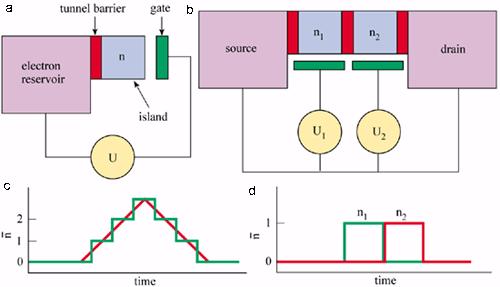
The basic building block of devices that can manipulate single charges is the “single-electron box” (see figure a). It consists of a small conducting electrode, known as an island, that is in contact with a charge-reservoir electrode via a thin insulating layer acting as tunnel barrier. The tunnel barrier is opaque enough to maintain charge quantization in the island, as if the island was surrounded by a perfect insulator. At the same time, however, the barrier is transparent enough to allow electrons to pass across it. A gate voltage U is applied between the reservoir and a gate electrode, which influences the island electrostatically.
This simple system is characterized by the number, n, of excess charge quanta on the island. (We assume that n is positive if there is an excess of electrons on the island and negative if there is a deficit.) The number of charge quanta is subject to two contradictory influences. On the one hand, n should adopt the value that minimizes the total electrostatic energy of the system. The characteristic energy involved is Ec = e2/2C, the energy of an excess electron with charge e on an island that has a total capacitance C when the gate voltage is zero.
On the other hand, the number of charge quanta is affected by thermal fluctuations that typically have energy kBT, where kB is the Boltzmann constant and T is the temperature. At sufficiently low temperatures (i.e. kBTEc) the average value of n varies with the gate voltage in a stepwise fashion, each step corresponding to the arrival of one electron onto the island (see figure b). At higher temperatures, thermal fluctuations mask the charge quantization and the average value of n varies continuously.
The charge-transfer process in a single-electron box with one island is very easy to understand but is also too elementary for applications. Although we can add a well defined number of electrons to the island, the only thing that we can do next is to remove them, because the charge on the island cannot grow indefinitely. With two islands and two gate voltages, however, we can play a much more interesting game (see figure c). Using a suitable sequence of gate voltages, we can transfer a single electron from a source reservoir to the first island, then to the second and finally to a drain reservoir (figure d). This is the basis of the single-electron pump.
Ingenious fabrication
But it is not easy to implement islands that are linked to charge reservoirs through tunnel barriers in silicon. Ordinary silicon is a semiconductor, not a metal. A silicon wire can become conducting, however, in the presence of a large electric field (which can be applied via a gate electrode). The next problem is to interrupt this wire with tunnel barriers to create an isolated island that has a sufficiently small capacitance so that the energy of an excess electron exceeds the energy of any thermal fluctuations.
The NTT team uses a clever fabrication method. Fujiwara and Takahashi built their device from a silicon wire some 10-20 nm diameter. On top of this wire they deposit a metallic wire made of polysilicon, which crosses the silicon at right angles and is similar in width. A very thin insulating layer of silicon oxide separates the two wires. Such an arrangement produces an island for holes in the silicon wire. This island forms in the small overlap region under the metallic wire when the latter is raised to a large negative voltage.
The experiment, which involves transferring charge between two coupled islands, has another ingenious feature: the charge in each of the islands is detected with in situ metal-oxide-silicon transistors. The channels of the transistors are made of the same wire as the islands. Sensing electrons run on the “floor” of the wire, while single holes are stored on the “ceiling”. The electrons and holes are kept apart by a strong electric field that is perpendicular to the wire, and thus they do not recombine.
The experiment runs at 25 K, a temperature that is still very low compared with room temperature, but 50 times higher than the temperature needed to observe single-electron effects in conventional metallic systems. Cooling systems have been making steady progress to ever lower temperatures, and it is reasonable to assume that one day these chips could be cooled by a small portable refrigerator that runs on electricity, rather than liquid helium. However, to take full advantage of the single-electron transfer, computer architecture will probably have to change as well, and will perhaps be based on a new principle like the cellular automaton. No one seems to doubt that we will reach the ultimate limit of electronics one day. The question is when.