Indeed, it is now possible to study for a degree in science and science fiction. Rest assured that this degree course at the University of Glamorgan in the UK does not involve watching videos and reading SF novels all day (note that science-fiction buffs do not approve of the term “sci-fi”). Rather the course involves modules on science – such as stars and stellar evolution, quantum mechanics and the like – and complementary modules on science-fiction themes that “focus on the relationship between science, culture and society”. As Brake writes: “Our aim is to produce graduates who not only have a dynamic and pluralistic understanding of the nature and evolution of science but can also critically develop and communicate ideas about science and its cultural context.”
The cartoon series The Simpsons – which features the adventures of Homer Simpson, an accident-prone safety inspector at a nuclear-power station, and his dysfunctional family – is certainly part of our cultural context as we enter 2001. Stephen Hawking has called The Simpsons “one of the cleverest shows on television”, and has even “appeared” in an episode. In his article, Robert P Crease analyses how science is presented in the programme, including the episode in which Homer’s underachieving son Bart spots a comet heading for Springfield, their home town.
Meanwhile, back in the real world, astronomers and space scientists have yet to find any evidence for Earth-bound comets, or anything resembling what happens in 2001, but they have made impressive progress in finding planets orbiting around stars other than the Sun. In his feature, Andrew Collier Cameron reports how some 50 giant planets have now been detected outside our solar system. So far, none of these planets resembles our Earth – indeed, it is not surprising that most resemble Jupiter, which is much larger and therefore easier to spot. However, there are ambitious plans on both sides of the Atlantic to use networks of infrared telescopes in space to search for Earth-like planets.
But what of any intelligent extraterrestrial life trying to make contact with us? Well, we are not trying too hard to make contact with them – save the message plaque that Carl Sagan designed for the Pioneer 10 spacecraft, or the movie Contact. However, spare CPU capacity on desktop computers all over the world is being harnessed to search for extraterrestrial intelligence in radio signals arriving from space as part of the imaginative SETI@home project (setiathome.ssl.berkeley.edu/).
Stanley Kubrick’s last film was called Eyes Wide Shut. As the space-science community enters 2001, it is clear that it has its eyes wide open.
Down to Earth physics
Back on planet Earth, meanwhile, physicists continue to apply their skills to a wide range of challenges in industry. In this issue you can read about ultrasound in the brewing industry (see article) and how road safety could be improved by including sensors in car tyres (see article). The careers article about healthcare (print version only) confirms the range of opportunities available to versatile physicists.
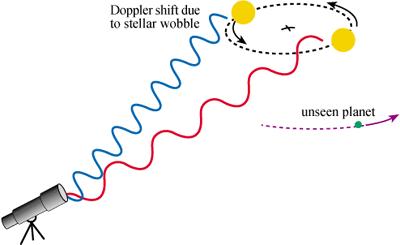
As recently as five years ago, the search for planetary systems beyond our own was the subject of a few painstaking surveys by a small but dedicated band of planet-hunters. Their goal was to find extrasolar counterparts of our own giant Jupiter, which circles the Sun once every 11 years. To do this they relied on the fact that the star around which any planet orbits also moves: for instance, the Sun circles its common centre of gravity with Jupiter at the leisurely pace of 12 metres per second. The aim of these early programmes therefore, was to develop techniques that could detect the periodic changes in the Doppler shift of the light from a star as it wobbled back and forth in response to the gravitational tug of an unseen Jupiter-like companion (figure 1).
Several teams achieved the required precision by the early 1990s. These efforts included a regular monitoring programme of 120 nearby stars that was started at the Lick Observatory in California in the late 1980s by Geoff Marcy and Paul Butler of San Francisco State University. However, the computational overheads needed to analyse the results were so great that much of their data remained unstudied in an archive. This strategy made good sense: by the time any candidate Jupiters had completed enough of their orbits to be clearly identifiable, processor speeds would have increased to the point where the data analysis could be carried out far more quickly. Other groups at the University of Victoria in Canada and the University of Texas at Austin adopted similar philosophies.
When Michel Mayor and Didier Queloz of the Geneva Observatory announced the first discovery of stellar reflex motion due to a planetary body in 1995, its form was so unexpected that it demanded independent confirmation. Their data showed the solar-like star 51 Pegasi to be wobbling back and forth at 56 m s-1, completing one orbit every 4.2 days. The only plausible explanation for this wobble was the presence of an unseen body with at least half the mass of Jupiter in an orbit with a radius of 0.05 astronomical units (AU). An astronomical unit is defined as the mean distance between the Earth and the Sun, which is around 1.5 × 10⁸ km.
1 Stellar wobble A star and planet orbit around their common centre of mass. Although the planet is so faint that it cannot be seen, the star’s reflex motion Doppler-shifts the starlight alternately to longer and shorter wavelengths that can be detected using high-precision spectroscopy.
Fortunately Marcy and Butler had been monitoring the same star for several years, and confirmed almost immediately that the wobble was present in their data as well. At the same time, they found similar signatures of close-orbiting giant planets for three other stars: tau Bootis, 55 Cancri and upsilon Andromedae. A spate of similar discoveries followed. New monitoring programmes were established, and the total number of stars that are currently under observation stands at about 1000. Among these, the tally of nearby stars known to possess at least one planet has risen to over 50. Several of these stars show extra, slower wobbles superimposed on the main signal, which betray the presence of one or more additional planets in larger orbits. Most notable among these is upsilon Andromedae with a family of three giant planets.
Last year saw the record for the lowest mass extrasolar planet being broken several times. Mayor currently holds the record for detecting a planet weighing just 0.16 times the mass of Jupiter that is orbiting around HD 83443, a bright star in the constellation Vela some 141 light-years from Earth.
Meanwhile in August 2000, a team led by Bill Cochran of the University of Texas at Austin announced that it had detected the closest extrasolar planet to Earth. At a distance of just 10.5 light-years away, the star epsilon Eridani shows evidence of a seven-year wobble, although this result still needs to be confirmed.
Reflex orbit
The period and size of a star’s wobble encode important information about the planet’s mass. Usually it is only possible to determine a lower limit on the mass, because for most systems astronomers cannot measure the tilt of the orbit relative to the line of sight. Assuming that the orbit is edge-on to the line of sight gives the smallest possible value of the planet’s mass. This is not as serious a problem as it might appear. If the orbital axes of the planetary systems are oriented randomly in space, there is a natural statistical tendency for us to see many more orbits edge-on rather than face-on. (Try throwing a handful of coins in the air to convince yourself of this.) All the planets discovered so far are giants with masses ranging from slightly less than the mass of Saturn, which is 95 times heavier than Earth, to a dozen times the mass of Jupiter. Jupiter is the most massive planet in our solar system and is 320 times heavier than the Earth.
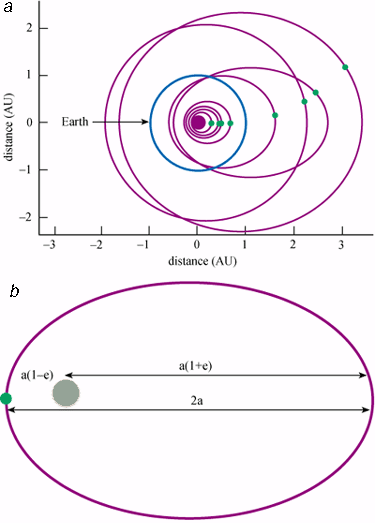
2 Exoplanet orbits (a) A selection of the orbits inferred for several extrasolar planets (drawn to scale) together with the Earth’s orbit (blue circle). The ‘hot Jupiters’ have near-circular orbits and are buried at the centre of the diagram. Exoplanets with orbits more than few tenths of an astronomical unit are in highly elliptical orbits. (b) The departure from a circular orbit is quantified by its eccentricity, e. In an eccentric orbit, the star is located at one focus of the elliptical path traced out by the planet. The star–planet distance is a(1 – e) at closest approach and a(1 + e) at maximum separation, where a is the semi-major axis and e is the eccentricity. Circular orbits have zero eccentricity.
A planet in a circular orbit around its star produces a symmetric wobble that varies sinusoidally with time. The dozen or so known planets with periods of less than a week – the so-called hot Jupiters, deemed hot because they are substantially closer to their stars than our Jupiter is to the Sun – have orbits that are nearly circular, as expected (figure 2). The reason is that a close-orbiting planet in a highly elliptical orbit produces tides on the star, which move the star’s centre of gravity in such a way that the orbit gradually evolves into its lowest energy state, a circular orbit. The greater the distance between the planet and the star, the smaller the tidal effects and the longer it takes for the orbit to become circular. For planets that have orbital distances larger than a small fraction of an astronomical unit, the orbit will remain elliptical for longer than the star’s lifetime.
A planet in an elliptical orbit speeds up when it is close to the star and slows down when it is further away from it, giving the star a characteristic lopsided wobble. Astronomers have used this idea to deduce that the orbits of the longer-period planets are much more eccentric (i.e. more elliptical), in stark contrast to the near-circular orbits of the planets in our solar system. Indeed, nobody has yet found a well behaved Jupiter-like planet in a circular orbit with a radius of several astronomical units.
The high masses and short orbital periods of the planets discovered so far makes them easier to detect than conventional Jupiter-like planets with long periods. This is because the speed, v, of the parent star in its reflex orbit is given by the relation v = 12(MP/MJ)(5.2MSun/aMstar)1/2 m s-1 where MP, MJ, MSun, Mstar are the masses of the extrasolar planet, Jupiter, the Sun and the star, respectively, a is the orbital distance of the planet and 5.2 AU is Jupiter’s distance from the Sun. This favours the discovery of massive planets in close short-period orbits, particularly as most of the monitoring programmes have only been running for a few years. However, it does not explain why so many of the orbits are so much more eccentric than those found in our solar system. To understand these differences, we need to look at the conditions under which planetary systems form.
How do Jupiters form?
Theories of giant-planet formation fall into two main categories. The “top-down” approach has planets forming from large-scale perturbations in the flattened, gaseous disc that surrounds a new-born star for the first few million years of its life. Meanwhile, the “bottom-up” approach requires dust grains with ice mantles to clump together to form bodies a few times the mass of the Earth. Once this critical mass is attained, the planet’s gravitational pull becomes strong enough for it to accrete large amounts of gas from the disc and grow rapidly into a gas giant.
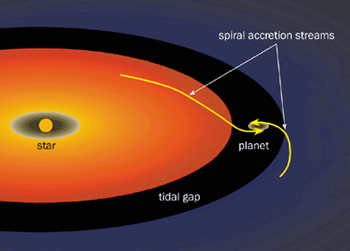
As the planet grows, however, it causes slow-moving material outside its own orbit to speed up and faster-moving material with smaller orbits to slow down. This tidal effect sweeps the planet’s own orbit relatively free of material (figure 3). Computer simulations show that accretion can only occur along a pair of spiral shocks extending inward and outward from the planet. However, several things can go wrong. For example, the growth process itself may be self-limiting due to a lack of material in the region swept clear by the planet. And in many models, the angular momentum that is inevitably exchanged between the planet and the surrounding disc material causes the planet’s orbit to decay, spiralling in to be swallowed by its sun before it can attain a high enough mass.
3 Planet formation A high-mass planet forming in a protostellar accretion disc produces a ‘tidal gap’ nearby. Accreting material flows onto the planet along a pair of spiral arms stretching inward and outward from the gap. A net imbalance in the exchange of angular momentum between the planet and the surrounding disc material causes the planet to gradually migrate inwards or, in some models, outwards.
Other models have shown that top-down planet formation occurs in local clumps in the wake of a growing giant planet, producing a system of several giant planets in dynamically unstable orbits. In this case, interactions between the planets may lead to some bodies being ejected from the system altogether, while others are left behind in eccentric orbits.
Tantalizing new evidence emerged recently that top-down formation of planetary-mass bodies may even occur in interstellar space. Maria Zapatero Osorio and co-workers at the Instituto de Astrofisica de Canarias in Spain and the California Institute of Technology in the US recently announced the discovery of several faint objects in the star-forming region around the massive star sigma Orionis (see further reading). The spectra of these “freely floating” objects, which appear unbound to the star, are a good match with theoretical models of gaseous bodies that weigh a few Jupiter masses and are between 1 and 5 million years old. At these very young ages, the objects still shine brightly as they contract by radiating gravitational energy. However, it is not yet clear from the observations whether the free-floaters have formed in isolation or have been ejected from nearby protoplanetary systems.
These new ideas – inspired largely by the properties of the exoplanetary systems discovered so far – paint a much more violent picture of the planet-formation process than is needed to explain our solar system. While the same problems of spiral-in and self-limiting growth were encountered as long ago as the mid-1980s, much of the fine-tuning of the models was carried out under the assumption that the end-product should look like our system, with well behaved giant planets in circular orbits at more or less the distances where they formed.
The orbits of the giant exoplanets suggest that many of the things that can go wrong in building a tidy system like our own, do go wrong elsewhere. Neither top-down nor bottom-up scenarios can produce Jupiter-like planets with four-day orbits, such as the planets around 51 Pegasi, tau Bootis, upsilon Andromedae and the star HD 187123 in the constellation Cygnus. If the cores of these exoplanets formed from rock-ice planetesimals, they must have done so several astronomical units from their stars, accreted their atmospheres, spiralled in and had their migration halted near 0.05 AU by some as yet unknown mechanism. The giants in eccentric orbits between a few tenths and a few AU must have undergone a similar formation and migration history, combined with violent dynamical interactions with other newly formed giants.
Hints from other worlds
The exoplanets themselves may give some clues about their formation history. The radius of a Jupiter-like planet depends weakly on its total mass and internal composition, and also on its age. Even today, Jupiter is shrinking, radiating 65% more energy than it absorbs from the Sun. Recent calculations by Adam Burrows at the University of Arizona in the US and Tristan Guillot at the Observatoire de la Côte d’Azur in France show that the shrinkage rate for a giant planet with a given mass can be slowed considerably if it is prevented from radiating efficiently. The extreme irradiation experienced by the hot Jupiters due to their close proximity to their stars has precisely this effect, as the planet can only radiate efficiently from its dark side.
Much of the shrinkage occurs early in a planet’s history when it is hot and has a large radiating surface area. The present-day radii of the hot Jupiters are therefore quite sensitive to the ages at which the planets reached their current orbits. For example, a planet that took a long time to form and spiral in will have plenty of opportunity to radiate and shrink. On the other hand, a planet that formed quickly and spiralled in rapidly would have arrived at its new orbit with a large radius, and would subsequently find it harder to cool.
Since the ages of the parent stars can generally be determined to within a billion years or so (from their luminosities, temperatures, heavy-element abundances and axial-spin rates), observational determinations of the radii of exoplanets with known masses can provide important insights into the interior compositions and histories of these planets.
Late last year, David Charbonneau, Tim Brown and others at Harvard University and the High-Altitude Observatory (HAO) in Boulder, Colorado discovered a planet in a 3.5-day orbit about the star HD 209458, which lies roughly 200 light-years from the Sun in the constellation of Pegasus. As the plane of the planetary orbit lies along our line of sight, the new planet passes across the face of its parent star once every orbit. The Harvard-HAO team, and others, quickly found that nearly 1.5% of the star’s light was blocked each time the planet crossed in front of it. This allowed the researchers to measure for the first time the relative sizes of the planet and the star directly, and so obtain the first confirmation that the hot Jupiters are indeed gas giants. With a radius 1.35 times that of Jupiter, HD 209458’s planet is over-sized for its age and mass, in agreement with recent models published by Burrows’ team.
Silicate clouds and the sodium greenhouse
The progress made so far in determining the properties of these other worlds is remarkable in that it has all been achieved without actually seeing the light directly from the planets themselves. Direct detection will help astronomers to pin down the properties of these planets’ atmospheres and to determine when the hot Jupiters arrived in their current, bizarre orbits.
A planet must balance the amount of radiation absorbed on its sunward hemisphere against the amount radiated back into space. As this balance determines the planetary radius, astronomers are keen to find out what fraction of the incident stellar radiation is absorbed so as to understand the sizes of these planets.
4 Sodium absorption spectra A hot Jupiter’s optical and infrared reflectivity (y-axis) depends strongly on the depth at which silicate clouds form, according to theoretical models by David Sudarsky and co-workers at the University of Arizona. If the clouds are high in the atmosphere (green), some absorption by alkali metals is seen in the optical spectrum at wavelengths less than 1 micron. As the cloud deck is pushed to lower altitudes (blue), these absorption troughs broaden until almost the entire optical spectrum is absorbed (red). Water and carbon monoxide give an even stronger “greenhouse effect” at the longer, infrared wavelengths. If the cloud deck is very low, the best place to look for reflected starlight is at the blue end of the optical spectrum.
A star like our Sun or 51 Pegasi pumps out most of its power at optical and near-infrared wavelengths, so the reflectivity of a planet’s atmosphere at these wavelengths plays an important role in the overall energy balance. Indeed, the large radius of the planet orbiting around HD 209458 is best explained if the optical reflectivity is low, allowing the planet to absorb a large fraction of the radiation received from its star. The other side of this particular coin is that the planet’s atmosphere should then reflect relatively little starlight back into space.
Theoretical models offer several good reasons why this might be the case. A deep, cloudless atmosphere of molecular hydrogen should reflect a substantial proportion of incident radiation back into space, particularly at short wavelengths (i.e. blue light) where Rayleigh scattering is efficient. At longer wavelengths, however, the incident radiation can penetrate deeper into the atmosphere before being scattered. If the incoming photons are absorbed by other molecular or atomic species along the way, they may never re-emerge from the atmosphere. Instead, their energy is converted into heat, adding to the planet’s overall thermal energy.
As on Earth, water and methane are among the molecules that absorb strongly at red and near-infrared wavelengths, thereby trapping incoming stellar radiation. However, any resemblance to the Earth’s atmospheric chemistry ends there. As a rule of thumb, the temperature at the top of a planet’s atmosphere varies roughly as d–1/2, where d is the distance from the star. A hot Jupiter orbiting at 1/20th of the Earth’s orbital distance around a Sun-like star should therefore be about four or five times hotter than the Earth’s cosy 300 K. Temperatures ranging from 1300 to 1500 K are hot enough for substantial amounts of the alkali metals to be present in the gaseous state.
In a high-pressure atmosphere, alkali-metal atoms constantly collide with the hydrogen molecules that dominate the gas. During these collisions, the atomic energy levels are perturbed, allowing the alkali-metal atoms to absorb light at wavelengths very different from the usual narrow ranges available to isolated atoms. As a result, the absorption signature of the familiar yellow sodium “D-lines” can become so broad that it absorbs photons over almost the entire optical spectrum. This is expected to give the planets a highly effective “stealth coating”, allowing very little starlight to be reflected back into space (figure 4).
5 Exoplanetary weather Clouds form in a planetary atmosphere wherever the temperature and pressure provide the right conditions for molecules to condense from the gaseous phase to liquid droplets or solid particles. In the hot Jupiters, the most likely cloud-forming species are iron and silicates, such as enstatite. Alkali metals such as sodium and potassium are also present but remain in the gas phase. Light entering the atmosphere will be scattered efficiently back into space by the clouds. Without clouds, the light penetrates deeper into the atmosphere, encountering many more alkali-metal atoms along its path, and generally being absorbed before it can escape back into space.
The major uncertainty in this cosy picture of exoplanetary weather is the role of clouds. The pressure in any planetary atmosphere decreases with height, and so does the temperature. Clouds form if the temperature drops sharply enough with height to cross the condensation curve for any common molecule present in the atmosphere (figure 5). On Earth, the dominant cloud-forming molecule is water, and cloud systems appear brilliant white when viewed from above. Meanwhile, the temperatures in the upper atmosphere of Jupiter and Saturn are in the range where ammonia forms clouds. These cloud decks reflect large numbers of incoming solar photons back into space, even at long wavelengths that might otherwise be absorbed by methane. As a result, Jupiter and Saturn appear white in colour, while Uranus and Neptune have deep, cloudless atmospheres in which methane absorbs most of the red light, giving them a bluish appearance.
However, the atmospheric temperatures are so high in the giant exoplanets that the dominant cloud-forming species are expected to be silicates of magnesium, such as enstatite, and perhaps even iron. Current models indicate that the reflectivity of these planets’ atmospheres can increase drastically at visible wavelengths if the silicate clouds form high enough in the atmosphere so that they can scatter photons back into space before they are absorbed by sodium (figure 4). A team led by David Sudarsky of the University of Arizona in the US predicted recently that high-altitude cloud-forming conditions could be particularly favourable in the lowest mass and most strongly irradiated hot Jupiters.
tau Boo: now you see it, now you don’t
Like all forms of weather prediction, exoplanetary meteorology is a complex business in which unforeseen effects due to trace species can have a disproportionately large influence on the system as a whole. Given the importance of the optical reflectivity for determining the overall energy balance of planets, these models need to be guided by direct observation.
Two groups began searching for light reflected from exoplanets about three years ago. David Charbonneau, Bob Noyes and others at Harvard used the 10 m Keck telescope in Hawaii. Meanwhile, our team at the University of St Andrews – Keith Home, Dave James and myself – together with Alan Penny of the Rutherford Apple ton Laboratory used the 4.2 m William Herschel Telescope on La Palma to search for the faint, Doppler-shifted signature of starlight reflected from the massive planet orbiting tau Bootis.
Circling its star once every 3.3 days, tau Boo’s planet is the heaviest of the hot Jupiters, with a mass of at least 3.9 times – and more probably 7 or 8 times – that of Jupiter. Both teams selected tau Boo because the planet’s short orbital period and predicted large radius ensure that it intercepts more light from its star than any other of the hot Jupiters. We expected that the light reflected from this planet should therefore be brighter relative to its star than any of the other exoplanets known at the time.
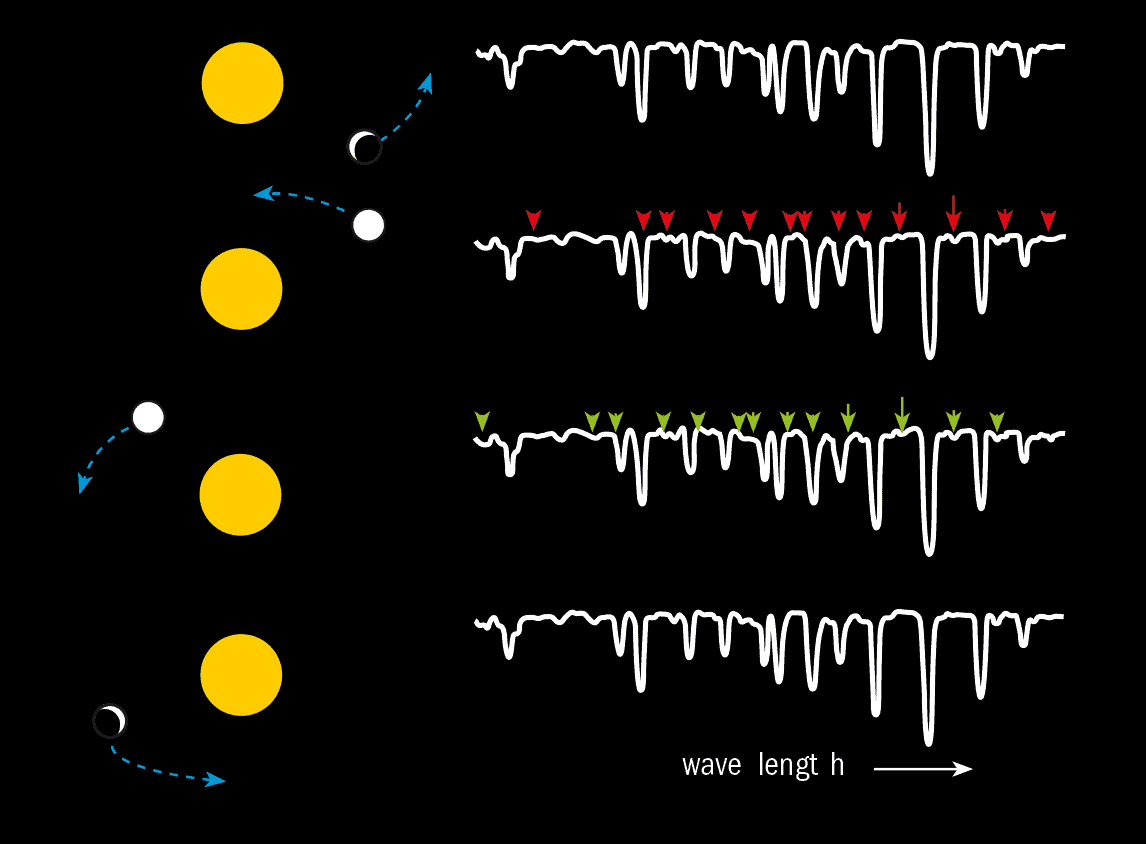
Each team developed sophisticated data-analysis methods to disentangle the faint signature of the reflected starlight from that of the parent star (figure 6). The spectrum of the reflected light should contain copies of the thousands of narrow absorption lines produced by heavy elements in the star’s atmosphere. As the planet orbits the star, any light reflected from the planet towards the observer is Doppler-shifted by the planet’s orbital motion, so we expect to see a faint echo of the star’s absorption lines moving periodically back and forth with the planet’s orbital speed of 150 km s–1. At the same time, the strength of the reflected signature rises and falls with the changing illumination of the planet by the star. The planet is brightest when it is on the far side of the star with its illuminated hemisphere facing towards us, but invisible when it is between us and the star.
6 Reflections from another planet Light reflected by the planet’s atmosphere will contain copies of all the narrow absorption lines caused by trace elements in the star’s atmosphere. The planet’s orbital motion Doppler-shifts the reflected light away from the corresponding absorption lines in the direct starlight to wavelengths indicated by the red and green arrows. The length of the arrows denotes the relative strength of the shifted absorption lines. The reflected-light signal is only appreciable when the planet is on the far side of its orbit, with its illuminated face turned towards us. The reflected spectral lines then drift steadily from longer to shorter wavelengths as the planet passes behind the star. The planetary features shown in the simulated spectra here are exaggerated by a factor of about 3000.
Both groups independently developed methods for subtracting out a model of the direct starlight. We then searched deep in the resulting noise for statistical evidence that the known pattern of lines was wobbling back and forth while changing in brightness at a tempo dictated by the stellar-wobble measurements made by Marcy, Butler and co-workers.
If the orbit is tilted significantly to the line of sight, the component of the planet’s velocity toward the observer is lower, and the brightness variations are less pronounced. Asa result, we had to search for signatures over a plausible range of orbital tilts. Charbonneau and Noyes did not detect a measurable signal during three nights of observations at Keck. Instead, they established that the planet had to be at least 10,000 times fainter than the star if its illuminated hemisphere could be viewed face on.
Our observations in April 1998, and in April and May 1999, produced a weak but plausible signal that was about 30% brighter than Charbonneau’s upper limit. The result was controversial. It was hard to reconcile with the Harvard team’s results, and implied that if the planet had a Jupiter-like reflectivity, its radius had to be nearly twice as large as Jupiter’s. We estimated at the time that there was roughly a 5% possibility that a chance alignment of noise in our data could produce a spurious detection of this strength. In March, April and May 2000 we observed tau Boo for a further six nights, carefully targeting those points in the orbit at which the reflected-light signature would be strongest and the absorption lines in the reflected light would be Doppler-shifted well away from the direct starlight. This strategy allowed us to probe much more sensitively for reflected light coming from a planet in the orbit suggested by our earlier measurement. However, the new observations – when combined with the 1998 and 1999 data – indicated that our earlier result had been spurious.
Nevertheless, our findings provided a new insight into the exoplanet’s atmosphere. If the planet reflects light between 385 and 580 nm uniformly, it has to be at least 30,000 times fainter than the star. This means that if the planet’s radius is 20% greater man Jupiter’s – as the models of Burrows’ group predict – its atmosphere must be less than 40% as reflective as Jupiter. This is well below the reflectivity predicted for a high-altitude silicate cloud deck, and suggests that tau Boo’s planet may well have a deep cloud deck with an overlying stealth coating of sodium gas.
Next steps
Our efforts are currently devoted to the innermost of the three planets that orbit the Sun-like star upsilon Andromedae. This planet appears to be 10 times lighter than tau Boo’s planet, so it has a much lower surface gravity and a more distended atmosphere. The most recent models of cloud formation for planets near their stars suggest that the silicate cloud deck may form higher in the atmospheres of planets with low surface gravities. If there is less sodium above the clouds, this planet could be very much more reflective than the planet orbiting tau Boo. We went back to the William Herschel Telescope in October and November last year to search for starlight reflected from the planet closest to upsilon Andromedae using the same techniques we developed for tau Boo, and we are currently analysing the data.
Several groups worldwide also observed HD 209458 last summer, hoping to detect the faint spectral signature of sodium in its atmosphere at the times when the planet passes between us and the star. Rather than look for light reflected from the planet’s atmosphere, this method involves searching for evidence that light passing through the planet’s atmosphere has been absorbed at the wavelengths of the sodium lines. HD 209458 has a similar mass and surface gravity to the planet around upsilon Andromedae that we are studying. If no-one succeeds in detecting mis absorption, it will mean that the amount of sodium above the cloud deck is relatively small. This would augur well for a direct detection in upsilon Andromedae, so exoplanetary astronomers await these results with keen anticipation.
Ultimately, the holy grail for planet-hunters is an Earth-like planet orbiting another star. Several programmes that have the potential to detect such planets are just beginning. The first of these involves searching for the faint dips in light that would occur as an Earth-like planet passes between us and its parent star. Earth-like planets, however, are 10 times smaller in radius – and therefore 100 times smaller in area – than Jupiter-like objects. So astronomers have to be able to detect a dip that is only one part in 10,000 of the total light from the star. This accuracy is difficult to achieve from the Earth’s surface because of turbulence and the variable transparency of the Earth’s atmosphere. However, several space missions have been proposed that would be capable of making such precise measurements.
The likelihood of an Earth-like planet’s orbit being oriented so that we can see it cross in front of its star is very low (about 1 in 200), so these missions will have to survey hundreds or thousands of stars to have a reasonable chance of success. This is true even if half or more of all Sun-like stars possess Earth-sized planets at Earth-like distances.
In autumn last year, planet-hunters were delighted to learn that one of these missions – named Eddington in honour of the great early 20th century astrophysicist Sir Arthur Eddington – has been selected as a reserve for one of the European Space Agency’s (ESA) so-called flexi-missions to fly within the next decade.
7 Gravitational lensing Light from a distant star in the Galactic Bulge is bent around a star in the foreground in such a way as to form two images. The summed area of these images is greater than normal, so the starlight is amplified. If the alignment is perfect, the light of the background star will pass around the lensing star to form an “Einstein ring”. A planet orbiting the foreground star and located near its Einstein ring will give a second amplification event.
Another more bizarre search technique uses the gravitational bending of light around a star to detect planets. If we look towards the densely packed star clouds at the centre of our galaxy, we find that at any given time, one star in a million has its light amplified by this “gravitational microlensing” effect, as a star (usually a faint red dwarf) passes in front of it (figure 7). The background star appears to grow brighter then fade over a few weeks. If the star in the foreground has a Jupiter-like planet, there is about a 20% chance that a second, briefer amplification will occur as planet passes across our line of sight. That probability falls to about 2% if the planet is Earth-like.
The duration of such a secondary lensing event tells us the mass of the planet. For a Jupiter-like planet it would last about a day, whereas for an Earth-like object it would last about an hour. Several groups are already monitoring micro-lensing events as intensively as existing telescopes permit. At the International Astronomical Union’s general assembly in Manchester last summer, Penny Sackett of the Kapteyn Institute in Groningen, the Netherlands, announced that the very fact that none of these groups has seen such an event yet suggests that less than 30% of red dwarfs possess Jupiter-like planets in Jupiter-like orbits.
Other groups are planning to build a global network of automated telescopes, capable of doing the intensive brightness monitoring without the need for human intervention. Although astronomers only get one shot at each planet by this method, it could provide a good census of just how common Earth- and Jupiter-like planets may be around other stars that are less massive than the Sun.
The search for extraterrestrial fife
If these relatively cheap methods produce evidence that Earth-like planets are reasonably common around solar-type stars, then the incentive to study them in detail will be over-whelming. Both NASA and ESA are looking at the possibility of using networks of infrared telescopes in space to image and obtain spectra of Earth-like planets orbiting stars up to 30 light-years away.
These two missions – known as Terrestrial Planet Finder (TPF) and Darwin – have similar aims. Both propose combining the starlight collected by four or five telescopes flying in formation about 100 metres apart to form an interference pattern. The telescopes will be positioned so that the crests and troughs of the wave trains coming from the central star via the different telescopes cancel each other out. This will allow astronomers to detect and study the light from any Earth-like planets, unobscured by the glare of the parent star.
If planets are detected, astronomers will be able to search for the thumbprints of gases like water, carbon dioxide and ozone in their infrared spectra. The presence of water would suggest a relatively benign environment for life, but finding ozone would be a clincher. Ozone – and by implication, oxygen – should not be present in a planetary atmosphere unless some mechanism is constantly renewing the supply of this highly reactive gas. On Earth, the name we give to this mechanism is “life”.
But TPF and Darwin will not be cheap. They will be the most technically challenging space-science missions either agency has ever attempted. NASA and ESA will probably combine the Terrestrial Planet Finder and Darwin to keep the price within their “large missions” budget. The anticipated launch date for Darwin/TPF is around 2014, so we are uniquely privileged to be living at a time when there is a realistic prospect of seeing such a long-standing and fundamental question answered within our lifetimes.
D’oh! Lisa, Marge, Hawking and Homer (Credit: Fox TV/Sky One)
Until recently I was surely the only person who hadn’t seen The Simpsons, the cartoon series about a dysfunctional family that is the longest-running animated series of all time and a classic of American popular culture. Then I heard that Stephen Hawking had made a cameo appearance in one episode, declared it “one of the cleverest shows on television” and said “it always has a moral”.
That endorsement by the world’s best-recognized living scientist intrigued me. What could Hawking have found in a show that is said to parody science, nuclear safety and intelligence in general? Had the brilliant physicist talked glibly to reporters, or was he just out of his element in the intricacies of popular culture? I borrowed some tapes to find out.
Succeeding despite idiocy
I saw the “clever”, certainly. The most visible landmark in Springfield, the setting for the cartoon, is a nuclear-power plant. The plant is disaster-prone – regularly plagued by improbable events, dumb luck and human bungling. Homer Simpson, the safety inspector, pushes the wrong buttons, sleeps through alarms and almost causes core meltdowns. So why hasn’t the Springfield reactor Chernobyl-ed long ago?
The reason is that the plant is also regularly protected by improbable events, dumb luck and human bungling. In one episode, seconds before a core meltdown, with alarm klaxons blaring, Homer is helpless, having completely forgotten his training. He plays “eenie, meenie, miney, moe” with the controls, covers his eyes and pushes a button. It’s the right one. Plant and town are saved, and “pulling a Homer” becomes a new expression meaning “to succeed despite idiocy”.
Any serious application of intelligence gets like treatment. In “They saved Lisa’s brain”, the episode in which Hawking features, a council of high-IQ MENSA members takes over Springfield’s governance, determined to use “the power of good ideas to change things for the better”. The effort quickly collapses. Enter Hawking. Introduced as “the world’s smartest man”, his character is pompous, spouts clichés, steals an idea from Homer (that the universe is toroidal), and mishandles his wheelchair.
In another episode, the zoologist Stephen Jay Gould is asked to debunk a purported angel fossil. Homer’s religious next-door neighbour is outraged. “Science is like a blabbermouth who ruins a movie by telling how it ends,” he says. “I say there are some things we don’t want to know! Important things!” And the residents rush off to demolish the town’s scientific institutions. The angel, however, turns out to be a hoax, planted in a scheme to advertise the opening of a new shopping mall.
Science, woo!
Science in The Simpsons is not alone in being singled out for mockery but is instead woven into the satiric fabric as just another source of improbable events, dumb luck and human bungling. Science permeates the world of the Springfield residents, but their decisions are shaped not by rationality but by habit, ignorance and laziness. Minor advances in science can have monumental if momentary impacts, for example when Homer takes some Rogaine anti-baldness treatment and immediately becomes an executive of the plant because he now has hair.
If Springfield’s residents can relate to science at all, it is at the level of relating to a cartoon character or baseball game. Once, when pressed to name a scientist, Homer replies: “Batman”. Another time, Homer’s son Bart, voicing the maximum enthusiasm he can give anything, shouts out, “Hurrah for science. Woo!”
The very idea of a “moral” – an authoritative message – seems antithetical to the show’s lighthearted, funny spirit and the way it punctures all pretence to authority. For this reason my colleagues would say it has a post-modern sensibility, but I wouldn’t go there myself, because that is precisely to adopt the kind of wannabe authoritative stance that the show parodies.
What The Simpsons has to say about science is encapsulated in the “Bart’s comet” episode. As punishment for mocking his school’s science week, Bart has to help in an exacting and laborious comet search. When the school principal is momentarily distracted, Bart malevolently spins the telescope like a roulette wheel, spots a comet and calls the observatory, which names it the Bart Simpson Comet. However, the comet is heading directly for Springfield. Scientists build a rocket to intercept the comet and blow it up.
As you’ve guessed, the rocket misses and instead blows up the only bridge out of town. Most of Springfield’s inhabitants squeeze into a bomb shelter, but leave at the last minute so that they can all die together. This, too, fails because the comet disintegrates in the atmospheric pollution hanging over the town. “I can’t believe that extra-thick layer of pollution that I’ve actually picketed against is what burned up the comet,” says Bart’s sister Lisa. The one fragment of the comet to make it through hits the bomb shelter where they had huddled for safety moments before. Someone then says: “Let’s go burn down the observatory so this will never happen again!” A newscaster describes the ethos of the inhabitants: “Never give up and never think things out.”
The critical point
Could Hawking really have found an acceptable credo here? Quite possibly. Life – and maybe Hawking was thinking “science” – offers us a constant sequence of false alternatives. When we grab one choice, and find that it inevitably founders, new possibilities emerge and we are spared the worst. Chance is not the awful terrorism dreaded by the rationalists presented by Einstein’s dice-playing God. Improbable events, dumb luck and human bungling sabotage us but they also help us to muddle through, however comic this process may look to outsiders. The things in heaven and Earth work far more perversely than dreamed of by our science and philosophy. We pull Homers and go on. Life (and science) is resilient.
Could this be what the wise Hawking saw all along?
The Simpsons can be seen on Sky One weeknights at 7.00 p.m. GMT
You are paid while you train, you get a lump sum after one year on the job, and you can apply for fast-track promotion, a free laptop computer and double the normal pay increases. On the face of it, it seems an attractive deal. But as yet more goodies are thrown into the package to recruit would-be science teachers in the UK, physics students seem even less keen to enter the classroom than in previous years.
Recent figures show that just 205 graduates in England and Wales had registered on teacher-training courses by the end of September 2000, compared with 238 in 1999. This drop is part of a dramatic downward trend. In 1993, for example, 568 people registered on graduate teacher-training (PGCE) courses.
The effect of this sustained shortfall is compounded by the number of experienced staff expected to leave the profession over the next decade. A disproportionately high number of physics teachers are aged over 50, and one quarter are expected to retire by 2010. In addition, increasing paperwork, growing class sizes, low morale and the stress from teaching-standards inspectors have all been cited as reasons for quitting the classroom by qualified teachers across the board.
Teaching by example
As specialist physics teachers leave the profession, their places are increasingly likely to be filled by graduates from other sciences. Last year four times as many biology graduates as physics graduates opted to train as science teachers. Physics will therefore be taught more and more by graduates less familiar with the subject.
But good teachers can make all the difference. “My teaching at A-level was very influential in my decision to pursue physics,” says Will Marshall, who recently started a PhD in physics at Oxford University. “I had two teachers, one who was quite good and stuck very much to the syllabus. The other didn’t teach us much of the syllabus but did something that I consider to have been much more crucial; he showed us why you might want to study physics.”
So fewer specialist physics teachers could mean that even fewer pupils will be persuaded to take up physics beyond the age of 16. The shortage in teachers could then be self-perpetuating, as fewer physics graduates will mean a smaller pool of teacher trainees. “I started off wanting to do maths, but didn’t have a very good maths teacher,” says Claire Blay, who trained to teach during her four-year physics degree at Bath University. “The two physics teachers that I had were wonderful. They definitely made me feel that I wanted to go on and inspire others.”
Competitive job market
PGCE students registering on courses in England and Wales at the start of this academic year were offered a £6000 training salary. Those specializing in physics will receive an additional £4000 at the start of their second year in school employment. Evidence suggests that PGCE students welcomed the money, but hopes that the cash would significantly widen recruitment have not been realized. Indeed, many PGCE students and newly qualified science teachers have already become disillusioned on discovering that their £4000 bonus will be taxed.
A degree in physics is highly prized by employers at present, and students know that they can afford to pick and choose. With numerate, technically literate graduates much in demand by high-tech companies and banks, perhaps it is not surprising that many opt for careers in which their efforts are not only recognized, but also rewarded with attractive starting salaries and benefits packages.
“If you are in the graduate market, you need to pay the graduate rate,” says Brenda Jennison, a lecturer in physics education at Cambridge University. Jennison would like to see the training salary doubled, so that PGCE students are paid the equivalent of a graduate starting salary. She also believes that the government should write off trainee teachers’ outstanding student loans. “Young teachers don’t want to start in debt. At the end of a four-year physics course, they could owe up to £20 000,” she says.
However, money is not the only factor turning graduates away from teaching. “Methods like the ‘golden hello’ are, in the end, just token gestures,” says Alex King, a PhD cosmology student at Imperial College London who is not planning a teaching career. “What’s needed is to change the whole image of teaching as an occupation. A bit of extra cash won’t sway people.”
Margaret Sharp, senior researcher at the Science Policy Research Unit at Sussex University, is concerned about the detrimental knock-on effects that the shortage of specialist physics teachers could have in the future. If fewer teenagers choose to take A-level physics and more students opt for combined science degrees, fewer candidates will go on to take up PhDs and post-doctoral research work in physics. Sharp believes that this inevitable reduction in numerate, technically literate graduates could harm the country’s capacity for cutting-edge research and development.
Targeting older applicants
In common with many educators, Sharp would prefer to address the problem in the short term by targeting support and resources towards a broader selection of potential applicants. “We have got to declare a crisis in science teaching as a whole and try to recruit a large number of middle-aged changers or returners with degrees but no teaching experience and put them on fast-track training to get into the classroom,” she says. “In the aftermath of the Second World War, they trained a whole lot of teachers in this way and they proved to be some of the best teachers the system had. It might be worth trying the trick again.”
Efforts to enlist older applicants are already underway with a scheme that allows people over 24 to train while employed as teaching assistants. From September 2000, schools taking on non-qualified graduates have been invited to apply for grants of up to £13 000 to cover their trainees’ salaries. An additional £4000 per candidate is available from the Teacher Training Agency (TTA) to cover the year’s training and final assessment. Applicants who have completed two years of higher education can take advantage of the scheme too, so long as they can find a school willing to fund their salary for the extended two-year training period and can complete a degree at the same time.
On-the-job training programmes may ease the problems older teaching recruits can face in persuading schools to hire them, by allowing individuals to prove their worth in situ. “Too many mature entrants train and then find difficulty in securing teaching posts or even getting shortlisted for interview,” says Catherine Wilson, education manager at the Institute of Physics. “More readily accessible advice is needed for potential mature entrants on how they might set up taster visits to schools, or set up regular school visits over time.”
Phil Scott, senior lecturer in education at Leeds University, shares the view that more effort should be put into attracting mature applicants back into the classroom. Experience has convinced him that there is a limit to student uptake. Leeds is one of five universities that have taken part in a scheme of lunch-time presentations, organized in conjunction with the Association for Science Education, to answer students’ questions about teaching physics. Attendance at the presentations was disappointing, and most of those who came along had already planned to apply for PGCE courses. “Only a small minority of physics students wants to end up as teachers. You could pay them as much as you like. If they don’t want to do it, they don’t want to do it,” says Scott.
“Young graduates don’t see teaching as an attractive lifestyle,” says Jennison. There are always some who will enjoy and thrive from it, but beginners at 21 don’t like the look of the it. It is the widespread image of long hours, lack of respect, after-hours marking, and lessons spent controlling 30 inattentive and boisterous teenagers in a closed classroom environment that is dissuading current physics students from considering teaching as a career.
Taster sessions designed to enthuse graduates often confirm their suspicion that crowd control is as much a part of teaching secondary science as tuition. Older applicants who have sampled the fast lane, may be better suited to handling the responsibility. “I think that there is quite a market for the 30 to 35 year old, who is burned out from the City,” says Jennison. Once the excitement of trading in technology stocks fades and the promise of e-commerce wears thin, physics graduates may then be ready to take on the classroom challenge.
Zhang and colleagues found that the filaments – which are several centimetres long – have two distinct stable states depending on their length. Below a certain threshold the filament stretches out straight, in line with the fluid flow. Even when the researchers nudge the filament to encourage it to flap, it quickly returns to the stable ‘stretched-out’ state. But above this critical length, a sufficiently large disturbance causes the filament to jump to a stable flapping state. This state is quite robust and persists even after attempts to disturb it. “This refutes the common belief that a flag always flaps in the wind”, Zhang told PhysicsWeb. “Here we see two stable states under the same conditions. It was quite surprise to us.” Zhang’s team compares the two states to swimming: the stretched-out phase is analogous to a swimmer gliding through water and the flapping state corresponds to the swimmer using the oscillations of their body to propel themself through the water.
In the straight configuration, the filament produces a train of vortices – alternating between clockwise and anti-clockwise – that trail from its free end. Zhang’s team noticed that the shape of this train changes dramatically when the filament is in its stable flapping state – and that adjacent vortices tend to rotate in the same direction.
If the filament is very long, the stable stretched-out state disappears, leaving only the stable flapping state, but this behaviour remains mysterious. At these lengths, only the end of the filament oscillates. Zhang’s team believes that this effect, in common with the other phenomena, arise from the tension, mass and elasticity of the filament – features usually overlooked in fluid dynamics – together with the interaction between the filament and the fluid flow. “On the one hand, this is one of the simplest experiments I have ever done”, said Zhang, “but on the other hand, it is one of the most complex phenomena in hydrodynamics”.
Using data from the Chandra satellite, the young scientists pinpointed an X-ray source in the supernova remnant known as IC443 and asked the National Radio Astronomy Laboratory for data from the VLA to back up their find. The radiowave data confirmed that a point-like source exists in the remnant, supporting the team’s suspicion that the object is a pulsar. Their theory was confirmed when they found a cloud of high-energy electrons surrounding the radiation source – a characteristic of pulsars. “This is a really solid scientific finding”, said Bryan Gaensler of the Massachusetts Institute of Technology, an astrophysicist who reviewed the paper for the students. “Everyone involved can be really proud of this accomplishment.”
“The experience of doing new and relevant science has been one of the most rewarding experiences I have ever had”, said Olbert. “I never expected to publish a scientific paper while I was still in high school.” The students’ science teacher had applied for observation time while he was associated with NASA’s Goddard Space Flight Center.
Earlier studies used simplistic models that assume human cells are spherical. But many cells – for example, muscular and red blood cells – are not spherical. Sebastián’s team therefore developed a more sophisticated model that accounts for cells that are shaped like rods, cylinders and rugby balls. “If we are to understand the biological effects of electromagnetic radiation, it is essential we consider the combined effects of shape and cell interaction”, says Sebastián. The researchers investigated the effects of radiation from 900 to 2450 MHz – the range we are exposed to by mobile phones, microwave ovens, and police and air-traffic radar.
Sebastián and co-workers found that the electric fields in ellipsoidal and cylindrical cells were higher than those observed in the simulations of spherical cells. They also noticed that polarizing effects in cells aligned with the electric field reinforce the field in the cell wall. A further refinement that included the effects of water bound within the cell wall showed that, for all cell shapes, the electric field was higher than simpler models predicted.
The current study was performed at a microscopic level, however, and research into the effects of mobile phones are usually based on whole biological structures. “It would be possible to consider a tissue as an aggregate of cells, but I think that a realistic simulation of the electric field would be almost impossible”, Sebastián told PhysicsWeb. “But our research could provide better information on radiation exposure effects and possibly establish lower acceptable levels for radiation from mobile phones”.
The JIF scheme was set up in 1998 by the UK government and the Wellcome Trust – the world’s largest biomedical research charity – to provide much-needed funding for university laboratory facilities. The £125m divided out among 28 research projects in this latest round brings the total money awarded so far under the scheme to £729m.
Cambridge’s fluid dynamics laboratory will be used to model phenomena such as turbulence and volcanic eruptions. It will be part of a new site on the outskirts of the city that will house the university’s maths and theoretical physics departments. Cambridge University’s other successful project in this round will develop instruments for the astronomy facilities, such as the Attacama Large Millimetre Array. It will also design and build high-frequency detectors for applications in medical imaging, biochemistry and remote sensing.
Richard Nelmes of Edinburgh University, says he is ‘very excited’ at being awarded JIF money to establish a centre for research into science at extreme conditions, having bid for £7m. “The money will help to secure the future of extreme conditions research in the UK”, he adds. The successful bid will allow a new wing to be built onto Edinburgh’s physics department. The new centre will provide a focus for a multi-disciplinary effort in science at extremes of pressure, temperature, and electromagnetic and mechanical excitation, for research that encompasses chemistry, biology, earth and planetary science, and engineering as well as physics.
The laboratory at Cardiff will create instruments for studying the cosmic microwave background. The Durham Centre for Fundamental Physics will combine the Institute of Particle Physics Phenomenology and the Institute for Advanced Astronomical Computing. The new centre will bridge the gap between theoretical and experimental particle physics and it is hoped that combining the two organizations under one roof will stimulate interdisciplinary research and provide a computing base for the UK physics community.
The rest of the JIF money will be allocated next year. Infrastructure funds will then come from the recently announced Science Research Investment Fund, which will involve the government investing £325m in 2002/3 and £450m the following year and the Wellcome Trust providing £225m for biomedical research. This fund will not involve open competition between rival bids. Money will instead be allocated depending on the quality and quantity of research at the host institution.
Researchers at the laboratory first created a superconducting tape five years ago. They used a process known as Ion Beam Assisted Deposition (IBAD) to create a film of the ceramic superconductor yttrium barium copper oxide onto a buffer layer of zirconia sitting on a base of nickel alloy tape. The buffer layer stops the superconductor reacting with the nickel tape and encourages the superconductor grains to lie flat and close together, increasing the current flow. In the IBAD process, an argon ion beam removes material from a zirconia source and deposits it on the nickel tape. A second beam then aligns the zirconia grains in preparation for deposition of the superconducting layer, which can be 1 – 6 µm thick.
But the team has recently found that a magnesium oxide buffer layer a hundred times thinner aligns the superconductor grains just as well as the zirconia layer. “This difference means we can manufacture a metre of tape in under a minute instead of the several hours it took with the thicker zirconia layer”, Peterson told PhysicsWeb. “This clearly has a knock-on effect on the cost, making it more commercially attractive.” The Los Alamos laboratory has teamed up with American Superconductor Corporation, 3M Corporation and Intermagnetics General Corporation to speed up commercial development of the process. The world market for superconducting tape in electrical power technologies is estimated to be worth up to $50bn by 2020.
Pulsars are rotating neutron stars that emit radiation, which is seen from Earth as a series of highly regular pulses. Anomalous x-ray pulsars (AXPs) are not, however, powered like most pulsars. AXPs do not appear to have companion stars from which they can gather material and energy to transform into x-ray emissions, and their x-ray output cannot be explained by a loss of rotational energy as they slow down. That leaves two possibilities. An AXP could gain energy by collecting matter from the accretion disc created by the supernova from which it was born. X-rays emitted by the AXP would be absorbed by the accretion disc and re-emitted as visible light. Alternatively, AXPs could be powered by the intense magnetic field of a neighbouring magnetar – a neutron star with a magnetic field around 1015 times greater than that of the Earth.
The Dutch-American group observed the visible light from an AXP labelled 4U0142+61 – the brightest AXP, in terms of x-ray emission – using the Keck telescopes on Mauna Kea in Hawaii. They found a faint star-like object at the same location as the x-ray source – it appears to be in the same place because the resolution of the telescope is not high enough to separate the AXP and any companion.
Van Kerkwijk and co-workers believe that the object is a magnetar because it is too faint to be an accretion disc and too small to be an ordinary star. Further analyses of the emission spectra ruled out the possibilities of a compact binary system and a companion hot white dwarf. If the object is a magnetar, its powerful magnetic field could easily fuel the AXP. “We believe the x-ray emission we are seeing is due to the decay of the magnetar’s very strong magnetic field”, van Kerkwijk told PhysicsWeb. “The magnetic field needs to be much stronger than the field of an ordinary neutron star to produce x-rays at all, but also to initiate the processes that cause the field to decay in the first place”.