One of the key questions in planetary science is whether the early climate of Mars was warm enough for liquid water – and hence extraterrestrial life – to exist. The layered rocks, thought to be around 4000 million years old, are deposited horizontally and appear to consist of fine-grained material. Sedimentary rocks can be created in several ways – by wind, water, volcanoes, or even meteorite impact – but many of the newly discovered outcrops are in ravines or basins in the planet’s crust, suggesting that the Martian surface was once dotted with lakes. “Some of the images show hundreds of identically thick layers, which is almost impossible to have without water”, says Malin. The researchers have not established the origin of the sedimentary matter and believe that clues to where the matter came from have been eroded over time.
But Malin and Edgett have still not ruled out an alternative theory. It is possible that dramatic changes in atmospheric pressure – altering the composition of the atmosphere and therefore its ability to carry dust – might have caused rock layers to form.
The photographs were taken by the Mars Orbiter Camera on board the Mars Global Surveyor, which was commissioned to follow up Mariner and Viking data collected in the 1960s.
Carbon-60 is in a class of organic materials known as fullerenes, which are insulators. Scientists first generated superconductivity – current flow without resistance below a certain ‘transition temperature’ – in carbon-60 ten years ago. They doped the material with alkali metal ions, which donate its electrons and makes the carbon-60 conducting. But electron doping led to a maximum transition temperature of only 40 K. Researchers believed that adding positive charges, known as positive holes, to carbon-60 might lead to a higher transition temperature. But carbon-60 is very electronegative – that is, it strongly repels positive charges – and this makes it very difficult to add positive holes by conventional doping.
Batlogg and co-workers overcame the problem with a completely different method. They deposited electrodes onto a carbon-60 crystal to form a field-effect transistor, and applied a voltage across it that forced positive holes into the crystal. The team found that the transition temperature varied smoothly with changing voltage, peaking at 54 K.
The superconducting behaviour of hole-doped carbon-60 is expected to be similar to that in electron-doped carbon-60. In electron-doped carbon-60, the addition of alkali metal ions stretches the crystal lattice and makes the transition temperature rise. Batlogg’s team predicts that the transition temperature could reach 100 K if they can add impurities to the hole-doped carbon-60.
The phenomenon observed by Batlogg’s team has much in common with early superconductivity observations. Superconductivity in carbon-60 is thought to originate from interactions between electrons and lattice vibrations known as phonons – this mechanism was proposed in 1957 by Bardeen, Cooper and Schrieffer. This is fundamentally different to the process that takes place in modern copper-oxide-based superconductors, which relies on interactions between only electrons.
There is one central quandary to 21st-century physics. It is that the two main pillars of 20th-century physics – quantum mechanics and Einstein’s general theory of relativity – are mutually incompatible. On the sub-atomic scale, Einstein’s view of gravity fails to comply with the quantum rules that govern the elementary particles, while on the cosmic scale, black holes are threatening the very foundations of quantum mechanics. “Quantum gravity” is the name we give to the solution to this problem, but the way to achieve it and the question of whether such a solution even exists are the subjects of hot debate. Three Roads to Quantum Gravity by Lee Smolin is a layperson’s guide to the different routes on which today’s theorists are currently embarked.
Smolin has himself worked in the field of quantum gravity for the last 25 years, but it is fair to say that his ideas have always remained outside the mainstream. This book is no exception. Indeed, the “true heroes of this story” are not the names that most practitioners would have chosen, such as Ed Witten or Stephen Hawking, but rather other mavericks such as Alain Connes, David Finkelstein, Chris Isham, Roger Penrose and Raphael Sorkin.
So the reader should be aware that Smolin’s views are highly idiosyncratic and are by no means representative of current thinking. This said, the book is written in the same lively, anecdotal and readable style that those familiar with his previous book, The Life of the Cosmos, will have come to expect (see “Holes in a final theory?” Physics World December 1997 pp39-40).
The first of the three roads that Smolin identifies is superstring theory and its successor, M-theory. According to superstring theory, the fundamental building blocks of nature are not point-like elementary particles, but tiny one-dimensional strings that live in a universe with one time dimension and nine space dimensions. Just like violin strings, these relativistic strings can vibrate, with each mode of vibration representing a different elementary particle. Most importantly, these stringy particles include gravitons, the hypothetical carriers of the gravitational force.
Indeed, superstrings satisfy one of the main requirements of a consistent quantum gravity: we can calculate the probability of transitions from one quantum state to another involving gravitons without encountering the infinities and anomalies that have plagued all previous attempts based on applying ordinary quantum field theory to Einstein’s general relativity. Superstrings nevertheless subsume Einstein’s theory, in that it is recovered in the limit where the energy of the gravitons is sufficiently small. Moreover, the superstring equations admit solutions for which six of the nine dimensions are curled up to an unobservably small size so that the theory is compatible with our everyday experience of a world with only three space dimensions.
Unfortunately, there is not one but five mathematically consistent superstring theories, each competing for the title of the “theory of everything”; clearly an embarrassment of riches. This problem is cured by M-theory, a unique all-embracing theory that subsumes the five superstring theories by requiring eleven space-time dimensions and incorporating higher-dimensional extended objects called membranes.
Among the achievements of M-theory is the first microscopic explanation for the entropy of a black hole, first predicted in the 1970s by Stephen Hawking using macroscopic arguments. There is a cautionary tale here. In the years between the superstring revolution of 1984 and the M-theory revolution of 1995, the mavericks who advocated eleven dimensions and membranes were scoffed at by the orthodox superstring theorists. So perhaps we should be more tolerant of Smolin’s version of unorthodox speculations – although some of them, such as the formation of new universes inside black holes, will take some swallowing.
The second road Smolin describes is “loop” quantum gravity, the road that he himself walked for many years (see “The new universe around the next corner” by Lee Smolin Physics World December 1999 pp79-84). According to this picture, if we were to probe space-time at very small length scales, we would discover that it is not the smooth Riemannian geometry of general relativity but quantized in tiny discrete volumes. The theory grew out of an idea in quantum chromodynamics (QCD), the accepted theory of the strong nuclear force.
In a version of QCD due to Kenneth Wilson, the fundamental entities are not fields but loops. Smolin and others attempted a Wilson-loop description of gravity. Their motivation was to get away from the idea of fundamental quantum processes taking place in a fixed-background space-time and allow the space-time to be part of the quantum dynamics.
Critics of this approach will argue that although there is nothing wrong with Wilson loops as a calculational technique, it must be applied to the right equations if it is to get anywhere. And although QCD no doubt provides the right equations of the nuclear force, the right theory of quantum gravity has to go beyond the 1916 Einstein equations upon which loop quantum gravity is based. Perhaps not surprisingly, Smolin’s attitude is more forgiving, and he advocates a synthesis of these ideas and string theory.
The third road, trod only by the heroes, involves “wrestling with the fundamental principles” and questioning the foundations of thought and even of mathematical logic.
There is always a danger when following this road that it can easily become so nebulous as to invite the famous put-down of Wolfgang Pauli: it is not even wrong. To say that the final theory will be completely different from what we have now, with concepts we have not yet even dreamed of, is an empty truism. Much more can be learned from a concrete proposal, however flawed, than from a sterile contemplation of the quantum-gravity navel. Smolin is not one to heed such warnings, however. The more he can feel that his musings are “deep”, “profound” and “philosophical”, the happier he is.
Read this book. You will be informed, provoked and sometimes irritated – but always amused.
Under threat – fusion energy is just one scientific challenge requiring public support if it is to succeed.
One hundred years ago the mathematician David Hilbert compiled a list of his field’s great unsolved problems. A century later, drawing up such lists has again become popular – even Physics World carried out a millennium survey last year and published articles on the ten “outstanding challenges” in physics (December 1999). Meanwhile a group of theoretical physicists drew up a list of ten millennium questions that included the lifetime of the proton, the cosmological constant and the supersymmetric nature of the universe (see feynman.physics.lsa.umich.edu/strings2000/millennium.html). Answering any one of these challenges would require a huge project that would consume enormous amounts of resources. The authors of these and other lists cheerfully seem to assume that society eventually will. I’m not so sure.
A recent article by Roel Snieder in Nature (2000 406 939) compared scientific communities to the colonies of tube worms that live on the ocean floor and clustered around hydrothermal vents that supply them with nutrients. Like the tube worms, the author wrote, scientists “are completely reliant on the stability of their habitat”. However, as scientific projects have grown in scale, expense and visibility, they can sometimes overtax, or are perceived as environmental threats to, their habitats. Key scientific facilities, including the Advanced Neutron Source and the Superconducting Super Collider in the US, have been cancelled in the planning or construction stages in recent years.
Such habitat disruptions are usually blamed on villains such as schools, the media and politicians. However, the behaviour of these players merely reflects deeper habitat fluctuations. Not only are the fluctuations likely to continue, but they are also likely to grow worse as demands on the habitats increase. Are scientific projects poised to run up against a natural limit, or is some co-evolution or reintegration of projects and habitats possible?
Millennium questions: science and society
I propose another millennium list: ten questions that must be answered for such co-evolution to be possible. The bigger and more expensive scientific projects grow, the more they will tax the habitat, the more its stability matters and the more important these questions become.
1. How is trust generated, perpetuated, disrupted and recovered?
Trust is of increasing importance in contemporary science. Rarely a concern for university-based scientific projects before the Second World War, trust is now critical in planning any large-scale scientific undertaking and is an ongoing concern for any scientific institution. Several episodes in the past 50 years have generated public distrust in connection with scientific research, including the infamous Tuskegee study of the course of untreated syphilis in African-American males, as well as cover-ups of toxic chemical and radiation spills. This distrust has then adversely affected socially valuable and morally justifiable research.
2. How can we avoid building environmental Maginot lines?
Environmental risks often come to political attention only in response to specific real or manufactured crises. This piecemeal approach can result in significant resources being targeted for minor or even non-existent environmental hazards (such as background-level radiation and electromagnetic fields). It can end up building, as it were, a series of environmental Maginot lines. This is harmful because it squanders resources on the wrong places, lulls people into a false sense of security, is vulnerable to political manipulation and contributes negligibly to the wider social purpose – public safety – that is the ostensible goal. A society that addresses risk this way endangers not only science but also itself.
3. How can reliance on expertise be reconciled with democratic pluralism?
Expertise is crucial for a society that depends on science and technology. However, the authority conferred on an expert seems to collide with the democratic, anti-elitist urge to accord equality to all opinions. How can the need for expertise in a society dependent on science and technology be reconciled with democratic pluralism?
4. How can science be presented in the media?
The media is like a prism, systematically distorting what passes through it while giving the illusion of transparency. Its behaviour, although not immutable, is so deeply ingrained and reinforced by other factors that it would be as pointless to blame the media or look for it to change as it would be to curse a prism for its distortions or to hope for alterations in the laws of optics. What other possibilities are there for presenting science in the media?
5. How is science social?
Science is both interest-driven – in other words, developed in response to changing human social needs and desires – and event-driven, that is, developed in response to physical events in the laboratory. The recent “science wars” between scientists and certain sociologists of science have been fought by those who emphasize only one aspect or the other. Why not both aspects at once? The concept of performance provides a clue: a performance is both a singular act that is produced by a specific social and historical context, and simultaneously something that can produce a meaning that is not confined to that context. What would a performative conception of science look like?
6. Can discourse be defeudalized?
In public controversies with a technical dimension, positions are often not argued but dramatically presented by people who think in slogans and communicate in images. Anti-biotechnology protesters who dress up as Frankenstein monsters or protesters who call shipments of low-level radioactive wastes “mobile Chernobyls”, while carrying placards of the skull-and-crossbones, displace, in public arenas, those who would argue or inform. The issues are treated as if they were entertainment, and the public is effectively precluded from engaging them. The German philosopher Jurgen Habermas refers to such patronizing tactics as a “refeudalization” of the public sphere. Is there an alternative to capitulating to such feudalization? Can one try to steer discourse towards mutual understanding and still get a hearing?
7. How can a better “impedance matching” be achieved?
A vast distance exists between the knowledge about a subject that circulates in a laboratory and the knowledge about the same subject among the public. A huge gap exists between the “load”, as it were, born by the discourse in the two cases. Connecting the two requires a kind of “impedance matching”, in which the load is stepped down. This cannot be a one- or two-step process – education plus science popularization, say – but requires an entire spectrum of processes bearing different loads.
8. Can science and pseudoscience coexist?
Pseudoscience is a symptom of magical thinking, which is in turn not a corrupt or defective form of scientific thinking but thinking of a different kind. Magical thinking plays a different function in human life, which poses and seeks answers to a different set of questions than scientific thinking. Can science peacefully coexist with it?
9. Is science a special interest?
Robert Oppenheimer once called science a “special interest”, in the sense that everyone benefits when it flourishes. Nowadays it is often viewed as a special interest in a more current sense, as the doings of an entitled elite with special privileges. Which is it?
10. How to respect the public sphere?
It is tempting to treat the public as a poorly educated and easily manipulated mass of people who must be convinced or even conned into supporting large scientific projects. If that were true, the safest way to ensure high-quality science would be to insulate it as much as possible from the public sphere. However, the public is not a static mass; it, too, is actively engaged in sense-making and as interested in predictive stability. As the philosopher John Dewey pointed out, the public sphere is always in the process of being generated or reconstructed. How might the public sphere be reconstructed differently?
The critical point
My millennium list is different from others. The lists compiled by scientists consist of technical questions that can be solved independently of each another, while my questions cannot be technicalized. Mine is a list of social problems, each of which is, in effect, a version of the same one, namely: how does the public sphere work? Each problem addresses a different aspect of the way in which science is positioned, and positions itself, in the public sphere.
These problems cannot therefore be attacked piecemeal – by a set of taskforces on, say, trust, the expert-lay divide, communicating to the public and science education. Nor can they be addressed by scientists alone, any more than tube worms have it in their power or ability to affect the character of the hydrothermal vents that they depend on. It may require some Sputnik-like event – perhaps a huge international scientific project the collapse of which threatens the very public that failed to support it – to provoke the soul-searching, perception of imminent threat, massive reorganization and interdisciplinary commitment needed to address them. Or the reintegration may never occur. But failing to take these questions seriously means failing to be serious about the future of science.
The integration of science and its habitat wasn’t always like this. Pre-19th-century “natural philosophy” had a lively and diverse exchange with a broad spectrum of social groups. However, since then the interaction between science and various segments of the public has grown more one-dimensional. Perhaps the relative stability of the habitat in its support of large scientific projects in the second half of the 20th century was a historical fluke, due to unprecedented prosperity coupled with the authority that scientists gained during the Second World War, and that only a new reintegration will support ever-larger projects.
If such a co-evolution is possible, these questions will have to be answered. If they are not resolved, many of the other, purely scientific, millennial questions will remain unsolved – guaranteed.
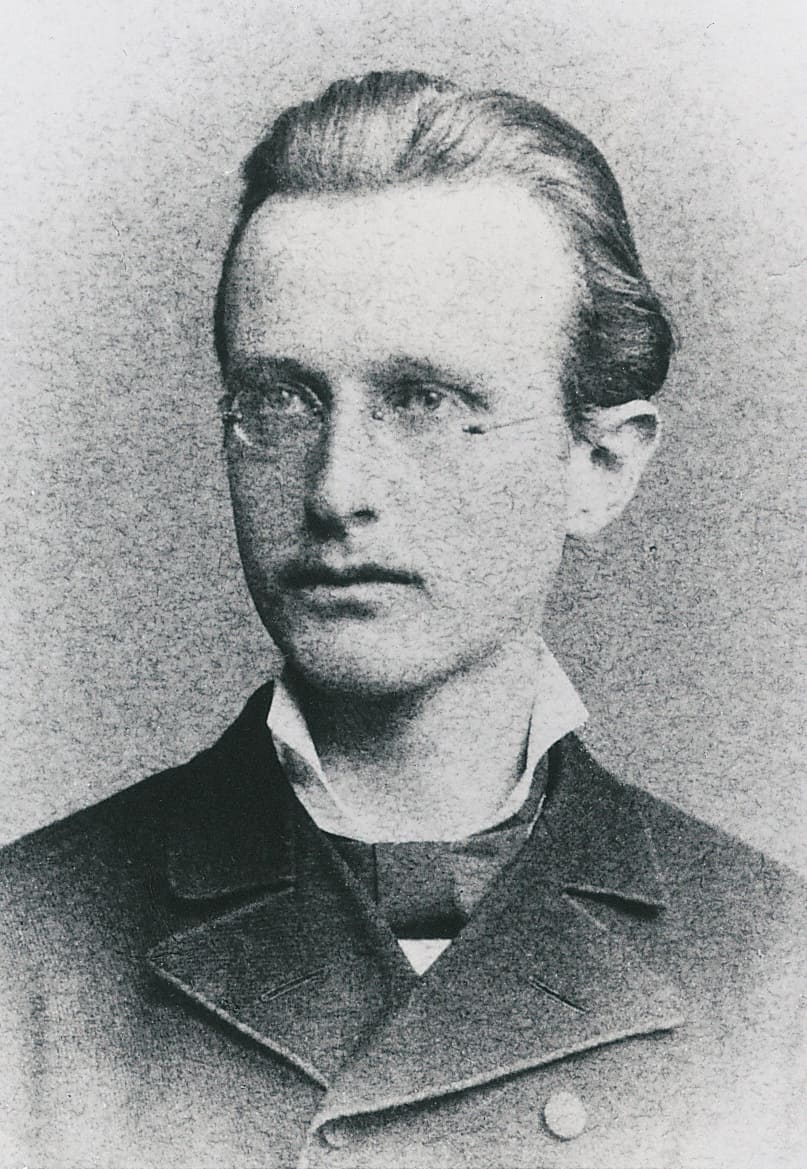
Quantum uncertainty Max Planck is widely credited for being the first person to realize that the energy of a body is “quantized”, but history shows that this is probably not what he had in mind at the time. Indeed, the “discovery” of quantum theory should not be seen as a moment of insight in December 1900, but as an extended process by many physicists. (Courtesy: AIP Emilio Segrè Visual Archives)
According to the standard story, which is unfortunately still found in many physics textbooks, quantum theory emerged when it was realized that classical physics predicts an energy distribution for black-body radiation that disagrees violently with that found experimentally. In the late 1890s, so the story continues, the German physicist Wilhelm Wien developed an expression that corresponded reasonably well with experiment – but had no theoretical foundation. When Lord Rayleigh and James Jeans then analysed black-body radiation from the perspective of classical physics, the resulting spectrum differed drastically from both experiment and the Wien law. Faced with this grave anomaly, Max Planck looked for a solution, during the course of which he was forced to introduce the notion of “energy quanta”. With the quantum hypothesis, a perfect match between theory and experiment was obtained. Voila! Quantum theory was born.
The story is a myth, closer to a fairytale than to historical truth. Quantum theory did not owe its origin to any failure of classical physics, but instead to Planck’s profound insight in thermodynamics.
The enigmatic entropy
During the final years of the 19th century, many physicists found themselves discussing the validity of the mechanical world view, which until then had been taken for granted. The question at the heart of the debate was whether time-honoured Newtonian mechanics could still be held as the valid description of all of nature.
In these discussions, which probed the very foundations of physics, electrodynamics and thermodynamics occupied centre stage. As far as the electrodynamicists were concerned, the fundamental problem was the relationship between mechanics and electrodynamics, or between matter and the hypothetical ether. Could the laws of mechanics be reduced to electrodynamics?
Specialists in thermodynamics, meanwhile, focused on the relationship between the laws of mechanics and the two basic laws of heat – the principle of energy conservation and the second law of thermodynamics. This discussion looked at the status of statistical-molecular physics and therefore examined the fundamental question of whether all matter is composed of atoms. Although the two discussions had much in common, it was the latter in particular from which quantum theory emerged.
Max Karl Ernst Ludwig Planck was deeply interested in – even obsessed with – the second law of thermodynamics. According to this law (in one of its many versions), no process is possible in which the only result is the transfer of heat from a colder to a hotter body. With the help of the concept of entropy, introduced by Rudolf Clausius in 1865, the law can be reformulated to state that the entropy of an isolated system always increases or remains constant.
Born in 1858 as the son of a professor of jurisprudence, Planck was appointed professor of physics at the University of Berlin in 1889. His doctoral dissertation from the University of Munich dealt with the second law, which was also the subject of most of his work until about 1905. Planck’s thoughts centred on the concept of entropy and how to understand “irreversibility” on the basis of the absolute validity of the entropy law – the version of the second law of thermodynamics formulated in terms of the entropy concept.
In the 1890s the debate about the second law centred on the statistical (or probabilistic) interpretation that Ludwig Boltzmann had originally proposed back in 1872 and expanded in 1877. According to Boltzmann’s molecular-mechanical interpretation, the entropy of a system is the collective result of molecular motions. The second law is valid only in a statistical sense. Boltzmann’s theory, which presupposed the existence of atoms and molecules, was challenged by Wilhelm Ostwald and other “energeticists”, who wanted to free physics from the notion of atoms and base it on energy and related quantities.
What was Planck’s position in this debate? One might expect that he sided with the winners, or those who soon turned out to be the winners – namely Boltzmann and the “atomists”. But this was not the case. Planck’s belief in the absolute validity of the second law made him not only reject Boltzmann’s statistical version of thermodynamics but also doubt the atomic hypothesis on which it rested. As early as 1882, Planck concluded that the atomic conception of matter was irreconcilably opposed to the law of entropy increase. “There will be a fight between these two hypotheses that will cause the life of one of them,” he predicted. As to the outcome of the fight, he wrote that “in spite of the great successes of the atomistic theory in the past, we will finally have to give it up and to decide in favour of the assumption of continuous matter”.
However, Planck’s opposition to atomism waned during the 1890s as he realized the power of the hypothesis and the unification it brought to a variety of physical and chemical phenomena. All the same, his attitude to atomism remained ambiguous and he continued to give priority to macroscopic thermodynamics and ignore Boltzmann’s statistical theory. Indeed, by 1895 he was ready to embark on a major research programme to determine thermodynamic irreversibility in terms of some micro-mechanical or micro-electrodynamical model that did not explicitly involve the atomic hypothesis. The programme not only expressed Planck’s deep interest in the concept of entropy, but also displayed his “aristocratic” attitude to physics: he focused on the fundamental aspects and disregarded more mundane, applied ideas. His fascination with entropy, which was shared by only a handful of other physicists, was not considered to be of central importance or of providing significant results. And yet it did.
Black-body radiation
From the perspective of Planck and his contemporaries, it was natural to seek an explanation of the entropy law in Maxwell’s electrodynamics. After all, Maxwell’s theory was fundamental and was supposed to govern the behaviour of the microscopic oscillators that produced the heat radiation emitted by black bodies. Planck initially believed that he had justified the irreversibility of radiation processes through the lack of time symmetry in Maxwell’s equations – i.e. that the laws of electrodynamics distinguish between past and present, between forward-going and backward-going time. However, in 1897 Boltzmann demolished this argument. Electrodynamics, Boltzmann showed, provides no more an “arrow of time” than mechanics. Planck had to find another way of justifying irreversibility.
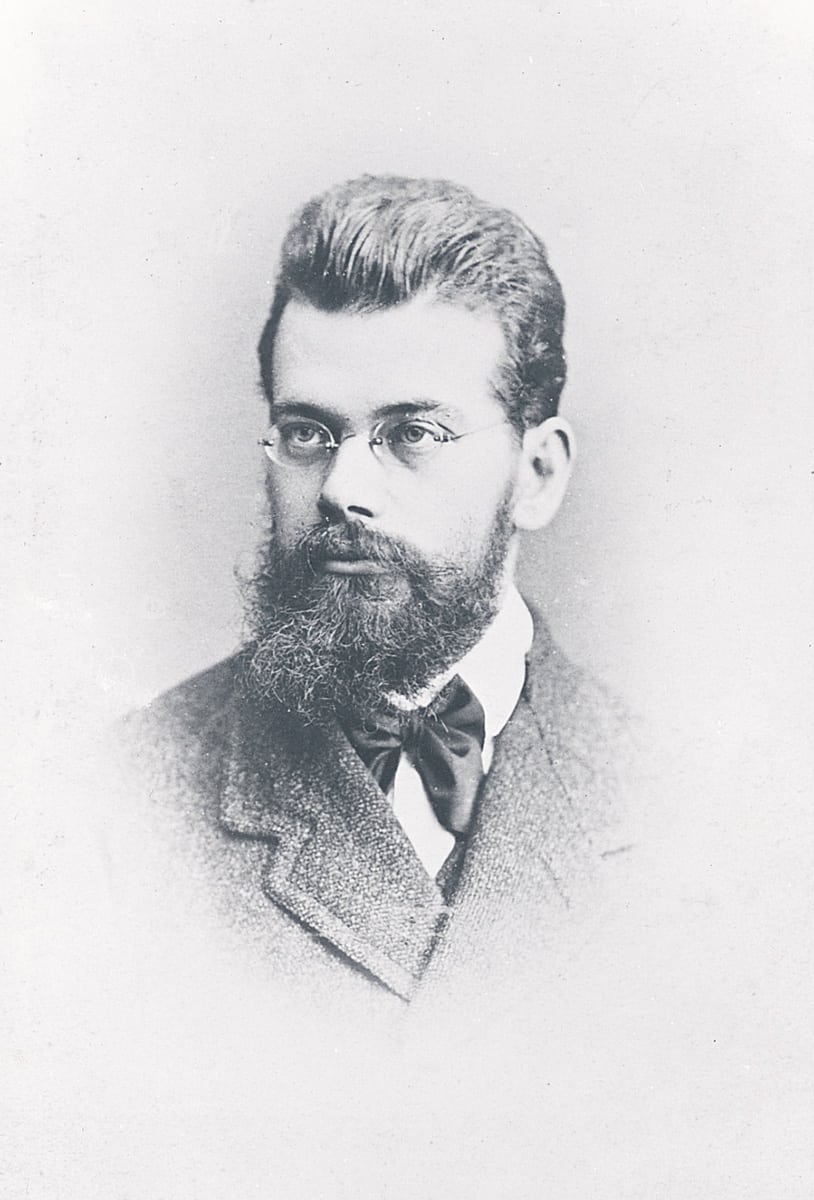
Planck rejected the statistical interpretation of the second law of thermodynamics developed by Ludwig Boltzmann (above) and tried, mistakenly, to justify irreversibility in terms of electrodynamics.
The study of black-body radiation had begun in 1859, when Robert Kirchhoff, Planck’s predecessor as professor of physics in Berlin, argued that such radiation was of a fundamental nature. By the 1890s several physicists – experimentalists and theorists – were investigating the spectral distribution of the radiation. Important progress was made in 1896 when Wien found a radiation law that was in convincing agreement with the precise measurements being performed at the Physikalisch-Technische Reichsanstalt in Berlin.
According to Wien, the spectral density, u, – the radiation energy density per unit frequency – depended on the frequency, f, and temperature, T, according to the formula u(f,T) = af3exp(bf/T)-1, where a and b are constants to be determined empirically. However, Wien’s law lacked a satisfactory theoretical foundation and was, for this reason, not acceptable to Planck. It is important to note that Planck’s dissatisfaction was not rooted in Wien’s formula – which he fully accepted – but in Wien’s derivation of it. Planck was not interested in producing an empirically correct law, but in establishing a rigorous derivation of it. In this way, he believed, he would be able to justify the entropy law.
Guided by Boltzmann’s kinetic theory of gases, Planck formulated what he called a “principle of elementary disorder” that did not rely either on mechanics or on electrodynamics. He used it to define the entropy of an ideal oscillator (dipole) but was careful not to identify such oscillators with specific atoms or molecules. In 1899 Planck found an expression for the oscillator entropy from which Wien’s law followed. The law (sometimes referred to as the Wien-Planck law) had now obtained a fundamental status. Planck was satisfied. After all, the law had the additional qualification that it agreed beautifully with measurements. Or so it was thought.
Discrepancy with theory
The harmony between theory and experiment did not last long. To Planck’s consternation, experiments performed in Berlin showed that the Wien-Planck law did not correctly describe the spectrum at very low frequencies. Something had gone wrong, and Planck had to return to his desk to reconsider why the apparently fundamental derivation produced an incorrect result. The problem, it seemed to him, lay in the definition of the oscillator’s entropy.
With a revised expression for the entropy of a single oscillator, Planck obtained a new distribution law that he presented at a meeting of the German Physical Society on 19 October 1900. The spectral distribution was now given as u(f,T) = af3[exp(bf/T) – 1]-1, which approximates Wien’s law at relatively high frequencies. More interestingly, this first version of the famous Planck radiation law also agreed perfectly with the experimental spectrum in the lower-frequency infrared region. Although it included a constant b that Planck believed was fundamental, the subsequent shift from b to h was more than merely a relabelling. Planck’s derivation did not make use of energy quantization and neither did it rely on Boltzmann’s probabilistic interpretation of entropy.
Those developments were to come two months later in “an act of desperation” as Planck later recalled. Before proceeding to this act of desperation, we need to consider the Rayleigh-Jeans law and the so-called “ultraviolet catastrophe”, if only to discard it as historically irrelevant. In June 1900 Rayleigh pointed out that classical mechanics, when applied to the oscillators of a black body, leads to an energy distribution that increases in proportion to the square of the frequency – utterly in conflict with the data. He based his reasoning on the so-called equipartition theorem from which it follows that the average energy of the oscillators making up a black body will be given by kT, where k is Boltzmann’s constant.
Five years later, Rayleigh and Jeans presented what is still known as the Rayleigh-Jeans formula, usually written as u(f,T) = (8 pi f2/c3)kT, where c is the speed of light. The result is an energy density that keeps on increasing as the frequency gets higher and higher, becoming “catastrophic” in the ultraviolet region. In spite of its prominent role in physics textbooks, the formula played no part at all in the earliest phase of quantum theory. Planck did not accept the equipartition theorem as fundamental, and therefore ignored it. Incidentally, neither did Rayleigh and Jeans consider the theorem to be universally valid. The “ultraviolet catastrophe” – a name coined by Paul Ehrenfest in 1911 – only became a matter of discussion in a later phase of quantum theory.
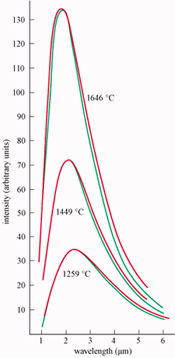
Law breaker In 1896 Wilhelm Wien derived an empirical law that appeared to accurately describe the radiation emitted by a black body. However, as these spectra measured by Otto Lummer and Ernst Pringsheim in November 1899 reveal, Wien’s theoretical curve (green line) did not agree with the experimental data (red line) at long wavelengths, indicating the inadequacy of Wien’s law. Faced with this grave anomaly, Planck looked for a solution, during the course of this he was forced to introduce the notion of “energy quanta”.
In November 1900 Planck realized that his new entropy expression was scarcely more than an inspired guess. To secure a more fundamental derivation he now turned to Boltzmann’s probabilistic notion of entropy that he had ignored for so long. But although Planck now adopted Boltzmann’s view, he did not fully convert to the Austrian physicist’s thinking. He remained convinced that the entropy law was absolute – and not inherently probabilistic – and therefore reinterpreted Boltzmann’s theory in his own non-probabilistic way. It was during this period that he stated for the first time what has since become known as the “Boltzmann equation” S = k log W, which relates the entropy, S, to the molecular disorder, W.
To find W, Planck had to be able to count the number of ways a given energy can be distributed among a set of oscillators. It was in order to find this counting procedure that Planck, inspired by Boltzmann, introduced what he called “energy elements”, namely the assumption that the total energy of the black-body oscillators, E, is divided into finite portions of energy, epsilon, via a process known as “quantization”. In his seminal paper published in late 1900 and presented to the German Physical Society on 14 December – 100 years ago this month – Planck regarded the energy “as made up of a completely determinate number of finite equal parts, and for this purpose I use the constant of nature h = 6.55 x 10⁻²⁷ (erg sec)”. Moreover, he continued, “this constant, once multiplied by the common frequency of the resonators, gives the energy element epsilon in ergs, and by division of E by epsilon we get the number P of energy elements to be distributed over the N resonators”.
Quantum theory was born. Or was it? Surely Planck’s constant had appeared, with the same symbol and roughly the same value as used today. But the essence of quantum theory is energy quantization, and it is far from evident that this is what Planck had in mind. As he explained in a letter written in 1931, the introduction of energy quanta in 1900 was “a purely formal assumption and I really did not give it much thought except that no matter what the cost, I must bring about a positive result”. Planck did not emphasize the discrete nature of energy processes and was unconcerned with the detailed behaviour of his abstract oscillators. Far more interesting than the quantum discontinuity (whatever it meant) was the impressive accuracy of the new radiation law and the constants of nature that appeared in it.
A conservative revolutionary
If a revolution occurred in physics in December 1900, nobody seemed to notice it. Planck was no exception, and the importance ascribed to his work is largely a historical reconstruction. Whereas Planck’s radiation law was quickly accepted, what we today consider its conceptual novelty – its basis in energy quantization – was scarcely noticed. Very few physicists expressed any interest in the justification of Planck’s formula, and during the first few years of the 20th century no one considered his results to conflict with the foundations of classical physics. As for Planck himself, he strove hard to keep his theory on the solid ground of the classical physics that he loved so much. Like Copernicus, Planck became a revolutionary against his will.
Planck was the archetype of the classical mind, a noble product of his time and culture. Throughout his distinguished career as a physicist and statesman of science, he maintained that the ultimate goal of science was a unified world picture built on absolute and universal laws of science. He firmly believed that such laws existed and that they reflected the inner mechanisms of nature, an objective reality where human thoughts and passions had no place. The second law of thermodynamics was always his favourite example of how a law of physics could be progressively freed from anthropomorphic associations and turned into a purely objective and universal law. After 1900 he increasingly recognized Boltzmann’s probabilistic law of entropy as grand and fundamental, but he stopped short of accepting its central message, that there is a finite (if exceedingly small) probability that the entropy of an isolated system decreases over time. Only in about 1912 did he give up this last reservation and accepted the truly statistical nature of the second law.
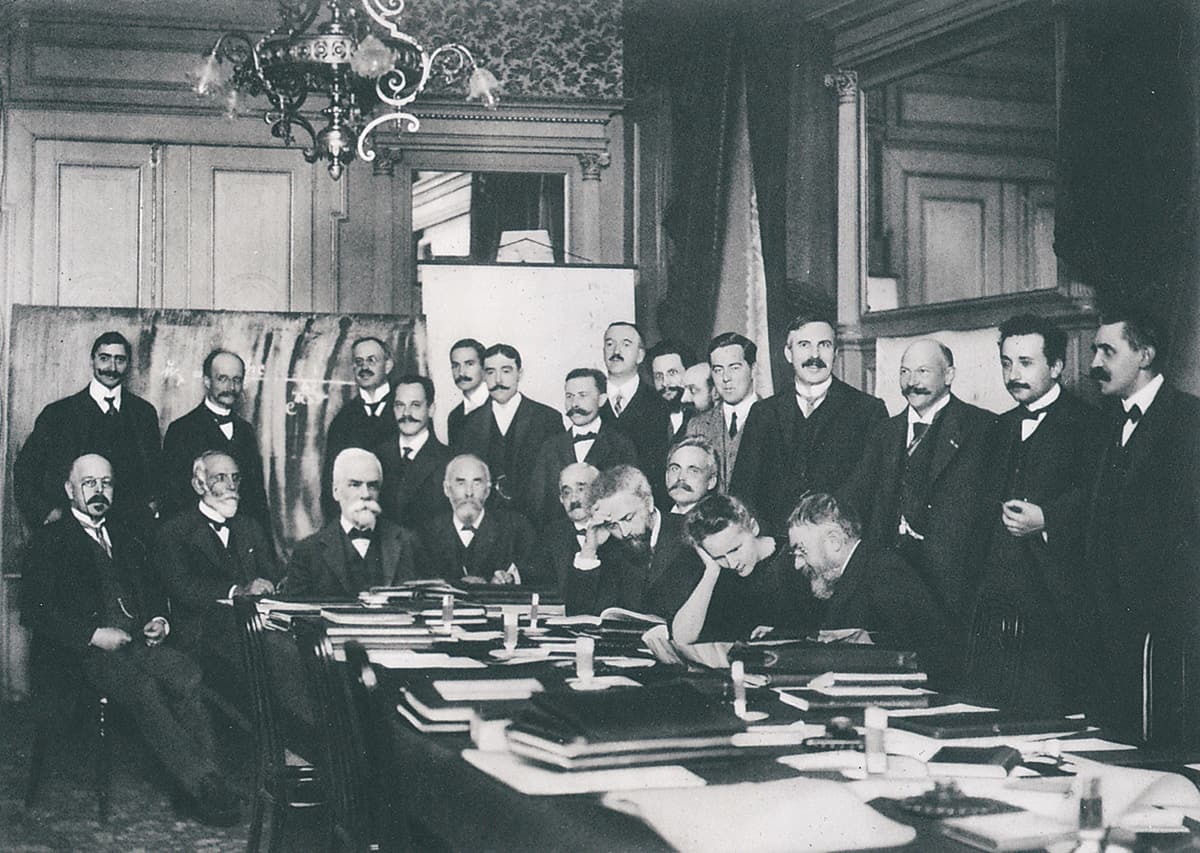
Mass recognition Quantum theory only really took off following the first ‘Solvay’ conference in Brussels in1911, attended by leading lights from physics. But even then it was not believed that quantum theory had anything to do with atomic structure. Planck is standing second from the left. Einstein is second on the right. (Courtesy: Institut International de Physique Solvay/AIP Emilio Segrè Visual Archives)
As to the quantum discontinuity – the crucial feature that the energy does not vary continuously, but in “jumps” – he believed for a long time that it was a kind of mathematical hypothesis, an artefact that did not refer to real energy exchanges between matter and radiation. From his point of view, there was no reason to suspect a breakdown of the laws of classical mechanics and electrodynamics. That Planck did not see his theory as a drastic departure from classical physics is also illustrated by his strange silence: between 1901 and 1906 he did not publish anything at all on black-body radiation or quantum theory. Only in about 1908, to a large extent influenced by the penetrating analysis of the Dutch physicist Hendrik Lorentz, did Planck convert to the view that the quantum of action represents an irreducible phenomenon beyond the understanding of classical physics.
Over the next three years Planck became convinced that quantum theory marked the beginning of a new chapter in the history of physics and, in this sense, was of a revolutionary nature. “The hypothesis of quanta will never vanish from the world,” he proudly declared in a lecture of 1911. “I do not believe I am going too far if I express the opinion that with this hypothesis the foundation is laid for the construction of a theory which is someday destined to permeate the swift and delicate events of the molecular world with a new light.”
Einstein: the real founder of quantum theory?
So is December 2000 the right moment to celebrate the centenary of quantum theory? In other words, did Planck really introduce the quantum hypothesis a century ago? The historian and philosopher of science Thomas Kuhn, who carefully analysed Planck’s route to the black-body radiation law and its aftermath, certainly thought Planck does not deserve the credit (see further reading).
However, there is evidence both for and against Kuhn’s controversial interpretation, which has been much discussed by historians of physics. There is a fairly strong case that we ought to wait a few more years before celebrating the quantum centenary. On the other hand, the case can be disputed and it is clearly not unreasonable to chose 2000 as the centenary and Planck as the father of quantum theory. Besides, there is a long tradition of assigning paternity to Planck, who, after all, received the 1918 Nobel Prize for Physics for “his discovery of energy quanta”. Jubilees and similar celebrations enhance traditions, they do not question them.
As Kuhn points out, nowhere in his papers of 1900 and 1901 did Planck clearly write that the energy of a single oscillator can only attain discrete energies according to E = n epsilon= nhf, where n is an integer. If this is what he meant, why didn’t he say so? And if he realized that he had introduced energy quantization – a strange, non-classical concept – why did he remain silent for more than four years? Moreover, in his Lectures on the Theory of Thermal Radiation from 1906, Planck argued for a continuum theory that made no mention of discrete oscillator energy. If he had “seen the light” as early as 1900 – as he later claimed – what caused him to change his mind six years later? Could the answer be that he did not change his mind because he had not seen the light?
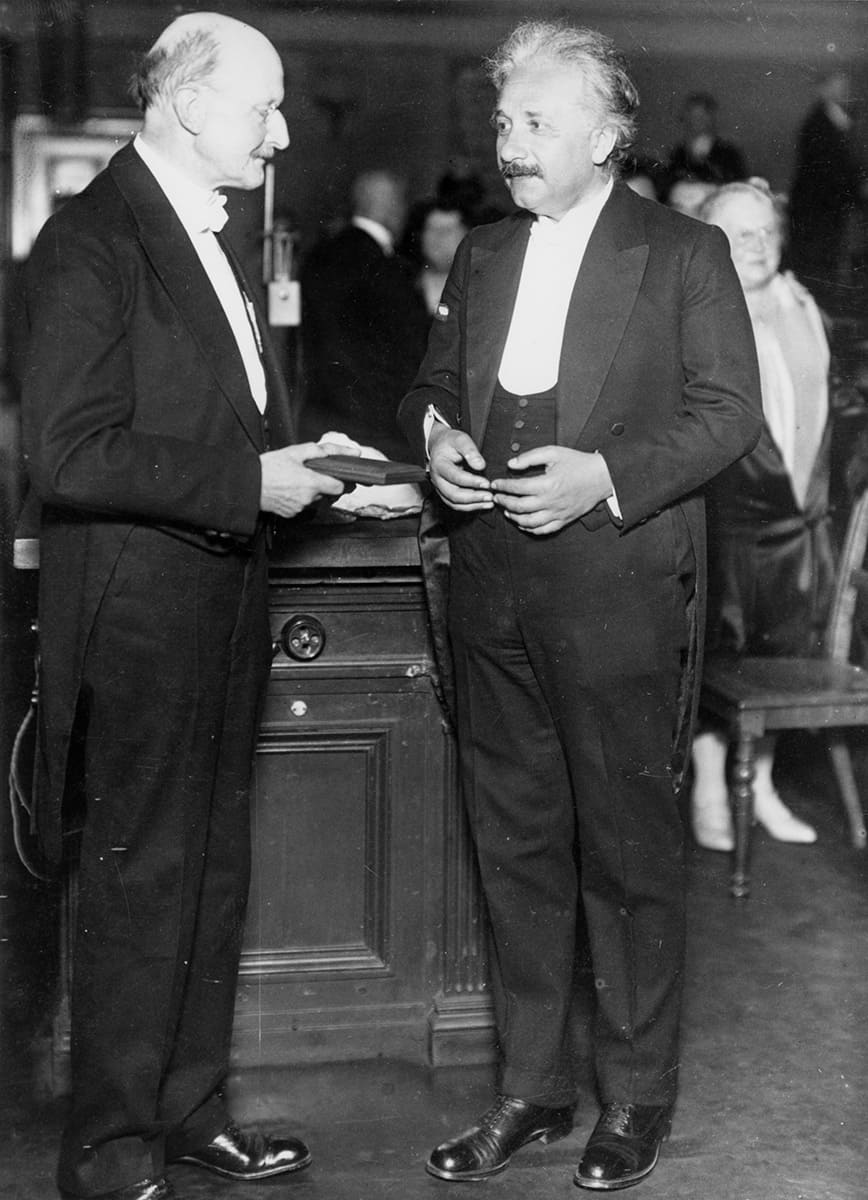
Genuine genius? Some historians regard Einstein as the true father of quantum theory. He developed the theory of light quanta in 1905 and made important contributions in 1907 to the quantum theory of the specific heats of solids and in 1909 to energy fluctuations. Shown here is Einstein (right)receiving the Planck medal from Planck himself in July 1929. (Courtesy: AIP Emilio Segrè Visual Archives, Fritz Reiche Collection)
These are only some of the arguments put forward by Kuhn and those historians of physics who support his case. Like historical arguments in general, the controversy over the quantum discontinuity rests on a series of evidence and counter-evidence that can only be evaluated qualitatively and as a whole, not determined in the clear-cut manner that we know from physics (or rather from some physics textbooks).
If Planck did not introduce the hypothesis of energy quanta in 1900, who did? Lorentz and even Boltzmann have been mentioned as candidates, but a far stronger case can be made that it was Einstein who first recognized the essence of quantum theory. Einstein’s remarkable contributions to the early phase of quantum theory are well known and beyond dispute. Most famous is his 1905 theory of light quanta (or photons), but he also made important contributions in 1907 on the quantum theory of the specific heats of solids and in 1909 on energy fluctuations.
There is no doubt that the young Einstein saw deeper than Planck, and that Einstein alone recognized that the quantum discontinuity was an essential part of Planck’s theory of black-body radiation. Whether this makes Einstein “the true discoverer of the quantum discontinuity”, as claimed by the French historian of physics Olivier Darrigol, is another matter. What is important is that Planck’s role in the discovery of quantum theory was complex and somewhat ambiguous. To credit him alone with the discovery, as is done in some physics textbooks, is much too simplistic. Other physicists, and Einstein in particular, were crucially involved in the creation of quantum theory. The “discovery” should be seen as an extended process and not as a moment of insight communicated on a particular day in late 1900.
Einstein’s 1907 theory of specific heats was an important element in the process that established quantum theory as a major field of physics. The changed status of quantum theory was recognized institutionally with the first Solvay conference of 1911, on “radiation theory and the quanta”, an event that heralded the take-off phase of quantum theory. The participants in Brussels realized that with quantum theory the course of physics was about to change. Where the development would lead, nobody could tell. For example, it was not believed that quantum theory had anything to do with atomic structure. Two years later, with the advent of Niels Bohr’s atomic theory, quantum theory took a new turn that eventually would lead to quantum mechanics and a new foundation of the physicists’ world picture.
A burning issue for fatties like me is whether you can make a low-fat Black Forest gateau. The answer, surprisingly, can be found in two new science books. The Pursuit of Perfect Packing by Tomaso Aste and Denis Weaire tells you how to pack the cherries in the middle of the cake as densely as possible so that the absolute minimum of cream is required. Universal Foam by Sidney Perkowitz gives insights into how to incorporate vast amounts of air when whipping the cream into a stiff foam.
The question of just how closely you can pack identical spheres has been around for many years. I was fascinated to read in Aste and Weaire’s book that in 1591 Walter Raleigh commissioned some military research to find a formula for the number of cannon balls in a stack. The problem was easy enough for Thomas Harriot to solve without much difficulty, but may well have been the beginning of the search to find the closest possible packing.
Not long after this, Johannes Kepler was amongst the first to state that hexagonal close packing gave the highest possible density. But despite the fact that all physicists “knew” and all mathematicians “believed” that there could not be any denser arrangements of spheres, the formal proof remained elusive. Indeed, the proof put forward by the American mathematician Thomas Hales in 1998, while generally accepted, is still being tested for any possible errors or omissions.
The Pursuit of Perfect Packing not only describes the mathematics surrounding the various ways that spheres and other shapes may be packed together, but also brings a real sense of humour and fun to what might otherwise seem a dry theoretical topic. The brief biographical sketches of some of the important players bring them to life. I treasure the image of J D Bernal being chased down a street by an irate naval officer carrying a revolver after “a brusque interruption of an amorous interlude”. And the description of Kepler as a “nerd” is justified by the fact that he “carefully analysed the merits of no less than 11 girls – before choosing the wrong one [to be his wife])”.
More recent developments are animated with reproductions of e-mail correspondence announcing breakthroughs and discussing results. Some knowledge of the language of maths and physics is useful when reading Aste and Weaire’s book, as they do not shy from inserting equations or using mathematical terminology. Indeed, I find it odd that they should criticize crystallographers for mystifying many with the definition of a crystal as “any solid with an essentially discrete diffraction diagram” (in an attempt to include the recently discovered aperiodic crystals), while seeing nothing strange in writing that “the sausage conjecture states that for d greater than or equal to 5 the arrangement of hyperspheres with a minimal volume convex hull is always a ‘sausage’ “. But despite occasional complexities such as these, this is a very readable and enjoyable book that I would recommend to any student learning crystallography. It certainly contains one of the clearest descriptions of aperiodic crystals I have seen to date.
Universal Foam covers some of the same ground as The Pursuit of Perfect Packing. Both books look at the internal structure of a foam: the shapes of the bubbles. Both begin with Joseph Antoine Ferdinand Plateau, the blind scientist who was the first to work out the three simple rules governing the internal structure of foam bubbles. They relate the story of how Kelvin deduced that the shape should be a tetrakaidecahedron and how he made a wire model of his idealized foam known as “Kelvin’s bedspring”. Both also go on to show that this is an unrealistic model, before describing our current best model of “Weaire-Phelan” cells, which can be observed in real foams.
It is perhaps not surprising that Weaire and Aste provide the clearer narrative of later developments in this area as they are active researchers in the field. All the different shapes are well illustrated in their book, together with a photograph of Kelvin’s “bedspring”, although the latter is expressed only in words in Perkowitz’s book. To me, though, it is a little disappointing that the clearer explanation is found in the more academic text and not in Perkowitz’s supposedly “popular-science” book.
But it would be unfair to suggest that Universal Foam is not a good popular-science book. It takes the reader on an imaginative trip through the science and uses of foams. Along the way, Perkowitz shows that foams are ubiquitous. He defines a foam as any substance with lots of small voids inside. This takes us well beyond our normal expectations of foams as collections of soap-like bubbles and into a variety of fascinating materials, such as the ultra-light and strong aerogels, as well as systems as diverse as cork and living cells.
Each chapter is devoted to a particular type of foam and consists of several short essays about different aspects of that foam. So, for example, in the chapter on living foam we learn about cell division; about bone and lung structure; how fish and frogs use foams to help aerate and protect their eggs; and even about “mad-cow” disease.
With such a wide range of topics the book is sometimes repetitive as the author tries to ensure that each section is self-contained and can be read without the need to read the whole book. This style makes Universal Foam an ideal book to dip into and discover yet another interesting new aspect of foam.
So can these books really help reduce the fat in a Black Forest gateau? If one assumes that normally one just whips the cream until it is stiff enough to hold its own weight and that the cherries are randomly packed in the middle of the cake, then significant reductions could be made. Carefully packing the cherries (and deforming them into polyhedra) can reduce the space to be filled by the cream by at least a factor of two, while adding surfactants (such as egg white) to the cream while whipping can increase the volume of air incorporated by another factor of two. In other words, the fat content might go down by a factor of four or more.
These two books are not only good to read. They can also be good for your health!
Atomic physicists can now trap individual atoms with a single photon and reconstruct their trajectories. (Courtesy: Caltech Quantum Optics)
One of the driving forces behind the development of quantum mechanics at the start of the last century was the need to understand why atoms only emit light at certain wavelengths. Shortly afterwards quantum mechanics was applied to molecules and then to solids. Moving in the other direction, it was also applied to predict the properties of fundamental particles, notably the electron.
Quantum mechanics has been remarkably successful in all these realms. Indeed, quantum electrodynamics – the theory of how light and matter interact – is the most powerful and accurate theory in all of physics. But even more remarkable is the fact that quantum theory still continues to fascinate researchers. It might be thought that 100 years after it was developed, there would be little that we did not know about quantum mechanics. Nothing could be further from the truth. Interest in quantum mechanics – both theoretical and experimental – is probably greater now that it ever has been.
In this article we will concentrate on just one aspect of the ongoing love affair between physicists and quantum mechanics – experiments in which single atoms are trapped inside a small box or cavity containing, on average, just one photon. Atomic physicists are now able to observe the motion of a single atom in real time with high spatial and temporal resolution, to reconstruct its trajectory and to explore hitherto unknown light forces. The realization of such “single-photon optical tweezers” is opening up new possibilities in the control of the internal and external quantum states of atoms, the cooling of molecules and quantum information processing.
Atomic entrapment
The idea that an atom can be trapped by a single photon in a cavity was put forward as early as 1991 by Serge Haroche and colleagues at the Ecole Normale Supérieure in Paris and independently by Berthold-Georg Englert, then at the Max Planck Institute for Quantum Optics in Garching, and co-workers (see Haroche et al. and Englert et al. in further reading).
Both groups proposed dropping an atom into a microwave cavity where it might be trapped by the field produced by a single photon. Trapping can occur when the potential depth is larger than the kinetic energy of the atom. The depth of the potential is related to the square root of the photon’s energy density in the cavity. But the energy of microwave photons is small and the volume of the cavity, which is determined by the wavelength, is large. It immediately became clear that a trap created by microwaves would be too shallow to hold an atom falling through the cavity under gravity.
The key to creating traps that are smaller and deeper is to replace the microwaves with optical photons, which have much shorter wavelengths. High-intensity visible light is now routinely used to manipulate the motion of colloidal particles, living cells and atoms, for example. These “optical tweezers” can trap objects in the focal region of a laser beam.
In addition, lasers have also been employed to slow down or “cool” atoms – an approach that has found widespread applications in fundamental and applied research. For example, exotic quantum states known as Bose-Einstein condensates, high-precision atomic clocks, and ultra-sensitive rotation and gravity sensors all employ cold atoms. Laser-cooled trapped ions are also prime candidates for an optical frequency standard or a scalable quantum computer that could, in principle, outperform conventional computers for some tasks.
All of these experiments, however, use large numbers of photons to manipulate the atomic motion, since the field of a single photon is not strong enough, in general, to trap an atom. And none of the experiments is sensitive enough to track the motion of a single atom in real time.
However, this situation has changed recently thanks to the combination of laser-cooling and trapping techniques with methods from cavity quantum electrodynamics (QED). Considerable progress has been made over the last decade in manipulating the optical properties of atoms by using cavities made of high-quality mirrors. Now, a light field inside a tiny optical cavity with highly reflective walls can ensnare a slow-moving atom.
Earlier this year Jeff Kimble at the California Institute of Technology (Caltech) and co-workers from Caltech and the University of Auckland in New Zealand, and, independently, the author’s group at the Max Planck Institute for Quantum Optics (MPQ) in Garching, Germany, reported that this unique combination of techniques makes it possible to trap and track a single moving atom in an optical cavity (see Hood et al. and Pinkse et al. in further reading). Both groups employed highly reflective mirrors to form a high-finesse optical cavity in which the light completed an almost record-breaking number of round trips. In these experiments, the cavity contained, on average, just one photon and thereby acted as a set of single-photon optical tweezers.
Detecting single atoms
Large samples of atoms can be detected using light when the energy of the beam matches the energy difference between two electronic levels in the atoms (i.e. when the light is resonant with an atomic transition). The atoms absorb light and thus reduce the flux of photons transmitted through the sample. This effect is large and can easily be measured when the sample contains at least a few thousand atoms. But the detection of just a single atom is by no means straightforward. In particular, the attenuation of the light beam due to the presence of a single atom is too small to be visible among the fluctuations or “noise” in the intensity of the laser.
The noise problem is less severe in fluorescence imaging, when single ions or atoms at rest in a trap absorb and emit photons. While this imaging technique has become routine, it is important to note that the available signal is severely limited by the rate of photon scattering and the solid angle of the detection system. Long integration times are typically required to observe the particle, which makes the detection scheme unsuitable for tracking the motion of a single atom with high spatial and temporal resolution.
1 Single-atom detection Figure 1. (a) Part of the optics and the vacuum system used to trap a single atom in a high-finesse optical cavity at the Max Planck Institute for Quantum Optics in Garching, Germany. From left to right: Thomas Fischer, the author, Pepijn Pinkse, Thomas Puppe and Peter Maunz. (b) In the MPQ experiment, rubidium atoms (green) collected in a magneto-optical trap and cooled are ejected upwards towards a cavity that is 110 µm long and has a finesse of 430,000. Light from a weak laser with a wavelength of 780 nm sets up a standing wave in the cavity. The atoms are detected by measuring the light transmitted through the cavity. (c) If the wavelength of the light is resonant with the atom, then the presence of the atom is signalled by a dip in the transmission. (d) The presence of an atom can still be detected even if the light is not resonant with the empty cavity or the atom by tuning the external laser so that a cavity containing exactly one atom is resonant with the input light. In other words, the atom tunes the cavity into resonance with the light. Each of the three peaks displayed is characteristic of a single atom.
Non-resonant light, however, can get round the disadvantage of the resonant-detection scheme. In this case, the single atom does not absorb or emit light, rather it shifts the phase of the incoming light wave – an effect that can be attributed to the atom’s refractive index.
Of course, the refractive index of a single atom is small, but its effect is enhanced in a high-finesse cavity simply because the light travels back and forth many times between the cavity mirrors. In the most recent experiments the finesse of the cavities has approached values as high as 500,000, which means that the mirrors reflect the light about 160,000 times. In this way, the circulating light probes the atom again and again, thereby picking up a large phase shift after many round trips.
It follows that the refractive index of even a single atom in the cavity can significantly change the optical path length between the mirrors. As a consequence, the atom is able to tune the cavity in or out of resonance with the light from an external laser. (The resonant frequency or wavelength of the empty cavity is determined by the mirror separation.) For a fixed laser frequency, a moving atom therefore induces changes in the intensity of the light transmitted through the cavity – an effect that can easily be measured when the cavity resonance is narrow.
Resonant light can also be used to observe an atom in the cavity. In this case, the refractive index does not change but the amount of absorption of the light is large. This absorption decreases the transmission of light through the cavity and increases the reflection – a surprisingly large effect due to just a single atom in the cavity. Such an effect was first observed in 1996 by Hideo Mabuchi and co-workers at Caltech for single atoms falling slowly through a high-finesse cavity (see further reading).
In our experiment at the MPQ, we first collect rubidium atoms within a trap and then cool them with a combination of magnetic and optical techniques (figure 1). The atoms are then thrown upwards into a Fabry-Perot cavity using lasers, which create a so-called moving molasses. The cavity is placed at the turning point in the “atomic fountain” and is illuminated with a weak light beam from a diode laser. This light forms a standing wave between the two mirrors due to the multiple reflections, with nodes (i.e. minima in intensity) located at the mirror surface. The slow speed with which the atom passes through the cavity means that the atom can be observed for a relatively long period of time by recording the intensity of the light transmitted through the cavity. The atom can be detected by its influence on either the absorption or refractive index (figures 1b and 1c, respectively).
Cavity quantum electrodynamics
But what is the optimal intensity of light needed to detect single atoms? Intuitively, one would expect that the signal-to-noise ratio increases with the intensity of the illuminating laser, thus making a powerful laser beam more useful than a weak one. However, a strong laser beam can easily excite the atom into a higher-energy state where it loses its ability to absorb more light – an effect known as saturation. At this stage the atomic medium becomes transparent.
Saturation also changes the refractive index of the atom. And for sufficiently high-intensity lasers, this refractive index approaches that of a vacuum. Under this condition, the atom can no longer shift the phase of the light wave. Saturation makes it harder for single atoms to be detected via absorption or changes in the refractive index of the cavity when the intensity is above a certain value.
But just how large is this upper limit on the intensity? For the caesium and rubidium atoms in the experiments at Caltech and the MPQ, saturation occurs at modest intensities. As the intensity is proportional to the number of photons per cavity volume, fewer photons are needed to saturate the atom as the size of the cavity gets smaller. In the recent experiments, the spacing between the mirrors is as small as 10 microns. An atom in such a tiny cavity can become saturated even when there is less than one photon present, on average, which explains why power levels of about 1 picowatt (10-12 W) – corresponding to about one cavity photon – are used in these experiments.
The saturation problem is particularly severe in the case when the light is in resonance with an atomic-transition frequency. For non-resonant light, more photons are needed to saturate the atom, thereby relaxing the constraints on the light intensity.
What happens when the light is intense enough to saturate the atom? In this case, the atom spends a significant fraction of its time in the excited state. It can return to the ground state either by spontaneous emission or when it is stimulated by the light field in the cavity – a much faster process. When the intensity of this light field is large, the atom is far more likely to emit a photon via stimulated emission.
In a small cavity, a single-photon field is intense enough to stimulate the decay of an excited atomic state. Amazingly, the photon does not need to be in the cavity before the emission begins. Spontaneous emission leads to a photon in the cavity, which stimulates its own emission. As a consequence, an excited atom will radiate its energy into the cavity, rather than into the free-space continuum outside the cavity.
If the finesse is large, the photon is stored in the cavity and is periodically absorbed by the atom and re-emitted into the cavity many times before being lost into the environment outside the cavity. Such novel oscillatory radiation properties are typical of the so-called strong coupling regime of cavity QED, where the coherent coupling of a single atom to a single photon makes spontaneous emission a reversible process. These radiation properties have previously been investigated by many groups worldwide, but the motion of an atom under these conditions can only now be explored with the new generation of cavity-QED experiments.
Light force
Radiation pressure is probably the best known of the forces that light can exert on an atom. In this case, an atom absorbs resonant light and receives a momentum kick in the direction of the laser beam. Although the atom’s momentum changes again when it spontaneously emits a photon, this second kick is in a completely random direction and therefore averages to zero after many absorption-emission cycles.
Induced transitions, on the other hand, lead to a so-called dipole force. This force can be understood classically by noting that the electric field of the driving laser induces a mechanical oscillation of the atom’s electron. The oscillating dipole moment that is produced experiences a force in a light field with an intensity gradient, such as a standing wave.
The sign of this force depends on the “detuning” of the laser with respect to the atomic-transition frequency. For example, when the laser frequency is lower than the atomic frequency, the induced atomic dipole oscillates in phase with the driving laser field, and the atom is attracted towards regions of high intensity just like a small piece of paper is attracted towards an electrically charged object. Hence, the dipole force can trap particles in the focal region of a “red-detuned” laser beam. For a “blue-detuned” laser (i.e. when the laser frequency is higher than the atomic-transition frequency), the dipole oscillates out of phase with respect to the laser, so the atom is repelled from the high-intensity regions.
2 Single-photon tweezers A rubidium atom entering the high-finesse cavity of the MPQ experiment leads to an increase in the transmitted power that triggers a feedback switch that increases the power of the driving laser (dashed line). This traps the atom in a light field containing on average about one photon. The atom remains in the cavity for as long as 1.7 milliseconds. After 3 milliseconds the laser-light intensity is switched back to its original value, waiting for the next atom to be captured. The large oscillations in the transmitted light power reflect the motion of the trapped atom. In the Caltech experiment, these oscillations are more regular, indicating a more periodic motion of the atom.
Inside a cavity, the radiation properties of the atom change, with dramatic consequences for the forces that the light can produce. New effects can be expected for a moving atom because it induces position-dependent changes in the field intensity inside the cavity. In 1997, for example, Peter Horak and co-workers at the University of Innsbruck in Austria suggested that an atom could be cooled while moving through the nodes and antinodes (i.e. the minima and maxima) of a standing-wave cavity, similar to the one in figure 1a.
To explain this cooling mechanism and illustrate why the cavity plays an essential role, let’s consider the situation where the strong coupling of the atom at an antinode enhances the intensity of the light field in the cavity, as it did in figure 1c. In this case, the laser is red-detuned with respect to the atom so that the dipole force attracts the atom towards the antinode. Hence, a moving atom decelerates when approaching the neighbouring node. When the atom reaches that node, its coupling with the cavity mode vanishes and the intensity of the light field decreases. Consequently, the atom moves in the dark when it approaches the next antinode and gains little kinetic energy, certainly not enough to compensate the previous loss.
As a result, the atom slows down simply because the field inside a high-quality cavity cannot adjust fast enough to the atom’s motion. Unlike conventional laser cooling in which the atoms slow down by spontaneously emitting photons, the dissipative mechanism in cavity cooling involves the loss of photons from the cavity. Using this cavity-mediated “friction force”, it might become possible to cool molecules, for which standard laser-cooling techniques fail, as was emphasized earlier this year by Vladan Vuletic and Steven Chu of Stanford University in the US (see further reading).
Cavity-mediated cooling is interesting because it might complement other techniques that have recently been developed to trap molecules, in particular by Hendrick Bethlem and co-workers at Nijmegen University in the Netherlands.
However, as well as changing the intensity of the intra-cavity field, an atom that periodically exchanges energy with the cavity also causes fast fluctuations in the amplitude and phase of the light field. As the trapping potential is determined by the light field within the cavity, these variations lead to fluctuations in the light force. These, in turn, affect the momentum of the atom in a random way, typically heating a cold atom by increasing its velocity.
Atom-cavity molecules
A spectacular feature of the cavity-QED scheme is that the trap is deep enough to hold a laser-cooled atom even when the cavity contains only a single photon. Trapping with a single photon can occur in a small cavity because the electric field per photon, and hence the light force per photon, is large.
But one more trick is needed to capture the atom in the photon’s dipole potential: the potential must not be turned on before the approaching atom has reached the centre of the cavity. Otherwise, the atom falling into the trap from one side would escape out the other side in the same way that a marble rolled into a bowl would just roll out again without being trapped. Switching the potential on at exactly the right moment is helped by the fact that we can now observe the atom’s position in a cavity field containing, on average, less than one photon.
The experimental signature of an atom trapped successfully in a cavity by this author’s group at the MPQ is shown in figure 2. As the atom enters the cavity, it causes the transmission of light from an external laser to increase, thereby triggering a switch that increases the power of the driving laser. When timed properly, the atom is trapped in an antinode of the standing-wave dipole potential for up to a few milliseconds – about ten times longer than it would remain in the cavity without switching.
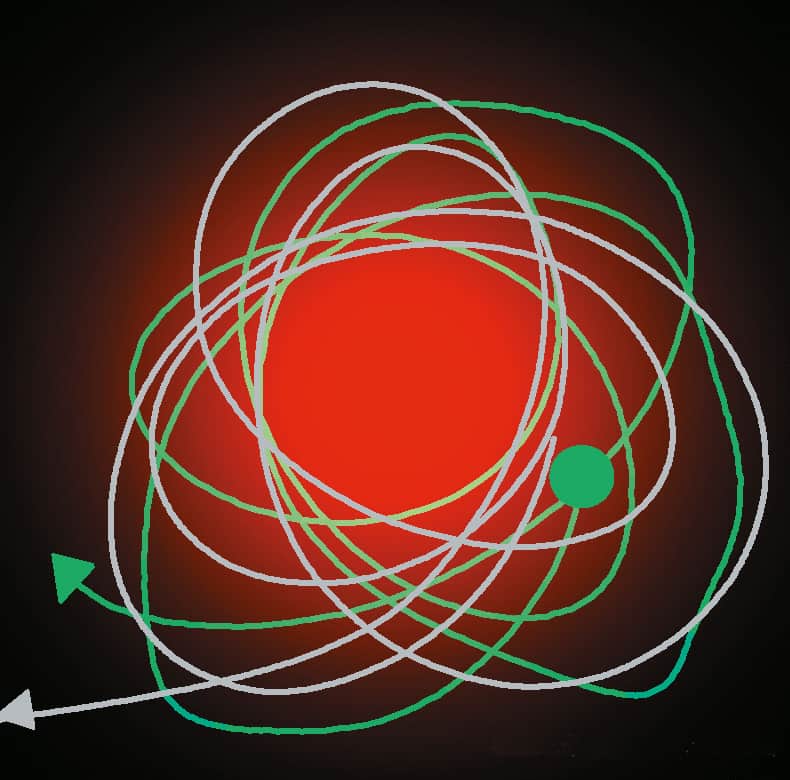
3 Atom in action The reconstructed trajectory of a single atom measured in the Caltech experiment. The small cavity and the correspondingly large atomcavity coupling leads to a regular trajectory (green). The atom, which has been dropped into the cavity from above, rapidly orbits the high-intensity region (red) at the centre of an antinode in a plane perpendicular to the cavity axis. The period of the motion is about 150 µs and the atom stays in the cavity for about a millisecond. (Picture credit: Caltech Quantum Optics)
The large oscillations that are evident in the transmitted intensity reflect the motion of the trapped atom. In particular, the transmission is large when the atom is at the centre of the cavity, and it decreases when the atom moves away from the cavity axis.
At first sight, trapping atoms with single photons in a cavity seems to be similar to trapping atoms with laser beams in free space – with the exception that the intensity enhancement in a cavity allows us to use weak lasers. However, the strong atom-cavity coupling requires a conceptually different description. This can be understood by borrowing a simple picture from chemistry.
Just as the two protons in a hydrogen molecule can be surrounded by a symmetric (i.e. binding) or anti-symmetric (anti-binding) electron wavefunction, in the atom-cavity system the atomic dipole moment can oscillate in phase with the light field (binding) or out of phase (anti-binding).
The two states that characterize the atom-cavity “molecule” both contain one quantum of energy that can oscillate between the atom and the cavity. This quantum is therefore shared by the atom (as electronic excitation) and the cavity (as a photon), just as the electron in the hydrogen molecule is shared by both protons.
This sharing means that atom trapping can also lead to photon trapping. In this case, the presence of an atom with a long-lived excited state can prolong the time that the photon remains in the cavity.
Reconstruction of atomic trajectories
Atomic physicists can now work backwards and calculate the classical trajectory of the atom by measuring the light passing through the cavity. This is possible because the transmitted light depends on the coupling between the atom and the cavity, which in turn depends on the atom’s position.
In the Caltech experiment, the large atom-field coupling confines the atom strongly to one antinode so that its motion is restricted mainly to the plane perpendicular to the cavity axis. This motion is expected to be regular, with little perturbation expected from spontaneous emission. We can therefore assume that the angular momentum of the atom around the cavity axis hardly changes during one revolution. This conservation of angular momentum means that we can identify a constant of the motion.
The two-dimensional orbit – apart from the sign of the angular momentum and the specific antinode in which the atom is confined – can be reconstructed from the data using an algorithm based on classical equations of motion. The reconstruction algorithm has been tested by applying it to the signals obtained from a simulation of the atom’s motion. Indeed, Christina Hood and co-workers at Caltech have found that the spatial resolution of such inferred trajectories is typically around 2 microns on a 10 microsecond timescale (figure 3).
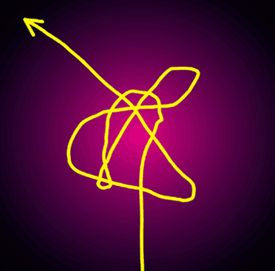
4 Simulated motion A simulation of an atom’s motion in a cavity. The relatively small coupling between the atom and the light field in the larger cavity in the MPQ experiment increases the role of the momentum kicks from spontaneous emission events. These kicks perturb the otherwise regular motion of the atom in a plane perpendicular to the cavity axis and make the atomic trajectory (yellow) more random. The atom enters from below and is trapped for about 1.2 ms.
Our group at the MPQ has also performed simulations to explore the motion of an atom in a cavity. The trapping potential is weaker in the MPQ experiment and, hence, the atomic motion is more strongly perturbed by spontaneous emission (figure 4).
The simulations also indicate that the trapped atom sometimes flies to another, distant, antinode, making the motion truly three dimensional (figure 5). This motion is due to two different, but equally important, mechanisms. First, the atom is heated out of an antinode due to fluctuations in the trapping potential. Next it becomes trapped in another antinode because the cavity-mediated friction force, which is proportional to the atom’s velocity, cools the moving atom.
Experimental evidence for long atom flights comes from the measurement of the intensity fluctuations of the light transmitted through the cavity. The transmission is large when an atom is near an antinode and falls when the atom is near a node, thus providing valuable information about the atom’s position. In particular, an atom moving along the cavity axis will periodically modulate the transmission. We have found that the intensity is noisy, in general, but occasionally it oscillates in a periodic fashion before becoming random again. According to our interpretation of this behaviour, each peak in the light intensity is due to the strong coupling of the atom to each antinode it passes, until it settles down at a distant antinode.
Looking ahead
The same techniques that allow us to measure the trajectory of an atom in a cavity could be adapted to investigate the dynamics of single molecules as they undergo chemical reactions or biological processes. Another exciting possibility is to extend the techniques developed in different areas of science and engineering in which the state of a system is monitored and appropriate feedback loops to control the state are applied. Chemical reactions, for example, can be controlled in a coherent way using suitably tailored ultra-short laser pulses. These pulses are optimized in consecutive experiments, but are always applied to molecular systems that have been prepared in identical ways. The new generation of atom-cavity experiments, however, allows us to investigate feedback loops applied to the same system over and over again without the need to prepare the system in the same initial state each time the experiment is carried out. In addition, such feedback experiments open up the exciting possibility of being able to precisely control the motion of an atom within a cavity according to the laws of quantum mechanics.
5 Atom jumping A fluctuating potential can increase the atom’s velocity, while the cavity-mediated friction force decreases its velocity. In this case, an atom can leave an antinode (indicated by the horizontal lines), fly along the cavity axis and be recaptured by another antinode. According to our simulation at the MPQ, this particular atom has flown across two consecutive antinodes. Before and after the flight, the trapped atom oscillates rapidly around the relevant antinode. Evidence for long atom flights is obtained from periodic bursts of photons observed in the light transmitted through the cavity.
Feedback might also allow an atom in a cavity to be cooled to low temperatures. By applying corrective forces to the atom – a variant of the “stochastic cooling” technique developed to cool particles stored in high-energy accelerators – one might be able to cool the atom into the region where the quantum-mechanical nature of atomic motion will become important. At this stage, an atom can no longer be treated as a point-like particle moving along a classical trajectory. Instead, it must be thought of as a wave packet that can be observed continuously in space. According to Heisenberg’s uncertainty principle, the momentum of the wave packet will be altered each time we localize the atom. Such measurements at the quantum limit will be a challenge in future experiments.
Another interesting situation arises when two or more atoms reside in the cavity simultaneously. In this case the photon emitted by one atom is stored in the cavity, absorbed by the other atom, then re-emitted into the cavity where it can be re-absorbed by the first (or even a third) atom. Hence, the atoms are not independent of each other. Instead, the common field in the cavity establishes a long-range interaction between the atoms and one can expect co-operative effects in the motion of several atoms. For example, if the field in the cavity is turned on when one of the atoms moves from an antinode to a node, then it will affect the motion of the other atoms.
The first evidence for such a co-operative effect was observed earlier this year by Peter Münstermann and co-workers in the author’s group. We measured the spatial distribution of the atoms over the nodes and antinodes of the cavity field by recording the light transmission through the cavity as a function of frequency. The observed data could only be explained by taking into account the full long-range mechanical interaction between the atoms.
A system with one or more individual atoms at rest and strongly coupled to a single mode of the electromagnetic field is ideal for testing fundamental concepts of quantum computing and quantum information processing (see Physics World 1998 March). Indeed, Scott Parkins, now at the University of Auckland, and collaborators at the JILA Laboratory in Boulder, Colorado, and Caltech first proposed this system as a highly efficient quantum interface in 1993. Using the strong coupling of an atom to a single photon, it should be possible to map a quantum bit at rest from an atomic medium onto a propagating light field, and vice versa. In other words, this scheme could allow quantum information to be sent from one place to another. The first experimental results in this direction were obtained very recently by Markus Hennrich and co-workers at the MPQ. Moreover, two atoms in the cavity should make it possible to realize a “controlled NOT gate”, the elementary building block of a quantum computer.
Cavity-QED experiments with single atoms and optical photons look certain to provide a rich source of physics for many years to come, and could launch a raft of future applications in both the physical and life sciences. Quantum mechanics is assured a bright future for many more years to come.
Columbia University string theorist Brian Greene can put his feet up this Christmas, safe in the knowledge that his popular-science title The Elegant Universe is this year’s best-selling physics book on both sides of the Atlantic, according to Amazon, the on-line bookstore. The book already scooped the Aventis Prize for Science Books earlier this year.
“I think it is wonderfully gratifying that ideas about the universe, which thousands of physicists worldwide have devoted themselves to developing over many years, are now being widely shared with the general public,” Greene told Physics World. “I am surprised at how well my book has done and I feel its success directly reflects the depth of curiosity that people have about the workings of the universe.”
Everybody out: there will be no extension for LEP.
“We felt there was evidence to justify running LEP again next year,” says Tiziano Camporesi, spokesman for LEP’s DELPHI experiment. The CERN staff association, which represents more than 70% of the employees at the lab, has denounced the “lack of clarity in the procedure that led the director general to take such a decision”. It said: “Such a decision cannot be taken on the sly by a director general who no longer knows how to listen to the scientific community as a whole.”
But there are many researchers who think that it is important to dismantle the accelerator in order to make way for CERN’s next major facility, the Large Hadron Collider (LHC), which will be built in the tunnel that currently houses LEP. “I think overall it is the right decision since it maximizes the future of the lab,” says Peter Jenni, spokesman for the LHC’s ATLAS experiment. “I don’t think it would be right to put at risk the other science at the LHC.”
Lyn Evans, LHC project leader, believes that physicists must accept the management’s decision. “If they don’t put all of this behind them there is going to be a serious chance that the particle-physics community splits,” he says. “In the end I hope common sense prevails, but it is absent at the moment.”
Supporters of LEP are dismayed that the opportunity to discover the Higgs will now pass to the Tevatron collider at Fermilab in the US, which is likely to gather convincing evidence for the particle over the next five years. “Not running in 2001 has clear consequences,” says Patrick Janot, LEP physics coordinator. “Fermilab will put all its efforts and resources to solve the question before the LHC. Then CERN will look ridiculous at having missed this opportunity, and the future of CERN will be very dark.”
Fermilab director Michael Witherell believes that Maiani’s was “as hard a decision as it gets” and says that he has mixed feelings about the closure. “I relish the prospect of going after the Higgs,” he says, “but the definite observation of the Higgs that could be produced by an extension of the LEP run would emphasize the importance of pushing our accelerator performance to study it at Fermilab.”
A rollercoaster ride
Emotions have been running high at CERN since the summer when LEP first detected signs of the Higgs, the particle that is thought to provide all other particles with mass and forms the missing link in the Standard Model of particle physics (Physics World October p5). Keen to squeeze every last drop out of the 11-year-old machine before it was due to shut down at the end of September, physicists hiked its centre-of-mass energy up to just over 206 GeV. They saw five events in two of LEP’s four detectors, which they interpreted as the tell-tale signs of a Higgs particle with a mass of about 115 GeV c-2. This led CERN to extend the running of the machine by a further four weeks in the hope that more data would strengthen its claim on the Higgs.
On Friday 3 November hundreds of scientists packed into the CERN auditorium to hear the results from LEP’s extended run. Researchers reported evidence for a sequence of particle decays in the L3 detector that were different from the events seen thus far. This reduced the chances that the combined measurements were due to statistical fluctuations from about 2.2 sigma (2.2 standard deviations) to 2.8, equivalent to a probability of 2 in 1000.
The results were greeted with shouting and screaming, and the researchers presenting the new data received a standing ovation, says Steve Myers, head of machine physics at LEP. “The only other time I can remember a reception like that was when Carlo Rubbia presented his results on the discovery of the Z boson, for which he received the Nobel prize,” adds Myers.
Scientists at CERN thought that these results would be good enough to convince the management to run LEP for another year in the hope that it could gather enough data to reach the magical 5 sigma, which means that the uncertainty in the measurements would be reduced to three parts in 10 million. But within days their euphoria had changed to agony. Technical staff were dumbfounded the following Wednesday when they found out through a press release that LEP had been switched off for the last time. “The new data were not sufficiently conclusive to justify running LEP in 2001, which would have had an inevitable impact on LHC construction and CERN’s scientific programme,” said the press release. “The CERN management decided that the best policy for the laboratory is to proceed full-speed ahead with the LHC.”
To reach his decision Maiani took advice from three committees. The LEP science committee could not decide whether or not to shut down the ageing accelerator. Then CERN’s high-level research board spent hours debating the problem, but it too could not agree an outcome. And CERN’s scientific policy committee was split down the middle. Since none of the committees could reach a consensus, Maiani decided to shut LEP down. “If LEP had seen a 4.5 sigma effect then we probably would have said go for it,” says Roger Cashmore, CERN’s director of research. “But LEP has seen less than 3 sigma. Experience tells you that need around 5 sigma to be sure.”
The science committee put the chances of LEP producing 5 sigma evidence by the end of next year at “50:50”. If the Higgs mass is 115 GeV c-2, as thought, then the committee estimated that LEP would have produced a 5.3 sigma event by the end of 2001, with an uncertainty of ±0.5 sigma. However, if the mass is in fact 116 GeV c-2 then this figure falls to 4.3 sigma.
But the science was not the only the factor that the management had to consider, says Cashmore. He maintains that in addition to delaying the LHC by a year, running LEP in 2001 would have cost around SFr 100m (about £40m), partly due to the default on engineering contracts. “We could have ended up with the situation where we had delayed the LHC, spent all that money and still only have had a 3.5 sigma effect,” he says.
For just over a week after Maiani reached his decision, physicists hoping to revive LEP clung to the faint hope that a committee representing CERN’s member states would reverse the closure. But when this committee met on 17 November it too could not reach a consensus, so Maiani’s decision stood.
Many physicists, however, remain unconvinced by the management’s verdict. Rumours spread through the corridors of CERN that an extension to LEP would not significantly affect the LHC because the LHC’s schedule was reckoned to be set back anyway by delays to engineering work. Lyn Evans, LHC project leader, says this analysis is not correct. He calculates that if LEP were to have run in 2001 then there would have been a “serious chance” that the LHC’s first physics run would have been put back from 2006 to 2007.
But many researchers believe that such considerations are peripheral. Belen Gavela, a physicist at the Universidad Autonoma de Madrid and an independent member of the CERN research board, says that she has not heard “any serious scientific argument” in favour of closing LEP. “I understand that there may be political and financial issues,” she says. “But in my opinion, it would be a very great service to science if you can overcome them. [A delay to the LHC is a] minor consequence, as there is no scientific competitor for that physics at the time that the LHC will open. Besides, if the signal disappears during 2001, it would still imply a relatively quick answer to a timely and fundamental question.”
“We should have carried on with LEP while we had the chance,” says Sam Ting of the Massachusetts Institute of Technology, who shared the 1976 Nobel Prize for Physics for the discovery of the J/* particle. “Its full potential for discovering the Higgs was not explored,” he says. Ting, who worked on the L3 experiment, believes it is difficult to object to an extension of LEP on economic grounds when billions of pounds have already been spent on it. “And who knows how long it will be before the LHC detects the Higgs,” he says. “The complexity of that machine and the detectors makes it difficult to estimate when it will produce useful results.”
Supporters of the LHC point out that, unlike LEP, the LHC is tailor-made to study the Higgs over a wide range of masses. The LHC is due to come on line in 2005 and should get its first sight of the Higgs about two years later. It will operate at a higher energy, a superior luminosity and will produce Higgs via several decay channels.
But this machine is likely to be beaten into second place by Fermilab’s Tevatron. Fermilab director Michael Witherell is confident that the Tevatron will get the upgrades it needs over the next few years to produce 5 sigma evidence for the Higgs in 2005 or 2006. “The visibility of what has happened at CERN should put us in a very good position,” he says.
Try this introspective experiment. Think about your favourite quiz show and ask yourself how many questions you can remember after the programme ends (never mind the answers). You’ll find that you fall into one of two categories. Where the questions are in a subject you know about, you will probably remember quite a few. Where you do not know the subject, you will probably not recall many. There are two exceptions. If you are a contestant, you will probably remember everything word for word. And if you spot a mistake – like University Challenge quizmaster Jeremy Paxman struggling with quantum theory – you will probably not forget it.
So it is with lectures. In passive mode, students remember only what they already know. Occasionally, a lecturer might engage attention by tripping over his shoelaces or singeing her eyebrows. But lecturing is a spectator sport, and you do not learn to play mainly by watching. The arguments for improving lectures have been rehearsed in these pages on various occasions. Here I argue for a bit of humane culling and some redistribution of resources.
Before we go any further, let us agree on a few facts of life. First, the aim of a physics degree is not to provide students with a knowledge of physics. In the UK, at least, we are not merely training students to regurgitate lectures notes in handily sized examination packages. We regard a knowledge of physics as a means, not an end; we do not even necessarily see physics as a prelude to a career in physics. The purpose of a physics degree is, in essence, to train students to think the non-obvious in an appropriately rigorous manner.
Second, we want our students to be trained for life as independent learners because we know that, in the real world, few people spend any time learning much by means of lectures. So how do we achieve this? By occupying over half of the working week with lectures? I don’t think so.
Lecture problems
The preponderance of the traditional lecture as a way of communicating information is a relatively new phenomenon. Even recent techniques to make lectures more interactive have not changed their basic format. Indeed, study-skills manuals from the early part of the last century advised students going to university that they should initially expect relatively few lectures, because most material can be found in standard textbooks.
Lectures serve a useful social role, but in large doses they lead to a “lecture dependency”. This manifests itself as a tokenism, in which both teacher and taught go through the abstract ceremonial for an hour, inducing the satisfaction of devotions carried out. But it achieves little: the only people who benefit are the small number of students whose progress is almost teacher-independent.
In research it is difficult to be a revolutionary. This is because everyone is doing new things all of the time, if only to stop their competitors getting ahead in the next research-assessment exercise. In teaching, in contrast, it is very easy. Change anything at all and you are threatening the foundations of university life. New approaches to teaching therefore tend to be ghettoized. There is a good reason for this, namely that we lack a strong theoretical underpinning for different modes of teaching. However, in the absence of theory, let us try to create a few facts.
Some 15 years ago my colleagues and at Leicester University decided to abandon lectures for our courses on mathematical techniques for physics students. We found that the intelligent attention span of most students in maths lectures is a number that approaches zero. We decided instead to adopt a planned programme using textual material, exercise workshops and small-group teaching, with just a weekly lecture as an introduction to the current topic. For the last three years we have extended this approach to all of our core physics teaching.
Life without lectures
The basic plot is this. The traditional core “modules” in the first three years – mechanics, electricity and magnetism, etc – are each divided into four fortnightly “units” that follow the same basic pattern throughout the autumn and spring terms. Each consists of:
* an introductory lecture;
* one or more lectures devoted to problem solving after students have familiarized themselves with the material – with some multiple-choice computer-marked questions to encourage them;
* an exercise workshop with students working in groups with help from the staff team;
* a follow-up lecture based on experience in the workshop;
* small group sessions for feedback to students on marked work.
Each module totals about 100 hours and is taught by a team of three staff. The summer term is left free for revision classes.
So what’s new? After all, physics courses everywhere involve the equivalent of examples classes, tutorials and so on. Well, it certainly feels very different – in the same way that the same sum of money feels different if it is a debt or a credit. The material is designed to fit the number of hours of staff-student contact time, which occupy less than a third of the working week, so there is adequate (although not generous) time to go properly round the cycle of learning in each unit.
This cycle involves the acquisition of new knowledge, its assimilation, application and refinement or reflection. The structure of each unit is organized on this principle. As a result, staff and students have manageable tasks with immediate feedback. The responsibility can thus be put legitimately where it belongs: in the hands of the students.
Challenges and solutions
What are the problems of adopting this sort of approach? The news that the physics department has abolished lectures will certainly get round the rest of the university. The first you will know about this is when the pro-vice-chancellor for quality demands to know how your students are supposed to learn physics now that the physics department has given up teaching. You will also need to charm your university timetabling officer to schedule classes at times that are appropriate for the students, not when it is convenient for his or her computer. Finally, for a variety of reasons, the available textbooks are not entirely suitable for the task, so you will have to, as we did, produce some of your own material.
Apart from this we should talk of opportunities, not problems. The structure lets us help students to acquire “study skills”. For example, we run induction workshops where we advise students on how to make notes. It also allows us to integrate core skills such as time management, group work and oral communication into the physics teaching. Above all, however, it has given us the opportunity to incorporate an element of flexible pacing whereby the time that students spend on core material can be extended by up to 40% over two or three years, essentially without additional staff effort. There is no remedial teaching: students proceed at a (quantized) range of speeds through the core material.
But does it work? To help us find out, we employed a consultant from outside the university to carry out an initial evaluation of our new approach. By turning to an external person, we avoided the danger of hearing only what we wanted to. We also hoped that it would prevent us from broadcasting our failings within the university.
In the end, the consultant’s report was largely positive, although it highlighted various scheduling changes and other essential tweaks. And while a few students still find ways of spending a year without apparently learning very much, examination results have generally improved in an interesting way. What we have found is that even the weaker students now attempt the problem sections with some success, and do not just try to regurgitate what they have learned in their textbooks. This is a qualitative leap, not just a lowering of expectations, and it has improved the retention rate of students.
The more interesting evidence is, however, anecdotal. The staunchest defenders of our programme at the staff-student liaison committee meetings are now the third- and fourth-year students. But the story I most like comes from one of our new professors who came to Leicester from a prestigious institution and was impressed by the relative ability of his third-year project students here to get things done.
Do I therefore want the world to adopt our system? No. Whatever you do, do not copy us. What I would suggest, however, is that when constructing a teaching programme you should not think in terms of the solution (lectures) before you have specified the problem. Start from what you want to achieve and draw up a list of the teaching techniques available to achieve it. Then match the means to the ends in the most efficient way. You may be surprised at how much less the traditional lecture figures in the programme. And there is then no reason why those that remain should not all be brilliant.