ESA’s director general Antonio Rodotà appointed the committee in March 2000. Carl Bildt, former Swedish Prime Minister and UN Envoy to the Balkans, Jean Peyrelevade, President of Crédit-Lyonnaisse, and Lothar Späth, CEO of German laser and optics company Jenoptik, were chosen to represent political, economic and industrial interests. The committee compares the annual US investment in space-based technology of $26 bn with a European spend of $1.4 bn, reflecting poor recognition in Europe of the potential of space science.
The committee highlights the necessity for a European space policy that reflects the importance of space science as EU countries head towards closer integration. Space science is vital to growth areas like telecommunications that will underpin a successful European knowledge-based economy. Similarly, any common European defence policy will rely heavily on space technology such as surveillance. Meteorology is also a crucial service for government, business and the public, and earth observation is a key component of environmental monitoring.
Bildt, Peyrelevade and Späth also recommend the establishment of a forum to encourage communication between the space sector and the business community. The forum would allow entrepreneurs to exploit existing space science for commercial applications. Global positioning satellite (GPS) technology is a prime example of a military technology that has found new applications in traffic monitoring, civil navigation, sports and leisure.
Europe’s space programme currently depends on a number of non-European systems, a situation the committee believes is unsatisfactory. However, the report suggests that Europe would benefit from closer ties with Russia. Most importantly, according to the advisory team, dialogue must begin now to ensure that Europe’s policies fully exploit space science to secure peace and prosperity in the European Union.
Hints that the elusive Higgs boson – the holy grail of particle physics – had finally been sighted prompted CERN to extend LEP operation by five weeks. But in a race against time particle physicists failed to find convincing evidence to justify the continued operation of the accelerator.
While the latest results from all four LEP experiments – ALEPH, DELPHI, OPAL and L3 – are consistent with a Higgs boson with a mass of 115 GeV c-2, there is still a 1.4 in 1000 chance that the effect is a statistical fluctuation. “The results are intriguing, but not compelling,” Tiziano Camporesi, spokesperson for the DELPHI experiment told PhysicsWeb. “We felt that the evidence justified running again. Obviously we are disappointed at the decision.”
The collider was originally due to be switched off at the end of September to allow construction work on the Large Hadron Collider (LHC) to begin. CERN believes that the LHC will enable physicists to search for a much wider range of particles – including the Higgs – with greater efficiency.
Among many notable achievements in its eleven-year history, LEP established that the Standard Model theory of particle physics is correct. Physicists at LEP also proved that all particles belong to one of just three fundamental groups.
Ordinary experimental fluids are subject to effects like viscosity and can be difficult to manipulate. Durkin and Fajans therefore used a cylindrical column of magnetically confined electrons to simulate a perfect fluid. Electron density is equivalent to fluid vorticity, and this strongly magnetized electron column behaved as a vortex. The researchers used a photocathode to produce a region of high electron density – or vortex – in the cylinder of electrons.
The intense point-like vortex traced a circular clockwise path, spinning in the same direction as the larger vortex. As the small vortex circulates, it causes a wave to form on the perimeter of the larger vortex. The wave grows and produces a trailing filament. After several revolutions of the large disc, the filament rejoins the main body of the vortex, enclosing a “vorticity hole” which becomes incorporated into the weaker disc. The hole acts like a vortex spinning in the opposite direction. As it is pulled further into the disc by the point-like vortex, the motion of the whole system becomes chaotic.
Durkin and Fajans also experimented with other configurations. The pair introduced seven randomly placed intense vortices into a weaker vortex. The same phenomenon took place, but surprisingly, the vortices arranged themselves into the shape of a regular hexagon with one central vortex – a process known as crystallization.
“What still amazes me is how well three-dimensional electron columns model two-dimensional fluids”, Durkin told PhysicsWeb. “The columns are essentially analogue computers that model 2D flows, and our ultimate goal is to simulate a planet’s atmosphere.”
Physics is well catered for within the week’s activities. A mock spaceship is part of an exhibition exploring the sun’s activity and how it affects us, and a film – Inspired by Nature – emphasises the link between naturally occurring phenomena and everyday products and appliances. An exhibition in Paris aims to demystify radioactivity by stressing that it is a natural process which has brought many benefits – and some problems – to society. The fundamental role of maths in all aspects of science and life is celebrated in seven cities. The project, in conjunction with the European Mathematical Society, falls within UNESCO’s World Mathematical Year.
The Physics on Stage fair puts physics education under the spotlight – the week-long event involves over 400 physics educators from 22 European countries. Teachers will demonstrate new ways of communicating physics designed to stimulate greater interest among schoolchildren and the public. CERN is hosting the festival, which features workshops on a wide variety of topics in physics education. The crisis in teacher recruitment, the issue of gender in physics and the public understanding of physics are tackled, among many other subjects including teaching resources and primary education.
The Descartes prize for the best European collaborative research will also be awarded during the festival. It is the competition’s first year and over a hundred teams from all fields of science are competing for the prize. A jury of 11 eminent scientists will choose the winner and make the award in Brussels on 8 November.
A supernova explosion marks the death of a certain type of star. During the evolution of these stars, nuclear reactions take place at their cores, creating light elements like hydrogen and helium. Heavier elements are produced as the chain reaction proceeds, but iron is the heaviest element that it is energetically favourable for the star to make. Such stars therefore contain a high proportion of iron, which is ejected into space when the supernova explodes.
Filippo Frontera and co-workers used the BeppoSAX satellite to scrutinize the x-ray emission from a gamma-ray burst – known as GRB-990705 – that took place on 5 July 1999. The group found that the spectrum contained the signature of iron, and concluded that the x-rays travelled through a dense cloud of ionized iron. Frontera and colleagues believe that the cloud is the aftermath of a supernova that erupted just ten years earlier, and that the explosion triggered the gamma-ray burst.
Luigi Piro and co-workers used the Chandra X-ray Observatory to examine the x-ray spectrum of GRB-991216, a burst that took place on 16 December 1999. The team found the same tell-tale signs that the x-rays had encountered clouds of iron ions. “Our observations tell us that the material in the clouds is moving at ten percent of the speed of light and that the iron-rich cloud is extremely dense”, says Piro. “The large mass of ejected material tells us that the progenitor [supernova] was a very massive star”. Piro and colleagues believe that the gamma-ray burst occurred soon after the supernova ejected the cloud.
Gamma-ray bursts are so intense that only an extremely energetic event like a supernova could give rise to them. “We cannot rule out other scenarios yet”, says Frontera, “but this one is the simplest and the most consistent with our results”. An alternative to the supernova hypothesis is the theory that the collision of two extremely dense objects, for example black holes or neutron stars, could lead to a gamma-ray burst.
Atoms move through the crystal lattice of a solid by a process called diffusion. The atoms migrate by swapping places with ‘point defects’ such as vacancies – empty spaces in the lattice – and ‘interstitial’ atoms, which float between the regularly spaced atoms. In a semiconductor structure, a solid is doped with ‘foreign’ atoms that carry charge. Since these charge carriers move by a similar diffusion process, a better understanding of the phenomenon could enable scientists to develop more efficient semiconductors.
Hartmut Bracht and co-workers created a structure from gallium antimonide (GaSb) layers containing different concentrations of Ga and Sb isotopes. Using a technique called secondary ion mass spectrometry (SIMS), the team measured how far the isotopes travelled through the structure in 18 days. SIMS allows diffusion to be monitored for a longer period than was possible with earlier methods, which were limited by the half-lives of radioactive ‘tracer’ atoms they used. The SIMS results showed that Ga diffuses at a similar rate through both Sb-rich and Ga-rich regions. But the team was surprised to find that Sb moves through Sb-rich regions over a thousand times more slowly, and it hardly diffuses through the Ga-rich regions at all. “GaSb is a key ingredient in high-mobility transistors”, team member Eugene Haller told PhysicsWeb, “and our studies form the basis of the advanced understanding we need to make these devices”.
The discrepancy occurs near the melting point of GaSb, and cannot easily be explained by conventional theories of diffusion. Bracht’s team proposes a new mechanism for the effect, in which reactions between defects on the Ga and Sb sublattices remove the defects that are necessary for the migration of the Sb atoms. The group now plans more detailed experiments on GaSb.
From the pure beauty of general relativity to modern high technology, physics is a fascinating and worthwhile subject, leading to both vast new industries and far-reaching speculations about the world in which we live. However, physics does not necessarily need advanced equipment or the latest supercomputers for worthwhile research to be carried out. In some cases it is possible to carry out satisfactory experimental physics even in fairly simple laboratories.
Suitably thought-out programmes can even lead to results that are good enough to be published. What is particularly important for developing countries is that such programmes can help to create groups of experts who are familiar with modern technology. These people can then help their countries to industrialize, and provide their governments with sound scientific advice. Supporting physics in developing nations is, in short, both possible and important.
Physics goes international
It was this need to support physics in the developing world that drove Abdus Salam, the Nobel-prize winning Pakistani physicist, to found the International Centre for Theoretical Physics (ICTP) in Trieste, Italy, in 1964. The centre, which is now named after him, is mainly supported by the Italian government and is currently directed by the respected theoretical physicist Miguel Angel Virasoro from Argentina. No physics department in the “third world” can afford to ignore the existence of the ICTP, which organizes international collaborations of physicists and mathematicians for the benefit of researchers in developing countries.
It is important to remember that the level of training and research in physics varies remarkably around the world. The most advanced nations can produce several thousand times as many physics PhDs as the least developed countries. Indeed, some nations, including many in central Africa, do not run postgraduate courses and do not produce any PhDs at all.
There has been some progress in recent decades. Several countries on the United Nations’ official list of developing nations have set up educational systems that allow physics to be studied to PhD level and for scientists to carry out original research in their own land, rather than having to go abroad, possibly never to return. Countries such as India, China, Brazil, Argentina and Chile – as well as Korea, Malaysia, Singapore, Thailand and others on the “Confucian Rim” – now all have their own groups of university physicists, many doing excellent work.
However, other developing countries have been unable to make such progress and have actually seen their science base shrink. For them the gap is widening. These countries will soon feel the dramatic consequences of scientific regress. For example, the average age of university physics professors in some African countries, such as Ghana and Uganda, is now more than 50. If no action is taken immediately, there will be no-one to replace these staff when they retire in 10 years’ time. We need to start training young physicists right now.
However, this will not be achieved through programmes that merely offer grants for students to carry out the whole of a PhD course abroad. What we need are “sandwich fellowships”, in which students study with an “external” university in a developed nation for part of the time, but have their degrees awarded by their home country. This will help to stem the brain drain of scientific talent to industrialized nations, which already produce more than enough science graduates of their own. The need for developing countries to train PhD students locally is so urgent that it must be a priority for those organizations, such as the International Union of Pure and Applied Physics (IUPAP), that are trying to stimulate scientific progress in the third world.
Fortunately, some universities in the developing world – such as the University Cheikh Anta Diop in Dakar, Senegal – do produce their own PhD students, and these institutions will be able to replace staff who are due to retire over the next few years. However, even these universities do not fully benefit from their scientific potential because there are so few academic positions on offer. Young scientists feel discouraged from embarking on academic careers because the chances of getting a research post are so slim. It is therefore important that international organizations, such as IUPAP, should stimulate the scientific awareness of governments in developing nations. Hopefully, this will enhance the role of science in those countries, and encourage them to strengthen university science facilities and appoint more young scientists as researchers and university teachers.
The role of IUPAP
IUPAP, which was founded in 1924, plays a key role in helping third-world science. It encourages international co-operation in physics, helps scientists to move freely about the world and promotes all forms of physics research and education. IUPAP operates through 24 scientific commissions, each of which specializes in a particular aspect of physics. One commission – C13 – focuses on “physics for development”. As well as finding ways of improving the conditions for physics and physicists in developing countries, C13 promotes and supports initiatives that show how physics can help industry. It also collects and distributes information on opportunities for the development of physics. It is therefore natural that C13 should mainly focus on developing countries, where physicists often work in isolation or in modest research conditions.
While most developed nations are members of IUPAP and participate in its programmes, a remarkable number of developing countries (more than 50%) are not. These countries are unable to benefit from being part of an international forum, which enhances their isolation still further. C13 is therefore doing all that it can to encourage such countries to join IUPAP. Indeed, following contacts with the highest governmental and university authorities, IUPAP has recently encouraged both Ghana and Senegal to became members. Ethiopia and Cameroon are also deciding whether to join. However, many countries – especially in Africa – remain to be convinced of the benefits of joining IUPAP.
In practical terms, C13 offers scientific advice and financial support to scientists wishing to organize international conferences, with the emphasis on those meetings that strengthen regional co-operation and encourage links between scientists from the least advanced nations. It has particularly close links with the IUPAP commission for education (C14) and it has also begun to form contacts with the International Commission for Optics.
Education and information technology
With physics playing such a key role in technology, C13 has also started a series of international conferences to debate how physicists can contribute to the growth of high-tech industry in developing nations. Successful case studies were examined to find the best approaches. By looking at the progress of countries such as India, China, Brazil, Argentina and Japan – the classic example of a nation that has transformed itself into a high-tech economy – it identified guidelines to show how even the poorest countries can develop their economies through science. The commission also analysed scientific subjects, such as semiconductor physics and lasers, that are relevant to technological development. From these studies it became clear that developing nations must have a good-quality science-education system in place if they want to grow industrially.
However, another factor has recently entered the equation: information technology. While the growth of the Internet has provided scientists with increased opportunities for global collaboration, it also leaves those who are not part of these new networks at a huge disadvantage. Of course, third-world nations need to find the money to invest in information technology, but it is often more than just a question of funding. Many developing countries – particularly those in sub-Saharan Africa, South East Asia and some parts of South America – have failed to invest in IT because they lack any scientific culture whatsoever.
This imbalance will only widen the educational and technological gap between developing and industrialized countries still further. Also, when a nation lacks trained physicists, it lacks people who can become experts in many sectors of high technology. Third-world governments end up relying on foreign experts to help them with major national projects such as new telecommunications networks.
C13 has promoted conferences on these issues and been directly involved in the series “Physics and Industrial Development: Bridging the Gap”. Each meeting in the series has focused on problems in a particular region. The first took place in New Delhi, India, in 1994, the second in Belo Horizonte, Brazil, in 1996 and the latest in Durban, South Africa, in September. At the most recent conference, special emphasis was placed on education and the need to train scientists and technicians.
C13 also maintains contacts with organizations that run programmes to support physicists in developing countries, such as the ICTP in Trieste and the International Programme in the Physical Sciences at Uppsala University in Sweden. Although these programmes all have their own approaches, IUPAP – through C13 – acts as a “clearing house”, helping to coordinate the efforts of different institutions that are trying to support physics in the third world.
The way forward
So what can physicists in the North do to help their colleagues in the South? I believe that they must do all that they can to collaborate with scientists from developing nations, but that these collaborations must be driven by science alone. They should not be viewed as an act of mercy from a powerful world towards a poorer one. It is the duty of international organizations to support such collaborations, so that universities in the third world can one day become as good as those in the North.
The North also has a moral duty to support the most promising universities in the third world. Of course, this will not be enough to transform science in those countries overnight. Scientific progress cannot be “donated” or transferred from one mind to another, but we must start somewhere. Meanwhile, physicists in the developing world must resist the temptation to go abroad and make the effort to carry on working in their home countries. These scientists who sacrifice their lives for research require our full support.
* This article is based on a report in the IUPAP book entitled Physics 2000.
Hari Seldon, the fictional creator of “psychohistory” in Isaac Asimov’s “Foundation” series of novels, predicts the imminent demise of the First Galactic Empire after a 12 millennium run and establishes the Foundation on a planet at the galaxy’s edge. In doing so, he initiates a chain of events aimed at reducing the duration of the dark ages between the first and second empires from a disastrous 30 millennia to a tolerable one. Seldon’s plan is based on psychohistory – “that branch of mathematics which deals with the reactions of human conglomerates to fixed social and economic stimuli”.
Will psychohistory always remain in the realms of science fiction, or might complex human affairs be susceptible to scientific description – and even to prediction and control? Mark Buchanan, in his new book Ubiquity: The Science of History…or Why the World is Simpler than We Think, suggests that the answer might be partly “yes”. Human history, he argues, is simpler than we think, but that very simplicity tells us that it is intrinsically unpredictable, subject to uncontrollable catastrophic events. Buchanan, who has a PhD in theoretical physics and is now a science writer after spells on Nature and New Scientist, argues that various ideas, originally developed to describe non-equilibrium many-body systems, are now being successfully applied to phenomena both inside and outside physics, and that they now await application to history.
Buchanan’s argument is based on several observations. The first is the ubiquity of “power laws” in natural systems and human affairs. According to these laws, the number of events of a certain size – such as earthquakes, forest fires or price movements in the stock market – falls off as a power of the size. So, for example, earthquakes that are n times as large as smaller ones are also rarer by a factor of 1/n2 , as was first shown by the seismologists Beno Gutenberg and Charles Richter in the 1950s. The exponent varies from one phenomenon to another, but in all cases the power law means that the events have no typical size, and it suggests that all events, large and small, have the same cause.
The second observation is that such power-law distributions seem to be a general consequence of toy models of these systems, in which “microscopic” constituents or agents – rocks, trees and investors in the examples above – interact through a simple set of rules. The system organizes itself naturally into a “critical state” in which a single microscopic occurrence – be it a microscopic slippage at a point along a fault, a single tree catching fire after a lightning strike or a single investor deciding to sell – can trigger events of all possible sizes.
The third observation is that the size of an event depends critically on the history of the system. Indeed, the critical state is dominated by “frozen accidents” of history, which determine whether an event becomes large or small.
These ideas were originally formulated in 1987 by Per Bak, Chao Tang and Kurt Wiesenfeld in an analysis of a theoretical model of a sand pile, in which grains of sand are sprinkled onto the pile, one at a time. As the pile grows, its sides become steeper, until it reaches a critical state, at which point dropping just one more grain triggers an avalanche. Bak, Tang and Wiesenfeld found that the size of these avalanches is distributed according to a power law, and they coined the phrase “self-organized criticality” to describe the pile’s natural growth to a critical state.
Buchanan believes that the notion of a self-organized critical state provides a unifying principle for understanding a variety of complex phenomena. The causes of big and small events are the same in the critical state, so one should give up the notion of finding a special cause for large events, be they catastrophic earthquakes, forest fires or collapses in the stock market. Such systems are organized in such a way that they are inherently susceptible to unpredictable events of all sizes.
One of the charms of Buchanan’s book is his description of the diverse phenomena the sizes of which are governed by power laws. The most amusing of these is the experiment that determined the power-law distribution for the sizes of the shards produced when a frozen potato shatters. The study was carried out by three Danish physicists in 1993, who counted shards ranging in size from one hundred grams down to one-thousandth of a gram and found that doubling the size of a shard makes it six times as rare.
The connection to history comes in the final chapters, where Buchanan presents evidence that power laws govern the numbers of casualties in wars and the numbers of citations garnered by scientific papers. These data invite explanation in terms of models of interacting agents, groups of people or scientists, producing a critical state in which scientific ideas or intergroup tensions operate. Buchanan is not saying that we can predict the future course of history, but that we can use the notion of a critical state to provide the context for analysing and understanding past historical events.
It is probably unnecessary to remind the reader to be cautious about buying all of Buchanan’s argument. I prefer to see this set of ideas as part of a larger enterprise to understand the behaviour of complex systems. Although the notion of a critical dynamical state might serve as one of the guiding principles in this effort, it will not be the only such principle. It is probably just one clue to the puzzle of complexity.
Physicists are good at taking advantage of even one clue, however, and an inspiring feature of Buchanan’s book is his account of physicists applying the methods of many-body physics to such diverse phenomena as earthquakes, forest fires and market movements (see “Complexity, catastrophe and physics” by Didier Sornette Physics World December 1999 p57). In doing so, they reduce a phenomenon to its constituent parts, formulate a simple model that tries to capture the interactions between parts, and then try to reproduce the essential features of the phenomenon.
Sound familiar? This is what physicists always do when faced with a new situation. What’s inspiring is to find physicists doing physics in fields far removed from their usual concerns. We need to apply our expertise to areas throughout the sciences, wherever our distinctive approach of analysis followed by synthesis can be applied. Buchanan’s book is a cheerleader in this regard. It should be required reading for physicists – especially department chairs – to teach that physics is the way we do problems, as much as the problems we’ve always done.
That models of interacting constituents lead generally to power laws means that a successful model might not teach one much about the actual interactions in a system. Yet understanding the actual interactions – instead of toy interactions in a toy model – could be important. Buchanan suggests that, since events of all sizes have the same cause in a critical state, it is hopeless to think about predicting large events. Perhaps that is giving up too easily.
However, if one understood the actual system and its interactions with other systems, one might be able to identify observable signatures of the critical organization that precedes a large event, either in the system itself or in systems with which it interacts – for example, in the density of trees or underbrush preceding a catastrophic fire, or in the tensions between nations and the attitudes of their citizens prior to a major war.
When asked how, in view of the First Galactic Empire’s evident strength, he could predict its fall, Hari Seldon said: “The appearance of strength is all about you. It would seem to last forever. However…the rotten tree-trunk, until the very moment when the storm-blast breaks it in two, has all the appearance of might it ever had. The storm-blast whistles through the branches of the Empire even now. Listen with the ears of psychohistory and you will hear the creaking.”
If Asimov were alive today, psychohistory might be the science of the critical state, and the creaking might be the tell-tale signature of collapse.
Superfluids are among the most peculiar and counterintuitive of all materials. They have no viscosity, which allows an object travelling in a pure superfluid to move without friction. Similarly, they can flow effortlessly through narrow channels and pores that are virtually impermeable to conventional liquids. Superfluids are relatively rare and inaccessible, with only two known examples in liquids: helium-3 and helium-4. Now Peter Toennies and co-workers at the Max Planck Institute of Flow Research in Göttingen and the Russian Academy of Sciences in Moscow have revealed convincing evidence for superfluidity in liquid hydrogen (S Grebenev et al. 2000 Science289 1532).
The first liquid in which superfluidity was recognized was helium-4 back in 1938. It loses its viscosity below 2.12 K. At the time Fritz London suggested that the phenomenon was associated with Bose-Einstein condensation (BEC), which occurs when an assembly of bosons (particles with zero or integer “spin”) is cooled below a critical temperature. In Bose-Einstein condensation a large fraction of all the particles in the assembly congregate in the zero-momentum ground state.
Superfluidity was later discovered in liquid helium-3, which has a critical temperature of 2.4 mK – about 1000 times smaller than the temperature at which helium-4 becomes a superfluid. Since helium-3 atoms have a half-integer value of spin (i.e. they are fermions), the mechanism behind superfluidity in this system is somewhat different. At the critical temperature, the helium-3 atoms can link up to form Cooper pairs. Because each pair is a boson, the system can then undergo Bose-Einstein condensation like its cousin, liquid helium-4.
Where else might superfluidity exist? The most long-standing example is the electron gas in a superconductor – the original instance of a Cooper-pair system (electrons are fermions). More recently, superfluidity has been observed in laser-cooled alkali gases. Meanwhile, astrophysicists believe that the neutron and proton fluids in neutron stars are superfluid, but this idea is, to say the least, rather difficult to test experimentally.
Although it is generally agreed that there is a close association between Bose-Einstein condensation and superfluidity, the exact relationship has yet to be established. For instance, the ground-state condensate of an ideal Bose-condensed system would clearly not be a superfluid because there is no reason why the atoms should not undergo collisions that would lead to the usual frictional effects. Inter-particle forces evidently play an important role in some way.
Over the years, a great deal of effort has gone into finding new superfluids for experimental investigation. A major difficulty is that materials other than helium solidify long before they have been cooled down to their critical temperature. Even the best candidate, hydrogen, has its triple point at 13.8 K, while the temperature at which Bose-Einstein condensation is predicted to occur is much lower. Hydrogen is therefore already a solid at the temperature at which Bose condensation is expected to take place.
Humphrey Maris of Brown University in the US has explored a possible way to overcome this problem by supercooling the liquid below its normal solidification point – but this has failed. The alternative approach pursued by Toennies and colleagues is radically different.
In their experiments at Göttingen, the researchers hold a tiny quantity of “parahydrogen” – a hydrogen molecule in which the proton spins point in opposite directions – within a microscopic helium droplet containing a large impurity molecule, linear carbonyl sulphide or OCS. Each of the droplets contains between 14 and 16 parahydrogen molecules.
In the stable state, the OCS molecule is at the centre of the droplet and is surrounded by a thin layer of hydrogen, which is itself surrounded by a relatively thick shell of liquid helium-4. It is also possible to add an outer shell of liquid helium-3 (figure 1).
The droplets cool almost instantly by evaporation as they enter a vacuum region in the apparatus through a nozzle a few microns wide. Those with a helium-4 outer shell reach 0.38 K, while the helium-3-coated droplets cool to 0.15 K. In both cases, the helium-4 shell has to be a pure superfluid with no viscous “grip” on the rest of the droplet.
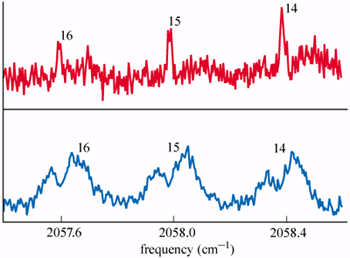
The drops are analysed using an infrared laser as they travel from the source to a quadrupole mass spectrometer. The detector signal decreases markedly when the wavelength of the laser is tuned so that the droplets readily absorb the photons. A variety of different modes of the OCS molecule can, in principle, be excited. Of particular interest are the rotational states of the OCS-parahydrogen complex. If the complex rotates as a whole, it has a relatively large moment of inertia. However, if the parahydrogen layer becomes superfluid, it largely decouples from the OCS, so that its net moment of inertia falls to almost zero.
Examples of the spectra obtained using the two types of droplets at different temperatures are shown in figure 2. In each case, the spectra are almost identical for droplets containing different numbers of parahydrogen molecules. However, the shapes of the spectra at the two temperatures are totally different. The sharp peaks at 0.38 K are related to rotation of the complex, and their absence at 0.15 K strongly suggests that rotation is no longer being excited. The most likely explanation is that the moment of inertia of the OCS-parahydrogen complex has fallen to a very small value at 0.15 K because the onset of superfluidity in the hydrogen at some temperature between 0.38 K and 0.15 K has caused it to decouple from the OCS.
When the experiment was repeated with deuterium in place of the hydrogen, the sharp peaks still persisted at 0.15 K, indicating an absence of superfluidity in deuterium at this temperature. Toennies and co-workers have carried out several checks and simulations, and all of these seem to confirm the central conclusion that parahydrogen is a superfluid at 0.15 K.
How does this result relate to more conventional types of experiment? It should be emphasized that superfluidity in a shell containing about 15 hydrogen molecules does not necessarily mean that the phenomenon will ever be observed in bulk liquid. Indeed, it probably will not, due to the difficulty of maintaining the liquid state at low enough temperatures. But the results for droplets seem to have given us a new superfluid, presumably quite different from the liquid heliums with which low-temperature physicists are so familiar. It will be an interesting challenge to find ways of studying superfluid parahydrogen in order to establish its properties.
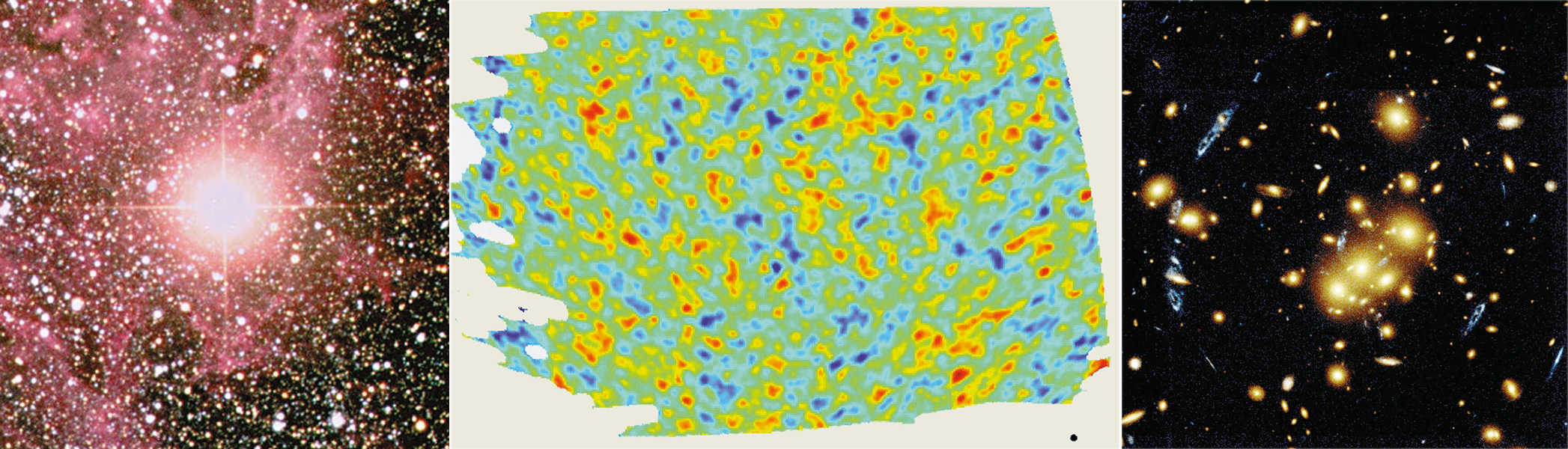
Data from observations and experiments – such as measurements of supernovae (left), the cosmic microwave background (centre) and gravitational lensing – have convinced cosmologists that about two-thirds of the energy in the universe is ‘dark’.
A revolution is taking place in cosmology. New ideas are usurping traditional notions about the composition of the universe, the relationship between geometry and destiny, and Einstein’s greatest blunder. As numerous observations and experiments reshape the field, many cosmologists are exploring the possibility that the vast majority of the energy in the universe is in the form of a hitherto undiscovered substance called “quintessence”.
Quintessence has the striking physical characteristic that it causes the expansion of the universe to speed up. Most forms of energy, such as matter or radiation, cause the expansion to slow down due to the attractive force of gravity. For quintessence, however, the gravitational force is repulsive, and this causes the expansion of the universe to accelerate.
The name has historical precedents. In philosophy, quintessence refers to the fifth element – after air, earth, fire and water – proposed by the ancient Greeks to describe a sublime, perfect substance. In literature, Quintessence is the queen of a land of speculative science in Rabelais’ Gargantua.
In cosmology, quintessence is a real form of energy distinct from any normal matter or radiation, or even “dark matter”. Its bulk properties – energy density, pressure and so forth – lead to novel behaviour and unusual astrophysical phenomena. So far its existence has only been inferred indirectly from a range of observations, but a number of current and planned experiments will make direct searches for this elusive form of energy.
Although cosmological quintessence bears some superficial resemblance to the historical version, there is plenty of substance in the modern invocation of this classical name.
Geometry is destiny, or is it?
Some 15 billion years ago, the universe was filled with a hot, dense, uniformly distributed gas of matter and radiation. Over the intervening years, space has been stretching, and as the gas has expanded to fill the growing volume, the matter has condensed to form atoms, molecules, planets, stars, galaxies and everything else we see in the universe today. But where is all this going?
According to Einstein’s equations, the expansion of the universe is governed by the amount and type of energy in the universe, and by the geometry of space. Until recently, big-bang cosmologists assumed that almost all of the energy in the universe today consists of the mass energy (E = mc2) of the matter contained within.
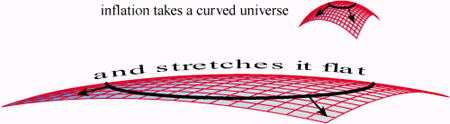
1 Inflation A schematic illustration that shows how inflation an extremely short period of hyperexpansion in the very early universe smooths out inhomogeneities and stretches the curvature scale so that the geometry of the universe effectively becomes flat after inflation.
As for geometry, space may be flat and obey the laws of Euclidean geometry, or it may be curved. The curvature may be negative, in which case parallel light beams diverge and the universe is open; or it may be positive, in which case the beams ultimately converge like lines of longitude on a globe and the universe is closed.
As the universe expands, the matter spreads out, with its density decreasing in inverse proportion to the volume. The strength of the curvature effect decreases less rapidly, as the inverse of the surface area. So, in the standard picture of cosmology, geometry ultimately gains control of the expansion of the universe.
In a flat or open universe, the expansion continues forever, albeit at an ever-decreasing rate because of the gravitational self-attraction of the matter. In a closed universe, on the other hand, the expansion eventually comes to a halt and the universe starts to contract. In this standard picture, the universe is decelerating in all cases, and its ultimate fate is decided by the choice of geometry.
But perhaps the geometry is not a free choice. In the 1980s Alan Guth of the Massachusetts Institute of Technology introduced the inflationary theory of the universe to address a number of flaws in the standard big-bang picture (see further reading). According to the inflationary concept, the universe underwent a fantastic burst of hyperexpansion during the first instants after the big bang, stretching unimaginably faster than the conventional picture would predict. This hyperexpansion can explain why energy is spread so uniformly throughout the universe and how tiny deviations from perfect uniformity can arise. These deviations eventually led to the formation of galaxies and large-scale structure.
A by-product of hyperexpansion is that the geometry of the universe is ironed out (figure 1) and space is made extraordinarily flat. Since the geometric effect on the expansion today is negligibly small, matter alone accounts for the current expansion rate. Therefore, by measuring the expansion rate, the matter density can be predicted from general relativity to be approximately 10-29 grams per cubic centimetre. This value is known as the critical density, rhocritical = 3H02/8¼G, where H0 is the Hubble constant (which is closely related to the expansion rate) and G is the gravitational constant. Cosmologists could go to sleep at night knowing that inflation had tamed the geometry, determined the matter density, and decided the fate of the universe: space expands forever at an ever-decelerating rate.
Three new discoveries
In the last decade, three new discoveries have awoken cosmologists to the possibility that one of their key assumptions about the composition and behaviour of the universe might be wrong (see Bahcall et al. in further reading). While evidence for a flat universe and the inflationary theory has grown, a new element that breaks the chain of logic between inflation, geometry and destiny has been added. That element is “dark energy”.
First, a census of the total matter density of the universe has revealed that it adds up to considerably less than expected. Cosmologists have known for decades that the sum of all the ordinary or “baryonic” matter – that is all the matter made of protons and neutrons – is only about 5% of the critical value predicted for a flat universe. Numerous measurements, dating as far back as the 1930s, have indicated that there must be other invisible or “dark” matter in the universe, to explain, for example, how stars remain in rapid orbit around galaxies and how galaxies orbit around galaxy clusters.
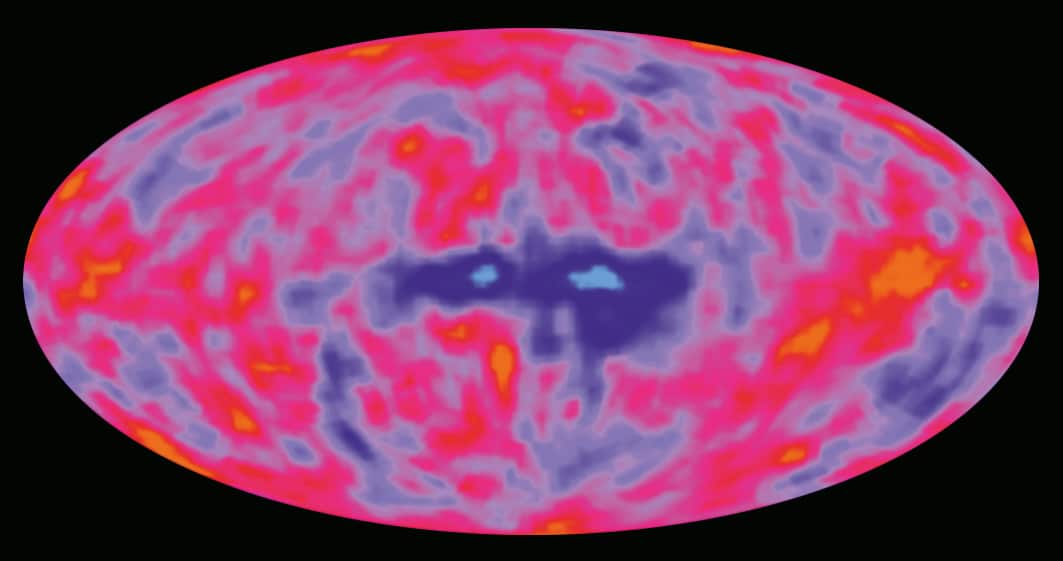
2 The cosmic microwave background Measurements of the cosmic microwave background (CMB) by the COBE satellite in 1992 strongly supported the predictions of the inflationary model. Recent, more detailed, measurements of the CMB provided evidence for a flat universe (see figure 3).
This dark matter might consist of exotic new elementary particles suggested by various unified theories of particle physics, and it might add up to the missing 95% needed to reach the critical density. However, a series of diverse measurements have converged on the common conclusion that while some “exotic” dark matter exists, it adds up to less than half of the critical density. (Some baryonic matter, such as that in asteroids or brown dwarfs in distant galaxies, does not shine and is therefore “dark”, but its density in insignificant compared with exotic dark matter.)
One of the simplest observational methods takes advantage of the fact that galaxy clusters, the largest objects in the universe, contain a fair sample of the relative proportions of dark matter and baryons. The ratio of cosmological dark matter to baryonic matter can be inferred from the gravitational mass of the cluster (that is the sum of the baryonic and dark matter) and its luminosity (which is determined by just the baryonic or ordinary matter). Knowing that baryonic matter accounts for at most 5% of the critical density, astronomers expected the clusters to contain at least 20 times as much dark matter as ordinary matter. However, the observed ratio is only about ten to one. Therefore, the total amount of matter of all kinds in the universe is less than half the critical density.
Confidence in inflation and its prediction of a flat universe might have been shaken if not for the emergence in the early 1990s of precise measurements of the cosmic microwave background that strongly supported the inflationary predictions (see figure 2). The microwave background is a bath of radiation emitted when the universe was just 300 000 years old and the hot plasma of electrons and protons condensed to form the first atoms – leaving behind hydrogen, helium and traces of other elements, as well as photons – in an event known as recombination.
These photons, now observed at microwave and radio frequencies, have an average energy that corresponds to a black-body spectrum of temperature T = 2.726 K. Most remarkably, as one scans across the sky there are slight variations in the temperature at the level of 1 part in 105. These fluctuations are due to the varying conditions in the distribution of matter that existed at recombination. In effect, these microwave-background photons provide a snapshot of the inhomogeneities in the dust and radiation that later collapsed to form clusters and galaxies.
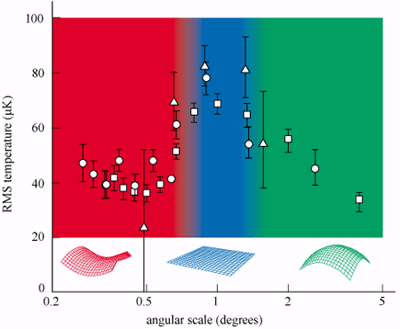
3 The flat universe Fluctuations in the temperature of the cosmic microwave background plotted as a function of angle for three experiments: MAT/TOCO (triangles), BOOMERANG (squares) and MAXIMA (circles). The position of the peak in this spectrum depends on the geometry of the universe. (The height of the peaks in the three datasets are different due to instrument-calibration effects.) Recent observations confirm that the peak occurs at the position predicted for a flat universe (blue). In an open universe the peak would be to the left (red), and in a closed universe it would be on the right (green).
Inflation provides a very specific, detailed prediction about the pattern of hot and cold patches on the sky: it predicts how many patches there should be of each angular size, how much hotter or colder than the average temperature they should be, and so forth. The most important prediction is the angular scale of the hottest and coldest patches.
These hot and cold spots are due to photons climbing out of the most overdense and underdense regions at recombination. The characteristic size of these regions can be calculated, based on the Jeans length (which is determined by the balance between gravity and pressure) at recombination.
The relationship between the physical size and the apparent angular size as observed on the sky depends crucially on the geometry of the space-time. If the universe is flat, the spots subtend an angle of about 1º on the sky. However, negative spatial curvature makes the apparent size on the sky smaller, while positive curvature makes it larger. In 1999 the ground-based MAT/TOCO experiment observed the stunning result that the hottest and coldest spots are at just the angular size consistent with a flat, Euclidean geometry (figure 3). This was later confirmed with better precision by the balloon-based BOOMERANG and MAXIMA experiments (see further reading and Physics World July 2000 pp23-24).
Dark energy and the accelerating universe
How can it be that the matter density is only one-third of the critical value, yet the universe is flat? Does this mean that Einstein’s general theory of relativity is wrong? Most likely not. By the mid-1990s, based on the results of various observations, several groups, including Jeremiah Ostriker of Princeton University and one of the authors (PJS), foresaw the problem and pointed to its resolution (see further reading). The missing two-thirds of the critical density might consist of an exotic form of “dark energy”, quite distinct from dark matter in that it does not cluster under the influence of an attractive gravitational force to form galaxies and large-scale structure. Hence, the total energy density could add up to the critical value, consistent with the evidence for a flat universe, but any census of the matter density would only find one-third of the critical value.
This proposal seemed to fit all the existing data beautifully, resolving many of the discrepancies associated with previous models. However, the proposal also made a shocking prediction. Although dark energy accounts for two-thirds of the energy density in the universe today, it must have been an insignificant fraction just a short time ago, otherwise its gravitational influence would have made it almost impossible for ordinary matter to form the stars, galaxies and large-scale structure that we see in the universe today.
It follows that any form of energy that dominates today, but was insignificant in the recent past, must have a density that decreases much more slowly with time than the matter density. That is, as the expanding universe doubles in volume and the matter density decreases by a factor of two, the density of this dark energy must decrease by a smaller factor. According to Einstein’s equations, dark energy with this property is quite possible, but it must have an unusual property – it must be gravitationally self-repulsive.
Unlike normal matter, this self-repulsive dark energy will cause the expansion of the universe to accelerate. If the dark-energy proposal was correct, therefore, the universe should be accelerating today – a prediction that ran contrary to the accepted wisdom, and data, at that time.
Then, in 1998, two independent groups – the Supernovae Cosmology Project and the High-Z Supernova Search – announced a spectacular result based on significantly more precise measurements of cosmic expansion. Their observations of the brightening and dimming of distant type 1a supernovae revealed that the expansion of the universe is in fact accelerating (see further reading).
Their findings relied on the discovery that there is a relationship between the intrinsic brightness of a supernova and the rate at which it brightens and dims. Having determined the brightness of a supernova by measuring its “light curve” (i.e. how the observed brightness varies with time), the observed flux of photons is used to determine the physical distance to the supernova. Then, by comparing the distance with the redshift (which tells us how fast the supernova is moving away from us), the expansion history of the universe is reconstructed, one supernova at a time. An analogy can be made with mileposts viewed from a moving vehicle: the rate at which the mileposts pass by and recede tells us how fast the vehicle is moving.
The measurements indicate that the distant supernovae are dimmer than they ought to be if the universe was expanding at a steady pace. Exhaustive efforts have been made to demonstrate that no systematic effects are confounding the measurements, such as obscuring dust or variations in the supernovae themselves, but no effects have been found so far.
For cosmologists who had been studying the issue closely, the supernova result was the last key observation to fall into place. Now it can be said that a cosmological model based on the big bang, inflationary cosmology, and a universe that is composed of one-third matter and two-thirds dark energy is consistent with all current astrophysical and cosmological measurements. For the broader scientific community and the public-at-large, the discovery that the universe is accelerating came as a stunning surprise.
Einstein’s blunder or a quintessential mystery?
Although cosmologists can be justly proud of having a model that fits a dazzling array of observations, they cannot rest for long. A new mystery immediately arises. What is the dark energy that composes two-thirds of the present energy in the universe?
One fact we know about the dark energy is that it has negative pressure: cosmic acceleration can only occur if the pressure is sufficiently negative. The reason for this is found in general relativity, which tells us that energy and momentum, and therefore pressure, all gravitate. (Indeed, the deflection of light by gravity is exploited by astronomers in the well-established technique known as gravitational lensing.) The strength of this gravitational force is determined by rho + 3P, where rho is the energy density (including all forms of energy) and P is the pressure.
Normally, the pressure is negligibly small compared with the energy density, rho, so the greater the energy density, the more attractive the force. A large energy density will therefore cause space to bend and contract around it – this is how a black hole forms. However, if rho + 3P is negative – which can happen for negative pressures – then the gravitational force is repulsive.
When we apply this to the universe, we find that a ubiquitous energy substance with negative pressure causes space to repel itself: every point in space flees from its neighbours and the cosmic expansion accelerates. The bottom line for quintessence is that its pressure must be negative enough to overcome the attractive gravitational force of all the energy density in the universe.
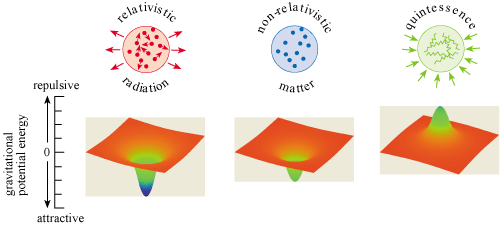
4 Positive and negative pressures According to Einstein’s general theory of relativity, the gravitational potential due to an isolated source is proportional to rho + 3P, where rho is the energy density and P is the pressure. For non-relativistic matter the pressure is negligibly small, whereas for radiation P = rho/3. Therefore, for the same value of the energy density, radiation produces a deeper and more attractive gravitational potential (left) than non-relativistic matter (centre). If rho + 3P is negative, as in the case of quintessence in this example P = 2rho/3 the sign of the gravitational field is transformed from attractive to repulsive (right).
Negative pressure may seem extraordinarily exotic, but it can actually be caused by rather straightforward physical processes. An ordinary gas composed of atoms and radiation acts like a compressed spring, pushing outwards in all directions. However, a bubble of interacting gas atoms in a metastable state (i.e. with higher energy than the surrounding gas), can act like a stretched spring under tension and exert an inward force or negative pressure.
The counterintuitive aspect is the gravitational response, which is an unappreciated feature of Einstein’s general theory of relativity (see figure 4). Filling the universe with a fluid (e.g. matter and radiation) that has positive pressure and a positive rho + 3P slows the expansion. On the other hand, a fluid with sufficiently negative pressure will have a negative rho + 3P, and this will cause the expansion to accelerate.
The other piece of information we know about dark energy is that it somehow resists the gravitational pull of galaxies. The negative pressure is sufficient to explain why dark energy is spatially uniform on average, but why don’t small inhomogeneities grow in, for instance, the dense regions at the centres of galaxies? There is not a unique answer to this question, but it seems likely that the particles composing this dark energy are so light and relativistic that nothing short of a black hole can disturb them.
Perhaps the dark energy is not made of particles at all. One candidate is vacuum energy, the energy of empty space. Einstein introduced this possibility in 1917 in his first attempt to apply his new theory of gravity to cosmology (see further reading). Einstein was convinced that the universe was static, but he could not construct a static universe if there was only matter and curvature because rho + 3P was positive. He therefore introduced an additional term to his theory, the so-called cosmological constant or Lambda. This was a form of energy with constant negative pressure P = -rho and, therefore, negative rho + 3P. By carefully choosing the amount of matter and the value of the cosmological constant, he could balance the forces to obtain a static universe. Several years later, after Hubble showed that the universe was truly expanding, Einstein described the cosmological constant as his “greatest blunder”.
Today’s cosmologists find Lambda to be just as objectionable, but for a different reason. All quantum fields possess a finite amount of “zero-point” vacuum energy as a result of the uncertainty principle. A naive estimate of the zero-point energy predicts a vacuum energy density that is 120 orders of magnitude greater than the energy density of all the other matter in the universe. If the vacuum energy density really is so enormous, it would cause an exponentially rapid expansion of the universe that would rip apart all the electrostatic and nuclear bonds that hold atoms and molecules together. There would be no galaxies, stars or life. Since we cannot ignore quantum mechanics, some other mechanism must nullify this vacuum energy. One of the major goals of unified theories of gravity has been to explain why the vacuum energy is zero.
Einstein’s blunder has been resurrected as a possible solution to the dark-energy problem. Maybe there is a miraculous cancellation mechanism, but perhaps it is slightly imperfect. Instead of making Lambda exactly zero, the mechanism only cancels to 120 decimal places. Then, vacuum energy would comprise the missing two-thirds of the critical density. The requirements seem bizarre, though. Some constant that is naturally enormous must be cut down by 120 orders of magnitude, but with such precision that today it has just the right value to account for the missing energy.
Extrapolating back in time to the early universe, the story seems even more bizarre. When the volume of the universe was 100 orders of magnitude smaller, say, the mass density was 100 orders of magnitude greater, but the vacuum energy density had to have the same value as today. In other words, the vacuum energy density remained constant as the universe expanded, but the total vacuum energy increased as the volume of space increased. This extra energy came from the gravitational potential energy of the universe. Whatever physical processes created the initial energy in the universe had to arrange for an exponentially large difference between the two forms of energy, but somehow this difference had to have exactly the right value for the vacuum energy to become important 15 billion years later.
Quintessence on track
It would seem more natural for the dark energy to start with an energy density similar to the density of matter and radiation in the early universe. The dark energy and matter density could both then decrease at similar rates as the universe expanded, with the dark energy density overtaking the matter density only after structure has formed in the universe. However, if the dark energy density has been changing, it cannot consist of vacuum energy. Therefore, the concept of quintessence was introduced to overcome this problem by ourselves and Rahul Dave, then at the University of Pennsylvania, in 1998 (see Caldwell et al. in further reading). Quintessence is a dynamic, time-evolving and spatially dependent form of energy with negative pressure sufficient to drive the accelerating expansion. Whereas the cosmological constant is a very specific form of energy – vacuum energy – quintessence encompasses a wide class of possibilities.
The simplest model proposes that the quintessence is a quantum field with a very long wavelength, approximately the size of the observable universe. Some examples had been explored almost a decade earlier by Bharat Ratra and James Peebles at Princeton University, and by Chris Wetterich at the University of Heidelberg in Germany. A particle is usually thought of as a bundle of oscillations in a quantum field, but since this bundle is much larger than any conventional length scale, the particle description is impractical.
The energy is composed of kinetic energy, which depends on the rate of oscillations in the field strength, and potential energy, which depends on the interaction of the field with itself and matter. The pressure is determined by the difference between the kinetic and potential energy, with kinetic energy contributing positively to the pressure. However, since the oscillation has an extremely long wavelength and period – essentially the size and age of the universe – its kinetic energy is negligible. The behaviour of the quintessence field is therefore dominated by how it interacts with itself. Much like a stretched spring, this self-interaction potential leads to negative pressure.
5 Tracker fields and k-essence The energy density of the matter (blue), radiation (red) and tracker fields (green) all change with time or, equivalently, redshift. If the energy is plotted on a logarithmic axis, the energy density of the radiation falls as a straight line as the universe expands. The energy density of matter also falls, at a slower rate. In the early universe the energy density of a tracker quintessence field can start from a wide range of initial conditions, which all join a common path before the matter density overtakes the radiation density at the onset of the matter era. In the case of k-essence, matter domination triggers a change in the behaviour of the tracker field that causes its energy to decrease and then freeze at a value that remains nearly constant with time. Ultimately, k-essence overtakes the matter density and initiates the cosmic acceleration.
Within certain models that seek to unify the four fundamental forces of nature there exist fields, called “tracker fields”, that can make quintessence behave in this way (see Zlatev et al. in further reading). First, the dark energy density in the early universe can be comparable with the matter density. The model is insensitive to the precise initial value because the dynamical equations that determine the time evolution of the tracker field have solutions that cause the energy to follow the same evolution, independent of initial conditions (similar to the classical attractor solutions found in conventional nonlinear dynamics). In particular, the energy density tracks the radiation and matter density (see figure 5). For most of the history of the universe, the quintessence occupies a very small fraction of the critical density, but the fraction grows slowly until it catches up with and ultimately overtakes the matter density.
It seems natural to ask if there are any direct gravitational interactions between ordinary matter and dark energy. If the dark energy is vacuum energy, then the two do not interact because vacuum energy is inert and unchanging. But if the dark energy is quintessence, they can interact under certain conditions. Ordinary particles are physically very small compared with the Compton wavelength, lambdac = h/mc, of the quintessence particles, so individual particles have a completely negligible effect on quintessence (and vice versa). However, very large clumps of ordinary matter – spread out over a region comparable with the Compton wavelength – can interact gravitationally with quintessence and create inhomogeneities in its distribution that may produce detectable signals in the cosmic microwave background.
Why now?
What cosmologists find most difficult to explain is why the acceleration should begin at this particular moment in cosmic history. Is it a coincidence that, just when thinking beings have evolved, the universe suddenly shifts into overdrive? The situation is peculiar because the energy associated with the cosmological constant or quintessence is very tiny, less than a millielectron-volt. If new ultra-low-energy physics is responsible, it should have already been observed in other experiments.
Some physicists and astronomers have proposed an anthropic argument (see Weinberg in further reading). Perhaps there is a multitude of universes, all with different values for the vacuum energy density, with larger values being more probable than smaller values. Then universes with a vacuum energy much greater than a millielectron-volt would be more probable, but they would expand too rapidly to form stars, planets or life. At the same time, universes with much smaller values are less probable. The anthropic argument would say that our universe has the optimal value. Physicists disagree about whether this kind of explanation, which makes bold assumptions about the existence of universes that can never be tested, and about the probability distribution of the vacuum energy, is an acceptable explanation.
Perhaps a more satisfying possibility is that the acceleration is triggered by natural events in the recent history of the universe. According to the big-bang model, the energy density in the universe was predominantly in the form of hot, relativistic particles until the universe was a few tens of thousands of years old. At that time, the universe had cooled enough that the mass energy of non-relativistic particles became more important than both their kinetic energy and the energy of radiation, resulting in a change in the cosmic expansion rate. This marked the beginning of the “matter-dominated epoch”. Only then could gravity begin to clump matter together to form stars, galaxies and large-scale structure. Is it possible that this transition triggered the onset of quintessence?
Tracker quintessence has a pressure that adjusts to the form of energy that dominates the universe – up to a point. When the universe is radiation dominated, the tracker field mimics radiation: the energy density falls at the same rate as the radiation energy density, and the pressure for quintessence is given by P = rho/3, the same as for radiation. When the universe becomes matter dominated, the tracker field mimics the matter, for which the pressure is nearly zero. The tracker field is able to follow the radiation and matter energy densities because the time variation of the tracker-field energy and pressure are controlled by a frictional effect, Hubble damping, that is determined, in turn, by the radiation or matter. As long as the mimicking continues, the tracker-field energy is a small fixed fraction of the total energy and the expansion decelerates.
To stop this mimicking and begin a period of acceleration, the tracker potential must possess some feature that causes the field to become locked into a nearly constant value at some later time. If the tracker field is constant, the kinetic energy is negligible compared with the potential energy, which is precisely the condition required for a negative pressure component and cosmic acceleration. The problem is that the feature of the potential that locks the tracker field must be delicately tuned so that the acceleration begins at the right time.
The tuning problem can be circumvented for a novel form of tracker field called “k-essence”, short for kinetic-energy-driven quintessence (see Armendariz et al. in further reading). In these models, the kinetic energy depends nonlinearly on the time variation of the tracker field, which causes novel dynamical features. In the early universe, when the universe is radiation dominated, these features are not evident, and the energy mimics the radiation. However, when the universe undergoes the transition to matter domination, unlike the examples discussed above, the k-essence field refuses to track the matter. At first, the field slows down and the kinetic energy density drops sharply, but it soon converges to a fixed value and begins to act as a source of negative pressure. It is then just a short time (about the present epoch) before it overtakes the matter density (which continues to fall) and drives the universe into cosmic acceleration. The crucial point is that there does not have to be some special feature in the potential energy for this to happen. Rather, it is an automatic dynamical response to the onset of matter domination.
In this picture, the fact that thinking beings and cosmic acceleration occur at nearly the same time in cosmic history is not a coincidence. Both the formation of the stars and planets necessary to support life and the transformation of quintessence into a negative pressure component are triggered by the onset of matter domination. This explanation is decidedly non-anthropic.
The quest for quintessence
Quintessence leaves its mark on the universe in several ways, so experimenters have a number of methods they can use to test for this exotic form of energy. The acceleration effect of a dark-energy component depends on the ratio of its pressure to its energy density. More negative values of this ratio, w, lead to greater acceleration. Quintessence and vacuum energy have different values of w, so more precise measurements of supernovae over a longer span of distances may be able to separate these two possibilities.
This challenge is the motivation for two proposals – the Earth-based Large-Aperture Synoptic Survey Telescope (LSST) and the space-based Supernova Acceleration Project (SNAP) – that will monitor the sky for supernovae and other time-varying astrophysical phenomena. The proposers of these projects are currently seeking funding.
Cosmic acceleration also affects the number of galaxies to be found as one explores deeper and deeper into space. With appropriate corrections for evolution and other effects, the average density of galaxies is uniform throughout space. Consequently, for a fixed range of distances, one should find the same number of galaxies nearby and far away. But cosmologists measure the redshift of distant galaxies, not their distance. The conversion from redshift to distance follows a simple linear relation (the Hubble law) if the distances are small, but a nonlinear relation depending on the acceleration of the universe if the distances are large. The nonlinear relation will cause the number of galaxies found for a fixed range of redshifts to change systematically as one probes deeper into space. The Deep Extragalactic Evolutionary Probe (DEEP), an advanced spectrograph on the Keck II telescope in Hawaii, is poised to test this prediction with an accuracy that may be sufficient to distinguish between quintessence and a cosmological constant.
Quintessence should also have an effect on the cosmic microwave background because differences in the acceleration rate will produce small differences in the angular size of hot and cold spots. Moreover, unlike a cosmological constant, quintessence is not spatially homogeneous. Small variations in the amount of quintessence across the sky should be seen as ripples in the microwave background temperature. Measurements by the MAP and Planck satellites (launch dates 2001 and 2007, respectively) may be able to detect these effects, which will be at the level of a few per cent, although it will be difficult to separate them from other effects.
In many cases, quintessence interacts with matter in a way that affects the forces between particles. Then, if the quintessence field is varying temporally or spatially, it will cause the strengths of the forces between particles to change as well. Hence, ongoing tests for changes in the values of the fundamental physical constants with time could be another source of evidence for quintessence. It might be possible to search for such effects with astrophysical observations (e.g. a variation of hyperfine splitting with redshift) or in ultrahigh-precision laser-spectroscopy experiments.
Cosmic destiny revisited
The revolution in cosmology, driven by observations and experiments, has changed more than our understanding of the composition of the universe – it has changed our expectations for the future. Quintessence, a sublime substance, may permeate the universe, marking an end to the epoch that saw the formation of stars and galaxies, and the beginning of an epoch of cosmic acceleration. In the short term, space will stretch ever faster, and galaxies will fly apart from one another, leaving a colder, emptier universe. As for the ultimate fate of the universe, the nature of quintessence, not geometry, will be the determining factor.
The universe may accelerate forever, or the quintessence could decay into new forms of hot matter and radiation that could repopulate the universe with new structure. The various experiments described above will provide key tests of the quintessence hypothesis and supply new information about the future of the universe. To obtain a more definitive answer, however, physicists will have to understand how quintessence fits within the fabric of the still-elusive unified theory of all the fundamental forces.