The radiation oncology department at Kuopio University Hospital (KUH) in eastern Finland has, for more than a decade, been treating the overwhelming majority (>98%) of its cancer patients, across diverse disease indications, using a proven combination of volumetric modulated-arc therapy (VMAT) plus daily low-dose cone-beam CT for image guidance. Zoom in a little further and it’s evident that an innovative variation on the VMAT theme – known as tangential VMAT (tVMAT) – is similarly established as the go-to treatment modality for adjuvant breast radiotherapy at KUH.
That reliance on tVMAT, which employs beam angles tangential (rather than perpendicular) to the curvature of the chest wall, is rooted in clinical upsides along multiple coordinates. Those advantages include highly conformal dose distributions for enhanced coverage of the target volume; reduced collateral damage to normal healthy tissues and adjacent organs at risk (OARs); as well as improved treatment delivery efficiency – think streamlined treatment times and lower integral dose to the rest of the body – compared with fixed-gantry intensity-modulated radiotherapy (IMRT).
Enabling technologies, clinical efficacy
If that’s the headline, what of the back-story? The pivot to a tVMAT workflow for breast radiotherapy began in 2013, when the KUH radiation oncology team took delivery of three Elekta Infinity linacs, simultaneously installing Elekta’s Monaco treatment planning system (six workstations). The KUH treatment suite also includes an Accuray CyberKnife machine (for stereotactic radiosurgery and stereotactic body radiotherapy) and a Flexitron brachytherapy unit (used mainly for gynaecological cancers).
With an addressable regional population of 250,000, the KUH radiotherapy programme sees around 1500 new patients each year, with adjuvant radiotherapy for breast cancer comprising around one-fifth of the departmental caseload. Prior to the roll-out of the Elekta linac portfolio, KUH performed breast irradiation using a 3D conformal radiotherapy (3D CRT) field-in-field technique (with planar MV imaging for image guidance integrated on the treatment machine).
The use of 3D CRT, however, is not without its problems when it comes to whole-breast irradiation (WBI). “With the field-in-field technique, there were planning limitations for WBI related to hot and cold spots in the planning target volume [PTV],” explains Jan Seppälä, chief physicist at KUH, where he heads up a team of six medical physicists. “In some cases,” he adds, “target coverage was also compromised due to heart or lung dose constraints.”
Fast-forward and it’s clear that the wholesale shift to tVMAT with daily cone-beam CT imaging has been a game-changer for adjuvant breast radiotherapy at KUH. Although the clinical and workflow benefits of conventional VMAT techniques are also accrued across prostate, head-and-neck, lung and other common disease indications, Seppälä and colleagues have made breast-cancer treatment a long-term area of study when building the evidence base for VMAT’s clinical efficacy.
“We have found that, with proper optimization constraints and beam set-up in the Monaco treatment planning system, tVMAT can reduce doses to the heart, coronary arteries and ipsilateral lung,” Seppälä explains. “The technique also enhances dose distributions greatly – reducing hotspots, improving target-volume dose coverage, while avoiding high-dose irradiation of healthy tissue as well as a low dose bath.” All of which translates into fewer reported side-effects, including breast fibrosis, changes in breast appearance, and late pulmonary and cardiovascular complications.
Jan Seppälä “With tVMAT, we have much less skin toxicity than we used to have with previous 3D CRT techniques.” (Courtesy: KUH)
Operationally, the total treatment time for breast tVMAT – including patient set-up, cone-beam CT imaging, image matching and treatment delivery – is approximately 10 minutes without breath-hold and about 15 minutes with breath-hold. The average beam-on time is less than two minutes.
“We use daily cone-beam CT image guidance for every patient, with the imaging dose optimized to be as low as possible in each case,” notes Seppälä. The cone-beam CT highlights any breast deformations or anatomical changes during the treatment course, allowing the team to replan if there are large [>1 cm] systematic changes on the patient surface likely to affect the dose distributions.
It’s all about outcomes
Meanwhile, it’s clear that toxicity and cosmetic outcomes following breast radiotherapy have improved greatly at KUH over the past decade – evidenced in a small-scale study by Seppälä’s team and colleagues at the University of Eastern Finland. Their data, featured in a poster presentation at last year’s ESTRO Annual Meeting, provide a comparative toxicity analysis of 239 left- or right-sided breast-cancer patients, with one cohort treated with tVMAT (in 2018) and the other cohort treated with 3D CRT (in 2011).
In summary, the patients treated in 2018 with the tVMAT technique exhibited less acute toxicities – redness of skin, dermatitis and symptoms of hypoesthesia (numbness) – versus the patients treated in 2011 with 3D CRT. Late overall toxicity was also lower, and the late cosmetic results better, in the 2018 patient group. “With tVMAT,” says Seppälä, “we have much less skin toxicity than we used to have with previous 3D CRT techniques. What we are still lacking, however, is the systematic and granular capture of patient-reported outcomes or daily images of the patient’s skin after each fraction.”
For Seppälä, comprehensive analysis of those patient-reported quality-of-life metrics is the “missing piece of the jigsaw” – and, ultimately, fundamental to continuous improvement of the tVMAT treatment programme at KUH. A case in point is the ongoing shift to ultra-hypofractionation treatment schemes in breast radiotherapy, with some KUH patients now receiving as few as five fractions (x5.2 Gy) as opposed to 15 (x2.67 Gy) fractions per the norm to date.
To support this effort, work is under way to evaluate the clinical implementation of Elekta ONE Patient Companion, powered by Kaiku Health, a system providing patient-reported outcomes monitoring and intelligent symptom-tracking for cancer clinics. “This software tool would enable us to capture real-world outcome data directly from patients,” says Seppälä. “Those data are key for quantifying success, such as the correlation of cosmetic outcomes with a change in fractionation scheme.”
Meanwhile, machine-learning innovation is another priority on KUH’s tVMAT development roadmap, with the medical physics team in the process of implementing AI-based dose predictions to inform treatment planning on an individualized patient basis. The driver here is the push for more unified, standardized dose distributions as well as workflow efficiencies to streamline patient throughput.
“We are doing some treatment planning automation – mainly on the optimization side,” Seppälä concludes. “The challenge is to push the optimization system to its limit to ensure low doses to critical structures like the heart and ipsilateral lung. By doing so, we can deliver at-scale enhancements to the overall quality and consistency of our treatment planning in Monaco.”
We are in the midst of a quantum renaissance, with researchers in academia and industry all vying to “win” the quantum computing race. The quantum marketplace is booming, with scores of companies, large and small alike, investing in this technology, backed by huge government funding across the globe.
In this wide-ranging interview, Paternostro talks to Tushna Commissariat about his views on the quantum landscape – from the “four pillars” of quantum technology and hybrid architectures to the promising marriage between quantum tech and artificial intelligence (AI). Paternostro also underlines the need for continued government funding to realize the true potential of this world-changing technology.
We’ve seen the quantum bubble blow up over the last decade, but what are the potential advantages and risks of the exponential expansion in quantum technology companies and funding around the world?
Overall, the picture is very positive. Quantum information processing needed a boost from industry, as firms can push for the more pragmatic developments that the field needs. The perspective that industry offers is helping to shape quantum technologies in a more focused manner, when it comes to overall goals. The budding, exploding market – be it in industry or academia – is great.
But, as you point out, there has been a swift growth. And while that is mostly a good thing, there is also a little bit of worry that we might be creating create a big bubble that will burst sooner rather than later. So I think it’s a matter of control – we do need to somewhat restrain ourselves, while allowing the research area to grow organically.
I am slightly concerned with the number of small companies that all seem to be developing their own quantum software. Their products have very little to do with true quantum algorithms and are typically classical optimization solutions – which have their own merits. But they are not necessarily what I would call a quantum framework.
On the other hand, some spin-off companies are more oriented towards the implementation of quantum processing platforms, such as quantum sensors. These are really interesting, as it’s not just quantum computation at play, but also other physical laws.
There are four pillars underpinning the developments of quantum technology: quantum computing; quantum simulation; quantum communication; and quantum sensing and metrology. And I would say that all four are developing in a very healthy way.
Quantum sensing seems to be one of the most advanced, together with communication thanks to the maturity of the technologies they can leverage. While the involvement of industry is beneficial and promising, we should be wary of the wild speculation and “inflation” that comes from trying to jump onto a fast bus, without having the full fare for the ride at hand.
And while I am often sceptical of smaller companies, you also sometimes get concerning news from the big players. For example, Chinese tech firm Alibaba had an interest in developing quantum computing platforms and solutions, until it suddenly decided to close its in-house quantum team at the end of last year, stating it would rather focus on being a leader in AI research.
Was this simply a business decision, or is Alibaba smelling something that we have not yet smelled? I guess we will have to wait and see. Overall, I think the future is bright and the involvement of industry is very good news.
There are a number of different quantum-computing technologies vying for top spot – from trapped ions and quantum dots to superconducting and photonic qubits. Which do you think is most likely to succeed?
I’m sort of an agnostic, in that I don’t believe that the first quantum device we build will be fully quantum. I know for some this is a controversial take, but it’s an opinion shared by many others in my field. What I think we will end up with is a hybrid architecture, where the best of high-performance computing (HPC) will interface with quantum-computing architectures.
Maybe these noisy intermediate-scale quantum (NISQ) architectures will be joined by a full-fledged HPC architecture that will boost their performance, or vice versa. The quantum resources put on the table by this sort of hybrid device will enhance the performance that current classical HPC can produce. I strongly believe in the feasibility of that sort of hybrid architecture – a fully quantum solution is still a long way from where we are now.
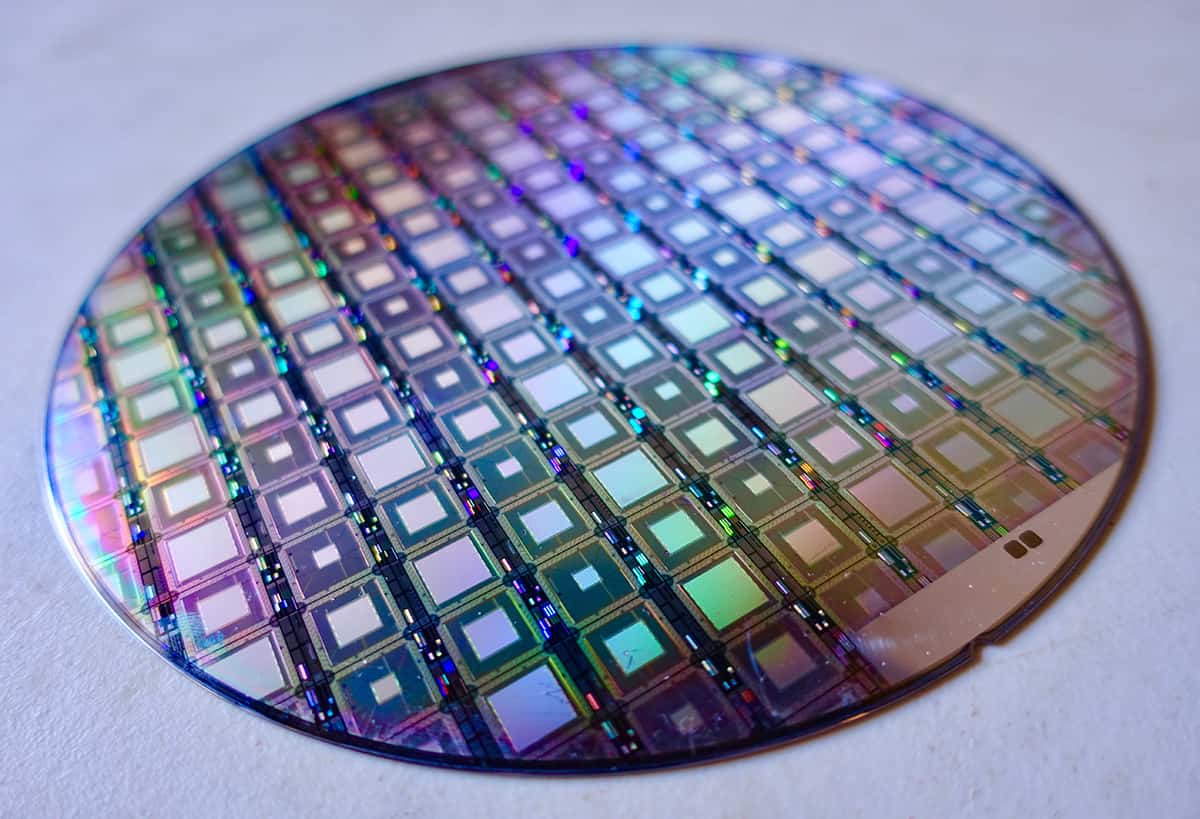
Tech triumph A wafer full of quantum processors from D-Wave, a Canadian quantum-computing company. (CC BY 2.0 Steve Jurvetson)
Also, I’m not entirely convinced that we will have the ability to manage the massive resources that would be needed to make full use of the gap in computational power that a quantum computer would offer. A medium-term goal aiming for this hybrid HPC quantum architecture will be a much more realistic – and potentially very fruitful architecture – to pursue. I’m mildly optimistic that something will come up in my lifetime.
You mentioned that quantum sensors are already being developed for a wide variety of applications including healthcare, construction and even gravity measurement. What’s new and exciting in that area?
Quantum sensors are developing amazing capabilities to investigate mechanisms that so far have been elusive. Essentially, these sensors help us to better detect the potential quantum effects of forces like gravity, which many researchers in the UK have an interest in pursuing. A substantial fraction of the experimental community is pursuing these goals – with the University of Birmingham’s quantum hub leading on this front.
I don’t think that anyone claims that there is a winning experimental platform to pursue – both cold atoms and optomechanics are some of the most promising ones in that respect. But the theoretical and experimental progress that this area has achieved is very interesting.
Sensors that can probe the fundamental nature of elusive physical mechanisms will, I believe, be a key development. And then there are other sensing devices, such as accelerometers or imagers that are already pretty well established. The UK’s National Quantum Technologies Programme has already made significant advances in that regard, and the technology is available and mature enough to have a real impact.
I think industries should heavily invest in this area because, alongside communication, sensing is at the forefront of the implementations of quantum technologies at this stage.
Quantum communication is probably the most concrete example where academic progress has been put to work, to the benefit of industry-led targets. It’s been an absolutely superb example of what we can achieve when these two components work together.
While the progress has been fantastic, there are also controversial aspects, especially when we consider the larger geopolitical implications of a global quantum network. The issue of communication and data security will become significant, so we must carefully consider the wider implications of these technological developments. Geopolitical boundaries are continually changing, and their aims are not always concurrent with scientific goals.
What are some key areas where AI and quantum technologies intersect? Where do they best help one another, and what are potential issues?
This is a very important question. Needless to say, the holy grail for both areas is very close – both AI and quantum computation are based on the development of new algorithms. One hears people talking about quantum machine learning (ML), or quantum AI, but that’s not what they really mean. They are not referring to specifically designed quantum algorithms for AI or ML problems. What they mean is the hybridization of classical machine learning or classical AI with quantum problems.
These solutions will depend on the field and the problem we are trying to tackle. But in general we are looking at classical techniques for processing data sets; optimizing problems; solving cost functions; and controlling, optimizing and manipulating quantum problems.
It’s very promising, as you’re putting together the best of the two worlds. From a theoretical point of view, the aim is to tackle questions at the general quantum-mechanical level that need to be addressed, and perhaps the larger and more complicated problems in terms of scale. We want to build tools at the algorithmic level that allow you to cope with the complexity of those problems in a certifiable and consolidated manner.
And the interesting thing is that experiments have started catching up with the theoretical developments. We already have a number of solutions, approaches and methodologies that have been developed in this hybrid scenario where ML and quantum information processing come together.
I hope these experiments are fully investigated in the next few years, and don’t get caught up if the AI and quantum bubble does burst. I doubt that would be the case though, because AI is here to stay, while ML is now an unmissable tool used by data analysts worldwide. If we have any ambition to scale up the complexity of the problems that we can and should tackle, then we must focus on developing these tools.
What new initiatives are going on in this area?
Earlier this year, UK Research and Innovation (UKRI) announced that it is funding nine new research hubs to “deliver revolutionary AI technologies” to tackle complex problems from healthcare to energy as well as 10 other studies to define “responsible AI”. I know that a number of these have a quantum component – especially in healthcare, where AI-based solutions are absolutely fundamental, but there may be quantum solutions as well.
So I’m very optimistic when it comes to the merger of AI and quantum tech, as long as the development of an AI framework is regulated. Right now, the European Commission is formulating the legal framework for its AI Act, which will address the risks that AI might pose, and the global role the EU hope to play in regulating the technology. Both the UK and the US have been working on similar frameworks for a while already, so we should have some global policy and regulation formulated, sooner rather than later.
As long as this development follows a regulated policy with solid framework, AI’s interactions with quantum technologies should create a useful two-way feedback mechanism that will help both fields grow significantly.
When it comes to quantum-technology funding by governments across the global stage, what specific areas would you like to see further investment in?
My grants! But on a more serious note, government-level investment has been widespread and substantial for what is essentially still an emerging scientific field. Compared with some other areas that receive science funding, such as military or medical research, the amount of money that has been put on the plate is almost ridiculous – but it’s a very good thing for us of course. A benefit of this kind of government spending is that it forces us to form a community and come up with shared goals.
If we refer to the aforementioned four pillars, there is an underlying connection of fundamental physics and theoretical developments. Different countries have chosen one or more pillar to focus on, depending on their expertise and resources. The US is very focused on computation. The EU is more widespread and so the situation is more complex, but there is major investment in communications, as well as a growing interest in simulation, while a number of EU national strategies are also focused on sensing.
Quantum expertise A research scientist with IBM Quantum in the lab with a large quantum system built by the firm. (Courtesy: IBM)
The UK is also trying to cover the whole spectrum, but identifying some very well-defined topics, from imaging to computation, and from communication to sensing. There are countries like Finland that have a more experimental approach and are focused on superconducting architectures, as they already have huge facilities available. Singapore, on the other hand, is developing a very strong line of research in satellite-based quantum communication. For a small country, it has huge potential, in terms of both talent and resource.
So different countries have developed their own area of expertise, in an organic manner. And by doing so, we are all winning as a community – we are all benefiting from all the progress that has been made. Some baby steps, some more incremental steps, some huge quantum leaps.
I think it will be really important that governments, national and super national, realize that investment in quantum technologies should be sustained. It’s an area that needs continuous, unbroken support to deliver its lofty goals. And we, as the scientific community, must project a coherent picture with the very same set of goals, despite any differences we have. Only then will we be best placed to translate quantum technologies to life-changing realities.
It’s a big honour, and I’m absolutely flattered, but it’s also a big endeavour, given the evolving landscape of quantum-related journals. What I want for the journal is to make sure that QST remains one of the preferred avenues for the submission of top-notch contributions. But I also want to help shape the journal’s manifesto and its goals.
My first priority as editor-in-chief has therefore been to set up an executive board that along with the support of the editorial board will shape the scope and mission of the journal in a clear manner. And that will then inform the way the journal will develop over the next few years, guided by the quantum research community. In terms of the scope, I would like to see more high-quality experimental updates that push the envelope of the implementation of quantum technologies.
IOP Publishing has a transformative agreement (TA) with your institution, in terms of open-access publishing. Can you tell me about that?
I think it has been a game-changing agreement as far as the publication of our output is concerned. With the stringent criteria that the research councils have put on outputs supported by grants – from the Engineering and Physical Sciences Research Council (EPSRC) for instance – and the need for them to be fully accessible, and data to be fully available to the community, having a TA that guarantees open access is what we need. It’s great to have the peace of mind that IOP Publishing is a viable avenue for where my EPSRC-compliant outputs can be published.
Apart from funding compliance, the IOPP agreement removes the administrative burden of dealing with invoices for the article publication charges (APCs) which is a big relief for the scientists. I have been advocating for broadening the initiative – by establishing similar agreements with other publishing companies – but also making sure that this is not a one-off experiment that fades away in the next year or so. We should make it systemic to the way institutions across not only UK, but as far as I’m concerned, Europe are involved. It should be encapsulated right from the start, in the way higher-education institutions and research institutes are operating. Making sure there is a synergy between publishing companies and universities or research institutes is crucial.
Researchers at the Dutch quantum institute QuTech in Delft have announced plans to build Europe’s first 100-quantum bit (qubit) quantum computer. When complete in 2026, the device will be made publicly available, providing scientists with a tool for quantum calculations and simulations.
The project is funded by the Dutch umbrella organization Quantum Delta NL via the European OpenSuperQPlus initiative, which has 28 partners from 10 countries. Part of the 10-year, €1bn European Quantum Flagship programme, OpenSuperQPlus aims to build a 100-qubit superconducting quantum processor as a stepping stone to an eventual 1000-qubit European quantum computer.
QuTech was set up in 2015 by Delft University of Technology (TUD) and the Netherlands Organisation for Applied Scientific Research (TNO). It has spawned numerous spin-off firms, with the chips being developed by QuantWare, cryogenic cabling from Delft Circuits, control software from Qblox, and software from Orange Quantum Systems. TNO will work on the web interfaces and TUD will integrate the various systems.
Quantum Delta NL says the 100-qubit quantum computer will be made publicly available via a cloud platform as an extension of the existing platform Quantum Inspire that first came online in 2020. It currently includes a two-qubit processor of spin qubits in silicon, as well as a five-qubit processor based on superconducting qubits.
Quantum Inspire is currently focused on training and education but the upgrade to 100 qubits is expected to allow research into quantum computing. Lead researcher from QuTech Leonardo DiCarlo believes the R&D cycle has “come full circle”, where academic research first enabled spin-off companies to grow and now their products are being used to accelerate academic research.
Spectral phase-contrast tomography Three-dimensional rendering of a contrast-perfused mouse sample using three decomposition channels: water (soft tissues, blue), iodine (vasculature, red) and calcium (bones, white). (Courtesy: CC BY 4.0/Phys. Med. Biol. 10.1088/1361-6560/ad3328)
The introduction of photon-counting detectors into CT scanners paved the way for the rise of spectral CT in clinical settings. Such systems employ two or more X-ray energies to create material-specific 3D maps. But since spectral CT is based on X-ray attenuation, it exhibits low contrast when imaging weakly absorbing materials such as biological tissues. As such, high-Z contrast agents are often employed to highlight structures of interest.
In parallel, X-ray phase-contrast imaging is becoming more widely available and gaining attention for both pre-clinical and clinical applications. Phase-contrast techniques, many of which can produce both attenuation and phase-shift maps, offer higher visibility of low-Z materials such as soft tissues.
“Spectral CT has proven effective in a range of applications, from material quantification to image-artefact reduction, while phase-contrast imaging boasts superior visualization of soft and microstructured tissues,” says Luca Brombal from the University of Trieste and INFN. “Building on these bases, we sought to leverage the combined strengths of both techniques.”
Brombal and colleagues, also from University College London, demonstrated the first integration of spectral and phase-contrast CT using a tomographic edge-illumination setup. The project, described in Physics in Medicine & Biology, involved developing an imaging setup that can acquire data with both spectral and phase-contrast properties, alongside the implementation of a material decomposition model.
“The benefits of the combined spectral phase-contrast approach are the possibility to simultaneously produce three mass density maps of specific elements or compounds in the sample, while improving the signal-to-noise ratio, especially of the soft-tissue component, due to phase sensitivity,” Brombal explains.
Material decomposition
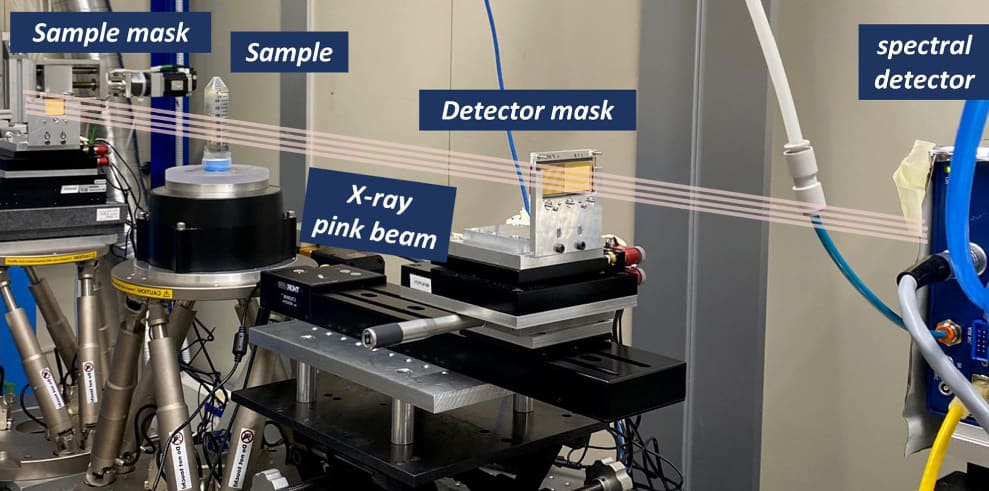
The team used an edge-illumination phase-contrast set-up, in which masks placed either side of the sample shape the incident X-ray beam and selectively block the detector. A reference illumination curve is created with no sample in place. Once the sample is inserted, this curve is attenuated and laterally displaced, changes that are then used to retrieve attenuation images and calculate the sample-induced phase shift.
Experimental setup The main components of the experiment at the Elettra synchrotron facility’s SYRMEP beamline. (Courtesy: CC BY 4.0/Phys. Med. Biol. 10.1088/1361-6560/ad3328)
For this study, the researchers employed synchrotron radiation from the Italian synchrotron facility Elettra. They note, however, that translation to a laboratory setup using conventional X-ray tubes should be straightforward. They first scanned a test phantom comprising plastic cuvettes filled with five liquids: calcium chloride solution (370 and 180 mg/ml); iodine solution (50 and 10 mg/ml, similar to concentrations used in iodine-based contrasts); and distilled water.
The imaging system is based on a photon-counting detector with a small-pixel (62 µm) cadmium telluride sensor, operated in two-colour mode to record incoming photons in low- and high-energy bins. The researchers acquired tomographic images of the phantom, recording 360 projections over 180°, with an exposure time of 1.2 s per step and a total acquisition time of 2.9 h.
After reconstructing 3D volumes from the attenuation and phase projections, the team performed material decomposition using three algorithms: spectral decomposition, using the low- and high-energy attenuation reconstructions as inputs; attenuation/phase decomposition, applied to phase and attenuation reconstructions obtained by summing the energy bins; and spectral/phase decomposition, which uses low-energy, high-energy and phase reconstructions.
The spectral/phase decomposition algorithm exhibited the best performance of the three, correctly identifying all materials with no signal contamination across channels and significantly less noise than standard spectral decomposition, due to the low noise of the input phase channel. This algorithm computed values closest to the nominal mass density, with RMS errors of 1.1%, 1.9% and 3.5% for water, iodine and calcium chloride solutions, respectively.
Spectral/phase decomposition also improved the signal-to-noise ratio of the images, by a factor of nine in the water channel and a factor of 1.3 in iodine images, compared with spectral decomposition. In addition, only the spectral/phase decomposition enabled simultaneous quantification of all three material densities.
Biological demonstration
To validate the technique using a biological sample, the researchers imaged ex vivo a laboratory mouse perfused post-mortem with an iodine-based vascular contrast agent. They acquired 720 projections over 360°, with a total exposure time of 5.8 h and a resulting radiation dose of around 2 Gy. They note that for future in vivo applications the delivered dose could be reduced to hundreds of milligray, by optimizing the mask design, for example, or using more dose-efficient acquisition schemes.
To preserve high-resolution details, the researchers reconstructed attenuation and phase images with a 20 µm3 voxel size. Spectral attenuation images showed signal from bones (calcium map) and vasculature (iodine map), but no soft-tissue signal. The phase input reconstruction, meanwhile, revealed soft-tissue structures such as cutaneous and subcutaneous layers and internal organs
Material decomposition using the spectral/phase algorithm clearly separated the vasculature and bones, with no contamination signal, while the phase channel provided good visibility of the formalin-fixed soft-tissue component.
The high resolution of the iodine and calcium images demonstrated that the system can capture blood vessels smaller than 50 µm, as well as the fine trabecular structure of the bone. The researchers also created a 3D rendering of the mouse sample reconstruction after spectral/phase decomposition, which simultaneously visualizes soft tissues, bones and vasculature.
The next step, Brombal tells Physics World, will be to translate this technique from a proof-of-principle study to more compelling scientific cases. “We recently started a new project focused on the application of spectral phase-contrast to osteoarticular research, especially in the context of detection of diseases such as osteoarthritis, and to (quantitative) virtual histology, potentially providing complementary insights alongside conventional pathological analysis of surgical tissue specimens.”
You may remember the recent news that it only takes three fish to make up a school.
Well now comes more vertebrata developments thanks to researchers at Johns Hopkins University who have studied the noise that a swimming school makes as it moves in unison.
It is already well known that fish swim in groups to avoid predators, but wouldn’t all that commotion lead to increased noise and thus attract the nearest big fish? To find out, the researchers created a 3D model of between one and nine swimming mackerel.
As well as different numbers of fish, they also modelled varying swimming formations, how close they swam to each another and the degree to which their movements matched their nearest neighbour.
The team found that a school of fish moving together in just the right way – flapping their tail fins at alternate times rather than in unison — was incredibly effective at reducing noise, so much so that the sound that a school of seven fish produced was the same as a single fish (Bioinspir. Biomim.doi.org:10.1088/1748-3190/ad3a4e).
It also resulted in the fish swimming faster while using less energy. “A predator, such as a shark, may perceive it as hearing a lone fish instead of a group,” notes Johns Hopkins mechanical engineer Rajat Mittal. “This could have significant implications for prey fish.”
The team now plan to increase the complexity of the models to include ocean turbulence to reveal more sea-crets of schooling fish.
Happy World Quantum Day . To celebrate, Physics World and our colleagues at IOP Publishing have put together a package of quantum-related content that we hope you will enjoy.
From today, IOPP is offering a special 20% discount on a selection of its quantum-related ebooks. You can find the eligible books here, and the offer expires on 31 May, 2024. Use the code WQD_2024 when you make your purchase.
Meanwhile, over at Physics World you can read about all things quantum on our quantum channel. There you will find an eclectic mix of news, feature articles and opinion that is focused on quantum science and technology.
And stay tuned to Physics World because on 2 July, the first episode of Physics World Livewill explore the burgeoning field of quantum sensors. This live online panel debate will feature leading experts in the field and you can register here to take part and put your questions to the panellists.
And to find out why Physics World’s Matin Durrani is “irked” by the story behind the choice of 14 April, check out his blog: “Get set for World Quantum Day 2024”.
X-ray astronomers in the US have begun a campaign to save the Chandra X-ray Observatory from budget cuts that would effectively end the mission. They assert that the craft, which was launched in 1999, has plenty of life left in it. Cancelling support could, they say, damage scientific efforts to understand the universe and the careers of an emerging generation of X-ray astronomers.
Like other government agencies, NASA is facing financial restrictions. Although US president Joe Biden’s budget request for financial year (FY) 2025, which starts on 1 October, aims to increase funding for most science agencies, much of the proposed increase merely compensates in part for cuts this year over FY2023 levels.
While the president’s budget request is always more of a wish list than a forecast of actual numbers, the figures in each agency’s requests can indicate its leaders’ priorities – and for NASA that includes no funding for Chandra. In its budget request, NASA claimed that the craft “has been degrading over its mission lifetime to the extent that several systems require active management…increasing management costs beyond what NASA can afford” – an observation that surprised researchers.
Mark Clampin, NASA’s director of astrophysics, says that it is currently a “challenging budget environment”, which means making “difficult decisions”. But he insists the budget request is “not a cancellation of Chandra” and that NASA will hold a “mini-senior review” to seek community guidance options for reducing the cost of science operations for both the Hubble Space Observatory and Chandra. “Once we have received recommendations from that review,” Clampin says, “we will determine a path forward for Chandra and Hubble.”
‘Shocked and appalled’
While astronomers had expected funding difficulties for Chandra in the FY2025 proposal, no-one imagined that it would mean an “orderly mission drawdown to minimal operations”. David Pooley – an astronomer at Trinity University in San Atonio, Texas – told Physics World that he is “shocked and appalled” by the decision. “Other branches of astronomy can go elsewhere, like the National Science Foundation, for funds. But astrophysics in the US is 100% dependent on NASA.”
Chandra’s supporters say the craft has much more to offer. “Some thermal issues were patched, so that users don’t notice any problem,” says Laura Lopez, an astronomer from Ohio State University. She admits that some build-up of contaminants on the observatory’s charge-coupled device has required longer observing time, but claims “there are no additional challenges”.
Scientists have now created a grassroots organization, Save Chandra, to generate support for the observatory. “I’ve been rallying scientists to sign a letter asking for the restoration of funds for users,” says Pooley. “Later, we’ll look for more organized efforts.”
So far, the organizers recommend that astronomers reach out to their representatives and senators. Given that Congress is unlikely to agree on the final FY2025 budget for several months and Congressional committees have been known to alter even small items in the budget proposals of agencies such as NASA, both time and politics may be on their side.
For the scientific community, however, the challenge is not only keeping Chandra funded but also saving the careers of a generation of PhD and postdoc X-ray astronomers. According to Lopez, grants from Chandra support several of her PhD students – and losing that support would force them to become teaching assistants rather than research assistants. Other astronomical disciplines could also suffer as they rely on Chandra for follow-up studies.
Surprising similarity: the magnet field surrounding Sagittarius A* (left) is very similar to that of the field surrounding the supermassive black hole at the heart of M87 (right). Both images were created by using the Event Horizon Telescope to observe the polarization of radio waves from the objects. (Courtesy: EHT Collaboration)
The magnetic field surrounding the supermassive black hole at the centre of the Milky Way has been observed for the first time. Astronomers using the Event Horizon Telescope (EHT) have been surprised by the orderly nature of the field, which exists in the extremely violent environment surrounding the black hole Sagittarius A*. The study could lead to a better understanding of the crucial role that the magnetic field plays in how the black hole feeds on surrounding matter.
This is the second time that the EHT has observed the magnetic field of a supermassive black hole. In 2021 it detected the field of the black hole at the centre of the galaxy Messier 87 (M87).
Supermassive black holes are believed to be surrounded by plasma that is swirling into the gravitational abyss. This creates a powerful magnetic field, which can then interact with the infalling material. This accelerating material emits copious amounts of radiation including radio waves that are polarized by the local magnetic field.
Global network
The EHT is a global network of radio telescopes that can measure this polarization and therefore map-out the magnetic field surrounding a black hole.
Sagittarius A* weighs in at about 6.6 million solar masses – which is one thousand times less massive than the gargantuan M87. Despite this huge difference, EHT astronomers were surprised by the similarity of the two objects’ magnetic fields.
“We expected to find some signature of the magnetic field simply because we know Sagittarius A* is still feeding, just very slowly,” says Ziri Younsi of University College London, who is a member of the EHT team. “What we didn’t anticipate was that the pattern of the polarization would be so similar in morphology to M87.”
All supermassive black holes that accrete matter are expected to have a magnetic field that is embedded in their accretion discs. The field is anchored in the plasma just outside the event horizon and is then amplified by the rotation of the black hole. The M87 black hole is very active with a large accretion disc of plasma, compared to Sagittarius A*.
Controlling the flow
The magnetic fields of both objects have magnetic field lines in vortex-like configurations (see figure). The closer the lines are to each other, the stronger and more organized the magnetic field is. Younsi estimates that the magnetic field strength of Sagittarius A* is on par with that of a refrigerator magnet. While that might not sound like much, it is strong enough to affect the inflow of accreting plasma – thereby helping to control how the black hole feeds.
The apparent similarity in the structures of the two magnetic fields has some astronomers wondering about other possible similarities.
M87’s black hole is notably for its relativistic jet. This is a tightly collimated beam of particles that are swept up from the accretion disc by the magnetic field and accelerated outwards to close to the speed of light. One jet is visible along the object’s axis of rotation and it is possible that another extends in the opposite direction.
Given the similarity in magnetic structure, it is possible that Sagittarius A* could also host relativistic jets that have thus far gone undetected.
Mysterious bubbles
Indeed, such jets could be the source of the Milky Way’s mysterious Fermi Bubbles. These are two huge plumes of charged particles that rise 25,000 light–years above and below the plane of the galaxy. Estimated to be just a few million years old, they originate from the galactic centre, but their cause is uncertain.
However, Younsi points out that a jet is highly collimated, whereas the Fermi Bubbles span a wider area and are almost like an explosion. And while he considers the similarities between the two black holes as “curious”, Younsi tells Physics World of his scepticism that our galaxy’s black hole has a jet.
“One could take some liberty and over-interpret this and say maybe it’s evidence that there could be a jet,” he says. “Or it could be that we need to have better data in the future at higher resolution and maybe we’ll see that the polarization pattern changes a little bit.”
Rapid change
M87 is 53 million light–years away, and its black-hole accretion disc is huge, so those two factors mean we do not see it change very much over short time frames. Sagittarius A* is much closer to us at a distance of about 26,000 light–years, and its far smaller accretion disc means that the EHT can see the accretion disc changing over the course of minutes and hours.
The first image of Sagittarius A* (brightness, not polarization), released in 2022, was therefore, a time-averaged view of the black hole, and Younsi points out that it could just be a coincidence that the time-averaged image of the magnetic field looks similar to M87, meaning searches for jets could be futile.
“Sagittarius A* is changing very rapidly, so there is a lot more uncertainty in the structure seen in the image,” says Younsi. “We need some long-term monitoring, because what we’re looking at right now could just be a fluke that happens to look like M87 and actually it’s not representative of the general time-averaged state. It could be that this image changes a lot in the next few years.”
Weather permitting, the EHT observes Sagittarius A* every year, most recently this April. It is also continuing to keep tabs on M87’s black hole and is trying to detect supermassive black holes in other galaxies. The more black holes are observed, the more we will know whether Sagittarius A* and M87’s black hole really are typical examples.
Twenty members of the European Parliament have called for urgent action to develop a new standard for data encryption that would protect against quantum computers being used for malicious purposes. In their letter, the members urge the European Commission to develop security measures and regulations to ward off the threat of quantum computers for cybercrime and data breaches.
Quantum computers, once fully developed, have the potential to calculate complex processes that cannot be easily carried out by classical devices. There is, however, a real threat that they may also be used to hack encrypted information, even present-day information that is currently considered unhackable.
Experts estimate that the commonly used RSA-2048 keys can be cracked by a quantum computer within 24 hours. This puts secret information, for example held by governments or companies, at risk of being stolen.
Even though practical quantum computers still need years, if not decades, to become practical, the complexity of any new encryption standard could take a similar amount of time to implement. Transitioning to a new cryptographic standard to incorporate a wide range of technological domains, such as internet servers, banking and internet-of-things devices, has already started.
The National Institute of Standards and Technology (NIST) in the US has determined the algorithms that will be included as post-quantum encryption standards and these are currently being developed by collaborations around the world. The new standards will be applied to public-key encryption and for digital signatures.
In their letter, the MEPs urge the European Commission to create an inventory of current encryption algorithms that are used by organisations. They want a review of which new (classical) cryptographic libraries can be easily included in current infrastructure and are keen to ensure that hybrid – classical as well as post-quantum cryptographic – encryption is deployed where possible. The MEPs also want a phased implementation to begin as soon as NIST has adopted relevant standards.
“The [relevant] commissions should play an important role in spurring this transition now, by explaining in joint guidance what taking ‘appropriate’ security measures under the different regulatory regimes means, in the view of the development of quantum computers,” the letter states.
Black hole in a blender: The experimental set-up the researchers used to create the giant quantum vortex, which mimics certain behaviours of black holes. (Courtesy: Leonardo Solidoro)
A novel experimental platform known as a giant quantum vortex mimics certain behaviours of black holes, giving scientists an opportunity to observe the physics of these astrophysical structures up close. The vortex appears in superfluid helium cooled to near-absolute zero temperatures, and according to the team that made it, studies of its dynamics could offer hints as to how cosmological black holes produce their characteristic rotating curved space–times.
Black holes exert huge gravitational forces on their surroundings, curving the fabric of space–time to an extent that is unprecedented among other structures we observe in the universe. These forces are so big that they drag the fabric of space–time around them as the black hole rotates, creating uniquely turbulent environments.
Such dramatic effects obviously cannot be studied in the laboratory, so researchers are exploring ways of making structures that mimic them. For example, gravity and fluid dynamics behave somewhat similarly if the viscosity of the fluid is extremely low, as is the case for liquid helium (a superfluid, meaning it flows with little or no friction) and clouds of cold atoms.
Vortex flows created in a kitchen blender
At near zero temperatures (less than –271 °C), liquid helium contains tiny swirling structures known as quantum vortices. Normally, these vortices stay apart, explains Patrik Svancara, a physicist at the University of Nottingham, UK. In the latest study, however, Svancara, co-team leader Silke Weinfurtner, and colleagues at King’s College London and Newcastle University managed to confine tens of thousands of these quanta in a compact object that resembles a tornado.
“The central part of our set-up is a spinning propeller that establishes a continuous circulating loop of superfluid helium, stabilizing the vortex formed above it,” Weinfurtner and Svancara explain. This set-up, they add, was inspired by researchers in Japan, who likewise produced giant vortex flows in a device that resembles a kitchen blender, rather than by placing the entire experimental apparatus on a rotating platform.
Spinning round: A quantum vortex forming in superfluid helium. (Courtesy: Leonardo Solidoro)
From ordinary fluids to superfluids
The researchers began their experiments with rotating fluids back in 2017, when they observed black hole-mimicking wave dynamics in a specially designed “bathtub” containing almost 2000 litres of water. “This was a breakthrough moment for understanding some of the bizarre phenomena that are often challenging, if not impossible, to study otherwise,” says Weinfurtner, a physicist at Nottingham’s Black Hole Laboratory, where the experiment was conceived and developed. “Now, with our more sophisticated experiment, we have taken this research to the next level, which could eventually lead us to predict how quantum fields behave in curved space–times around astrophysical black holes.”
Transitioning from classical fluids like water to quantum ones like superfluid helium was essential, Weinfurtner explains, because the superfluid’s viscosity is much smaller. Superfluids also display unique quantum-mechanical properties like the quantization of vortex strength, meaning that any vortex in superfluid helium must be composed of elementary quanta called quantum vortices. “Setting up large vortices like ours is challenging since individual quanta tend to move apart from each other, as Patrik mentioned,” Weinfurtner tells Physics World, “but we were able to stabilize vortex flows that accommodate tens of thousands of quanta in a compact region, [which] is a record-breaking value in the realm of quantum fluids.”
The new structure will help researchers simulate quantum field dynamics within complex rotating curved space-times, like black holes, and offer an alternative to the two-dimensional ultracold systems conventionally used in such studies until now, she adds.
“Leveraging advanced flow control techniques and high-resolution detection methods to detect the wave dynamics on the superfluid’s surface has allowed us to extract macroscopic flow structures and visualize intricate wave-vortex interactions,” she says. “These observations have revealed the presence of microscopic bound states and phenomena of black-hole-like ringing on the free surface of a giant quantum vortex, which we are currently investigating further.”
The researchers now plan to enhance the accuracy of their detection method and explore regimes in which the quantization of vortex strength becomes important. “This feature could influence the way black holes interact with their surroundings, potentially teaching us about the physics of black holes,” Svancara says.