Heeger, MacDiarmid and Shirakawa made their breakthrough in the late 1970s, when they discovered that the electrical conductivity of a certain form of polyacetylene increased by a factor of ten million when it was doped with iodine. Subsequent developments have produced diverse applications for the technology: conductive plastics are used in anti-static materials, filters for blocking the radiation produced by computer screens, and electronic windows that can switch light transmission on and off. Semiconducting polymers have also been incorporated into light-emitting diodes, solar cells and displays.
Future research on plastic conductors, which is closely linked to molecular electronics, is likely to yield ever-smaller electronic components – and an accompanying increase in the speed of our computers.
In the late 1950s, Weber became intrigued by the relationship between gravitational theory and laboratory experiments. His book, General Relativity and Gravitational Radiation, was published in 1961, and his paper describing how to build a gravitational wave detector first appeared in 1969. Weber’s first detector consisted of a freely suspended aluminium cylinder weighing a few tonnes. In the late 1960s and early 1970s, Weber announced that he had recorded simultaneous oscillations in detectors 1000 km apart, waves he believed originated from an astrophysical event. Many physicists were sceptical about the results, but these early experiments initiated research into gravitational waves that is still ongoing. Current gravitational wave experiments, such as the Laser Interferometer Gravitational Wave Observatory (LIGO) and Laser Interferometer Space Antenna (LISA), are descendants of Weber’s original work.
Weber was born in 1919 in Paterson, New Jersey, and graduated in 1940. He spent eight years as an electrical engineer in the US Navy, and was assigned as navigator on the aircraft carrier Lexington during World War II. After his resignation from the Navy in 1948, Weber went on to obtain his PhD in 1951 from the Catholic University of America. He was appointed professor of electrical engineering at the University of Maryland, and he moved into the physics department in 1961 when he began his investigations into gravitational waves.
Weber died on 30 September in Pittsburgh, Pennsylvania. He is survived by his wife, the astrophysicist Virginia Trimble.
Kroemer and Alferov share the prize for their work on semiconductor heterostructures – devices that contain thin layers of different semiconductors, usually based on gallium arsenide, stacked on top of each other. In 1957 Kroemer, then working at the RCA company in Princeton, published the first proposal for a heterostructure transistor. His theoretical work showed that heterostructure devices could offer superior performance compared with conventional transistors.
In 1963 Kroemer and Alferov independently proposed ideas to build semiconductor lasers from heterostructure devices. Alferov built the first semiconductor laser from gallium arsenide and aluminium arsenide in 1969. Semiconductor lasers are now used in a vast number of applications.
After the transistor had been invented, it was still necessary to solder the different parts of electronic circuits together. In the early 1950s, along with the late Robert Noyce, who died in 1990, Jack Kilby was the first person to realize that the different components in a circuit could be integrated on a single piece of silicon. Kilby’s work has underpinned the entire information technology industry. Kilby also co-invented the pocket calculator.
Zhores Alferov was born in Byelorussia in 1930. After graduating from the Electrotechnical Institute in Leningrad in 1952 he went on to gain his doctorate in physics and mathematics from the Ioffe Institute in 1970. Alferov’s research on III-V semiconductors has spanned the last four decades and he has received many national and international awards. He is currently director of the Ioffe Institute, vice president of the Russian Academy of Sciences, president of the St Petersburg Scientific Center of the Russian Academy of Sciences, and a fellow of the Institute of Physics.
Herbert Kroemer received his PhD in theoretical physics from the University of Göttingen, Germany, in 1952. After spells at RCA, Varian Associates and the University of Colorado at Boulder, he moved to Santa Barbara in 1976. Kroemer’s work has been rewarded nationally and internationally. His current research focuses on superconductor-semiconductor devices.
Jack Kilby earned BS and MS degrees in electrical engineering from the Universities of Illinois and Wisconsin. He joined the Centralab Division of Globe Union Inc in 1947, where he developed silk-screen circuits for electronic devices. He moved to Texas Instruments in 1958, and it was here that he carried out his pioneering work in microchip technology. Kilby has over 60 US patents and has received numerous international awards recognising the impact of his revolutionary work in the field of consumer electronics.
During the rapid expansion of the universe after the big bang, the ‘outward’ kinetic energy of the explosion fought against the ‘inward’ gravitational pull of matter. The evolution of the universe is therefore directly linked to the amount of mass (or equivalently energy) it contains. The idea of dark matter was proposed to explain why some galaxies seemed to be rotating faster than could be explained by the amount of visible matter they contained.
Two years ago, the Boomerang experiment photographed with unprecedented accuracy fluctuations in the temperature of the microwave background – the radiation left over from the big bang – in a patch of sky at the South pole. As expected, the results revealed a peak consistent with a ‘flat’ universe that has just enough energy to continue expanding forever. As expected the Boomerang team also detected a second peak, but it was considerably smaller than predicted. A possible explanation of this finding is that there might be twice as much baryonic material in the universe as has been detected so far, and that it could be hidden inside galaxies.
However, McGaugh offers a different interpretation of the Boomerang results, proposing that the small second peak is evidence for a purely baryonic universe with no dark matter. He argues that many of the adjustments that have been made to cosmological models to account for the small second peak contravene other crucial constraints. McGaugh is a supporter of modified Newtonian dynamics (MOND) which, he claims, has had considerable success in predicting the dynamics of a wide variety of cosmological objects.
However, Paolo de Bernardis of the University of Rome La Sapienza and a spokesperson for the Boomerang experiments is cautious. He believes that the “low” second peak found by Boomerang is “perfectly compatible with standard big bang nucleosynthesis in a universe with cold dark matter and baryons”. But he adds that both dark matter and the MOND model “should be directly experimentally proven before we believe either of them. It is simply too early to decide.”
In a photonic crystal the periodic variation of the dielectric constant results in a range of ‘forbidden’ frequencies called a photonic bandgap (PBG). Electromagnetic waves with a ‘forbidden’ frequency cannot propagate through the crystal. This phenomenon can be exploited to create a waveguide. Adding a strip of linear defects to the PBG material destroys the bandgap and creates a ‘path’ – or waveguide – for the light through the PBG material.
Noda and co-workers started with a virtually two-dimensional waveguide. Light cannot usually escape into the air above or below the waveguide because air has a very different refractive index to the PBG material. The team introduced a single defect into the PBG material close to the waveguide. They found that the defect behaved as an optical resonator with a resonant frequency that depends on its size. Photons travelling through the waveguide with a frequency that matches that resonant frequency are ‘trapped’ by the defect and re-radiated perpendicular to the surface of the waveguide. “Nobody noticed before that the single defect can act as a coupler from the in-plane to the vertical direction”, Noda told PhysicsWeb. This unique geometry is critical: it will enable many such devices to work together in a very compact device. The method also transmits the light with a very high efficiency.
Adding a second defect with a different resonant frequency enabled the device to select two different wavelengths of light. “By changing the defect size, we can easily tune the wavelength of the photons to be trapped and emitted” explains Noda. The team believes that this flexibility – combined with the geometry, efficiency and very small size of the new device – could have an enormous impact in global communications networks.
Many planets have been discovered outside our solar system, but they are usually detected by observing the wobble of the parent star induced by the gravitational pull of the orbiting planet. Zapatero Osorio’s team, however, observed the floating planets directly by optical and infrared imaging. The objects are dim and reddish – the characteristics of planets – but brown dwarf stars can also look like this if dust clouds obscure our view. Brown dwarfs are generally defined as bodies between 13 and 75 Jupiter masses, and are massive enough to support nuclear fusion.
To establish their true nature, Zapatero Osorio and colleagues examined the energy spectra of the bodies using the Keck telescopes at the Mauna Kea Observatory in Hawaii. Different molecules emit radiation at characteristic wavelengths, so the spectrum can reveal the object’s composition and mass. Zapatero Osorio’s team found that the spectra fit the profile of young giant planets and that the objects are less massive than brown dwarfs. Like the planets in our solar system, the objects cannot sustain nuclear burning. This confirms that they are cool and explains why they are so faint.
The age of the floating planets also challenges current theories of planet formation. It is thought that planets take tens of millions of years to accumulate under the gravitational influence of the parent star, but the star cluster in which the objects were found is no more than five million years old.
The classification of the objects is partly a problem of terminology, as Zapatero Osorio explains: “If planets only exist around a star, then our candidates are very low mass brown dwarfs. But if planets must be a certain mass, then these objects are planets”. She also notes that this first survey uncovered a relatively large number of the floating planets, suggesting they may be very common.
Most physicists and astronomers believe that space, time and all the matter and radiation in the universe was formed during the big bang some 15 billion years ago. A key challenge in physics and astronomy – perhaps the ultimate challenge – is to understand how the universe we live in today evolved from the cosmic fireball created in the big bang. As our understanding of the laws of physics improves, we are able to look further and further back in time and unravel the structure of the early universe, and its subsequent evolution.
The bulk of the matter we see in the universe today is found in the nuclei of atoms, confined inside neutrons and protons. We know that these neutrons and protons are made up of smaller particles called quarks. A neutron contains two “down” quarks and one “up” quark, while a proton contains two up quarks and one down quark. Since an up quark (u) has a charge of 2e/3, where –e is the charge of the electron, and a down quark (d) has a charge of –e/3, neutrons are neutral and protons have a positive charge.
Quarks interact with each other through the strong nuclear force, which is transmitted by uncharged particles called gluons. It is the strong force that holds quarks together in neutrons, protons and other hadrons (the collective name for particles that contain quarks). Heavier quarks – the so-called strange, charm, beauty and top quarks – were also present in the early universe.
However, this is not the full story because every matter particle has an antiparticle with the same mass and the opposite charge. It is widely believed that almost equal amounts of matter and antimatter were created in the big bang, and that most of the antimatter, if not all of it, annihilated with matter as the universe cooled and expanded. This annihilation started about 40 microseconds after the big bang.
Just a small fraction of this matter has survived to make the material universe that we see around us today. Understanding the origins of this small but extremely important asymmetry between matter and antimatter, and understanding the reasons why the universe is dominated by matter, are key challenges for physicists (see Quinn and Hewitt in further reading). Another major challenge, and the topic of this article, is to understand how the quark-gluon matter that survived from the early universe became confined inside neutrons and protons.
Quark universe
Individual quarks and antiquarks have never been observed in experiments. Quarks and antiquarks are always bound in groups of three in baryons (e.g. protons and neutrons) or antibaryons (e.g. antiprotons and antineutrons), or in bound quark-antiquark pairs known as mesons. However, “free” quarks must have existed in the extreme conditions of the very early universe. Until about 40 microseconds after the big bang, according to theory, the universe consisted of a very hot gas of free quarks, antiquarks and gluons: this gas is called a “quark-gluon plasma”.
The temperatures in this plasma exceeded 2.5 x 10¹² kelvin – about 150 000 times hotter than the core of the Sun. We do not know if quarks are truly elementary, but if they are, the quark-gluon plasma in the early universe would have been formed directly in the big bang. As the universe cooled, the quarks and antiquarks “froze” into hadrons. To understand how quarks became confined within protons and neutrons – which is essential if we hope to understand how the universe we live in came to be the way it is – we need to be able to recreate and study the quark-gluon plasma in the laboratory. We need to create a “micro bang” (see figure 1).
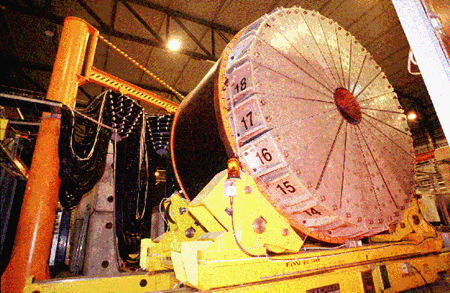
2 Quark matter at CERN The NA49 experiment is one of the seven experiments involved in the heavy-ion programme at CERN that provided evidence for the existence of a new state of matter. The other detectors are NA44, NA45, NA50, NA52, WA97/NA57 and WA98 (see cern.web.cern.ch/CERN/Announcements/2000/NewStateMatter/photos.html). The NA49 hadron calorimeter shown here allows us to understand the global evolution of the hadronic energy of the colliding nuclei.
The fact that a single quark has never been observed in an experiment has puzzled physicists for many years. The confinement of quarks inside a small volume, such as inside a neutron or proton, costs energy because the light up and down quarks would prefer to occupy a much greater volume. This makes the mass of a proton, for instance, about 50-200 times heavier than the total mass of the three quarks inside it. (A proton has a mass of 1.67 x 10⁻²⁷ kg = 0.938 GeV c-2, whereas the mass of two isolated up quarks and a down quark would only be 0.005-0.02 GeV c-2.) Indeed, most of the inertial mass of protons and neutrons, and hence of practically all the matter around us, originates from the confinement of quarks, rather than their inertial masses (see Davies and Collins in further reading).
Theorists have conjectured that quarks are permanently confined in nucleons by complex quantum fluctuations of the vacuum. In a space-time region where this virtual vacuum structure has been “dissolved”, nucleons and nuclear matter as we know it will cease to exist. Under these conditions the quark-gluon plasma, the state of matter that existed in the early universe, will be formed.
Physicists are edging closer to achieving this goal in the lab. A proposed path to the production of free quarks in the laboratory is to exceed the temperatures that governed the universe 40 microseconds after its birth. Collisions between elementary particles cannot accomplish this because they cannot pack enough energy into a large enough volume. This means that they cannot form a macroscopic fireball in which quarks can roam freely. We need to collide large atomic nuclei and to allow the nucleons inside these nuclei to plough into each other, raising the energy density locked inside the fireball. As this happens, the particles will undergo many collisions and thus reach thermal equilibrium, as happened in the early universe.
In recent years, physicists have collided larger and larger nuclei in experiments and have managed to reach the conditions that existed shortly after the big bang (figure 1). Earlier this year researchers at CERN, the European particle-physics laboratory in Geneva, evaluated the results from seven separate experiments – including the WA97 experiment for which one of us (EQ) is the spokesperson – to show that a state of matter in which quarks were not confined had been created (see figure 2 and Physics World March p5). Certain features of the CERN experiments prove beyond doubt that for a short instant we reached, and in fact significantly exceeded, the conditions required for quark deconfinement. But was the primordial quark-gluon phase of matter formed?
We present here some of the main experimental evidence for the formation of such a state in high-energy lead-lead collisions, namely the production yields and spectra of strange particles – that is particles containing one or more strange quarks (s). Theoretical studies, initiated by one of us (JR) in the early 1980s, led to the prediction that the number of strange particles produced in the collisions would be significantly enhanced as a result of the formation of a quark-gluon plasma. This happens because the strange quarks and antiquarks that are produced by pairs of gluons fusing into quark-antiquark pairs in the plasma would lead to the formation of relatively large numbers of composite particles containing one or more strange quarks during the subsequent “hadronization” process.
This article focuses on the results that have been obtained by looking for this signature of the quark-gluon plasma. Other signatures of quark deconfinement studied at CERN are also briefly described.
Relativistic nuclear beams
To make a quark-gluon plasma in the laboratory it is necessary to collide two nuclei head on, or to direct a high-energy nuclear beam at a solid target. The challenge is to achieve a high enough energy density over a large enough volume and, perhaps more difficult, to have reliable methods of identifying and probing the resulting quark-gluon plasma.
Quark deconfinement should arise when the energy of the colliding nuclei is high enough and their size is big enough. What is enough? When plans were made to collide heavy nuclei using the particle-physics accelerators that were available almost 20 years ago, nobody knew for sure if even the largest nuclei would be large enough to make a quark-gluon plasma, or if the collision energy possible with the existing technology would be high enough. There was also the possibility that the deposition of energy from the collision into the fireball would be more effective if the collision conditions were not too extreme. With this in mind, it seemed appropriate to first study and explore the “moderate” collision energies that were available at the time.
A technical obstacle to exploring these new physics opportunities was that, in general, heavy nuclear beams were not available at the particle-physics labs that had the biggest accelerators. In 1986, therefore, a collaboration between CERN, the GSI nuclear-physics laboratory at Darmstadt in Germany and the Lawrence Berkeley Laboratory in the US started a pilot programme at CERN to accelerate oxygen nuclei, and then sulphur nuclei, to energies of 200 GeV per nucleon, which is more than 200 times their rest-mass equivalent. About the same time, a low-energy accelerator used for nuclear-physics experiments at the Brookhaven National Laboratory in the US was linked to the AGS synchrotron, a particle-physics machine. This was used to accelerate silicon nuclei to about 15 times their rest-mass energy, and later to accelerate gold beams.
Lead beams have been available at the Super Proton Synchrotron (SPS) at CERN since 1994, following an upgrade of the accelerator complex by a collaboration between researchers from CERN, the Czech Republic, France, Germany, India, Italy, Sweden and Switzerland. At the same time, a series of much-improved experiments dedicated to observing the quark-gluon plasma came on line. The teams building these experiments drew on years of experience gained in the study of light-ion collisions.
There was no assurance 15 years ago that the experiments at CERN and Brookhaven would lead to a discovery. Therefore researchers at Brookhaven started work on a dedicated experimental facility, the Relativistic Heavy-Ion Collider (RHIC), that would use cutting-edge technologies to study the quark-gluon plasma in detail at higher energies. At RHIC, gold nuclei with an energy equivalent to 100 times their rest mass (that is about 100 GeV per nucleon) are made to collide head on. The first results from RHIC are currently being analysed.
The next step after RHIC will be ALICE, a dedicated heavy-ion experiment at the Large Hadron Collider, which is due to come on line at CERN in about five years’ time. ALICE will take data at energies about 30 times higher than those at RHIC (that is about 3500 GeV per nucleon).
When comparing different experiments it is important to realize that experiments at the SPS are fixed-target experiments, whereas RHIC and ALICE are both colliding-beam experiments. In a colliding-beam experiment, all the energy in both beams is available to “squeeze” the quarks out of the nuclei; in a fixed-target experiment, on the other hand, only a fraction of the energy is available. Indeed, the energy available at ALICE will be a factor of 400 more than is available at the SPS today. This makes it difficult to predict the outcome of experiments at ALICE.
First results from RHIC, obtained at an initial collision energy of 7.5 times the SPS energy, suggest that the density of particles produced, and hence the energy density achieved in the collisions, is 60% higher than at the SPS (see Back et al. in further reading). The symmetry between matter and antimatter is also better at RHIC. This result assures us that we will be able to unravel the mystery of the big bang in the next decade.
The CERN and Brookhaven research programmes have unified both nuclear and high-energy experimentalists in pursuit of the quark-gluon plasma. Physicists in this field are driven both by the desire to study the behaviour and properties of big-bang matter in the laboratory, and by the goal of observing how the elementary properties of matter change in the deconfined vacuum state.
Where and how to find free quarks
To create the new deconfined phase of matter in the laboratory we need to exceed a minimum temperature or, equivalently, energy density. However, the short lifetime of the micro bang makes the study of free quarks in this quark-gluon plasma a daunting experimental challenge. Indeed, at one stage it was not obvious how to demonstrate that the conditions for quark deconfinement had even been reached. To make progress we need to study various features that depend on the formation of the plasma, and to measure more than one variable.
In laboratory experiments, the chemical composition of the plasma varies during its lifetime as new types or “flavours” of quarks are cooked up inside. Up and down quarks are easily produced as quark-antiquark pairs in the hot fireball because they have small masses. In the current CERN experiments the extra quark flavour is strangeness. The quarks and antiquarks produced in the deconfined fireball find their way into a multitude of different particles – with different quark contents – that emerge as the fireball breaks up.
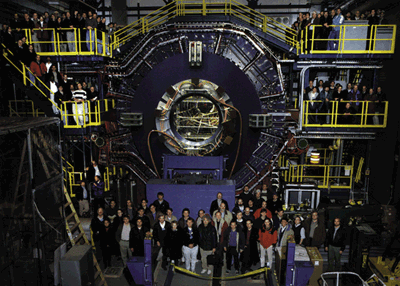
3 The STAR experiment at RHICSTAR collaboration The view into the centre of the STAR detector at RHIC before it was moved into the beam. Particles produced in the collisions between the gold beams at RHIC are tracked in the central and surrounding detectors. There are three other detectors at RHIC: PHENIX, BRAHMS and PHOBOS (www.rhic.bnl.gov/html2/experiments.html)
Given the ready supply of antiquarks in the fireball, deconfinement leads to the abundant formation of antimatter particles. However, antimatter production is not a characteristic signature of quark deconfinement since it can be explained by other physical mechanisms.
By chance, the mass of strange quarks and antiquarks is equivalent to the temperature or energy at which protons, neutrons and other hadrons dissolve into quarks. This means that the abundance of strange quarks is sensitive to the conditions, structure and dynamics of the deconfined matter phase. Moreover, unlike the up and down quarks, strange quarks are not brought into the reaction by the colliding nuclei. Therefore we know for sure that any strange quarks or antiquarks observed in experiments have been “freshly” made from the kinetic energy of colliding nuclei.
Other signatures of quark deconfinement have also been studied. At first, the photons produced “directly” in reactions in the quark-gluon plasma, such as those produced by quark-antiquark annihilation, were considered to be a powerful diagnostic tool, just as they are a powerful diagnostic tool for traditional (electromagnetic) plasmas. However, thousands of particles are created in high-energy nuclear collisions, so the photon background from the decay of neutral pions (bound states of up and down quarks and antiquarks) is large. Observations have shown that these and other “indirect” photons are so numerous that they make it very difficult to extract the direct photon signal, which is only a small fraction of all the photons produced.
Occasionally, the electromagnetic radiation produced in the hot plasma can appear as an electron-positron pair, or as a heavier muon-antimuon pair. However, these so-called dilepton pairs can have other origins that do not require deconfinement. Therefore, although their study opens a window on novel phenomena, at present electromagnetic observables offer mainly supportive evidence for new physics.
Strong evidence for the deconfinement of quarks comes, instead, from studying the production of charmonium – particles containing a heavy charm quark and antiquark – in nucleus-nucleus collisions. Some of the dilepton pairs seen in experiments come from the decay of charmonium. These charmonium particles (also called J/psi, chi and psi prime) have many properties that we are familiar with from the study of positronium, the bound state of an electron and positron.
Since the charm quark is about ten times heavier than the strange quark, charm quark-antiquark pairs can only be formed during the very early stages of the collision as the nuclei begin to penetrate each other. However, they may not have the chance to form charmonium if they are produced within a quark-gluon plasma because the gluons present in the plasma will interact with the charm quarks in a way that hinders their binding. Indeed, the experiments studying the production of charmonium at the SPS (the NA38 and NA50 experiments) have observed a suppression of the J/psi signal compared with what would be expected if each incident nucleon interacted with the target nucleus on its own.
This suppression was predicted to occur in the quark-gluon plasma, and it cannot be accounted for by extrapolating the absorption of J/psi particles in confined matter from proton-nucleus interactions to lead-lead interactions. (Note that a lead nucleus contains 208 nucleons.) Suppression of the J/psi signal is therefore interpreted as a striking signature for quark deconfinement.
The interpretation of strangeness, photons, dileptons and J/psi signals as evidence for the formation of a quark-gluon plasma relies on the study of the global features of the collision such as the number of particles produced in the collisions (the “multiplicity”) and their momentum distribution. From these we can estimate the fraction of nucleons that participates in the reaction, which is called the “centrality”. It turns out that geometric considerations describe centrality very well, and thus in collisions that occur at zero impact parameter (i.e. in “head-on” collisions) practically all nucleons participate.
Particle yields per participant nucleon are used to compare particle production between collisions of different nuclei, and to compare head-on collisions with less central ones. We learn what happens to the energy of the incoming nuclei, how this energy is deposited into the fireball of dense matter that is produced in the centre-of-momentum reference frame, and how such a fireball evolves. Such global studies of particle production allow us, using the interferometry method, to estimate the size of the region of space from which the particles are emitted, and to determine the duration of this process.
Doing this requires dedicated experiments that can detect most of the thousands of particles that are produced in each collision. Indeed, the size of the hardware and “crew” needed for the experiments at RHIC rival those of a small battleship, as the photograph of the STAR experiment illustrates (see figure 3).
Strangeness shows the way
Strange particles are naturally radioactive and decay by weak interactions that occur on a timescale that is extremely long compared with the nuclear-collision times. This makes it relatively easy to detect strange particles through the tracks left by their decay products. Moreover, in fixed-target experiments, such as those at the SPS, the centre-of-momentum frame of reference is moving, which means that most of the collision products leave the interaction region with relativistic velocities. This has the advantage of increasing the lifetime of unstable particles, which makes their paths longer and allows us to isolate the decay tracks from a background of thousands of other tracks.
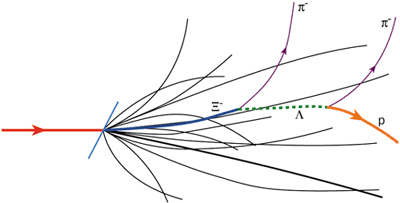
4 How to spot strange decays A schematic representation of the interaction of a high-energy beam (red) and a fixed target (light blue), in which a xi (dss) particle (dark blue) is produced. The xi particle decays into a negative pion (purple) and lambda (uds) particle, which is shown as a dashed line because it is neutral and cannot therefore be seen directly. The lambda particle subsequently decays into another negative pion and a proton (orange). The combination of a kink in the path of a negatively charged particle and the V-shaped decay into two charged particles indicate that a xi particle has decayed into a lambda particle. The trajectories of the charged particles are bent by a magnetic field that is normal to page. The charge and momentum of these particles can be determined from the curvature of the tracks.
To see how this works, consider the decay of a negative xi particle, which contains a down quark and two strange quarks, into a negative pion (which contains an up antiquark plus down quark) and a neutral lambda particle (one up, one down and one strange quark). The lambda particle then decays into a proton and another negative pion (figure 4). In general this is the signature of the decay of a xi particle. Although the negative omega particle, which contains three strange quarks, has a similar decay topology, it can be clearly distinguished from the xi because its decay products are different.
Strange enhancements
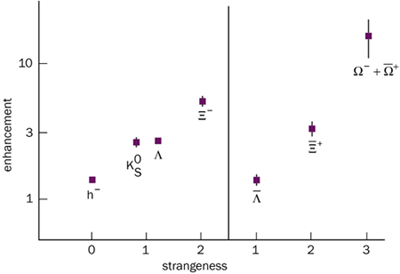
As the ability to track strange particles in a dense hadron background improved, experimentalists were able to search for the enhanced production of strange particles that was predicted to occur as a consequence of the formation of a quark-gluon plasma. Clear enhancements have now been observed in the number of strange particles produced per participating nucleon in both sulphur-sulphur and lead-lead collisions at CERN compared with proton-proton and proton-nucleus collisions. However, it was argued that some enhancement may also occur in the absence of a quark-gluon plasma. To resolve any possible ambiguity, the enhancements for particles carrying one, two and three strange quarks were then measured separately. In a quark-gluon plasma the enhancement for each particle species is predicted to increase with the strangeness content of the particle.
5 Strange enhancements Particle enhancement versus strangeness content for various particles produced in lead–lead (PbPb) and proton–beryllium (pBe) collisions. The enhancement for a particular particle is defined as the number of that particle produced per participating nucleon in PbPb collisions, divided by the number produced per participating nucleon in pBe experiments. There is an enhancement of 1.3 for all non-strange particles, h–, in these collisions; these are mainly negative pions that do not contain any strange quarks. Such enhancement is natural in a quark–gluon plasma and can also be accounted for by conventional reaction scenarios. However, the production of particles that contain one strange quark, such as the neutral kaon (KS0) and the lambda particle, is enhanced by a factor of about three; the enhancement factor rises to about five for the doubly strange xi particle (and its antiparticle, the anti-xi), and to about 15 for the omega particle, which contains three strange quarks, and its antiparticle. The particles in the right panel have no valence quarks in common with the projectile nucleons (e.g. an anti-lambda contains three antiquarks, including one strange antiquark). These results were obtained by considering particles emitted at ‘mid-rapidity’ in 158 GeV per nucleon PbPb interactions. The data are from the CERN WA97 experiment.
Such behaviour, which is not expected in the absence of a quark-gluon plasma, has indeed been observed in comparisons of data from proton-beryllium collisions with data from lead-lead collisions (figure 5). These results can easily be explained in the case of deconfinement. The quark-gluon plasma is a copious source of strange quarks and antiquarks, which are normally hard to find; therefore, when the plasma fireball breaks up into the final-state hadrons, there will be a good chance that these hadrons will contain two or more strange quarks or antiquarks. In conventional reaction schemes, on the other hand, the production of particles containing two or more strange quarks is suppressed by high energy thresholds and by the rarity of the required collision process.
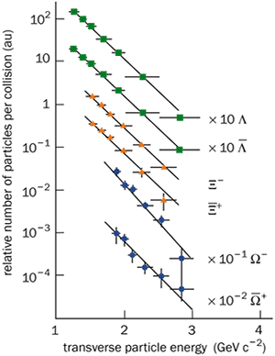
More evidence for the deconfinement of quarks is obtained by going beyond measurements of the abundance of particles and measuring the number of each type of particle as a function of transverse energy. The transverse energy, mtrans, is defined as mtrans = (m2 + p2trans)1/2, where m is the rest mass of the particle and ptrans is its momentum in the direction at right angles to the collision axis. The exponential fall-off of the spectra, as these distributions are called, is best seen in a logarithmic plot (figure 6). Measurements of how the spectra fall off with transverse energy tell us about the temperature of the fireball matter, and the speed of the fireball explosion, at the time when the inertia of the compressed matter has been overcome by internal pressures that are in excess of 1030 bar.
All the slopes are remarkably similar, with the slope of each baryon spectrum being identical to that of the corresponding antibaryon to a high degree of precision (figure 6). This is what one expects if both strange matter and antimatter particles are produced directly from a plasma of quarks and gluons.
These results provide strong experimental evidence for the explosive formation of strange hadrons from a thermalized fireball of deconfined matter. No other theoretical description has come close to predicting this.
Exploring big-bang matter
Finding evidence for a deconfined form of matter, the quark-gluon plasma, has been the first challenge. The next challenge is to determine the exact energy that is needed to free the quarks. It has been argued that this could occur when the energy per nucleon inside the fireball is as low as four to eight times the nucleon mass. To achieve such energy densities in the fireball created in fixed-target lead-lead collisions, such as those at CERN, requires beam energies of between 30 GeV and 120 GeV per nucleon.
6 Similar spectra Spectra of strange baryons (lambda (uds), xi (dss) and omega (sss)) and antibaryons (anti-lambda, anti-xi and anti-omega) as function of transverse energy, mtrans. The most significant feature of the figure is that the slope of the spectra for a particle, e.g. the xi, and its antiparticle are very similar. The difference in the particle and antiparticle yields is a result of the quark–antiquark asymmetry in the plasma (see figure 1). Data taken at mid-rapidity in lead–lead collisions at 158 GeV per nucleon by the CERN WA97 experiment.
The CERN experiments described earlier were performed with a beam energy of 156 GeV per nucleon. Last year this was reduced to 40 GeV per nucleon in an attempt to find out the energy at which the quark-gluon plasma sets in. Theoretical interpretation of the experimental results depends on knowing how much energy is needed to free the quarks (i.e. to melt the vacuum), which tells us how much energy is left over to produce strange quarks and drive the explosive disintegration of the fireball.
A systematic study of how the properties of the fireball and particle production change could, in principle, allow us to determine the value of the latent heat associated with the melting of the vacuum, which is perhaps the most fundamental quantity in this context. Of course, this presupposes that a change in the long-range confinement behaviour occurs in association with a first-order phase transition and that latent heat is released when the quarks freeze into hadrons.
Equally interesting, however, would be the observation of a smooth transformation from a deconfined to a confined vacuum structure. Understanding how the universe evolved from quarks and gluons into hadrons, and thus how this phase, which was almost symmetric between matter and antimatter, evolved into our matter-dominated universe, depends in a decisive way on understanding the properties of this phase transformation.
The much higher effective collision energies available at RHIC, compared with the SPS, will mean that the symmetry between matter and antimatter production should be considerably better, therefore providing conditions more akin to those that existed after the big bang. Indeed, almost equal numbers of up, down and strange quarks and antiquarks will be produced at RHIC. It is also expected that most of the matter and, importantly, antimatter produced there will be strange because it will be difficult to assemble three non-strange quarks into a non-strange matter or antimatter particle. Therefore, in addition to confirming the existence of quark deconfinement and telling us more about the properties of deconfined matter, the study of strange antibaryons at RHIC will shed new light on how the early universe evolved into its present form.
In conclusion
Experiments at CERN have provided strong evidence that a new type of matter has been formed. This new matter behaves in the same way that a quark-gluon fireball subject to an explosive break-up is predicted to behave. There is no other known reaction picture that is capable of describing this behaviour.
Physicists now want to study the properties of this new state of matter in more detail. New experimental results are eagerly awaited from both the ongoing experiments at the SPS at CERN, and from the new experimental programme with higher energy densities, and better matter-antimatter symmetry, that has just started at the RHIC facility. Within a decade we should have unravelled the mystery of what happened 15 billion years ago when the free quarks and gluons created in the big bang became confined inside nucleons, and all the antiquarks in our part of the universe disappeared.
8 The Pleasure of Finding Things Out (Amazon, Amazon UK) Richard Feynman (Allen Lane The Penguin Press) hb 1999
9 The Making of the Atomic Bomb (Amazon, Amazon UK) Richard Rhodes (Simon & Schuster) pb 1986
10 The Emperor’s New Mind (Amazon, Amazon UK) Roger Penrose (Oxford Paperbacks) pb 1989
When it comes to sales of physics books, there are some titles that just never fade away. According to Amazon.co.uk, the on-line bookstore, five of the top ten best-selling physics titles during August were originally published back in the 1980s. John Gribbin’s In Search of Schrödinger’s Cat – in fifth spot in the list – is the veteran of the pack, still finding buyers 16 years after it first appeared. The Making of the Atomic Bomb – Richard Rhodes’ epic tale of how physicists developed nuclear weapons – is in ninth place, some 14 years after it was originally published. Stephen Hawking’s crowd-pleaser A Brief History of Time (1988) is second, although whether sales will be affected by the controversial new play God and Stephen Hawking (see p49) remains to be seen.
Time will also tell whether the other five books on the list, all of which were published either this year or last, remain classics in years to come. The Elegant Universe – Brian Greene’s prize-winning book on string theory – looks set to join the elite after riding high for more than a year, while The Pleasure of Finding Things Out – an edited collection of lectures and interviews by Richard Feynman – is bound to remain popular, if his many other hits, such as Surely You’re Joking Mr Feynman! (1985), are anything to go by. Particle theorist Frank Close and the UK’s Astronomer Royal Martin Rees must be praying that their new books – in sixth and third place – also become firm favourites.
On the 10th of this month a physicist – or possibly two or three – will receive a telephone call from Stockholm that will change their life. The Royal Swedish Academy of Sciences will be ringing with the news that they have been awarded the most prestigious accolade that any physicist can receive – the Nobel Prize for Physics. This year’s prize will be worth SwKr 9m (about £660 000).
Some 159 physicists have received this honour so far, dating back to Wilhelm Conrad Röntgen, who received the first prize in 1901. Indeed, the founding of the prize coincided with the revolution in physics that started around the turn of the century. Röntgen’s discovery of X-rays in 1895 was quickly followed by the discovery of radioactivity in 1896 – for which Henri Becquerel shared the 1903 prize with Marie and Pierre Curie – and the discovery of the electron in 1897, for which J J Thomson received the prize in 1906.
In the early years of the prize most of the winners were from Europe, but in recent decades American physicists have been more successful (see box below).
The 2000 prize
The selection process for this year’s prize began last September when the Swedish Academy of Sciences sent letters to more than 2000 physicists, inviting them to nominate candidates for the prize. Invitations were sent to Swedish and foreign members of the Academy, previous Nobel-prize winners, permanent and assistant professors in Scandinavia, and various heads of department and senior physicists all over the world. The response rate to the letters of invitation is typically about 15% according to Anders Bárány, professor of physics at Stockholm University and secretary to the Nobel Committee for Physics.
The 300 or so nominations that had been received by the deadline of the end of January were whittled down to between about 10 and 15 proposals by the Nobel committee, which is chaired by Tord Claeson, head of the applied solid-state physics group at Chalmers University of Technology in Gothenburg, Sweden. The other members of this year’s committee are: Per Carlson, an experimental particle physicist at the Royal Institute of Technology in Stockholm; Cecilia Jarlskog, a theoretical particle physicist at Lund University; Mats Jonson, a theoretical condensed matter physicist at Chalmers; and Sune Svanberg, an experimental laser physicist at Lund.
The committee asks the physicists whom they have consulted not to make their nominations public. However, Claeson says it is clear that in the past there have been organized campaigns in the US for particular nominations. He points out that the committee does not count the number of nominations, or discriminate against campaigns.
Each proposal selected by the Nobel committee was sent to one or two experts in the relevant field for review. The committee then studied the reviewers’ reports and made its recommendation for who should win this year’s prize in the form of a memorandum that was sent to the 40 or so members of the “physics class” of the Swedish Academy of Sciences. This year the memo was sent on 19 September and was discussed by the physics class on 26 September, with a further discussion on 2 October.
Early this month the physics class will forward the memorandum, along with its comments, to the full Academy, which includes 350 Swedish members and 164 foreign members from all areas of science. Based on past experience, says Bárány, the comments of the physics class can be minor (e.g. suggested changes to the wording of the citation) or major – they can, for example, suggest a different winner for the prize.
The full Academy is due to have a closed vote on the physics prize on the morning of 10 October and the outcome will be announced around midday.
All the proposals and material related to this year’s prize will remain a closely guarded secret for 50 years, after which time they will be made available to historians of science. In the meantime, a completely unscientific poll of physicists and Physics World staff has resulted in a list of major discoveries in physics that have not yet been rewarded with the prize.
Particles mean prizes
Since 1950 the prize has been dominated by particle physics (18 prizes) and condensed-matter physics (16). There have been eight prizes for atomic, molecular and optical physics during this period and, surprisingly, only five for astrophysics. The last prize for nuclear physics was awarded in 1975 and plasma physics received its only prize in 1970. The Nobel statutes state that the prize should be awarded for the “most important discovery or invention within the field of physics”, but only a handful of prizes since 1950 have been awarded for inventions: for example the transistor (1956), the laser (1964) and the hologram (1971).
The 1950 prize, which was awarded to Cecil Powell, marked a turning point in the history of the prize. Working on the boundary of cosmic rays and particle physics, Powell discovered the pion in a series of balloon flights that exposed photographic emulsions high in the atmosphere. Since then all the particle prizes have been awarded for theory, discoveries made at accelerators, or advances in accelerator or detector technology.
However, the development of neutrino astronomy, which started with the pioneering work of Ray Davis in the late 1960s, and the subsequent observation of neutrino oscillations by Masatoshi Koshiba and co-workers at the SuperKamiokande experiment in 1998, could result in another prize for non-accelerator particle physics. Indeed, Davis and Koshiba shared the Wolf Prize – which four of the 1990s Nobelists had previously won – earlier this year.
Particles that have been discovered but not rewarded include the gluon and the top quark. However, rewarding either discovery will pose problems for the committee. The discovery of the gluon at the DESY laboratory in Hamburg, Germany, in 1979 has already been the subject of controversy (see “Gluon prize revives discovery debate” in Physics World September 1995 p5). And it will be difficult to single out no more than three names among the 850 or so physicists who collaborated on the CDF and D0 experiments that discovered the top quark at Fermilab in the US in 1995.
Anders Bárány says that the Nobel regulations allow for the prize to be awarded to an organization, and cites the example of the 1995 peace prize, which was shared by the Pugwash movement and the physicist Joseph Rotblat. Tord Claeson confirms that this possibility has been discussed, but adds that “the committee is not close to recommending that the prize should be awarded to an organization”.
In particle theory the inventors of quantum chromodynamics (QCD) – the theory that is used to describe the strong nuclear force in the Standard Model of particle physics – could be in the running, although QCD does not enjoy the same level of acceptance as quantum electrodynamics (QED), its electromagnetic counterpart. The names most commonly associated with demonstrating asymptotic freedom in certain types of gauge theories – the crucial step on the road to QCD – are David Gross, David Politzer, Frank Wilczek and Gerard ‘t Hooft (who shared the prize last year for other contributions to the Standard Model).
The inventors of the CKM matrix – Nicola Cabibbo, Makoto Kobayashi and Toshikide Maskawa – are also contenders. The CKM matrix is used to describe mixing between the different families of quarks. Other theoretical architects of the Standard Model who might be honoured include: Yoichiro Nambu, who made many theoretical contributions to symmetry breaking and QCD, and shared the Wolf prize in 1994/95; Jeffrey Goldstone for his work on symmetry breaking; and Chen Ning Yang, who shared the prize in 1957, and Robert Mills for Yang-Mills theory. Confirmation of the discovery of the Higgs boson will almost certainly bring a prize for the experimentalists who confirm it, and for Peter Higgs and the other theorists who developed the mechanism for generating mass in field theories.
Beyond the Standard Model
The committee has no policy on the relative merits of theoretical or experimental discoveries, but in general theorists only receive the prize when their work has been verified experimentally. “Stephen Hawking is a good example,” says Anders Bárány. “I am often asked why Hawking has not won the prize. He has done fabulous work but we are not yet sure that it really applies to nature.”
Claeson adds that many theorists work over a broad range of problems, building up a “good integral”, whereas experimental discoveries are often “delta functions”. The fact that the prize is given for a discovery or an invention, rather than a lifetime’s work, may explain why more experimental physicists seem to win the prize.
There is also a wide range of discoveries outside particle physics that might be recognized by the committee. The results from the COBE satellite in 1992 – which showed that the cosmic background radiation has a perfect black-body spectrum and that there are tiny fluctuations in the background temperature across the sky – could be recognized. And if evidence that the expansion of the universe is accelerating can be confirmed beyond doubt, that would be another contender.
Astronomy is not covered by the physics prize, but Claeson points out that recent developments in instrumentation mean that more and more of astronomy is becoming astrophysics, and he expects to see a lot of discoveries in the future that will be eligible for the prize.
The creation of a Bose-Einstein condensate in a dilute atomic gas, a “new state of matter” in which all the atoms are in the same quantum ground state, in 1995 and the subsequent demonstration of an atom laser are also contenders. Other areas of atomic and optical physics that could be recognized include photonic band-gap materials and ultrashort (femtosecond) laser pulses. Within quantum physics, experimental tests of Bell’s inequalities and the prediction of various quantum and geometric phases (for which Yakir Aharonov and Michael Berry shared the 1998 Wolf Prize) might also be recognized.
In condensed-matter physics, the discovery of giant magnetoresistance in the mid-1980s has stimulated much further research and has had a major commercial impact in the multibillion-dollar magnetic-recording industry. Other areas of condensed-matter physics in the running will include quasicrystals (for which Dan Shechtman received the 1999 Wolf Prize), colossal magnetoresistance, pseudopotential theories for electrons, valence-level photoemission experiments, low-dimensional semiconductor devices that control single electrons, and the broad areas of correlated-electron systems and mesoscopic physics.
Semiconductor lasers continue to be an area of intense research activity and immense commercial importance, but their discovery has yet to be recognized with the prize. Synchrotron radiation is another physics discovery that is used in a vast range of experiments in all areas of science, but has not been acknowledged with a Nobel prize.
Who will win this year’s prize?
As is almost always the case, the field for the prize is wide open. Predictions are easy to make, but just as experiment is the final arbiter in physics, so will the Swedish Academy decide the fate of the first Nobel prize of the new century.
Prize spreads
Some 55 US-born physicists have won the prize. Germany comes second in this list (26 winners), followed by the UK (20), France (10), the Netherlands (9) and Russia (7). The last British-born prize-winner was Nevill Mott in 1977.
Alfred Nobel’s will was clear that nationality should not be a consideration in the selection of the winner: “It is my express wish that… the most worthy shall receive the prize, whether he be a Scandinavian or not.” And while successive Nobel committees have awarded the prize to just seven Scandinavians, a mere two women have received the physics prize: Marie Curie in 1903 and the nuclear physicist Maria Goeppert-Mayer, who shared the 1963 prize. It is widely believed that Lise Meitner deserved to share the prize with Otto Hahn for her work on nuclear fission.
Hahn actually won the prize for chemistry. Indeed there is a tradition of physicists winning the chemistry prize that stretches all the way from Ernest Rutherford in 1908 to Walter Kohn, the condensed-matter theorist, in 1998. Marie Curie also won the 1911 chemistry prize outright for the discovery of radium and polonium. Only one person has received the physics prize twice – John Bardeen shared the 1956 prize for the invention of the transistor and the 1972 prize for his work on the Bardeen-Cooper-Schrieffer theory of superconductivity.
In the early years the prizes were dominated by experimental discoveries, but that is no longer the case. Max Planck was the first theorist to win the prize alone, in 1918, followed by Albert Einstein (1921), and Niels Bohr (1922). In a masterful understatement Einstein received the prize “for his services to Theoretical Physics and especially for his discovery of the law of the photoelectric effect”.
To someone in the UK, a university education in Germany must seem to go on for an eternity. British students typically graduate three or four years earlier than their German counterparts, who take about six years to complete their “diploma”. Lengthy first degrees in physics are favoured in many countries throughout Europe because they allow students to gain a thorough theoretical training. But governments across the continent are now dismantling these degrees in favour of the “Anglo-Saxon” system, in which a three- or four-year bachelors degree is followed by optional masters qualifications. This would allow students to graduate and enter the job market more quickly, a prospect that appeals to governments eager to improve efficiency and increase economic competitiveness.
This changeover in degree structure was agreed in Bologna last June by ministers from 29 European countries. The so-called “Bologna Declaration” is a binding commitment between countries to bring coherence to the myriad of university-teaching systems across Europe, and must be implemented by 2010. Currently most countries in the European Union have, or are experimenting with, two-tier curricula in at least part of their higher-education system. Germany and Austria have introduced new bachelors and masters degrees on a voluntary basis alongside diplomas. Meanwhile, France and Italy (see box) are rearranging existing curricula into first and postgraduate stages.
“There is no other way,” says Andreas Wieck, a physicist at Ruhr University in Bochum, Germany. “The infrastructure exists, we just adapt the system.” Wieck hopes that the new structure will make life easier for students who want to go overseas and that it will attract more students from abroad. This should help to increase Germany’s presence in the increasingly global market for students, which is currently dominated by English-speaking countries. And more foreign students could go some way to reducing Germany’s shortage of physicists, which is a problem the world over but particularly acute in Germany.
“Within the last five years the number of kids who take up physics studies has gone down by a factor of two or three,” says Claus Gößling of Dortmund University. Although this decline has stalled recently, hopes are not high. “We have to be prepared for only 500 to 600 PhDs per year. We will need ‘green cards’ for physicists,” says Rainer Kassing of the German Physical Society (DPG).
Physics in the real world
The Anglo-Saxon model is more naturally suited to university education believes Jacques Lewiner, dean of science at the Ecole Superieure de Physique et de Chimie Industrielles in Paris. He feels that France’s students receive a broader education at school, but get a worse deal at degree level. “In the Anglo-Saxon system, people learn a lot by themselves,” he says, “and are not taught everything in class. They build up theory only after learning from experience, which is what happens in real life.”
French universities are introducing more applied classes. In the past, electromagnetism, for example, would typically have been taught by starting with Maxwell’s equations. “This year,” says Lewiner, “the class in my ecole started off with a very basic question: ‘You all have a mobile phone in your pocket. How does it work?’ From this the students learn wave propagation.”
Some French institutions have also introduced tuition for students, along Anglo-Saxon lines. “I believe this is very positive because it reduces the time spent in formal classes and allows students more time to study by themselves,” says Lewiner, who adds that tuition is set to become even more commonplace in the future.
Dissenting voices
Not everyone, however, is happy about the changes confronting European universities.
“I find it a pity,” says Nobel-prize winner Gerard ‘t Hooft, a theoretical physicist at the University of Utrecht in the Netherlands. “I think that the Dutch system [in which people graduate only after having studied up to masters level], is superior to the Anglo-Saxon system and in my opinion our courses are of a higher level.” He believes that at secondary school, students in the US get an education in subjects such as geography and history that is considerably less thorough than it is here. “Consequently,” he says, “it makes sense there to spend a lot of time on those subjects in the bachelor’s phase. But why should we assume that our students know as little as students in the Anglo-Saxon system and why should we lower our level to theirs?”
Vincent Icke, an astronomer at Netherland’s University of Leiden, describes the change over as “the first step on the way to the total infantilizing of university education.” He is unhappy that students will have the option of leaving university after three years. “This will effectively lop off the active contact with academic research,” he says.
Michael Kobel, a physicist at Bonn University, recognizes that a German diploma takes too long to complete, but does not think it needs to be scrapped. A tight reign at Bonn means that students graduate on average half a year earlier than students at other German institutions. The university also runs an international physics programme in which all courses are taught in English, something that was originally designed to attract students from abroad but has turned out to be popular among German students as well. When they graduate, they can also choose to be given a document, written in English, which states clearly that the masters degree is contained in the German diploma. The idea is that this document will avoid the usual misconception among non-Germans that a diploma is nothing more than a bachelor’s degree.
Although the DPG still believes that the diploma should remain the nation’s professional qualification, the German Science Council, however, backs the introduction of bachelors and masters curricula. In the past German companies wanted physicists who had obtained a diploma, since it meant that they were highly qualified. But now industry is not so fussy. Siemens, one of Germany’s big employers of physicists, is happy to recruit any physics graduate, whether they hold a bachelors, masters or diploma. A personnel officer from the company says that Siemens supports young people who have an Anglo-Saxon-style qualification, but that they still employ physicists with a diploma because “we know about their abilities”.
Lewiner supports this sentiment. He feels that diversity should be maintained within European education and that it is unhealthy to switch completely to one system. “The Anglo-Saxon and continental traditions can learn from one another,” he says.
A brave new world for Italian higher education
Some of Italy’s leading universities will go Anglo-Saxon this month when they move over to a new qualifications structure consisting of a three-year bachelors followed by a two-year masters degree. Until now a physics degree was supposed to last for four years but in order to pass the necessary 18 exams students took on average six or seven years, with more than 40% of students dropping out along the way. Shorter degrees, called diplomas, were introduced a few years ago but were unpopular with students.
“Diplomas will disappear in the new scheme,” says Antonio Rossi, chairman of the physics-degree board at Bologna University. “The new three-year course in physics will provide students with a good-quality general training and the possibility to specialize in various fields.” Specialist courses will cover subjects such as information technology, applied electronics, didactics, medical physics, environmental physics and electromagnetic pollution. “These subjects are likely to fulfil the job-market expectations,” adds Rossi.
Within 18 months all of Italy’s 70 universities will have to adopt the new degree structure. This is in addition to another huge change in higher education: each university now has a budget and the freedom to spend it how it sees fit. To assess how well suited a student is to a course, universities will introduce entrance exams, a move that is proving controversial. The Italian Ministry of Education believes that entrance exams should be viewed as a “verification of the natural skills and expectations of each student”. Admission will depend on the student’s previous qualifications and training, and a knowledge of English will be compulsory as some lectures will be taught in English.
There are some, however, who feel that providing universities with more autonomy will lead to a decline in academic quality. They fear that since enrolment fees will provide universities with part of their income, institutions will be forced to let the students pass their exams in order to ensure that they enrol. Until now, each university was funded by central government independently of the success (or failure) rate of applicants.
The hope is that universities will start a “virtuous” circle by offering high-quality degrees rather than “selling” diplomas. To guarantee a standard level of quality, however, the new system comes with a kind of “certificate” based on a system of credits. To earn one credit a student must complete 25 hours of work, which can include lectures, homework and lab work. To pass a first-level degree, students will have to have worked for at least 4500 hours.