Wobbling pulsar discovered

Pulsars are rotating neutron stars, and are the collapsed cores of supergiant stars that have exploded as supernovae. They are extremely dense, typically 20 km across but with masses a million times greater than the Earth. As a pulsar rotates, it sends beams of radio waves from its magnetic poles out across space, like a lighthouse. Radio telescopes receive a signature pulse as the beams sweep over the Earth. Astronomers can tell how fast a pulsar is spinning by examining the characteristics of these pulses. Most pulsars emit stable signals that steadily slow down, but the new find represents the first long-term highly periodic variation in a pulsar.

‘We were suspicious that something strange was happening after about six years ‘, Andrew Lyne, one of Stairs’ co-workers and head of the pulsar research group at Jodrell Bank, told PhysicsWeb. ‘But we needed 13 years of observation before we could be confident about what we were seeing. The long period of observation was chiefly because of the long period of the pattern, and we wanted to be sure that we were not observing some random effect or the result of planetary bodies orbiting the star’.

Ingrid Stairs and her colleagues believe that the variation in the pulses suggests the neutron star is not spherical, but very slightly squashed. ‘The bulge in the neutron star causes the angle between the pulsar’s rotation axis and its radio beam to change with time, creating the wobbling effect that we measure’, explains Stairs. The bulge is extremely small: the new pulsar departs from being a sphere by just 0.1 mm in 20 km.

But it is surprising that the wobble, similar to that of a spinning top, was detected at all. Previous observations from Jodrell Bank show that a pulsar consists of neutron superfluid encased in a solid crust. Astronomers believed that any precession would die out extremely quickly because of the interactions between the superfluid and the crust. ‘But this pulsar is one hundred thousand years old and it is still wobbling’ says Lyne. Theorists will now have to re-think current ideas to explain the unexpected precession.

‘We are now looking closely at a number of other interesting candidates in our database’, Lyne told PhysicsWeb, ‘and while we are making some progress, we may need to exercise a similar degree of patience.’

Buddhism beyond the bounds of belief

The mathematician and philosopher Alfred North Whitehead once wrote: “When we consider what religion is for mankind, and what science is, it is no exaggeration to say that the future course of history depends upon the decision of this generation as to the relations between them.”

You'd Buddha believe it - science and religion need to forge closer links

I agree with Whitehead’s assessment, but would add that in the main we have got the relations between science and religion badly wrong. We have either denied that there is any relationship between them at all (the neo-orthodox position advocated by the theologian Karl Barth and, in a modified form, by the evolutionary biologist Stephen Jay Gould), or we seek an easy alliance or even a conflation in which science and religion blur and blend so that one mysteriously supports the other. What we need is a third way that can expose the core dimensions of science and religion, thereby leading to an appreciation of exactly where common ground can be found, and where the two rightly go their separate ways.

While I consider the investigation of the relation between science and the spiritual dimensions of life to be of great importance, I am afraid that this book by Reg Brissenden is a huge disappointment. Briefly put, it is a hodgepodge of ideas, speculations and strong opinions written in a cavalier and sometimes abrasive style. Granted, here and there interesting connections are made, but no sooner are they suggested than they become accepted as part of a grand synthesis that ranges from the Hilbert-space formalism of quantum mechanics and Penrose’s so-called “no-access” theorem, to political history and a postulated Zen “Bose field”. (This field is supposedly the mediating “particle” that couples with an as yet undiscovered physical structure in the brain to connect us with “actuality”, or Penrose’s world of Platonic ideas.)

In the interest of fairness, I will try to give a brief overview of a book that, considering the range of its topics, defies summarizing. Brissenden sees mathematics and physics, especially when taken together with Zen Buddhist philosophy, as having guided our deepest understanding of the world at all levels – both physical and spiritual. Within the first 75 pages we are given a whirlwind treatment of classical physics, artificial intelligence, Zen, free will, quantum physics, von Neumann’s treatment of measurement, the “many worlds” interpretation of quantum mechanics, and sundry other subjects. Even in the first chapter Brissenden discovers what he takes to be a compelling correspondence between the theory of quantum-mechanical observation and the Zen concept of “discrimination”. He also sees a link between quantum superposition and experiences in satori, the sudden enlightenment sought in Zen Buddhism. The author periodically picks up these supposed correspondences and suggests that they will lead to various novel discoveries in science.

The two heroes of the book are the mathematician Roger Penrose and the philosopher Michael Lockwood. According to Brissenden, Lockwood offers the correct interpretation of quantum mechanics, and one that is also in agreement with Zen Buddhist philosophy. Penrose, meanwhile, is seen as having proved that human beings possess an intuitive ability to go beyond a purely computational way of thinking and enter a realm of “actuality” that seems to lie beyond the everyday physical world, in the spiritual domain. Here is where Brissenden’s idea of “Zen bosons” comes in. Relativity, cosmology and free will all appear next.

We are then taken on another whirlwind tour through the history of Zen Buddhism and Brissenden’s unique version of Zen ethics. By the way, he dismisses reincarnation as a sop to the ego-loving Hindus, which makes for a novel reading of Buddhist ethics. Brissenden closes with a long chapter on religion (or what he terms “sanctified unreason”), which is as much about Hegel, the politics of 20th-century warfare, Post-Modernism and the evidence for extrasensory perception, as it is about religion.

My objections to Brissenden’s approach are many, but I will concentrate on only two. First, he takes on too much, and in doing so fails to make a solid case for any of his speculations. Zen Buddhism and Modern Physics is an unending series of one-page summaries of science, mathematics, Zen and world history. In the end, rather than being stimulated I was impatient for a careful, substantial treatment of what are important topics. Second, I distrust completely an approach that looks for correspondences between Zen Buddhism and quantum physics. This approach is common in some dialogues between science and religion, and I believe it to be fundamentally misguided and nearly always unproductive. We should not be comparing the fruits of theology with the fruits of science. Rather, science and religion should seek a more fundamental basis for their discussions – one that elucidates the philosophical and empirical foundations of each. You’d Buddha believe it – science and religion need to forge closer links.

New life for Schrödinger’s cat

When the formalism of quantum mechanics is applied to experiments involving microscopic objects such as electrons, we often find that the resulting description assigns finite probability amplitudes to two, or more, possibilities that appear to be mutually exclusive. In the classic Young’s double-slit experiment, for example, these possibilities are the passage of an electron through either the left- or right-hand slit.

According to most interpretations of quantum mechanics, we cannot say that any given electron goes through one slit or the other: to explain the interference patterns observed in double-slit experiments it appears that each electron must leave its options open until it is “observed”, at which point it always chooses one possibility (i.e. a particular slit) or the other.

As Schrödinger pointed out in a famous paper in 1935, this curious state of affairs cannot be quarantined at the atomic level. If we believe that quantum mechanics gives, in principle, a complete description of the physical world, then it is quite easy to set up a situation in which the formalism assigns a finite probability amplitude to each of two states that differ in dramatic ways. In Schrödinger’s “quite absurd” example, a cat is alive in one state and dead in the other. In such a situation we know that a measurement will reveal whether the cat is one state (e.g. alive) or the other (dead).

However, if we interpret the formalism of quantum mechanics in the same way as we do at the microscopic level, we could not say that the system (i.e. the cat) was in just one state before it was observed. Do we really believe this, or is the system in just one of the states, even in the absence of measurement? This latter scenario is called the “macrorealistic” scenario.

For many years it was widely believed that this rather fundamental question cannot, in principle, be answered. According to this view, by the time that the two states are “macroscopically” distinct, it will automatically be impossible to see the kind of quantum interference effects that are observed at the atomic level. The reason usually given for this assertion is the phenomenon of “decoherence”: the macroscopically distinct states of the system of interest (e.g. the cat) rapidly get correlated, it is claimed, to mutually orthogonal states of the “environment” (e.g. the radiation field). Once this decoherence happens, standard theorems of quantum mechanics assure us that no experiment on the system alone can show any quantum interference effects. In fact, all predictions made by quantum mechanics for such experiments are indistinguishable from those made using macrorealistic scenarios.

Which way round?

Over the last 20 years, however, it has gradually become accepted that this argument may fail in certain experimental systems. The key is to find a degree of freedom that can both generate macroscopically distinct states and also remain sufficiently decoupled from its environment.

Although several experimental systems have been explored, the most promising has been a device known as a superconducting quantum interference device or SQUID. This is a superconducting ring that contains one or more Josephson junctions, and the relevant variable is the current circulating in the ring (figure a).

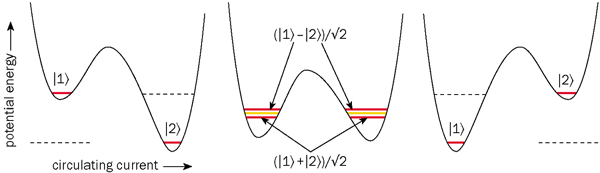
Under appropriate conditions the potential energy of the system is a “double potential well” when plotted as a function of the current (figure b). The two states, the possible superposition of which we would like to investigate, are the ground states in the left and right well, respectively. One state corresponds to a current of about one microamp circulating in the clockwise direction, and the other corresponds to a similar current in the anticlockwise direction.

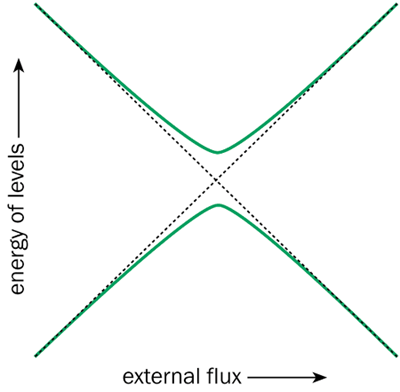
According to standard quantum mechanics, such a superposition would manifest itself as a coherent oscillation of these two currents. This oscillation could be observed directly in a so-called time-domain experiment. The superposition can also manifest itself as an energy difference or “splitting” between the two ground states that varies as a function of the bias applied to one well relative to the other (see figure c). The bias in these so-called spectroscopic experiments is in the form of an external magnetic flux through the superconducting ring.

Although there have been a number of experiments on related phenomena, such as quantum tunnelling out of a metastable well, up until very recently there was no reliable direct evidence for the superposition of macroscopically distinct states in a SQUID system.

Now experimental teams at the State University of New York at Stony Brook (J R Friedman et al. 2000 Nature 406 43) and the Technical University of Delft in the Netherlands (C van der Wal et al. 2000 Science submitted) have performed spectroscopic experiments and observed the variation of the energy splitting with external magnetic flux that is predicted by quantum mechanics.

The two experiments are similar in concept and design. The principal difference is that the Delft group observed the splitting of the ground state, as described above, whereas the Stony Brook team investigated a particular pair of excited states of the individual wells. In both cases, all the parameters necessary to calculate the quantum predictions were measured in independent experiments, and good agreement with these predictions was found.

While there has been much debate over the extent to which these two states are really “macroscopically” distinct, the Delft and Stony Brook experiments are very different from typical microscopic experiments in two respects. First, the circulating current in the two superposed states differs by an amount of the order of a microamp. This corresponds to a difference in magnetic moment of about 1010 Bohr magnetons: magnetic moments of a few Bohr magnetons are typical in experiments at the atomic level.

Second, we can ask how many electrons are behaving “appreciably differently” in the two states? Clearly the answer to this question depends on what is meant by appreciably different, but if we use the definition given by this author, the answer would seem to be in the range 109-1010 (A J Leggett 1980 Prog. Theor. Phys. Suppl. 80 p69). In both these respects the SQUID system appears, at present, to be unique among the candidate systems for demonstrating “macroscopic” superpositions.

What next?

Although the Delft and Stony Brook experiments, when interpreted according to the standard quantum formalism, give strong evidence for the existence of quantum superpositions of macroscopically distinct states, neither in their present form can definitively rule out the alternative hypothesis of macrorealism.

However, it should be possible to do this (or not!) in a time-domain experiment in which one measures a set of two time correlations of the current. This will be an important goal in the next generation of experiments. And then we shall know for sure whether Schrödinger’s cat has definitively expired or not before we look at it!

Symmetry at the Alhambra

Anyone who visits the Alhambra palace in Granada will marvel at the intricate arabesque designs that decorate everything from the tiles and plasterwork to woodcarvings and the lattice-work in the windows. These designs from Islamic art are not only beautiful to look at but also rich in symmetry, involving the repetition of a fundamental motif or element in an ordered and mathematically perfect way. Indeed, the way in which these motifs are repeated illustrate the basic rules of reflection, rotation, translation and “glide reflection” – a reflection followed by a translation parallel to the axis of reflection. This video, which introduces the mathematics of symmetry and its application to crystallography, gives examples of the many arabesque designs at the Alhambra. Amazingly, it turns out that all 17 planar-crystallographic “groups” appear as symmetry groups in the arabesque designs at the palace. The film is easy to follow and will be useful for those who have to teach crystallography.

Brain drains and gains

Science is a truly international activity: indeed, Einstein told us that the laws of physics are the same everywhere in the universe, not just everywhere on Earth. Mobility between nations has always been a trademark of the physics community, first between the historic university centres of Europe, and later back and forth across the Atlantic. In the run up to the Second World War many physicists left Europe for the United States to escape persecution by the Nazis; now they leave in search of higher salaries and research funding. Although hard data are difficult to find, there can be little doubt that the US is the key beneficiary of this mobility. In the past two years, for instance, the holders of three of the top jobs in European astronomy have left for the US. The question is: what effect does this “brain gain” – and the resulting “brain drains” elsewhere – have on physics in countries outside the US?

There is no doubt that time spent in North America can be a crucial element in the training of a research physicist, and that European universities benefit when young physicists return to take up permanent positions and start their own research programmes. However, there are worries that the very best physicists might not return, or that they will only return after they have done their best work. Various countries in Europe have realized this and are starting to offer competitive packages to attract and retain the best talent. However, these packages have not been enough to tempt those physicists interviewed in the following news story about the US brain gain.

The brain drain was one of the reasons why the UK government recently announced a major increase in the national science budget, including £1bn for infrastructure and new equipment. However, one criticism that featured strongly among the otherwise positive reaction to the fund was that the government has not done enough to address the fact that academic salaries in the UK are generally lower than those in the US, often by a factor of two or more.

Paying academic scientists the international “going rate” would appear to be an obvious solution, and might seem inevitable given that universities are increasingly being run as “businesses” in the international education market. Ignoring the obvious problems – there is no way that the government is going to agree to substantial across-the-board pay rises for academics – this approach poses other threats to physics departments. In the business model of a university, physics has the disadvantages of low income (i.e. relatively low student numbers) and high costs (physics is expensive). In the short term, the high salaries for physicists look set to remain on one side of the Atlantic.

Quantum largesse

In 1935 Erwin Schrödinger proposed a thought experiment to show the absurd consequences of applying quantum mechanics to everyday objects. Schrödinger imagined placing a cat in a box, along with a vial of deadly poison that is connected to a radioactive atom. If the atom decays, it releases the poison and kills the cat. When the box is closed we do not know if the atom has decayed or not, which means that it can be in a “superposition” of two states (decayed and non-decayed) at the same time. Therefore, protested Schrödinger, the cat can be both dead and alive at the same time – which is clearly absurd. There was obviously, he thought, some boundary between the microscopic world of atoms and quantum mechanics, and the macroscopic world of cats and classical mechanics.

Some 65 years later, physicists have demonstrated a quantum superposition of macroscopically distinct states for the first time (p23). Admittedly, there is little room to swing a cat in a micron-sized superconducting ring, but as quantum mechanics approaches its 100th anniversary in December, it remains in very good shape.

Why do the world’s leading scientists flock to the United States?

Thomas Baumgarte did not plan to stay in the United States. “It happened in several stages,” says the German-born astrophysics post-doc at the University of Illinois. A one-year undergraduate visit to Cornell University in New York State led to a PhD at Cornell, and then an offer to stay on as a post-doctoral researcher in Illinois. Along the way, he met and married fellow physicist Karen Topp, an American, and they now have a young daughter. Although Baumgarte is including European jobs in his search for a permanent position, he hopes to stay in the US.

It is a familiar story. Talented researchers, drawn by the comparatively high salaries and aggressive intellectual climate, have been flowing into the US from Canada and Europe since 1945. Many never go back. American scientists, on the other hand, tend to stay at home. “There is no reward for foreign travel,” explains Betty Kirk, director of programmes in Central Europe and Asia for the American Association for the Advancement of Science. “The US is a little myopic in that sense.”

Irving Lerch, director of international affairs at the American Institute of Physics, agrees: “There is very little flow in the opposite direction.”

This is confirmed by Richard Ellis, who recently resigned from one of the top jobs in European astronomy – director of the Institute of Astronomy at Cambridge University – to join the California Institute of Technology. “The salary levels are much higher in the US, so there is a tendency not to return,” says Ellis, who will be director of a new telescope project called the California Extremely Large Telescope (CELT).

In addition to better salaries, there are more funds for research in the US. String theorist Michael Duff left a professorship at Imperial College in London in the 1980s to join Texas A&M University. “[In the UK] I spent much more effort – and time – competing for money,” says Duff, who recently moved on to the University of Michigan in Ann Arbor. “Now I spend that time and effort doing research.”

Brain drains and gains

Depending on your perspective, the flow of scientific talent to the US is either a brain drain or a brain gain. But is there really a persistent net flow of European scientists into the US? “There is not a great deal of hard data,” says Bob Ward, a science-policy researcher at the Royal Society in London, “so it is difficult to demonstrate that there is a brain drain.” However, the proportion of fellows of the Royal Society – the UK’s foremost academic society – working outside the UK has increased significantly over the past decade.

Money, however, is not the only reason to emigrate. Most scientists leave their home countries looking for new professional challenges. After five years as the director of the Institute of Astronomy, Richard Ellis “could not see what was next in Britain. I needed to do something different, I needed to move”. So when Caltech offered him the chance to lead the development of a new telescope, he jumped, but not without some reservations. “It was a huge decision,” he says.

Scott Tremaine, a Canadian astrophysicist, was also looking for more than money when he moved from the Canadian Institute for Theoretical Astrophysics (CITA) in Toronto to Princeton University in New Jersey. “[CITA] offered me a comparable compensation package,” Tremaine recalls, “but I still wanted a new challenge.” And he found it. As the new chair of the department of astrophysical sciences at Princeton, Tremaine leads a small elite department that must compete with departments over twice its size.

And simply moving to a new country presents unforeseen difficulties. “The biggest surprise,” says Ellis, “was how hard it was, at the age of 49, to get acclimatized to a new culture.” In addition to the high expectations of his colleagues and the stress of building an organizational infrastructure from scratch without the benefit of a wide network of professional contacts, Ellis’s wife had to wait several months to get permission to work in the US. All the distractions take a toll. “[Scientists] should expect to lose about a year,” he adds.

Once settled, however, researchers are often reluctant to leave. “I am growing roots,” says German physicist Wolfgang Ketterle, who first moved to the Massachusetts Institute of Technology (MIT) 10 years ago with his wife and three children. Ketterle now runs one of the world’s leading groups working on atom lasers and Bose-Einstein condensates. But an offer to return to Germany almost convinced him to pull up those roots. “If everything had not been in such good shape, I would have returned,” says Ketterle, “but I am very happy at MIT. Why fix it if it works?”

The transition to a new culture is never complete, however. “I think everyone discovers a part of themselves that is happy in the US and a part that is happy in Europe,” says Dutch string theorist Herman Verlinde, who moved from the University of Amsterdam to Princeton University in 1998. Verlinde stills spends summers with his family in Holland.

Back home

What about the countries these prominent scientists left behind? Are they helped or hurt by the mobile science population? “I think it is tremendously important for scientists to work abroad,” says Ketterle. “And it benefits the home country because quite a few of the very best return.” And when they do, they undoubtedly bring a wealth of new experience with them.

There is a concern, however, that these returning scientists leave the best of their research careers in their adopted countries. “There is a danger that scientists will spend their prime, when they are most innovative, in the US,” says Bob Ward.

And with the international battle for science talent hoting up, innovative scientists are at a premium. The demand for scientifically trained workers has climbed dramatically in recent years; yet at the same time, student interest has waned. “Declining enrolments in science are really the most severe problem,” says Irving Lerch at the AIP. “It is an internal brain drain.” With fewer people to fill more research slots, the demand for talent will continue to rise. “It is a complex ecology,” says Lerch, “and I believe that the competition will become even more fierce.”

To fill these important niches in their economies, many countries are competing to keep their native scientists home. “Holland has a good stimulus package,” says Verlinde. Meanwhile in the UK, a recent report from the Royal Society recommended increasing salaries to retain the highest calibre researchers, and the government has just announced an investment of £1bn in new equipment and infrastructure for research (see p5).

However, those expecting a return to the days of national scientific sovereignty are sure to be disappointed. It is just too easy to hop from country to country. “Science is very international now and the boundaries between countries are being erased,” says Richard Ellis. Thomas Baumgarte agrees: “A hundred years ago, you bought a one-way ticket on the boat and never expected to return home. Now, no one comes [to the US] without a return plane ticket.”

But Michael Duff, for one, is sceptical that things will change soon, although he adds that “the climate of hostility to science [in the UK] is not there anymore”. Despite a bumpy transition from London to a small Texas town before his latest move to Michigan, Duff is happy to be out of Britain. “I have no regrets,” he says. “Life is much better now.”


Top marks awarded to Chinese students

Every year some of the world’s brightest 18 year olds get together to pit their wits against each other in the physics equivalent of the Olympic Games. The International Physics Olympiad involves teams of students from competing nations sitting gruelling exams in theory and lab work. This year’s competition was held at Leicester University in the UK for eight days in the middle of July and brought together over 300 students from 63 countries.

“It’s amazing to be here,” said one of the team from India, “because I’m one of only five people from the whole country. I was the only person to come from my city.”

Qualifying for one of the five places in each national team is not only a great source of pride but often guarantees students a place on a science or engineering degree course at a prestigious university. But it also involves beating off the competition of tens or, in some countries, hundreds of thousands of other students who take part in preliminary rounds.

“The competition is about individual endeavour,” says John Furniss, a member of the academic committee that was responsible for setting and marking the questions. “The spirit is that of the Olympics.” Gold, silver and bronze medals are awarded to those students who score a high enough fraction of the top mark, although no league table of countries is compiled.

This year, however, there was no doubt about which team finished top of the heap: China. All five team members were awarded gold medals and one of the team, Lu Ying, finished top overall. The Russian, Hungarian and Indian teams all picked up two gold medals and the Swiss, Bulgarian and Taiwanese groups each received one.

But success in the Olympiad is as much a sign of a country’s ability to train its students as it is of a healthy education system. Some nations take their brightest students away from mainstream education for several months and teach them nothing but physics for seven or eight hours a day for three days a week. Although the British students take part in a correspondence course to sharpen up their physics skills, their training is generally minimal compared with some other countries.

One of the smaller countries to have entered this year’s competition, Ireland, has relatively few students entering its national competition. “With our national exams we do not have time to prepare our students as thoroughly as we would like, and I think they find the competition very tough,” says Irish team leader Enda McGlynn of Dublin City University. “But they have always enjoyed it.” He also points out that many students, particularly in rural areas, often do not get the chance to use laboratory equipment themselves, and are restricted to watching their teacher carry out a demonstration. “It is a good experience for them to go into the lab and have to do it for themselves. It is an unusual experience for them, but I think it is very positive.”

Encouraging elitism?

Executive secretary of the Olympiad Cyril Isenberg believes that the competition is important because it encourages the very brightest students, and defends the event against charges of elitism. “In the UK at the moment there seems to be a system of not encouraging the best students, but instead putting all the emphasis on the average student. But it is going to be the brightest students who make important contributions in the future.”

This sentiment is supported by Martin Barstow, an astrophysicist at Leicester University and a member of the Olympiad organizing committee. “Our education system has recently worried less about the cleverest people, and, quite rightly, worried about the majority,” he says. “But there is a problem: what do you do with the really bright students? If you do not stretch them, you run the risk of them switching off and not fulfilling their potential. You have to recognize that if you are going to keep the education system broad for a long time, then eventually you have to channel [the more able] people into some kind of extra system like the Olympiad. There are many people taking part in this competition that may well be future Nobel-prize winners.”

When the Physics Olympiad started in Warsaw in 1967 only Eastern European countries competed, and there were fewer students than in the present competition. Organizing this year’s event was no mean feat, as Isenberg points out. “Try to imagine what it is like to feed, house and entertain over 650 people for a week,” he says.

Preparing the exams was a challenge, since these had to be translated into over 20 different languages. Each exam lasted five hours and certainly stretched the young physicists taking part, many of whom found the theory exam particularly difficult. In the practical exam, students had to carry out two experiments, one investigating the conductance of a light-dependent resistor and the other looking at the forces exerted on a puck when it slides down a slope.

But the week was not all about intellectual labour. The students also had an extensive social programme lined up for them and went on visits to London, Oxford, Cambridge and the Rutherford Appleton Laboratory. They also went on a trip to Alton Towers leisure park and experienced a simulated space mission at Leicester’s Challenger Learning Centre.

Bolstering physics

Despite the enthusiasm they have for physics, quite a number of the students at the Olympiad will not study physics at university. Four of the Indian team, for example, will go on to study computing. They say that the high wages and bright prospects mean that the computing industry in India provides a more secure future than physics research. And the level of education in computing is higher than that of physics, they add. “I would like to do physics,” says one, “but I would get frustrated because the standards are not very high.”

Many of the best students in Taiwan will not go on to study physics at university either, according to Pauchy Hwang of the National Taiwan University. “In the old days, almost all of the brightest students would go into physics,” he said, “but now the best students in Taiwan tend to go into things like medicine.”

But Hwang believes that the Olympiad has an impact in high-school education. “I think the Olympiad is a good way of getting kids interested in physics at an early stage.” This view is supported by Ming-Juey Lin of the National Taiwan Normal University and the leader of the Taiwan team. “We can use the material from the Olympiad not only to train the best students,” he says, “but also to train the high-school physics teachers, who will pass on what they have learned to their students.”

Strength is weakness on the Internet

In a ‘scale-free’ network of many interconnected nodes, like the Internet, most of the nodes are connected to a relatively small number of other nodes. Only a very small minority have a large number of connections. It is therefore extremely unlikely that randomly failing links would have a catastrophic effect on the whole network. In contrast, an intelligent attack on the few highly connected nodes could be devastating.

Barabasi and co-workers studied the effect that removing random nodes from a scale-free network had on the ability of the remaining nodes to communicate with each other, and the degree to which the network became fragmented. They found that the network’s performance remained constant, even after they had removed as many of 5% of the nodes, and that it was resistant to fragmentation. But when the team simulated an intelligent attack by targeting the highly connected nodes, it was a different story: the network became fragmented very quickly, and with 5% of the nodes missing, its ability to communicate was halved.

The team applied tools and ideas from statistical mechanics to the Internet. “I believe that for many complex systems, we have to first understand the topology that describes how the diverse constituents interact with each other”, Barabasi told PhysicsWeb. “This is fundamentally a physics problem, since it involves randomness and self-organization living side by side, and that is best addressed by the tools of statistical mechanics.”

Error tolerance may come at the expense of reduced robustness in a scale-free network like the Internet, but Barabasi and colleagues point out that this peculiar feature can be exploited in scale-free systems such as metabolic networks, where drug design can target vulnerable points. But it is not a promising development for the Internet.

Tau neutrino identified at last

The DONUT team fired an intense beam of neutrinos, which they expected to contain tau neutrinos, at a target consisting of iron plates with layers of emulsion sandwiched between them. One in a million million tau neutrinos interacted with an iron nucleus to produce a tau lepton, which subsequently decayed leaving a characteristic track in the emulsion. The team isolated just four tracks containing the telltale kink of the tau neutrino track, out of a possible six million.

Far from completing the picture for neutrino physics, the new discovery poses many more questions, such as whether the tau neutrino has mass, and whether it interacts differently to the other neutrinos. The answers to these questions will have major implications for our understanding of the evolution of the universe, and international efforts to find them are already underway.

Laser smashes light-speed record

Special relativity prevents any object with mass travelling at the speed of light, and the principle of causality – the notion that the cause comes before the effect – is used to rule out the possibility of superluminal (faster-than-light) travel by light itself. However, a pulse of light can have more than one speed because it is made up of light of different wavelengths. The individual waves travel at their own phase velocity, while the pulse itself travels with the group velocity. In a vacuum all the phase velocities and the group velocity are the same. In a dispersive medium, however, they are different because the refractive index is a function of wavelength, which means that the different wavelengths travel at different speeds. Wang and colleagues report evidence for a negative group velocity of -310c, where c (=300 million metres per second) is the speed of light in vacuum.

Their experimental set-up is remarkably similar to that used to slow light to a speed of just 17 metres per second last year. It relies on using two lasers and a magnetic field to prepare a gas of caesium atoms in an excited state. This state exhibits strong amplification or gain at two wavelengths, and highly anomalous dispersion – that is, the refractive index changes rapidly with wavelength – in the region between these two peaks.

Wang and colleagues begin by using a third continuous-wave laser to confirm that there are two peaks in the gain spectrum and that the refractive index does indeed change rapidly with wavelength in between. Next they send a 3.7-microsecond long laser pulse into the caesium cell, which is 6 centimetres long, and show that, at the correct wavelength, it emerges from the cell 62 nanoseconds sooner than would be expected if it had travelled at the speed of light. 62 nanoseconds might not sound like much, but since it should only take 0.2 nanoseconds for the pulse to pass through the cell, this means that the pulse has been travelling at 310 times the speed of light. Moreover, unlike previous superluminal experiments, the input and output pulse shapes are essentially the same.

There is no widespread agreement among physicists about the speed at which information is carried by pulses in such experiments. One definition is that it is the speed at which the point of half the maximum intensity on the leading edge of the pulse travels, but this velocity is superluminal in the Princeton experiment. The team intend to analyse this further, including cases in which the pulse contains only a few photons.

Copyright © 2026 by IOP Publishing Ltd and individual contributors