

Hubble back in business
Eskimo Nebula is 5000 light years from Earth and resembles a face inside a furry parka when viewed from ground-based telescopes. Hubble resolved the ‘hood’ into a disk of material containing a ring of comet-shaped objects, with their tails streaming away from the central, dying star. The ‘face’ of the nebula was resolved into an expanding high speed cloud of material being blown into space by the central star.
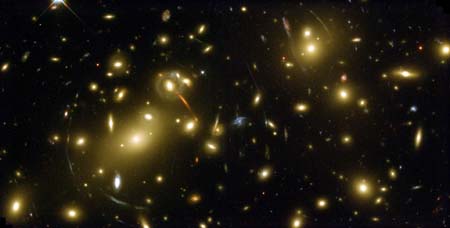
The second target, Abell 2218, has such a large gravitational mass that it magnifies the light of more distant galaxies far behind it. “For the first time we can view the internal colour structure of some very distant galaxies,” said Richard Ellis of the University of Cambridge in the UK. “This gives us new insight into details of what young galaxies are like.” The cluster is at least 2 billion light years from Earth in the constellation Draco.
“It is a tremendous boost to all of astronomy to see Hubble back in action,” said Steven Beckwith, director of the Space Telescope Science Institute. “NASA has restored the observatory to a condition that is better than it was even before the fourth gyroscope failed.” A further repair mission is scheduled for 2001.
Neutrino pioneers win Wolf prize
In 1967 Davis, then at the Brookhaven National Lab, built the first experiment to detect neutrinos produced by the Sun. Neutrinos only interact weakly with matter and are extremely difficult to detect. Davis’s experiment, which consisted of 615 tonnes of dry-cleaning fluid in the Homestake gold mine in South Dakota, detected less than half the flux of neutrinos predicted by widely accepted models of the Sun. The results could only be explained if these models were wrong, or if the neutrino had mass.
For 20 years Davis’s detector was the world’s only solar neutrino detector. Then, in 1987, Koshiba and colleagues started taking data with the Kamiokande detector, which was located 1000 metres underground in a lead and zinc mine.
Kamiokande, and subsequent experiments in Italy and Russia, confirmed the lower-than-expected neutrino flux reported by Davis. However, it was not until 1998 that the SuperKamiokande experiment found convincing evidence for neutrino mass in the form of oscillations between tau and muon neutrinos.
Polymer lasers without mirrors
The waveguide structure was created by pouring a mixture of copolymer solution and molecular laser dye into a mould situated on top of a silicon wafer. The solution was allowed to solidify over 12 hours. The mold was imprinted with a set of thin lines by a soft lithography stamp. The sol-gel copolymer used by the group is suitable for waveguide applications because its refractive index is lower than that of standard silicon wafers. The mould was then peeled off leaving the waveguide pattern on top of the wafer. The waveguide was pumped with laser radiation and a charge-coupled device (CCD) camera was used to record the output.
Stucky believes that parts of their technique could be used commercially within a year or two, but it will take longer to develop the lasing waveguides. “The first application for these lasing waveguides will be in lab-on-chip applications for microanalysis or sensing purposes,” he says.
Measuring decoherence in real time
Quantum particles such as electrons can be in a superposition of two or more quantum states. This means that an electron can, for instance, be in two places at the same time. However, classical objects – such as the cat in Schrödinger’s famous thought experiment – clearly cannot be in two states (e.g., dead and alive) at the same time, even though they are composed entirely of quantum particles such as protons, neutrons and electrons.
It is impossible to observe the transition from quantum to classical behaviour in macroscopic systems because the decoherence occurs on timescales that are too short to be measured. However, it is possible with mesoscopic systems such as atoms and ions. In the Boulder experiment the ion is confined in a magnetic trap and cooled so that quantum effects dominate its behaviour. This behaviour can be observed in quantum interference fringes. Wineland and co-workers then introduced various external disturbances to the trap that would cause the quantum behaviour to decohere into classical behaviour. This resulted in a decrease in the contrast of the quantum interference fringes. The Boulder team used three different types of disturbances and their results agreed with theory in all three cases.
In addition to shedding light on one of the major problems in quantum theory, the results will also have significance for researchers hoping to build so-called quantum computers that exploit quantum superposition.
Overlooking female innovation in science
Hamilton came to her conclusions after studying the writings of female scientists over the past two and a half thousand years, and reading descriptions of women scientists by others. She analysed the diaries of scientists such as Sofie Brahe (the sister of the astronomer Tycho Brahe) and Henrietta Swan Leavitt, and compared their experiences with her own. Leavitt’s work on the luminosity of variable stars led to the standard technique for calculating distances in cosmology, for instance, but she was never awarded a professorship at Harvard because she was a woman.
Hamilton believes that more women innovators will appear as social attitudes change. “I think we haven’t learned the skill of appearing to be the humble academic while still somehow informing everybody who counts of our accomplishments,” she says. “Women are still encouraged to be modest, more so then men, and even female scientists attempt to fit that social mould.”
Asteroid threat over estimated
A collision with a Near-Earth asteroid is believed to have wiped out the dinosaurs 65 million years ago. Near-Earth asteroids are usually piles of rock from the Mars-Jupiter asteroid belt whose orbit has been disturbed by a collision in the asteroid belt or by the gravitational pull of Jupiter. As asteroids are exceptionally faint visible objects, they are extremely difficult to detect. Rabinowitz and his colleagues came to their new estimate using a new technique for collecting and analysing the images of an automated 1 metre telescope in Hawaii. They then created a computer model to predict the total number of Near-Earth asteroids in the Solar System by extrapolating the number of asteroids discovered in the past ten years to those in the future.
Other astronomers are more concerned about asteroids smaller than 1 km in diameter. In a related article, David Jewitt of the Institute for Astronomy in Hawaii points out that there are 100 times as many such small asteroids as there are kilometre-sized asteroids. This will make it “a hundred times more likely [that they will] collide with Earth,” he says. He adds that a 300 m diameter asteroid could cause over 100 000 people to die in such a collision (Nature 403 145).
‘Naked’ black holes seen
Black holes are usually detected by the effects of their vast gravitational field on the orbits of nearby astronomical objects such as stars. Naked black holes have no such material near them making it practically impossible to detect these objects. However, when a black hole drifts in front of distant star – as seen from Earth – light from the star undergoes a microlensing effect, creating two separate but close images of the star. The black hole’s gravity also magnifies the brightness of the images making the passing of the black hole in front of the star easier to detect.
The two microlensing events were first discovered in 1996 and 1998 by the Massive Compact Halo Object (MACHO) collaboration. Further observations were carried out by the Global Microlensing Alert Network and Microlensing Planet Search. In both cases the two stars appeared to brighten over a period of 800 and 500 days, providing the astronomers with some estimate of the mass of the black holes. Then last year observations with the Hubble Space Telescope allowed the teams to identify the lensed stars and make more precise measurements of the stars’ original brightness.
Physicist queries test-ban evidence to US Senate
Since the US stopped testing in 1992 it has relied on the “stockpile Stewardship” programme to maintain the reliability and safety of its nuclear weapons. But a number of misconceptions were spread by the lab directors when they testified to the Senate hearings on the CTBT, argues Gottfried. He says the directors alleged that the US would be at a “intolerable disadvantage” if other nations secretly conducted very low yield tests (which are banned under the treaty). Gottfried also accuses Paul Robinson, director of the Sandia National Laboratory of making politico-military judgements disguised as impartial scientific advice in his testimonial.
Gottfried believes that the failure of the Senate to ratify the CTBT will make it likely that a nuclear arms race will develop on the Indian sub-continent – unless the US changes its position and the lab directors “conduct an embarrassing retreat from the branch on which they are now perched.”
Practical hints for classy demos
One of my initial goals when I enrolled on my teacher-training course at Warwick University in 1996 was to develop a portfolio of demonstrations that would entertain, interest and also educate a class of 30 watchful pupils. As the course progressed and the practical workshops started, the tutors shared their experiences with us “pen-poised” student teachers. I wanted to remember every detail of every demonstration and practical, to go to bed with my file on my head and take in its whole contents by osmosis. Who, though, has the time for interesting, jazzy, practical work when there is a syllabus to get through, particularly when planning, teaching and managing lessons on one’s own for the first time?
Now, two years later and teaching in a comprehensive school in Oxfordshire, I am still learning the art of experimental demonstrations – and I know that I will be doing so for many years to come. There are simply not enough hours in the day to pick the brains of other members of staff and to share good ideas – although we do try to! All opportunities for new and exciting approaches are therefore welcomed with open arms. Fortunately, my local authority is very supportive and runs workshops that are an ideal opportunity to learn from experienced teachers.
However, I have now found a new bible. Keith Gibbs’ book provides teachers – especially those who are at the start of their teaching careers – with interesting and enjoyable demonstrations, experiments and ideas that can help to highlight specific points and to set students thinking. The book covers a range of topics that are suitable for both 14-16 year olds taking GCSE exams and for post-16 pupils taking A-levels. Teachers from other disciplines will also be able to use the book because background theory for each demonstration is included.
Reading The Resourceful Physics Teacher was a revelation to me, and I believe it will help new teachers to make their lessons and demonstrations appeal to a wide variety of pupils, which is crucial in today’s demanding classroom. I have already been able to try some of the practical suggestions with some of my students and I have attempted some of the demonstrations during the odd spare moment in the prep room.
Students find heat flow difficult – particularly the concepts of conduction, convection and radiation. However, the “cardboard serpents”, which are simply paper spirals that can be hung from the ceiling over something warm, have been great at illustrating the fact that heat rises. I found the best results were achieved when the spirals were suspended over radiators, which do not visibly give off heat. As for those students taking GCSE science, who only require a very simple explanation of heat flow, I found that a lava lamp (which can be bought easily from high-street shops) brought the subject alive.
There was, however, one practical that I would feel a little apprehensive carrying out with more disruptive pupils. It suggests that pupils should place their hands very close to a bunsen-burner flame to experience air as an insulator and over the flame to experience convection. This demonstration could, in my opinion, prove dangerous, and it would need to be extremely carefully supervised. However, the need for caution is not mentioned anywhere. I also felt that many of the radiation experiments would prove too complicated for GCSE, and might be better suited to A-level students. Having said that, a group of GCSE girls found that the experiment using two thermometers, one of which is covered in soot, illustrated the scientific idea of radiation well. Both thermometers are placed in water, which is heated until it reaches boiling point. The thermometers are then removed and placed in clamps. The rate at which the temperatures dropped is compared, with the blackened thermometer obviously cooling more rapidly.
Nuclear physics is an appealing topic to students, but they can become less enthusiastic when they realize there are very few practicals they can carry out in the subject. However, some of my year-10 pupils (and some sixth-formers) thought that “the match” demonstration to simulate a chain reaction was very effective. This involves standing about 20 matches in a block of wood, in a straight line, with their heads upwards. By lighting the match at the end, the rest of the matches light up one by one. (It is important to try this out yourself first as the distance between the matches is crucial!)
There is even one experiment on nuclear physics that pupils can carry out themselves. It illustrates the concept of half-lives and radioactive decay – and, I have to say, it works brilliantly. The only equipment you need is a collection of, say, 100 small wooden blocks, each of which has one face coloured. The whole collection of blocks is then shaken like dice, and those blocks whose coloured faces are visible are removed. The rest of the blocks are counted and recorded. This process is repeated until there are no blocks left, and a graph of the number of remaining blocks versus the number of the shake can then be plotted. The resulting curve gives an excellent representation of radioactive decay.
All in all, I thoroughly enjoyed dipping into the 600 ideas and have stored away many gems. The book is a must for any new physics teacher, although some explanations might not be detailed enough for the non-specialist. The book is also geared a little more towards A-level students and the more able GCSE candidates, with the result that demonstrations for less able pupils are harder to find.
Nevertheless, in teaching you have to grab help and suggestions where you can, and the author has managed to build a wonderful collection of useful hints. And if you worry that you may have seen or heard of many of them before, just keep reading: there will be plenty more that you will not have come across.
Copyright © 2026 by IOP Publishing Ltd and individual contributors