Publishers seem to have hit on a winning formula for non-fiction books in recent years. Take a seemingly esoteric subject, mix in lots of history, add plenty of anecdotes, keep it short, and print the book in a nice, compact form with expensive paper and lots of arty pictures. The best-selling Longitude by Dava Sobel led the way, and now her publishers — Fourth Estate — have repeated the magic with this book on the physics of tie knots.
It’s a brilliant idea for a book. Thomas Fink and Yong Mao are condensed-matter theorists at the Cavendish Laboratory, Cambridge, and their work on tying knots made headlines around the world last year after it was published in Nature (1999 398 31). Using ideas from statistical mechanics, they worked out that there are 85 ways to tie a necktie. However, only 13 of these knots were deemed to be aesthetic on the grounds of “symmetry” and “balance”. Three of these – the Windsor, the half-Windsor and the four-in-hand – were already widely known, while a fourth, dubbed the Nicky, was found to be a simpler version of the unaesthetic “Pratt”, which was invented to much acclaim in 1989. This left nine brand new ways to tie a tie.
This book provides a full description of how to tie each of the 85 ties, with glossy pictures of the 13 aesthetic ties. There is a history of tie-wearing – the Duke of Windsor apparently did not invent the Windsor – and a brief discussion of the science of knots. There are also some (rather grainy) pictures of various celebrities wearing ties — Ernest Rutherford, it seems, favoured the four-in-hand.
So rather than publishing what could have been a straightforward but possibly dull book about the science of knots, the authors have thought laterally to come up with an imaginative and clever book that must have had the publishers’ marketing executives licking their lips. Other physicists who think they have a book inside them could do well to study this book’s successful formula.
Adaptive-optic telescopes differ from normal telescopes by using a thin flexible primary mirror that can easily be deformed. A bright guide star near the observing area acts as a “beacon” for the telescope. As the image of the bright star is affected by turbulence, the primary mirror is distorted by computers to correct for the fluctuations.
Ragazzoni and his colleagues propose that a primary mirror made from a collection of smaller deformable mirrors could correct for the effects of atmospheric turbulence in three-dimensions, by compensating for the much wider field of view. In their experiment, they used three stars surrounding a central star in the constellation Aquila. They collected 130 snapshots of the constellation using the Italian 3.6m Galileo telescope and deliberately defocused the images so that the atmospheric distortion was easily highlighted and correctable in the final images. Their technique works both for constellations of real stars and for groups of “artificial” stars – bright beacons generated 90 km up in the atmosphere by lasers. Once a number of outstanding technical challenges have been solved, the new technique could lead to improved resolution images of the entire sky.
NAUTILUS was designed to observe the gravitational waves produced by collisions between objects such as black holes or neutron stars. According to the Frascati’s group calculations, signals from such events could be masked by cosmic-ray showers. To take this effect into account they surround the cylinder with 116 cosmic ray detectors. When the aluminium cylinder vibrates from the effects of the gravitational waves, a transducer converts the mechanical signal into a electrical signal, which is in turn amplified and recorded. The group compared the signal from the cylinder with that from the cosmic-ray detectors over a three month period, and found that both the cosmic-ray detectors and the gravitational-wave detector registered events simultaneously on several occasions. The mechanical vibration of the cylinder – as small as 10-18 metres – corresponds to an energy deposit of 10-6 eV. According to the paper, future detectors operating near the quantum noise limit (i.e. cooled to 10-7 Kelvin) would have to be put underground to limit this cosmic interference.
Bose–Einstein condensates are trapped atoms that are cooled to low temperatures and occupy the same quantum state. They are ideal for studying and manipulating quantum effects such as solitons and vortices as they occur on the macroscopic rather than the microscopic scale. In both of the new experiments the soliton waves moved through the BECs at velocities less than the speed of sound, confirming that the effect was not sound waves. Indeed as soon as the solitons reached the speed of sound, they disappeared. “The ability to imprint phase profiles onto a condensate and the resolve the profile using a separate technique is a lovely advance,” says Keith Burnett an atomic physicist from Oxford University.
For as long as I can remember, the major research universities in the US have repeated the mantra that “good research makes good teaching”. When challenged about the need for investment in research personnel or facilities by those who think a university’s proper role is to educate undergraduates, university administrators often claim that the institution’s best researchers are also its best teachers. They say that researchers at the cutting edge of their disciplines are better able to provide insight and challenges to their students.
In effect, the claim is that the research enterprise benefits all undergraduates. Indeed, in my former position as a department chair I often made the same argument to parents of prospective students who were concerned about the benefits of sending their children to a research university, as opposed to a liberal-arts college devoted exclusively to undergraduate education.
It is surprising that this motto is repeated so often, particularly because of the lack of any persuasive evidence for its validity. From my own experience as an undergraduate and graduate student, I recall that courses given by leading researchers were as likely to be dreadful as they were to be inspiring. Indeed, I found no correlation between the quality of the course and the research credentials of the instructor. All too often institutions offer “textbook” courses and curricula that present little opportunity for lecturers to enhance their teaching with their experiences of cutting-edge research. In effect, the research enterprise is invisible to the typical undergraduate.
This point was emphasized in the 1998 report of the Boyer commission on educating undergraduates in US research universities. The report of the commission, which was set up by the Carnegie Foundation for the Advancement of Teaching, states that the research universities “have too often failed, and continue to fail, their undergraduate populations…At many universities, research-faculty and undergraduate students do not expect to interact with each other, and both groups distinguish between teachers and researchers as though the two experiences were not inextricably linked.”
Why academic work gets all the credit
This mindset perseveres throughout the structure of our institutions of higher education. Even at research universities, where most lecturers have to teach only about one course per term, they report spending at least half of their time on teaching and related activities such as student supervision, course administration, exam marking, and lecture and laboratory preparation. Despite these efforts, research accomplishment is generally the primary factor when academic staff are evaluated or considered for promotion. Even the relative standing of academic departments at research universities is based more on the ability of staff to attract extramural research funds than it is on their success at educating undergraduates. This bias also infects the language we use to describe our work: we often speak of teaching “loads” but of research “opportunities”.
Further evidence for the need to improve the teaching of science to undergraduates can be found in an extensive study by Elaine Seymour and Nancy Hewitt from the University of Colorado at Boulder (see Talking About Leaving: Why Undergraduates Leave the Sciences, Westview Press, 1997). They also looked at why students transfer out of undergraduate science degree programmes. Some 90% of students who switched subjects cited poor teaching by science faculty as the main reason for leaving, but even 75% of those who elected not to change complained about poor teaching in their science courses. Common concerns of students, according to the study, were that science faculty “do not like to teach, do not value teaching as a professional activity, and lack, therefore, any incentive to learn to teach effectively”. Students, the report continued, “constantly referenced faculty preoccupation with research as the overt reason for their failure to pay serious attention to teaching undergraduates”.
Happily, the situation is beginning to change. Research universities are increasingly demanding evidence of teaching potential when they hire staff, and of teaching accomplishment when considering promotion and tenure. Still, it is rare to hear of a brilliant young researcher who was denied tenure owing to inadequate teaching, while the academic landscape is littered with the decaying carcasses of those whose probationary periods were characterized by high student evaluation scores but inadequate research grant funding.
Too many of our colleagues begin their teaching careers by emulating their own undergraduate or graduate instructors; we teach as we were taught. While this may be acceptable in graduate classes for PhD students or even perhaps in advanced undergraduate classes for physics majors (although even then I would not recommend such an approach), it is deadly in physics classes that are designed for students in other subjects or that contribute to the university’s general education programme.
Like most researchers, I would not be successful in my research if I relied extensively on concepts and techniques from the 1960s or 1970s; so why should we be any less demanding when it comes to teaching? I am a productive researcher in my field, in part because I work on collaborative projects with expert colleagues and because I attend several conferences each year in my specialist area. Both of these activities reduce considerably the time that I would otherwise spend in acquiring expertise on my own. Success in teaching can be achieved through similar activities, yet few institutions encourage their faculty to pursue them. You can almost hear the sneers: “Collaborative teaching for newly hired faculty? Conferences about teaching physics? Too much time away from pursuing the research agenda.”
Getting to grips with teaching
The Boyer commission is not alone in calling for teaching and research to be more closely integrated at universities, especially when it comes to evaluating the professional activities of academic staff. In a project directed by Robert Diamond of Syracuse University, New York, professional societies representing the various academic disciplines were asked to review the reward system and the standards for judging scholarly accomplishments in their fields. The recommendations from many of the professional societies strongly supported the need to give greater recognition and reward to accomplishments in teaching. As we move toward the academic utopia in which teaching and research are equally valued, I would argue that universities should adopt the motto: “Good teaching makes good research.”
Like good research, good teaching requires certain personality traits that can be developed and nurtured through a successful mentoring process. Most research universities have established a superb record of effectively preparing graduate students for careers in research, but the record of helping them to acquire expertise in teaching is patchy at best. All graduate students (and even some newly hired faculty) are aware of the need to select a good research mentor. So why are they not also encouraged to find a good teaching mentor?
Good teaching must be informed and enhanced by current developments in pedagogy and by the well established outcomes of research in physics education. To discover and apply these developments on one’s own would be a Herculean task that would certainly diminish (or even eliminate) the time available to spend on research. So, as with my research, I try to study and emulate the work of others who could benefit my teaching. In doing so I can be an effective and successful teacher – without having to invest a significant share of my time. I therefore have more time for other work.
This effort involves little more than maintaining a passing familiarity with some of the leading journals of physics pedagogy and attending a physics education conference once a year. However, many departments may be isolated from these sources of information and many newly hired faculty are not encouraged to seek out this avenue for improving their teaching. In the US, for example, just 10-20% of faculty members at research universities are in the American Association of Physics Teachers.
As a partial remedy for this situation, the association has for the past four years offered an annual workshop to help recently hired faculty from the research universities acquire expertise in teaching. This programme, sponsored by the National Science Foundation, has exposed about 250 new faculty to some of the current ideas and techniques in physics teaching that have been shown to be effective in a variety of contexts. The emphasis has been on effective and immediately applicable reforms in physics teaching. Follow-up meetings with the participants suggest that these workshops have had a significant positive impact on their teaching methods and their effectiveness.
Similar schemes to boost the quality of teaching are starting in other countries too. In the UK, for example, the Institute for Learning and Teaching was set up last year to “enhance the status of teaching in higher education, support innovation and recognize the experience and expertise of lecturers”. The institute will run events and workshops for academics, provide networking opportunities, and offer access to the latest research on learning and teaching.
More time for research
In my research I have learned to differentiate the significant work from the pedestrian, and to identify a small subset of researchers whose work is reliable and replicable; in my teaching I have learned to make a similar differentiation. Through this process, I have specifically adopted those innovations that have proven outcomes and that give me the most impact for the least investment of my time. As a result, in my large lecture class in introductory physics, I am enjoying the highest student evaluations of my career while simultaneously seeing student achievement levels soar. And I am finding that the advance preparation and organization that I needed to improve my teaching have left me with more time to do my research.
So, rather than having research productivity serve as an excuse for shoddy teaching, I believe we should encourage universities to view effectiveness in teaching – especially in the undergraduate classroom – as facilitating and enhancing research itself.
As a physicist, you have the advantage of a three-way choice when it comes to developing a career. You can become a scientist, opt for work that involves science outside the laboratory, or consider offers from the broad range of employers who are keen to recruit you to do something quite different.
Let’s start with science. There is no doubt that we are in the grip of a telecommunications revolution. Optoelectronics, microwaves and radio communication are all extremely important technologies, and both equipment producers and service suppliers are actively recruiting. BT is the largest UK recruiter in the field, particularly to its research and development laboratory at Martlesham Heath, near Ipswich. Firms such as Racal, Nortel, Philips and Marconi (formerly GEC) have vacancies too.
Communications is also vital in the defence sector. The Defence Evaluation and Research Agency (DERA) is a major employer of physicists, particularly at its laboratory at Malvern. Other significant employers include the Government Communications Headquarters (GCHQ) at Cheltenham, and HM Government Communications Centre at Hanslope Park, near Milton Keynes.
Work with materials provides another attractive area of employment for physicists. You might work on electronic materials for one of the leading integrated-circuit manufacturers, semiconductor providers or electronics companies. And although electronic devices are mostly produced outside the UK, some research and development opportunities exist here in Britain. Alternatively, work can be found with materials manufacturers such as Corus (previously British Steel), with electronic equipment producers such as BAE systems (previously British Aerospace and Marconi Electronic Systems) , or with contract research organizations like the Rubber and Plastics Research Association. Incidentally, Matra Marconi, which makes satellites and puts them into orbit, has some extremely interesting projects on the use of composite materials that are both light and robust.
The energy sector should not be neglected. Last year the price of oil rose from $10 to $25 a barrel, and we can expect this increase to soon feed through into greater activity and new jobs. In exploration and production this means more openings for geophysicists to work on seismic surveys, and to carry out physical analyses of oil fields and wells. Other significant areas of study include the processing and distribution of oil, as well as applications such as lubrication. Several oil companies, including BP Amoco, Esso and Shell, are recruiting science graduates this year to research posts and other opportunities.
The gas and nuclear-power sectors also provide opportunities for physicists. Firms worth considering include British Energy and British Nuclear Fuels Limited, as well as AEA Technology, which is now a contract researcher covering a wide range of fields.
Physics continues to have an increasing impact on medicine. Hospitals employ medical physicists to introduce, calibrate, maintain and use relevant equipment, and the manufacturers of medical equipment also provide some employment opportunities in design, development, and occasionally marketing and customer services.
Astronomy will never be a major area of employment, but some physicists, usually those with a PhD, do find work in this area within university departments or at the Astronomy Technology Centre in Edinburgh (formerly the Royal Greenwich Observatory). Those interested in the weather may find employment with the Meteorological Office or the laboratories of the Natural Environment Research Council, which investigate climate change, global warming and related topics.
What about careers outside the laboratory? Demand for teachers continues to outstrip supply, especially in physics, where good teachers are desperately required. This is not a job for the faint-hearted, but it can be rewarding if you like communicating your science at many different levels, enjoy being centre-stage, and can cope with the increasing mounds of administration. Employers include state schools, sixth-form “crammer” colleges, private schools, further education colleges and the armed services.
Opportunities also abound to make a career as a patent agent, a technical writer in technical sales and marketing, and a host of other jobs where a broad scientific education is essential.
Physicists are renowned for their logical thought, analytical minds and problem-solving skills, which – together with their mathematical ability – make them exceedingly employable over a wide range of jobs. Outside science, the area presenting the most vacancies for physicists is information technology. Physicists make excellent computer programmers, despite many university physics departments never having progressed further than FORTRAN. Anyone with a good degree in physics can soon learn the skills now in constant demand – a knowledge of C++, Visual Basic, the Windows NT operating system and Java. Employers include consultants and software houses, engineering companies and IT departments of large firms. Electronics companies, in particular, employ software engineers, who work closely with electronics engineers on the design of circuits and the development of embedded software.
Other jobs now available in the IT sector include Web-site developer, Web-site manager and network manger. There are also roles in customer services and help desks, in multimedia, electronic commerce and virtual reality, as well as in artificial intelligence.
For many physicists, the City beckons. Many physicists – especially those with a PhD – find jobs as investment bankers and financial analysts, where their roles include research and forecasting (see “Modelling the money markets” by Jessica James Physics World September 1999 pp13-14). And do not forget that chartered accountants regularly take on trainees who have degrees in physics, as do the other areas of accountancy. Insurance companies and retail banks are also major recruiters in the field.
How much can you expect to earn? Salaries for new graduates are extremely variable, averaging in the region of £16 500. Join the civil service as a researcher or teach in a school and you will start on a salary of around £15 500. Go for a PhD and in three years’ time you might earn £16 000 as a post-doctoral researcher in a university (currently about 30 000 people in the UK do this). Take a job with an investment bank and the figure will be nearer to £25 000. Jobs in computing usually pay around £17 000 to start, though Reuters pays at least £24 000 to new graduates.
My advice is to remember Newton’s second law of motion: if you want to change direction, action is essential.
About 20 years ago Toshi Tajima and John Dawson, then at the University of California at Los Angeles, suggested that laser-produced plasmas could be used to accelerate particles to high energies. The essential feature of their proposal was that the electrons would be accelerated by plasma waves moving at close to the speed of light in much the same way that a surfer is carried along by a wave, a fitting analogy for an idea originating in California. Since the accelerating field in the plasma wave can, in principle, be very much larger than that in a conventional accelerator, plasma-based acceleration has been investigated as an alternative to conventional high-energy techniques.
While the generation of ultrahigh-energy particles by this means is still a long way off, recent experiments at the Rutherford Appleton Laboratory (RAL) in the UK and at the Lawrence Livermore National Laboratory in the US have shown that lasers can be used to induce nuclear reactions (K Ledingham et al. 2000 Phys. Rev. Lett.84 899; M Roth et al. www.llnl.gov/tid/lof/documents/pdf/236601.pdf; T E Cowan et al. 2000 Phys. Rev. Lett.84 903). These demonstrations have been made possible by the technique of “chirped pulse amplification”. In this technique a short laser pulse is stretched in time before it is amplified, and then compressed again after amplification. Existing laser media cannot amplify very short pulses to high energies directly. Chirped pulse amplification has made it possible for fairly modest tabletop lasers to deliver terawatt (1012 W) power in sub-picosecond pulses, while the most powerful laser systems are approaching the petawatt (1015 W) range.
When focused onto a target, a terawatt laser is able to achieve intensities of 1019-1020 watts per square centimetre. At such intensities the “quiver motion” of an electron in the oscillating electric field of the laser is highly relativistic. The interaction of the laser with a solid target – which rapidly forms a plasma of positively charged ions and electrons – is a complicated nonlinear process that results in the plasma waves that accelerate the electrons to high energies.
The nuclear-physics experiments at the Rutherford lab were performed by a team led by Ken Ledingham from Glasgow University, collaborating with groups led by Peter Norreys from RAL and Bucker Dangor from Imperial College in London (Contemporary Physics 1999 40 367-383). The team irradiated a tantalum target with the VULCAN laser, which formed a plasma at the front of the target. High-energy electrons from the plasma were then slowed down by the back of the target, and released their energy as bremsstrahlung radiation. These gamma-ray photons were then used to initiate a series of photo-nuclear reactions in a secondary target made of layers of different materials (see figure 1).
A variety of reactions in which the gamma-ray photons eject neutrons from the atoms in the secondary target were observed, with the unstable nuclei that were formed being identified from their decay properties and half-lives. The threshold for ejecting neutrons from the secondary target ranged from about 7.6 MeV for tantalum to 18.7 MeV for the carbon layer. The fact that these reactions take place provides unequivocal evidence that photons with these energies are being produced in the primary target and this, in turn, indicates that electrons of a similar energy are being generated in the focal spot of the laser.
The electron temperature is a crucial piece of information if we want to understand the laser-plasma interaction, and compare experiment with theory and computer simulations. The electron temperature can be obtained from the relative degrees of activation in the copper and carbon layers in the secondary target. This new approach to the difficult task of measuring the electron temperature provides a useful addition to existing laser-plasma diagnostics.
The RAL team, and independently a group at Livermore led by Tom Cowan, also saw optically induced fission for the first time, verifying a theoretical prediction made more than ten years ago (K Boyer, T Luc and C Rhodes 1988 Phys. Rev. Lett. 60 557). In this process a gamma-ray has enough energy to split a heavy nucleus into smaller fragments. The target for these experiments was a 2 mm thick slab of uranium-238, which was irradiated with three consecutive laser shots with intensities of around 1019 W cm-2. The occurrence of fission was confirmed by the detection of gamma-rays with energies characteristic of iodine-134, cesium-138, strontium-92 and other fission fragments. The team estimated that each laser shot produced around 106 fission events.
Now that lasers are capable of initiating nuclear reactions, we may ask what applications this might have. In particular, could this approach provide a compact and economical source of short-lived radioactive isotopes for medical applications? At present the yield per shot is too low and an impossibly large number of laser shots would be needed to produce a useful amount of an isotope. However, theory suggests that as the laser intensity is increased to around 1020 W cm-2, the efficiency for the conversion of laser power into fast electrons, and hence into gamma-rays, is increased. If laser technology continues to advance at its current rate, then we can envisage compact lasers delivering about 1 J of energy in pulses of less than 100 fs at a repetition rate of around 10 pulses per second. Such a laser could produce a useful amount of an isotope in about a day at a commercially viable cost.
The Glasgow-Rutherford-Imperial collaboration has just received funding to investigate the commercial potential of producing proton beams with the ASTRA laser (~1019 W cm-2) at RAL. The protons will be produced from the interaction of the laser light with a thin plastic layer. Such proton beams could be used to produce short-lived positron emitters for use in positron emission tomography. This is a powerful medical diagnostic technique but its use is limited at present because the positron-emitting isotopes required can only be produced by cyclotrons or van de Graaff accelerators.
High-energy ions are also generated in the focal spot of the laser and these have the potential to trigger fission reactions in heavy-element targets. In general, the use of very short laser pulses will open up the sub-nanosecond regime in nuclear physics, and will also permit the investigation of ultra-short-lived isotopes far from stability.
At even higher intensities still, around 1021 W cm-2 and above, other processes are predicted to occur. Electron-positron pair production, which has already been seen at Livermore (Physics World May 1999 p5), has the potential to provide useful positron-beam sources. And at such high laser intensities, the photon spectrum is expected to extend to high enough energies (above 140 MeV) to give a measurable output of pions.
The team working at RAL has done much to pioneer the application of lasers to nuclear processes, and as VULCAN is upgraded to higher intensities over the next two years, further exciting developments in this field can be anticipated.
Two of the outstanding challenges in physics identified in our millennium survey last month were the nature of “dark matter” and a proper understanding of nuclear structure. This month we look at these challenges in greater detail.
Dark matter is matter that does not interact with electromagnetic radiation: it cannot be seen with telescopes and only reveals itself through its gravitational interactions. Astronomers first became aware in the 1930s that our Milky Way galaxy was rotating faster than could be explained by the gravitational influence of the stars and dust that it contained. It later became clear that more than 90% of the matter in the universe – and possibly as much as 99% – might be dark.
Some of the dark matter might be in the form of ordinary or “baryonic” matter made primarily of neutrons and protons – such as failed stars or black holes. A small fraction might be in the form of neutrinos, but the majority of dark matter is non-baryonic and beyond the Standard Model of particle physics. Neutrinos with mass are also beyond the Standard Model but not as far beyond as neutralinos, axions and other exotic particles. Another possibility for this missing mass is “dark energy” in the form of a cosmological constant.
In this issue Nigel Smith and Neil Spooner of the UK Dark Matter Collaboration describe efforts to detect dark matter in underground experiments. Although the experiments sound easy – connect some photomultiplier tubes to a crystal and count the flashes – the challenge of isolating a dark-matter signal amongst a myriad of other background effects is formidable. However, dark-matter searches can be performed by teams much smaller than those found in traditional particle-physics experiments. The unequivocal detection of a dark-matter particle would be a tremendous boost for particle physics and cosmology, although there would doubtless be calls for it to be confirmed in an accelerator-based experiment.
Back in the baryonic world, meanwhile, nuclear physicists are probing more and more exotic nuclei. Over 7000 different nuclei are thought to exist, but only 3000 of these have been created and studied in the laboratory, and only 260 of the total are stable. As Isao Tanihata explained last month, there are various models of the nucleus that work well in different regions of the chart of the nuclides – something that is a source of both pride and frustration to nuclear physicists. In this issue Paddy Regan and Bertram Blankdescribe attempts to synthesize and study nuclei at the very limits of stability – the proton and neutron driplines.
These exotic species can be detected among the debris of collisions between stable nuclei. However, if enough of these short-lived nuclei could be isolated and then re-accelerated in a radioactive beam, it would be possible to create and study even more exotic nuclei. Plans for new facilities to perform such experiments are well advanced in various nuclear-physics labs around the world.
As we embark on the 21st century, dark matter and nuclear structure could be two of the outstanding challenges in physics to be overcome first.
Physicists are very particular about balancing budgets. Energy, charge and momentum all have to be conserved – and often money as well. Astronomers were therefore surprised and disturbed to learn in the 1930s that our own Milky Way galaxy behaved as if it contained more matter than could be seen with telescopes. This puzzling non-luminous matter became known as “dark matter” and we now know that over 90% of the matter in the entire universe is dark.
In later decades the search for this dark matter shifted from the heavens to the Earth. In fact, the search for dark matter went underground. Today there are experiments searching for dark matter hundreds and thousands of metres below ground in mines, road tunnels and other subterranean locations. These experiments are becoming more sensitive every year and are beginning to test various new models and theories in particle physics and cosmology.
Cosmological implications
On a galactic scale the most direct evidence for dark matter comes from observations of the rotation of spiral galaxies like the Milky Way. By measuring Doppler shifts it is possible to determine the rotation speeds of stars and gas at various distances from the centre of the galaxy. This in turn allows us to calculate the mass of the galaxy. However, this mass is about an order of magnitude larger than the mass of all the stars and gas that can be seen in the galaxy. It appears that at least 90% of the mass of any galaxy – and possibly as much as 99% of the mass of the universe – is in the form of matter that cannot be seen. What is this dark matter made of?
Astronomers have long been aware of many objects that do not emit electromagnetic radiation, and early candidates for the dark matter in galaxies included planets, dead or unborn stars, and black holes. These objects are collectively known as massive astrophysical compact halo objects or MACHOs, and they can be detected through a phenomenon known as gravitational lensing. When a massive object such as a MACHO passes between the Earth and a distant star, its gravitational field will cause the light from the star to bend, which leads to a characteristic change in the brightness of the star. But the chances of this happening are very small, so it is necessary to observe millions of stars to record just a few lensing events. Searches are underway by half a dozen groups worldwide, including the Australian/US MACHO collaboration and the French EROS team. Recent results from the EROS collaboration suggest that no more than about 20% of the dark matter in our galaxy is in the form of MACHOs.
The amount of dark matter in the universe as a whole has a bearing on its ultimate fate. As Edwin Hubble first deduced in the 1920s, the universe is expanding from a big bang some 10 to 15 billion years ago. If the overall density of the universe is below a “critical density”, then the gravitational attraction of its constituents will not be able to halt this expansion and the universe will expand forever. On the other hand, if the density is greater than the critical value, the expansion will be halted and then reversed, and the universe will ultimately experience a “big crunch”.
At the critical density, the universe asymptotically approaches some size. Large-scale observations of our universe seem to indicate that we live in this final scenario. This is also supported by the theory of inflation – in which the universe underwent an extremely short (about 10-32 seconds) period of rapid expansion just after the big bang – although as yet there is no experimental evidence for this.
Accounting for this critical density poses another budgetary problem. Prior to Hubble’s discovery that the universe was expanding, Einstein had modified his general theory of relativity by introducing a “cosmological constant” that acted against gravity to produce a static universe. After Hubble’s discovery Einstein called the cosmological constant his “greatest blunder”, but recent observations of distant supernovae suggest that this constant might actually account for 70% of the critical density. (The supernova observations suggest an “accelerating universe” in which the expansion is becoming faster rather than slower, although this is still under debate in the astrophysics community.)
The application of well established nuclear physics to the epoch of nuclear formation – between about 3 and 15 minutes after the big bang – allows the abundances of deuterium, helium, lithium and other light elements to be predicted. These values depend on the density of protons and neutrons, which are collectively called baryons. Observations of the current abundances of these elements imply that the density of baryons in the universe can be no more than about 5% of the critical density. Together with the results of the direct searches for MACHOs (which are also baryonic), the astronomical evidence indicates that the majority of the matter in the universe is both non-baryonic and dark.
Particle-physics implications
High-energy physicists have proposed various candidates for non-baryonic dark matter, all of which would indicate new physics beyond the well tested Standard Model of particle physics. In the Standard Model, matter is made from quarks and leptons (electrons, muons and tau particles), and there are four forces – gravity plus the strong, weak and electromagnetic forces – that can act between the matter particles. The forces are carried by particles such as the photon, which is responsible for electromagnetism, and the W and Z bosons, which carry the unified electroweak force. The Standard Model is completed by the three families or flavours of neutrinos corresponding to the three families of leptons.
Early in the search for dark matter it was realized that if the neutrino had a mass in the range 10-50 eV c-2 (the electron, in comparison, has a mass of 500 000 eV c-2), then the enormous number of neutrinos created during the big bang would be able to account for all the dark matter in the universe. Although the neutrino has zero mass in the Standard Model, various extensions of the model do allow it to have a mass. In recent years, observations of solar and atmospheric neutrinos have indicated that one flavour can change into another, which can only happen if the neutrino has mass.
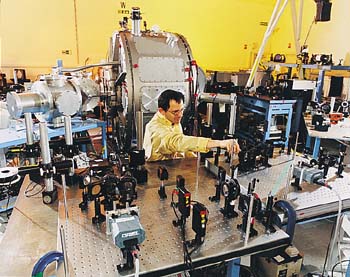
1 Underground physics The UKDMC operates its experiments in the Boulby salt mine in North Yorkshire. The experiment is located 1100 metres underground to protect the detectors from neutrons generated by cosmic-ray muons that can mimic the effects of the WIMPs that the collaboration is searching for. The detection of such dark-matter particles would have enormous significance for both particle physics and cosmology. The mine is operated by Cleveland Potash Ltd. (Courtesy: David Parker/SPL)
The best evidence for neutrino mass comes from the SuperKamiokande experiment, which is situated 1000 metres below ground in a lead and zinc mine in Japan (see “Neutrino mass discovered” by Lincoln Wolfenstein Physics World July 1998 pp 17-18). SuperKamiokande detects muon neutrinos produced when cosmic rays collide with molecules in the atmosphere. Fewer neutrinos are detected from below than above, suggesting that the muon neutrinos have changed into tau neutrinos on their journey through the Earth. The results indicate a mass difference of ~0.05 eV c-2 between the muon neutrino and the tau neutrino.
If the masses of the neutrinos follow the same pattern as the masses of the quarks and leptons, then such a small mass difference suggests that the neutrino masses themselves lie well below 1 eV c-2. This is not cosmologically significant, but if this pattern or “mass hierarchy” is not maintained, neutrinos could still contribute significantly to the non-baryonic dark matter in the universe.
Another candidate for non-baryonic dark matter is the family of heavier neutral particles known as weakly interacting massive particles or WIMPs. The leading candidate in this class is the neutralino, a particle predicted by the so-called supersymmetric (SUSY) extension to the Standard Model.
Supersymmetry is the most convincing theory that explains the particle-mass hierarchy and can unify the strong and electroweak forces. In supersymmetry all the particles in the Standard Model have superpartners. Quarks and leptons, which are fermions, have superpartners that are bosons, while the bosons that carry the fundamental forces have fermionic superpartners. (Most particles have an intrinsic angular momentum or “spin”. Bosons have spins of 0, h, 2h and so on, where h is the Planck constant divided by 2p, while fermions have spins of h/2, 3h/2 and so on.)
In many SUSY models the lightest supersymmetric particle is a neutralino with a mass between 20 GeV c-2 and 1000 GeV c-2 (that is about 20 to 1000 times that of the proton mass). Neutralino is a catch-all name for the lightest neutral SUSY particle. It is likely to be a quantum superposition of the superpartners of the two neutral Higgs bosons, the Z boson and the B boson (which is a neutral superposition of the W and Z bosons). Moreover, this neutralino is stable, which means that the density of neutralinos left over from the big bang will still be cosmologically significant.
Accelerators can be used to recreate the conditions that existed shortly after the big bang and in which neutralinos might have been formed, and the latest results from the LEP accelerator at CERN place a lower limit of 34 GeV c-2 on the neutralino mass. Meanwhile, several groups around the world are carrying out non-accelerator experiments to search for WIMPs that have been left over from the big bang. These groups include the authors and colleagues at Imperial College, the Rutherford Appleton Laboratory and Sheffield University in the UK Dark Matter Collaboration (UKDMC), the Italian/Chinese DAMA collaboration, and the Cryogenic Dark Matter Search (CDMS) in the US.
The UKDMC experiment is located 1100 metres below ground in the Boulby salt mine in North Yorkshire (figure 1), while the DAMA experiment is located at the Gran Sasso National Laboratory in Italy. The Gran Sasso lab was built 1400 metres below ground alongside a tunnel through a mountain on the road from Rome to L’Aquila. However, the use of a cosmic-ray veto means that the CDMS experiment is located just 10 metres underground at Stanford University in California.
Altogether there are now more than a dozen experiments searching for WIMPs, plus several experiments that are looking for axions – very light particles with masses in the range 10-4-10-6 eV c-2 that have been predicted to exist by several theories. Detection of a WIMP particle or an axion would clearly have a major impact on future directions in particle physics.
How to detect a WIMP
If WIMPs were indeed created in the big bang, we will be surrounded by them because of their gravitational interaction with the visible matter in the universe. Indeed, as you read this article there could be a billion WIMPs streaming through your body every second, travelling at a million kilometres per hour. However, as WIMPs only interact weakly with matter, most will pass straight through you without hindrance. This is what makes WIMPs so difficult to detect. Nevertheless, every day a few will strike a nucleus head-on and cause an elastic recoil.
The recoil energy of such a collision depends on the mass and velocity of the WIMP, and the mass of the target nucleus, with large recoils being less likely than small ones. Indeed, the number of recoils falls off exponentially with the recoil energy. The largest energy transfer occurs when the WIMP and target masses are the same, so a target with nuclei of different masses will give better sensitivity over a wider mass range.
2 Closing in on dark matter Dark-matter experiments hope to measure both the mass (x-axis) and interaction rate (y-axis) of WIMPs. From accelerator-based experiments we know that the mass must be at least 34 GeVc2. Supersymmetric theories predict that the interaction rate for the neutralino, one of the leading candidates for dark matter, is less than one event per kilogram of detector per day for a range of masses (pale green region). The first generation of detectors such as germanium ionization detectors (yellow line) were not sensitive enough to detect these low interaction rates. Subsequent generations of sodium-iodide (NaI) detectors have been more sensitive (blue and green lines), and experiments by the DAMA collaboration have detected so-called anomalous events (red rectangle) that might be dark-matter particles but may be caused by other interactions. The current sensitivity of the UKDMC Nal detectors (red line) and the predicted sensitivities of the next generation of UKDMC detectors (dark green region) are also shown.
The energy of the recoiling nucleus can be observed in several ways depending on the target material: a slight rise in temperature may be recorded in cryogenic materials (i.e. phonon-based detection), electric charge may be liberated (ionization), or a photon may be emitted (scintillation). In many materials more than one of these effects may be observed. To discover a WIMP the detector must therefore be capable of registering small nuclear recoil energies, only tens of keV, that will only happen about once per day for every 10 kg of detector.
Unfortunately, for every WIMP interaction there are millions of background events. These events arise from cosmic rays bombarding the surface of the Earth and from radioactivity in both the surroundings and the materials of the detector itself. To escape the cosmic radiation most dark-matter searches are performed deep underground.
To block the radiation from the surroundings, the detector is constructed from high-purity materials and encased in a shield that is low in radioactive impurities. One of the background signals that dark-matter searches need to be especially careful with comes from neutrons, which can cause nuclear recoils similar to those expected from WIMP interactions. These neutrons can come from natural radioactivity, or from collisions between cosmic-ray muons and nuclei. Shields made of water or wax can be used to absorb neutrons.
Similar criteria are needed in experiments such as HDMS – a collaboration between the Max Planck Institute in Heidelberg and the Kurchatov Institute in Moscow that operates low-background germanium-76 ionization detectors at Gran Sasso. Germanium-76 can undergo double beta decay in which two neutrons decay into protons, electrons and antineutrinos. However, it can also undergo a very rare decay process in which two electrons and no neutrinos are emitted. Such “neutrinoless double beta decay” can only happen if the neutrino has mass. These searches were the first experiments to place limits on the WIMP interaction rate. And as the sensitivity of germanium-76 detectors has improved over the last decade, they have been able to lower these limits to a few events per kilogram per day. However, this is still a factor of 10-100 above the neutralino rate predicted by theory (figure 2).
Germanium ionization detectors measure the energy deposited in the target. However, they are unable to distinguish between a WIMP interaction and a background event. Such discrimination is vital for the ultimate identification of a WIMP and depends on the different characteristics of a nuclear recoil produced by a WIMP (or a neutron) and the electron recoils produced by background X-rays, gamma-rays and beta-rays.
The CDMS experiment at Stanford contains both cryogenic germanium and silicon detectors, and uses charge amplifiers and thermal phonon sensors to discriminate between nuclear and electron recoils. Both the ionization and the heat rise created during a recoil are measured, and discrimination is possible because an electron recoil liberates more charge than a nuclear recoil. Recent improvements have allowed the CDMS experiment to set more stringent limits than the germanium ionization detectors alone, although these are still outside the expected neutralino rate.
Sodium-iodide detectors
The most sensitive experiments currently being used in the search for WIMPs, and those which have given the most intriguing results, are based on sodium-iodide (NaI) scintillation detectors. Typically 40 scintillation photons are released for every keV of energy deposited in the crystal, and about 10% of these are eventually recorded by the photomultiplier tubes in the detector.
Due to the low mass of sodium and the high mass of iodine, NaI gives good sensitivity over a wide range of WIMP masses, and its high “light yield” allows events depositing energies down to ~1 keV to be observed. Finally, the spin of the sodium nuclei allows the spin dependence of the WIMP interaction to be investigated.
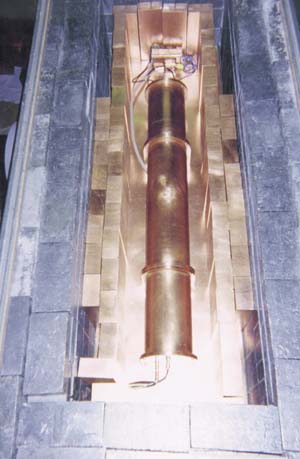
3 Protecting the detector One of the sodium-iodide (NaI) detectors operated by the UKDMC in the Boulby mine. The NaI crystal is encased in a cooling cryostat and viewed by two photomultipliers through quartz light guides. The detector is surrounded by high-purity lead and copper to shield it from radioisotopes in the walls of the cavern.
The UKDMC experiments comprise several NaI crystals ranging from 1 to 10 kg. These are housed in high-purity copper enclosures surrounded by either a lead and copper “castle” or 200 tonnes of high-purity water (figure 3). The NaI crystal is grown from powder that has been purified to remove uranium, thorium and radioactive isotopes of potassium.
All the materials used in the experiments have been checked to ensure radio-purity, right down to the glues used to secure the thermocouples in place. The photomultipliers used to observe the scintillation light have been developed in conjunction with Electron Tubes Ltd to ensure they are low in radioisotopes but high in efficiency. All this effort ensures that the background of gamma-rays is as low as possible.
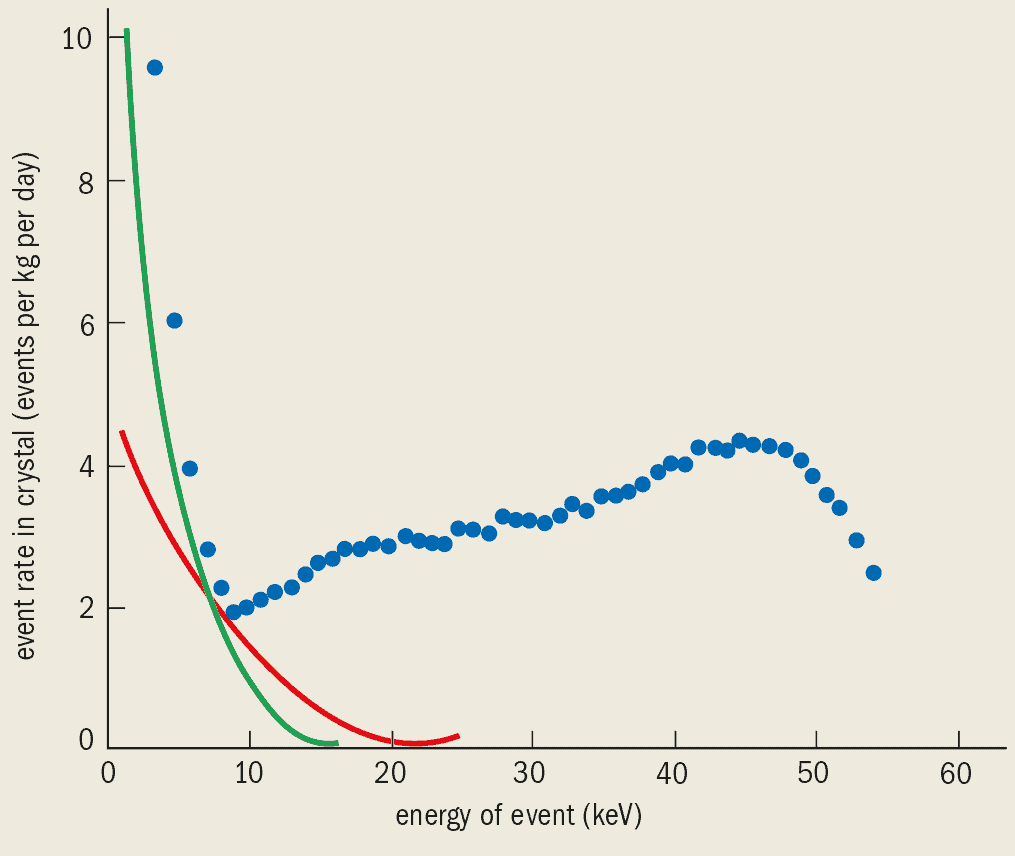
In a typical dark-matter experiment the energy of each recoil or “event” is measured over a period of months, and the number of events per kilogram of detector per day (the “event rate”) is plotted as a function of energy (figure 4). This energy spectrum allows an upper limit to be placed on the WIMP interaction rate as a function of WIMP mass as shown in figure 2. However, this technique does not work at low energies because noise in the detector mimics the expected WIMP signature.
4 Analysing the energy spectrum The energy of each event is measured over a period of months, and the energy spectrum is obtained by plotting the number of events as a function of energy (blue data points). Note that particles with the same mass will lead to events with a range of energies depending on the details of the collision between the particle and the nucleus. Moreover, the event energy is always much less than the WIMP mass: it is typically less than about 60 keV, while the WIMP mass must be at least 34 GeVc2. The expected energy spectrum is a product of the underlying interaction rate, an exponential function that depends on the WIMP mass, and the resolution and threshold of the detector. To determine the upper limit on the interaction rate for a given mass, the rate is increased until the predicted spectrum coincides with the observed one. This provides one data point on a plot like figure 2. The mass is then changed and the process in repeated. The spectrum for low-mass WIMPs (green line) falls off faster than that for high-mass WIMPs (red line), so different upper limits are set on the interaction rate for each mass.
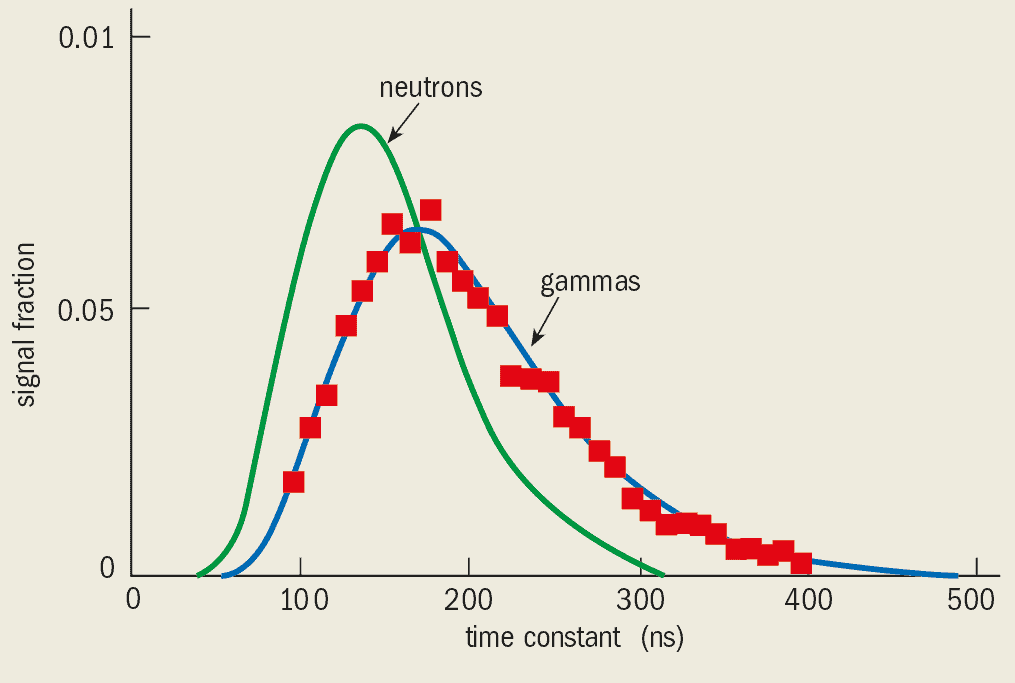
We then need to be able to discriminate between electron and nuclear recoils. This can be done by measuring the decay time of the scintillation light. The nuclear recoils produced by WIMPs or neutrons are typically 30% faster than the electron recoils cause by background gamma-rays. However, the distributions are not completely separated at the keV energies we are interested in, so calibrations are performed with neutron and gamma-ray sources (figure 5). Neutrons are used in the calibration because the kinematics of a neutron-nucleus interaction are expected to be identical to those of a WIMP-nucleus interaction.
The experimental data can then be statistically compared with the calibrations to determine the maximum number of nuclear recoils that could be present in the data. This sets an upper limit on the number of WIMP-like interactions within the crystal. The shielding of the detectors and the high purity of the materials used ensures that the contribution of background neutrons observed by the detector is less than one thousandth of the currently observed statistical limits.
5 Signal and noise We can analyse the data in figure 4 to discriminate between nuclear recoils and electron recoils caused by background gamma-rays. Several hundred photons are detected for each event and their arrival times at the photomultiplier tubes follow a log-normal distribution. The position of the peak depends on the type of particle causing the recoil, while the width of the peak depends mainly on the number of photons in the event (which is determined by the event energy and the efficiency of the detector). Each detector is calibrated with neutron and gamma-ray sources before the experiment begins: a neutron signal (green line) is faster than a gamma one (blue) for the same recoil energy. Most of the data (red points) collected during a dark-matter search will fall on the gamma-ray curve. Statistical analysis is then used to determine the maximum level of neutron-like signals present. This improves the sensitivity of the detector from the blue line to the green line in figure 2. The higher light yields of the upgraded sodium-iodide systems mean that more photons are detected, which gives narrower distributions and hence better discrimination between the two types of signal.
Anomalous events in NaI detectors
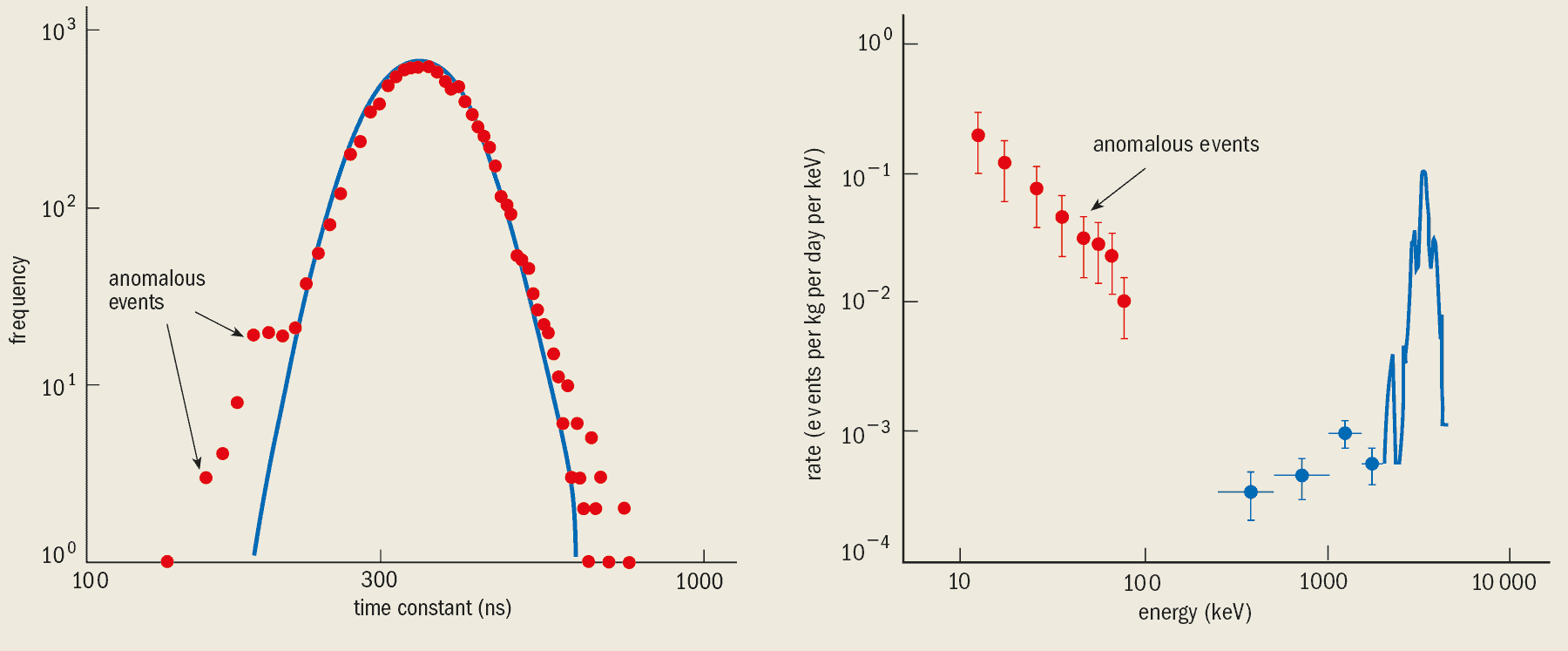
An improved version of the UKDMC’s NaI detector started taking data in 1997, and a number of anomalous events have emerged in the data since the autumn of 1998. These events were faster than the gamma-initiated events, which would not be surprising if they were due to WIMPs. However, they were also faster than the neutron calibrations used to simulate the WIMP interactions (figure 6) and therefore comprise an unknown population of events. Similar events have been seen in all the crystals in the improved experiment, and have recently been confirmed by a French collaboration that is using a 10 kg crystal in an underground laboratory at Modane. The French team is using entirely different data acquisition and analysis techniques, thereby showing it is not an artefact of either.
Spurious events due to light emission within the photomultipliers and other sources have also been ruled out. The following sources have all been investigated and dismissed: gamma-rays, neutrons, high-energy alpha particles from contaminants inside the crystals, surface X-rays and beta-particles, and fission products in the crystals. We are currently investigating unknown lattice and relaxation events, or certain types of alpha-particle emission from the surface of the crystal.
6 Anomalous events (a) This plot shows a small number of “fast events” (red points) with scintillation times shorter than the gamma-ray calibration curve (blue line). Itis similar to figure 5 except that logarithmic axes are used, (b) The same data plotted as event rate versus energy: the anomalous events (red) are clearly discriminated from higher-energy events due to alpha-particles (blue). This plot is similar to figure 4 except both axes are logarithmic. The event rate for gamma-rays is about 100 times higher and is not shown.
The presence of a population of events of unknown origin means that the data may not be used to set an upper limit on the WIMP interaction rate in figure 2. However, if we assume that the anomalous events are due to a background artefact in the detector, we can ask: what level of neutron-like signals could be detected in the distributions in addition to the unknown population? This allows us to calculate the potential sensitivity of the current NaI systems to WIMPs, and illustrates the improvements in the detectors.
The DAMA collaboration is using a 100 kg NaI array to look for a different signature of the WIMP interaction. The Sun is moving through the dark-matter “halo” of the Milky Way at a speed of 220 km s-1 and so continually feels a “wind” of WIMPs. However, the Earth rotates about the Sun with a speed of 30 km s-1 in an orbit that is at an angle of 60º to the Sun’s motion through the halo. Therefore, in June the Earth’s velocity must be added to the Sun’s velocity through the halo, while in December it must be subtracted: this means that the speed of the Earth through the halo is 10% faster in June than in December. The DAMA group are investigating the annual modulation of this signature.
Analysing all events observed over the last two years, the DAMA group does indeed find such an annual modulation in the data below 10 keV. When interpreted as a signal, a WIMP with a mass of 60 GeV c-2 and an interaction rate of about one event per kg per day would cause the observed modulation. However, caution must be exercised as many processes can give rise to an annual variation, such as ambient temperature. Moreover, the detector array must be maintained in a stable configuration over the entire data set. The DAMA group is currently investigating all potential backgrounds that would give rise to such a result.
Future dark-matter searches
These intriguing results from the NaI detectors certainly do not constitute evidence for the observation of dark matter, but they illustrate that experiments are starting to probe new regions of physics. The UKDMC has recently been given funding to develop a new generation of detectors. These include a 50 kg NaI detector that will be able to study the properties of the anomalous population in depth and to resolve the DAMA annual-modulation signal.
We could have more confidence in these events if they were observed in a detector based on alternative technology. Therefore we are building a series of xenon detectors, named ZEPLIN, in collaboration with physicists from the University of California at Los Angeles, the Institute of Theoretical and Experimental Physics in Moscow, CERN and the University of Torino in Italy. In these detectors the nuclear recoil produces both an ionization and a scintillation signal, which gives a discrimination power 10-100 times better than for NaI, allowing any potential signal to be observed over the gamma background with greater sensitivity. The first ZEPLIN detector was installed in the Boulby mine at the end of last year.
The ultimate signature of a WIMP interaction will be a full correlation between the direction of the recoil and the motion of the Earth through the dark-matter halo, an extension of the annual-modulation concept. A detector capable of such three-dimensional direction reconstruction is being developed by the UKDMC in collaboration with teams from Temple University in Philadelphia, Occidental College in Los Angeles and the University of California at San Diego. This detector, DRIFT, will use a low-pressure xenon gas target in which the ionization created by nuclear recoils will be captured on a two-dimensional readout system. The arrival time of the ionization signal will then be used to reconstruct the event in three dimensions. The concepts behind this device have recently been proven, and it is anticipated that a full-scale DRIFT detector could be operational underground within three or four years.
Meanwhile, the DAMA collaboration is planning to increase the mass of its NaI detector to 250 kg, while the CDMS project is developing germanium/silicon targets of up to 10 kg that will be placed in the Soudan mine in Minnesota. The Heidelberg-Moscow team is adding an active veto system to their germanium detectors, while the CRESST collaboration between Oxford University, the Max Planck Institute and the Technical University in Munich is developing low-temperature detectors based on calcium tungstate.
This new generation of detectors will yield further information about the intriguing signals currently being observed in the NaI systems. The sensitivity of these new experiments is such that they will begin to test predictions of many of the supersymmetric models that give rise to neutralinos and, we hope, make a major contribution to both the cosmological search for dark matter and the development of new models in particle physics.
Italy is paying over half of the cost of the SwFr 71million experiment, with voluntary contributions from Belgium, France, Germany and Spain covering the rest. The experiment will start taking data in May 2005.
CERN will send around 1018 muon neutrinos to Gran Sasso every year. However, only about 2500 of these will interact with the 1000 ton target there. If the results from the SuperKamiokande atmospheric neutrino experiment in Japan are correct, then a few tens of the neutrinos will have transformed or “oscillated” into tau neutrinos. Using a laboratory rather than atmospheric source of neutrinos will mean that the initial flux of neutrinos will be known much more accurately, and will allow more precise measurements to be made.