Confirmation that the universe is flat – expanding at just the right rate not to collapse – came from measurements of ripples in the cosmic background radiation left over from the big bang. Gamma-ray bursts have been one of the hottest topics in astrophysics in the 1990s and earlier this year astronomers found that a new ‘softer’ type of burst could be connected to supernovae explosions. Extrasolar planets have been another hot topic but until astronomers witnessed the dimming of light from star HD 209458 as it was eclipsed by a planet, all the evidence had been indirect.
In a degenerate fermion gas all the atoms occupy the lowest possible energy states, which leads to radical new quantum statistical properties. Science selected photonic crystals — structures that can trap and guide specific wavelengths of light — because of their potential for applications in the IT and telecommunications.
PhysicsWeb will be publish its own top ten highlights of 1999 next week.
The experiments were carried out by Thomas Udem from the Max-Planck Institute for Quantum Optics in Garching and colleagues. Udem and colleagues placed four atomic clocks – one rubidium clock, two caesium clocks and a hydrogen maser – in an air conditioned basement at Wessling in Germany and recorded their time difference every 4 seconds between the 3 and 23 August. To eliminate all possible external effects on the clocks, the team also monitored the background magnetic field, variations in temperature, power lines, and atmospheric pressure. Once these factors and the natural drift in the precision of the clocks were taken into account, no gravitational effects were observed.
Light from the planet is almost completely obliterated by the bright glare from the star. Although the reflected signal is 10-20,000 times weaker than the glare from tau Bootis, the planet studied by Cameron and co-workers is still the brightest and hottest planet among the extra-solar planets discovered so far. It also has one of the shortest orbital periods – just over three days – of any known planet.
The light from the planet was detected by exploiting the high orbital speed of the planet. By looking for Doppler shifts caused by this motion, Cameron and colleagues were able to find a faint trace of the light reflected by the planet. The chances of the signal being due to random noise is just 5 percent.
The team hope to confirm their findings during further observations in March and to apply the technique to other star systems later in the year. However, the method only works on planets with very short orbits. “If you want to go looking for Earth-like planets you’re going to have to use another technique,” says Cameron.
In quantum teleportation the quantum state of an object held by “Alice” is instantaneously sent to “Bob”. The new technique works by having two optical cavities that both contain a single trapped atom with three energy levels – two ground states and one excited state. The cavities are designed so that the photon emitted when the atom spontaneously decays from the excited state to one of the ground states can only escape from one side of the cavity. Alice also has a beam splitter and two detectors.
Alice teleports her quantum state to Bob in three stages. In the first stage Alice “maps” her atomic state to the cavity state while Bob simultaneously creates an “entangled” state consisting of his atom and cavity. Alice then waits for a finite time for one of her detectors to see a photon, indicating that the protocol is successful. The success of the transfer is then transmitted to Bob who can recreate the quantum state of Alice’s atom. The technique can, in principle, work over vast distances and could be ideal for linking up distant quantum processors.
NASA’s Mission Control Center hoped that the Deep Space Two micoprobe had landed safely and gone into a ‘sleep’ safety mode. But all attempts to contact the probes have failed. During re-entry the spacecraft had to break communications with Earth, which means that no information about the probes’ final moments exist. However, researchers at NASA suspect that a single event caused all three failures. The most probable explanation is that the protective covering of the spacecraft refused to eject before entering the Martian atmosphere, thereby preventing the microprobes from being launched. Another possibility is that all three craft could have been lost to the rocky Martian terrain.
The Mars Global Surveyor, which is in orbit around Mars, will now be repositioned over the Southern pole to look for the Mars Polar Lander descent parachute. “It is entirely possible that the Mars Polar Lander did a perfect descent, the parachutes came out, and the rockets fired, and we landed on a rock and tipped over,” says Edward Weiler, head of NASA Space Science, “This entire failure could be due to fate.”
Both NASA and the Jet Propulsion Laboratory(JPL) – which manages the Mars programme – are now investigating the failures. A number of programmatic and managerial problems are expected to be raised during their meetings. Earlier this year, for example, NASA discovered that a mix up between metric and imperial units led to the loss of the Mars Climate Orbiter mission. During a routine check on the Mars Polar Lander software NASA discovered some bugs which could also cause the craft’s destruction.
The new setback calls into question NASA’s policy of ‘faster, better, cheaper’ space missions as well as it’s ambitious Mars programme. Two more spacecraft – Mars Surveyor 2001 orbiter and lander – are scheduled for the next launch window to Mars in 2001. Another lander with a small rover that would collect soil samples and fire them into orbit is planned for 2003, while a similar mission is planned for 2005. A French spacecraft is then meant to collect the samples and take them back to Earth by 2008.
All these missions will now be redesigned or rescheduled, for example, by making sure that engineers can receive information about the spacecraft as they enter the atmosphere. Significant changes in the management of future missions are also planned. “Clearly something is wrong, and we have to understand it,” says Dan Goldin, NASA’s director. “We’re not going to just go rushing off and build a spacecraft just to meet an arbitrary [2001] deadline.”
In a series of interviews with a wide cross-section of students who remained in the physics programme, Booth and Ingerman discovered that many students could not adequately explain the links between the basic maths courses and the more advanced physics modules – for example, between Fourier analysis and electromagnetism. They explain that students do not understand the basic skills needed to become a physicist, while the intensive nature of the programme caused them to lose confidence in their abilities and to lose interest in physics itself.
According to the students, the lecturers would sometimes teach techniques that had previously been taught in earlier courses, or automatically assume that they knew the material to a more advanced level. “The major problem was the lack of communication between lecturers in different modules, whether they were in the physics department or not,” says Ingerman. The solution, he says, is for the lecturers in each module to discuss the skills required by today’s physicists, and “to help students relate physics to the outside world, for example, with hand-on experimentation.”
Lecturers in the UK agree. “These sorts of modular courses are very attractive to students,” says Jim Emerson from Queen Mary & Westfield College, University of London. But he points out that teaching staff need to plan the courses well. “With vigilance and careful organising by the teaching staff, who have lots of experience of this, we find modular degrees to be very successful,” he says.
The JIF scheme is funded by the UK government and the Wellcome Trust, the world’s largest biomedical research charity. It was set up after several reports found that a shortage of state-of-the-art research equipment was making it difficult for universities in the UK to remain at the forefront of international research. Nearly £320m has been awarded to 45 projects in 27 different institutions in the second round of the scheme. The size of the awards varies between £750 000 and £30 m.
The upgrade to the Lovell Radio Telescope will extend the life of the 76-metre telescope to the mid 21st Century. The useable frequency range of the telescope will be increased by a factor of four, and the sensitivity by a factor of five. The new funds will also treble the sensitivity of MERLIN – a network of UK radio telescopes link together to form a giant ‘virtual’ telescope.
XMM will be in a highly elliptical orbit to keep it away from interference caused by the Sun’s glare. The telescope’s large size and unusual orbit explains why XMM was launched from Ariane 5, which is the largest heavy-lift vehicle currently in service. XMM consists of three advanced X-ray telescopes. They each contain 58 high-precision concentric mirrors. Each set of mirrors are designed to catch X-rays at different energy levels. The observatory is expected to remain in orbit for at least two years although a longer, extended mission is planned if fuel reserves do not become exhausted.
Today’s telescopes offer detailed views of distant galaxies. The large spiral galaxy NGC1232 shown here is 100 million light-years away and almost 200000 light-years across. (Courtesy: ESO)
As we look back over 2000 years of astrophysics, we see two enormous peaks of scientific achievement. One is at the beginning of the epoch – the Greek world of Aristotle, Aristarchus and Ptolemy. The other peak is where we are standing now. The achievements in this century, and particularly during the last 50 years, have been immense.
Around 330 BC Aristotle recognized that the Sun and Moon are spheres, and that their orbits around the Earth are circular. He showed that the movements of the planets could be constructed from a combination of several circular motions. But after carefully considering the idea that the Sun was at the centre of the orbits, he opted for the Earth as the centre of the solar system.
Aristotle correctly explained eclipses of the Sun and Moon, and deduced that the Earth was spherical from its shadow on the Moon. He even made a fair estimate of the Earth’s radius. Moreover, he recognized that the stars must be very distant and argued that they too were spherical. He also postulated that they were distributed over a range of distances.
To appreciate Aristotle’s achievement, we have to understand that no significant advance on his picture of the world was made for almost 1900 years until Nicolas Copernicus discovered that the Sun is the centre of the solar system. Even that great advance was made within the Aristotelian framework and was conceived as part of an effort by Copernicus to improve the consistency of his observations with Aristotle’s prescription for planetary orbits.
During the Dark Ages most of this knowledge was lost to European view, although some was preserved by Arab astronomers (see Physics before Galileo by William Wallace, this issue). Only a feeble light was shed on this darkness by scholarly monks like the Venerable Bede in the 8th century. The Renaissance was not – as some would have – when astronomers broke Aristotle’s mould, starting with the work of Galileo at the beginning of the 17th century. The true Renaissance was the rediscovery of Aristotle’s works by European thinkers during the 12th and 13th centuries.
Out of the Dark Ages
One of the difficulties of reviewing 2000 years of astrophysics is that many of the advances made by astronomers tend also to be great advances in physics. Galileo’s analysis of the role of acceleration in understanding falling bodies and the motion of projectiles can be classified as pure physics. However, Newton’s recognition that the orbit of the Moon around the Earth is a limit of the motion of a projectile thrown from the Earth, and hence the discovery of universal gravity, must surely be an astrophysical discovery.
The work of Galileo and Newton in the 17th century represented the first major advance since the time of Ptolemy, 15 centuries earlier. Both scientists made key contributions to the development of the telescope. Newton provided the crucial breakthrough of the reflecting telescope, and Galileo was one of the first to apply the newly invented refracting telescope to astronomy. His description in Starry Messenger (Siderio Nuncio) of his first observations of the Moon, Jupiter and the Milky Way using the telescope is one of the most beautiful documents in science.
The telescope greatly improved the accuracy of positional astronomy and opened the way for many significant breakthroughs. In 1728 James Bradley discovered aberration, the cyclic change in the apparent position of a star due to the Earth’s orbital velocity round the Sun. And in 1838 Friedrich Bessel discovered parallax, the small change in the position of the nearer stars as seen from the opposite sides of the Earth’s orbit.
The telescope also led immediately to a huge expansion in the number of known so-called nebulae. William Herschel, whose professional astronomical career was made possible by his discovery of Uranus while working as a musician for King George III, devoted much of his time to surveying nebulae. He laid the foundations for modern nebular astrophysics, but could not decide whether nebulae were unresolved star systems or clouds of interstellar gas. In 1800 Herschel made a discovery that was to open the way to the multiwavelength astronomy of the 20th century. He found that the Sun emitted infrared radiation beyond the red end of the spectrum. A few years later Johann Ritter was inspired by this to look for light beyond the violet end of the spectrum, and discovered ultraviolet radiation.
The mid-19th century brought the second great technological tool of the astrophysicist, the spectrograph. It immediately became clear that some of the nebulae, like the famous one in Orion, were hot gaseous clouds. And the spectrum of the Sun’s atmosphere, which was recorded during an eclipse, revealed the presence of a new element, helium. A century later, helium was to prove of profound cosmological significance.
And so astronomers entered the 20th century with a horizon larger than that of Aristotle, but this was nothing compared with what was to come. They had the telescope and the spectrograph, Newtonian gravity and its application to the orbits of the Moon and planets. But they still had no real astrophysics, no relativity, no quantum theory and no real cosmology. In this brief article I can give only the most superficial account of this century’s achievements, omitting entirely, for example, solar-system science.
Stellar structure and evolution
In the early years of this century Ejnar Hertzsprung and Henry Russell independently suggested that the brightness and colour of nearby bright stars might show how they had evolved with time. The so-called Hertzsprung-Russell diagram shows the variation of the luminosity with colour (which is related to surface temperature) for the galaxy’s population of stars.
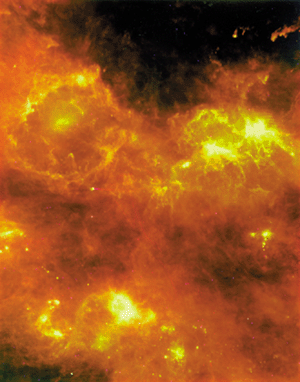
1 New view of the skies This image of the Orion constellation was constructed from data collected by the Infrared Astronomical Satellite. The infrared image highlights the dust content in the region rather than the stars and nebulae seen by optical telescopes. (Courtesy: IRAS)
In the 1920s Arthur Eddington laid down the basic equations of stellar structure and energy transport, and derived relationships between the mass, radius and central temperature of stars. These relations demonstrated that the interior of stars were at temperatures above a million degrees kelvin. Meanwhile Niels Bohr’s new quantum theory was applied to the ions seen in the surface layers of stars, and was crucial to the development of models of stellar atmospheres. This work culminated in the realization that the atmospheres of stars are mainly composed of hydrogen and helium.
In 1932 it was proposed that the stars lying on the so-called “main sequence” – a prominent band across the Hertzsprung-Russell diagram – are composed mainly of hydrogen. The main sequence was therefore interpreted as a locus of different stellar masses, not an evolutionary track.
In the late 1930s Hans Bethe and collaborators discovered the “proton-proton” and “carbon-nitrogen cycle”, nuclear-fusion processes that power the Sun and other main-sequence stars. And in 1955 Fred Hoyle and Martin Schwarzschild calculated the first detailed model for the evolution of a star that has exhausted the hydrogen at its centre. At this point the star starts to burn helium, thus creating carbon, nitrogen and oxygen, and rapidly becomes a luminous, extended, cool “red giant” star. By 1962 Chishuro Hayashi and co-workers were able to fully explain the Hertzsprung-Russell diagram with detailed evolutionary models for the full range of stellar masses from 0.01 to 100 times the mass of the Sun. The full evolution of stars from their birth to their death was finally understood!
Distance scale and the expansion of the universe
The studies of so-called Cepheid variable stars by Henrietta Leavitt in 1912 were fundamental to the discovery of the expanding universe. Cepheid variables are a type of star that undergoes regular radial pulsations. Leavitt demonstrated that there is a relation between the absolute luminosity and the period of pulsation.
Edwin Hubble used this relation in 1924 to measure the distance to spiral nebulae and demonstrated that they were extragalactic. Meanwhile Vesto Slipher had been measuring the velocities of the galaxies using the Doppler shifting of their spectral lines and found that most of them were receding.
In 1929 Hubble combined his galaxy-distance measurements and those of other researchers (based on the brightest stars in galaxies) with the recession velocities to discover the expansion of the universe. The theorist Alexander Friedmann had already shown that expanding-universe models were just as plausible under general relativity as the static, homogeneous, isotropic model postulated by Einstein in 1917.
For almost 30 years, however, the timescale of the expansion of the universe seemed far too short compared with the age of the Earth and the oldest stars. Allan Sandage greatly eased this problem in 1956 thanks to his improved galaxy-distance estimates. Controversy about the rate of expansion of the universe – measured by the so-called Hubble constant, H0 – has continued to rage for the past 30 years. However, a consensus is now in sight for a value in the range 60-70 km s-1 per megaparsec (1 megaparsec = 3.26 million light-years). This translates to an expansion timescale of 15 ± 1.2 billion years, which would be the age of the universe if there were no acceleration or deceleration of the expansion.
Meanwhile the age of the oldest stars, estimated from stellar-evolution models, has steadily decreased. In 1982 it was estimated as 17 billion years. However, the most recent studies of ancient stars use distances derived from the Hipparcos astrometric mission, and show that the stars are 11.5 ± 1.5 billion years old. This means that there is no longer an “age problem” for the universe.
The new astronomy of the invisible wavelengths
The wartime development of radar released a whole generation of radio experts into astronomy to follow up the pioneering discoveries made in the 1930s and 1940s. In 1934 Karl Jansky had discovered radio emission from the Milky Way and in the 1940s Grote Reber completed the first all-sky radio maps. In the same period John Hey discovered radio emission from the Sun and detected the first radio point sources. By the late 1950s radio astronomy was beginning to be a major field of modern astronomy.
Other wavelength bands soon followed: infrared astronomy made rapid progress during the 1960s, culminating in the launch of the Infrared Astronomical Satellite (IRAS) in 1983 and the European Space Agency’s Infrared Space Observatory (ISO) in 1995. The launch of the Uhuru satellite in 1970 marked a great step forward for X-ray astronomy.
The new astronomies brought the discovery of a wealth of new phenomena, such as radio galaxies, quasars, pulsars and hence neutron stars. Others findings have included X-ray binaries with neutron stars and black holes, massive black holes in galactic nuclei, starburst and ultraluminous infrared galaxies, protoplanetary discs, and gravitational lensing by stars, galaxies and clusters.
Black holes proved to be one of the most dramatic consequences of Einstein’s general theory of relativity. Discussed first by a series of theorists, they are now seen as the common end point for stars that are at least 20 times more massive than the Sun. Black holes are pervasive in galactic nuclei, where they are found with masses ranging between 106 and 109 solar masses. Although the evidence for their existence is inevitably indirect, it is by now overwhelming.
High-energy astrophysics – the study of energetic photons and relativistic particles – has been a wonderfully rich field. Achievements have included the detailed physics of gaseous accretion onto discs around black holes and compact stars, and models for the generation of relativistic jets in active galactic nuclei.
The interstellar medium
The discovery of interstellar dust by Robert Trumpler in 1930 transformed our perception of the space between the stars. Subsequent studies of dust and of atomic, molecular and ionized gas have revealed the complex physics of the clouds of gas and dust that pervade galaxies, including our own. Spectroscopic studies, ranging from optical to radio wavelengths, have been particularly important in understanding the ways in which new stars are continually formed from the interstellar dust and gas.
Most of the heavy elements in the interstellar medium, which comprise about 2% of the total mass, are either in the form of small grains of silicate or carbonaceous dust, or in carbon-monoxide molecules. Arno Penzias and his collaborators first discovered carbon monoxide in interstellar space in 1970. Now over 50 species of interstellar molecule are known.
Interstellar dust has a drastic effect on the flow of radiation through a galaxy. A significant fraction of the visible and ultraviolet light emitted by stars is actually absorbed by dust and re-emitted at infrared wavelengths (figure 1). The maps of the sky made by IRAS revealed the full picture of this re-emitted radiation for the first time.
The hot big bang
The most significant breakthrough of the new astronomy was the discovery of the microwave background radiation by Penzias and Robert Wilson in 1965. This radiation was immediately interpreted as the relic of the radiation-dominated phase of a hot big-bang universe. Its high degree of isotropy pointed towards an exceptionally simple structure for the universe on the largest scales.
In the 1940s and 1950s George Gamow and co-workers had pushed the concept of a hot big-bang universe that was dominated by radiation in its early stages. They were hoping to explain that the elements originated from nuclear reactions in the early universe. In the end only helium, deuterium and lithium proved to be cosmological relics, according to detailed calculations by Bob Wagoner, Willy Fowler and Fred Hoyle in 1967.
Geoffrey and Margaret Burbidge, Fowler and Hoyle had previously shown that the heavy elements – those from carbon onwards – were made in the stars. And in 1972 it was demonstrated that the remaining light elements (beryllium and boron) were made by cosmic rays ploughing through interstellar helium nuclei.
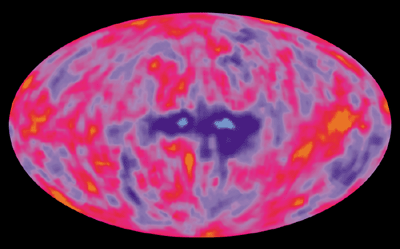
2 Ripples in the microwave background An image of the cosmic-microwave-background anisotropy measured by the Cosmic Background Explorer satellite over four years. (The dipole anisotropy has been subtracted.) The fluctuations in the background are extremely faint, only 1 part in 100,000, and are the imprint of a density contrast in the early universe. The density ripples are believed to have given rise to the structures of galaxy clusters that populate the universe today. (Curtesy: NASA COBE)
In the 1970s groups at Princeton, Berkeley and Florence detected the first tiny deviation from isotropy in the microwave background radiation. This so-called “dipole anisotropy” is due to the motion of our galaxy through the cosmic frame. The effect is that the microwave sky appears slightly hotter in the direction of our motion, by one part in a thousand, and slightly cooler in the opposite direction.
All-sky galaxy maps derived from the IRAS surveys allowed myself and co-workers to demonstrate that this motion was due to the gravitational attraction of galaxies within 300 megaparsecs. The precision with which the isotropy of the microwave background could be measured continued to improve. Then in 1991 the Cosmic Background Explorer (COBE) team announced that it had detected anisotropies at the level of 1 part in a 100,000 on a 10° angular scale (figure 2). This was the first evidence of the small density fluctuations from which, ultimately, galaxies and clusters of galaxies must evolve.
From the 1960s the spectrum of the radiation had seemed reasonably close to a black body at 2.7 K. These measurements reached their climax in 1990 when the COBE team showed that it had measured the perfect Planckian spectrum, accurate to one part in a thousand. This Planckian form is the strongest possible evidence for a big-bang universe with a radiation-dominated early phase.
Formation of galaxies and clusters
Galaxies and clusters of galaxies are thought to originate from the effects of gravity on small density fluctuations present in the early universe. This idea was first developed by Jim Peebles and Yakov Zel’dovich in the late 1960s. But by 1980 it was clear that the high degree of isotropy of the microwave background posed problems for a universe containing only ordinary “baryonic” matter, i.e. neutrons and protons.
To be able to form galaxies by the present day, it was necessary that fluctuations occurred in some non-baryonic component. In order to initiate structure formation, this component must have decoupled from the radiation produced in the big bang long before the baryons did. In other words, we cannot make galaxies unless the universe is dominated by “dark matter” that does not, by definition, radiate. As a result we expect dark matter to be present throughout the universe today.
Zel’dovich proposed that a neutrino with a mass of a few tens of electron-volts could form “hot dark matter”, so-called because the neutrinos would be moving at speeds close to the velocity of light. He argued that such hot dark matter could explain the origin of structure in a “top-down” picture, with clusters forming first that later fragmented into galaxies. Computer simulations showed, however, that this did not work and that the alternative “cold dark matter” scenario worked much better. This would lead to “bottom-up” structure formation, in which galaxies were produced first and then merged to form clusters. This approach requires the existence of dark-matter particles that moved around slowly in the early universe. Currently the most successful scenarios are based on cold dark matter, with the most popular candidate for dark matter being the lightest supersymmetric particle, the neutralino. Indeed, several underground experiments are under way to try to detect the neutralino.
However, some additional ingredient appears to be necessary to match the observed spectrum of density fluctuations in the universe today. Proposals for this extra ingredient include an additional repulsive force that acts on large scales, a concept that was first introduced by Einstein in 1917 to achieve a static universe. There could also be a second dark-matter component in the form of a neutrino with a mass of a few electron-volts.
Meanwhile, atmospheric-neutrino experiments appear to have demonstrated that at least one neutrino species does have a non-zero mass. However, the implied mass is not large enough to have an interesting cosmological effect, unless one turns to non-standard scenarios (see “Particle physics: the next generation” by John Ellis, this issue).
An important ingredient in the theory of the origin of structure was the invention of inflation by Alan Guth in 1980. This was introduced to solve the so-called “monopole” and “horizon” problems in cosmology. In the first of these problems, the phase transition associated with the symmetry breaking of the grand unified force in the early universe is likely to have generated a high density of magnetic monopoles. None are observed, however. The horizon problem arises when we look at the microwave background in opposite directions. How do two regions of the universe that have never been in causal contact in a standard expanding-universe model manage to be identical?
The original inflation concept was that at the epoch of symmetry breaking, the universe would be left in a state of “false vacuum”. This would act like a huge cosmological repulsion and drive an exponential expansion for long enough (only about 10-32 s) to solve the horizon problem. The vacuum energy would then be converted into matter and radiation. In the process the required small, primordial density fluctuations would have been generated, and the normal Hubble expansion would have resumed. A great variety of versions of this generic idea have subsequently been invented, with a consequent loss of predictive power.
Current status and future prospects
As we approach the end of this remarkable century for astrophysics and cosmology there seems to be no end to the wealth of new discoveries. The Hubble Deep Field – a very deep map of a small area of the sky made with the Hubble Space Telescope – has extended our picture of star formation in galaxies back to when the universe was only 10% of its current age (figure 3). Meanwhile, infrared and submillimetre surveys of the Hubble deep field using the ISO and the submillimetre array on the James Clerk Maxwell telescope in Hawaii have shown that much of the star formation in galaxies is hidden from optical view by dust.
3 Digging deeper into space The Hubble Deep Field consists of over 300 images taken when the Hubble Space Telescope was trained on the same region of sky for ten consecutive days in 1995. The image shows a wide range of galaxies, stretching back billions of years to when the universe was just 10% of its current age. (Courtesy: NASA)
The new breed of 8 m and 10 m telescopes is making spectroscopy of very distant galaxies almost routine. They are also allowing the identification of distant supernovae, which appear to show that the expansion of the universe is accelerating, presumably due to the cosmological repulsion discussed above. And careful spectroscopic searches have discovered several Jupiter-sized planets around nearby stars.
The mysterious gamma-ray bursts have begun to be pinned down via detection of their X-ray and optical afterglow. These intense outbreaks of radiation have been observed at cosmological distances and seem to be related to the destruction of a neutron star and the formation of a black hole.
The giddy pace of progress is likely to continue for at least the next few decades. Both NASA and the European Space Agency (ESA) are planning future missions to map the microwave background. The Microwave Anisotropy Probe and Planck missions should determine most of the main cosmological parameters to unprecedented precision, and probe the origin of density fluctuations.
ESA’s submillimetre mission, FIRST, the US-European millimetre array, ALMA, and NASA’s Next Generation Space Telescope will form a superbly complementary trio, probing star formation in the early universe. Meanwhile, missions like Gaia, Darwin and the Space Interferometry Mission will try to make progress in discovering and understanding planetary systems.
A series of ground-based experiments and, ultimately, ESA’s Laser Interferometer Space Antenna mission should at last make gravitational-wave astronomy a reality (see Schäfer and Schutz in further reading). And ideas for a ground-based optical telescope with a mirror 100 m in diameter are already in circulation.
Since the time of the ancient Greeks all advances in physics have found immediate application in astrophysics and cosmology. And time and again astronomy has been the driving force for breakthroughs in physics. Our understanding of the astrophysical universe has advanced immeasurably since the beginning of the century. As we enter the next millennium, the vein of discovery is far from exhausted.
Even a decade and a half after the discovery of high-temperature superconductivity in ceramic compounds containing copper-oxide planes, these materials continue to puzzle condensed-matter theorists. The challenge is not simply to find a reasonable formula that predicts the uniquely high values for the superconducting transition temperature in the cuprates. Rather, superconductivity is but one aspect of the unique and complex phase diagram exhibited by this class of materials. Depending on the temperature and the level of doping, the cuprates can be insulators, metals or superconductors. The non-superconducting or “normal” phase also exhibits unusual properties (see figure).
Before the mid-1980s, superconductivity – which is defined as the absence of resistance to electrical current – had only been observed in metals and metallic alloys that had been cooled below 23 K. In 1986, however, Georg Bednorz and Alex Müller discovered that when lanthanum copper oxide, which is an insulator, is “doped” with barium, it becomes a superconductor with a transition temperature, Tc, of 36 K. Similar materials with higher transition temperatures soon followed, including yttrium barium copper oxide (YBCO), which has a Tc above the temperature of liquid nitrogen and opened up the possibility of new applications. The highest transition temperature currently known is 130 K in a mercury-based cuprate at room pressure. (Tc tends to increase with pressure.)
Amazingly, although more than 50 superconducting cuprates are now known, they are all variations on a single theme – lightly doped copper-oxide planes. Extensive research to find high-temperature superconductivity in other families of materials has been singularly unsuccessful. So what is so unique about the cuprates that enables them both to entice us with promises of novel applications and to challenge our fundamental understanding of electrons in solids?
A common feature of all superconductors – both the low- and the high-temperature variety – is that the electrons somehow overcome their mutual electrostatic repulsion to form “Cooper pairs”. Since these pairs do not have to obey the Pauli exclusion principle, they can condense into a single quantum state below a certain temperature. This is what gives superconductors their unusual properties. In low-temperature superconductors the electrons pair together so that their total orbital angular momentum is zero – a so-called s-wave state. Interactions between the electrons and phonons (vibrations of the crystal lattice) are responsible for the pairing.
In high-temperature superconductors, on the other hand, the pairs are in a so-called d-wave state, a superposition of states in which the angular momentum is non-zero. This d-wave symmetry has been clarified only recently by elegant experiments. But how does one turn the Coulomb repulsion between electrons into a form of attraction that binds the Cooper pairs together?
The phonon-based pairing mechanism in low-temperature superconductors requires the Coulomb repulsion to be described in terms of so-called Landau-Fermi liquid theory. In this theory the properties of single electrons are changed or “renormalized” by interactions with other electrons to form “quasiparticles”. The properties of the material can then be understood in terms of weak residual interactions between quasiparticles.
For many years, theorists worked with the Landau-Fermi theory – which has been remarkably successful in most metals – in an attempt to show that Cooper pairs with non-zero angular momentum could be formed from Coulomb repulsion alone. However, the cuprates never form a Landau-Fermi liquid. But what causes the breakdown of the Landau-Fermi liquid theory, which is otherwise so successful, and what is the nature of the resulting electron liquid?
Such a breakdown can occur near a symmetry-breaking transition, such as the transition from paramagnetism to antiferromagnetism (in which the magnetic moments or “spins” on neighbouring atoms point in opposite directions). This sort of transition leads to superconductivity in the so-called heavy fermion metals at high pressure. This direction is being followed by many groups, but others are sceptical. They point out that the Landau-Fermi model breaks down above the superconducting transition temperature and over a wide range of doping levels (see figure). They also point out that the onset of superconductivity is often the only symmetry-breaking transition that actually occurs. (Superconductivity breaks an abstract mathematical symmetry called gauge symmetry.)
If one rejects the above scenario, then one has to find a way to stabilize a non-Landau-Fermi liquid without a broken symmetry. Further, this new form of electron liquid should form a d-wave superconductor when cooled below a certain temperature. One promising approach is based on the idea of a doped resonant valence bond (RVB) state. The RVB state was first proposed by Philip Anderson many years ago to describe a lattice of antiferromagnetically coupled spins where the quantum fluctuations are so strong that long-range magnetic order is suppressed. The system resonates between states in which different pairs of spins form singlet states that have zero spin and hence no fixed direction in space. But how does a doped RVB state behave? And why does doping stabilize a RVB state when the undoped state prefers an ordered magnetic state? Currently a comprehensive theory is lacking, but there are encouraging signs.
The RVB state is just one of many theoretical approaches to high-temperature superconductivity. Other competing theories include those based on fluctuating stripes (in certain cuprates at low temperature the doped holes are observed to localize along parallel lines, called stripes, in the copper-oxide planes), and those that propose to unite the superconducting and antiferromagnetic phases in a larger symmetry group (so-called SO(5) theories). Other theories are based on the polaron mechanism and seek to exploit the strong coupling between electrons and phonons in oxide materials.
Lastly, we can ask what the final theory should predict. First, it should describe the full complex phase diagram. Second, it should reveal the special conditions in the cuprates that lead to this very special behaviour. From this should follow some suggestions for other materials that would show similar behaviour. While it may not be possible to predict Tc accurately – because, for instance, of a lack of precise input parameters – the final theory should give the correct order of magnitude and explain the trends that are observed in the cuprates. These trends include the increase in Tc as we move from single-layer cuprates to those containing two and three copper-oxide layers. These challenges are likely to keep theorists busy for years to come, but hopefully not another decade and a half.