

Every year the Foundation asks 3000 physicists to nominate individuals for the prize, and compiles a short-list of 250 candidates. These names are then whittled down to a list of 30, from which the winners are chosen. Last year’s prize was awarded for the experimental discovery of the fractional quantum Hall effect, and its theoretical explanation.
Filing cabinets hamper scientific research!
Scargle argues that there already exists a bias in individual scientific papers because researchers usually only publish statistical summaries of their data – not the raw data itself. But his main concern is how negative results are automatically refused publication in some fields. This is likely to tilt any future survey of the literature in the field towards a more positive conclusion. “I was astonished to learn that some journals in medicine/biology have an explicit editorial policy that promotes publication bias,” says Scargle.
In a paper due to be published in the Journal of Scientific Exploration, Scargle points out there are at least 14 different cusp points – such as permanently recording the data or having a paper peer reviewed – at which research results may be prevented from inclusion in a survey of results from the published literature. Each step, says Scargle, involves human decisions and may therefore be influenced by the results of the study. “My main concern is that medical studies, including ones that lead to acceptance or rejection of drugs, are using incorrect statistics,” says Scargle.
Has Hubble seen dark matter?
When the astronomers – Rodrigo Ibata from the European Southern Observatory, Harvey Richer and Douglas Scott from the University of British Columbia in Canada, and Ronald Gilliland from the Space Telescope Science Institute in Baltimore – compared the two Hubble images, they noticed that five objects appeared to have moved, indicating that they are local to our galaxy. Two of them appear to be white dwarfs, while the other three require further observations.
White dwarfs are Earth-sized stars that have the masses similar to the mass of our Sun, which makes them extremely dense and compact. The possible white dwarfs seen by Hubble are very old – around 12 billion years of age. According to theoretical predictions, if all the missing mass in the galactic halo is made up of these white dwarfs, then four such stars should be seen in the Hubble Deep Field.
Taking a fresh look at maths and physics
The standard story about the development of physics as a separate discipline runs more or less as follows. After the Newtonian revolution of the 17th century, natural science divided into two parts: mechanics on the one hand and experimental science on the other. The latter investigated nature in a mostly qualitative way, whereas mechanics – under the influence of mathematicians such as Lagrange and Legendre – became more and more mathematical, giving rise to new branches of mathematics, in particular calculus.
Towards the end of the 18th century, mathematics started to be used more widely in physics, especially by French scientists like Laplace and Poisson, in accordance with Galileo’s old observation that “the book of nature is written in the language of mathematics”. This trend continued, until, by the end of the 19th century, physics had become well established as a separate discipline, in which physicists performed quantitative experiments and explained the results with the help of theories framed in the language of mathematics.
What is implicit in this story is a remarkable development that took place around the middle of the 19th century: the emergence of theoretical physics as a separate branch of physics and the consequent split of physics into an experimental and a theoretical part. For historians, this development raises two intriguing questions. Why did this split occur and why did it take place at this particular time?
Some time ago, the historians of science Christa Jungnickel and Russell McCormmach made the first attempt to provide a historical analysis of the emergence of theoretical physics, especially in the German-speaking world (see Intellectual Mastery of Nature: Theoretical Physics from Ohm to Einstein University of Chicago Press 1986). They mainly focused on institutional factors, such as the development of German universities, teaching needs and financial matters, and found that separate chairs of theoretical physics started to be created around 1870. The actual origins of theoretical physics, however, seemed to lie some decades earlier, when mathematics entered physics in a serious way.
This all sounds very plausible, but it is precisely the latter point that is contested by Elizabeth Garber in this book, The Language of Physics. Her main thesis is as remarkable as it is simple: much 19th-century work, which up to now has been considered theoretical physics, is in fact mathematics. For a long period, physicists were split personalities, as it were. On the one hand they did experimental work, using mathematics – especially calculus – to quantify their results. On the other hand they took mathematics, for instance differential equations, as the starting point for new investigations that in turn gave rise to new, purely mathematical results that were given little or no physical interpretation.
The latter work, which Garber terms “mathematical physics”, was usually published in mathematics journals. In Garber’s view, this trend persisted until well into the 19th century, when British and German physicists finally broke through existing boundaries and created theoretical physics in its own right by adopting the attitude that mathematics was just a tool to be used within physics and for practical purposes only. They took what they needed, often to the dismay of mathematicians, who watched with horror how the physicists ignored proper mathematical rigor to reach their goal.
A striking example is Paul Dirac’s introduction of his well known delta-function, a mathematical monstrosity, but one that was widely and successfully used in physics. Thus, a certain split between mathematics and physics was created, which has persisted till today. (In recent years, however, the gap seems to have been closing a bit: string theory, for example, has given rise to a number of new results in pure mathematics.)
A characteristic example of the split between mathematics and physics is the difference of opinion between Albert Einstein and the mathematician David Hilbert on the general theory of relativity – an example that Garber briefly discusses in the book. In about 1910 Hilbert had started to work in physics, commenting that “physics was too difficult to leave to the physicists”. Among other things, he took up Einstein’s early work on general relativity. Hilbert eventually published a theory that was similar to Einstein’s final version of general relativity and appeared almost at the same time as Einstein’s work. However, whereas Einstein’s theory was firmly based on physical principles, Hilbert’s was much more an exercise in pure mathematics, based on some dubious physical assumptions. Although Einstein admired Hilbert’s mathematical proficiency, he characterized Hilbert’s physics (in a letter to Hermann Weyl) as “infantile”.
To substantiate her thesis, Garber presents a detailed analysis of the development of the mathematization of physics between 1750 and 1914. She starts in 18th-century France and then moves on to the 19th century, and to Britain and the German states. Her approach is to focus on certain topics – such as the wave equation, elasticity and electrostatics – that characterize the general trend, with the contributions of scientists, such as Laplace, Poisson, Ohm, Stokes, Maxwell, Clausius and Helmholtz, discussed in depth. Institutional developments and social factors are also taken into account where needed.
In my view, Garber argues her case convincingly and I consider this book to be a very valuable addition to the existing literature on the history of modern physics. The book is also well written, although it is not bedtime reading: Garber brings in equations and sometimes intricate technical details if these are needed to clarify a point. However, those who make the effort to follow the argument will gain many new insights and obtain a fresh outlook on the mathematization of physics in the 18th and 19th centuries.
Do planets make diamonds from methane?
Lara Benedetti and colleagues from the University of California at Berkeley, the University of Missouri and the Lawrence Livermore National Laboratory sealed liquid methane between two diamond ‘anvils’ and squeezed it to 50 gigapascals – 25 million times atmospheric pressure. A laser was then used to heat the sample to 3000 Kelvin – producing the atmospheric conditions that exist 7000 km below the cloud tops of Neptune and Uranus.
Scientists have long suspected that the core of the outer planets could consist of diamond, but this is the first evidence for diamond formation in the middle layers of the planets. Both Neptune and Uranus consist of 10-15% methane and, according to Benedetti and colleagues, large quantities of diamond could effect both the luminosities and magnetic fields of the planets.
Doubly magic nickel-48 surprises theorists
The name magic number comes from the shell model of the nucleus. The combined quantum mechanical effects of protons and neutrons in the nucleus can create energy shells similar to the electron energy levels found in atoms. The number of protons or neutrons required to fill each shell is called a magic number. The GANIL team detected two nickel-48 nuclei among the debris of collisions between a beam of nickel-58 ions and a target containing various nickel isotopes.
Krebs resigns from DOE
Theorists tackle the Earth’s core
Dario Alfè, David Price and Mike Gillian of University College London used a Cray T3E supercomputer to calculate that the melting point of iron was 6700 Kelvin, plus or minus 600 Kelvin, at the pressure of the inner core boundary. The inner and outer cores store tremendous amounts of energy as heat. The transfer and movement of this energy can cause earthquakes and volcanoes. It can also influence the motion of continental plates. Moreover, the magnetic field generated by the molten core protects the Earth from the solar wind.
“The core temperature is crucial for our understanding of how the Earth changes over time,” says Mike Gillian. “You have to know this if you want to understand earthquakes on a fundamental level.”
New hope for physics education
LAST month some 600 students in 25 schools and colleges across the UK began piloting a completely new physics course for 16-19 year olds, called Advancing Physics. The course is part of a £1m initiative by the Institute of Physics, in partnership with the OCR examination board, to make physics teaching more up to date, more exciting and more relevant to all aspects of modern life. It is backed by funding from the Institution of Electrical Engineers, the Particle Physics and Astronomy Research Council, and various industrial sponsors.
Classroom visit
Imagine you are visiting a class that is just starting the Advancing Physics course. You sit by a student who “calls up” on a computer screen an image of the planet Mercury that was transmitted to Earth by the Voyager spacecraft. The image is speckled with noise that was introduced during the transmission. Deftly, the student selects an option to process the image, and most of the random noise is removed. Nearby, another student looks at an X-ray image of a skull with a barely visible hairline fracture, and enhances the contrast of the image to bring the fracture into view.
The teacher quizzes the students about how image processing works. The students talk confidently about images made of pixels, each storing and displaying one byte of data. One student explains how replacing the value stored in a pixel with the median of it and surrounding pixels is a good way to remove noise. The teacher points out the connection with averaging over a set of experimental data. The students know what they are doing because they have previously “looked under the bonnet” of image-processing software, understanding how smoothing and edge detection work by using a spreadsheet.
Images from medical physics (such as ultrasound scans, X-rays and magnetic-resonance images) and from modern areas of research like astronomy and space science are available to students on the CD-ROM that is an integral part of the new course. The CD-ROM also contains the scientific image-processing software they use.
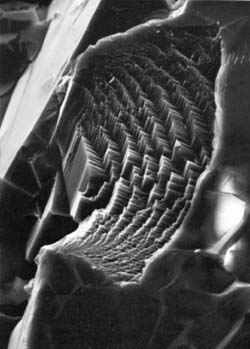
In another class along the corridor, the new Advancing Physics students begin studying the properties and uses of a wide variety of materials, such as metals, ceramics, polymers and composites. These students are working towards the concept of “designer materials” in which an understanding of the relations between the structure and properties enables new materials to be created to specification, sometimes even by building them atom by atom. The students have access to images of microstructures within materials, and a database containing the properties of a wide range of substances (figure 1). Models and simulations, all of which are a click or two away on the CD-ROM, also aid the students.
Both of these starting points reflect the latest aspects of physics in action. And both connect to issues of social importance that the students are eager to discuss, such as the uses and abuses of digitized images in newspaper reporting, the digital revolution in communication, and the creation and marketing of new fabrics, electronic devices and stronger materials. This is the world in which these students will live, having to judge whether changes are really of benefit or merely serve to create and satisfy passing fads. The new course provides space for students to put forward their own opinions and ideas, underpinning them with information and an understanding of the physical concepts.
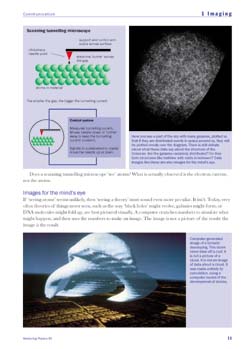
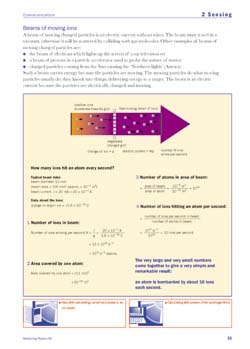
The students have a specially written textbook that is full of visual appeal and tells physics as an engaging story (figure 2). It contains plenty of “hard physics” and all the relevant mathematics, which is often presented with strong visual enhancements (figure 3). But the narrative is about ideas, discoveries and inventions as they happened, the people involved, and human purposes and consequences. It is this narrative that holds all the physical concepts together and creates interest among the students.
The textbook is slimline, while the CD-ROM contains additional exercises and activities as well as images and computer programs, including models and data. The CD-ROM also contains additional support for weaker students and more advanced material for stronger ones.
As with every A-level course, Advancing Physics by no means neglects the traditional core topics, such as mechanics, optics, electricity and magnetism, and thermodynamics. (A-levels are the exams taken in the UK by 18 year olds hoping to go to university.) Indeed, the Qualification and Curriculum Authority (QCA) only approves A-level courses that meet a rigorous set of criteria, one of which is that these fundamental topics make up 60% of the course content.
All change for A-levels
Many Physics World readers in the UK will know that A-levels in every subject will change next year. Instead of a two-year course that leads to an A-level qualification, there will be an initial one-year Advanced Subsidiary (AS) course and qualification. Students will then be able to continue for a second year if they wish, and sit a second examination. The two add up to the equivalent of a full A-level.
At present, students usually take between two and four A-levels, but under the new system they will be able to broaden their post-16 education by taking additional AS courses that they do not continue to A-level. This may bring students in England, Wales and Northern Ireland into line with their counterparts in Scotland and other European countries.
Physics is fortunate in having more than one innovative and well thought through initiative that will be ready to meet these new and challenging demands. The Salters-Horners course, which has been on trial for a year, capitalizes on students’ interests in the real-life use of science and illustrates physical concepts through a variety of applications. Teachers who want to know more about the Salters-Horners approach can obtain the pilot student textbooks and teachers’ guides, which are published by Heinemann.
The Institute of Physics initiative provides a further choice for teachers and students. Advancing Physics is designed to make physics attractive to as many people as possible, while remaining true to the soul of the subject. In particular, the course is designed to provide a really worthwhile one-year AS course that gives a broad picture of what physics is all about. Furthermore, the AS course is genuinely valuable to those who go no further and is an effective starting point for those who do.
Broadening the A-level system has been on the agenda for the UK government for at least a generation, but proposal after proposal has not quite come to fruition. Only now has the government committed itself to change. Meanwhile, students have taken matters into their own hands, broadening their post-16 education by increasingly choosing “mixed” combinations of arts and science subjects. Indeed, around 40% of all A-level students take a mixture of subjects.
Physics is evidently at risk when students look to broaden their choices because of its strong links with mathematics. Now it is essential to consider how the equivalent to A-level physics can be taught without students invariably studying mathematics to an advanced level. Mathematics features strongly in the Advancing Physics course, and students are given strong support in the maths that is relevant to their physics course. The new one-year AS courses offer a real opportunity to attract a wider variety of students to the subject.
The Institute of Physics post-16 initiative has much wider objectives than simply producing a new A-level physics course. It is imperative for those in the physics and engineering communities to have a say in the development of physics education during these changing and challenging times. We cannot afford for the future of physics education to be decided by government quangos without attempting to shape the arguments they take into account.
In order to recapture the influence that physicists once had in deciding educational policy, we must have good arguments and present them to the public in attractive and digestible forms. The Institute of Physics has therefore commissioned a “discussion series” of five booklets, entitled Shaping the Future, which discuss topics of major concern about the shape of post-16 physics. Three booklets in the discussion series have already been published: Making Physics Connect, Physics in Mathematical Mood and Physics in Vocational Courses. Two more are in preparation: The Study of Matter and Physics in a Broader Context.
Each booklet forms part of an on-going debate about the way forward for physics education in the next decade. As each booklet is being written, national meetings are held to discuss and refine the content. And the lively points that arise as a result are included in the final version. Each booklet is being sent to significant opinion-forming and decision-making bodies, including government regulatory bodies such as the QCA, who have welcomed them. The booklets have also been made available to groups of teachers around the country who continue to discuss the points they raise.
A-level physics made new
The urgent need to create the new A-level physics courses and to attract more students to the subject demands that we rethink post-16 physics education. It is essential to make the subject more attractive, while making sure that it remains true to itself. Students deserve a clearer picture of the many things physics can offer, both by way of personal and intellectual satisfaction, and by way of the enormous number of interesting and productive careers.
One example is the growing importance of “visualization” as a way of dealing with complex data and as a way of understanding complex systems such as the evolution of galaxies and the structures of atoms and molecules. Equally, the ability to visualize different parts of the body is crucial in medical imaging. While such images are attractive and create a lasting impression on students, they also provide an insight into how modern physics is done and how it makes essential use of computing. The new A-level physics courses need to be organized around a number of themes of this kind – for example instrumentation and sensing, structures and uses of materials, models and computing – which can both draw students in and point the way forward.
Variety must surely play a key role in making physics attractive. Fortunately the subject can offer a great deal of variety, from skilful experimenting to careful mathematical deduction; from designing new devices of practical use to inventing new ways to describe the world; from accounting for simple phenomena of everyday life to making sense of things never seen. Physics has much to offer those who want to make a difference to other peoples’ lives, but equally it has much to offer those who want to understand nature in as fundamental a way as possible. All of these needs must be reflected in a well designed A-level physics course (see ).
Students will find physics more attractive if they feel more involved. That means getting students to choose a topic to study by themselves. For this reason, visitors to a class following the Advancing Physics course might hear a student giving a talk about fibres in modern fabrics, or about designing a semiconductor material. Other students might have prepared posters or Web pages about their chosen subject. Their work will be assessed as part of the examination, and will take into account their developing ability to communicate and the way they have set the science or technology in a wider context.
Rethinking mathematics and practical work
Drop in on the class and you might find students plotting quantities, such as the strength or electrical conductivity of materials or the sizes of objects from atoms to galaxies, on a logarithmic scale. They would be discussing how on this kind of scale equal steps represent equal multiples (they might informally call the scale a “times” scale); why the scale has no “zero”; taking pleasure in writing 1 on the scale as 100. Later work will take equal care with other functions, particularly exponential and sinusoidal functions. The consequences of using the reciprocal function, for instance, will be brought out through examples such as the focal length and power of a lens, and the conductivity and resistivity of a material, not to mention speed and journey time.
When planning the Advancing Physics course, we decided that we must be very positive about mathematics in physics. Students should not see mathematics as a necessary evil to complain about, but as fundamental to the pleasure and power that physics has to offer. An example is vector quantities, which need to be presented as an exciting first step on a long road to constructing new quantities that can do more than represent single numerical values. Another, more important, example is simple differential equations. Students need to understand them as recipes that can predict the value of a quantity at a tiny step in the future. And that those tiny steps can be repeated again and again so that, for example, eclipses can be predicted with precision a long time before they happen. Here again, computing can play a crucial role.
Another visit to a class studying the Advancing Physics course could find students using modern microsensors and building them into measurement systems. Although it is obvious to an industrialist or an experimental physicist that this kind of activity is central to what many professional physicists actually do, other A-level syllabuses often do not highlight such real-life practical skills.
Much of the laboratory work in school is concerned with demonstrating concepts – making an idea “come real”. Even when students do the experiments, they are still proving to themselves that an idea works in real life. In Advancing Physics, practical work is given further roles to play, and students learn how to make skilful use of instruments and design experiments. They are tested on how well the job is done and gain satisfaction from achieving the goal deftly and skilfully. The students also learn how to investigate a phenomenon to find out how it works and are tested on whether something is better understood as a result. The practical work is assessed, together with additional coursework on analysing and presenting experimental data.
The role of computers
Walk round any university physics department or visit any industrial research facility and you will find computers being used as naturally and normally as breathing. Among the gamut of applications, computers are used to analyse and visualize data, communicate results, run experiments and monitor equipment. Computers are also used to model new phenomena and design new devices – not to mention watch the budget, deal with paperwork and exchange e-mail.
Computing plays an important and varied role in Advancing Physics. The delivery of additional course material on CD-ROM means that students have access to more examples, readings, images and data. Students are provided with tools such as modelling software, and image and signal analysis software that give examples of the use of computers in physics. A question or a piece of reading may require the student to use a model or simulation, while questions that demand an analysis of data can be performed on the spot.
The teacher has an enhanced CD-ROM with a guide that offers routes through the materials and advice on how to use them. In the past such guides were thick, expensive paper files that often languished on a shelf due to lack of adaptability. But an Advancing Physics teacher can customize all the teaching material, adapt experiments to local conditions, or tune questions to the knowledge and interests of students. In this way the CD-ROM becomes a flexible tool over which teachers can progressively assume ownership.
The future of A-level physics
The Advancing Physics syllabus has already passed many of the hurdles set by the QCA. Subject to final approval, Advancing Physics will begin in September 2000 as one of the physics AS and A-level courses offered by the OCR examination board. Meanwhile, EdExcel, another examination board, will offer the physics syllabus developed by Salters-Horners.
What can university admissions tutors in physics and engineering departments expect from students in the future? First, students will still understand the fundamentals of physics because of the common core that all the redesigned syllabuses share with the current A-level course. Furthermore, Advancing Physics students will have an awareness of physics in a wider context, knowledge of some basic topics in modern optics and electronics that are not in the core, and a grasp of some of the most important mathematical aspects of physics. In addition, these students will be skilled in experimentation and instrumentation, and will have good experience of the uses of computers in physics. On top of that, tutors can expect Advancing Physics students to be able to work independently and communicate effectively about topics they have personally chosen to study. In short, these students will have commitment and interest.
The Institute of Physics initiative, and others, offer real hope of reinvigorating physics at A-level. These drives will bring post-16 physics up to date, deliver more of what universities and industrialists need, and attract more students to a subject they see as challenging, but doable, and personally rewarding.
No time or ties for independent scientist
It was a beautiful October afternoon in 1963 when Julian Barbour’s life changed forever. He was travelling by train with a student friend to climb the Watzmann in the Bavarian Alps when he started reading an article in Scientific American by Paul Dirac. The article questioned whether it was correct to unify the concepts of space and time into space-time: Dirac appeared to be challenging one of the tenets of modern physics.
Barbour never climbed the mountain. After spending the night in a hillside hut, he woke early the following morning with a splitting headache and spent the rest of the day thinking about nothing except the meaning of time. “The article just sparked something in me,” he recalls, “and I started saying: ‘What is time?’ ”
The question has teased and tormented the 62-year-old Barbour ever since. Shortly after the trip to the Alps, he abandoned plans to study astronomy at Munich, and – with a maths degree from Cambridge under his belt – moved to Cologne, where he did a PhD in general relativity instead. But whereas many physicists would then have opted for the safety of a conventional academic career, Barbour realized that the only way to really understand time would be to become an “independent” scientist, free from the demands of university life.
He toyed briefly with the idea of working with John Wheeler at Princeton, and then sought the advice of Felix Pirani, a general relativist at King’s College London. “He said to me, ‘If you want to go into a career position, you have to produce two solid research papers a year, and do your lectures, and do your administration. Can you do it?’ ” Barbour didn’t think he could.
So he returned to England and in 1969 settled down in the Oxfordshire village where he had grown up. Barbour bought a farmhouse using money given to him by his father as a way of avoiding death duties and supported his family by translating Russian scientific journals into English. “I could churn out 50-60 pages of theoretical physics a day and was basically earning a professorial salary,” he says. Barbour continued the work until 1997, when his pension fund was large enough for him to “retire”.
However, the translating was “pretty dull”, and little more than a means to an end. “The real thing that has kept me going all these years has been this very basic fact that time is just completely invisible – you can’t get your hands on it,” Barbour tells me. “You go and look in all the books on dynamics and see if anybody tells you what time is, and they won’t! They just don’t ask this question.”
As most physicists know, Newton set up an invisible rigid framework of absolute space and time in which physics unfolds. The problem, as Barbour sees it, is that quantum mechanics is still formulated in a Newtonian framework. Absolute space and time still exist in the quantum world, even when combined in the space-time of special relativity. Barbour sees this as the source of the other main problem with quantum mechanics, namely that it is incompatible with general relativity. If you try to quantize the electromagnetic, weak and strong forces of nature, everything works out fine. But when you try to quantize the gravitational force to create “quantum gravity”, it all goes horribly wrong.
Barbour’s solution to these fundamental problems is both stunning and simple: he proposes that time does not exist. He sees the possible states of space and matter in the universe as “snapshots”, like the frames of a film. “What we see as an instant of time is just like freezing the universe and seeing where everything is.” He claims that all of Newtonian mechanics can be explained without invoking absolute space and time, and believes that “quantum cosmology” can also be formulated without them.
But if we live in a timeless universe, how do we get the impression that time exists? According to Barbour, the main evidence for time comes from our direct experience of seeing motion and experiencing things changing. “You always have to see something moving to say that time has passed,” says Barbour, waving his hand in front of me. “At any instant, information about several different positions of my hand could be coded in the neuronal patterns in your brain,” he explains. “They’re all there at once, and the brain is playing the movie for you. What we think of as the flow of time – and even seeing motion – is actually an illusion.” Barbour believes that his ideas will help to understand “instants of time”, without supposing that they belong to something that flows relentlessly forward.
All this might sound far-fetched, but Barbour’s ideas are supported by some physicists. The cosmologist Lee Smolin, for example, calls Barbour’s theory “the most interesting and provocative new idea about time to be proposed in many years”. And although other physicists see Barbour’s work as less revolutionary, he has just written a book The End of Time of which his publishers have high hopes – some 20 000 copies have already been printed.
Barbour is not sure how the book will be received. “I’m apprehensive and I’m sure I shall get some flak [from working scientists]. I’m sure some people will say this is too simple-minded or he just doesn’t know the full details of quantum mechanics. I could be laughed off the stage.” Indeed, he admits that while he has found lots of evidence to support his conjecture that time does not exist, he has “nowhere near anything that’s remotely approaching a proof”.
Barbour has no regrets over the life he chose. He would spend five weeks every spring and summer working with his Italian collaborator Bruno Bertotti from the University of Pavia, and regularly attended lectures and conferences. “It was an existence on the periphery of academia. One was never totally independent, but it had a lot of plusses. You could do exactly what you wanted, and you didn’t get aggravation with colleagues.” Barbour also did not have to worry about publishing – although he has 15 papers to his credit – and not having to apply for grants was “absolute bliss”.
However, Barbour admits that the life of an independent would not suit everyone. “It definitely worked for me because I certainly don’t seem to need a huge amount of direct interaction with people. Reading a good book or scientific paper gives me a terrific amount of stimulus.” And he warns young post-docs who might want to follow the path he took to be careful: “You’ve got to be really serious about wanting to do the research.”
As for his ideas about time, where does he see himself in the grand scheme of things? Drawing a parallel with the man who laid the foundations for Newtonian mechanics, Barbour concludes: “At my most wildly ambitious, I would be playing Descartes’ role in seeing a new picture of the world. But it will take a much better mathematician and theoretical physicist than me to put substance into my conjectures.”
Copyright © 2026 by IOP Publishing Ltd and individual contributors