

The classroom needs you

Towards the end of the last century many physicists feared that their work was done and that the end of physics was in sight. In 1894, for instance, Albert Michelson said that “it seems probable that most of the grand underlying principles [of physical science] have been firmly established”. Of course, the discovery of X-rays, radioactivity, the electron, relativity and quantum mechanics around the turn of the century proved him wrong.

A few years ago in his book The End of Science, the journalist John Horgan claimed that the end was in sight, again, because experimental tests of the major theories of particle physics and cosmology would never be possible. (He also quoted the science historian Stephen Brush’s view that the alleged “Victorian calm in physics was a myth”, but that is a different story.) The physics community is still happily and regularly disagreeing with Horgan. In recent years, however, it has become clear that physics is facing a different challenge, and that if no action is taken, this could well develop into a crisis. Put bluntly: there will be lots of physics left to discover, but not many physicists left to discover it.

Much of the evidence for these fears was presented at a meeting organized by the European Physical Society in Malvern last month. Delegates at Securing the Future of Physics heard that the number of first-year physics students in Germany had fallen from almost 10 000 to just over 5000 during the past seven years, and that there has been an alarming drop in the number of physics graduates who are training to become teachers in both Sweden and the UK. The number of students graduating with degrees in physics has also fallen significantly in the US in recent years.

It is not all doom and gloom, however. In the US, for example, the proportion of students taking physics courses in high schools reached 28% in 1997, a record for the period after the Second World War, while the number of girls studying physics has increased to near parity with boys over the past decade. Moreover, the number of physics teachers has remained constant, despite an increase in retirements. And in the UK, students starting physics degrees have much better qualifications than those studying all other science and engineering subjects, with the exception of medicine.

To see if there is a crisis we need to look at various populations: the numbers of students studying physics at school and university, the number of graduates who remain in research, and the number of physics teachers (which depends on the numbers entering and leaving the profession). These different populations are all obviously interconnected with various feedback loops in operation. The number of physics teachers is probably the most crucial measure at present: fewer teachers means fewer students, which means fewer teachers in a downward spiral.

Some factors are beyond the control of the physics community, such as the state of the global economy – when the economy is strong, fewer science graduates move into teaching. Physicists can, however, have an input in some other areas, such as national education policies, and there is evidence that this is happening. In the UK, for instance, both the Institute of Physics and the Salters organization have developed new curricula for 16-19-year-old students that place physics in a modern context and that should be more fun to both learn and teach.

Ultimately the physics community needs to answer the question: how many physicists do we need? Taking the UK as an example again, the number of new physics graduates every year has remained fairly constant at around 2500 for more than a decade. This is a perfectly satisfactory state of affairs, even if the number of students going to university has more than doubled in this period. However, the shortage of trainee physics teachers is a worry outside the physics community as well – in engineering, for example. There are signs that the government has started to take the problem seriously with a “fast track” for new teachers. And with new forward-looking curricula coming on-line, physics students at all levels – from first-year undergraduates to postgrads who are spell-checking their thesis – might find teaching a more attractive proposition than it was in the past.
Supersymmetry stands the test

An international team of nuclear physicists has found strong evidence for the existence of nuclear supersymmetry, a theory that relates bosons, which have integer values of spin, and fermions, with half-integer values of spin. The researchers from Germany, Switzerland and the US obtained the results in a series of complex experiments at the Paul Scherrer Institute in Switzerland, the University of Bonn and Ludwig-Maximilians University in Munich (A Metz et al. 1999 Phys. Rev. Lett. 83 1542). The findings are the culmination of sustained effort by many people to establish the validity of theoretical ideas that link the properties of various nuclei. This relation follows from a “supersymmetric” transformation that converts bosons into fermions and vice versa.

At the quantum level, bosons and fermions behave differently: bosons are sociable and do not object to sharing the same quantum numbers; fermions, on the other hand, shy away from each other because the Pauli exclusion principle forbids them from occupying the same quantum state.

One of the major breakthroughs in physics this century has been the development of theories that treat bosons and fermions on an equal footing. Thus each elementary boson has a much heavier supersymmetric partner that is a fermion and vice versa. The photon has a massive partner called the “photino”, for instance, while each quark is partnered by a corresponding “squark” and so on. Currently there is no evidence for supersymmetric particles, despite dedicated searches at the world’s high-energy particle accelerators. Meanwhile the holy grail of such supersymmetric theories is the unification of all the forces in nature.

Nuclear physics, which aims to describe the atomic nucleus in terms of its constituent neutrons and protons, also has its supersymmetric theory. The mathematical theory behind this is the same as in elementary particle physics. While the physics of nuclear supersymmetry is somewhat more mundane than the high-energy version, it has, on the other hand, already been subjected to direct experimental verification.

In the standard portrayal of the nucleus, known as the nuclear shell model, the core of the atom is described in terms of a collection of interacting nucleons (i.e. neutrons and protons) all of which are fermions. Since tens, even hundreds of nucleons may be involved, this description can be complex and there is no exact solution that can account for all of the properties of such a nucleus. Fortunately, the nuclear interaction encourages identical nucleons to pair up (i.e. protons with protons and neutrons with neutrons) so that they behave like bosons that can then be treated as nuclear building blocks. The first model of the nucleus in terms of interacting bosons was proposed in 1975 by Akito Arima, then at the University of Tokyo (and now minister for education in Japan), and Francesco Iachello from Yale University in the US.

In 1980 Iachello realized that supersymmetric theory could also be applied to nuclei because of the simultaneous occurrence of fermions and bosons, albeit effective bosons made from pairs of fermions. In practice, a nucleus containing an even number of protons and neutrons (an even-even nucleus) could be linked to a nucleus comprising an even number of protons and an odd number of neutrons (even-odd) or one with an odd number of protons and an even number of neutrons (odd-even).

Iachello’s suggestion prompted frantic activity as experimental teams around the world sought to verify the validity of the conjectured relation between nuclei that previously had been thought to behave very differently. And several pairs of nuclei – such as osmium-190 (even-even) and iridium-191 (odd-even), and platinum-194 (even-even) and platinum-195 (even-odd) – were indeed found to obey the relations proposed by Iachello. Later several experimental teams found more supersymmetric pairs of nuclei, providing firm evidence for this aspect of nuclear supersymmetry. In all these examples, the nuclei in each pair differed from one another by either a single proton or a neutron. There was, however, one piece missing from this nuclear supersymmetric jigsaw. It should be possible to further transform both an odd-even nucleus and an even-odd nucleus into one with odd numbers of both protons and neutrons.

In 1985 Vladimir Paar and co-workers from the University of Zagreb in the former Yugoslavia proposed that odd-odd nuclei could be described in terms of bosons plus one neutron and one proton. Shortly afterwards Jan Jolie, Kris Heyde and the current author (then at the University of Gent in Belgium) and Alejandro Frank from the Universidad Nacional Autónoma in Mexico interpreted this finding in the context of a nuclear supersymmetric scheme. We proposed that the properties of quartets of nuclei could be linked by supersymmetry – a conclusion that was also reached by Iachello and Baha Balantekin at Yale. Although the proposed theoretical formalism of “quartet supersymmetry” was elegant, there was scant experimental evidence for it. In particular, data were lacking on the fourth, odd-odd member of the proposed quartets. Over the years more information was gathered concerning these odd-odd nuclei, most notably by Michel Vergnes and co-workers at the Institute of Nuclear Physics at Orsay in France, but on the whole evidence for supersymmetry in quartets of nuclei remained dubious.

In 1991 Jan Jolie from the University of Fribourg in Switzerland set up a research programme to investigate the problem in detail. In recent years he has led several research teams and used a range of different nuclear reactions to painstakingly map out the energy spectrum of gold-196 (an odd-odd nucleus). Its spectrum can be predicted by applying supersymmetric transformations to the previously well measured energy spectra of platinum-194 and gold-195, and the energy spectrum of platinum-195, which was remeasured in the course of this investigation (see figure).

For example, in one of the reported experiments gold-197 nuclei were bombarded with polarized deuterons, bound states of one proton and one neutron. A particular reaction involved the deuteron picking up a neutron, hence transmuting the target nucleus into an excited state of gold-196. Jolie and co-workers measured the energy and scattering angle of an outgoing triton (a nucleus with one proton and two neutrons) and studied the decay of gold-196 as it emitted gamma rays in order to learn about its excited states. The researchers also studied other reactions involving different combinations of projectile and target nuclei at several energies to crosscheck the results. The team established several new energy levels in the gold-196 spectrum due to the improved energy resolution of their gamma-ray detector compared with earlier experiments.

The revised energy spectrum now agrees with the supersymmetry prediction based on a fit to the energy spectra of the three other nuclei in the quartet, and thus vindicates the theory. The search is now on for more examples of nuclear quartets to try and acquire a microscopic understanding of nuclear supersymmetry in terms of nucleon-nucleon interactions.

Can spin fluctuations explain superconductivity?

Superconductivity happens when the charge carriers overcome their mutual repulsion and bind together into Cooper pairs. In low-temperature superconductors phonons – quantized vibrations of the crystal lattice – are responsible for this pairing. Jules Carbotte from McMaster University in Canada, Ewald Schachinger from the Technical University of Graz in Austria, and Dimitri Basov from the University of California at San Diego believe that spin fluctuations play a similar role in high-temperature superconductors.

Carbotte and co-workers reached this conclusion by combining data from infrared spectroscopy experiments and neutron scattering measurements on yttrium barium copper oxide (YBCO), which is probably the most widely studied high-temperature superconductor. Infrared spectroscopy provides information on the charge carriers, while neutron scattering probes the spin fluctuations in the material. Neutron scattering experiments with YBCO have revealed a peak in the spin fluctuation spectrum at an energy of 41 meV. Carbotte and co-workers found that the coupling strength between the charge carriers and peaks in the fluctuation spectrum was strong enough to explain the high transition temperatures observed in materials such as YBCO. However, the origin of the 41 meV peak remains an mystery, and only time will tell if the community accepts that spin fluctuations are the cause of high-temperature superconductivity.

Chandra delights astronomers

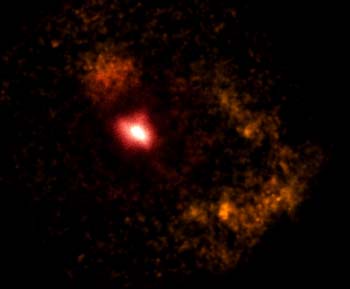
The image of G21.5-0.9, a supernova remnant which is 16,000 light years from Earth, shows a bright central source (the neutron star) with bright nebula and surrounded by a much larger diffuse cloud. The fluffy appearance of the central nebula is thought to be due to magnetic field lines which constrain the motions of the high energy electrons. “It’s a remarkable image,” said Patrick Slane of the Harvard-Smithsonian Center for Astrophysics. “Neither the inner core nor the outer shell has ever been seen before.”

PSR 0540-69

Chandra has also imaged PSR 0540-69, a pulsar some 180,000 light years away that rotates some 50 times per second, emitting pulses of radio waves, optical radiation and X-rays as it rotates. “The Chandra image gives us a much better idea of how this energy source works,” said Stephen Murray, principal investigator for the High Resolution X-ray Camera on Chandra. “You can see X-ray jets blasting out from the pulsar in both directions.”

E0102-72

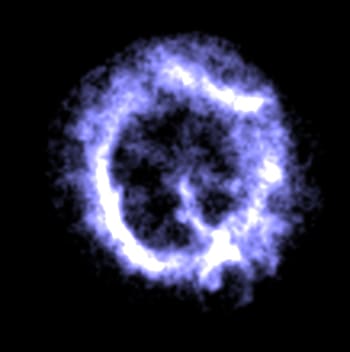
The third image is of E0102-72, which exploded several thousand years ago. Its nebula is now over 40 light years and resembles a “flaming cosmic wheel” according to Fred Seward, one of its discoverers at the Harvard-Smithsonian Center for Astrophysics.

Who will win this year’s Nobel Prize?

Who do you think will win? Will the prize be awarded for the discovery of the top quark, Bose-Einstein condensation, the gluon, the semiconductor laser, the anisotropy in the cosmic background radiation, the geometric phase, experiments on Bell’s inequalities, neutrino oscillations, giant magnetoresistance, quasicrystals, molecular beam epitaxy, quantum chromodynamics or something else?

Please send us up to three names and tell us in less than 100 words why you think they deserve the prize. The closing date for submissions is Wednesday October 6. PhysicsWeb will publish a summary of your suggestions on Friday October 8.

Blue lasers look up

Most semiconductor lasers emit light from the edge of the active laser region. However, in the VSCEL geometry light is emitted from the top of the device. This can reduce the threshold current needed to achieve laser action and can improve the optical quality of the output beam. The new device consists of an indium gallium nitride multiple quantum well region (the active region) sandwiched between two distributed Bragg reflectors, which form the laser cavity. The 52 layers in the active region are 3 and 5 nanometres thick.

The main challenge was to grow the first Bragg layer, which consists of alternate layers of gallium nitride and aluminium gallium nitride. Gallium nitride and aluminium nitride have different thermal expansion co-efficients and lattice constants, which make it difficult to grow a high-quality multilayer structure on which the active layer can then be grown. Metal organic chemical vapour deposition was used to grow this Bragg layer.

The team used a dye laser with a peak wavelength of 367 nanometres to pump the device, and lasing action was observed at 399 nanometres. The next challenge will be make devices that can be pumped electrically rather than optically.

More evidence for the accelerating universe

The first evidence for the accelerating universe came from observations of distant supernovae. However, the data were also consistent with an open universe – a universe that would expand forever because the total energy density was less than the so-called critical density – with a low mass density and no cosmological constant. The energy density of the universe is composed of matter (both ordinary visible matter and invisible or “dark” matter) and the energy density of the vacuum. The size of the latter, which is sometimes called quintessence or “dark energy”, defines the cosmological constant. This constant was first introduced by Einstein to explain why the universe did not appear to be expanding. Hubble later showed that the universe was expanding, causing Einstein to call it his “biggest blunder”.

Now Idit Zehavi of the Hebrew University in Jerusalem and Avishai Dekel of Fermilab in the US have studied the “peculiar” velocities of over 4000 galaxies on scales of about 300 million light years. These peculiar velocities are due to variations in the mass distribution of the universe which either slow down or increase the expansion due to the big bang. Zehavi and Dekel find that their data and the supernova data favour an almost flat universe in which the mass density and the cosmological constant are comparable. However, they add that “this type of universe seems to require a degree of fine tuning of the initial conditions that is in apparent conflict with ‘common wisdom'”. All of which means that the accelerating universe still presents lots of challenges to astronomers.

Fermions go degenerate

Brian DeMarco and Deborah Jin used a pair of magneto-optical traps to confine about 700000 atoms of potassium-40 at temperatures below 300 nanokelvin. This is about half of the degeneracy temperature for a gas of fermions. At these temperatures the occupation of the lowest quantum states increases from around zero to about 60%. The quantum degeneracy was observed as a barrier to evaporative cooling of the sample and a change in its thermodynamic behaviour. Measurements of the momentum distribution and total energy of the gas also revealed its quantum statistics.

A big challenge faced by DeMarco and Jin was cooling the gas. Most cooling techniques rely on collisions between the atoms for cooling, but since two identical fermions cannot be in the same place at the same time, the collisions needed for cooling cannot happen. The NIST team overcame this problem by placing the atoms in different magnetic sublevels. Atoms in the different sublevels were no longer identical and could therefore collide.

Quantum dots breakthrough

Only two other methods have previously been used to manufacture quantum dots: electron beam lithography and epitaxy. Lithography is a top down approach in which the beam defines the dot pattern, whereas epitaxy is a bottom-up approach in which the dots self-organize. Ion bombardment or sputtering is more cost effective and easily controllable than the other two techniques.

The latest approach relies on the “tug-of-war” between the sputtering, which roughens the gallium antimonide surface, and surface tension, which smoothes the surface. It only takes between 200 and 400 seconds for the quantum dots to form. Possible applications include photovoltaics, semiconductor lasers and protein tagging.

Scientists see electron orbits

In copper oxide each of the copper atoms is expected to bond with two oxygen atoms. According to some theories however, the copper atoms can covalently bond with each other. Such bonds – in which the nuclei share electrons – are not usually associated with metals. Such behaviour could help explain high-temperature superconductivity in the cuprates, which all contain two-dimensional copper oxide planes. Covalent bonds increase the ability of a material to conduct electricity, unlike ionic bonds, which are poor conductors.

Copyright © 2026 by IOP Publishing Ltd and individual contributors