The Senate has become increasingly vocal about alleged Chinese spying at the Los Alamos National Laboratory (see PhysicsWeb 28 May) and has argued for increased security at the nuclear weapons labs. Bethe – who was also in charge of the Manhattan bomb-project’s theoretical physics division – and the other authors of the letter point out that ratifying the CTBT would be more likely to increase US security.
They say that any country developing an atomic weapon would still have to test it, and the CTBT is still the best way of observing such a test.
It has been almost two years since the CTBT was submitted for ratification to the Senate. Since then it has come under political fire from Senator Jesse Helms, chairman of the Senate Foreign Relations Committee, who has delayed ratification of the treaty. America and Russia are the last two major nuclear weapon states to ratify the CTBT. Delays in ratifying the CTBT in the Senate has put the treaty in doubt and delayed ratification of START II in Russia. It has also jeopardised negotiations on START III, the next round of disarmament discussions between Russia and the US.
The European satellite organisation Eumetsat will update pictures every 10 minutes of the Moon’s shadow as it rushes across the globe. Meanwhile, the European Space Agency has brought together a wide range of material – including some of the experiments scientists hope to carry out – on their own web site ESA Eclipse99.
Although the eclipse will mainly be seen in Europe, the US space agency NASA has constructed some excellent teaching resources for the web. They have a live webcast and press releases on the eclipse and on some experiments scientists hope to carry out during the eclipse. However, their best page is an extensive list of every expedition, web page and web-broadcasting site on the internet connected with the event.
Both the two main UK news organisations also have eclipse webs sites, with ITN having more colourful graphics and the BBC more background information. The official UK government site can be found at Eclipse99.
The UK synchrotron, once known as Diamond, is intended to replace the ageing second-generation SRS machine at the Daresbury Laboratory in Cheshire, although the location of the new machine has still to be decided. The Wellcome Trust is contributing £110m to the construction costs. Biologists are likely to be the main users of the machine, followed by physicists and chemists.
French scientists had been lobbying to build Soleil for over a decade. However Claude Allègre, the science minister, has been opposed to the project ever since he was appointed in 1997. This week he announced that the UK, German, Italian and French governments have agreed to form a European group to plan future synchrotron and neutron sources for the continent, and make proposals for European investment in these areas.
The team were able to measure the distance because NGC4258 is one of 22 nearby galaxies that have active nuclei consisting of a supermassive black hole (over 100 million solar masses) surrounded by a thin rotating cloud of gas and dust. As the cloud rotates, friction heats the dust and gas, exciting the molecules in the cloud. This eventually causes the molecules to act as masers (the microwave equivalent of a laser) and release microwave radiation. By assuming that the masers rotate around the disk, the astronomers could plot their position with a network of radio telescopes known as the Very Long Baseline Array. From three years of observations and computer simulations they were able to calculate the absolute distance to the galaxy.
The next step, they say, is to use the Hubble Space Telescope to look for a Cepheid variable – one of the ‘standard candles’ of galactic measurements – in NGC4258. Once a Cepheid has been found, its real and apparent brightness can be calculated. This will enable astronomers to recalibrate all their extragalactic distances and hence refine estimates of the age of the universe.
The solar corona reaches temperatures of 1 million degrees Kelvin, while the Sun’s surface – the photosphere – is only 6000 Kelvin. The researchers used the UV camera on TRACE to create a movie of coronal loops. These are extremely hot magnetic loops that trap the solar plasma into pipe-like forms. Any solar flares near the loops create a series of magnetic pulses that oscillate through the loop. The team noticed that these oscillations decrease rapidly over a short period of time. Previously it was believed that the oscillations would last weeks. This suggests that the internal friction in the corona is hundreds of millions of times greater than expected.
“We thought magnetic energy could be used to heat the corona, but our old theory of a low viscosity corona made the process so inefficient that we could not see how it was done” said Leon Ofman one of the scientists working at Goddard. According to the new calculations, the magnetic energy is being drained from the pulse and absorbed by the plasma, creating the high temperatures seen in the corona.
Banin and co-workers used quantum dots made of indium arsenide, covered with a nonconducting barrier of hexane dithiol molecules and linked to a conducting gold film. The radius of the nearly spherical indium arsenide nanocrystals varied between 10 and 40 nm. Electrons tunnel from the gold through the insulating layer to the nanocrystal. The number of electrons in the dot can be controlled by adjusting the voltage on the gold film.
Quantum dots can only confine electrons at low temperatures, so the Israeli team had to adapt a scanning tunnelling microscope to operate at cryogenic temperatures. When Banin and co- workers examined the current-voltage curve of the tip as it moved over the nanocrystals, they noticed a number of discrete single-electron tunnelling peaks that matched the pattern of energy levels seen in real atoms.
Soon after the invention of the laser in the late 1950s many dubbed the discovery as “a solution in search of a problem”. Nowadays lasers are used in an enormous range of scientific and technological applications, thanks to their high intensity and their ability to emit light in an extremely narrow range of wavelengths. Indeed, the laser has revolutionized the whole field of optics and now plays a central role in the world’s communications networks. The market for lasers, optical amplifiers and other optoelectronic components is worth billions of dollars every year.
Atomic physicists are hoping that the invention of the “atom laser” will spark a similar revolution in the field of atom optics, or matter-wave optics as it is also known. Researchers in this field have relied heavily on the analogy between light and the wave-like nature of atoms. Lenses, mirrors and beam splitters have all been developed to control atomic beams just as their optical counterparts manipulate light. But what has been lacking in atom optics, until recently, is a source capable of producing an intense, highly directional, coherent beam in which all the atoms have the same wavelength just like the photons in a laser beam. This would be an atom laser.
Bose-Einstein basics
The idea for an atom laser predates the demonstration of the exotic quantum phenomenon of Bose-Einstein condensation in dilute atomic gases. But it was only after the first such condensate was produced in 1995 that the pursuit to create a laser-like source of atomic de Broglie waves became intense.
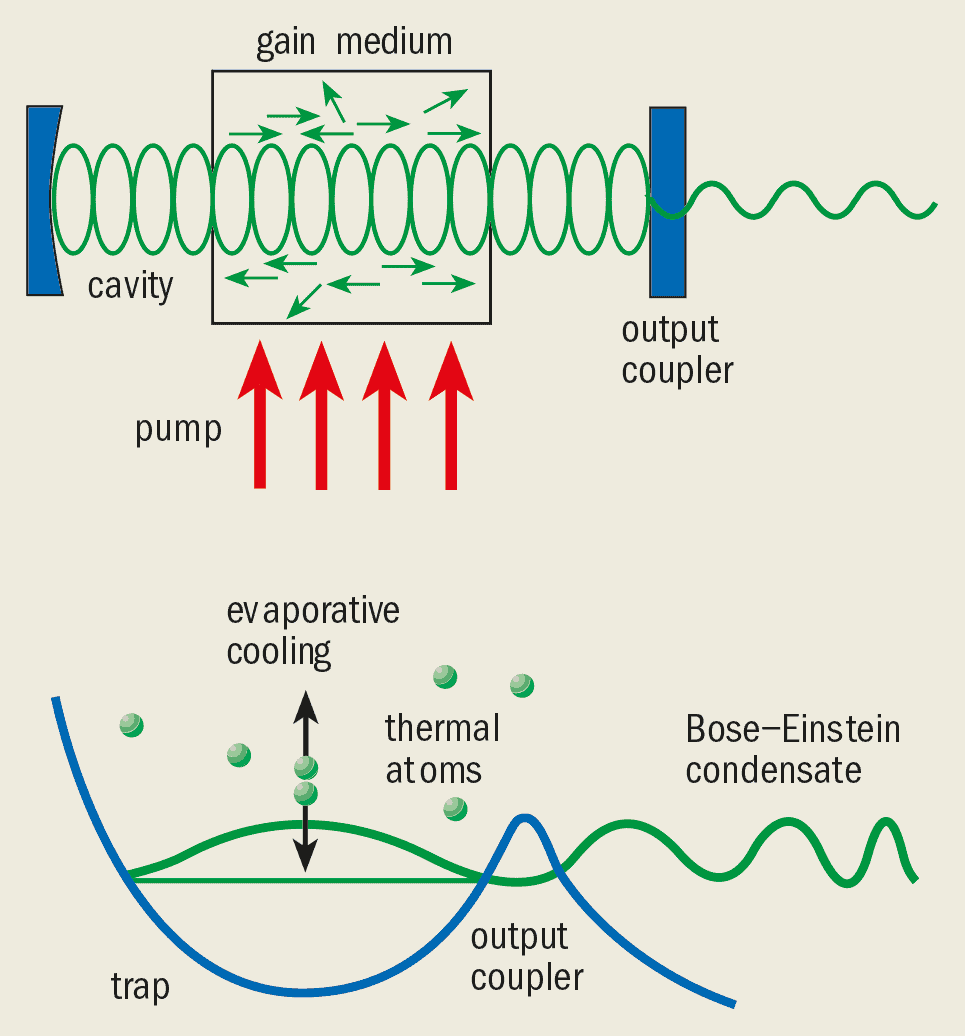
1 Atom lasers and optical lasers There is a close analogy between an optical laser and an atom laser. An optical laser emits coherent electromagnetic waves, while an atom laser emits coherent matter waves, (a) In an optical laser most of the photons occupy just one or a few of the modes in the laser cavity. This cavity is typically formed by two mirrors (blue), and the modes of the laser are essentially wavelengths defined by the round-trip time of light inside the cavity. Only one mode is shown in the figure. The “gain” medium is pumped by an external source of energy to ensure that large numbers of photons are emitted into that mode. One of the mirrors is usually partially transmitting to allow photons to “leak” out of the cavity, forming a beam of coherent light (green), (b) In an atom laser, a Bose–Einstein condensate in a magnetic trap (blue) contains many atoms in a single state, the lowest-energy state of the trap. The gain medium is a thermal cloud of atoms. The atoms can be extracted from the trap by allowing them to tunnel through the confining potential. The extracted atoms form a beam of coherent matter waves (green).
In a Bose condensate all the atoms occupy the same quantum state and can be described by the same wavefunction. The condensate therefore has many unusual properties not found in other states of matter. So why can we think of a Bose condensate as a coherent source of matter waves? To address this crucial point we have to remind ourselves of some of the physics behind the properties of laser light.
In a laser all the photons share the same wavefunction. This is possible because photons have an intrinsic angular momentum, or “spin”, of the Planck constant h divided by 2p. Particles that have a spin that is an integer multiple of h/2p obey Bose-Einstein statistics. This means that more than one so-called boson can occupy the same quantum state. Particles with half-integer spin – such as electrons, neutrons and protons, which all have spin h/4p – obey Fermi-Dirac statistics. Only one fermion can occupy a given quantum state.
A composite particle, such as an atom, is a boson if the sum of its protons, neutrons and electrons is an even number; the composite particle is a fermion if this sum is an odd number. Sodium-23 atoms, for example, are bosons, so a large number of them can be forced to occupy the same quantum state and therefore have the same wavefunction. To achieve this, a large number of atoms must be confined within a tiny trap and cooled to submillikelvin temperatures using a combination of optical and magnetic techniques (see “Bose condensates make quantum leaps and bounds” and Townsend, Ketterle and Stringari in further reading).
In this article we will concentrate on the properties of the condensates rather than on their creation. An important property of laser light is that it is monochromatic. By analogy, in a Bose-Einstein condensate all the atoms have the same energy and hence the same de Broglie wavelength. If this property can be maintained when the atoms are released from the condensate, we will have a highly monochromatic source of matter waves.
Another important property of laser light is that its intensity remains very stable. This property (called second-order coherence, which is discussed below) is rarely exploited in practical applications, but it is a feature that distinguishes a laser from a thermal light source, such as a filament lamp.
Output coupling
Bose-Einstein condensates are produced in confining potentials such as magnetic or optical traps by exploiting either the atoms’ magnetic moment or an electric dipole moment induced by lasers. In a magnetic trap, for instance, once the atoms have been cooled and trapped by lasers, the light is switched off and an inhomogeneous magnetic field provides a confining potential around the atoms. The trap is analogous to the optical cavity formed by the mirrors in a conventional laser (see figure 1).
But to make a laser we need to extract the coherent field from the optical cavity in a controlled way. This technique is known as “output coupling”. In the case of a conventional laser the output coupler is a partially transmitting mirror. Output coupling for atoms can be achieved by transferring them from states that are confined to ones that are not, typically by changing an internal degree of freedom, such as the magnetic states of the atoms.
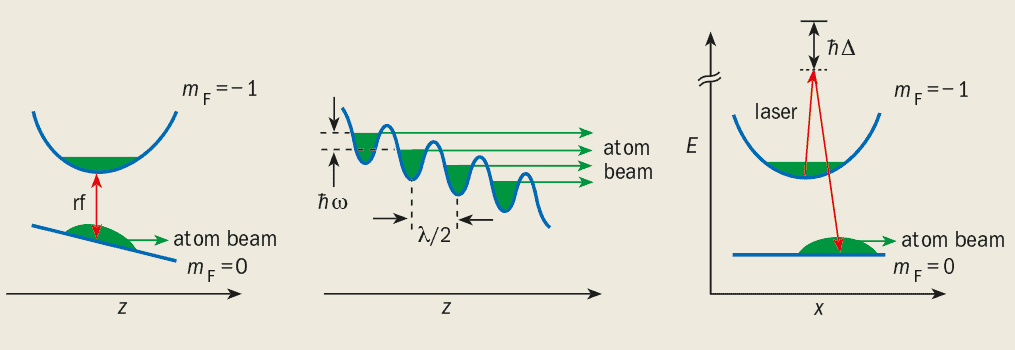
2 Output-coupling schemes Various output couplers have been employed to extract coherent beams of matter waves from a Bose–Einstein condensate, (a) At MIT pulses of radio-frequency (rf) radiation are applied to transfer atoms in the condensate from a trapped magnetic sublevel (mF = –1) to an untrapped one (mF = 0). At Munich a continuous radio-frequency field is used, (b) At Yale the condensate atoms are confined in a one-dimensional optical standing-wave potential. The potential is sufficiently shallow for there to be an appreciably probability for the atoms to tunnel downwards and out of the wells due to gravity. As the trap is aligned in the direction of gravity, the energy difference between adjacent potential wells is therefore E = mgλ/2, so atoms leaving adjacent traps have a frequency that differs by ω = E/ħ. The various waves will combine to produce a wavefunction that beats at the frequency ω = mgλ/2ħ.When the periodic potential is loaded with condensate atoms, the initial relative phase of the atoms is identical and the beating is observed as a train of pulses of atoms. (c) In the NIST output-coupling scheme, lasers are used to coherently transfer atoms from the trapped magnetic sublevel (mF = –1) to the mF = 0 sublevel, which does not feel the influence of the magnetic trap. Stimulated Raman scattering involves the simultaneous absorption and stimulated emission of photons. The direction of the momentum transfer to the atom is determined by the orientation of the laser beams, so the beam is not restricted to the downward direction.
The first demonstration of atomic output coupling from a Bose-Einstein condensate was performed with sodium atoms in a magnetic trap by Chris Townsend, Wolfgang Ketterle and co-workers at the Massachusetts Institute of Technology (MIT) in 1997. Only the atoms that had their magnetic moments pointing in the opposite direction to the magnetic field were trapped. The MIT researchers applied short radio-frequency pulses to “flip” the spins of some of the atoms and therefore release them from the trap (see figure 2c). The extracted atoms then accelerated away from the trap under the force of gravity. The output from this rudimentary atom laser was a series of pulses that expanded as they fell due to repulsive interactions between the ejected atoms and those inside the trap (see figure 3a).
In the MIT experiment, fluctuations in the confining magnetic field caused variations in the frequency needed to flip the spins of the atoms in the trap. To get round this problem, the radio-frequency field was pulsed on a timescale that was short compared with the period over which the magnetic field changed. The short, pulsed nature of the output coupling meant that the coherence length (i.e. the distance over which the matter waves remained “in step”) was limited to the length of the condensate itself. However, the coherence length can be increased by essentially “dribbling” the condensate out of the trap using a low rate of continuous output coupling.
Recently Theodor Hänsch and colleagues at the Max Planck Institute for Quantum Optics in Munich extracted a continuous atom beam that lasted for 0.1 s. The Munich team used radio-frequency output coupling in an experimental set-up that was similar to the one at MIT but used more stable magnetic fields (see figure 3b).
3 Atom-laser gallery The key to making an atom laser beam is to extract the atoms in a coherent way from the trap in which the condensate is produced. The (a) MIT and (b) Munich atom lasers use pulsed and continuous radio-frequency radiation to “flip” the spin of the atoms in a magnetic trap, releasing them to fall downwards under gravity. (c) In the Yale atom laser, gravity pulls the atoms from a weak periodic optical trap. (d) The NIST-Gaithersburg device uses light, not gravity, to “kick” atoms out of the trap, so the direction of the beam can be selected by the experimenter. The maximum intensity is shown in red, while the minimum is in blue.
In 1998 Brian Anderson and Mark Kasevich at Yale University in the US demonstrated how to extract atoms from a one-dimensional, periodic optical trap, known as an optical lattice. Two laser beams pointing in opposite directions interacted to form a standing wave that trapped the atoms in the vertical direction. The optical potential was sufficiently shallow that the atoms were able to both tunnel out of the traps and accelerate away via gravity (see figure 2b). The Yale team loaded the optical lattice with atoms from a Bose-Einstein condensate. This meant that the atoms that escaped from each trap were “phase coherent” i.e. the phases of the matter waves were correlated. The series of downward-falling output pulses was akin to the output of a mode-locked, pulsed laser (see figure 3c).
A new output-coupling technique was recently demonstrated by two of the authors (William Phillips and Kristian Helmerson) and colleagues at the US National Institute of Standards and Technology (NIST) in Gaithersburg, Maryland. The atoms were extracted from a magnetic trap, using an optical technique known as stimulated Raman scattering, to change the quantum state of the condensate atoms from one that is confined to one that is not. The condensate atoms absorb photons at one wavelength and emit photons at a slightly different wavelength (figure 2c). This gives the atoms a “momentum kick” away from the remaining trapped atoms. Both the magnitude and direction of the output beam can be selected by varying the orientation of the laser beams. Unlike the other output-coupling schemes, the NIST technique produces an atom laser that does not rely on gravity.
This output-coupling scheme has an additional advantage: the atoms in the beam have a transverse-momentum spread that is greatly reduced. In the other atom lasers repulsive interactions between the atoms cause a large momentum spread. In the NIST experiment, however, the atoms receive a large kick in the selected direction and spend little time in the presence of the other atoms, thereby reducing the problem.
The laser light used to release the atoms from the trap can be pulsed or continuous, just like the radio-frequency radiation in the other experiments. In the NIST experiments the magnetic field used to trap the atoms had a rotating component. The repetition rate of the output-coupling pulses was essentially synchronized to this rotating field. The rate was fast enough so that the clouds of atoms leaving the trap overlapped in a horizontal and essentially continuous beam (see figure 3d).
The coherence length of the various atom-laser beams has not been measured directly. Nevertheless, the NIST team has shown that two successive pulses are fully coherent over their pulse length, which is the size of the condensate. Because the output-coupling methods are coherent, it is likely that the coherence length of the lasers in figure 3 is in fact much larger than the size of the condensate.
Atom-laser theory
Theoretical studies of atom lasers have been stimulated by the increasing availability of experimental data. The challenge is to develop a quantum field theory of output coupling and then use it to optimize the design of practical systems. In 1998 Bernhard Kneer and colleagues at the University of Ulm in Germany developed a theoretical model that combined various aspects of optical-laser theory and the theory that describes static Bose-Einstein condensates. These treatments, however, do not fully address the question of the coherence of the output beam.
In reality, light and matter waves are not completely coherent – a fact that greatly complicates any theoretical description. The coherence of a condensate or output beam can be characterized using the theory of “partially” coherent matter-wave fields. The theory incorporates various so-called coherence functions that provide quantitative information about the coherence. The simplest of these, first-order coherence, tells us whether we can see interference fringes formed by two overlapping fields. Higher-order coherence functions can represent intensity correlations between fields, for example.
According to the theory, the matter waves output by an atom laser are coherent in two respects: they contain a narrow range of wavelengths and they are much more stable in intensity than thermal beams. In 1997 Robert Dodd and co-workers at NIST calculated the intensity stability for a trapped condensate within the framework of quantum field theory. We now need to do this for the flowing output from a condensate. Researchers at Oxford University are aiming to calculate the coherence functions for the output-coupling schemes mentioned earlier using so-called finite-temperature field theory. The aim of the work is to tune the output-coupler parameters to maximize the coherence of the atom-laser output.
An important challenge in building a continuous atom laser is to design an output-coupling scheme that keeps the phase of the matter waves “in step” over a long period of time. Suppose that we describe the matter wave by I(x,t) = A(x,t) cos(wt + f(x,t)) and we can keep the intensity, A, constant. The overall coherence of the output is then limited by the stability of the phase, f, over time and in space. If the phase wanders over time then it will also limit the line width of the atom laser via the uncertainty principle. Several theoretical studies to date have addressed the question of phase stability, while the stability of the condensate in real systems remains an area of active research.
Atom-laser applications
The possibility of producing a coherent beam of atoms that could be collimated to travel long distances, or brought to a tiny focus like an optical laser, opens up a whole host of applications. Although it would be imprudent to try to predict all of the applications that will arise, there are reasons to believe that the atom laser will be a significant scientific tool in the future. Atom lasers may have a major impact on the fields of atom optics, atom lithography, precision atomic clocks and other measurements of fundamental standards.
One application for which the coherence of an atom laser is critical is atom holography. Just as conventional holography uses the diffraction of a photon beam to reconstruct a 3-D image, atom holography uses the diffraction of atoms. As the de Broglie wavelength of the atoms is much smaller than the wavelength of light, an atom laser could create much higher resolution holographic images. Atom holography might be used to project complex integrated-circuit patterns, just a few nanometres in scale, onto semiconductors.
The first atom holograms were demonstrated in 1996 by Fujio Shimuzu and colleagues at the University of Tokyo, in collaboration with Jun-ichi Fujita at NEC Research, using laser-cooled atoms. However, the matter waves in these experiments were only partially coherent because the atoms were not all in the same quantum state.
In the case of laser-cooled gases, the level of coherence needed to create a hologram is achieved by selecting a small portion of the atoms. Although this increases the spatial coherence of the matter waves, it is at the expense of the flux or number of atoms available for the duration of the experiment (which is often determined by the overstretched patience of the graduate student). The problem would be alleviated by having a source in which most of the atoms are in the same quantum state. An atom laser is such a source and could provide a much more intense and fully coherent beam of atoms.
Holography is a two-step process. First, a hologram – a sort of diffraction grating containing information about the object – is produced. Then a beam of light (or atoms) is diffracted by the hologram to form the image. In optical holography, the hologram is often made by interfering a laser beam with light that has been reflected from an object. The resulting diffraction pattern is recorded on photographic film. However, the diffraction pattern can also be generated by computer, so that an image can be formed without ever actually using an object.
In the atom-holography experiments, an image has been created by diffracting a coherent beam of atoms through a grating that was manufactured using electron-beam lithography. The image was recorded on a “microchannel plate” – a detector that is sensitive to atoms. So far, atom holography has been able to produce 2-D images, and not the familiar 3-D ones of optical holography.
A related application, which might also benefit from a source of coherent matter waves, is atom interferometry. In an atom interferometer an atomic wave packet is coherently split into two wave packets that follow different paths before recombining. The interference pattern created when the two wave packets recombine tells us something about the phase difference between the two paths. Atom interferometers that are more sensitive than optical interferometers could be used to test quantum theory, and may even be able to detect changes in space-time (see Physics World March 1997 pp43-48). This is because the de Broglie wavelength of the atoms is smaller than the wavelength of light, the atoms have mass, and because the internal structure of the atom can also be exploited.
Until now, all atom-interferometry experiments have used thermal atomic beams, analogous to the lamps that were used in the early days of optics experiments. Filtering is typically used to reduce the energy spread of the beam and achieve the degree of coherence needed to see the interference effects. The coherence length, however, is short, limiting the use of atom beams to interferometers that have “arms” of equal length – otherwise the interference pattern would be washed out.
Atom lasers would allow the use of devices with unequal path lengths, such as Michelson interferometers. Such devices may provide a way to measure lengths over large distances with unprecedented precision.
Nonlinear atom optics
Just as the invention of the laser enabled the field of nonlinear optics to flourish, intense sources of coherent matter waves have opened up a similar field in atom optics. Until recently, most atom-optics experiments could be thought of as single-particle phenomena where the interactions between particles could be neglected. In 1993 Pierre Meystre and colleagues at the University of Arizona in the US considered a new kind of atom-optics experiment where interactions between the atoms were crucial. They called this new field “nonlinear atom optics”.
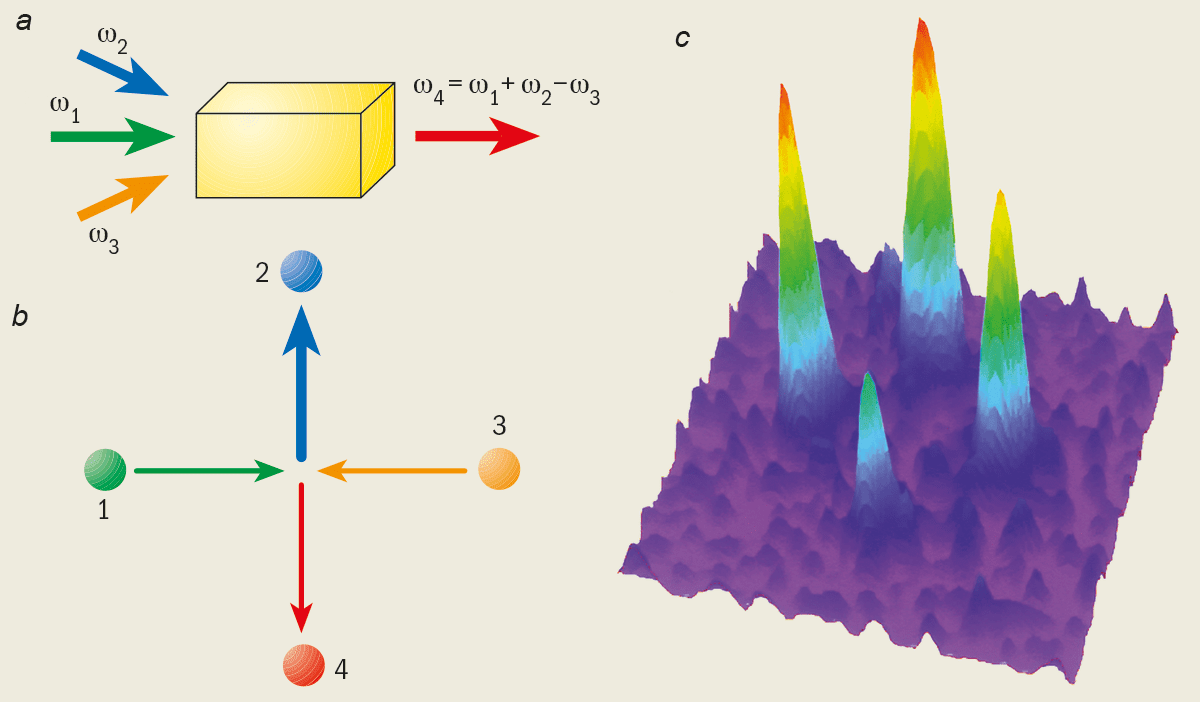
4 Four-wave mixing The phenomenon of four-wave mixing is an example of a nonlinear optical phenomenon, (a) Typically three waves, of frequency ω1, ω<sub<2 and ω3, are sent into a nonlinear crystal. The exchange of energy and momentum between the waves, mediated by the nonlinear crystal, results in the production of a fourth wave with frequency ω4 = ω1 + ω2 – ω3. A quantum mechanical description of this process shows that two photons from separate beams annihilate in the crystal and produce two new photons. The energy and momentum of one of these photons adds to the third beam, while the other photon corresponds to a new, fourth beam, (b) There is an analogous process with matter waves. The four-wave mixing process arises from collisions between pairs of atoms from two matter-wave beams (1 and 2). One pair of atoms scatters in the direction of the third, incident matter-wave beam and amplifies it (3). By the conservation of energy and momentum, the other pair of atoms produces a fourth, separate beam (4). (c) A false-colour image of the experimental atomic distribution showing the fourth (small) wave packet generated by the matter-wave mixing process. A Bose-Einstein condensate was divided into three momentum states using a sequence of pulsed laser beams. The nonlinear interaction between the atoms produces a fourth momentum state. The distribution of atoms in the four momentum states is easily observed after they have had sufficient time to separate.
In conventional nonlinear optics, photons interact with each other through some mediating material, such as transparent crystal. A common nonlinear optical phenomenon is “four-wave mixing”. Here, three waves are sent into a nonlinear medium and the exchange of energy and momentum between the waves results in the production of a fourth wave (see figure 4). A quantum mechanical description of this process involves two photons from separate beams annihilating while two other photons are created. One of these photons adds to the third beam and amplifies it, while the other represents a new, fourth beam.
In 1998 Paul Julienne from NIST, and Marek Trippenbach and Yehuda Band from Ben-Gurion University of the Negev in Israel predicted that the nonlinear mean-field interactions between atoms in a Bose-Einstein condensate, like the one at NIST, could lead to four-wave mixing of matter waves. They predicted that if three condensates of appropriate momenta collided, the term in the nonlinear Schrödinger equation that describes the interactions between the atoms would give rise to a fourth. At the atomic level, this process can be described as a collision between two atoms from separate matter-wave beams. One of the atoms is stimulated so that it scatters in the direction of the third incident matter-wave beam. By the conservation of momentum, the other atom goes off to make a fourth, separate beam.
The actual experiment performed at NIST did not use three separate condensates. Instead, lasers were used to divide a single condensate into three different momentum states via a process called Bragg diffraction. This is similar to the stimulated Raman process described earlier, except that the atoms return to the same magnetic sublevel. However, the absorption and emission of photons gives the atom a momentum kick in a well defined direction.
Starting with a condensate at rest, two separate pulses of interfering laser beams were applied to create the Bragg “diffraction grating” that divided the atoms roughly equally into three different momentum states, including the state of the initial condensate. When these pulses were applied fast enough – that is before the different momentum states had a chance to separate – atoms in a fourth momentum state were produced (see figure 4c).
The future of atom lasers
Although we have touched on some of the future applications of atom lasers, most of them (and even those that we cannot predict) are likely to depend on future developments in atom lasers themselves. Again, using developments in optical laser technology as a guide, we speculate on some of the possible future directions of atom-laser research.
Most continuous-wave optical lasers are truly continuous in the sense that they are continually fed energy or “pumped” so that they can supply photons indefinitely. A truly continuous source of coherent matter waves could be similarly achieved only if the condensate could be replenished continually. Schemes for steady-state condensate formation have been devised but so far none has been demonstrated in the laboratory.
The cavity in an optical laser is typically many wavelengths long and as a result can support several different frequencies or modes. In a Bose-Einstein condensate, however, the atoms typically occupy the lowest energy state of the trap. It remains to be investigated whether condensates can be produced in higher-energy states and then extracted from the trap to give a higher-energy beam of atoms.
In recent years laser cooling and neutral-atom manipulation have developed into mature areas of atomic physics and have boosted the development of matter-wave optics. More recently the discovery of Bose-Einstein condensation has heralded the new field of atom lasers, one that promises more exciting developments as the range of systems and degree of control over them increases.
The fantastic progress in the miniaturization of electronic devices that has taken place in the past few decades has largely been made possible by perfecting a century-old technique called lithography. Devices are built up layer by layer, the pattern on each layer being defined by a lithographic “mask”. In this “top-down” approach we start with a large, uniform chunk of semiconducting material and finish with a device that can have features that measure a fraction of a micron across. Forty years ago Richard Feynman proposed an alternative, “bottom-up” approach in which electronic devices would assemble themselves from individual atoms and molecules. Although such “self-assembly” sounds like science fiction, it can work in practice. All the plants and animals in the natural world are the result of self-assembly!
However, despite years of research and enormous scientific and commercial potential, there is still not a single example of a complete, self-assembled electronic device made directly from atoms or molecules. Nevertheless, researchers remain optimistic, heartened by the discovery of new carbon molecules that can act as electrical wires. Now a team of physicists from France, Russia and Germany has shown that these so-called carbon nanotubes can also exhibit zero resistance to electric current at temperatures below 1 K when connected to superconductors (A Yu Kasumov et al. 1999 Science284 1508).
Carbon nanotubes are a by-product of the discovery of fullerenes in the 1980s. Under the right conditions carbon atoms can assemble spontaneously from the plasma of an arc discharge and form closed meshes shaped like footballs and cigars. The beauty of molecules such as carbon-60 – which has the same pattern of pentagons and hexagons that is found in soccer balls – is in sharp contrast with the atomic chaos from which they form with a surprisingly high yield.
In 1991 Sumio Ijima of the NEC Laboratory in Tsukuba, Japan, discovered tube-like carbon structures that measured only a few nanometres across but were several microns long. These nanotubes can be described as rolled-up two-dimensional graphite sheets. The atoms are arranged in hexagons and the nanotubes are characterized by their diameter and their helicity, which is related to the direction in which the sheet is rolled. In addition to being very strong and flexible, carbon nanotubes also have unusual electronic properties. A specific nanotube can be metallic or semiconducting, depending on its diameter and helicity (see Physics World January 1998).
But what does “metallic” mean at the molecular level? A metallic wire can be broadly defined as a many-electron system which, if held between two metal contacts playing the role of electron reservoirs, has delocalized orbitals at the Fermi level of the contacts. (In a metal the Fermi level is the energy that separates occupied and unoccupied electron states. The electrical behaviour of all materials is largely determined by the behaviour of electrons near the Fermi level.) More precisely, if a bias voltage is applied across the contacts, thereby splitting their Fermi levels, there should be at least a molecular orbital in the “window” between the two Fermi levels that extends from one contact to the other.
Most molecules do not satisfy this criterion. If they are sufficiently regular and rich in mobile electrons, they can have extended orbitals. However, when the molecule is more than a few tens of atoms long an instability almost always occurs. Some bonds shorten, others get longer and a “gap” opens in the energy spectrum at the Fermi energy of the molecule. Inside this gap there are no energy states available to electrons, so the molecule becomes an insulator or a semiconductor. Semiconducting molecules can be “doped” by introducing atoms that add electrons to the system. Although doping can move the Fermi energy to outside the energy gap, the resulting disorder can localize the electrons, which means that they are no longer free to move.
Carbon nanotubes are the only molecules we know of in which this does not happen. The symmetry of nanotubes gives them a unique property: per unit length they have very few mobile electrons at the Fermi energy and lots of bonded electrons. Nanotubes thus have more “bones” than “flesh”, and this electronic rigidity prevents the instability described above.
In 1997 the metallic character of certain nanotubes was verified in experiments. These results immediately suggest another question. If metals such as lead and aluminium become superconductors at low temperatures, can nanotubes also carry electric currents without any losses?
Early experiments could not answer this question. When a current was passed through a nanotube, the voltage drop was dominated by the contact resistance between the nanotubes and the probes supplying the current. This contact resistance was too large to discriminate between a superconducting state, in which the electrons form pairs, and a normal metallic state, in which they are independent. Besides, measurements by Paul McEuen’s group at the University of California at Berkeley and by Cees Dekker’s group at the Delft University of Technology in the Netherlands indicated that the electrons in a nanotube strongly repel one another, which is not favourable for superconductivity.
A more sophisticated way of looking for superconducting behaviour in nanotubes has been developed by Hélène Bouchiat of the Université Paris-Sud in Orsay, and co-workers in Orsay, the Russian Academy of Sciences in Chernogolovka, the University of Montpellier in France and the Max Planck Institute in Stuttgart. Bouchiat and co-workers exploit the so-called proximity effect – an exotic effect in which an ordinary metal can carry a supercurrent when placed between two superconductors. However, this type of superconductivity can be induced over ranges of a few microns at most.
Would nanotubes display this proximity effect? A positive answer would at least demonstrate that electrons do not lose their quantum coherence as they travel along the nanotube. Quantum coherence means that the electrons remain in a well defined quantum state – or superposition of quantum states – as they travel along the nanotube. Although quantum coherence is not directly related to superconductivity, it might be exploited in device applications in the future.
The French-Russian-German team first solved the problem of the contact resistance by dipping the nanotubes in gold that had been melted with a laser beam, a technique pioneered by Alik Kazumov from Chernogolovka. Gold appears to make an excellent solder for nanotubes and the contact resistances are small (about the same as the resistance of a metallic nanotube). Although gold is not a superconductor, electrodes made from tantalum or rhenium and cooled to about 1 K can be used to make the gold superconducting due to the proximity effect.
Therefore the question now is: will the proximity effect also work on the nanotubes? The answer is yes. The team observes supercurrents in single nanotubes and bundles of nanotubes when the apparatus is cooled below the superconducting transition temperature of the contacts. For experiments on bundles of nanotubes the maximum supercurrent agrees with theoretical predictions.
However, the measurements performed on a single nanotube give surprising results: the maximum supercurrent is 40 times larger than expected. It is possible that this effect is due to enhanced superconductivity in the tantalum or rhenium layers caused by the melting of the gold. Other subtle and unexplored interactions between the nanotubes and the contacts might also be responsible. There is also a remote possibility that single-carbon nanotubes are indeed real superconductors, rather than materials that can only carry supercurrents as a result of the proximity effect, but this is thought unlikely at present.
Whatever the explanation, the work of Bouchiat and co-workers demonstrates beautifully the coherent character of electron propagation along the nanotube. Moreover, the experiment confirms that carbon nanotubes really are the ideal molecular wires that, until recently, only existed in the dreams of physicists.
Scientists at the research laboratory of the Museums of France in Paris compared the painting with nine of the 70 works accredited to Van Gogh during his time at Auvers. However, they were not allowed to remove samples from the painting, and could not use the lab’s synchrotron X-ray source since radiation can sometimes heat organic matter. “Van Gogh used organic matter such as geranium for colouring,” explains Elizabeth Martin, a scientist at the lab.
Instead, the team used a technique called microfluorescence, in which a beam of X-rays less than 1 mm wide was used to reveal the spectrum of most of the elements in the pigments. Unlike X-ray diffraction methods, microfluorescence does not destroy the surface of the painting. The researchers also used radiography to show that the canvas matched the kind Van Gogh used during his period at Auvers. And they found that the way in which the paint was applied was also consistent with Van Gogh’s style. Forgers often build up more layers of paint as they need several attempts to reproduce the style of the original.
Finally, the painting was examined by microscope. “This analysis gave very interesting clues,” says Martin. As with the other nine studied, the canvas showed markings where Van Gogh had stacked up his paintings on his bed before the oil was completely dry. “We found nothing that was incompatible with the painting being a Van Gogh,” says Martin. “Now it’s for the art historians, who are the specialists of Van Gogh, to make their conclusions.”
Stanley and colleagues looked at five different measures of research activity in universities: the annual expenditure on R&D, the number of papers published each year, the number of patents awarded, whether R&D funds had been transferred from one university to another by a funder, and the size of schools and departments within universities. They compared results from 719 universities in the US with data from the UK and Canada over a 17 year period.
They found that the growth in research activity did not depend on the size of R&D expenditure (i.e. the size of the university), just as business growth does not depend on the size of the company. The research also suggested that in order to make fundamental contributions to science, university research programmes should last more than five years – two years longer than the average research grant.