At a recent press conference, a Hubble Space Telescope Key Project team announced that it had completed an eight-year effort to measure the Hubble constant, the rate at which the universe is currently expanding. The team leaders, Wendy Freedman of the Carnegie Observatories in the US and Jeremy Mould of the Australian National University, claimed that their measurement is accurate to within 10%, and added that “after all these years, we are finally entering an era of precision cosmology”. Such a statement might reasonably raise eyebrows among non-astronomers – after all, measuring anything fundamental to a precision of 10% hardly seems worth crowing about. Moreover, many others have claimed to measure the Hubble constant to this accuracy before, so what’s new?
Freedman’s result comes at a time when there is growing optimism in cosmological circles that the set of long sought-after numbers that define the form and age of the universe will soon be nailed down (N Bahcall et al. 1999 Science284 1503). The implications for mainstream astronomy would be profound.
The significance of the Hubble constant lies not only in setting the physical scale of the universe, but also in constraining its age. But getting answers from the Hubble-constant measurements that are consistent with direct chronological measurements of stars and atomic nuclei has been notoriously difficult in the past.
The Hubble constant is normally measured by comparing the physical distances of galaxies with the velocity at which they are receding. Edwin Hubble’s original measurement suggested that the universe was expanding at 550 km s-1 for each megaparsec (3.26 million light-years) of distance travelled. Together with his estimate of the curvature of space based on the number of faint galaxies he could count, his measurements implied that the universe was younger than the Earth’s rocks. This caused Hubble to doubt his interpretation that the universe was expanding. A later version of this age conflict contributed to Fred Hoyle and others proposing the steady-state model, an alternative to the big-bang theory in which the universe is uniform in space and time.
The velocity with which the galaxies are receding can be determined with high precision from the light that they emit, which is “redshifted” to longer wavelengths on its journey to Earth. The challenge lies in measuring the absolute distances to the galaxies. Freedman and colleagues use a technique similar to the one employed by Hubble in 1923 to measure the distance to the Andromeda spiral galaxy. The method relies on a special class of pulsating stars, called Cepheid variables, which brighten and dim with a period that is correlated with their luminosity. These “standard candles” provide very reliable and accurate distance measurements. Freedman and co-workers used the Hubble Space Telescope (HST) to measure the period of almost 800 Cepheid stars in 18 galaxies up to 65 million light-years away. (In contrast, Edwin Hubble detected Cepheids just over 3 million light-years away using the 100 inch telescope on Mount Wilson.)
The HST has two important advantages over ground-based instruments. Thanks to its superlative angular resolution, the Cepheid variables can be more reliably isolated from other stars in crowded regions of nearby galaxies, yielding much more accurate photometric measurements. Secondly, as it is never cloudy in space, the all-important period of the Cepheid variables can be measured with fewer, well timed observations. Once the team was confident that they were able to accurately measure the distances to the Cepheid variables in nearby spiral galaxies, they were able to calibrate a relation that connects the rotational motions and luminosities of distant spiral galaxies. In this way, the team extended the range of the observations that are visible to the HST to distances much further than the Cepheid variables.
The Key Project team secured 420 hours of observing time on the HST over 8 years and the outcome is a considerable accomplishment in every respect. A significant step forward in the Key Project study was the exhaustive treatment of systematic errors. The team used a range of methods to independently verify its final value. These included using the motion of stars in elliptical galaxies and the peak luminosity of well studied supernovae. The outcome gives many astronomers confidence that the 10% uncertainty is realistic.
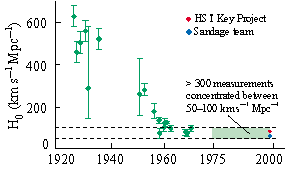
The measured value of the Hubble constant has varied over the years, culminating in a figure of 70 km s-1 Mpc-1 from Freedman and co-workers, and a figure of 60 km s-1 Mpc-1 from a rival team led by Allan Sandage, also from Carnegie Observatories (see left). The upshot from these measurements is that the universe is unlikely to be less than 11 billion years old, which is just about consistent with the latest estimate for the age of the oldest galactic stars. Moreover, the cosmic age inferred by both teams is no longer in conflict with independent estimates. Charles Lineweaver of the University of New South Wales in Australia has used recent observations of the cosmic microwave background and six other cosmological measurements to constrain the age of the universe to be 13.4 ± 1.6 billion years (Science 1999 284 1503). Significantly, a precise age is now more dependent on the rate at which the universe has been decelerating since the big bang, rather than on the Hubble constant.
In his book The Cosmological Distance Ladder, the British astrophysicist Michael Rowan-Robinson discusses how, in 1976, Allan Sandage and Gustav Tammann quoted a figure of 50 km s-1 Mpc-1. This value was a factor of two lower than the figure quoted by the late Gerard de Vaucouleurs. Sandage, to his credit perhaps, has consistently argued for a lower range of 50-55 km s-1 Mpc-1 for almost 25 years. His claim is based on the distance to Cepheid variables in galaxies in which supernovae, the most precise form of standard candle, have exploded. The satisfying recent convergence of Hubble-constant measurements is largely due to a downward trend from high values. Notably, the Key Project team’s first substantial stab at the Hubble constant in 1994 gave a value of 80 km s-1 Mpc-1. However, Sandage’s value has also crept up subtly, reaching 60 km s-1 Mpc-1 for the first time. After the controversy of the past 25 years, this is real progress!
But to what extent could this convergence be a transient phenomenon? Given time, could Freedman and colleagues contemplate an even lower value, corresponding to an older universe, as argued by Sandage? And should we be impressed by Freedman’s claim of “precision cosmology” given this is hardly the first time that the constant has been quoted to 10%? Indeed, Sandage quoted a 10% error on his 1975 value and now claims a precision of 3%. As the rivals use similar techniques, progress towards an agreement at the 1% level, for instance, will inevitably be slow – we are not going to wake up one day and find worldwide acceptance of any particular value. In the long term, other techniques based on satellite measurements of fluctuations in the cosmic microwave background may be more promising.
The Hubble constant is only one of several numbers that astronomers need to define the form and history of the universe. Others include the rate at which the universe is decelerating, which can be estimated by tracking the distance-redshift relation to great distances and early times, for example using supernovae. Another is the overall curvature of space, which is best estimated from the angular scale of features seen in the cosmic microwave background.
But there is an interesting, and perhaps perverse, twist to the story. Just at the time when astronomers have made great progress in measuring the Hubble constant, and a promising start in measuring the change in the rate of expansion over time, there is now growing evidence that the universe is accelerating, not decelerating as was once thought. If this is confirmed, one more target for observational astronomers will be to measure the so-called cosmological constant – a “vacuum energy density” thought to be responsible for the acceleration.
For decades measuring any of these parameters was regarded as a hopeless observational task, one necessarily riddled with unreasonable assumptions and beyond the capabilities of the telescopes available. It is a tribute to the skill and tenacity of both the scientists who operate the HST and the various teams of astronomers who analyse the data that there is genuine optimism that the various numbers will be nailed down soon. Although it is easy to dismiss the hype associated with the recent press releases, the underlying progress is tremendous. However, as the recent evidence for the existence of the cosmological constant demonstrates, there may still be surprises in store.
In his book The End of Science, the writer John Horgan predicts that the rapid progress towards measuring the cosmological parameters would leave something of a wasteland for astronomers in the next millennium. On the contrary, much progress in astrophysical cosmology concerning the origin and growth of structure, and the history of star and galaxy formation, is currently hindered by our poor knowledge of these parameters.
Finally, should we really be surprised that the Hubble constant lies in-between the values championed by opposing teams? In 1985 Rowan-Robinson predicted that the value would settle at 67 km s-1 Mpc-1. And, of course, the recent convergence will no doubt mean that both rival teams will ultimately claim success. The only real loser in this long-standing saga appears to be Douglas Adams, who gambled in the Hitch-Hiker’s Guide to the Galaxy that the truth must be 42.
The Moon is our closest neighbour in space and holds the key to unlocking the secrets of the inner solar system. It is the most studied planetary body other than the Earth, and 30 years ago provided the scene for what is arguably mankind’s greatest achievement: our first steps on an extraterrestrial body.
On 21 July 1969 Neil Armstrong became the first man to walk on the Moon. By the end of 1972, a total of twelve men had walked on the lunar surface. In addition, numerous craft had visited our neighbour armed with various sensors designed to examine it in almost every conceivable manner. There were many problems to solve. How did the Moon form and evolve? What is it made from? Is it still geologically active, and if not, when did activity cease? What was the nature of the volcanic activity that formed the vast, dark plains visible from Earth? Despite several missions to the lunar surface, many of these questions remained unanswered and the Moon has refused to surrender its most precious secrets.
Until the Clementine and Lunar Prospector missions were launched in the 1990s, an entire generation had never witnessed a major lunar mission. So why have we returned to the Moon after so long? What did we learn from the Apollo missions? Where do we stand now after the recent successes of Clementine and Lunar Prospector? And, perhaps most importantly, where do we go from here?
The Apollo era
It was inevitable that science would benefit greatly from the political drive to send a man to the Moon. Indeed, without the “Apollo incentive” many of the earlier spacecraft missions would never have flown. The golden age of lunar exploration, from 1959 to 1976, saw a whole range of spacecraft fly to the Moon. These included the five “Lunar Orbiter” reconnaissance missions that provided a magnificent, near-global photographic dataset that is still used extensively today. However, the jewel in the crown for lunar scientists unquestionably came in the form of more than 380 kg of rock and soil samples collected by the six manned Apollo landings and two of the unmanned Luna missions.
Before we had these samples, scientists were forced to infer the Moon’s history based on geological interpretations of photographs. The Apollo missions provided the “ground truth” for these observations. They confirmed that the bright lunar highlands were composed primarily of the coarse-grained igneous rock anorthosite, while the smooth dark plains, known as maria, were composed of the volcanic rock basalt. These two terrains form the familiar light and dark markings on the Moon that are visible with the naked eye. The lunar-soil samples showed the highland anorthosites were considerably less dense than the basalts on the maria. Furthermore, the highland rocks were rich in the trace element europium, while the basalts had a corresponding depletion.
In combination with other results, these factors were vital in the formulation of the “magma-ocean hypothesis”, detailing the early evolution of the Moon. This theory, which was proposed in the early 1970s, is still advocated today, albeit in a modified form. According to this theory, in its early life the upper layers of the Moon were molten. During this time the melt differentiated, with the heavier minerals sinking and leaving the less dense minerals to solidify and form the highland crust. The heavier minerals left beneath the crust would have remained molten for some time, and later erupted onto the surface to produce the vast mare plains we see today. This volcanic activity ceased sometime between 2.5 and 3 billion years ago, and since then the only action to have altered the lunar surface has been the impact of meteorites, asteroids and comets.
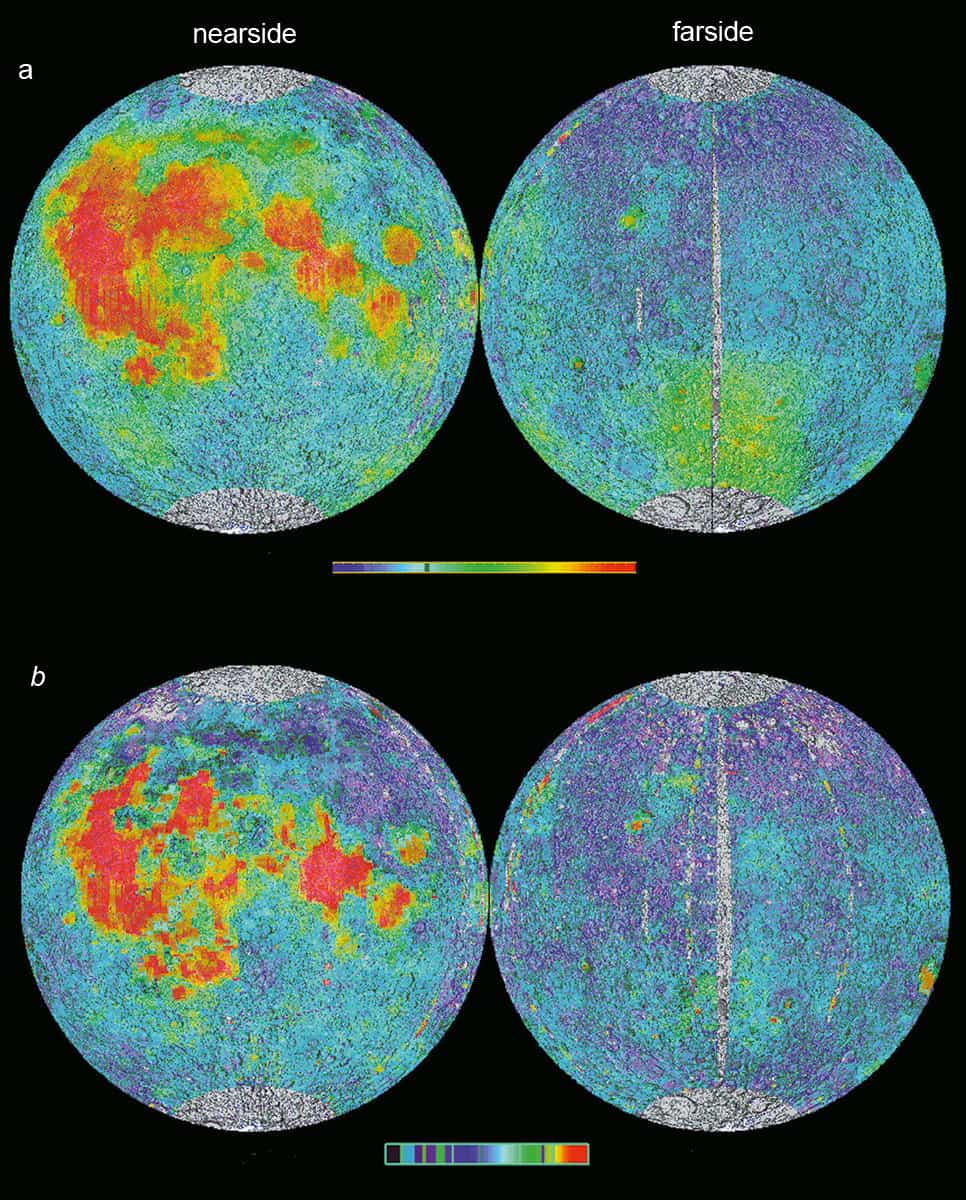
2 Mineral map of the Moon Clementine measured the abundance of (a) iron oxide and (b) titanium dioxide on both the nearside and farside of the Moon. The scale bar indicates the percentage-by-weight values, the highest concentration is shown in red and the lowest is in blue. Note the higher abundance of both iron oxide and titanium dioxide in the smooth plains, known as maria, on the nearside. (Courtesy: Lunar and Planetary Institute)
The lack of wind or water erosion on the Moon means that the highland crust now holds a record of the events that date right back to its birth. Asteroids and meteors would have bombarded the rest of the inner solar system, and particularly the Earth, in a similar way to the Moon. The record of lunar craters therefore provides us with a glimpse of how conditions in the inner solar system changed over time. Observing the lunar crust in detail is therefore of the utmost importance if we are to describe the conditions in the inner solar system from the creation of the Moon to the present day.
The Apollo missions and unmanned spacecraft provided us with major clues to the evolution of the Moon and its local environment, from which models were developed. But scientists required a lot more information about the composition of the Moon on a global scale in order to confirm and refine these models. The remote observations from Apollo were restricted to equatorial regions and covered just 15-20% of the lunar surface. In addition, large variations were observed within these areas, making it impossible to extrapolate the results to include other parts of the Moon.
Astronomers learned about the composition of the Moon by analysing the light reflected from the lunar surface with Earth-based telescopes – a technique known as reflectance spectroscopy. The lunar rock and soil samples brought back by the Apollo astronauts were crucial in helping to calibrate the data. Although this technique has proved valuable for large-scale compositional analyses of the lunar terrain, our view from Earth is restricted to just one hemisphere. Another space-based mission was needed to gather data from the farside of the Moon. Unfortunately, after the last Apollo mission, interest in the Moon waned as it became more feasible to explore other planets in the solar system.
Return to the Moon
We had to wait until 1990 before a spacecraft studied the Moon again. The Jupiter-bound Galileo craft turned its multi-spectral cameras to the Moon during flybys in 1990 and 1992, giving us a taste of the science to come.
In January 1994 the US Department of Defense launched the Clementine mission, designed to test new, lightweight technology for satellite systems. NASA provided the scientific payload, which included two multi-spectral cameras with filters targeted at specific features found in the spectrum of lunar soils and rocks returned by Apollo. Two months in lunar orbit saw the return of over 1 million digital images in 11 wavebands, ranging from 415 nm in the visible to 2792 nm in the near-infrared, providing the first ever global spectral dataset of the Moon.
3 Farside of the Moon An image of a 75 km wide impact crater, called King, located in the highland regions on the farside of the Moon. The image was taken using multi-spectral cameras on board the Clementine spacecraft. The red areas represent mature highland rocks and soils while the blue areas show the freshly excavated material. The rocks and soil thrown up by the impact are clearly highlighted by the bright blue rays to the left of the crater. (Courtesy: NASA)
Despite the poor spectral resolution of Clementine compared with the Earth-based observations, the results immediately showed that the Moon’s iron and titanium were concentrated in the maria (figure 2). Although various analyses of the Apollo samples and reflectance spectroscopy had hinted at this, these data were restricted to the nearside. Clementine provided the first global view. Knowing the distribution of elements on the Moon is crucial to models of its origin and evolution, so determining the distribution of iron and titanium across the whole of the Moon was an important advance in our understanding.
The Clementine data have a high spatial resolution, typically 80-300 m per pixel, compared with the Earth-based observations, which have a resolution of 2-3 km. The new results therefore allowed scientists to look at compositional variations on a much smaller scale, and how they relate to specific processes such as impact cratering.
Large asteroids have penetrated deep into the lunar crust, excavating material from beneath the surface and depositing it in an annulus round the impact crater (figure 3). By studying this excavated material, we can gain direct compositional information about the layers below the surface and the vertical structure of the lunar crust. Studies of many suitable craters will therefore allow us to build up a 3-D image of the Moon’s composition.
At the other end of the scale, the smallest craters resolvable by Clementine can be used to examine the thickness of individual lava flows in the maria. This information will help us to understand the nature of the volcanic episodes that produced the flows, and imply how the thermal properties of the Moon changed over time. This is an important uncertainty in current models of lunar evolution.
4 Deep impact A topographic map of the South Pole-Aitken Basin from the Clementine mission. The dashed line indicates the topographic rim of the basin that is 2500 km in diameter. The red and yellow regions indicate areas of high elevation, while the blue and purple zones are at a lower elevation. (Courtesy: Lunar and Planetary Institute)
Topographic data sent back from Clementine have also made it possible to study some of the oldest and most degraded impact basins on the Moon, such as the South Pole-Aitken Basin on the farside (figure 4). At 2500 km in diameter, it is the largest known impact structure in the solar system. The crater has a depth of 13 km from rim crest to basin floor, and the impact may even have excavated material from the lunar mantle. If this is the case, then compositional analysis will allow us to look deeper into the lunar interior than ever before.
Currently it is difficult to identify material from the mantle because we do not have any samples and must infer its composition indirectly. Paul Lucey and colleagues from the Hawaii Institute of Geophysics and Planetology, and the Lunar and Planetary Institute in Houston found a high abundance of iron and titanium in the basin relative to the surrounding highlands. From this they inferred that the South Pole-Aitken Basin contains a mixture of lower-crustal material and mantle rock, with the mantle containing up to 20% iron oxide and only 0.1% titanium dioxide by weight. It is true that other explanations can fit the data, but the only way to resolve the situation for certain is to go there and collect a sample.
Water on the Moon
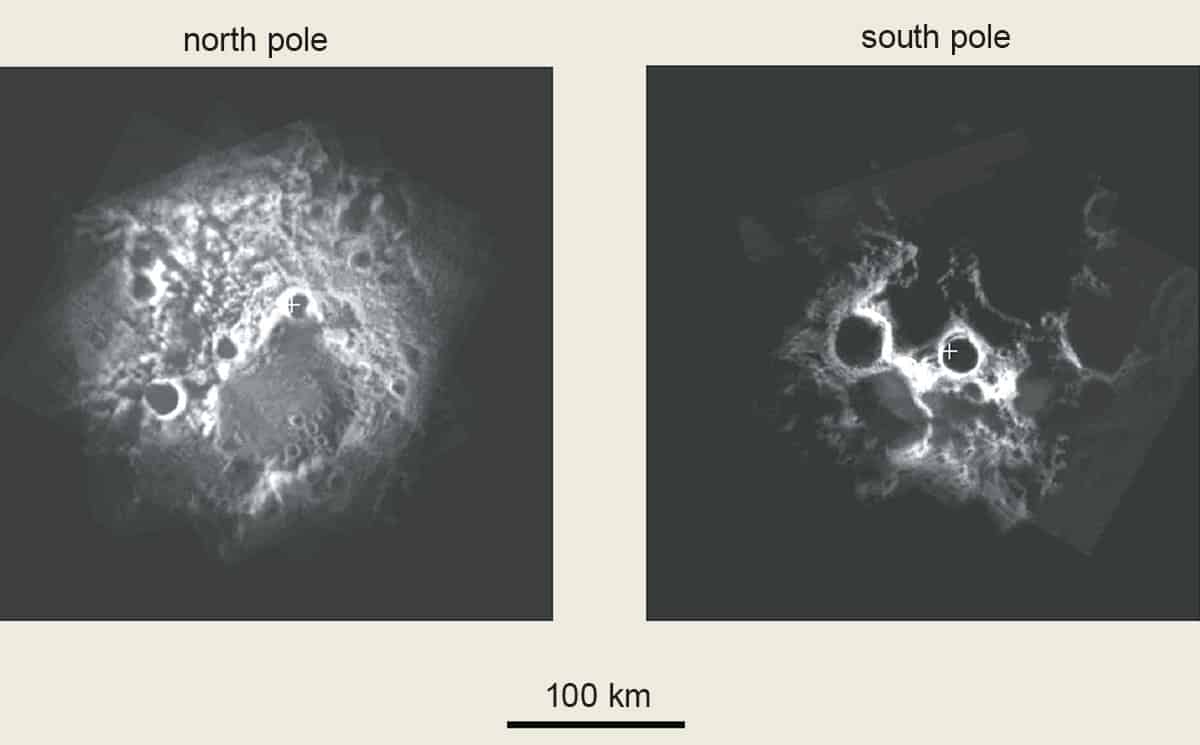
Perhaps the most exciting of all Clementine’s discoveries stemmed from images of the lunar poles. The plane of the Moon’s orbit has a very low inclination (1.5°) to the plane of the Earth’s orbit about the Sun, which means that incident solar radiation is almost horizontal at the poles. Clementine found hilly areas and crater rims in the southern polar region that receive illumination for a large percentage of the lunar day (figure 5). Likewise, in deeper craters there are also areas that remain in permanent shadow (totalling around 30,000 km2) that are cold enough for water-ice to be stable.
5 Lunar shadow Images of the north and south lunar poles taken by Clementine throughout the lunar day. Successive images are superimposed on top of each other and show areas that remain in shadow. (Courtesy: NASA)
It was therefore only natural that when the results from a bistatic-radar experiment on board Clementine were analysed and showed an anomalous signal over the south pole, many immediately interpreted this as representing deposits of ice. This was a controversial deduction and the result could not be confirmed by the other instrumentation on board Clementine. Fortunately, another mission was already in the pipeline that could shed more light on the situation.
Four years later, in 1998, NASA launched “Lunar Prospector” its first dedicated lunar mission since the end of the Apollo programme in 1972. It carries five instruments ranging from a gamma-ray spectrometer to a magnetometer and electron reflectometer (see box). Each instrument has a focused scientific objective and is designed to provide global information to complement the existing data. In December 1998 Lunar Prospector completed its year-long primary mission and began a more detailed “extended mission”. During the extended mission the spacecraft’s orbit was lowered from 100 km down to just 25 km, where it started to refine its previous measurements.
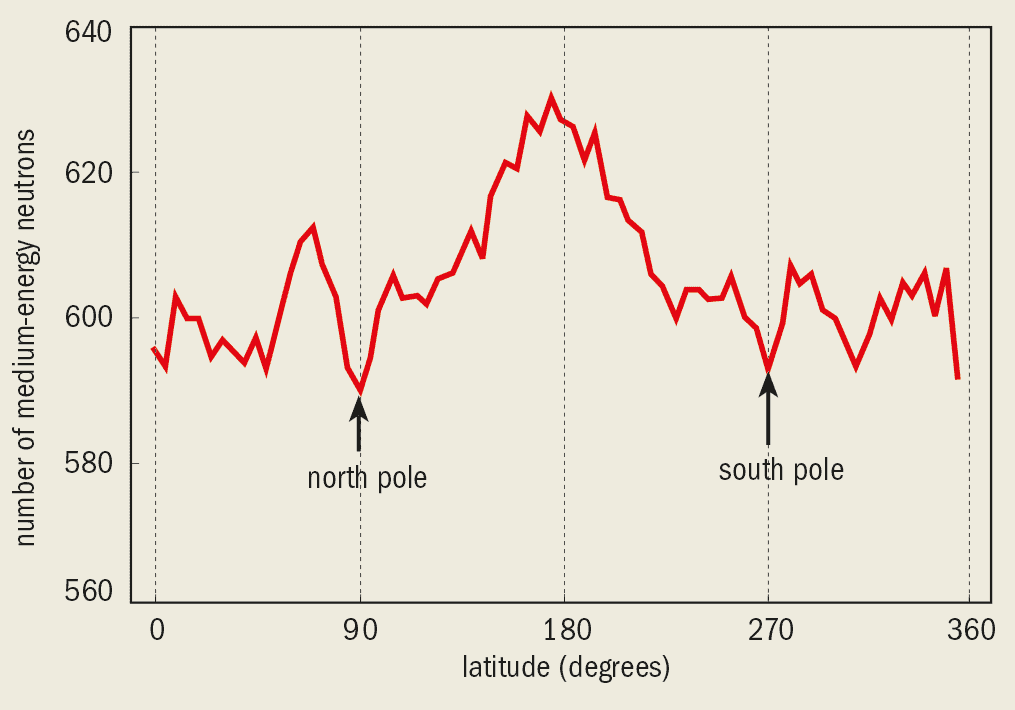
Lunar Prospector has confirmed the presence of ice deposits at the south pole from measurements made using its neutron spectrometer (figure 6). Although the device cannot detect water directly, it can locate concentrations of hydrogen. The conditions on the Moon are such that the hydrogen is most likely to be locked within ice molecules. Lunar Prospector found an even greater concentration of ice at the north pole, suggesting that there could be up to 3 billion tonnes of water at each pole. The result was a surprise as the earlier Clementine mission was unable to clearly detect anything in this region.
To put this result into perspective, it is estimated that each person in London uses 55 000 litres of water per year for drinking, washing, preparing food, etc. If we could obtain just 1% of the Moon’s water, it would support 2000 Londoners for over 500 years. Hence, if the presence of water at the poles can be confirmed by a direct-sampling mission, it will have huge implications for the long-term future of lunar exploration.
While Lunar Prospector orbits at the lower altitude the neutron spectrometer will make more detailed measurements and give us an even better idea of the quantity of hydrogen present. But the true nature of any water deposits (i.e. purity, depth, accessibility, etc) will require in situ measurements of rocks, soils and cores.
Elements and gravity
One of Lunar Prospector’s most important objectives is to use the on-board gamma-ray spectrometer to map the distribution of the key elements that make up 98% of the Moon’s mass. The measurements will help to constrain models of the bulk composition of the lunar crust, a key unknown in lunar-origin models. Previous data suggest that the Moon is rich in refractory elements, such as aluminium, thorium and uranium. If this is confirmed, it will have a bearing on models that suggest the Moon was formed from material thrown off from the Earth.
Similarly, the distribution of material rich in KREEP (potassium, K, rare-earth elements, REE, and phosphorus, P) is vital in testing theories of lunar evolution. The rocks containing KREEP are believed to have formed at the crust-mantle boundary during the final stages of magma-ocean differentiation. Preliminary results show that KREEP-rich rocks are concentrated round the edges of Mare Imbrium, a huge impact basin on the nearside. The locations of other similar rocks suggest that they were excavated and thrown across the Moon by the impact. The KREEP material was therefore probably buried deep beneath the crust before the impact occurred, consistent with the magma-ocean hypothesis.
6 Ice on the Moon Data from the neutron spectrometer on Lunar Prospector. If hydrogen is present in the lunar soil, its dominant effect would be to decrease the intensity of fast- and medium-energy neutrons. There are two consistent dips in the number of medium-energy neutrons detected, one at either pole, indicating that there are hydrogen deposits in these regions. The scientists working with Lunar Prospector data believe that the hydrogen is most likely to be in the form of water-ice, deposited by numerous meteorites or comets.
During the early days of lunar exploration it became clear that the gravitational field round the Moon was not uniform. This posed great problems to mission designers, since corrections had to be made to the orbit of the lunar spacecraft, yet there were tight constraints on the amount of fuel they could carry. A complete gravity map of the Moon was not produced until data were returned from Clementine, but this has now been surpassed by Lunar Prospector, which has provided the most detailed gravity maps yet.
Gravity anomalies occur over regions of either very high or very low density. Mapping these can therefore give indications of the surface and interior structure of the Moon. The highest anomalies occur over the nearside maria, which contain dense basaltic material. Lunar Prospector has discovered three new anomalies and found suggestions of four more that may be confirmed during the analysis of data from the extended mission. Perhaps more importantly the gravity experiment, together with measurements using the magnetometer, has provided estimates of the size of the lunar core, something that has remained elusive until now.
At the recent Lunar and Planetary Science conference in Houston, Texas, Alex Konopliv from the Jet Propulsion Laboratory presented results showing that the lunar core is between 200-450 km in radius, accounting for 12-25% of the total radius of the Moon and less than 4% of its mass. This is an important result, as it helps to constrain models of how the Moon formed. It also supports the hypothesis that a giant body collided with the Earth, throwing off iron-poor material to form the Moon.
The combination of data from Clementine and Lunar Prospector continues to provide a wealth of information about the Moon on a large scale. The data are allowing current models of lunar origin and evolution to be refined further, but there is still a good deal more to learn.
Scientific payloads on satellite missions
The spacecraft orbiting the Moon carry a wide range of instruments, designed to measure different aspects of the lunar surface.
Alpha particle spectrometer (APS). Although the Moon is no longer actively volcanic, it appears to occasionally vent gases such as nitrogen, radon and carbon dioxide. The APS detects alpha particles emitted during these outgassing events. The instrument consists often silicon detectors, each of which produces a charge whenever an alpha particle strikes its surface. The energy of each pulse is characteristic of the element from which it originated.
Electron reflectometer (ER) and magnetometer (MAG). The MAG is capable of measuring the direction and strength of the magnetic field of the Earth, Moon and Sun (carried by the solar wind). Together with the ER it can produce maps of the localized magnetic field on the lunar surface. The ER measures the magnetic field at the surface of the Moon by detecting solar-wind electrons repelled by magnetic material on the lunar surface. Such material will repel some of the electrons that would normally spiral down to the lunar surface, and their pitch angle will be dictated by the strength of the magnetic field.
Gamma-ray spectrometer (GRS). Gamma rays are produced on the lunar surface through the decay of radioactive isotopes, and via the bombardment of the surface by high-energy cosmic rays. Since the energy of the resulting gamma ray is characteristic of its parent element, the GRS can map the lunar distribution of these elements.
Neutronspectrometer (NS). The NS consists of two detectors, both canisters of helium-3. One is wrapped in tin and detects neutrons of all velocities; the other is wrapped in cadmium and screens out the thermal (slow-moving) neutrons. Because they are otherwise identical, the difference in the count rate will be due to thermal neutrons alone. An increase in thermal neutrons and a decrease in epithermals indicates the presence of hydrogen. This technique is used to infer the presence of water-ice.
Reflectancespectroscopy. This technique measures the reflectance of the lunar surface in specific wavebands. Reflected sunlight exhibits spectral characteristics that are dependent on the composition of the soil and rock with which it has interacted. Clementine carried two CCD (charge-coupled devices) cameras to make observations across 11 different wavebands, chosen to characterize absorption bands known to occur in lunar minerals.
Gravityexperiment. Both spacecraft carried out gravity experiments by measuring the forces acting on the orbiting spacecraft. Gravitational anomalies caused the craft to speed up or slow down, and over several orbits measurements of these were used to construct a global gravitational map of the Moon.
The future Moon – the next step?
New missions are planned that will address some of the remaining problems and will signal the start of lunar exploration by countries other than the US and Russia. This autumn, Japan will launch its first mission to the Moon, “Lunar-A”. The spacecraft aims to fire three “penetrometers” into the lunar surface to monitor changes in seismic activity over the course of a year. In addition, the Japanese are planning another lunar mission called Selene that, if funded, will be launched in 2003 or 2004. Europe also has plans to study the Moon from space. In 2001 the first SMART mission will map the Moon using various instruments, including an X-ray spectrometer, an instrument last used during the Apollo missions.
However, if we are ever to answer the burning questions remaining in lunar science, we need to return to the Moon in person. A detailed assessment of the composition of the lunar crust requires the analysis of rock and soil samples that are representative of the Moon as a whole. The current lunar-sample collection represents less than half of the types of mare basalt known to be present on the nearside, and the farside remains completely unsampled. Furthermore, all of the samples currently in our possession were found as debris strewn across the lunar surface and we have no way of knowing where they came from on the surface.
The best way to collect more samples is undoubtedly through manned missions. While it is well known that samples can be gathered by remote craft (as proven by the Luna missions in the 1960s), the limitations inherent to this technique would strongly compromise the overall science return. There is a sharp contrast in the quantity and scientific quality of the samples returned from the manned Apollo missions compared with those of unmanned programmes – a powerful indication of the scientific merits of humans returning to the Moon. For such a programme to be effective, we would need to construct a lunar base to allow for long-term visits, as opposed to the limited duration of missions such as Apollo.
Whether this will happen in our lifetime is difficult to say. We probably have the technological capability even now, but getting the economic and political support to embark on such an adventure will be difficult. Hopefully it will not be too big a hurdle, and in 30 years’ time we will be writing another article in Physics World, highlighting the amazing accomplishment of establishing the first permanent base on another world.
When astronomers train their telescopes on the heavens, they are not always looking for the most distant objects in the sky. Indeed there is much to be learnt from focusing a telescope closer to home. The amount of variety in the solar system alone is staggering, although recent observations of planets around other stars suggest that the pattern of planets orbiting the Sun is the exception rather than the rule. Little wonder that a convincing explanation of the origins of the solar system still escapes us.
Prompted by 21 July being the 30th anniversary of Neil Armstrong’s “one small step for man”, and by the total solar eclipse that is due on 11 August, this issue of Physics World highlights just a few areas of current research into the solar system. There may not be life on Mars but magnetic measurements strongly suggest that the surface of the red planet has been shaped by plate tectonics. There is water on the Moon for certain, but there is much about our nearest neighbour that we do not know, for instance its detailed composition and volcanic history. We will not see much of the Sun during next month’s solar eclipse, but solar physicists will be scrutinising those regions that are visible as part of the on-going quest to improve our knowledge of our nearest star. One burning question is how does the Sun’s corona reach temperatures of 2 million kelvin? And in the far reaches of the solar system, beyond the orbit of Neptune, lies an intriguing collection of objects called the Kuiper Belt. Although the first Kuiper Belt object was only spotted in 1992, there is already evidence for water-ice on at least one of these bodies.
Space has also been presented as “an essential laboratory in our journey beyond the Standard Model [of particle physics]” by Dan Goldin, head of the US space agency NASA, in a recent keynote speech. Goldin told a group of particle physicists and cosmologists that NASA is willing to help them test theories that unify the fundamental forces of nature at energies many orders of magnitude beyond those available at accelerator laboratories. Although particle physicists did not appreciate Goldin’s references to accelerators built with “yesterday’s technology”, they can afford to ignore them given NASA’s minimal role in funding high-energy physics at present.
Astronomers, on the other hand, would be advised to pay attention to comments made by Goldin in a speech to the American Astronomical Society a few days later. Goldin focused on astrobiology and the search for the origins of life as one of NASA’s top priorities. This will require a vast amount of new technology in optics, materials, propulsion, robots and many other areas. Astronomers need to pay particular attention to Goldin’s comment that “too many of you are hugging the Hubble Space Telescope” and to the six new principles outlined in his speech. The fifth principle, for instance, calls for an astronomical equivalent of “Moore’s law” that would involve the collecting area of telescopes doubling every ten years or less, rather than every 25 years as currently happens. The sixth is “to let go of old observatories when new technologies are ready for launch”.
Rising to the many multidisciplinary challenges that exist in space will keep astronomers and others busy for decades to come.
Tell us what you think
Magazine editors, like physicists, have to rely on intuition and experience for much of the time. There is, however, no substitute for hard data, which is why this issue of Physics World contains a reader survey. Please take the time to complete the questionnaire and let us know what you think of the magazine. Are the articles too difficult? Do you want more book reviews? Is the balance of coverage across the different areas of physics right? The survey can also completed via the Web. We look forward to your answers.
The media does not always give the public a balanced view of science. This was highlighted recently in the UK when newspaper stories of “Frankenstein foods” led to an outbreak of public anxiety over genetically modified food. To involve the public more closely with potentially sensitive scientific issues, several countries around the world have organized public debates in the shape of “consensus conferences”. Pioneered in Denmark, and used in Canada, the US, the UK, New Zealand, Australia, Korea and Japan, these conferences give informed members of the public the chance to quiz experts and come up with their own conclusions on complex issues.
One such issue is radioactive waste. The nuclear industry has long had an uneasy relationship with the public, and has had a problem when trying to convince local communities that it is safe to store long-lived radioactive waste in their backyards. Two years ago local protests scuppered the plans of Nirex, an industry-owned body, to transfer radioactive waste from temporary surface storage to a deep repository at Sellafield in Cumbria.
In March this year a report from the science and technology committee of the House of Lords put deep storage back on the agenda. The committee concluded that “phased geological disposal” was the best way to deal with radioactive waste. But it recognized that such plans would have to be accepted by the general population. It added that in the past the industry had tried to force its plans on the public. Instead, says the report, “a national policy [on nuclear waste] must be established with which the public is broadly content”.
The public has now had its say. Over four days in May a panel made up of 15 members of the public prepared its own report on radioactive waste after questioning representatives from the nuclear industry, government and environmental groups at a consensus conference in London. The panel was selected to represent a cross section of the public: the number of men and women were evenly balanced, as were educational backgrounds and regions of the country. The panel did plenty of background reading beforehand and was free to choose the questions and the experts. The meeting was set up by the UK Centre for Economic and Environmental Development, an independent charity, and was funded by the government and Nirex.
So what did the panel conclude? It felt that waste should be removed from the surface and stored underground, but, in contrast to the Lords committee, believed this should only be an interim solution. It felt that the waste should be easily retrievable, hoping that science would come up with ways to make the waste non-hazardous. It also concluded that the UK’s existing international reprocessing contracts should be honoured but that no new contracts should be taken up.
The panel believed that if the waste problem can be adequately dealt with, then the UK should continue, and perhaps expand, its use of nuclear energy. One of the panel members, Anna Hiett, said her preconceptions had been changed. “I had heard horror stories of two-headed chickens running around Sellafield, but having taken part in the consensus conference I now feel much more comfortable with the whole thing,” she said. The panel also noted a “welcome shift in culture” from the nuclear industry, and said industry representatives inspired a new feeling of openness in dealing with difficult issues.
The panel’s views have drawn praise from both sides of the nuclear debate. British Nuclear Fuels (BNFL) welcomed the report, accepting that there has previously been a lack of trust between the public and the industry. Patrick Green, Friends of the Earth’s senior nuclear campaigner, disagreed that waste needs to be stored underground, but said that the panel had a “refreshing, common-sense view”.
This is a feature of consensus conferences according to Steve Fuller, a sociologist at Durham University. “No consensus conference has ever come up with screwy proposals, although they are possibly a little conservative in their conclusions,” he says.
John Durant, professor of the public understanding of science at Imperial College, London, believes that such public consultation is extremely important in dealing with sensitive issues related to science and technology. “A consensus conference can tell you how disinterested people react when they learn a bit. It can act as a sort of early warning device,” he told Physics World.
The UK has held one previous consensus conference, in 1994, when the now thorny issue of plant biotechnology was discussed. If more attention had been paid to the outcome of this, says Durant, then the UK’s recent scare over genetically modified foods could have been avoided.
The problem with the biotechnology conference was that it did not feed into government policy. Will this be any different in the case of nuclear waste? A spokesman from the Department of the Environment, Transport and Regions (DETR) said that the conclusions of the panel “showed remarkable insight into the problems facing policy-makers in this area”. But the DETR would make no commitment beyond saying that the government would be “considering [the panels] views” when preparing its own consultation document on the subject.
In Denmark consensus conferences often do have a direct political impact. Following meetings in 1989, the Danish parliament banned food irradiation (except for dry spices), and outlawed genetic testing for recruitment and insurance claims. “In Denmark there is a tradition of ‘people’s enlightenment’,” says Lars Kluver of the Danish Board of Technology. “This is a big difference between Denmark and the UK – my impression is that people in the UK feel further from parliament.”
But there are those in the UK who believe that the government should be left to do its job. As evidence to the Lords report, David Fishlock, former science editor of the Financial Times, said that “….the public should not be expected to have an opinion. There are many things for which quite legitimately the public looks to government to make up the mind of 56 million people. Nuclear energy is a matter that is largely in government hands and is a matter for government decision”.
Needless to say this was not the view of the panel, who said they were “deeply offended” by this remark. Panel member Pam Phillipou thought that everyone in the panel had gained from their experience. Anna Hiett was equally forthright: “Apart from marrying my husband, this is the most exciting and rewarding thing I’ve ever done.”
The department has close links with the Lawrence Livermore National Laboratory, also in California, which Teller played a key role in establishing in the early 1950s. The applied science department at Davis was created when Teller realized that Livermore scientists had no experience of translating basic research to practical applications.
Although Teller, who turned 91 in January, officially retired from the University of California and the Livermore laboratory in 1975, he still divides his time between the laboratory, where he is director emeritus, and Stanford University’s Hoover Institution, where he is a senior research fellow.
Space agencies have become increasingly concerned about space debris after both the Russian Mir Space Station and the US Space Shuttle were damaged by flecks of paint travelling at over 13 kilometres per second. And last year a French spy satellite became the first satellite to be completely knocked out of operation by space debris. There are already 10 million pieces of debris larger than 1 millimetre surrounding the Earth. The danger of collisions is particular acute for satellites orbiting at an altitude between 800 and 1400 kilometres. Mobile phone companies are expected to launch hundreds of small satellites into this orbit in the next few years.
According to the CNUCE researchers, there is a 10% chance that one of the Iridium satellites will be destroyed by debris within a decade, but the probability will increase to 10% within five years if one of the satellites is destroyed. If such a chain reaction starts it could make the entire low-Earth orbit unsuitable for satellites within one hundred years -five times faster than current estimates.
The report also highlights the fact that 27% of the members of the panels that advise the EU on research are women. It does not, however, mention last year’s report on mismanagement and fraud in the EU’s research programmes. The report was highly critical of Edith Cresson, the commissioner for research, and led to the resignation of all 20 commissioners and the EU president, Jacques Santer.
The fifth framework programme, which was launched earlier this year, has a total budget of Euro 14.96 billion and will cover four broad themes: quality of life and management of living systems; the user-friendly information society; competitive and sustainable growth; and energy, environment and sustainable development. Unlike its predecessor, the fifth framework will also encourage collaborations with countries that are applying for membership of the EU.
“The meeting was extraordinarily successful in helping to bring people together,” says Siegbert Rather, director for physical sciences at the United Nations Educa-tional, Scientific and Cultural Organization (UNESCO), which organized the event. “There was a resounding ‘yes’ to take the project forward.” Some 70 participants attended the meeting, including delegates representing governments from the Middle East, Germany and Sweden, as well as scientists and representatives from UNESCO and BESSY-1 itself.
The plan is to rebuild and upgrade BESSY-1 so that it produces “hard” photons at wavelengths of about 1 Ångstrom. This will make the machine ideal for research in structural biology and environmental science. “In fact, the new facility would be on a par with bigger machines, such as the National Synchrotron Light Source at Brookhaven in the US,” says Gustav-Adolf Voss, a former director of the DESY particle-physics lab in Hamburg and one of the driving forces behind the project. The rebuilt source would be a world-class regional facility, available to scientists from throughout the Middle East and beyond.
The idea of donating the synchrotron came from Voss and his colleague Herman Winick from the Stanford Linear Accelerator Center in California. “We were at an advisory committee meeting for the new BESSY-2 source in Berlin and were discussing what should happen to BESSY-1,” explains Voss. “The German government cannot support two synchrotron labs so close to one another, so we approached some Israeli and Arab scientists about our idea.” The Middle East Scientific Collaboration – a network of scientists promoting scientific co-operation between Europe, the US and the Middle East – then heard about the proposal and discussed the idea at a meeting in Sweden last year.
However, Raither warns that the German government will want to receive assurances from the potential host that the new facility will be properly supported before donating the BESSY-1 source. “It won’t want the project to become a white elephant,” he says. Germany would also prefer the project to be under the umbrella of an international organization like UNESCO.
An interim council, under the auspices of UNESCO, was set up at the Paris meeting to move the project forward. It will be headed by Herwig Schopper, a former director-general of the CERN particle-physics lab. Committees to consider the scientific, technical, financial and training aspects of the project have also been formed. Countries interested in hosting the facility are required to declare their interest by the end of the month. The council hopes to receive formal proposals by November, which would allow it to make a final decision by the end of the year. “Then the real work can begin,” says Raither.
If the plan goes ahead, the 800 MeV beam-injection system, the beamlines, the bending magnets, the power supply and the detectors would be shipped to the new site and rebuilt. However, the control system, the vacuum system, and the radio-frequency system, which accelerates the electrons after they have been injected into the ring, would all have to be upgraded or replaced from scratch.
Voss thinks that it would take up to two years to build the infrastructure for the new lab, including the experimental halls and the cooling towers. Another year would then be required to install the machine. “If everything goes to plan, the machine could come on-line by 2003.” The annual running costs of the facility will be about $3.5m, plus salaries.
Fukumura and colleagues used a scanning Hall probe microscope to study the formation of the bubbles. The compound that they studied is unusual in that its magnetic structure changes markedly with temperature. As the temperature drops, the material becomes more antiferromagnetic (that is, the magnetic moments of neighbouring layers point in opposite directions). This effect eventually causes the net magnetic field to fall to almost zero below 37 Kelvin, leaving only a small domain with any trace of a magnetic field. As the temperature is increased, however, these domains increase in size until they form a regular pattern of magnetic bubbles around 72 Kelvin. The bubbles are extremely stable in external magnetic fields because they are small and circular. However, they collapse again when the temperature is increased above 78 Kelvin. The team believes that by changing the composition of the materials, or by fabricating artificial layers in the structure, the bubbles could be made stable at higher temperatures.
Charge-parity (CP) symmetry implies that particles and antiparticles behave like mirror images of each other. Charge conjugation changes particles into their antiparticles – e.g., electrons become positrons and so on – while parity-reversal is a special type of reflection in which all three directions of space are reversed. In 1964 Andrei Sakharov showed that CP violation was needed to explain why the universe was made of matter rather than anti-matter, even though equal amounts of both should have been created in the big bang.
At one time it was thought that all interactions conserved charge-, parity- and time-reversal symmetry separately. In 1956, however, Chien-Shiung Wu and co-workers showed that parity was not conserved in radioactive beta decay. And in 1964 James Christenson, James Cronin, Val Fitch and Ren‚ Turlay observed “indirect” CP violation, also in neutral kaons.
Although a neutral kaon is a bound state of a down quark and an antistrange quark, “real” kaons are actually quantum mixtures of neutral kaons and their antiparticles. If CP symmetry is conserved, the so-called short-lived neutral kaon, K-short, can decay into two pions, while the long-lived version, K-long, cannot. Cronin, Fitch and co-workers observed that about 1 in 500 long-lived kaons decayed into two pions, thus violating CP symmetry. This effect can be shown to be due to the fact that the K-short and K-long particles both contain about 0.3% more of the neutral kaon than its anti-particle.
However, the Standard Model of particle physics also allows for “direct” CP violation in the decay of particles. This effect is measured by a ratio known as e‘/e which is defined in terms of the ratio of four decay rates: K-long into two charged pions, K-long into two neutral pions, K-short into two charged pions, and K-short into two neutral pions.
The latest value from CERN, based on an analysis of 10% of the data from the NA48 experiment, gives a value of 18.5±7.3´10-4 for the effect, which is in agreement with the KTeV value of 28.1±4.1´10-4. Although both values are higher than theorists had been expecting, the uncertainties in the calculations are large and it should be possible to accommodate the results within the Standard Model of particle physics.
A different measurement of direct CP-violation is underway at the KLOE experiment in Frascati, Italy, and a new generation of so-called B-factories – colliders that produce large numbers of particles known as B-mesons – in the US and Japan are set to explore the whole process of CP violation in great detail in the next few years.