On page 38 of this provocative book, Thomas Gold describes how he began “nosing around in the field of petroleum geology” only after establishing himself as an esteemed astronomer and physicist, and having been elected as a member of several prestigious learned societies. He would not recommend a scientist of lesser standing, “however brilliant”, to propose the sort of radical theories summarized here. For Gold’s thesis amounts to a total revision of much of the Earth sciences. If he is right, the consequences could be dramatic, not only for science, but also for economics and politics.
At the heart of the theory is the problem of the origin of hydrocarbons in the Earth’s crust. Conventional wisdom has it that oil and coal are remnants of ancient surface life that became buried and subjected to extremes of temperature and pressure. Gold maintains that these deposits are not fossil fuels in the normal sense, but the products of primordial hydrocarbons dating from the time of the Earth’s formation. He claims that over the aeons the volatile gases migrate towards the surface through cracks in the crust, and either leak into the atmosphere as methane, become trapped in sub-surface gas fields, or are robbed of their hydrogen to become oil, tar or carbonaceous material like coal. In other words, these substances are formed from the bottom up, rather than the top down. It follows that there must be reserves of fuel vastly in excess of the quantities that the gas and petroleum industry estimates.
When Gold proposed this theory in the early 1980s, few scientists took him seriously. However, he did persuade the Swedish State Power Board to drill into a slab of granite fractured by an ancient meteor impact. Since oil is supposed to be found only in sedimentary rocks, it was a good test of Gold’s theory. If gas is coming up from deep in the Earth, it might be expected to accumulate beneath the dense granite cap, and migrate slowly up through any fissures, perhaps turning into oil or tar. In the event, the prospectors did strike oil – about 12 tons of it. This was not enough to make the well commercially successful, but it did confirm that Gold was on to something.
It was not the Swedish oil that proved the most significant discovery though. Mixed in with the sludge at the bottom of the well, at a depth of over 6 km, was a large quantity of magnetite – a reduced form of iron oxide often associated with bacterial activity. After further investigation, Gold announced to the world that life exists not only on the surface of our planet but, in microbial form, deep inside the crust too.
The claim that the biosphere extends far underground was, if anything, even more heretical than the theory of upwelling hydrocarbons. At the time it was greeted with widespread scepticism. But I, for one, immediately found the basic idea plausible. As it happened, within a few years other researchers also obtained evidence for deep-living microbes, not only beneath the land, but also under the sea bed. Soon, microbes were being extracted from deep bore holes and cultured in the laboratory. Today there is no doubt that the underworld teems with life, as Gold asserted all along, although the precise extent of this subterranean realm remains uncertain.
Many of the deepest dwelling organisms are “hyperthermophiles” thriving at temperatures in excess of 90 °C, and in some cases these resemble the microbes that inhabit the regions around volcanic ocean vents. Gene sequencing suggests that these heat-loving sub-surface organisms are genetic hangovers – living fossils that occupy the oldest and deepest branches of the tree of life. The implication, with which Gold concurs, is that life began inside the Earth, and migrated to the surface only at a later stage, when the intense cosmic bombardment that accompanied the formation of the planets abated.
For Gold, the existence of the deep hot biosphere provides clear confirmation of his theory of upwelling hydrocarbons, which he believes provide the primary energy source for sub-surface life. Other researchers disagree. They accept that life exists below ground, but they think that either the microbes make a living from organic products indirectly related to surface life, or else they combine hydrogen and carbon dioxide directly into biomass.
Whichever explanation is correct, Earth scientists are slowly coming round to the view that life has played a major role in shaping the geology of our planet, including the formation of large-scale mineral deposits such as iron, zinc and even gold. Conventionally it is assumed that water is the key solvent involved, but Gold suggests that hydrocarbons suffusing the crust offer a more efficacious medium. As microbes strip out the hydrogen, so minerals are precipitated. He presents some evidence for the association of oil and gas deposits with metal ores.
Gold extends his theory to include such topics as earthquakes, gas eruptions from the ground and the formation of diamonds – the latter a long-standing mystery for geologists. I am not competent to judge the plausibility of these explanations, but they all hinge on the assumption that copious quantities of hydrocarbon gases are forcing their way up from the mantle. One superficial objection – that deep rock strata are so compressed they offer no pore spaces for the gas to occupy – is easily answered. If the gas is at a high enough pressure, it can prevent the pores being squeezed out.
A more serious objection is that volatile hydrocarbons would not have survived the heat of the Earth’s formation from the solar nebula. Gold sidesteps this problem by claiming that the primeval Earth was not unduly hot. In this he is out of step with the prevailing theory that, shortly after its formation, the Earth was struck by a Mars-sized body that created the Moon from the detritus of impact, and ploughed on to form the Earth’s core. This awesome encounter would have melted the Earth and driven off or destroyed any primordial water or methane. According to the favoured scenario, such volatile substances were delivered later by the impact of smaller bodies such as comets and asteroids, which coated the planet with only a thin veneer.
Whatever the status of the upwelling-gas theory, many of Gold’s ideas deserve to be taken seriously. Because of the controversial nature of his work, he is often denied credit for the trailblazing research he did on the deep hot biosphere, the existence of which could prove to be one of the monumental scientific discoveries of our age. This book serves to set the record straight.
When it comes to employing new graduates, scientific institutions are increasingly keen to take on people who have practical scientific experience as well as the academic understanding that a physics degree provides. One way in which undergraduate students can gain this vital experience – and hence improve their job prospects – is by doing work placements at research institutions during their holiday periods.
The benefits can be great. A summer job can help you to learn more about a particular field, and to make decisions about what career you might like to go into. For example, it can help you decide whether to go into academic research and, if so, whether experimental or theoretical work is your forte. It is an opportunity to further your understanding of a particular field, and to find out how “real” scientific work is done. It is a chance for you to explore your interests, make a respectable addition to your CV, and – perhaps more importantly – develop contacts for the future. In today’s competitive job market a vacation placement can give you that vital head start after graduation.
California dreaming
Two summers ago, for example, a group of friends from my degree course and I were selected to go on a programme run by the California Institute of Technology in the US. Known as the Summer Undergraduate Research Fellowship (SURF) scheme, we were each given the chance to spend 10 weeks, fully paid, helping a researcher from the Jet Propulsion Laboratory (JPL) with their work. We worked on a range of projects, such as analysing spacecraft data, creating Web pages, writing research papers, and preparing educational material for schools.
Although the work was, at times, somewhat dull, the JPL and the field of Earth observation from the Space Shuttle were always interesting. In particular, we were there as JPL’s Pathfinder spacecraft landed on Mars, and we got to see the first “live” pictures from the red planet. Perhaps most importantly, we gained a greater understanding of the space industry and of how real scientific research is carried out. It also proved to be a fantastic travel opportunity!
Most of us experience something at one point in our lives that greatly affects our future. My time at the JPL was one such episode, giving me a greater drive to begin a research career and a better understanding of which field I would enjoy and be most suited to working in.
Benefits for employers
But why should academic institutions and other employers bother to take on vacation students? Won’t they just get in the way? I believe that employers can save valuable staff time by taking on summer students to do some of the relatively simple tasks that would suit an undergraduate. This can even make financial sense, since it frees up time for researchers and postgraduates to concentrate on more demanding tasks. Summer students also bring enthusiasm and new ideas, and their presence gives employers the chance to preview them for potential positions as research assistants or postgraduates. Finally, there is an altruistic reason for taking on students: it maintains student interest in physics, which is important for the future of the subject.
Given the benefits of vacation placements to both employers and students, why are so few students involved in such schemes? Is it because students cannot be bothered to organize them, or is it because research institutions do not recognize the benefits of setting up such schemes? My feeling is that while both sides are partly responsible, it might be easier for students to get the ball rolling. After all, if students tell researchers how enthusiastic they are about work experience and of the benefits it can bring, then perhaps employers will rethink their views.
Setting up a summer placement
There are two main ways in which students can organize a summer job – either do it themselves, or go on one of the many organized student programmes. The latter range from university schemes – like SURF – to programmes run by NASA, CERN and other large research institutes (see box). There are also more general science projects offered by government bodies, such as the UK’s Department of Trade and Industry, as well as specialized schemes like the particle accelerator student programme run by the DESY particle physics lab in Hamburg.
All of these programmes consist of a forum through which academic staff can advertise research projects suitable for undergraduates. The needs of the academics can then be matched with those of the students. The great advantage is that these schemes are largely organized by the employer on behalf of the students, so that things like expenses, visas and sometimes travel and accommodation are taken care of. These programmes are particularly good for newcomers to the work-experience game. Another benefit of organized schemes is that you get to meet many other like-minded students. Downsides include the fact that there is usually a limited range of scientific projects from which to choose – with the more interesting ones being harder to get onto – and that the programmes themselves can be quite hard to find.
The other option is to organize the whole thing yourself. This really can be done! It is possible to search the Web for the companies and organizations that do research on those areas that you want to learn more about and be involved with. By explaining to the relevant person what you can offer them through a short period of work experience, it is perfectly possible to create your own opportunities, particularly if you show enthusiasm and energy.
However, do not be surprised if you have to e-mail a dozen people before you get a positive reply. Most people are prepared to help students who are looking for work experience, but they cannot always create suitable opportunities, which is why enthusiasm is needed to find the right position. It can also take a lot longer to set up your own programme than it does to apply to an organized scheme. However, the rewards can be greater as you get to work on the project of your choice. A colleague of mine, for example, ended up carrying out experimental design work on a fusion propulsion experiment at NASA in this way.
Once your place has been confirmed, things can still be a bit risky. Most summer jobs are not well defined before you start, and the danger is that you could just end up making the tea – although in my experience such a scenario is extremely rare. After all, researchers are usually eager to help students see why their research is interesting.
Get ahead for summer
However you decide to organize a summer placement, now is the time to get the wheels in motion. The key is to have energy and enthusiasm to network, to contact people and to ask them if opportunities exist. It does take effort – there are no two ways about it – and you have to plan a long time ahead. But the rewards very much outweigh the initial effort. Your motto should be: “Nothing ventured, nothing gained.”
Some fantastic opportunities exist. Yes, they can be hard to find – but with enough energy, and by starting early enough in the year, it can be done and, in my opinion, it can be extremely worthwhile. Not only do you learn more about your subject, you are helping science progress, you get to meet people at the forefront of their fields, you get the chance to travel – and make some great contacts for your future career.
Jaakkola observed two-dimensional Bose-Einstein condensation (2D BEC) in a gas of specially prepared hydrogen atoms adsorbed on the surface of liquid helium. In Bose-Einstein condensation all the particles in a system collapse into a single quantum state that has many unusual and novel properties.
Atomic hydrogen was once considered the epitome of a quantum gas, but it proved more difficult to condense than expected and has been pushed into the background in recent years by the work on alkali atoms. However, in contrast to three dimensions, atomic hydrogen has two natural advantages in the race to produce a two-dimensional condensate: it is anomalously stable and has only a very weak interaction with liquid helium. The latter property ensures that the hydrogen atoms can move freely over the surface and behave as a 2D gas.
The Turku experiment was the first to demonstrate quantum-degenerate behaviour in atomic hydrogen, and was quickly followed by a 3D demonstration by Tom Greytak, Daniel Kleppner and colleagues at the Massachusetts Institute of Technology in the US (Phys. Rev. Lett. 1998 81 3811). However, its true importance lies in the fact that it was done in a 2D geometry. Quantum degeneracy in a 2D gas, just as in the 3D case, is connected with many-particle correlations that change markedly when the interatomic distance becomes less than the de Broglie wavelength of the atoms. This wavelength increases as the atoms are cooled.
However, the theory of the 2D weakly interacting Bose gas is far more complex than that of its 3D counterpart, and is only partly understood. The special and sometimes subtle role of 2D systems is quite general in physics. These systems balance on the edge between 1D, where phase transitions are not possible, and 3D, where they are.
The physics of the 2D Bose gas of hydrogen atoms is complementary to that of thin films of liquid helium. The quantum behaviour observed in the latter system, superfluidity, is a transport property and can be well described in terms of the phenomenological theory of Kosterlitz, Thouless and Berezinski. In contrast, superfluidity is very hard to detect in a 2D hydrogen gas. Instead this system is sensitive to local (two- and three-particle) correlations and can be related to more microscopic theories that explain BEC in terms of atomic interactions. This in turn is more difficult for helium.
The essence of the Turku experiment is as follows: a buffer volume is filled with hydrogen atoms that all have their electron and nuclear spins pointing in the direction of an applied magnetic field. Such a gas is said to be doubly polarized. This gas and the hydrogen atoms absorbed onto a helium surface inside the experimental chamber are in equilibrium with each other. By cooling the walls of the chamber, or by increasing the density of hydrogen atoms in the buffer, the density of the 2D gas can be increased to the point where the condensate appears.
The truly important feature is the huge stability of the spin-polarized adsorbed gas: the only loss mechanism is the formation of hydrogen molecules in three-body collisions. The rate constant for this three-particle process is about 10 orders of magnitude smaller in hydrogen than in other systems of cold atoms. This stability is the key to success, as it allows for the accumulation of the very high surface densities needed to achieve quantum degeneracy.
If this were the whole story then a 2D BEC would have probably been observed years ago. But there is a catch: molecules are occasionally formed on the surface. Each molecule releases a total energy of 4.5 eV but, fortunately, it does so only after it desorbs from the surface. The overall result is to heat and evaporate hydrogen atoms from the surface, thus reducing the phase-space density, and the chances of producing a condensate.
One way round this problem is to reduce the effective surface area for the atoms by using strong magnetic-field gradients to confine the atoms into a small spot. The beauty of this idea, originally conceived by Yuri Kagan and Gora Shlyapnikov of the Kurchatov Institute, is that the inhomogeneous field does not affect the molecules formed in recombination events because they are non-magnetic and can therefore escape into the buffer gas. The recombination heat is thus diluted to a harmless level. In the Turku experiment the magnetic-field gradient is produced by an annular knife-edge of cobalt-iron. This knife-edge acts as a field compressor and is located just below the helium surface. The whole set-up is placed inside the bore of a superconducting solenoid. Locally, this field compressor produces a field gradient as large as 105 T m-1.
So how does one measure the surface density on the small spot, which is only about 10-3 cm2 in area, and how does one know that a condensate has been formed? The Turku group used an indirect method to tackle this problem: the surface density is monitored by injecting small bursts of hydrogen atoms that have their nuclear spins polarized in the opposite direction to the adsorbed atoms. If one of these “reactive” atoms lands on the helium surface, it will trigger the formation of a molecule. The resulting increase in the loss of surface atoms leads to an increased depletion of the buffer. The number of buffer atoms is monitored and hence the surface density on the spot can be inferred.
The presence of the condensate is revealed through its effect on the intrinsic three-body decay of the surface gas. To measure this, the injection of reactive atoms is switched off, so that the decay becomes proportional to the cube of the surface density. The rate constant for this decay is sensitive to the quantum statistics of the adsorbed atoms. Kagan and co-workers showed that the appearance of a condensate should lead to a reduction of the decay constant by a factor of six (see figure). It was the observation of a large reduction in this decay rate that convinced the Turku researchers that they had struck gold. Surprisingly, the measured reduction was even higher, a result that still awaits a satisfactory explanation.
The Turku experiment is the first to demonstrate 2D Bose-Einstein condensation in a rarefied atomic gas. Its interpretation is rather complex and the results give rise to many new questions. What is sure, however, is that the experiment has opened up an exciting new class of quantum fluids to experimental scrutiny.
Colloids are also immensely important in a range of industries. Although the products themselves are low-tech – paint, mayonnaise, toothpaste and ice cream, for instance – the physics underpinning these industries is extremely complex and challenging. In the early 1990s several multinational companies with R&D centres in the UK realized that they simply did not know enough about the physics and chemistry of colloids so, with the support of the government, they set up a pre-competitive collaborative research project with four universities to put this right. A description of some of the physics that emerged is presented in Colluding over colloids, along with a few lessons that apply to university-industry collaborations of all kinds.
One important lesson is that a company’s priorities and personnel can change very quickly, often overnight. Moreover, when the results of research look promising, industry wants to get its hands on them straightaway, whereas an academic might prefer to check and double-check the results. Overall, however, the academics have pronounced themselves well satisfied with the venture, and the companies are continuing to collaborate with the universities, although the pay-off in terms of new products and processes is difficult to quantify.
If colloids have a ready market, even though we do not fully understand their microstructure, then the class of materials called manganese perovskites has the opposite problem. Ever since an unusual property called colossal magnetoresistance was discovered in these materials at two industrial laboratories in 1993, increasing numbers of physicists have been investigating the interplay between the structural, electronic and magnetic properties of perovskites. In colossal magnetoresistance the electrical resistance of a material changes by a large amount when a magnetic field is applied, a property with obvious potential in the multi-billion dollar magnetic-recording industry. Applications still seem a long way off, although data-storage devices based on giant magnetoresistance – a more modest effect first observed in magnetic multilayers in the mid-1980s – have only recently reached the market.
Optical fibre, on the other hand, is firmly established in the burgeoning communications industry. There are, however, constant demands for better components that can wring the last ounce of performance out of fibre networks by increasing the bit-rate at which information is sent and exploiting the full range of wavelengths at which fibres can operate. But ultimately the quantum nature of light will place fundamental limits on what is possible. That is why researchers in universities and telecommunications companies are investigating various quantum tricks – such as “squeezing” – to overcome these limits and improve performance (see quantum solitons).
Colloids, colossal magnetoresistance and quantum solitons are three very different topics, but they all show that it is still possible to perform research that is both relevant to industry and acceptable to the best journals.
Physics versus the law
One theory often proposed to improve the status of physicists in society is to make the subject less understandable to the general public, rather than more. The law profession is often cited as a good example. Lawyers speak in a language that no one else understands and operate a highly profitable “closed shop” system. The end result is that it is often prohibitively expensive to seek justice. Now a US physics professor has proposed a new way to reduce the cost of court cases. Not surprisingly, it has not been welcomed by the legal profession.
One of the most remarkable sights over Europe in the spring is the migration of large groups of birds from the south. Each group is composed of individuals of different strengths and speeds yet, thanks to an aerodynamic trick, they manage to move together as a group. The trick is to fly in a tight V-shaped formation in which the strongest and fastest birds stay at the front. These birds take the brunt of the air resistance, which slows them down. The weaker birds fly behind the leaders, taking advantage of the low-pressure region behind the stronger birds. This allows the weaker birds to move faster and with less effort. The overall result is that the group moves as a whole without dispersing, held together by air pressure at a uniform velocity.
A similar trick can be played by photons as they travel over intercontinental distances in optical fibres. In these systems, photons can fly in special bell-shaped pulses known as solitons. Solitons rely on the fact that the refractive index of the fibre – which determines, among other things, how fast light can travel in the fibre – depends on both wavelength and intensity.
Each pulse is composed of photons of different wavelengths. These wavelengths travel at slightly different speeds because the refractive index of the fibre decreases with wavelength at the infrared wavelengths used in fibre communications. This chromatic dispersion produces a “chirp” – blue wavelengths travel faster and move to the leading edge of the pulse, while longer red wavelengths travel slightly slower and stay at the trailing edge. Ultimately this chirp causes the pulse to spread.
Like the migrating birds, however, the photons can exploit another effect – in this case the nonlinearity of the fibre. This results from the fact that a small fraction of the refractive index depends on the intensity of the light travelling through the fibre. The fibre nonlinearity means that the peak of the soliton pulse experiences a higher refractive index than the rest of the pulse and is therefore delayed with respect to the “wings”. This produces a chirp that opposes that caused by the dispersion in the fibre. Thus the variation of the refractive index with both wavelength and intensity keeps the pulse together. This delicate balance between chromatic dispersion and the nonlinearity of the fibre occurs for pulses with a very specific shape (see box “The basics of solitons”).
Thanks to the compensation of chromatic dispersion by the fibre nonlinearity, soliton pulses can travel thousands of kilometres without changing their shape, provided that they are periodically re-injected with energy to compensate for losses. In optical communications systems this energy is supplied by erbium-doped fibre amplifiers that are spaced every 50-100 kilometres or so along the fibre.
The basics of solitons
Solitons rely on two properties of an optical fibre – its chromatic dispersion and its nonlinearity – cancelling each other out. When a pulse of duration T0 travels through an optical fibre, chromatic dispersion causes the duration to increase by a factor of √2 after it has propagated over a characteristic length, LD = T02/β2, where β2 is the coefficient of dispersion. For infrared pulses with durations of a few tens of picoseconds travelling in a typical communication fibre, the characteristic dispersion length, LD, is generally between 50 and 250 kilometres.
Similarly, when a pulse of peak power P1 travels through a fibre, the nonlinearity causes the phase of the peak of the pulse to be retarded by one radian after the pulse has propagated over a characteristic length, LNL = 1/γP1 where γ is the nonlinear refractive-index parameter.
If we have a pulse with a peak power P1 = β2/γT02). and an intensity profile of the form l(t) = P1/cosh(t/T0), the characteristic lengths for the dispersion and the nonlinearity are the same, LNL = LD, and the two effects will cancel each other. This means that the pulse can propagate in the fibre without changing its shape. Such a pulse is called a “soliton”.
A typical soliton contains a few hundred thousand photons. Solitons can be generated directly by fibre lasers, which naturally produce pulses of the right shape. Alternatively, if a pulse with a slightly different shape is introduced into the fibre, it will shed any excess energy and take up the correct shape for a soliton after having travelled for a few characteristic dispersion
Quantum noise
The capacity to travel without spreading, especially over long distances, has made solitons prime candidates for transmitting information. However, reaching the destination in good shape is no guarantee that information is transmitted faithfully because, in addition to any spreading of the pulse, the information has to fight against noise. Most of the noise is usually due to technical imperfections, such as random strains in the fibre or fluctuations in the lasers generating the pulses, and can generally be eliminated by improving the components in the system. But there is also a fundamental and unavoidable source of noise that cannot be eliminated by technical improvements: this is the noise due to the quantum mechanical nature of light.
Quantum noise is a consequence of the uncertainty principle, and arises because there is a quantum mechanical “incompatibility” between the generation and the detection processes for light pulses. Solitons are made of coherent light, which is the “purest” light that a laser can deliver. The electric field of a coherent state has a non-zero expectation value that oscillates sinusoidally in time, just like a classical oscillating field.
The detection of solitons is performed by a photodiode. This device measures energy and therefore essentially counts the number of photons, N, in the soliton. The quantum eigenstates associated with these eigenvalues are called number states. However, a coherent state is not an eigenstate of the photon-number operator and must therefore be expressed as a superposition of all possible photon-number states. This means that when a coherent soliton pulse is detected, the most likely outcome of the measurement will be N but, in general, a different result will be obtained each time a measurement is made. This uncertainty in the values measured in such experiments is often referred to as quantum noise.
Quantum noise is usually illustrated by making the classical picture of the field “fuzzy” to an extent prescribed by the Heisenberg uncertainty principle. For example, a coherent soliton can be represented as a superposition of a classical hyperbolic secant (I(t) = P1/cosh(t/T0)) light pulse and the quantum fluctuations of the field (figure 1).
Clearly, this “noise” does not arise from any technical imperfection of the instrumentation, but is simply due to the fact that laser emission and light detection involve two different observables – the amplitude of the electric field and the energy of the pulse – that do not have common eigenstates. The noise power level in such a measurement is proportional to the variance of the photon-number distribution. Since this distribution obeys Poisson statistics for a coherent state, the noise power level is proportional to N , the mean number of photons in the pulse. The particular noise power level associated with a coherent state is also known as the “shot noise” (figure 2).
The quest to reduce the quantum noise in solitons has been going on for about a decade, based on ideas proposed by Marc Levenson, then at the IBM Almaden Research Centre in San Jose, California. Levenson’s ideas were further developed by Herrmann Haus of the Massachusetts Institute of Technology (MIT) in the US and by Peter Drummond of the University of Queensland in Australia.
2 Quantum correlations The Erlangen group has measured the correlations between the different wavelengths in the soliton. Wavelength is measured with respect to the central soliton wavelength. Purple corresponds to strong positive correlations, seen most clearly in the long-wavelength part of the spectrum, while pale blue corresponds to negative correlations (see colour bar). The squares along the diagonal give the photon-number variance (noise level) of each wavelength. The correlations between the low-intensity parts of the spectrum had large error bars and have been left blank. (From Spalter et al.)
These ideas were based on the concept of “squeezing”, which is closely linked to the uncertainty principle. Consider, for example, the uncertainty relationship between position, x, and momentum, p. According to the uncertainty principle, DxDp >= h/2, where Dx and Dp are the uncertainties in position and momentum, and h is the Planck constant. A similar relationship exists between the photon number, n, and phase, f, in an electromagnetic field. In this case the uncertainty relation can be written roughly in “shot-noise units” as DnDf >= 1.
When the equality sign holds in the Heisenberg relation – for example DxDp = h /2 – we have a “minimum-uncertainty state” that does not have any excess noise. A coherent state is a very special kind of minimum-uncertainty state in which the uncertainties in any pair of “conjugate” variables are equal (e.g. Dn = Df = 1). The basic idea behind squeezing is that it is possible to construct other kinds of minimum-uncertainty states by reducing the uncertainty in one variable at the expense of increasing the uncertainty in the other variable, while still satisfying the equality (e.g. Dn < 1 and Df > 1, but DnDf = 1). Squeezing was achieved in the laboratory for the first time in 1985 by Dick Slusher and co-workers at Bell Labs in the US, and since then a large number of squeezing experiments on different aspects of the electromagnetic field have been reported.
The first experimental demonstration of soliton squeezing was reported by Michael Rosenbluh and Bob Shelby at IBM in San Jose in 1991. Rosenbluh and Shelby did not squeeze the photon number but rather the so-called in-phase quadrature of the soliton: this is the sine or cosine component of the soliton and it can be measured by combining the soliton with a stronger reference beam known as a “local oscillator” in an interference experiment. This early work was followed up by groups in other US laboratories, notably those of Erich Ippen at MIT and Keren Bergman at Princeton University.
In 1996 Stephen Friberg’s group at the NTT Basic Research Laboratories in Japan squeezed the intensity (i.e. the photon number) of a soliton to 60% of the shot-noise level. Friberg and co-workers started with a pulse that contained slightly more energy than a fundamental soliton and then filtered away some of its spectral components to produce a squeezed soliton.
Recently a group led by Gerd Leuchs and Andreas Sizmann of the University of Erlangen-Nurnberg in Germany announced that it had squeezed the photon number of a soliton pulse even further – to 30% of the shot-noise level. In addition to being the current record for soliton squeezing, this feat was achieved with a simpler experimental set-up than that used at the NTT. Ultimately it should be possible to squeeze solitons to below 10% of the shot-noise level.
Inside the soliton
The main physical feature that makes soliton squeezing possible is the fibre nonlinearity. Indeed, in addition to serving as the “glue” that keeps the soliton together in the face of dispersion, the nonlinear interaction among the photons imparts quantum correlations that make the fluctuations of an observable in any two wavepackets in the soliton vary in unison, even though each individual wavepacket varies at random.
One way of understanding this is to view the nonlinear interaction among photons as a process in which pairs of photons annihilate each other to create a virtual state of polarization in the fibre. This virtual polarization disappears immediately to produce a pair of “twin” photons whose fluctuations are correlated. This process creates a “brotherly bond” among the photons that helps structure the soliton, and this persists even as the individual photons merge into the large crowd of other photons – just as family ties underlie the internal structure of migrating flocks of birds and persist for as long as each bird lives.
These quantum correlations have been demonstrated in recent experiments in Erlangen. Leuchs, Sizmann and co-workers “sliced” a soliton into 15 spectral intervals and measured correlation functions for the intensity fluctuations between pairs of these intervals. They measured all 105 pair correlation functions to construct a map of the intra-pulse quantum correlations (figure 2). This map showed that the photon-number fluctuations of the different spectral components of the soliton are very strongly correlated or anti-correlated (i.e. they either vary together in the same sense or in the opposite sense), as if they consisted of “twins”. These experiments reveal one aspect of the intricate internal quantum structure of optical solitons that is at the root of squeezing. Armed with this knowledge the Erlangen group was able to reduce the noise power in a soliton to 30% of the shot-noise level.
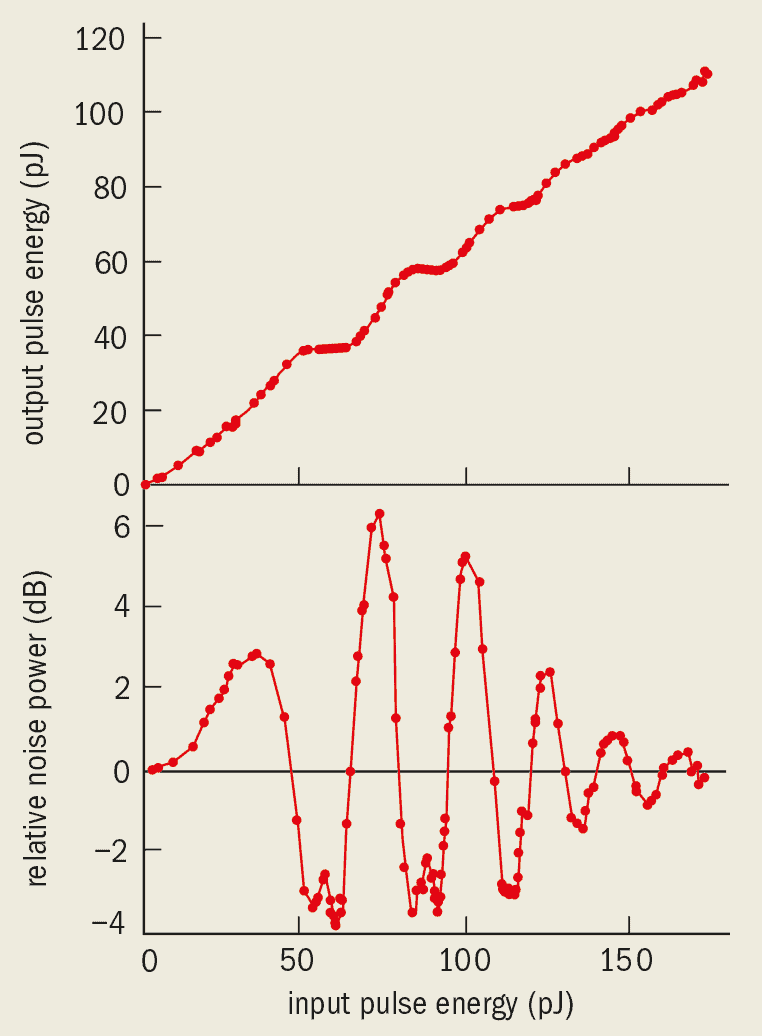
3 Squeezing the soliton Output energy (top) and squeezing (bottom) plotted as a function of the input energy for a 90/10 asymmetric fibre-based interferometer loop. The output-pulse energy shows an optical-limiting effect at input energies of 53 picojoules and 83 picojoules. The y-axis in the lower graph is the photocurrent noise power in a photodiode detector relative to the shot noise (horizontal line). The quantum fluctuations are reduced below the shot-noise level (i.e. “squeezed”) at the input energies for which optical limiting occurs. (From Schmitt et al.)
Leuchs and colleagues used a fibre-loop interferometer in which the soliton is split asymmetrically (90/10) into two replicas that interfere with each other at the exit of the loop. The input-output characteristic curve of the loop displays several plateaus – regions for which the energy of the output pulse is almost independent of the input pulse energy. The interferometer therefore acts as an “optical limiter”, producing pulses with a stabilized energy content.
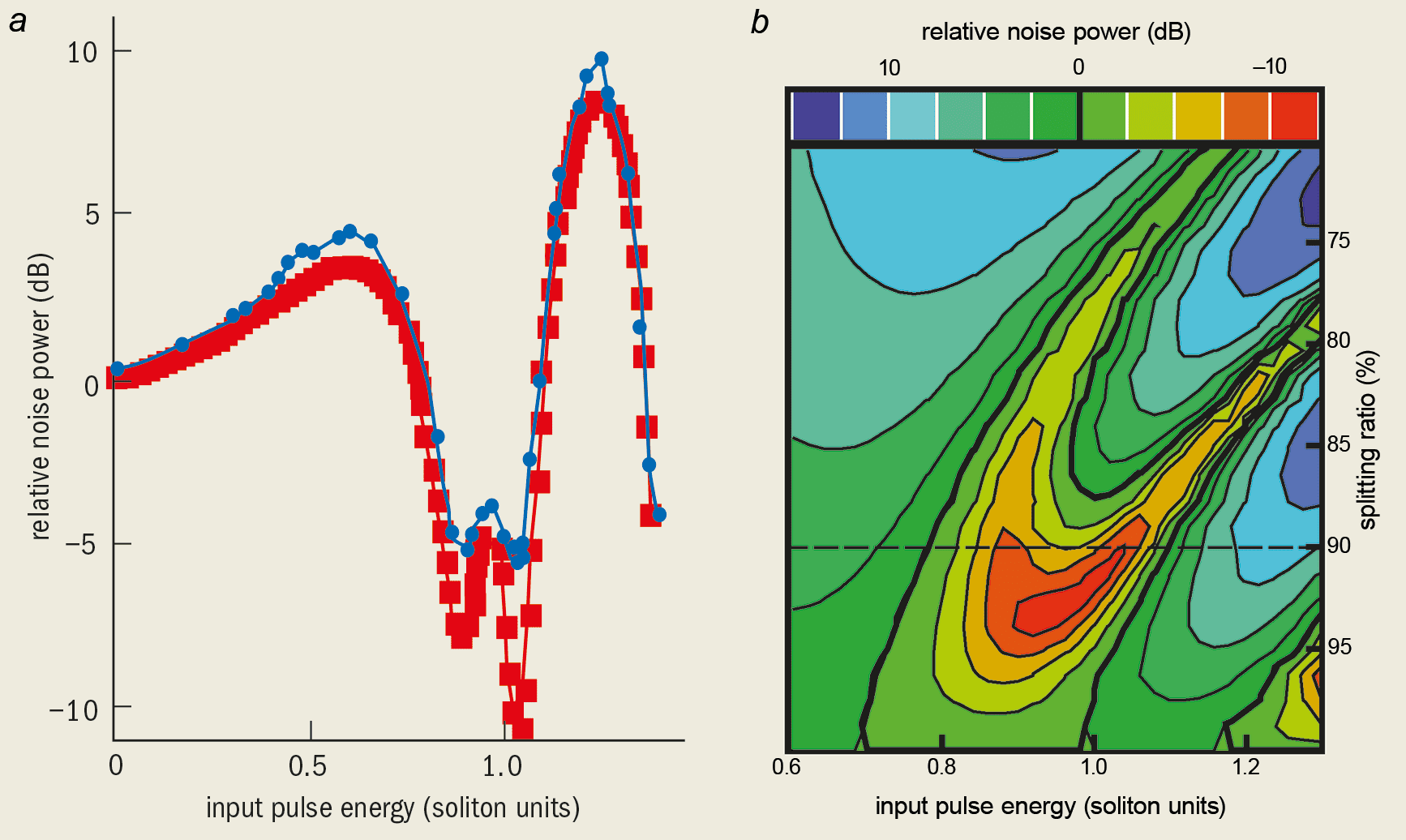
The Erlangen group measured the quantum noise of these stabilized pulses by detecting them with a pair of photodiodes and looking at the fluctuations of the overall photocurrent at a frequency of 20 MHz. There should not be any signal or any technical noise in this frequency range, so any fluctuations observed can be attributed to the quantum noise of the detected pulses. The team found a noise level that was significantly lower than the shot-noise limit, indicating that the stabilization involved not only the mean pulse energy but also its quantum fluctuations (figures 3 and 4).
This experiment is striking for two reasons. First, it produced a high level of squeezing. Second, the experiment used run-of-the-mill fibre technology, which means that a device for squeezing solitons could be readily incorporated into a real fibre communications system.
The special stabilizing properties of asymmetric interferometers have been discussed by many theorists, including Yoshi Yamamoto of Stanford University in California, Akira Hasegawa of Osaka University in Japan and Nick Doran of Aston University in the UK, over the past 10 years. However, the Erlangen experiment is the first clear-cut demonstration of these stabilizing properties. Mike Werner of NTT in Japan has independently proposed the use of asymmetric interferometers to achieve many different types of soliton squeezing.
Solitons in action
Mastering the physics of the nonlinear refractive index of the fibre has been crucial for the development of high-bit-rate long-haul transmissions. Taking advantage of the fibre nonlinearity has produced a definite niche in transoceanic fibre communications for soliton-like pulses, even though the distinction between soliton and non-soliton pulses becomes blurred at high bit rates where nonlinear effects are important for all types of pulses (see Doran and Bennion in further reading). And although our understanding of the subtle interplay between the nonlinear interactions and the quantum fluctuations has not yet reached the stage where it can pass from research to development, we can already envisage potential areas of applications for the squeezed solitons.
In all these applications one has to bear in mind that squeezing is very fragile, and that the carefully tailored distribution of photons in the squeezed soliton goes back to the shot-noise level as losses gradually remove photons from the soliton pulse at random. However, even if the squeezing of solitons cannot survive for more than a dozen kilometres of propagation, it can be extremely valuable when it is alive.
4 Getting the conditions right (a) Comparison of theory (red) and experiment (blue) for the squeezing of a 126 femtosecond pulse in a 6.4 metre long fibre. The x-axis is the input energy (in soliton units) and they-axis is the noise power (relative to the shot-noise level). Squeezing occurs for values of the input energy between about 0.78 and 1.11. (b) Predicted squeezing (see colour bar) as a function of input energy and asymmetry of the interferometer (y-axis). The shot-noise level is shown by the thick blackline and squeezing occurs in the region inside this line. The dashed line represents the asymmetry used in (a). Preliminary experiments have confirmed that a larger asymmetry will lead to even more noise reduction. (From Schmitt et al.)
One area of application concerns the transmission and processing of classical (binary) information, in which the presence or absence of a soliton in a time-window corresponds to a “1” or “0”, as in traditional optical-fibre communications. However, since solitons occur at fixed power levels, we do not have the luxury of being able to crank up the input power to improve the signal-to-noise ratio at the receiving end. Nevertheless, the exploitation of quantum effects such as squeezing could help to reduce noise and improve fidelity.
In long-distance communications, where the signal is amplified every 50-100 kilometres or so, the soliton pulse is strongest just after the amplifier. Luckily this is where the bulk of the nonlinear interaction needed to maintain the soliton shape occurs. However, the pulse gets weaker as it propagates along the fibre, so the nonlinear interaction also becomes weaker and weaker. This means that dispersive effects become dominant until the next stage of amplification, where the nonlinearity takes over again. One problem is that quantum fluctuations in the amplifiers lead to random jumps in the central wavelength of the individual solitons, and this results in a random variation of the speed of individual solitons in the fibre.
Several schemes have been devised to remove this excess noise and bring the train of solitons back to the orderly behaviour characteristic of a stable coherent state (e.g. the solitons could be passed through a spectral filter). Photon-number squeezing could also play a key role in solving this problem. For example, if the solitons are number-squeezed immediately after amplification, there will be a smaller uncertainty in the nonlinearity that keeps the soliton in shape and, therefore, there will also be less noise in the soliton. This results in an improvement in the bit-error rate of the transmission. The fact that squeezing does not survive attenuation does not matter in this case, since it is alive during the nonlinear interaction – when it is needed.
Another possible application of squeezed solitons would be in switching devices and logic gates based on soliton interactions, such as the fibre-end devices for signal processing in telecommunications developed by Mohamed Islam at AT&T in the US in the early 1990s. The use of number-squeezing would allow collisions between solitons to be controlled to high precision, thus significantly reducing the error rate of these devices.
What is shot noise?
Shot noise is the noise power level associated with a coherent state. As explained in the text, a coherent state, |α⟩,can be expressed as a superposition of all possible photon “number states”, |n⟩, as |α⟩ = exp(–1/2|α|2)Σ(αn/√n!)|n⟩ where |n⟩ is a number state containing n photons, and N = |α|2 is the nominal number of photons in the pulse.
The photodiodes used to detect solitons essentially count the number of photons in the soliton. For a coherent state, the photon-number distribution measured by the photodiode follows Poisson statistics, Pn = exp(–|α|2)(α/n!). The noise level of any state is defined as the variance of the photon-number distribution.
A property of Poisson distributions is that the variance is equal to the mean. Therefore, the noise level associated with any pulse obeying Poisson statistics is simply N, the mean number of photons contained in the pulse. However, techniques such as squeezing allow many of the limitations imposed by this fundamental quantum noise to be overcome.
Solitons and quantum information
It might also be possible to use solitons in the processing of quantum information. Quantum information is an emerging field of physics that takes advantage of phenomena that are particular to quantum mechanics – such as uncertainty, superposition and entanglement – to code, transmit or process information (see Physics World March 1998). Recent highlights in this field include quantum cryptography (which can be used to achieve unconditionally secure key distribution) and quantum computing, which considerably speeds up the solution of problems that are exponentially difficult. These problems include the factorization of large numbers and searches of large databases.
Although most proposals for processing quantum information to date concentrate on single-photon or single-spin implementations, optical solitons may offer an alternative that is easier to handle experimentally, yet still provides many of the basic quantum features that are displayed by single quanta. This could lead to new paradigms for computation and communications. In particular, the existence of quantum correlations in the fluctuations of the spectral and temporal sidebands of the solitons turns them into macroscopic quantum objects with internal entanglement. If these internal quantum correlations can be tailored into prescribed patterns, it might be possible to use solitons as “quantum signatures” and have completely secure transmissions.
Another interesting feature is that the interaction of two solitons puts them into an “entangled” state in which quantum mechanical correlations (“brotherly bonds”) exist between two spatially separated objects. This has already been exploited for quantum non-demolition measurements by Friberg’s group at NTT, and could also possibly lead to quantum devices such as “controlled-NOT” gates. These gates form the basis of quantum computing.
The possibilities that are opened up by the quantum mechanical nature of the optical soliton, and by the exploitation of the brotherly bonds that exist among its photons, are vast but still too early to assess. We can expect, nevertheless, that the research on the quantum properties of solitons will have a large impact on information transmission and processing – just as an understanding of the family structure and sociology of migrating birds gave man the idea to use homing pigeons to carry messages. Indeed, this was the basis of long-distance high-speed information transmission from the time Noah set foot on dry land until radio waves took over, four millennia later.
“This is certainly the quickest movement since we started measurements in Greenland in 1928, ” says Torsten Neubert, who heads DMI’s Solar-Terrestrial Physics Department. Neubert thinks that this acceleration points to a switching of the magnetic poles, perhaps within the next thousand years, something that could have dire consequences. “In the period up to a reversal, the Earth’s magnetic field would lose its strength and would no longer be able to protect the Earth from radiation coming from space – we could be exposed to violent cosmic radiation, ” says Neubert. Such radiation would affect navigation as well as the production of semiconductors.
However, not all geophysicists are convinced. “I wouldn’t say that the northward movement of the magnetic pole is a sign that the field is about to reverse, ” says a sceptical Jeremy Bloxham, an Earth and planetary scientist at Harvard University in the US. He thinks that the pole would have to be travelling towards the equator in order to flip. Neubert admits that the case for a switch in the magnetic field is unproven and says that the field is a chaotic system and therefore difficult to predict.
The new Danish Ørsted satellite may make prediction a little easier by looking at the whole of the Earth’s magnetic field, rather than just the poles. Due to be launched in the coming weeks, it should give researchers more accurate data on the orientation and strength of the field. Bloxham, however, believes that more accurate data will not point to a reversal. “I think the chances are that it will not happen, ” he says. “It’s a highly erratic process – there have been intervals of tens of millions of years without reversals.” But Neubert is looking forward to a reversal. “It would be an exciting time, ” he says.
Researchers at the Dubna Laboratory of Heavy Ion Nuclear Reactions in Russia, headed by Yuri Oganessian, collaborating with a team from the Lawrence Livermore National Laboratory in the US, made the discovery by firing a rare isotope of calcium at a plutonium target. They bombarded the plutonium-244 day and night for a month, finding one “event” of the sort they were looking for. The subsequent sequence of decays – three alpha-particle emissions followed by spontaneous fission – has never been seen before and is unique to the superheavy-element region. This rarest of isotopes had an atomic mass of 289 and survived for 30 seconds before decaying.
The existence of element 114 is important because it would offer strong evidence for the long-sought-after superheavy “magic island” of stability first predicted in the 1960s. The most stable isotope on the island is though to have 114 protons, 184 neutrons (nine more than the Dubna isotope), and a half-life measured in millions of years, albeit with large error bars.
“The creation of this element puts us only on the shore of the island, ” says Albert Ghiorso, a nuclear scientist at the Lawrence Berkeley National Laboratory in the US. “But its discovery is enormously important since it shows that the putative island is really there.”
However, Ken Moody, leader of the US team, is still not 100% convinced by the result. “You have to consider the possibility of random events correlating to give you something that looks like a real event, ” he says. Moody hopes that within the next couple of weeks he will be able to say for sure whether element 114 really has been created in Dubna.
The technique works because two different ions, gadolinium and europium, are in the phosphor material. The UV light boosts a gadolinium ion to its excited state. This excess energy is then transferred to two europium ions, both of which emit one photon of red visible light as they drop back down to the ground state. Meijerink and colleagues now hope to discover other phosphor compounds that can generate blue or green light so that a mixture of all three colours would produce white fluorescent light.
Vertical cavity lasers work by having a quantum well sandwiched between alternating layers of gallium arsenide (GaAs) and aluminium gallium arsenide (AlGaAs). As the two materials have different refractive indices, the layer stacks act as a set of mirrors that form a resonant cavity. Light from the lasing action is therefore emitted vertically from the surface of the semiconductor.
Giacomelli and colleagues observed the behaviour of the laser over all possible input settings. To add a noise signal to help generate stochastic resonance to the system they attached a white noise generator to the laser. By changing the parameters of the noise and the pump current, they were able to create a comprehensive map of the probability of generating stochastic resonance under a variety of conditions. This, they say, has led to an “unprecedented comparison with theoretical works” say the authors.