“The idea of using white noise to mimic zero-point fluctuations is clever, ” said Steve Lamoreaux of Los Alamos National Laboratory in the US. “The fundamentals are quite different from the electrodynamical Casimir effect, but the calculational techniques are quite similar.”
The conventional Casimir effect can be understood in terms of the radiation pressure exerted by electromagnetic plane waves in the quantum vacuum. Reflections of waves within the plates push them apart, while waves outside the plates push them together. The difference between the two is the Casimir force.
The acoustic equivalent to the vacuum electromagnetic field is noise that contains a broad range of wavelengths. But the advantage of the acoustic version is that the speed of sound is much less than the speed of light, which makes the time and length scales more manageable. It could therefore be used to test some of the theories describing the Casimir effect.
Larraza and Denardo produced a uniform acoustic field inside a large steel tank. They then measured the force between two aluminium plates 15 cm in diameter as the separation between them was increased.
When the separation was so small that no waves could exist between the plates, the force was independent of distance. As the separation was increased, the force became repulsive and then attractive. The repulsive force at small separations is not seen in the normal Casimir effect and is thought to be caused by waves travelling in different directions: between the plates the waves travel perpendicular to the plates, while outside the plates the waves travel in all directions.
The force can be altered by changing the distance between the plates, or by changing the frequency content of the acoustic field. This means that the force could be used to levitate an object – although only in a low-gravity environment – or to determine the total intensity of background noise.
Faulkes was educated at Hinckley Grammar School and at an early age specialised in science. He obtained a degree from Hull University and then went to London University to do a PhD in general relativity and cosmology. Afterwards he spent three years doing post-doctoral research before moving into the computer industry. He sees this latest project as a way to put something back into education. “Unlike most people I was nearly 30 when I finished my studies in mathematics and cosmology. I can thank my parents for allowing me all those years in school and university and the state system for giving me a free education, ” he says.
The Particle Physics and Astronomy Research Council is also getting involved. It is negotiating with the University of Hawaii to run the telescope on behalf of the Royal Observatory. School students in Hawaii would receive time on the telescope as payment to the university. Faulkes hopes that the project will enable Hawaiian and UK students to meet on the Internet to discuss the exploration of space.
Every year we pump 60 million tons of nitrogen oxides, 100 million tons of sulphur dioxide and 20 000 million tons of carbon dioxide into the Earth’s atmosphere by burning fossil fuels. Surely nuclear power, which emits almost negligible amounts of these gases, is beyond reproach? However, as the nuclear industry knows well, the public does not think so, and remains deeply suspicious of nuclear power.
Björn Wahlström, who has worked in the Finnish nuclear industry for the past 25 years, makes a persuasive case for nuclear power in this amusing but informative little book. He begins by imagining that nuclear power had been used since the dawn of civilization and describes the outcry that would ensue today if someone discovered “fossil instead of reactor energy” or “FIRE”. He then shows how innocuous – and even mundane – nuclear power can be by pretending to be an anxious member of the public on a tour of a nuclear-power station. He also tries to show how safe such plants are by coming up with a raft of supposedly reassuring statistics.
The author is less convincing about how to deal with nuclear waste, and does not address the nuclear industry’s reputation – whether undeserved or not – for secrecy and cover-ups. He is also a little too eager to blame the media for the public’s poor perception of nuclear power, although he makes the valid point that the media often give the opponents of nuclear power, who can afford to make wildly inaccurate statements, the same coverage as the carefully worded opinions of experts.
But my main criticism of the book is that author has not included any references, supposedly to avoid making it “boring”. Identifying the sources of his claims would, I feel, have helped to add weight to his argument.
There is a spectre haunting this book – the spectre of John Horgan, the journalist whose successful book The End of Science tweaked the collective nose of the scientific community when it was published in 1996. Horgan claimed that everything of fundamental importance that can be known to science is already known, or soon will be. He is nowhere mentioned in What Remains to be Discovered (except on the back cover, as a rather ambiguous reviewer), yet I would be surprised if John Maddox did not intend to write this book as an antidote to Horgan.
Anyone who seeks to prophesy what science is or is not going to discover faces a tricky problem – namely that, quite literally, they cannot possibly know what they are talking about. What can we know about knowledge that we do not possess? It is hard enough to know that one is under a misconception; but by definition one cannot know what that misconception is, or what brilliant insight will dispel it tomorrow. When we do perceive a problem, we cannot tell what it would take to solve it – otherwise we should do so right away. We cannot know what blind alleys are going to delay us tomorrow – otherwise we could avoid them. In short, it is impossible to foretell the future of knowledge. Yet despite the fact that this century’s greatest philosopher of science, Karl Popper, made it his business to warn us of the futility and danger of attempting such prophecy, it has not lost its specious appeal.
Advances in science are expressed as new theories. Yet if one conceives of science merely as a succession of theories, one will miss the point just as surely as if one were to conceive of politics as a succession of acts of parliament. Moreover, because one can know only the theories of the past and present, one must inevitably end up either extrapolating past progress, and foretelling more of the same, or extrapolating one’s present conception of the world, and foretelling the end of progress.
Both exercises are equally empty – and irrelevant too, for the true characterization of science is not in terms of theories but of problems. Problems are the raw material of science, its motive force and its justification for existing. And while we cannot pontificate about theories that we do not have, we can certainly explain problems that we do have. It is because Maddox understands this that his book deserves to be taken seriously, while Horgan’s is best regarded as entertainment.
Maddox, a long-serving former editor of Nature, is well respected in the scientific community, and well qualified to present us with this status report. His quietly absorbing narrative includes a competent, clear and fairly balanced overview of the current problem-situations in fundamental physics, cosmology and biology, as well as some perceptive comments about practical applications of science – including a devastating refutation of the proposition that the “survival of the planet” depends on slowing the pace of discovery.
The context of scientific problems – crucial, but often neglected in popular accounts – is especially well presented. Maddox provides just the right mixture of history, factual exposition and discussion, and his own opinions as well, to allow one to understand not only what current theories say, but also why they are inadequate as they stand, what the disputes are about and why they are important.
For me, what is lacking in What Remains to be Discovered is a sufficient sense of urgency, of passion and of bewilderment at the astonishing dilemmas and opportunities in the structure of scientific knowledge as it stands today. At least the complacent Victorians who (allegedly) thought that the 19th century would see the end of science – or, at least, of physics – had an excuse: it really did look superficially as though the big picture had been drawn and the future belonged to the details. But there is no such appearance today, even superficially: although our knowledge is more unified than ever, it has never before contained such powerful and widespread indications of its own provisional status.
Maddox points to “loose ends”, to “mysteries” in every field, to the increasing standard of explanation that we demand from scientific theories, to the need to deepen our understanding. And he is right. But what an understatement! What we face are not “loose ends” in our fundamental ideas about nature, but gaping wounds. For example, Maddox writes of the need for a “rapprochement” or “accommodation” between the two deepest theories in physics: quantum mechanics and the general theory of relativity. It is not going to happen! Half a century of attempts to reconcile these theories by the finest minds on Earth – some of them fresh from the triumph of solving apparently similar problems – have revealed only that our two deepest theories are logically irreconcilable at their very roots. They do not need reconciliation; they need replacement. And if new discoveries in physics cease tomorrow, they will still need replacement, and that need will continue to engage and frustrate the finest minds, perhaps forever, or perhaps, like Fermat’s last theorem, only for centuries until the problem is finally cracked.
Similarly, Maddox mentions the problem of consciousness, but he seems to assume that it will be solved by quantitative advances in existing brain science. Yet that is to ignore the fact that we do not yet even possess a language, or a notation, in which such a solution could be expressed. How, even in principle, shall we express a scientific prediction of what colour will look like to an observer who is about to see for the first time? Again, it appears that only a fundamental shift in our conception of this problem could solve it.
These and other problems that Maddox discusses are, as I said, dilemmas. But they are pleasant dilemmas in the sense that no matter how each issue is resolved, something that now forms part of our basic conception of the world must be overturned in favour of something better. And only an idea so radical that no one has even conceived of it yet can possibly overturn it.
Even the title What Remains to be Discovered is much too defensive. Maddox is telling us that there’s life in the old dog yet. But science today is more like a puppy that has only just opened its eyes, to see the world as a unity for the first time. It would be ill-advised to conclude that this first glimpse encompasses all that it will ever see.
Moreover, by stimulating experimental tests of the deepest and most profound aspects of quantum theory, Bell’s work led to the possibility of exploring seemingly philosophical questions, such as the nature of reality, directly through experiments. And this was just Bell’s “hobby”.
Early life
John Stewart Bell was born in Belfast on 28 July 1928. The families of both his parents, Annie and John, had lived in the north of Ireland for several generations. Annie’s family had originally come from Scotland and John’s middle name, Stewart, was her family name. In fact, John was known as Stewart at home, only becoming John when he went to university.
John Stewart, his elder sister Ruby and his two younger brothers David and Robert were brought up as firm members of the (Anglican) Church of Ireland. There was no hint of prejudice in the family, and Annie Bell had many friends in the Catholic community.
Bell’s parents were known as intelligent lively people, and although the family was not well-off, love and care were never in short supply. In particular Annie Bell was keen to impress on the children that education was the key to a satisfying life in which “they could wear their Sunday suits all week”. Although only John was able to stay at school much beyond the age of 14, David studied in the evening to become a qualified electrical engineer, and now lectures at Lambton College in Canada, while Robert is a successful local businessman. Later in life they were all able to joke with their mother that they could indeed wear their Sunday suits all week, although John rarely did!
John showed exceptional promise at his first schools, Ulsterville Avenue and Fane Street, and also used the public library in Belfast voraciously. Indeed, he was known as “The Prof” at home because of his tendency to amass great quantities of information, on which he would then freely expound. At the age of 11 John announced to his mother that he wanted to be a scientist.
Although John did extremely well in his “qualifying examination” at 11, his family could not afford to send him to any of Belfast’s more prestigious schools. However, money was found for John to attend the Belfast Technical High School for four years. This was probably ideal for him, as practical courses, which he enjoyed, were mixed in with a full academic curriculum that allowed him to qualify for entrance to university.
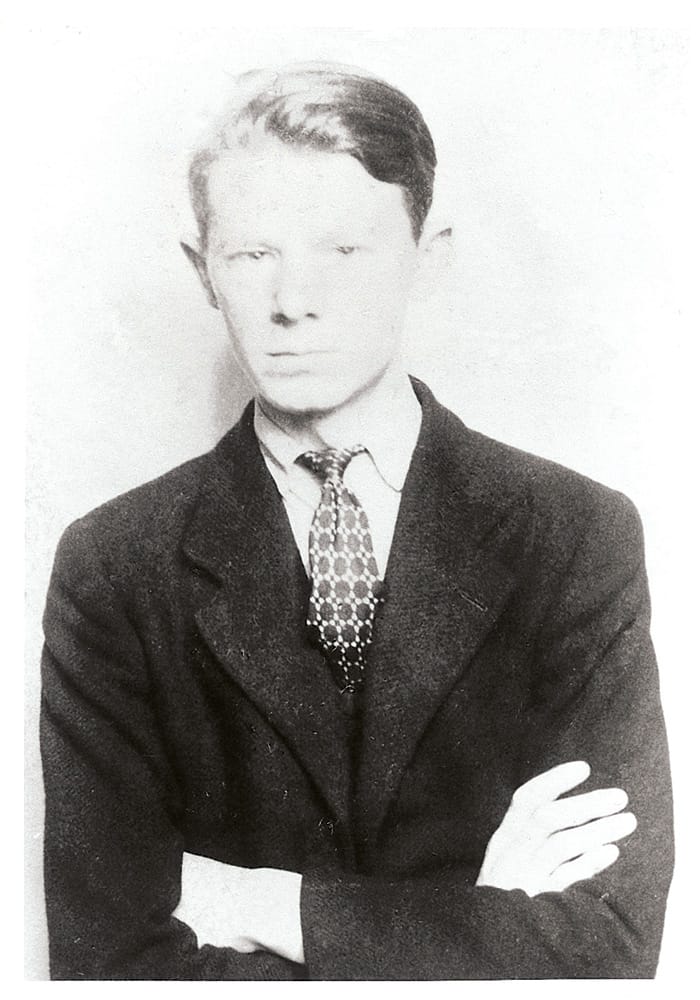
John Bell in 1945, the year he started his physics degree at Queen’s University in Belfast. Bell had spent the previous year working as a technician in the teaching laboratory because, as a 16 year old, he had been too young for admission to the university. Bell graduated with firs-class honours in experimental physics in 1948 and first-class honours in mathematical physics in 1949. (Courtesy: Queen’s University, Belfast)
At age 16, however, Bell was a year younger than the minimum age for admission to Queen’s, the local university. Instead in 1944 he entered the physics department at Queen’s as a technician in the teaching laboratory, where he greatly impressed the lecturing staff, Professor Karl Emeleus and Dr Robert Sloane. Indeed, Emeleus and Sloane lent John books and allowed him to attend the first-year lectures while still working as a technician. With savings from this year’s salary, and help from other sources, Bell was able to enter the university as a student in 1945. His performance was outstanding and he graduated with first-class honours in experimental physics in 1948.
Bell was especially interested in theoretical physics and a year later he was able to graduate for a second time, obtaining a first in mathematical physics in 1949. His teacher in this area was Peter Paul Ewald, famous as one of the founders of X-ray crystallography, who had been driven out of Germany by the Nazis and had been in Belfast since 1939. Bell enjoyed his contact with Ewald from an academic point of view and for its lack of formality.
Bell was less happy about the way Queen’s taught quantum theory, a subject in which he was already interested. Although there was a good course on the basics, later courses concentrated on applying quantum theory to atoms, whereas Bell wanted to study the more philosophical aspects of the theory as well. In particular he clashed with Sloane, whose account of the Heisenberg principle made it appear rather subjective in nature, which was not unusual in those days.
In retrospect Sloane should not feel guilty about not living up to Bell’s standards concerning quantum theory; over the next 40 years or so, many others would follow suit.
Career: particles and accelerators
In 1949, after he graduated, Bell joined the UK Atomic Energy Research Establishment (AERE) at Harwell, although he soon moved to the accelerator design group in Malvern. After the financial stresses of student life, it must have been pleasant to have a tenured position and a steady, if modest, income. He bought a motorbike, though a nasty accident while riding this led to a deep cut around the mouth, and thus to the famous beard.
An important event in this period was meeting his future wife, Mary Ross, who had joined the accelerator design group with a degree in mathematics and physics from Glasgow. They married in 1954, and enjoyed a long and happy life together, even writing joint papers. When some of John’s papers were collected as Speakable and Unspeakable in Quantum Mechanics in 1987 (see further reading), he ended the preface with the following words: “I here renew very especially my warm thanks to Mary Bell. When I look through these papers again I see her everywhere.”
Bell’s work up to 1953 consisted of modelling the paths of charged particles through accelerators. Without the benefit of computers, the work required a thorough knowledge of physical principles, together with the skill to retain the important physics while making sufficient approximations to allow the problem to be solved on a mechanical calculator. Bell’s work, produced in a series of AERE reports (including one in collaboration with Mary), was excellent.
This was the period when the discovery of “strong focusing”, in which axial and radial focusing are applied separately to the beam being accelerated, led to the next generation of synchrotrons. Bell’s numerical calculations had shown signs of the strong focusing principle, and when it was established formally in 1952 he rapidly became an expert and acted as a consultant to the team designing the Proton Synchrotron at CERN in Geneva.
The accelerator design group moved from Malvern to Harwell in 1951. That same year Bell was delighted to be offered a year’s leave to work with Rudolf Peierls, professor of theoretical physics at Birmingham University. At Birmingham, Bell discovered the important CPT theorem of quantum field theory. The CPT theorem states that the combined operation of charge conjugation (in which a particle is replaced by its antiparticle), parity reversal (reflection in a mirror) and time reversal is a symmetry operation that leaves the system unchanged. This is a fundamental theorem which proves, for example, that particles and antiparticles must have equal masses. Unfortunately Gerhard Lüders and Wolfgang Pauli performed similar work at the same time and received all the credit for what is usually called the Lüders-Pauli theorem.
Bell, however, had built up his reputation where it counted, and on his return to Harwell in 1954 he joined a group being set up to work on elementary particle physics, obtaining his PhD in 1956. However, in the years that followed he and Mary became worried that Harwell was moving away from fundamental work, and in 1960 they moved to CERN, where they spent the rest of their careers.
Between 1955 and 1984, Bell published around 80 papers in the general area of high-energy physics and field theory, including nuclear physics and many-body physics. Some work was directly concerned with experiments at CERN; for example, Bell helped to analyse the first neutrino experiments performed there in 1963. Most of the work, however, tackled theoretical issues.
Bell’s most famous paper in this area – published with Roman Jackiw in Il Nuovo Cimento in 1969 and cited more than any other of his papers – was the discovery, clarified to some extent by Stephen Adler, of the Bell–Jackiw–Adler anomaly. At the time, theory predicted that the neutral pion could not decay into two photons, but this had been observed in experiments. Bell, Jackiw and Adler were able to explain the observed decays theoretically by adding an “anomalous” term resulting from the divergences of quantum field theory. A condition that the “anomaly” produced agreement with experiment was that the sum of the charges of the elementary fermions had to be zero. This provided support for the idea that quarks come in three colours, now part of the widely accepted Standard Model. (The first family of elementary fermions consists of the electron, which has charge –1; the neutrino, which has no charge; and the three colours of up- and down-quarks, which have charges 2/3 and –1/3, respectively. If quarks came in only one colour, then the sum of the charges would be –2/3, not zero.)
Another crucial paper was Bell’s 1967 argument that weak interactions should be described using a gauge theory. (Gauge theories possess gauge symmetries: these symmetries are connected with the idea that quantities such as electric charge and quark colour are conserved locally as well as globally.) This suggestion was picked up by his collaborator, Martinus Veltman, whose research student, Gerard ‘t Hooft, later showed that the unwanted infinities in this gauge theory could be removed or “renormalized”. This in turn gave mass to the particles, now known as the W and Z bosons, that carried the weak nuclear force. The Standard Model of particle physics is based on gauge theories.
In the 1980s Bell returned to accelerator design, writing papers with his wife on electron cooling, radiation damping and quantum bremsstrahlung, including a theoretical tour de force in which he related Hawking radiation to the heating of electrons in an accelerator beam.
The quantum background
As a man of the highest principles, Bell gave every effort to his work on accelerator and particle physics, for which CERN paid him. Quantum theory, on the other hand, was his hobby, perhaps his obsession. And it was quantum theory that was to make him famous.
From his student days Bell had been fascinated by the theory and its implications for the nature of the physical universe. Many of these implications had been argued over by Bohr and Einstein in the 1920s and 1930s (see Whitaker in further reading). From the birth of the theory it was clear that if the only properties of the system that exist are those that are implicit in the wavefunction, then many properties with precise classical values just do not have quantum values at any particular time. The most famous example was the Heisenberg uncertainty principle: if a particle has a precise value of position, then its momentum cannot have a value. Similarly, if a spin-1/2 particle possesses a value of spin in the z-direction, sz, then it does not have values of spin in either the x- or y-direction. This is a much stronger statement than saying that the particle may have such values but that we do not or cannot know them. Physicists often call this property a lack of realism, although philosophers may define the same word in a more general manner.
Furthermore, measurement has a very special role in quantum theory: if we measure, say, spin in the x-direction, sx, then we must obtain a precise value for this quantity, even if a precise value did not exist beforehand. There are two possible results or “eigenvalues” for sx: +hw/2, which is associated with a quantum “eigenstate” a+, and – hw/2, which is associated with the eigenstate a–. We can predict the result of a measurement if the initial state vector describing the system, y0, is either a+ or a–: if y0 = a+ the result will be + hw/2, and if y0 = a– the result will be – hw/2.
In general, however, the state vector will be a linear combination of both eigenstates: y = c+a+ + c–a–, where c+ and c– are complex constants, and c+2 + c–2 = 1. In this case, we are still bound to get one or other of the eigenvalues, but it is not certain which one. Born’s postulate tells us that the probabilities of obtaining +hw/2 and – hw/2 are c+2 and c–2, respectively. Therefore the long-cherished principle of determinism, according to which identical initial conditions (e.g. identical state vectors) must always evolve with time in exactly the same way, is no longer valid.
The most common approach to measurement is von Neumann’s collapse postulate: for example, if the result +hw/2 is obtained in the measurement, then the state vector collapses at that instant to the corresponding eigenstate, a+, and another measurement of the same quantity will again yield +hw/2. The scheme works well pragmatically but, as von Neumann admitted, the collapse process is mathematically distinct from the normal evolution of the state as described by the Schrödinger equation. However, as measurement is just a conventional physical process, it should be governed by the Schrödinger equation.
Moreover, to Einstein the collapse postulate was an even more pernicious retreat from realism than that described above: it implied that physical quantities usually have no values until they are observed, and therefore that the observer must be intrinsically involved in the physics being observed. This suggests that there might be no real world in the absence of an observer!
Enter the hidden variables
One obvious way to reinstate realism and determinism was to add “hidden variables” to the wavefunction to provide the most complete description of the system possible. These hidden variables might, for example, provide values for all components of the spin at all times, and thus dictate whether the result +hw/2 or –hw/2 was obtained in a measurement. However, Bohr and Heisenberg were convinced that one could not supplement quantum theory with hidden variables. Therefore they were pleased when, in 1932, von Neumann claimed to have proved that the application of hidden variables to quantum theory was indeed impossible. This was to remain accepted wisdom for over 30 years.
A conceptual approach to the problems of quantum measurement was provided by Bohr in the 1920s. Bohr’s starting point was that the results of a measurement must be expressed classically; there must be a classical region of every experiment where physicists can set apparatus, read pointers and so on. And since (in the absence of hidden variables) there must also be a quantum region, then there must also be a “cut” between the two regions. The position of this cut will, to a considerable extent, be arbitrary.
The arbitrary position of the cut implies what Bohr called wholeness. The object being observed and the measuring apparatus cannot be regarded as separate – they are inextricably linked. Therefore measurement is not a passive registration by the apparatus of the value of a pre-existing property of the observed system. Rather measurement is a physical procedure involving the entire experimental set-up. So values of, say, sz and sx cannot be combined in a simple way, because completely different experimental arrangements are required to measure these two quantities.
This led Bohr to his framework of complementarity, according to which the value of a particular quantity can only be discussed in the context of an apparatus for measuring that quantity being in place. Evidence obtained under different conditions cannot be comprehended within a simple picture but is complementary. Thus one may not discuss simultaneously values of sx and sz, or x and px. Complementarity essentially forbids one to discuss the very situations that gave rise to conceptual problems; whether it actually explains anything is another question!
Bohr’s position was at least self-consistent, and quickly became regarded as “orthodox”. But it also contradicted many of science’s most cherished beliefs, such as realism, and, as is well known, Einstein had a long-standing debate with Bohr over what he perceived to be its inadequacies. The only aspect of Einstein’s criticisms that really struck home, and even then it took decades to do so, was his demonstration of entanglement via the famous Einstein-Podolsky-Rosen (EPR) thought experiment of 1935.
EPR argued that either there was a breakdown in locality, in the form of an instantaneous movement of information from one point to another (and obviously Einstein was appalled by this as it implied faster-than-light communication), or that the orthodox view of quantum theory was incomplete and there were elements of reality over and above those implicit in the wavefunction. EPR concluded that quantum theory was incomplete, but Bohr strongly disagreed with them. His response was to extend his definition of wholeness – both spins in the EPR set-up, although spatially separated, should be regarded as aspects of a single system. The scientific community almost unanimously sided with Bohr.
Enter John Bell
When Bell became interested in these matters in the late 1940s, his position on the Bohr-Einstein debate was unambiguous. Years later he explained this to Jeremy Bernstein: “I felt that Einstein’s intellectual superiority over Bohr, in this instance, was enormous; a vast gulf between the man who saw clearly what was needed, and the obscurantist.” Bell later showed Einstein to be wrong on this question, but that was the opposite of what he intended.
Bell felt that the introduction of deterministic hidden variables was very natural for three reasons. First it might eliminate the need for the cut between the classical and quantum regions of a measuring apparatus. In the terms used above, it could restore realism. His second, less compelling, motivation was to restore determinism.
His third motivation was specifically connected with EPR. Bell regarded Einstein’s call for the completion of quantum theory as a simple call for the addition of hidden variables: if all components of each spin had precise values at all times, there could be no problems for locality. Bell may have actually misunderstood Einstein – who probably hoped for a theory on a much grander scale, rather like his general theory of relativity, that would almost incidentally solve all the problems of quantum theory – but much of Bell’s major work would stem from this approach to hidden variables.
Bell described himself as a follower of Einstein. As for Bohr, Bell practically regarded him as two separate people. Bell strongly supported his assertion that apparatus must be classical in nature and his concept of wholeness in an individual measurement. Moreover, Bohr’s idea that the measurement process was not a simple discovery of a pre-existing property was a major component of Bell’s most important work, and he gave Bohr great credit for this insight. But Bell was repelled by what he felt was the complete lack of clarity in Bohr’s complementarity, which he preferred to call contradictoriness. Bell regarded Bohr’s “solution” of the EPR problem as incoherent.
Bell’s enthusiasm for hidden variables had been tempered by reading about von Neumann’s “proof” of their impossibility in his student days.He was frustrated because von Neumann’s book was written in German and was not translated into English until 1955. However, in 1952 Bell “saw the impossible done”. David Bohm, largely repeating work done a quarter of a century earlier by Louis de Broglie, was able to add hidden variables, actually particle positions, to standard quantum theory, and to obtain a fully realist and deterministic version of the theory.
Bohm suffered the strange fate of being dismissed equally by Bohr and Einstein. Bell, however, was enthralled and for a long time was just about the only supporter of the de Broglie–Bohm theory, which is also known as the pilot wave theory or the causal interpretation of quantum theory.
In 1953 Rudolf Peierls, who was to be a life-long friend and supporter, asked Bell to give a short talk at Birmingham. Bell offered to talk about either accelerator design or the foundations of quantum theory. Peierls, however, was part of the generation who considered that all the problems of quantum theory had been solved by Bohr, so he asked Bell to talk about accelerators. In fact it was probably a good thing that Bell resisted the temptation to join the debate on quantum theory until he was more established. By 1963, however, he had reached the peak of his “daytime” profession of high-energy physics, and a year’s stay at the Stanford Linear Accelerator Center in California gave him time and space to think.
John Bell and quantum theory
At last Bell was able to devote a fair proportion of his time to the questions that had interested him for so long. First he addressed von Neumann’s work on hidden variables in the light of Bohm’s theory. Bohm’s argument had been fairly complicated, and it was easy for those who did not welcome its conclusions to assume it was flawed. Bell started by producing a hidden-variable model of his own. It was fairly simple, covering just the measurement of any component of spin for a spin-1/2 particle. But the simplicity was really the point – it was too simple just to ignore.
Bell then turned his attention to von Neumann. Clearly both Bohm’s hidden-variable model and his own must violate one of the axioms of von Neumann’s proof, and Bell was soon able to trace this down. In quantum theory let us say we measure sx and then sy on a particular spin. It is obviously wrong to say that, had we measured sx + sy, we would have obtained the sum of the two individual measurements. Bohr’s argument of wholeness tells us that all three measurements require totally different arrangements of the apparatus, and that we cannot combine the results in a simple way.
However, if we calculate the “expectation value” of sx + sy, which is essentially the value of sx + sy averaged over all possible states of the system, we find that it is equal to the sum of the expectation values of sx and sy. Although this is little more than a strange coincidence in quantum theory, von Neumann had used this result as an axiom for his hypothetical hidden-variable states. There was no justification for this axiom and it did not work for either Bohm’s or Bell’s hidden-variable models. And when it was removed, von Neumann’s theorem crashed. Thus Bell was able to remove a 30-year-long log-jam from the study of the fundamentals of quantum theory. There were other well known “impossibility theorems” and, in the same paper, Bell disposed of these as well. Although the paper was written in 1964 while Bell was at Stanford, it was not published in Reviews of Modern Physics until 1966. (The journal had mis-filed Bell’s revised version of the paper, and by the time the editor had written to Bell to ask about the revisions, he had already returned to CERN and the letter was not forwarded.)
In the same paper, Bell also discussed two rather unwelcome properties of hidden-variables theories. The first was contextuality. This tells us that, except in trivial cases, any hidden-variable theory must be such that the result of measuring a particular observable will depend on which other observable(s) are measured simultaneously. The second was non-locality. All the hidden-variable models that Bell examined, including Bohm’s, had the unpleasant feature that the behaviour of a particular particle depended on the properties of all others, however far away they were. In the EPR case, the measurement result obtained on one particle would depend on what measurement is performed on the second. As Bell said, this was the resolution of the EPR problem that Einstein would have liked least, and it is in this sense that it may be said that Bell proved Einstein wrong.
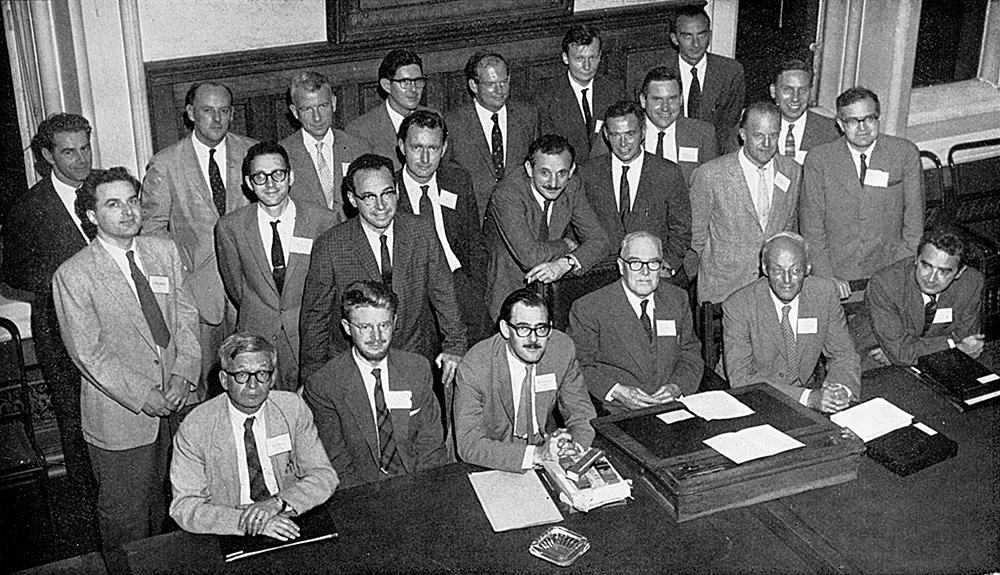
John Bell, second from the left in the front row, at the Rutherford Jubilee Conference at Manchester University in 1962. To his right is Rudolf Peierls, who worked with Bell in the 1950s. The other delegates are (back row: l–r) P C Gugelot, D H Wilkinson, H H Barschall, H E Gove, J M Cassels, C Rubbia, G E Brown; (middle row) L T B Goldfarb, S A Moskowski, M Goldhaber, R J Blin-Stoyle, S Devons, H McManus, H P Noyes, R H Dalitz, B J Cohen, A Bohr; (front row) Peierls, Bell, B H Flowers, E Marsden, D R Inglis, J B French. (Courtesy: Dept of Physics and Astronomy, Manchester University)
These two features are actually related, for contextuality in a system with entanglement suggests that the results of a measurement on one particle may depend on measurements made simultaneously on a second particle, spatially separated from the first, with which the first has become entangled.
Suggestions of non-locality were one thing; Bell wished for a rigorous proof, and was able to provide one in his second great quantum paper, written and published in Physics, a now-defunct journal, in 1964. Bell wrote the first draft of the paper during a stay at Brandeis University in Massachusetts and completed it at the University of Wisconsin at Madison.
As he stressed later, Bell started from locality and, following EPR, argued for the existence of deterministic hidden variables. However, he also went beyond EPR and considered measurements of spin components along arbitrary directions in each wing of the experiment (rather than just sz or sx as in EPR). Bell calculated what happened when the measurement direction was kept constant in one wing of the experiment and varied in the other. He was able to show that the behaviour predicted by quantum theory could not be duplicated by a hidden-variable theory if the hidden variables acted locally.
As subsequently shown by Bell and others, local realist theories (i.e. theories with hidden variables) satisfy a so-called Bell inequality. This is a constraint on the relationship between the joint probability densities of the signals recorded in the two wings of the apparatus; it involves the four distinct cases that may be obtained by having two settings in each wing. Quantum theory, on the other hand, does not obey the Bell inequality. In this way Bell had opened up the possibility of experimental philosophy, the study of what are normally thought of as philosophical issues in experiments. Not only do these experiments probe the deepest and most profound aspects of quantum theory, they also provide information on the fundamental nature of the universe. Henry Stapp of the Lawrence Berkeley National Laboratory in California was later to call Bell’s work on quantum theory “the most profound discovery of science”. Bell’s work in this area is also a major influence on the rapidly growing field of quantum information (see Physics World March 1998).
After the inequality
A large number of Bell inequality experiments have been performed over the last 30 years or so, the most famous being those of Alain Aspect and co-workers at Orsay. In these experiments, pairs of photons are emitted in a cascade from an excited atomic state and their polarizations are measured along different axes. More recent experiments have used pairs of entangled photons emitted by nonlinear optical crystals. In these experiments the polarization of the photon plays the role of the spin in the EPR–Bohm–Bell set-up.
However, the low efficiency of the detectors used in the experiments means that additional assumptions (essentially that those photons detected are a fair sample of the total flux) have to be made to test the Bell inequality. If these assumptions are made, the results are found to rule out local realist theories, and to be in good agreement with the quantum predictions. Most physicists now accept that quantum theory is correct, and that local realism has to be abandoned.
However, other physicists, often known as the realists, strongly disagree. They question the additional assumptions in the experiments and insist on the “detection loophole” being taken seriously (see Selleri in further reading). Particles are easier to detect than photons and it will be possible to close the detection loophole with measurements of the kaons produced in f-meson decays. Such experiments are planned for the “f-factory” that was opened in Frascati, Italy, last year.
Bell himself was worried that, according to special relativity, the nonlocal (faster than light) influence demonstrated in the Aspect experiment could involve propagation backward in time in other inertial reference frames of equal status. What he called the “cheapest resolution” to this problem was to return to the Lorentz (i.e. pre-Einstein) approach to relativity in which an ether is retained. In other words, there is a preferred frame of reference in which a real causal sequence may be defined (see Bell’s contribution to The Ghost in the Atom in further reading). Propagation backward in time in other frames may then be dismissed as “unreal” or “apparent”. More generally, however, Bell hoped for better theories than the ones we have now, and insisted that our current version of quantum theory was no more than a temporary expedient.
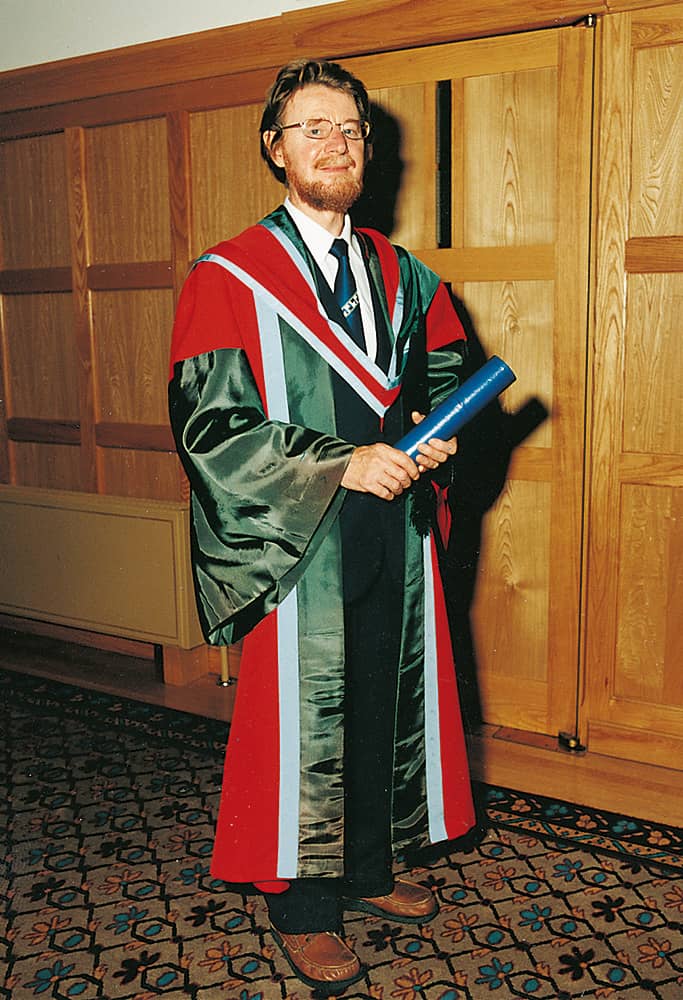
John Bell back at Queen’s in 1988 when he received an honorary doctorate. It was only in the late 1980s that the nature of Bell’s exceptional achievements in quantum theory became fully recognized. (Courtesy: Queen’s University, Belfast)
In the 1980s Bell’s work on quantum theory was centred on criticisms of the orthodox view of quantum measurement and suggestions for its modification. At the 1987 Schrödinger conference, he famously championed the 1985 theory of Ghirardi, Rimini and Weber (GRW) in which the collapse of the wavefunction is not an arbitrary and artificial device but is represented by a precise, though probabilistic, term in a nonlinear modification of the standard Schrödinger equation. Collapse would occur very fast for systems of macroscopic size, but its speed would decrease with the size of the system, and become negligible on the atomic scale.
In 1990, in an aggressive article called “Against ‘measurement'” published in Physics World (August pp33–40), Bell severely criticized the von Neumann collapse procedure and the very idea of “measurement” as a “fundamental term”. He also dismissed other approaches that, although more sophisticated, were in Bell’s opinion no less contrived. Once again he advocated Bohm and the GRW theory.
The man
John Bell was greatly respected by all who knew him as a man of total integrity and great generosity. He was modest and unassuming, with a delightfully puckish sense of humour – most notably exhibited in his “Bertlmann’s socks” paper in which the EPR problem was explained in analogy with the unmatched socks of one of his closest collaborators, Reinhold Bertlmann. Bell and his wife were both long-term vegetarians, and in his version of Schrödinger’s cat paradox, the two states of the cat are being hungry or not hungry, rather than being dead or alive.
Bell became a Fellow of the Royal Society in 1972, and although he received many awards, they did not come for many years, until the nature of his exceptional achievements became fully realized. Indeed, between 1987 and 1989 he was awarded the Hughes Medal of the Royal Society, the Dirac Medal of the Institute of Physics and the Heineman Prize of the American Physical Society. And in 1988 he received honorary degrees from both the Queen’s University of Belfast and Trinity College, Dublin. He was nominated for a Nobel prize and, had he lived longer, might well have received it.
In 1988 he made another visit to Belfast to lecture to the British Association. However, Bell remembered his early days in the teaching laboratory and spotting Reggie Scott, with whom he had worked as a technician over 40 years previously, left the assembled bigwigs to have a yarn about the old days when they were two young men making their way in the world.
Sadly it was much nearer the end than anyone would have hoped. On 1 October 1990 John Bell died suddenly of a stroke. This was of course a terrible tragedy for family and friends, but also a cause of great sadness to all those who knew him mainly from his work and his reputation. It may be a source of a little consolation that, over the last eight years, recognition has increased still further, and it is now unquestioned that he stands among the truly great scientists.
Further reading
J S Bell 1987 Speakable and Unspeakable in Quantum Mechanics (Cambridge University Press). This book contains most of Bell’s quantum papers
J S Bell 1995 Quantum Mechanics, High Energy Physics and Accelerators (World Scientific, Singapore). This book, edited by M Bell, K Gottfried and M Veltman, contains many papers by Bell on these three topics
J Bernstein 1991 Quantum Profiles (Princeton University Press). Bernstein interviewed Bell extensively and his profile of Bell contains a lot of material on Bell’s early years
P C W Davies and J R Brown (ed) 1986 The Ghost in the Atom (Cambridge University Press)
F Selleri 1990 Quantum Paradoxes and Physical Reality (Kluwer, Dordrecht)
A Whitaker 1996 Einstein, Bohr and the Quantum Dilemma (Cambridge University Press)
Recent Physics World articles related to Bell’s work on quantum theory include: C Jack “Sherlock Holmes investigates the EPR paradox” April 1995 pp39-42; D Greenberger and A Zeilinger “Quantum theory: still crazy after all these years” September 1995 pp33-38; A Zeilinger “Fundamentals of quantum information” March 1998 pp35–40
Everyday experience tells us that it is impossible to travel backwards in time, no matter what science-fiction writers and movie directors tell us. However, this seemingly natural impossibility is actually one of the greatest mysteries in physics. Currently most physicists associate the irreversibility of time with the production of entropy in the warm macroscopic world. One consequence of this irreversibility – often called the “arrow of time” in thermodynamics – is the ageing process. In plain terms, one grows old because of the irreversible physical processes that occur during one’s life. However, the fundamental classical laws of physics discovered by Galileo, Newton and Einstein do not distinguish between the future and the past. In other words, they appear to be symmetric in time.
One might naively expect that the thermodynamic arrow of time would be absent in the cold microcosmos of elementary particles, which most physicists believe to be closed quantum mechanical systems. However, this is not the same as saying that time-reversal symmetry is preserved at the level of elementary particles. On the contrary, there is a different “arrow of time” that manifests itself in the fact that there is no symmetry in time between the process of matter transforming into antimatter and vice versa.
This arrow of time is one of the great mysteries in elementary particle physics. It is still unclear whether the arrow of time seen in particle decays is related to any sort of “ageing” process for particles. Therefore, understanding the nature of time-reversal symmetry, and its violation, appears essential in the elusive quest for a full understanding of the concept of time.
Most physicists believe that the violation of time-reversal symmetry is linked to the symmetry between matter and antimatter. Mathematically, this latter symmetry is expressed through a fundamental theorem stating that under the assumptions of locality (i.e. that interactions are local in space-time), Lorentz invariance (the laws of physics are the same in all reference frames) and unitarity (all probabilities always add up to one), all known quantum field theories possess a symmetry under the combined operation of CPT: C denotes the charge conjugation, which changes the quantum numbers of every particle into those of its antiparticle; P is a reflection operation known as parity, which turns an object into its mirror image and rotates it by 180° about an axis perpendicular to the mirror; and T denotes time reversal. Therefore, assuming that CPT symmetry is always preserved, any violation of time-reversal symmetry should always be accompanied by a violation of CP symmetry and vice versa.
The laws of electrodynamics and the strong interaction preserve CP symmetry to great accuracy. However, it is known that weak interactions do not conserve CP symmetry. This was confirmed experimentally by Christenson, Cronin, Fitch and Turlay in 1964 when they measured rare (1-in-500) decays of long-lived kaons into pairs of pions. The neutral-kaon system is still the only system in which CP violation has been verified experimentally. Although this result implies that time-reversal symmetry should also be violated, it is nevertheless very important to demonstrate T violation directly, as such an experiment could allow us to test the CPT theorem itself, and thus shed light on the issue of entropy production in a particle system.
Such an independent measurement of T violation has now been provided by the CPLEAR collaboration at CERN, the European particle physics laboratory in Geneva. The test essentially amounts to a comparison of probabilities for the neutral kaon to transform into its antiparticle, the antikaon, and vice versa. The neutral kaon is a bound state of a down quark and an anti-strange quark, and has a strangeness quantum number of -1; its antiparticle has a strangeness quantum number of +1. Weak interactions are known not to conserve strangeness, so kaon can transform into antikaon in the course of time and vice versa.
In the CPLEAR experiment, headed by Panagiotis Pavlopoulos of the University of Basle in Switzerland, the neutral kaons are produced through the strong interactions in collisions of antiprotons with the protons in hydrogen atoms:
The strangeness of the neutral kaon – that is, whether it is kaon or antikaon- at the time of production can be “tagged” by the charge of the second kaon produced in the collision. The strangeness of the kaon at the moment of decay can be tagged through its decay products: kaon particles decay into a positron, negative pion and a neutrino, while antikaon particles decay into an electron, positive pion and anti-neutrino. (These decays are called semileptonic because some of the products are leptons and some are hadrons.) If there is an asymmetry, AT, between the number of initial antikaon decaying into positrons and the number of initial kaon decaying into electrons, then, under certain assumptions that have been supported by the current data, this is a measure of the violation of time-reversal symmetry in the sense described above.
The CPLEAR collaboration, following a series of preliminary announcements at conferences since 1995, has now reported a final result for the asymmetry of AT = (6.6 ± 1.3stat ± 1.0syst) X 10-3 (A Angelopoulos et al . 1998 Physics Letters B at press). The result demonstrates clearly a departure from time invariance in the semileptonic decays of neutral kaons.
Within the experimental accuracy of the CPLEAR experiment, the amount of T violation is found to be equal to the amount of CP violation observed in the neutral-kaon system, thereby providing a non-trivial consistency check of the validity of the CPT theorem to this level of accuracy.
An indirect demonstration of T violation, based on a phenomenological analysis of CP-violating amplitudes, was actually made at CERN in 1970 using data on the decay of long- and short-lived kaons into two neutral pions (K R Schubert et al. 1970 Phys. Lett. B31 658; 662). That analysis assumed unitarity: in other words, it was assumed that those kaons that disappeared had decayed into observable states. The CPLEAR experiment does not rely on this assumption and, most importantly, the result is the first direct observation of the T violation.
The violation of time-reversal symmetry in the neutral-kaon system has subsequently been confirmed by the KTeV experiment at Fermilab in the US. The KTeV collaboration, headed by Bruce Winstein of the University of Chicago, has reported preliminary results from an experiment on very rare events, the 1-in-107 decay of a single kaon into electrons and pions. In such a process time-reversal violation manifests itself in a subtle way. Since changing the direction of time also reverses the direction of momentum of a particle, the KTeV team detect violation of T symmetry by comparing the rates of some decays with other decays in which the particles emerge in the “time-reversed” direction.
What the CPLEAR and KTeV collaborations have shown with their observation of T violation is that the transformation of matter into antimatter is asymmetrical in time compared with the reverse process. This might have far-reaching consequences for our understanding of the cosmos. For instance, it might help explain why the universe is made of matter rather than antimatter, despite the fact that it is thought that equal amounts of both were created in the big bang. However, the discovery of the violation of time-reversal symmetry does not tell us if entropy is produced in the microcosmos. In simple terms, these experiments do not answer the question: do kaons grow old?
All indications currently point towards the validity of the CPT theorem for the neutral-kaon system. However, if kaons do grow old, this would constitute evidence of new fundamental interactions in nature not covered by the CPT theorem. A natural candidate for such interactions is gravitation. Indeed, in highly curved space-times the CPT theorem is known to fail, at least in its original formulation. The neutral-kaon system exhibits great sensitivity to such effects – indeed, the CPLEAR experiment has placed stringent bounds on these effects, which are close to the magnitude at which gravitational interactions might set in (R Adler et al. 1995 Phys. Lett. B364 239).
Other tests of fundamental symmetries should be possible in the near future. The DAFNE collider at the Frascati National Laboratories in Italy will provide further precision tests of CP and CPT violation by measuring the decays of f-mesons (bound states of strange and anti-strange quarks). The AD project at CERN will test CPT in anti-atoms. And many tests of T, CP and CPT violation will be possible at the NA48 experiment at CERN, at “B-factories” at the Stanford Linear Accelerator Center in the US and the KEK Laboratory in Japan, and ultimately at the Large Hadron Collider at CERN.
These experiments are expected to shed more light on the microscopic origin of discrete symmetries within the Standard Model of particle physics and, perhaps, tackle fundamental issues on the nature of space-time and gravity.
Every morning Caroline Davidson goes into her office in west London and rifles through her “slush pile”. Like all literary agents, she hopes that buried deep within the daily deluge of book proposals and manuscripts will be something so fantastic that no potential publisher would dare turn it down. “My dream is to open a parcel and find a beautifully written covering letter, a title that leaps out from the page and an idea that seems so simple and so obvious that I’m straight on the phone to the author.”
One proposal that caught her eye was sent in by Peter Barham, a physicist from Bristol University who wanted to write a book on “science in the kitchen”. He had failed to sell his idea directly to a publisher, and approached Davidson following a tip-off from a friend. “Caroline showed me how to turn my idea into a workable proposal and told me what would work and what would not, ” says Barham. She soon tied up a deal with a major publisher, and his book is set to hit the high-streets next Christmas.
Physicists like Barham are increasingly keen to muscle in on the “popular science” market, and publishers are constantly on the look-out for new talent and ideas. They all want to emulate the runaway success of Stephen Hawking’s A Brief History of Time, this cosmological masterpiece has so far sold more than eight million copies world-wide. Other physicists in the big league include Paul Davies, who has sold 235 000 copies of his books with Penguin, and John Gribbin, who has written 80 popular books on physics and astronomy. Rich pickings if you can find the winning formula.
So what are the secrets of a successful science book? “Cosmology, evolution and genetics are always popular with the public as they try to answer ultimate questions like why we’re unique, where we come from and where we’re going, ” says Peter Tallack, publishing director with Weidenfeld and Nicolson. Shoe-horning the word “God” somewhere in the title is not a bad idea either. Paul Davies has done it twice.
It also helps to have a good story. Simon Singh says that was why Fermat’s Last Theorem became the first mathematics book to reach number one in the best-sellers’ list, selling more than 80,000 copies in the UK alone. His book traces the story of Fermat’s mathematical puzzle, explaining how it challenged the finest minds for centuries until it was finally solved by Andrew Wiles in 1993. “It’s a wonderful tale. It has heroes, it has twists and turns, and because it has a long history I could start the mathematical explanations at a fairly elementary level, ” says Singh.
Luckily Singh knows how to tell a good story. After finishing his PhD in particle physics at Cambridge University in 1990, he joined BBC Television, where he directed a documentary about Fermat’s last theorem. “When you write for television, your explanation has to be very clear because the viewer has only one chance to understand what you’re talking about. Writing the book was therefore relatively easy.”
That’s not to say that you have to lead a glamorous media life to write a popular-science book. Many good ideas emerge from those who are involved in the public understanding of science. “I’m not a natural writer, ” admits Martin Rees, an astrophysicist at Cambridge University, who has written two successful books on cosmology and black holes, and is currently putting the finishing touches to a third on the fundamental constants of nature. “But I had done quite a lot of popular lectures and articles on cosmology for the general public. Having put the spadework in for that, I felt that it was worth the extra effort to transform my ideas into a book.” His publishers evidently thought so too; his latest work, Before the Beginning, has been translated into German, with Italian, Spanish and Polish versions due out soon.
Some of the best books come from scientists from one field who examine another subject from an interdisciplinary point of view. The Emperor’s New Mind by the mathematical physicist Roger Penrose is the classic example of the genre. Despite being heavy going in parts, his exploration of the overlap between consciousness and quantum physics proved an enormous success with book buyers.
The other side of the coin is that books that plod along the main path of a discipline are doomed to failure. “I am astonished at the number of proposals I receive where I’m being offered yet another book on cosmology that doesn’t approach the subject from a new perspective, ” says Simon Mitton, science director at Cambridge University Press, which publishes some 350 science books a year.
But no matter how original your idea, how great your title, or how cunning your marketing campaign, it’s the quality of writing that counts. Passion, enthusiasm and flair are what it’s all about. “Unless the writer can write well, the book won’t succeed, ” explains Stefan McGrath, an executive editor at Penguin. “You can’t market a book that isn’t well written.”
Mitton agrees. He urges physicists who want to become the next Paul Davies to dust off their copies of Pride and Prejudice , A Tale of Two Cities and Jude the Obscure . “My advice is to read as many books as possible from the central canon of English literature. Your training as a physicist will simply not have given you any idea how to tell a story. You have to learn that each chapter in a popular-science book has to have a beginning, a middle and an end.”
But budding writers should be careful not to expect too much. Most books sell just a few thousand copies, and the time and effort involved in writing can be substantial. “The only reason to write popular-science books is because you want to. Usually the pay in dollars per hour is small, ” explains Lawrence Krauss, a theoretical physicist from the Case Western Reserve University in the US, who wrote The Physics of Star Trek and Beyond Star Trek. “The key thing in the end is to come up with something new and hope that it interests people. I think we owe it to the public to explain what we do, and those who are sufficiently motivated to spend a great deal of time for potentially little financial return should try.”
But as Caroline Davidson points out, the rewards in other respects for those who take up the challenge can be huge. “Writing a book is satisfying, it’s life-enhancing, it puts you in touch with all sorts of people, and it can boost your credibility. Publishers will, I assure you, fight for anything in their field that they think is worth publishing.”
Once upon a time the news that the budget for particle physics and astronomy in the UK was going to keep pace with inflation for three years (see Physics fails to keep pace in the UK) would have been greeted with jubilation. After declining in real terms for the past 20 years, a period of stability for researchers currently funded by the Particle Physics and Astronomy Research Council was long overdue. Instead, however, British particle physicists and astronomers find themselves looking with envy at scientists in other disciplines – notably those in the life and biomedical sciences – as they wonder what happened to their share of the extra £400m that the government plans to invest in the science base over the next three years. Welcome to what the government calls “the post-genome challenge”, the cornerstone of its new science policy.
Put simply, the post-genome challenge is to fully understand all the genes in the human genome, and then exploit this knowledge in the health-care, food and other industries. The post-genome approach certainly has much to recommend it. It will produce a lot of new and exciting science for industry to exploit, and train a great many scientists for companies to employ as the emphasis shifts from research through development to production. No one can criticize it as a short-term option.
Although there is absolutely no reason why the new money should have been distributed according to historical spending patterns, the size of the shift to the life sciences has come as a surprise to many. It also indicates a remarkable convergence of the two main strands of government science policy – the creation of wealth and the improvement in the quality of life – into a single genome-dominated philosophy. The post-genome challenge receives five paragraphs in the document announcing the allocation of the science budget, compared with just one on IT and communications, the other area of science and technology expected to dominate the economy in the next century. The UK is never going to produce an Intel or a Sony and the government seems to have accepted this.
What will stick in the throats of particle physicists and astronomers, however, is that they have played by the government’s rules in recent years – the CERN subscription has been reduced and one of the Royal Observatories has been closed – but they are still at the back of the queue when new money is being handed out. Their colleagues in mainstream physics – most of whom are funded by the Engineering and Physical Sciences Research Council (EPSRC) – have fared better with a real-terms increase of 3.5%. However, the extra money comes with strings attached – two-thirds of it must be used to fund research that underpins work in biology, medicine and the environment. The EPSRC has already taken steps in this direction: its physics programme recently announced an initiative in “physics for health care” and has awarded grants to physicists working on the theory of protein folding.
Now, more than ever before, it is essential for the physics community – including particle physicists and astronomers – to highlight the spin-offs from research. The new emphasis on the genome should not cause any problems. Moreover, the budget document makes it clear that life scientists are bona fide “users” of physics research. A huge number of physics-based techniques have already become established in the life and biomedical sciences – X-rays, magnetic resonance, positron emission tomography, ultrasound and many others – and continue to do so: witness the way that protein crystallographers will be among the main users of synchrotron radiation sources in the future.
And as this magazine has argued several times before, there are countless opportunities for physicists to contribute to both the diagnosis and treatment of disease – see, for instance, last month’s special issue on “New Directions in Medical Physics” – and the most basic research in the life sciences. Next September, for example, we will publish a special issue on “Physics and the Fundamental Challenges in Biology”. Welcome to post-genome physics.
Richter, 67, will remain on the faculty at Stanford University and will be the next president of the International Union of Pure and Applied Physics. Richter’s main achievements at SLAC have been the construction of the two-mile Stanford Linear Collider (SLC), the world’s first linear collider, and the Stanford B-factory. Work on the SLC began in 1983 and physics experiments started in 1989. Experiments on the B-factory, another electron-positron collider, will start next year. Richter will also leave SLAC with strong programmes on synchrotron radiation and accelerator-based X-ray sources, and R&D for the next linear collider.
Experimentalists at CERN will use a cloud chamber to mimic the Earth’s atmosphere in order to try and determine whether cloud formation is influenced by solar activity. According to the Danish theory, charged particles from the Sun deflect galactic cosmic rays (streams of high-energy particles from outer space) that would otherwise have ionized the Earth’s lower atmosphere and formed clouds.
The theory is supported by findings presented by Svensmark, of the Danish Space Research Institute, in a paper published in the 23 November edition of Physical Review Letters. Svensmark found long-term correlations between cosmic rays and the Earth’s temperature, concluding that cosmic radiation fluctuations were related to cloud cover. “Clouds are important to the Earth’s energy balance, ” says Svensmark, “but there are still many aspects of the relationships that need clarification. If the sun does influence our climate as we believe, it means that processes originating in the formation of the Milky Way affect the climate.”
Jasper Kirkby, who will lead the CERN project, believes Svensmark is right. He points out that there was a mini ice age in northern Europe at the end of the 17th century that was not caused by humans but that perfectly matched changes in the Sun’s activity. “The theory will probably be able to account for somewhere between a half and the whole of the increase in the Earth’s temperature that we have seen in the last century, ” says Kirkby. “But we have yet to prove the relationship between the Sun’s cosmic radiation and the formation of clouds.” He points out that global warming may be part of a natural cycle in the Earth’s temperature.
Bent Sørensen, an environmental physicist at Roskilde University Centre in Denmark, believes Svensmark’s paper lacks real evidence. “It’s an interesting proposal for research, which is why CERN will try to acquire the knowledge that is lacking, ” says Sørensen, “but I feel there’s a large gap between finding statistical correlations with some assumptions and having a causal correlation or even a physical correlation.”
Sørensen says that Svensmark and Friis-Christensen have done themselves no favours by denouncing the greenhouse theory: “I think it’s very unfortunate that the authors said right from the beginning that they didn’t believe in the greenhouse theory, which is a proper physical theory with a concrete mechanism. Instead their theory is still speculative. I’m not saying there isn’t anything in it, it just has a different status to the theories behind the greenhouse effect.”