If Only I Could Hibernate: Mongolian movie follows a teenager entering a physics olympiad

I’ll be honest: the cinema in Bath where I saw the Mongolian-language film If Only I Could Hibernate wasn’t exactly packed to the rafters. There’s probably never going to be a huge audience for a movie about a teenage boy from a hard-up family in Mongolia’s capital Ulaanbaatar wanting to enter a physics olympiad.

Written and directed by Zoljargal Purevdash, who apparently excelled at physics herself, the film stars Battsooj Uurtsaikh as Ulzii, who lives with his siblings and mum in a freezing, snow-covered hut in the hilly outskirts of the city. His mum has a drinking problem and goes off to the country with her youngest son to earn some money, leaving Ulzii at home in charge of the rest of the family.

Ulzii’s a typical teenage boy, mucking about with his mates in the snow, getting drunk on cheap spirits, and playing silly games with his other brother and sister. At school, however, he realizes he has a knack for physics and his teacher encourages him to study hard to enter a physics olympiad.

Ulzii enters a regional heat at a local university, where he starts to see that if he studies hard, physics could open the door to a much brighter future. But lacking money to heat his hut and struggling to keep his home in some kind of order, Ulzii gets sidetracked and quits his studies to earn money out in the forests illegally chopping trees.

There’s a stand-off with his teacher who tracks Ulzii down in the countryside and, without going into spoiler-alert territory, the film takes a few twists and turns as Ulzii tries to decide where his future lies: doing physics or chopping trees. There’s a certain amount of dramatic tension to the story here but, had I not been a physicist, I’m not sure I’d have been that bothered about Ulzii’s fate.

On general release at UK and Irish cinemas from 19 April, If Only I Could Hibernate made its world premiere at the 2023 Cannes Film Festival and I do know that real physics competitions, such as the British Physics Olympiad, are popular among school-age students and their teachers. Perhaps, then, there’s scope for another film-maker to explore such competitions but with more added spice, drama and – dare I say – more “real” physics.

Physics World rating: 3/5.

Sticky materials un-stick themselves in jumps

Researchers in Germany and the US have found a new explanation for why soft solids stick to surfaces easily but are difficult to remove. Though experts had long hypothesized that various chemical processes and material-specific properties could play a role in this so-called adhesive hysteresis, a team at the universities of Freiburg, Pittsburgh and Akron has now shown that surface roughness alone is enough to account for it. According to the team, this finding could fundamentally change the way we think about the stickiness of soft materials.

If you’ve ever found it easy to stick an object to something, but almost impossible to get it off it once it’s stuck, you’ve observed adhesive hysteresis in action. “Any soft material will show this hysteresis when making contact,” explains team co-leader Lars Pastewka, a physicist in the department of microsystems engineering at Freiburg. “Scotch tape and sticky notes attach easily but are difficult to detach.”

In 1966, scientists seeking to explain this behaviour developed a rule of thumb called the Dahlquist criterion. This criterion states that if a material is very soft – which Pastewka says is sometimes translated as requiring a Young’s modulus of less than 0.1 MPa – it will “bond” when pushed into contact, and it will maintain this “bond” when released.

In the new study, Pastewka says, “We show that there is no real ‘bond’, but that roughness pins the contact line, yielding a physical explanation for the Dahlquist criterion.”

“Stick-slip” instabilities dissipate energy

To reach this conclusion, Pastewka and colleagues at Freiburg and the livMatS Cluster of Excellence developed models that weave together different strands of engineering and physics. These strands include standard contact and fracture mechanics as well as more abstract research on elastic lines in random media (a topic that lies within the branch of physics dealing with complex systems). The results of these models showed discrete “jumps” known as stick-slip instabilities occurring when the perimeters of elastic bodies contact each other.

These stick-slip instabilities dissipate energy and lead to hysteresis, and Pastewka says that his theory and modelling group at Freiburg hypothesized that they could also play a role in adhesion. “To confirm this, we asked our experimental colleagues at Akron to check their measurements,” he says. “They also saw these jumps.”

Past hypotheses

Scientists had previously suggested that adhesion hysteresis in soft solids might be caused by the dissipation of viscoelastic energy – that is, energy lost to heat when a material deforms during contact. If a material compresses during contact and expands during release, these energy losses would counteract the movement of the contact surface, increasing the adhesive force during separation.

Another explanation centred on a process called contact ageing, which involves the formation of chemical bonds on the contact surface. Under this hypothesis, the longer the contact exists, the greater the adhesion will be.

Though both explanations sound physically plausible, “Our simulations show that the observed hysteresis can be explained without these specific energy dissipation mechanisms,” says Antoine Sanner, a postdoctoral researcher at Freiburg who did the bulk of the study’s theoretical work. “The only source of energy dissipation in our numerical model is the sudden jumping movement of the edge of the contact, which is induced by the roughness of the surface.”

Simplifying the design of adhesives

Because material systems designed to be sticky are often also designed to be viscoelastic, Pastewka says the new work may simplify the design of (reversible) adhesives. Such adhesives might be employed in the locomotion of soft robots, where there is a need to control the load-bearing capacity of the robots’ contacting limbs. Another application might be pick-and-place systems for manufacturing plants, which are increasingly relying on soft robotics.

The processes described in this study are also affected by interfacial water bridges, and the researchers say they are now exploring the influence of water on adhesion – particularly in the form of capillary adhesions. “Since water is ubiquitous, I believe most adhesive joints are at least to a certain extent mediated by water,” Pastewka says. “We may therefore be able to construct similar (and even simpler) models for capillaries at interfaces.”

All of this is a somewhat surprising outcome for a research project which, according to Pastewka, originally focused on triboelectricity — the phenomenon whereby surfaces in contact with each other become charged. This effect can be exploited for energy harvesting, and it is also related to the processes that charge up clouds during thunderstorms and produce lightning. “Previous research has shown that charge occurs in specific patterns on interfaces, and we thought that thus may be related to how interfaces detach,” Pastewka tells Physics World. “This is why we decided to look into the details of the detachment processes and found the stick-slip instabilities.”

The work is detailed in Science Advances.

An orchestral trip through the moons of our solar system

This month’s episode of Physics World Stories features an interview with composer Amanda Lee Falkenberg with music from her The Moons Symphony. Her creation takes listeners on an epic journey through the science and stories of the moons of our solar system.

The seven-movement symphony dramatizes the geophysical features of Io, Europa, Titan, Enceladus, Miranda and Ganymede, before turning to our own Moon for a two-part finale. In creating the work, Australian-born Falkenberg immersed herself in the scientific research and consulted many scientists and astronauts.

The Moons Symphony performed by the London Symphony Orchestra is available now via Signum Records.

Scientists discover that like-charged particles can sometimes attract

From a young age, we are taught in school that like charges – whether both positive or both negative – will repel each other, while opposite charges attract. It turns out that under certain conditions, like charges can actually attract each other instead. In work recently published in Nature Nanotechnology, researchers at the University of Oxford have demonstrated the attraction of like-charged particles in solutions.

The journey began for the lead scientist Madhavi Krishnan back in the mid-2000s, when she came across the “like-charge attraction problem” while studying how DNA molecules squeezed into slit-like boxes. It was expected that the DNA would flatten into a pancake-like geometry, but instead it aligned alongside the edge of the box. Without any external forces being applied, the only explanation was that the DNA was attracted to the box, despite them both being negatively charged. Thus, an interest in how attraction and repulsion may not be as they seem was born.

The like-charge problem is not new knowledge though. Different scientists over the years have tried to explain how like charges can attract, with some of the earliest works coming from Irving Langmuir back in the 1930s.

One of the areas where like-charge attraction is seen the most is within fluids, and the interaction of solid matter with fluids. “I encountered the problem early in my trajectory as a scientist,” Krishnan tells Physics World. “Considering the observations entailed such a fundamental departure from the current understanding of a basic and central phenomenon in the fluid phase, turning away from the problem was never going to be an option.”

The attraction of like charges in fluids has been seen many times using multivalent ions, but these are known ionic species that are exempt from DLVO (Derjaguin–Landau–Verwey–Overbeek) theory – the expectation that like-charged molecules will repel at long ranges when van der Waals forces are too weak to influence the interactions between molecules.

However, a number of molecules that are expected to follow the rules of DLVO theory – such as nucleic acids, liposomes, polymers and colloidal particles in aqueous media – have been shown to possess some level of attraction when like charges are present.

Why do some like charges attract?

Current theories of charge attraction within solvents consider the fluid to be a continuum but overlook some of the finer details of the solvent and how it interacts with solid interfaces. However, new theories suggest that the behaviour of the solvent at an interface has a significant influence on the total interaction free energy of two charge-carrying objects when they approach each other.

The latest study from Krishnan and colleagues showed that the solvent plays an unforeseen but crucial role in interparticle interactions and can break the charge reversal symmetry. The team also found that the degree of interparticle interactions that the solvent is responsible for depends strongly on the pH of the solution.

The researchers used bright-field microscopy to examine a range of solid particles, including inorganic silica, polymeric particles, and polyelectrolyte- and polypeptide-coated surfaces, within various solvents. They found that in an aqueous solution, negatively charged particles attracted each other and formed clusters, while positively charged particles repelled. However, in solvents that have an inverted dipole at an interface – such as alcohols – the opposite was true: positively charged particles attracted each other and negatively charged particles repelled.

“The findings would suggest a major re-calibration of basic principles that we believe govern the interaction of molecules and particles, and that we encounter at an early stage in our schooling and education,” says Krishnan. “The study brings to light an adjustment required of something we regard as a ‘textbook principle’.”

The reason for the like charges attracting each other is attributed to the solvent having a large influence on the interparticle interactions, which can spontaneously assemble the like-charged particles in the solution. This is because the concerted action of electrical charge at the interface and the local interfacial solvation structure generate an “electrosolvation force” between the negatively charged functional groups in the solution, causing the particles to attract each other and cluster.

The team also found that both the sign and magnitude of the free energy contribution can have an impact on whether the particles form self-assembled systems (a negative free energy will drive spontaneity and self-assembly). It’s thought that these like-charge attractions are responsible for nanometre-scale biological processes, such as biomolecular folding of macromolecules in the body.

When asked about the impact of the study, Krishnan says that “the major open frontier is how this interaction affects biology. Biology is loaded with charge. These forces are the bedrock on which interactions between molecules plays out, influencing the way they come together, are packaged into small spaces, and ultimately carry out their function.”

“These are the most exciting directions, and I hope for us to be able to pursue at least some interesting questions in the general area,” Krishnan adds.


Frugal approach to computer modelling can reduce carbon emissions

As computing power continues to grow, theoretical physicists have been able to do larger and more complicated simulations. Running these models consumes a growing amount of energy, and for the time being, this results in more greenhouse-gas emissions that contribute to climate change. Indeed, doing an intensive supercomputer simulation can result in emissions that are on par with taking a long-haul flight.

In this episode of the Physics World Weekly podcast, Alejandro Gaita and Gerliz Gutiérrez  of Spain’s University of Valencia tell Physics World’s Margaret Harris how the physics community can reduce its computing-related carbon emissions.

Gaita and Gutiérrez are theoretical materials physicists and they argue that scientists should take a frugal approach to computer modelling, which can achieve scientifically relevant results while minimizing energy consumption.

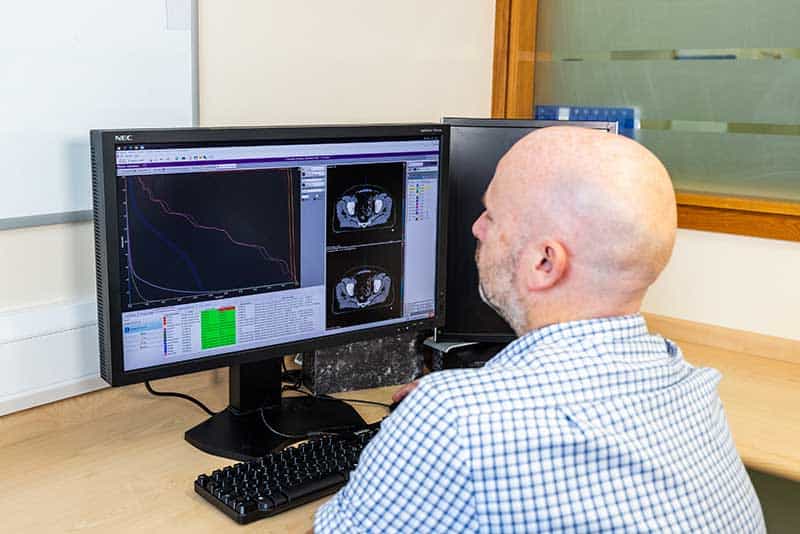
Automating patient-specific QA: clinical use of RadCalc and script automation to enhance pre-treatment and in vivo workflow

Want to learn more on this subject?

Join Maximilian Grohman in a detailed webinar on using RadCalc’s patient-specific quality assurance tools within a Varian-equipped radiotherapy department, focusing on their practical implementation for enhanced patient-specific pre-treatment and in vivo verification.

Maximilian will also discuss the role of custom scripting (Python, C#) through the Eclipse Scripting API to optimize workflow efficiency and accuracy.

It is essential for medical physicists and clinicians aiming to boost patient care through automation. Whether you’re looking to understand the technical integration or explore the clinical benefits, this webinar will equip you with knowledge and strategies to improve your department’s operations.

Want to learn more on this subject?

Maximilian Grohman, MSc, holds a master’s in medical physics and is a qualified medical physicist at the Radiotherapy Clinic of the University Medical Center of Hamburg-Eppendorf in Germany. With expertise in treatment planning, dosimetry and a hobby in medical physics informatics, he is dedicated to enhancing the quality and efficiency of the radiotherapy workflow in his clinic.

How India is transitioning its energy production in a carbon-constrained world

Shri Rajesh Veeraraghavan is a mechanical engineer who was appointed as technical director of the Nuclear Power Corporation of India Limited in July 2023. In December 2023 he presented the Homi Bhabha and Cockroft Walton lecture series – a bilateral exchange of lecturers between the Institute of Physics and Indian Physics Association, which have been running since 1998.

How do people in India view the subject of climate change?

I have seen the impact of climate change in my own home state of Kerala in southern India. In 2018 the region was hit by an unprecedented flood that remained for about a week or so. That is when many people realized that the impact of climate change is happening not just in other countries, but in India too.

What about the Indian government?

The government is trying to drive down the consumption of fossil fuels while at the same time making a push for renewables, especially solar, which is increasing hugely through rooftop arrays that are able to deliver energy to homes and businesses. For any change to happen, the population needs to be onboard and to help deliver renewable targets.

India is a low-income country and to become developed requires a lot of energy consumption

What are those targets?

India is committed that by 2070 we will be a net-zero emissions country. Yet at the same time we are a low-income country and to become developed requires a lot of energy consumption, which is why we still have a large dependence on coal. Global warming has already reached 1 °C above pre-industrial levels and keeping it within 1.5 °C is the target. Yet it is the high-income nations that have contributed the majority of carbon emissions that have been released in the last two centuries, so developing nations are not the main creator of the problem. So, while we have to develop as a nation, we are also at the same time working towards solving the problem of climate change.

How can India achieve this?

We have committed that by 2030 renewables will meet about 50% of electricity demand, up from 40% today. But we will also need nuclear. Today, the installed capacity of nuclear in India is around 7.3 GW – or about 3% of electricity generation – and that will double by 2030 to about 15 GW while still remaining at 3% of total energy produced. It is expected that India will require about 770 GW of total installed energy-generation capacity in 2030 compared with 415 GW today.

With the focus on renewables, does nuclear power have a future?

Yes, nuclear power has many advantages. A 1 GW nuclear plant will continuously provide 1 GW to the grid, operating 90% of the time. Wind or solar require sunlight or the wind to blow, which gives an operating capacity of about 30%. This requires ways to store that energy. As renewables alone cannot provide a continuous power supply, there has to be a mix of nuclear and fossil fuels with renewables.

How does the public in India view nuclear power?

The public in general accepts nuclear, but as in other countries, there is opposition. Some people say nuclear is unsafe, but we have operated some of our reactors continuously for years and of the 24 reactors currently in operation, we have not had one nuclear safety incident.

Are people concerned about issues around radiation safety?

The radiation you are exposed to from natural sources is of the order of 2400 microsievert (µSv) per year. The radiation that can be released into the atmosphere from a nuclear plant is heavily regulated. In India this is carried out by the Atomic Energy Regulatory Board and that number is required to be less than 1000 µSv per year. However, emissions at our nuclear plants are much less, ranging from 0.002 to 24 µSv per year.

What is the future of nuclear power in India?

The Indian nuclear physicist Homi Bhabha – credited as the father of India’s nuclear programme – envisaged a three-stage nuclear power programme for the country. The first stage is pressurized water reactors and currently India has a mix of pressurized heavy-water reactors and light-water reactors. The second stage is the development of fast breeder reactors, a prototype of which is being built in India. The third stage is thorium-based reactors, which India is ideally placed to lead given we have large thorium deposits.

Do small modular reactors have a future in India?

Such reactors, which generally produce less than 300 MW, are a beautiful technology and one that may revolutionize nuclear power. They can be assembled in a factory with minimum construction at the intended site. As of now, small modular reactors are mostly in the conceptual or design phase. But if implemented, it would be possible to power a small city by putting a single reactor on the outskirts, for example.

What benefits does the nuclear industry bring?

Establishing a nuclear plant gives many benefits. The local surroundings are developed, it provides jobs and companies also undertake social responsibility projects. We need nuclear power.   

Space weather phenomenon observed in the lab for the first time

Space weather events known as whistler mode chorus emissions have been observed in the laboratory for the first time. These emissions occur naturally within regions of space dominated by planetary magnetic fields – magnetospheres – and they are related to the aurorae that light up our northern and southern skies every winter. However, their exact origins are poorly understood, and until now, studying them has involved either spacecraft observations or numerical simulations. By recreating the conditions that produce these emissions, researchers at Japan’s National Institute for Fusion Science and the University of Tokyo hope to better understand them and how they affect orbiting satellites as well as ground-based power and communication networks.

Whistler mode chorus emissions are intense, coherent waves that produce and transport high-energy electrons through planetary magnetospheres. They get their name because their frequencies vary repeatedly in a way that reminded early researchers of the “dawn chorus” of birdsong. These plasma waves have been observed in Jupiter’s magnetosphere and in the region affected by Earth’s magnetic field, but never before under controlled conditions in a laboratory.

Recreating magnetosphere-type plasmas

The first task for team leaders Haruhiko Saitoh and Zensho Yoshida was to create a suitably magnetosphere-mimicking magnetic field. The most fundamental type of magnetic field that forms in planetary magnetospheres is a dipole field, and at the University of Tokyo’s Ring Trap 1 (RT-1) facility, this type of field is commonly used to stably confine plasmas for advanced fusion experiments.

In their work, which they describe in Nature Communications, Saitoh and colleagues generated this field using a 110-kg magnetically levitated superconducting coil located within the RT-1’s vacuum vessel. By filling the vacuum vessel with hydrogen gas and exciting the gas with microwaves, they created a high-quality hydrogen plasma containing electrons heated to high temperatures. “Creating an environment similar to the magnetosphere in the laboratory was challenging,” Saitoh tells Physics World, “but RT-1 is able to achieve this thanks to the levitating superconducting coil in a vacuum chamber.”

Chorus emissions could be a universal phenomenon

The researchers used magnetic probes to study how the plasma – including the hot electron component – fluctuates. They found that the plasma spontaneously produced whistler wave chorus emissions whenever it contained a significant proportion of high-temperature electrons. These electrons are responsible for the plasma’s pressure, and the team observed that increasing their number drives the generation of chorus emissions.

According to the researchers, this result suggests that chorus emissions are a universal phenomenon in plasmas that contain high-temperature electrons within a simple dipole magnetic field. Plasmas of this type are common in the geospace, which the team define as “the space around the Earth that is particularly closely linked to human activities”. As such activities intensify, they note, the study of magnetospheric disturbances capable of causing aurorae, as well as power and communication failures, becomes more important. “Chorus emissions are important for understanding and potentially mitigating these effects,” they say.

Compton camera measures gamma-ray polarization in nuclear physics experiment

A Compton camera has been used to measure the polarization of gamma rays in a nuclear physics experiment. This was done by a team led by Shintaro Go at Japans’s RIKEN Cluster for Pioneering Research. They say that that their novel approach could help physicists to probe the structure of atomic nuclei in much better detail.

An atomic nuclei contains protons and neutrons that are bound together by the strong force. Much like electrons in an atom or molecule, these protons and neutrons can exist in a number of distinct energy states – often associated with different shapes of the nucleus. Transitions between these states often involve the emission of gamma-ray photons and the study of these photons provides important information about the internal structure of nuclei – a discipline called nuclear spectroscopy.

These studies involve determining both the spin and parity of nuclei, which can be done by measuring the polarization of the emitted gamma rays. However, making accurate measurements of gamma-ray polarization is no easy task.

Multilayer camera

Recently, new opportunities for high-quality measurements have come from a multilayer cadmium–telluride Compton camera design that was first developed by Tadayuki Takahashi and colleagues at the University of Tokyo.

A Compton camera comprises at least two layers of material that interact with, and detect, gamma rays. The process begins with a gamma-ray photon inelastically (Compton) scattering from the first layer. The photon is then absorbed by the second layer. By using position information from the detection of both of these events, the source of the incident gamma ray can be traced back to a circle in space. By measuring many such interactions, the source of a beam of gamma rays can be pinpointed to the intersection of the circles. As a result, Compton cameras have played an important role in gamma-ray astronomy.

Indeed, Takahashi’s design was first developed for use on Japan’s Hitomi mission, which was an ill-fated space telescope that launched in 2016. However, Go points out that “this type of detector has since been applied to a broad range of fields. Its applications range from locating radioactive materials released after the nuclear power plant accident in Japan, to serving as a multi-probe tracker in nuclear medicine.”

Polarization dependent

Now, Go’s team have used Takahashi’s Compton camera in a nuclear spectroscopy experiment that measured the polarization of gamma rays. Their technique takes advantage of the fact that the probability that a photon is Compton scattered at a particular angle is dependent on its polarization. This means that a Compton camera can be used to determine the polarization of a gamma-ray beam originating from a source at a known location.

“This approach provides valuable information about the linear polarization of gamma-rays from excited nuclei,” says Go.

In the experiment, the researchers fired a beam of protons at a thin foil of iron. Some of these protons scatter from iron-56 nuclei – putting the nuclei in an excited state that decays by the emission of a gamma-ray photon. In this proof-of-principle experiment, this nuclear transition was chosen because the gamma rays are emitted with a well-known polarization.

To the delight of Go and colleagues, the photon polarization measured by their Compton camera closely matched the known value. Having successfully demonstrated their new experimental technique, Go’s team hope that the camera could soon be applied more widely in state-of-the-art nuclear spectroscopy experiments.

“Our findings include remarkably high sensitivity and efficient detection efficiency,” Go describes. He says that this will be very useful for studying rare radioactive nuclei, which involves detecting very small numbers of photons.

The research is described in Scientific Reports.

Never mind the right stuff, here’s the red stuff: how Yuri Gagarin and the cosmonauts shaped Soviet space culture

On 12 April 1961 Yuri Gagarin became the first human to orbit the Earth, launching into space in his Vostok-1 craft with an enthusiastic shout of “Poekhali!” (“Let’s go!”). A quarter of a century later, and more than a decade after Gagarin’s death, his “Poekhali!” was considered so iconic that Soviet media included it in the opening sequence for the country’s nightly TV news programme. By the early 2000s, though, the fall of the Soviet Union had taken some of the shine off Gagarin’s legacy. When a survey (one of several carried out in Russia by local newspapers on anniversaries of Gagarin’s flight) asked students in Siberia to name the person who said “Poekhali!”, a 12-year-old boy called Vasia Maskalov suggested it might have been the Formula One driver Michael Schumacher.

The 40-year period between Gagarin’s triumph and Maskalov’s ignorance of it offers rich pickings for Cathleen S Lewis’ book Cosmonaut: a Cultural History. As a Soviet and Russian specialist at the US National Air and Space Museum, Lewis has a keen eye for differences between the rival Cold War space programmes. After noting in her introduction that American astronauts were required to have what the journalist and author Tom Wolfe termed “the Right Stuff”, Lewis coins a similar phrase for their Soviet counterparts. Cosmonauts, she writes, were expected to have “the Red Stuff” – a nebulous set of qualities that owed as much to Russian ideals (the association between red and Russia predates Lenin) as to Communist ones.

According to Lewis, the differences between the Right Stuff and the Red Stuff played out in several ways. Although the Americans and the Soviets both chose their early space farers from shortlists heavily (and, in the US, completely) dominated by military pilots, the first cosmonauts were too young to have fought in the Second World War. Instead, their authorized biographies emphasized their wartime experiences as children who suffered alongside every other Soviet citizen. Hence, if America’s astronauts were lionized as heroic individuals, the early cosmonauts were promoted as heroic everymen (and, in one case, everywoman).

For the Soviet leadership, the Red Stuff also made cosmonauts a convenient new focus for the personality cult that formerly centred on Josef Stalin. The ruthless dictator’s posthumous fall from favour coincided with the rise of the Soviet space programme, and both were strongly linked to his successor Nikita Khrushchev, who used the cosmonauts’ accomplishments to buttress his domestic and international support. Luckily for Khrushchev, the propagandists were pushing at an open door; in Lewis’ view, people would have adored Gagarin and his colleagues even without official encouragement.

Curious as to how far this sentiment penetrated, I asked a friend who grew up in Soviet-controlled Lithuania (and who, accordingly, detests the Soviet Union and all it stood for) what she remembered about Gagarin. “He was a hero,” she texted back. “Boys wanted to be cosmonauts when they grew up.” The cosmonauts’ achievements, she added, were viewed as “genuinely impressive” – even though “you could go to prison for joking about Gagarin”.

If Kennedy-era NASA officials felt that women didn’t have the Right Stuff, why did their counterparts in Khrushchev’s space programme come to such a different conclusion about women and the Red Stuff?

For me, the most fascinating chapter of Cosmonaut focuses not on the first man in space, but the first woman. Valentina Tereshkova’s history-making flight came barely two years after Gagarin’s, and I have often wondered why it took more than two decades for the US to repeat this Soviet “first”. If Kennedy-era NASA officials felt that women didn’t have the Right Stuff, why did their counterparts in Khrushchev’s space programme come to such a different conclusion about women and the Red Stuff?

The answer, Lewis suggests, is complicated. “According to Communist Party doctrine, there was equal opportunity to toil and labour for women in the USSR,” she writes. “The repeated need to demonstrate that equality indicated that reality was far different.” Although Soviet women flew combat missions, commanded partisan bands and directed factories during the Second World War, by the early 1960s a patriarchal backlash was in full swing. Like their Western counterparts, Soviet women were under enormous pressure to give up their former leadership roles in favour of men. They were also urged to have lots of babies (to replace the 11 million Soviet soldiers and perhaps 20 million civilians who died during the war) and to continue doing low-level work (because the staggering loss of life meant there wasn’t anyone else to do it).

Tereshkova’s flight was thus simultaneously the last gasp of wartime feminism; a means of pretending that the Soviet Union was winning the race for equality at the same time as it was dominating the space race; and a patronizing way to suggest that Soviet spacecraft were so well-designed that even a woman could fly them.

Lewis is a museum curator, and substantial portions of her book focus on the material artefacts of cosmonaut culture. For non-specialist readers, these lengthy discussions of cosmonaut-themed stamps, collectible badges and other memorabilia may have limited appeal. Similarly, I could have done without the summaries that appear at the beginning and end of each chapter, as well as in the introduction and epilogue. A more interesting option for the latter might have been to explore what cosmonaut culture looks like in today’s Russia – something that Lewis, who has clearly put in the hard yards in the Soviet and Russian archives, is well placed to do. Alas, though she notes in passing that “the Putin government has not enthusiastically and wholeheartedly embraced the Red Stuff”, she never explains why this is so. It’s a disappointing omission, and it means that, like the Soviet space programme itself, Cosmonaut peters out rather than living up to its early promise.

  • 2023 University Press of Florida 324pp £37.95/$38.00hb
Copyright © 2026 by IOP Publishing Ltd and individual contributors