

Outside it is a warm May evening, as two friends sit deep in discussion in a coffee house in Berne. “Besso, you must help me, I think I am going mad. How is it even thinkable that a light ray could overtake two reference systems with exactly the same speed if one is moving, the other at rest? Yet, if the symmetries we observe in electromagnetic phenomena are to make any sense, somehow it must be so. But how is it possible?” How would you or I have responded? Probably with something like, “Albert, this is silly. Go home. Get some rest.” It is to Michele Besso’s enduring credit that he represses that first reaction and sits loyally by Einstein. He even offers suggestions as Einstein – his friend and co-employee (second-class) at the patent office – goes over and over the same ground, trying one desperate ploy after another. How the rest of that turbulent night passed cannot be known. However, we have as its fruit a manuscript entitled Electrodynamics of Moving Bodies, which was completed at the end of June 1905 and dispatched to Max Planck in Berlin. We also have Einstein’s own recollection years later of a brief encounter with Besso in the patent office the following morning. Simply, and without greeting or preamble, Einstein informed his friend: “Thank you. I’ve completely solved the problem.” Perhaps only someone who knew the dice were rolling his way could have found the courage to take on this supreme challenge. In fact, it was the climax of a surge of confidence and productivity without parallel in the history of science. It led Einstein to write five papers in that one year of 1905, each of which alone would have secured his reputation as one of this century’s leading scientists. Those five jewels – originally published in German in the journal Annalen der Physik – are collected here, newly translated into English. Although we do not have the exact date of the May breakthrough, it was quite probably no more than a few days after Einstein completed his paper on Brownian motion. On 30 April he also completed his PhD dissertation, which was published later that year. It showed how to obtain Avogadro’s number and the sizes of ions in solution from measurements of osmotic pressure and the coefficient of diffusion. Long undervalued compared with his more spectacular contributions from 1905, it nowadays outstrips all of them in terms of the annual number of citations. In March there were two papers, one on Avogadro’s number, and another that bears the innocent-looking title: On a Heuristic Point of View Concerning the Production and Transformation of Light. In its first three paragraphs, the battle-lines are drawn by a master of stagecraft. The wave theory of light, Einstein writes, “has proved itself superbly in describing purely optical phenomena and will probably never be replaced by another theory”. Having summarized the compelling evidence in favour of the wave theory, he then goes on to propose the completely opposite hypothesis, namely that “the energy of light is discontinuously distributed”. Einstein advocates this view partly because the wave theory seems to lead to contradictions when applied to certain emission and absorption phenomena (such as the photoelectric effect), but mainly because he is dissatisfied with the “profound difference” that existed between the discrete corpuscular description of matter and Maxwell’s continuous-field description of radiation. This sort of reasoning must surely have struck any reader of the time as metaphysical if not downright frivolous, so deeply entrenched was the wave theory of light as the crowning achievement of 19th-century physics. This was the only one of Einstein’s 1905 papers that he described as “revolutionary”. It was also the one that his contemporaries – Planck in particular – found hardest to swallow. In fact, Einstein advanced the idea with considerable caution and reserve, and it was not until his radiation papers of 1917 that he felt confident enough to assign a momentum to these energy quanta. Although Compton’s scattering experiments of 1923 finally convinced physicists of the reality of these “speeding bullets” – it was only in 1926 that they were given the name “photons”. Einstein’s five papers were all written within a period of four months, but their incubation extended over a much longer time. He had brooded over the peculiar symmetries of electromagnetic phenomena for some seven years. And although his “apprentice” papers of 1902-4 were flawed, they played a crucial role in Einstein’s intellectual development. Independently of Gibbs, he had arrived in these papers at some of the key results of statistical mechanics – in particular his favourite toy, the beloved fluctuation formulae. These results led him from one profound insight to another over the next twenty years, culminating with the first intimation of the wave-like character of matter (independently of de Broglie) in 1924. In these excellent new translations of Einstein’s papers, the economy and freshness of Einstein’s style come through with undiminished force. There is the occasional jolt, as when one finds that his thrice-familiar formula, E = mc2, appeared originally as m = L/V2. Somehow, this does not have quite the same aura. John Stachel, the founding editor of Einstein’s collected papers, provides an admirable and non-technical general introduction, while each paper is preceded by a clear and detailed commentary that places it in the context of the physics of its day and of Einstein’s own development. To re-read these papers is to relive perhaps the most dramatic year in the history of physics. In the words of his biographer, Albrecht Fölsing: “Never before and never since has a single person enriched science by so much in such a short time as Einstein did in his annus mirabilis.”
Breaking free from the post-doc trap
Genevieve Haddad is typical of many scientists. She did a degree, a PhD and a post-doc, but then realized she did not want to spend the next few years of her life “getting to know more and more about less and less”. She liked the intellectual thrill of research, but hated doing experiments, which she found boring and frustrating. But when she told her university colleagues that she wanted to do something outside academia, they thought her “crazy at best and a traitor at worst”. Despite the prejudice she experienced in contemplating a career beyond research, Haddad persevered and soon broke free from the post-doc trap by finding a job as a research manager in the US Air Force. She now runs a $5m science programme, travels extensively, interacts with a wide variety of scientists – and earns $100 000 to boot. As far as Haddad is concerned, she can now influence the course of science, not simply through one discovery or research project, but by directing an entire research programme in the direction she wants. Haddad is just one of 24 scientists in this book who describe how they abandoned university life in search of different – but equally enjoyable – careers in the outside world. Edited by a bioscientist who left academia to join the biotechnology industry before starting her own consultancy and publishing business, the book includes the stories of scientists who became entrepreneurs, financial advisers, venture capitalists and patent officers, as well as those who transformed into publishers, consultants, journalists and policy experts. The scientists describe how they changed their careers, what skills they need and what a typical day for them is like. They also offer practical advice on salaries, promotion prospects and career structures. One problem with the book is that all but two of the authors are life scientists, which means that one of the most lucrative careers for physicists – working as a “rocket scientist” on the international money markets – is not covered. Nevertheless, the accounts are well written, honest and open, and offer plenty of insight into the lives of those who have dared to break free from the ivory tower.
Electronics put it on plastic
The goal of all-polymer electronics has motivated an increasing number of research groups around the world for the past 20 years. These groups hope to provide plastics – which have the advantages of low-cost processing, flexibility and toughness – with the electronic properties needed for practical circuitry. In the past few months, exciting new results towards this goal have been reported by three independent groups from Cambridge University in the UK, Bell Laboratories in the US and Philips Research Laboratory in the Netherlands. The Cambridge and Bell Labs groups have both succeeded in integrating a polymeric transistor with an organic light-emitting diode (H Sirringhaus et al . 1998 Science 280 1741; A Dodabalapur et al . 1998 Appl. Phys. Lett . 73 142). Organic light-emitting diodes (LEDs) are under development in laboratories from Japan to California, and could be used for flat-panel displays in devices such as pagers and cellular phones, and perhaps eventually in televisions and computer screens. The active layer in an organic LED is a fluorescent organic material, either a specially designed polymer or a small dye molecule, that emits light when an electrical current passes through it. Most work to date combines this organic layer with other components – such as substrates, electrodes and the encapsulation material needed to protect the device – that must be made from inorganic compounds. The ultimate aim of the new work is to produce a fully functioning display, including the driving circuitry, made almost entirely from plastic materials. Both the Cambridge and Bell groups have constructed field effect transistors (FETs) with a semiconducting polymer as the active material in the channel. They used a derivative of polythiophene – regioregular poly-3-hexylthiophene – that exhibits one of the highest carrier mobilities and one of the best transistor on/off ratios of any polymer to date. This organic transistor makes it possible to turn the light from the organic diode on and off. The Cambridge group used an orange-emitting polymer – a derivative of polyphenylenevinylene – while the Bell team fabricated organic LEDs from small organic molecules deposited by thermal evaporation. Although these two reports clearly represent significant progress towards the goal of a cheap, flexible display, there are still many obstacles to overcome. The Bell Labs scheme used several conventional and inherently expensive photolithographic steps, one of which is critical to achieving the short channel length needed to get sufficient current through the transistor. For practical display applications, the individual circuit that comprises each pixel must be reproduced across the length and breadth of the screen. Brightness and resolution are then determined by the relative areas occupied by the light-emitting diode and the transistor drivers. As the Cambridge team points out, the situation is made more difficult because the light output of an organic LED is proportional to the current passing through it. This means that at least two transistors are required for each pixel, with one charging a capacitor to maintain the on state of the second. A further problem is that a fairly large electric current is needed to run an organic LED screen of any significant size – typically 10 mA cm-2. This current must be carried by leads running to the pixels from the edge of the display, and is beyond the capabilities of all known conducting polymers. Inorganic materials such as metals and the transparent conductor indium-tin oxide, will continue to be used until improved polymers are developed, which raises processing costs and reduces the device flexibility. Lastly, there is the issue of encapsulation. Because they are sensitive to water and oxygen, organic LEDs must be carefully protected from the environment. Plastic films can only provide protection for a few months, and so most groups developing organic LEDs for display applications are focusing on inorganic or composite encapsulation materials. In contrast, the Philips group has focused on electronic identification tags (Appl. Phys. Lett . 1998 73 108). This is a much less demanding application than displays, and one that may be much more amenable to early commercial development. Each tag is set to transmit a unique pattern of bits, an electromagnetic songbird if you will. The group has developed the electrical circuitry needed to produce a programmable generator of digital code, and in this case the fabrication is truly “all plastic”. The complex pattern of electrical connections is produced by exposing the conducting polymer – polyaniline doped with camphorsulphonic acid – to ultraviolet light. The insulating material, including the gate insulator of the transistor, is polyvinylphenol, and semiconducting polythienylenevinylene is used for the channel. Even the substrate is plastic. The intended application can tolerate quite low digital data rates and small currents, so the relatively poor conductivity of the polymers is not a problem. Volume production may reduce costs enough for the tags to be viable alternatives to conventional bar codes in shopping and inventory control. These new tags have the potential to store far more information than today’s passive tags, and they would not need the manual manipulation required by laser-scanned optical bar codes. The work highlighted in this article represents only a snapshot of the progress that is being made at these three labs in using polymeric materials for electronics. Much independent work is going on in various locations, and it is not yet clear what the first commercial applications will be. Perhaps soon, Benjamin will give his graduating granddaughter two words of advice: “plastic electronics”.
Ten years after
The first news story in that first issue was a sneak preview of the Edwards’ report on the future of physics departments in UK universities, which concluded that 20 staff and 200 full-time-equivalent students was the minimum feasible size for a department. Some 20 or so of the 53 departments of the time did not meet the Edwards criteria and, indeed, six had closed or merged with other departments by the time the report was published. Ten years on, the former polytechnics have become universities and there are still more than 40 physics departments in the UK, although small departments continue to close. Plus ça change…
The first issue also included a story that began: “British particle physicists are hoping for a positive sign from the CERN council this month that will encourage the government to continue Britain’s membership of the European laboratory.” Although Britain, later backed by Germany, continued to argue about the cost of its CERN subscription for most of the following decade, the complaints have stopped for the time being, the UK is still a member of CERN and a British physicist is currently director general of the laboratory. CERN itself has managed to bring the LEP collider online and convince its paymasters to build the world’s biggest accelerator, the Large Hadron Collider. However, the subject of the next news story in the same issue – about the storage of high-level radioactive waste – remains as unresolved and controversial as ever.
Elsewhere in the issue, physicists were trying to find a theory of high-temperature superconductivity, still a good source of copy, while an oil company was advertising vacancies for two semiconductor physicists, a rare sight nowadays. The first issue also contained what is still the best Physics World headline – “Quark soup for starters” was an article about the quark plasma that existed just after the big bang.
Both physics and Physics World have changed since then, but many of the challenges – to explain the fundamental behaviour of energy and matter on all scales, to harness physical processes in useful and safe ways and, for Physics World, to report this work in a reliable and understandable manner – remain the same.
The Richard Feynman Experience
A “new” book by Richard Feynman is published this month: Six Not-so-Easy Pieces contains reprints of six more chapters from the Feynman Lectures on Physics with an introduction by Roger Penrose. The lectures – on relativity, symmetry and space-time – are more difficult than those in Six Easy Pieces, which is released in paperback this month. What can explain the repackaging of an undergraduate physics lecture course, one that was too difficult for all but the best undergraduates, as a popular book?
The answer, as Paul Davies writes in the introduction to Six Easy Pieces , is that Feynman is now an icon alongside Newton and Einstein, and as well known for his exploits outside physics as inside. Indeed, Feynman is fast becoming the Jimi Hendrix of physics. Both were great showmen and revolutionaries who continue to exert enormous influence – witness the constant references to Feynman by researchers working on nanotechnology and quantum information. And just as Hendrix has “released” dozens of albums since he died, compared with just four when he was alive, Feynman seems to be doing the same. What price the first popular book on statistical mechanics or path-integral methods in quantum mechanics?
Optical data storage
The compact disc has revolutionized the way information is stored. Audio CDs have all but wiped out the vinyl record, while CD-ROMs are now replacing more traditional forms of information such as encyclopaedias and reference books. CDs have become one of the cheapest and most convenient ways to distribute digital information.
Compact discs are also an example of the much heralded convergence of computers, communication systems and consumer electronics in an era of digital information. The latest versions allow us to record and edit audio fragments with a personal computer or home CD recorder, and then listen to the results on a normal CD player. Digital video discs (DVD) are now being introduced for distributing prerecorded movies, and an optical disc system for recording digital video will soon emerge from research laboratories.
These more futuristic systems will require higher storage densities than are currently available. A single-sided compact disc now stores 650 Mbytes of information, corresponding to a data density of 1 bit per square micron. In the early 1980s this storage density was 100 times greater than could be achieved with conventional magnetic hard disks – at the time floppy disks with a storage capacity of only 1.4 Mbytes could store the entire operating system of a personal computer. Since then, however, increasing storage capacities and processing power have led to a software explosion, with many of today’s computer games easily filling an entire CD.
The recordable and rewritable versions of the compact disc, which became available only a few years ago, have already met with tremendous commercial success. Although the market for read-only CD-ROMs is still growing, it is expected that recordable or rewritable optical storage will represent up to 40% of the market for optical disc drives – estimated at $10bn – by the year 2000.
But the holy grail for optical storage is to replace the traditional videocassette recorder with a system based on optical discs. Initial attempts to introduce a read-only optical video disc met with limited success. An early attempt, an analogue video disc player called Laser Vision, flopped because the picture quality was not good enough and customers did not want a system that could not record. The CD-Video failed because it could only store 6 minutes of analogue video and 20 minutes of digital audio on a standard-sized disc. The Video-CD – which uses data compression techniques to store 74 minutes of digital audio and video – is quite successful in China where video broadcasting is not yet widespread and where the demands on picture quality are less severe.
The latest attempt, DVD-Video, is another read-only system now being launched on the European market. A storage capacity of 4.7 Gbytes and the use of data compression techniques allows DVD-Video to offer high-quality prerecorded video, 8 channels of audio and up to 32 channels of subtitles.
But a worthy successor to present-day video recorders should incorporate a rewritable optical-disc system together with 4 hours of superior picture and sound quality. It would also provide the rapid random access of a disc-based system, eliminating the need for tedious rewinding and complicated searching inherent with cassette-based systems. A video recorder based on optical discs would also allow digital video fragments to be recorded and edited, making the personal computer a true multimedia platform. Together with on-line services and distribution of digital video by cable or satellite, many new applications are expected to emerge.
Such applications would require a disc capacity of about 10 Gbytes, with data being written to disc and accessed at rates of at least 5-10 Mbit s-1. The race is now on to develop such a high-powered digital video recorder.
Replicable and removable
Any new form of optical data storage must retain the technology’s many intrinsic benefits. Compact discs, for example, have become popular because they offer a cheap and robust way to distribute information, can be easily removed, will reliably retain data for over 30 years, and can rapidly access and retrieve information. Their success can also be attributed to the fact that discs and players made by different manufacturers are entirely compatible. Worldwide standardization – with its associated company politics – is therefore a crucial step in the development of any new technology for optical storage.
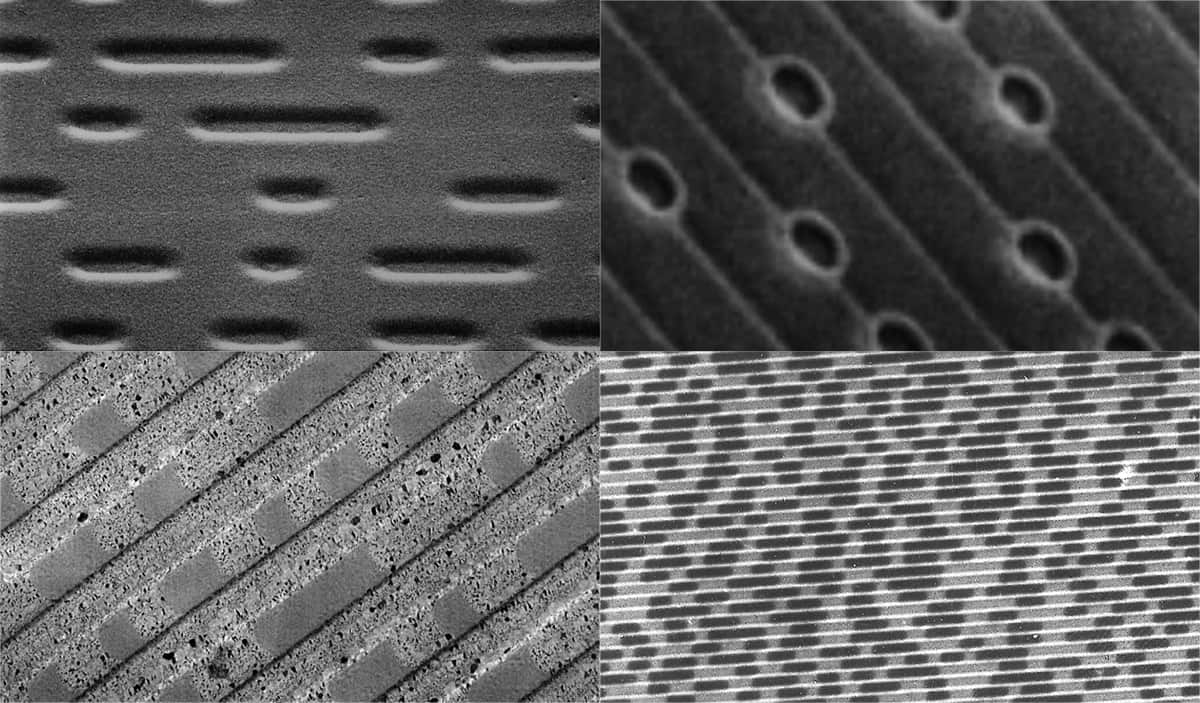
The digital information on a CD is encoded in a pattern of pits with varying lengths (figure 1). This pattern can be replicated at low cost and in high volumes with a process known as injection moulding, which uses a stamper containing the desired pattern to mould the surface layer of a 1.2 mm thick plastic disc. This “information layer” is then coated with a metallic mirror and covered by a protective lacquer.
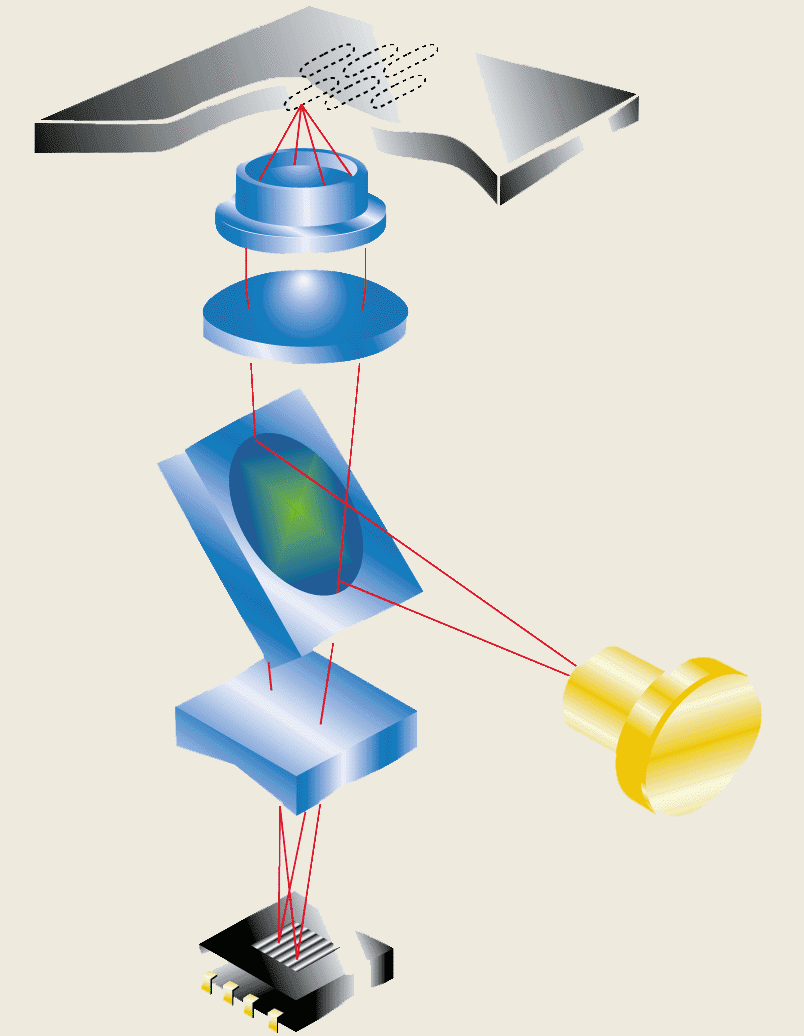
To read the data, a laser beam is focused through the substrate onto the information layer, and a photodiode detector collects the light reflected back through the lens (figure 2). The pits reflect back less light than the regions between them.
The focused spot produced by the objective lens has a finite diameter because of diffraction and is limited to about l/2NA, where l is the wavelength of light and NA is the numerical aperture of the lens. Compact-disc players use an infrared laser with a wavelength of 780 nm, and the numerical aperture of a lens is given by NA = nsinqmax, where n is the refractive index of the medium (n = 1 in air) and qmax is the outer angle of the cone formed by the converging beam of light. Because of Snell’s law of refraction, which says that nsinq is a constant, the numerical aperture does not change at the transition from air to the plastic substrate. In compact disc players, NA is typically 0.40-0.52, which gives a spot diameter of about 1 µm.
By reading the information through the substrate, dust particles and small scratches on the disc surface do not affect the read-out signal (figure 3). The diameter of the laser beam is typically about 0.7 mm as it enters the substrate, which ensures that any blemishes on the disc are out of focus.
Since the substrate is part of the optical path, it is important to control properties such as its thickness, angular orientation, optical homogeneity, birefringence and surface flatness. Moreover, the laser beam can easily become distorted as it passes through the substrate – spherical aberration causes concentric rings to form around the focused spot, which makes it difficult to read the information pattern. Although an aspherical objective lens can compensate for spherical aberration, it is still vital to maintain tight control over variations in disc thickness. Any tilting of the disc during read-out creates other aberrations that are not easily compensated for.
Commercial discs are often slightly warped, or have central holes that are not exactly in the middle. To keep the laser beam focused and centred on a track, the objective lens is mounted on an electromechanical actuator to adjust its vertical and radial position. The electronic signals needed to control these positions are derived from optical error signals.
The entire process from creating the disc to playing it back can be regarded as a problem in data transmission. Concepts from information theory are widely exploited to optimize the transmission capability of the optical recording “channel”. First of all, extra bits are added to the data to allow faulty bits to be detected and corrected during read-out. Particular attention must also be paid to the creation of the data pattern on the disc, since the transmission characteristics of the optical channel are determined by the physics of reading the data with a focused laser beam.
Because this spot has a finite size, marks on the disc are only detected if they have a certain minimum length. A so-called channel modulation code is applied to the binary data before they are recorded on the disc, resulting in an encoded pattern of marks on the disc that is optimally adapted to the characteristics of the optical channel. When reading the data, the modulation code is decoded before errors are detected and corrected. Extra steps are needed to ensure the proper timing of the bit detector, to compensate for the non-ideal frequency response of the channel, and to determine the physical location of the data.
Many different schemes have been considered for modifying conventional CDs so that they can record information once or many times. An early magneto-optic version failed because it was incompatible with conventional CDs. A disc that could be written to once and then read back many times was introduced as long ago as 1984. Intended as a replacement for magnetic hard disks in computers, its success was again rather limited.

A new format for recordable compact discs with a capacity of 650 Mbytes -the same as conventional CDs – was standardized in 1989. The tremendous success of these “CD-Recordables” is due to their compatibility with the read-only counterpart. This is achieved by recording the data using a laser that creates pits in a disc substrate covered with a carefully selected film of organic dyes. Data can be recorded only once and read back many times, which makes the discs ideal for making a copy of a CD, or for photo archiving, data back-up and file distribution.
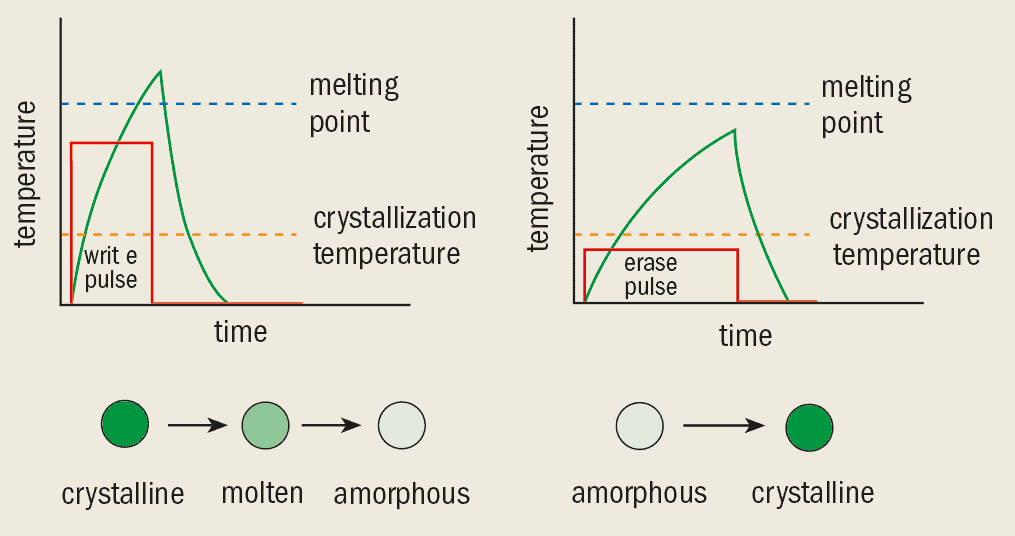
In 1996 a rewritable compact disc became available that can record data many times, and is now considered to be a possible successor to the floppy disk. Instead of storing information as pits on the disc surface, this technology uses laser pulses to change the structural phase of the surface material. The recording marks consist of a series of overlapping amorphous dots that reflect less light than the surrounding crystalline material. The amorphous areas are created by first melting the material with the laser and then rapidly cooling the molten material below its crystallization temperature (figure 4). Data can be erased by heating the material above the crystallization temperature, but below the melting point, until the material regains its polycrystalline state. This is known as phase-change recording.
Rewritable CDs can also be played back on modern CD-ROMs or CD players, even though the data are stored in a quite different way.
Video goes digital
The latest advance in optical data storage has been the recent launch of read-only digital video discs (DVDs). This new generation of DVDs can store 4.7 Gbytes of data, seven times more than a conventional compact disc. Such an increase in capacity is the result of several key developments. The basic improvement was to make the spot size used for reading the data smaller by using shorter wavelength light (650 nm instead of 780 nm) and a lens with a larger numerical aperture (NA = 0.6). This made it possible to reduce the distance between pits and the length of the smallest pit, but other advances were needed to create a practical system.
The greater storage density of DVDs means that they are more susceptible to defects. The manufacturing tolerance of both the discs and the drives had to be tightened. Changes were also made to the data format and the channel modulation code, and a more powerful error-correction scheme was introduced. To keep operating parameters such as disc tilt and focusing errors within acceptable levels, the substrate thickness had to be halved to 0.6 mm. But to maintain mechanical stability and the same physical appearance as a compact disc, a DVD consists of two 0.6 mm substrates bonded back-to-back.
The coexistence of DVD and CD calls for the development of players that can accommodate both types of disc. This is not a trivial task, however, due to the differences in physical parameters. For example, the optical system must be able to read an information layer through a substrate that may be either 1.2 or 0.6 mm thick, while the objective lens cannot correct for the different amounts of spherical aberration simultaneously. One solution is to create a light path with a single red laser and two different objectives that can be switched into the laser beam. Another solution is to keep the single objective, but to use an infrared laser for compact discs and a red laser for DVDs. In this case a dichroic aperture is placed in front of the objective so that its numerical aperture adapts automatically to the laser being used.
However, a rewritable counterpart of the DVD with a full 4.7 Gbyte capacity presents significant technical challenges. As stepping stones towards this goal, two industry consortia have developed lower-capacity systems that are optimized for real-time random access. A working group within the DVD Forum – an industry platform steered by 16 companies, including our company Philips of the Netherlands – has proposed a 2.6 Gbyte DVD-RAM, while Hewlett-Packard of the US, Sony of Japan and Philips have submitted a 3.0 Gbyte DVD+RW for standardization by ECMA, a body active in the worldwide standardization of computer-related technologies.
To understand the differences between these two systems, it is important to know that the substrate of a rewritable disc contains embossed grooves that provide tracking when the disc is blank. The DVD-RAM format records data both within the grooves and on the “lands” between the grooves. By optimizing the groove shape and geometry, it is possible to suppress interference between adjacent lands and grooves. In contrast, the DVD+RW only records inside the grooves, just as in a rewritable CD.
The difference in storage capacities is caused by the way in which each format provides the address information on the disc. DVD-RAM uses a header format, which means that the data are interrupted by regions of embossed data pits that contain the physical address information. In contrast, a DVD+RW disc encodes the address information in a “wobble” superimposed on the groove pattern. Although the tracking mechanism is too slow to follow such a high-frequency wobble, it can easily be detected by the track-following electronics. The addressing method used in the DVD+RW format is more efficient because no disc space is used for headers.
Current R&D effort is focused on developing full-capacity rewritable or recordable DVD systems. We believe that such a capacity can be attained without major changes to existing formats, but it will be important to improve the recording materials, to change the design of the stack of materials surrounding the information layer, and to optimize strategies for writing the data.
Towards digital video recording
The development of a robust and rewritable DVD system would be quite an achievement. But we have to aim beyond this goal, and work towards a digital video recorder. Using state-of-the-art computer chips for real-time video compression, such a machine would require a storage capacity of at least 9 Gbytes and a data transfer rate of 5 Mbit s-1 to provide high-quality video over a playing time of 4 hours. An alternative scenario might be to design a system that provides 2 hours of very high-quality video recorded at 10 Mbit s-1.
There are two basic options available to achieve a capacity of 9 Gbytes, which requires about double the data density of current DVDs. The first is to replace the red laser in a DVD with a blue laser. Blue lasers with a wavelength of 410 nm were first demonstrated in 1995 by Shuji Nakamura of Nichia Chemical Industries in Japan, and Nichia has announced that lasers with sufficient power, beam quality and lifetimes will come on the market by the end of this year. However, it could still take several years before optical recording systems based on blue lasers are mass-produced.
The other option is to increase the numerical aperture of the objective lens to 0.85, compared with 0.60 in DVDs. Such a high numerical aperture would place stringent constraints on disc tilt and variations in disc thickness, since the required tolerances vary inversely with higher powers of NA, and will also result in a shorter depth of focus. The same holds true for shorter wavelengths, but in this case the required tolerances scale linearly with wavelength.

The first problem in designing a lens with such a high numerical aperture is to provide enough space between the lens and the disc to prevent collisions. This requires a doublet lens – in other words, a combination of two lenses with at least two aspherical surfaces (figure 5). Second, a system must be found to allow for some variation in disc tilt. Philips Research Laboratories in the Netherlands has studied a system that uses an actuator to keep the second lens parallel to the disc. This active-tilt correction has the advantage that it achieves compatibility with read-only DVDs, since it allows recording and read-out through a 0.6 mm substrate. However, it requires a complex actuator that relies on a number of independent error signals to feed the electronic circuits controlling it.
Another option is to use adaptive optics to cancel the aberrations induced in the wavefront. An interesting idea, recently demonstrated by Pioneer of Japan, is to achieve this with segmented liquid-crystal cells.
But Sony has suggested a simpler and more elegant solution: to access the information layer through a 0.1 mm cover layer on top of a 1.1 mm plastic substrate (figure 5). The cover layer can be manufactured by a spin coating process, or by bonding a thin plastic sheet onto the disc. This solution is more tolerant of disc tilt, and thickness variations in the cover layer can be made small enough to minimize spherical aberration. The only problem is that the disc is more sensitive to dust and fingerprints due to the small spot size at the surface of the cover layer, but this problem could be overcome by putting the disc inside a cartridge.
Taking all considerations into account, the most attractive option for a digital video recorder is to use a lens with NA = 0.85 combined with read-out through a thin cover layer. A storage capacity of 9 Gbytes should be achievable with a red laser, while a blue laser could probably increase this to 18 Gbytes or more. Such a capacity would meet future demands for storage of very high bit rate digital video at home, in a way compatible with standards for broadcasted high-definition digital television. Long recording times, which are needed to store, edit and retrieve several movies on a single disc, would also be possible.
What about near-field recording?
Several start-up companies in the US are developing disc-based storage systems that combine the technologies used in the optical recording and hard disk industries. For example, the California-based company TeraStor is developing an optical disc drive based on an objective lens that has a numerical aperture greater than one. The use of such lenses, known as solid immersion lenses (SILs), was pioneered by Gordon Kino and colleagues at Stanford University in the US.
The key concept here is that the numerical aperture of an objective lens can be larger than 1 if the light is focused within the glass of the lens, since glass has a refractive index greater than one. The simplest SIL comprises a hemispherical lens that focuses a converging beam of light to a very small spot close to the flat exit surface of the lens (figure 6). Unfortunately, all the rays for which nsinq > 1 are rendered useless due to total internal reflection at the bottom surface of the lens, so it becomes difficult to address the information layer on an optical disc.
This problem can be solved by exploiting a phenomenon known as frustrated total internal reflection. The trick is to keep the separation between the lens and disc much smaller than the wavelength of light used (a gap of about 50 nm is typical). In this case photons that would normally experience total internal reflection at the glass-air interface can “tunnel” through the gap between two materials with high refractive index, in much the same way as electrons can tunnel through a very thin insulating layer. This tunnelling of photons is usually referred to as evanescent wave or near-field coupling, and the coupling efficiency can be as high as 50%.
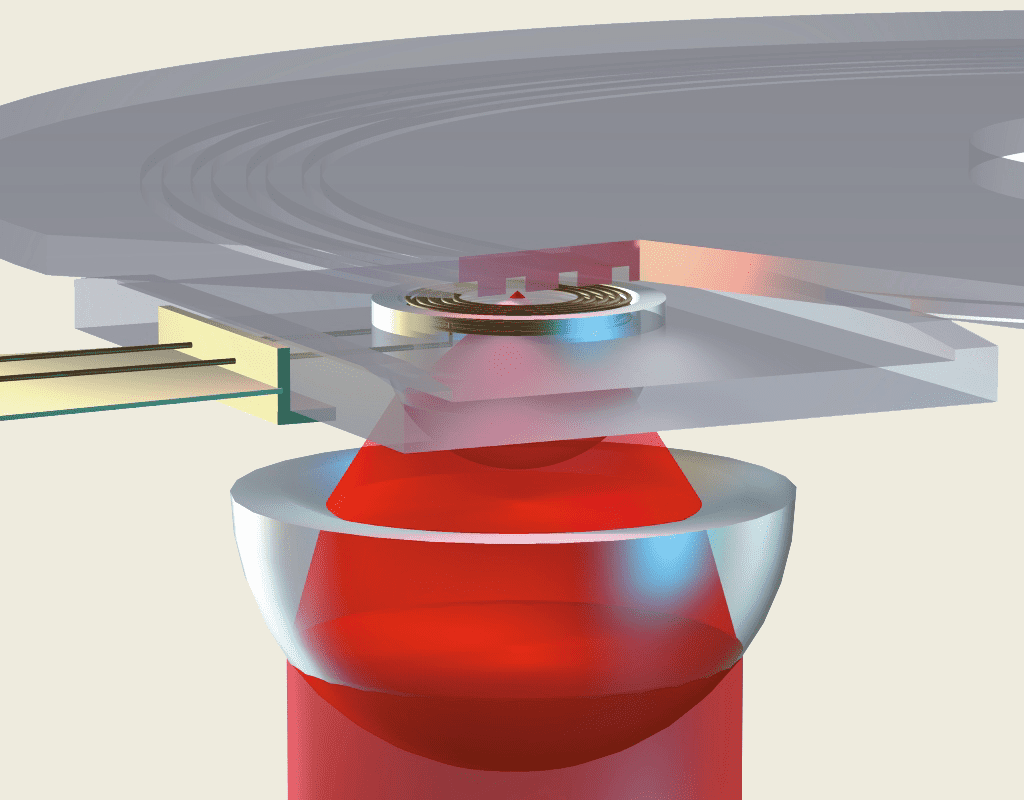
In this scheme it is important to have precise control over the size of the gap between the lens and the disc. This can be achieved with an air-bearing slider, which is commonly used in magnetic storage to hold a read/write head close to the surface of a magnetic hard disk. Moreover, a second lens attached to the slider could eliminate the need for active-focus control (figure 6).
This idea can also be extended to magneto-optical recording by mounting a miniature magnetic coil on the slider. The coil can be used in combination with a pulsed laser beam to create very small magnetic domains on a disc, a technique known as magnetic field modulation. This technique is attractive for ultrahigh storage densities because bits can be written at a spacing smaller than the optical spot diameter. Many people believe that magneto-optical recording will outperform phase-change recording at extremely high bit densities, mainly because of the noise associated with the finite size of grains in the polycrystalline phase.
It is expected that data-storage systems based on solid immersion lenses will initially target specialized markets, such as peripheral storage for PCs, because it will be difficult to achieve compatibility with other members of the CD family. In addition, conventional magnetic hard disks could find an insurmountable obstacle on their way to further evolutionary progress: the super paramagnetic limit. This limit, which marks the point where the magnetic domains in conventional recording media are so small that they become unstable, is predicted to occur at storage densities of about 5 Gbit cm-2. There is some hope that a combination of near-field optics, magnetic field modulation and advanced magneto-optical media will come to the rescue, allowing the rapid increases in storage capacity that have been achieved over the last two decades to be continued into the future.
Since the CD was introduced in 1982, it has made a major impact on the way we live and work. With continued development of the underlying technologies and the emergence of new applications such as digital video recording, it seems likely that optical data storage will have an equally profound influence on our lives in the years to come.
Closing in on the Planck constant
The kilogram is currently defined by a platinum-iridium alloy maintained at the Bureau International des Poids et Mesures (BIPM) in Paris and six official copies. However, the official mass of the standard kilogram has been known to vary with time, hence the interest in defining the kilogram is terms of fundamental constants like h.
The highly stable magnetic field needed for the experiment is generated by a superconducting magnet that has been cooled to 4 Kelvin. The experiment also uses two induction coils: the lower coil is fixed to the support structure of the experiment, while the upper coil can move. This upper coil is also attached to a wheel balance above the experiment. In the first stage of the measurement, the mass balance is empty and a small force is applied to the upper coil, forcing it to move at 2mm/s. The researchers found that this generated a voltage of 1.018 ± 0.001 V across the moving coil. In the second stage of the experiment, a 500 g countermass is balanced by a – 10.18 mA current in the induction coil. Both stages were repeated over many months to obtain a value of 6.62606891(58) x 10-34 Joule seconds for the Planck constant.
This result – which corresponds to an accuracy of 9 parts in 108 – is a factor of 15 better than previous measurements. The team hope to improve on this result by another factor of 10 by modifying their experiment.
Physics fights terrorism
Bill Richardson, head of the DOE, says that Livermore “will provide critical new technologies to counter the threat of weapons of mass destruction [and provide] the FBI with new capabilities that could save American lives”. The partnership extends a previous agreement under which the agencies collaborated on crime-fighting technology.
The move into civilian science is a relatively new phenomenon for Livermore, which started off as a centre for research into nuclear weapons. However, for the past seven years the forensic science centre has focused its analytical abilities on non-proliferation and counter-terrorism measures. It employs experts in nuclear science, organic and inorganic chemistry, biochemistry and genetics. Managers at the centre apply their skills to everything from verifying compliance with international treaties to helping local police. “The FBI is funding us in the new agreement because they feel it’s necessary, ” says Brian Andresen, the centre’s director.
The key to the new partnership is the centre’s wealth of analytical instruments. One device that it has developed is a miniature gas-chromatograph mass spectrometer. Self-contained in a suitcase-sized box, it can detect sub-microgram quantities of narcotics and compounds that are related to chemical warfare agents. “We’ve made a complete system under 50 lb in weight, with the precision of a laboratory-quality mass spectrometer, ” says Andresen. “To do that, we’re using advanced composites and lightweight materials where needed.” The centre is now developing ways of reducing the equipment’s size to that of a briefcase.
Another recent development is a solid-phase microextraction kit, which will allow FBI agents and safety officers to collect samples of nuclear, chemical, and biological agents without having to touch the material. The system contains a polymer coated on a 100 µm-diameter fibre that has been tailored to absorb organic and inorganic chemicals. The polymer and the fibre are attached to the end of a wand, which is waved above the suspect material, and then injected into a mass spectrometer. The new Livermore devices are also highly versatile. “Our system will do drugs one day, chemical weapons another and industrial pollution on another, ” says Andresen.
Tevatron upgrade complete
The Main Injector has a circumference of 3.2 km and contains 432 magnets, each of which weighs over 18 tonnes. The Tevatron itself has a circumference of 6.3km and collides protons and antiprotons at a centre-of-mass energy of nearly two trillion electron volts (2 TeV). “Fermilab’s new Main Injector will open up extraordinary new opportunities for discovery in this basic field of research, not only for scientists from the United States but for the international physics community” said DOE boss Bill Richardson, who fixed the last magnet into place. The upgraded Tevatron is scheduled to come online early next year.
US looks to unlock the future in science
The report has three main recommendations: all areas of research must be given the opportunity to thrive; technology-based industries should be given the chance to grow; and education must be strengthened at all levels. To encourage research, the report states that the government must “make federal research funding stable and substantial, maintain diversity in the federal research portfolio, and promote creative groundbreaking research.”
In writing the report the committee was guided by the vision that “the USA must maintain and improve its pre-eminent position in science and technology in order to advance human understanding of the universe and all it contains, and to improve the lives, health, and freedom of all peoples.”
The report also contains some of the evidence presented by scientists to the committee. James Langer, a physicist from the University of California at Santa Barbara, explained how difficult it was to know which research projects were going to be successful or have the greatest impact. “Newton spent a large part of his career studying alchemy, ” Langer told the committee. “Einstein devoted the second half of his life to problems that we now know could not be solved without modern discoveries in elementary particle physics. Bardeen grossly underestimated the importance of his invention of the transistor, as did major US corporations at the time. I am equally certain that we cannot trust scientists, engineers, or public policy experts to predict where those advances will occur or in what ways they will have there greatest impacts.”
The report also considers how peer review can stifle creativity and risk-taking in research. “There are no rewards for risky science, ” Suzanne Rutherford of the University of Chicago told the committee. “It is too important to publish.” The report recommends that a fraction of government research grants should be reserved for speculative research, although the money should still be allocated through peer review.
And in an effort to make the outcome of government-funded research more understandable, the report recommends that plain English summaries of all results, including their implications, should be publicly available on the Internet.
New tools for brain surgery
Unlike other instruments, the invention does not require any sharp blades or cumbersome power sources (such as those needed for ultrasound devices) in the operating theatre. Instead, a small paddle rotates at high speed, converting the tissue into a liquid form that can be removed by a small vacuum pump attached to the instrument. By altering the shape and speed of the paddle, doctors can alter the instrument to remove either soft or hard tissue. Rapidly growing cancerous tumours, for example, are ‘softer’ that normal brain tissue, while slow-growing benign tumours are ‘harder’ than healthy tissue. The instrument also allows the doctor to feel the consistency of the tissue, while analysis of the fluid remove can alert the surgeon if he or she starts to remove healthy tissue – improving the chances of a healthy recovery by the patient.
Copyright © 2026 by IOP Publishing Ltd and individual contributors