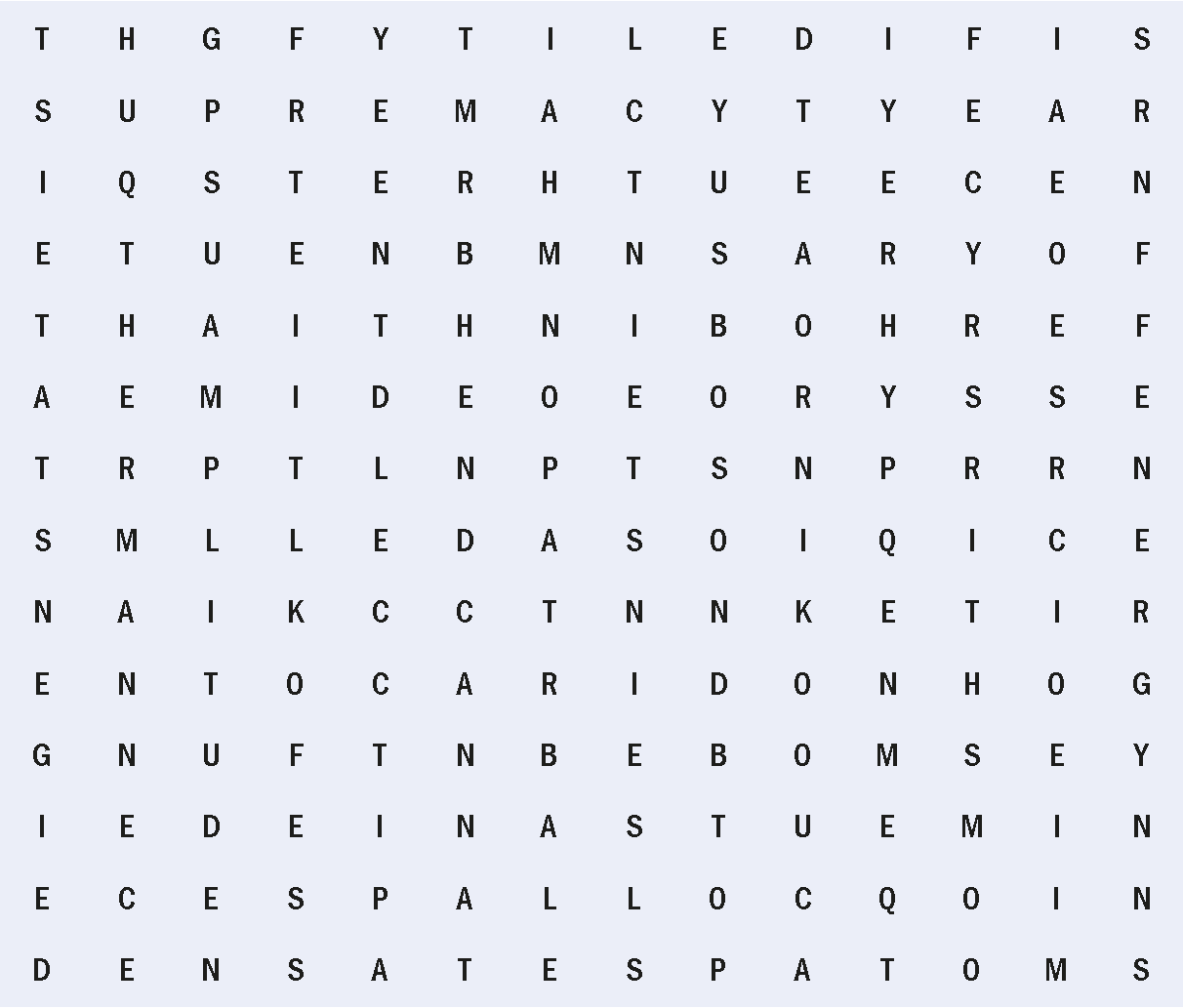
As an added bonus, all of the unused letters – when read top left to bottom right – reveal a hidden message.
You can download a PDF of this puzzle. The answers will be published on 1 May on the Physics World website. Please note that this word search is just for fun; there are no prizes.
Clues
Wave range? A plum tide at sea (9)
Sequence of hobo sonata carries force (5)
Yell out “circle” immediately? Overpowered freezer (8)
Nineties served up “greatest physicist” candidate (8)
Devotion to closeness (8)
Hubbub after unwanted disturbances (5)
Line, we heard, for bishop with computers? A quantum of quantum (5)
Inky creature is sensitive about fields (5)
Ill gent, nun in a bad way? It’s barrier breaking (10)
Single cat is smallest matter (4)
Odd chart reveals quantum victim, potentially (3)
Policeman finds right account for electron equation chap (5)
Power to get-up-and-go (6)
Physicist namesake for fictional meth lord? Cooking begins here (10)
Nobel winner recited isometric exercise (6)
Australian quantum physicist brings short model to space mountain (7)
Situation report, clearly (5)
Danish physicist sounds like a pig (4)
Run out after firm hand? Result of quantum measurement (8)
Gee, it’s neat! Uncertain, when some things are predictable (10)
Iron soldier charged? Obeys exclusion principle (7)
Mr Munster gets a bearing on often overlooked German quantum pioneer (7)
Take his head! Queen killed dispatcher for sending secret messages (3)
An astrophysical process that creates elements heavier than iron may be even more challenging to reproduce in the laboratory than was previously believed – but not impossible. This is the conclusion of researchers at the Laboratoire pour l’Utilisation des Lasers Intenses (LULI) in France, who report that reproducing conditions typically seen during neutron-star mergers will require major improvements to both proton and neutron sources. This insight is crucial, they say, because it provides a more realistic framework for future efforts to replicate stellar processes.
Many heavier-than-iron elements form via the so-called r-process, where r refers to rapid neutron capture. This process occurs when two neutron stars merge, creating an abundance of free neutrons. In these neutron-rich environments, atomic nuclei capture neutrons much more quickly than they can lose them via beta decay (which occurs when a nucleus emits an energetic electron or positron, thereby transforming one of its neutrons into a proton).
Scientists believe that the r-process is the source of about half of all heavy elements found in the universe today. However, the exact conditions required to facilitate rapid neutron capture are not fully understood. This is because it is extremely difficult to generate the very high-density neutron fluxes needed to create neutron-rich isotopes in the laboratory.
A next-generation multi-petawatt laser system
The good news is that laser-driven (pulsed) neutron sources could produce the types of neutron beams required. In the approach developed by Vojtěch Horný and colleagues at the LULI, such a laser would first direct ultra-intense light pulses at a solid target. This would cause hydrogen ions from a contaminant layer on the target’s surface to accelerate to a significant fraction of the speed of light, Horný explains. These hydrogen ions would then be directed to a secondary target made of gold that would serve as both neutron converter and neutron capture target.
“Unlike the traditional method that accelerates deuterons [heavy hydrogen ions] for fusion reactions in a low-atomic-number converter (for example, one made from beryllium) to release neutrons, our approach leverages a new-generation multi-petawatt laser system to trigger a more efficient spallation process in high-atomic number materials,” Horný tells Physics World. “Here, protons accelerated to energies in the hundreds of megaelectronvolt (MeV) range strike a heavy nucleus, releasing a higher number of neutrons.”
Ways to enhance neutron production
Horný says that the goal of this method, which is described in Physical Review C, is to significantly enhance neutron production. Using numerical simulations, he and his colleagues calculated that currently-available lasers would produce a negligible number of neutron-rich isotopes (defined as those with at least two more neutrons than the initial seed nucleus).
However, a good isotope count would nevertheless be possible if the neutrons were slowed down to very low energies (20 millielectronvolts, corresponding to the temperature of solid hydrogen). Such slow speeds would boost the neutrons’ probability of being captured. The laser would also need to be pulsed at a frequency of 100 Hz for several hours.
Those are all tall orders, but Horný isn’t giving up. “Despite the sobering realization that current proton and neutron sources preclude the near-term observation of the r-process via laser-driven neutron sources, our work has laid important groundwork,” he says. There are also reasons to be hopeful about technological progress. As an example, Horný cites an ongoing project at Colorado State University in the US, where researchers are building two 200-Joule, 100-femtosecond, 100 Hz lasers. This project, he says, “represents a significant step forward”.
The intense flux of neutrons the team described could have other applications, Horný adds. These include reconstructing a material’s elemental composition using fast neutron resonance radiography; fast neutron activation; and fast neutron therapy in medicine.
The LULI team is now preparing to fabricate their proposed laser source, with the hope of achieving record-breaking neutron parameters using the Apollon laser system. Horný, for his part, has moved to the Extreme Light Infrastructure-Nuclear Physics (ELI-NP) in Romania, where his work as a research scientist will focus on advancing electron and ion acceleration, as well as generating high-energy radiation from laser-plasma interactions. The new role, he says, involves exploring various sources of secondary particles, including neutrons.
Alternative to black holes: physicists at Goethe University Frankfurt have calculated that a nested gravastar (nestar) could look like a matryoshka doll. (Courtesy: Daniel Jampolski and Luciano Rezzolla/Goethe University Frankfurt)
Gravastars, hypothetical alternatives to black holes, could end up nested inside one another like a Russian Matryoshka doll – according to new calculations that combine quantum mechanics with Einstein’s general theory of relativity. If such exotic objects exist, they could reveal their presence in gravitational-wave signals.
Black holes form by the gravitational collapse of a large star, or possibly a gas cloud, to a tiny region where gravity is so strong that not even light can escape.
In 2001 the US-based physicists Pawel Mazur and Emil Mottola showed that, in theory, another object could form from such a collapse. They did this by combining Einstein’s field equations – which describe how matter and energy affect the geometry of space–time – with quantum mechanics. Their analysis revealed that quantum fluctuations could prevent the formation of a black-hole singularity during the final stages of gravitational collapse, at least in principle. Rather, a new and bizarre type of object called a gravastar would form.
No event horizon
Gravastar is a contraction of gravitational vacuum condensate star. In some ways a gravastar is like a black hole. They both have extremely strong gravitational fields and can both emit Hawking radiation. However, a gravastar does not have a singularity at its heart, nor does it have an event horizon beyond which light, matter and information can pass but never return.
Instead, a gravastar is a bubble of de Sitter space, which is a mathematical description of space filled with negative energy. As such, it provides a simple model that is consistent with an expanding universe driven by dark energy. In the conventional gravastar model this bubble of de Sitter space is initially created by the quantum fluctuations and bounded by an infinitesimally thin shell of matter.
“A de Sitter space–time wants to expand but in a gravastar it is surrounded by a shell of matter that instead wants to collapse,” says Luciano Rezolla, who is the chair of theoretical astrophysics at the Goethe University of Frankfurt. “Balancing the two opposite behaviours leads to a stable gravastar.”
Nested gravastars
Now, Rezolla’s graduate student Daniel Jampolski has found a new solution to the field equations that describes how two or more gravastars can be nested inside one another like a cosmic Matryoshka doll.
Jampolski and Rezolla call such a phenomenon a nestar, which is short for nested star. The interior structure of a nestar would feature a bubble of de Sitter space, surrounded by a shell of matter, which is then surrounded by another volume of de Sitter space that is encased by another shell of matter, and so on. In addition, rather than being infinitesimally thin, the matter shells could have a substantial thickness, in some cases making up practically the entire radius of the nestar.
“There are some nestar configurations that are given by an infinitesimally small de Sitter interior – just a point – followed by a matter interior that essentially fills the whole nestar, and then there are two thin shells near the surface, one made of de Sitter space–time, the other one of matter,” Rezzolla tells Physics World. “Because in this case the nestar would be mostly made of matter, its formation may be less exotic than in the case of a complete de Sitter interior.”
However, gravastars remain hypothetical with no observational evidence that they exist, which should lead to some caution says Paolo Pani, a professor of theoretical physics at Sapienza University of Rome, who was not involved in the study.
“A fundamental question is how such solutions – ordinary or nested gravastars – can be formed dynamically in the first place, since we do not currently have a consistent model,” Pani says.
Ringing like a bell
However, not knowing how gravastars form does not exclude their existence. Indeed, they could exist in compact binary systems that merge and produce gravitational waves.
As two compact massive objects (such as black holes or neutron stars) spiral into one another they broadcast a distinctive gravitational-wave signal called a chirp. When the objects merge to create a black hole, the gravitational waves that are emitted resemble the fading ringing of a struck bell. Both the chirp and ringdown from such mergers have been observed by the LIGO–Virgo–KAGRA gravitational wave detectors.
Such a merger could also create a gravastar or nestar, and Jampolski and Rezolla say that these would have distinctive ringdown signals. Rezolla adds, “A nestar would ringdown differently from a gravastar of the same mass because of its internal structure.” Specifically, the various shells where matter and de Sitter space interface would oscillate in a particular manner, distinct from a regular gravastar.
With 90 gravitational-wave events having been detected thus far, and another observing run currently under way, there’s been plenty of data in which to search for a gravastar signature.
“All gravitational-wave observations so far are consistent with the hypothesis that the objects are black holes or neutron stars,” says Pani. “However, the ringdown is hard to measure accurately,” he adds, which leaves some room for uncertainty.
Heating the shell
Another way in which a gravastar could reveal itself is by the accretion of matter onto its surface. In the case of a black hole, matter and light disappear beyond the event horizon, which is what the Event Horizon Telescope saw when it imaged the “shadows” of the supermassive black holes at the centre of the M87 and Milky Way galaxies. Gravastars are different in that they are horizonless. While some matter could pass through the outer shell to be absorbed by the de Sitter space–time within, more matter could impact the surface shell, making it thicker and causing it to heat up and emit light. If the Event Horizon Telescope were to ever image an actively accreting gravastar it would see this emission, albeit highly redshifted by gravity.
Rezzolla admits that while the mathematics might work, a physical model describing how gravastars and nestars could exist in reality still eludes us.
“We really do not have a good idea about how gravastars form [and] since we know so little about the matter constituting gravastars, these assumptions are difficult to test,” Rezzolla says.
Jampolski and Rezzolla describe their new solution to Einstein’s field equations in the journal Classical and Quantum Gravity.
The Institute of Physics (IOP) has announced three areas for the second phase of its “impact projects” initiative. They are: the green economy (second phase), space technologies and opportunities in venture capital investment. Three further topics – artificial intelligence, medical physics and metamaterials – have been chosen as potential impact projects for 2025.
The IOP’s impact projects involve hosting community debates, gathering evidence and setting out recommendations to influence national science strategies and investment as well as showcasing important but less understood areas of physics.
The first phase of the initiative concentrated on three areas: quantum, which fed into the UK’s £2.5bn National Quantum Technology Strategy; semiconductors, which influenced the £1bn National Semiconductor Strategy; and the green economy, resulting in the IOP’s recent Physics Powering the Green Economy report.
This second phase was carried out in consultation with IOP members and, for the first time, the wider physics community. Some 26 projects were submitted and a panel consisting of IOP fellows and members then prioritized the ideas. Chosen projects had to align with the IOP’s strategy; match UK and Ireland physics expertise; and offer an opportunity for wider influence and impact.
Louis Barson, the IOP’s director of science, innovation and skills, says the second phase represents an “important moment” for the IOP. “The second phase [comprises] three crucial areas that give us lots of opportunity to develop fresh thinking and have a real impact on the development of the scientific landscape for innovators, researchers and businesses,” he says. “If these are areas where you have an interest or expertise – or if you want to suggest another impact project – check out the IOP website for more detail on how to get involved.”
Barson adds that the areas support the IOP’s strategy, which launched last month. “[The strategy] commits us to the three priorities of tackling the skills shortage, strengthening physics and exploring the social and economic benefits of physics,” he says. “These impact projects will allow us to bring that to life.”
The quantum world provides fertile material for thought experiments that seem so strange-but-true as to defy logic. One of the most notorious is “Wigner’s friend”, which has challenged physicists and philosophers ever since it was first conceived by the Hungarian-American physicist Eugene Wigner. He published the thought experiment in a 1961 book edited by the mathematician Irving Good entitled The Scientist Speculates: an Anthology of Partly-baked Ideas.
Wigner’s thought experiment is a more humane version of Schrödinger’s less complex but more famous thought experiment a quarter century before, which involved a cat inside a box whose fate hangs on a quantum event. Inside the box Schrödinger’s cat is dead or alive, whereas for someone outside, the cat remains dead-and-alive; it’s in a “superposition”. The bizarre situation only vanishes when the box lid opens.
The set-up of Wigner’s thought experiment is disarmingly simple. Wigner and his friend are interested in the outcome of a particular experiment, let’s say preparing a quantum bit (qubit) whose measurement outcome will be either 0 or 1. The friend goes into a lab and sets up the equipment, while Wigner remains outside. Each is fully versed in the quantum formalism.
Counterintuitively, their predictions differ. Wigner’s friend – the experimentalist – prepares the qubit with a superposition of states, and predicts the final state to be 0 with 50% probability, or 1 with 50% probability. Wigner, on the other hand, is isolated from his friend. Using a single quantum state in superposition to describe his friend plus the lab contents, Wigner predicts that the system will remain in superposition with 100% probability.
Wigner maintains this prediction even if he believes that his friend has finished the experiment. According to quantum mechanics, Wigner cannot separate the friend out from the rest of the lab contents. Wigner must therefore ask his friend in order to gain information about the friend’s quantum state. So who’s got the right answer: Wigner or his friend?
Both are right
The answer is that both probabilities are correct – from the standpoint of each individual. Their two correct uses of the mathematics give different predictions: Wigner predicts that the state is 100% in superposition, while the friend predicts that the measurement outcome of the qubit is either 1 or 0. Essentially, Wigner’s thought experiment says that what’s true depends on where you stand.
But if we assume that the probabilities describe the same “set of facts” – and that there’s something that’s true from everyone’s point of view – then these predictions are in conflict. Wigner himself, and many who followed, thought it paradoxical that the quantum formalism gives two differing predictions for the same state of affairs. They believed that objectivity requires that observers must characterize the facts in the same way regardless of their position.
What makes this scenario seem paradoxical, however, is its reliance on hidden classical assumptions. One assumption is that Wigner is right and his friend wrong (or vice-versa) because both are ultimately modelling the outcome of the friend’s qubit measurement. But suppose their differing predictions mean that the two are modelling different systems. Wigner is modelling the friend-qubit-lab environment, while his friend models just the qubit.
In a classical situation, Wigner and friend could have the same probabilities for predicting the outcome of a coin flip. Even if Wigner were, say, standing behind a curtain, he would not have to treat the friend flipping the coin as being in superposition. In the quantum situation, however, Wigner cannot single out and isolate the probabilities for just the coin. There may as well be no “coin” for Wigner – there’s not one thing among others in a room full of objects.
But back to Wigner’s thought experiment. What happens when the laboratory door opens and Wigner and friend can talk about their predictions? The two had disagreed but now it looks like they agree on the final state of the qubit. It seems that their previously inconsistent descriptions of a single state of affairs have converged into one.
That’s not what happens, though. Rather, Wigner’s new information does not repudiate his initial prediction. The quantum formalism indicates Wigner and friend had consistent descriptions for two different states of affairs. This feels paradoxical only if we give in to our intuition and assume that it was the same system for Wigner and friend all along.
The eagerly awaited moment when Wigner and his friend share their findings, then, is not the resolution to the paradox, but what happens after the paradoxical situation has already ended. Wigner had his correct formalism and the friend had theirs.
Wigner, and many of those who followed, were bothered by the fact that there could be two people using the same methods on the same experiment arriving at two correct descriptions depending on whether one was inside or outside the lab. Our classical intuition is that the system is the same for everyone. Quantum mechanics inclines us to think that we can have different systems without there being an inconsistency or be objective without needing to make all our descriptions identical.
Is there a fork in the road, classical or quantum? To stick with the classical interpretation that says Wigner’s friend involves two inconsistent descriptions of one state of affairs produces paradoxes. The quantum perspective implies there are descriptions of two different states of affairs. The first is intuitive but ends up in a contradiction, the other is less intuitive, but consistent. Quantum friendship means never having to say you’re sorry for your use of the formalism.
Robert P Crease is a professor (click link below for full bio), Jennifer Carter is a lecturer and Gino Elia is a PhD student, all in the Department of Philosophy, Stony Brook University, US.
A proposed new optical metamaterial could behave like true one-way glass thanks to the Tellegen effect, which connects a material’s response to light waves with its magnetization and polarization. Under the design put forward by researchers in Finland, the US, Sweden and Greece, the new metamaterial would be formed from randomly oriented nanocylinders consisting of ferromagnets and a high-permittivity dielectric that operates at the right resonance. Unlike previous proposals, the metamaterial would not require external magnetic fields to operate, and its developers say it could also make solar cells more efficient.
The Tellegen effect is also known as the nonreciprocal magnetoelectric effect (NME), and it occurs when the electric field component of light (an electromagnetic wave) magnetizes a material at the same time as the magnetic field component polarizes it. The effect shows much promise for advanced technologies such as magnet-free optical isolators, as well as for fundamental research – for instance on the electrodynamics of relativistic matter and theoretical particles called axions.
Enhancing the effect through metamaterials
For light in the visible part of the electromagnetic spectrum, the NME in natural materials is negligible because the magnetization effect is weak, explains Shadi Safaei Jazi, a PhD student at Finland’s Aalto University who led the research. Most proposed approaches involving such materials only work for microwaves, and this is partly why the Tellegen effect has not been exploited in realistic industrial applications yet.
The magnetization component of the NME can, however, be enhanced in metamaterials and metasurfaces. These artificially engineered materials are structured in ways that give them properties such as a negative refractive index that are rare or absent in natural materials.
In the new work, which is detailed in Nature Communications, Safaei Jazi and colleagues describe a three-dimensional metamaterial that shows a strong Tellegen effect in the visible frequency range. This metamaterial would be formed from nanocylinders containing two components: a ferromagnetic nanodisc in a single-domain magnetic state, and a high-permittivity dielectric nanodisc that supports a so-called magnetic Mie-type resonance (a structural resonance at the level of the nanocylinder).
Spontaneous magnetization and the magnetoelectric effect
The researchers suggest that this 3D metamaterial could be made by randomly distributing the nanocylinders within a host medium such as water or a polymer. The ferromagnetic nanodiscs would exhibit spontaneous magnetization and the magnetoelectric effect (ME) without the need for an external magnetic field. Using conventional materials such as cobalt and silicon to make up the structure would increase the ME by two orders of magnitude compared to other known natural materials at room temperature, the team add.
The team also showed that using emerging materials such as magnetic Weyl semimetals in the metamaterial would enhance the ME even further, by almost four orders of magnitude. Weyl semimetals are a recently discovered class of topological material in which electrons behave like massless particles thanks to a special kind of symmetry in their electronic structure.
Seeing clearly in one direction
One potential application for such magnetoelectric colloids would be a true one-way glass, Safaei Jazi says. “Such a glass should not be confused with commercial semi-transparent reciprocal glass, which lets light through in both directions,” she explains. “Only when the brightness is different between the two sides (for example, inside and outside a window), does the latter act like a one-way glass.”
A true one-way glass based on the proposed magnetoelectric metamaterials would incorporate several layers of magnetoelectric coatings on top of a conventional glass surface, she continues. “Conventional technology for such a glass would require strong and bulky electromagnets surrounding the glass to create magnetization and break reciprocal light transmission. These electromagnets would completely obscure the view and make the system opaque to light in both directions.”
Viktar Asadchy, an electro-optical engineer at Aalto and Stanford University who supervised the project, says that the team’s system would, in principle, show strong spontaneous magnetization and one-way light transmission without external magnetic fields. “This means that a window with that glass in your house, office, or car would allow you to enjoy a perfect view, regardless of the brightness outside, and people wouldn’t be able to see anything inside,” Asadchy says.
The proposed one-way glass could also make solar cells more efficient, Safaei Jazi tells Physics World. This is because it would block the thermal emissions that today’s cells radiate back towards the Sun, which reduces the amount of energy the cells can capture.
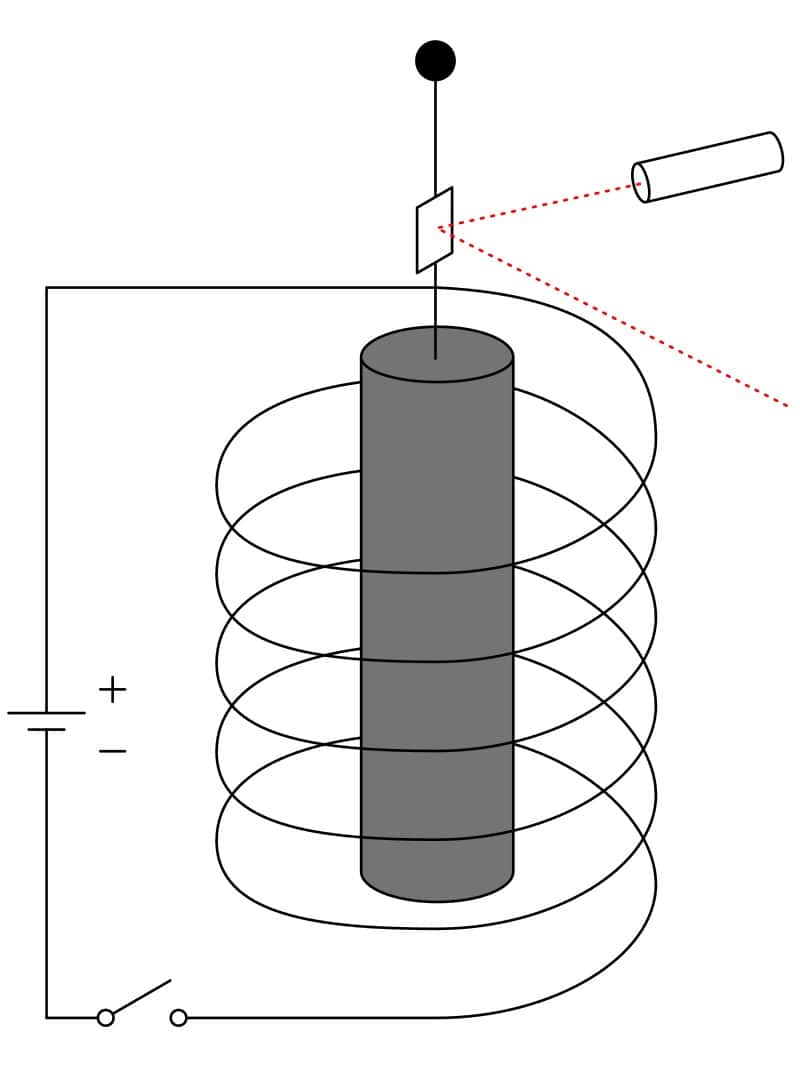
Do the twist: schematic of the Einstein–de Haas experiment showing the mirror, solenoid and ferromagnetic cylinder. (Courtesy: Jasper Olbrich/CC BY-SA 3.0)
Albert Einstein is famous as a theoretical physicist, but he also did one significant experiment. This was the Einstein–de Haas experiment, which he did in 1915 with the Dutch physicist Wander de Haas. This work showed that the magnetization of ferromagnetic materials such as iron is related to the angular momentum of electrons.
Now, some of the apparatus used by Einstein and de Haas has been found languishing in the Ampère Museum near Lyon, which is one of France’s oldest science museums. The finding was made by Alfonso San Miguel of the Claude Bernard Lyon 1 University and Bernard Pallandre, who is a curator at the museum. They say that the provenance of the objects can be verified by documents associated with Geertruida de Haas-Lorentz. She was a physicist and the wife of de Haas. San Miguel and Pallandre say that she donated the equipment to the museum in the 1950s.
The Einstein–de Haas experiment involves a cylinder of ferromagnetic material that is suspended by a thread so that it can rotate about its axis of symmetry. A mirror is situated at top of the cylinder such that the rotation of the cylinder can be measured by reflecting a beam of light onto a screen (see figure).
Curious rotation
The cylinder is placed in the centre of a solenoid. When an electrical current is sent through solenoid, it creates a magnetic field that magnetizes the cylinder – which becomes a bar magnet. This results in the cylinder rotating slightly, which is observed in the deflection of the light beam. If the magnetic field is then reversed, the cylinder rotates in the opposite direction.
This rotation is not predicted by classical electromagnetic theory because the cylindrical symmetry of the experiment offers no way for the magnetic field to exert a torque on the ferromagnet.
Instead, the observed rotation supports the idea that magnetism is created by charged currents that flow in circles within a ferromagnetic material – an idea that was first put forth nearly a century earlier by the French physicist André-Marie Ampère.
As well as having magnetic moments, these orbiting electrons also have angular momentum. The magnetization of the cylinder involves the alignment of these magnetic moments. This results in changes in the directions of the angular momenta of the electrons when the magnetic field is applied. Because angular momentum must be conserved, the cylinder rotates in response to this change.
We now know that electrons have intrinsic angular momentum (spin) as well as orbital angular momentum. The Einstein–de Haas experiment can be used to study how both of these contribute to the magnetization of a material.
This year promises to be a bumper one for cicadas given that 2024 marks the first time in more than 200 years that two broods belonging to two species will emerge at the same time.
Now researchers at Georgia Institute of Technology in the US say we might have more to worry about than just the cacophony that the insects are famous for.
Most insects urinate via droplets given that it takes less energy to do so and that their orifices are too small to do anything else.
Cicadas, however, are such voracious eaters of tree sap that individually flicking away each drop would be too taxing and would result in being unable to extract enough nutrients.
To get around this problem, they instead pee via short jets (see video above).
“Previously, it was understood that if a small animal wants to eject jets of water, then this becomes a bit challenging, because the animal expends more energy to force the fluid’s exit at a higher speed,” notes Elio Challita, who is currently based at Harvard University, US. “This is due to surface tension and viscous forces. But a larger animal can rely on gravity and inertial forces to pee. ”
Due to the cicadas’ larger size they use less energy to expel a jet and indeed, it turns out that cicadas are the smallest animal to create such high-speed jets.
The team thinks that a greater understanding of cicadas urination could help in the design of better nozzles and robots.
And with a double brood emerging this year, it could be a noisy, and wet, summer.
Soap has long been a household staple, but scientists in Slovenia have now found a new use for it by transforming soap bubbles into tiny lasers. Working at the Jožef Stefan Institute and the University of Ljubljana, they began by creating soap bubbles a few millimetres in diameter. When they mixed these with a fluorescent dye and pumped them with a pulsed laser, the bubbles began to lase. The wavelengths of light the bubble emits are highly responsive to its size, paving the way for bubble-laser sensors that can detect tiny changes in pressure or ambient electric field.
A laser requires three key components: a gain medium, an energy source for the gain medium and an optical resonator. The gain medium amplifies the light, meaning that for every photon that goes into the gain medium, more than one photon comes out. This phenomenon can be exploited by placing the gain medium in a resonator – for example, between two mirrors or inside a loop – such that the photons emitted by the gain medium go back through it to create an amplified, coherent beam of light.
The soap-bubble lasers do exactly that. To make them, Matjaž Humar and Zala Korenjak mixed standard soap solution with fluorescent dye, which acts as the gain medium. The bubbles form at the end of a capillary tube, and illuminating them with a pulsed laser pumps the gain medium. The light the gain medium produces circulates along the surface of the bubble, which acts as a resonator.
To characterize the bubble’s output, the researchers used a spectrometer to measure the wavelengths of light it produces. Only after the system reaches a threshold pumping energy do the researchers see peaks in the bubble’s wavelength spectrum – a key marker of lasing.
From St Paul’s Cathedral to the surface of a soap bubble
Forming a resonator out of a sphere is not, in itself, new. Micro-cavities formed in spheres, rings and toroids have all found uses in sensing, and are known as whispering gallery mode resonators after the famous whispering gallery at St Paul’s Cathedral in London. Within this large, circular room, two people who stand facing the wall on opposite sides can hear each other even at a whisper thanks to the efficient guiding of sound waves along the room’s curved walls.
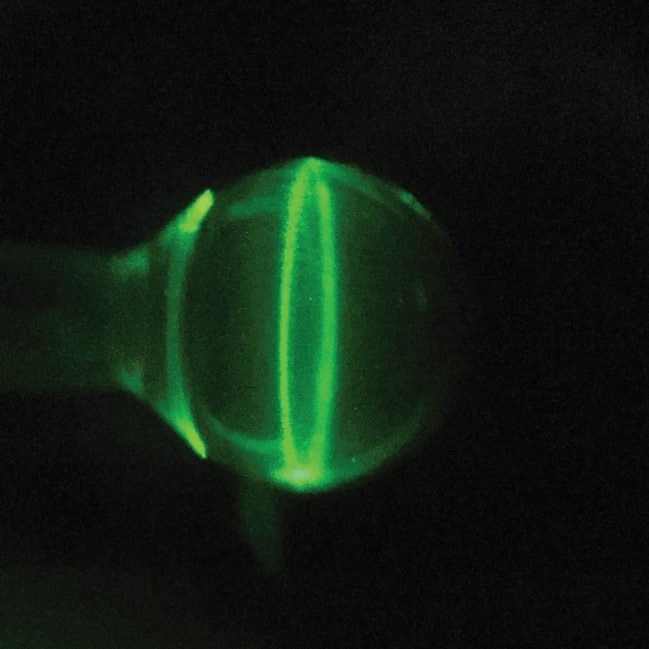
Whispering gallery modes: Laser light propagates along the surface of a soap bubble in the same way as sound travels around the walls of the famous “whispering gallery” in St Paul’s Cathedral, London. (Courtesy: Matjaž Humar and Zala Korenjak/Jožef Stefan Institute)
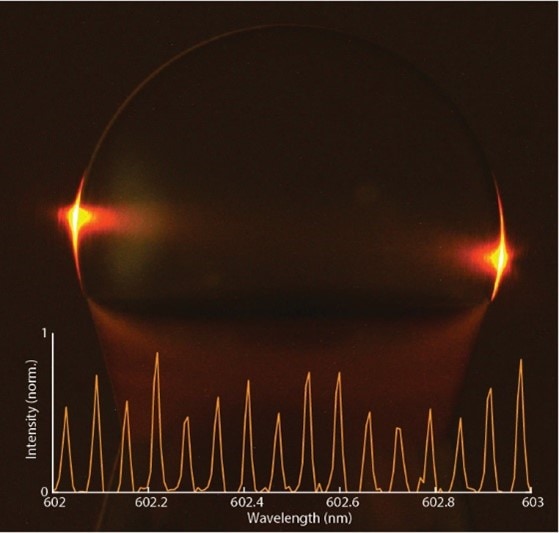
In much the same way, Humar and Korenjak found that light propagates along the surface of the soap bubble in their laser, and appears as a bright band on the bubble’s shell. As the light travels around the surface of the bubble, it interferes, creating distinct “modes” of the resonator. These modes show up as a series of regularly spaced peaks in the wavelength spectrum of the bubble.
Spectrum from a bubble: A smectic bubble laser emits regularly spaced wavelengths of light. (Courtesy: Matjaž Humar and Zala Korenjak/Jožef Stefan Institute)
Don’t burst my bubble
“There are many micro-resonators used as laser cavities, including solid spherical shells,” Matjaž notes. “Soap bubbles, however, have not been studied as optical cavities until now.”
This may be partly because bubble lasers made of soap have limited practicality. As water evaporates from the surface of the bubble, the bubble’s thickness changes rapidly until it pops.
A more practical solution the researchers pursued is to make bubbles out of smectic liquid crystals. These do not contain water and can form very thin bubbles, typically around 30-120 nanometres (nm) thick. These smectic bubble lasers are more stable and can survive almost indefinitely. As Matjaž explains, thicker bubbles (such as those created by soap), allow many modes in the resonator, resulting in many, possibly overlapping peaks in the wavelength spectrum. Thinner bubbles (less than 200 nm), however, allow only one mode in the resonator. This single-mode operation manifests as evenly distributed peaks in the lasing spectra.
The researchers demonstrated that the wavelength the bubble lasers emitted could be tuned by altering their environment. Specifically, changing the ambient pressures or electric fields altered the size of the bubble, which changes the size of the resonator and, in turn, the wavelength of the laser emission. The measurements they present show that the smectic bubble lasers are sensitive to electric fields as small as 0.35V/mm and pressure changes of 0.024 Pa – on par or better than some existing sensors.
This episode of the Physics World Weekly podcast features a wide ranging interview with Keith Burnett, who is president of the Institute of Physics (IOP).
The IOP is the professional body and learned society for physics in the UK and Ireland. It represents 21,000 members and a key goal of the institute is to make physics accessible to people from all backgrounds.
Burnett, who is halfway through his two-year term in office, was knighted in 2013 for his services to science and higher education. He has served as vice chancellor of the University of Sheffield and is also an advocate for high-quality vocational education and technician training.
He talks to Physics World’s Matin Durrani about the challenges facing universities; physicists as entrepreneurs; supporting early-career physicists; and the need for the IOP to continue its drive to boost the diversity of the physics community.
The Institute of Physics owns IOP Publishing, which brings you Physics World