

The researchers constructed a mathematical representation of the irregularly spaced near Earth asteroid Castalia for their calculations. They assumed it would be made of solid rock, a pair of solid rocks separated by rubble, or a 50% porous agglomeration of large boulders. To simulate a collision they imagined a 8m diameter basalt sphere travelling at 5 kms-1 hitting the asteroid. This would impart a explosive force equivalent to a 17 kiloton nuclear device. They found that in most cases only 10 percent of the asteroid’s mass reached escape velocity, the rest of the material stayed loosely bound in the area. A hard rock object on the otherhand was more likely to simply split into two. As well as suggesting that deflecting or destroying asteroids may not be as easy as first thought, it also suggests that most binary asteroids were formed in collisions this way.
South Africa approves new telescope
Astronomers involved with the project hope to use a lightweight multi-segment design similar to the Hobby-Eberly Telescope (HET) in Texas, which cost only about 20 per cent of what it would cost to build a traditional telescope of the same size. The HET board has agreed to make available the detailed plans for its telescope in return for observing time on SALT . The new telescope will give South African astronomers facilities comparable with those in South America and Australia for the first time in decades.
The primary mirror of SALT will be a giant hexagon containing approximately 90 segments. Each five centimetre thick segment will be independently controlled by computer to reduce the effect of atmospheric turbulence on observations. The telescope will use spectroscopic techniques to study the early universe, quasars and galaxy populations, and to search for new planets.
South Africa has a long tradition in astronomy due to the superb southern night skies overhead. However, this tradition has suffered because of the refusal of international partners to form collaborative projects, and a lack of investment in infrastructure during the apartheid era. SALT could well reverse this trend.
Super-Kamiokande finds neutrino mass
Neutrinos come in three types – electron neutrinos, muon neutrinos and tau neutrinos – and only interact very weakly with matter, which makes them extremely difficult to detect. Neutrino detectors have to be built underground to isolate them from cosmic rays. Even then natural radioactivity from the detector itself can mimic a neutrino interaction, so the detector must be made from ultrapure materials and isolated from its surroundings. The Super-Kamiokande experiment consists of 50, 000 tons of ultrapure water in a tank 1000 metres below ground in central Japan. It can detect both electron neutrinos and muon neutrinos – but not tau neutrinos – from the faint flashes of light given off when they interact with electrons in the water molecules.
According to the Standard Model of particle physics neutrinos have zero mass. However, experiments to measure neutrinos from the Sun and atmospheric neutrinos – produced when cosmic-rays interact with nuclei in the Earth’s atmosphere – detect fewer of these elusive particles than predicted. One possibility is that electron neutrinos can ‘oscillate’ into muon and tau neutrinos, and vice versa. However, this is only possible if neutrinos have mass. A non-zero neutrino mass could also explain some of the ‘missing mass’ in the universe.
Super-Kamiokande has found evidence for oscillations, and hence mass, in atmospheric neutrinos. Data from Super-Kamiokande show that more muon neutrinos enter the detector from above than below. Neutrinos entering from above would have travelled only tens of kilometres through the atmosphere, while those from below would have also had to travel through the Earth. The Super-Kamiokande team claim that the muon neutrinos oscillate into tau neutrinos – or, possibly, a new type of ‘sterile’ neutrino – on their journey through the Earth. “One only gets such great data once or twice in a professional lifetime, maybe never, ” says John Learned of the University of Hawaii, one of the Super-Kamiokande team.
However, the future success of Super-Kamiokande could be compromised by the recent financial turmoil in Japan. The government cut the experiment’s budget by 15 per cent this year, and another 15 per cent is scheduled for next year. If imposed this second cut will force the laboratory to close down for part of the year. Physicists at Neutrino 98 are appealing for extra funding to ensure continuous operation for the experiment. “Budget cuts … jeopardise the strength of the international collaboration and could result in the loss of important observations, such as a rare supernova event, ” they say.
City risk pays off for physicists
In 1992 seven postgraduate students started their PhDs in the high-energy physics group at Imperial College, London. Six years later, three of them now work in international finance in the City of London. Although neither the research councils nor the financial sector keep records of how many physicists enter the City, it is clear that more and more are doing so. “[PhD physicists] are more in demand than they were five years ago, ” says Ivan Collins, a senior consultant at Michelangelo Associates, a company that specializes in international financial recruitment. Theoretical physicists have long been prized in the City for their skills in modelling and programming. But it is no longer just theoretical physicists who become rocket scientists – experimentalists with experience of data analysis are also in demand. “We look for people with the quantitative skills to build models and to understand risk, ” says Collins. Most physicists who work in the City are quantitative analysists or “quants”. They model the past behaviour of the stock market in order to predict the range of values that a stock or share might have in the future. Quants deal in derivatives – financial products such as futures and options with a price derived from something else. In a future, you agree to buy something at a given time in the future for a price agreed now. In an option, you pay for the right – rather than the obligation – to buy something at a given price in the future. By modelling the stock market, quants can calculate a fair price for a given derivative (Physics World April 1995 p8). “It is a common misconception that we predict what is going to happen on the market – that is not what we do, ” says Han Lee, who has a PhD in theoretical condensed matter physics and now works as a quant and derivatives trader for Toyko-Mitsubishi International. Lee’s work involves calculating a fair price and the associated risk for complex financial products based on interest rate models. Lee finished his PhD at Cambridge University in 1992, then spent two years as a post-doc before entering the City. “Relatively speaking, it is difficult to get a permanent job in theoretical physics, ” says Lee. “Matching the real world with maths is a transferable skill, ” he says. “And the financial rewards are much greater.” Rocket scientists are indeed handsomely rewarded for their work. PhD quants with no experience can expect a starting salary of £35 000-40 000, according to Collins. After one year, this typically rises to £150 000; five years into the job, the quants will be earning between £250 000 and £500 000 a year. Many of the rocket scientists who command these salaries are top-notch physicists who could have made a career in academic research. John Sleath, a monetary analysist at the Bank of England, shared the Royal Astronomical Society’s astronomy prize last year for his “outstanding doctoral thesis” on the computer simulation of the formation and evolution of galaxies. After completing a PhD at Cambridge University, Sleath spent two years as a post-doc at the University of Wales at Cardiff. But a new career beckoned. “I got the feeling that astrophysics does not matter, ” says Sleath. He now models the time structure of interest rates; the research is long-term but is ultimately used by the bank’s monetary policy committee to set interest rates. “I now have the feeling that I am contributing to something worthwhile, ” he says. Sleath also had complaints about other aspects of academic work. “I never enjoyed teaching, but it was a necessary part of career progression, ” he adds. “Now, I still do all the bits [of research] that I enjoy but with more purpose. I can do research without the teaching and for more money.” Working in finance gives physicists the opportunity to show off skills that could be neglected in universities. “Being a good organizer, a good communicator and empathetic are not necessary to be a good physicist…I wanted to display a few more of my talents, ” says Jessica James, vice president in the strategy risk management advisory group at the First National Bank of Chicago. James, who did her PhD in theoretical atomic physics at Oxford University, is obviously well organized – she handed in her thesis, got married, moved house and started her new job all in the same week. “The whole of finance is to do with probabilities – that is very physics-y, ” she says. “For example, we might need a Monte Carlo simulation to look at the possible value of a deal at the end of a time period. Monte Carlo simulations and programming are things that physicists do.” James designs trading strategies for the bank and advises external clients. “A client might have a portfolio of 12 currencies, whose value fluctuates considerably, ” she says. “We can show the client the possible range of values that his investment will have in the future. If that range is too great to be acceptable, we can hedge the risk.” Entry to the City was straightforward for James. “I had a small lectureship at Oxford but was looking around for something else, ” she says. “My supervisor came in with a letter from the First National Bank of Chicago, and he said ‘Jess, you are looking for a job, aren’t you, ‘ and I thought ‘Oh, well it won’t do me any harm’. The e-mail address on the letter had been mis-typed but I could work out what it should have read and so I applied. I was the only one who passed that particular intelligence test.” So where do rocket scientists end up? Although a job in the City is lucrative, it is not necessarily secure. “The paternal instincts of institutions are becoming less and less evident, ” says Collins. “A person who has been in the City for five years may well have had three jobs, ” he adds. Quants tend to remain in the City until they are in their late thirties or early forties. Some then move into senior management roles; others have made enough money to retire. “Ultimately, I would like to work and write, ” says James, who is currently writing a book about interest rate modelling with Nick Webber of the University of Warwick. “And I want to write good, bad science fiction – but that is another story.”
Blood tests without needles
Recognising blood cells presents a big challenge for automated counting systems. As blood flows through veins, the cells are deformed in the direction of blood flow. Blood also contains a lot of other ‘junk’ material such as proteins. Computers find it difficult to recognise the cells once they have been deformed against this background ‘junk’ and therefore require a large number of ‘templates’ of each different cell shape.
The Sysmex system shines a laser onto a part of the body that has blood vessels close to the skin, for example an earlobe, lip or finger. A set of fibre optic cables collects the light reflected from the blood vessel and pipes it to an image intensifier. This signal is then sent to a CCD camera and analysed on an Apple Mac computer in real-time. The computer converts the captured image into a two dimensional grid and a mathematical algorithm is used to determine if a particular object is a blood cell or not. Rapid analysis of the blood passing through the system then allows the computer to calculate the number of cells in the blood.
Shuttle goes on ‘antimatter’ hunt
The known universe consists almost entirely of matter. However, it is thought that equal amounts of matter and antimatter were created during the big bang. One possibility is that this antimatter now forms galaxies that lie beyond those detected from Earth. The AMS will try to detect minute quantities of antimatter in cosmic rays that come from outside our galaxy. If it is successful, the results could suggest that antimatter galaxies do exist.
The AMS is also designed to search for evidence of invisible or “dark” matter. Although dark matter does not emit or absorb radiation, its presence is revealed by its gravitational interactions. Observations suggest that perhaps as much as 99% of the matter in the universe is dark. Although some dark matter is known to be made of ordinary or baryonic particles, the bulk of it is thought to be in the form of new particles beyond the Standard Model of particle physics.
The shuttle will also break another record on this trip with the world’s fastest Internet router. Unfortunately this only refers to the speed of the space shuttle – 8 km/s – not the transmission speed of the data (64 kilobits/s). The experimental package, developed by the commercial company Spacehab, gives researchers Web-like access to data collected on the Shuttle. The system will use common TCP/IP file transfer protocol with .orb, a new Internet extension.
Predicting the impact of science
At the beginning of this century, before the advent of quantum mechanics, who could have foreseen molecular biology? And in the 1940s, before the discovery of DNA and the development of computers, who could have predicted the Human Genome Project and all of its staggering implications? The scientific exploration of the future is not a trivial exercise, especially when looking further than a few decades ahead. Indeed, unpredictable theoretical or technological breakthroughs in one field can often lead to unexpected developments in unrelated fields – and even open up new fields altogether.
Still, predicting the future (or at least trying to extrapolate major forthcoming developments in science and technology) has always been a big temptation for scientists, as well as for science-fiction writers. Arthur C Clarke’s Profiles of the Future , which was first published 40 years ago, introduced millions of readers to the technological marvels promised by the science of the 1950s. But more important than the predictions themselves was the spirit of exploration that was encapsulated in Clarke’s now famous “laws”. The first law stated that when distinguished, but elderly, scientists say that something is possible, they are almost certainly right; but when they say that something is impossible, they are very probably wrong. Clarke’s second law stated that the only way of discovering the limits of the possible is to venture a little way past them, into the impossible.
As we approach the new millennium, the public’s interest in this kind of futurological essay is expected to rise. In fact, one of the safest predictions is that the number of such publications will explode. Adrian Berry’s The Next 500 Years (1996 W H Freeman) and the late Carl Sagan’s Pale Blue Dot (1995 Random House) have already paved the way, at least as far as our future in space is concerned.
This book by Michio Kaku, a theoretical physicist from the City University of New York, is a serious attempt to present a “unified” view of the scientific and technological landscape of the 21st century. The book is based on a series of interviews with over 150 prominent scientists in various fields, including several Nobel laureates. This impressive list makes the author feel confident that the picture that emerges from the book is quite reliable. However, I do not completely share the author’s optimism – not only because of Clarke’s first law, but also because it is rather well known that socio-economic factors often play a far greater role in shaping the future than techno-scientific ones. In fact, predictions in sociology or economics are notoriously harder to make than those in the physical sciences.
In spite of this, Kaku’s view of the future is well organized around the three main developments in modern science: the quantum revolution, which has enabled us to understand the behaviour of matter; the biomolecular revolution, which has unravelled many (but not yet all) of the secrets of life; and the computer revolution, which Kaku associates, rather fallaciously, with our understanding of the mind. By extrapolating current trends in these fields, he suggests that “predictions about the future of computers and biotechnology can be quantified with reasonable accuracy beyond the year 2020”.
For example, Kaku assumes that computer power and the amount of DNA sequencing will double roughly every two years, and so predicts that by 2020 silicon microprocessors will be as plentiful and as cheap as scrap paper. This will allow us to put “intelligent” systems everywhere, giving us “smart” homes, cars, televisions, clothes and money. The Internet, meanwhile, will evolve into a membrane of millions of computer networks, creating an “intelligent” planet. By 2020 microchip components will shrink to the size of molecules, and quantum effects will necessarily put an end to the reign of silicon. New technologies, involving optical, molecular, biological and – ultimately – quantum computation, will lead to radically new types of computer and reshape the computer industry that we know today.
On the other hand, the automation of DNA sequencing will, by early next century, have unravelled the complete DNA code of thousands of organisms, which will have profound implications for biology and medicine. It will eliminate many genetic diseases and killer viruses, help to treat AIDS and many types of cancer, and enable entire organs – including livers and kidneys – to be grown in the lab. Beyond the year 2020, the understanding of “polygenic” diseases – those involving the complex interaction of many genes – will perhaps enable us to tackle some of our most dreadful chronic enemies, such as heart disease, arthritis and schizophrenia. It may also enable us to clone humans, develop new varieties of disease-resistant plants and animals, and even isolate the fabled “age genes”, which would enable us to extend the lifespan of humans.
The quantum future, meanwhile, will plausibly lead to the further development of nanotechnology, which would allow molecular-sized machines to be built. Carbon nanotubes could be used to create extremely tough fibres – imagine such a cable linking the Earth and a geostationary satellite to allow cheap access to space. Developments in quantum physics could also lead to room-temperature superconductors, which would limit heat losses in electric devices and lead to cheap but powerful magnetic fields that could be used in magnetically levitating trains and cars. Controlled thermonuclear fusion would be another possibility.
These developments will pave the way for us to colonize the solar system, and will ultimately lead to the construction of the first interstellar vehicles. Our civilization will progressively develop into what the Russian astronomer Nikolai Kardashev called a “type I” civilization – one that can master the energy and material resources of a whole planet – and then still further to a “type II” civilization that can use the resources of its solar system.
Despite the lessons of the past, most futurologists take the risk of presenting “time-frames” with approximate dates for when their predictions will come true. For example, in Profiles of the Future, Arthur C Clarke correctly predicted that man would land on the Moon by 1970, but he turned out to be wrong when he said that controlled fusion would be possible by 1990, and that humans would have colonized other planets and created artificial intelligence by the year 2000. Kaku, however, presents a more reasonable, albeit less precise, timetable. He divides the future into three broad periods: up to the year 2020, from 2020 to 2050 and beyond 2050. Still, he isn’t afraid of predicting that the first commercial fusion plant will be up and running by 2035. Taking into account how often the announced celebration of that event has been cancelled in the past, this is not, I think, a very safe bet.
One of the most attractive aspects of the book is that the author does not merely present future developments in various fields as merely a catalogue of isolated, independent events. Instead, Kaku shows clearly the links between the quantum, the biomolecular and the computer revolutions, emphasizing the synergy between these fields. He also considers the potential implications for society. For example, the computer revolution may threaten privacy, bring massive unemployment and, ultimately, make humans obsolete (by producing super-intelligent robots). Progress in biomolecular research may unleash deadly viruses, produce armies of human clones and promote new forms of racism, like the eugenics movement. And although sociologists are probably better placed to discuss such matters, Kaku does not neglect them.
On the other hand, the book has some surprisingly trivial errors in physics and the history of science. For example, the “echo” of the big bang – the 3 K cosmic background radiation – was not discovered by the Cosmic Background Explorer satellite in 1992, as Kaku says, but by Arno Penzias and Robert Wilson in 1965. And Einstein did not say that the universe was “originally a pinpoint”; if the universe is open – as we think today – it is infinite and has always been so.
In fact, the last part of the book is the least satisfactory section, as the author jumps swiftly from Earth-threatening asteroids to extra-terrestrials, from von Neumann machines to time travel, and from wormholes to superstrings and quantum cosmology. Despite this rather disappointing finale, Kaku nevertheless fulfils his aim – of presenting a plausible vision of science and technology in the 21st century.
Particle physics made easy
Is it possible to really understand asymptotic freedom, superstrings and other jargon from particle physics without knowing any relevant mathematics whatsoever? John Gribbin certainly thinks so. In a series of books that began with In Search of Schrödinger’s Cat, Gribbin has tried to explain the mysteries of the sub-atomic world to non-experts.
Now he has compiled this dictionary of particle physics, which should be useful for students who need to bluff their way through tutorials, science journalists who want snappy definitions of tricky concepts, and ordinary physicists who feel guilty at not knowing what quantum chromodynamics, parity non-conservation and spontaneous symmetry breaking are really about.
Without resorting to maths or equations, the book combines short entries on familiar terms, such as baryons, bosons and beta decay, with longer, feature-length items on major subjects from particle physics – including almost eight pages on string theory alone. But to alleviate what might otherwise be an unduly heavy diet, Gribbin includes potted biographies of eminent physicists, such as Enrico Fermi, Werner Heisenberg, Robert Oppenheimer and Abdus Salam. Excursions into related fields such as quantum cryptography, black holes and time travel are also provided.
Exams hinder critical thought
You might not have thought about this analogy before, but exams are rather like experiments. Both are designed to evaluate certain parameters. Lab experiments might measure things like temperature or pressure, while exams test how much students understand and how well they discuss particular ideas. The problem for students – as most physicists would agree – is that exams just do not stand up as valid scientific experiments. Some students, for example, might work hard throughout the year and then under perform on the day of the exam. Quite literally, they do not give the right results. Others might over perform by simply having identified how to maximize their chances of success – not that you can blame them for doing so, since exam results can affect your chances of getting a job or being given a place on a PhD course. But the biggest problem, as far as I am concerned, is that many exams do not require students to show any signs of “critical thinking”. Critical thinking is the core of modern science and it should be the basis for all science education. However, some exams actually penalize students for thinking in this way. Don’t get me wrong: I am not complaining about educational evaluation in general, which provides students with important feedback on how efficiently they are working. The problem is that most physics exams encourage students to repeat ideas without thinking, instead of motivating them to learn as much as they can about the subject. For example, there may have been parts of the syllabus that were badly taught by a particular lecturer, and that could not even be understood after discussions with other students or staff. It would take a lot of courage to try to explain the perceived flaws on an exam paper. Besides, one would hardly have the time to do so. Any attempt at critical thinking might then backfire and give the impression that you just didn’t understand the subject at all. Although it would break all of my principles to simply repeat an explanation that I knew did not stand up, one can only agree that to do so would be the easiest way of getting a good grade. Another problem with some exams is that you often more or less know what the answers should be, and it is a case of following the right path to the answer as fast and effectively as you can. You might need to know a few tricks along the way, but provided you remember the path or have tackled enough similar questions in the past, that is usually all that it takes. Of course, it helps to understand the subject – but even that is not always what counts. Some universities actually hold special classes at the end of courses to teach students how to do exams and reproduce particular lines of reasoning. To me, this approach means abandoning all attempts at critical thinking – and actually adopting uncritical thinking.
Working practices
Exams also place too much emphasis on puzzle-solving. In a sense, they follow the philosophy of Thomas Kuhn, who said that research scientists are motivated by the desire to solve new puzzles or to solve existing puzzles better than has been done before. However, puzzles do not motivate me. My motivation is that I am constantly unsatisfied with the current state of knowledge, and I don’t see why exams can’t be geared more closely to students like me who want to do more than just solve puzzles. Exams should be designed to encourage students to show what they can do. It’s a horrible feeling to come out of an exam knowing that you haven’t been allowed to prove to the examiner what you actually know.
Exams also affect the way students work. It is generally agreed that you learn better by working at an even pace throughout a course. However, most students would say from personal experience that you get better grades by studying intensively just before an exam. After all, exams are one-offs, so surely the best way to revise for them is in a single burst? If you have just one day to prove yourself, does it really matter what you did during the rest of the time?
There is another unfortunate side-effect of the fact that students only study to get good grades: I am sure we have all sat in a lecture thinking how nice it would be if the lecturer ran out of time to teach the whole syllabus. It would, after all, leave a lot less to learn. Students end up being more interested in knowing which topics they don’t need to study – instead of wanting to learn as much as they can.
The need for critical thinking
Most physics exams are designed to test our understanding of the subject. However, the most exciting parts of physics are those that we do not understand, and physics students tend not to be given the chance to discuss such topics during their courses. Students end up with no real idea of how to handle new or unfamiliar topics, and in an exam they tend to hide their cluelessness as best they can. This is wrong. We should be trained to be honest, admit our cluelessness and discuss problems on that basis.
I bet some older readers are thinking: “We had to go through the same exams as today’s students, but we learnt how to become critical thinkers.” That may be true, but nowadays many universities are little more than “student factories”, where the pressure is on academics to force as many students as possible through the system. Tutors simply no longer have the time to work closely with each student.
I have talked to professors who have told me about students who were mediocre as undergraduates but who flourished when they become postgraduates, because they finally got the chance to ask questions – and not just answer them. The transformations occurred because the students were at last allowed to show critical thinking.
The need for critical thinking also has wider implications. The current decline in the status of science in some areas of society may be because scientists are failing to respond to their critics and because “pseudo-science” is having far too big an influence on our society. If scientists are not taught critical thinking in university education, they may not only fail to use it in their work, but they will also lack the philosophical sophistication that is needed to respond to those who think science is a belief system that differs little from religion.
And indeed, why should science receive massive funding if it is not different from other belief systems? As the philosopher Theodore Schick, of Muhlenberg College in the US, said last year when addressing this problem: “Unless our educational system focuses more on teaching students how to think, rather than on what to think, our populace will become increasingly credulous. Scientists and educators alike need to realize that the educated person is not the person who can answer the questions, but the person who can question the answers.”
Answers, please
Some critics might argue that the impact of exams on individual students evens out in the long run. A student might be unlucky and under perform in one exam, but he or she might be lucky in the next exam, and the average grade is more or less right. However, returning to my analogy with experiments, this is nothing more than a random error. The real problem is that exams produce systematic errors, which occur long before the exams themselves. As I said, my concern is with the situation that students are forced into – not the evaluation itself.
Although I do not have clear solutions to the problems with exams, I believe that an important first step would be for physicists to recognize that the problems exist and to realize the urgency of solving them. We could then decide what actions to take. For example, we could survey current evaluation methods. Students and their tutors could then come together and try to work out ways of evaluating students without compromising the need for critical thinking. There must be something that is better than what we have today.
My feeling is that the solution lies in the direction of course work. Yes, there are problems with course work – in particular the fact that it can make it easier to cheat. However, if everything were closely scrutinized, cheating could be easily discovered. And if the evaluation were designed so that cheating gained you very little, then the incidences of cheating might actually fall.
I hope that my views have been sufficiently unpleasant for those who set exams and that the will to do something to change the situation has been stimulated. After all, if you were an examiner and if exams were experiments, would you dare to submit your exam data to a referee?
The physics of football
Many fans will remember the free kick taken by the Brazilian Roberto Carlos in a tournament in France last summer. The ball was placed about 30 m from his opponents’ goal and slightly to the right. Carlos hit the ball so far to the right that it initially cleared the wall of defenders by at least a metre and made a ball-boy, who stood metres from the goal, duck his head. Then, almost magically, the ball curved to the left and entered the top right-hand corner of the goal – to the amazement of players, the goalkeeper and the media alike.
Apparently, Carlos practised this kick all the time on the training ground. He intuitively knew how to curve the ball by hitting it at a particular velocity and with a particular spin. He probably did not, however, know the physics behind it all.
Aerodynamics of sports balls
The first explanation of the lateral deflection of a spinning object was credited by Lord Rayleigh to work done by the German physicist Gustav Magnus in 1852. Magnus had actually been trying to determine why spinning shells and bullets deflect to one side, but his explanation applies equally well to balls. Indeed, the fundamental mechanism of a curving ball in football is almost the same as in other sports such as baseball, golf, cricket and tennis.
Consider a ball that is spinning about an axis perpendicular to the flow of air across it (figure 1). The air travels faster relative to the centre of the ball where the periphery of the ball is moving in the same direction as the airflow. This reduces the pressure, according to Bernouilli’s principle. The opposite effect happens on the other side of the ball, where the air travels slower relative to the centre of the ball. There is therefore an imbalance in the forces and the ball deflects – or, as Sir J J Thomson put it in 1910, “the ball follows its nose”. This lateral deflection of a ball in flight is generally known as the “Magnus effect”.
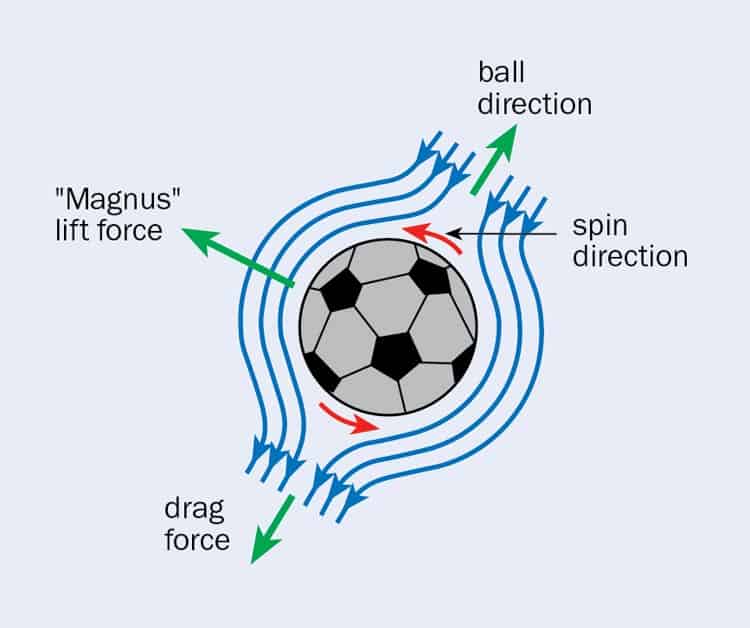
The forces on a spinning ball that is flying through the air are generally divided into two types: a lift force and a drag force. The lift force is the upwards or sidewards force that is responsible for the Magnus effect. The drag force acts in the opposite direction to the path of the ball.
Let us calculate the forces at work in a well taken free kick. Assuming that the velocity of the ball is 25–30 ms–1 (about 70 mph) and that the spin is about 8–10 revolutions per second, then the lift force turns out to be about 3.5 N. The regulations state that a professional football must have a mass of 410–450 g, which means that it accelerates by about 8 ms–2. And since the ball would be in flight for 1 s over its 30 m trajectory, the lift force could make the ball deviate by as much as 4 m from its normal straight-line course. Enough to trouble any goalkeeper!
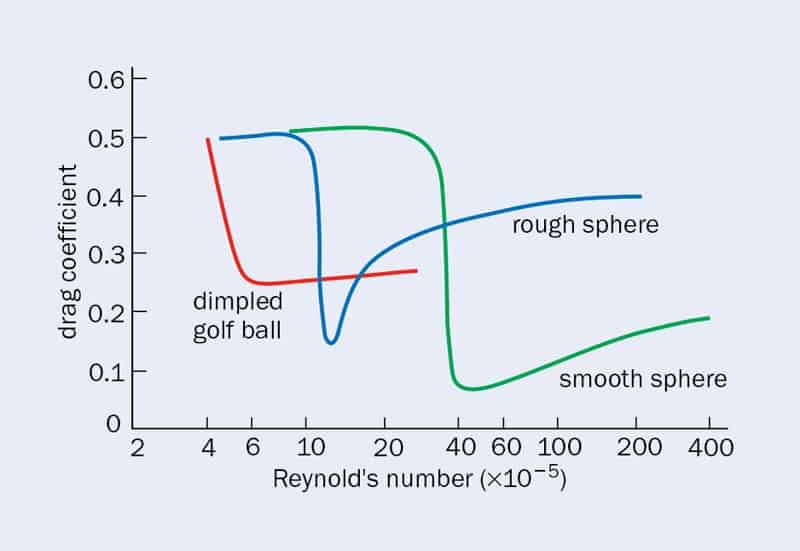
The drag force, FD, on a ball increases with the square of the velocity, v, assuming that the density, r, of the ball and its cross-sectional area, A, remain unchanged: FD = CDrAv2/2. It appears, however, that the “drag coefficient”, CD, also depends on the velocity of the ball. For example, if we plot the drag coefficient against Reynold’s number – a non-dimensional parameter equal to rv D /μ, where D is the diameter of the ball and μ is the kinematic viscosity of the air – we find that the drag coefficient drops suddenly when the airflow at the surface of the ball changes from being smooth and laminar to being turbulent (see right).
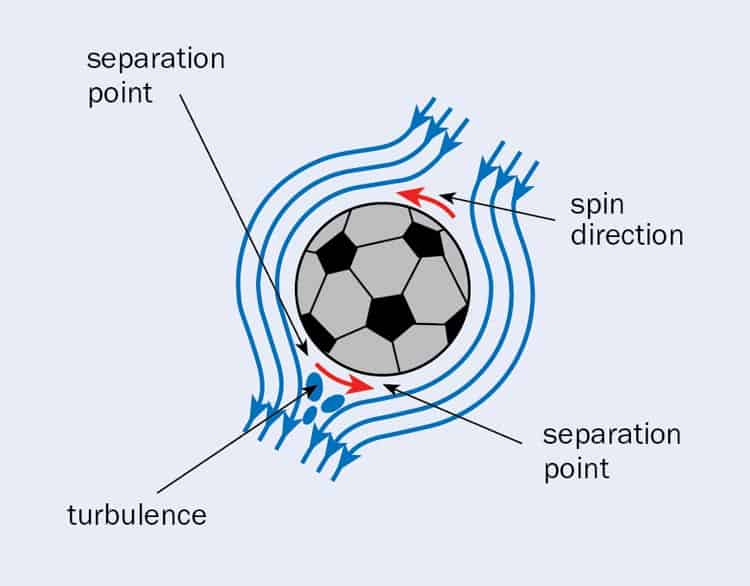
When the airflow is laminar and the drag coefficient is high, the boundary layer of air on the surface of the ball “separates” relatively early as it flows over the ball, producing vortices in its wake. However, when the airflow is turbulent, the boundary layer sticks to the ball for longer. This produces late separation and a small drag.
The Reynold’s number at which the drag coefficient drops therefore depends on the surface roughness of the ball. For example, golf balls, which are heavily dimpled, have quite a high surface roughness and the drag coefficient drops at a relatively low Reynold’s number (~2 × 10⁴). A football, however, is smoother than a golf ball and the critical transition is reached at a much higher Reynold’s number (~4 × 10⁵).
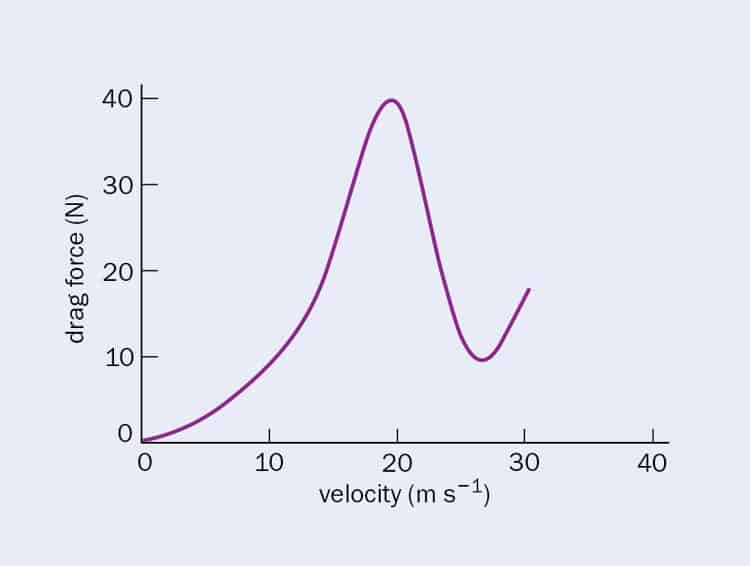
The upshot of all of this is that a slow-moving football experiences a relatively high retarding force. But if you can hit the ball fast enough so that the airflow over it is turbulent, the ball experiences a small retarding force (see right). A fast-moving football is therefore double trouble for a goalkeeper hoping to make a save – not only is the ball moving at high speed, it also does not slow down as much as might be expected. Perhaps the best goalkeepers intuitively understand more physics than they realize.
In 1976 Peter Bearman and colleagues from Imperial College, London, carried out a classic series of experiments on golf balls. They found that increasing the spin on a ball produced a higher lift coefficient and hence a bigger Magnus force. However, increasing the velocity at a given spin reduced the lift coefficient. What this means for a football is that a slow-moving ball with a lot of spin will have a larger sideways force than a fast-moving ball with the same spin. So as a ball slows down at the end of its trajectory, the curve becomes more pronounced.
Roberto Carlos revisited
How does all of this explain the free kick taken by Roberto Carlos? Although we cannot be entirely sure, the following is probably a fair explanation of what went on.
Carlos kicked the ball with the outside of his left foot to make it spin anticlockwise as he looked down onto it. Conditions were dry, so the amount of spin he gave the ball was high, perhaps over 10 revolutions per second. Kicking it with the outside of his foot allowed him to hit the ball hard, at probably over 30 ms–1 (70 mph). The flow of air over the surface of the ball was turbulent, which gave the ball a relatively low amount of drag. Some way into its path – perhaps around the 10 m mark (or at about the position of the wall of defenders) – the ball’s velocity dropped such that it entered the laminar flow regime. This substantially increased the drag on the ball, which made it slow down even more. This enabled the sideways Magnus force, which was bending the ball towards the goal, to come even more into effect. Assuming that the amount of spin had not decayed too much, then the drag coefficient increased. This introduced an even larger sideways force and caused the ball to bend further. Finally, as the ball slowed, the bend became more exaggerated still (possibly due to the increase in the lift coefficient) until it hit the back of the net – much to the delight of the physicists in the crowd.
Current research into football motion
There is more to football research than simply studying the motion of the ball in flight. Researchers are also interested in finding out how a footballer actually kicks a ball. For example, Stanley Plagenhof of the University of Massachusetts in the US has studied the kinematics of kicking – in other words, ignoring the forces involved. Other researchers, such as Elizabeth Roberts and co-workers at the University of Wisconsin, have done dynamic analyses of kicking, taking the forces involved into account.
These experimental approaches have produced some excellent results, although many challenges still remain. One of the most critical problems is the difficulty of measuring the physical motion of humans, partly because their movements are so unpredictable. However, recent advances in analysing motion with computers have attracted much attention in sports science, and, with the help of new scientific methods, it is now possible to make reasonably accurate measurements of human motion.
For example, two of the authors (TA and TA) and a research team at Yamagata University in Japan have used a computational scientific approach coupled with the more conventional dynamical methods to simulate the way players kick a ball. These simulations have enabled the creation of “virtual” soccer players of various types – from beginners and young children to professionals – to play in virtual space and time on the computer. Sports equipment manufacturers, such as the ASICS Corporation, who are sponsoring the Yamagata project, are also interested in the work. They hope to use the results to design safer and higher performance sports equipment that can be made faster and more economically than existing products.
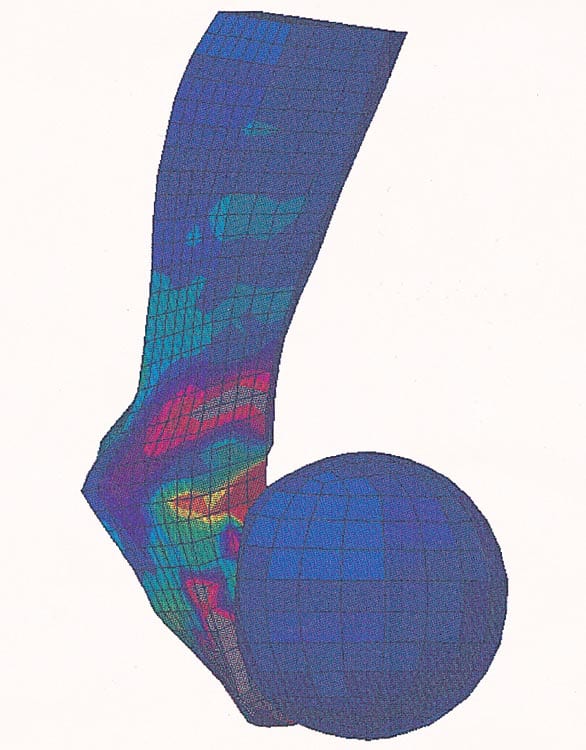
The movement of players was followed using high-speed video at 4500 frames per second, and the impact of the foot on the ball was then studied with finite-element analysis. The initial experiments proved what most footballers know: if you strike the ball straight on with your instep so that the foot hits the ball in line with the ball’s centre of gravity, then the ball shoots off in a straight line. However, if you kick the ball with the front of your foot and with the angle between your leg and foot at 90° (figure 2), it will curve in flight. In this case, the impact is off-centre. This causes the applied force to act as a torque, which therefore gives the ball a spin.
The experimental results also showed that the spin picked up by the ball is closely related to the coefficient of friction between the foot and the ball, and to the offset distance of the foot from the ball’s centre of gravity. A finite-element model of the impact of the foot on the ball, written with DYTRAN and PATRAN software from the MacNeal Schwendler Corporation, was used to numerically analyse these events. This study showed that an increase in the coefficient of friction between the ball and the foot caused the ball to acquire more spin. There was also more spin if the offset position was further from the centre of gravity. Two other interesting effects were observed. First, if the offset distance increased, then the foot touched the ball for a shorter time and over a smaller area, which caused both the spin and the velocity of the ball to decrease. There is therefore an optimum place to hit the ball if you want maximum spin: if you hit the ball too close or too far from the centre of gravity, it will not acquire any spin at all.
The other interesting effect was that even if the coefficient of friction is zero, the ball still gains some spin if you kick it with an offset from its centre of gravity. Although in this case there is no peripheral force parallel to the circumference of the ball (since the coefficient of friction is zero), the ball nevertheless deforms towards its centre, which causes some force to act around the centre of gravity. It is therefore possible to spin a football on a rainy day, although the spin will be much less than if conditions were dry.
Of course, the analysis has several limitations. The air outside the ball was ignored, and it was assumed that the air inside the ball behaved according to a compressive, viscous fluid-flow model. Ideally, the air both inside and outside the ball should be included, and the viscosities modelled using Navier-Stokes equations. It was also assumed that the foot was homogeneous, when it is obvious that a real foot is much more complicated than this. Although it would be impossible to create a perfect model that took every factor into account, this model does include the most important features.
Looking to the future, two of us (TA and TA) also plan to investigate the effect of different types of footwear on the kicking of a ball. Meanwhile, ASICS is combining the Yamagata finite-element simulations with biomechanics, physiology and materials science to design new types of football boots. Ultimately, however, it is the footballer who makes the difference – and without ability, technology is worthless.
The final whistle
So what can we learn from Roberto Carlos? If you kick the ball hard enough for the airflow over the surface to become turbulent, then the drag force remains small and the ball will really fly. If you want the ball to curve, give it lots of spin by hitting it off-centre. This is easier on a dry day than on a wet day, but can still be done regardless of conditions. The ball will curve most when it slows down into the laminar flow regime, so you need to practise to make sure that this transition occurs in the right place – for example, just after the ball has passed a defensive wall. If conditions are wet, you can still get spin, but you would be better off drying the ball (and your boots).
Nearly 90 years ago J J Thomson gave a lecture at the Royal Institution in London on the dynamics of golf balls. He is quoted as saying the following: “If we could accept the explanations of the behaviour of the ball given by many contributors to the very voluminous literature which has collected around the game…I should have to bring before you this evening a new dynamics, and announce that matter, when made up into [golf] balls obeys laws of an entirely different character from those governing its action when in any other conditions.” In football, at least, we can be sure that things have moved on.
Copyright © 2026 by IOP Publishing Ltd and individual contributors