

Gamma-ray bursts

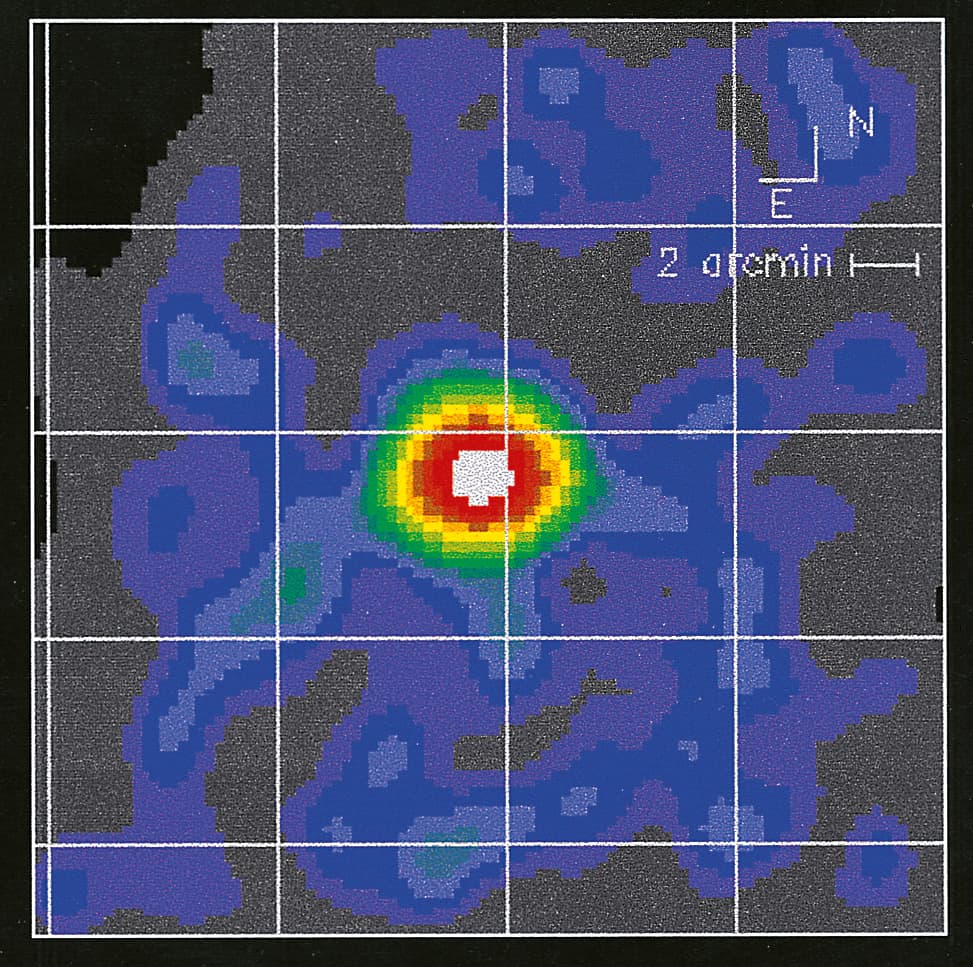
detection of a gamma-ray burst by BeppoSAX

Gamma-ray bursts are one of the top unsolved mysteries in astrophysics, alongside such burning issues as the nature of dark matter and the cosmological constant. We have known of the existence of gamma-ray bursts for over 25 years, but these short flashes of gamma rays have defied all our attempts to understand their causes and origin.

New clues to the mystery were provided on 28 February 1997, when the BeppoSAX satellite located a gamma-ray burst more quickly and precisely than ever before. This allowed astronomers to image the burst, revealing a rapidly fading point of light near a faint nebula. Another gamma-ray burst was found in the same way a few months later, and this time the optical spectrum was recorded by the Keck telescope on Hawaii. This told us unambiguously that gamma-ray bursts lie at the very edges of the universe, making them the most energetic phenomenon we know of.

Although these findings have solved part of the puzzle, we still do not know what causes gamma-ray bursts. Their formation appears to be related to the deaths of massive stars, and almost certainly requires matter to be flung into space at close to the speed of light. The bursts are so bright that they can be detected out to very great distances, and could even hold the record for the most distant known objects. In principle, more sensitive detectors could see gamma-ray bursts from even further away. This could prove to be the only way of observing the early universe, when the first stars and galaxies were forming.

The gamma-ray sky: a burst a day

If you looked at the heavens in gamma rays, you would recognize very little of the normal night sky. Gamma rays typically have energies of 1 MeV, while visible light is recorded at energies of around 1 eV. The Sun would still be visible, but none of the usual constellations or stars would be seen. Instead the sky would be dominated by the Milky Way, which usually appears as a faint band of stars that can only be seen away from city lights.

Gamma rays do not come from these stars, but from big gas clouds that drift between the stars. Cosmic rays excite the nuclei inside the clouds and trigger nuclear reactions, leading to the emission of gamma rays. We would also see a few star-like sources of gamma rays, mainly black holes in the Milky Way and beyond – the material just outside black holes is hot enough to emit gamma rays.

But the most striking observation would be intense flashes of gamma rays that occur several times every day. These gamma-ray bursts (GRB) typically last for a few seconds but are incredibly diverse: some last a few milliseconds, while others extend beyond 15 minutes; some decay smoothly with time, while others show many sharp spikes in their light curves.

Gamma rays are absorbed by the atmosphere, so cannot be detected from the ground. The first GRB was detected on 2 July 1967 by Vela 4a, a satellite flown to verify that nuclear weapons were not being exploded in space. However, the discovery was not made public until 1973 because the satellite did not provide any directional information, making it difficult to establish the bursts as extraterrestrial objects. The workhorse for studies of gamma-ray bursts today is the Burst and Transient Source Experiment ( BATSE) on board NASA’s Compton Gamma Ray Observatory. BATSE was launched in 1991 and detects about one burst every day – it notched up its 2000th burst at the end of last year.
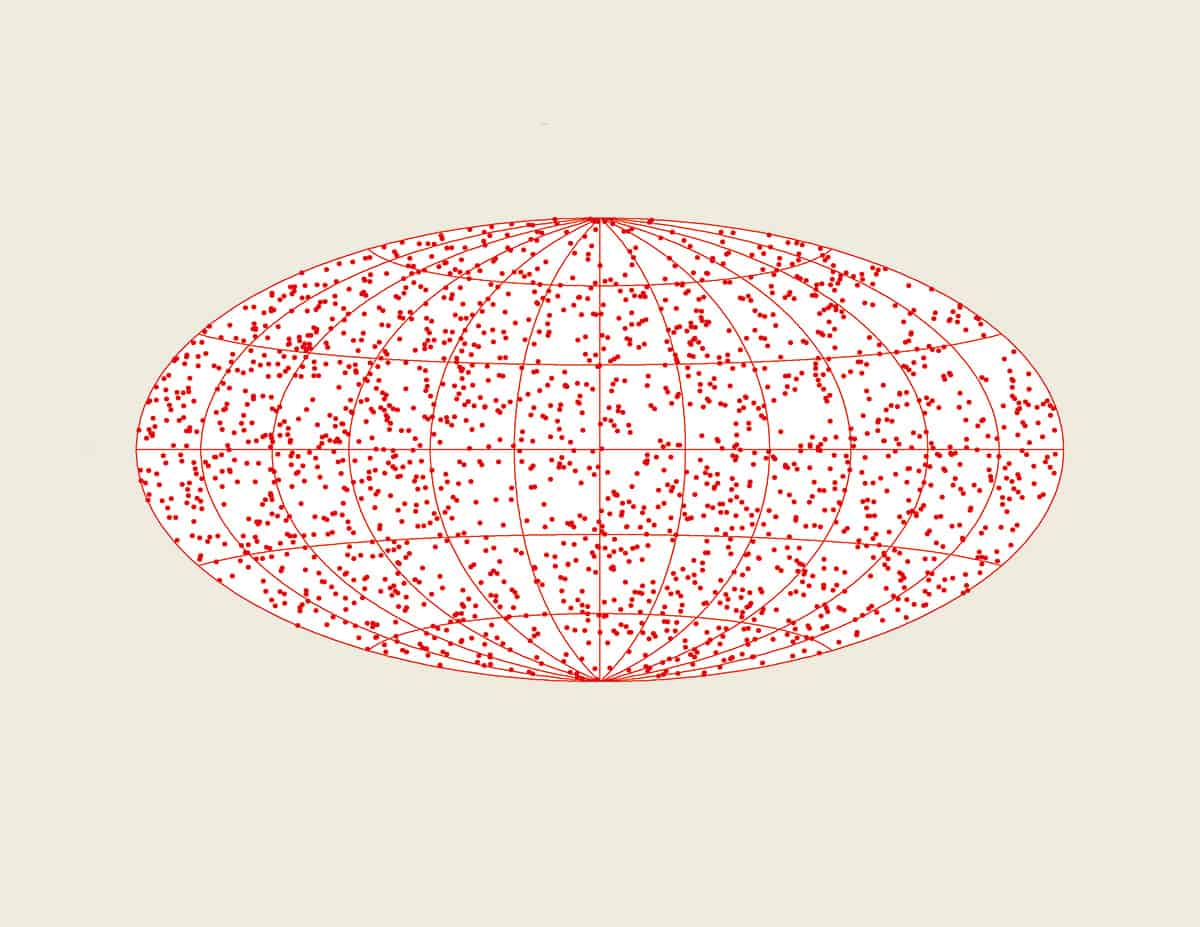
Figure 1

Before BATSE, almost everyone thought that GRBs came from nearby areas of our galaxy. Fainter ones would then lie in the Milky Way band, still within our galaxy but further away. But this theory was shattered when the BATSE team announced results from their first year of observing weak bursts: the recorded locations revealed no pattern at all, indicating that any part of the sky can produce a gamma-ray burst.

This finding convinced many astronomers that gamma-ray bursts had to come from the distant edges of the universe, because only the universe looks the same in all directions. But some researchers maintained that the bursts came from the edges of our galaxy. This is about a thousand times further away than the region the bursts were thought to have come from, but is still 100 000 times closer than the distant reaches of the universe.

A needle in a haystack

A great deal of effort was devoted to finding out the distances to gamma-ray bursts, and some successes were reported. In 1994 Jay Norris and colleagues at NASA’s Goddard Space Flight Center in Greenbelt, Maryland, discovered that faint bursts last longer than bright ones. They attributed this to a “redshift stretching” of the fainter bursts, which implies that the faint bursts are at high redshift and are therefore further away. However, the result failed to convince many people who believed in a galactic origin.

What was really needed was an observational breakthrough. One approach was to observe gamma-ray bursts at different wavelengths – many riddles in astronomy have been solved by looking at a new, enigmatic type of object at other wavelengths. This provides more information about the object and often pinpoints exactly what it is. This was certainly the case for radio stars in the 1950s, thought by some to be nearby stars and by others to be distant galaxies. Martin Ryle, the main proponent of the nearby-stars interpretation, accepted defeat when Walter Baade and Rudolph Minkowski recorded an optical image of the radio source Cygnus A, clearly showing it to be a distant galaxy. There was a similar controversy over quasars, which looked like stars in optical images. But when Cyril Hazard obtained an accurate location for the quasar 3C 273 from lunar occultation, Maarten Schmidt was able to record the famous spectrum that finally settled the issue. (The acrimony over how the credit for this discovery was divided between the people who located the object accurately and those who analysed it was as great for quasars then as it is for GRB now. With quasars, Hazard never got the credit he was due; this mistake should not be repeated.)

However, apart from a few X-rays, no radiation at other wavelengths had ever been recorded from a gamma-ray burst. This is largely due to the fact that gamma rays penetrate materials very easily, which means that they cannot be detected using conventional imaging optics such as lenses and mirrors. Indeed, the detectors on BATSE are essentially flat plates of sodium iodide that absorb and count every incident gamma-ray photon. Eight detectors are mounted on the satellite, each seeing half the sky and facing in a different direction.

A single gamma-ray burst is typically seen by four of the detectors, and the flux each one measures is large if the detector faces the source of the burst, and smaller if it lies at an angle. A best position for the gamma-ray burst can be found by analysing the fluxes measured by all of the detectors, but this is typically a circle about 20 times the size of the full moon. Within such an area there are millions of stars and galaxies, and it is hard to find the culprit.

This problem was overcome with the development of the Wide Field X-Ray Cameras on board the Italian-Dutch satellite BeppoSAX, which was launched in 1996. These have a wide field of view and also provide precise imaging, which means that the satellite can give an accurate location for a gamma-ray burst. However, this satellite does not view the whole sky at the same time, and so it only detects a burst about once every month.

BeppoSAX made history in the early hours of 28 February 1997. The satellite saw a flash that was recognized by other instruments on board as a gamma-ray burst. Less than eight hours later, the project team (Luigi Piro, Enrico Costa, Marco Feroci, John Heise and many others) pointed BeppoSAX’s sensitive X-ray telescopes at the location of the burst and saw a rapidly fading X-ray source. The burst was also seen by Ulysses, a satellite studying the Sun from the far reaches of the solar system. Kevin Hurley from the University of California in Berkeley used the difference in arrival time between the signals from Ulysses and BeppoSAX to further constrain the location of the burst.
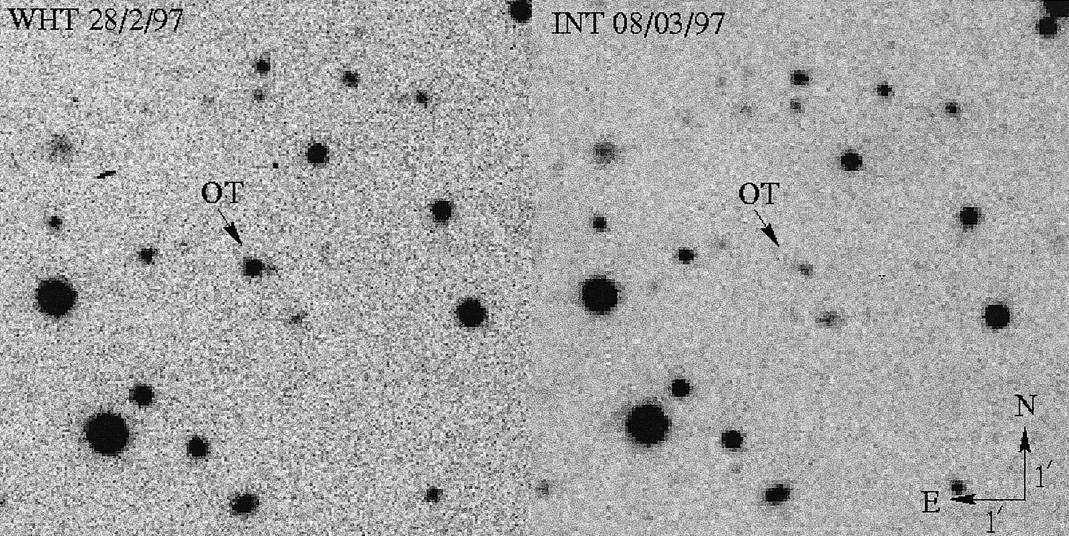
Figure 2

Armed with this information, a team led by Jan van Paradijs of the University of Amsterdam used the British-Dutch observatory on La Palma to obtain an optical image of the burst just 21 hours after it was detected. When the area was imaged again a few days later, the optical signal from the burst had faded. Observations with the Hubble Space Telescope revealed a faint nebula underlying the fading point, which might be the distant galaxy in which the burst took place. The same procedure was repeated for another burst on 8 May. Its afterglow remained bright for longer, which made it possible to analyse its optical spectrum with the 10 m Keck telescope on Hawaii. The analysis showed that some of the light from the afterglow had been absorbed by intervening material, with the spectrum showing the unmistakable signatures of magnesium and iron. However, the spectral lines of these elements were at significantly longer wavelengths than usually observed in the lab. This is due to redshift, caused by the constant expansion of the universe. Stars and galaxies move away from us with speeds that increase predictably with distance, and the Doppler shift of their spectral lines (the redshift) allows us to measure the speed of recession and the distance between the Earth and the object. The spectrum recorded by the Keck telescope shows that the intervening material has a redshift of 0.835, indicating that it is 7 billion light-years away. This means that it is far outside our own galaxy, somewhere in the distant universe.

This amazing story, written by many sub-disciplines of astronomy, finally showed conclusively that gamma-ray bursts come from the far edges of the universe. The results also provided some good clues to the causes of gamma-ray bursts.

Mother nature’s firecrackers

The implications of these findings are astounding. Although gamma-ray bursts are among the most distant objects known, they can be brighter than anything else in the sky and so must be the most luminous objects in the universe. In their 10 seconds of glory, they release about 1044 J, 100 times more energy than the Sun gives out in its 10 billion year life. Even the most powerful quasars are 1000 times less luminous. So what is the exceptional phenomenon that can release so much energy in such a short time? The only event known to liberate the required energy so quickly is a supernova explosion. Such an explosion happens when a massive star is at the end of its life, at which point its core – then consisting mostly of iron – collapses to nuclear density (1017 kg m3). Of the 1046 J released in this process, and only 0.01% is emitted as visible light. Even so, in the few weeks after the event this bright supernova outshines all the other 1011 stars in its galaxy.

The vast majority of the energy (99%) is carried away by neutrinos. The rest is converted into the kinetic energy of the star’s “envelope”, the stellar material that lies outside the collapsing core. This gaseous material is hurled into space at a speed of some 10 000 km s-1 and does not slow down until about 100 years later, when collisions between the expanding envelope and the surrounding interstellar gas convert the kinetic energy into heat. This supernova “remnant” remains visible as a glowing, expanding shell of gas for tens of thousands of years.

A supernova certainly releases enough energy for a gamma-ray burst, but it is mainly released as visible light and over a rather longer time than 10 seconds. This is because the heavy envelope of the star acts as a “shock absorber” for the initial explosion, releasing the energy over a longer time. The leading contender for the source of gamma-ray bursts is therefore a supernova-type event without the envelope, so that the effects of the explosion are unmitigated by a large shock absorber. However, the way in which this is achieved remains speculative.

There could be some special supernovae in which the star rotates very rapidly just before collapse, allowing some of the explosion energy to escape along the rotation axis. Or it could be caused by the collision of two neutron stars. This may seem a long shot, but the orbits of binary stars consisting of two neutron stars gradually become smaller, suggesting that the stars should merge at some point. Such a merger should take place once every million years in an average galaxy like ours, which matches the estimated rate of gamma-ray bursts. For comparison, ordinary supernovae take place about once every century in our galaxy.

In the “fireball” model proposed by Martin Rees of Cambridge University in the UK and Peter Mészáros of Penn State University in the US, most of the energy is given to an envelope with much less mass than a typical supernova envelope. If the mass of the envelope is about 0.01% of the star’s mass, then the material in the envelope will acquire about 1000 times its rest mass energy, Erest = Mc2. This fireball of concentrated energy expands at close to the speed of light, converting all of its heat into kinetic energy and very little into radiation that we can see – the fireball is so dense and opaque that light remains trapped inside.

In the month or so after the explosion, the expanding shell sweeps up enough surrounding gas to slow it down, causing its energy to be reconverted into heat. Since the gas contained in the shell is now much less dense, radiation is allowed to escape. Gamma rays might be emitted over a month or so – much longer than the duration of a gamma-ray burst – but relativity can play strange tricks on us. Since the shell is moving at close to the speed of light, it is only just behind the radiation it sends out. After a month of radiating energy, all of the light is contained in a narrow region just ahead of the shell, and all the gamma rays reach us within a few seconds (see box).

Relativistic motion

When an object moves at a speed comparable with the speed of light, we must take relativity into account. This means that events seem different to an observer watching the moving object than to an observer moving with it. The speed, v, of a fast-moving object is usually expressed in terms of its Lorentz factor, γ = 1/ √(1 – v2/c2),where c is the speed of light. The total energy of a rest mass m moving with a Lorentz factor of γ is given by γmc2. The initial Lorentz factor of a gamma-ray burst can be as high as 1000, which means that its speed is 99.9999% that of c.

So what happens during a gamma-ray burst? Imagine that an expanding shell starts to move towards us, and that a flash of light is emitted at the same time. At given radius, r, the shell starts to decelerate and will then start to emit more light. For an observer at the centre of the expanding shell, this happens after a time r/c, which for a realistic case is about a month. On Earth, however, we can only measure the difference in arrival time between the flash of light emitted at the start of the burst and the light emitted at deceleration. The flash travels at the speed of light, and so takes a time r/c to reach the radius of the shell. Meanwhile, the shell travels with speed v = c(1 – 1/2 γ2), assuming that γ » 1. The time difference between the two is r/2γ2c, which is also the duration of the burst as we measure it. Since γ is such a large number, the duration we measure is only seconds.

So what causes the gamma rays to be emitted? When the mass from the explosion ploughs into the surrounding medium, it drives a shock into it, compressing the surrounding gas and heating it. This causes the shock to slow down, which means that waves forming at the front of the shock become unstable and start to break up – a consequence of the so-called Rayleigh-Taylor instability. These unstable motions can give rise to the build-up of a magnetic field in a similar way to the magnetic fields in sunspots. This mix of relativistic electrons and magnetic field leads to the emission of synchrotron radiation – the light emitted by electrons spiralling in a magnetic field. It is not certain whether this “forward shock” model accounts for the light we see from a gamma-ray burst. It is equally possible that velocity differences in the initial outflow cause the material to collide, creating shocks that can also emit synchrotron radiation. In view of the rather jagged and unpredictable light curves of gamma-ray bursts, this “internal shock” model is more likely to be correct.

But the forward shock is very important for the next stage of the process. As the shell of gas sweeps up more mass, it is slowed down further and radiates more energy. Since the shock is now less relativistic, the radiation becomes weaker, lasts longer and is predominantly at longer wavelengths. This phase is called the afterglow, and consists mostly of X-rays for the first few minutes, then ultraviolet radiation and then visible light is emitted for a few days to several weeks. Infrared light and radio waves can be emitted for months or years afterwards. After about a year, the shock is no longer relativistic and it gradually turns into a normal supernova remnant.

Seeing the edge of the universe

Since gamma-ray bursts can be seen from such great distances, the light we receive from them has been travelling for a long time. So long, in fact, that the universe was perhaps less than a tenth of its current age when the light was emitted. By looking at the faintest, most distant bursts we should therefore get a glimpse of what the universe was like in its youth. If, as many astronomers now think, gamma-ray bursts are related to the deaths of massive stars, the number of bursts should be proportional to the number of dying stars. Since massive stars die fairly quickly after they are formed, the rate at which they die is in many cases about the same as their birth rate, and this has recently been measured as a function of time since the big bang.
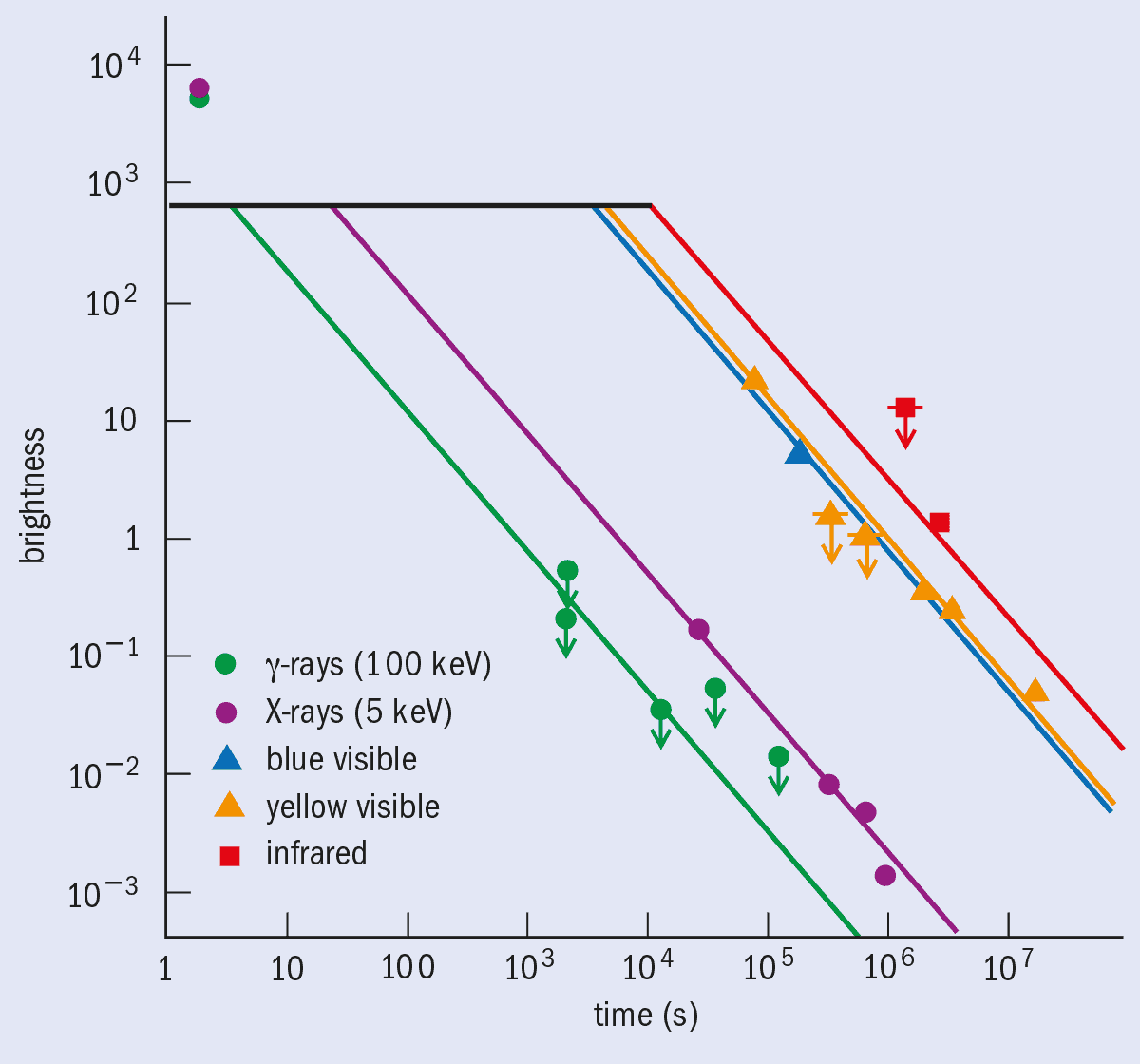
Figure 3

Just after the universe was formed, gas had not yet collected in clouds dense enough to collapse into galaxies and stars. Stars started to form within a billion years of the big bang and reached a peak about 8 billion years ago. The formation rate then slowed to its present value, which is about 20 times lower than the peak rate.

It turns out that the rate at which gamma-ray bursts are thought to have occurred since the big bang tracks the rate of star formation, supporting the notion that the two are related. More direct evidence also points to a connection between gamma-ray bursts and regions of star formation, since the spectrum of the 8 May burst shows some emission from gas that is normally seen in star-forming regions. Moreover, another burst detected on 28 August was seen in X-rays but not in visible light, because the burst was hidden behind a dense dust cloud. Such dust clouds are mainly found in regions of star formation.

With Josh Bloom, Jasjeet Bagla and Priya Natarajan at Cambridge University, I tested this model a couple of months ago and found that it agrees with the data remarkably well. There was, however, a surprise: the dimmest bursts seem to be at a redshift of 6, beyond the furthest quasar, which indicates that they happened about 750 million years after the big bang. If confirmed, the next generation of more sensitive gamma-ray detectors could see bursts at redshifts of 10 and beyond, if they exist. This range of redshifts corresponds to the time when we believe the first stars and galaxies formed, but it is also known as the “dark age” of cosmology because we have never observed anything at those redshifts.

Quasars tell us about the nature of the universe about 1.3 billion years after the big bang, since their spectra reveal light absorption by gas clouds at redshifts of 1-4. It is just possible that gamma-ray bursts will turn out to be the torches that reveal the nature of the universe at even earlier times.

What is truth in science?

“What is Truth? said jesting Pilate; and would not wait for an answer.” Francis Bacon’s well known quotation shows Pilate to be a busy and sensible administrator, who was aware of problems but who knew how to avoid unnecessary conflict most of the time. However, his washing of hands for the trial of Jesus had unexpected consequences. He realized that any discussion of truth awakens arguments, since people tend to select their facts to support their view.

But what is truth in science? Should this not be easier to establish and be more clear cut, since facts can be tested and proved by replication? One would like to think so, and it is this issue that Roger Newton, an emeritus professor of physics at Indiana University in the US, addresses in this book. One of the first questions he asks is whether science differs from other activities. This is a key theme of the so-called “science wars”, in which scientists – particularly physicists – have argued that science is being misinterpreted and devalued by certain sociologists who are known as “Post-modernists” and “Constructivists” (see “What’s wrong with relativism?”).

One of the sociologists is David Bloor of Edinburgh University, who claims that “knowledge for the sociologist is whatever men take to be knowledge”, and that objectivity is nothing more than “institutionalized belief”. But Newton explains that while there is some subjectivity in science, objectivity dominates. He attacks Bloor’s “principle of symmetry”, which “enjoins sociologists to disregard [truth] in the sense of treating both true and false beliefs alike for the purpose of explanation”. Scientists would consider that there is a big difference between true and false – and they are probably too busy to be aware of the harm that is being done by opinions such as Bloor’s.

Looking back through history, one can see that it generally takes a few special people and a favourable society for the idea to emerge that if you have a theory, then you should test it. Indeed, the author makes the interesting suggestion that science is not a natural development in most civilizations. Societies tend to have belief systems, and the thought of trying to prove yourself wrong is not acceptable to most in authority, who might lose power as a result. According to the author, laboratory science as we now know it was developed by Robert Boyle – although for my money it was Galileo who first pointed out that one should test one’s ideas experimentally. The author describes Boyle’s famous argument with Thomas Hobbes, who considered the vacuum to be nothing more than a metaphysical concept. Hobbes felt that experiments were therefore inappropriate and that only rational argument mattered. But when Boyle used a new and better vacuum pump to establish the law that bears his name, one might think that experimental science had at last won the day.

However, the author describes how sociologists like Bloor take examples where ideas and proofs have changed with time to deduce that science is only a conventional system of beliefs established by scientists, and that these beliefs change with time. Newton explains that Bloor fails to understand that as new information becomes available, the old idea often holds good, but the region over which it is valid becomes better defined. For example, Isaac Newton’s laws were not “overthrown” by Einstein’s relativity theory – but were limited to velocities much less than the velocity of light.

The author also discusses the ideas of radical feminists like Sandra Harding, who emphasize personal experience as a source of knowledge and who ignore the question of replication. She considers that as most science has been developed by men it is therefore biased – and has even referred to Newton’s laws as a “rape manual”. It is, of course, useful for scientists to be reminded that others often have very different views of science and that they should be prepared to talk to them. However, such discussions are often surprisingly difficult, and this book should help scientists to have a reasonable public debate.

Other topics that the author looks at include the role of theories and facts – as well as pseudo-facts, such as cold fusion. Newton correctly says that Martin Fleischmann and Stanley Pons’ original work has been extensively tested and is discredited, although I suspect he would be surprised to know that some “true believers” still continue to come up with new and even more fantastic claims. (Some even argue that black spots on photographic plates were created by black holes produced by cold fusion!) The author also emphasizes the great contribution to the question of scientific truth made by the philosopher Karl Popper, who said that a theory cannot be proved, only disproved. A satisfactory theory should be falsifiable, which leads the author on to the question of whether or not psychoanalysis is a science. Newton says that one of the most telling arguments against psychoanalysis as a science “is that its system can easily produce plausible explanations of symptoms or dreams…but there appears to be no way to show that the explanation is wrong”. (This would be a useful argument to employ in cases of “recovered memory”.)

It struck me that the quotation in the book from the philosopher Imre Lakatos that “there is no falsification before the emergence of a better theory” could be applied to the current debate about the value of the relative energy density of the universe, W. The only reasonable theory of the big bang is “inflation”, which proposes that the universe expanded extremely rapidly for a short period after the big bang. Inflation requires W to be exactly one (to four decimal places!), which would mean that the universe will eventually settle down and stop expanding. However, more and more experimental observations suggest that W is about 0.3 ± 0.1, which would mean that the universe will go on expanding forever. Many theorists strongly resist these new results, arguing that there is no theory other than inflation. (Inflation could be salvaged if there were a “cosmological constant” – a large-scale repulsive force that permeated the universe – but many theorists tend to reject this type of constant, even though recent data on supernovae are exciting.)

Einstein is generally considered to be this century’s greatest physicist, but he is rather criticized in this book for appearing to reject probability as the heart of physics, famously saying that he did not believe that “God played dice with the world”. The author describes the Einstein-Podolsky-Rosen (EPR) paradox, in which two particles are produced at a point and then fly off in opposite directions at the speed of light. Quantum mechanics says that one particle must have spin up and the other spin down, but you cannot know which is which until you measure their spin. Einstein was worried about the following question: if you measured the spin of one particle, then how could the other particle know that it must have the opposite sign – given that any signal sent from the first measurement would have to travel faster than light?

Recent experiments to test the EPR paradox have come out in favour of quantum mechanics and have shown Einstein to have taken the wrong approach. It therefore surprised me that Newton says that the results are “still somewhat controversial”. As Andrei Linde explained to me ten years ago, the initial system that produced the two particles has to obey the laws of quantum mechanics, and the fact that parts of this system are moving away with the velocity of light does not change the need for the system to continue to obey these laws. End of paradox, for me at least!

It seems to me that the relative proportions of subjectivity and objectivity in science are crucial for understanding truth. David Bloor considers subjectivity to be the critical factor and to dominate (Physics World March p23). Scientists, however, strive to be completely objective and to eliminate subjective bias before, during and after their work. Nevertheless, there is some element of subjectivity. Evgeny Feinberg gave the following example to me. Suppose a theory is proposed and then experiments are done to test it. After a certain number of experiments that agree with the predictions, people assume the theory to be “proved”. But how many experiments are needed? This is a subjective decision that depends on the nature and quality of the experiments and the experimenters. Thus science has a subjective element, but it is dominantly objective.

So what is the truth of science? The merit of this book is that it explains the complexity of the question. A theory is considered never to be absolutely true, but to be provisional and approximate. Science makes a web or network of understanding, into which known facts can fit. This coherence is central to the recognition of truths. Science forms a basis for action because of the power of prediction. After all, when sociologists are passengers on board a plane, they – like scientists – expect the laws of physics not to change before the plane lands safely. And although quantum theory is taken as the basis of truth, the problem is that explaining its truths can sometimes only be achieved in the language of mathematics. So the nearest that one can come to an answer is that science is a “rationally coherent structure of comprehending the world”, but one needs to study the book to understand the strengths and weaknesses of this partial answer.

The author says that his book is intended for anyone with some scientific education, and that it is not for professional philosophers or sociologists of science. However, I think it would be useful for both groups. It would help the former to widen their horizons, and provide the latter with some professional guidance in language that is not too technical. But would they read it? At a recent meeting between scientists from CERN and philosophers from Geneva University, I showed Newton’s book to a philosopher who specializes in the history of quantum theory. She intends to buy the book – and I hope others like her will do so too.

What’s wrong with relativism?

In his article last year, the Belgian physicist Jean Bricmont separated out some of the distinct strands in “science studies” and tried to provide a considered critique of sociology and history of scientific knowledge. He saw that there is a difference between “philosophical relativism” and “methodological relativism”. He grasped that the former view, which says that the truth of a proposition depends on who interprets it, is a perfectly tenable philosophical position, even though it has little leverage on the world. And he saw that methodological relativism – impartial assessment of how knowledge develops – is the key idea for sociology of scientific knowledge (SSK).

It was also good to see that Bricmont – unlike so many others – did not treat an accusation of “relativism” as an argument in itself. In contrast, he tried to explore what he sees as the faults of methodological relativism. In the context of the “science wars”, this is good progress, which makes it worthwhile to go over some of the arguments on which SSK was founded. In doing so, I will point out that scientific truth is somewhat more complicated than it is usually taken to be – particularly in the short term.

How much science should one know?

Bricmont’s complaint was that historians and sociologists of science do not know enough science. He said that they need to know more. Practitioners of SSK believe that it is important to know as much science as possible about the cases they study. Sometimes one cannot learn enough. For example, after carrying out some thirteen tape-recorded interviews on the topic of the theory of amorphous semiconductors, I concluded that I could not understand enough of the science to do the sociology; I abandoned the study. On the other hand, in fields in which I feel more at home, I check my writings carefully with respondents to make sure there are no serious scientific errors. This is normal practice within SSK.

If sociologists of scientific knowledge cannot learn to talk science at some kind of interesting level with their respondents, they should choose another field. But there is another way of looking at this. Methodological relativism means the sociologist puts on hold all appeals to terms like “truth” and “the facts”. This is because what counts as “the truth” or “the facts” in the case under study is typically contested. Prescribing methodological relativism is another way of telling the analyst to avoid being wiser than the scientists themselves. In historical case studies, this means that we have to try to forget how things turned out. To know more than the scientists who were involved is to know too much science.

For example, because I know that special relativity is right, I know that the Michelson-Morley experiment in 1887 should have given a result of zero ether-drift. Similarly, I know that when, in the 1930s, Dayton Miller – using what was then thought to be the most sensitive interferometer yet built – won a prize from the American Association for the Advancement of Science (AAAS) for finding an ether-drift of 11 km s-1, he was doing something wrong. The principle of methodological relativism says: “When you ask the question ‘Why did most people choose to believe the Michelson-Morley result rather than the Miller result?’, you must not include as any part of your answer ‘because it was true’ or ‘because special relativity is true’.”

Michelson, Morley and Miller did not know these things. Michelson and Morley knew nothing about relativity and Michelson, it seems, thought that there might be something wrong with his experiment because it had failed to detect the Earth’s movement through the ether. Miller thought that special relativity was wrong. Furthermore, those other scientists who were making up their minds about who to believe did not know these things either – at least not in the way we know them now. If they knew what we know now, Miller would have thrown out his own result, and the AAAS would not have given him a prize. In sum, to explain the outcome of an argument you must not include the outcome in the explanation, because this leads to circularity. And this is what methodological relativism is about. To repeat, in the history of science it is sometimes a matter of trying to know less science rather than more.

To go back to Bricmont’s argument, he says that to answer this kind of question properly one needs to know enough science to understand the scientific reasons for believing in Michelson-Morley rather than Miller. How much science is this? It is certainly more science than Miller, because Miller got it wrong! So, according to Bricmont, it is not that the sociologist has to know as much physics as a research physicist before doing sociological analyses of physics, or as much microbiology as a research microbiologist before doing sociological analyses of microbiology, and so forth: the sociologist has to know more. This is absurd. In passing, it is worth noting that if experiment is the key, then Miller was in a much better position to reach a conclusion than anyone who had not actually done an experiment for themselves. Miller had better knowledge of what these experiments involve than any commentator. It is sociologically interesting that, nevertheless, the opinions of scientists who watch from the sidelines tend to be much stronger than the views of those involved at the research front of a difficult area of science. The relationship between the views of insiders and outsiders is often the opposite of what one might expect.

Now let me go over the argument again for a more contemporary example. In 1989 it was claimed that room-temperature, resonant-bar, gravitational-wave detectors saw events that correlated with supernova 1987A. But in the very paper that announced this finding, M Aglietta and co-workers said that if our current understanding was correct, the energy seen by the detectors was equivalent to the complete conversion of 2400 solar masses into gravitational waves (1989 Il Nuovo Cimento 12C 1 75) The authors agreed that this was incredible, but nevertheless thought they should report what they had found in print in case something odd was going on. Nearly everyone else thought that the result was wrong, and a critical paper was published that tried to show that it was the outcome of inadvertent statistical massage (1995 Phys. Rev. D 51 2644). Last year, in an internal report from the University of Rome La Sapienza, the original authors rejected the criticism.

The easy solution for the sociologist studying a dispute like this (in this case, me) is to side with the “big guns”, and say that the SN1987A findings were wrong because too much energy was involved, and that the accidental misuse of statistics was the culprit. There is nothing terribly difficult to understand here, but the scientists who put the claims forward continue to stand by them. Thus for me to take the easy option would imply that either I am morally bankrupt, possess the aptly named gift of prescience or am a better physicist than many of the physicists I am studying. Now, that would justify a science war! Once more, the crucial thing for the sociologist is to avoid claiming to know too much science. What the sociologist must do is ignore mainstream opinion and minority opinion alike, and stick to the question of how most people were persuaded to go one way rather than another. Setting the science aside, one is led to ask a different kind of question. For example, how did the particular pattern of publication come about and what was its influence likely to be? Physical Review refused to publish the original paper before it was accepted by Il Nuovo Cimento . But Physical Review still published the criticism, then refused the rebuttal. This is noteworthy because, often, criticisms of disputed claims in recent gravitational radiation research have never been seen in print but have been confined to the informal networks.

Short term, long term and history

To the superficial glance this kind of history may look like gossip, but it is the wider patterns that are important. As a very first step, one can see from cases like this that the peer-review system is segmented, and that not all claims are treated in the same way. What follows is that various groups of researchers and observers are exposed to different cross-sections of debate. Furthermore, there is a systematic difference between what insiders and outsiders get to see. In this case one might guess that outsiders were considered a more important group than usual and that is why the rebuttals were published. In a full case study, the work of relating the pattern of argument to the wider context would now begin. How much difference these patterns make in the very long term is sometimes hard to see; all human activity is deeply social, but, that said, it is the details that are interesting and important. (And it is vital to take into account the deeply social nature of human activity if the limitations of non-social entities, such as intelligent machines, are to be understood.) In the short term, the relationship between the details of the debate and the conclusions people reach is more evident than it is in the long term. The “short term” is important and can be remarkably long. In the case of the experiments relating to the constancy of the speed of light, the short term was about half a century; for the direct detection of gravitational waves it is 30 years and counting.

In saying that the way scientists come to agree on scientific truth is somewhat more complicated than it is usually taken to be, one is not saying that science is flawed, or shoddy, or should be replaced by something better. The only thing that science cannot live up to is the idealized notions of the scientific method. Experienced research scientists need little convincing of this. Even Lewis Wolpert, the biologist, has said: “…scientists must make an assessment of the reliability of experiments. One of the reasons for going to meetings is to meet the scientists in one’s field so that one can form an opinion of them and judge their work”. The idea that SSK attacks science may result from confusing one kind of history for another. Most history of science is written for the scientific profession and it is meant, quite properly, to attribute credit for scientific success: this kind of “professional history” gives a sense of what and who is deserving. But this kind of history has limited use when it comes to understanding scientific knowledge-making because it concentrates exclusively on success. To use it for deeper purposes would be like trying to understand the economy by concentrating exclusively on the activities of millionaires. “Interpretative history and sociology of science”, on the other hand, does not use success as a sorting rule. Some of the critics of SSK have, perhaps, taken interpretative history to be an attack on the way honour is distributed within professional history – it is not. Bricmont began his piece with a quotation from my and Trevor Pinch’s book The Golem: What Everyone Should Know About Science (1993 Cambridge University Press pp144-145): “Scientists at the research front cannot settle their disagreements through better experimentation, more knowledge, more advanced theories, or clearer thinking.”

In the new edition of The Golem, which will be published later this year, the word “disagreements” has now been changed to “deep disagreements”, and this quotation is discussed at length.

Consider the deep disagreement about SN1987A discussed above. Observations, better experimentation, more knowledge, more advanced theories and clearer thinking have not settled the argument – at least, not to the satisfaction of all parties. What happens in deep disputes like this is summed up in the grim Planck dictum: scientists do not give up their disputed ideas, they only die. The quotation also expresses the philosophical truism that all scientific claims require interpretation – their meaning is never self-evident. Interpretation does not follow automatically from the data, the theories or the logic. Interpretation is the prerogative of the scientific community. Finally, setting philosophical and intellectual issues aside, the problems of day-to-day life make it more important to understand the “short term” life of science than the long term. In more public forums – such as courtrooms – it is hard to cope with the “short term” disagreements among scientists and technologists to which we are continually exposed. The trouble is that the popular image of science is a kind of conveyor belt for agreement; disagreement is taken to imply incompetence, or bias, or political interference. If one can show that disagreement is found within the best of the hardest sciences, it will cease to be seen as a symptom of a pathology. Experts who disagree are not to be distrusted; disagreement often accompanies virtuosity. On the other hand, disagreement will continue to be seen as damaging to science’s credibility so long as we continue to live with the dangerous, idealized models of science and technology that treat the short term as an aberrant phase within a perfectible activity.

CERN head to move to UCL

During his five-year tenure at CERN, Llewellyn Smith has overseen an increase in funds for the Large Hadron Collider by persuading countries outside CERN, particularly the US, to become involved in the project.

A theoretical physicist by training, Llewellyn Smith replaced Carlo Rubbia as director general of CERN in 1994. Prior to that, he streamlined Oxford university’s physics departments when he became chairman of physics in 1987.

“UCL has an outstanding reputation, a vibrant atmosphere, and a great liberal and innovative tradition, ” said Llewellyn Smith on his appointment to the UCL position. “It will be an exciting challenge to help further the college’s standing as a world leading centre for teaching, scholarship and research across science and the arts.”

Nuclear waste dump could be unstable

The new findings is reported by Brian Wernicke and colleagues from the California Institute of Technology (Caltech) and the Harvard-Smithsonian Center for Astrophysics in the current issue of Science . Since 1991 Wernicke and colleagues have been using the satellite-based Global Positioning System to measure the movement of Yucca Mountain with unprecedented precision. The team also used measurements made on a 14 km track across the proposed dump site by the US Geological Survey between 1983 and 1997. The researchers found that the south east region of the mountain had “moved significantly” to the south east at a rate of between 1 and 1.7 mm per year.

At first the researchers thought that an earthquake on the nearby Little Skull Mountain in 1992 could have caused the movement, but further calculations led them to conclude that Yucca Mountain itself suffers sharp periods of accumulated strain – in other words the region is in an period of increased earthquake and volcanic activity.

Although nuclear waste dumps are not currently designed to withstand earthquakes, Wernicke believes that increased tectonic activity should not prevent the storage of nuclear waste at Yucca Mountain providing that the activity is taken into account in the design.

NuPECC recommends future for nuclear physics

In the report NuPECC suggests that national funding agencies should become more involved during the planning stage of these new facilities because future facilities and detectors will be significantly more complex and expensive compared to present systems. It also recommends that more young researchers should be encouraged into nuclear theory groups, so that progress in nuclear physics is not dependent on experimental activity. For the same reason NuPECC suggests that funders should find long-term financial support for the European Centre for Theoretical Studies in Nuclear Physics and Related Areas (ECT) in Italy.

Its last general recommendation is for university nuclear physics departments to be maintained at their current strength.

NuPECC aims to strengthen nuclear science by promoting collaboration between European facilities and researchers, discussing new instrumentation, and providing advice and recommendations to the European Science Foundation (ESF) and other similar bodies.

The report Nuclear Physics in Europe: highlights and opportunities has been sent to all organizations within Europe that fund nuclear science. It is split into six groups: nuclear structure under extreme conditions; nucleus-nucleus collisions and the phase transitions of nuclear matter; quark and hadron dynamics; nuclear and particle astrophysics; neutrino physics; and fundamental interactions. Individual group’s recommendations can be found by clicking .

Superfluidity seen on microscopic scales

Bulk superfluid helium has many unusual properties – it can flow up walls and through narrow pores without resistance. Helium-4 and helium-3 become superfluid below 2.12 and 0.003 Kelvin respectively. However, only a proportion of the helium becomes superfluid at the transition temperature. This two-fluid model was confirmed experimentally by Andronikashvili in the mid-1940s. The latest experiments are microscopic versions of the Andronikashvili experiment.

The researchers used infrared absorption to measure the rotational spectra of oxygen carbon sulphide (OCS) molecules in small clusters of liquid helium. Narrow rotational lines imply free rotation of the molecules and hence superfluidity in the helium. 60 helium atoms are enough to coat the OCS molecule with two layers of atoms. This number of atoms is also in reasonable agreement with theoretical predictions.

In a paper published in this week’s Science magazine the researchers – Slava Grebenev, Peter Toennies and Andrei Vilesov of the Max Planck Institute for Fluid Dynamics in Göttingen – suggest that the effect should be called “molecular superfluidity.”

Defence diversification agency to be created

DERA has an annual turnover of £1bn, 90% of which comes from the Ministry of Defence, and is active in many areas of physics including semiconductors, materials and optics.

The agency would encourage the exploitation of defence technology by industry, and the transfer of civilian technology into military programmes. For example, in the 1960s researchers at DERA developed the liquid crystal displays that are now widely used in civilian applications. And non-defence companies have made great advances in IT. By establishing the new agency, the government hopes to transfer technologies between these sectors more efficiently.

According to the green paper, the work of the defence diversification agency would be integrated with other government departments and agencies. However, there are no details on how the agency would slot into DERA, nor how much money would be available to it. DERA is currently being reviewed as part of the strategic defence review, which is due to report in the summer. Options for DERA’s future include closer relationships with the private sector, or even privatization. The IPMS, a trade union that represents scientists at DERA, welcomed the proposal to establish a defence diversification agency as strengthening the case for DERA remaining in the public sector. “It is inconceivable that the government could create a diversification agency within the Ministry of Defence and then privatize it, ” says Paul Noon of the IPMS.

Ground breaking physics in the garden

In Ammann’s scheme the plants are grown in a vertical structure with their roots protruding into a central column. A nozzle at the top of the structure sprays nutrients into this column, wetting the roots of the plants. The plants are also able to breathe in nitrogen and carbon dioxide through their roots, as would happen in soil.

One drawback of aeroponic systems is that stagnant air can build up in the chamber. Ammann has overcome this problem by designing the system such that the falling droplets cause atmospheric turbulence, and by using an air induction manifold to establish a low pressure zone inside the system that draws in fresh air.

Radio astronomers agree eight-hour day with mobile phone companies

Interference from satellites is an increasing problem for radio astronomers, and this problem is set to get worse as hundreds of telecommunications satellites are launched into low-Earth orbit over the next few years. Signals from the satellites – mostly for mobile phones – interfere with the radio signals from outer space that the astronomers are trying to detect. The latest agreement addresses interference at 1612 Megahertz, the frequency at which hydroxyl, one of most common interstellar molecules, emits radiation.

“This agreement is a good compromise in protecting astronomers’ ability to observe at this frequency, ” said Paul Goldsmith, NAIC director. “Some radio astronomers may have felt that they were entitled to 24 hours a day, but I’m happy that both sides could agree to eight. The agreement should help radio astronomy and communications’ use of the spectrum to coexist productively.”

As well as guaranteeing radio astronomers eight hours free from satellite interference per day, the agreement allows for extra time if special scientific opportunities arise.

Copyright © 2026 by IOP Publishing Ltd and individual contributors