Mapping brain circuits reveals potential treatment targets for brain disorders

The brain’s frontal circuits play a vital role in controlling motor, cognitive and behavioural functions. Disruption of the fronto-subcortical circuits, which connect the frontal cortex in the forebrain with basal ganglia located deeper within, can result in a range of neurological disorders. It’s not clear, however, which connections are associated with which dysfunctions. To shed light on this problem and help identify potential treatment targets, an international research team has used deep brain stimulation (DBS) to map the circuits associated with four different brain disorders.

DBS is an invasive therapy in which surgically implanted electrodes modulate brain networks by electrical stimulation of target regions. One such target – the subthalamic nucleus – is of particular interest as it receives input from the entire frontal cortex to the basal ganglia. Indeed, electrical stimulation of the subthalamic nucleus has been shown to alleviate symptoms of several brain disorders.

The research team – led by Andreas Horn from the Center for Brain Circuit Therapeutics at Harvard Medical School and Charité – Universitätsmedizin Berlin, and Ningfei Li from Charité – studied a total of 534 DBS electrodes implanted to treat four brain disorders: Parkinson’s disease (PD), dystonia, obsessive-compulsive disorder (OCD) and Tourette’s syndrome (TS).

First author Barbara Hollunder and colleagues first examined data from 197 patients who had DBS electrodes bilaterally implanted in the subthalamic nucleus to treat these disorders, including 70 with dystonia, 94 with PD, 19 with OCD and 14 with TS.

For each disorder, they mapped stimulation effects at the subthalamic level across the cohort to identify the sites associated with the most beneficial stimulation. These DBS “sweet spots” differed in location on the subthalamic nucleus for the four disorders.

Next, the researchers mapped stimulation effects to the fronto-subcortical circuits, enabling them to identify which brain circuits had become dysfunctional (and could be targeted for treatment) in each disorder. The circuits that benefitted most from stimulation (referred to as “sweet streamlines”) included projections from sensorimotor cortices for dystonia, the primary motor cortex for TS, the supplementary motor area for PD, and the ventromedial prefrontal and anterior cingulate cortices for OCD.

“We were able to use brain stimulation to precisely identify and target circuits for the optimal treatment of four different disorders,” says Horn in a press statement. “In simplified terms, when brain circuits become dysfunctional, they may act as brakes for the specific brain functions that the circuit usually carries out. Applying DBS may release the brake and may in part restore functionality.”

Clinical potential

These disease-specific streamline models hold potential for guiding future clinical treatments. To confirm this capability, the researchers performed further experiments using independent data. They validated the PD and OCD streamline models (selected due to patient availability) in two additional retrospective groups of 32 and 35 patients, respectively.

In these additional patients, the researchers used the level of overlap between stimulation volumes and the respective streamline model to estimate clinical outcomes. For both disorders, they observed a good match between the estimates and improvements in symptoms.

The researchers also performed three prospective experiments using the identified circuits to improve treatment benefit. For two patients, they reprogrammed their DBS implants to maximize the overlap of stimulation volumes with the respective streamline model. The first patient, a 67-year-old male with PD, had benefited from a 60% reduction in symptoms upon conventional clinical treatment with DBS. Optimized stimulation based on streamline-guided parameters improved this treatment benefit further to a 71% reduction in symptoms.

In the second case, a 21-year-old female with severe treatment-resistant OCD, one month after streamline-based DBS reprogramming she experienced a 37% reduction in global obsessive-compulsive symptoms, compared with a 17% symptom reduction under clinical stimulation parameters.

Finally, the team implanted a pair of subthalamic electrodes to treat a 32-year-old male who had suffered from treatment-resistant OCD since the age of 18. Four weeks after surgery, with DBS informed by the streamline models, he reported a 77% reduction in global obsessive-compulsive symptoms, with improvements seen within one day of switching on the DBS.

The researchers suggest that their successful validations of the OCD and PD streamline targets may provide initial evidence for clinical applications in the context of prospective validation studies. They note that – if further confirmed – the identified circuits may represent therapeutic targets that could also be used for stereotactic targeting in neurosurgery and potentially non-invasive transcranial magnetic stimulation.

Li tells Physics World that in future, the researchers “plan to refine the model, focusing more on fine-grained dysfunctional brain circuits, and validate our findings through prospective clinical trials”.

The researchers describe their findings in Nature Neuroscience.
‘It can be a long road and that’s okay’  –  Prineha Narang on going the distance in science

When she was in middle school in the US between the ages of 11 and 14, Prineha Narang wasn’t planning on becoming a physicist. As a sporty preteen, her attention was instead on the running track. “I was convinced that I was going to do something athletic. I had always been good in my math and science courses, but I’d never really thought of that as a career,” Narang explains. “It was actually a track coach who gently pushed me towards STEM (science, technology, engineering and mathematics) saying, ‘You’re good at running, but I hear you’re really good at math and science.’”

The coach’s comment would seem to be justified. Narang went on to do a PhD in applied physics at Caltech, and after postdoctoral positions at Harvard University and the Department of Physics at MIT, she joined the faculty at Harvard in 2017. But she says there wasn’t a single defining moment where she realized she was destined for a career in physics, describing her trajectory as a gradual progression.

Now Narang runs a group at the University of California Los Angeles (UCLA)  where she researches non-equilibrium materials science – controlling quantum matter and quantum systems using external drives like lasers or electron beams. The work of the NarangLab spans areas of physics, chemistry, computing and engineering.

Writing your own rules

Narang says that her journey to define herself and her research has not been seamless. She notes that there was a lack of programmes focused on undergraduate women in physics, and little support for women in the field, adding that perhaps this inequality was something that hadn’t been identified as a problem at that time.

“One of the challenges was finding someone who could help me find my way through all of the different things you could do in this field, as I recognized that there weren’t that many female faculty members to assure me that I belonged there,” Narang says. “That kind of a question remarkably went away when I became a graduate student at Caltech and had incredibly supportive mentors, both in my own research as well as others on the faculty.”

In our group, we have embraced this interdisciplinary approach

Another challenge Narang faced came after she had become a full faculty member. She had to decide what her research area would be and how it would fit in the broader sphere of physics. The work of the NarangLab is hard to fit into a box, but that’s exactly how she likes it. “In our group, we have embraced this interdisciplinary approach,” Narang explains. “We think about how you can bring together condensed matter and optics, how you can bring together device physics – and make this happen in a synergistic manner.”

Staying curious

Narang’s research has received many awards, including the 2023 Maria Goeppert Mayer Award from the American Physical Society and a 2023 Guggenheim Fellowship in Physics. She was also recently selected as a United States Science Envoy. But she says there’s a surprising secret to her work. “The focus of the group is doing excellent science while having fun,” she explains. “That’s something that we emphasize a lot, and it comes from my own experience in science. I want people to feel that excitement when working on a topic, especially when they have a new result.”

I get a lot of satisfaction out of communicating the science that we’re doing because I’m excited about it

Narang applies the same enthusiasm when communicating their results. She adds that this is particularly important when disseminating ideas that aren’t easily accessible, such as those that the team works with every day. “I think it’s really important to go out there and make that effort,” Narang says. “I get a lot of satisfaction out of communicating the science that we’re doing because I’m excited about it, and I feel like if I could get other people to see it the way I do, they would be excited about it, too.”

Life lessons

Narang doesn’t let doing and talking about exciting physics stop her from outdoor pursuits like mountain climbing and running – and though this may just be a hobby today, her early interest in athletics has resulted in life experience that she carries over to her career.

“I still run. Science has a lot in common with distance running. For example, the most important thing is actually to get out there and run and continue to try,” Narang says. “Some days are amazing, and other days you feel like, ‘Oh my gosh, that crushed me’. It kind of feels the same with the science.”

Narang adds that the key to overcoming this feeling in both long-distance running and in science is the determination to push through feelings of despondency. “Something I try to convey to junior scientists is that not everything needs to come to you instantly,” Narang concludes. “It can be a long road, and that’s okay.”

Controllable Cooper pair splitter could separate entangled electrons on demand

Entangled particles – that is, those with quantum states that remain correlated regardless of the distance between them – are important for many quantum technologies. Devices called Cooper-pair splitters can, in principle, generate such entangled particles by separating the electrons that pair up within superconducting materials, but the process was considered too random and uncontrollable to be of practical use.

Physicists at Aalto University in Finland have now put forward a theoretical proposal indicating that these electron pairs could, in fact, be split on demand by applying time-dependent voltages to quantum dots placed on either side of a superconducting strip. The technique, which preserves the entangled state of the separated electrons, might aid the development of quantum computers that use entangled electrons as quantum bits (qubits).

When a conventional superconducting material is cooled to very low temperatures, the electrons within it overcome their mutual repulsion and pair up. These so-called Cooper pairs propagate through the material without any resistance. The paired-up electrons are naturally entangled, with spins that point in opposite directions. Extracting and separating these electron pairs while preserving their entanglement would be useful for a host of applications, including quantum computing, but doing this is no easy task.

In the latest work, which is detailed in Physical Review B, physicists led by theorist Christian Flindt propose a new way to operate a Cooper pair splitter. Their design consists of a superconducting strip that contains two electrodes and is coupled to two quantum dots (nanosized pieces of semiconducting material) on either side of the strip. When a voltage is applied to the electrodes, Cooper-paired electrons within the superconductor are drawn to the tip of the superconducting strip and become separated, with each quantum dot accommodating one separated electron at a time. These separated electrons can then be passed on through a nanowire.

Time-dependent voltages

The key to the team’s set-up is that the voltage applied to the electrode on one side of the strip varies in time such that exactly two Cooper pairs are split and ejected during each periodic oscillation. “In experiments so far, the applied voltages were kept constant,” Flindt explains. “In our proposal, we show how the splitting of Cooper pairs can be controlled with time-dependent voltages applied to the device.”

Based on their calculations, Flindt and colleagues estimate that their Cooper-pair splitter could separate entangled electrons at a frequency in the gigahertz range. Most modern computers operate with clock cycles in this range, and for many quantum technologies it is important to have a similarly fast source of entangled particles. Indeed, combining several splitters together could help form the basis of a quantum computer that operates using entangled electrons, the team says.

Experimentalists invited to “pick up the baton”

The Aalto physicists decided to undertake their study because they realized that there was a need to control the splitting of Cooper pairs. Their biggest challenge was to figure out how  to vary the voltages in time such that the Cooper pairs would be split on demand. Looking forward, they think it should be possible to realize their proposal experimentally and hope that experimentalists will “pick up the baton”.

“It would also be interesting to investigate how our on-demand Cooper pair splitter can be integrated into a larger quantum electronic circuit to develop quantum information processing,” Flindt tells Physics World.

Magnetic microbots show promise for treating aneurysms and brain tumours

Magnetic soft microfibrebots in a blood vessel

A team of researchers in China has developed novel magnetic coiling “microfibrebots” and used them to embolize arterial bleeding in a rabbit – paving the way for a range of controllable and less invasive treatments for aneurysms and brain tumours.

When attempting to stop bleeding in aneurysms or stem the flow of blood to brain tumours (a process known as embolization), surgeons generally run a slim catheter through the femoral artery and navigate it through blood vessels to deliver embolic agents. Although widely used, these catheters are difficult to guide through complex vascular networks.

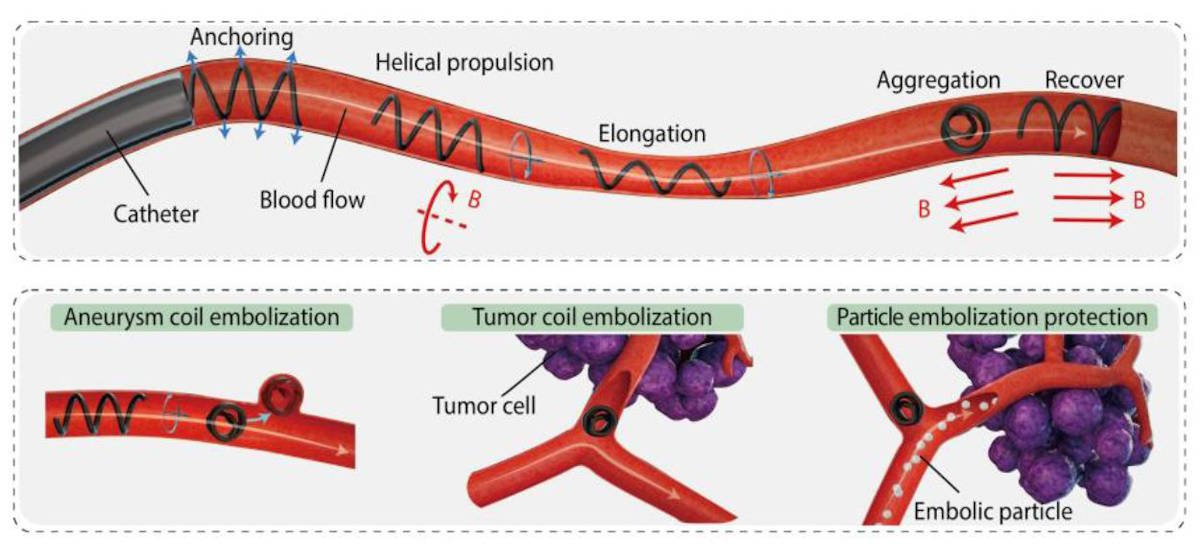
In an effort to address this challenge, a team of researchers at Huazhong University of Science and Technology (HUST) created tiny magnetic, soft microfibrebots that can carry out such procedures remotely. The devices, made from a magnetized fibre twisted into a helix shape, can fit a range of different vessel sizes and move along in a corkscrew fashion when exposed to an external magnetic field. The results of the research, presented in Science Robotics, demonstrate how the devices were successfully used to stem arterial bleeding in a rabbit.

As co-author Jianfeng Zang explains, the microfibrebots are made by using thermal energy to draw magnetic soft composite materials into microfibres, which are then “magnetized and moulded to give them helical magnetic polarity”. By controlling the magnetic field, the magnetic soft microfibre robot demonstrated reversible morphological transformation (elongation or aggregation) and spiral propulsion through blood flow (both upstream and downstream). This allows it to be navigated through complex vascular systems and perform robotic embolization in the sub-millimetre region.

“The article shows how we performed in vitro embolization of aneurysms and tumours in a neurovascular model, and performed robotic navigation and embolization under real-time fluoroscopy in an in vivo rabbit femoral artery model,” says Zang. “These experiments demonstrate the potential clinical value of this work and pave the way for future robot-assisted embolization surgical options.”

Anchoring function

According to first author Xurui Liu, a PhD student at HUST, each microfibrebot possesses an anchoring function, similar to that of a vascular stent, enabling it to be stably anchored to the inner wall of blood vessels through contact friction to avoid being washed away by the blood flow.

“Its helical magnetization distribution provides the microfibre robot with a net magnetization direction along its central axis. By applying an external magnetic field consistent with the direction of the net magnetization direction, the robot can be elongated,” she says.

“Conversely, when the external magnetic field is opposite to the direction of net magnetization, the robot will gather,” she adds. “The softness and high robustness of this microfibre robot ensures that its morphological reconstruction function remains fully reversible after more than a thousand aggregation and elongation cycles.”

Promising alternative

In contrast to the magnetic soft robots reported in earlier research, Zang confirms that the helical magnetization direction characteristics of the new robots enable their deformation and movement modes to be orthogonally decoupled independently of the control magnetic field, providing “unique magnetic field control flexibility”.

“This feature not only allows a single microfibre robot to move at high speed against the blood flow under the action of a rotating magnetic field, but also enables independent control of the shape and movement of multiple microfibrebots,” Zang explains.

“Additionally, these devices are compatible with commonly used interventional catheters to maximize their potential for use in clinical settings,” he adds.

Faced with the challenges of traditional methods such as catheter-based embolization – particularly in terms of their operational limitations and insufficient precision, as well as the health risks related to doctors being exposed to radiation for long periods of time (from the X-ray guidance system) – Zang points out that the development of magnetic microfibrebot technology provides clinicians with a new means of improving existing treatments.

“The development of microfibrebots provides a new perspective for vascular embolization treatment and shows application potential in minimally invasive surgical treatment technology. This technology provides an effective complement or alternative to traditional catheter embolization technology by precisely controlling blood flow occlusion,” he says.

Zang notes that while this technology shows potential, there are still challenges to overcome prior to its clinical application. These include structural optimization of microfibrebots, increasing the biocompatibility of materials, and development of blood vessel positioning and tracking systems. “The research team is working to address these key issues to advance the application of the technology,” he adds.

New attosecond X-ray spectroscopy technique ‘freezes’ atomic nuclei in place

Scientists can now follow the movement of electrons and the ionization of molecules in real time thanks to a new attosecond X-ray spectroscopy technique. Like stop-motion photography, the technique effectively “freezes” the atomic nucleus in place, meaning that its motion does not skew the results of measurements on the electrons whizzing around it. According to the technique’s developers, it could be used not only to probe the structure of molecules, but also to track the birth and evolution of reactive species that form via ionizing radiation.

“The chemical reactions induced by radiation that we want to study are the result of the electronic response of the target that happens on the attosecond timescale (10-18 seconds),” explains Linda Young, a physicist at Argonne National Laboratory and the University of Chicago, US, who co-led the research together with Robin Santra of the Deutsches Elektronen-Synchrotron (DESY) and the University of Hamburg in Germany and Xiaosong Li of the University of Washington, US. “Until now, radiation chemists could only resolve events at the picosecond timescale (10-12 seconds), which is a million times slower than an attosecond. It’s kind of like saying ‘I was born and then I died.’ You’d like to know what happens in between. That’s what we are now able to do.”

Pump and probe

The new technique works as follows. First, the researchers apply an attosecond X-ray pulse with a photon energy of 250 electron volts (eV) to a sample – of water, in this case, though the team say the technique could work with a wide range of condensed-matter systems. This initial “pump” pulse excites electrons from the water molecule’s outer (valence) orbitals, which are responsible for molecular bonding and chemical reactions. These orbitals are further from the atomic nucleus, and they have much lower binding energies than the inner “core” orbitals: around 10-40 eV compared to about 500 eV. This makes it possible to ionize them – a process known as valence ionization – without affecting the rest of the molecule.

Around 600 attoseconds after the valence ionization, the researchers fire a second attosecond pulse – the probe pulse – at the sample, with an energy of around 500 eV. “The short time delay between the pump and probe pulses is one of the reasons why the hydrogen atoms themselves do not have time to move and are like ‘frozen’,” Young explains. “This means their movement does not affect the measurement results.”

When the probe pulse interacts with the holes (vacancies) left behind in the valence orbitals following valence ionization, the pulse’s energy distribution changes. By reflecting the pulse from a grating that disperses this energy distribution onto a two-dimensional detector, the researchers obtain what Young calls a spectral “snapshot” or “fingerprint” of electrons occupying the valence orbitals.

Finding flaws in earlier results

By observing the motion of the X-ray-energized electrons as they move into excited states, the researchers uncovered flaws in the interpretation of earlier X-ray spectroscopy measurements on water. These earlier experiments produced X-ray signals that appeared to stem from different structural shapes, or ​“motifs,” in the dynamics of water or hydrogen atoms, but Santra says the new study shows this is not the case.

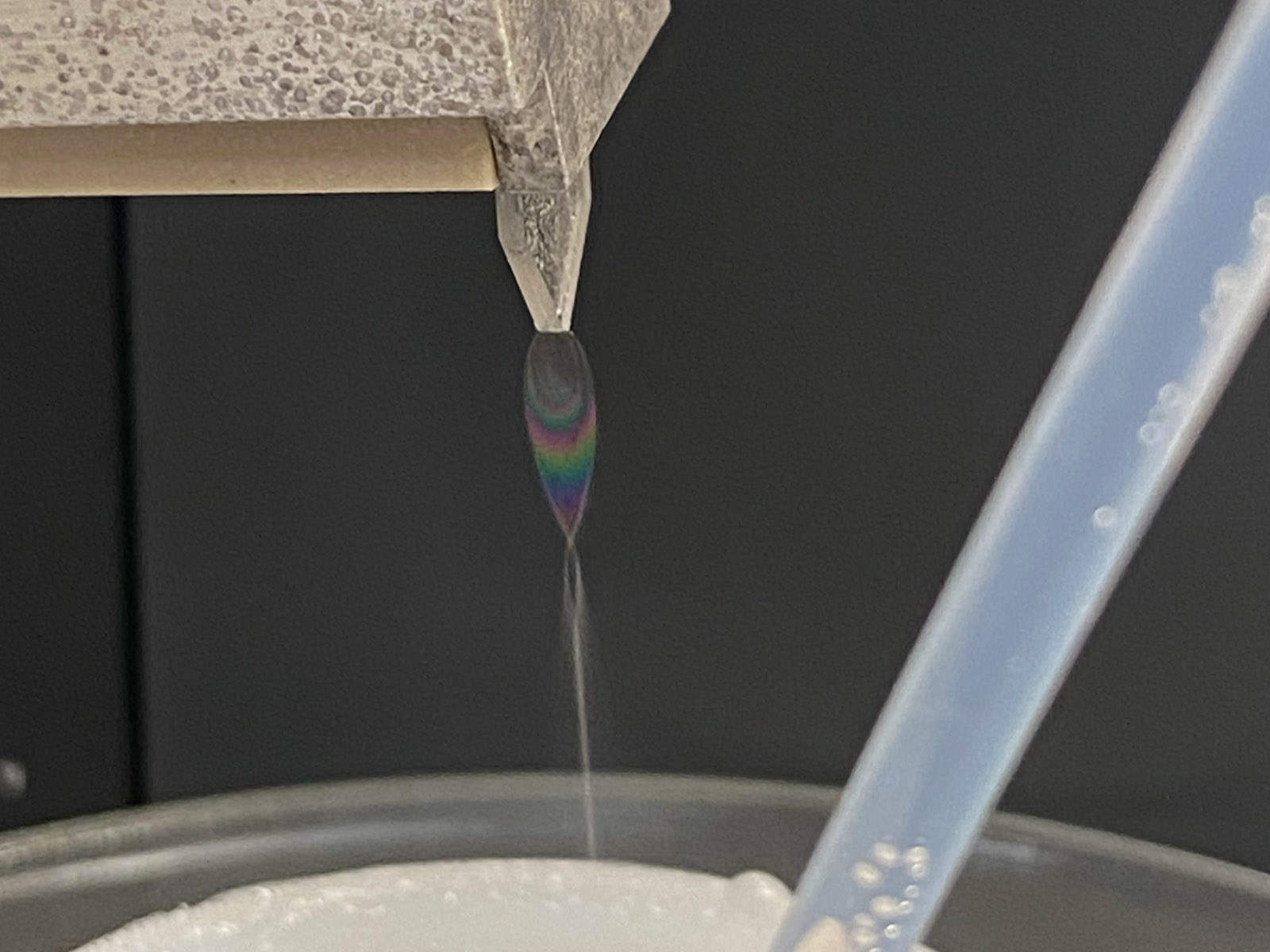
Photo of a thin stream of water falling from a spout

“In principle, one could have thought that the timing precision of this type of experiment is limited by the lifetime (which is around a couple of femtoseconds, or 10-15 seconds) of the X-ray-excited electronic quantum states produced,” he tells Physics World. “Through quantum-mechanical calculations, however, we showed that the observed signal is confined to less than a femtosecond. This is the reason why we were able to show that X-ray spectroscopy measurements on the structure of liquid water had been previously misinterpreted: unlike these earlier measurements, ours were not affected by moving hydrogen atoms.”

Experimental goals and challenges

The researchers’ initial goal was to understand the origin of reactive species created when X-rays and other forms of ionizing radiation impinge on matter. These reactive species form on an attosecond time scale following ionization, and they play important roles in biomedical and nuclear science as well as chemistry.

One of the challenges they encountered was that the X-ray beamline they used – ChemRIXS, part of the Linac Coherent Light Source at the SLAC National Accelerator Laboratory in Menlo Park, California – had to be completely reconfigured to perform all-X-ray attosecond transient absorption spectroscopy. This powerful new technique makes it possible to study processes on extremely short time scales.

The researchers now plan to extend their studies from pure water to more complex liquids. “Here, the different molecular constituents can act as traps for the freed electrons and produce new reactive species,” Young says.

They report their present work in Science.

Ultraviolet dual-comb spectroscopy system counts single photons

Dual comb spectroscopy

Dual-comb spectroscopy – absorption spectroscopy that utilizes the interference between two frequency combs – has been performed at ultraviolet wavelengths using single photons. The work could lead to the use of the technique at shorter wavelengths, where high-power comb lasers are unavailable. The technique could also find new applications.

Since their invention at the dawn of the 21st century, frequency combs have become important tools in optics. As a result, Theodor Hänsch of the Max Planck Institute for Quantum Optics in Germany and John Hall of the US National Institute for Standards and Technology shared the 2005 Nobel Prize for their invention. A frequency comb comprises short, periodic light pulses containing a very broad spectrum of light with intensity peaks at regular frequency intervals – resembling the teeth of a comb. Such spectra are particularly useful whenever light at a precisely defined frequency is needed, such as in atomic clocks or spectroscopy.

In traditional spectroscopy, a frequency comb can be used as an “optical ruler” when probing a sample with another laser. “You have a continuous-wave [CW] laser interacting with the sample that you want to analyse and you want to measure the absolute frequency of this CW laser,” explains Nathalie Picqué of the Max Planck Institute of Quantum Optics. “And for this you beat the laser with the frequency comb. So the frequency comb gives you the possibility to measure any frequency but at a given time you only measure one.”

Intensity changes

In contrast, dual-comb spectroscopy exposes the sample to broadband light from a frequency comb itself. As the input is broadband, the output is also broadband. However, the light passing through the sample combines with the light from a second frequency comb with a slightly different repetition frequency at an interferometer. The changing intensity of the light emerging from the interferometer is recorded (see figure).

If the sample has not interacted with the first frequency comb – the periodic intensity change simply reflects the difference in the repetition frequency between the combs. However, if the sample absorbs light from the comb, this alters the shape of the intensity modulation. The absorbed frequencies can be recovered from a Fourier transform of this temporal interference pattern.

Dual-comb spectroscopy has been very successful at infrared frequencies. Using the technique at higher frequencies, however, is problematic. “There are no ultrafast lasers that directly emit in the ultraviolet region,” explains Picqué, “so you need to use non-linear frequency conversion, and the more you want to go into the ultraviolet, the more stages of non-linear frequency conversion you need.” Non-linear frequency up-conversion is very inefficient, so the power drops at each stage.

Low-power solution

So far, most researchers have focused on increasing the power in the incoming infrared laser. “You have a very challenging experiment with high power lasers, a lot of noise and a very expensive system,” says Picqué. In the new research, therefore Picqué, Hänsch and colleagues at the Max Planck Institute for Quantum Optics created a system with much lower power requested.

The researchers up-converted two infrared combs twice, first in a lithium niobate crystal and then in bismuth triborate. The resulting ultraviolet combs generated average optical powers of at most 50 pW. The researchers passed one of these through a cell of heated caesium gas, while the other one was sent straight to the interferometer. One arm of the interferometer was sent to a single photon counter. “There are really very few counts,” says Picqué; “If you take one scan the signal does not look like anything.” However, they then repeated exactly the same scan over and over again. “When we repeat the scan 100,000 or close to a million times we get our time domain interference signal, which is the signal we are looking for.”

In around 150 s of scanning time, the researchers could resolve two atomic transitions in caesium that have similar frequencies, with signal-to-noise ratios of about 200. They could also observe the splitting of  one of the transitions caused by the the hyperfine interaction.

“The idea of working at very low light levels is very counterintuitive,” says Picqué. “We show that the technique can work with optical powers that are one million times weaker than what has been used before.” They now hope to push to even shorter wavelengths in the vacuum ultraviolet. Aside from ultraviolet spectroscopy, the capacity to utilize dual-comb spectroscopy at very low powers could prove useful in a variety of other situations, explains Picqué, such as where samples are prone to radiation damage.

Dual-comb expert Jason Jones of the University of Arizona, who does experiments far into the vacuum ultraviolet is enthusiastic about the Max Planck work. “No matter how far you go into the ultraviolet, you’ll always have some minimum amount of light because of the way it’s generated, so if you can use less light, you’ll always be able to go deeper,” he says. “Being able to use single photons and still get good signal-to-noise spectroscopic results is significant for that.”

The research is described in Nature.

Explaining the origin of life with physics

Can you explain the origin of life on Earth using the principles of thermodynamics and statistical mechanics? It’s not a question that even physics students see in their more challenging assignments. But it is one that Liam Graham – physicist turned economist – attempts to answer in his debut book Molecular Storms: the Physics of Stars, Cells and the Origin of Life.

Throughout Molecular Storms, Graham uses a light, informal tone with a measured injection of humour to keep readers on a direct path from the laws of thermodynamics to the inception of biological diversity. He begins by painting a picture of the motions of molecules in the “molecular storm”. The opening chapters acquaint the reader with the main tenets of statistical mechanics (such as microstates and Brownian motion) as well as, of course, thermodynamics.

Graham clearly explains that the entropy (disorder) of a closed system is destined to increase, and describes in detail the operation of heat engines, motors and their lesser-known cousin, ratchets. Other blockbuster principles of physics – such as Noether’s theorem (which relates conservation laws to symmetries in nature) and quantum superposition – are also introduced in passing, more in the form of acknowledgement than explanation.

Graham continues with an examination of the prerequisites of life. The physics groundwork that he’s laid lets him explore how the formation of planets, the action of enzymes and the biological processes essential to the functioning of cells can all be understood in terms of the thermodynamical concepts of ratchets and heat engines.

This section is supported by a brief but clear detour into how mixtures of molecules are driven to chemical equilibrium by the molecular storm. The diversion into chemistry is necessary for the reader to follow the lengthy discussion in the next few chapters about the reactions of compounds, which play a central role in the metabolism of cells. The book ends with a detailed discussion of the thermodynamics that would have been key to the production of organic molecules and the environment of the newly formed Earth, like hydrothermal vents and ponds.

As someone with a pure physics background, I was tempted to refer to other sources to fully understand the more biology-heavy chapters. Still, there is enough detail for the reader to comfortably follow the general direction of the book’s argument. But given the virtual impossibility of explaining every relevant process of such a complex subject in detail – while still entertaining and holding the reader’s attention – Graham includes lots of well-researched suggestions for further reading and links to relevant research papers.

Which “hard problem”?

Graham’s career, characterized by a journey across various disciplines including physics, philosophy and economics, is reflected in the structure of his book. This blend of different fields might be why Molecular Storms is such an engaging read. The strong undertone of statistical mechanics throughout the narrative undoubtedly owes its origin to his first degree in theoretical physics from the University of Cambridge.

But Graham also draws on his background in philosophy to address the puzzle of the origin of life, referring repeatedly to the concept of a “Boltzmann brain” – that is, the idea that random fluctuations of matter could give rise to consciousness. In a similar vein, he explicitly demotes the “hard problem of consciousness” – which questions how physical matter gives rise to conscious and subjective experience – saying, “The origin of life is as complex a problem as there is (I suspect it will prove harder than the so-called ‘hard problem’ of consciousness).”

Molecular Storms is likely to appeal to readers on two levels. First, it can be seen as a fascinating guide for a reader with a general interest in physics, examining a physicist’s view of the emergence of life. This casual reader can enjoy the ride without needing to turn to the mathematical calculations outlined in the appendices.

This book is a good example of the interdisciplinary nature of scientific research, something that is often under-emphasized in undergraduate courses

Alternatively, an undergraduate student interested in this area would benefit from working through the calculations and following the explanations. This book is also a good example of the interdisciplinary nature of scientific research, something that is often under-emphasized in undergraduate courses. However, I would advise student readers to have other texts on hand unless they already have a very good conceptual grasp of the principles mentioned.

Indeed, both the casual reader and the student would benefit from referring to the online resources for illustrations of the concepts discussed, as the diagrams in the book are sometimes merely representative of the online content.

But as most Physics World readers are likely to fall into one of these categories, I would highly recommend that you add Molecular Storms to your reading list.

  • 2023 Springer 291pp £29.99pb £23.99ebook

Solid-state battery electrolyte makes a fast lithium-ion conductor

Researchers at the University of Liverpool, UK have developed a new solid-state battery electrolyte that conducts lithium ions so rapidly, it could compete with the liquid electrolytes found in today’s ubiquitous lithium-ion batteries. This high lithium-ion conductivity is a prerequisite for rechargeable energy storage, but it is unusual in solids, which are otherwise attractive for batteries because they are safer and quicker to charge.

The new electrolyte has the chemical formula Li7Si2S7I and contains ordered sulphide and iodide ions arranged in both a hexagonal and cubic-close-packed structure. This structure makes the material highly conductive because it facilitates the movement of lithium ions in all three dimensions. “One could envisage it as a structure that allows lithium ions to have more ‘options’ to choose from for movement, which means they are less likely to get stuck,” explains Matt Rosseinsky, the Liverpool chemist who led the research.

The right material with the right properties

To identify a material that facilitates this freedom of movement, Rosseinsky and colleagues used a combination of artificial intelligence (AI) and crystal structure prediction tools. “Our original idea was to create a new structural family of ion conductors inspired by the complex and diverse crystal structures of intermetallic materials, such as NiZr, in order to generate a wide range of potential sites for the lithium ions to move between,” Rosseinsky explains. AI and other software tools helped the team know where to look, though “the final decisions were always made by the researchers and not the software”.

After synthesizing the material in their laboratory, the researchers determined its structure with diffraction techniques and its lithium-ion conductivity with NMR and electrical transport measurements. They then demonstrated the lithium-ion conductivity efficiency experimentally by integrating the material into a battery cell.

Exploring unchartered chemistry

Rosseinsky’s research focuses on designing and discovering materials to support a transition to more sustainable forms of energy. This type of research involves a wide variety of techniques, including digital and automated methods, exploratory synthesis of materials with new structures and bonding, and the targeted synthesis of materials with real-world applications. “Our study brought all these directions together,” he says.

Discovering materials that differ from known ones is difficult, Rosseinsky adds, not least because any candidate materials must be experimentally realized in the lab. Once he and his colleagues have determined a material’s synthetic chemistry, they must then measure its electronic and structural properties. This inevitably requires interdisciplinary research: in the present work, Rosseinsky teamed up with colleagues in the Materials Innovation Factory, the Leverhulme Research Centre for Functional Materials Design, the Stephenson Institute for Renewable Energy and the Albert Crewe Centre and School of Engineering as well as his own department of chemistry.

Applicable to the larger field of battery research

The process the team developed, which is detailed in Science, could be applicable throughout the field of battery research and beyond, Rosseinsky says. “The knowledge gained in our work about how to favour fast ion motion in solids is relevant for materials other than those employed in lithium-ion batteries and is generalizable to other techniques that rely on ion-conducting materials,” he tells Physics World. “This includes proton or oxide ion conducting materials and solid-state fuel cells or electrolysers for hydrogen generation, as well as sodium and magnesium-conducing materials in alternative battery structures.”

The researchers say that Li7Si2S7I is likely just the first of many new materials accessible with their new approach. “There is thus much to do in defining which materials can be studied and how their ion transport properties connect to their structures and compositions,” Rosseinsky concludes.

Surf’s up: Physics World admires the famous Severn bore

This morning some of the Physics World team set out from Bristol at 7:00 and by 8:30 we were standing on a muddy riverbank in the pouring rain. Along with a growing crowd of people, we were watching the River Severn rush towards the sea – swollen by this winter’s heavy rains.

While some were sharing flasks of coffee and tea while huddling under umbrellas, the braver in the crowd were launching surfboards and kayaks into the cold river. Most had wetsuits and specialist gear on, but one hardy paddler was out in a T-shirt and tracksuit bottoms. (No Physics World personnel got into the river, we watched safely from the bank).

Then, just after 9:00 and ahead of schedule, a huge wave came roaring up from the sea some 50 km away. This was the Severn’s tidal bore. I first spotted it as it rounded a bend in the river, picking up about half a dozen surfers and kayakers and launching them upstream. While most were just scattered by the wave, two managed to surf several hundred metres past us before being pushed into a tree that was leaning precariously from the opposite bank.

Extreme range

Today’s bore was rated a five-out-of-five, and that’s why we made the trek to watch it. The Severn has one of the highest tides in the world and this morning the tidal range in its estuary (at Avonmouth) was nearly 14 m. This extreme range was caused by the alignment of the Moon and Sun through Earth’s equator – which happens around the equinoxes.

The tidal bore is created when the incoming tide enters a shallow, narrowing river. When the rising tide over tops the river flow, a surge of water travels upstream as a series of waves. Indeed, another amazing aspect of this morning was how rapidly the tide rose as the bore passed. Before the event, the level of the river was constant but after the wave passed it had risen about 2 m in what seemed just a few minutes.

There are several other rivers around the world that have tidal bores, and you can read more about them – and the physics behind the phenomenon – in this article by the physicist Michael Berry: “Chasing the Silver Dragon: the physics of tidal bores”.

Rhapsody as European synchrotron examines Niccolò Paganini’s violin

An almost 300-year-old violin that was played by the great virtuoso Niccolò Paganini has been studied at the European Synchrotron, the ESRF.

As one of the most famous violins in the world, “Il Cannone” was crafted in 1743 by the great luthier Bartolomeo Giuseppe Guarneri. The instrument was Paganini’s most treasured due to its unique acoustic properties.

Paganini is considered to be one of the greatest violinists of all time, so talented that it was rumoured that his mother had sold his soul to the devil to gain his abilities.

The ESRF teamed up with the violin’s custodians, the municipality of Genoa, and the Premio Paganini, to carry out an X-ray analysis to help determine the structural status of the wood and bonding parts of the violin.

The measurements were performed on ESRF’s new beamline, BM18, which is able to construct a 3D X-ray image of the instrument with micrometre resolution using a technique called phase-contrast X-ray microtomography.

It is hoped that carrying out such measurements will help to preserve the instrument, which is only occasionally played.

ESRF scientist Luigi Paolasini, who led the project, says it was a “fantastic experience” to work on the violin.

“[It] opens new possibilities to investigate the conservation of ancient musical instruments of cultural interest, as a crossing point between music, history and science”, he says.

Copyright © 2026 by IOP Publishing Ltd and individual contributors