

On 10 December 1997, after a session lasting two days and nights virtually without a break, politicians at the climate summit in Kyoto, Japan, agreed a protocol limiting the emissions of greenhouse gases from developed countries. The agreement is not as strong as many countries and environmental groups would have liked – and participants have yet to sign and ratify the protocol – but to have achieved any agreement on an issue with such large global implications was an enormous step forward. The agreement at Kyoto (Physics World January p14) is strongly rooted in accurate and honest science, and balanced technology, as was the UN Framework Convention on Climate Change, which was signed at the “Earth Summit” in Rio de Janeiro in 1992 and under whose auspices the Kyoto summit was held. The Kyoto agreement is also based on the belief that the science of climate change – as expounded by the UN’s Intergovernmental Panel on Climate Change – is basically sound, and that adequate and appropriate technology is available to enable the emissions of greenhouse gases to be reduced to the necessary levels. So what science and technology will be needed over the next decade if the objectives of the climate convention are to be realized? So far, scientists have been able to make useful projections of the likely climate change over the next century in terms of global averages. For example, in the absence of any mitigating action, the global average temperature is likely to rise over the next 100 years by about 2.5 oC (with a range of 1-3.5 oC), while the sea level will rise by about 0.6 m (with a range of 0.2-1 m) over the same period. The hydrological cycle is likely to be more intense, leading, in some places, to more frequent and more intense floods and droughts. (For full details, see Climate Change 1995: the Second Assessment Report 1996 Cambridge University Press). Progress now needs to be made in reducing the uncertainties in such estimates and in providing more credible regional detail. So what are the greatest uncertainties in projecting the likely climate change over the next century? The increase in the atmospheric concentration of carbon dioxide – the main greenhouse gas – and its link with fossil-fuel burning is well understood. Less well known are the climate effects of particles in the atmosphere. These particles, also known as aerosols, arise from a variety of sources – for example, from the burning of forests or from sulphates generated by power stations and other industrial activity (see ” Air pollution: the role of particles” by Christopher Noble and Kimberly Prater Physics World January). Uncertainties in quantifying the likely climate changes also come from our lack of knowledge of some of the major feedbacks that occur in the climate system, in particular: those arising from the effects of changes in cloudiness, which can lead to both positive and negative feedback; those due to interactions of the climate with the ocean circulation, which can have a large regional effect; and those due to changes in the biosphere. In addition to improvements in the accuracy of projections on a global scale, we also need much more accurate and more detailed information on local and regional scales. Scientific progress will come from carefully planned and painstaking analyses of observations, and by incorporating better physics and dynamics into computer models of the climate. And as more computer power becomes available, progress will also be made from models that have higher spatial and temporal resolution. Increased understanding of major questions, such as those to do with cloud, ocean and biosphere feedback, will only come by combining more accurate observations possessing better coverage with careful model simulations. One particular concern in recent years has been the tendency to cut back on some important climate observations, which have been discontinued to save money in the short term, with no thought to the long-term consequences for our understanding of the climate. A major challenge is therefore to improve the accuracy and coverage of global observations and to ensure that the data become more easily available to researchers – concerns that are being addressed by the international Global Climate Observing System. Well designed programmes of space observations that also manage, disseminate and analyse the data properly will be central to an effective observational network. In addition to the science of climate change itself, there is a lot of research to be done in understanding the impacts of climate change. Since some climate change will inevitably occur – whatever action is taken to reduce emissions – we urgently need to carry out scientific and technical work that will help us to adapt to climate change, for instance to changes in sea level and the availability of water. This work will need to take into account other causes of environmental degradation, such as those arising from deforestation or the overuse of ground water. However, as the UN Framework Convention on Climate Change (UNFCCC) clearly recognizes, we cannot just prepare ourselves to adapt to climate change. We also need to put a lot of effort into mitigating against climate change. Indeed, the objective of the UNFCCC is to stabilize the concentration of greenhouse gases in the atmosphere at a level and on a timescale that is consistent with the needs both of the environment and of sustainable development. Stabilizing concentrations in this way will eventually demand severe cuts in global emissions. Emissions of carbon dioxide, for example, would have to fall to well below today’s levels by the second half of the 21st century. The Kyoto protocol, which agreed that the emissions of the main greenhouse gases from developed countries should be reduced by 5-8%, can therefore be seen as a rather modest first step towards what will be required later. Since emissions of carbon dioxide, which arise from the burning of fossil fuels such as coal, oil and gas, contribute about two thirds of the total effect, most attention must be given to reducing our consumption of these sources. But emissions of methane, the second most important greenhouse gas, could also be lowered by stemming leaks from pipelines, by reducing deforestation (which is good for other reasons too) and by reducing the methane arising from agricultural sources. They could also be lowered by cutting the amount of waste going to landfill sites and by collecting the gas that such sites emit. However, the availability of cheap energy is seen as the engine for industrial and economic growth, and these reductions are not going to be easily made. So what can be done to reduce our use of fossil fuels in the energy and transport industries? The average efficiency of energy supplies has substantially increased in recent years, but there is still plenty of room for further improvement. For instance, technologies are available that could improve the efficiency of coal-fired power stations, which is typically no more than about 35%. I will mention just two possibilities. First, the materials used in the advanced aerospace industry could be transferred to steam-power plants, which would, according to Colin Humphreys of Cambridge University, raise the operating temperatures of such plants from 550 oC to 750 oC, and increase their efficiency by about 50%. Second, “combined heat and power” plants, which have a typical overall efficiency of about 80%, have a large potential for growth in countries like the UK, where their use has so far been comparatively limited. There are also a number of possibilities for removing the carbon dioxide from fossil-fuel emissions so that the gas does not enter the atmosphere. The most promising idea is to pump the carbon dioxide down into spent (or partially spent) gas or oil wells, where it can then be used to increase the gas or oil yield. For example, a company in Norway, where there is a carbon tax, has found it makes economic sense to sequester unwanted carbon dioxide in a gas well, rather than pay the tax that would be required if it were released to the atmosphere. However, the key to future sustainable energy provision lies in the rapid development and growth of renewable energy sources. Indeed, a number of such sources are poised for growth. In appropriate locations, wind energy can be supplied at a price that is becoming competitive with fossil-fuel sources. Power stations that use waste materials or renewable biomass as fuel are also being developed. And solar energy is likely to become one of the major sources of world energy, particularly through the use of photovoltaic cells to generate electricity, with hydrogen produced electrolytically as a storage medium. Wave and tidal energy sources could also be developed. In 1993 the World Energy Council developed a detailed scenario for energy provision in the next century, in which “new” renewable energy sources would make up 12% of the total energy provision by 2020. However, the council pointed out that real commitment and substantial investment would be needed to achieve this goal, and it emphasized the need for urgent action. “The real challenge, ” said the council, “is to communicate the reality that the switch to alternative forms of supply will take many decades, and thus the realisation of the need and commencement of the appropriate action must be now [their italics].” Most energy is used inefficiently, and only a few per cent of primary energy is turned into effective use; the rest is simply wasted. There is therefore enormous potential to increase energy efficiency in buildings, industry, domestic appliances and transport (see, for example, Factor Four: Doubling Wealth, Halving Resource Use by Ernst von Weizsacker, Amory Lovins and Hunter Lovins 1997 Earthscan Publications). We could, for example: Another major concern is the current level of research and development into the science and technology of climate change and how to mitigate against any further decline. Particularly worrying has been the trend over the last ten years to reduce R&D investment in energy-supply and energy-use technologies. As the markets have increasingly taken over energy supply, neither governments nor the energy industry are investing as much in long-term R&D as they previously had done. For example, government spending on energy R&D has fallen by a factor of ten in the UK since 1983, while the global average has fallen by a factor of three to about 0.04% of the world’s gross national product. This is a tiny sum compared with the capital investment in the energy industry, which is nearly 4% of the world’s gross national product. If greater energy efficiency and the necessary growth in renewable energy sources are to be achieved, we need much greater support for R&D by both industry and governments. The UK government has put forward its own target of a 20% reduction in carbon dioxide emissions by 2010. Although this target is not legally binding, it is nevertheless one that the government intends to take seriously. Such a demanding target can only be achieved through an effective partnership, in which all sectors of society play their part. The challenge for the UK government is to set up this framework – including appropriate economic and other incentives – in which change can occur. Industry, with the support of scientists and technologists, must provide innovative technology and develop the necessary markets. Meanwhile, all of us as consumers need to demand products that generate fewer greenhouse gas emissions, both when they are made and when they are used. We must also recognize the need to make changes in the way that we do things, and in the way that we live our lives.The science of climate change
Impacts, adaptation and mitigation
Developing energy-supply technologies
Developments in energy-use technologies
Research and development
The way forward
Consultancy as a career
Reviewed by Allan Newton
This is an interesting book that analyses the career options of scientists who become consultants, whether in a self-employed capacity or in a large consultancy firm. It is a book that surely must be required reading for scientists who are considering consultancy or thinking about setting up their own small high-tech business. The authors have a pleasant style, which makes the book easy to read, but they are clearly scientists first and authors second, for their material is based on thorough research that included a questionnaire and follow-up interviews with practising consultants.
The book does have some limitations, most of which are freely acknowledged by the authors. It is written by Americans and is largely based on the social, academic and industrial environment of the US. It also sticks very closely to its title of “the scientist as consultant” and seems largely to ignore the whole area of technology transfer and design. Surprisingly, the book also limits most of its examples to the biological and environmental sciences.
Although the first limitation is trivial – anyone can translate Americanisms such as CPA, attorney and IRS into their own language – the fact that the book concentrates on science and excludes entirely engineering and technology transfer applications is a much more serious drawback. Most UK physics consultants would probably agree that these are very fertile business areas, and in my own business they account for the bulk of my work. The authors also largely ignore alternative sources of income – such as writing books, giving training courses and selling high-value products – that many consultants take on as a sideline to their main business. It is a pity that these activities are hardly addressed, because many consultants find them technically and financially beneficial.
Where the book is strong is in its analysis of the various skills that are needed to manage a science-based business. Indeed, on this basis the book will be valuable reading for anyone who is running – or planning to run – such a firm. For example, the authors discuss the myriad of areas in which small businesspeople need skills that are peripheral to those of their core business, such as bookkeeping, sales and marketing. Although this material is quite standard, and can be found in many business textbooks, Sinderman and Sawyer depart from almost all other authors by actually questioning whether a business should expand or not.
From my experience, most textbooks, business advisers and indeed friends and family automatically assume that all businesspeople want to expand their businesses. Now this may be true for the person who is a businessman or woman first and a physicist, plumber or landscape gardener second. But most consultants are physicists first, and businesspeople only out of real necessity. If we do decide to expand our firms, it only increases the on-physics workload. And the reason why many of us set up a consultancy in the first place is precisely because we wanted to do more physics – not less. It is therefore very pleasant to read, as we do here, that being a sole proprietor is a valid business objective, and that many scientific consultants have decided to remain as sole proprietors. Expansion and growth are, of course, valid – but we need not feel ashamed for wanting to stay as solo operations.
The two areas in the book that are specific to high-technology consultancy and manufacturing businesses are ethics and the need to keep up to date with your subject. The whole ethical basis of consulting – particularly in the authors’ speciality of environmental science – can be highly problematic. For example, many customers who ask for “environmental impact” studies tend to know in advance what result they want. A developer usually wants a consultant to produce a report that concludes that the project in question will have no detrimental impact, while opponents of the project will want a report that predicts catastrophe. The consultant can therefore feel under pressure to deliver what the client wants, rather than a more factual analysis. One of the examples in the book shows a client who ignored one consultant and retained another, more well known consultant who delivered the desired result. The point is that a scientific consultant must satisfy three codes of practice and ethics simultaneously – those of the scientist, the businessperson and the independent consultant.
Keeping up with your subject – or continuing professional development (CPD) to sound more impressive – is a problem that most scientists and engineers encounter. For the one-person business it can be a difficult problem, as it is a long-term effect, and for so many of us, short-term problems are usually more pressing. (After all, if the short-term problems cannot be solved, then the long-term problems will be irrelevant!) And for older scientists, who see their businesses gradually tailing off as they drift into retirement, CPD hardly counts. But for younger scientists, who will have to stay at the front of their chosen field for perhaps 20 or 30 years, CPD is important. Attending meetings and conferences can, with some careful planning, be used to keep you abreast of your subject, and to make and maintain the network of contacts that are the essentials of marketing and selling consultancy services. In other words, CPD can meet both your short-term and long-term objectives.
The conclusion of the book is that for the right individual, consultancy can be an intellectually and financially rewarding career path. Like all career paths, it has its own attractions and its own pitfalls. In the UK, for example, there are probably more pitfalls as an independent consultant than as a salaried employee, but there are also many more attractions. This book will help you to decide whether a career as an independent physicist is the right one for you, and then help you along the road to success.
The messages from the book are also somewhat more widely applicable than I think the authors realize. If you are setting up a small technology-based business – be it consulting, design, technology transfer or manufacturing – then this book should be one of the first you read. It might even be an invaluable investment to give a copy to your bank manager, who may end up with a better understanding of your business.
Einstein’s papers
This volume, sixth in an ongoing series of works by Princeton University Press, contains some of Albert Einstein’s more important papers on quantum theory and general relativity. Early versions of some of these papers had numerous inaccuracies in the text. This was because of the “publish or be damned” attitude prevalent at the time. Many scientists rushed to get their work published, and common mistakes crept into their papers as aspects of proof reading were overlooked.
The editors of this edition, along with the translator have tried to correct many of these errors, and have made notes in the margins where these corrections have been made. The translation itself is very close to the original German, and the editors have done an excellent job in building such a collection of unique papers together.
Einstein was one of the leading giants of twentieth century physics, and every physicist should at one time read one of his papers.
How to deal with mistakes
Luckily the literature is not like a barrel of apples and one bad paper will not ruin all of the others. There are also different types of mistakes with different consequences. Deliberate mistakes are the most damaging and, on the basis of recent high-profile cases, such scientific fraud is largely a problem for life scientists rather than physical scientists. One reason for this is that the concept of reproducibility is less clear-cut in biology, although financial considerations also play a role.
Most mistakes, however, will be honest ones. If an honest mistake has major consequences then it will be spotted quickly and little harm will be done. If the paper is of little consequence, the evolutionary processes at work inside science mean that the paper will effectively die. The biggest problem with honest mistakes is that a lot of time and money can be wasted by other researchers. We can take comfort, therefore, from recent developments in the search for both extrasolar planets and life on Mars.
The planet story has turned full circle. In 1995 two Swiss astronomers published evidence that a planet with half the mass of Jupiter was orbiting close to the star Pegasi 51. Many astronomers were puzzled as to how such a large planet could have formed so close to a star, but the finding was accepted by the community and was quickly followed by several other discoveries. Last year, however, a Canadian astronomer published a high-profile paper suggesting that Pegasi 51 did not have a planet. Now the same astronomer has looked at the data more carefully and changed his mind, concluding that a planet may be the best explanation after all.
The life-on-Mars story is not so clear. Moreover, it involves researchers from a range of disciplines including biology, geology, chemistry and space science. In 1996 US researchers reported evidence for microfossils in a meteorite that originally came from Mars. Now one team of US researchers is claiming that the microfossils are geological, not organic, while two other teams claim that the organic material in the meteorite came from the Earth in the first place.
What both cases show, however, is that when the stakes are high, scientists will attempt to reproduce results, and mistakes of all types will be weeded out.
Physics and biology
There has been a lot of loose talk lately about the next century being the century of biology. This has come to a head with reports that the US president, Bill Clinton, has said that biology will be the science of the 21st century just as physics was the science of the 20th century. As with much of what Clinton says, or is reported to say, the true story is often distorted. For the record, what Clinton actually said was: “I do believe that in scientific terms, the last 50 years will be seen as an age of physics and an age of space exploration. I think that the next 50 years will very likely be characterized predominantly as an age of biology and the exploration of the human organism.” Comforting words for life scientists, to be sure, but hardly the end of physics at we know it.
This magazine has often advocated that physics and physicists should see medicine and biology as an opportunity rather than a threat. These opportunities range from the most basic researches into the workings of cells and the brain to the development of sophisticated hardware for the diagnosis and treatment of disease (June 1996, July 1997). The movement of physicists into these fields is not an admission of defeat but a natural and logical application of physics. And if it resonates with politicians and funding agencies, so much the better.
Pathfinder leads the way to red planet
In The Crystal Egg, a short story written in 1897, HG Wells describes how a remarkable object in Mr Cave’s Curiosity Shop allows its owner to gaze at a real-time image from the surface of Mars while sitting in a darkened room on Earth. A century later, we can all do much the same thing, courtesy of NASA and its new line of bargain-basement planetary missions.
The programme was spearheaded last year by Mars Pathfinder, largely developed by scientists and engineers at the Jet Propulsion Laboratory (JPL) in California. They are proud of the fact that Pathfinder cost about the same as Titanic, the latest Hollywood blockbuster, and delivered at least as many thrills. It has also made a another small step in mankind’s quest for knowledge of its origins and its destiny, as the first scientific results have shown (Science 1997 278 1743-1768).
To appreciate the scale of Pathfinder’s achievement, it is necessary to understand its background and goals. Despite appearances, the name was not chosen because Pathfinder is the first in a series of missions that will explore Mars in the next decade, which will hopefully include Mars Express, Europe’s first contribution to the “faster, cheaper, better” revolution. It was instead a test flight for the Mars Environmental Survey (MESUR), an ambitious project that would have landed 20 or so stations on Mars at the same time. Even in the old days, implementing so many stations would have required a rethink of the expensive landing technology used for Viking in 1976. When MESUR was cancelled because of its cost – pushing into billions of dollars – NASA decided to carry on with the development flight. Science was never really in the driving seat.
How wonderful, then, that Pathfinder has achieved so much in terms of public interest, and scientific results as well. The dramatic landing, the ability of the probe to move on Mars for the first time and the intrinsic interest of seeing the Martian surface all contributed to its success. For example, important insights can be gained from the photographs Pathfinder took of the region where it landed, the Ares Vallis. This is one of many regions on Mars that appears, from orbit at least, to have contained running water in the geological past. The scene around the lander showed rocks and pebbles rounded by erosion, as well as a layered material that was probably deposited by running water. These and other clues provide almost indisputable evidence that Mars was once warm and wet with a thick atmosphere.
Tracking the lander on the surface of Mars has given new information about the precession of the planet’s axis of rotation and variations in the rate at which the planet turns on its axis. This has provided a new value for the moment of inertia, which constrains models of the interior. The latest indication is that Mars has a central metallic core 1300-2000 km in radius, with the exact value depending on the composition of the core and the overlying crust. It seems that the core of Mars contributes less to the planet’s total mass than is the case for Earth.
A large fraction of the Martian atmosphere (about 30%) condenses on the winter pole and then sublimes back into the atmosphere in the summer, which changes the planet’s moment of inertia and causes the length of the Martian day to vary with season. Nearly a trillion tonnes of carbon dioxide are transferred in this way every year, a phenomenon that has no significant analogue on Earth but has a large effect on the Martian weather. Combining the new observations of rotation and precession with those from Viking 20 years ago has provided a much better picture of the dynamics of the Martian globe. This provides good agreement with a model of the dynamics in which the rate of mass exchange is estimated from the change in pressure over a Martian year.
Pathfinder investigated the atmosphere of Mars with a package of meteorology instruments that collected data on the surface and on the way down to the planet. The MESUR network would have monitored the atmosphere in three dimensions, and a single station is much less useful, especially when short-lived. However, the data provide a valuable one-off test for general circulation models of Mars, currently under development in the UK, France and the US. The day-night cycle was much as predicted, as were the trends in temperature (a chilly -10 °C at best on the surface, and as low as -96 °C at night), pressure (varying between 6.55 and 6.85 millibars) and winds (about 10 m s-1, with the direction swinging through a full 360° during the course of a day). Martian weather forecasting may soon be a viable proposition.
The Sojourner rover was also primarily an engineering test bed for more sophisticated missions planned for the next year or two, and was small and dumb compared to the prototypes that are now running around JPL, Arizona, and Death Valley in California. However, it did carry a camera and an a-proton X-ray spectrometer to analyse and examine the soil and rocks. Preliminary results show that the dusty soil does not have the same composition as the rocks, so it was not formed by the grinding up of local material. However, the soil is like that found by Viking at locations elsewhere on Mars, indicating that it is a global mixture of weathered surface material from an unknown location, distributed around the planet by stormy winds.
Magnets mounted on the lander trapped some of the airborne dust and showed that it has a strongly magnetic component. The rocks visited by Sojourner on its 52 m trek around the lander station (now called Sagan) are not identical to each other or to the Martian meteorites found on Earth. Mars is certainly a diverse world.
The philosophy behind Pathfinder meant that it was not intended to last long – a week was planned and the mission actually lasted 83 sols (Mars days, 24.7 hours each). But despite its short life, it opened a new fast track to Mars and did some key science. Most of all, perhaps, it captured the public imagination and provided a boost to the forthcoming programme of intensive research planned for the Martian environment and climate. How appropriate that the landing station should be named after Carl Sagan, who in his spare time was a modern disciple of HG Wells and shared his vision.
Paul Dirac: the purest soul in physics
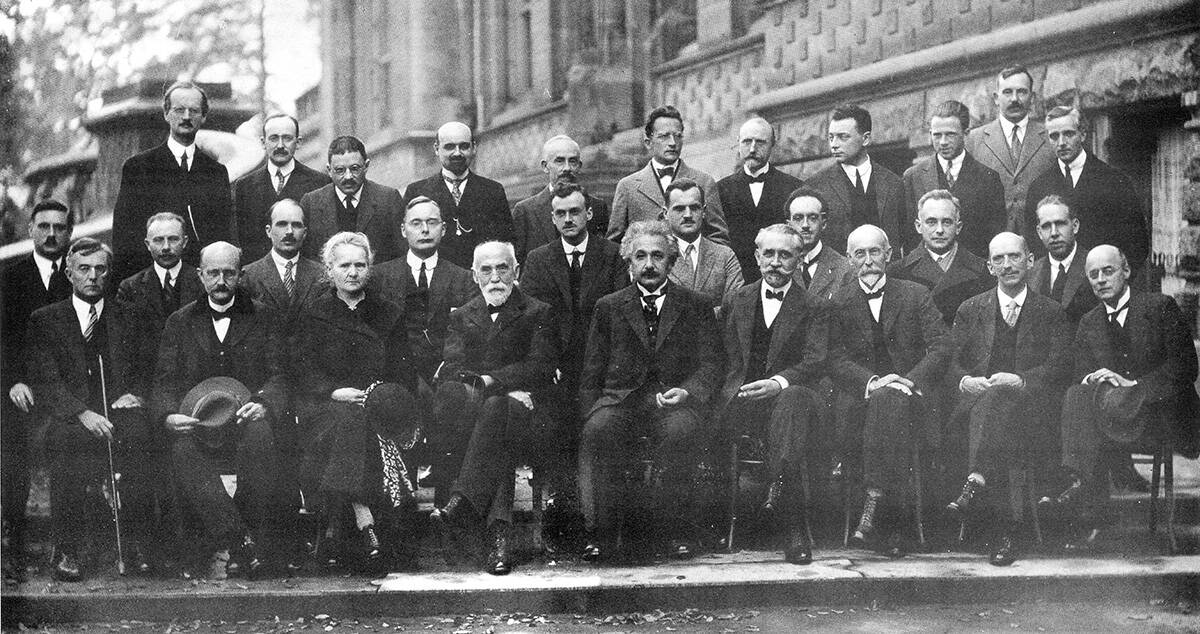
Each day, I walk past the road where Paul Adrien Maurice Dirac lived as a child. It is pleasant to have even this tenuous association with one of the greatest intellects of the 20th century. Paul Dirac was born at 15 Monk Road in Bishopston, Bristol, on 8 August 1902, and educated at the nearby Bishop Road Primary School. The family later moved to Cotham Road, near the University of Bristol, and in 1914 the young Dirac joined Cotham Grammar School, formerly the Merchant Venturers.
Dirac was a student at Bristol University between 1918 and 1923, first in electrical engineering and then in applied mathematics. Much later, he said: “I owe a lot to my engineering training because it [taught] me to tolerate approximations. Previously to that I thought…one should just concentrate on exact equations all the time. Then I got the idea that in the actual world all our equations are only approximate. We must just tend to greater and greater accuracy. In spite of the equations being approximate, they can be beautiful.”
Because Dirac was a quiet man – famously quiet, indeed – he is not well known outside physics, although this is slowly changing. In 1995 a plaque to Dirac was unveiled at Westminster Abbey in London and last year Institute of Physics Publishing, which is based in Bristol, named its new building Dirac House.
It is hard to give the flavour of Dirac’s achievements in a non-technical article, because his work was so mathematical. He once said: “A great deal of my work is just playing with equations and seeing what they give.”
Early days
When Dirac went to Cambridge in 1923, the physics of matter on the smallest scales – in those days this was the physics of the atom – was in ferment. It had been known for more than a decade that the old mechanics of Newton – “classical” mechanics, as it came to be called – does not apply in the microscopic world. In particular, evidence from the light coming out of atoms seemed to indicate that some quantities that in classical mechanics can take any values are actually restricted to a set of particular values: they are “quantized”. One of these quantities is the energy of the electrons in an atom. This was strange and shocking. Imagine being told that when your car accelerates from 0 to 70 miles per hour it does so in a series of jumps from one speed to another (say in steps of one thousandth of a mph), with the intermediate speeds simply not existing. It did not make sense, and yet observations seemed to demand such an interpretation.
In the first attempts at a theoretical understanding, physicists tried to find the general rules for imposing these restrictions on classical mechanics – that is rules for quantization. It seemed that in order to quantize, it was necessary first to identify those quantities that do not change when their environment is slowly altered. If a pendulum is slowly shortened, for example, it swings farther and also faster, in such a way that its energy divided by its frequency stays constant. These rules worked for simple atoms and molecules but failed for complicated ones.

Dirac entered physics at the end of this baroque period. One of his first papers was an attempt at a general theory of these unchanging quantities. This is a delicate problem in classical mechanics, not solved even now. It is amazing today to read that paper. In its mathematics it is quite unlike any of Dirac’s later works (for example, he brings in fine differences between rational and irrational numbers), and “pre-invents” techniques developed by other people only decades later. (I say pre-invents because the paper was forgotten until recently.)
At this time the situation in atomic physics resembled that at the end of the 16th century, when the old Earth-centred astronomy had to be made ever more elaborate in the face of more accurate observations. The difficulties of the 16th and 20th centuries were resolved in the same way: by a complete shift of thought. In atomic physics this happened suddenly, in 1925, with the discovery by Heisenberg of quantum mechanics. This seemed to throw out classical mechanics completely, though it was built in as a limiting case to ensure that, on larger scales, the new mechanics agreed with more familiar experience. The quantum rules emerged automatically, but from a mathematical framework that was peculiar. For example, it involved multiplication where the result depends on the order in which the multiplication is done. It is as though 2 multiplied by 3 is different from 3 multiplied by 2. Heisenberg found this ugly and unsatisfactory. Dirac disagreed, and just a few months after Heisenberg he published the first of a series of papers in which quantum mechanics took the definitive form we still use today.
The main idea is that the multiplied objects – objects that represent variables we can measure in experiments – should be thought of as operations. An experiment is an operation, of course, even though its result is a number. With this interpretation, it is not surprising that the order matters: we all know that putting on our socks and then our shoes gives a result different from putting on our shoes and then our socks. Dirac found the one simple rule by which a multiplied by b differed from b multiplied by a, and from which the whole of quantum mechanics follows.
The same unification was soon found to include Schrödinger’s way of doing quantum mechanics, where the state of a system is represented by a wave whose strength gives the probabilities of the different possible results of measurements on it. For a while this seemed completely different from the framework that Heisenberg had used, but it quickly emerged that in fact each represents Dirac’s operators in a different way. It seemed miraculous.
The Dirac equation
Although brilliant – in Einstein’s words, “the most logically perfect presentation of quantum mechanics” – this was a reformulation of physics that had, admittedly only just, been discovered. Dirac’s main contribution came several years later, when (still in his mid-twenties) he made his most spectacular discovery.
Before quantum mechanics, there had been another revolution in physics, with Einstein’s discovery in 1905 that Newton’s mechanics fails for matter moving at speeds approaching that of light. To get things right, time had to be regarded as no longer absolute: before-and-after had to be incorporated as a fourth co-ordinate like the familiar three spatial co-ordinates that describe side-to-side, forward-and-backward and up-and-down. Just as what is side-to-side and what is forward-and-backward change when you turn, so time gets mixed in with the other three co-ordinates when you move fast. Now, in the 1920s, came quantum mechanics, showing how Newton’s mechanics failed in a different way: on microscopic scales. The question arose: what is the physics of particles that are at the same time small and moving fast?

This was a practical question: the electrons in atoms are small, and they move fast enough for the new quantum mechanics to be slightly inaccurate, since it had been constructed to have as its large-scale limit Newton’s mechanics rather than Einstein’s. From the start people tried to construct a quantum theory concordant with relativity, but failed to overcome technical obstructions: in particular, their attempts gave probabilities that were negative numbers – something that is nonsense, at least in the usual meaning of probability. The question boiled down to this: what are the right sort of quantum waves describing electrons? And what is the wave equation that governs the dynamics of these waves, while satisfying the requirements of relativity and giving sensible physical predictions?
Dirac’s construction of his wave equation for the electron – published in two papers in the Proceedings of the Royal Society (London) in February and March 1928 – contained one of those outrageous leaps of imagination shared by all great advances in thought. He showed that the simplest wave satisfying the requirements was not a simple number but had four components (see below). This seemed like a complication, especially to minds still reeling from the unfamiliarity of the “ordinary” quantum mechanics. Four components! Why should anybody take Dirac’s theory seriously?
First, and above all for Dirac, the logic that led to the theory was, although deeply sophisticated, in a sense beautifully simple. Much later, when someone asked him (as many must have done before) “How did you find the Dirac equation?” he is said to have replied: “I found it beautiful.” Second, it agreed with precise measurements of the energies of light emitted from atoms, in particularly where these differed from ordinary (non-relativistic) quantum mechanics.
There are two more reasons why the Dirac equation was compelling as the correct description of electrons. To understand them, you should realize that any great physical theory gives back more than is put into it, in the sense that as well as solving the problem that inspired its construction, it explains more and predicts new things. Before the Dirac equation, it was known that the electron spins. The spin is tiny on the scale of everyday but is always the same and plays a central part in the explanation through quantum mechanics of the rules of chemistry and the structure of matter. This spin was a property of the electron, like its mass and its electric charge, whose existence simply had to be assumed before quantum mechanics could be applied. In Dirac’s equation, spin did not have to be imported: it emerged – along with the magnetism of the electron – as an inevitable property of an electron that was both a quantum particle and a relativistic one.
So, electron spin was the third reason for believing Dirac’s mathematically inspired equation. The fourth came from a consequence of the equation that was puzzling for a few years at first. Related to its four components was the fact that any solution of the equation where the electron had a positive energy had a counterpart where the energy was negative. It gradually became clear that these counterpart solutions could be interpreted as representing a new particle, similar to the electron but with positive rather than negative charge; Dirac called it an “anti-electron”, but it soon came to be known as the positron. If an electron encounters a positron, Dirac predicted, the two charges cancel and the pair annihilates, with the combined mass transforming into radiation in the most dramatic expression of Einstein’s celebrated equation E = mc2. Thus was antimatter predicted. When the positron was discovered by Anderson in 1932, Dirac’s immortality was assured. Dirac and Schrödinger shared the Nobel Prize for Physics in 1933.
Nowadays, positrons are used every day in medicine, in PET (positron emission tomography) scanners that pinpoint interesting places in the brain (e.g. places where drugs are chemically active). These work by detecting the radiation as the positrons emitted from radioactive nuclei annihilate with ordinary electrons nearby.
The Dirac equation
The Dirac equation for an electron moving in an arbitrary electromagnetic field can be written in many ways. In Dirac’s original papers it is written as
where p0 = ih∂/c∂t (the energy operator), e is the charge on the electron, A0 is the scalar potential associated with the electromagnetic field, c is the speed of light, α1 are 4×4 matrices derived from the Pauli matrices, p1 = -ih∂/∂x is a momentum operator (p2 = -ih∂/∂y, p3 = -ih∂/∂z). A1 are the three components of the electromagnetic vector potential, m is the mass of the electron and Ψ is the wavefunction of the electron.
The wavefunction Ψ is a 4×1 column vector (also known as a spinor) and each element is a function of space and time, representing the spin state (up or down) of the electron and the associated positron solution. As explained in the main text, the equation was able to explain the results of all of the experiments at the time, to explain the origin of electron spin and to predict the existence of antimatter.
The equation can be written in more compact form. In §67 of The Principles of Quantum Mechanics (4th edn, Oxford University Press) it is written as
where ρ1 and ρ3 are 4×4 matrices (related to α1 and the Pauli matrices), σ is a three-component vector of 4×4 matrices, and p is a three-component vector of momentum operators. The version of the equation in Westminster Abbey is even more compact and reads iγ⋅∂ψ = mψ where γ is a 4×4 matrix and ∂ is a 4-vector.
Other achievements
Having explained spin, it was natural for Dirac to try to explain electric charge, and in particular the mysterious fact that it is quantized: all charges found in nature are multiples of the charge on the electron. In classical electricity, there is no basis for this: charges can have any value.
In 1931 Dirac gave a solution of this problem in an application of quantum mechanics so original that it still astounds us to read it today. He combined electricity with magnetism, in a return to the 18th-century notion of a magnet being a combination of north and south magnetic poles (magnetic charges), in the same way that a charged body contains positive and negative electric charges. That symmetry was lost in the 19th century with the discoveries of Oersted, Ampère and Faraday, culminating in Maxwell’s synthesis of all electromagnetic and – in another example of getting out more than you put in – optical phenomena. In its place came a greater simplicity: there are only electric charges, whose movement generates magnetism (and now the motive power for much of our civilisation). The absence of isolated magnetic poles – magnetic monopoles – was built into classical electromagnetism, and also the quantum mechanics that grew out of it.
Dirac wondered if there was any way that magnetic monopoles could be brought into quantum physics without spoiling everything that had grown out of assuming that they did not exist. He found that this could be done, but only if the strength of the monopole (the “magnetic charge”) was linked to that of the electric charge, and if both were quantized. This solved the original problem: for consistency with quantum mechanics, the existence of even one monopole anywhere in the universe would suffice to ensure that electric charge must be quantized. The implication is compelling: to account for the quantization of electricity, magnetic poles must exist. After this, Pauli referred to Dirac as “Monopoleon”.
Alas, no magnetic monopole has ever been found. Perhaps they do not exist, or perhaps (and there are hints of this in the theory) positive and negative monopoles are so tightly bound together that they have not been separated. Much later, Dirac referred to this theory as “just a disappointment”. However, the mathematics he invented to study the monopole – combining geometry with analysis – now forms the basis of the modern theories of fundamental particles.
There were two other seminal contributions to physics in those early years. I have space only to mention them. Dirac applied quantum mechanics to the way light and matter interact. This made him realize that it was necessary to quantize not only particles but the electromagnetic field itself, and led him to the first consistent theory of photons (which had been discovered several decades previously in the beginnings of quantum mechanics). This led to the elaborate and thriving quantum field theories of today.
Dirac also showed how quantum waves for many electrons had to be constructed, incorporating the philosophically intriguing fact that any two of these particles are absolutely identical and so cannot be distinguished in any way. This produced the definitive understanding of earlier rules about how quantum mechanics explains the periodic table of the elements, and provided the basis for the theory of metals and the interior of stars.
Like all scientists at the highest level, Dirac was not afraid to descend from the pinnacle and discuss more down-to-earth matters. Here are two examples. Much of our knowledge comes from light scattered by matter; in particular, that is how we see. In a clever stroke of lateral thinking, Dirac realized that the quantum symmetry between waves of light and waves of matter implied that it is also possible for material particles to be scattered by light, a ghostly possibility that could be observed, as he showed in 1933 in a paper with Peter Kapitza. This was observed for the first time about ten years ago and the manipulation of atoms by laser beams is now a thriving area of applied quantum mechanics – a fact recognized with a Nobel prize last year (Physics World November 1997 p51, print version).
The second example is his Second World War work. In the Manhattan Project to develop the first nuclear bombs, it was necessary to separate isotopes of uranium. One class of methods involved the centrifugal effects of fluid streams that were made to bend. Dirac put the theory of these techniques on a firm basis, and indeed his work in this field has been described as seminal.
Dirac stories
It is not my intention to write about what sort of person Dirac was. But I must mention the genre of “Dirac stories”. He was so unusual in the logic and precision of his interaction with the world, both in and out of physics, that tales have become attached to him and have acquired a life of their own. I suppose it matters to a historian whether they are true or apocryphal (or as Norman Mailer says, “factoids”), but to us they have a deeper resonance that transcends fact. Resisting temptation, I retell just two less well known ones.
Like many scientists, Dirac was known to sleep during (other people’s) lectures, and then wake and suddenly make a penetrating remark. Once, a speaker stopped, scratched his head and declared: “Here is a minus where there should be a plus. I seem to have made an error of sign.” Dirac opened one eye and said: “Or an odd number of them.” Another time, Dirac was at a meeting in a castle, when another guest remarked that a certain room was haunted: at midnight, a ghost appeared. In his only reported utterance on matters paranormal, Dirac asked: “Is that midnight Greenwich time, or daylight saving time?”
Dirac’s writing was famous for its clarity and simplicity. Every physicist knows his Principles of Quantum Mechanics – such a perfect and complete summary of his views that in later years his lectures consisted of readings from it. There is the story that he was once present when Niels Bohr was writing a scientific paper – with many hesitations and redraftings, as was his custom. Bohr stopped: “I do not know how to finish this sentence.” Dirac replied: “I was taught at school that you should never start a sentence without knowing the end of it.”
Many physicists have spoken of Dirac with awe. John Wheeler, referring to the sharp light of his intelligence, said “Dirac casts no penumbra.” Niels Bohr said: “Of all physicists, Dirac has the purest soul.” He is also reported as saying (I cannot now find this quotation): “Dirac did not have a trivial bone in his body.”
The mathematician Mark Kac divided geniuses into two classes. There are the ordinary geniuses, whose achievements one imagines other people might emulate, with enormous hard work and a bit of luck. Then there are the magicians, whose inventions are so astounding, so counter to all the intuitions of their colleagues, that it is hard to see how any human could have imagined them. Dirac was a magician.
Light emission moves into the blue
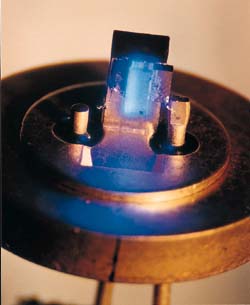
Light-emitting devices based on semiconductors have had a huge impact on modern technologies. The brightness and durability of light-emitting diodes make them ideal for displays, while semiconductor lasers have been used in everything from optical communications systems to compact disc players. But these applications have been limited by the lack of materials that can emit blue light efficiently. Full-colour displays, for example, require at least three colours, usually red, green and blue, to produce any visible colour. Such a combination is also needed to make a white light-emitting device that would be more durable and use less power than conventional bulbs or fluorescent lamps.
Many other applications would benefit from blue light-emitting devices. The shorter wavelength means that the light can be focused more sharply, which would increase the storage capacity of magneto-optical and optical disks. Digital versatile disks, which came on the market in 1996, rely on red semiconductor lasers and have a data capacity of about 4.7 Gbyte, compared with 0.65 Gbyte for compact discs. By moving to blue wavelengths, the capacity could be increased to 15 Gbyte. Blue laser diodes could also improve the performance of laser printers and undersea optical communications.
Efficient blue-emitting devices were first demonstrated by my group at Nichia Chemical Industries in Japan in 1995, after about 30 years of research by groups around the world. Such was the need for these devices that blue and green light-emitting diodes based on indium gallium nitride are already being used in a variety of applications, such as traffic lights and full-colour displays. Blue semiconductor lasers were also introduced in 1995, and today can achieve a lifetime of 10,000 hours under continuous operation at room temperature.
Light from semiconductors
A light-emitting diode (LED) essentially consists of an “active” layer of semiconducting material sandwiched between n-type and p-type semiconductors. When a voltage is applied to the junction, electrons from the n-type material move into the conduction band of the active layer, while holes from the p-type semiconductor are injected into the valence band. Light emission takes place when electrons at the bottom of the conduction band spontaneously recombine with holes in the top of the valence band.
If many more electrons and holes are injected into the active layer, a “population inversion” takes place between the conduction and valence bands. By including mirrors at both sides of the active layer to form a so-called waveguide cavity, the emitted light can be amplified and strong stimulated emission is observed at the edges of the cavity. This device is called a laser diode.
The key point is that the wavelength of the emitted light, and hence its colour, is determined by the band gap of the active layer. The wavelength is given by l = hc /E g, where h is Planck’s constant, c is the speed of light and E g is the band gap. The band gaps of compound semiconductors such as aluminium gallium arsenide and aluminium indium gallium phosphide make them suitable for fabricating efficient red and yellow light-emitting diodes, but until recently there have been no suitable materials for comparable blue light-emitting devices.
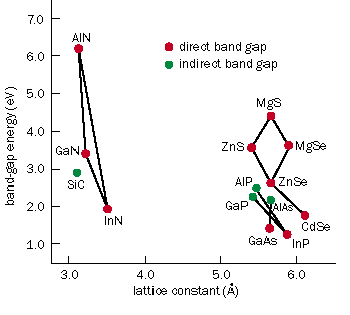
Although blue and green light-emitting diodes have been made from materials such as silicon carbide and gallium phosphide, they are not very efficient. These materials have an indirect band gap, which means that the electrons and holes have different momenta and can only recombine by scattering from lattice vibrations. In a material with a direct band gap, the electrons in the conduction band can recombine directly with holes in the valence band, making recombination much more efficient.
Although many researchers have investigated various direct-band-gap materials for blue and green light-emitting devices, it has proved extremely difficult to produce efficient and reliable devices. The most intense research has focused on II-VI materials such as zinc selenide and III-V nitrides such as gallium nitride, since these materials have a large enough band gap to emit light at blue and green wavelengths.
The advantage of II-VI compounds is that they can be deposited easily on a gallium arsenide (GaAs) substrate with a relatively low density of defects. This is because materials like zinc selenide have a similar lattice constant to GaAs. Any mismatch in lattice constant creates strain in the layers, which is generally released as misfit dislocations. In the case of red-emitting devices, aluminium gallium arsenide has almost the same lattice constant as GaAs, while aluminium indium gallium phosphide can be lattice-matched to gallium arsenide by altering its composition.
Materials based on zinc selenide have been studied intensively for use in blue- and green-emitting devices. Indeed, in 1991 Michael Haase and colleagues at 3M in the US demonstrated the first pulsed operation of green laser diodes based on II-VI materials. However, the lifetime of these laser diodes is only about 100 hours, a limitation that has prevented them from being commercialized.
These short lifetimes are thought to be due to crystal defects. Even though there are relatively few defects in II-VI materials, about 1000 cm-2, a single defect can cause others to propagate, disrupting the weak bonding in the material and causing the device to fail. This is not expected to be such a big problem in III-V nitrides because the bonding is much stronger.
Gallium nitride and other III-V nitrides also have a direct band gap that is suitable for blue light-emitting devices. The band-gap energy of aluminium gallium indium nitride varies between 6.2 and 2.0 eV, depending on the composition at room temperature. However, there is no lattice-matched substrate for the growth of gallium nitride. Sapphire is commonly used, despite a mismatch of 13.5%. Other options are silicon carbide and magnesium aluminate, which have mismatches of 3% and 9%, respectively.
Such large differences in lattice constant create misfit dislocations at the interface between the gallium nitride and the substrate. Although the number of defects can be as high as 1010 cm-2, these dislocations do not seem to reduce the efficiency of light emission and have not prevented the development of practical devices. Moreover, since these materials are bound much more strongly than the II-VI materials, devices based on gallium nitride are expected to be more reliable.
So far, only a ternary compound, indium gallium nitride, has been used as the active layer of blue and green light-emitting devices. As we shall see, the addition of indium to gallium nitride is vital for achieving strong light emission. The band gap of the material can be varied between 2.0 and 3.4 eV by altering the indium content, which corresponds to emission wavelengths between 620 and 365 nm.
Routes to blue devices
One of the main problems in the development of devices based on III-V nitrides was the lack of p-type materials. Although n-type gallium nitride is easy to produce, researchers had struggled to make p-type gallium nitride since the 1960s. The usual approach has been to dope the material with impurities such as zinc, magnesium and beryllium. These should accept electrons when positioned at gallium sites, and so generate large numbers of holes in the material. However, this approach did not produce p-type gallium nitride with good hole conductivity, and no-one understood why.
The breakthrough came in 1989, when Hiroshi Amano and colleagues at Nagoya University in Japan obtained thin films of p-type gallium nitride for the first time. They used metal organic chemical vapour deposition (MOCVD) to produce films doped with magnesium. Gases of trimethylgallium, ammonia (NH3) and bis-cyclopentadienyl magnesium were supplied to the sapphire substrate by a hydrogen carrier gas. The substrate was heated to 1000 °C, causing the precursor gases to react and form a thin film of gallium nitride on the surface. After growth, the films were irradiated with a low-energy electron beam, and the resulting film was found to be p-type, although the hole conductivity was poor.
It seems that the effect of the electron beam was to move the magnesium atoms to gallium sites. Before irradiation, the magnesium atoms cannot act as acceptors because they are not positioned at gallium sites. By moving the magnesium atoms with the electron beam, the impurities can act as acceptors and generate large numbers of holes. At the time, however, this mechanism was not fully understood and other groups were unable to produce p-type gallium nitride for another few years.
At Nichia, colleagues and I first obtained p-type gallium nitride films in 1992. Rather than treating films of magnesium-doped gallium nitride with an electron beam, we thermally annealed the layer in a nitrogen atmosphere at temperatures above 700 °C. Annealing was found to reduce the resistivity of the films from 106 W cm to just 2 W cm.
To help understand this change in resistivity, we tried two further annealing experiments. If the low-resistivity p-type films were further annealed in nitrogen at temperatures ranging between room temperature and 1000 °C, the resistivity remained almost constant at 2-8 W cm. However, if the films were annealed in ammonia at 600 °C, the resistivity increased to as much as 106 W cm.
So what causes the change in resistivity? The key seems to be the effect of atomic hydrogen, produced by the dissociation of ammonia at temperatures above 400 °C. Since dissociation occurs at the gallium nitride surface, hydrogen atoms can easily diffuse into the gallium nitride. Once inside the film, the hydrogen atoms form neutral complexes with the magnesium impurities and stop them from acting as acceptors.
This hydrogenation process is probably responsible for the surprisingly high resistivity of magnesium-doped gallium nitride films. The effect of thermally annealing the films in a nitrogen atmosphere is to remove atomic hydrogen from the neutral complexes, reactivating the magnesium acceptors and reducing the resistivity.
Many researchers now agree that hydrogenation can stop impurities from acting as acceptors. This finding finally solved the mystery of p-type gallium nitride, which had puzzled researchers for over 30 years.
Towards practical devices
Another key breakthrough was the fabrication of high-quality films of indium gallium nitride (InGaN). This is the most important compound of the III-V nitrides because it is the only one to produce light emission that is strong enough for practical devices. But it was not until 1992 that Takashi Mukai and I developed a technique to deposit high-quality InGaN films.
Our approach was to use a novel MOCVD method with two separate gas flows. The main flow carries the reactant gas parallel to the substrate at a high velocity. A subflow transports an inactive gas perpendicular to the substrate, changing the direction of the main flow and bringing the reactant gas into contact with the substrate. Using this method, we could alter the amount of indium in the deposited material by optimizing growth parameters such as gas-flow rate, temperature and growth rate.

Fluctuations in indium content lead to the formation of deep localized states in which the electron energy is confined in three dimensions, just as in quantum dots. To change the indium content during growth, the vapour pressure of the indium nitride (one of the precursor materials) is kept very high. The film is deposited at 800 °C, which causes the indium nitride to dissociate – this phase separation makes it possible to vary the composition of the indium gallium nitride. As we shall see, the localized states that are generated by this process are responsible for the strong light emission in InGaN. The films that we deposited in this way could emit light efficiently from green to ultraviolet wavelengths at room temperature.
In 1995 we demonstrated the first blue/green light-emitting diode based on InGaN. The structure consisted of a 3 nm layer of indium gallium nitride (In0.2Ga0.8N) sandwiched between p-type aluminium gallium nitride and n-type gallium nitride, all grown on a sapphire substrate. Such a thin layer of InGaN minimizes the effect of lattice mismatch: the elastic strain in the layer can be accommodated without the formation of misfit dislocations, and the crystal quality of the InGaN remains high. Moreover, the difference in thermal expansion coefficient between the active layer and the surrounding material is also reduced.
In this structure, the layer of indium gallium nitride forms a single quantum well, which leads to the formation of quantized energy states. Holes and electrons supplied by the surrounding materials are confined in the InGaN, specifically in the n = 1 energy level, where n is the principal quantum number. Because of this confinement, the charge carriers can recombine efficiently to emit blue or green light. The rate of recombination depends on the indium content in the active layer and the energies of the quantized states, which in turn depend on the thickness of the quantum well and the energy barrier between the InGaN layer and the surrounding materials.
At a current of 20 mA, the output power of the blue diode was 5 mW, while the external quantum efficiency was 9.1%. The equivalent values for the green devices were 3 mW and 6.3%. Typical luminous intensities, which provide a measure of the brightness of the device, were 2 candela for the blue diode and 6 cd for the green diodes. These figures-of-merit are comparable with those of conventional high-efficiency red LEDs. By combining red light-emitting diodes with blue and green ones with the same power and brightness, it is possible to produce full-colour displays and efficient white lamps.
To determine the energy levels responsible for emission and absorption, we measured the light emitted when a current of 20 mA was applied to the structure (electroluminescence) and when monochromatic light was focused on the device (the photocurrent spectrum). Electroluminescence from the blue and green diodes was most intense at 453 nm (2.73 eV) and 520 nm (2.38 eV), as expected from their band-gap energies (figure 4). The largest peak in the photocurrent spectra, at 360 nm, is simply due to the absorption of light by the thick surrounding layers, although there are also weaker shoulder-like peaks at 410 nm for the blue LED and at 420 nm for the green one.
It has since been shown that these smaller peaks result from absorption by free “excitons” in the n = 1 energy level. Excitons are electron-hole pairs held together by the Coulomb interaction, and they form when electrons and holes are injected into the InGaN quantum well.
The energy difference between absorption by the n = 1 quantum energy state and the peak in the electroluminescence signal was 290 meV for the blue LEDs and 570 meV for the green ones. All of the electroluminescence is observed at the lower tail of the absorption spectra, suggesting that light emission results from the recombination of electrons and holes at deep localized states with energies of 290 and 570 meV.
When more indium is included in the active layer, there are larger variations in the indium content, leading to the formation of lower-energy states. Since green diodes are produced by adding more indium, the photocurrent spectrum of the green diode extends to lower energies.
Laser action
We first achieved laser emission from diodes based on III-V nitrides in 1995. These devices were based on multiple quantum wells of indium gallium nitride, and produced blue light efficiently at room temperature. Although early versions required high voltages and could only generate laser pulses, continuous-wave lasers have now been developed. By 1997 the lifetime of continuous blue lasers had improved to 27-35 hours, and the latest research has further extended the lifetime to 10,000 hours. This improvement in lifetime suggests that laser diodes based on indium gallium nitride will soon be commercialized with even longer lifetimes.
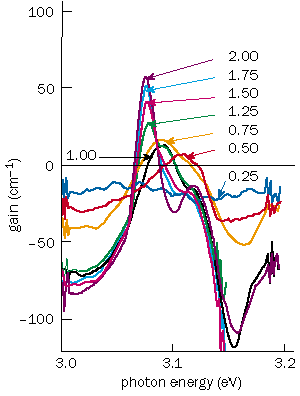
The continuous-wave laser diode is made from a layered structure with between 2 and 10 quantum wells. At room temperature, the current needed for laser emission is about 20 mA and the threshold current density is 2-4 kA cm-2, about 10 times higher than in red laser diodes. The operating voltage is 4-6 V, compared with about 2 V for red lasers, while the maximum output power was 50 mW per facet. Most of the light is emitted at wavelengths of 390-420 nm.
In 1997 Takahiro Deguchi and colleagues at Waseda University in Japan studied how the gain spectra of InGaN laser diodes depends on the power supplied by a pump laser. The sharp peak at 3.07 eV is particularly strong for pump powers in excess of 1 MW cm-2, and marked absorption is observed at 3.15 eV. The absorption is again caused by free excitons in the n = 1 energy level of indium gallium nitride. But the sharp gain cannot be understood in terms of the conventional picture of recombination between conduction and valence bands.
Indeed, the feature only appears when the energy of the pump laser matches the difference in energy between the n = 1 energy level and the energy of deep localized states in the InGaN layer. This suggests that the strong absorption at the n = 1 energy level transfers carriers into deep localized states. Electrons injected into the conduction band of the InGaN quantum well are transferred into localized states, while holes are supplied to the top of the valence band. Stimulated emission therefore takes place between the localized states and valence bands of the InGaN quantum wells. Population inversion is quite easy to achieve because the density of electronic states is expected to be relatively small in the localized states. This means that only a few injected electrons are needed to raise the quasi-Fermi level in the localized state, which increases the energy difference between this level and the energy level at which recombination takes place. Population inversion can therefore be achieved at low currents.

The large lattice mismatch between gallium nitride and sapphire means that up to 1010 dislocations per cm2 can form at the interface, and these defects can thread their way into the active layer (figure 6). In 1995 Steven Lester and colleagues at Hewlett Packard Laboratories in Palo Alto, California, measured a similar density of dislocations in light-emitting diodes based on InGaN.
So why are devices based on indium gallium nitride so efficient? In conventional III-V compound semiconductors, such as gallium arsenide and indium phosphide, the dislocation density must be less than 103 cm-2 to achieve high efficiencies. The presence of indium appears to play a key role, particularly since devices based on gallium nitride are much less efficient. It seems that free excitons formed in the InGaN layer are transferred into the deep localized energy states before they can be captured by the non-radiative recombination centres formed by dislocations. The electrons and holes can therefore recombine to emit blue light, without interference from non-radiative recombination centres. Localized energy states are thus the key to obtaining efficient light-emitting devices based on III-V nitrides.
Into the blue
The advances in light-emitting diodes and laser diodes based on indium gallium nitride have progressed at an amazing rate. It has taken just two years to progress from pulsed to continuous operation of blue laser diodes, while the same advance for conventional laser diodes based on III-V compound semiconductors has generally taken over 10 years.
The recent improvement in lifetimes suggests that blue lasers will soon appear on the market. With so many potential applications, the optoelectronics industry is eagerly anticipating a move into the blue.
Further reading
H Amano et al. 1989 P-type conduction in Mg-doped GaN treated with low-energy electron beam irradiation (LEEBI) Japan J. Appl. Phys. 28 L2112
T Deguchi et al. 1997 Gain spectra in CW InGaN/GaN MQW laser diodes E-MRS (June 16-20, Strasbourg, France) L-XIII-3
S D Lester et al. 1995 High dislocation densities in high efficiency GaN-based light-emitting diodes Appl. Phys. Lett. 66 1249
S Nakamura et al. 1992 Hole compensation mechanism of p-type GaN films Japan. J. Appl. Phys. 31 1258
S Nakamura et al. 1995 Superbright green single-quantum-well-structure light-emitting diodes Japan. J. Appl. Phys. 34 L1332
S Nakamura et al. 1997 High-power, long-lifetime InGaN multi-quantum-well-structure laser diodes Japan. J. Appl. Phys. 36 L1059
S Nakamura et al. 1997 InGaN/GaN/AlGaN-based laser diodes with modulation-doped strained-layer superlattices Japan. J. Appl. Phys. 36 L1568
S Nakamura and G Fasol 1997 The Blue Laser Diode (Springer, Heidelberg)
S Nakamura and T Mukai 1992 High-quality InGaN films grown on GaN films Japan. J. Appl. Phys. 31 L1457
Critical issues at the original nuclear lab
First published November 1997 in Physics World
As the sixth director of the Los Alamos National Laboratory, John Browne faces broad challenges at a critical time in the laboratory’s history. After a lifetime of secrecy – the first atomic weapons were built there in 1945 – public concerns are forcing the lab to become more accountable. But the key challenge for Browne’s directorship will be stockpile stewardship – the task of maintaining the safety and reliability of US nuclear weapons without explosive testing.
The laboratory, in the south-western state of New Mexico, is one of the world’s largest multidisciplinary research centres. With an annual budget of about $1.2 bn, it employs about 6800 people – roughly one-third of whom are physicists – with a further 2800 people working for the laboratory’s contractors. The organization has several science divisions, including physics, nuclear materials technology, applied physics and computational physics, and nuclear weapons technologies programmes. A relatively recent addition is the Los Alamos neutron science centre (LANSCE), a pulsed neutron research institute that includes what used to be the accelerator operations and technology division.
Before taking over from Sig Hecker as director of the lab, Browne was director of LANSCE. He has no doubts about the basis of his directorship of Los Alamos. “One of the things I share with my predecessors is scientific excellence, ” he says. “Being good in science and the quality of the people will really be the key to whether we can create this new future for our success.”
Browne will need to use all his management skill, because Los Alamos faces a period of retrenchment. Certainly, the lab’s budget has increased over the past two years due to the introduction of the stockpile stewardship programme. But the long-term outlook is somewhat pessimistic, according to Robert Park of the American Physical Society. “It’s difficult to rationalize having two nuclear weapons laboratories, ” Park explains, referring to Los Alamos and the Lawrence Livermore National Laboratory in California.
More immediately, Browne also faces problems with the lab’s safety procedures. A series of four apparently unrelated accidents over a period of 16 months, which killed one person and left another in a coma, led Hecker to shut down all work at the lab while all employees reviewed safety procedures. As a result, Los Alamos instituted what it calls integrated safety management, a process that makes every single employee responsible for the lab’s safety, and permits each one to halt work at any time on the basis of perceived danger.
However, says Browne, implementation of integrated safety management needs to improve. “I believe we’re well along the way, but we’re not there yet, ” he says. “I think that one of the major issues we have to deal with is that the lab has been secretive for 50 years, ” Browne says. “The game has changed. We should be able to reduce the amount of waste the laboratory produces; we should try to minimize the amount of emissions we have from our work. I think we need to be as open as we can with the public.” That will not be easy. Representatives of communities around Los Alamos have long complained that the lab has failed to inform its neighbours about either immediate problems such as accidents or its long-term mission.
But the greatest challenge will be stockpile stewardship programme to ensure that nuclear weapons will explode when they are meant to but won’t when they are not. This programme consists of a variety of computational work and research using neutrons, lasers and other large facilities. “Performing the stockpile stewardship management programme is really a grand scientific challenge, ” says Browne. “It’s the one area in modern technological enterprises that will not be using testing as you actually develop a product. It’s going to require good facilities and good people. So recruiting is a major part of this.”
How will Brown attract top-notch young scientists? “One of the reasons that we’ve been able to attract the best and the brightest is the breadth of programmes that we have, ” he explains. “You know that it’s not necessarily the first place a graduate thinks of coming, to work on defence programmes, but many times they’re attracted to work on a problem of great scientific challenge.”
Indeed, Los Alamos offers scientific challenges beyond the near-term concerns of stockpile stewardship. “There are lots of issues we may have to be worrying about down the road; the capabilities we have at this laboratory as a result of our prime mission could be brought to bear on other problems. Global climate change is an example of one where computational modelling plays a major role, ” Browne points out. “There are plenty of other areas in non-defence research where the laboratory has made a contribution in the past and I think we just need to make sure that we don’t forget about the other things that we can do for our country, ” says Browne.
ESA plans worry staff
Senior management at ESA have had great difficulty in improving morale at the agency. Since 1995 the group has lost 19 percent of its staff, and morale fell so low during 1996 that over 50 percent of them signed a petition of no confidence in ESA’s management.
In an effort to involve staff in discussions about policy and boost morale Daniel Sacotte, ESA’s director of administration, has started to conduct internal opinion polls. The latest data – collected at the end of November and due to be published in two weeks – suggest that staff welcome the policies introduced by the new secretary general, Antonio Rodotà. In particular, Rodotà has promised to combat expected budget cuts by working more closely with the aerospace industry.
A task force has already recommended that industry pays the majority of costs in applied programmes, such as Earth observation, and that future programmes should be driven by users, not technology. Industry reaction so far seems positive. A similar scheme is expected in any agreement between ESA and the military.
Fast spinning pulsar
Frank Marshall, Will Zhang and Eric Gotthelf from the Goddard Space Flight Center, and John Middleditch of Los Alamos National Laboratory found the star by studying data from NASA’s Rossi X-Ray satellite. They have calculated that the star is spinning over 60 times per second, twice as fast as any previously known pulsar. The pulsar is suspected to be connected with supernova remnant N157B in the Large Magellanic Cloud, 170, 000 light years from Earth. This explosion occurred 4, 000 years ago and the pulsar could have been spinning at 150 times per second when it was formed. This discovery confirms a prediction by Gotthelf and Wang of Northwestern University that a link exists between fast spinning pulsars with weak magnetic fields, and slow-spinning pulsars with strong fields.
Copyright © 2026 by IOP Publishing Ltd and individual contributors