Novel superconducting cavity qubit pushes the limits of quantum coherence

Over the history of quantum computing, the coherence time of superconducting qubits – that is, the time during which they retain their quantum information – has improved drastically. One major improvement comes from placing superconducting qubits inside three-dimensional microwave resonator cavities, which preserve the qubit’s state by encoding it in photons stored in the cavity.

In a recent study, researchers from Israel’s Weizmann Institute of Science pushed the boundaries of this method by demonstrating a novel three-dimensional cavity qubit setup with a single-photon coherence time of 34 milliseconds (ms). Long coherence time is key to achieving low-error qubit operations (thereby reducing the hardware required in fault tolerance), and the new coherence time shatters the previous record by more than an order of magnitude.

Qubits are highly sensitive to their environments, and readily lose information due to noise. To preserve qubit states for longer, researchers turned to microwave resonator cavities as a form of storage device. As their name implies, these cavities are three-dimensional structures comprising a hollow space designed to accommodate a superconducting transmon qubit chip and the microwave photons that interact with it. Through an encoding process involving the application of specific microwave pulses, the qubit state is transferred to the cavity state and stored there. Once the desired period has passed, the state is retrieved by encoding it back into the transmon. The cavity thus plays a crucial role in controlling and measuring the qubit placed inside it.

For practical applications in quantum information processing, the cavity must be capable of storing the quantum state for extended periods. However, achieving this is not straightforward due to various external factors. Because they are the smallest particles of light, photons are hard to confine, and are easily lost. Disturbances in the qubit chip placed inside the cavity are significant sources of photon damping and decoherence. The formation of an unwanted oxide layer on the cavity’s surface further diminishes the photon lifetime.

Engineering a novel cavity design

Led by Serge Rosenblum, Fabien Lafont, Ofir Milul, Barkay Guttel, Uri Goldblatt and Nitzan Kahn, the Weizmann team overcame these challenges by designing a low-loss superconducting niobium cavity that supports a long-lived single-photon qubit. They used highly pure niobium to fabricate two separate parts of the cavity, and later welded the parts together to prevent photons from leaking out. They also removed oxide and surface contaminants by chemically polishing the cavity.

The resulting structure looks a little like an open umbrella, with a half-elliptical geometry that evolves into a narrow waveguide where the umbrella’s handle would be. Like a satellite dish antenna, which has a curved surface that reflects radio waves towards its focal point, the elliptical structure of the cavity concentrates the electromagnetic field at the centre of the flat surface of the other half of the cavity (see image).
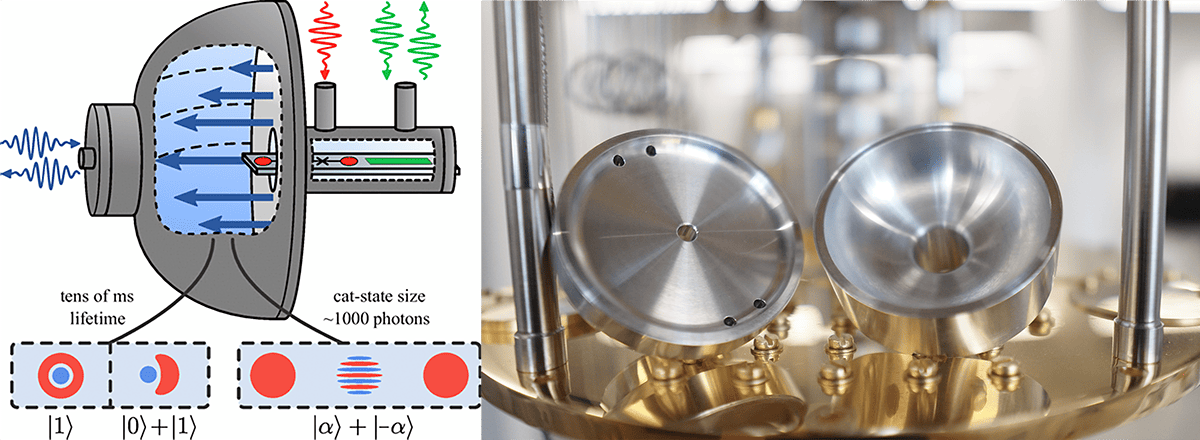
Diagram and photo of the team's cavity set-up

Once the team had prepared the cavity, “the biggest challenge was to integrate a superconducting transmon qubit into a cavity without diminishing the cavity’s photon lifetime”, Rosenblum says. “This takes us back to the infamous balancing act in quantum systems between controllability on one side and isolation on the other.”

The researchers achieved this balance by placing only about 1 millimetre of the transmon chip inside the elliptical cavity, while the rest is housed inside the waveguide. This configuration minimizes chip-induced loses. The cavity’s limited exposure to the chip does, however, weaken the cavity-transmon interaction, so the researchers compensated for this by applying strong microwave pulses to encode the qubit state in the cavity.

Leveraging a cavity for quantum memory and quantum error correction

Thanks to this innovative cavity design, researchers achieved a single-photon lifetime of 25 ms and a coherence time of 34 ms. This is a significant improvement over the previous state-of-the-art cavity, which had a coherence time of about 2 ms.

Rosenblum and colleagues also demonstrated an error-correction method known as bosonic quantum error correction, whereby the qubit’s information is redundantly stored in multiple photons occupying the cavity (so-called Schrödinger cat states). This preserves the fragile qubit state by storing it in many cavity photons, not just a few. The drawback is that as the number of stored photons increases, so does the photon loss rate. Despite this constraint, the Weizmann team achieved Schrodinger cat states with a size of 1024 photons. This corresponds to an average number of 256 photons, which is 10 times larger than previous demonstrations – a remarkable advancement that could improve the performance of bosonic quantum error correction.

With a photon lifetime four orders of magnitude greater than the time required for gate operations, this breakthrough provides ample time for controlling the qubit before it loses information. Looking ahead, Rosenblum says the team’s aim is to realize quantum operations on these cavities with unprecedented fidelity, or probability of success. Notably, he mentions that after the study was published in PRX Quantum, the team has more than doubled the single-photon lifetime to 60 ms, indicating significant potential for further advancements.

Lake Shore introduces the MeasureReady system for material and device research

Lake Shore videoIn this video, Lake Shore summarizes the capabilities of the MeasureReady™ M81-SSM synchronous source measure system, which provides ultra-low noise DC and AC source and measure performance.

The M81-SSM has been designed to simplify the complexity often experienced with typical multiple function-specific instrumentation set-ups. It combines the convenience of DC and AC sourcing with DC and AC measurement – including both voltage and current lock-in measurement capabilities – for a wide range of low-level device characterization applications. It also enables switching between AC, DC and lock-in measurements at the press of a button, without having to change any cables or instruments.

Unique MeasureSync™ signal synchronization technology

An extremely low-noise simultaneous source and measure system, the M81-SSM’s MeasureSync™ technology ensures inherently synchronized measurements from 1-3 source channels and 1-3 measure channels per each half-rack instrument.

Amplitude and frequency signals are transmitted to and from the remote amplifier modules using a proprietary real-time analogue method that minimizes noise and ground errors while ensuring tight time and phase synchronization between all modules. Because the M81-SSM sources and measures channels synchronously, multiple devices can be tested under identical conditions so that time-correlated data can be easily obtained.

Connect up to three source modules and up to three measure modules at once

The M81-SSM system provides DC to 100 kHz precision electrical source and measure capabilities with 375 kHz (2.67 μs) source/measure digitization rates across up to 3 source and 3 measurement front-end modules.

There is a choice of differential voltage measure (VM-10) and balanced current source (BCS-10) modules, and single-ended current measure (CM-10) and voltage source (VS-10) modules. All modules use 100% linear amplifiers and are powered by highly isolated linear power supplies for the lowest possible voltage/current noise performance, which LakeShore says rival the most sensitive lock-in amplifiers and research lab-grade source and measure instruments. Embedded calibration data on the modules enables flexible measurement reconfiguration between experimental set-ups.

On the VS-10 module, dual AC and DC range sourcing allows for precise full control of DC and AC amplitude signals with a single module and sample/device connection. On the VM-10 module, seamless range-change measuring significantly reduces or eliminates the typical range change-induced measurement offsets/discontinuities in signal sweeping applications that require numerous range changes.

For further details, visit the M81-SSM webpage at www.lakeshore.com/M81.

Neural prosthetic aims to boost memory

An electronic prosthetic system could help people with impaired memory – due to Alzheimer’s disease, traumatic brain injury or epilepsy – remember specific information. The new technology, being developed by researchers at Wake Forest University School of Medicine and the University of Southern California, works on the hippocampus, a part of the brain involved in making new memories.

Brain–computer interfaces, such as robotic limbs, establish communication between the brain and an external device. The hippocampus (humans actually have two hippocampi, one in each hemisphere of the brain) can, to some degree, grow new neurons. But scientists haven’t found a way to repair hippocampal damage. The neural prosthetic developed by the researchers uses models derived from hippocampal electrical activity to stimulate recall.

“Most brain control interfaces have relied on the brain figuring out how to deal with input from things. We’re working on how to figure out how to match what the brain is doing,” says Brent Roeder, a research fellow at Wake Forest who has been working on the project for nearly a decade. “We’re figuring out, what are the possible ways to enhance memory function, and which ways work best for what people and what type of conditions?”

Encoding and decoding memory

In a study published in 2018 in the Journal of Neural Engineering, the team stimulated neurons in the hippocampus in real time using a multi-input multi-output nonlinear mathematical model. “[In that study, the model] didn’t care what you were trying to remember…it was just trying to help your hippocampus work better,” Roeder explains.

In their most recent work, reported in Frontiers in Computational Neuroscience, the researchers isolated electrical activity to specific neurons and then used that information to stimulate the hippocampus to see if that could help people remember specific images better.

The study included 14 adults – all of whom had a diagnosis of epilepsy and were participating in a diagnostic brain-mapping procedure in which electrodes were placed in at least one hippocampus. The participants were shown different categories of images (animal, building, plant, tool or vehicle) in a visual delayed match-to-sample memory task. The researchers identified common neural activity in the hippocampus for each image category and used this information to derive a mathematically calculated, fixed firing pattern. This firing pattern was then used to stimulate the hippocampus during a visual recognition memory task.

“We were really testing two things in this study. The first is, can you stimulate for specific information? And the second was, how good are we at stimulating for the information we want to stimulate?” says Roeder. “So the answer to the first question is yes, you can stimulate for specific information. The answer to the second question is, well, there’s a lot of room for improvement.”

The researchers observed both increases and decreases in memory performance. In approximately 22% of cases, there was a difference in how well participants remembered images they had been shown before. When stimulation was delivered on both sides of the brain, almost 40% of participants with impaired memory function showed changes in memory performance.

“The example I give is, you’ve seen a waiter carry a tray on their fingers. They’re not supporting the whole tray, they’re supporting part of the tray. But because those parts of the tray are connected to the rest of the tray, they lift the whole tray,” Roeder explains. “Our memory is associative. We’re not trying to support all of the memory – we’re trying to support part of the neural activity to boost all of the memory.”

The researchers conclude that there may have been more overlap between image categories than they had anticipated (for example, animals are often found near plants). Making image categories more distinct, by showing colours or directions instead of images, for instance, could help improve the performance of the electronic prosthetic.

“Now that we know it’s possible…it’s just a matter of getting better at it,” Roeder says.

Battle for the skies: US insists GMT and TMT telescopes must vie for funding

The US National Science Foundation (NSF) has announced it will only support the construction of the Giant Magellan Telescope (GMT) or the Thirty Meter Telescope (TMT) – but not both facilities. The decision to pick just one next-generation, ground-based instrument came as the National Science Board (NSB), which oversees the NSF, set a limit of $1.6bn for its Extremely Large Telescope programme (US-ELTP). The board says it will discuss the NSF’s “plan to select which of its two candidate telescopes to continue to support” at its meeting in May.

Both the GMT and the TMT are seen as the future of US ground-based astronomy and stem from advances in mirror technology. The GMT will rely on seven primary and seven secondary mirrors to give it an optical surface of 25.4 m. Building is already under way at Chile’s Las Campanas peak.

The TMT, meanwhile, will use a segmented primary mirror consisting of 492 elements of zero-expansion glass for a 30 m-diameter primary mirror. The team has chosen Hawaii’s Mauna Kea peak as its location.

However, protests by indigenous Hawaiians, who regard the site as sacred, have delayed the start of construction. The issue might even force a change of the TMT’s location with officials identifying the island of La Palma, belonging to Spain’s Canary Islands, as an alternative site in 2019.

Going it alone

In 2018 the two telescope teams joined forces to create US-ELTP to give US researchers access to giant telescopes in both the Northern and Southern hemispheres. A further boost came in 2020 when the two telescopes emerged from Astro2020, the most recent decadal survey of U.S. astronomy and astrophysics, as a main priority for the community.

The decision for the NSF to now only focus on one design comes after a reduction in funds for science-based government agencies in the current financial year, which began on 1 October 2023. Contentious negotiations among the Republican-majority House of Representatives, the Democratic-majority Senate, and Democratic US President Joe Biden have resulted in a cut of 8.3% in the NSF’s proposed budget. At $9.06bn, it falls about $820m short of the financial year 2023 amount.

At a meeting in late February, the NSB pointed out that any figure greater than $1.6bn for US-ELTP would impoverish other major projects supported by NSF. Yet the decision has not surprised insiders. Michael Turner, a cosmologist from the University of Chicago, wrote in Science last November that it was “simply not possible for NSF to join both projects at the level needed to make each successful”.

The GMT and TMT, both of which have support from various US universities, are not, however, entirely American projects. The GMT works with institutions in Asia, Australia and South America, while TMT’s partners include research organizations in Canada, India and Japan.

Indeed, in a letter published in Science on 16 February days before the NSB’s decision, the executive director of the TMT and president of GMT – along with the director of the NOIRLab, the US national center for ground-based observatories – wrote that overseas and US partners “are on a path to contribute a substantial portion of the $3bn required for each of our telescopes” adding that they “advocate US government funding for both telescopes”.

The GMT is expected to cost $2.54bn, of which $850m has already been committed. Officials at the TMT have not released a final construction cost for the telescope, but it is expected to be at least $3bn, of which $2bn has been committed.

Any further delays to the US programme, however, would give Europe the edge when it comes to making discoveries with a next-generation ground-based telescope. The European Southern Observatory’s Extremely Large Telescope is already under construction in Chile’s Cerro Amazones region. With a primary mirror of 39 m, first light is planned for 2028.

Evidence for ‘quark coalescence’ found in LHC collisions

Physicists working on the LHCb experiment have seen evidence that “quark coalescence” plays a role in the evolution of quarks into hadrons following proton collisions at the Large Hadron Collider (LHC). This mechanism, which was originally proposed in the 1980s, has existing quarks with overlapping wavefunctions combining rather than creating new quarks. It is most pronounced at low transverse momenta, and gradually turns off as quarks escape rapidly from the collision point.

Quarks are the particles that make up the protons and neutrons inside atomic nuclei and numerous other hadrons (heavy particles) that feel the strong interaction. One of their strangest features is that they can never be observed in isolation. The main reason is that, unlike gravity, electromagnetism and the weak interaction, all of which drop in strength with distance, the effect of the strong interaction grows as bound quarks mover further apart. If quarks are sufficiently far apart, the gluon field that mediates the strong interaction contains enough energy to create particle-antiparticle pairs. These bind to the original quarks, creating new bound particles that can either be mesons (combinations of one quark and one antiquark) or baryons (comprising three quarks). This process is called fragmentation.

Experiments involving heavy ion collisions have suggested that this is not the whole story, however. Physicists believe that quarks can also combine in the dense quark–gluon plasma formed by smashing these large particles together in a process called coalescence.

“You have a collision, you make a bunch of quark–antiquark pairs that start moving away from each other, and because of wave-particle duality each particle has a wavelength that sort of tells you how big it is,” explains Matt Durham of Los Alamos National Laboratory in the US, who is a member of the LHCb collaboration.

Existing quarks combine

“If you have three quarks that overlap each other, you freeze them together into a baryon; if you have two quarks that overlap, you freeze them together into a meson; if you have a quark that doesn’t overlap with any other ones it has to fragment,” Durham explains. “So coalescence takes quarks that are produced in the collision and sticks them together; fragmentation requires you to make new quarks out of the vacuum.”

Coalescence in heavy ion collisions has been “generally accepted”, says Durham, because it is otherwise difficult to explain the ratios of protons to pions produced in experiments. Heavy ion collisions are messy, however, and theoretical predictions are inevitably imprecise. In the new research, the LHCb team studied the production of b quarks in proton-proton collisions.  Sometimes called the bottom or beauty quark, the b quark is the second most massive quark in the Standard Model of particle physics.

The production of b quarks is almost certain to produce either a b-lambda baryon or a B0 meson, which both contain a b quark. The production ratio between these two has been extensively studied in experiments in which the b quark is produced by electron-positron collisions – a process that can lead only to fragmentation.  “If you only have fragmentation, this ratio should be universal,” says Durham.

The LHCb team combed through several years’ data on proton–proton collisions and studied the decay products from collisions that had produced b quarks. For collisions with high transverse momenta relative to the colliding beams and few other outgoing particles detected at the same time, the baryon-to-meson ratio was approximately equal to the ratio in electron-positron experiments.

More baryons

However, as the transverse momenta dropped and as the number of other particles detected simultaneously grew, the proportion of baryons gradually increased relative to the proportion of mesons. This, the researchers concluded, was clear evidence that another process more likely to produce baryons was at work in these collisions. In this scenario the b quark is surrounded by other quarks – but became increasingly disfavoured as the produced quark was more separated from the other particles. “You really require coalescence to explain that,” says Durham, who adds, “I think we’ve shown it quite definitively here”.

“I definitely find the data convincing,” says theorist Ralf Rapp of Texas A&M University; “There used to be a disconnect between very small systems – the extreme being electron–positron, where you only have one quark–antiquark pair – and the heavy ion systems where you have thousands of quarks. The way they really make their point is to show systematically how the effect goes away and recovers the electron-positron limit as a function of how many hadrons are observed, which is an observable measuring how many quarks and antiquarks there are to coalesce with.”

Experimentalist Anselm Vossen of Duke University in North Carolina agrees that the work is “very nice”, but notes that the underlying assumptions used to calculate the fragmentation fractions involve the quarks being isolated, so it is perhaps unsurprising that they give incorrect results at low transverse momenta when this is not the case. “All these are models,” he says. “It’s very suggestive that if you use something in the coalescence model it works, but that doesn’t mean it’s ‘the truth’”

The research is described in Physical Review Letters.

Spectacular scans of thousands of vertebrate specimens released

A freely available repository of thousands of natural history specimens has been created by researchers in the US.

The openVertebrate (oVert) project, funded by the National Science Foundation, is a five-year initiative between 18 US institutions to create 3D reconstructions of vertebrate specimens using computed tomography (CT) scans (BioScience 10.1093/biosci/biad120).

The collection includes amphibians, reptiles, fish and mammals, with many of the fluid-preserved specimens held by museums and not only those on public display.

The specimens were scanned between 2017 and 2023 and allowed scientists to examine them without having to dissect or sample their tissues.

The study has already thrown up some surprises such as the finding that frogs have lost and regained teeth more than 20 times throughout their evolutionary history.

“When people first collected these specimens, they had no idea what the future would hold for them,” notes Edward Stanley from Florida Museum of Natural History, who is oVert’s co-principal investigator.

A suspenseful story of life and death in the universe

In a saturated market, it’s hard to make an astronomy book stand out. For me, the blurb and introduction of C Renée JamesThings That Go Bump in the Universe didn’t immediately differentiate it from the thousands of other similar popular-science titles.

This is a shame because James – a researcher at Sam Houston State University in the US – is an engaging writer who employs all the careful plotting and pacing of a detective novelist. Once it gets into its groove, the book covers the explosive lives and deaths of stars, which, as James reminds us, are but a short-lived blip in the story of a universe that is unstoppably cooling and expanding.

The book starts slowly, beginning with the first hints found by early astronomers that we inhabit only a tiny, dim corner of a vast and cacophonous cosmos. The smoking gun is the discovery that the universe extends far beyond our Milky Way, making the stars far brighter and more energetic than astronomers had thought possible. The rest of the book details a century of efforts to solve the mystery of how to align our understanding of physics with the wild growing pains of our stellar neighbours.

The characters we meet along the way – from binary stars to black holes – are painted with rich and lively prose

The characters we meet along the way – from binary stars to black holes – are painted with rich and lively prose, with James detailing the range of clues astronomers use to study these strange objects, including neutrinos, gamma-ray bursts and even tree rings. The chapters are short and punchy, and while they do build to a coherent story, they are self-contained enough that keeping up with James never feels like studying for an exam.

To the non-expert reader, the scale of the universe can sometimes be so cartoonishly large that it fails to make an impression. But James cleverly never takes her feet off the Earth. The faltering, human stories of the people who have tried to peer through the intergalactic noise – from the first Aboriginal Australians to modern astronomers – emphasize the awesome size of the events she describes.

Though the broadness of the book’s topic might have put me off picking it off the shelf, James manages to bring it all together in the final pages. I finished the book on my evening commute, and I found myself racing to reach the end before my train pulled into the station.

  • 2023 Johns Hopkins University Press 304pp hb$29.95

Intelligent solutions streamline radiotherapy treatment planning

Intelligent software solutions have become a crucial tool for stretched clinical teams to provide the best possible care to cancer patients, particularly those that require more complex treatments using higher radiation doses. Software systems with built-in artificial intelligence can automate repetitive tasks, enhance the information that can be extracted from CT simulators, and ensure consistency of care across an increasing number of cases.

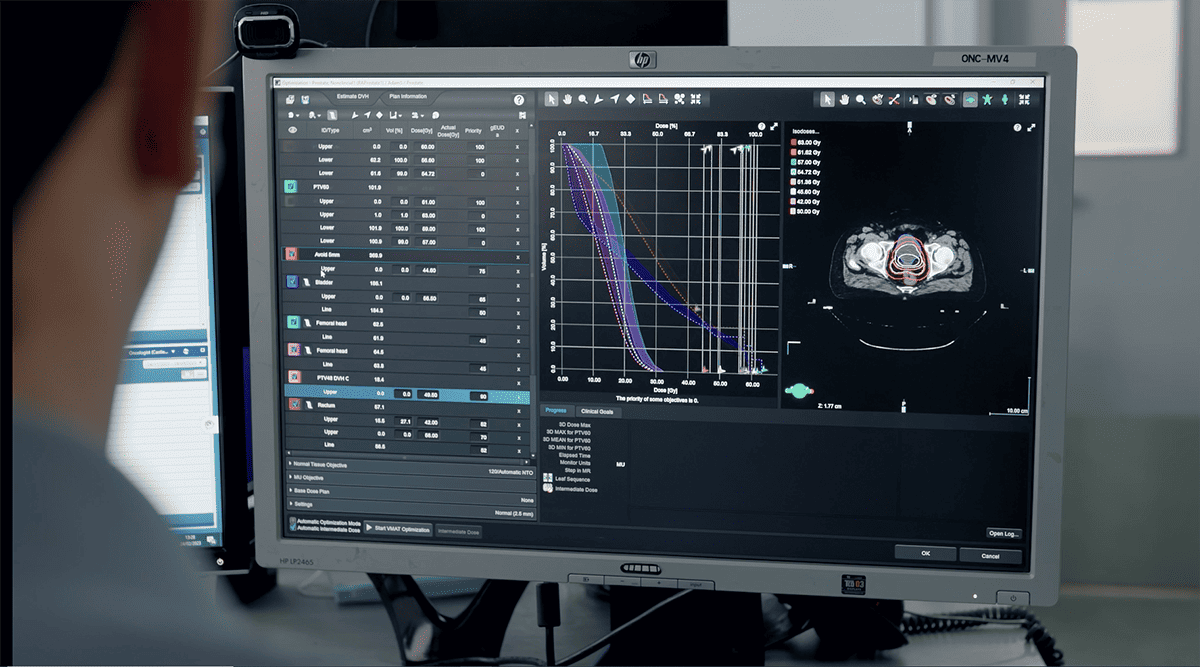
At Castle Hill Hospital in Cottingham, UK, which treats several hundred patients every month with its six linear accelerators, intelligent software has been deployed across the entire treatment planning process. “We try to make use of every tool at our disposal, whether it’s simple decision trees or commercial software that makes our work easier and more efficient,” says Carl Horsfield, principal physicist at Hull University Teaching Hospitals NHS Trust. “Like many treatment centres we are short of staff when compared to national models, and we use software to help us deliver high-quality care.”

Right at the start of the process, automated software on the CT simulators – the SOMATOM go.Open Pro from Siemens Healthineers – maintains the sensitivity of the images by modulating the radiation dose to match the size of the patient. The scanners are also equipped with a smart algorithm, called Direct i4D, that improves the quality of time-resolved images that are used to capture the breathing motion of patients with lung cancer. Normally these 4D CT scans only produce accurate images when regular breaths are taken during the acquisition time, typically around two minutes, but that is rarely the case for patients with lung conditions.

“Lung patients are often complex and problematic at CT, and I have spent a great deal of time attending scans to assess whether the images for 4D lung patients are clinically suitable,” says Horsfield. “With this smart algorithm the scan parameters adapt to the patient’s breathing in real time, which makes the radiographers much more confident in the acquisition when the breathing pattern is irregular.”

Even more significant time savings can be achieved by using an AI-powered solution embedded in the CT scanner, called DirectORGANS, that combines the image data with a deep-learning algorithm to automatically contour the patient’s critical organs. Such automatic contours are generated for every radical patient who is treated at Castle Hill, avoiding the need for a clinician to draw every structure by hand. In congested treatment sites, like the head-and-neck, that can reduce the time taken by an hour or more. “Saving time for our clinicians is paramount, and autocontouring is a fantastic way to ensure they are not repeating simple tasks for multiple patients,” comments Horsfield.

Importantly, the accuracy of the automatic contours – and therefore the amount of time that can be saved – depends on the quality of the input data. DirectORGANS offers a key advantage here, since it captures a bespoke dataset from the CT scan that has been optimized to generate the best results from the deep-learning algorithm. “Many autocontouring tools are hosted in the cloud, which means that they only have access to the scan that has been configured for the needs of the clinical team,” explains Horsfield. “One of the reasons we like DirectORGANS is that it makes its own reconstruction, setting the parameters on the acquiring scanner to match the way the organs should be made.”

The software generates accurate contours for many common organs-at-risk, including the lung, prostate, bladder and spinal canal. Once created, the patient’s clinician at Castle Hill always reviews the structures, edits them as needed, and manually delineates the tumour. Crucially, the clinician must also approve the final set of contours before they are used for treatment planning. “A clinician still needs to make sure that the contours produced by the algorithms are fit for purpose,” says Horsfield. “We also prompt them to provide feedback on the quality of the organs, which provides us with some internal quality assurance.”

While the initial version of the software included 30 or 40 pre-loaded structures, the latest release has improved the coverage and accuracy still further. One key advance, for example, is the ability to automatically contour the lymph node chains, normally a manual and painstaking task. “For prostate patients where there is risk of nodal infiltration, the clinicians need to work their way all the way from the prostate across the sacrum to the end of the local lymph-node chain,” explains Horsfield. “Having automated contouring for those kinds of structures will be a massive saving for them, even on the occasion when some editing is required.”

RapidPlan

Meanwhile, a number of automated tools are also built into the team’s treatment planning system, Varian’s Eclipse. One that has proved particularly useful for the Castle Hill team is RapidPlan, a knowledge-based solution that uses a model created from previous cases to generate a personalized treatment plan for a new patient. “It’s a tool that helps us to determine what is achievable for each patient, particularly for more complicated cases where the location of the organs-at-risk might compromise the coverage of the target,” says Horsfield. “We have class solutions for our treatment plans as starting points, but it’s smarter than that because it is specific to the anatomy of each patient.”

This knowledge-based approach has proved particularly beneficial for new staff members, and has also improved the consistency and quality of the plans produced across the whole team. “Someone who has been with us for six months might not create a plan of the same standard as one of our more experienced team members,” says Horsfield. “Augmenting their knowledge with these intelligent tools allows them to access that experience and standardizes the quality of the plans we produce.”

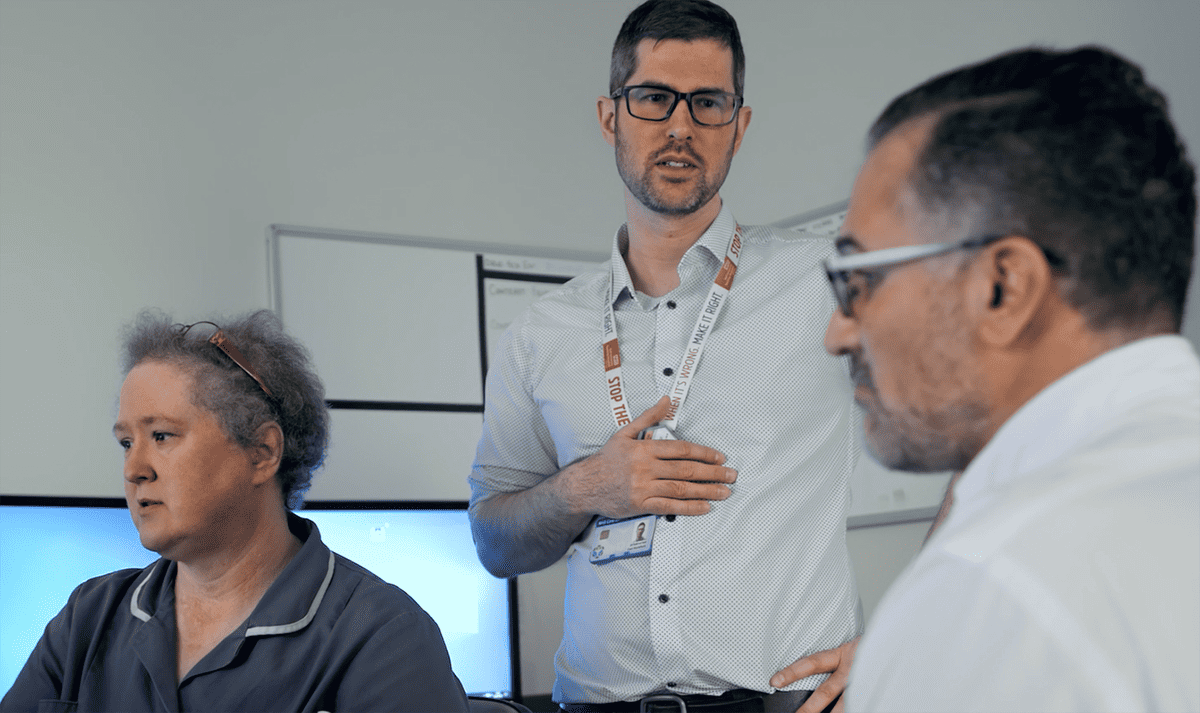
Carl Horsfield and team

As with any machine-learning approach, the quality of the predictions depends on the training data used to create the model. At Castle Hill the team has used its own cases to develop models for four treatment sites – the lung, head-and-neck, oesophagus and prostate – with several others now being developed to realize further time savings for the planning team. “One of the big difficulties with treatment planning is knowing when to stop,” says Horsfield. “RapidPlan provides the reassurance that you have found an optimal solution for that patient, and that there’s less benefit to spending additional time questioning your choices.”

The Eclipse treatment planning system also provides an interface for adding bespoke tools to the planning process. As an example, the team at Castle Hill has created an automated tool for creating optimization structures, which constrain the solutions produced by the treatment planning system by defining particular areas that should not be targeted with radiation. “We’ve made about 15 different protocols to create these avoidance and optimization structures,” says Horsfield. “They are all simple operations, but we realized that they were being done manually for nearly every treatment plan. It’s been really empowering to be able to create our own tools for making our processes more efficient.”

Such efficiency savings are particularly critical at a time when treatment centres like Castle Hill are dealing with the fallout from the COVID-19 pandemic. With a huge influx of patients and a shortage of healthcare professionals, intelligent tools that can automate at least some of the treatment planning process is helping ongoing efforts to work through the backlog. “Our capacity before COVID was to produce 40 plans per week, and now the whole team is making a big push to increase that to 50,” says Horsfield. “Every efficiency we can achieve by automating our processes is helping us to make headway against our recovery plan, while also ensuring that we continue to produce high-quality plans for every patient we treat.”

Cat qubits reach a new level of stability

Quantum computers could surpass conventional computing in essential tasks, but they are prone to errors that ultimately lead to the loss of quantum information, limiting today’s quantum devices. Therefore, to achieve large-scale quantum information processors, scientists need to develop and implement strategies for correcting quantum errors.

Researchers at the Paris-based quantum computing firm Alice & Bob, together with colleagues at France’s ENS–PSL and ENS de Lyon, have now made significant strides towards a solution by enhancing the stability and control of so-called cat qubits. Named after Erwin Schrödinger’s famous thought experiment, these quantum bits use coherent states of a quantum resonator as their logical states. Cat qubits are promising for quantum error correction because they are constructed from coherent states, which make them intrinsically robust against certain types of errors from the environment.

A new measurement protocol

Quantum bits suffer from two types of errors: phase flips and bit flips. In quantum computing, a bit flip is an error that changes the state of a qubit from |0⟩ to |1⟩ or vice versa, analogous to flipping a classical bit from 0 to 1. A phase flip, on the other hand, is an error that alters the relative phase between the |0⟩ and |1⟩ components of a qubit’s superposition state. Cat qubits can be stabilized against bit-flip errors by coupling the qubit to an environment that preferentially exchanges pairs of photons with the system. This autonomously counteracts the effects of some errors that generate bit-flips and ensures that the quantum state remains within the desired error-corrected subspace. However, the challenge of quantum error correction is not just about stabilizing qubits. It is also about controlling them without breaking the mechanisms that keep them stable.

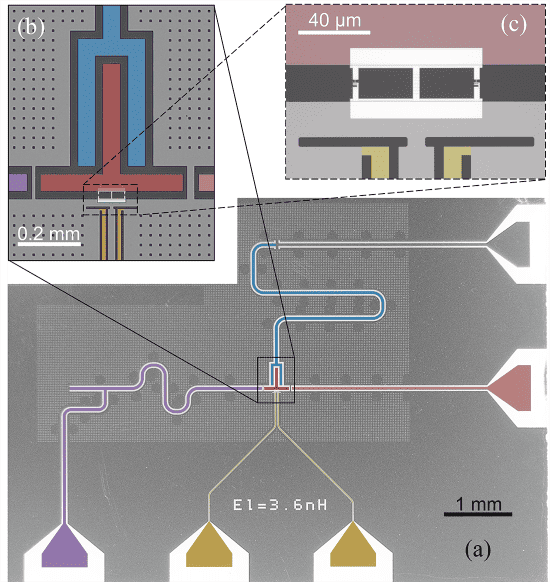
Photograph of the circuit design

In the first of a pair of studies posted on the arXiv preprint server, and not yet peer-reviewed, researchers at Alice & Bob, ENS-PSL and ENS de Lyon found a way of increasing the bit-flip time to more than 10 seconds – four orders of magnitude longer than previous cat-qubit implementations – while still fully controlling the cat qubit. They achieved this by introducing a readout protocol that does not compromise bit-flip protection in their cat qubit, which consists of a quantum superposition of two classical quantum states trapped in a superconducting quantum resonator on a chip. Crucially, the new measurement scheme they devised for reading out and controlling these qubit states does not rely on additional physical control elements, which previously limited the achievable bit-flip times.

Previous experiment designs used a superconducting transmon – a two-level quantum element – to control and read out the state of the cat qubit. Here, the researchers devised a new readout and control scheme that uses the same auxiliary resonator that provides the two-photon stabilization mechanism for the cat qubit. As part of this scheme, they implemented a so-called holonomic gate that transforms the parity of the quantum state to the number of photons in the resonator. The photon number parity is a characteristic property of the cat qubit: an equal superposition of the two coherent states contains only superpositions of even photon numbers, whereas the same superposition but with a minus sign contains only superpositions of odd photon numbers. The parity therefore provides information about what state the quantum system is in.

Redesigning the stabilization of cat qubits

The Alice & Bob team prepared and imaged quantum superposition states while also controlling the phase of these superpositions and maintaining a bit-flip time of over 10 seconds and a phase-flip time longer than 490 ns. Fully realizing a large-scale error-corrected quantum computer based on cat qubits will, however, require not only good control and fast readout, but also a means of ensuring the cat qubit remains stable for long enough to perform computations. Researchers from Alice & Bob and ENS de Lyon addressed this important and challenging task in the second study.

To realize a stabilized cat qubit, the system can be driven by a two-photon process that injects pairs of photons while dissipating only two photons at once. This is usually done by coupling the cat qubit to an auxiliary resonator and pumping an element called an asymmetrically-threaded-SQUID (ATS) with precisely tuned microwave pulsesThis approach, however, poses significant drawbacks, such as heat buildup, activation of unwanted processes, and the necessity of bulky microwave electronics.

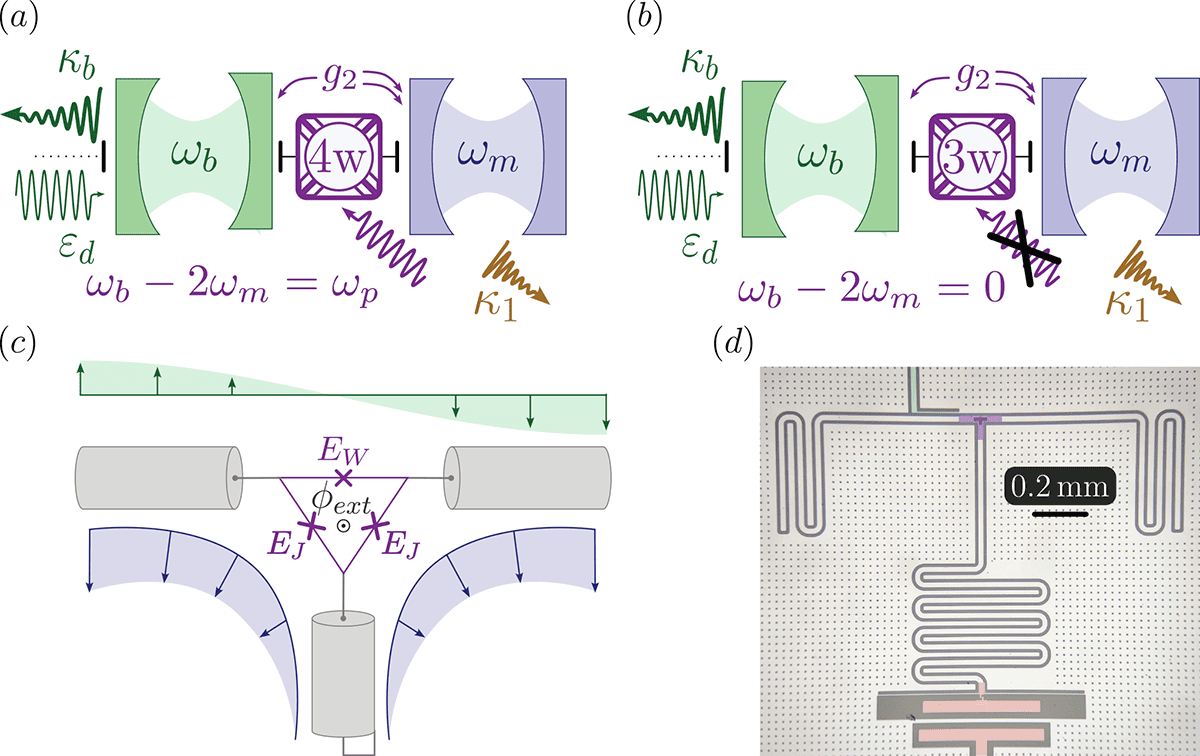
Diagram of circuit design

To mitigate these problems, the researchers redesigned the two-photon dissipation mechanism so that it does not require such an additional pump. Instead of an ATS, they implemented the cat qubit in a superconducting oscillator mode coupled to a lossy auxiliary mode via a nonlinear element consisting of multiple Josephson junctions. The Josephson element serves as a “mixer” that makes it possible to exactly match the energy of two cat qubit photons to that of one photon in the auxiliary resonator. As a result, in this so-called autoparametric process, pairs of photons in the cat qubit resonator are transformed into a single photon of the buffer mode without the need for any additional microwave pump.

Photo of Alice and Bob's chip, held with tweezers in a person's gloved hand against a black background

By designing a superconducting circuit with a symmetric structure, the team was able to couple a high-quality resonator with a low-quality one through the same Josephson element. They thereby increased the two-photon dissipation rate by a factor of 10 compared to previous results, with a bit-flip time approaching one second – in this case limited by the transmon. A high two-photon dissipation rate is needed for fast qubit manipulation and short error correction cycles. These are crucial for correcting the remaining phase-flip errors in a repetition code of cat qubits.

Future applications with cat qubits

Gerhard Kirchmair, a physicist at the Institute of Quantum Optics and Quantum Information in Innsbruck, Austria, who was not involved in either study, says that both works describe important steps towards realizing a fully error-corrected qubit. “These are the next steps towards full-fledged error correction,” Kirchmair says. “They clearly demonstrate that it is possible to achieve exponential protection against bit flips in these systems, which demonstrates that this approach is viable to realize full quantum error correction.”

The researchers acknowledge that significant obstacles remain. Because the accuracy of readout using the holonomic gate protocol was rather limited, they want to find ways to improve it. Demonstrating gates involving multiple cat qubits and checking whether the inherent bit-flip protection remains will be another important step. Furthermore, with the new autoparametric device setup to exchange pairs of photons, Alice & Bob co-founder Raphaël Lescanne anticipates being able to stabilize a cat qubit using four different coherent states instead of only two. “Our goal is to use the unprecedented nonlinear coupling strength to stabilize a four-component cat-qubit, which would offer in situ phase-flip error protection along with bit-flip error protection,” Lescanne says.

Kirchmair believes these results pave the way for more elaborate error correction schemes relying on these heavily noise-biased qubits, where the bit-flip rate is much lower than the remaining phase flip rate. “Next steps will be scaling this system to also correct for phase flips thus realizing a fully error-corrected qubit,” Kirchmair tells Physics World. “One could even imagine combining both approaches in one system to make the best of both results and improve the bit flip times even further.”

The physics behind ‘fractal painting’ revealed

Two researchers at the Okinawa Institute of Science and Technology (OIST) in Japan have examined the physics behind dendritic painting, which involves mixing colourful inks with alcohol and applying the droplets to a surface coated with a layer of acrylic paint.

The process first involves diluting one part of acrylic paint to two or three parts of water and applying it to a non-absorbent surface with a brush.

The next step is to mix the alcohol and acrylic ink and apply a droplet of the mix to the surface layer while the acrylic paint is still wet.

The result is an intricate set of fractal patterns that can resemble snowflakes, thunderbolts or neurons.

OIST’s Chan San To and Eliot Fried examined the fluid dynamics at play when the liquids create these patterns (PNAS Nexus 3 pgae059).

The duo found that the surface tension as the droplet dries and the non-Newtonian nature of the fluids play an important role.

As the ink droplet mix expands it changes the viscosity of the surface layer by shearing it and this force is what creates the fractal patterns. The researchers found that a surface layer less than half a millimetre thick was best to create the fractal patterns.

They discovered that the physics of dendritic painting is similar to how a liquid travels in a porous medium such as soil.

“If you were to look at the mix of acrylic paint under the microscope, you would see a network of microscopic structures made of polymer molecules and pigments,” notes Fried. “The ink droplet tends to find its way through this underlying network, travelling through paths of least resistance, that leads to the dendritic pattern.”

For a video of the process, see here.

Copyright © 2026 by IOP Publishing Ltd and individual contributors