The interaction between free electrons and nonlinear optical states has been used by scientists in Switzerland and Germany to tailor an electron beam that could be used for new types of microscopy. The team was led by Yujia Yang at EPFL.
Electron microscopes use focused beams of free electrons to take images at much higher spatial resolution than optical instruments. Lasers that deliver ultrashort pulses allow researchers to study phenomena that occur on very short timescales. For decades both techniques have been very useful to scientists. More recently, researchers have combined the two technologies to create ever more powerful experimental methods that manipulate electron beams on ultrashort timescales.
Nonlinear opportunities
Yet there is one particularly important area that has so far gone untouched by these latest advances, as Yang explains.
“Nonlinear optical phenomena are of paramount importance in science and technology alike and have heralded numerous breakthroughs. However, the use of nonlinear optical effects to control free-electron beams has rarely been experimentally studied; nor has the use of free electrons to probe nonlinear dynamics been experimentally investigated.”
Nonlinear effects occur when light changes the optical properties of a material, which in turn affects how that light interacts with the material. This usually occurs at high light intensities – and in materials such as photonic crystals, which can be engineered to have specific nonlinear properties.
To combine nonlinear photonics with electron microscopy, Yang’s team used a type of photonic microresonator that is known to have a diverse array of nonlinear optical effects. In particular, the microresonator’s refractive index changes as light intensity varies.
Frequency comb
Nonlinear effects can be used to create optical frequency combs. These are trains of short light pulses that have optical spectra comprising spikes at evenly-spaced frequencies – resembling the teeth of a comb.
“Such combs have been intensively studied not only with respect to fundamental spatiotemporal pattern formation dynamics, but also technologically in an ever-growing number of applications,” says Yang. “Now, we couple such nonlinear optical states in microresonators with the electron beam in an electron microscope.”
In their experiment, the microresonator was integrated onto a chip and driven by a continuous-wave laser. The device created frequency-comb pulses called dissipative Kerr solitons. An electron-microscope beam was sent through part of the microresonator, where it interacted with the light. This caused distinct characteristics of comb pulses being imprinted on the electron beam – characteristics that the team was able to observe.
Kerr solitons
Yang describes their success, “we were able to generate dissipative Kerr solitons in situ, and spectrally identify electrons that have interacted with the femtosecond soliton pulse. In addition, we directly probe the soliton properties from the electron spectra and retrieve the hallmark signatures of soliton formation.”
Yang believes that the team’s research will be built upon. “Our work unlocks the potential to probe ultrafast transient nonlinear optical dynamics with nanometre–femtosecond spatiotemporal resolution, and to directly access to the intracavity field,” he explains. “This could assist the investigation and development of key processes and components in nonlinear integrated photonics.”
Their approach could also allow researchers to create on-chip devices that generate entirely new optical waveforms – which would offer new possibilities for the advanced control of electrons.
Furthermore, by exploiting interactions between free electrons and Kerr solitons on timescales shorter than 100 fs, the effect could push electron microscopy to shorter timescales without any major changes to existing microscope designs.
A new technique for monitoring “second sound” – a bizarre type of heat wave that occurs in superfluids – has been developed by physicists in the US. The work could help model a variety of scientifically interesting and poorly understood systems, including high temperature superconductors and neutron stars.
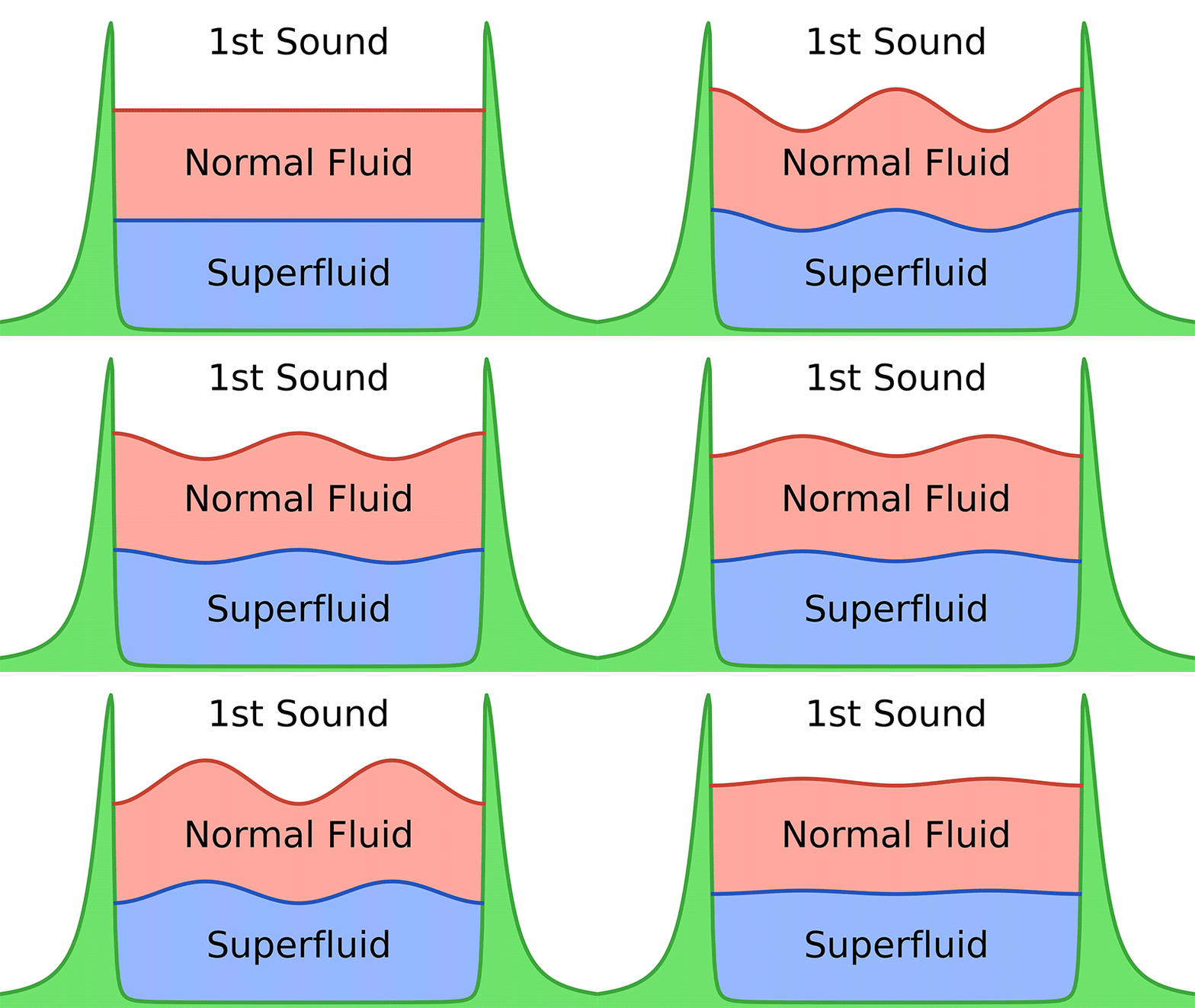
The term “second sound” was coined by the Soviet physicist Lev Landau in the 1940s after his colleague László Tisza suggested that the bizarre properties of liquid helium might be explained by considering it as a mixture of two fluids: a normal fluid and a superfluid that flowed without friction. This arrangement gives rise to the possibility that, if the superfluid and normal fluid flow in opposite directions, the material will not experience any apparent disturbance, but heat will nevertheless pass through it like a wave as the normal fluid and superfluid switch places.
Shortly afterwards, another Soviet physicist, Vasilii Peshkov, confirmed this experimentally. “He [Peshkov] literally was able to heat the superfluid periodically on one side and measure that the heat was distributed like a standing wave in his container,” says Martin Zwierlein, a physicist at the Massachusetts Institute of Technology (MIT) who led the new study.
In the 21st century, physicists such as Zoran Hadzibabic of the University of Cambridge, UK; Deborah Jin of JILA in Boulder, US; and Wolfgang Ketterle of MIT introduced a new dimension to second sound research by demonstrating that Bose–Einstein condensates and strongly interacting Fermi gases also display superfluid properties. In 2013 Rudolf Grimm of the Center for Ultracold Atoms and Quantum Gases in Innsbruck, Austria became the first to observe second sound in such a system. “[Grimm] could not see the heat, but whenever you have a heat gradient in a gas there is also an accompanying density gradient because the gas is compressible,” Zwierlein explains. “There was a travelling density wave at a speed much slower than the speed of normal sound and that was associated with second sound.”
Direct imaging of heat flow
In the new research, Zwierlein and colleagues imaged heat flow in a strongly interacting Fermi gas composed of ultracold lithium-6 atoms. To do this, they placed the atoms in a box potential and switched on a magnetic field precisely tuned to a value associated with a so-called Feshbach resonance in the atoms. At this resonance, fermionic lithium-6 atoms below a certain critical temperature can interact with each other at long range, forming bosonic pairs by a mechanism akin to the Bardeen-Cooper-Schrieffer mechanism in superconductivity. “It’s a bit misleading but helpful for first understanding to think of the superfluid as the component of pairs and the normal component as the component of unpaired atoms,” Zwierlein explains.
Sounds good: This simple animation contrasts ordinary sound (density waves in which normal fluid and superfluid oscillate together) and second sound, which is the movement of heat when superfluid and normal fluid “slosh” against each other while leaving the density constant. (Courtesy: Zhenjie Yan)
Next, the researchers applied a short radiofrequency (RF) pulse to the gas. The RF radiation excited the unpaired atoms to a different hyperfine state, leaving the paired atoms undisturbed. The researchers then used laser light to image the two groups of atoms. “These hyperfine states are split enough that our optical probe responds only to the particular hyperfine states that we selected,” Zwierlein explains. “Where there are lots of atoms, we get a dark shadow; where there are almost no atoms, the light passes through.” Crucially, because colder gases contain a larger fraction of paired atoms that are unaffected by the RF, the images contain information about the gas’ temperature. The researchers could therefore image heat flow directly, even when the medium remained still.
Armed with this new tool, the researchers made several measurements. At the coldest temperatures, locally heating a single region caused strong second sound waves. As the medium approached its critical temperature, these waves became gradually less significant for heat transfer compared with simple diffusion. Above the critical temperature, they vanished altogether. The team also observed anomalous behaviour at the critical temperature. “It’s similar for any phase transition like water boiling in a kettle: you see bubbles – things go crazy,” Zwierlein says. Finally, they measured the damping of the second sound, which arises from the fact that although the superfluid component flows without friction, the normal fluid does not.
High-temperature superconductors and neutron stars
The researchers say the new technique should apply to Bose–Einstein condensates as well, and could also be used for analysing the recently developed Fermi–Hubbard model of high-temperature superconductivity. Moreover, Zwierlein suggests that “matter inside a neutron star is very similar in behaviour, surprisingly, because these neutrons are also very strongly interacting, so we’re learning something from our puff of gas in the lab which is a million times thinner than air something about crazy neutron stars, which are hard to get to.”
Hadzibabic, who was not involved in the study, is impressed. “It’s not just that they do great thermometry below a nanokelvin – which is hard even if the temperature’s the same everywhere – but additionally they can do it locally, which is key for seeing this wave,” he tells Physics World. “So they can say here it’s half a nanokelvin hotter and here, 20 microns away, it’s half a nanokelvin colder.” He says he looks forward to seeing the technique applied “in systems about which we know far less and where the whole system is far from equilibrium”.
Scientific research on humans in space is crucial if we are to make future space flights as safe as possible, and it can also help address important health issues here on Earth. Organizations such as NASA, the European Space Agency (ESA) and others around the world perform such studies under clear ethical research guidelines. But for commercial space flights, which are becoming more and more prevalent, the rules are less clearly defined.
Over the coming decades, these commercial companies will be looking to fly thousands of passengers and workers into space, and they will all have the opportunity to participate in research. For this to happen, however, it’s essential to develop clear ethical guidelines for these human studies.
With this in mind, a panel of experts recently published a policy paper titled “Ethically cleared to launch?”, which provides guidelines to ensure space-based research on humans is as safe and productive as possible (Science 381 1408).
The policy paper came out of a workshop held to discuss the potential ethical concerns associated with research performed during commercial space flights. What or who prompted this workshop – and why was it needed?
Baylor College of Medicine has one of the few space medicine programmes in the US, so naturally it is involved in a lot of research on humans in space. The idea for the ethical framework came from a research ethics consultation my colleagues and I did for Baylor’s Translational Research Institute for Space Health (TRISH). We were looking at the ethics of recruiting healthy volunteers for a study on intracranial pressure in space flight, which involved commercial space flight companies.
While writing up the study, we found that the rules and regulations governing human research in space are different depending on whether it is sponsored by a government or space agency, or a commercial space flight company. We identified a need to bring together this multi-stakeholder group – comprising US regulators, bioethicists, space lawyers, former astronauts and space medicine physicians – to come up with consistent ethical guidance. We embarked on evaluating what principles and practices should be carried over from existing policies, and what new ethical issues had to be considered in the context of commercial space flight.
The framework is really needed on at least two accounts right now. The first is that in the US, the Federal Aviation Administration (FAA) is reviewing new flight regulations for safe commercial space vehicles. In October 2023 the agency was given a three-month extension to its “learning period”, during which its ability to regulate safety measures for commercial flight participants is limited.
Second, the US is set to decommission its involvement in the International Space Station (ISS) by 2030. The ISS is still the only collaborative low-Earth orbit research hub among spacefaring nations, and the move to leave it is paving a direct path for commercial space flight companies to fill in this gap. Indeed, companies are racing to secure government contracts to build new space stations in the ISS’s stead, so we expect lots of human research to be conducted.
The framework your team developed has four key principles, the first being social responsibility – in other words, those who have the privilege to travel in space should contribute to research that benefits all of society. Do you think passengers on commercial space flights will want to take part in research studies?
I think many will consider it. It’s incumbent on the research sponsors as well as the researchers themselves to be transparent about both the benefits of participating, and the heightened risks from the significant scientific uncertainty regarding how the human body functions in space long-term.
The risks of the research are highly protocol-dependent, just as they are on Earth. They could range from minimally risky – such as an observational study that simply requires some sort of self-monitoring, or a minorly invasive one that involves blood draws or other biospecimen collection – to highly risky studies, like the intracranial pressure case I mentioned earlier.
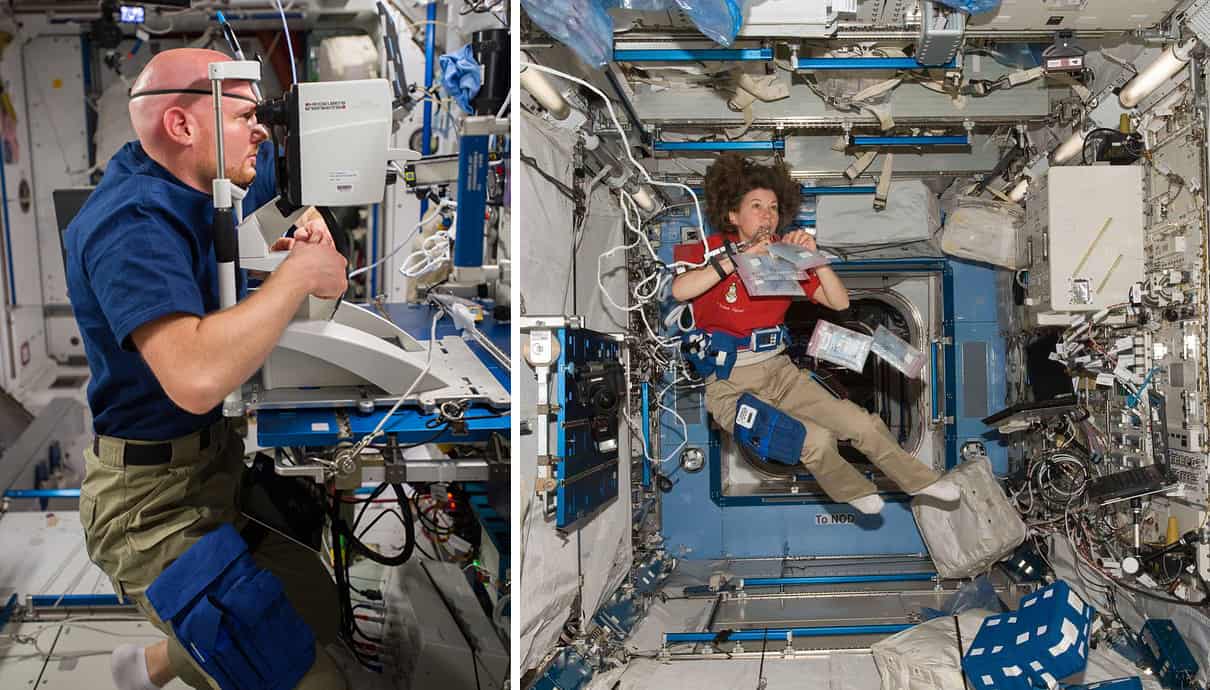
Inspiring science (left) ESA astronaut Alexander Gerst uses the optical coherence tomography camera during an ocular health test on the ISS. (right) NASA astronaut Cady Coleman participates in the ambulatory monitoring portion of the Integrated Cardiovascular research experiment, which investigates ventricular atrophy associated with long-duration space flight. (Courtesy: NASA)
Do you think there’s a risk of people agreeing to take part in research just so they can get their trip into space?
It’s an important question, and the quick answer is yes – especially considering that commercial crews are poised to fly many different kinds of people with different motivations, from paying customers to former astronauts to employees of commercial companies themselves. In our field, we refer to this ethical issue as “undue inducement”. We commonly face this in terrestrial clinical trials, where the benefits of participating in research (for example, payment) can’t be so great that it fundamentally alters how somebody would normally make decisions in the face of the risks involved.
In our paper, we propose ways of avoiding undue inducement. These include recruiting people to participate in research studies and missions who would already be going to space, as opposed to offering what might be considered an excessive benefit to travel to space simply for research purposes.
The second principle is scientific excellence. What sorts of experiments do you see future space travellers participating in? And are these going to be different from the studies that astronauts are performing today?
We should expect to see studies that attempt to answer lingering questions about how humans can thrive in space environments long-term. In September 2023 NASA astronaut Frank Rubio broke the record for the longest space mission by a US astronaut after spending 371 days in space. Given that it will take nearly seven months to reach Mars and at least that long to return, future studies will really need to focus on how to sustain human life in space for longer.
The studies I find particularly compelling are those that look at human behaviours, psychology and mental health on long-duration space missions. They look at questions like, “what do crews on a mission do if someone dies?”, “what do they do if someone has appendicitis?” and “how do we ensure the safety and welfare of people with various disabilities who have different clinical needs?”. We need to address these to make space flight and long-duration missions safer for everyone.
The third principle in the policy paper is proportionality – maximizing the value of the study while minimizing harm to participants. What sort of increased risks are there compared with similar studies performed on Earth?
Proportionality refers to the realistic balancing of known or foreseen risks with the anticipated benefits. Space flight – even though we’ve made huge strides in the engineering and human physiology of it – remains a really high-risk, high-reward endeavour. In the paper, we argue that the add-on risks of research participation should be evaluated against the baseline risks of space flight itself.
First and foremost, there are the environmental exposures – namely zero gravity and radiation – that are substantially different in space than on Earth. The lack of load-bearing weight on muscles due to zero-gravity environments can lead to muscle atrophy and bone-density weaknesses, while increased radiation heightens risks for all types of cancers. Another considerable risk that’s not often considered is the impact of isolation on mental health and emotional well-being.
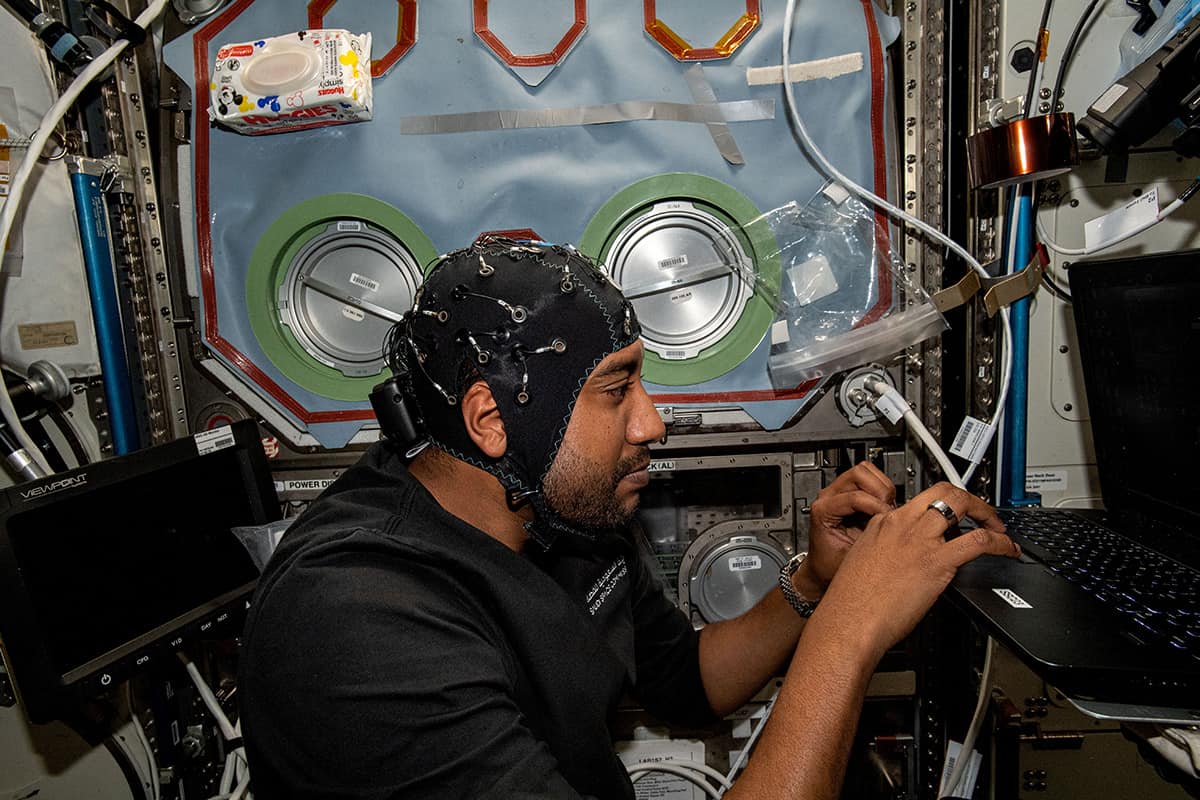
Microgravity and the brain Axiom Mission 2 (Ax-2) astronaut Ali Alqarni used an EEG device while on the ISS as part of a study assessing the effects of microgravity and long-term space travel on an astronaut’s cognitive health, stress levels and sleep quality. (Courtesy: Axiom Space)
The only way we’re able to assess and characterize these risks is with data generated from studies. These are our most valuable resource, providing important insight into the extent of those risks.
The incredible time, resources and sacrifice needed to gather just one data point justifies sharing the data whenever possible. There are therefore additional risks that have to be considered around privacy and confidentiality – especially when crews are small. There is a worry that with such small data sets, we cannot make the same assurances for data privacy compared with larger studies that share aggregate data, and therefore the chance of re-identification is higher.
Nevertheless, sharing high-fidelity data from rigorously designed and executed studies really benefits the entire industry, especially in a competitive market space like commercial space flight.
Finally, the fourth guideline is described as “global stewardship”. Can you explain what that means?
At present there are obvious inequities around who gets to go to space, what scientific questions get prioritized in research, and who ultimately makes those decisions. We’re people on one planet, in one solar system within what we think is an ever-expanding universe. But the research we conduct must be representative of humankind’s diversity as we know it in order for that research to truly benefit everyone.
Global stewardship refers to the responsible use of time, data and natural resources to learn more about space and our place within it. It means focusing on questions about how prolonged human presence in space will affect other planetary resources, life forms and environments we have yet to discover.
We borrowed the concept of global stewardship from other disciplines, such as environmental science and conservation studies, as they have great relevance for guiding responsible human exploration in space. Global stewardship really conveys the sense of collective responsibility for the resources we take up to expand this frontier, while being mindful of how resource investments in space will affect us here on Earth now and in the future.
But how can you ensure that commercial space flight companies stick to these four principles? Could they be written into law, or do you think companies will create their own guidelines based on your suggestions?
You’ve actually outlined the next phase of our research. We’ll be looking at how we entrench these best practices in not only regulation but also guidelines, so that commercial companies can demonstrate in good faith that their research is both scientifically and socially valuable. At present, there are different arms and policy levers that can be used to incentivize commercial companies and other stakeholders to adopt some of these practices.
Regulation is one such incentive. I think with such an emerging competitive industry, there are a lot of eyes on these companies at the moment. It’s therefore in their best interests to be transparent with the public about what studies they are doing, if any, and the results of those studies. I think the court of public opinion will be the strongest motivating and incentivizing factor for adopting the rules at present. But we’re continuing to ask this question, and this issue of accountability is one we’ve discussed at length.
Are you continuing to work with some of these commercial space flight companies?
Not at the moment, but we are always looking to collaborate.
Looking ahead, how do you think commercial space flight will grow over the next decade?
In our lifetime we’ll witness more and more advanced research missions that fly further and further into our solar system, and I think the commercial space flight industry will expand, both in the number and the sophistication of launches. With artificial intelligence and machine learning, we’ll be able to get a better understanding of what changes happen to the human body, even at the molecular level in real time, and personalize risk calculations for anyone who wishes to travel to space. Scientific and technological innovation will expand considerably with greater commercial industry involvement, as well as our understanding of the built environment within space vehicles.
Finally, do you see yourself ever taking part in a commercial space flight?
I do actually. So Elon or Jeff, if you’re listening, I’m ready to be the first astro-ethicist in space.
A team of researchers in China has pioneered the use of novel metal-free graphene quantum dots (GQDs) for chemodynamic therapy, an emerging non-invasive cancer treatment. The breakthrough paves the way for an efficient and cost-effective means of improving the catalytic activity of GQDs, while addressing the toxicity concerns linked with metal-based nanozyme treatments.
Reducing side effects
In recent years, metal-based nanozymes (nanomaterials with enzyme-like characteristics) have shown strong potential as therapeutic agents for chemodynamic therapy. The treatment works by using the nanozymes to catalyse the breakdown of hydrogen peroxide in cancer cells, leading to the production of highly cytotoxic hydroxyl radicals. Moves to use them more widely, however, have been hampered by the presence of persistent off-target side effects associated with metal toxicity.
In an effort to overcome these limitations, the team – led by Hui Wang from the Hefei Institutes of Physical Science (HFIPS) at the Chinese Academy of Sciences – used a relatively simple “one pot” process to synthesize n/p co-doped graphene quantum dots (NPGQDs) – metal-free nanozymes, derived from red blood cell membranes. The NPGQDs proved highly effective in treating tumours with fewer side effects.
Publishing their findings in the journal Matter, the researchers outline how they used NPGQDs as a Fenton-like reagent, which can catalyse hydrogen peroxide to generate hydroxyl radicals in a slightly acidic tumour environment, leading to intracellular oxidative damage and the inhibition of tumour cell proliferation.
In vitro studies of cancer cells showed that the NPGQDs induced apoptosis and ferroptosis (two types of cell death). The researchers also treated tumour-bearing mice with NPGQDs, observing 77.71% inhibition of tumour growth following intravenous injection and 93.22% inhibition for intratumoural injection, with no off-target toxicity.
“Notably, the synergistic electron effect of introducing nitrogen and phosphorus into GQDs can generate highly localized states near the Fermi level, thereby increasing substrate adsorption and improving enzyme activity,” says first author Hongji Liu, based at the State Key Laboratory of Chemo/Biosensing and Chemometrics at Hunan University.
“As a result, their Michaelis-Menten maximum velocity of 0.247 µM/s [a measure of hydroxyl radical generation rate], in the presence of hydrogen peroxide as a substrate, surpasses that of classical GQDs and graphene oxide by ten-fold,” he adds.
Areas for improvement
According to Liu, chemodynamic therapy exhibits several advantages over existing approaches to cancer treatment – including the fact that the approach is “tumour-selective with low side effects” and that the treatment process is initiated by endogenous substances such as hydrogen peroxide, meaning that it does not depend on external field stimulation.
“Chemodynamic therapy is also capable of modulating the hypoxia and immunosuppressive tumour microenvironment,” he explains. “In addition, it does not require complicated therapeutic devices and thus has relatively low treatment costs.”
Moving forward, Liu intends to further validate and refine his findings through rigorous experimentation and data analysis. “This will involve conducting more comprehensive studies, expanding the sample size, and exploring potential confounding factors that may influence the results. By doing so, I aim to strengthen the reliability and generalizability of my findings,” he says.
Liu also plans to collaborate with other researchers and experts in the field to gain a variety of different perspectives and insights. In his view, such a collaborative approach can help to foster interdisciplinary research and “promote a more holistic understanding” of the applications and implications of his findings.
“It will also allow for the exchange of ideas and the identification of potential areas for improvement or further investigation,” he says.
“When it comes to clinical and healthcare applications, my goal is to translate my research findings into practical solutions that can benefit patients and healthcare providers. To achieve this, I will work closely with medical professionals and industry partners to develop and refine prototypes, conduct clinical trials, and assess the feasibility and effectiveness of implementing these solutions in real-world healthcare settings,” Liu tells Physics World.
The most accurate measurements so far of voltage oscillations at a superconductor junction have been made by Sergey Lotkhov and colleagues at the German Federal Metrology Institute (PTB). The team’s approach could lead to the development of a new standard for measuring electrical current.
Frequencies can be measured and compared with very high accuracy, so metrology systems often convert physical quantities into frequencies. So far, however, the measurement of electrical currents have not benefitted from this approach.
But now, new research by Lotkhov’s team suggests that a frequency-based current standard could be created using Josephson junctions. These are a widely-used quantum devices that comprise two superconducting materials that are separated by a thin insulating barrier.
Voltage oscillations
When a constant current is fed into a Josephson junction, electron pairs will build up on one of the superconductors, unable to cross the insulating barrier. This increases the voltage across the barrier until it reaches a level where a pair can quantum-mechanically tunnel across the barrier. This tunnelling causes the voltage to drop and the process repeats itself.
The result is a steady variation in the voltage across the junction – called a Bloch oscillation. This occurs at a frequency that is proportional to the input current, so measuring this frequency could provide a very accurate way for measuring and comparing current – at least in principle. But in practice, these oscillations are very small and their frequencies have proven very difficult to measure directly. Instead, previous studies have measured them indirectly by synchronizing the oscillation with an external microwave source.
In this synchronized state, a series of plateaus called Shapiro steps appear in the voltage–current curve of a junction. These steps occur at specific current values that are proportional to exact multiples of the frequency of the applied microwave radiation. This offers a way of measuring current.
Noise problems
However, such measurements are hampered by various types of noise that occur in a Josephson junction. So far, this noise has made Bloch oscillations unsuitable for use as a robust current-measurement standard.
Now Lotkhov and colleagues have reduced the noise by using a superconducting quantum interference device (SQUID) to deliver the microwave oscillations. A SQUID comprises two strongly coupled Josephson junctions and is often used to measure tiny magnetic fields. The SQUID was integrated along with another Josephson junction in a single device that was child to 0.1 K to minimize thermal noise.
With this setup, the researchers achieved far lower levels of noise than previous microwave experiments and were able to make accurate measurements of the Bloch oscillation frequency. Crucially, the voltage-current relationship they observed displayed the same series of Shapiro steps seen in past studies. This established the link between current and Bloch frequency.
The team’s results also agree closely with simulations of the oscillations. Following the success of their approach, Lotkhov and colleagues hope their experiments could be an important next step towards a robust new measurement standard for electric current. For now, they will aim to address quantum-scale fluctuations in the SQUID, which could help them to reduce noise even further.
Bubbling away: In the quantum gases lab in Trento, the team produced a superfluid spin mixture of sodium atoms in a false vacuum state (blue) and observed and studied its decay to the true vacuum state (red) through the formation of spin bubbles. (Courtesy: G Lamporesi, A Recati and A Zenesini)
Physicists in Italy have observed a phenomenon known as false vacuum decay for the first time. The work, which was performed in a ferromagnetic superfluid, advances our understanding of ferromagnetic phase transitions and could shed more light on the stability of the early universe.
Some types of quantum systems have metastable (false) vacuum states as well as an absolute ground (true) vacuum state. These states represent different configurations of a quantum field, and the field can decay from the false vacuum state to the true one. When this happens, localized macroscopic regions of true vacuum – bubbles – form, surrounded by patches of false vacuum.
“Such a mechanism was originally discussed in the context of cosmology to study the stability of our universe, which can be in a stable or metastable configuration,” explains Gabriele Ferrari, a physicist at the University of Trento, Italy, who co-led the study together with Giacomo Lamporesi, Alessio Recati and Alessandro Zenesini of the Pitaevskii BEC Center, CNR-INO in Trento, Italy. “Indeed, vacuum decay is thought to play an important role in how space, time and matter was created in the Big Bang.”
Spontaneously generated bubbles
In the new work, the Pitaevskii BEC Center team used sodium atoms with a ferromagnetic ground state to explore false vacuum decay in a many-body quantum system. The team prepared this system by confining the atoms in an optical trap and cooling them to less than a microkelvin above absolute zero, where they form a ferromagnetic superfluid.
“We prepared the system in a metastable state in which the superfluid is polarized in the opposite direction with respect to the applied magnetic field,” explains Lamporesi. “After some time, we saw that the system spontaneously generated bubbles in macroscopic regions aligned with the magnetic field.”
Working with theorists at the University of Newcastle, UK, the team further showed that these bubbles were, in Recati’s words, “the first experimental evidence of the mechanism of false vacuum decay on a macroscopic quantum field”.
The researchers went on to measure the relationship between the bubbles’ average decay time and experimentally tuneable parameters such as the energy difference between true and false vacuum states (which changes with the applied magnetic field due to the Zeeman effect). They found that small variations lead to large changes in the decay time. “Our results show a very good agreement with the predictions of a field theory tunnelling (instanton) model, thus confirming the false vacuum decay origin of our system,” Lamporesi tells Physics World.
A technical achievement
The results of these experiments are described in Nature Physics, and Lamporesi stresses that obtaining them was technically challenging. Among other factors, the external magnetic field needs to be extremely stable to preserve the spin coherence of the superfluid system. To achieve the required stability, the team had to install a magnetic shield around the ultracold atomic gas – a tricky task, given that they needed to access the system with laser beams to manipulate the atoms.
While the researchers have analysed how long it takes for bubbles to form, this is just the first step. They now plan to investigate bubble dynamics in a controlled environment to understand the nature of bubble growth.
“Another important step will be to increase the effective dimensionality of the system from quasi-one-dimensional, as in the present study, where the theoretical analysis is easier, to two-dimensional, where interesting phenomena such as bubble collisions and merging appear,” Zenesini says. “Many features of bubble nucleation and dynamics were studied theoretically in the context of cosmology, where experiments are not yet accessible. They are highly relevant for the condensed-matter community too, however, since they are associated with quantum ferromagnetic dynamics that can be observed experimentally – as we have demonstrated in our work.”
Networking events are back – at least they are in my day-to-day business activities. Sure, I picked up lots of great online networking skills during the COVID pandemic. But it’s fun – and often essential – to return to the old-school methods of talking to people face to face, going to conferences and attending trade shows. If you’re lucky, you could even go on a trade mission.
In fact, I’m surprised how many events I went to in 2023 and how important they’ve been to my business activities. Some people, I found, were rusty after sitting behind their keyboards for so long. If you work in industry, as I do, what’s vital is to craft a high-quality, concise introduction to yourself, your company and your aims.
The classic “elevator pitch” – a pithy, 30-second summary to sell yourself or your product – is vital in many social and business situations. You need to be able to deliver a short, positive and punchy introduction to yourself and then ask the other person about themselves. If they respond with a similarly punchy pitch, you’ll soon know if you have – or haven’t – got something of mutual interest to discuss.
But even if the person you’re talking to doesn’t seem of interest, their work may be relevant in the future so I always share contact details; you never know where life will take you. So swap business cards, QR codes to your LinkedIn profile or whatever you think is appropriate, and thank them for their time. Networking events can be awkward and nerve wracking, but this strategy works well – after all, the other person is likely to be on a similar mission.
Mission accomplished
One networking highlight for me last year was a week-long trade mission to India I went on as part of Innovate UK’s Global Business Innovation Partnership (GBIP) programme. Focused on “power electronics, motors and drives”, it took me to various automotive manufacturing centres and companies in Chennai and Pune. Delegates have to apply to take part, with Innovate UK typically selecting representatives from a dozen or so relevant UK firms.
Designed to help stimulate collaboration and partnerships, the mission started with a briefing session in the UK detailing the programme’s aims and the places to be visited. In fact, the session was a great way to introduce yourself and your company to others on the programme. As for the visit itself, it gave me incredible opportunities to meet businesses and organizations I’d perhaps otherwise have no chance of meeting.
Even the bus rides between events were a great way to meet the other firms taking part
We made up to five visits per day, describing our companies at each event through 30-second to one-minute elevator pitches. Once everyone knew what we did, there were opportunities to meet potential partner organizations for more in-depth discussions. Even the bus rides between events were a great way to meet the other UK firms taking part and bond with others on the mission – none of us can forget the moment suitcases broke free from the coach and bounced down the road causing traffic chaos.
We had some other pretty amazing experiences on the trip, including a visit to several companies building electric buses and cars. At Bajaj Autos, which is one of the largest manufacturer of scooters and “tuk-tuk” three-wheelers, we even got to ride some of the terrifyingly quick electric prototypes. We also went to regional trade-association meetings attended by 150 or so people, as well as vast research institutes. There was also an amazing drinks reception at the British High Commissioner’s residence in Chennai.
At the end of the week, I made several key business connections and got through a full box of business cards. Whereas I don’t think I’d used any at all in previous years, I quickly discovered that they’re a key part of doing business in India. In fact, the trade mission proved so useful that I applied for – and went on – another trip to Canada in early December. It was just as useful, if 50 ºC colder.
Out and about
Not everyone can go on trade missions, but good networking skills are just as useful at trade shows and conferences. During the pandemic, most such events went virtual or were cancelled – but now they’re back with a vengeance. Trade shows are great for launching new products, meeting new and existing customers, and making connections in your industry.
They are even more important in changing markets where new solutions and products that could be game changers need to be launched and validated. Posting information on your company’s website is important, of course, but it’s not necessarily going to get people’s attention. A website also won’t give you the vital customer feedback that you need to fine-tune your offering.
After all those years online, I have noticed some people look a little lost at real events. It’s almost as if they have forgotten how to network or introduce themselves without the safety and structure of a chaired online meeting on Zoom or Teams. Far too many people end up fiddling on their phones or laptops, adopting a “they know where I am if they are interested” approach.
Sure, it’s okay to go on your phone for a few minutes now and then to kill time, deal with something urgent, or charge your “social battery”. But you shouldn’t be on it the whole time – that’s shocking to see. What’s the point of staring at a screen at a real event when you should be out there, maximizing the opportunity for yourself or the business you represent.
Wonder of wonders
At one event last year – a workshop jointly organized by the UK’s MagSoc and the magnetism group of the Institute of Physics (IOP) – the organizers broke the ice using “speed-dating” style introductions. It worked a treat and I ended up meeting Ocean Bach, a physicist who in 2022 won the IOP’s Three Minute Wonder (3MW) science-communication competition. Designed to get physicists to explain their work to the public in just three minutes, 3MW is a great way to learn the art of the elevator pitch.
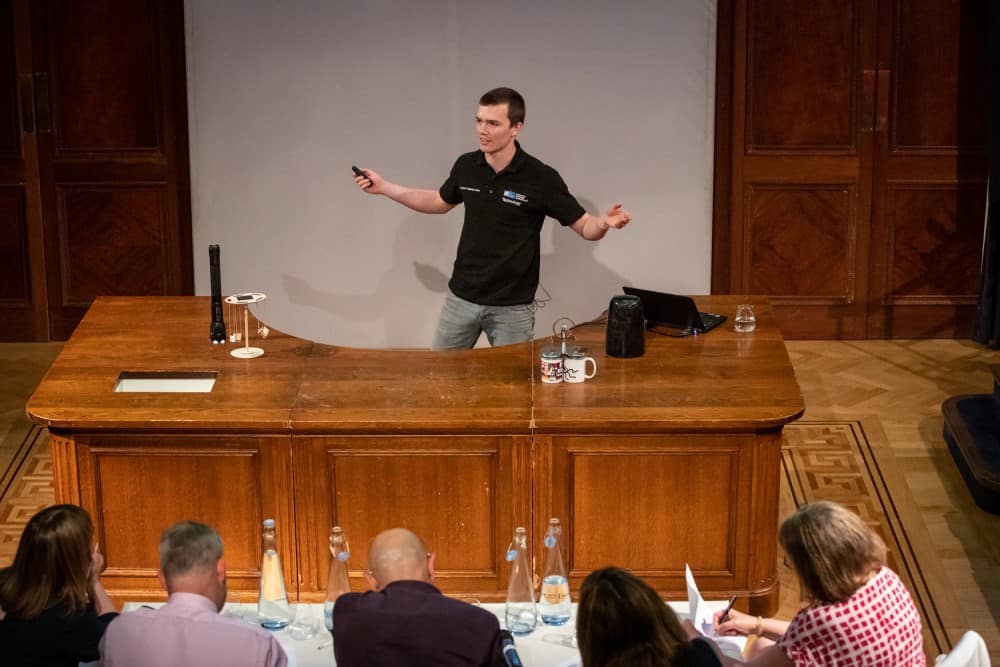
Winning formula Physicist Ocean Bach presents his “Three Minute Wonder” talk at the Royal Institution. (Courtesy: Ocean Bach)
The competition involves a series of regional or national heats, with the winner from each going through to a grand final, which in previous years was held at the Royal Institution in London. Contestants must explain their work to a panel of established science and technology communicator judges, in front of a non-specialist audience. All competitors must work in physics or a related field in academia, business or industry.
They can only use one slide and one video, but can include as many other props as they like to bring their science to life. Having been a judge in one heat a few years ago, I can attest to the skills of the presenters and admired the complexity of the ideas they were trying to present. So whether you’re in industry or academia, why not enter yourself? The skills you’ll gain are invaluable for explaining who you are and what you do – pre-requisites for success, whatever your line of work.
The Duke of Edinburgh visited the headquarters of the Institute of Physics (IOP) in London yesterday to hear about the role that physicists are playing in supporting the “green economy”.
The event included members of the IOP and representatives of some of the UK’s leading physics-based businesses and organizations, who showcased their role in making energy generation and industry more sustainable.
Tom Grinyer, group chief executive of the IOP, said afterwards it had been “fantastic to speak to his Royal Highness about the role physics and physicists are having in the green transition and the work the IOP has been doing on this issue”.
That work includes the recent Physics Powering the Green Economy report, which describes how physics-based technology can help the move to a low-carbon economy. More than 500 IOP members contributed to the report, supported by 26 expert advisers, many of whom were at yesterday’s event.
As well as an address from the duke himself, there were short speeches from IOP president Keith Burnett; nuclear physicist Martin Freer from the University of Birmingham, who co-wrote the introduction to the report; and high-energy physicist Tara Shears from the University of Liverpool, who is the IOP’s current vice-president for science and innovation.
While the odds of being struck by lightning is about one in a million, a direct hit can be fatal, especially to the head. So what can you do to protect yourself against such a shocking event? According to researchers in Germany, applying rainwater to the scalp could help. To investigate, they used two model “heads” that contained three layers corresponding to the scalp, skull and brain. One head was sprayed with a weak salt solution to mimic rainwater with the other one kept dry. The two heads were then exposed to ten electrical discharges of 2 kA and 12 kV.
They found that the wet head carried a lower amount of current in the brain layer compared to the dry head and could correspond to a survival rate of 70-90% compared to 30% for a dry head. It struck the researchers that the reason for the lower activity could be that vaporising water helps to reduce the temperature of the skin and directs lightning away from it. They now plan to conduct more research into the effect.
What colour are blueberries? This might sound like a silly question because they appear to be blue in colour. But, it’s more complicated than that – according to Rox Middleton and colleagues at the UK’s University of Bristol. The team has shown that the blue hue of the popular fruit is a result of structural colour on the skin of the blueberry.
Tiny structures
Structural colour is created by tiny, recurring surface structures that have spacings on par with the wavelength of light. Interference effects at the surface allow some wavelengths of light to be reflected while other wavelengths are not, making the surface appear certain colours. A wide range of living organisms make use of structural colour – including plants, birds, insects and cephalopods.
Now work done by Middleton’s team adds blueberries to that list. The researchers identified a layer of wax on the skin of the fruit that is is made up of randomly arranged crystal structures that scatter blue and UV light. Apparently, the chemical pigments on the skin of the berries are red in colour, but what we see is the blue structural colour from the waxy layer – which is only 2 micron thick.
The team confirmed this by mashing up the wax structures, at which point they ceased to be blue. However, they were able to carefully reconstitute the wax crystals on a substrate, creating a blue-UV coating.
The researchers are now investigating practical ways to create similar coatings with the goal of creating sustainable, biocompatible and even edible UV and blue-reflective paint.
Describing their work in Science Advances, the team also reports similar waxy structures on plums and juniper cones.
Sunday 11 February 2024 is the ninth International Day of Women and Girls in Science. Established in 2015 by the United Nations, the event aims to promote women’s and girls’ participation in science, technology, engineering and mathematics (STEM) subjects and to highlight gender disparities in these fields.
We know that women make up a disproportionate minority of physicists, and they continue to face both outright and implicit biases in their work. That’s why this year’s International Day was marked by an assembly at the UN headquarters in New York, featuring panel discussions and an exhibition for female youth that showcased careers in science. It will also see organizations including governments and universities promoting opportunities for female scientists.
Physics World has also done a lot in recent years to cover the work of female physicists and report on efforts to achieve gender equality in physics. In case you missed it, here’s a round-up of highlights over the last year. You can also read our online collection of articles on women in physics.
An ongoing conversation
One significant new initiative to tackle gender discrimination is the $3m Bell Burnell Graduate Scholarship Fund, which funds physics PhD students in the UK and Ireland from under-represented groups. In June 2023 it announced its fourth cohort of students and Helen Gleeson, the physicist who chairs the selection panel for the fund, wrote in Physics World about what the scholarship has achieved. Thanks to the fund, 31 students who would otherwise struggle to access physics graduate programmes have been able to pursue research that they are passionate about.
Meanwhile, the theoretical physicist Chanda Prescod-Weinstein from the University of New Hampshire, who is a contributing columnist for Physics World,explained how her frustration at the lack of information about Black woman role models in physics led her to compile a bibliography of their papers. In addition, Physics World editor-in-chief Matin Durrani wrote about how the rule against self-nomination for awards such as the Nobel Prize can hinder scientists from under-represented backgrounds.
Looking to the past
Gender disparities in physics are, of course, far from being a new topic of discussion. In 2002 Physics World ran an article about female physicists that featured comments from Anne L’Huillier, who said she believed that having female physics professors as role models would encourage more girls to pursue the subject. In 2023 L’Huillier was one of three winners of last year’s Nobel Prize for Physics. In doing so, she became the fifth woman in history to win the award, recognized for her work on attosecond pulses.
Gender disparities in physics are, of course, far from being a new topic of discussion
Another physicist featured in that 2002 article was the late Deborah Jin, who said that subtle, sometimes unintentional biases against female physicists are often more prevalent than outright sexism. Jin’s pioneering experimental work on Bose–Einstein condensates was covered this year in Chad Orzel’s series of three features on the history of laser cooling.
Other Physics World features on the history of women in physics included the story of the nuclear physicist Gertrude Scharff–Goldhaber, and the codebreaker Emily Anderson. Scharff-Goldhaber was a German born Jewish physicist who fled Nazi oppression to the US; she went on to have a wide-ranging career and is known for her work on the “low-energy” physics of excited nuclei. Anderson was a skilled mathematician and linguist whose career for the British Foreign Office spanned both world wars.
Diverse paths for women in physics
Over the last year, Physics World has also given plenty of coverage to the careers of women in physics, highlighting the diversity of contributions made by female physicists, which stretch from biophysics and quantum physics to materials and astronomy and cosmology . The women profiled have forged careers not only in academia but also in finance, science communication, software engineering, teaching and even science policy, in the form of Cathy Foley — Australia’s chief scientist. What’s more, some have projects in both academia and industry — such as Silvia Vignolini, who spoke about building start-ups from her photonics research.
Many of the women profiled spoke about the changing attitudes towards women in physics, as well as persistent problems. Astronomer Wen-fai Fong encouraged younger researchers to focus on the science, saying “Women are still under-represented in physics but I never fixate on that.” Meanwhile, in her interview with Physics World, theoretical physicist Nicola Spaldin spoke about her role on the European Research Council’s Scientific Council, which has recently changed its evaluation criteria to reflect the fact that female scientists are often less able to migrate for work than their male counterparts.
The female physicists featured in Physics World last year were united by their curiosity and their drive to push at the boundaries of our knowledge of the universe. This collection of stories shows that, despite existing challenges for gender equality, the work of women in physics is not, and has never been, a separate narrative from that of physics as a whole.