Geologists at the Massachusetts Institute of Technology (MIT) in the US have discovered a connection between two important theories of Earth’s long-term climate history. The first is that exposure of fast-weathering rocks called ophiolites correlates with the climate getting colder. The second is that as mountains erode into the sea, carbon becomes buried under the water. Both phenomena can cause large-scale cooling, and the MIT team’s findings suggest that the combination not only triggered the four major ice ages in Earth’s history, it is also continuing to cool the planet today, providing a buffer against a warming climate – albeit only on a timescale of millions of years.
Ophiolites are fragments of the Earth’s oceanic crust that have been lifted to the surface over time by plate tectonics. Once exposed to the atmosphere, these fragments weather into rocks called smectites that eventually settle back onto the ocean floor. There, they make excellent traps for carbon thanks to their layered and folded structure. Over geological timescales, these rocks thus have a global cooling effect, and researchers led by Oliver Jagoutz of the MIT’s Department of Earth, Atmospheric and Planetary Sciences say they may have helped glaciers spread over the planet’s surface in the Palaeozoic era 541-252 million years ago.
Clay sheets expand and separate
To support this conjecture, the team analysed the geochemistry and carbon isotopic history of smectite shales and limestones. “The smectite structure forms predominantly when aluminium-poor minerals (pyroxene and olivine) lose their cations to rainwater and groundwater,” explains team member Joshua Murray. “The minerals that form have weak layer charges (clay minerals look like long flat sheets that interact through electrostatic forces). The weak layer charges mean the clay sheets expand and separate, exposing a lot more surface area on which organic carbon can bind.”
The researchers studied the formation of smectite clays for two reasons. First, they did not understand why carbon mostly precipitates out of the ocean in the form of calcium carbonate, even though so much recent weathering occurs in magnesium-rich ophiolites located in the tropics. “There are some theories of why this happens, but the fate of magnesium and how it relates to cooling is poorly constrained,” Murray says.
Second, they read in the literature about smectite clays being geologically transported to the island of Luzon, which is now part of the Philippines. Located in the South China Sea, Luzon is volcanic, and produces a lot of magnesium-rich, or mafic, smectite. The nearby island of Taiwan, on the other hand, is made largely of old metamorphic and sedimentary rocks, and produces other clay minerals. “We started to connect the dots and link these mafic ophiolitic rocks to organic burial in the past,” Murray explains.
Clay mineralogy and climate
Linking tectonic events to clay mineralogy and climate could be a promising avenue for future research, he tells Physics World. “The burial of organic matter liberates oxygen into the atmosphere, so it is worth looking at some of the major climatic events in the Earth’s history, with an eye for the mineralogy of the sediments that were deposited, particularly during the so-called great oxidation event(s) and ‘snowball Earth’,” he says.
The results could even have implications for our understanding of climate on the early Mars, since much of the Martian surface is also covered in smectite. “We are actively thinking about [how] these high surface-area clays interacted in the past,” Murray says.
Back on Earth, the findings are the first to show that plate tectonics can trigger ice ages through the production of carbon-trapping smectite, he adds. “Today, these ophiolites stretch from Papua New Guinea all the way up through northern India, Iran, Turkey, Greece, and into Italy,” Murray says. “We want to analyse the sediments which are coming off of mountain ranges in these regions of the world and assess the link between rock-type, clay mineralogy, and Earth’s carbon cycle.”
Making decisions about your career can be an exciting process, but for most people it’s also a tricky one. Physics World Careers 2024 is here to help you navigate the current jobs market – to find the right role that matches your skills and interests, while also letting you discover all the many opportunities available to you. The good news is that if you are an early-career physicist, or about to graduate with a degree in physics, then your talents and expertise are in high demand.
Employers from sectors as varied as construction, healthcare, engineering, green energy and data science are looking for people with your physics skills and knowledge, as well as additional transferable skills that will let you successfully apply physics within the workplace. A good place to start is the article “The demand for physics skills in the UK workplace” in the “Careers development” section, by physicist and broadcaster Sharon Ann Holgate. She reveals the key findings of the Physics in Demand: the Labour Market for Physics Skills in the UK and Ireland – a report produced for the Institute of Physics.
To take stock of what a successful career looks like for you, our “Case study” section showcases some of the myriad of researchers across academia and industry, working in everything from cosmology and quantum computing, to biology and education. And if it’s careers advice you are after, take a look at the “Ask me anything” section, where top physicists offer their sage advice. As always, we also have a comprehensive “Employer directory”, where you can find out more about companies and institutions currently hiring physics graduates. If you’re ready to start your job search, do explore all the latest opportunities on the Physics World Jobs website, where you can find vacancies in physics and engineering for people at all career stages.
You can also sign up for the Physics World careers newsletter, sent out every two months. To subscribe, simply sign into your free Physics World online account and tick the “Careers bimonthly” box.
The overall picture for those graduating with a degree in physics is a positive one, as we attempt to meet the needs of science, commerce and society.
Interdisciplinary achiever Azadeh Keivani turned her sights from astrophysics to data science in healthcare, while also founding an educational non-profit organization. (Courtesy: Ashkan Balouchi)
Astrophysicist turned data scientist Azadeh Keivani has had an unusual career journey. From an early interest in astronomy as a high school student in Iran, she moved to the US to complete a PhD and postdoc in cosmic rays and particle astrophysics, and now develops machine-learning techniques across healthcare, education and business. Keivani is also passionate about sharing her journey with current students.
Today, she works at NewYork-Presbyterian Hospital, developing AI models for cardiology. In 2023 Keivani received the American Physical Society (APS) Forum on Industrial and Applied Physics (FIAP) Career Lectureship Award. She talks about the importance of being open-minded, the value of interdisciplinary collaborations, her involvement in educational initiatives, and deciding whether to stay in academia.
What sparked your initial interest in science, and physics in particular?
When I was in middle school, I attended a stargazing event for the first time, and that was so fascinating to me. Not only looking at the sky itself, but also being surrounded by cool people was inspirational. After that, I signed up for an astronomy magazine that held regular events, including stargazing nights and astronomy workshops in Tehran, where I went to school. I thought that physics was the closest thing to astronomy that I could pursue.
Later on in high school, I got very interested in physics itself, in solving physics problems, as well as reading undergraduate and even postgraduate-level textbooks. I didn’t understand much and the maths was hard, I was just excited to see what the books talked about.
At the time in Iran, we had a university entrance exam for everyone in the country, and they sorted people based on their interest and exam score. I ended up with the subject and university I wanted, which was physics at Sharif University of Technology in Tehran.
What led you to do a PhD in astrophysics? And what was it like, being part of a large collaboration?
When I was at Sharif University, I started working with a cosmic-ray physics group, and I decided to continue in this field in grad school. In 2007, when I was a third-year undergraduate, I attended the International Cosmic Ray Conference (ICRC) in Mexico. That was a great experience because I got to know a lot of people from different US universities, including a group at Louisiana State University (LSU), which I joined a year later for my PhD. I worked on the effects of the galactic magnetic fields on deflections of ultrahigh-energy cosmic rays. My adviser was James Matthews, one of the pioneers of the Pierre Auger Cosmic Ray Observatory. He has always been a great mentor to me and I am so happy that we are still in contact.
Working in a collaboration has its pros and cons. For example, in most collaborations, author lists are written in alphabetical order, so even if you are the main contributor, you won’t be the first author on the paper. This usually means lower visibility for junior physicists. But at the same time, you build a very large network as you go to collaboration meetings regularly. That made it relatively easy for me to find a postdoc position. I was hired by Miguel Mostafa and Doug Cowen for a postdoc at Pennsylvania State University, which I joined in 2014. They, along with Derek Fox, made my time at Penn State truly fruitful. I think ofthem as my forever mentors, who had big impact on my career.
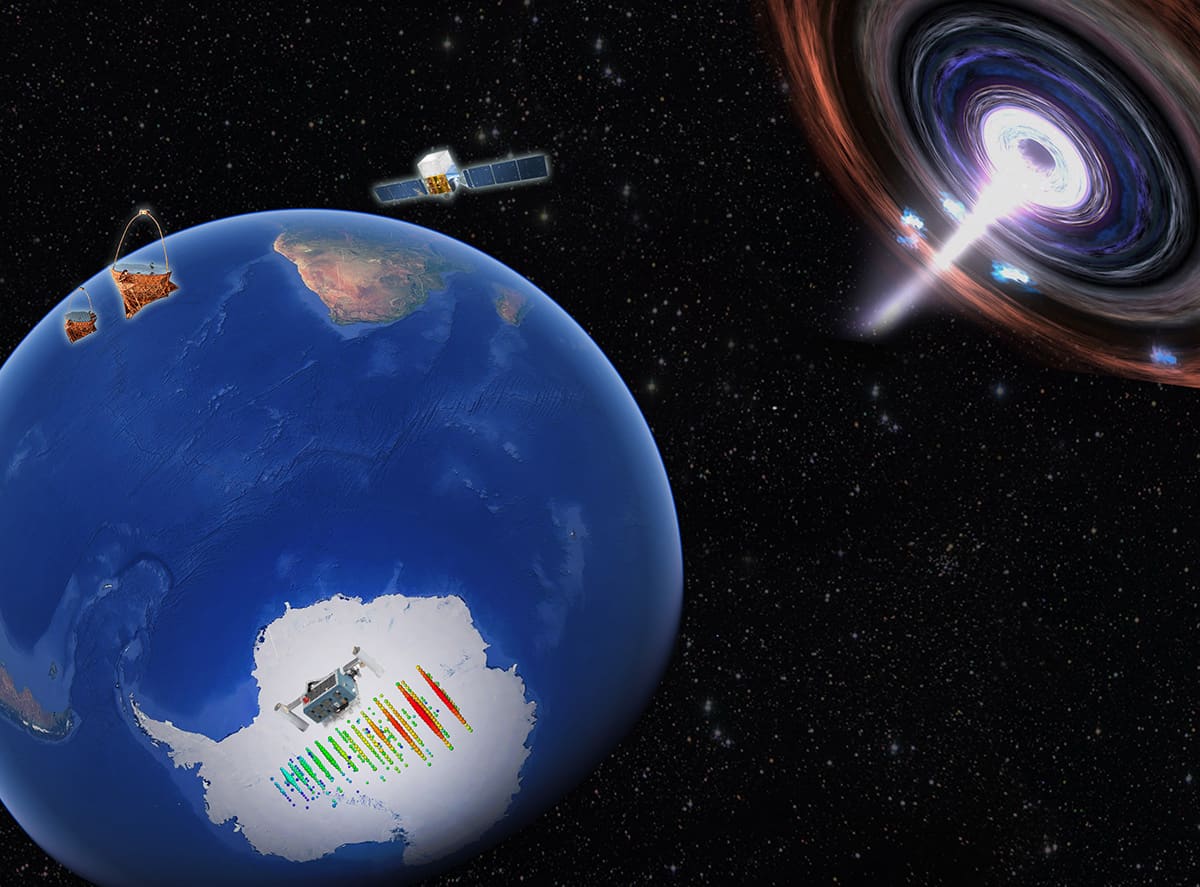
Shine bright Azadeh Keivani and collaborators at AMON, IceCube, Swift, Fermi and other observatories discovered the first evidence of an astrophysical high-energy neutrino source in 2017. This artistic rendering depicts a powerful blazar, the origin of IceCube neutrino IC170922. (Courtesy: IceCube Collaboration/Google Earth: PGC/NASA US Geological Survy Data SIO,NOAA, US Navy, NGA, GEBCO Landsat/Copernicus)
One of the best things about working on the AMON project was the feeling of ownership. I worked closely with another postdoc, Gordana Tešić, who is a good friend now. I also developed several soft skills as well as technical skills such as coding, building Python packages and databases, statistical analysis and machine learning modelling.
What were the next steps for you, after your postdoc?
After my postdoc, I started applying for faculty positions. At the time, my husband was in New York, and I really wanted a job there, so I ended up picking this three-year lectureship called the Frontiers of Science Fellowship at Columbia University.
This programme, founded by astronomer and educator David Helfand, recruits people with PhDs with different STEM backgrounds – across physics, biology, chemistry, neuroscience and earth sciences. The idea is to instil the scientific habits of mind in new students through different disciplines, so every one of us had to teach all these topics. We were teaching different scientific skills, such as how to read articles and how to distinguish science from pseudoscience, how to understand trends in plots and statistics. It was very challenging and interesting because, for the first time in a long time, I had to learn concepts outside physics, to be able to teach them. I was also a NASA-funded researcher at the Columbia Astrophysics Laboratory, using data from several high-energy astrophysical observatories in multimessenger astronomy; I focused on exploiting machine-learning techniques.
At the same time, during my Columbialectureship, teaching became very interesting to me, and also education more generally. I started thinking about how I could help students, especially from underserved communities. In many ways, our educational systems are still quite traditional. But the world is changing, so students really need to develop their technical, digital and entrepreneurial skills from early on. Often, minority students and those from lower-income backgrounds do not have sufficient opportunities or mentors available to them, to help plan their education and careers. This was on my mind especially during the early days of the COVID-19 pandemic, and so I co-founded an educational technology non-profit organization to empower the next generational workforce, called Digital Age Academy (DAA).
We recruited students from the 11th or 12th grade (ages 16–18) by partnering with high schools in the South Bronx in New York. We developed some workforce and entrepreneurial development programmes, and we matched students with mentors. Together, they defined some projects that helped their families or their community, and they had some brilliant ideas. At the end of 2020 we graduated the first DAA cohort.We now run a number of programmes through the year, and have corporate and school partners.
You have now moved out of academia and are in an industry role that is still heavily involved in physics. What were some of the factors that you considered while making this career choice?
There were a few things I thought about. One was whether I wanted to continue working on the narrow topic of multimessenger astrophysics, or to explore new fields of research. I was thinking about whether I wanted to become hyper-specialized, or to develop new skills and have a multidimensional perspective on the professional world. That became more appealing to me, although I know most people want to climb the corporate or academic ladder.
I was also thinking about the salary because living in New York is very expensive. It’s not necessarily the most important thing, but it was definitely a factor. A lot of my friends with PhDs who went into finance or data science were earning three or four times a postdoc’s salary.
I also wanted to stay in New York, because, for an immigrant like me, it’s the best city. You feel you belong here. But if I wanted to become a professor, I would have to apply everywhere in the US. The work–life balance was another aspect, and I was also intrigued to learn about other cultures outside the particle astrophysics community.
At the end of 2020, I decided to leave Columbia, and for one year I continued working only on DAA. At the end of 2021, I decided to apply for data science positions, but with a scientific flavour, so I focused on biotech and healthcare. I ended up at Memorial Sloan Kettering Cancer Center (MSK) as a senior data scientist. I was part of a team called “Technology Incubation”, which included different experts in design, product, engineering and data science, who worked together on bringing in new technologies for cancer care. Then, at the beginning of 2023 I started my current role at the NewYork-Presbyterian Hospital.
What’s a typical day like for you now, and what are some of the main skills you use in your job?
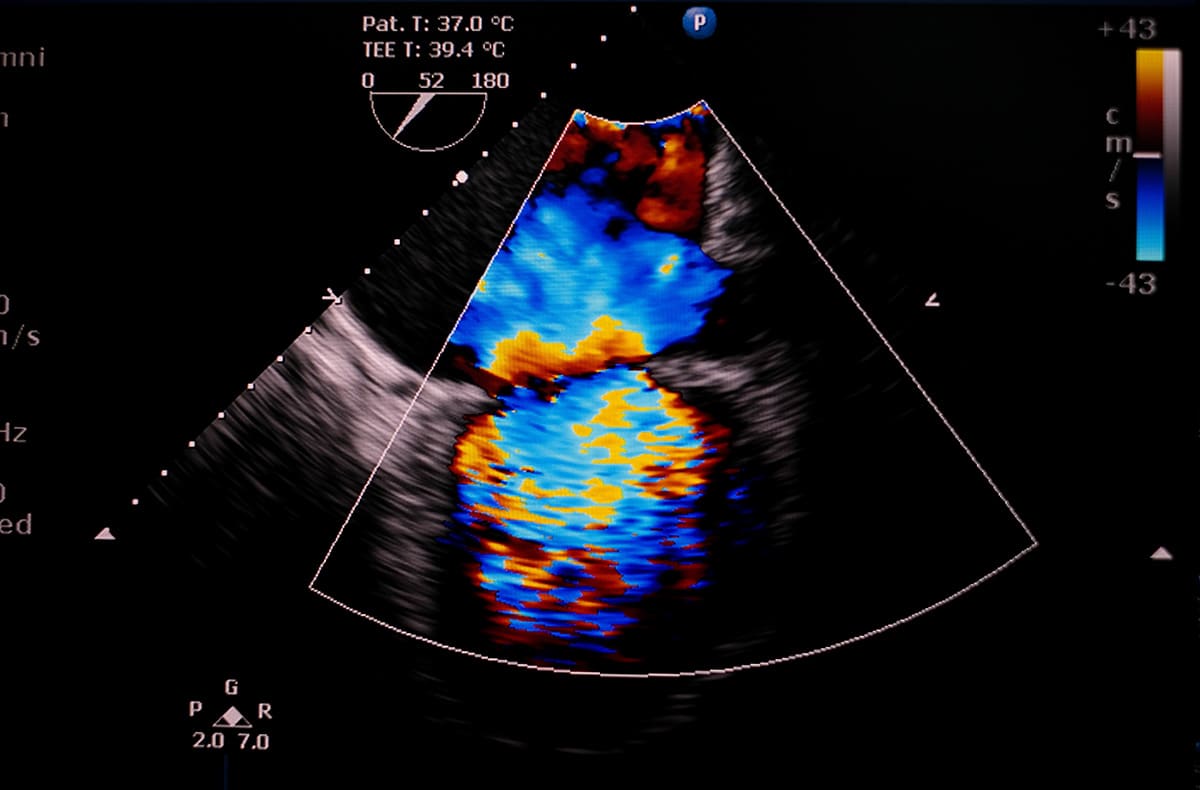
Our team, including scientists and engineers at NewYork-Presbyterian, works closely with Columbia University’s Division of Cardiology and Department of Biomedical Informatics. I mainly use echocardiographic data and build deep-learning models to detect cardiovascular diseases at earlier stages. We automate the whole process of reading echocardiographic images and clips, and these models help cardiologists to quickly read the echoes and diagnose diseases like aortic stenosis.
When you’re building machine-learning or statistical models to solve problems, you need to define the problem well, and come up with a clear question and hypothesis
I use both my physics knowledge and the technical skills I acquired in academia. When you’re building machine-learning or statistical models to solve problems, you need to define the problem well, and come up with a clear question and hypothesis, which my physics background helps with. I also need to use my computer skills to pre-process and analyse the data.
After I have a good dataset, I use the maths I learned in grad school to find the best algorithm to build the model around. Being sceptical is another thing I borrowed from being a physicist – for example,we need to test the models in clinical studies, so it is very important to make sure they have decent results.
AI in cardiology Azadeh Keivani now works on building deep-learning models using echocardiographic data, such as the scan imaged here, to detect cardiovascular diseases at earlier stages. (Courtesy: Shutterstock/PIJITRA PHOMKHAM)
Also, we use many physics concepts in cardiology and healthcare in general. For example, you need to use the Doppler effect when you send and receive signals from the heart. Based on the velocity and frequency of the signal, you can calculate the velocity of the blood.
Another interesting example, from when I worked at MSK, was when I noticed that a former colleague from particle astrophysics had posted online about researchers at MSK who had used the Cherenkov effect in their imaging technique for tumour detection. I contacted him and we all got on a call together. It was very interesting because he is a particle astrophysicist, and the other two people were a biologist and an oncologist, and I was in between. That ignited a collaboration between our team at MSK and the other team at MSK, because I had some ideas for a machine-learning model for their data.
After I started my career in healthcare, I started thinking about giving lectures to graduate students and postdocs to tell them my story. I wanted to talk about my experiences inside and outside academia, share the pros and cons I considered when I was leaving, and empower people to think about their own unique career path.
I went to four universities and gave talks, and I could totally see myself in those lovely students, seeing how common our worries and challenges are. I also wanted to help international students who have to think about visas on the path towards getting a more settled status in the US.
When I got the FIAP award, I was very excited because I now have more opportunities to go to different schools and inspire students to think outside the box. Part of this award is giving lectures in at least three institutes, including an underserved school. I’ve been invited to the APS March meeting, where I will receive my award, and I will also give an invited talk about my journey and my advice on career opportunities for physicists.
What’s your advice to students starting out today? What do you know now that you wish you’d known when you started your career?
When I was a student, I remember that most of us who were astronomy graduate students only attended astronomy seminars. If you want to work on one topic and become really good at it, then you might want to use every single minute focusing on that topic. The caveat is you become so focused that you might forget about new insights and perspectives. Coming up with new ideas doesn’t happen in solitude. It happens when you are exposed to other people’s thoughts, work and experience.
It’s not possible to attend every talk, but if I were a student again, I would definitely go to more seminars and explore other science departments on campus. Sometimes speakers give more general talks that are not necessarily very technical, so you might grasp half of a talk about another field and understand their approach. You might even go to an art performance and generate a new idea about your own work, or realize you are interested in a field like finance or the gaming industry. So keep your eyes open and have an open mind.
I remember at the end of grad school I felt a lot of pressure and I was worrying about finding a postdoc. You have to remember you’ve developed a lot of skills and you have a lot of knowledge and experience. You will always be able to find a job, and not only survive but thrive. You just need to believe in yourself and you can do amazing things. You can be the person who discovers something new or creates something for other people. So these are critical, pivotal moments in life. Although they are scary, they can lead you to become the best version of yourself.
Last, there are moments in everyone’s career, and in life in general, when you feel disappointed and feel like you cannot succeed. You might think that you can’t find a job or that you’re not good at one thing. This is very normal and is actually not a bad thing. It means you are revisiting your values, and you can use that opportunity to find your next step. Do not think it is the end of the world. It’s the beginning of a new chapter.
This article was first published in APS Careers, a guide published by Physics World on behalf of the American Physical Society. You can read the full guide online
In 1914 H G Wells published The World Set Free, a novel based on the notion that radium might one day power spaceships. Wells, who was familiar with the work of physicists such as Ernest Rutherford, knew that radium could produce heat and envisaged it being used to turn a turbine. The book might have been a work of fiction, but The World Set Free correctly foresaw the potential of what one might call “atomic spaceships”.
The idea of using nuclear energy for space travel took hold in the 1950s when the public – having witnessed the horrors of Hiroshima and Nagasaki – gradually became convinced of the utility of nuclear power for peaceful purposes. Thanks to programmes such as America’s Atoms for Peace, people began to see that nuclear power could be used for energy and transport. But perhaps the most radical application lay in spaceflight.
Among the strongest proponents of nuclear-powered space travel was the eminent mathematical physicist Freeman Dyson. In 1958 he took a year’s sabbatical from the Institute of Advanced Study in Princeton to work at General Atomics in San Diego on a project code-named Orion. The brainchild of Ted Taylor – a physicist who had worked on the Manhattan atomic-bomb project at Las Alamos – Project Orion aimed to build a 4000-tonne spaceship that would use 2600 nuclear bombs to propel it into space.
Dropping atomic bombs out of the back of a spacecraft sounds crazy on environmental grounds, but Dyson calculated that “only” 0.1–1 Americans would contract cancer from this method. The project was even backed by rocket expert Wernher von Braun, and a series of non-nuclear test flights were carried out. Thankfully, the 1963 Partial Test Ban Treaty put an end to Project Orion, and Dyson himself later withdrew his support for atomic spacecraft after belatedly recognizing their environmental hazards.
Despite Project Orion ending, the lure of nuclear propulsion never really went away (see box “Nuclear space travel: a brief history”) and is now enjoying something of a resurgence. Rather than using atomic bombs, however, the idea is to transfer the energy from a nuclear fission reactor to a propellant fuel, which would be heated to roughly 2500 K and ejected via a nozzle in a process called “nuclear thermal propulsion” (NTP). Alternatively, the fission energy could ionize a gas that would be fired out of the back of the spacecraft – what’s known as “nuclear electric propulsion” (NEP).
So, is nuclear-powered space travel a realistic prospect and, if so, which technology will win out?
Nuclear space travel: a brief history
Crazy dreams Physicists Ted Taylor and Freeman Dyson imagined using nuclear bombs to fire a spacecraft into orbit. (Courtesy: MIT/Laurent Taudin; www.unsitesurinternet.fr)
The idea of nuclear-powered spaceflight dates back to the 1950s when the physicist Freeman Dyson proposed using atomic bombs to propel rockets into space. That notion was thankfully and swiftly abandoned, but in the 1960s and 1970s, NASA and the US Atomic Energy Commission ran the Nuclear Engine for Rocket Vehicle Application (NERVA) programme, which aimed to use the heat from a fission reaction to propel a rocket into space. Although a nuclear mission was never launched, NERVA did lead to several advances in reactor design, fabrication, turbomachinery and electronics.
Later, in the 1980s, the US set up the $200m Space Nuclear Thermal Propulsion (SNTP) programme, which sought to develop nuclear-powered rockets that would be twice as powerful as traditional chemical rocket engines. SNTP was part of the US Strategic Defense Initiative, which President Ronald Reagan had set up to protect America from incoming nuclear missiles. SNTP was abandoned in the early 1990s as the fuel elements tended to fracture under stress and the propulsion system testing was deemed too expensive. Now, however, NASA is looking once again at nuclear space travel (see main text).
Nuclear boost
Most conventional rockets are powered by ordinary, chemical fuels. The Saturn V rocket that took astronauts to the Moon in the late 1960s and early 1970s, for example, used liquid fuels, while the rocket boosters that failed so spectacularly during the launch of the space shuttle Challenger in 1986 contained solid fuel.
More recently, Space X’s Falcon rockets, for example, have used a mix of kerosene and oxygen. Trouble is, all such propellants have a relatively small “energy density” (energy stored per unit volume) and a low “specific impulse” (the efficiency with which they can generate thrust). This means that the overall thrust of the rocket – the specific impulse multiplied by the mass flow rate of the exhaust gas and Earth’s gravity – is low.
Chemical propellants can therefore only get you so far, with the Moon being the traditional limit. To reach distant planets and other “deep-space” destinations, spacecraft usually exploit the gravitational pull of multiple different planets. Such journeys are, however, circuitous and take a long time. NASA’s Juno mission, for example, needed five years to get to Jupiter, while the Voyager craft took more than 30 years to reach the edge of the solar system. Such missions are also restricted by narrow and infrequent launch windows.
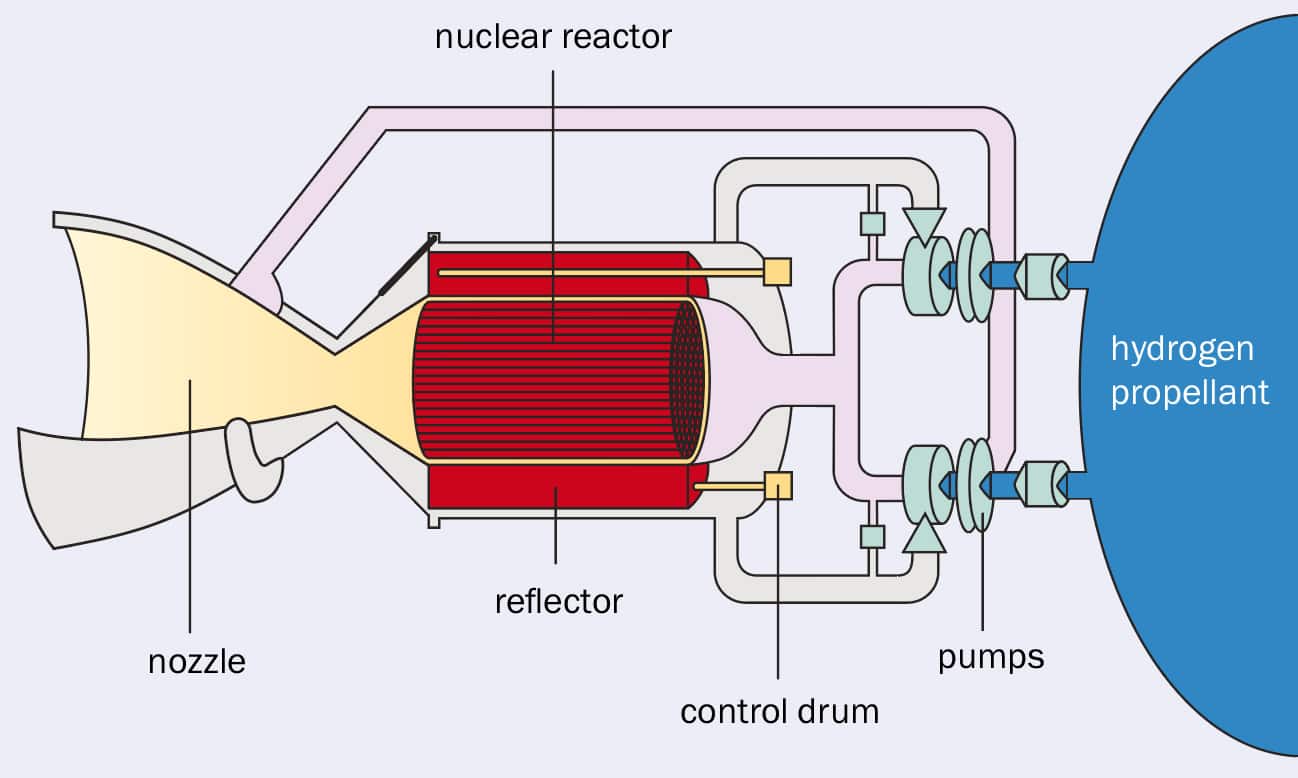
A nuclear spacecraft would instead use fission energy to heat a fuel (figure 1) – most likely cryogenically stored liquid hydrogen, which has a low molecular mass and high heat of combustion. “Nuclear propulsion, either electric or thermal, could extract more energy from a given mass of fuel than is possible via combustion-based propulsion,” says Dale Thomas, a former associate director at NASA’s Marshall Space Flight Center, now at the University of Alabama in Huntsville.
1 Inside a nuclear-powered spacecraft
(Courtesy: NASA)
In a rocket using nuclear thermal propulsion, a working fluid, usually liquid hydrogen, is heated to a high temperature in a nuclear reactor and then expands through a nozzle to create thrust. Providing a higher effective exhaust velocity, such a rocket would double or triple payload capacity compared to chemical propellants that store energy internally.
Thomas says that today’s most efficient chemical propulsion systems can achieve a specific impulse of about 465 seconds. NTP, in contrast, can have a specific impulse of almost 900 seconds due to the higher power density of nuclear reactions. Combined with a much higher thrust-to-weight ratio, NTP could get a rocket to Mars in just 500 days, rather than 900.
“The thrust-to-weight ratio is crucial because it determines the spacecraft’s ability to accelerate, which is especially critical during key mission phases, like escaping Earth’s gravity or manoeuvring in deep space,” says Mauro Augelli, head of launch systems at the UK Space Agency. “The specific impulse, on the other hand, is a measure of how effectively a rocket uses its propellant.”
Nuclear propulsion, either electric or thermal, could extract more energy from a given mass of fuel than is possible via combustion-based propulsion
Dale Thomas, University of Alabama in Huntsville
Essentially, for a given amount of propellant, a nuclear-powered spacecraft could travel faster and sustain its thrust for longer periods than a chemical rocket. It would therefore be great for crewed missions to Mars – not only would the astronauts have a quicker journey, but as a result of that, they’d be exposed to less cosmic radiation. “Moreover, shorter mission durations reduce the logistical and life-support challenges, making deep-space exploration more feasible and safer,” Augelli adds.
But nuclear power is not just about cutting journey times. NASA also has a dedicated programme at its Glenn Research Center in Cleveland, Ohio, to use nuclear fission – rather than solar energy or chemical fuels – to power spacecraft once they have reached their destination. “Nuclear energy offers unique benefits for operating in extreme environments and regions in space where solar and chemical systems are either inadequate or impossible as power sources for extended operation,” says programme manager Lindsay Kaldon.
Back in action
In 2020 the US government put nuclear spacecraft firmly back on the agenda by awarding almost $100m to three firms – General Atomics, Lockheed Martin and Blue Origin. They will use the money to work on the Demonstration Rocket for Agile Cislunar Operations (DRACO) programme, which is funded via the DARPA research agency of the US Department of Defense. In the first phase, the companies will aim to show that NTP can be used to fly a rocket above low-Earth orbit, with DARPA aiming for thrust-to-weight ratios on par with existing chemical rocket systems.
Energy on demand A fission surface power system like this one could provide safe, efficient and reliable electrical power on the Moon and Mars. (Courtesy: NASA)
Tabitha Dodson, DARPA programme manager for DRACO, thinks that the successful launch and flight of a nuclear space reactor by the DRACO programme would revolutionize space flight. “Unlike today’s chemical systems, which have reached a limit in how far they can evolve, nuclear technologies are theorized to evolve to systems such as fusion and beyond,” she says. “Spacecraft evolved to be manoeuvred and powered by nuclear reactors will enable humanity to go farther, with a higher chance of survival and success for any mission type.”
In the DRACO programme, General Atomics will design the NTP reactor and draw up a blueprint for a propulsion subsystem, while Blue Origin and Lockheed Martin will plan the spacecraft itself. The fission reactor would use a special high-assay low-enriched uranium (HALEU), which can be made using fuel recycled from existing nuclear reactors. Containing only 20% enriched uranium, it is unsuitable for being turned into nuclear weapons.
The reactor would not be turned on (i.e. go critical) until the craft had reached a “nuclear-safe” orbit. In the unlikely event of an emergency, any contamination would, in other words, be harmlessly dissipated into space. Lockheed Martin has already joined forces with BWX Technologies of Lynchburg, Virginia, to develop the reactor and produce the HALEU fuel. BWX says that a DRACO rocket could launch as soon as 2027.
Elsewhere, researchers at Idaho National Laboratory in the US are helping NASA develop and test the materials needed for a nuclear rocket at its Transient Reactor Test (TREAT) facility near Idaho Falls. They already carried out a practice run last year to validate the computer models and test a new sensor and experiment capsule. Long-term, the aim is to identify which materials, composite structures and uranium compounds work best in the extremely hot conditions of an NTP reactor.
The heat from the reactor would heat hydrogen fuel, which provides the biggest change in velocity – what rocket scientists call Δv – for a given mass. The downside of hydrogen is that it has a low density and the rocket would need large tanks. Other propellants, such as ammonia, have a lower Δv per kilogram of propellant, but are much more dense. Over at Huntsville, Thomas has shown that ammonia would be the ideal fuel to get astronomers to Mars from NASA’s Lunar Gateway – a space station that would orbit the Moon.
Having published a review of NTP technology for the American Institute of Aeronautics and Astronautics in 2020, Thomas has concluded that regular NTP systems, which offer lots of thrust for short burns of about 50 minutes, will be ideal for flybys and rendezvous missions. But there are also “bi-modal” systems, which combine NTP with NEP (see box “The challenges of nuclear electric propulsion”). The former gives quick bursts of high thrust while the latter yields low thrust for longer periods – perfect for lengthy, round-trip missions.
Kate Haggerty Kelly, director of space and engineering at BWX Technologies, says that overall nuclear thermal propulsion can be two to five times more efficient than chemical propulsion systems while also offering high thrust. “[In contrast], nuclear electric propulsion systems can provide higher efficiencies but lower thrust, and the energy generated through nuclear fission can be converted to electricity to provide power to subsystems on the spacecraft.”
The challenges of nuclear electric propulsion
Steady as we go Lindsay Kaldon, project manager of fission surface power at NASA, thinks that the steady power from nuclear electric propulsion will enable reliable trips into deep space. (Courtesy: NASA)
Nuclear thermal propulsion (NTP) involves using the energy from a nuclear reaction to heat fuel that’s fired out of the back of a rocket, like the air from a toy balloon. But with nuclear electric propulsion (NEP), the fission energy is instead used to ionize a gas. “The propellant expelled by a NEP system can be an inert gas, such as xenon or krypton, but iodine, lithium or hydrogen can be options depending on the type of electric thruster,” says Lindsay Kaldon, project manager of fission surface power at NASA’s Glenn Research Center.
As the propellant is ionized, the gas can be guided and accelerated using electromagnetic devices to give a spacecraft its forward motion. Kaldon admits that the amount of thrust is far less than you’d get from an NTP rocket. “Think of NEP as a sailboat with a slight breeze compared to a speedboat,” she says. “However, this is really all we need for a steady, reliable trip into deep space.”
The challenge for Kaldon and her colleagues at Glenn is to ensure that the reactor is producing enough electricity to ionize the propellant and that the thrusters are functioning smoothly. One option is to use a “Stirling engine”, which uses the cyclic compression and expansion of gas between a hot and cold end of the engine to produce electricity. The other option is a “Hall effect thruster”, which creates a voltage by combining an electrical conductor with a magnetic field perpendicular to the conductor.
So will NTP or NEP be better for deep-space operations? According to Thomas, it will depend on the type of mission. “For missions of a certain class – such as scientific spacecraft above a certain mass – or crewed missions, or for certain destinations, NTP will be the best choice, whereas for other missions NEP will be best. Like a car journey, it depends on the distance, how much baggage you are carrying, your schedule demands and so forth.”
Nuclear future
NASA is already considering several nuclear-powered space missions. According to a report released in June 2021, these could include craft that will orbit various moons of Uranus and Jupiter, and others that will orbit and land on Neptune’s moon Triton. The report also envisages a nuclear-powered rocket entering a polar orbit around the Sun and possibly even a mission into interstellar space.
In the final analysis, nuclear propulsion of some type will – either alone or combined with another type of propulsion – be an important part of humanity’s future space efforts. With NASA, the UK Space Agency and the European Space Agency all looking at nuclear-powered spaceflight, my bet is that the first crewed missions to Mars will, by the 2030s, use some form of this technology. The dream of Freeman Dyson could, I am sure, soon see the light of day.
Degenerative diseases of the retina can damage or destroy photoreceptor cells, resulting in severe vision impairment. One promising way to restore lost vision is to implant an electronic retinal prosthesis, which works by detecting external light and stimulating inner retinal neurons such as ganglion and bipolar cells in response.
Existing retinal implants, however, contain rigid stimulation electrodes that could damage soft retinal tissue. They also suffer from a mismatch between the rigid electrodes and the curved retinal surface, which can be particularly irregular in patients with severe retinal degenerative disease.
To address these limitations, a research team headed up at Yonsei University in Korea has developed a soft retinal prosthesis that combines flexible ultrathin phototransistor arrays with stimulation electrodes made from eutectic gallium–indium alloy, an intrinsically soft liquid metal with low toxicity.
To create this “artificial retina”, first author Won Gi Chung and colleagues started with a high-resolution phototransistor array (50 × 50 pixels with 100 µm pitch) and 3D printed liquid metal electrodes on top. The electrodes form an array of pillar-like probes (20 µm in diameter and 60 µm in height) that, when placed on the retinal surface, directly stimulate retinal ganglion cells (RGCs).
The tip of each electrode is coated with platinum nanoclusters, which add nanometre-scale roughness and improve charge injection into the retinal neurons. Illuminating the phototransistors generates a photocurrent that injects charge into the RGCs through the electrodes. The action potentials evoked within the RGCs then travel to the optic nerve to create the visual information.
High-resolution array Left: transistor array integrated with 3D liquid metal microelectrodes (scale bar, 1 mm). Right: scanning electron microscopy image showing the 60 µm high microelectrodes (scale bar, 100 µm). (Courtesy: CC BY 4.0/Nat. Nanotechnol. 10.1038/s41565-023-01587-w)
The researchers performed various in vivo tests to assess the biocompatibility of the device. Five weeks after implantation into live retinal degenerative (rd1) mice, they found no signs of bleeding, inflammation or cataracts and no significant impact on retinal thickness. They note that the device’s epiretinal placement – inside the vitreous with the electrode tips positioned on the RGC layer – is safer and less invasive than the subretinal implantation required by previous implants.
To evaluate their artificial retina further, the team performed ex vivo experiments by placing the device on isolated retinas from both wild-type and rd1 mice. Visual stimulation with blue light (performed without device operation) induced a response in the wild-type retina but not the rd1 retina. Electrical stimulation during device operation caused RGC spikes in both retinas, with a similar magnitude of electrically evoked potential in the wild-type and rd1 retinas.
In vivo vision restoration
Next, the team examined whether the device could restore vision to rd1 mice with a fully degenerated photoreceptor layer. Attaching the device to the animal’s retinal surface caused no notable damage or bleeding, and the electrodes remained intact when implanted onto the retinal surface.
The researchers then projected visible light onto the animal’s eye and recorded the real-time neural responses on the retina. Due to the complexity of retinal activity, they used unsupervised machine learning for signal processing. They found that the illumination induced spiking activity in the RGCs of the animal’s retina, creating RGC spikes with consistent potential magnitude and firing rates.
To investigate whether the implant can be used for object recognition, the researchers also exposed the eye to laser light through a patterned mask, observing that illuminated areas exhibited larger retinal responses than areas remaining in the dark. Comparing the maximum firing rates recorded from fully illuminated electrodes and dark-state electrodes showed that the RGC activity in the illuminated areas was about four times higher than the background RGC activity.
“The in vivo experiments confirmed that the signal amplification due to visible-light illumination induces real-time responses in the RGCs of the local area where the light is incident for live rd1 mice with massive photoreceptor degeneration, suggesting the restoration of their vision,” the researchers write. They point out that these findings could be used to help develop personalized artificial retinas for patients with uneven retinal degeneration.
Next, the team plans to conduct examinations of the artificial retina on larger animals. “After thoroughly validating our device on larger animals, our ultimate goal is to conduct clinical trials,” Chung tells Physics World.
Europe’s new head of fusion wants European nations to work on a demonstration fusion reactor at the same time as building the ITER experimental fusion facility in southern France. Ambrogio Fasoli, who took over in January as head of EUROfusion, says that work on such a device will require closely collaborating with the private fusion industry. EUROfusion is a consortium of 28 fusion labs bringing together 4800 researchers from across Europe.
First mooted in the 1980s, ITER is currently expected to open by the end of 2025. But it will not be until the mid-2030s – at the earliest – that ITER will carry out deuterium-tritium (D-T) plasma experiments. Only then will ITER demonstrate its main aim of achieving a net energy gain of 10 and that nuclear fusion can be a safe, reliable, efficient and relatively clean energy source.
Due to ITER’s delays, some countries have begun to plan their own demonstration fusion plants. The UK for example, is currently designing the Spherical Tokamak for Energy Production to switch on in the 2040s while fusion companies are examining ways to bring fusion energy to the market even earlier.
The European fusion community, which is the leading partner in ITER, is taking a different approach. It wants to wait until ITER is fully operating before designing and building a demonstration reactor that will also produce electricity – a “DEMO” fusion plant. But Fasoli, a plasma physicist who is also director of the Swiss Plasma Center at the EPFL Lausanne, says that Europe must now rethink its strategy.
“If we want to develop DEMO by the middle of the century, we have to proceed as much as possible parallel to ITER, rather than following the current sequential approach that fully depends on ITER milestones,” Fasoli told Physics World. “ITER is a crucial project for fusion research and we have already learned so much from the project that we don’t need to wait to apply these lessons elsewhere.”
Fasoli insists that knowing all the details about ITER’s D-T plasma it not necessary before starting on a DEMO design. “We can prepare a design that can accommodate possible different arrangements of the plasma,” he adds, pointing out that it is possible to use numerical simulations as well as to extrapolate data from current or previous plasma experiments such as JET in Oxfordshire, which performed its last fusion shot last year and has been carrying out ITER-relevant experiments for years.
High-risk, high-reward
Fasoli says that Europe should now work on “solutions” that are high risk but have high potential by balancing consolidated knowledge with innovation. This approach would be similar to the way that private fusion firms are operating with “a sense of urgency”, but he acknowledges that Europe is behind the US when it comes to fostering a private fusion industry.
“This obliges us to be a bit more entrepreneurial and to also work more closely with the private sector, ideally within public-private partnerships,” he says. “We already have the public part, but certainly in Europe we are lacking the private part. For DEMO we need both.”
Fasoli insists that this partnership would go much further than public entities simply purchasing equipment from the private sector, as currently happens at ITER. “It needs to have common goals, responsibilities and results,” he adds.
Fasoli adds that the potential boom of private fusion in Europe poses a challenge in terms of maintaining and expanding a public sector fusion workforce. “The job market for fusion physicists and engineers is probably larger than ever before, and private companies are often more attractive than public labs, especially for young people,” he says. “So we risk a brain drain.”
To secure and enlarge the influx of talent, Fasoli says that fusion should take inspiration from the European particle-physics community, which has private labs and companies that are “well connected and integrated in academia.”
Dark solitons – regions of optical extinction against bright backgrounds – have been seen spontaneously forming in ring semiconductor lasers. Made by an international team of researchers, the observation could lead to improvements in molecular spectroscopy and integrated optoelectronics.
Frequency combs – pulsed lasers that output light with equally-spaced frequencies – are one of the most important achievements in the history of laser physics. Sometimes referred to as optical rulers, they are the basis of time and frequency standards and are used to define many fundamental quantities in science. However, traditional frequency comb lasers are bulky, complex and expensive and laser experts are keen on developing simpler versions that can be integrated in chips.
While undertaking one such attempt in 2020, researchers in Federico Capasso’s group at Harvard University discovered accidentally that, after initially entering a highly turbulent regime, a quantum cascade ring laser settled down to a stable frequency comb – albeit one with only nine teeth – in the mid-infrared “fingerprint” region widely used in molecular spectroscopy.
A ring laser has an optical cavity in which light is guided around a closed loop and a quantum cascade laser is a semiconductor device that emits infrared radiation.
Unexpected results
“All those interesting results came out from a control device – we were not expecting this to happen,” says Harvard’s Marco Piccardo. After months of head-scratching, the researchers worked out that the effect can be understood in terms of an instability in the non-linear differential equation that describes the system – the complex Ginzberg–Landau equation.
In the new work, Capasso and colleagues teamed up with researchers in Benedikt Schwarz’s group at Vienna University of Technology. The Austrian team had developed several designs for frequency combs based on quantum cascade lasers. The researchers integrated a waveguide coupler into the same chip. This makes it much easier to extract light and achieves greater output power. It also allows the scientists to tune the coupling losses, nudging the laser between its frequency-comb regime and the regime where it should operate as a continuous-wave laser that outputs radiation continuously.
In the “continuous wave” regime, however, something even stranger happens. Sometimes when the laser is switched on it behaves simply as a continuous-wave laser, but flicking the laser off and on may cause one or more dark solitons to appear randomly.
Solitons are non-linear, non-dispersive, self-reinforcing wave packets of radiation that can propagate through space indefinitely and pass through one another effectively unchanged. They were first observed in 1834 in water waves but have subsequently been seen in numerous other physical systems including optics.
Solitons in tiny gaps
The surprising thing about this latest observation is that the solitons appear as tiny gaps in the continuous laser light. This apparently small change in the laser emission makes a tremendous change to its frequency spectrum.
“When you talk about a continuous wave laser, it means that in the spectral domain you have a single monochromatic peak,” explains Piccardo. “This dip means the whole world…These two pictures are related by the uncertainty principle, so when you have something very, very narrow in space or time, that means that in the spectral domain you have many, many modes, and having many, many modes means you can do spectroscopy and look at molecules that emit over a very, very large spectral range.”
Dark solitons have occasionally been seen before, but never in a small, electrically-injected laser like this. Piccardo says that spectrally speaking, a dark soliton is as useful as a bright one. Some applications such as pump-probe spectroscopy require bright pulses, however. The techniques needed to produce bright solitons from dark ones will be the subject of further work. The researchers are also studying how to produce solitons deterministically.
A crucial advantage of this comb design for integration is that, as light circulates in only one direction in the ring waveguide, the researchers believe the laser is inherently immune to the feedback that can disrupt many other lasers. It would therefore not require magnetic isolators, which are often impossible to integrate into silicon chips at commercial scale.
With integration in mind, the researchers want to extend the technique beyond quantum cascade lasers. “Despite the chip being really compact, quantum cascade lasers typically require high voltages to operate, so they’re not really a way to put the electronics on the chip,” says Piccardo. “If this could work in other lasers such as interband cascade lasers, then we could miniaturize the whole thing and it could really be battery operated.”
Laser physicist Peter Delfyett of the University Of Central Florida in Orlando believes the work holds promise for future work. “This dark pulse in the frequency domain is a bank of colours and, while their spectral purity is quite good, their exact positioning has not been achieved – yet,” he says. “However, the fact that they can do this – making solitons on chip with an electrically pumped device – that is in fact an extremely significant advance. Without a doubt.”
Cold atoms solve many problems in quantum technology. Want a quantum computer? You can make one from an array of ultracold atoms. Need a quantum repeater for a secure communications network? Cold atoms have you covered. How about a quantum simulator for complicated condensed-matter problems? Yep, cold atoms can do that, too.
The downside is that doing any of these things requires approximately two Nobel Prizes’ worth of experimental apparatus. Worse, the tiniest sources of upset – a change in laboratory temperature, a stray magnetic field (cold atoms also make excellent quantum magnetometers), even a slammed door – can unsettle the complicated arrays of lasers, optics, magnetic coils and electronics that make cold-atom physics possible.
To cope with this complexity, cold-atom physicists have begun exploring ways of using machine learning to augment their experiments. In 2018, for example, a team at the Australian National University developed a machine-optimized routine for loading atoms into the magneto-optical traps (MOTs) that form the starting point for cold-atom experiments. In 2019, a group at RIKEN in Japan applied this principle to a later stage of the cooling process, using machine learning to identify new and effective ways of cooling atoms to temperatures a fraction of a degree above absolute zero, where they enter a quantum state known as a Bose-Einstein condensate (BEC).
Let the machine do it
In the latest development in this trend, two independent teams of physicists have shown that a form of machine learning known as reinforcement learning can help cold-atom systems handle disruptions.
“In our laboratory, we found that our BEC-producing system was fairly unstable, such that we only had the ability to produce BECs of reasonable quality for a few hours out of the day,” explains Nick Milson, a PhD student at the University of Alberta, Canada who led one of the projects. Optimizing this system by hand proved challenging: “You have a procedure underpinned by complicated and generally intractable physics, and this is compounded by an experimental apparatus which is naturally going to have some degree of imperfection,” Milson says. “This is why many groups have tackled the problem with machine learning, and why we turn to reinforcement learning to tackle the problem of building a consistent and reactive controller.”
Computer control: Nick Milson and his PhD supervisor Lindsay LeBlanc working in their laboratory at the University of Alberta. (Courtesy: John Ulan)
Reinforcement learning (RL) works differently from other machine learning strategies that take in labelled or unlabelled input data and use it to predict outputs. Instead, RL aims to optimize a process by reinforcing desirable outcomes and punishing poor ones.
In their study, Milson and colleagues allowed an RL agent called an actor-critic neural network to adjust 30 parameters in their apparatus for creating BECs of rubidium atoms. They also supplied the agent with 30 environmental parameters sensed during the previous BEC-creation cycle. “One may think of the actor as the decision-maker, trying to figure out how to act in response to different environmental stimuli,” Milson explains. “The critic is trying to figure out how well the actions of the actor are going to perform. Its job is essentially to provide feedback to the actor by assessing the ‘goodness’ or ‘badness’ of potential actions taken.”
After training their RL agent on data from previous experimental runs, the Alberta physicists found that the RL-guided controller consistently outperformed humans at loading rubidium atoms into a magnetic trap. The main drawback, Milson says, was the time required to collect training data. “If we could introduce a non-destructive imaging technique like fluorescence-based imaging, we could essentially have the system collecting data all the time, no matter who was currently using the system, or for what purpose,” he tells Physics World.
Step by step
In a separate work, physicists led by Valentin Volchkov of the Max Planck Institute for Intelligent Systems and the University of Tübingen, Germany, together with his Tübingen colleague Andreas Günther, took a different approach. Instead of training their RL agent to optimize dozens of experimental parameters, they focused on just two: the magnetic field gradient of the MOT, and the frequency of the laser light used to cool and trap rubidium atoms in it.
The optimum value of the laser frequency is generally one that produces the greatest number of atoms N at the lowest temperature T. However, this optimum value changes as the temperature drops due to interactions between the atoms and the laser light. The Tübingen team therefore allowed their RL agent to adjust parameters at 25 sequential time steps during a 1.5-second-long MOT loading cycle, and “rewarded” it for getting as close as possible to the desired value of N/T at the end, as measured by fluorescence imaging.
While the RL agent did not come up with any previously-unknown strategies for cooling atoms in the MOT – “a quite boring result”, Volchkov jokes – it did make the experimental apparatus more robust. “If there is some perturbation at the time scale of our sampling, then the agent should be able to react to it if it’s trained accordingly,” he says. Such automatic adjustments, he adds, will be vital for creating portable quantum devices that “cannot have PhD students tending them 24-7”.
A tool for complex systems
Volchkov thinks RL could also have wider applications in cold-atom physics. “I firmly believe that reinforcement learning has the potential to yield new modes of operations and counter-intuitive control sequences when applied to the control of ultracold quantum gas experiments with sufficient degrees of freedom,” he tells Physics World. “This is especially relevant for more complex atomic species and molecules. Eventually, analysing these new modes of control might shed light on physical principles governing more exotic ultracold gases.”
Milson is similarly enthusiastic about the technique’s potential. “The use-cases are probably endless, spanning all areas of atomic physics,” he says. “From optimization of loading atoms into optical tweezers, to designing protocols in quantum memory for optimal storage and retrieval of quantum information, machine learning seems very well suited to these complicated, many-body scenarios found in atomic and quantum physics.”
This article was amended on 31 January 2024 to clarify Valentin Volchkov’s affiliations and details of the Tübingen experiment and on 9 October 2024 to add a link to the published version of the paper.
Modelling blood flow in the brain The spatiotemporal propagation of blood (violet) through the vessels (yellow) in the reconstructed brain model. Left to right: the distribution at the start (0.2 s), after 1.5 s and at equilibrium (longer then 7s). (Courtesy: CC BY 4.0/Phys. Med. Biol. 10.1088/1361-6560/ad144e)
Treating cancer with radiation can stimulate the body’s immune response and inhibit tumour growth, but it can also reduce the level of lymphocytes, the white blood cells associated with immune response, resulting in impaired tumor control and poor prognosis. The severity of this radiation-induced lymphopenia correlates with the dose delivered to circulating blood cells and lymphocytes. As such, minimizing dose to the heart, peripheral blood and lymphoid organs could help reduce this detrimental effect.
To investigate this theory further, Antje Galts and Abdelkhalek Hammi from TU Dortmund University explored whether FLASH radiotherapy – radiation delivered at ultrahigh dose rates – could reduce the level of immune cell depletion during proton therapy of brain cancer patients.
“The biological mechanism behind the observed FLASH sparing effect at high dose rates is not yet fully understood. However, one of the proposed theories is the immune hypothesis, which suggests that the instantaneous dose delivery of FLASH irradiation significantly reduces the depletion of circulating lymphocytes by minimizing exposure time,” Hammi explains. “In our study, we showed that a hypofractionated treatment and fast dose delivery spared immune cells by up to 27 times compared with a conventional fractionated proton pencil-beam scanning treatment plan.”
Galts and Hammi used a dosimetric blood flow model to simulate the dose to circulating lymphocytes during conventional and FLASH-based intensity-modulated proton therapy (IMPT) of a brain tumour. The dynamic beam delivery model simulates an IMPT fractionated treatment plan while considering the spatiotemporal variation of dose rate of each single proton pencil beam. Hammi notes that the model incorporates realistic delivery parameters from commercially available cyclotrons.
To accurately reflect blood circulation in the human brain, Galts and Hammi mapped blood vessels directly from brain MR angiography images. They used the resulting cerebrovascular model, which included 465 blood vessels and 8841 individual vessel branches, to simulate the circulation of immune cells within the blood stream.
The researchers created realistic IMPT treatment plans for a glioblastoma tumour, using four incident proton beams and clinically relevant delivery parameters. They then calculated the time-varying radiation fields that the circulating blood is exposed to during delivery of the proton therapy plans and the accumulated dose following treatment, reporting their findings in Physics in Medicine & Biology.
Glioblastoma is the most lethal form of brain cancer and treating it with radiotherapy can cause prolonged radiation-induced lymphopenia. “By modeling a cerebrovascular system during radiation delivery, we hope to gain deeper insights into how radiotherapy affects the immune response in these groups of patients, potentially leading to improved therapeutic strategies,” says Hammi.
Plan comparisons
Galts and Hammi examined four treatment scenarios: IMPT FLASH with a single 22.3 Gy fraction; hypofractionated FLASH using two 14.6 Gy and five 8 Gy fractions; and conventional IMPT using thirty-two 2 Gy fractions. For each treatment plan, they assessed the dosimetric impact on the circulating lymphocytes and estimated the resulting radiotoxicity.
Dose–volume histograms revealed that FLASH radiotherapy significantly reduced the proportion of irradiated cells compared with conventional dose rate IMPT. During the first treatment fraction, all three FLASH schemes irradiated around 1.52% of the circulating blood volume, while conventional IMPT irradiated 2.18%. Hypofractionated FLASH plans, delivered over two or five fractions, increased this irradiated volume to 3.01% and 7.35%, respectively, while conventional IMPT exposed 42.41% of peripheral blood to radiation.
Next, the researchers examined the level of circulating lymphocytes that received a dose of at least 7 cGy – a threshold that causes 2% depletion in lymphocyte population – during the entire treatment. After completing conventional IMPT, 25.65% of the circulating lymphocytes received a dose of at least 7 cGy. For single-, two- and five-fraction FLASH treatments, the volumes receiving more than this dose threshold were 1.21%, 2.30% and 5.14%, respectively.
The volumes of circulating lymphocytes receiving doses of more than 100 cGy, which causes 30% depletion, were 0.77%, 1.28% and 2.09% for single-, two- and five-fraction FLASH, respectively, and 0.10% during conventional IMPT.
Galts and Hammi also studied the response of CD4+ and CD8+ lymphocytes, which have different distributions in peripheral blood, to the various irradiation scenarios. For both lymphocyte types, cell killing after the first fraction was 0.66%, 0.62%, 0.32% and 0.08% for single-, two- and five-fraction FLASH, and conventional IMPT, respectively.
After the full treatment, the depletion in lymphocytes was 1.02% and 1.56% for two- and five-treatment fractions, respectively, and 2.14% for conventional IMPT. These findings demonstrate that FLASH proton therapy spares circulating immune cells during intracranial treatment, with single-fraction FLASH reducing the depletion rate by almost 70% compared with conventional IMPT.
Hammi tells Physics World that they are now expanding the model to include head-and-neck cancers. “Furthermore, we are exploring various FLASH delivery methods and their impact on the depletion of the immune system, with a particular focus on conformal FLASH treatment that’s based on passive, patient-specific energy modulation,” he explains. “This delivery model has the potential to spare more circulating lymphocytes compared with shoot-through FLASH delivery.”
In recent years there have been several technological and scientific developments made possible due to the convergence between machine learning and physics at the nanoscale. This webinar examines this rapidly progressing field of ‘intelligent nanotechnology’ and brings together four leading researchers from within it.
During the webinar, hosted by Nano Futures, we will learn about some of the most recent developments and breakthroughs that are taking place, the projected direction that the field may take into the future, and the most critical challenges currently posed.
Left to right: Keith Brown, Sergei Kalinin, Amanda Barnard, Yaroslava Yingling
Keith Brown, Boston University, USA
Presentation: Towards closed-loop materials discovery at the femtogram scale using scanning probes
Keith A Brown is an associate professor of mechanical engineering, materials science & engineering, and physics at Boston University. The KABlab studies approaches to accelerate the development of advanced materials and structures with a focus on polymers. The group employs self-driving labs, additive manufacturing, scanning probe techniques, and machine learning to achieve these goals. Keith has co-authored more than 100 peer-reviewed publications and has six issued patents. Keith has received the Frontiers of Materials Award from The Minerals, Metals, & Materials Society (TMS), been named a “Future Star of the AVS”, and received the Omar Farha Award for Research Leadership from Northwestern University. Keith served on the Nano Letters Early Career Advisory Board, co-organized a National Academies of Science, Engineering, and Medicine Workshop on AI for Scientific Discovery, and currently leads the MRS Artificial Intelligence in Materials Development Staging Task Force.
Sergei Kalinin, The University of Tennessee, Knoxville, and Pacific Northwest National Laboratory, USA Presentation: Physics and structure-property relationship discovery via automated scanning probe microscopy
Sergei V Kalinin is the Weston Fulton Professor at the University of Tennessee in Knoxville, and chief scientist for ML/AI for physical sciences at Pacific Northwest National Laboratory. His research interests include machine learning for materials discovery and optimization, direct atomic assembly via electron beams, the applications of machine learning and artificial intelligence for physics extraction from the atomically resolved and mesoscopic imaging data, and coupling between electromechanical, electrical, and transport phenomena on the nanoscale. He is a recipient of numerous awards, including Medard Welch Medal of ACS (2023) and Blavatnik National Awards for Young Scientists (2018). Sergei has published more than 700 peer-reviewed journal papers, edited four books, and is the holder of more than 10 patents. Sergei has organized numerous symposia worldwide, acts as consultant for companies such as Intel and several scanning probe microscopy manufacturers, and sits on the editorial boards of numerous international academic journals.
Amanda Barnard, Australian National University, Australia Presentation: Interpretable features, influential instances and explainable machine learning models for nanoscience and technology
Amanda Barnard is one of Australia’s most highly awarded computational scientists. She currently leads research at the interface of computational modeling, high-performance supercomputing, and applied machine learning and artificial intelligence (AI). She was awarded her BSc (Hons) in applied physics in 2000, her PhD in theoretical condensed matter physics in 2003, and DSc in 2020 from RMIT University. With more than 20 years’ experience in high-performance computing and computational modeling and informatics, Amanda sits on boards for various institutions. She has been recognized for leadership and has been awarded in five scientific disciplines. She is a fellow of the Australian Institute of Physics (FAIP), the Royal Society of Chemistry (FRSC), and in 2022 was appointed a Member the Order of Australia (AM). Amanda is the current editor-in-chief of Nano Futures and her current research interests include applied machine learning and artificial intelligence, data science and eResearch and high-performance computing.
Yaroslava Yingling, North Carolina State University, USA Presentation: Towards data fusion in materials science: bridging simulations and experiments with data science
Kobe Steel Distinguished Professor, Yaroslava G Yingling is an associate department head, University Faculty Scholar, and director of undergraduate programmes. She received her university diploma in computer science and engineering from St Petersburg State Technical University of Russia and her PhD in materials engineering and high-performance computing from the Pennsylvania State University in 2002. She carried out postdoctoral research at Penn State University chemistry department and at the National Institutes of Health National Cancer Institute, prior to joining North Carolina State University in 2007. She is an editor for the Springer Journal of Materials Science and an editorial board member of ACS Biomaterials Science and Engineering and ACS Applied Materials and Interfaces. She received the National Science Foundation CAREER award, and the American Chemical Society Open Eye Young Investigator Award, and was named an NC State University Faculty Scholar. She was inducted into the NC State Research Leadership Academy in 2021 and received NC State Alumni Association Outstanding Research Award.
About this journal
Nano Futures is a multidisciplinary, high-impact journal publishing fundamental and applied research at the forefront of nanoscience and technological innovation.
Editor-in-chief: Amanda Barnard, senior professor of computational science and the deputy director of the School of Computing at the Australian National University.